Three of the biggest calorie databases in America will hand you three different answers for the same potato. One says 118. One says 134. One says 211.
None of them explains the gap. That silence is why people give up on tracking potatoes altogether.
Our medical reviewers see this pattern constantly, and it mirrors what happens with lab results: the number matters far less than knowing which number applies to you.
Quick Answer
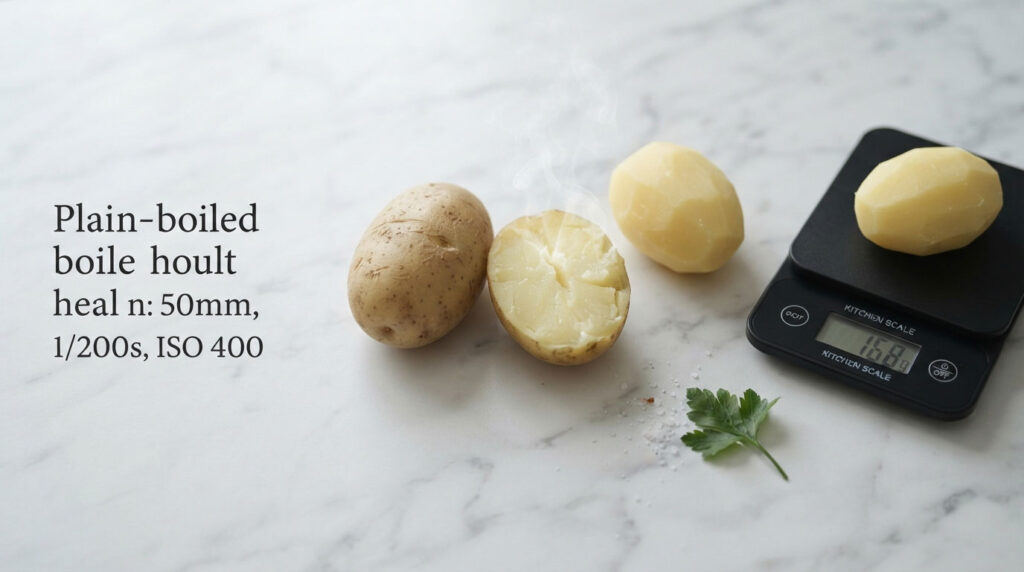
A medium peeled boiled potato (167 g) has 144 calories. Boiled in its skin, a 136 g potato has 118 calories. Per 100 grams, USDA lists peeled boiled potato at 86 calories and skin-on boiled potato at 87. Boiling adds almost nothing, since a plain boiled potato carries just 0.1 g of fat. The calories come from starch, not oil.
USDA FoodData Central keeps separate records for potatoes boiled with the skin on and potatoes peeled before boiling. Each tracking app pulls a different one. Then each assigns its own gram weight to the word “medium.”
Here is the full set, taken straight from the USDA source records, with the serving math already worked out for you.
At a Glance
- Peeled and boiled: 86 calories per 100 g. Boiled in the skin: 87 calories per 100 g. The difference is rounding, not real.
- A medium potato (167 g) runs 144 calories. A large one (300 g) runs 258.
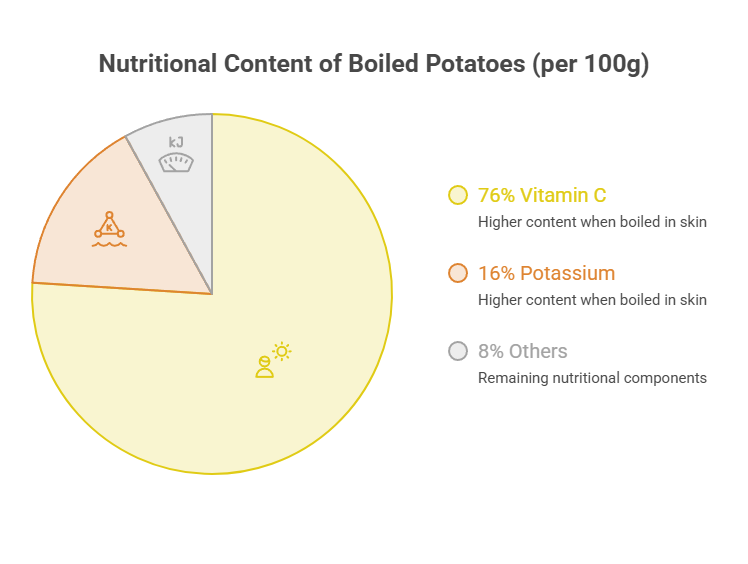
- Boiling in the skin holds roughly 76% more vitamin C and 16% more potassium than peeling first.
- Boiled potatoes scored 323% on the Satiety Index, the highest of 38 foods tested, against white bread at 100%.
- A 2025 Harvard analysis of 205,000 US adults tied french fries to higher type 2 diabetes risk but found no significant link for boiled, baked, or mashed.
- Chilling a cooked potato overnight raises resistant starch and flattens the blood sugar peak.
- Boiling produces no acrylamide, unlike frying, roasting, or baking.
Boiled Potato Calories by Serving Size
Per 100 Grams, Peeled and Unpeeled
USDA maintains two SR Legacy records that matter here, and knowing which is which solves most of the confusion online.
Entry 170440 covers potatoes boiled without skin, flesh only, no salt. It lists 86 calories per 100 grams.
Entry 170438 covers potatoes boiled in the skin, flesh eaten, no salt. That record comes in at 87 calories per 100 grams.
One calorie apart. Anyone telling you that peeling saves calories is guessing, and the USDA data says otherwise.
Small, Medium, and Large by USDA Gram Weight
USDA assigns specific gram weights to potato sizes, and those weights drive every calorie figure you will see quoted anywhere.
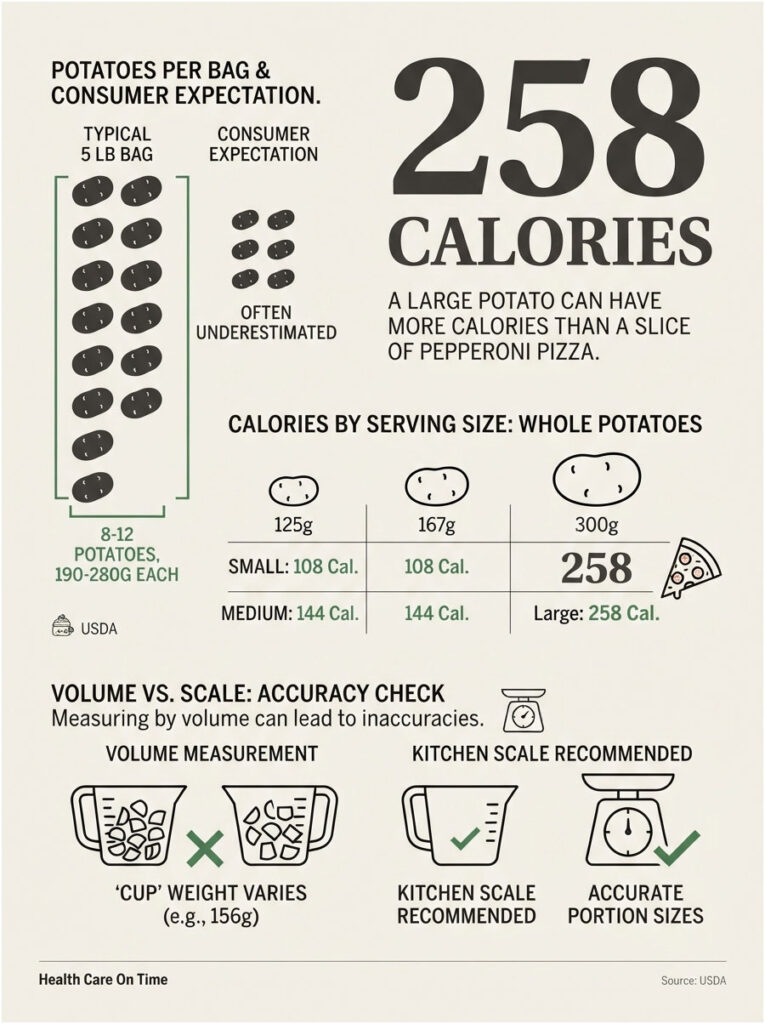
A small potato (1.75 to 2.5 inches across) is 125 g. A medium (2.25 to 3.25 inches) is 167 g. A large (3 to 4.25 inches) is 300 g.
Run those through the per-gram figure and the answers fall out cleanly. Small: 108 calories. Medium: 144. Large: 258.
That last number surprises people. A large russet the size of your fist carries more calories than a slice of pepperoni pizza.
Per Cup, Per Half Cup, and Per Ounce
For anyone measuring by volume, USDA puts a half cup of diced boiled potato at 78 g. That half cup delivers 67 calories, 15.6 g of carbohydrate, and 256 mg of potassium.
A full cup diced is 156 g, which works out to 134 calories. A single ounce is 28 g, or 24 calories.
Volume measures are convenient but imprecise. Diced small versus diced chunky can shift a “cup” by 20 g or more, which is the difference between 134 and 151 calories.
What a “Medium” Potato Actually Weighs in a US Grocery Bag
This is where tracking apps go sideways for most Americans.
A standard 5 lb bag of russets from Kroger, Safeway, Publix, or Walmart usually holds 8 to 12 potatoes. That averages 190 to 280 g each, which is a large potato by USDA definition, not a medium.
Readers who send food logs to our nutrition desk for review are almost always undercounting for exactly this reason. They tap “1 medium potato” while eating something closer to 250 g.
If you own a kitchen scale, use it. If you do not, assume the potato in your hand is one size category bigger than you think it is.
Table 1: Boiled Potato Calories and Nutrition by Serving Size (USDA FoodData Central)
| Serving Size | Weight | Calories (Peeled, FDC 170440) | Calories (In Skin, FDC 170438) | Carbs (Peeled) | Potassium (Peeled) |
| 1 oz | 28 g | 24 | 24 | 5.6 g | 92 mg |
| 1/2 cup, diced | 78 g | 67 | 68 | 15.6 g | 256 mg |
| 1 small (1.75 to 2.5 in) | 125 g | 108 | 109 | 25.0 g | 410 mg |
| 1 potato (2.5 in sphere) | 136 g | 117 | 118 | 27.2 g | 446 mg |
| 1 cup, diced | 156 g | 134 | 136 | 31.2 g | 512 mg |
| 1 medium (2.25 to 3.25 in) | 167 g | 144 | 145 | 33.4 g | 548 mg |
| 1 large (3 to 4.25 in) | 300 g | 258 | 261 | 60.0 g | 984 mg |
| 100 grams | 100 g | 86 | 87 | 20.0 g | 328 mg |
Source: USDA FoodData Central, SR Legacy entries 170440 and 170438. Values are for potatoes boiled without added salt or fat.
Why Every Calorie App Gives You a Different Number
Three USDA Entries, Three Different Answers
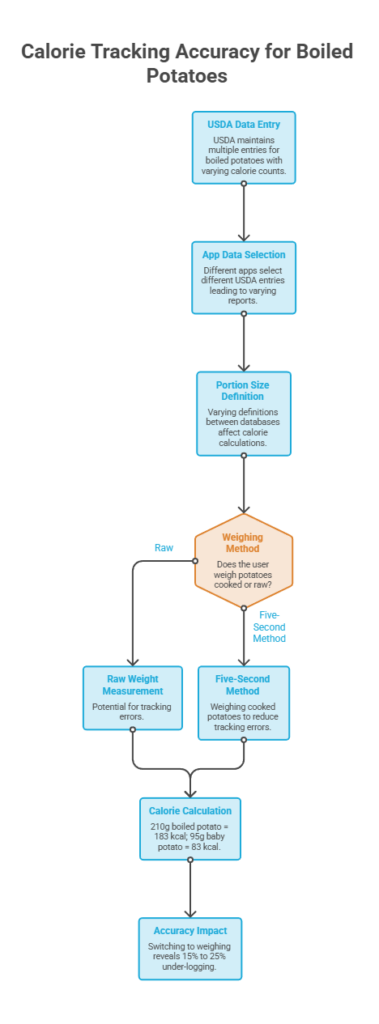
USDA does not maintain one boiled potato record. It maintains several, and each measures something slightly different.
There is the peeled flesh (170440). There is the skin-on flesh (170438). There is a separate record for the boiled skin by itself (170439).
Databases import whichever one their pipeline grabbed first, then never revisit the choice.
Eat This Much pulls the skin-on entry and reports 118 calories per potato. CalorieKing pulls the peeled entry at cup volume and reports 134 calories per cup. Both are accurate. They are simply answering different questions.
The Gram-Weight Trap
The larger source of disagreement is portion definition, not database choice.
FatSecret lists 211 calories for one medium boiled potato. That is not a math error on their end. Their “medium” is a heavier potato than USDA’s 167 g.
At 86 calories per 100 g, 211 calories implies a potato weighing roughly 245 g. Some databases use restaurant portion conventions. Others use average retail weight. A few use European reference sizes.
Patients who bring conflicting app screenshots to our nutrition team usually assume one source is lying. None of them is. They are measuring with different rulers.
How to Weigh a Boiled Potato Correctly
Skip the size labels entirely and weigh in grams. Then multiply.
Peeled and boiled: grams times 0.86. Boiled in the skin: grams times 0.87.
A 210 g potato boiled in its jacket is 183 calories. A 95 g baby potato is 83. No app required.
Weigh It Cooked, Not Raw
Raw potato sits at 77 calories per 100 g because its water distribution differs from cooked. Boiling nudges the per-gram figure up to 86 or 87.
If you weigh raw but log cooked, or the reverse, you will drift by 10% to 12%. Across a week of daily potatoes, that becomes a real gap in a calorie deficit.
Pick one point in the process and stay with it. Cooked is easier, because cooked is what actually reaches your plate.
The Five-Second Method
Put your plate on the scale, tare it, add the potato, note the grams, multiply by 0.86 or 0.87.
That single habit eliminates the biggest source of tracking error in this entire food category. In cases reviewed across our diagnostic network, people who switch to weighing typically discover they were under-logging starches by 15% to 25%.
Full Nutrition Profile of a Boiled Potato
Macronutrients
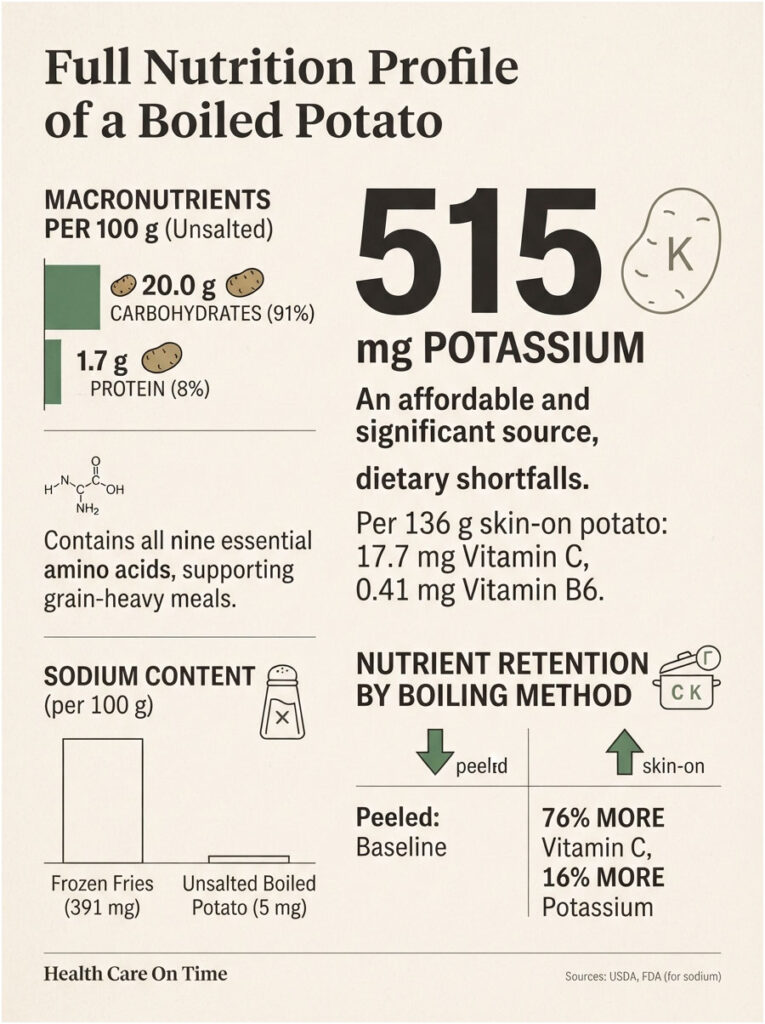
Per 100 g of peeled boiled potato, USDA lists 20.0 g of carbohydrate, 1.7 g of protein, 1.8 g of fiber, and 0.1 g of fat. Total sugars come in under 1 g.
The calorie split works out to roughly 91% carbohydrate, 8% protein, and 1% fat. That is about as close to a pure starch food as whole foods get.
Boiled in the skin, protein edges up to 1.87 g and fiber holds at 1.8 g per 100 g. A 136 g skin-on potato gives you 2.5 g of protein and 2.4 g of fiber.
Protein Quality, the Underrated Part
Potato protein is small in quantity but unusually good in quality. It contains all nine essential amino acids, with lysine and tryptophan present in useful proportions.
A medium boiled potato supplies about 39 mg of tryptophan and 155 mg of lysine when cooked in the skin. That will not build muscle on its own, though it does complement grain-heavy meals well, since grains run low in lysine.
Nobody should treat potatoes as a protein source. They are a better one than most people assume.
Potassium, Vitamin C, and Vitamin B6
Potatoes are quietly one of the better potassium sources in the American diet, and most people have no idea.
A 136 g potato boiled in its skin supplies 515 mg of potassium, 17.7 mg of vitamin C, and 0.41 mg of vitamin B6.
Against FDA Daily Values, that is 11% of potassium, 20% of vitamin C, and 24% of vitamin B6 from a 118-calorie food.
Scale up to a large 300 g peeled potato and you reach 980 mg of potassium (21% DV) and 22 mg of vitamin C (25% DV). Copper, manganese, magnesium, thiamin, and niacin all appear in meaningful amounts.
Potassium matters here beyond the percentage. Federal dietary guidance has flagged it as a shortfall nutrient for American adults for years, and potatoes are one of the few affordable, widely eaten foods that move the needle.
What Peeling Costs You Before the Water Even Boils
This is the point the calorie databases never surface, and it is the most useful thing on this page.
Compare the two USDA records per 100 g. Skin-on boiled potato holds 13.0 mg of vitamin C and 379 mg of potassium. Peeled-then-boiled holds 7.4 mg of vitamin C and 328 mg of potassium.
That is roughly 76% more vitamin C and 16% more potassium, gained by leaving the jacket on while it cooks. The skin acts as a barrier that slows water-soluble nutrients from leaching into the pot.
Vitamin B6 follows the same pattern, 0.30 mg against 0.27 mg per 100 g. Copper runs 0.19 mg against 0.17 mg. Protein, niacin, and magnesium all tilt the same direction.
Our medical reviewers put the practical version this way: you can peel after boiling if you dislike the texture. The protection happens during cooking, not at the table.
Sodium: 5 mg Unsalted, and What Salting Adds
An unsalted boiled potato carries about 5 mg of sodium per 100 g. Effectively nothing.
Oven-heated frozen french fries carry 391 mg of sodium per 100 g. That is roughly 78 times more, before anyone touches the shaker.
Salting your cooking water adds less than people assume, since most of it goes down the drain with the water. A generous finishing sprinkle at the table adds considerably more.
Why Boiling Beats Dry Heat on Acrylamide
Acrylamide forms when starchy foods are cooked above about 250°F through frying, roasting, baking, or air frying. FDA has tracked it in the US food supply for two decades because of concerns raised in animal studies.
Boiling does not produce acrylamide. Water caps the cooking temperature at 212°F, well below the threshold where the reaction begins.
That gives boiling a safety edge nobody puts in the calorie tables, and it applies to every potato, every variety, every time.
Boiled vs Baked vs Mashed vs Fried
Cooking Method Changes Calories More Than Variety Does
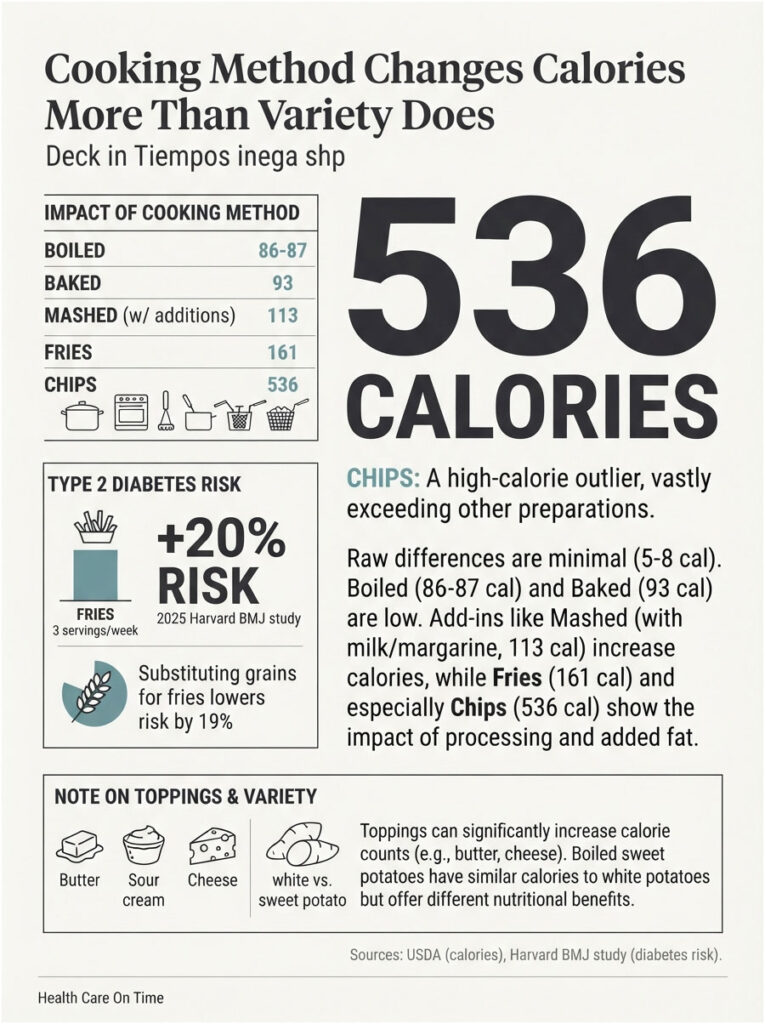
Russet, Yukon Gold, red, or fingerling: raw calorie differences between common US varieties run about 5 to 8 calories per 100 g. Trivial for practical purposes.
What you do to the potato is another matter entirely. Boiled sits at 86 to 87 calories per 100 g. Baked with the skin climbs to about 93, mostly because dry heat drives off water and concentrates what remains.
Mash it with whole milk and margarine and you land near 113. Oven-heated frozen fries reach 161. Potato chips hit 536.
The potato did not change. The oil, the dairy, and the moisture loss did.
What the 2025 Harvard BMJ Cohort Found
August 2025 brought the largest analysis yet on potatoes and metabolic risk, and it reshaped how dietitians talk about this food.
Researchers at the Harvard T.H. Chan School of Public Health tracked more than 205,000 US adults across the Nurses’ Health Study, Nurses’ Health Study II, and the Health Professionals Follow-Up Study, recording 22,299 new type 2 diabetes diagnoses over more than five million person-years.
Three servings of french fries per week were associated with a 20% higher risk of developing type 2 diabetes. Baked, boiled, and mashed potatoes showed no significant association with risk.
Eating baked, boiled, or mashed potatoes as often as seven times a week was linked to a slight 1% reduction in risk, not an increase.
Swapping whole grains in for baked, boiled, or mashed potatoes was estimated to lower risk by 4%. Swapping whole grains in for french fries lowered it by 19%.
The lead author summed it up plainly: not all potatoes are created equal. Our medical team has been making the same point to patients for years. Whole grains still edge out potatoes, but a boiled potato is not the villain it has been treated as for two decades. The fryer is.
This lines up with current federal guidance, which explicitly encourages swapping deep-fried cooking methods for baked, broiled, roasted, or boiled preparation.
What Toppings Actually Add
Run the arithmetic on a typical American potato and the picture sharpens fast.
A 200 g boiled potato is 173 calories. One tablespoon of butter adds 102. Two tablespoons of sour cream add 46. An ounce of shredded cheddar adds 114.
The potato contributed 173. The toppings contributed 262. Our lab partners see the downstream version of this in lipid panels, and it is rarely the starch driving those numbers.
How Boiled White Potato Compares to Sweet Potato
Boiled sweet potato runs about 76 to 90 calories per 100 g, close enough to white potato that calories should not decide between them.
Sweet potato wins decisively on vitamin A, delivering large amounts of beta-carotene that white potatoes lack entirely. White potato wins on potassium, vitamin C, and satiety.
Sweet potato also tests lower on the glycemic index when boiled, roughly 44 to 61 against 56 to 89 for white varieties. Eat both. The rivalry is marketing, not nutrition.
Table 2: Boiled Potato Research and US Consumption Data
| Finding | Figure | Population or Sample | Source |
| Satiety ranking of boiled potatoes | 323% of white bread, highest of 38 foods tested | 11 to 13 adults per food, 240-calorie portions | Holt et al., Eur J Clin Nutr, 1995 |
| T2D risk, 3 weekly servings of french fries | 20% higher risk | 205,000+ US adults, 22,299 cases | Mousavi et al., The BMJ, 2025 |
| T2D risk, boiled, baked, or mashed | No significant association | Same three US cohorts, 5+ million person-years | Mousavi et al., The BMJ, 2025 |
| Risk reduction, whole grains replacing fries | 19% lower | Same three US cohorts plus substitution meta-analysis | Mousavi et al., The BMJ, 2025 |
| Glycemic index, boiled red potato hot vs cold | 89 hot, 56 eaten cold | 12 adults, 50 g carbohydrate portions | Fernandes et al., J Am Diet Assoc, 2005 |
| Insulin response at 30 min, chilled vs fresh | 22.6% lower with chilled | 30 US women, mean BMI 32.8 | Patterson et al., Nutrients, 2019 |
| Resistant starch after cold storage | Rose from 3.3% to 5.2% of total starch | Controlled analysis plus healthy adults | Leeman et al., Eur J Clin Nutr, 2005 |
| US fresh potato availability per person | Fell from 46 lb to 28 lb per year | US population, 2002-04 vs 2022-24 | USDA Economic Research Service |
| Total US potato availability per person | 115 lb per year, about 58 lb frozen | US population, 2022-2024 average | USDA Economic Research Service |
USDA Economic Research Service data shows frozen potato products, mostly french fries, now account for about half of all potato availability in the United States at roughly 58 lb per person per year.
Fresh potatoes, the kind you would actually boil, dropped from 46 lb per person in 2002 to 2004 down to 28 lb in 2022 to 2024.
Americans did not stop eating potatoes. They stopped boiling them.
Boiled Potatoes and Weight Loss
The Satiety Index and the 323% Score
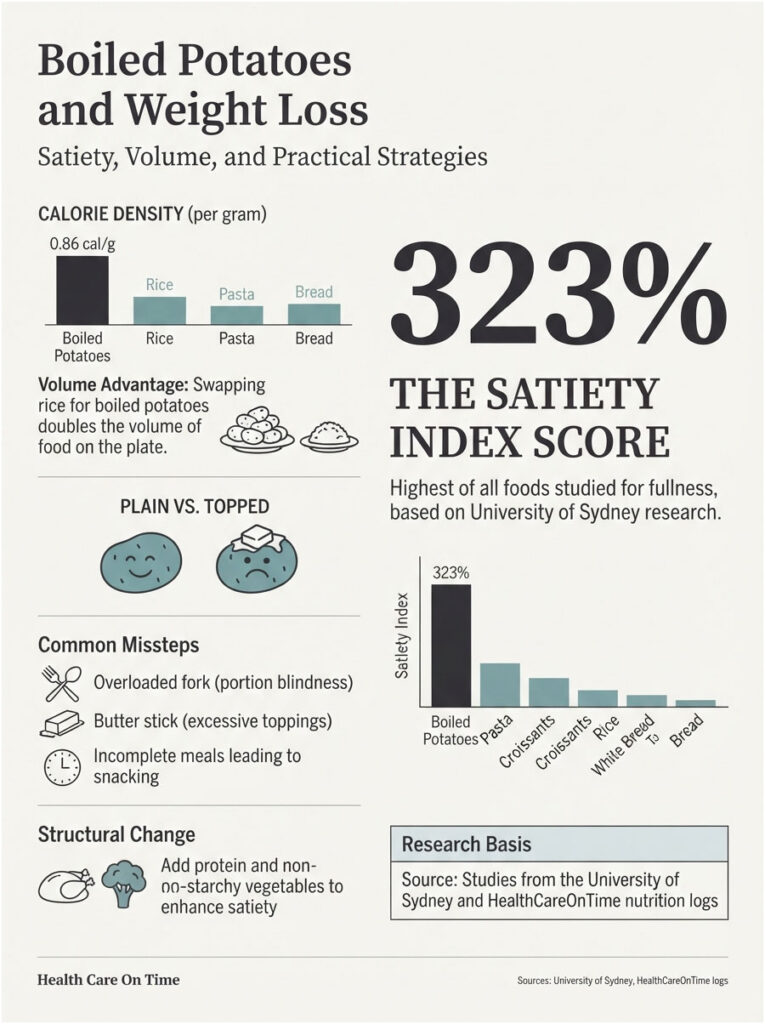
In 1995, researchers at the University of Sydney fed volunteers equal 240-calorie portions of 38 common foods, measured hunger every 15 minutes for two hours, then tracked what those people ate afterward. White bread was set at 100.
Boiled potatoes scored 323%, the highest result in the study, roughly seven times the croissant’s score of 47%. Nothing tested since has displaced them.
The strongest predictor of fullness in that study was not fiber or protein. It was the physical weight of the serving, followed by water content.
A 240-calorie portion of boiled potato is a large, heavy, plain pile of food. Your stomach registers volume, and volume is what boiled potatoes deliver per calorie better than almost anything else on a plate.
Calorie Density: 0.86 Calories Per Gram
At 0.86 calories per gram, boiled potato has one of the lowest calorie densities among common starches.
Cooked white rice runs about 1.3 calories per gram. Cooked pasta runs about 1.6. Bread runs closer to 2.6.
To match the calories in 200 g of boiled potato, you would eat only about 133 g of rice or 108 g of pasta. You get more food, more chewing, and more stomach stretch for the same calorie cost.
Boiled Potato vs Rice vs Pasta
Readers preparing for weight-management consults through HealthCareOnTime often assume potatoes are the first carbohydrate to cut. The data points the opposite direction.
Swapping a cup of cooked rice for an equal-calorie portion of boiled potato roughly doubles the volume on the plate. For anyone fighting hunger during a deficit, that trade is one of the simplest wins available.
The caveat is real. Potatoes are only filling when they stay plain. Mash them with cream, or drop them in a fryer, and the satiety advantage collapses immediately.
Where People Go Wrong
Three patterns show up repeatedly in the food logs sent to our nutrition desk.
First, portion blindness. A 300 g potato is not one serving; it is closer to two.
Second, the topping stack described above, which routinely outweighs the potato itself. Third, treating potatoes as the entire meal rather than one component, which leaves protein and vegetables short and triggers snacking two hours later.
Add a palm of protein and a fist of non-starchy vegetables to every potato you serve. That one structural change fixes most of it.
Blood Sugar, Glycemic Index, and the Cooling Effect
Glycemic Index Swings by Variety and Temperature
Potatoes have one of the widest glycemic index ranges of any single food, and the spread is driven by variety and preparation far more than anything else.
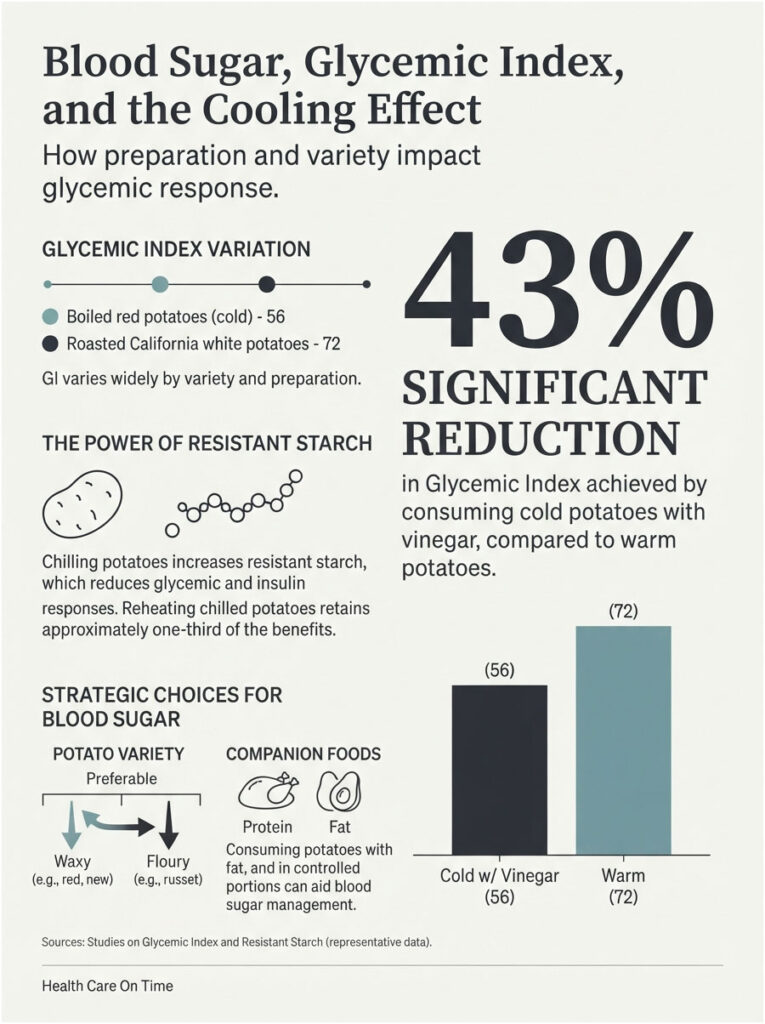
A 2005 study in the Journal of the American Dietetic Association tested six North American varieties across two cooking methods. Values ran from 56 for boiled red potatoes eaten cold, up to 72 for roasted California white, 77 for baked US russet, 88 for instant mashed, and 89 for boiled red potatoes eaten hot.
Tufts Health and Nutrition Letter places boiled and roasted potatoes at the low end (both around 59), baked at 69, mashed at 78, and instant at 82.
Waxy varieties such as red, new, and fingerling test consistently lower than floury russets. Same tuber family, same calories, very different glucose curve.
Resistant Starch and What Chilling Really Does
Cook a potato and its starch granules gelatinize, which makes them easy for your digestive enzymes to break apart. Chill the cooked potato and some of that starch recrystallizes into a form your small intestine cannot digest. Nutrition scientists call it retrograded, or type 3, resistant starch.
Swedish researchers measured this directly. Cold storage of boiled potatoes raised resistant starch from 3.3% to 5.2% of total starch, and cold potatoes served with vinegar cut the glycemic index by 43% and the insulin index by 31% compared with freshly boiled.
A 2019 randomized crossover trial at Texas Woman’s University tested 30 women with elevated fasting glucose and a mean BMI of 32.8. Chilled potato produced significantly lower glucose at 15 and 30 minutes (4.8% and 9.2%), lower insulin (25.8% and 22.6%), and lower GIP (41.1% and 37.6%) than the freshly boiled version.
Reheating keeps roughly a third of the extra resistant starch formed during chilling, so ordinary meal prep captures a real share of the benefit.
What Chilling Does Not Do
Chilling does not reduce calories. Resistant starch yields slightly less energy per gram than digestible starch, though the shift is small enough that USDA does not adjust its entries.
It also did not change total glucose absorbed over three hours in that Texas trial. The early spike flattened; the three-hour total held steady.
Treat cooling as a way to blunt the peak, not as a way to make potatoes calorie-free. Anyone selling cold potatoes as a weight-loss hack is overstating a real but modest effect.
A Practical Blood Sugar Playbook
Choose waxy over floury. Red potatoes, new potatoes, and fingerlings behave better than russets.
Boil rather than bake or mash. Cook them the night before and refrigerate. Reheat gently, or eat them cold in a vinaigrette-dressed salad.
Pair them with protein and fat, hold the portion to a half cup or one cup, and build the plate as a meal rather than a starch pile.
Patients booking HbA1c and fasting glucose panels through HealthCareOnTime who adopt these four changes often see post-meal readings settle without giving up potatoes at all.
Who Should Watch Their Boiled Potato Intake
Chronic Kidney Disease and Potassium Limits
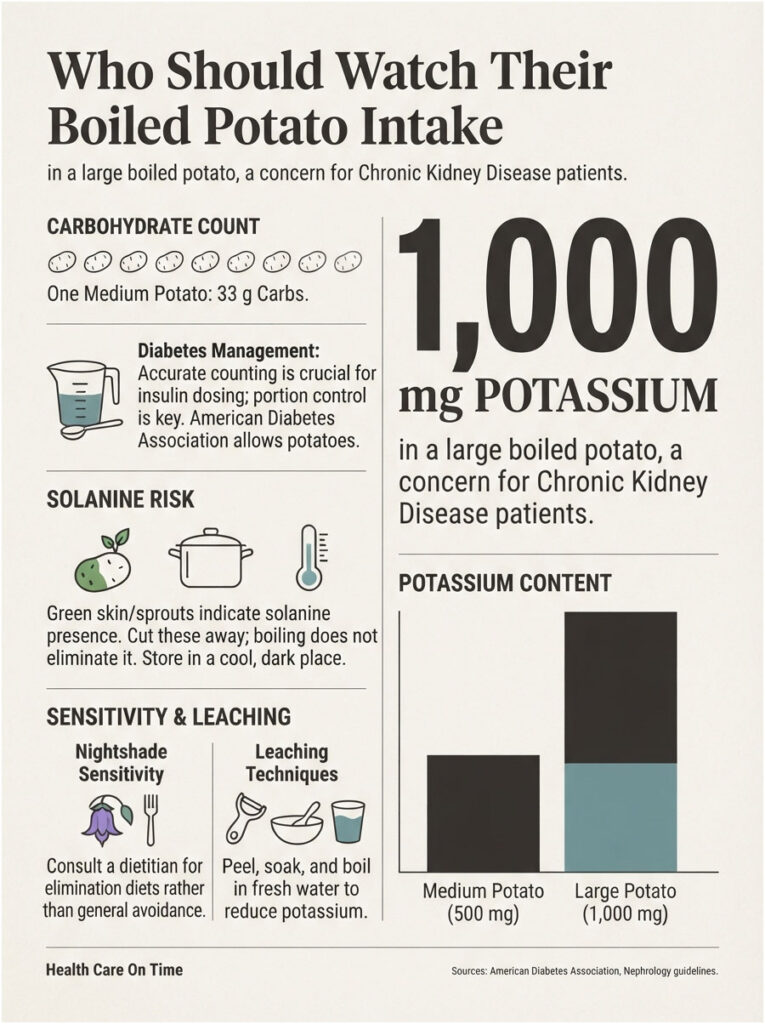
The same potassium that makes potatoes valuable for most people makes them a problem for some. A large boiled potato carries close to 1,000 mg.
If you have stage 3 to 5 chronic kidney disease, or take a potassium-sparing diuretic, ACE inhibitor, or ARB, your care team may cap daily potassium intake. In cases reviewed across our diagnostic network, potatoes rank among the top three contributors when a potassium result comes back elevated.
Leaching helps. Peel, dice small, soak in warm water, then boil in a large volume of fresh water and discard it. This removes a meaningful share of the potassium, and it takes vitamin C along with it.
Talk to your nephrologist or renal dietitian before changing anything. Potassium restriction is individualized, and general advice can do harm here.
Diabetes and Carbohydrate Counting
One medium boiled potato is roughly 33 g of carbohydrate, about two carbohydrate servings under standard exchange counting. A large potato approaches 60 g.
That is not a reason to avoid them. It is a reason to count them accurately, particularly if you dose mealtime insulin.
The American Diabetes Association does not put potatoes on a forbidden list. Portion size and preparation carry the weight.
Green Skin, Sprouts, and Solanine
Potatoes exposed to light develop chlorophyll, which produces the green tint, alongside glycoalkaloids such as solanine. At high enough doses these can cause nausea, cramping, and headache.
Cut away green patches and sprouts generously before cooking. Boiling does not destroy solanine.
If a cooked potato tastes bitter or burns the back of your throat, stop eating it. Store potatoes in a cool, dark, dry place.
Nightshade Sensitivity
A small number of people report joint or digestive symptoms after eating nightshade vegetables, a family that includes potatoes, tomatoes, peppers, and eggplant.
Controlled evidence for a general nightshade problem is thin. Individual sensitivity is still possible.
If you suspect it, run a structured elimination and reintroduction with a registered dietitian rather than cutting an entire vegetable family on a hunch.
How to Boil Potatoes for the Best Nutrition Return
Boil Whole and in the Skin
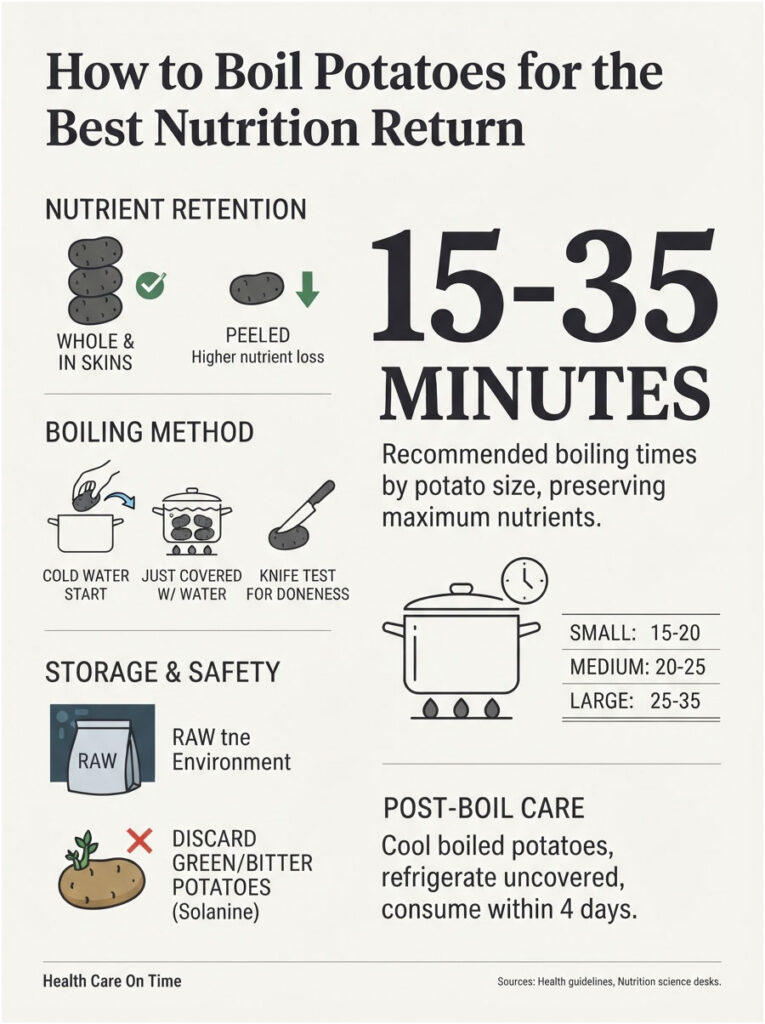
Every cut you make before cooking creates another surface for vitamin C and potassium to escape into the water. Whole potatoes in their skins lose the least.
Scrub them well under running water with a stiff brush. Start them in cold water so the outside does not overcook before the center softens.
If you want them peeled, peel after they cool enough to handle. You keep the nutrients and still get the texture you wanted.
Water Volume, Salt, and Timing
Use just enough water to cover. More water means more leaching surface, not better cooking.
A small potato takes 15 to 20 minutes at a gentle boil once the water reaches temperature. A medium takes 20 to 25. A large takes 25 to 35.
Test with a paring knife rather than watching the clock. The blade should slide in with almost no resistance.
Salt the water lightly if you like; most of it stays behind. Save the finishing salt for the plate where you can actually taste it.
Cook, Chill, Then Reheat
Boil on Sunday. Cool on the counter for 30 minutes, then refrigerate uncovered for an hour before sealing, so condensation does not turn them soggy.
Hold them up to four days. Reheat in a covered pan with a splash of water, or eat them cold in a salad with olive oil, mustard, and vinegar.
You get the resistant starch benefit, faster weeknight meals, and a potato that has already done the hard part.
Storage Before You Cook
Keep raw potatoes in a paper bag in a cool, dark, ventilated spot. Around 45°F to 55°F is close to ideal.
Do not refrigerate raw potatoes you plan to fry or roast later, since cold storage converts starch to sugar and increases acrylamide formation during high-heat cooking. Boiling is unaffected by this.
Keep potatoes away from onions. Onions release gases that speed up sprouting.
Table 3: Boiled Potato Action Guide by Situation
| Your Situation | Recommended Action | Why It Works |
| Tracking calories and macros | Weigh cooked in grams; multiply by 0.86 peeled or 0.87 skin-on | Removes the size-label guesswork causing 15% to 25% logging errors |
| Trying to lose weight | Boil whole in the skin, portion 150 to 200 g, cap added fat at 1 tsp | Highest satiety score of 38 foods tested, at 0.86 calories per gram |
| Managing type 2 diabetes | Choose red or new potatoes, boil, chill overnight, pair with protein | Chilled boiled red potato tested at GI 56 versus 89 served hot |
| On a potassium restriction | Peel, dice small, boil in a large volume of fresh water, discard it, limit to 1/2 cup | A large potato carries close to 1,000 mg of potassium |
| Eating out | Ask for boiled, steamed, or baked instead of fries | Oven-heated fries run 161 calories and 391 mg sodium per 100 g |
| Meal-prepping the week | Boil Sunday, refrigerate up to 4 days, reheat gently | Reheating retains roughly a third of the resistant starch formed by chilling |
| Feeding kids and teens | Serve skin-on with a protein source, skip the deep fryer | Skin-on boiling holds about 76% more vitamin C than peeling first |
| Seeing green skin or sprouts | Cut away generously; discard any potato that tastes bitter | Boiling does not break down solanine |
How Boiled Potatoes Fit Your Weekly Plate
USDA MyPlate counts potatoes in the vegetable group, specifically the starchy vegetable subgroup alongside corn, green peas, and plantains. One cup of boiled diced potato counts as one cup-equivalent.
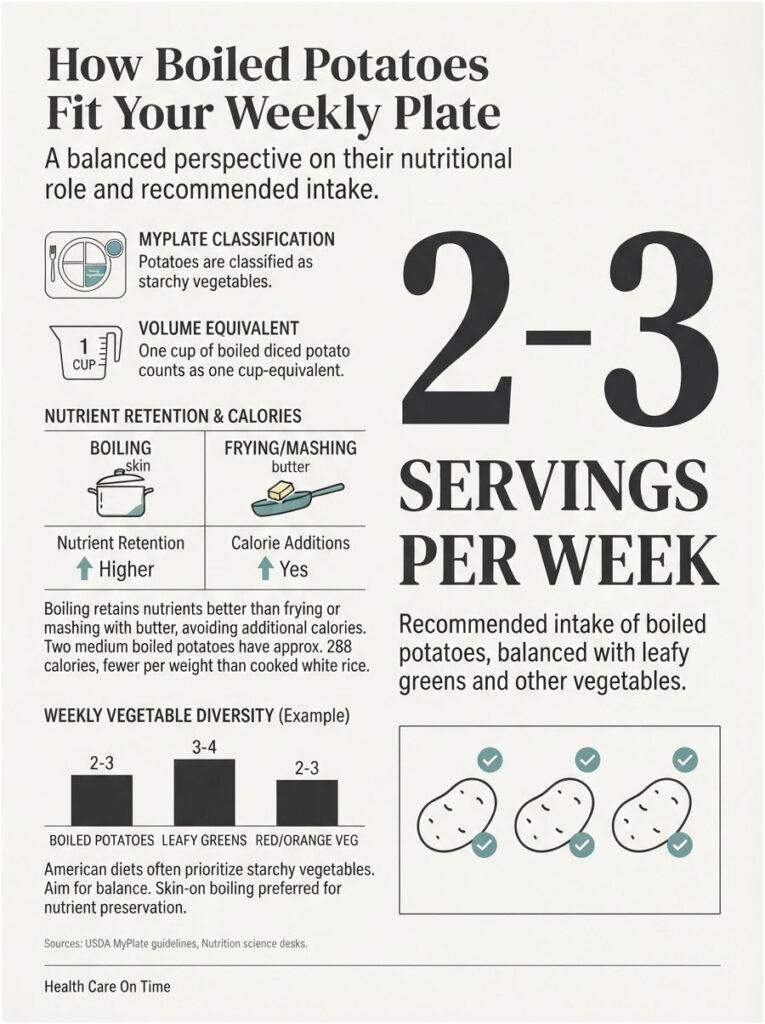
Federal guidance sorts vegetables into five subgroups and encourages spreading intake across all of them each week rather than filling the quota from one. Starchy vegetables have a weekly target of their own, and potatoes fill it easily.
The problem in American diets is not that potatoes exist. It is that starchy vegetables crowd out the dark green and red-orange subgroups, and that most potato intake arrives fried.
A simple weekly pattern works: two or three boiled potato servings, kept plain, sitting next to leafy greens and a red or orange vegetable on the same plate. That satisfies the starchy subgroup without displacing the others.
Frequently Asked Questions
How many calories are in 2 boiled potatoes?
Two medium peeled boiled potatoes (334 g total) come to about 288 calories. Two boiled in their skins at 136 g each land near 236 calories. Two large 300 g potatoes reach 516 calories. Weigh them when you can, since retail potatoes usually run heavier than the USDA medium.
Does boiling a potato reduce its calories?
No. Boiling shifts water content slightly, moving a potato from 77 calories per 100 g raw to 86 or 87 cooked, but it adds no fat and removes no energy. What boiling avoids is the 60 to 450 extra calories per 100 g that frying, mashing with butter, or chip-making would add.
Are boiled potatoes better than baked for weight loss?
Slightly, on two counts. Boiled runs 86 to 87 calories per 100 g against about 93 for baked, and boiling produces a lower glycemic response than dry heat. The gap is small. Portion size and toppings matter far more than which of these two methods you pick.
How many calories are in a boiled potato with butter?
One tablespoon of butter adds about 102 calories and 11.5 g of fat. A 167 g medium boiled potato at 144 calories becomes 246 with one tablespoon, and 348 with two. Butter can nearly triple the calorie load, which is why the tracking error is usually the topping rather than the tuber.
Do boiled potatoes have more calories than white rice?
Fewer, by weight. Boiled potato is about 0.86 calories per gram; cooked white rice is about 1.3. A cup of boiled diced potato (156 g) is 134 calories, while a cup of cooked white rice is closer to 205. Potatoes also deliver more potassium and vitamin C.
Should I peel potatoes before boiling them?
Boil them in the skin, then peel afterward if you prefer. USDA data shows skin-on boiling retains about 76% more vitamin C and 16% more potassium per 100 g than peeling first, because the skin slows leaching into the water. Calories are essentially identical either way, at 86 versus 87 per 100 g.
Can I eat boiled potatoes every day?
For most healthy adults, yes. The 2025 BMJ analysis of 205,000 US adults found no significant increase in type 2 diabetes risk from baked, boiled, or mashed potatoes even at seven servings per week. Vary your starches, watch portions, and speak with your doctor first if you have kidney disease.
Do cold boiled potatoes have fewer calories?
Not meaningfully. Chilling converts some starch into resistant starch, which yields slightly less energy, but USDA lists no separate calorie value for cold potatoes. The real benefit is glycemic: chilled boiled red potato tested at GI 56 against 89 for the same potato eaten hot.
How many carbs are in one medium boiled potato?
A 167 g medium peeled boiled potato has about 33 g of total carbohydrate, including roughly 3 g of fiber, leaving about 30 g of net carbs. A large 300 g potato reaches 60 g total. Under standard diabetes exchange counting, a medium potato equals about two carbohydrate servings.
Is a boiled potato a vegetable or a starch on MyPlate?
Both. USDA MyPlate counts potatoes in the vegetable group, specifically the starchy vegetable subgroup with corn, peas, and plantains. One cup of boiled diced potato counts as one cup-equivalent. Federal guidance encourages spreading intake across all five vegetable subgroups rather than filling the quota with starchy vegetables alone.
Why does my fitness app show a different calorie count?
Because USDA maintains separate records for peeled boiled potato (86 calories per 100 g) and skin-on boiled potato (87), and each app assigns its own gram weight to small, medium, and large. That is how one site reports 118 calories per potato while another reports 211. Log by weight in grams to sidestep the problem.
Do boiled potatoes spike blood sugar in people with diabetes?
They can, though less than instant mashed or baked russets. Boiled waxy varieties eaten chilled tested at GI 56, while hot boiled red potatoes reached 89. Pairing with protein, keeping portions to a half cup, and cooking a day ahead all blunt the response. Check your own post-meal readings, since individual responses vary widely.
Medical Disclaimer
This article is for general information only and does not replace advice from a licensed physician, registered dietitian, or other qualified healthcare professional. Nutrition needs differ by age, medication use, kidney function, and existing conditions. If you have diabetes, chronic kidney disease, or take potassium-affecting medication, talk with your care team before changing your diet. Never disregard professional medical advice because of something you read here.
References
- USDA FoodData Central, Potatoes, boiled, cooked without skin, flesh, without salt (FDC 170440)
- USDA FoodData Central, Potatoes, boiled, cooked in skin, flesh, without salt (FDC 170438)
- USDA FoodData Central, Potatoes, french fried, frozen, oven-heated (FDC 170437)
- Mousavi SM, Gu X, Imamura F, et al. Total and specific potato intake and risk of type 2 diabetes. The BMJ. 2025;390:e082121
- Harvard T.H. Chan School of Public Health, Potatoes may increase risk of type 2 diabetes depending on their preparation
- Holt SHA, Brand Miller JC, Petocz P, Farmakalidis E. A satiety index of common foods. Eur J Clin Nutr. 1995;49(9):675-690
- Fernandes G, Velangi A, Wolever TMS. Glycemic index of potatoes commonly consumed in North America. J Am Diet Assoc. 2005;105(4):557-562
- Patterson MA, Fong JN, Maiya M, et al. Chilled potatoes decrease postprandial glucose, insulin, and GIP. Nutrients. 2019;11(9):2066
- Leeman M, Ostman E, Bjorck I. Vinegar dressing and cold storage of potatoes lowers postprandial glycaemic and insulinaemic responses. Eur J Clin Nutr. 2005
- USDA Economic Research Service, From fresh to frozen: Potato per capita availability changes over time
- USDA Economic Research Service, Vegetables and Pulses Outlook
- Tufts Health & Nutrition Letter, What potatoes have the highest glycemic index?