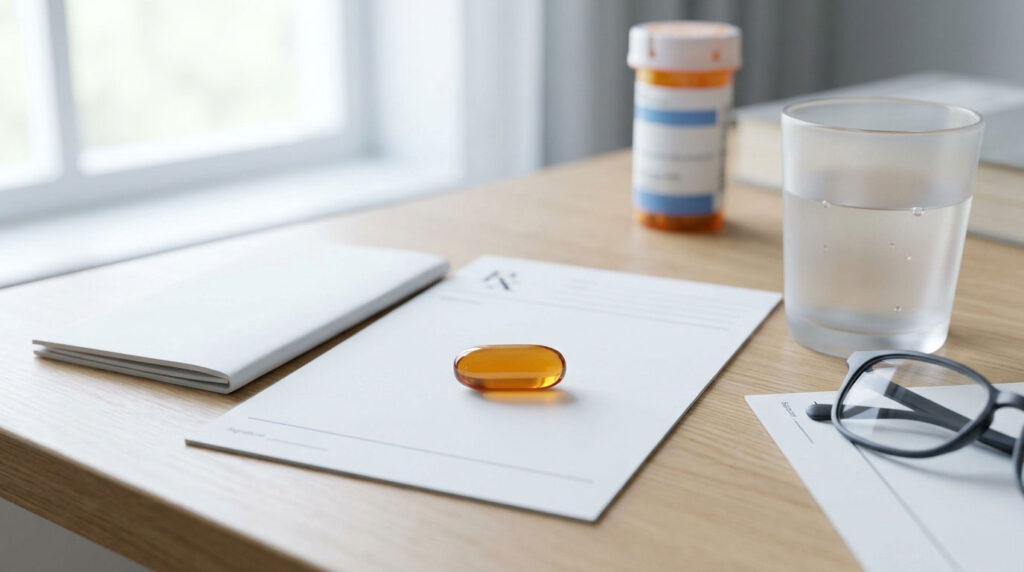
That small, jelly-bean-shaped cough capsule in your medicine cabinet has more in common with the numbing gel at a dentist’s office than with the cough syrup sitting beside it. Benzonatate quiets a cough by quietly anesthetizing your lungs, and that single fact explains almost every rule, warning, and drug interaction attached to it.
Quick Answer: Benzonatate is a non-narcotic prescription cough suppressant (brand names Tessalon, Tessalon Perles, and Zonatuss) used to relieve dry coughing from colds, flu, and bronchitis. It works by numbing stretch receptors in the lungs and airways. It pairs safely with most medicines but calls for caution alongside other sedatives, alcohol, and local anesthetics.
At a Glance
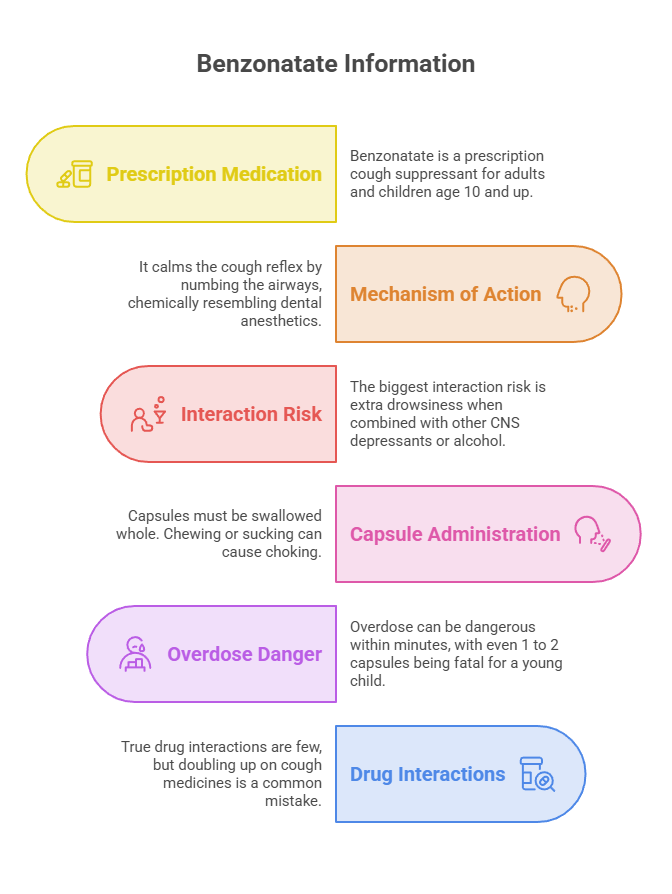
- Benzonatate is a prescription, non-opioid cough suppressant for adults and children age 10 and up.
- It calms the cough reflex by numbing the airways; chemically it resembles dental anesthetics, not narcotics.
- Its biggest interaction risk is extra drowsiness when combined with other CNS depressants or alcohol.
- Capsules must be swallowed whole. Chewing or sucking one can numb your throat and cause choking.
- Overdose can turn dangerous within minutes. Even 1 to 2 capsules can be fatal for a young child.
- True drug interactions are few, but doubling up on cough medicines is a common, avoidable mistake.
What Is Benzonatate?
What It Is and What It Treats
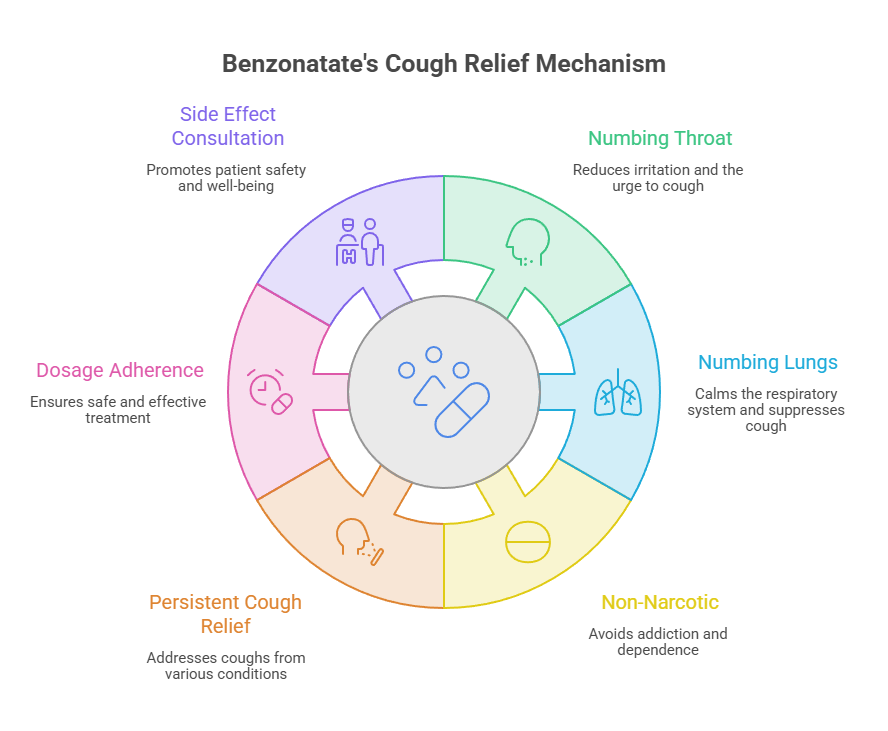
Benzonatate is a prescription medicine that calms a cough. It belongs to a class of drugs called antitussives, the clinical term for cough suppressants. Unlike many cough remedies, it is neither a steroid nor a narcotic.
The U.S. Food and Drug Administration first approved benzonatate in 1958, making it one of the older prescription cough drugs still in everyday use. It is sold under the brand names Tessalon and Zonatuss, alongside lower-cost generics that share the same active ingredient.
According to the Cleveland Clinic, benzonatate calms your cough reflex and can keep you from coughing for several hours after a single dose. Doctors typically reach for it when a dry, nagging cough is interfering with sleep, work, or recovery from a respiratory bug.
Patients filling cough prescriptions through our network often ask whether this is just a stronger version of the cough syrup on the pharmacy shelf. It is not. Benzonatate is prescription-only and works in a fundamentally different way from over-the-counter syrups.
How Benzonatate Works (Numbing the Cough Reflex)
Here is where benzonatate gets genuinely interesting. It is chemically related to local anesthetics in the para-aminobenzoic acid family, the same group that includes procaine and tetracaine, the numbing agents used in dental and minor surgical work.
When you swallow a capsule, the medicine acts directly on the stretch receptors in your lungs, your breathing passages, and the lining around them (the pleura). It numbs those receptors so they stop firing off the “time to cough” signal toward your brain.
Benzonatate appears to work on a second front too, dampening the cough reflex at the level of the brainstem, where cough signals get relayed to the nerves that drive coughing. The combined effect is fewer cough urges, usually beginning within 15 to 20 minutes and lasting roughly 3 to 8 hours.
This makes benzonatate what doctors call a peripherally acting antitussive, since it works mainly out in the airways rather than only inside the brain. That sets it apart from centrally acting suppressants like dextromethorphan and codeine, and it is one reason benzonatate tends to cause less of the heavy sedation linked to opioid cough drugs.
One detail carries enormous weight here. Because the drug is a numbing agent, it has to reach your lungs by way of your stomach, not your mouth. That single requirement is why the capsule rules covered below are stricter than most people expect.
Is Benzonatate a Narcotic or Controlled Substance?
This is one of the most common worries our medical reviewers field, so let’s settle it cleanly. Benzonatate is not a narcotic, not an opioid, and not a federally controlled substance. It will not get you high and carries little to no abuse potential at normal doses.
That distinction is part of why prescribers like it. As doctors moved away from codeine- and hydrocodone-based cough medicines, benzonatate became a favored non-narcotic alternative without the dependence risk that comes with opioid cough syrups.
Still, “non-narcotic” does not mean “harmless.” Benzonatate carries its own set of safety rules, a theme worth holding in mind through the rest of this guide.
What Benzonatate Is Used For (and What It’s Not For)
Approved Uses
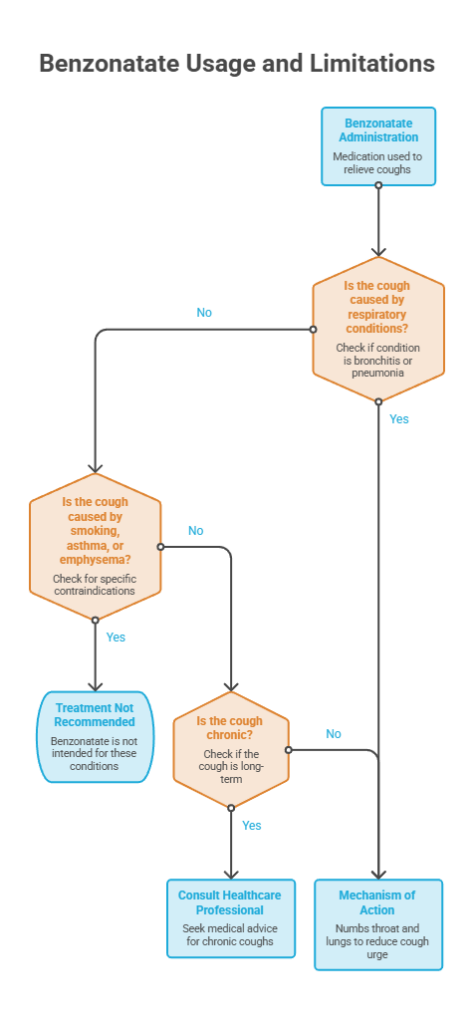
Benzonatate is approved for the symptomatic relief of cough, especially the dry, hacking kind that rides along with common respiratory illness. The Mayo Clinic lists colds and influenza as the usual triggers.
In real-world prescribing, doctors also use it for coughs tied to bronchitis and certain other respiratory conditions. It performs best on an irritating, unproductive cough that simply will not settle down on its own.
The appeal is straightforward. Benzonatate can quiet a cough without the sedation, constipation, and dependence that often accompany opioid cough syrups. For many adults, that tradeoff is the entire reason it lands on their prescription.
When Benzonatate Is the Wrong Choice
Benzonatate is not a fit for every cough. Mayo Clinic notes it should not be used for a chronic cough linked to smoking, asthma, or emphysema, or when a cough is bringing up large amounts of mucus or phlegm.
The reasoning is sound. If your body is busy clearing mucus, suppressing that cough can trap material in your lungs and slow your recovery. A wet, productive cough usually calls for an expectorant that loosens mucus, not a suppressant that silences it.
A stubborn cough can also be a messenger. If yours lasts beyond about 7 days, or shows up with a high fever, skin rash, or a lingering headache, treat that as a cue to call your doctor rather than reach for another dose. Those signs can point to a problem that needs evaluation.
How to Take Benzonatate Safely (the Swallow-Whole Rule)
Benzonatate comes as a soft, liquid-filled capsule, usually in 100 mg, 150 mg, or 200 mg strengths. For adults and children 10 and older, the typical dose is one 100 mg capsule three times a day as needed, up to a maximum of 600 mg in a single day.
The most important instruction is also the simplest: swallow the capsule whole. Do not chew it, suck on it, crush it, or let it dissolve in your mouth.
Why the firmness on this? Because the medicine is an anesthetic, releasing it inside your mouth can numb your tongue, throat, and the back of your airway. Our medical team’s guidance to readers is blunt, that numbness can set off choking, a closed-off airway, and a serious reaction within minutes.
If you miss a dose, take it when you remember unless your next dose is close. In that case, skip the missed one and carry on with your schedule. Never take a double dose to make up for a missed one, since stacking doses is exactly how benzonatate becomes dangerous.
The table below shows how benzonatate stacks up against the other cough options Americans reach for most often.
| Medication | Type | How It Works | Best For | Prescription? | Key Risk |
| Benzonatate | Non-narcotic antitussive | Numbs stretch receptors in the lungs | Dry cough from cold or flu | Yes | Overdose toxicity; choking if chewed |
| Dextromethorphan (DXM) | Non-narcotic antitussive | Acts on the brain’s cough center | Dry cough, OTC use | No (OTC) | Misuse at high doses; serotonin effects |
| Codeine | Opioid antitussive | Suppresses brain cough center | Short-term severe cough | Yes (controlled) | Addiction, heavy sedation, breathing risk |
| Guaifenesin | Expectorant (not a suppressant) | Thins and loosens mucus | Wet, productive cough | No (OTC) | Mild; nausea at high doses |
| Honey (non-drug) | Natural soother | Coats and soothes the throat | Mild cough, ages 1 and up | No | Never give to infants under age 1 |
Is Benzonatate Safe With Other Drugs?
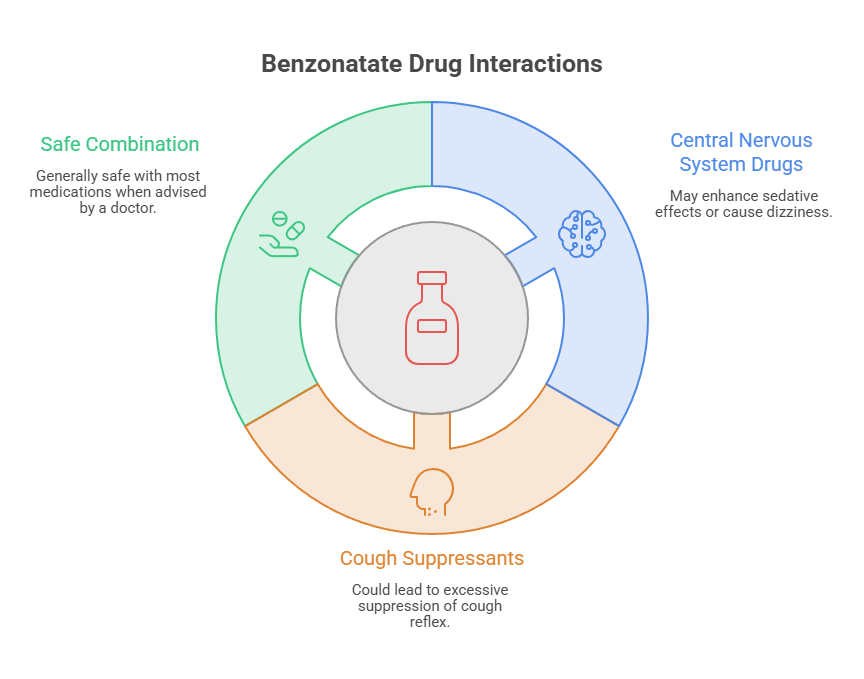
Here is the reassuring headline: benzonatate has relatively few known drug interactions compared with many medications. It does not heavily tangle with the liver’s drug-processing pathways the way some notorious drugs do.
The real concern is not chemical interference. It is overlap. Benzonatate can cause drowsiness and dizziness, so the danger surfaces when you layer it on top of other things that do the same.
Why Interactions Happen
Two mechanisms drive nearly every benzonatate interaction. The first is additive central nervous system (CNS) depression, where two sedating substances combine to slow your brain and breathing more than either one would alone.
The second is its anesthetic chemistry. Because benzonatate is a relative of numbing agents, combining it with other local anesthetics can theoretically pile on numbness or raise toxicity. Both pathways are manageable once you know what to watch for, which is what the next sections lay out.
CNS Depressants to Watch
This is the big one. Combining benzonatate with other CNS depressants can stack up drowsiness, dizziness, foggy thinking, and in serious cases, slowed breathing. According to GoodRx, the categories to be careful with cover several everyday medicines.
Opioid pain medicines sit at the top of the list, along with benzodiazepines such as alprazolam (Xanax), diazepam (Valium), and lorazepam (Ativan). Other anti-anxiety drugs like buspirone (Buspar) and hydroxyzine (Vistaril) can add to the drowsiness as well.
The same caution applies to sleep aids, muscle relaxers, barbiturates, anti-seizure medicines, and sedating antihistamines like diphenhydramine. None of these are flat-out forbidden with benzonatate, but each one is a reason to talk with your prescriber about timing and dose before you combine them.
Other Cough and Cold Medicines
This is the trap our medical reviewers see catch people most often, especially during cold and flu season. Many over-the-counter cold products already contain a cough suppressant, so doubling up is easy to do without realizing it.
The classic culprit is dextromethorphan, the active suppressant in many DayQuil, NyQuil, and Robitussin DM products. Benzonatate and dextromethorphan calm a cough through different mechanisms, but stacking two suppressants invites the same overlapping side effects.
A moderate interaction is flagged between benzonatate and multi-symptom products like NyQuil, partly because those formulas often add sedating antihistamines and sometimes alcohol on top. The safe rule is simple: take only one cough suppressant at a time unless your prescriber says otherwise.
Plain guaifenesin, the expectorant in regular Mucinex, generally pairs fine with benzonatate because it loosens mucus rather than sedating you. Acetaminophen (Tylenol) taken for fever is also usually compatible.
A quick habit protects you here. Before taking anything alongside benzonatate, flip the box over and read the Drug Facts panel for the active ingredients. If you spot dextromethorphan, a sedating antihistamine, or alcohol on that list, treat the product as one to clear with your pharmacist before you combine it.
Alcohol and Benzonatate
Alcohol is itself a central nervous system depressant, so mixing it with benzonatate can deepen drowsiness and dizziness and blunt your coordination. Driving or operating machinery after that combination is a real hazard, not a theoretical one.
There is a second reason to set drinks aside while you recover. If your cough stems from an infection, your immune system needs to run at full strength, and alcohol works against that. Our medical team’s advice to patients is to skip alcohol until the illness clears.
Local Anesthetics and the Allergy Contraindication
Because benzonatate is chemically related to numbing agents, anyone allergic to local anesthetics like tetracaine, procaine, or lidocaine should not take it. A known allergy to those agents is a clear signal to choose a different cough medicine entirely.
Combining benzonatate with other anesthetics, even topical ones, can in theory add up the numbing effect or increase toxicity. If you have a procedure coming up that involves local anesthesia, mention your benzonatate use to the provider ahead of time.
Heart-Rhythm Considerations
This one is uncommon but worth knowing. Benzonatate has sodium-channel-blocking properties, and in rare cases it has been linked to heart-rhythm disturbances, particularly during overdose. Combining it with drugs that affect cardiac conduction or prolong the QT interval may add to that risk.
For most people on normal doses, this is not a daily concern. It matters most for those taking antiarrhythmic medicines or living with an existing heart-rhythm condition, who should clear the combination with their cardiologist first.
The quick-reference table below sums up the scenarios that come up most in real life.
| If You Take / Your Situation | Risk Level | Recommended Action |
| Opioids, benzodiazepines, or sleep aids | High | Avoid combining; ask your doctor about timing or alternatives |
| Alcohol | Moderate to high | Skip alcohol entirely while taking benzonatate |
| Another cough suppressant (NyQuil, DXM) | Moderate | Use only one cough suppressant at a time |
| Allergy to numbing agents (lidocaine, procaine) | High | Do not take benzonatate; tell your prescriber |
| Most blood-pressure medicines | Low | Generally fine; mention sedating beta-blockers to your pharmacist |
The Real Risk: Overdose and Why Dosing Matters
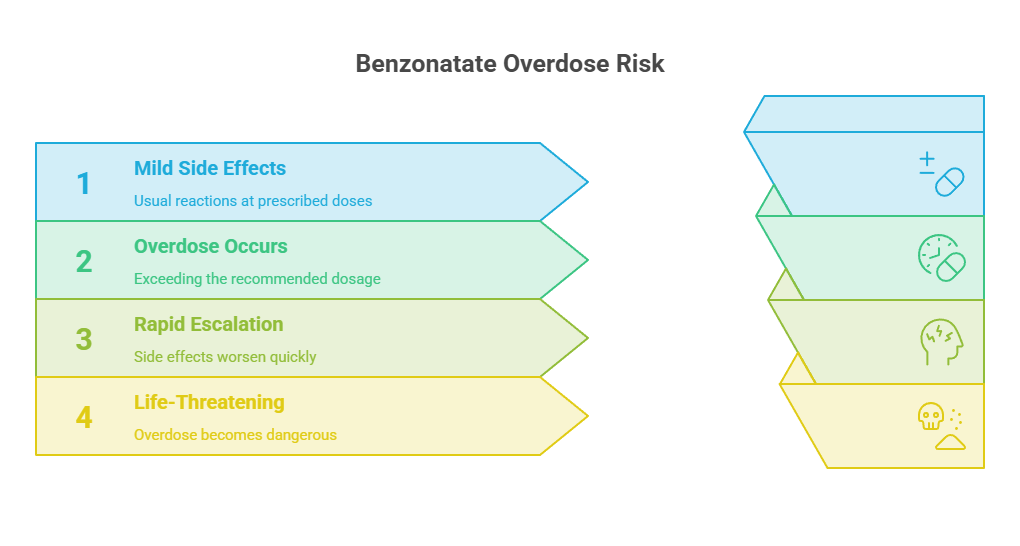
If benzonatate has a serious side, this is it. The medicine is mild for most people at prescribed doses, but in overdose it can become life-threatening with alarming speed.
What Overdose Looks Like
Benzonatate overdose can move fast. Symptoms have been reported within 15 to 20 minutes of ingestion, and in severe cases death has occurred within about an hour.
Warning signs include restlessness, tremors, convulsions or seizures, and in the worst cases coma and cardiac arrest. Because the drug blocks sodium channels, an overdose can trigger seizures and dangerous heart rhythms at the same time.
This is exactly why dosing discipline matters so much. Sticking to the prescribed amount, and never taking an extra capsule to “catch up,” keeps benzonatate firmly in its safe lane.
There is no specific antidote for benzonatate. Treatment in the emergency room is supportive, which can include controlling seizures, steadying the heart rhythm, and protecting the airway. That is why fast action and a call to Poison Control matter so much whenever an overdose is suspected.
The FDA Warning and Children Under 10
In December 2010, the FDA issued a Drug Safety Communication warning that accidental ingestion of benzonatate by children under 10 can be fatal. The agency had reviewed 31 overdose cases, with amounts ingested ranging from 1 or 2 capsules up to 30, and symptoms developing within an hour.
The danger to small children is stark. In children under 2 years old, swallowing even 1 or 2 capsules has caused overdose. Part of the problem is the capsule itself, a small, round, candy-like gelcap that can look tempting to a curious toddler.
The numbers below show why this drug earns real respect, particularly in homes with kids.
| Statistic | Figure | Source |
| US poison-center benzonatate exposures (study period) | 18,619 reported | National Poison Data System |
| Pediatric exposure cases, 2010-2018 | 4,689 (rose from 308 to 799 per year) | AAP, Pediatrics |
| Benzonatate share of cough-suppressant prescriptions (2019) | About 10% | Pediatrics / IQVIA |
| Overdose cases in FDA review (through May 2010) | 31 cases, including child deaths | FDA Drug Safety Communication |
| Time to symptoms after overdose | 15 to 20 minutes | FDA / Mayo Clinic |
A study in the journal Pediatrics tracked the trend. Researchers identified 4,689 pediatric benzonatate exposure cases reported to U.S. poison control centers between 2010 and 2018, most of them unintentional and most involving children ages 0 to 5. Annual cases climbed steadily across the period as prescriptions rose.
More recent figures reinforce the pattern. A 20-year review at one regional poison center, published in Clinical Toxicology in 2025, found that intentional exposures to benzonatate far more often required serious medical intervention, while unintentional exposures rarely caused clinically significant harm. In that review, about 22% of intentional exposures involved at least one serious adverse effect and 38% led to hospitalization, compared with under 1% of unintentional exposures. The takeaway is reassuring for accidental everyday slip-ups and sobering for misuse.
Safe Storage and Disposal
The single best protection is keeping benzonatate in a child-resistant container, stored well out of a child’s reach and sight. Poison Control drives this point home for every household that has the medicine on hand.
Leftover capsules should be disposed of promptly using federal drug-disposal guidance rather than left sitting in a cabinet. If a child does swallow benzonatate, call Poison Control at 1-800-222-1222 or seek emergency care immediately. The guidance is free, confidential, and available around the clock.
Side Effects and Who Should Be Cautious
Used as directed, benzonatate is well tolerated by most people. Our pharmacy partners report that the large majority of side effects stay mild when the capsule is swallowed whole and the dose is kept where it belongs.
Common Side Effects
The effects reported most often are drowsiness, dizziness, headache, and a stuffy nose. Some people notice mild nausea or constipation. These tend to be manageable and frequently ease as your body adjusts to the medicine.
If a side effect lingers or worsens after a few days, treat that as a reason to check in with your prescriber rather than push through it on your own.
Serious Reactions to Act On
A handful of reactions call for fast action. Signs of a severe allergic reaction include hives, itching, and swelling of the lips, tongue, or throat, along with trouble breathing. Those warrant emergency care without delay.
Numbness or tingling in the mouth, chest, or throat, or a choking sensation, usually means a capsule was chewed or sucked instead of swallowed. Rare reports also describe confusion, hallucinations, or unusual behavior, more often when benzonatate is taken in combination with other prescribed drugs.
Pregnancy, Breastfeeding, and Older Adults
Benzonatate’s safety during pregnancy has not been firmly established, so it should be used in pregnancy only when a doctor specifically prescribes it. Whether it passes into breast milk is unknown, another reason to ask your clinician before using it while nursing.
Older adults deserve extra care, largely because of polypharmacy, the reality that many seniors take several medicines at once. With slower drug clearance and more chances for overlap, watch closely for dizziness, confusion, or breathing changes, and have a pharmacist review the full medication list before starting.
Benzonatate vs Other Cough Suppressants
Choosing a cough medicine is not one-size-fits-all. The right pick depends on your cough type, the other medicines you take, and whether you want a prescription option or something off the shelf.
Benzonatate vs Dextromethorphan
Both quiet a dry cough, but they go about it differently. Benzonatate numbs the airways from the periphery, while dextromethorphan works centrally in the brain’s cough center and is available over the counter.
For someone who wants to sidestep sedation and dependence and already has a prescription, benzonatate is appealing. For a quick, no-prescription option for a mild cough, dextromethorphan is the everyday pick. Taking both at the same time is the combination to avoid.
Benzonatate vs Codeine-Based Options
Codeine cough syrups are opioids, and they bring opioid baggage, including sedation, constipation, and a genuine risk of dependence. Benzonatate was popularized in part as a way to skip those downsides.
In cases reviewed across our diagnostic network, the non-narcotic profile is exactly why benzonatate often wins out for patients who cannot or should not take opioids, including people with a history of substance use or certain breathing conditions.
Choosing With Your Pharmacist
Your pharmacist is one of the most underused resources in this entire conversation. When you pick up a benzonatate prescription, ask them to run an interaction check against everything else you take, including supplements and herbal products.
The rise of benzonatate is itself tied to this comparison. As prescribers worked to reduce reliance on narcotic cough medicines, benzonatate prescriptions grew, even though it still made up a minority of cough-suppressant prescriptions overall in recent years. That shift is why so many Americans now have a bottle in the cabinet.
How to Use Benzonatate Safely: Action Steps
A short routine keeps benzonatate working for you instead of against you. Think of these as the habits that separate a smooth recovery from an avoidable trip to the ER.
First, swallow each capsule whole with water, never chewed or dissolved. Second, take only your prescribed dose and never double up. Third, skip alcohol and avoid layering on a second cough suppressant.
Fourth, store the bottle in its child-resistant container, far out of reach of children, and dispose of leftovers properly. Fifth, hand your doctor and pharmacist a full list of your medicines, supplements, and allergies before you start.
That final step is where most interaction problems get caught early. As the most recent poison-center data shows, accidental everyday exposures in adults rarely cause serious harm, while intentional overdoses are the ones that land people in the hospital. Used with respect, benzonatate is a reliable, non-narcotic way to get a stubborn cough under control.
Frequently Asked Questions
What is benzonatate used for?
Benzonatate is a prescription cough suppressant used to relieve coughing from colds, flu, and similar respiratory illnesses. It works by numbing the stretch receptors in your lungs and airways, which calms the urge to cough. It is approved for adults and children age 10 and older.
Is benzonatate a narcotic or opioid?
No. Benzonatate is a non-narcotic, non-opioid cough suppressant, and it is not a federally controlled substance. Chemically it resembles local anesthetics like procaine, not opioids. It carries little to no abuse potential at prescribed doses and will not produce a high.
Can you take benzonatate with NyQuil?
Use caution. NyQuil products often contain dextromethorphan (another cough suppressant), sedating antihistamines, and sometimes alcohol, all of which can add to drowsiness. A moderate interaction is recognized. Stick to one cough suppressant at a time and check with your pharmacist before combining them.
Can you take benzonatate with DayQuil or Mucinex DM?
Be careful, because both can contain dextromethorphan, a second cough suppressant. Doubling up risks overlapping side effects. Plain Mucinex (guaifenesin only) is generally compatible since it loosens mucus rather than suppressing cough. Always read the active ingredients and ask your pharmacist if unsure.
Does benzonatate make you sleepy, and can you drink alcohol with it?
Benzonatate can cause drowsiness and dizziness in some people. Alcohol is also a central nervous system depressant, so combining the two can deepen drowsiness and impair coordination. Skipping alcohol while taking benzonatate is the safer choice, especially if you plan to drive.
Can you take benzonatate with ibuprofen or Tylenol?
Generally yes. Acetaminophen (Tylenol) and NSAIDs like ibuprofen have no major interaction with benzonatate. Since benzonatate can cause nausea and NSAIDs can irritate the stomach, you may want to take them with food. Confirm with your pharmacist if you have concerns.
How long does benzonatate take to work and how long does it last?
Benzonatate usually starts easing a cough within about 15 to 20 minutes of swallowing a dose. The effect typically lasts somewhere between 3 and 8 hours, which is why a standard schedule is one capsule three times a day as needed, up to the daily maximum.
Can you take benzonatate with blood pressure medication?
For most blood-pressure medicines, benzonatate poses no significant interaction. The main exception is certain sedating beta-blockers, which could add to drowsiness. Give your doctor and pharmacist a full list of what you take so they can check your specific combination.
Is benzonatate safe during pregnancy or breastfeeding?
Benzonatate’s safety in pregnancy has not been firmly established, so it should be used only if a doctor prescribes it during pregnancy. It is unknown whether it passes into breast milk. Talk with your clinician before using benzonatate while pregnant or nursing.
What happens if you chew or suck a benzonatate capsule?
Releasing the medicine in your mouth can numb your tongue, throat, and airway, because benzonatate is an anesthetic. This can cause choking, a feeling of a closed throat, and a severe reaction within minutes. Always swallow the capsule whole with water.
Can you overdose on benzonatate, and what are the signs?
Yes, and overdose can be serious and fast. Signs include restlessness, tremors, seizures, coma, and cardiac arrest, sometimes within 15 to 20 minutes. Even 1 to 2 capsules can be fatal for a young child. Call Poison Control at 1-800-222-1222 or seek emergency care right away.
Is benzonatate safe for older adults on multiple medications?
It can be, with care. Older adults often take several medicines and clear drugs more slowly, which raises the chance of overlapping sedation. Watch for dizziness, confusion, or breathing changes, and have a pharmacist review the full medication list before starting benzonatate.
Medical Disclaimer: This article is for general information only and is not a substitute for professional medical advice, diagnosis, or treatment. Benzonatate is a prescription medication; always follow your doctor’s instructions and consult your physician or pharmacist about your specific situation and medicines. In an emergency or suspected overdose, call Poison Control at 1-800-222-1222 or 911 immediately.
References
- FDA Drug Safety Communication: Death from overdose after accidental ingestion of Tessalon (benzonatate)
- Mayo Clinic: Benzonatate (oral route)
- Cleveland Clinic: Benzonatate capsules
- Pediatrics (AAP): Benzonatate Exposure Trends and Adverse Events
- Clinical Toxicology: Outcomes of benzonatate exposures, a 20-year review
- Poison Control: Are benzonatate capsules poisonous?
- GoodRx: Benzonatate Interactions