Search “calories in steamed broccoli” right now and page one of Google hands you seven different answers: 19, 30, 31, 35, 40, 52, and 55. Same vegetable. Same cooking method. Seven numbers.
That spread is not sloppiness on anyone’s part. It comes from a quirk in how the USDA database handles cooked vegetables, and once you see it, the confusion disappears for good.
Table of Contents
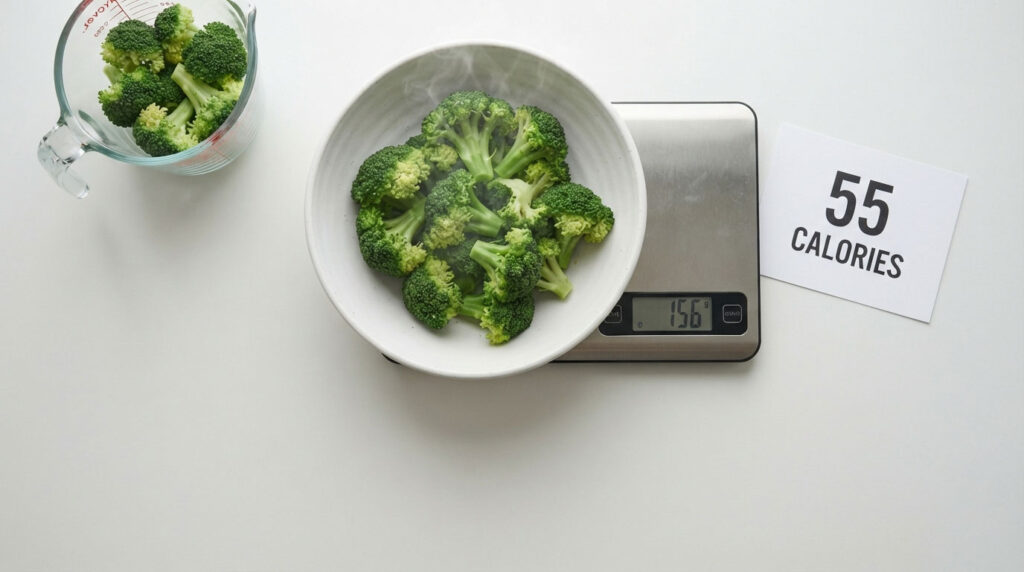
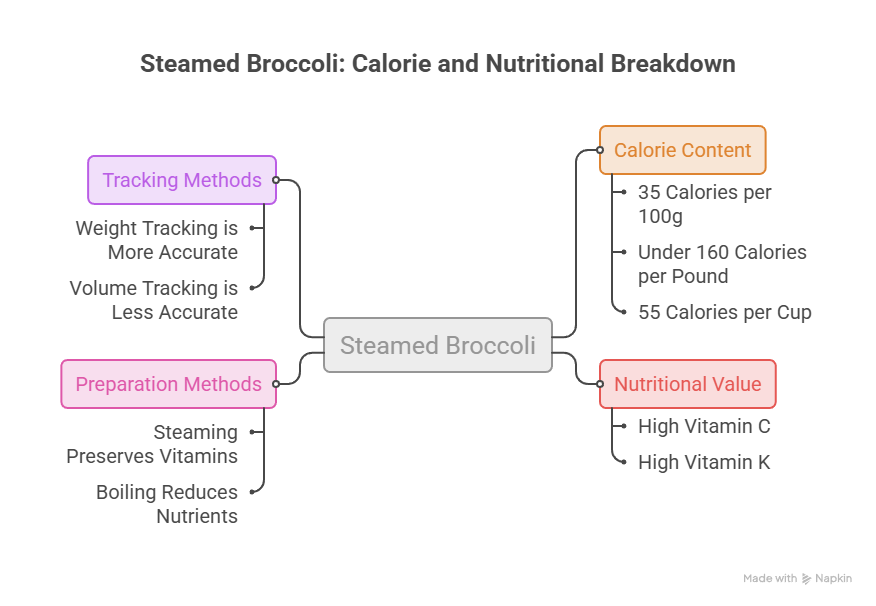
Quick Answer: Steamed broccoli contains 35 calories per 100 grams. A 1-cup serving of chopped steamed broccoli weighs 156 grams and delivers about 55 calories. A cup of loose, lightly steamed florets weighs closer to 91 grams and lands near 32 calories. USDA publishes no separate “steamed” record, so both figures trace to FDC ID 169967.
At a Glance
• 100 grams of steamed broccoli: 35 calories, 2.4 g protein, 3.9 g net carbs
• 1 cup chopped and packed (156 g): 55 calories
• 1 cup loose florets (91 g): about 32 calories
• One cup covers 112% of the Daily Value for vitamin C and 183% for vitamin K
• Steaming adds zero calories. Butter, oil, and cheese sauce add 30 to 130 per serving
• Fresh broccoli availability in the US hit 6.13 pounds per person in 2023, down 8% year over year
• Digestive tolerance, not calories, is what limits how much you can eat
The Short Answer, With the USDA Numbers Behind It
Steamed broccoli is one of the lowest-calorie foods most Americans put on a dinner plate. At 35 calories per 100 grams, you could eat a full pound and stay under 160 calories.
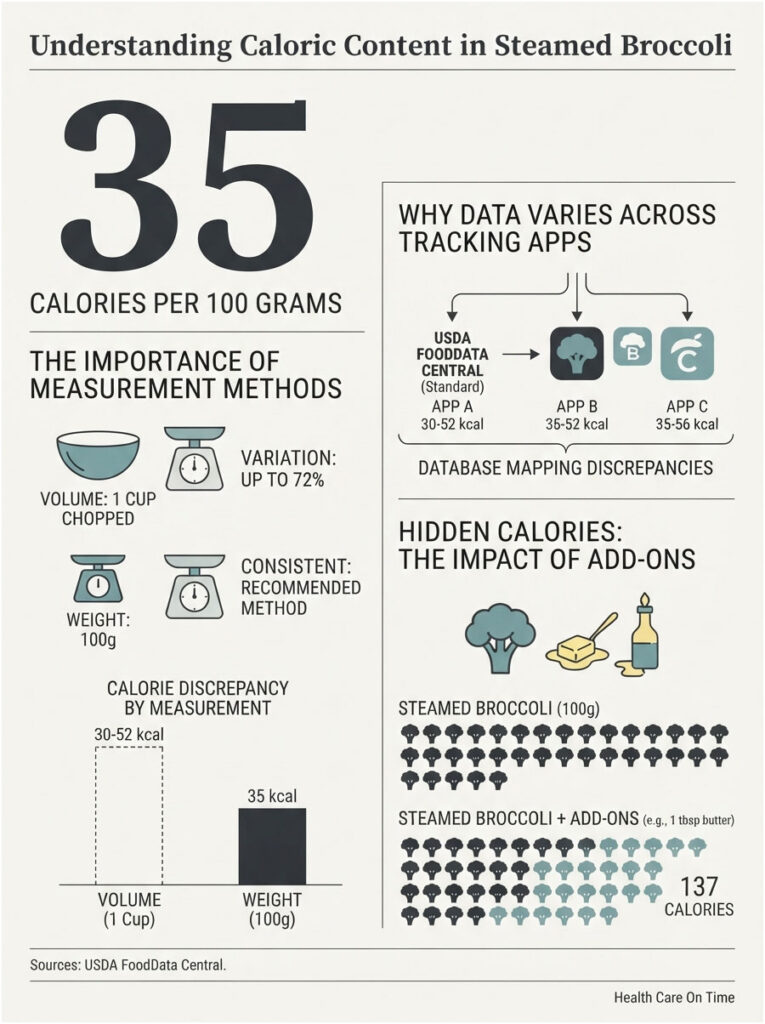
The trouble starts when you measure by cup instead of by gram. Our nutrition reviewers see this trip up more calorie-tracking questions than almost any other food on the plate.
Calories by Portion Size
Every number below comes from USDA FoodData Central entry 169967, scaled to standard reference weights. This is the record every major tracking app pulls from when you log steamed broccoli.
| Portion | Weight | Calories | Protein | Net Carbs |
| 1 ounce | 28 g | 10 | 0.7 g | 1.1 g |
| 1 spear (5 inches) | 37 g | 13 | 0.9 g | 1.4 g |
| 100 grams | 100 g | 35 | 2.4 g | 3.9 g |
| Half cup, chopped | 78 g | 27 | 1.9 g | 3.0 g |
| 1 cup, loose florets | 91 g | 32 | 2.2 g | 3.5 g |
| 1 cup, chopped and packed | 156 g | 55 | 3.7 g | 6.1 g |
| 1 medium stalk | 180 g | 63 | 4.3 g | 7.0 g |
| 1 large stalk or small head | 280 g | 98 | 6.7 g | 10.9 g |
Look at what happens between the two 1-cup rows. Same measuring cup, same vegetable, and the calorie count jumps by 72%.
Why Google Shows You Seven Different Numbers
Three things explain nearly all the disagreement online. None of them involve anyone being wrong.
The first is volume versus weight. A cup measures space, not mass, and broccoli is an unusually airy vegetable.
The second is database mapping. Different apps attach different reference weights to the phrase “1 cup steamed broccoli,” and that single choice swings the answer by 20 calories or more.
The third is add-ons. Restaurant and packaged versions often arrive with butter or oil already applied, which the label folds into the total without flagging it.
The Cup Trap Explained
Raw broccoli florets are full of trapped air. They wedge against each other in your measuring cup and leave gaps.
The USDA reference weight for 1 cup of chopped raw broccoli is 91 grams. Apply heat and the cell walls soften, the florets collapse, and that same cup now holds 156 grams.
That is 71% more food in the identical volume. Energy density did not change at all. You are simply eating more broccoli.
Patients tracking calories with us are often startled by this, because it feels like cooking created calories out of nowhere. It did not. Your cup just got denser.
How to Measure a Portion Accurately
The fix takes about ten seconds and only has to happen once. Put your usual serving of steamed broccoli on a kitchen scale and note the grams.
If it reads 85 to 100 grams, you are eating loose florets and your count is roughly 30 to 35 calories. If it reads 145 to 165 grams, you are eating a packed cup and your count is closer to 55.
From then on, log by weight rather than by cup and the ambiguity is gone permanently. Digital kitchen scales run about fifteen dollars and remove more tracking error than any app setting.
Patients who start weighing rather than eyeballing frequently discover their real intake sits 20% to 40% away from their estimate, in both directions.
What USDA Actually Publishes About Steamed Broccoli
Here is the detail almost no other page will tell you, and it changes how you should read every steamed broccoli number online.
There Is No “Steamed” Entry, and That Matters
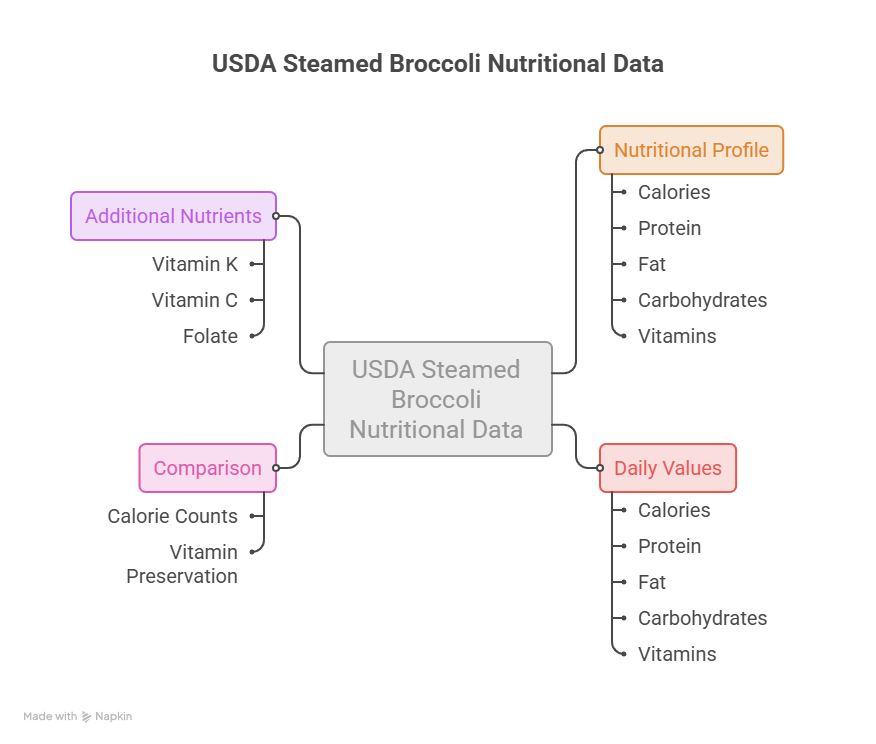
USDA FoodData Central carries two standard reference records for plain broccoli. One is “Broccoli, raw” (FDC ID 170379). The other is “Broccoli, cooked, boiled, drained, without salt” (FDC ID 169967).
There is no third record for steaming. Not in SR Legacy, not in the Foundation Foods dataset.
So when your app returns a number for steamed broccoli, it is quietly serving you the boiled-and-drained record. Every reputable tracker does this, and it is a reasonable substitution, but almost nobody discloses it.
Is the substitution fair? For calories, yes, and closely so. Boiling and steaming both soften cell walls and drive similar water uptake, so energy per gram lands in the same place.
For water-soluble vitamins, the substitution understates steamed broccoli. Boiling leaches vitamin C and folate into the pot. Steaming keeps most of it on the plate.
Our medical reviewers treat this as a case where the database runs conservative rather than inaccurate. Your steamed serving likely carries somewhat more vitamin C than the tables below show.
The Full Nutrient Profile Per 100 Grams and Per Cup
| Nutrient | Per 100 g | Per 1 Cup (156 g) | % DV per cup | Source |
| Calories | 35 kcal | 55 kcal | 3% | USDA FDC 169967 |
| Protein | 2.38 g | 3.7 g | 7% | USDA FDC 169967 |
| Total fat | 0.41 g | 0.64 g | 1% | USDA FDC 169967 |
| Total carbohydrate | 7.18 g | 11.2 g | 4% | USDA FDC 169967 |
| Dietary fiber | 3.3 g | 5.1 g | 18% | USDA FDC 169967 |
| Total sugars | 1.39 g | 2.2 g | n/a | USDA FDC 169967 |
| Cholesterol | 0 mg | 0 mg | 0% | USDA FDC 169967 |
| Water | 89.25 g | 139 g | n/a | USDA FDC 169967 |
| Vitamin C | 64.9 mg | 101 mg | 112% | USDA FDC 169967 |
| Vitamin K | 141.1 mcg | 220 mcg | 183% | USDA FDC 169967 |
| Folate (DFE) | 108 mcg | 168 mcg | 42% | USDA FDC 169967 |
| Vitamin A (RAE) | 77 mcg | 120 mcg | 13% | USDA FDC 169967 |
| Potassium | 293 mg | 457 mg | 10% | USDA FDC 169967 |
| Calcium | 40 mg | 62 mg | 5% | USDA FDC 169967 |
| Iron | 0.67 mg | 1.0 mg | 6% | USDA FDC 169967 |
| Sodium | 41 mg | 64 mg | 3% | USDA FDC 169967 |
Daily Values follow the FDA reference amounts printed on every US Nutrition Facts panel.
The Nutrients That Never Make It Onto a Label
Mandatory labeling covers only a slice of what USDA actually measures. These rows rarely appear anywhere online, and several of them are where broccoli quietly outperforms.
| Nutrient | Per 100 g | Per 1 Cup (156 g) | % DV per cup |
| Vitamin B6 | 0.20 mg | 0.31 mg | 18% |
| Pantothenic acid (B5) | 0.62 mg | 0.96 mg | 19% |
| Riboflavin (B2) | 0.123 mg | 0.19 mg | 15% |
| Vitamin E | 1.45 mg | 2.26 mg | 15% |
| Choline | 40.1 mg | 63 mg | 11% |
| Manganese | 0.194 mg | 0.30 mg | 13% |
| Magnesium | 21 mg | 33 mg | 8% |
| Phosphorus | 67 mg | 104 mg | 8% |
| Copper | 0.064 mg | 0.10 mg | 11% |
| Zinc | 0.45 mg | 0.70 mg | 6% |
| Selenium | 1.6 mcg | 2.5 mcg | 5% |
| Beta-carotene | 929 mcg | 1,449 mcg | no DV set |
| Lutein plus zeaxanthin | 1,080 mcg | 1,685 mcg | no DV set |
Lutein and zeaxanthin are worth a second look. Both concentrate in the retina, both are undersupplied in typical American eating, and a single cup of steamed broccoli delivers 1,685 micrograms.
The Two Standouts, Vitamin K and Vitamin C
One cup of steamed broccoli covers a full day of vitamin K almost twice over, at 220 micrograms against a 120 microgram Daily Value.
Vitamin C lands at 101 milligrams, clearing the 90 milligram DV. That is more vitamin C than a medium navel orange, from a food with a third of the calories.
Folate deserves a mention too. At 168 micrograms DFE per cup, steamed broccoli covers 42% of the daily target, which matters for anyone pregnant or planning to be.
Does Steaming Change the Calorie Count?
Short version: no, not in any way that affects your tracking app. The longer version is more interesting.
Heat Does Not Burn Calories, Water Changes the Math
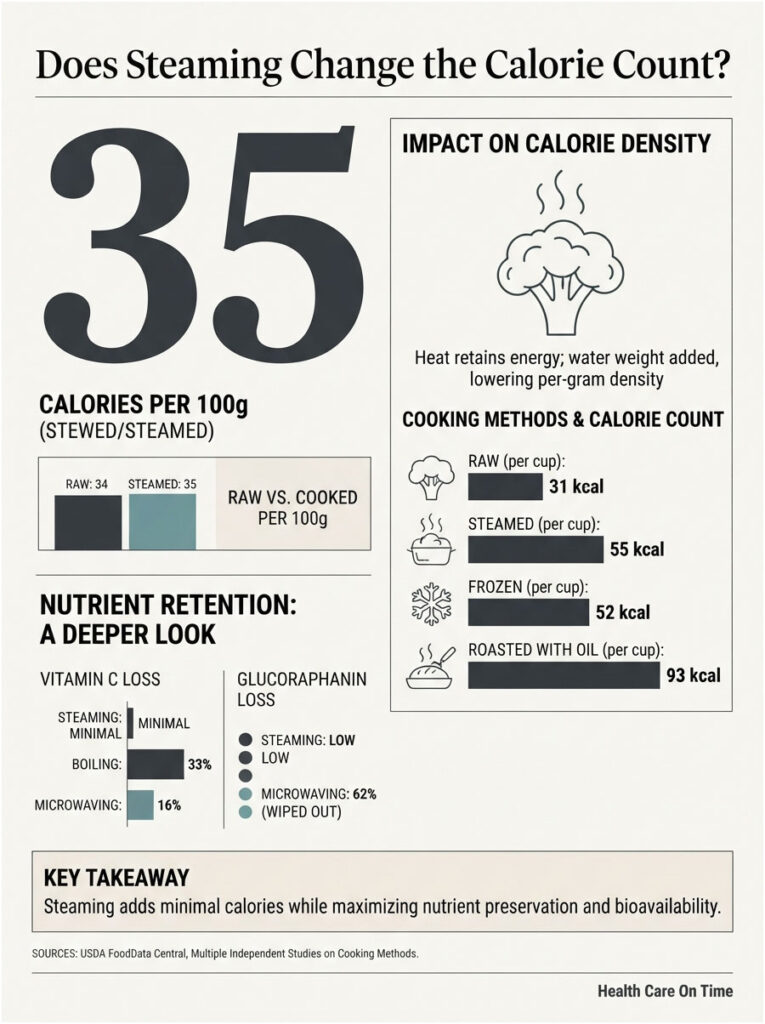
Calories are stored chemical energy. Steam does not destroy carbohydrate, protein, or fat molecules, so the energy in the broccoli survives cooking intact.
What steam adds is water weight, and water carries zero calories. That is why per-gram energy density actually drops slightly after cooking in some measurements.
Raw broccoli sits at 34 calories per 100 grams. Cooked and drained sits at 35. The one-calorie gap is measurement noise, not a real difference.
Steamed Versus Raw Versus Boiled Versus Roasted
The comparison that actually matters is per cup, because that is how people serve themselves at the counter.
Raw chopped broccoli at 1 cup (91 g) runs 31 calories. Steamed and packed at 1 cup (156 g) runs 55. Frozen broccoli, cooked and drained, at 1 cup (184 g) runs about 52.
Roasted broccoli is the outlier. Add 1 teaspoon of olive oil to a 150 gram portion and you are at roughly 93 calories, because the oil alone contributes 40.
Gram for gram, all the plain methods sit within a few calories of each other. The method only shifts your total by changing how much fits on the fork.
What Steaming Does Change: Nutrients, Not Energy
This is where cooking method earns its reputation. Researchers at Zhejiang University tested five common cooking methods and found steaming caused no meaningful vitamin C loss while leaving glucoraphanin, the precursor to sulforaphane, essentially untouched.
Boiling destroyed 33% of vitamin C and 41% of key glucosinolates. Microwaving lost less vitamin C at 16% but wiped out 62% of glucoraphanin, the worst result of any method for that compound.
Not every study agrees, and honest reporting means saying so. An Italian analysis published in the Journal of Agricultural and Food Chemistry recorded vitamin C losses of 34% from boiling and 22% from steaming, a meaningfully worse showing for steam.
The discrepancy likely comes down to steaming time, water volume, and how finely the broccoli was cut. Short steams over minimal water do best. Long steams over a rolling pot start behaving like boiling.
What both camps agree on is the ranking. Steaming beats boiling. Our medical team treats that as the settled part of the evidence and the rest as an active question.
There is human bioavailability data as well. A trial published through the National Library of Medicine found plasma isothiocyanate levels more than double after steamed broccoli compared with boiled, with an area-under-curve of 417.4 versus 175.3.
How Steamed Broccoli Stacks Up Against Other Sides
Calorie context beats calorie counts. Knowing broccoli runs 55 calories per cup only helps if you know what it is replacing.
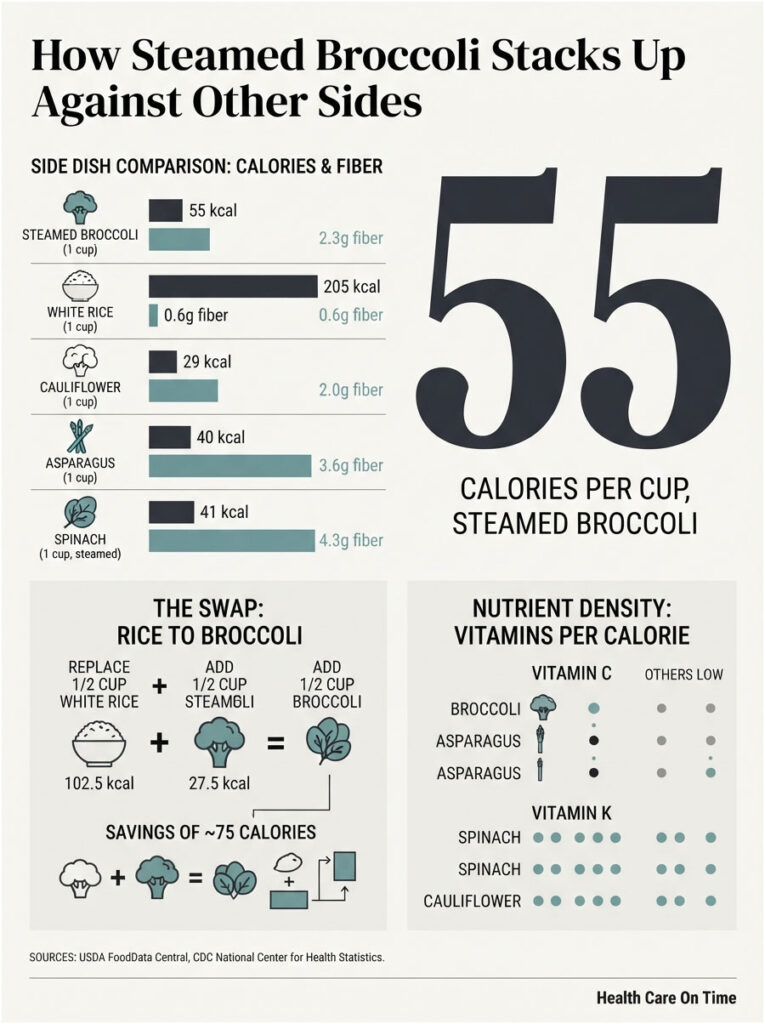
Every figure below is a USDA value for one cup, cooked, drained, and unseasoned.
| Side Dish (1 cup, cooked) | Weight | Calories | Fiber | Swap Note |
| Cauliflower | 124 g | 29 | 3.4 g | Lowest calorie of the group |
| Asparagus | 180 g | 40 | 3.6 g | Similar profile, less vitamin C |
| Spinach | 180 g | 41 | 4.3 g | Higher iron, far less vitamin C |
| Green beans | 125 g | 44 | 4.0 g | Comparable, lower vitamin K |
| Carrots | 156 g | 55 | 4.7 g | Same calories, much higher sugar |
| Steamed broccoli | 156 g | 55 | 5.1 g | Best vitamin C and K per calorie |
| Brussels sprouts | 156 g | 56 | 4.1 g | Closest cruciferous match |
| Green peas | 160 g | 134 | 8.8 g | Starchy; more than double broccoli |
| Sweet corn | 164 g | 157 | 4.6 g | Starchy vegetable, not a swap |
| White rice | 158 g | 205 | 0.6 g | The swap that saves the most |
Two things stand out. Among non-starchy vegetables, broccoli is average on calories and best in class on vitamin C and vitamin K per calorie.
Against a starch, the gap is enormous. Replacing half a cup of white rice with a full cup of steamed broccoli removes roughly 48 calories while doubling the volume on your plate.
What You Add Is Where the Calories Actually Come From
Plain steamed broccoli is close to a free food. Almost nobody eats plain steamed broccoli.
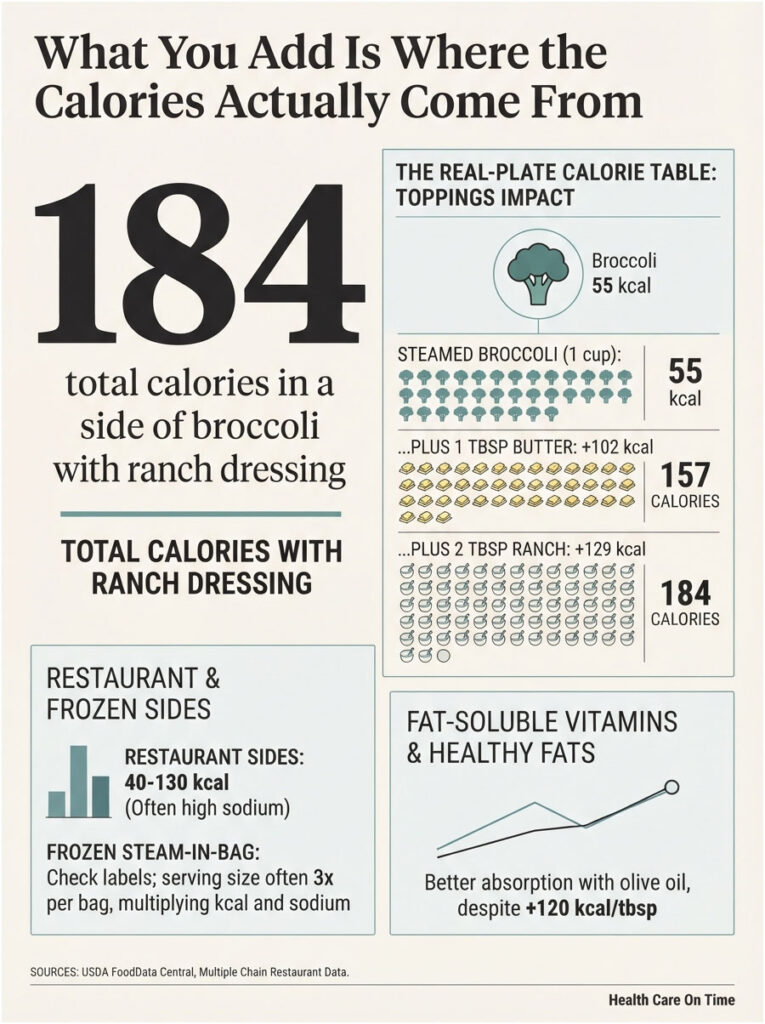
The toppings do the real damage, and they do it fast. A tablespoon of butter carries roughly twice the calories of the entire cup of vegetable underneath it.
The Real-Plate Calorie Table
| What You Add | Amount | Added Calories | Total With 1 Cup (156 g) |
| Nothing | 0 | 0 | 55 |
| Fresh lemon juice | 1 tbsp | 3 | 58 |
| Minced garlic | 1 clove | 4 | 59 |
| Grated parmesan | 1 tbsp | 21 | 76 |
| Butter | 1 tsp | 34 | 89 |
| Olive oil | 1 tsp | 40 | 95 |
| Butter | 1 tbsp | 102 | 157 |
| Cheddar cheese sauce | 1/4 cup | 110 | 165 |
| Olive oil | 1 tbsp | 119 | 174 |
| Ranch dressing | 2 tbsp | 129 | 184 |
Look at the bottom of that table. Ranch dressing turns a 55-calorie side into a 184-calorie one, and the broccoli contributed less than a third of it.
None of this makes fat the enemy. Vitamin A, vitamin K, vitamin E, lutein, and zeaxanthin in broccoli are all fat-soluble, so a teaspoon of olive oil genuinely improves how much of them you absorb.
The point is knowing which line item you are paying for. A teaspoon buys absorption. A tablespoon buys a second meal’s worth of fat.
Patients who tell us they “eat broccoli every day and still gained weight” are almost always describing the topping, not the vegetable.
Restaurant and Frozen Steam-Bag Versions
Chain restaurant broccoli sides typically run 40 to 130 calories depending on whether the kitchen finishes them with butter. Sodium is often the bigger surprise, since a plain USDA cup carries 64 milligrams while a restaurant side can carry 100 to 400.
Frozen steam-in-bag broccoli is nutritionally sound and sometimes better than fresh, because it is blanched and frozen within hours of harvest. Fresh broccoli that spent six days in transit has already given up vitamin C.
Reading a Steam-in-Bag Label Correctly
Most 12-ounce bags list three servings, not one. If you steam the bag and eat the whole thing, multiply everything on the panel by three.
That takes a 30-calorie label to 90 calories, still modest, but it also takes 15 milligrams of sodium to 45 and triples your fiber load in a single sitting.
Check whether the bag includes a sauce packet. Cheese and butter sauce packets frequently carry more calories than all the vegetables in the bag combined.
Steamed Broccoli and Weight Management
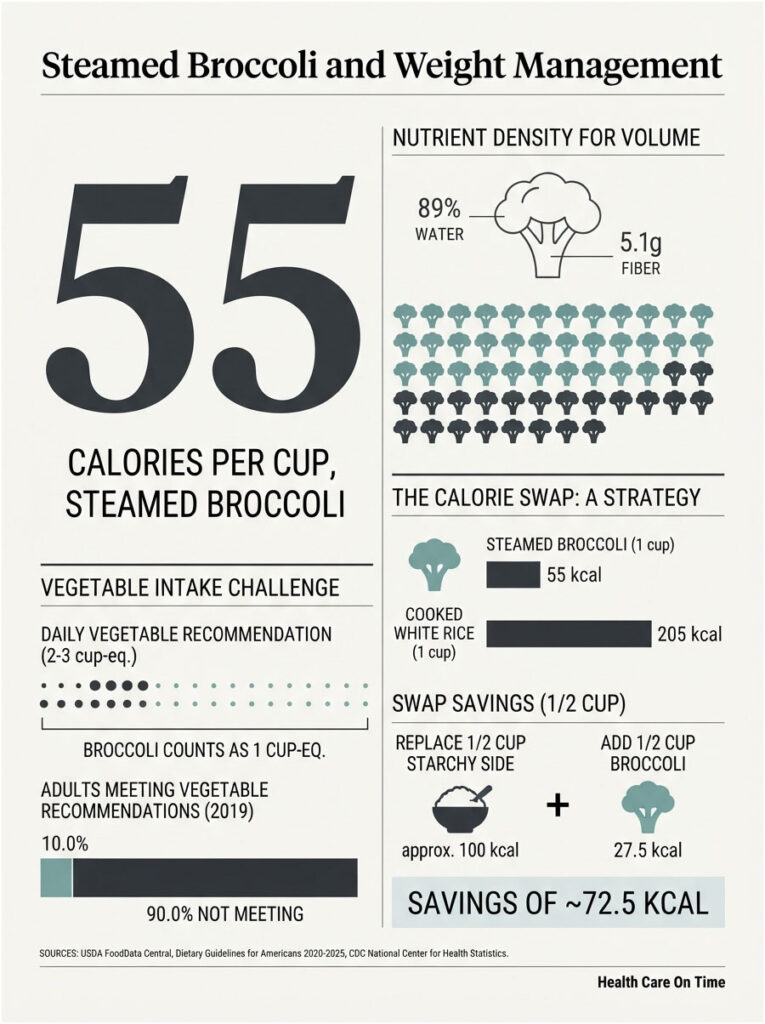
At 55 calories per cup, steamed broccoli is one of the few foods where portion anxiety is misplaced. The math simply does not work against you.
Calorie Density, and Why 55 Calories Fills You Up
Steamed broccoli is 89% water by weight. Add 5.1 grams of fiber per cup and you get significant stomach volume for very little energy.
Set that against a cup of cooked white rice at roughly 205 calories. You would need almost four cups of steamed broccoli to match it.
This is the practical case for volume eating. Swapping half a cup of a starchy side for a cup of steamed broccoli typically removes 80 to 100 calories from a plate without shrinking it.
Patients working through weight goals with our team often find this swap easier to sustain than portion cutting, because the plate still looks full and the meal still feels like a meal.
Fitting It Into MyPlate and the Dietary Guidelines
The Dietary Guidelines for Americans, 2020 to 2025 put adult vegetable targets at 2 to 3 cup-equivalents daily. One cup of chopped steamed broccoli counts as one full cup-equivalent.
Most Americans are nowhere close. CDC analysis of 2019 BRFSS data found only 10.0% of adults met vegetable intake recommendations, ranging from 5.6% in Kentucky to 16.0% in Vermont.
Broccoli itself is holding steady but softening. USDA Economic Research Service data put fresh broccoli availability at 6.13 pounds per person in 2023, down 8% from 2022 and down 3% from 2018.
Put those two figures together and the practical read is straightforward. One cup of steamed broccoli at dinner moves you from the bottom third of American vegetable intake to roughly a third of the way to the daily target, at a cost of 55 calories.
Keto, Low-Carb, and Diabetes Considerations
One cup of steamed broccoli carries 11.2 grams of total carbohydrate and 5.1 grams of fiber, leaving 6.1 grams of net carbs.
On a 20 gram net carb ketogenic protocol, that is a real allocation but a workable one. Half a cup at 3.0 grams net carbs fits almost any low-carb plan without arithmetic.
For blood sugar management, broccoli’s glycemic load is low enough that it rarely produces a meaningful glucose excursion on its own. The fiber slows the release further.
Anyone tracking glucose closely should still test their own response rather than assume. Our lab partners see enough individual variation to make personal data worth more than any published average.
Getting the Most From Every Steamed Serving
If you are going to eat this vegetable regularly, a few small technique changes meaningfully increase what you actually absorb.
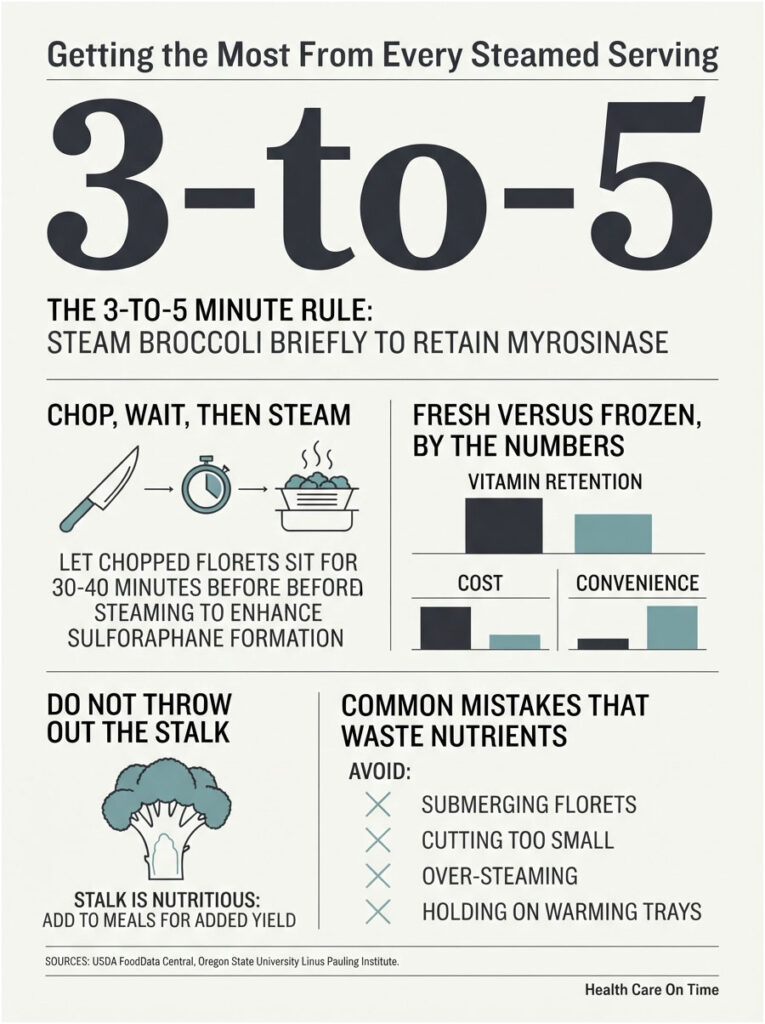
The 3-to-5 Minute Rule
Sulforaphane, broccoli’s most-studied compound, is not present in the raw vegetable. It forms when glucoraphanin meets an enzyme called myrosinase, and myrosinase is heat-sensitive.
Research from the University of Illinois, summarized by the American Institute for Cancer Research, found steaming for up to five minutes was the best method for retaining myrosinase. Boiling or microwaving for even one minute destroyed most of the enzyme.
Aim for bright green and fork-tender with some resistance. Dull olive-green means you went too far.
Chop, Wait, Then Steam
There is a simple prep trick with real evidence behind it. Chop the florets, then let them sit at room temperature for 30 to 40 minutes before steaming.
The rest period gives myrosinase time to convert glucoraphanin into sulforaphane at room temperature, before any heat arrives. You get the compound formed and banked before cooking can interfere with it.
If you forget the wait, there is a rescue. Sprinkle a pinch of mustard powder, or add raw arugula, radish, or wasabi to the finished dish. All of them carry active myrosinase that can restart the conversion.
Fresh Versus Frozen, By the Numbers
Frozen chopped broccoli, cooked and drained, runs about 28 calories per 100 grams against 35 for fresh cooked. The gap comes from blanching, which pulls out some solids before freezing.
Vitamin C runs modestly lower in frozen, roughly 56 milligrams per 100 grams against 65. Vitamin K and the minerals hold up well.
Frozen wins on cost, waste, and convenience. Our nutrition reviewers consider the small nutrient gap a fair trade for a vegetable that actually gets eaten instead of wilting in the crisper drawer.
Do Not Throw Out the Stalk
Broccoli stalks carry comparable fiber and mineral content to the florets, and they cost you nothing extra since you already bought them.
Peel the tough outer layer with a vegetable peeler, slice the interior into coins about a quarter inch thick, and add them to the steamer basket two minutes before the florets. They finish at the same time.
The flavor is milder and slightly sweeter than the florets. Households that start using the stalks typically get 30% to 40% more edible vegetable out of the same bunch.
Common Mistakes That Waste Nutrients
Submerging the basket is the most frequent error. If water touches the florets, you are boiling, and you just handed a third of the vitamin C to the pot.
Cutting the florets too small is the second. More cut surface means more leaching, so keep pieces roughly bite-sized rather than confetti.
Over-steaming is the third. Past roughly seven minutes the sulforaphane advantage is mostly gone, though fiber, potassium, and vitamin K remain intact.
Holding cooked broccoli on a warming tray is the fourth, and it is the one restaurants commit most often. Vitamin C degrades steadily with heat exposure long after cooking stops.
Should You Eat Steamed Broccoli Every Day?
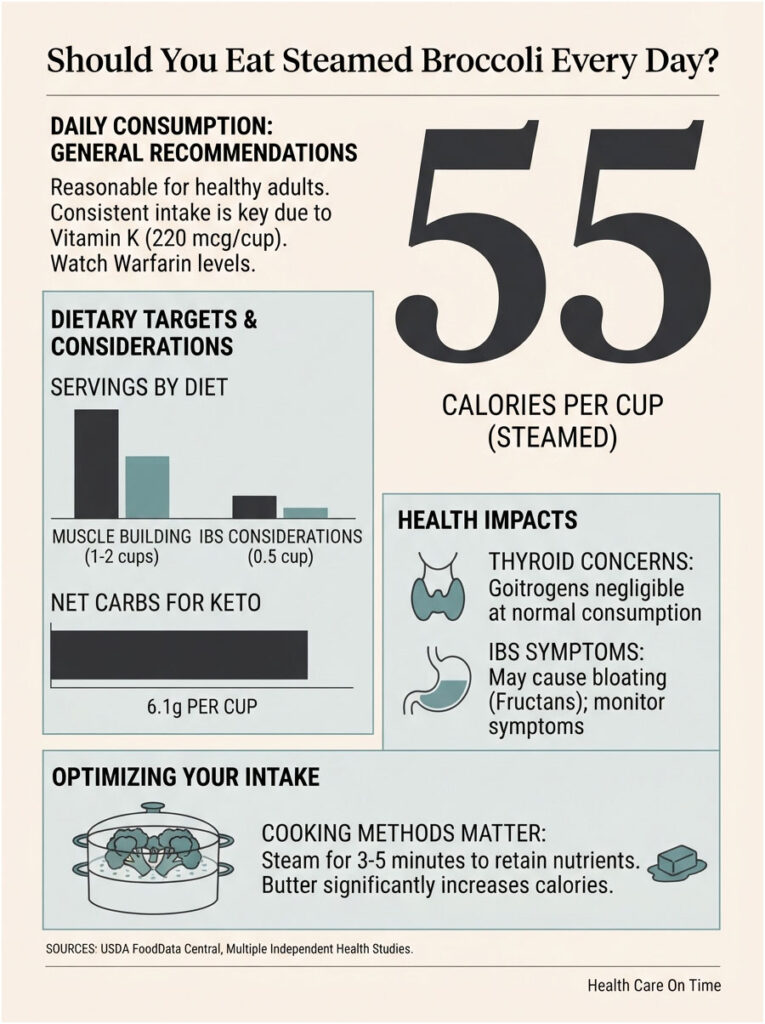
For most healthy adults, yes, and daily intake is a reasonable goal rather than an excessive one. A few groups should pay closer attention.
Who Should Watch Their Intake
Anyone on warfarin needs consistency, not avoidance. Vitamin K affects how the drug works, and 220 micrograms per cup is a substantial dose, so sudden large swings in broccoli intake can move your INR.
The instruction from cardiology is steady intake at a predictable level. Talk to your prescriber before changing your pattern, and keep servings similar week to week.
Thyroid concerns are largely overstated. Broccoli contains goitrogens, but the amounts required to affect thyroid function in a healthy person sit far beyond normal eating, and cooking reduces them further.
People with IBS may struggle regardless of calories. Broccoli florets carry fructans, a FODMAP that triggers bloating and gas in sensitive guts, and the stalks are generally harder to tolerate than the florets.
Patients on our diagnostic network who report persistent bloating after cruciferous vegetables often benefit from a short elimination and reintroduction rather than permanent avoidance. That is a conversation for a clinician, not a search result.
Your Situation, Your Move
| If You Are | Target Serving | Prep Method | Watch Out For |
| Cutting calories | 1 to 2 cups daily | Steam 4 min, lemon and garlic only | Butter and cheese sauce adding 100-plus calories |
| Building muscle | 1 to 2 cups daily | Steam and pair with lean protein | Treating broccoli as a protein source; 3.7 g per cup is a bonus, not a base |
| On a ketogenic diet | 1 cup daily | Steam 4 min, finish with olive oil | 6.1 g net carbs per cup counts against your limit |
| Taking warfarin | Consistent daily amount | Any method, kept steady | 220 mcg vitamin K per cup; sudden increases can shift INR |
| Managing type 2 diabetes | 1 to 2 cups daily | Steam, serve before the starch | Cheese sauces adding saturated fat and sodium |
| Pregnant | 1 to 2 cups daily | Steam thoroughly, wash first | Raw broccoli sprouts, which carry listeria risk |
| Managing IBS | Half cup, florets only | Steam soft, skip the stalks | Fructans; introduce slowly and track symptoms |
| Feeding kids | Quarter to half cup | Steam 3 min, keep it bright green | Overcooking, which produces the sulfur smell kids reject |
Frequently Asked Questions
How many calories are in 1 cup of steamed broccoli?
About 55 calories for 1 cup of chopped steamed broccoli weighing 156 grams, the USDA reference weight. If your cup holds loose florets and weighs closer to 91 grams, the count drops to roughly 32 calories. Weigh your portion once to learn which one matches your habits.
How many calories are in 100 g of steamed broccoli?
Exactly 35 calories, per USDA FoodData Central entry 169967. That 100 gram portion also delivers 2.4 grams of protein, 3.3 grams of fiber, 64.9 milligrams of vitamin C, and 141 micrograms of vitamin K. Gram-based tracking is the most accurate way to log this vegetable.
Does steaming broccoli add calories?
No. Steam is water vapor and carries zero calories, so energy content per gram stays essentially unchanged. Raw broccoli measures 34 calories per 100 grams and cooked measures 35, which is measurement noise. Your per-cup count rises only because cooked florets pack more densely into the same space.
How many calories in steamed broccoli with butter?
One cup of steamed broccoli with 1 teaspoon of butter comes to about 89 calories. Move up to a full tablespoon and you reach roughly 157 calories, with the butter contributing 102 of them. The butter carries nearly twice the calories of the vegetable underneath it.
Is steamed broccoli keto friendly?
Yes. One cup carries 11.2 grams of total carbohydrate minus 5.1 grams of fiber, leaving 6.1 grams of net carbs. On a 20 gram daily limit that is a meaningful allocation, so many people on keto stick to half-cup servings at 3.0 grams net carbs instead.
How much protein is in steamed broccoli?
About 3.7 grams per 1 cup serving of 156 grams, or 2.4 grams per 100 grams. That is high for a vegetable but low in absolute terms, so treat it as a supporting contribution rather than a protein source. Pair it with fish, chicken, tofu, or beans.
Why do calorie apps show different numbers for steamed broccoli?
Because each app assigns a different gram weight to the phrase “1 cup.” Some use 91 grams for loose florets, others use 156 grams for chopped and packed. Since USDA publishes no separate steamed entry, apps also map steamed to the boiled record in slightly different ways.
Is steamed broccoli better than raw for weight loss?
Both work well. Raw broccoli fits fewer grams into a cup, so a raw cup runs about 31 calories against 55 steamed. Steamed is easier to digest and more filling by weight. Choose whichever one you will actually eat consistently, since adherence beats optimization.
How many calories in a whole head of steamed broccoli?
A large stalk or small head weighing about 280 grams comes to roughly 98 calories once steamed. A medium stalk at 180 grams lands near 63 calories. Even eating an entire head keeps you under 100 calories before any butter or oil goes on top.
How many calories in frozen steamed broccoli?
Frozen chopped broccoli, cooked and drained, runs about 28 calories per 100 grams, so a 1 cup serving of 184 grams comes to roughly 52 calories. Frozen is slightly lower than fresh because blanching before freezing removes some solids. Nutrient quality otherwise stays close.
Can you eat unlimited steamed broccoli?
Practically speaking, calories will not be your limit. Digestive tolerance will. Large amounts of fiber and fructans cause gas and bloating in many people, and very high vitamin K intake matters for anyone on warfarin. Two to three cups daily suits most healthy adults comfortably.
How long should you steam broccoli to keep the nutrients?
Three to five minutes over gently simmering water, with the florets sitting above the waterline. Research indicates myrosinase, the enzyme that produces sulforaphane, survives steaming up to about five minutes. Past seven minutes most of that benefit is gone, though fiber and minerals remain.
Medical Disclaimer: This article is for general information only and is not a substitute for professional medical advice, diagnosis, or treatment. Nutrient values reflect USDA reference data and will vary with variety, growing conditions, and cooking time. Anyone taking anticoagulant medication, managing thyroid disease, living with diabetes, or following a therapeutic diet should speak with a qualified healthcare provider before making significant dietary changes. Always seek the advice of your physician with any questions about a medical condition.
References
- USDA FoodData Central — U.S. Department of Agriculture, Agricultural Research Service, Beltsville Human Nutrition Research Center. Entries 169967 (broccoli, cooked, boiled, drained, without salt) and 170379 (broccoli, raw)
- Dietary Guidelines for Americans, 2020 to 2025 — U.S. Department of Agriculture and U.S. Department of Health and Human Services
- Adults Meeting Fruit and Vegetable Intake Recommendations, United States, 2019 — CDC Morbidity and Mortality Weekly Report
- Broccoli: Steam It to Boost Cancer-Fighting Compounds — American Institute for Cancer Research
- The influence of processing and preservation on the retention of health-promoting compounds in broccoli — Journal of Agricultural and Food Chemistry, via PubMed
- Bioavailability of isothiocyanates and other bioactive compounds in boiled or steamed broccoli — National Library of Medicine
- Vegetables and Pulses Data — USDA Economic Research Service
- MyPlate Vegetable Group — U.S. Department of Agriculture
- How Many Calories in 1 Cup of Broccoli? Raw, Steamed and Cooked — HealthCareOnTime