The ABCC11 gene decides whether your body odor exists at all, and about one in fifty white Americans carries a version that shuts it off completely. Most of them never find out, because they keep buying deodorant anyway.
The whole thing comes down to a single letter of DNA on chromosome 16. That letter also decides what your earwax looks like, which means you can make an educated guess about your own genotype in about five seconds.
Table of Contents
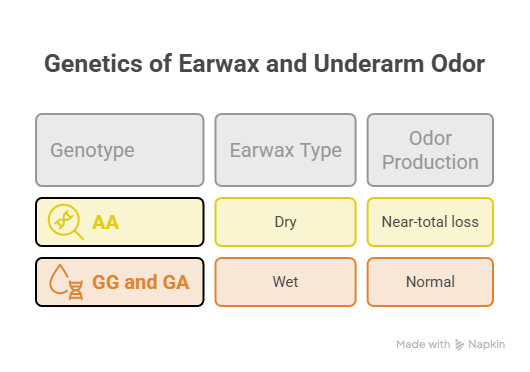
Quick Answer: The ABCC11 gene builds a transporter protein that carries odor precursors out of your apocrine sweat glands. A variant called rs17822931 can switch that transporter off. People with two A copies (AA genotype) have dry, flaky earwax and almost no underarm odor. People with GG or GA genotypes have wet earwax and typical body odor.
At a Glance
• One variant, rs17822931, controls earwax type and underarm odor together as a simple inherited trait.
• AA genotype means dry earwax plus near-total loss of the classic armpit odorants.
• GG and GA genotypes mean wet earwax plus normal odor production, because G is dominant.
• Loss-of-function frequency runs 80% to 95% across East Asian populations and roughly 2% among Americans of European descent.
• The AA genotype cuts underarm odor sharply, but it does not make anyone odorless everywhere.
• Consumer DNA tests already report this variant; earwax type is a free first clue.
• A sudden odor change in adulthood points to health or medication issues, never to genetics.
Patients booking tests with HealthCareOnTime raise body odor more often than you might expect, and the question almost always arrives wrapped in embarrassment. The good news is that the science here is unusually clean for human genetics.
Most inherited traits involve dozens of genes nudging an outcome in small increments. This one runs on a single switch with two positions.
What the ABCC11 Gene Actually Does
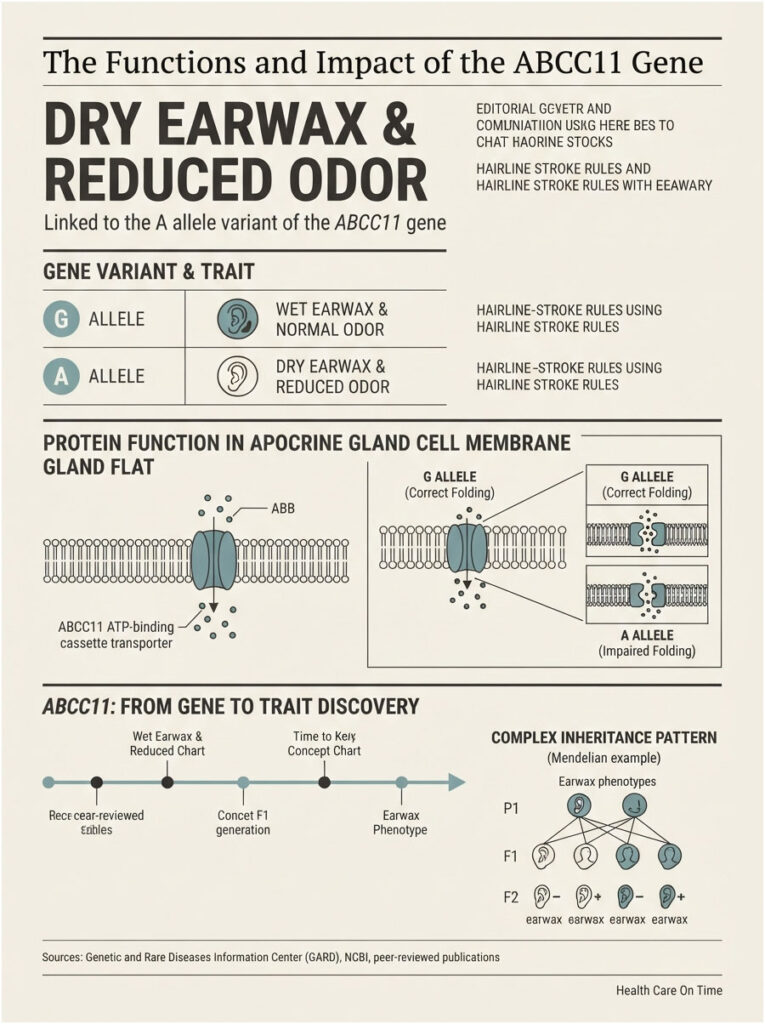
ABCC11 stands for ATP-binding cassette subfamily C member 11. The name is a mouthful, but the job description fits in four words: it builds a pump.
The transporter protein in plain English
Picture a cell membrane as a locked wall. Molecules inside a gland cell cannot simply drift out; something has to carry them across and burn energy doing it.
ABC transporters are those carriers. The NIH Genetic Testing Registry describes ABCC11 as a full transporter in the MRP subfamily, handling bile acids, conjugated steroids, and cyclic nucleotides.
One of its cargo items matters enormously for how you smell. Apocrine sweat glands use ABCC11 to push out odorless precursor molecules, including a glutathione conjugate that skin bacteria later convert into a sharp, sulfurous scent.
Where the gene is switched on
Three locations matter. Apocrine sweat glands in the armpits and groin, ceruminous glands lining the ear canal, and mammary tissue.
That shared expression explains the odd pairing of traits. Earwax consistency and armpit odor travel together because the same pump serves both gland types.
The mammary connection is why researchers eventually started asking questions about colostrum secretion and breast tissue, a thread this article picks up later.
The one-letter change that switches it off
The variant is written as c.538G>A. At the protein level it swaps glycine for arginine at position 180, shortened to Gly180Arg, and its reference number is rs17822931.
That swap eliminates an N-linked glycosylation site. Without it, the freshly built protein misfolds inside the endoplasmic reticulum and gets tagged as defective.
The cell then destroys it through proteasomal degradation before it reaches the gland surface. Tissue-level research confirmed exactly that pattern: ABCC11 protein appears in the axillary apocrine glands of 538GG and 538GA individuals and is absent in 538AA homozygotes.
Why this discovery mattered
When Japanese researchers identified this variant as the determinant of earwax type in 2006, they had found something without precedent. It was the first DNA polymorphism shown to control a visible, everyday human trait through simple Mendelian inheritance.
Textbook genetics examples had long relied on traits that turned out to be far messier than advertised. Earwax type turned out to be the real thing.
The G allele is dominant, so one working copy produces wet earwax and normal odor output. GA heterozygotes behave essentially like GG homozygotes.
Our medical reviewers note that this dominance pattern trips people up constantly. Two parents with wet earwax can each carry a hidden A allele and produce a child with dry earwax.
Why Your Armpits Smell (and Why Some Do Not)
Here is the part that surprises nearly everyone: sweat has no smell. Not the watery eccrine kind, and not apocrine sweat either.
Sweat itself is odorless
Eccrine glands cover most of your body and produce thin, salty fluid for cooling. Apocrine glands switch on at puberty and secrete a thicker, protein-rich and lipid-rich fluid into hair follicles in the armpits and groin.
Fresh apocrine sweat leaving the skin is essentially scentless. Odor is a second-stage event requiring bacteria, warmth, and the right chemical raw material.
The bacteria doing the actual work
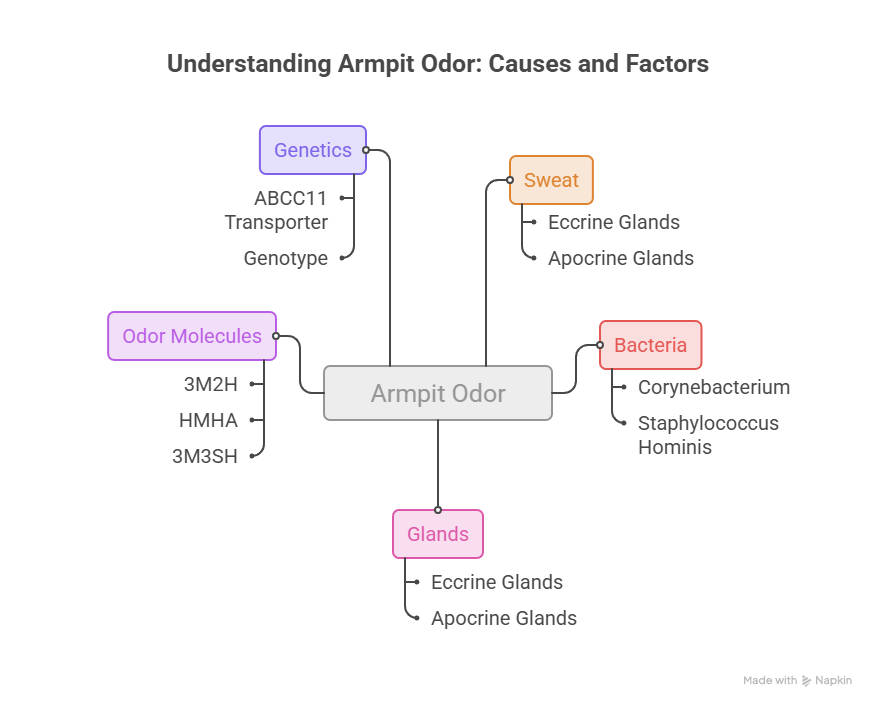
Your armpit hosts one of the densest microbial communities on the body. Corynebacterium species and Staphylococcus hominis are the main producers of classic underarm smell.
According to the American Society for Microbiology, these microbes metabolize compounds in human sweat and release the volatiles that reach your nose. Men generally have larger glands and higher output, which supports bigger Corynebacterium populations and a stronger cheese-like note.
Age shifts the chemistry too. The ASM points to 2-nonenal, an unsaturated aldehyde formed when skin surface lipids oxidize, as the compound behind the distinctive scent associated with older adults.
The three odor molecules that matter
Chemists have narrowed classic axillary odor to a short list of offenders.
3M2H, HMHA, and 3M3SH without the chemistry degree
The first is (E)-3-methyl-2-hexenoic acid, or 3M2H, carrying a sour, goat-like note. The second is 3-hydroxy-3-methylhexanoic acid, or HMHA, in the same acidic family.
The third is 3-methyl-3-sulfanylhexanol, or 3M3SH, a thiol responsible for the sharp onion and sulfur quality of strong odor.
None of these leave your body ready to smell. They exit bound to carrier molecules: amino acid conjugates for the two acids, and a glutathione conjugate for the thiol.
Bacterial enzymes snip the conjugates apart on the skin surface, releasing the free odorants. Research in the Journal of Investigative Dermatology analyzed sweat from 25 volunteers across genotypes and found every branched-chain odorant significantly reduced in AA homozygotes.
What happens when the transporter is missing
Cut the transporter and you cut the supply line. Precursors stay locked inside the gland, surface bacteria get nothing usable, and the characteristic smell never forms.
The bacterial population itself shifts, because the food supply changed. AA individuals do not just smell less, they smell different, which is why “no body odor” overstates the case.
| Trait or Marker | GG Genotype | GA Genotype | AA Genotype | Evidence Source |
| ABCC11 transporter function | Fully functional | Functional (G is dominant) | Degraded before reaching the gland | PMC5343951 tissue study |
| Earwax type | Wet, sticky, yellow-brown | Wet, sticky, yellow-brown | Dry, flaky, gray-white | Yoshiura et al., Nature Genetics |
| Odor precursors in sweat | High levels present | High levels present | Near-complete loss | J Invest Dermatol, 25 subjects |
| Typical underarm odor | Standard to strong | Standard to strong | Minimal to none | ASM review |
| Daily deodorant use | Highest; GG women ~10x more likely than AA | High | ~5x overrepresented among rare or never users | ALSPAC cohort, N approx. 17,000 |
| Axillary osmidrosis risk | Elevated | Elevated | Very low; 1 of 79 clinical cases | Japanese AO genotyping study |
Across the patients HealthCareOnTime serves, this table settles more arguments than any explanation of the biochemistry does. Genotype sets the ceiling on how much odor your armpits can produce, and no product on a drugstore shelf changes that ceiling.
Who Carries the No-Odor Variant, and Why
Allele frequency for rs17822931 varies more sharply by geographic ancestry than almost any other common human variant. That variation is why this gene keeps going viral online.
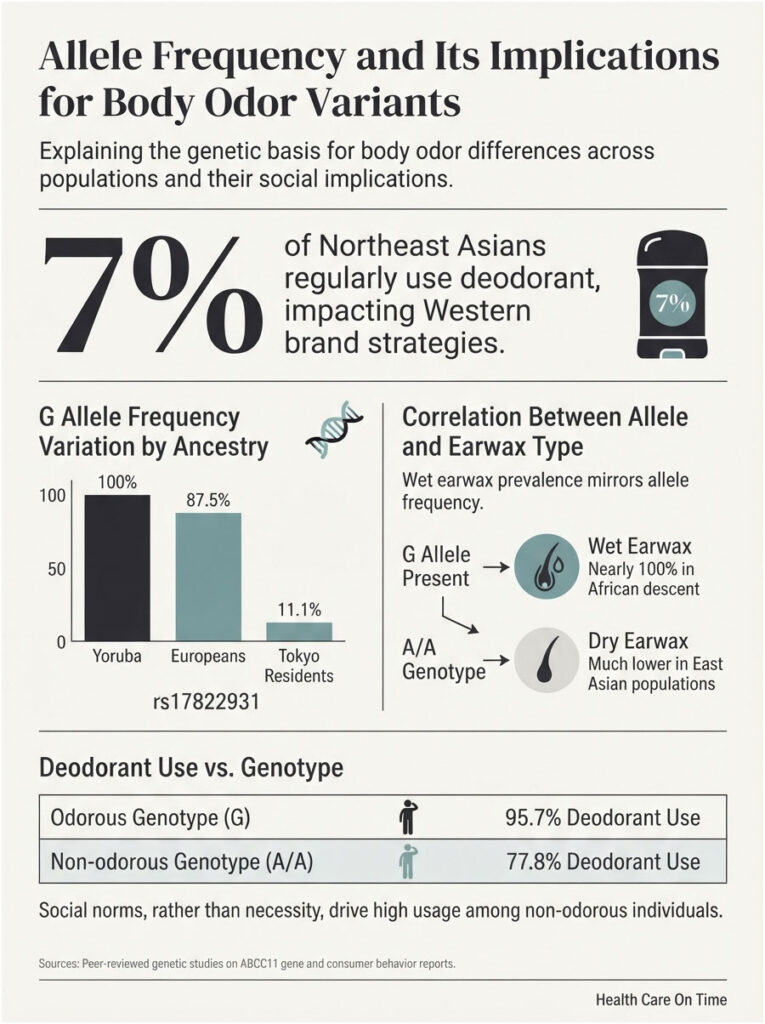
Allele frequency across populations
HapMap data placed the G allele frequency at 1.000 in the Yoruba population of West Africa, 0.875 in European CEPH families, and 0.111 among Tokyo residents. Read that as: essentially everyone of West African descent carries a working transporter, most Europeans do, and most Japanese people do not.
Wet earwax prevalence follows the same gradient. It sits near 100% in African-descent populations and around 95% in European-descent populations, then drops to roughly 15% in Japan, about 10% among Han Chinese, and near 5% in Korea.
The A allele shows a north-south and east-west downward gradient worldwide. That pattern suggests it arose in northeast Asia and spread outward, and in South Asian populations the derived variant sits closer to 50%.
The Northeast Asia origin story
Why the variant reached such high frequency in one region is still debated. Reduced odor is a weak survival advantage on its own, so most researchers suspect the variant either hitchhiked alongside something else under selection or spread through drift in a small founding population.
Cold-climate adaptation is one hypothesis. Reduced apocrine secretion may have offered a small edge in freezing conditions, though direct evidence remains thin.
The commercial fallout is not debated at all. Only about 7% of Northeast Asians use deodorant regularly, a fact that has cost Western personal care brands enormous sums in failed market entries.
What this means for Americans specifically
The United States is genetically mixed, so population averages predict individuals poorly. An American with one East Asian grandparent may carry a single A allele and have completely typical body odor, because one G allele is enough.
| Population or Cohort | Measure | Figure | Source |
| Yoruba (West Africa) | G allele frequency (wet earwax) | 1.000 | HapMap, via BMC Genetics |
| European CEPH families | G allele frequency (wet earwax) | 0.875 | HapMap, via BMC Genetics |
| Tokyo residents | G allele frequency (wet earwax) | 0.111 | HapMap, via BMC Genetics |
| East Asian populations | Loss-of-function ABCC11 prevalence | 80% to 95% | American Society for Microbiology |
| Americans of European descent | Carry the no-odor (AA) genotype | Approximately 2% | ALSPAC-based estimates |
| ALSPAC cohort | Genotype vs deodorant use | N approx. 17,000, P = 3.7 x 10⁻²⁰ | Journal of Investigative Dermatology |
| Non-odorous genotype, white Europeans | Still use deodorant regularly | 77.8% | Journal of Investigative Dermatology |
| US adults | Use antiperspirant or deodorant products | 81% | Mintel US Bodycare and Deodorant Report |
| US adults | Living with hyperhidrosis | Approximately 15 million | Mayo Clinic dermatology estimate |
That 77.8% figure deserves a second look. The ALSPAC deodorant study found that more than three quarters of people who genetically cannot produce classic armpit odor buy and apply deodorant anyway, driven by habit and social expectation rather than need.
Our medical reviewers treat that as the practical headline of this entire research area. Genotype predicts biology accurately and predicts behavior badly.
Why mixed ancestry makes earwax a shaky predictor
Earwax type reflects genotype reliably across populations. At the individual level, humidity, ear canal shape, cleaning habits, age, and skin conditions all change what you actually see.
Eczema or dermatitis in the ear canal can dry out wax that would otherwise be sticky. Recent swimming or showering does the opposite.
How to Tell Which Variant You Have
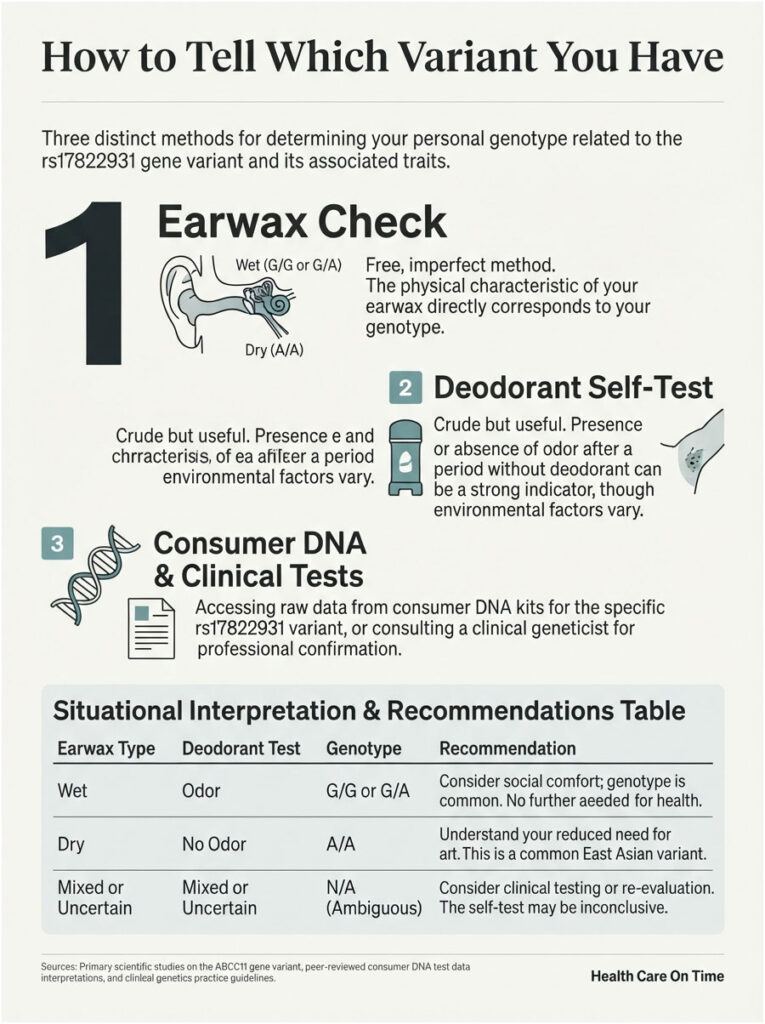
Three routes exist, and they differ in cost, accuracy, and how much they genuinely tell you.
The earwax check (free, imperfect)
Look at the wax at the entrance of your ear canal, not deep inside. Sticky, honey-colored to dark brown wax points toward GG or GA. Flaky, crumbly, gray or off-white wax points toward AA.
Never insert anything into the ear canal to collect a sample. Cotton swabs push wax inward, cause impaction, and risk perforating the eardrum.
The deodorant self-test
Skip antiperspirant for two consecutive days while keeping your normal shower routine, then check the underarm seam of a worn shirt in the evening. Crude, but it separates people who genuinely produce odor from people who assume they must.
Patients commonly ask us whether this test is reliable. It is directional at best, because fabric type, diet, stress levels, and menstrual cycle phase all shift the result within the same person.
Consumer DNA tests and raw data
Most direct-to-consumer platforms genotype rs17822931 as standard. If you have already tested with 23andMe or AncestryDNA, the answer sits in a file you already own.
Finding rs17822931 in your raw data
Download the raw data file from your account, open it in a plain text editor or a spreadsheet, and search for the string rs17822931. The matching row shows your two alleles.
Two A copies means the non-functional variant on both chromosomes. Any G at all means a working transporter and typical odor biology.
Why your file may show C/T instead of G/A
This confuses people constantly. The same variant can be reported on the genomic plus strand as C/T rather than in transcript notation as G/A.
In that convention, T corresponds to A and C corresponds to G. Match the rsID first, then confirm the strand convention in your provider’s documentation before drawing any conclusion.
Clinical genetic testing and coverage
Ordering a standalone clinical test for this variant is possible. The NIH Genetic Testing Registry lists laboratory options, though orders come through a physician or genetic counselor rather than directly from patients.
For most people it is not worth it. Testing is not medically necessary for a cosmetic trait, and US insurers rarely cover it.
The exception is workup before surgery for severe axillary osmidrosis, where genotype carries real clinical weight. Genotyping costs a fraction of an operation and can prevent an unnecessary one.
| Your Situation | What It Likely Means | Recommended Next Step |
| Dry, flaky earwax and no noticeable odor | AA genotype, non-functional transporter | No action needed; deodorant is optional, not required |
| Dry earwax but you still notice odor | AA genotype with odor from another source | Check feet, groin, scalp, breath, and laundry habits before doubting the genotype |
| Wet earwax with odor controlled by normal products | GG or GA genotype, typical presentation | A standard aluminum-based antiperspirant is enough |
| Wet earwax and odor resistant to drugstore products | GG or GA plus possible osmidrosis or hyperhidrosis | See a dermatologist; ask about clinical-strength aluminum chloride and procedural options |
| Odor changed suddenly in adulthood | Not genetic; genotype never changes | Request metabolic screening: blood glucose, kidney and liver function, thyroid panel |
| Teenager with new strong odor at puberty | Apocrine glands activating on schedule | Reassurance plus daily washing and antiperspirant; not a medical problem |
| Raw data shows A/A but odor is obvious | Possible strand-notation misreading | Re-check the rsID and the provider’s strand convention before concluding anything |
When Body Odor Is Medical, Not Genetic
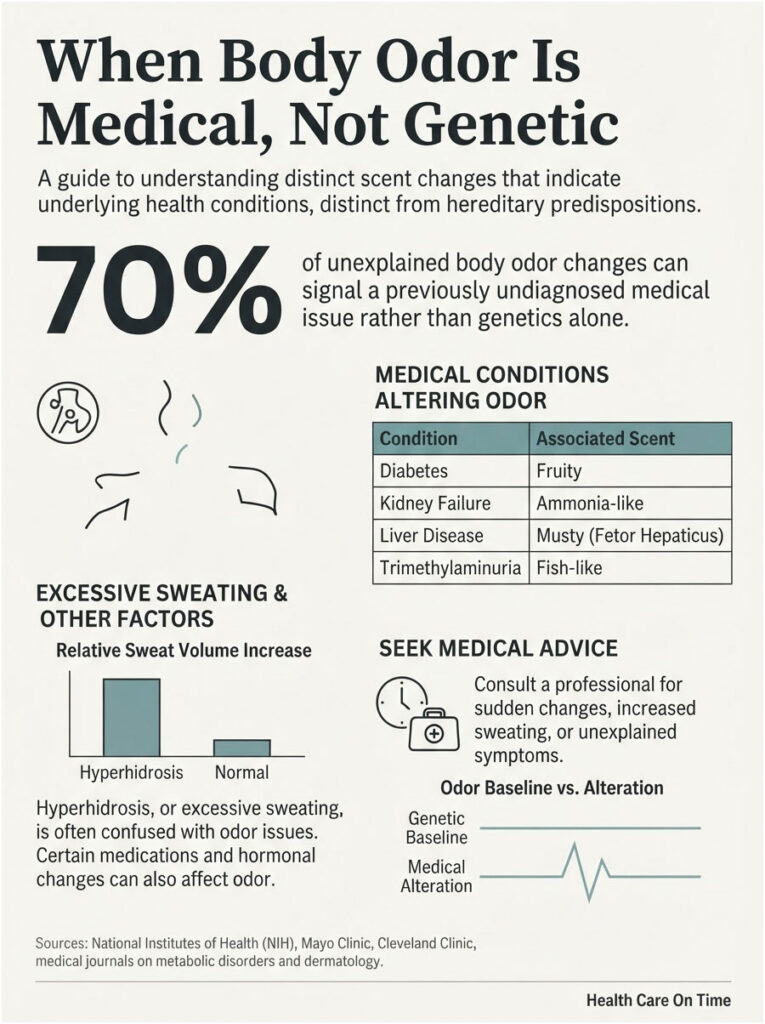
Genetics sets your baseline. Health conditions can override that baseline in either direction, and the ones that do are worth recognizing early.
Axillary osmidrosis and bromhidrosis
Axillary osmidrosis, also called bromhidrosis, describes armpit odor strong enough to cause real distress and social withdrawal. It usually begins around puberty and often runs in families.
The genetic association here ranks among the strongest in dermatology. A Japanese genotyping study found 78 of 79 patients with axillary osmidrosis carried GG or GA, compared with 35.4% of 161 general population controls.
A replication study in the Chinese Han population confirmed the pattern, reporting that 91.38% of affected individuals had wet-type earwax, with G allele carriers showing earlier onset and stronger family history.
The clinical value is direct. If someone seeking surgical removal of axillary glands genotypes as AA, that surgery is unlikely to help, because their apocrine glands are not the source of the problem.
Hyperhidrosis is a separate problem
Excessive sweating and excessive odor get merged constantly, and they are not the same complaint. Hyperhidrosis involves eccrine glands producing far more watery sweat than temperature regulation requires.
Mayo Clinic describes hyperhidrosis as sweating unrelated to heat or exercise, heavy enough to soak through clothing. It affects roughly 15 million people in the United States.
Someone with the AA genotype can sweat heavily and barely smell. Someone with GG can sweat lightly and smell strongly. The treatments differ accordingly.
Medical causes that override genetics
Our medical team sees a short, repeating list behind most sudden adult-onset odor changes.
Diabetes and ketones
Poorly controlled diabetes can produce a sweet, fruity, nail-polish-remover scent on the breath and skin during ketosis. Diabetic ketoacidosis is an emergency requiring immediate care, not a stronger deodorant.
Kidney and liver disease
Advanced kidney failure can create an ammonia-like or urine-like odor as urea accumulates. Liver failure produces a musty, faintly sweet smell that clinicians call fetor hepaticus.
Trimethylaminuria
This rare metabolic disorder leaves the body unable to break down trimethylamine, producing a strong fish-like odor in sweat, breath, and urine. It has nothing to do with ABCC11 and does not respond to hygiene changes.
Medications and hormonal shifts
Certain antidepressants, opioids, and supplements alter sweat composition. Menopause, pregnancy, and thyroid disorders all change sweating patterns and odor intensity.
Mayo Clinic advises seeing a clinician when body odor changes for no clear reason, when sweating suddenly increases, or when night sweats appear without explanation.
In cases reviewed by our medical team, a new odor arriving alongside weight change, fatigue, or unusual thirst is a reason for a basic metabolic panel rather than a trip to the personal care aisle.
What Actually Works for Odor Control
Most people buy the wrong product for their actual problem, then conclude that nothing works.
Deodorant versus antiperspirant
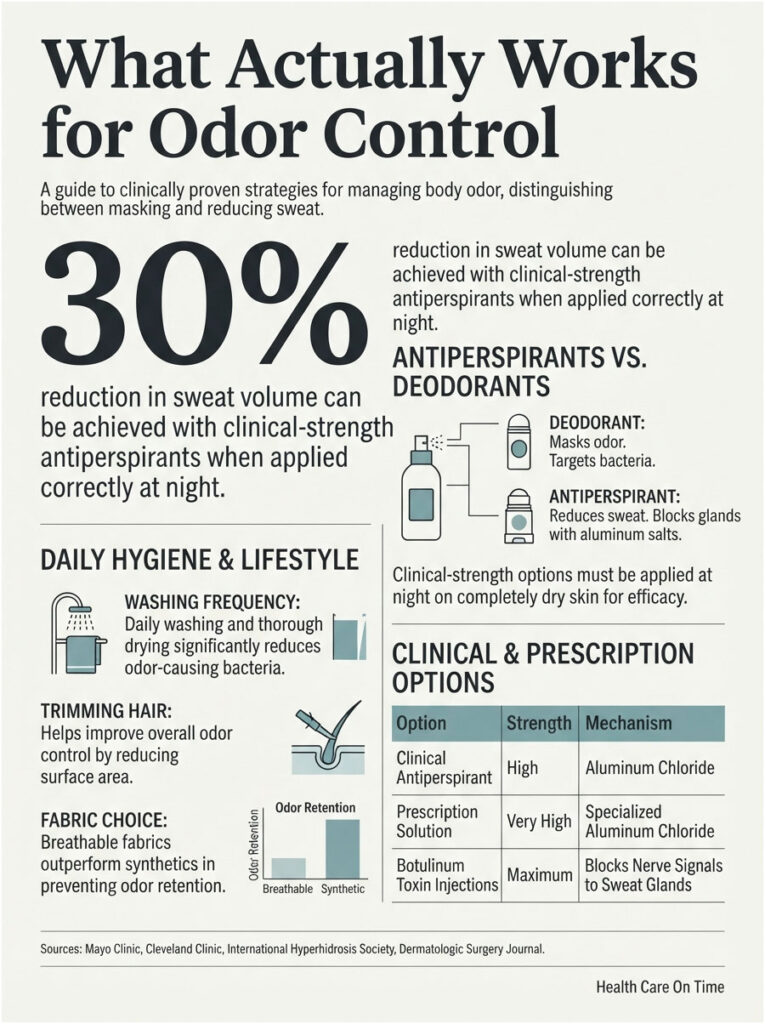
Deodorant masks or suppresses odor using fragrance and antibacterial agents. It does nothing to reduce how much you sweat.
Antiperspirant reduces sweat output. Aluminum or zirconium salts form temporary plugs inside eccrine sweat ducts, cutting the moisture bacteria depend on.
If wetness is the complaint, you need an antiperspirant. If smell without much wetness is the complaint, deodorant is the right tool. Combination products exist and suit most people.
Over-the-counter clinical strength options
Clinical-strength antiperspirants carry higher aluminum chloride concentrations than standard formulas and are sold without a prescription. Apply them at night on completely dry skin.
That timing matters more than the brand. Sweat ducts are least active during sleep, and the salts need undisturbed hours to form plugs.
Applying antiperspirant to damp skin right before a workout is the most common mistake in odor control. The product washes away before it can work.
Prescription and procedural options
Prescription-strength aluminum chloride hexahydrate solutions are the usual next step when drugstore products fail. Skin irritation is the main side effect and often improves with less frequent application.
Botulinum toxin injections block the nerve signals that trigger sweating, with results typically lasting four to six months per treatment. Microwave thermolysis destroys sweat glands in the treated area across one or two sessions.
Surgical removal of axillary glands remains available as a last resort, with scarring and recovery considerations that deserve a full conversation with a dermatologist or surgeon.
Habits that outperform product choice
Wash the armpits, feet, and groin daily and dry thoroughly, since bacteria multiply fastest in damp skin folds. Change out of sweaty clothing instead of letting it dry on the body.
Cotton and other breathable fabrics hold less odor than synthetic athletic wear, which traps odor compounds inside the fibers. Wash gym clothes promptly, because dried-in odor becomes stubborn.
Trimming underarm hair reduces the surface area where bacteria colonize and where odor molecules linger. It will not eliminate odor, but it makes everything else work better.
What does not work
Baking soda alone irritates plenty of people’s skin without controlling sweat at all. Aluminum-free natural deodorants can manage mild odor but do nothing for sweating, so they disappoint anyone with a real hyperhidrosis component.
Laboratory screening has identified plant compounds, including the soy isoflavone genistein, as in vitro inhibitors of ABCC11. That is early-stage cell research, not a diet plan, and eating soy will not switch off your armpits.
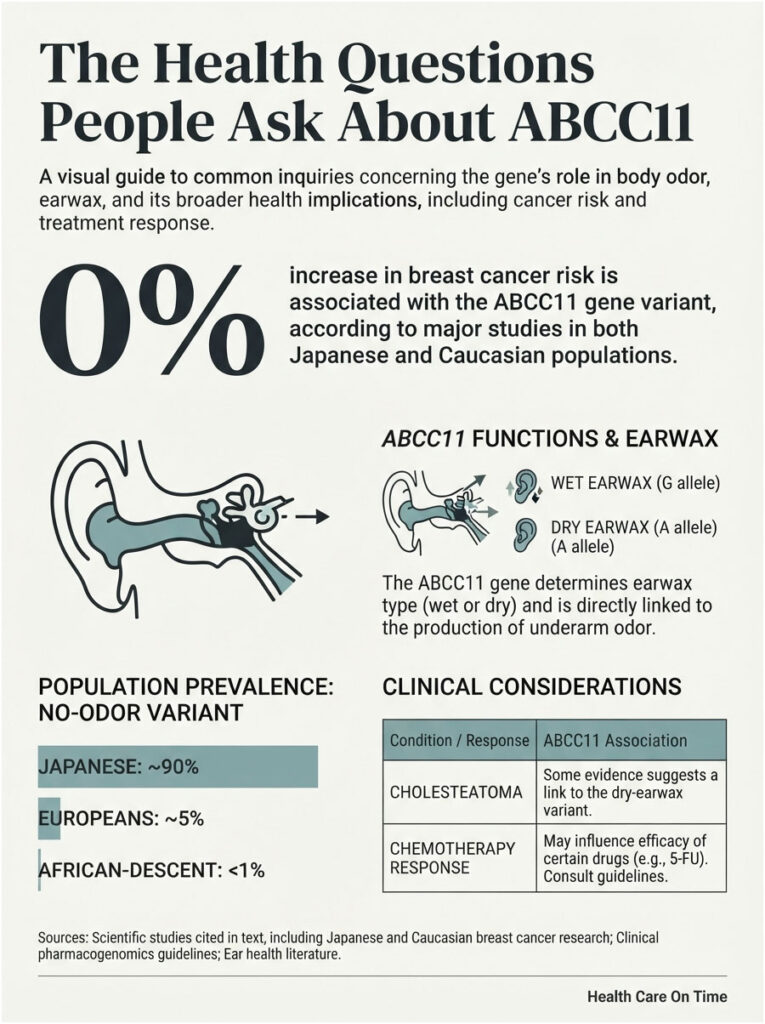
The Health Questions People Ask About ABCC11
Because ABCC11 is expressed in breast tissue as well as sweat glands, this gene has collected health associations that deserve careful handling rather than headlines.
The breast cancer question, answered honestly
Decades ago, researchers noticed that international breast cancer rates loosely tracked wet earwax prevalence. Once the responsible variant was identified, that observation finally became testable.
What the Japanese data showed
A study of 270 women with invasive breast cancer and 273 controls in Japan found the G allele more frequent among patients. The reported odds ratio for GG or GA genotypes was 1.63, with a p-value of 0.026.
What the replication attempt found
A separate analysis of 1,342 cases and 2,256 controls among Caucasian women found no evidence of any association between this variant and breast cancer risk.
Those findings do not reconcile neatly. The Japanese study was small, population-specific, and reported a modest effect; the larger study in a different population found nothing at all.
The honest position: no professional body recommends ABCC11 genotyping for breast cancer risk, and no US screening guideline references it. Wet earwax tells you nothing actionable about your cancer risk.
Separate work has found that high ABCC11 expression inside tumors correlates with aggressive subtypes and poorer disease-free survival. Tumor expression and inherited genotype are different measurements answering different questions, and mixing them produces bad conclusions.
Earwax, cholesteatoma, and ear health
A 2022 analysis suggested a possible link between certain ABCC11 alleles and middle ear cholesteatoma, a noncancerous cyst that develops behind the eardrum. The finding is preliminary and does not justify screening.
Dry earwax carries one everyday consequence: it traps dust and debris less effectively than sticky wax. It also forms obstructive plugs less often, so the trade runs both directions.
Chemotherapy response and pharmacogenomics
ABCC11 pumps out nucleoside-based drugs alongside its natural cargo. That raised interest in 538G>A as a possible biomarker for predicting response to certain chemotherapy regimens.
This remains a research question rather than clinical practice. Our lab partners report that it has not entered routine pharmacogenomic panels in the US market.
Frequently Asked Questions
What is the ABCC11 gene in simple terms?
It is the instruction manual for a pump that moves molecules out of certain gland cells. In the armpits, that pump exports the odorless compounds skin bacteria later convert into body odor. It also determines whether earwax is wet or dry.
Can you be born with no body odor at all?
Not entirely. The AA genotype removes the classic armpit odorants, but feet, groin, scalp, and breath still produce smell through separate mechanisms. People with this genotype have far less underarm odor, not zero odor everywhere.
Does dry earwax always mean no body odor?
It strongly suggests it without guaranteeing it. Ear canal humidity, skin conditions, cleaning habits, and age all change wax appearance. Some AA individuals still notice odor from compounds unrelated to the three main axillary odorants.
What percentage of Americans have the no-odor variant?
Roughly 2% of Americans of European descent carry the AA genotype. The figure runs far higher among Americans of East Asian ancestry, where loss-of-function prevalence reaches 80% to 95%, and near zero among those of West African descent.
How do I check rs17822931 in my 23andMe raw data?
Download your raw data file, open it in a text editor or spreadsheet, and search for rs17822931. Two A copies indicate the non-functional variant. Some files use plus-strand notation showing C/T instead, where T corresponds to A.
If I have the AA genotype, can I stop using deodorant?
Biologically, yes. In practice, ALSPAC data showed 77.8% of genotypically non-odorous people kept using it regardless. Two product-free days and a check of a worn shirt is a low-risk way to find out what suits you.
Does the ABCC11 gene affect foot odor or breath?
No. ABCC11 acts on apocrine glands, concentrated in the armpits and groin. Foot odor comes from eccrine sweat and different bacterial species, while breath odor comes from oral bacteria or metabolic sources.
Can two parents with dry earwax have a child with wet earwax?
Almost never. Two AA parents can only pass A alleles, so their child will be AA. The reverse happens often: two wet-earwax parents each carrying a hidden A allele have a one in four chance of a dry-earwax child.
Is strong body odor a sign of a health problem?
Usually not, though a sudden change deserves attention. Fruity odor can signal diabetic ketosis, ammonia-like odor can suggest kidney problems, and fish-like odor may indicate trimethylaminuria. Persistent new odor with other symptoms warrants a medical workup.
Does diet change body odor regardless of genotype?
Yes. Garlic, onions, cruciferous vegetables, red meat, alcohol, and certain spices release sulfur compounds and other volatiles through sweat and breath. Diet shifts odor character in everyone, including people lacking the classic axillary odorants.
Is the ABCC11 gene linked to breast cancer?
Evidence is inconsistent. One Japanese study reported an odds ratio of 1.63 for the G allele, while a larger study of Caucasian women found no association. No US screening guideline uses ABCC11 genotype for risk assessment.
Can gene therapy or supplements switch off ABCC11?
Not currently. Laboratory screening has identified compounds such as genistein that inhibit the transporter in cell models, but nothing has reached approved treatment. Odor control still depends on antiperspirants, hygiene, and medical procedures when needed.
Medical Disclaimer: This article provides general information and does not replace advice from a licensed healthcare professional. Genetic variants describe tendencies across populations and cannot diagnose any individual condition. Persistent, severe, or newly changed body odor should be evaluated by a physician, since it may reflect an underlying metabolic, endocrine, or dermatologic condition. Do not start, stop, or change any treatment based on information in this article.
References
- How the ABCC11 gene affects body odor, Medical News Today, medically reviewed by Paul A. Regan, MD, FAAD
- Microbial Origins of Body Odor, American Society for Microbiology
- ABCC11 gene record, NIH Genetic Testing Registry, National Library of Medicine
- A Functional ABCC11 Allele Is Essential in the Biochemical Formation of Human Axillary Odor, Journal of Investigative Dermatology
- Dependence of Deodorant Usage on ABCC11 Genotype, Journal of Investigative Dermatology
- The Pharmacogenetics of Body Odor, Journal of Investigative Dermatology commentary
- A strong association of axillary osmidrosis with the wet earwax type determined by ABCC11 genotyping, BMC Genetics
- A missense variant of ABCC11 associated with axillary osmidrosis in the Chinese Han population
- Clinical and Molecular Evidence of ABCC11 Protein Expression in Axillary Apocrine Glands
- Pharmacogenomics of Human ABC Transporter ABCC11 (MRP8)
- Association between breast cancer risk and the wild-type allele of ABCC11, PubMed
- No evidence for an association between the earwax-associated ABCC11 polymorphism and breast cancer risk in Caucasian women
- Soy Isoflavone Genistein Inhibits ABCC11, an Axillary Osmidrosis Risk Factor
- Hyperhidrosis, Symptoms and Causes, Mayo Clinic
- Sweating and Body Odor, Symptoms and Causes, Mayo Clinic
- Roses, noses, and underarms, NCBI Bookshelf, National Library of Medicine
- How Are Earwax and Body Odor Linked, The Scientist