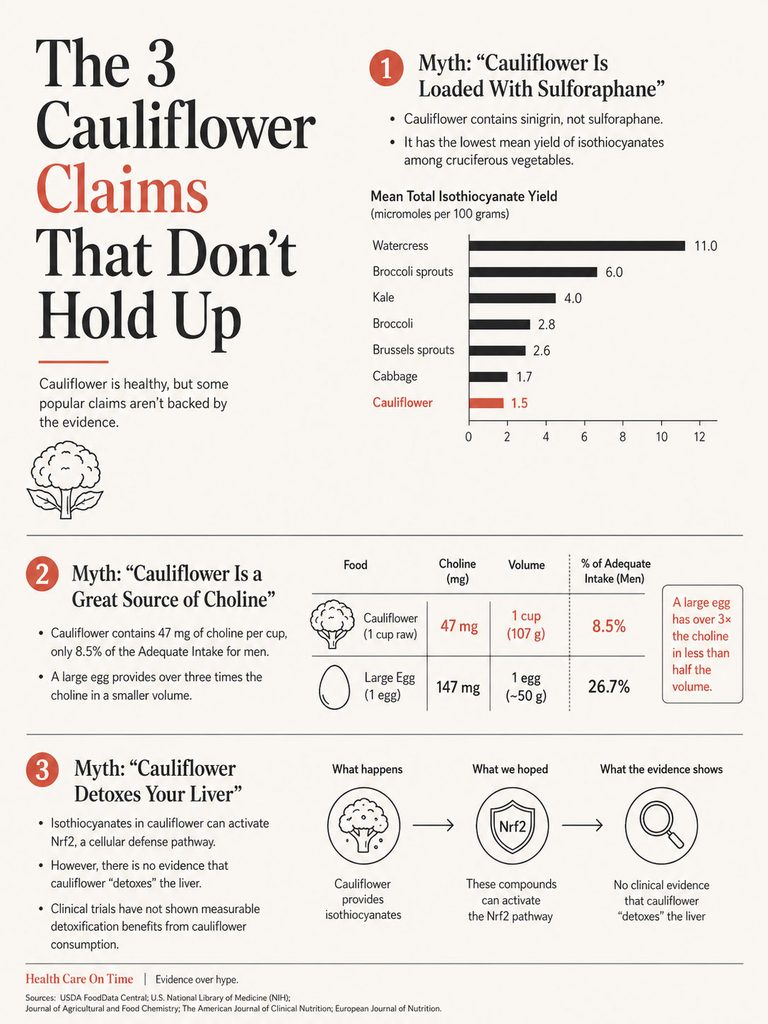
A US laboratory once tested 73 samples of nine cruciferous vegetables commonly sold in American supermarkets. It measured how much active isothiocyanate each one actually released when eaten raw.
Cauliflower finished last. Dead last, at 1.5 micromoles per 100 grams, against a nine-vegetable average of 16.2 and a mustard greens high of 61.3.
Table of Contents
That single result contradicts most of what gets written about this vegetable. And yet the health benefits of cauliflower are still real. They are simply not the ones the internet keeps repeating.
Quick Answer
Cauliflower delivers about 27 calories, 51.6 mg of vitamin C (roughly 57% of the Daily Value), 2.1 grams of fiber, and 320 mg of potassium per raw cup. Its strongest evidence sits in blood pressure and vascular health, where a controlled trial using cauliflower inside a cruciferous mix lowered 24-hour systolic pressure by 2.5 mmHg. Its weakest claim is sulforaphane, which cauliflower produces in the smallest amounts of any common cruciferous vegetable.
At a Glance
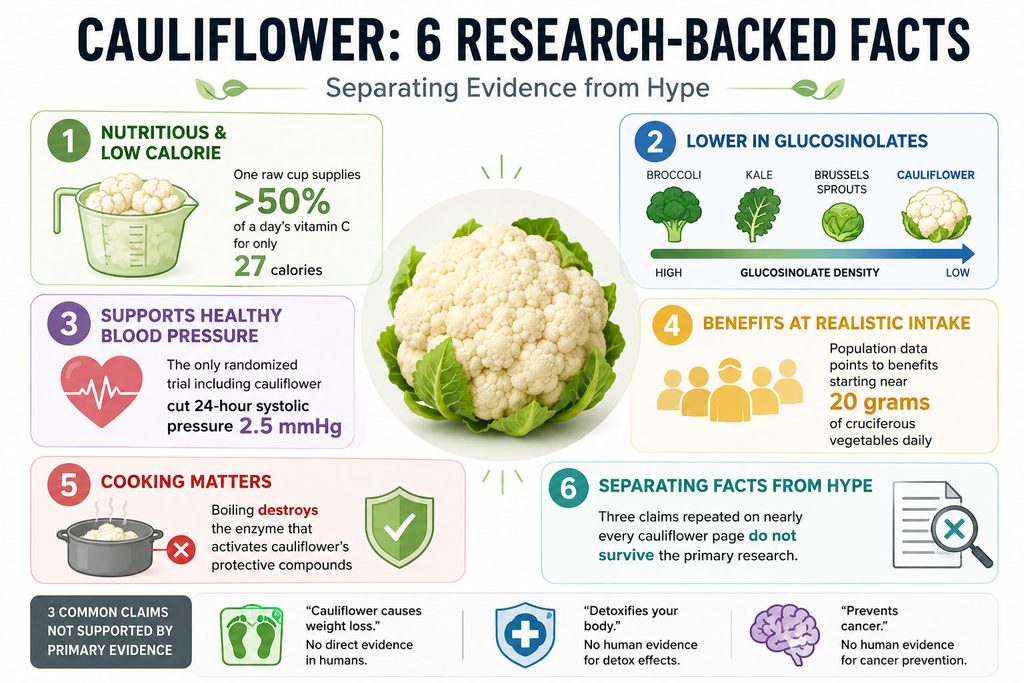
- One raw cup supplies more than half a day’s vitamin C for 27 calories
- Cauliflower ranks near the bottom of cruciferous vegetables for glucosinolate density
- The only randomized trial including cauliflower cut 24-hour systolic pressure 2.5 mmHg
- Population data points to benefits starting near 20 grams of cruciferous vegetables daily
- Boiling destroys the enzyme that activates cauliflower’s protective compounds
- Three claims repeated on nearly every cauliflower page do not survive the primary research
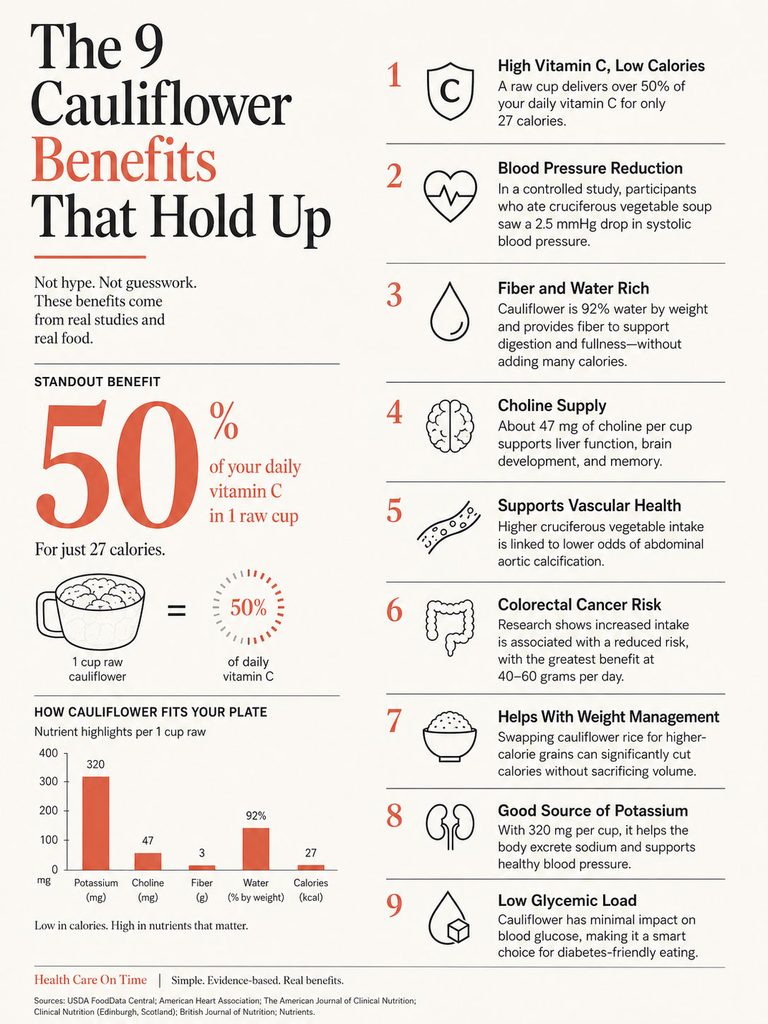
The nine cauliflower benefits covered below: vitamin C density, blood pressure reduction, fiber with high water volume, choline contribution, lower vascular calcification odds, colorectal risk reduction, calorie displacement for weight management, potassium against sodium load, and negligible glycemic impact.
What Cauliflower Actually Is (And Why That Matters)
Cauliflower is not a root, a leaf, or a fruit. It is an immature flower head, thousands of undeveloped buds packed into one dense white curd.
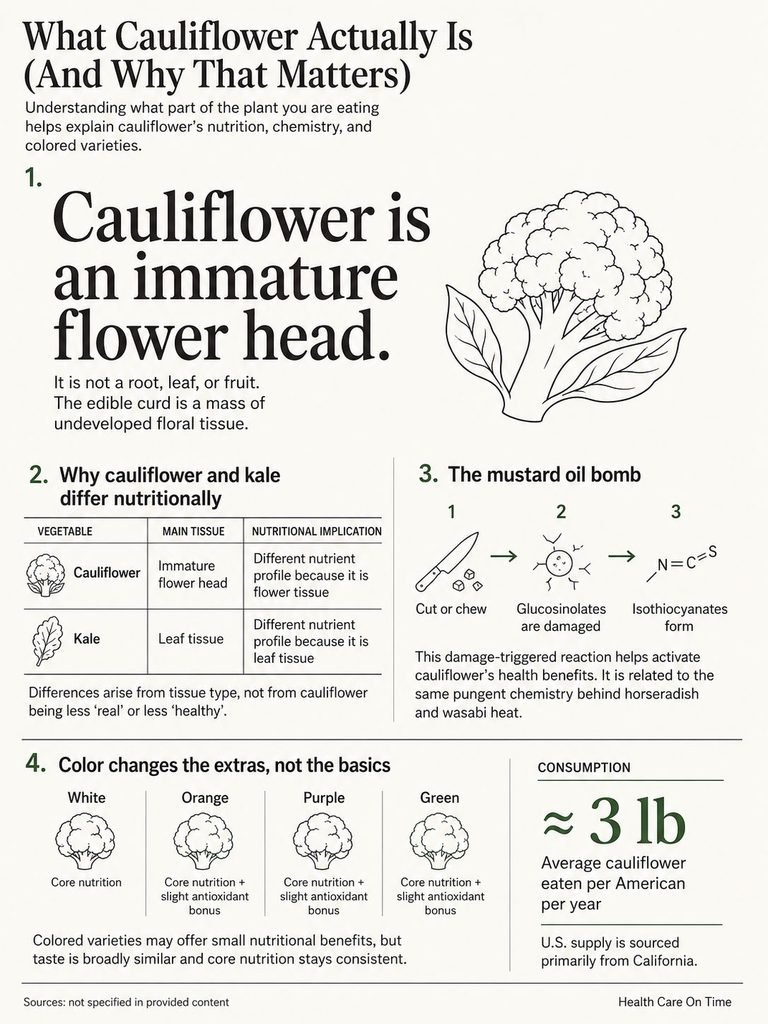
That botanical detail explains its nutrition. Flower tissue stores different compounds than leaf tissue does, which is why cauliflower and kale, close cousins within the same species Brassica oleracea, deliver such different nutrient profiles.
Where the Active Compounds Live
Cauliflower stores sulfur-containing molecules called glucosinolates inside its cells. On their own, glucosinolates do almost nothing.
The action starts when you cut, chew, or crush the vegetable. That damage releases an enzyme called myrosinase, which sits in a separate cell compartment, and the two react to form isothiocyanates, the compounds carrying most of the biological activity.
Researchers nicknamed this reaction the mustard oil bomb. It is the same chemistry behind horseradish and wasabi heat, and it is why cooking method matters more for cauliflower than for almost any other vegetable in your cart.
White, Orange, Purple, and Green Varieties
Orange cauliflower carries beta-carotene the white variety lacks. Purple heads contain anthocyanins, the same pigment class found in blueberries and red cabbage. Green cauliflower, sometimes labeled broccoflower, sits chemically between cauliflower and broccoli.
Taste stays roughly the same across all four. Patients who ask us whether the colored varieties justify the higher price get a straightforward answer: the pigment adds a small antioxidant bonus, but the core nutrition barely moves.
Americans eat roughly 3 pounds of cauliflower per person per year, according to USDA Economic Research Service availability data. Around 90% of the US supply grows in California, concentrated in the Salinas Valley.
Cauliflower Nutrition, By the Numbers
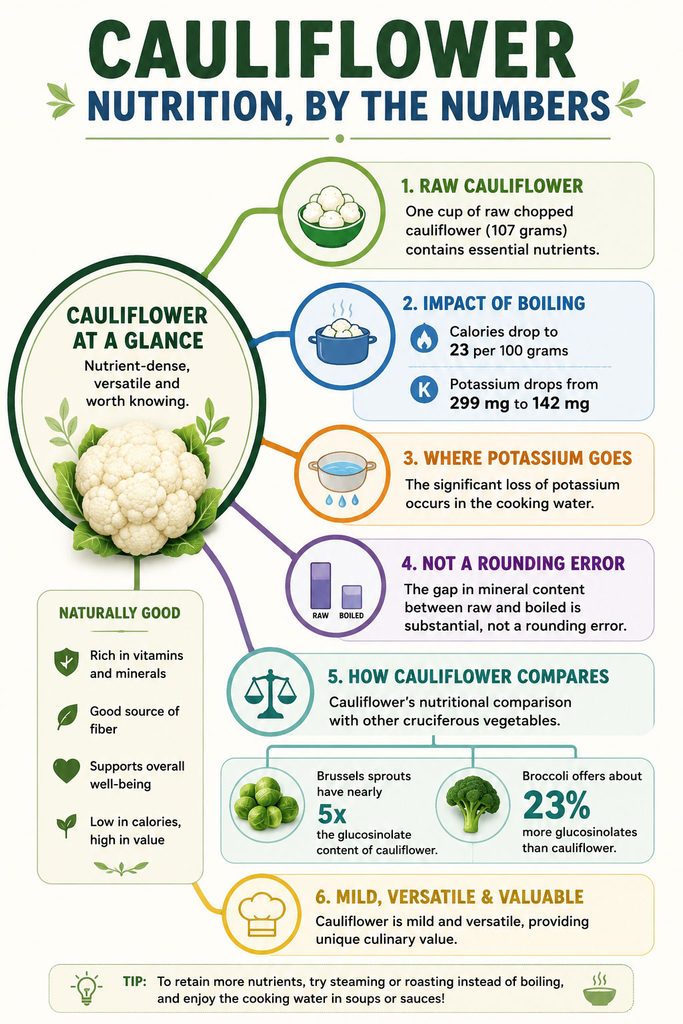
Here is what one cup of raw chopped cauliflower (107 grams) actually contains, drawn from USDA FoodData Central entry 169986:
- Calories: 27
- Water: 98.5 grams, about 92% of total weight
- Fiber: 2.1 grams
- Total carbohydrate: 5.3 grams, of which roughly 3.2 grams are net carbs
- Protein: 2.1 grams
- Vitamin C: 51.6 mg, about 57% of the Daily Value
- Folate: 61 mcg, about 15% DV
- Potassium: 320 mg, about 7% DV
- Choline: 47 mg
- Vitamin K: 17 mcg, about 14% DV
Boiling rewrites that picture. USDA entry 170397 puts boiled, drained cauliflower at 23 calories per 100 grams, with potassium falling from 299 mg to 142 mg. More than half the potassium leaves the vegetable and stays in the cooking water.
Our medical reviewers flag this often when patients compare nutrition labels. The gap between raw and boiled cauliflower is not a rounding error; it halves the mineral content.
Table 1: Cauliflower Nutrition Compared to Other Cruciferous Vegetables
| Vegetable (raw) | Serving | Calories | Vitamin C (mg) | Fiber (g) | Total glucosinolates (mg) |
| Brussels sprouts | ½ cup (44 g) | 19 | 37.4 | 1.7 | 104 |
| Kale | 1 cup (67 g) | 23 | 80.4 | 2.6 | 67 |
| Broccoli | ½ cup (44 g) | 15 | 40.5 | 1.2 | 27 |
| Cauliflower | ½ cup (50 g) | 13 | 24.1 | 1.0 | 22 |
| Bok choy | ½ cup (35 g) | 5 | 15.8 | 0.4 | 19 |
Nutrient values from USDA FoodData Central. Glucosinolate values from the McNaughton and Marks food composition database published in the British Journal of Nutrition.
Read that last column carefully, because no other cauliflower article prints it. Brussels sprouts carry nearly five times the glucosinolate load of cauliflower in a comparable serving. Broccoli carries about 23% more.
Cauliflower is not the cruciferous heavyweight. It is the mild, versatile one, and that has genuine value of its own.
The 9 Cauliflower Benefits That Hold Up
Before the list, one honest note about geography. The two strongest studies below were run in Australia, in mostly white participants who already ate more vegetables than the typical American. The biology travels; the exact numbers may not.
1. Serious Vitamin C for Almost No Calories
A raw cup covers more than half your daily vitamin C at a cost of 27 calories. Very few foods match that ratio.
Vitamin C supports collagen synthesis, immune cell function, and non-heme iron absorption from plant foods. Pairing cauliflower with beans, lentils, or leafy greens measurably improves how much iron you take up from that meal.
The catch is heat. Vitamin C is water-soluble and heat-sensitive, so boiled cauliflower delivers considerably less than raw or lightly steamed.
2. A Measured Blood Pressure Effect in a Controlled Trial
This is the strongest human evidence cauliflower has, and almost no consumer article mentions it.
The VESSEL study, published in BMC Medicine in 2024, randomized adults aged 56 to 72 with mildly elevated blood pressure to two-week soup interventions in crossover order. The active soup contained roughly 300 grams daily of cruciferous vegetables: 40% broccoli, 25% cauliflower, 25% cabbage, and 10% kale. The control soup used potato, pumpkin, carrot, and sweet potato at matched calories.
Twenty-four-hour ambulatory systolic pressure fell 2.5 mmHg on the cruciferous soup compared with control (95% confidence interval -4.1 to -0.9, P = 0.002). Daytime systolic pressure fell 3.6 mmHg. Serum triglycerides dropped modestly as well.
Why 2.5 mmHg Is Not Trivial
Pooled drug-trial data indicates a 5 mmHg systolic reduction lowers major cardiovascular events by roughly 10%. On that scale, the trial authors estimated their 2.5 mmHg result could translate to about 5% fewer major cardiovascular events.
Both groups lost a little weight, with no difference between them, so the blood pressure change was not a weight-loss artifact. Urinary sodium and potassium excretion did not differ either, which rules out a simple mineral explanation.
What the Researchers Flagged Themselves
Only 18 people enrolled. Pandemic-era recruitment problems stopped the team short of their 25-person target, and they described the result as a pilot trial rather than a phase 2 study.
Sixteen of the 18 participants were women, and 94% were Caucasian. Baseline vegetable intake was already high at 327 grams daily against a general-population average of 195 grams.
The 25% cauliflower share means participants ate about 75 grams of cauliflower daily, roughly three-quarters of a cup. That is a realistic amount, but cauliflower was one ingredient among four rather than the tested variable on its own.
Patients booking cardiovascular panels with us often ask whether a vegetable can replace medication. It cannot. What this trial suggests is that vegetable type may matter, not just vegetable quantity.
3. Fiber That Arrives With Water, Not Calories
Two grams of fiber per cup is respectable. The more useful number is the water content: 92% by weight.
That combination fills stomach volume and slows gastric emptying without adding meaningful calories. It is the mechanical reason cauliflower works as a stand-in for rice, mashed potato, or pizza crust.
Fiber also feeds colonic bacteria, which produce short-chain fatty acids that support gut barrier integrity. Most American adults fall well short of the 25 to 38 gram daily fiber target.
4. Choline, in an Honest Amount
Cauliflower supplies about 47 mg of choline per cup. Choline supports liver fat export, cell membrane structure, and acetylcholine production for memory and muscle control.
This matters because Americans run short. NHANES 2015-2018 data shows mean intakes of 284 mg daily for women and 390 mg for men, against Adequate Intake levels of 425 mg and 550 mg. Only about 6% of women and 11% of men exceed the AI.
A cup of cauliflower closes roughly 9% of that gap for an adult woman. Useful, real, and nowhere near enough on its own. More on that in the myths section below.
5. Vascular Calcification: The Observational Signal
Researchers scored abdominal aortic calcification in 684 older women, mean age 74.9, using spine imaging. Median cruciferous vegetable intake was 28.2 grams per day.
Women eating more than 44.6 grams daily had 46% lower odds of extensive calcification compared with those eating under 15 grams (odds ratio 0.54, 95% CI 0.30 to 0.97). Cauliflower was one of four vegetables counted, alongside cabbage, Brussels sprouts, and broccoli.
This is cross-sectional data, so it cannot establish that eating cruciferous vegetables caused the difference. Women who eat more vegetables differ in many other ways. Treat it as a signal worth knowing, not proof.
6. Colorectal Cancer Risk: What the Dose Data Shows
A 2025 dose-response meta-analysis in BMC Gastroenterology pooled cohort and case-control studies through June 2025. Higher cruciferous vegetable intake associated with an odds ratio of 0.80 for colorectal cancer (95% CI 0.72 to 0.90).
The dose curve is the interesting part. Risk reduction began around 20 grams per day, the steepest per-gram benefit fell between 20 and 40 grams, and the optimal range landed at 40 to 60 grams daily.
Forty grams is a little over a third of a cup of chopped cauliflower. That is a genuinely modest target.
The authors reported significant publication bias (Egger’s test P = 0.001) and noted that mixing case-control designs into the pool introduces recall bias. In cases reviewed by our medical team, this is exactly the kind of finding that supports a dietary habit without justifying a health claim.
7. Satiety and Calorie Displacement for Weight Management
Cauliflower’s weight value is arithmetic, not metabolic. Replacing one cup of cooked white rice (about 205 calories) with one cup of cauliflower rice (about 25 calories) removes roughly 180 calories from that meal.
Do that five times a week and the deficit reaches about 900 calories weekly. Sustained across a year, that is meaningful, provided the calories do not return as oil, cheese, or sauce.
There is no evidence cauliflower burns fat, blocks absorption, or raises metabolic rate. It simply occupies room that denser food would otherwise fill.
8. Potassium Against a National Sodium Problem
Most Americans take in too much sodium and too little potassium. Potassium helps the kidneys excrete sodium and relaxes blood vessel walls.
Raw cauliflower supplies 320 mg per cup. That falls to roughly 175 mg per cup when boiled and drained, which is a strong argument for roasting or steaming instead.
9. Blood Sugar: Low Glycemic Load by Design
At roughly 3 grams of net carbohydrate per cup, cauliflower has a negligible effect on blood glucose. That is why it appears constantly in diabetes and low-carbohydrate meal plans.
A follow-up analysis of the VESSEL trial, published in Diabetes, Obesity and Metabolism, reported improved glycemic markers on the cruciferous soup compared with the root and squash control. The same small-sample limitations apply, and cauliflower was again one ingredient among four.
The 3 Cauliflower Claims That Don’t Hold Up
Myth 1: “Cauliflower Is Loaded With Sulforaphane”
This appears on nearly every major cauliflower page online. It is the single most repeated error about this vegetable.
Sulforaphane comes from one specific glucosinolate called glucoraphanin. Broccoli is genuinely rich in glucoraphanin. Cauliflower is not.
Analysis of Brassica oleracea varieties found cauliflower’s dominant glucosinolate is sinigrin, present at around 9.3 micromoles per gram of dry weight, followed by glucobrassicin at 1.3. Sinigrin produces allyl isothiocyanate, the pungent compound in mustard and horseradish, not sulforaphane.
The 41-Fold Spread Across US Crucifers
The strongest evidence is the Journal of Functional Foods analysis opening this article. Across 73 samples of nine raw cruciferous vegetables sold in the United States, isothiocyanate yield varied 41-fold.
Raw cauliflower produced the lowest mean yield at 1.5 micromoles per 100 grams. Mustard greens produced 61.3. The nine-vegetable average was 16.2.
So cauliflower does contain glucosinolates and does form isothiocyanates. But if sulforaphane specifically is your goal, broccoli sprouts contain 10 to 100 times more glucoraphanin than mature broccoli, which itself substantially outperforms cauliflower. Our lab partners report this distinction gets lost constantly when patients bring in supplement labels for review.
Myth 2: “Cauliflower Is a Great Source of Choline”
Cauliflower contains choline. The question is whether 47 mg per cup earns the word “great.”
Against an Adequate Intake of 550 mg for men, one cup covers about 8.5%. A single large egg supplies roughly 147 mg, more than three times as much, in a fraction of the volume.
Calling cauliflower a great choline source leads a reader to think the problem is handled when it is not. A more accurate framing: cauliflower is a modest, worthwhile contributor to a nutrient most Americans under-consume.
Myth 3: “Cauliflower Detoxes Your Liver”
The kernel of truth is real. Isothiocyanates activate a cellular pathway called Nrf2, which increases production of phase II enzymes including glutathione S-transferases. Those enzymes help the body process and clear foreign compounds.
The problem is the leap from “increases enzyme expression” to “detoxes your liver.” Your liver detoxifies continuously without dietary assistance, and no clinical trial has shown that eating cauliflower clears any measurable toxin from a human body.
Human trials in this area used Brussels sprouts at 300 grams daily or watercress at 170 grams daily to shift enzyme markers, not cauliflower. The Linus Pauling Institute states plainly that there is insufficient evidence that isothiocyanate exposure through cruciferous vegetable consumption decreases cancer risk.
How You Cook It Changes What You Get
Boiling Breaks the Activation Enzyme
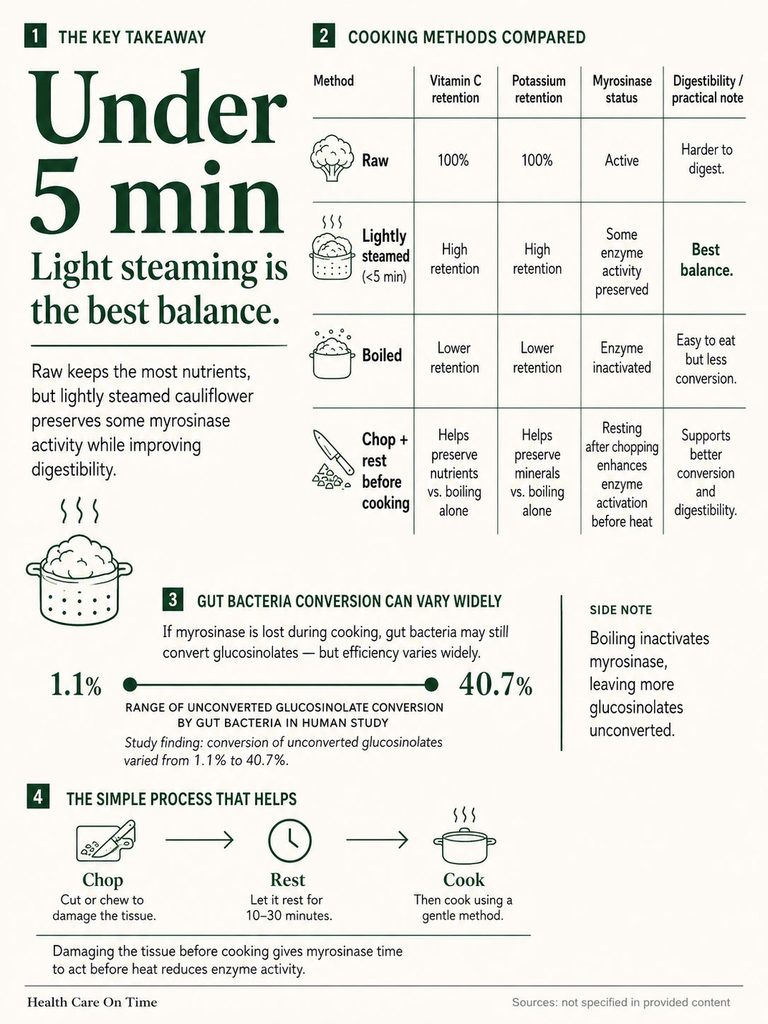
Myrosinase is a protein, and heat denatures proteins. Boiling cauliflower inactivates myrosinase almost completely, which means glucosinolates pass into your digestive tract unconverted.
Light steaming for under five minutes preserves part of the enzyme. Chopping the vegetable and letting it rest 30 to 40 minutes before cooking lets the reaction begin before heat arrives.
Your Gut Bacteria Are the Backup System
Unconverted glucosinolates are not wasted. They reach the colon, where bacterial myrosinase can convert them.
That backup runs at a poor exchange rate. In a feeding study of 45 healthy adults, mean conversion of glucosinolates to measurable metabolites over 24 hours ran about 12%, with individual results ranging from 1.1% to 40.7%. By comparison, 70% to 75% of already-formed isothiocyanates get metabolized.
That 37-fold spread between individuals is one reason cruciferous vegetable research produces inconsistent results. Two people eating identical meals can end up with wildly different internal exposure.
Table 2: What Each Cooking Method Costs You
| Method | Vitamin C retention | Potassium retention | Myrosinase status | Practical verdict |
| Raw | 100% (baseline 51.6 mg/cup) | 100% (320 mg/cup) | Fully active | Best enzyme activity; hardest to digest |
| Steamed under 5 min | Roughly 80-90% | Roughly 90% | Partially active | Best overall balance |
| Roasted | Roughly 60-75% | Roughly 95% (no leaching) | Largely inactivated | Best flavor, minerals preserved |
| Boiled and drained | Roughly 50-55% | 47% (142 mg vs 299 mg per 100 g) | Fully inactivated | Weakest nutritionally |
| Frozen then boiled | Reduced further | Reduced | Fully inactivated | 19 kcal per 100 g; convenient, less dense |
Calorie and mineral values from USDA FoodData Central entries 169986, 170397, and 170399. Enzyme behavior from the Linus Pauling Institute Micronutrient Information Center.
Who Should Be Careful With Cauliflower
If You Take Warfarin
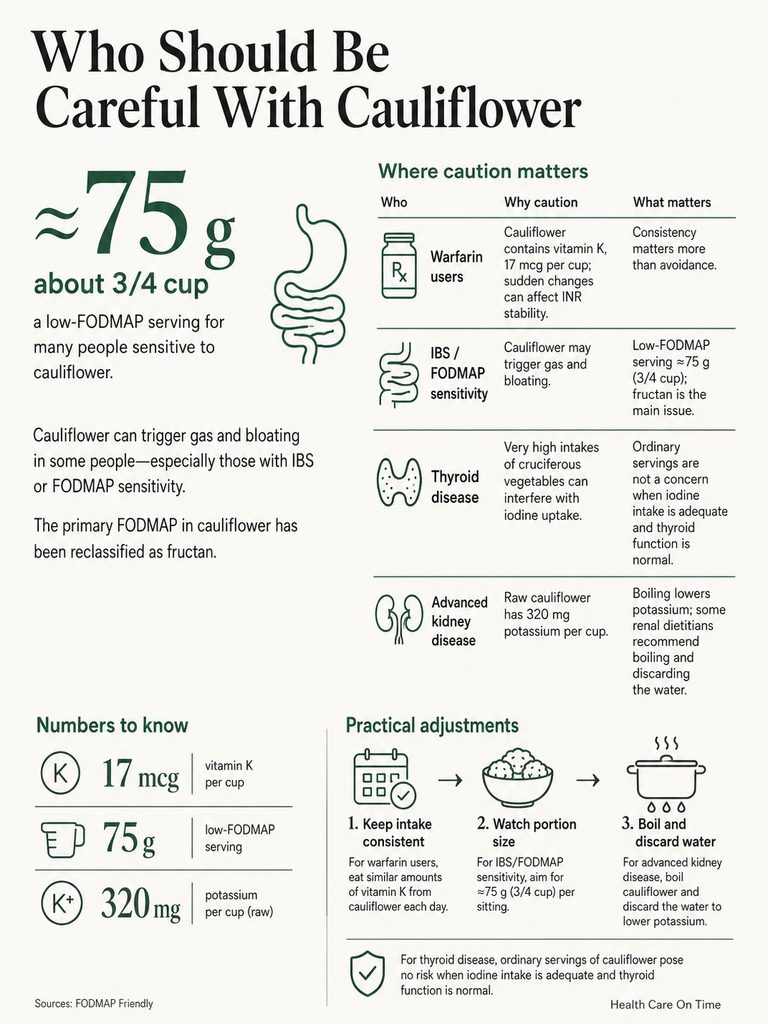
Cauliflower contains vitamin K, which counteracts warfarin. At roughly 17 mcg per raw cup it is a light source compared with kale or spinach, but it is not zero.
The clinical advice is consistency, not avoidance. Eating a similar amount of vitamin K each week lets your prescriber set a stable dose. Sudden large increases or eliminations are what destabilize INR.
If You Have IBS or FODMAP Sensitivity
Cauliflower is a well-known trigger for gas and bloating. Monash University reclassified its primary FODMAP in May 2025 from mannitol to fructan, and identifies roughly 75 grams as a low-FODMAP serving.
That is about three-quarters of a cup. Above it, symptoms become more likely in sensitive people. FODMAP Friendly, a separate certifying body, publishes different thresholds, so treat any single number as a starting point rather than a rule.
If You Have Thyroid Disease
Cruciferous vegetables contain compounds that can interfere with iodine uptake at very high intakes. The doses in documented cases were extreme, involving raw consumption far beyond normal eating patterns.
For someone with adequate iodine and a normally functioning thyroid, ordinary cauliflower servings carry no realistic risk. If you have hypothyroidism and take levothyroxine, raise total cruciferous intake with your prescriber rather than cutting a food group on your own.
If You Have Advanced Kidney Disease
Potassium restriction applies at later stages of chronic kidney disease. Raw cauliflower at 320 mg per cup is moderate, and boiling cuts it by more than half, which is one reason renal dietitians often recommend boiling and discarding the water.
How Much to Eat, and How to Actually Eat It
The Gram Targets the Research Supports
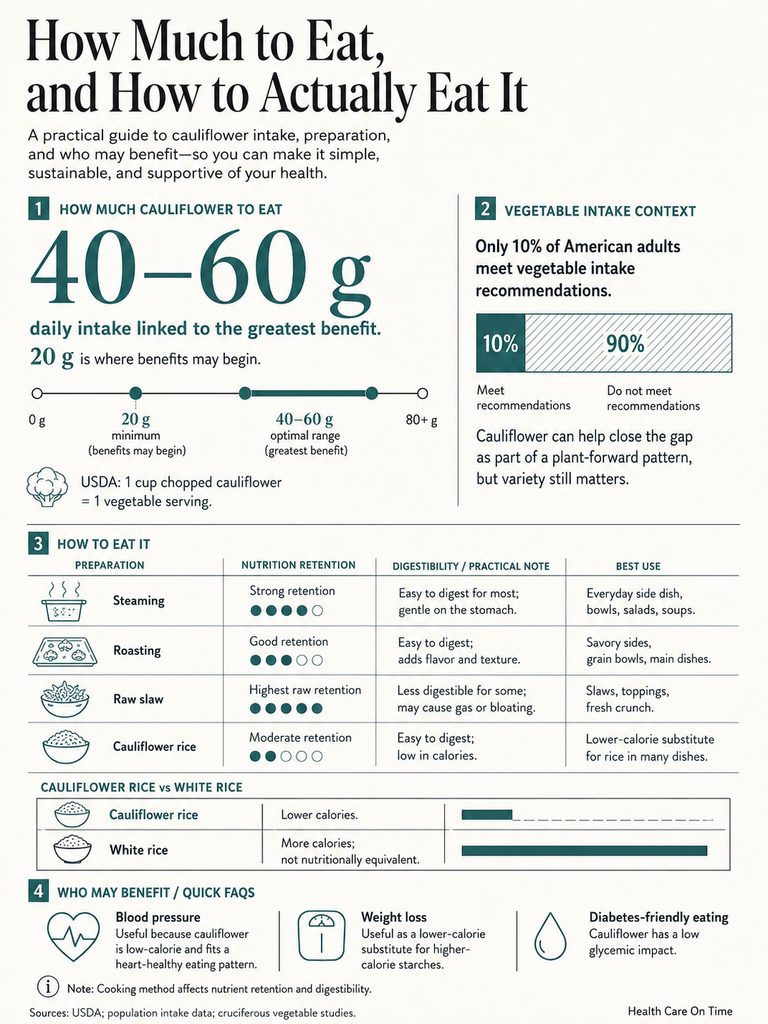
The colorectal dose-response data points to 20 grams daily as a floor and 40 to 60 grams as the range where benefit peaks. The vascular calcification study found its strongest signal above 44.6 grams daily.
The VESSEL trial used 75 grams of cauliflower inside a 300-gram cruciferous mix. Taken together, half a cup to one cup of cauliflower most days, alongside other cruciferous vegetables, matches every dose in the published literature.
For context, CDC survey data has found only about 10% of American adults meet vegetable intake recommendations at all. Reaching a daily half cup would put most readers ahead of the curve.
Table 3: Match Your Goal to the Right Cauliflower Approach
| If your goal is… | Then eat this much | Prepare it this way | Evidence strength |
| Blood pressure support | 75 g daily inside a 300 g cruciferous mix | Soup, steamed, or roasted | Moderate (one small RCT, n=18) |
| Colorectal risk reduction | 40-60 g daily of cruciferous vegetables | Any method | Moderate (meta-analysis, publication bias noted) |
| Maximum vitamin C | 1 cup (107 g) | Raw or steamed under 5 minutes | Strong (direct USDA measurement) |
| Calorie displacement for weight | 1-2 cups replacing rice or potato | Riced, roasted, or mashed with minimal fat | Strong (energy arithmetic) |
| Highest isothiocyanate yield | Choose a different crucifer | Brussels sprouts or broccoli instead | Strong (cauliflower ranks lowest of nine) |
| Gentle on a sensitive gut | Cap at 75 g per sitting | Well-cooked, spread across the day | Moderate (Monash FODMAP data) |
Dose ranges drawn from the VESSEL trial, the 2025 colorectal dose-response meta-analysis, USDA FoodData Central, and Monash University FODMAP guidance.
Three Preparations That Keep the Nutrition Intact
Roast florets at 425°F with olive oil until the edges brown. Roasting preserves minerals because nothing leaches into water, and caramelization makes the vegetable palatable without cheese sauce.
Steam for four minutes and finish with lemon juice. The short cook protects some myrosinase, and the vitamin C in lemon reinforces what heat took away.
Shave raw florets thin for a slaw. Raw delivers maximum enzyme activity and full vitamin C, though it is the hardest form to digest.
Cauliflower Rice, Honestly Assessed
Cauliflower rice is genuinely lower in calories than white rice, roughly 25 per cup against 205. That gap is real and useful.
What it is not is nutritionally equivalent. Rice supplies more carbohydrate energy, and enriched white rice sold in the United States is fortified with folate, thiamin, niacin, and iron. Swapping every serving removes those fortified nutrients from your diet.
Frozen retail cauliflower rice also varies widely in package weight per cup, which explains why calorie labels across brands range from about 20 to 47 per serving. Check grams, not cups.
Frequently Asked Questions
Is cauliflower healthier than broccoli?
Broccoli wins on most measures. It carries about 23% more glucosinolates per serving, substantially more vitamin C and vitamin K, and far more glucoraphanin, the sulforaphane precursor. Cauliflower’s advantages are milder flavor, better texture for substitution recipes, and slightly fewer calories. Both belong in your rotation.
What happens if you eat cauliflower every day?
For most people, nothing negative. Daily servings of half a cup to one cup fall within the range associated with benefit in population studies. Some people notice increased gas or bloating from the fructan content. Anyone on warfarin should keep intake steady rather than variable.
Is raw or cooked cauliflower better for you?
Raw preserves vitamin C and the myrosinase enzyme that activates protective compounds. Cooking improves digestibility and reduces gas. Steaming under five minutes offers the best compromise. Boiling is weakest, cutting potassium by more than half and destroying the enzyme entirely.
Does cauliflower actually help you lose weight?
Indirectly, through calorie displacement. Replacing a cup of cooked rice with cauliflower rice removes about 180 calories from that meal. There is no fat-burning or metabolic effect. The benefit disappears if the saved calories return as oil, butter, or cheese.
Why does cauliflower give me gas?
Cauliflower contains fructans, a fermentable carbohydrate the small intestine cannot fully absorb. Gut bacteria ferment them in the colon and produce gas. Monash University lists roughly 75 grams as a low-FODMAP serving. Cooking thoroughly and increasing portions gradually both help.
Can people with diabetes eat cauliflower?
Yes. At roughly 3 grams of net carbohydrate per cup, cauliflower has minimal effect on blood glucose and works well as a rice or potato substitute. Patients commonly ask us whether it can replace medication. It cannot, but it can cut the carbohydrate load of a meal considerably.
Is cauliflower rice as healthy as regular cauliflower?
Nutritionally it is the same vegetable, processed into smaller pieces. Differences come from cooking and additives. Frozen versions cooked from frozen lose some vitamin C, and some retail products add oil or salt. Check the label for anything beyond cauliflower.
Does cauliflower interfere with thyroid medication?
Not at normal serving sizes in people with adequate iodine. Documented interference involved extreme raw intakes far beyond typical eating. If you take levothyroxine, keep total cruciferous intake reasonably consistent and raise the question at your next appointment rather than eliminating these vegetables.
How much cauliflower is one serving?
USDA counts one cup of chopped cauliflower, about 107 grams, as one vegetable serving. Half a cup cooked also counts. A medium head weighs roughly 588 grams and yields about five to six cups of florets.
Can I eat cauliflower on warfarin?
Yes, with consistency. Cauliflower supplies about 17 mcg of vitamin K per raw cup, light compared with leafy greens. The risk comes from sudden changes in intake, not from the vegetable itself. Keep your weekly amount steady and tell your anticoagulation clinic about major dietary changes.
Is frozen cauliflower as nutritious as fresh?
Close. Frozen cauliflower is blanched before freezing, which inactivates myrosinase and costs some vitamin C. Minerals and fiber survive intact. Frozen then boiled comes in at 19 calories per 100 grams versus 25 raw, reflecting water uptake. For most purposes the difference is small enough to ignore.
Should I take a cauliflower or cruciferous supplement instead?
Whole-food evidence is stronger than extract evidence here. Supplements made without myrosinase show much lower isothiocyanate bioavailability; peak metabolite levels were eight times higher in plasma after fresh broccoli sprouts than after a supplement. Eat the vegetable.
Medical Disclaimer
This article is for general information and does not replace advice from a licensed healthcare professional. Cauliflower can interact with warfarin and other anticoagulants through its vitamin K content, and intake may need adjustment in advanced chronic kidney disease, thyroid disease, and irritable bowel syndrome. Do not change your diet, stop any medication, or begin a supplement based on this content. Speak with your physician, registered dietitian, or pharmacist about your individual situation. Nutrient values reflect USDA database averages and will vary with variety, growing conditions, storage, and preparation.
References
- USDA FoodData Central, Cauliflower, raw (FDC 169986)
- USDA FoodData Central, Cauliflower, cooked, boiled, drained (FDC 170397)
- Connolly EL, et al. Cruciferous vegetables lower blood pressure in adults with mildly elevated blood pressure: the VESSEL study. BMC Medicine. 2024;22:353
- Linus Pauling Institute Micronutrient Information Center, Isothiocyanates
- Linus Pauling Institute Micronutrient Information Center, Choline
- Blekkenhorst LC, et al. Cruciferous vegetable intake is inversely associated with extensive abdominal aortic calcification in elderly women. British Journal of Nutrition. 2021;125(3):337-345
- Cruciferous vegetables intake and risk of colon cancer: a dose-response meta-analysis. BMC Gastroenterology. 2025
- NIH Office of Dietary Supplements, Choline Fact Sheet for Health Professionals
- Cleveland Clinic, Health Benefits of Cauliflower
- Ahmadi Tabatabaei SV, et al. Fruit and vegetable intake in relation to lung cancer risk: dose-response meta-analysis. Journal of Cancer Prevention. 2025;30(2):75-88