Search this question tonight and two of the pages Google shows you are owned by freestanding emergency rooms. Both suggest that readings above 140/90 warrant a trip in. Every major clinical guideline in American medicine says the opposite.
Table of Contents
That gap between what gets published and what gets practiced is why so many people sit in a waiting room for four hours over a number that needed a phone call instead.
Quick Answer: A blood pressure of 140/90 is not, by itself, an emergency room visit. It falls into stage 2 hypertension under the 2025 AHA/ACC guideline and needs a doctor’s appointment within a week or two, not an ambulance. Three things change that answer: any red-flag symptom (chest pain, stroke signs, sudden vision loss), pregnancy past 20 weeks, or a reading at or above 180/120. Recheck properly first.
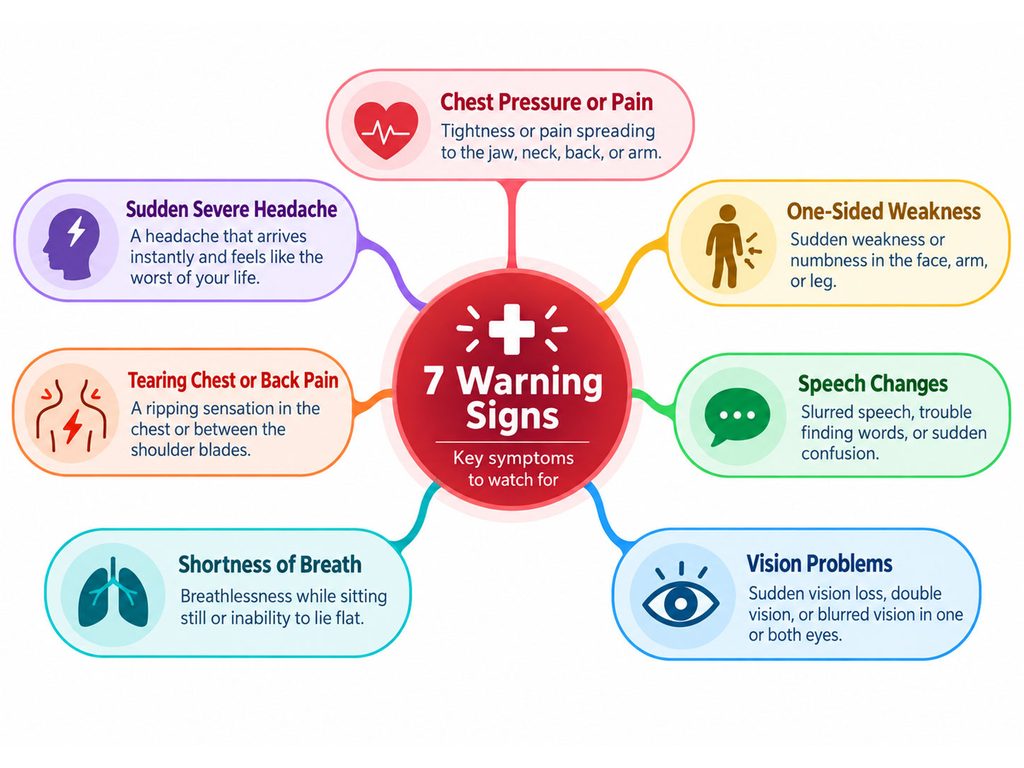
Go to the emergency room, or call 911, if a high reading comes with any of these:
- Chest pressure, tightness, or pain spreading to the jaw, neck, back, or arm
- Sudden weakness or numbness in the face, arm, or leg, especially on one side
- Slurred speech, trouble finding words, or sudden confusion
- Sudden vision loss, double vision, or vision blurring in one or both eyes
- Shortness of breath while sitting still, or inability to lie flat
- A headache that arrives instantly and feels like the worst of your life
- A tearing or ripping sensation in the chest or between the shoulder blades
At a Glance
• 140/90 is stage 2 hypertension, the level where guidelines recommend starting medication, but it is not an acute emergency on its own.
• Symptoms outrank the number. Chest pain or stroke signs mean call 911 even if your reading is 130/85.
• The threshold for emergency evaluation is 180/120, and even then only with signs of organ damage.
• Arm position and cuff size can inflate a reading by 6 to 20 mmHg, so a 140/90 is often a 130/85 measured badly.
• A landmark Cleveland Clinic study found that sending patients with far higher readings to the ER produced more hospital admissions and no better heart outcomes.
• Pregnancy past 20 weeks is the one common situation where 140/90 changes everything and needs same-day contact.
• Only about one in five Americans with hypertension has it controlled, so the real risk is years of no treatment, not one bad night.
The Short Answer, and the Three Things That Change It
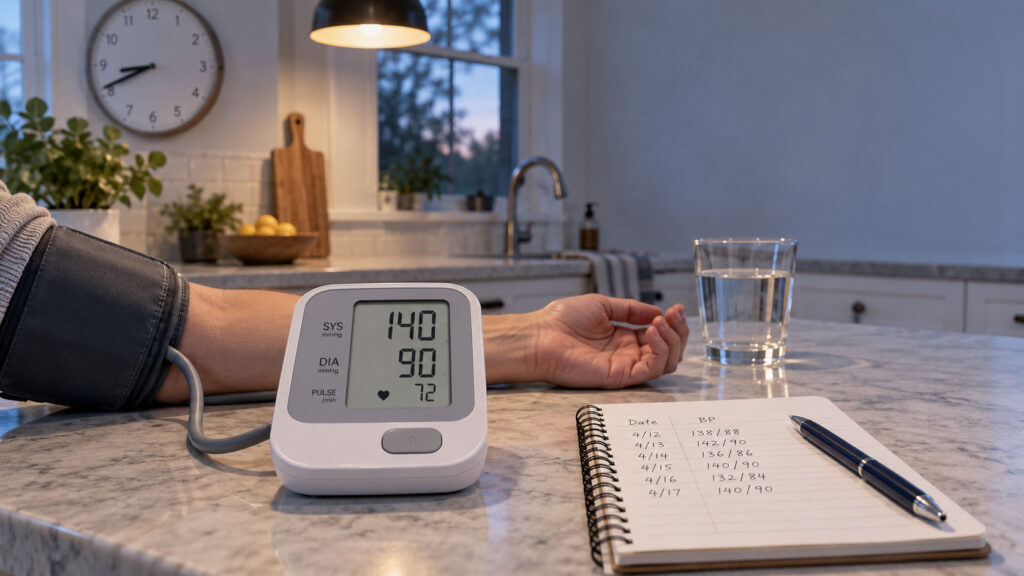
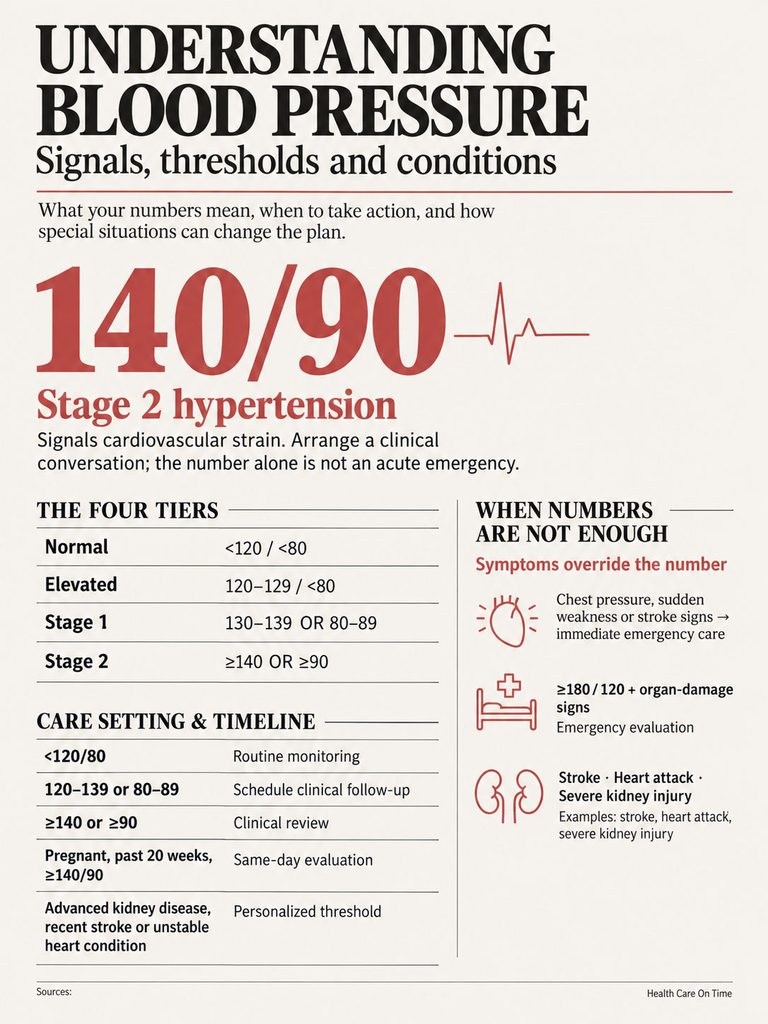
A single reading of 140/90 in someone who feels fine is a signal, not a siren. It means your cardiovascular system is under more strain than it should be, and it means you need a clinical conversation soon. It does not mean tonight, and it does not mean the emergency department.
Our medical reviewers see this question constantly from people who have just bought their first home monitor. The reading arrives without context, the internet supplies panic, and the ER absorbs the result.
What 140/90 Actually Is Under Current Guidelines
The 2025 AHA/ACC High Blood Pressure Guideline, released in August 2025 as the first major update since 2017, kept the same four-tier framework. Normal is below 120/80. Elevated is 120 to 129 systolic with diastolic under 80.
Stage 1 hypertension is 130 to 139 systolic or 80 to 89 diastolic. Stage 2 hypertension is 140 or above systolic, or 90 or above diastolic. A reading of 140/90 sits exactly on the stage 2 line.
That classification carries real weight. For stage 2, the guideline recommends starting lifestyle changes plus two first-line medications from different classes, preferably combined into a single pill. That is a treatment decision, though, not a triage decision.
The Number That Triggers Emergency Evaluation
The threshold clinicians actually work from in acute settings is 180/120, and even that number alone does not define an emergency. What defines an emergency is evidence of new or worsening damage to an organ.
The American Heart Association’s 2024 scientific statement on acute care draws the line clearly. Markedly elevated blood pressure means readings above 180/110 to 120. Add new or worsening organ damage and it becomes a hypertensive emergency. Without that damage, it is asymptomatic markedly elevated blood pressure, managed with follow-up rather than urgent treatment.
Organ damage in this context means specific, detectable events. Bleeding or stroke in the brain, heart attack or acute heart failure, aortic dissection, sudden kidney injury, or severe retinal changes.
Three Conditions That Override the Number
First, symptoms. If you have chest pressure, difficulty breathing at rest, sudden weakness on one side, trouble speaking, or vision loss, the number stops mattering. Those symptoms need emergency evaluation at any blood pressure.
Second, pregnancy past 20 weeks. In that window, 140/90 is a diagnostic threshold with a same-day pathway, covered in its own section below.
Third, known advanced kidney disease, recent stroke, or unstable heart disease. In those situations your own care team may have given you personal thresholds that differ from general guidance. Follow theirs.
| Blood Pressure Range | Category (2025 AHA/ACC) | Symptoms Present? | Where to Go | Timeline |
| Below 120/80 | Normal | No | Routine care | Annual check |
| 120 to 129 / under 80 | Elevated | No | Primary care | Within a few months |
| 130 to 139 / 80 to 89 | Stage 1 hypertension | No | Primary care | Within 4 to 6 weeks |
| 140 to 179 / 90 to 109 | Stage 2 hypertension | No | Primary care or urgent care | Within 1 to 2 weeks |
| 180+ / 120+ | Markedly elevated BP | No | Same-day call to your clinician | Within 24 hours |
| 180+ / 120+ | Hypertensive emergency | Yes | Emergency department, call 911 | Immediately |
| Any reading | Not classified by number | Chest pain, stroke signs, vision loss, severe breathlessness | Emergency department, call 911 | Immediately |
Table 1. Blood pressure range, category, and the care setting that matches it. Sources: 2025 AHA/ACC guideline; AHA scientific statement, Hypertension 2024;81(8):e94-e106.
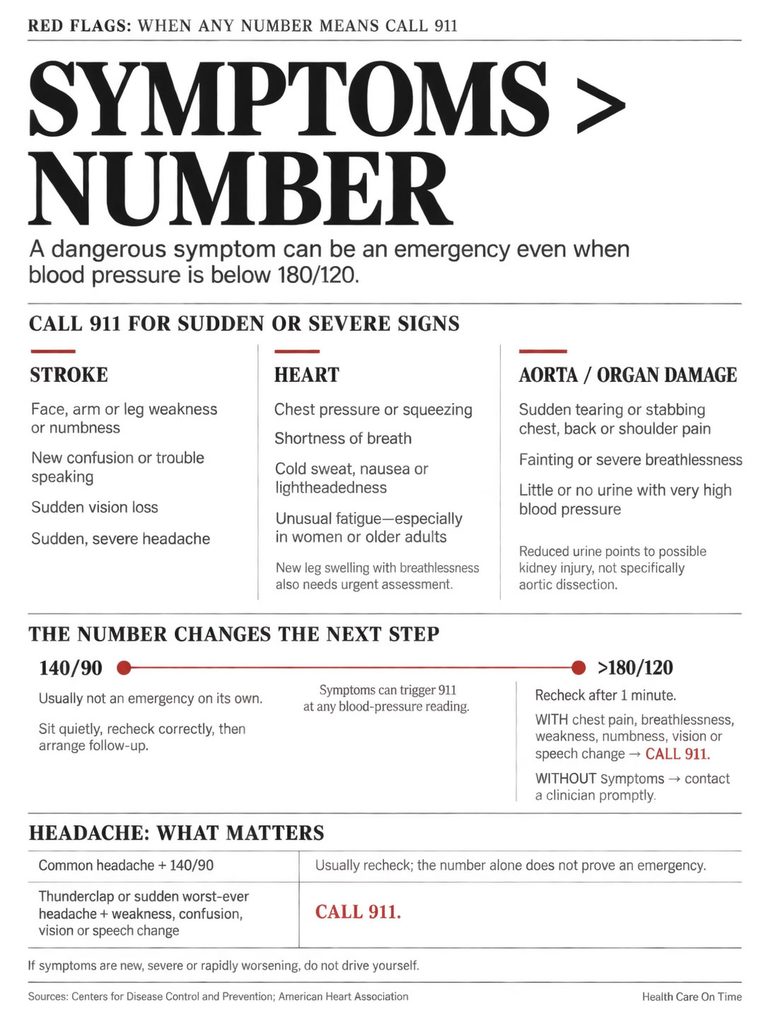
Red Flags: When Any Number Means Call 911
The single most useful thing to take from this page is that symptoms beat the number every time. Patients booking cardiac risk panels with us often assume the cuff is the alarm system. It is not. Your body is.
Brain Signals
Sudden weakness or numbness on one side of the face, arm, or leg. Drooping on one side of the face. Slurred or garbled speech, or difficulty finding words.
Sudden confusion, sudden loss of vision in one or both eyes, or a headache that arrives instantly and feels like the worst you have experienced. Any of these means call 911, not a car ride.
These are stroke symptoms, and stroke treatment is time-dependent. Blood pressure will often be high during a stroke, but the pressure is a passenger, not the driver of your decision.
Call the ambulance rather than driving. Paramedics start the assessment on the way and route you to a hospital equipped for stroke care, which a private car cannot do.
Heart and Lung Signals
Chest pressure, tightness, or squeezing, particularly if it spreads to the jaw, neck, back, or arm. Shortness of breath while sitting still, or breathlessness that stops you lying flat.
Sudden swelling in both legs with breathlessness. Fainting or near-fainting. Any of these paired with a high reading needs emergency evaluation.
Women, older adults, and people with diabetes more often present without classic crushing chest pain. Unexplained nausea, jaw or back discomfort, extreme fatigue, or breathlessness alone can be the presenting sign of a cardiac event.
Aorta and Kidney Signals
A sudden tearing or ripping sensation in the chest or between the shoulder blades is a classic description of aortic dissection, which is a surgical emergency. Producing no urine for many hours, paired with very high pressure, also needs same-day evaluation.
Why a Headache With 140/90 Is Usually Not an Emergency
This is the most common false alarm. Ordinary hypertension at 140/90 does not typically cause headaches, and the two often coincide by chance rather than by cause.
Pain itself raises blood pressure. A tension headache, a migraine, or a bad night of sleep can all push a reading up by 10 to 15 mmHg. Treating the headache frequently brings the number down with it.
The headache that matters is different in character. It is sudden, severe, unlike anything before, and often paired with vomiting, neck stiffness, confusion, or vision change. That one goes to the emergency department.
Before You Panic, Check Whether the Reading Is Real
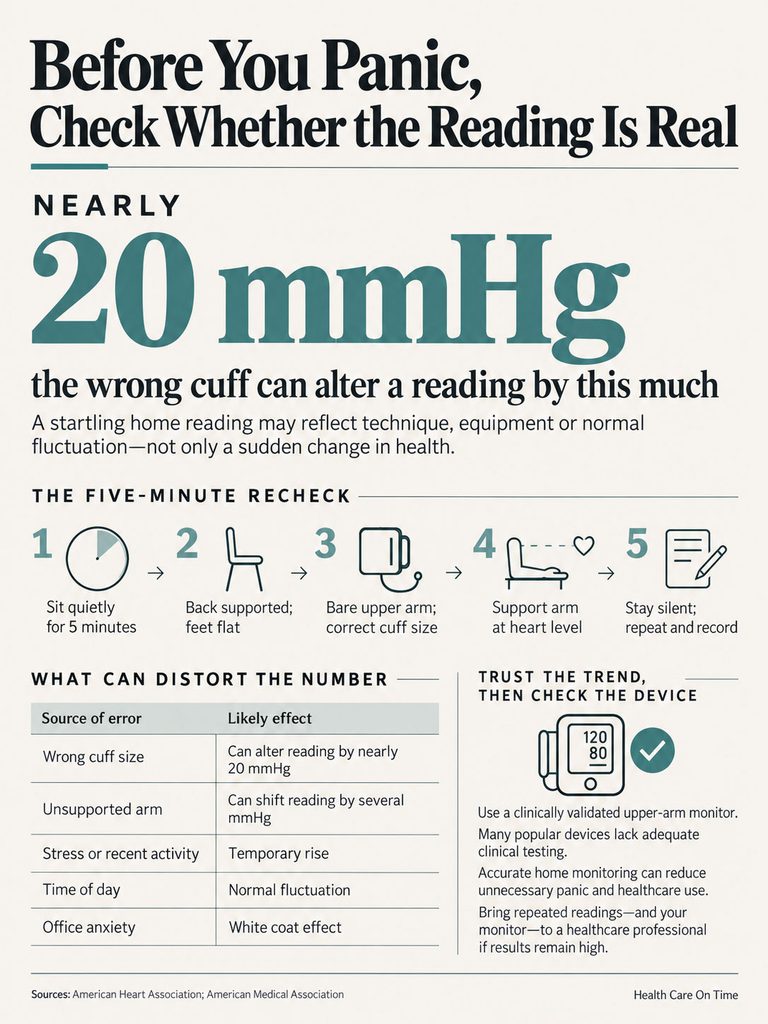
A large share of frightening home readings are measurement artifacts. This is the section almost no competing page carries, and it changes more outcomes than any other advice here.
The Five-Minute Recheck Protocol
Empty your bladder first. A full bladder can add 10 mmHg or more. Skip caffeine, nicotine, and exercise for at least 30 minutes beforehand.
Sit in a chair with a back, feet flat on the floor, legs uncrossed. Rest quietly for five full minutes without talking or looking at your phone.
Rest your arm on a table so the middle of the cuff sits level with your heart. Take two readings 60 seconds apart and average them. If the two differ by more than 5 mmHg, take a third.
What Arm Position Does to Your Number
The ARMS crossover randomized trial from Johns Hopkins, published in JAMA Internal Medicine in December 2024, put exact figures on this. Researchers measured 133 adults with the arm in three positions.
Resting the arm on the lap inflated systolic pressure by 3.9 mmHg and diastolic by 4.0 mmHg compared to proper desk support. Letting the arm hang unsupported at the side inflated systolic by 6.5 mmHg and diastolic by 4.4 mmHg.
Among participants who already had elevated pressure, the dangling-arm error reached roughly 9 mmHg systolic. That alone can turn a 131/86 into a 140/90.
What the Wrong Cuff Does to Your Number
The Cuff(SZ) randomized crossover trial, also from Johns Hopkins and published in JAMA Internal Medicine in 2023, tested what happens when a standard cuff is used on arms that need a different size.
For people whose arm circumference called for a large cuff, a regular cuff added 4.8 mmHg to systolic. For people who needed an extra-large cuff, a regular cuff added 19.5 mmHg. For people needing a small cuff, a regular cuff subtracted 3.6 mmHg.
Nearly 20 mmHg of error from a strap. In practical terms, a genuine 125/78 can display as 144/90 if the cuff is two sizes too small. Measure your upper arm circumference and match it against the cuff’s printed range.
Is Your Monitor Even Validated?
This one surprises people. Researchers examined the 100 best-selling blood pressure monitors on Amazon across ten countries and found that 81% had never undergone adequate clinical validation testing, according to analysis reported by the American Medical Association.
For upper-arm cuffs sold in the United States, only about 16% were validated. Among wrist cuffs, none were.
Check your model against the US Blood Pressure Validated Device Listing at validatebp.org. If it does not appear, its accuracy is unknown. Validated devices tend to cost slightly more, but the price gap is often $20 to $30, and an unvalidated cuff can cost you an ER copay.
The Temporary Spikers
Blood pressure is not a fixed property like your height. It moves through the day by 20 to 40 mmHg in healthy people, dipping at night and climbing in the morning.
A stressful phone call, cold hands, a full bladder, pain, poor sleep, alcohol the night before, or a decongestant can all push a reading temporarily. So can the anxiety of taking the reading itself.
White coat hypertension is the formal version of this. Studies estimate it affects roughly 10% to 30% of people with elevated office readings, depending on the definition used. Their office readings run 140/90 or above while home and 24-hour readings sit in the normal range.
What the Evidence Says About Going to the ER for a High Number
This is where most published advice quietly separates from the research.
The Cleveland Clinic Study That Settled It
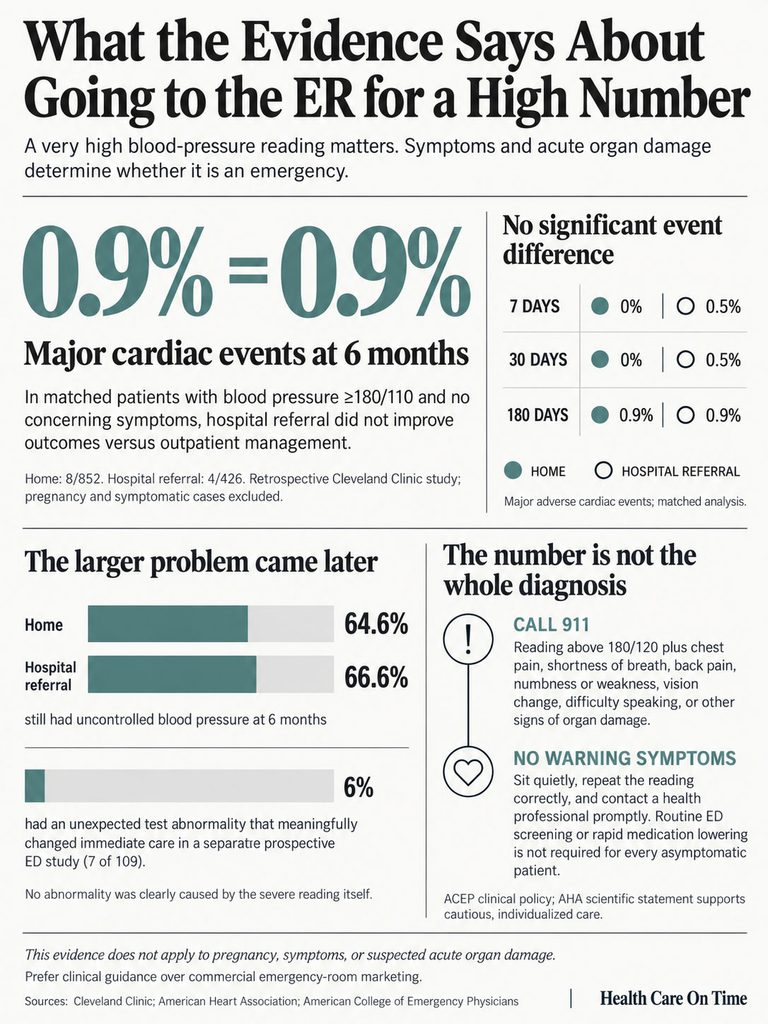
In 2016, researchers at the Cleveland Clinic published a propensity-matched cohort study in JAMA Internal Medicine that remains the reference point. They screened 2,199,019 office visits over six years and identified 58,535 patients presenting with readings at or above 180/110 without symptoms.
Some were sent to the emergency department. Most were managed as outpatients. The two groups were matched and followed for six months.
The result: rates of major adverse cardiac events were very low in both groups, with no significant difference at 7 days, 30 days, or 6 months. Emergency department referral produced more hospital admissions and more testing, without better outcomes.
The study also found something sobering. Two-thirds of these patients still had uncontrolled blood pressure six months later. The urgent trip did not fix the underlying problem, and neither did the reassurance that followed.
Bear in mind that this evidence covers readings at 180/110, far above 140/90. If the ER adds nothing at 180/110 in an asymptomatic patient, the case for going at 140/90 is weaker still.
What the ER Actually Does for an Asymptomatic High Reading
The American College of Emergency Physicians clinical policy on asymptomatic elevated blood pressure is direct. Routine screening for organ injury, meaning serum creatinine, urinalysis, and ECG, is not required. Routine medical intervention in the emergency department is not required. Patients should be referred for outpatient follow-up.
A prospective study of 109 asymptomatic patients with readings at or above 180/90 found that roughly 6% had any meaningful unanticipated abnormality on testing, and not one had findings indicating a hypertensive emergency.
Despite this, national data show most of these patients get tested anyway. An analysis of emergency department visits with hypertension as the chief complaint found that about four in five received diagnostic testing and more than one in three received an antihypertensive medication.
Here is what the visit typically looks like in practice. Triage takes your pressure in a busy hallway, often with your arm unsupported, which the ARMS data tells us inflates the reading before anyone has examined you. You wait. A clinician asks about symptoms, listens to your heart and lungs, and checks your legs and eyes.
If nothing points to organ damage, you may get an ECG and a basic blood panel, then a recheck after you have been sitting quietly for an hour. Pressure usually falls on its own by then. Discharge instructions say to follow up with your regular doctor within one to two weeks, which is exactly where the process could have started.
The Terminology Change Nobody Has Caught Up With
Almost every page competing for this query uses the phrase hypertensive crisis. The AHA formally moved away from it in 2024.
The scientific statement in Hypertension replaced hypertensive crisis with markedly elevated blood pressure, and replaced hypertensive urgency with asymptomatic markedly elevated blood pressure. The reasoning was that the old language implied an emergency where none existed, driving unnecessary treatment.
The statement goes further and cautions against rapidly lowering pressure in patients without organ damage, noting observational evidence of harm from that practice. Dropping pressure too fast can reduce blood flow to the brain and kidneys.
Why Some Sites Still Tell You to Go
Look at who publishes the advice. Several of the pages ranking for this question belong to freestanding emergency room chains and urgent care franchises whose revenue depends on visits.
That does not make them dishonest, and their red-flag lists are usually accurate. It does mean the framing tilts toward walking in the door. Compare their guidance to the ACEP policy written by emergency physicians for emergency physicians, and the difference is visible.
Across patients we serve, the pattern is consistent. The people who benefit most from an urgent visit are the ones with symptoms. The people who benefit least are the ones who took one reading, felt frightened, and drove in.
Where to Go Instead, and What Each Door Costs
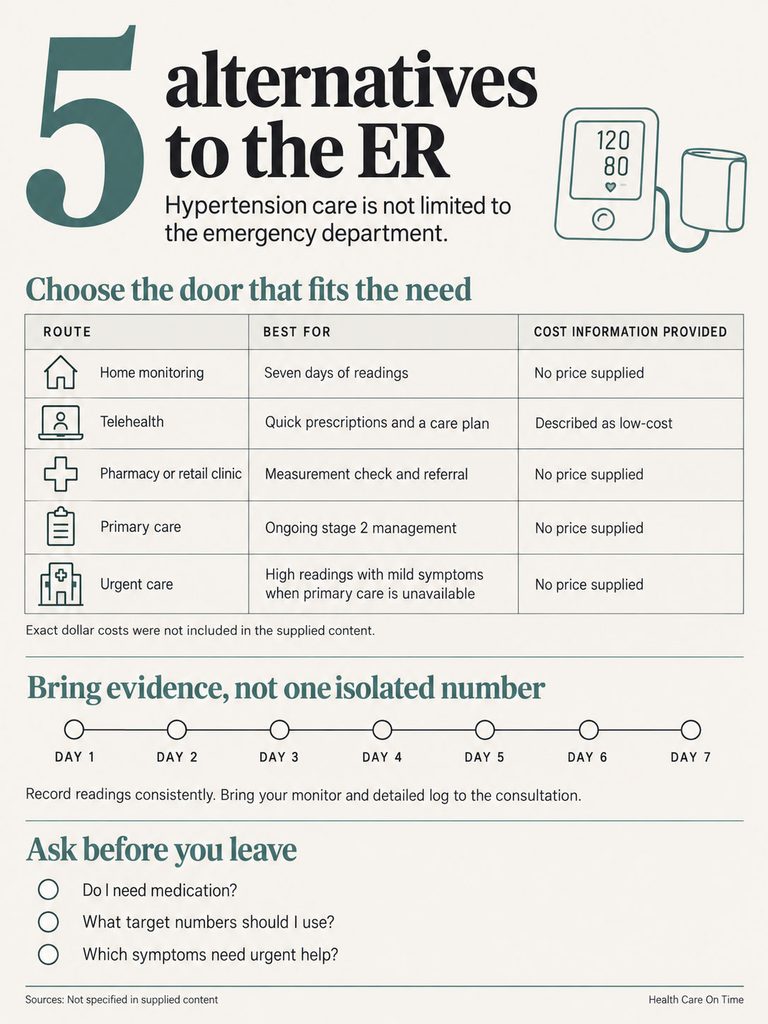
The choice is not ER or nothing. There are five doors, and most people at 140/90 should walk through one of the middle three.
The Five Doors
Home self-monitoring comes first. Seven days of morning and evening readings gives your clinician far more information than one office visit ever will.
Telehealth is the fastest low-cost route to a prescription or a plan. Most platforms can review your home log, order labs, and start medication.
Pharmacy and retail clinics offer a validated cuff, a trained measurement, and a referral. Useful if you distrust your own device.
Primary care is the correct destination for stage 2 hypertension. This is a condition that needs a relationship, not a transaction, because dosing gets adjusted over months.
Urgent care fits when readings are high, you have mild symptoms that are not red flags, and your doctor’s office is closed for the weekend.
What to Bring and What to Ask For
Bring your monitor itself, not just the numbers. Clinicians can check it against their own device in 60 seconds.
Bring a written log with dates, times, and both readings from each session. Bring a full medication list including over-the-counter products, since decongestants, NSAIDs, and some supplements raise pressure.
Ask three questions. Should I be on medication now or after a trial of lifestyle changes? What is my target number? What symptoms should send me somewhere urgently?
| Metric | Figure | Source |
| US adults with hypertension | 47.7% | CDC / NCHS Data Brief 511 (Aug 2021 to Aug 2023) |
| Adults with hypertension who are aware of it | 59.2% | CDC / NCHS Data Brief 511 |
| Adults with hypertension taking medication | 51.2% | CDC / NCHS Data Brief 511 |
| Adults with hypertension controlled below 130/80 | 20.7% | CDC / NCHS Data Brief 511 |
| Hypertension prevalence at age 60 and older | 71.6% | CDC / NCHS Data Brief 511 |
| Annual US ED visits with essential hypertension as primary diagnosis | 1.1 million | CDC FastStats, Hypertension |
| Best-selling online BP monitors never clinically validated | 81% | AMA / Journal of Hypertension analysis |
Table 2. US hypertension and measurement statistics, with source attribution.
Those control figures deserve a moment. Only about one in five Americans with hypertension has it under control. The problem in this country is not that people fail to rush to the ER. It is that millions never get consistent outpatient treatment at all.
| Setting | Uninsured Cost | Insured Out-of-Pocket | Typical Wait | Best For | Not For |
| Home recheck | $0 (cuff $40 to $70 once) | $0 | 5 minutes | Confirming any reading before acting | Any red-flag symptom |
| Telehealth visit | $0 to $75 | $0 to $50 copay | Same day | Reviewing a home log, starting medication | Physical exam needs, emergencies |
| Retail or pharmacy clinic | $75 to $150 | $20 to $60 copay | Under 1 hour | Verified measurement, referral | Complex or resistant hypertension |
| Primary care office | $150 to $300 | $20 to $50 copay | Days to weeks | Diagnosis, labs, long-term dosing | Anything urgent tonight |
| Urgent care | $150 to $250 | $30 to $75 copay | Under 1 hour | Weekend readings with mild symptoms | Chest pain, stroke signs |
| Emergency department | $1,500 to $3,000+ | $400 to $700 typical | Around 4 hours | Red-flag symptoms, suspected organ damage | An isolated 140/90 reading |
Table 3. Typical US cost and wait time by care setting. Figures are national ranges and vary by state, plan, and facility.
What 140/90 Actually Means for Your Long-Term Risk
Deciding you do not need the ER is not the same as deciding you can ignore it. Those are two separate conclusions and only the first one is settled.
Stage 2 and What It Triggers
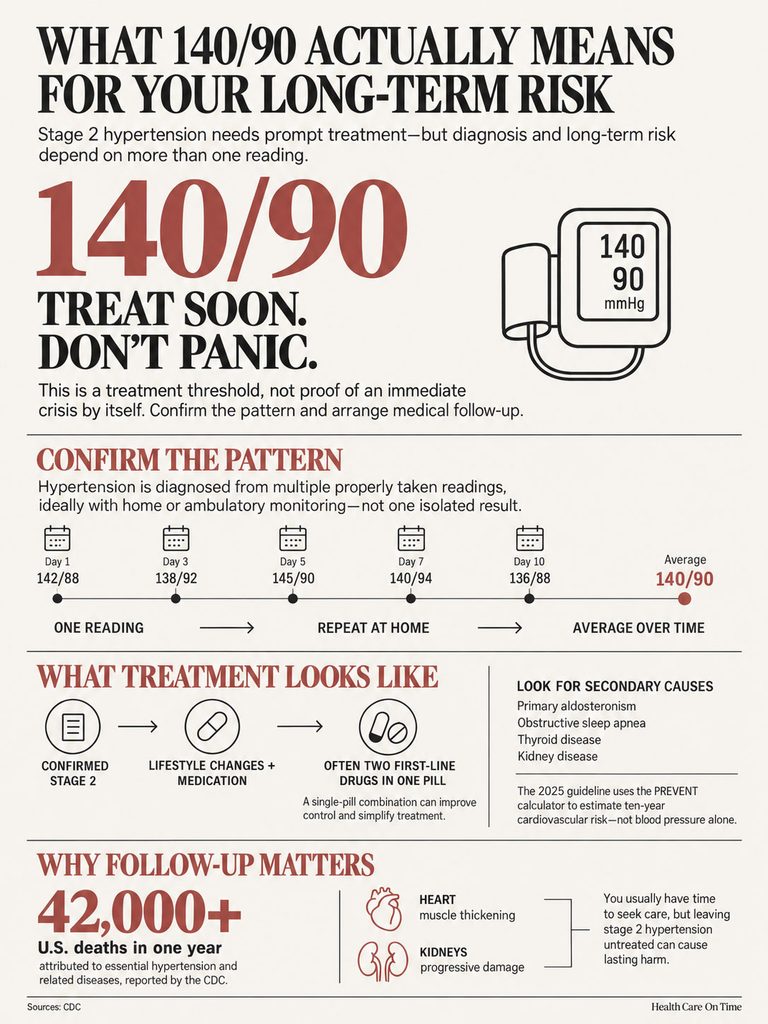
Reaching a confirmed average at or above 140/90 changes the starting point of treatment. You skip the wait-and-see phase that applies at stage 1 and begin medication alongside lifestyle change rather than after it.
The preferred approach is two first-line drugs from different classes in one combination pill. Two gentler medications working through different mechanisms control pressure better than one at a high dose, with fewer side effects, and a single pill is easier to keep taking.
First-line classes are thiazide diuretics, ACE inhibitors, angiotensin receptor blockers, and dihydropyridine calcium channel blockers. The 2025 guideline made agent selection race-neutral, a notable change from earlier practice.
The Secondary Causes Worth Ruling Out
Most hypertension has no single identifiable cause. A meaningful minority does, and finding it can change treatment entirely.
The 2025 guideline expanded screening for primary aldosteronism to everyone with stage 2 or resistant hypertension. This adrenal condition is more common than most people assume, frequently missed, and responds to targeted treatment rather than general blood pressure drugs.
Obstructive sleep apnea is another. If you snore heavily, wake unrefreshed, or your partner has noticed you stop breathing, mention it. Treating the apnea often lowers the pressure.
Thyroid disease, kidney disease, and certain medications round out the list. That is why the initial workup includes labs rather than just a prescription.
The PREVENT Calculator, In Plain Terms
For stage 1 hypertension, treatment now depends on calculated risk rather than the number alone. The 2025 guideline adopted the PREVENT calculator, replacing the older Pooled Cohort Equations.
PREVENT folds in kidney function, statin use, and social factors that the previous model ignored, producing a more realistic ten-year estimate. At stage 1 with risk of 7.5% or higher, medication is recommended. Below that, lifestyle change gets a 3 to 6 month trial first.
At 140/90 you are past that fork. Stage 2 gets medication regardless of the calculated figure, so the tool matters more for tracking your risk over time than for deciding what happens next.
Why One Reading Never Earns a Diagnosis
Hypertension is diagnosed on averages, not snapshots. Standard practice uses two or more readings on two or more separate occasions, ideally supported by home or 24-hour ambulatory monitoring.
Ambulatory monitoring, where a cuff inflates automatically every 20 to 30 minutes for a day, remains the reference standard. It catches white coat hypertension and its opposite, masked hypertension, where office readings look fine and home readings do not.
What Happens If You Do Nothing
Untreated stage 2 hypertension is not dramatic in the short term, which is precisely the danger. Nothing hurts. Nothing announces itself.
Over years, sustained pressure at this level thickens the heart muscle, stiffens arteries, damages the filtering units of the kidneys, and damages small vessels in the retina and brain. The CDC recorded 42,343 US deaths from essential hypertension and hypertensive renal disease in a single reporting year.
The reassuring part is that this timeline is measured in years, not hours. You have time to make an appointment. You do not have time to forget about it.
The Exceptions: Groups Where 140/90 Is Handled Differently
Pregnancy Past 20 Weeks
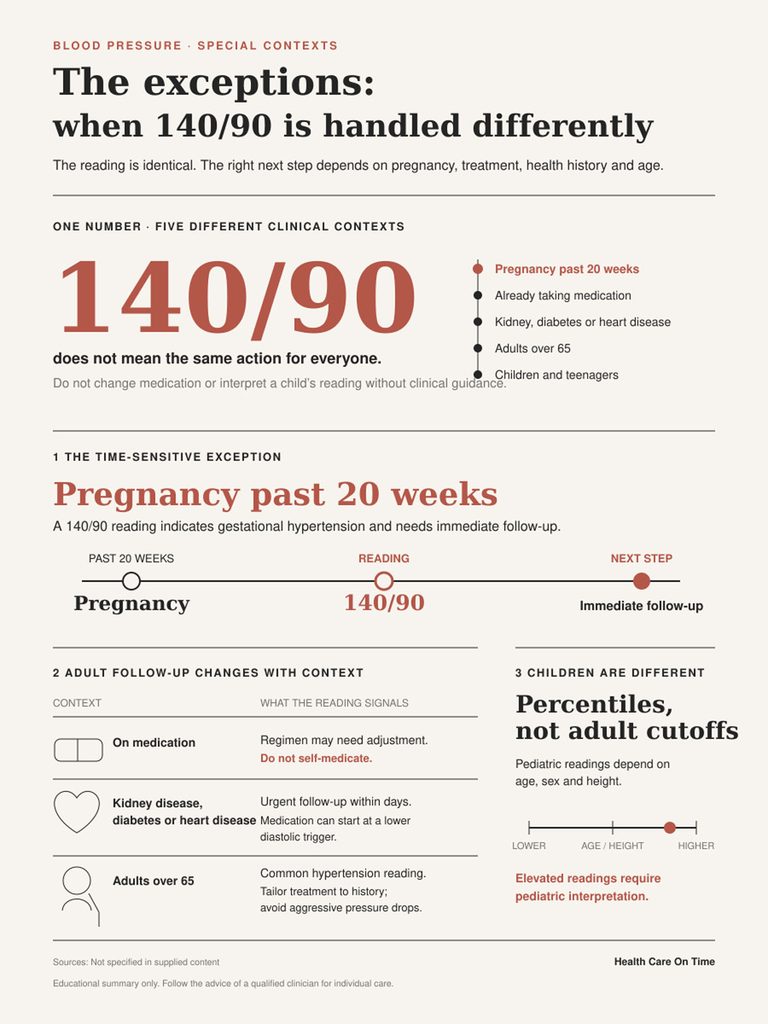
This is the one common scenario where 140/90 stops being a routine number. According to ACOG, new-onset blood pressure at or above 140/90 after 20 weeks of pregnancy, measured on two occasions at least four hours apart, defines gestational hypertension.
Severe range in pregnancy is 160/110 or higher, and that needs immediate evaluation. Up to half of women with gestational hypertension go on to develop signs of preeclampsia.
If you are pregnant past 20 weeks and read 140/90, call your OB team the same day. Not next week. They will decide between an office recheck, labs, or evaluation on labor and delivery.
Go in immediately if you have a persistent headache that does not respond to acetaminophen, vision changes such as spots or blurring, pain under the ribs on the right side, sudden swelling of the face or hands, or a sharp drop in the baby’s movement.
The postpartum window matters too. Preeclampsia can appear for the first time in the weeks after delivery, and readings at 140/90 during that period need the same same-day call.
People Already on Blood Pressure Medication
A 140/90 reading on medication means your regimen is not achieving target, which is a dosing conversation rather than an emergency. Do not take an extra dose on your own.
Doubling up can drop pressure too quickly, causing dizziness and falls, and it disrupts the steady levels your clinician is titrating against. Log the readings and call.
Missed doses are worth checking honestly before you assume the drug has stopped working. Stopping some blood pressure medications abruptly, particularly beta blockers, can cause a rebound spike that looks alarming.
Kidney Disease, Diabetes, and Known Heart Disease
These conditions do not change the ER threshold, but they compress the follow-up window. Aim for contact within a few days rather than a couple of weeks.
For people with existing cardiovascular disease, the guideline recommends starting medication when average diastolic pressure reaches 80 or above, a tighter trigger than the general population uses.
Adults Over 65
More than 71% of adults over 60 have hypertension, so a 140/90 reading in this group is common rather than alarming. Treatment is still recommended, but the balance shifts.
Older adults face a real risk from dropping pressure too aggressively, including dizziness, falls, and fractures. Targets get individualized, particularly for frail patients. That is a conversation for a clinician who knows your history, not an emergency physician meeting you for the first time.
Children and Teenagers
Pediatric blood pressure is not judged against fixed adult numbers. It uses percentiles based on age, sex, and height, so 140/90 in a 12-year-old means something entirely different than in a 50-year-old.
Any elevated reading in a child should go to a pediatrician for percentile-based interpretation.
Your Next 72 Hours: A Step-by-Step Plan
Tonight
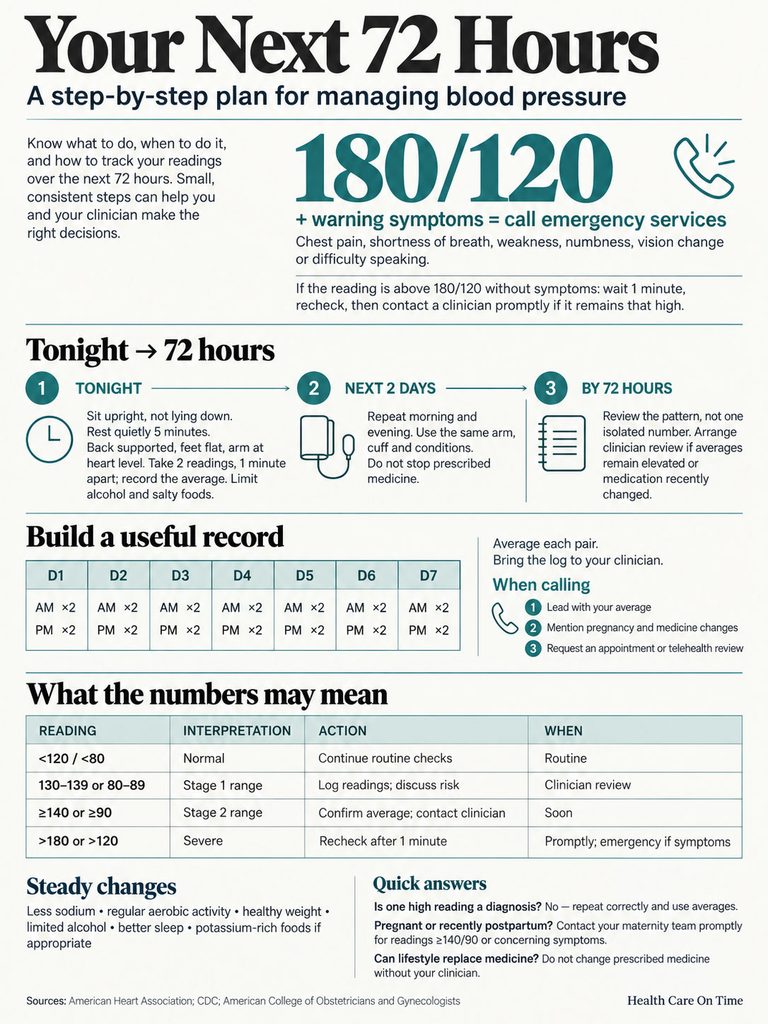
Recheck using the five-minute protocol. If the average is under 180/120 and you feel well, you are not going anywhere tonight.
Do not lie down and take repeated readings for an hour. Repeated measurement raises anxiety, anxiety raises pressure, and the loop feeds itself. Two readings, then stop.
Skip alcohol and heavily salted food this evening. Neither will cause a catastrophe, but both nudge tomorrow’s numbers up.
The Next Seven Days
Take two readings each morning before medication and food, and two each evening. Average the pair each time and write down the date, time, and both numbers.
Seven days of paired readings gives 28 data points. That is a genuine picture, and it is what clinicians want to see. In tests booked through HealthCareOnTime, patients who arrive with a written log get to a treatment decision noticeably faster than those who arrive with a single number.
Order the basic workup at the same time so results are ready for the appointment:
- A basic metabolic panel with creatinine and electrolytes, for kidney function
- A urine albumin-to-creatinine ratio, for early kidney involvement
- A lipid profile, for overall cardiovascular risk
- HbA1c or fasting glucose, for diabetes and prediabetes
- A TSH, for thyroid causes of elevated pressure
What to Say When You Call
Lead with the average, not the scariest single reading. My home average over the past week is 143 over 91, taken twice a day, no symptoms. That phrasing gets you scheduled appropriately.
Mention pregnancy status, existing conditions, and any new medication or supplement started in the past month.
If the earliest appointment is more than three weeks out, ask to be added to a cancellation list, or use a telehealth visit as a bridge. Our lab partners report that patients who get baseline labs done before the appointment often shorten the path to treatment by a full visit.
The Lifestyle Levers That Actually Move the Number
Sodium reduction has the largest measured effect for most people, with cutting toward 1,500 mg per day producing meaningful drops. Most of that sodium comes from packaged food and restaurant meals rather than the salt shaker.
Regular aerobic activity, weight loss where relevant, limiting alcohol, and improving sleep all contribute. Potassium-rich foods help too, though anyone with kidney disease should confirm with their clinician first.
These changes are effective but slow, typically showing over 4 to 12 weeks. At stage 2, they work alongside medication rather than instead of it.
| Your Situation | What It Likely Means | Recommended Action | Timeline |
| 140/90 once, no symptoms, feeling fine | Possible measurement artifact or normal variation | Recheck after 5 minutes rest, start a 7-day log | Recheck tonight |
| 140/90 repeatedly over a week, no symptoms | Probable stage 2 hypertension | Book primary care, bring log and labs | Within 1 to 2 weeks |
| 140/90 plus chest pain or breathlessness at rest | Possible cardiac event | Call 911, do not drive yourself | Immediately |
| 140/90 plus weakness, speech trouble, or vision loss | Possible stroke | Call 911 | Immediately |
| 140/90 while pregnant past 20 weeks | Possible gestational hypertension or preeclampsia | Call your OB team, describe symptoms | Same day |
| 165/105, no symptoms, already on medication | Regimen not at target | Call prescriber, do not self-adjust dose | Within 2 to 3 days |
| 185/125, no symptoms after two rechecks | Asymptomatic markedly elevated BP | Same-day call to clinician or urgent care | Within 24 hours |
| Reading only high at the doctor’s office | Possible white coat hypertension | Request home or 24-hour ambulatory monitoring | At next appointment |
Table 4. Scenario-to-action triage guide. When symptoms and numbers disagree, act on the symptoms.
Frequently Asked Questions
Is 140/90 stage 1 or stage 2 hypertension?
Stage 2. Under the 2025 AHA/ACC guideline, stage 1 covers 130 to 139 systolic or 80 to 89 diastolic. Stage 2 begins at 140 systolic or 90 diastolic. A reading of exactly 140/90 crosses into stage 2 on both numbers, which is why it triggers a medication conversation.
How high does blood pressure have to be before the ER is right?
There is no pure number that sends you in. The working threshold is 180/120, and even then only with symptoms suggesting organ damage. Without symptoms, a reading of 180/120 warrants a same-day call rather than an ER visit. With symptoms, any reading warrants 911.
Should I lie down if my blood pressure reads 140/90?
Sit rather than lie. Guidelines specify a seated position with back supported, feet flat, and arm at heart level, because that is the posture reference ranges were built on. Lying down changes the measurement. Rest quietly for five minutes, then recheck seated.
Can anxiety or a panic attack cause a 140/90 reading?
Yes. Acute anxiety commonly raises systolic pressure by 10 to 30 mmHg through adrenaline release. The reading is real in the moment but does not reflect your usual pressure. This is also why checking repeatedly during a panic episode produces progressively worse numbers.
Will the ER just send me home?
Usually, if you have no symptoms. The ACEP clinical policy states that routine testing and routine treatment are not required for asymptomatic elevated pressure, and that patients should be referred for outpatient follow-up. Expect a few hours, possibly some tests, and a discharge instruction to see your regular doctor.
How much does an ER visit for high blood pressure cost?
Uninsured ER visits commonly run $1,500 to $3,000 before any imaging or admission. Insured patients frequently pay $400 to $700 out of pocket, more if the deductible is unmet. Urgent care for the same evaluation typically costs $150 to $250 uninsured.
Is 140/90 normal for someone over 60?
Common, but not normal or acceptable. More than 71% of adults aged 60 and above have hypertension. The 2025 guideline still recommends treatment at 140/90 in older adults, though targets are individualized for frail patients where fall risk from overtreatment matters.
Can I take an extra dose of my medicine to bring it down?
No. Self-dosing can drop pressure too fast, causing dizziness, fainting, and falls, and it interferes with the titration your prescriber is tracking. The AHA specifically cautions against rapid lowering in people without organ damage. Log the readings and call your prescriber.
My reading drops on the second try. Which one counts?
The average of two readings taken 60 seconds apart, after five minutes of rest, counts. A first reading is often higher because of the startle response to cuff inflation. Clinicians expect this and discard isolated first readings routinely.
Is 140/90 dangerous during pregnancy?
It is treated differently. After 20 weeks, new-onset readings at or above 140/90 on two occasions four hours apart define gestational hypertension, which carries preeclampsia risk. Call your OB team the same day. Severe-range readings of 160/110 or higher need immediate evaluation.
How long can 140/90 go untreated before it causes damage?
Damage accumulates over years, not days or weeks, which is why one high reading is not urgent. Sustained pressure at this level gradually thickens the heart, stiffens arteries, and injures kidney and eye vessels. Treatment within a few weeks of confirmation prevents essentially all of that trajectory.
Does a headache with 140/90 mean a stroke is coming?
Almost never. Hypertension at this level does not typically cause headaches, and pain from an ordinary headache can itself raise the reading. The headache that needs emergency care is sudden, severe, unlike any before, and paired with confusion, vomiting, neck stiffness, weakness, or vision change.
Medical Disclaimer: This article is educational and does not replace evaluation by a licensed clinician. It cannot account for your medical history, medications, or current condition. If you have chest pain, difficulty breathing, sudden weakness or numbness, trouble speaking, sudden vision loss, or a severe sudden headache, call 911 immediately regardless of your blood pressure reading. If you are pregnant and reading 140/90 or higher, contact your obstetric team the same day. Never start, stop, or adjust prescription medication without speaking to your prescriber.
References
- 2025 AHA/ACC Guideline for the Prevention, Detection, Evaluation, and Management of High Blood Pressure in Adults, JACC
- The Management of Elevated Blood Pressure in the Acute Care Setting: AHA Scientific Statement, Hypertension 2024;81(8):e94-e106
- Patel KK et al. Characteristics and Outcomes of Patients Presenting With Hypertensive Urgency in the Office Setting. JAMA Intern Med. 2016;176(7):981-988
- Liu H et al. Arm Position and Blood Pressure Readings: The ARMS Crossover Randomized Clinical Trial. JAMA Intern Med. 2024;184(12):1436-1442
- Ishigami J et al. Effects of Cuff Size on the Accuracy of Blood Pressure Readings: The Cuff(SZ) Randomized Crossover Trial. JAMA Intern Med. 2023;183(10):1061-1068
- ACEP Clinical Policy: Asymptomatic Elevated Blood Pressure
- CDC / NCHS Data Brief No. 511: Hypertension Prevalence, Awareness, Treatment, and Control Among Adults Age 18 and Older
- CDC FastStats: Hypertension
- ACOG: Preeclampsia and High Blood Pressure During Pregnancy
- American Medical Association: Why a Validated Device Listing Is Important for BP Control
- US Blood Pressure Validated Device Listing