Look up red bell pepper calories on two popular nutrition sites and you can get two different answers for the same USDA record. One says 26 calories per 100 grams. The other says 31.
Table of Contents
For one pepper, that gap barely matters. Across months of logged meals, it does. This guide gives the official USDA numbers for every common size and color, explains where the wrong numbers come from, and shows how cooking changes the count.
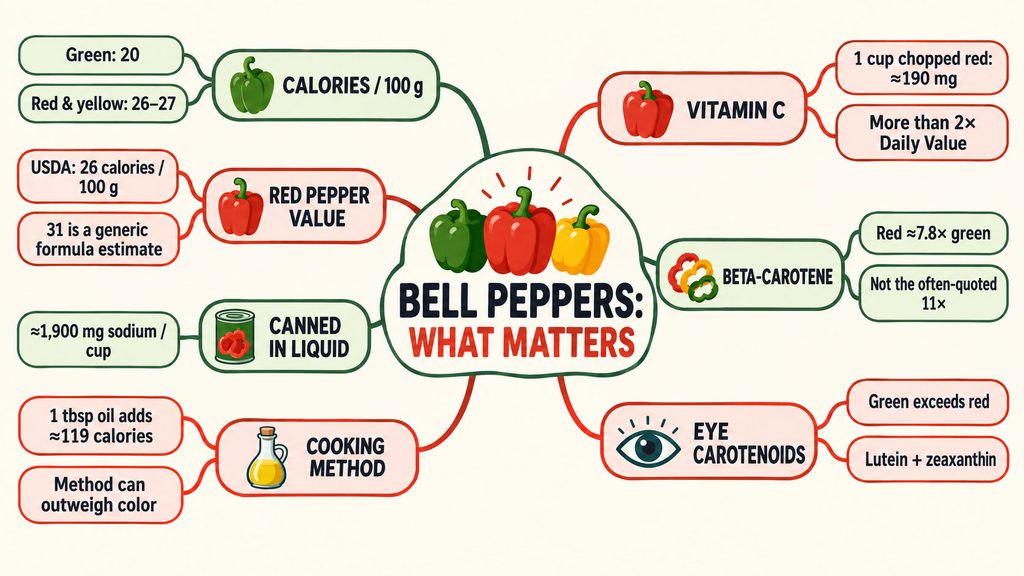
Quick Answer: A medium green bell pepper (119 grams, 4.2 ounces) has about 24 calories. A medium red has about 31 calories, and a medium yellow about 32. One cup of chopped bell pepper has 30 to 40 calories, depending on color. Per 100 grams, USDA FoodData Central lists green at 20 calories, red at 26, and yellow at 27. Sautéing in oil can push one cup to about 140 calories.
Bell pepper calories at a glance (medium pepper, raw):
- Green: 24 calories
- Red: 31 calories
- Yellow: 32 calories
- Orange: about 31 to 32 calories (estimated)
- One cup chopped: 30 (green) to 40 (yellow) calories
At a Glance
- Green bell peppers are the lowest in calories at 20 per 100 grams; red and yellow come in at 26 to 27.
- The “31 calories” figure for red peppers comes from a generic formula, not from USDA’s official value of 26.
- One cup of chopped red pepper provides about 190 mg of vitamin C, more than twice the Daily Value.
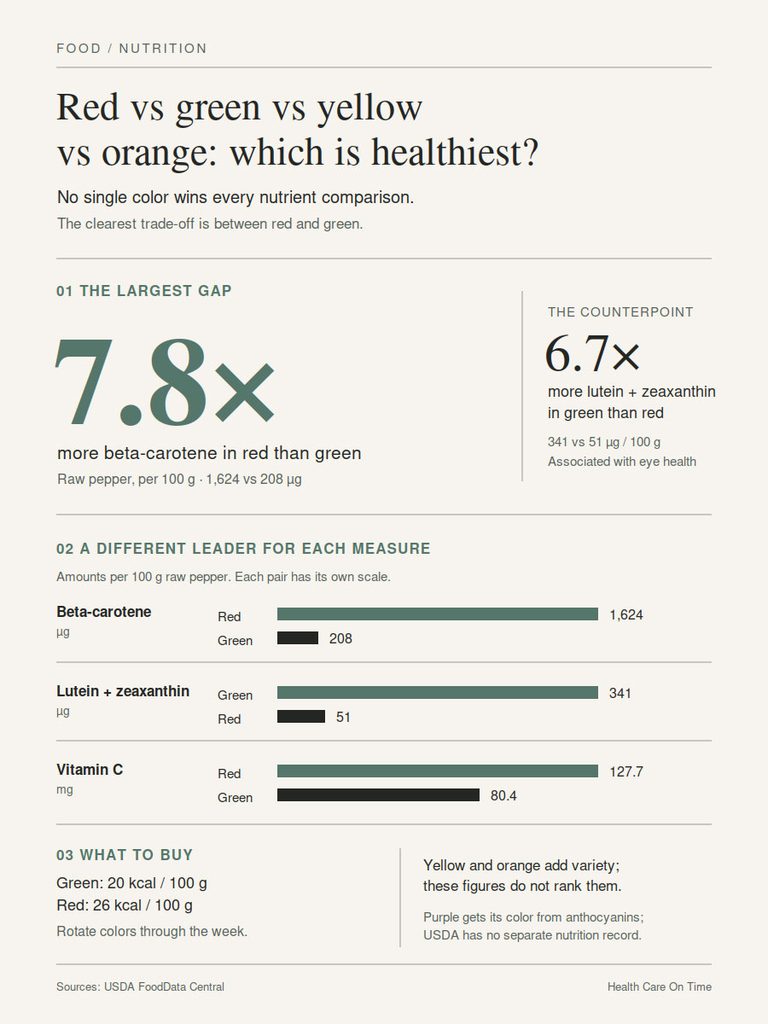
- Red peppers have about 7.8 times the beta-carotene of green, not the “11 times” often quoted.
- Green peppers beat red on lutein and zeaxanthin, the carotenoids tied to eye health.
- Cooking method matters more than color: one tablespoon of oil adds about 119 calories.
- Canned peppers packed in liquid can carry about 1,900 mg of sodium per cup.
How Many Calories Are in a Bell Pepper? The Short Answer
A bell pepper is one of the lowest-calorie vegetables in the produce aisle. Even a large red pepper stays under 45 calories raw.
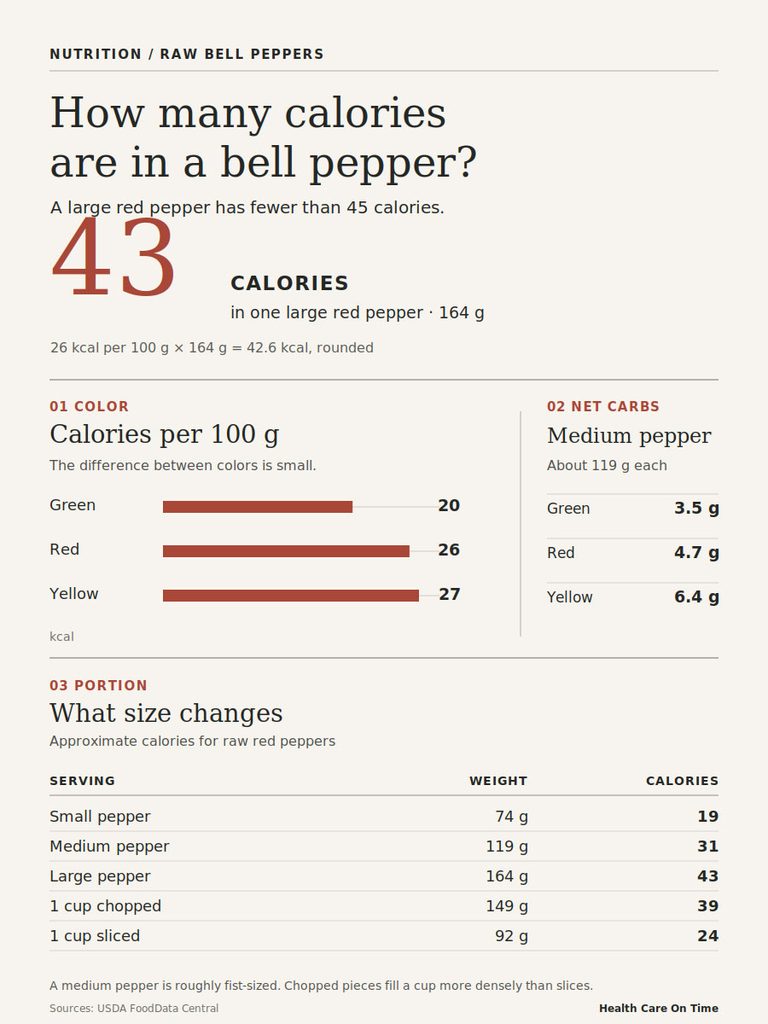
Every number in this section comes from USDA FoodData Central’s SR Legacy records: green raw peppers (FDC 170427), red raw peppers (FDC 170108), and yellow raw peppers (FDC 169383).
Calories by Size
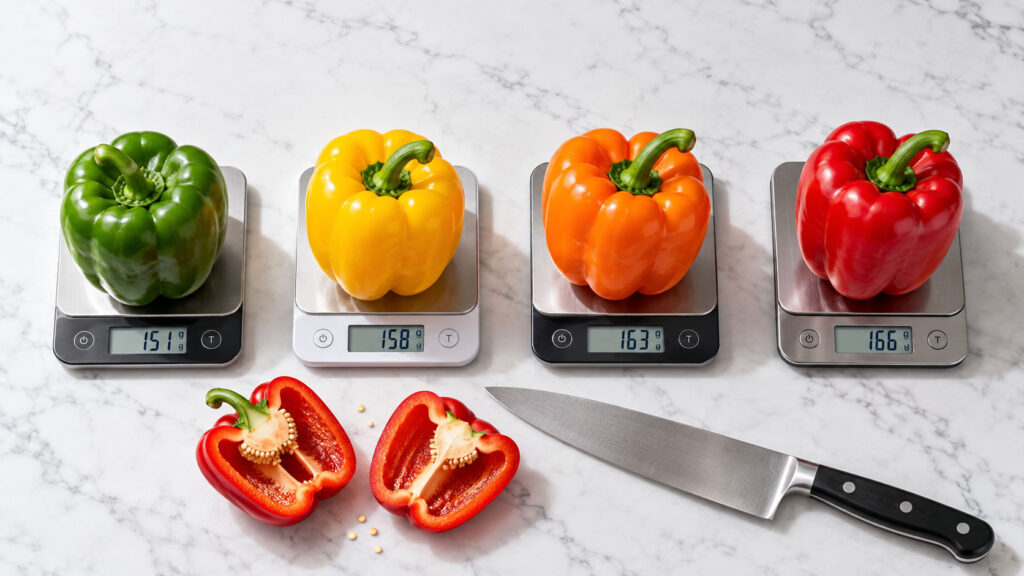
USDA publishes standard weights for bell peppers. A small pepper weighs about 74 grams (2.6 ounces), a medium 119 grams (4.2 ounces), and a large 164 grams (5.8 ounces).
A cup of chopped pepper weighs 149 grams (5.3 ounces). A cup of sliced pepper weighs only 92 grams (3.2 ounces), because slices trap more air. That’s why two “1 cup” entries in a calorie app can differ by about 40%.
Calories by Color
Color tracks ripeness. Green peppers are picked early. Left on the plant, they turn yellow, orange, or red and build natural sugar as they go.
More sugar means slightly more calories. The gap is small: about 7 calories per medium pepper between green and red.
Table 1: Bell Pepper Calories by Color and Size (USDA FoodData Central, raw)
| Color | Per 100 g (3.5 oz) | Small (74 g) | Medium (119 g) | Large (164 g) | 1 cup chopped (149 g) | 1 cup sliced (92 g) |
| Green | 20 kcal | 15 kcal | 24 kcal | 33 kcal | 30 kcal | 18 kcal |
| Red | 26 kcal | 19 kcal | 31 kcal | 43 kcal | 39 kcal | 24 kcal |
| Yellow | 27 kcal | 20 kcal | 32 kcal | 44 kcal | 40 kcal | 25 kcal |
| Orange (estimated) | 26 to 27 kcal | 19 to 20 kcal | 31 to 32 kcal | 43 to 44 kcal | 39 to 40 kcal | 24 to 25 kcal |
| Generic-formula red (often shown online) | 31 kcal | 23 kcal | 37 kcal | 51 kcal | 46 kcal | 29 kcal |
Two notes on this table. USDA’s own “large” yellow pepper weighs 186 grams, which works out to 50 calories; the 44 shown uses 164 grams so all colors compare fairly. USDA’s SR Legacy database has no orange bell pepper record, so orange values are estimated from the red and yellow entries.
For carbs, a medium pepper has about 3.5 grams of net carbs if green, 4.7 grams if red, and 6.4 grams if yellow.
When our nutrition review team checks patient food logs, the per-100-gram column is the one we trust. It stays accurate no matter how big the pepper in your kitchen is.
How to Estimate Without a Scale
No kitchen scale? Use your fist. A pepper about the size of an adult fist is close to USDA’s medium, at 119 grams.
A pepper that fills your whole palm and spills past your fingers is large. One cup of chopped pepper is roughly a medium pepper after you remove the stem, seeds, and core, which make up about 18% of the weight.
Why Some Websites Say 26 Calories and Others Say 31
This is the question no top-ranking page answers. If you track calories, it affects you, because many apps pull the higher number.
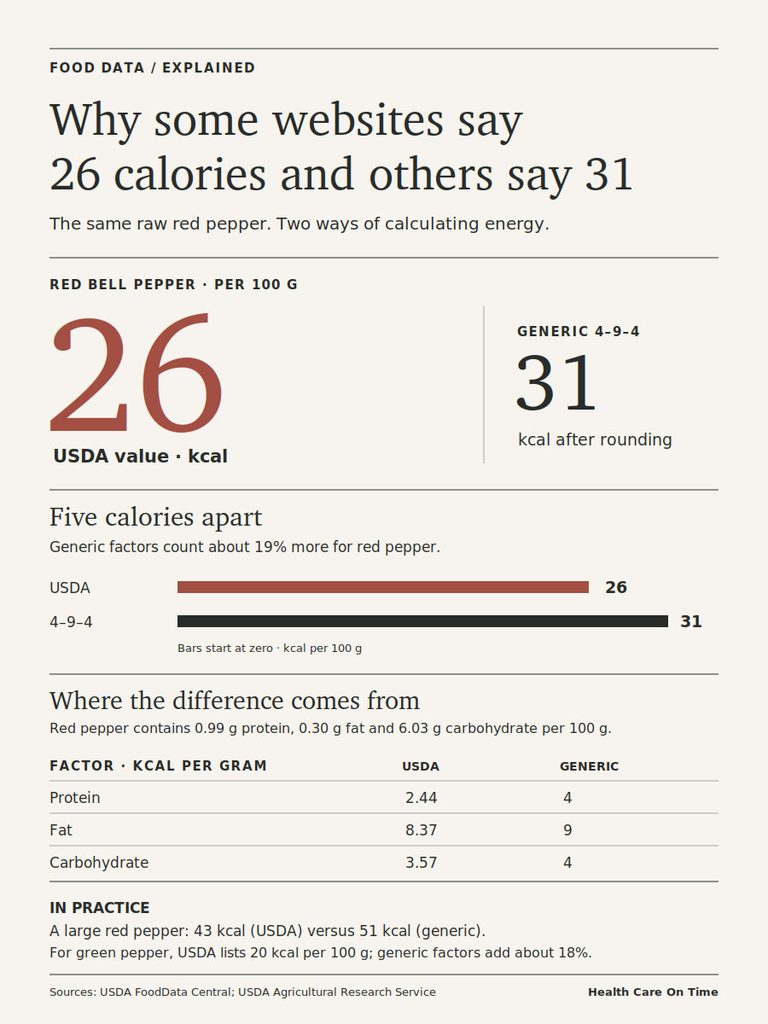
Same USDA Record, Two Formulas
USDA doesn’t burn peppers in a lab to count calories. It measures protein, fat, and carbohydrate, then multiplies each by a conversion factor.
For bell peppers, USDA uses vegetable-specific factors: 2.44 calories per gram of protein, 8.37 per gram of fat, and 3.57 per gram of carbohydrate. Apply those to red pepper’s 0.99 g protein, 0.3 g fat, and 6.03 g carbohydrate, and the result is 26 calories.
Many third-party sites use the general 4-9-4 formula from textbooks instead. The same macros then produce 31 calories. Some nutrition databases list raw red peppers at 31 calories per 100 grams while citing the USDA record, while others report 26 calories alongside the same 6.03 grams of carbs, which matches USDA.
Which Number to Trust in a Calorie App
Use 26 calories per 100 grams for red peppers and 20 for green. These are the values USDA publishes today and the values used in federal nutrition research.
If your app shows 31 for red or 24 for green, it’s using the generic formula. That overcounts by about 19% for red and about 18% for green.
What This Means for a Large Red Pepper
Using the USDA value, a large red pepper has 43 calories. Using the generic formula, it has 51.
That explains why some popular pepper sites put a typical red bell pepper at 37 to 51 calories. That range matches the generic math, not USDA. Either number is low, so the real advice is to pick the USDA value and stay consistent.
Full Bell Pepper Nutrition Facts (USDA Per 100 Grams)
Calories are only part of the picture. Bell peppers deliver a lot of nutrition for very little energy.
Carbs, Net Carbs, Sugar, and Fiber
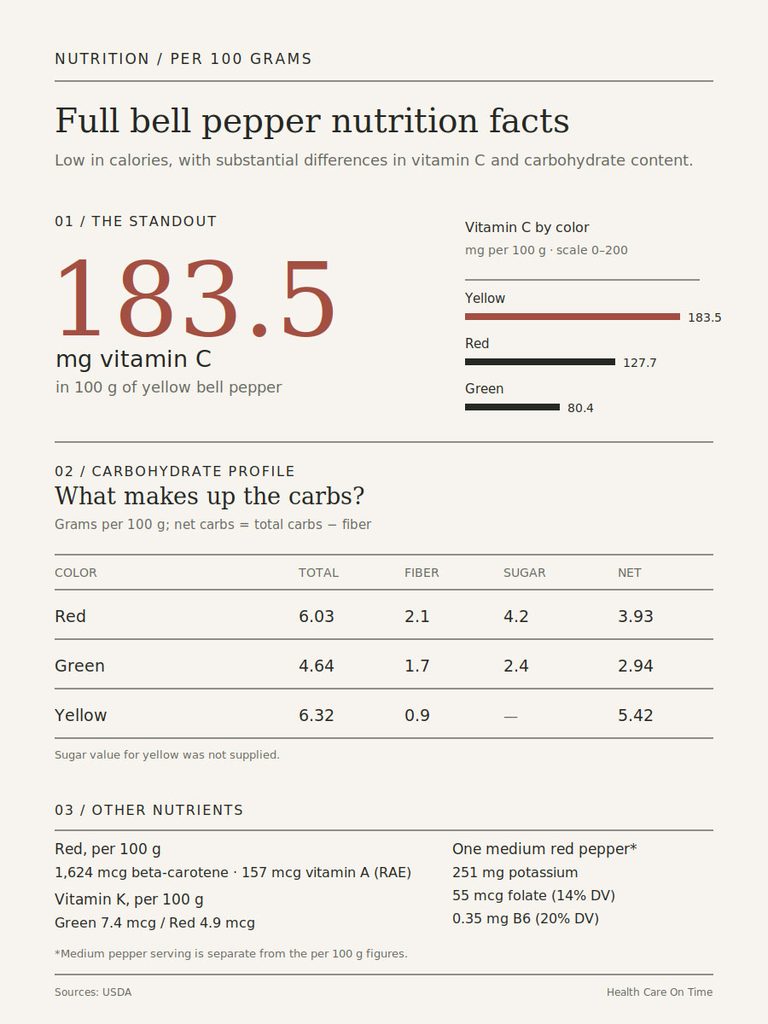
Per 100 grams, red bell pepper has 6.03 g carbohydrate, 2.1 g fiber, and 4.2 g natural sugar. That leaves 3.93 g net carbs.
Green is lower: 4.64 g carbohydrate, 1.7 g fiber, 2.4 g sugar, and 2.94 g net carbs. Yellow has the most carbohydrate (6.32 g) and the least fiber (0.9 g), which gives it the highest net carbs at 5.42 g.
Fat is close to zero, between 0.17 and 0.3 g. Protein is about 1 g. Peppers are 92% to 94% water, which is why they fill you up for so few calories.
Vitamin C: More Than an Orange
This is where bell peppers shine. Per 100 grams, green has 80.4 mg vitamin C, red has 127.7 mg, and yellow has 183.5 mg.
In a real portion, one cup of chopped red pepper gives about 190 mg. The FDA Daily Value is 90 mg, so one cup covers 211%. A medium orange (131 grams) has about 70 mg.
The NIH Office of Dietary Supplements sets the RDA at 90 mg for men and 75 mg for women, plus 35 mg more for people who smoke. One medium red or yellow pepper covers any of those targets on its own.
Vitamin A, Beta-Carotene, and Carotenoids
Red peppers contain 1,624 mcg of beta-carotene per 100 grams, which your body turns into vitamin A. That’s 157 mcg vitamin A (RAE) per 100 grams, or about 21% of the Daily Value in a medium pepper.
Green peppers have 208 mcg of beta-carotene. Yellow peppers have even less, at 120 mcg, which surprises most people. Red peppers also carry 490 mcg of beta-cryptoxanthin, another carotenoid your body can convert to vitamin A.
Carotenoids are fat-soluble, so you absorb more when peppers are eaten with a little fat, such as olive oil, avocado, or cheese.
Potassium, Folate, B6, and Vitamin K
A medium red pepper gives about 251 mg potassium, 55 mcg folate (14% DV), and 0.35 mg vitamin B6 (20% DV). Green peppers carry much less folate, 10 mcg per 100 grams compared with red’s 46.
Vitamin K is low in both colors: 7.4 mcg per 100 grams for green and 4.9 mcg for red, against a Daily Value of 120 mcg. That’s relevant for people on warfarin, covered below.
Red vs Green vs Yellow vs Orange: Which Color Is Healthiest?
Most articles crown red the winner and move on. The USDA data is more balanced than that.
Why Red Peppers Have More Calories
A red pepper is a green pepper that ripened on the plant. As it matures, it breaks down chlorophyll, builds carotenoids, and stores more sugar.
That’s why red peppers taste sweeter, cost more, and carry 6 more calories per 100 grams. On calories alone, green wins. For vitamin C, vitamin A, folate, and B6, red and yellow come out ahead.
Where Green Peppers Actually Win
Green peppers have 341 mcg of lutein plus zeaxanthin per 100 grams. Red peppers have 51 mcg, so green has nearly seven times more of these eye-health carotenoids.
Green also has slightly more vitamin K, the lowest net carbs, the lowest price, and the largest IBS-friendly portion. Patients who ask our team which color to buy usually expect “always red.” A better answer is to rotate colors through the week.
Two Myths Worth Correcting
Myth 1: Red has 11 times the beta-carotene of green. Some major health sites say red peppers have almost 11 times more beta-carotene and twice the vitamin C of green. Current USDA data gives 7.8 times for beta-carotene (1,624 vs 208 mcg) and 1.6 times for vitamin C (127.7 vs 80.4 mg). Red still wins, just by less.
Myth 2: Red peppers get their color from anthocyanins. Some health articles say red bell peppers get their deep color from anthocyanins. Red bell peppers actually get their color from carotenoids called capsanthin and capsorubin. Anthocyanins are the blue-purple pigments in foods like blueberries.
Purple Peppers Are the Real Anthocyanin Source
Purple bell peppers do contain anthocyanins in the skin. They’re harvested before full ripeness, so their nutrition is closer to green peppers. USDA has no separate record for them, and cooking often turns them green as the pigment breaks down.
Raw vs Cooked: How Preparation Changes Calories
Color moves bell pepper calories by a few points. Cooking method can move them by more than 100.
Boiled and Steamed
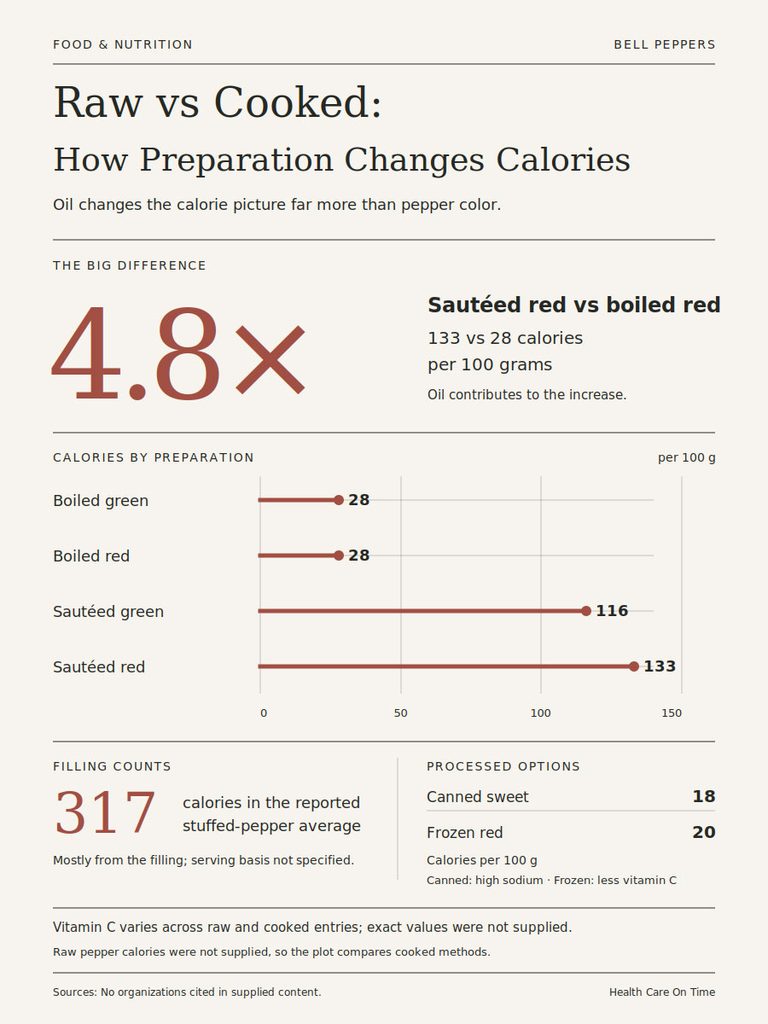
USDA lists boiled, drained green and red peppers at 28 calories per 100 grams. A cup of boiled strips (135 grams) comes to about 38 calories.
The per-100-gram number rises a little because cooking removes some water. Per serving, the change is minor.
One detail trips people up. USDA’s boiled red record shows more vitamin C (171 mg) than its raw record (127.7 mg). Cooking doesn’t add vitamin C. The two entries come from separate samples analyzed at different times, not one pepper tested before and after. Heat and water generally lower vitamin C.
Sautéed, Roasted, and Grilled
This is where the calories climb. USDA lists sautéed green peppers at 116 calories per 100 grams and sautéed red at 133. One cup of sautéed red pepper (106 grams) comes to about 141 calories.
Almost all of that increase is oil. USDA’s sautéed peppers hold about 12 grams of fat per 100 grams, and one tablespoon of olive oil adds about 119 calories. The pour matters far more than the pepper.
In the calorie logs our dietitian reviewers go over, “peppers and onions” from a restaurant fajita skillet are among the most underestimated items. The vegetables are light; the cooking fat isn’t.
Stuffed Peppers
A stuffed pepper’s calories come almost entirely from the filling. Here’s a typical homemade example built from USDA values:
- Medium red pepper: 31 calories
- 2 ounces (57 g) cooked 90% lean ground beef: about 131 calories
- One-third cup (53 g) cooked white rice: about 69 calories
- One-quarter cup (62 g) marinara sauce: about 31 calories
- 2 tablespoons shredded cheddar: about 55 calories
That adds up to about 317 calories, and the pepper is under 10% of it. Using 93% lean ground turkey and cauliflower rice in place of white rice can bring the total closer to 250. Restaurant versions with more meat and cheese often land between 450 and 600 calories.
Jarred, Canned, and Frozen Peppers
USDA’s canned sweet pepper record (solids and liquids) has just 18 calories per 100 grams but 1,369 mg of sodium. One cup of halves (140 grams) would carry about 1,917 mg sodium, or 83% of the 2,300 mg daily limit.
Draining and rinsing removes some of that sodium. Jarred roasted red peppers vary by brand, so read the label. Canned pimentos are a different product and much lower, at 14 mg sodium per 100 grams.
Frozen chopped red peppers have 20 calories per 100 grams and 58.7 mg vitamin C. That’s less vitamin C than fresh, but frozen peppers are still a practical, budget-friendly choice for cooked dishes.
Bonus Table: Bell Pepper Calories by Preparation (USDA FoodData Central)
| Form | Calories per 100 g | Common serving | Calories per serving | Sodium per serving |
| Green, raw | 20 | 1 cup chopped (149 g) | 30 | 4 mg |
| Red, raw | 26 | 1 cup chopped (149 g) | 39 | 6 mg |
| Red, boiled, no salt | 28 | 1 cup strips (135 g) | 38 | 3 mg |
| Green, sautéed | 116 | 1 cup chopped (115 g) | 133 | 20 mg |
| Red, sautéed | 133 | 1 cup chopped (106 g) | 141 | 22 mg |
| Red, frozen, unprepared | 20 | 1/3 package (95 g) | 19 | 5 mg |
| Sweet peppers, canned | 18 | 1 cup halves (140 g) | 25 | 1,917 mg |
| Pimento, canned | 23 | 1 tablespoon (12 g) | 3 | 2 mg |
Bell Peppers vs Other Vegetables
How do bell peppers compare with other low-calorie vegetables? Per 100 grams of raw vegetable, USDA lists cucumber at 15 calories, celery at 14, zucchini at 17, tomato at 18, and spinach at 23. Green bell pepper sits in that group at 20.
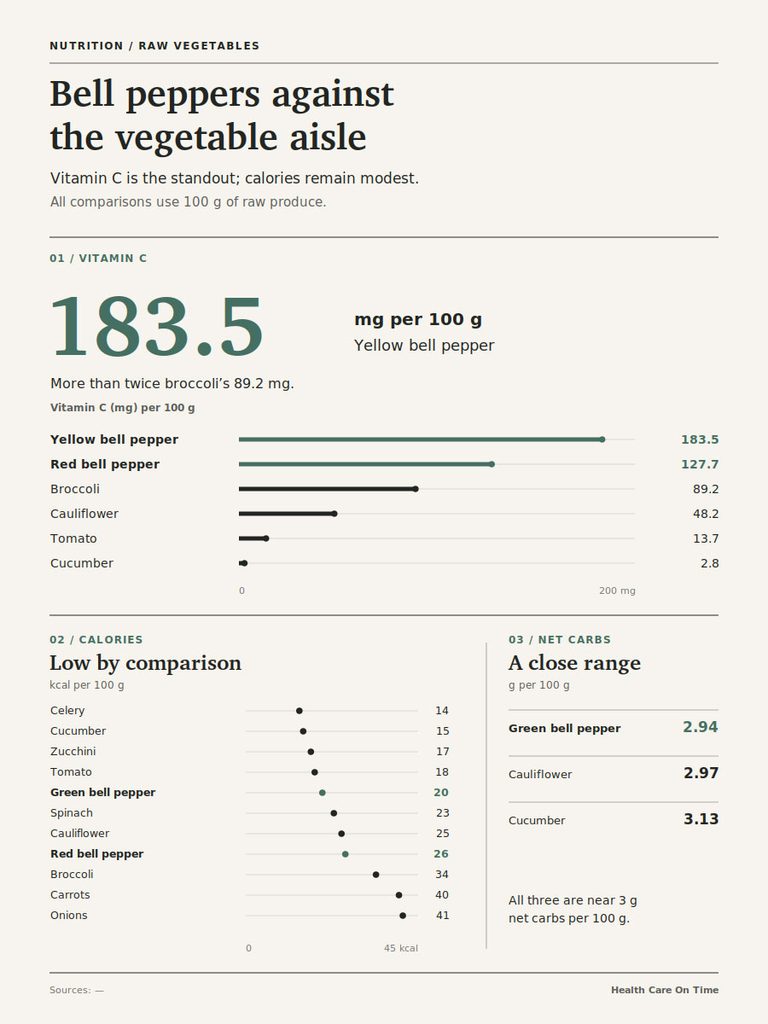
Red bell pepper (26) is close to cauliflower (25). Broccoli has 34, and carrots and onions are higher at about 40 to 41.
The difference shows up in vitamin C. Per 100 grams, cucumber has 2.8 mg, tomato 13.7 mg, cauliflower 48.2 mg, and broccoli 89.2 mg. Red bell pepper, at 127.7 mg, beats them all, and yellow, at 183.5 mg, is higher still.
For net carbs, green pepper (2.94 g per 100 grams) falls between cucumber (3.13 g) and cauliflower (2.97 g), so it fits well in low-carb meals.
Are Bell Peppers Good for Weight Loss and Blood Sugar?
Raw bell peppers are about as easy to fit into a calorie budget as any food. The numbers explain why.
Energy Density in Plain Numbers
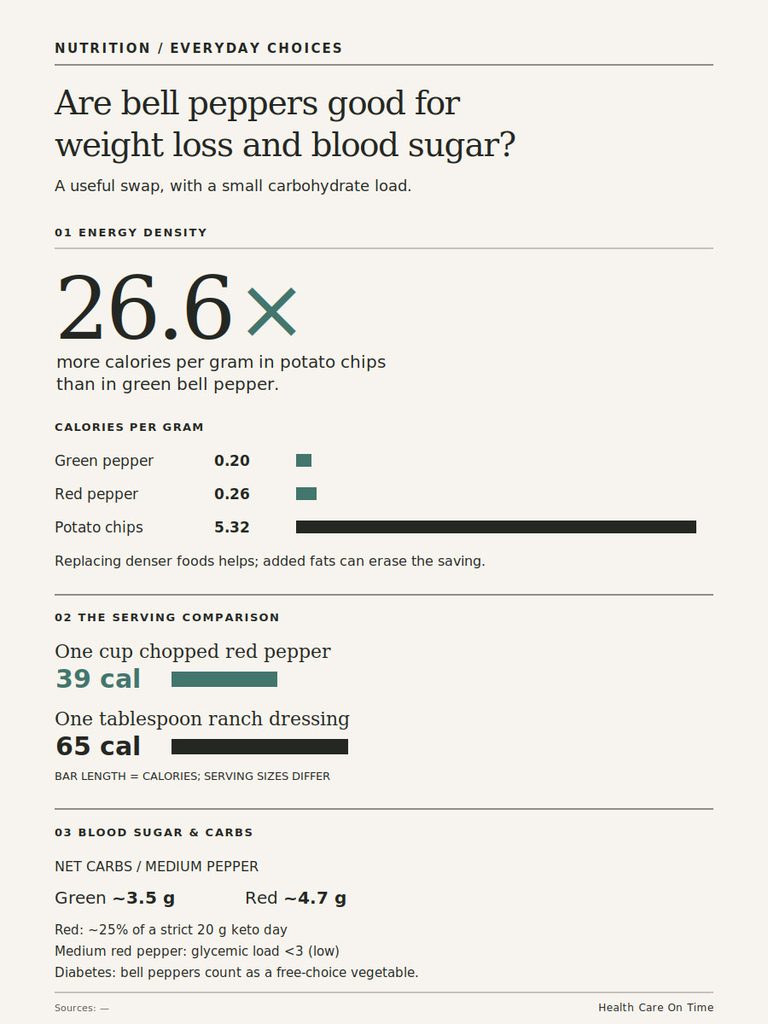
Energy density means calories per gram. Green peppers have 0.20 and red have 0.26. Plain potato chips, per USDA, have 5.32.
That means one cup of chopped red pepper (39 calories) has fewer calories than one tablespoon of regular ranch dressing (about 65). An ounce of chips has about 151. Swapping chips for pepper strips with a measured dip is one of the simplest changes our team suggests to patients working on weight.
The catch is the same as with any vegetable. Peppers help when they replace denser food, not when they’re added on top with extra oil or cheese.
Keto and Low-Carb Portions
A medium green pepper has about 3.5 grams of net carbs and a medium red about 4.7 grams. On a strict 20-gram-a-day keto plan, one red pepper uses roughly a quarter of the budget.
Green peppers go further on tight carb limits. On a looser low-carb plan (50 to 100 grams daily), any color fits easily.
Glycemic Load: Why a GI Number Barely Matters
A standard glycemic index test uses 50 grams of available carbohydrate. For red peppers, that’s about 2.8 pounds, roughly 11 medium peppers eaten at once.
Glycemic load, which is based on a real portion, is more useful. A medium red pepper’s glycemic load is under 3, which counts as low. For people with diabetes, bell peppers are a free-choice vegetable in normal portions. Patients who book HbA1c and fasting glucose tests with us often ask about “sweet” vegetables, and red peppers aren’t one to worry about.
The Data: Bell Peppers in the American Diet
Bell peppers have gone from garnish to grocery staple over the past 60 years, and more of them now come from outside the US.
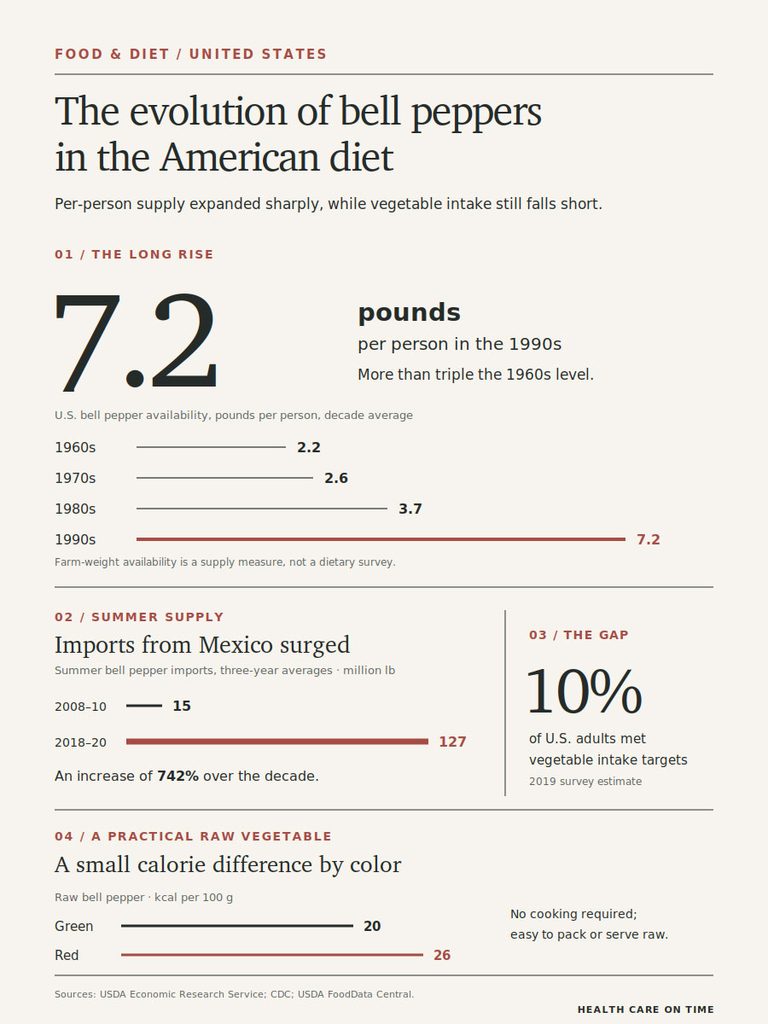
According to USDA’s Economic Research Service, per person bell pepper use held around 2.0 to 2.5 pounds through the 1960s and 1970s, came close to 4 pounds in the 1980s, and passed 7 pounds in the 1990s. Summer bell pepper imports from Mexico rose 742% from 2008–10 to 2018–20. In an older ERS report, advertised retail prices for conventional red peppers averaged $2.45 per pound, 70% above field-grown green, and orange peppers had the highest wholesale price, 3 times that of green.
Table 2: Bell Pepper Facts and US Statistics
| Data point | Figure | Source (data year) |
| Red bell pepper, raw, calories per 100 g | 26 kcal | USDA FoodData Central, FDC 170108 |
| Green bell pepper, raw, calories per 100 g | 20 kcal | USDA FoodData Central, FDC 170427 |
| Vitamin C in 1 cup chopped red pepper | 190 mg (211% DV) | USDA FDC 170108; FDA Daily Value 90 mg |
| US adults meeting vegetable intake recommendations | 10.0% | CDC MMWR (2019 BRFSS data, published 2022) |
| US bell pepper use per person, 1960s vs 1990s | 2.0 lb vs over 7 lb | USDA Economic Research Service |
| Rise in summer bell pepper imports from Mexico | 742% | USDA ERS (2008–10 vs 2018–20) |
| Retail price, red vs green | Red about 70% higher | USDA ERS / AMS (around 2012) |
| Monash low-FODMAP serving, red vs green | 43 g vs 75 g | Monash University FODMAP app (retested 2022) |
The CDC reports that only about 1 in 10 US adults eats enough vegetables. Bell peppers are an easy fix: no cooking needed, they travel well, and most kids will eat them raw.
About the Data
USDA’s bell pepper records are SR Legacy entries, the long-standing reference set. They’re averages, and real peppers vary by variety, size, season, and farm. The retail price comparison comes from an older ERS report, so use it as a ratio rather than a current price. Current prices for colored peppers still tend to run above green.
Who Should Be Careful With Bell Peppers
Bell peppers are safe for nearly everyone. A few groups should watch portions or preparation.
Warfarin and Vitamin K
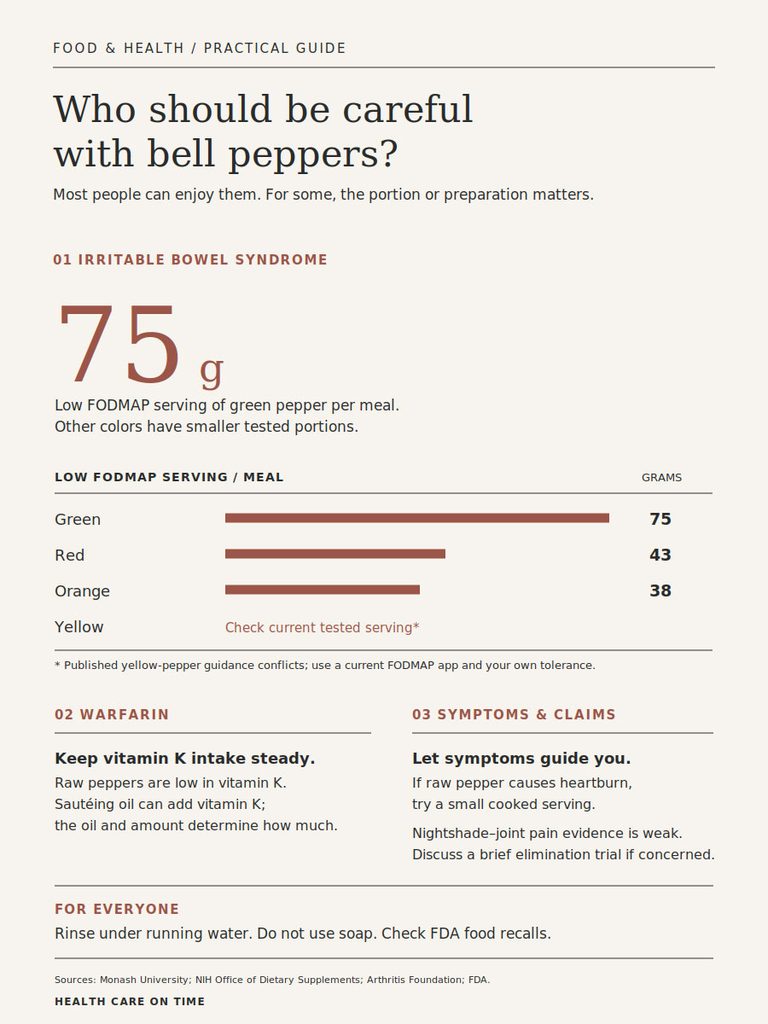
People on warfarin need a steady vitamin K intake, not zero. Raw bell peppers are low: about 9 mcg in a medium green pepper and about 6 mcg in a medium red.
Sautéed peppers are higher, at 21.3 mcg per 100 grams for green, partly because of the cooking oil. The NIH vitamin K fact sheet stresses steady habits. Our medical reviewers suggest keeping pepper portions about the same from week to week if you take warfarin.
IBS and FODMAP Portions
Bell peppers contain excess fructose, which can trigger IBS symptoms. Color makes a big difference.
In Monash University’s FODMAP app, red bell pepper stays low FODMAP up to 43 grams (about 1/3 cup) per meal, while green has the largest safe serving at 75 grams. Orange is low FODMAP at 38 grams and yellow at 35 grams. If peppers bother your stomach, green is the one to test first.
Heartburn and Reflux
Bell peppers have no capsaicin, so they’re not spicy. Some people with reflux still find raw peppers uncomfortable. Cooked peppers are often easier to tolerate, but this varies, and there’s little formal research on it.
Nightshade Concerns
Bell peppers are nightshades, along with tomatoes, potatoes, and eggplant. Online claims link nightshades to joint pain, but good clinical evidence that they worsen arthritis in most people is lacking. If you suspect a reaction, a short elimination trial guided by a clinician tells you more than cutting the whole group for good.
Food Safety
Rinse peppers under running water just before eating, even if you’ll cut or cook them. Don’t use soap. If a produce outbreak is in the news, check the FDA recall page.
How to Choose, Store, and Use Bell Peppers
A few habits help you get the most from every pepper.
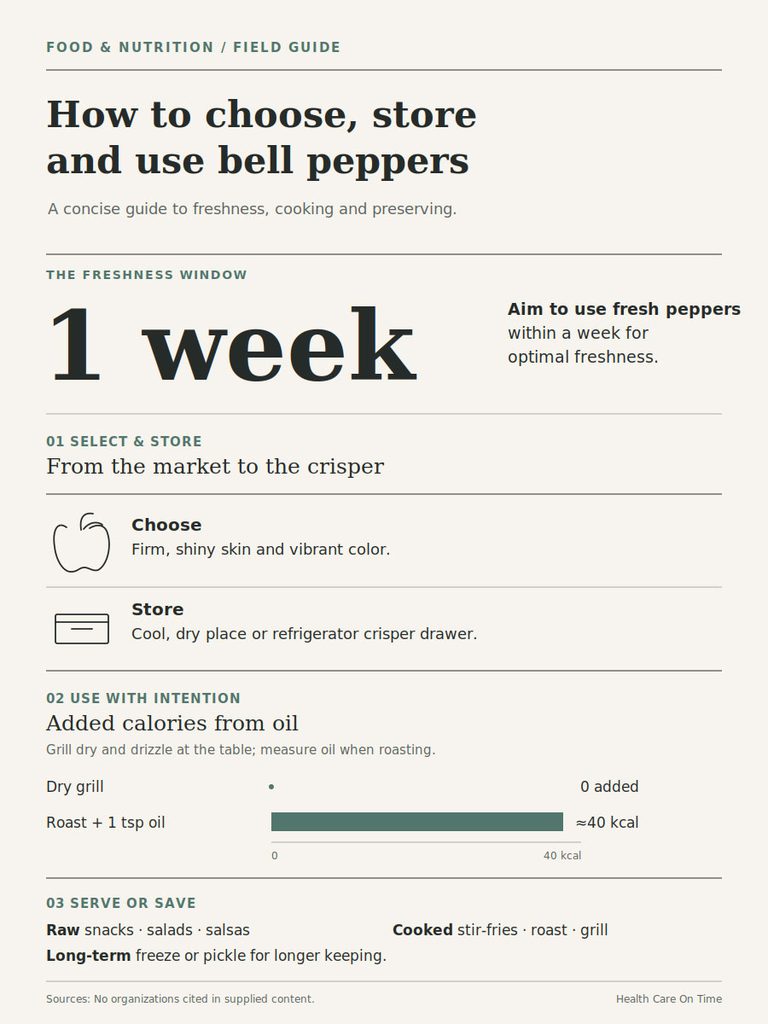
- Choose firm, glossy peppers that feel heavy for their size. Wrinkles mean water loss.
- Store whole peppers unwashed in the crisper drawer. They usually last about 1 to 2 weeks, and green lasts longer than red.
- Refrigerate cut peppers in a sealed container and use them within 3 to 5 days.
- Freeze extras in strips on a tray, then bag them. No blanching is needed if you’ll cook them later.
- Shop by season. US-grown peppers peak in summer and early fall. Winter supply leans more on imports, which can raise prices for colored peppers.
- Save money with green. Green peppers cost less and still provide about 120 mg of vitamin C per cup.
To keep calories low, eat peppers raw, roast them with a measured teaspoon of oil (about 40 calories), or grill them dry and drizzle oil at the table.
What to Do Next: Quick Decision Guide
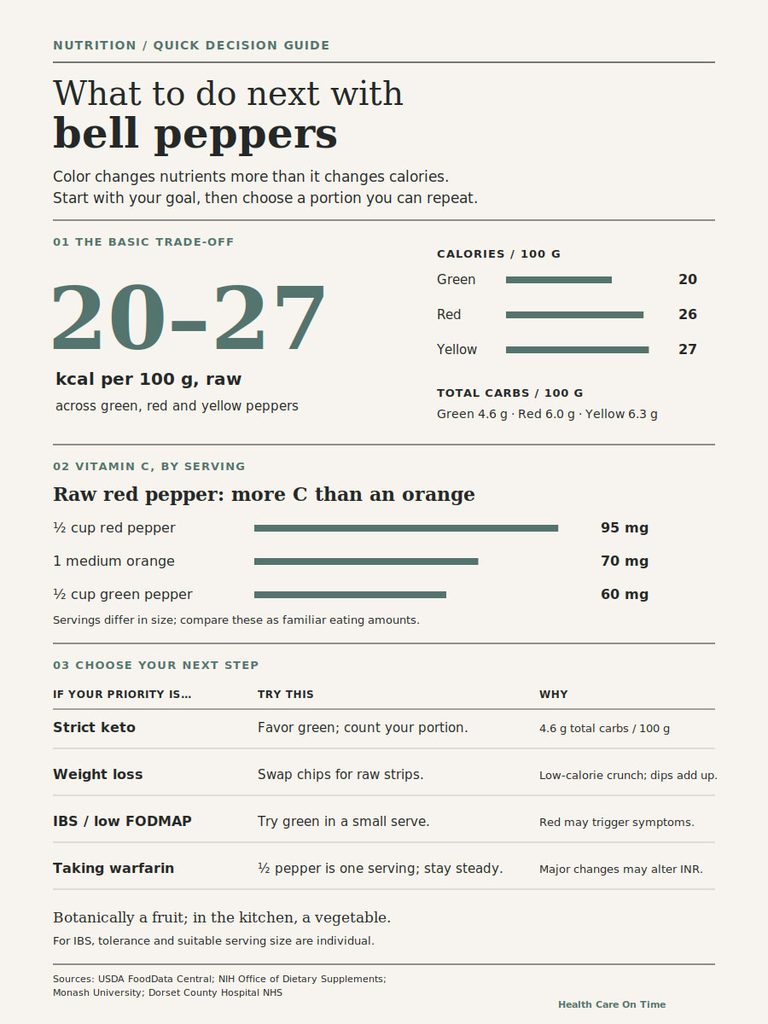
Table 3: Bell Pepper Scenarios and What to Do
| Your situation | Recommended action | Why it works |
| Logging calories in an app | Use 26 kcal per 100 g for red and 20 for green; weigh the pepper | Generic-formula entries overcount by about 18% to 19% |
| Strict keto (20 g net carbs a day) | Choose green; limit red to one medium pepper a day | Green has 3.5 g net carbs per medium pepper vs 4.7 g for red |
| Trying to lose weight | Swap chips for raw pepper strips | 1 cup red pepper is 39 kcal vs about 151 kcal for 1 oz chips |
| Taking warfarin | Keep pepper portions steady week to week | Vitamin K is low but should stay consistent |
| Managing IBS | Start with green at 75 g; keep red to 43 g per meal | Monash testing gives green the largest low-FODMAP serving |
| Want more vitamin C | Choose yellow or red, eaten raw | Yellow has 183.5 mg per 100 g; heat lowers vitamin C |
| Want more lutein for eye health | Include green peppers with a little oil | Green has 341 mcg lutein plus zeaxanthin vs 51 in red |
| Watching sodium | Choose fresh or frozen; rinse canned peppers | Canned peppers can carry about 1,900 mg sodium per cup |
Frequently Asked Questions
How many calories are in one whole bell pepper?
A medium bell pepper (119 grams) has about 24 calories if green, 31 if red, and 32 if yellow, according to USDA FoodData Central. A large pepper (164 grams) has 33 to 44 calories. Weighing the pepper gives the most accurate count, because sizes vary a lot between stores.
Which color bell pepper has the fewest calories?
Green bell peppers have the fewest calories, 20 per 100 grams. Red has 26 and yellow has 27. Green peppers are harvested before they ripen, so they hold less natural sugar. Between colors, the difference is only about 6 to 8 calories per medium pepper.
How many calories are in a cup of chopped bell pepper?
A cup of chopped bell pepper weighs 149 grams, which comes to 30 calories for green, 39 for red, and 40 for yellow. A cup of sliced pepper weighs only 92 grams, so it has 18 to 25 calories. Check whether your app means chopped or sliced.
How many carbs are in a bell pepper?
A medium red bell pepper has about 7.2 grams total carbohydrate, 2.5 grams fiber, and 4.7 grams net carbs. A medium green pepper has about 5.5 grams carbohydrate and 3.5 grams net carbs. By any standard definition, both are low-carb vegetables.
Are bell peppers keto friendly?
Yes. Green bell peppers suit strict keto best, at about 3.5 grams net carbs per medium pepper. Red and yellow run higher, at about 4.7 to 6.4 grams. On a 20-gram daily limit, one red pepper uses about a quarter of your carb budget.
Do cooked bell peppers have more calories than raw?
Boiled peppers have only slightly more calories per 100 grams (28 vs 20 to 26) because some water cooks off. Sautéed peppers are much higher, 116 to 133 calories per 100 grams, because of the oil. The cooking fat accounts for nearly the entire difference.
How many calories are in a stuffed bell pepper?
A typical homemade stuffed pepper with lean ground beef, rice, marinara, and a little cheese has about 300 to 350 calories. Restaurant versions often reach 450 to 600. The pepper itself adds only about 31 calories, so the filling sets the total.
Do bell peppers have more vitamin C than oranges?
Yes. One cup of chopped red bell pepper has about 190 mg of vitamin C, while a medium orange has about 70 mg. Yellow peppers are higher still, at 183.5 mg per 100 grams. Even a cup of green pepper, at about 120 mg, beats an orange.
Is it okay to eat a bell pepper every day?
For most people, yes. One pepper a day is a low-calorie way to meet your vitamin C needs and add fiber. People with IBS may need smaller portions of red, yellow, or orange peppers. Rotating colors gives you a wider mix of carotenoids through the week.
Are bell peppers good for weight loss?
Bell peppers can support weight loss because they’re very low in calories and high in water. A cup of red pepper has 39 calories. They help most when they replace higher-calorie snacks and sides, and when you keep the oil, cheese, and dips in check.
Is a bell pepper a fruit or a vegetable?
Botanically, a bell pepper is a fruit, since it grows from a flower and contains seeds. In cooking and nutrition, it counts as a vegetable. US dietary guidance counts bell peppers toward daily vegetable intake, just like tomatoes and cucumbers.
Can bell peppers affect warfarin?
Raw bell peppers are low in vitamin K, about 6 to 9 mcg per medium pepper, so they’re unlikely to affect warfarin on their own. Sautéed peppers are somewhat higher. The key is consistency: keep your usual portions steady and tell your care team about big diet changes.
Disclaimer: This article is for general education and doesn’t replace personal medical or nutrition advice. Nutrient values are USDA FoodData Central averages, and individual peppers vary by variety, size, and growing conditions. If you take warfarin, manage diabetes, or have IBS or kidney disease, talk with your doctor or a registered dietitian before making major diet changes.
References
- USDA FoodData Central: Peppers, sweet, red, raw (FDC 170108)
- USDA FoodData Central: Peppers, sweet, green, raw (FDC 170427)
- USDA FoodData Central: Peppers, sweet, yellow, raw (FDC 169383)
- USDA FoodData Central: Peppers, sweet, red, sautéed (FDC 168550)
- USDA FoodData Central: Peppers, sweet, red, canned (FDC 168546)
- NIH Office of Dietary Supplements: Vitamin C Fact Sheet
- NIH Office of Dietary Supplements: Vitamin K Fact Sheet
- FDA: Daily Value on the Nutrition and Supplement Facts Labels
- CDC MMWR: Adults Meeting Fruit and Vegetable Intake Recommendations
- USDA ERS: Imports of Bell Peppers From Mexico Grow
- USDA ERS: Vegetables and Pulses Outlook, Bell Pepper Special Article
- Monash University: Fructose Changes for Vegetables in the Monash FODMAP App