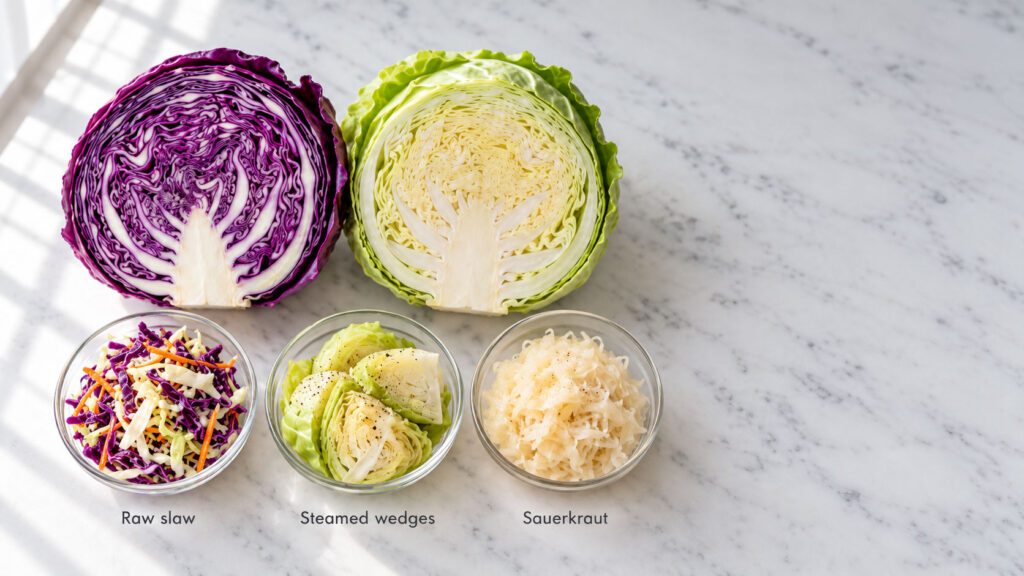
Polish women who move to the United States see their breast cancer risk climb roughly threefold, until it matches the US rate. A Michigan State researcher noticed something else that changed after the move: their cabbage.
Table of Contents
Women in Poland traditionally ate about 30 pounds of cabbage and sauerkraut a year, compared with about 10 pounds for American women.
That question launched one of the few studies to look at cabbage by name. It also shows why cabbage advice online is so messy. Some claims rest on real human data. Others rest on rat studies, a 1949 paper with 13 patients, or nutrients found only in red cabbage.
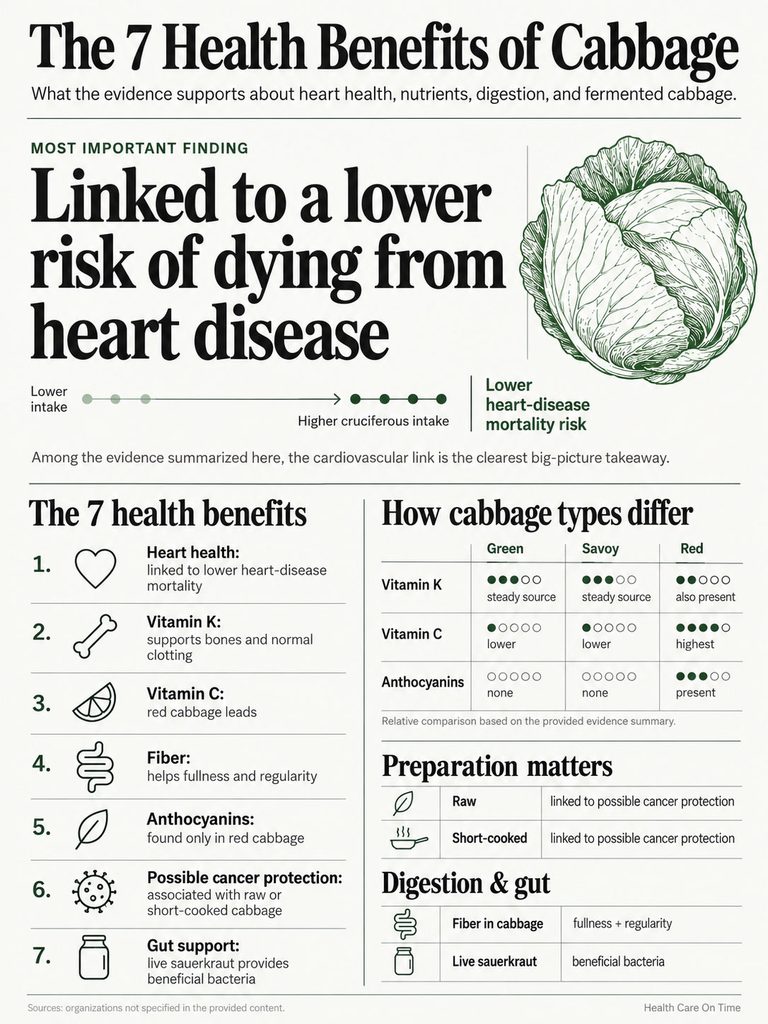
Quick Answer: Eating cabbage regularly (about 3 or more half-cup servings a week) is linked to these 7 benefits:
- Lower risk of dying from heart disease
- Steady vitamin K for bones and clotting
- A strong vitamin C boost
- Fiber for regular digestion
- Anthocyanin antioxidants (red cabbage only)
- Possible lower cancer risk with raw or lightly cooked cabbage
- Gut support from live sauerkraut
At a Glance
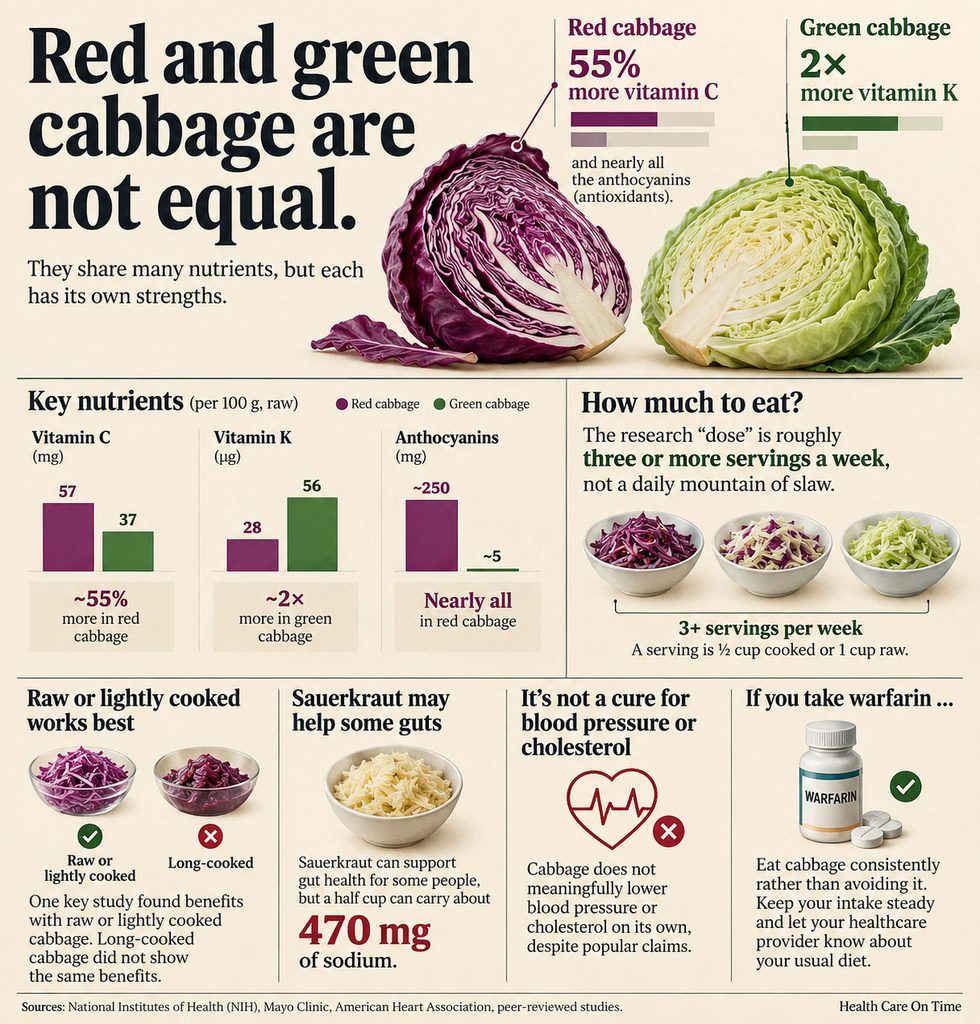
- Red and green cabbage are not equal. Red has about 55% more vitamin C and nearly all the anthocyanins; green has about twice the vitamin K.
- The research “dose” is roughly three or more servings a week, not a daily mountain of slaw.
- Raw or lightly cooked cabbage showed benefits in one key study; long-cooked cabbage did not.
- Sauerkraut may help some guts, but a half cup can carry about 470 mg of sodium.
- Cabbage does not meaningfully lower blood pressure or cholesterol on its own, despite popular claims.
- If you take warfarin, eat cabbage consistently rather than avoiding it.
What Counts as “Eating Cabbage Regularly”?
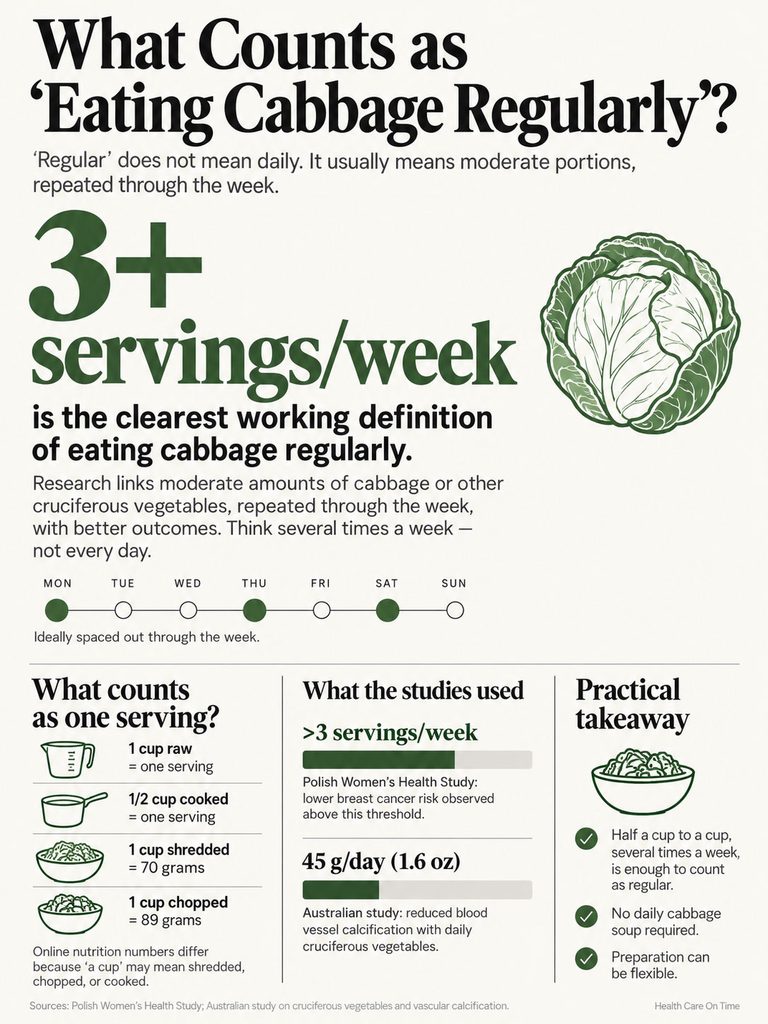
“Regularly” sounds vague, but the research gives it a shape. Most studies count a serving as about half a cup cooked or one cup raw. That is roughly a side of coleslaw or a scoop of sautéed cabbage.
Our medical review team checked the studies most often cited for cabbage benefits. The intake levels that showed results were modest, not extreme.
The Serving Size Used in Studies
A cup of raw shredded green cabbage weighs about 70 grams (2.5 ounces). A cup chopped weighs about 89 grams (3.1 ounces). That gap is why websites disagree on nutrient numbers. For the full portion math, see our guide on how many calories are in cabbage.
For benefits, frequency matters more than grams. A half cup to a cup, several times a week, is the pattern linked to better outcomes.
The “3 Servings a Week” Line
In the Polish Women’s Health Study, women with the lowest breast cancer risk ate more than three servings a week of raw or short-cooked cabbage and sauerkraut. An Australian study of 684 older women, published in the British Journal of Nutrition in 2021, found less blood vessel calcification above about 45 grams (1.6 ounces) of cruciferous vegetables a day.
So “regularly” means three or more servings a week, ideally spread out. You don’t need cabbage soup every day.
The 7 Health Benefits Backed by Real Evidence
Patients who book lipid panels and wellness tests with HealthCareOnTime often ask which food claims are real. This table is our honest answer for cabbage.
| Claim | Evidence type | Strength | Applies to | Verdict |
| Lower heart disease death risk | Large cohorts (134,796 adults) | Moderate | All cruciferous vegetables | Real |
| Vitamin K for bones and clotting | Nutrient data (USDA) | Strong | Green, savoy | Real |
| High vitamin C | Nutrient data (USDA) | Strong | Red highest | Real |
| Fiber for regularity | Nutrient data plus fiber research | Strong | All | Real |
| Anthocyanin antioxidants | Lab plus nutrient data | Moderate | Red only | Real (red only) |
| Lower breast cancer risk | One case-control study | Weak to moderate | Raw or short-cooked | Real but early |
| Gut support from sauerkraut | Two small trials (n=34, n=87) | Weak to moderate | Fermented only | Real but modest |
| Lowers blood pressure | Potassium math, one mixed-vegetable trial | Weak | All | Hyped |
| Lowers cholesterol via plant sterols | Sterol math | Very weak | All | Hyped |
| Cabbage juice cures ulcers | 1949 uncontrolled study, 13 patients | Very weak | Raw juice | Hyped |
1. Lower Risk of Dying From Heart Disease
The strongest human data for cabbage comes from its family. A pooled analysis of the Shanghai Women’s and Men’s Health Studies, published in the American Journal of Clinical Nutrition, followed 134,796 Chinese adults. People in the highest fifth of cruciferous vegetable intake had a 22% lower risk of death from any cause (HR 0.78).
The link was strongest for cardiovascular death and was not seen for cancer death. In Shanghai, cabbage, bok choy, and Chinese greens make up most cruciferous intake, so the finding fits cabbage well.
This is observational data. People who eat more vegetables may also smoke less or move more. Researchers adjusted for many factors, but a cohort cannot prove cause and effect.
What Might Explain It
Cruciferous vegetables contain glucosinolates, sulfur compounds that break down into isothiocyanates when you chew or chop them. Lab research suggests these compounds calm inflammation and protect blood vessel walls.
A 2014 study in the Journal of the Academy of Nutrition and Dietetics looked at 1,005 Chinese women. Those eating the most cruciferous vegetables had lower blood levels of inflammatory markers such as IL-6 and TNF-alpha. That supports the heart link without proving it. Our article on high CRP levels explains how inflammation is measured in a blood test.
2. Steady Vitamin K for Bones and Clotting
One cup of chopped raw green cabbage gives about 68 mcg of vitamin K, roughly 56% of the Daily Value, per USDA FoodData Central. Savoy cabbage is similar.
Vitamin K1 helps your liver make clotting proteins. It also activates proteins that bind calcium into bone. The NIH Office of Dietary Supplements notes that leafy and cruciferous vegetables are the main dietary source for American adults.
Red cabbage has about half as much vitamin K as green. If bone support is your goal, green or savoy is the better pick.
3. A Real Vitamin C Boost (Red Cabbage Leads)
A cup of chopped raw red cabbage provides about 51 mg of vitamin C, around 56% of the Daily Value. Green cabbage gives about 33 mg, or 36%.
Vitamin C helps you make collagen, supports immune cells, and boosts absorption of plant iron. Pairing cabbage with beans or lentils is a smart move for that reason.
Heat breaks down vitamin C, and boiling leaches it into the water. Raw slaw, quick stir-fries, and steaming keep more of it.
4. Fiber for Regular Digestion
A cup of chopped green cabbage has about 2.2 grams of fiber for roughly 22 calories. That high fiber-per-calorie ratio helps with fullness and regularity.
Most of that fiber is insoluble, the kind that adds bulk to stool. Two grams is modest on its own, since adults need about 25 to 38 grams daily. Cabbage helps as one part of a fiber-rich plate, not as a single fix.
5. Anthocyanins, But Only in Red Cabbage
Red cabbage gets its deep purple color from anthocyanins, the same pigment family found in blueberries. Large cohort studies tie higher anthocyanin intake to lower heart attack risk.
Why the “36 Anthocyanins” Claim Misleads
Many top-ranking pages say cabbage contains more than 36 types of anthocyanins. That research was done on red cabbage. Green cabbage, which most Americans buy, has almost none.
If you choose cabbage partly for antioxidants, buy red. Green wins on vitamin K. Mixing both in one slaw gets you the best of each.
| Nutrient (per 1 cup chopped raw, about 3.1 oz) | Green | Red | Savoy | Napa |
| Vitamin C | ~33 mg (36% DV) | ~51 mg (56% DV) | ~28 mg | ~24 mg |
| Vitamin K | ~68 mcg (56% DV) | ~34 mcg (28% DV) | ~61 mcg | ~38 mcg |
| Anthocyanins | Trace | High | Trace | Trace |
| Potassium | ~151 mg | ~216 mg | ~205 mg | ~210 mg |
| Best use | Slaw, sauerkraut | Raw salads, pickling | Wraps, soups | Stir-fry, kimchi |
Values are approximate, calculated from USDA FoodData Central per-100-gram records.
6. Possible Cancer Protection (Raw or Short-Cooked)
The Polish Women’s Health Study compared Polish-born women living around Chicago and Detroit, with and without breast cancer. Higher intake of raw or short-cooked cabbage and sauerkraut, in both adolescence and adulthood, was tied to significantly lower risk.
When the team first presented results in 2005, women who ate more than three servings a week as teenagers had about a 70% lower risk than low consumers. Long-cooked cabbage, such as stews and braises, showed no significant link.
The Honest Limits
This was a case-control study. Women were asked to recall what they ate as teens decades earlier, and memory can be biased. It was also small, with about 140 women with cancer in the early analysis.
Across the cases our medical team reviews, cruciferous vegetables look protective in several cancer studies, but no single food prevents cancer. Treat this as one good reason to eat cabbage, never a substitute for mammograms or other screening.
7. Gut Support From Live Sauerkraut
Fermented cabbage carries lactic acid bacteria such as Lactobacillus plantarum. A Norwegian randomized trial in Food & Function gave 34 people with IBS 75 grams (2.6 ounces) of sauerkraut daily for 6 weeks.
Both the raw and pasteurized groups reported fewer IBS symptoms and showed gut bacteria changes. Only the raw group carried more sauerkraut-related bacteria in their stool. There was no group that skipped sauerkraut, so a placebo effect can’t be ruled out.
A 2025 crossover trial of 87 healthy adults found daily sauerkraut was well tolerated and caused subtle shifts in gut metabolism, but no dramatic change in microbial diversity. The honest summary: sauerkraut is a reasonable gut-friendly food, not a probiotic drug.
3 Cabbage Claims That Are Overhyped
Our medical reviewers flag these three because they appear on nearly every top-ranking cabbage page, usually with no numbers behind them.
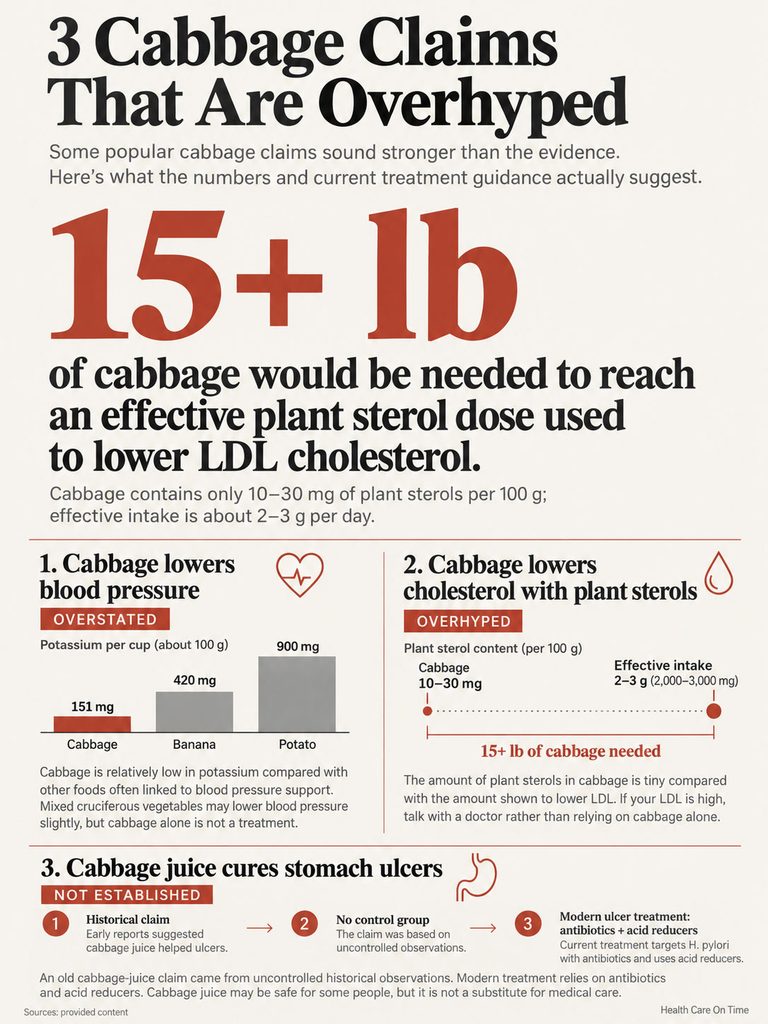
“Cabbage Lowers Blood Pressure”
The claim rests on potassium. But a cup of chopped green cabbage has only about 151 mg, roughly 3% of the 4,700 mg Daily Value. A medium banana has about 420 mg, and a baked potato has more than 900 mg.
A small UK trial of 18 adults, published in BMC Medicine in 2024, found a daily mix of broccoli, cauliflower, cabbage, and kale lowered systolic pressure by a few points compared with root vegetables. That was about 300 grams (10.6 ounces) of mixed cruciferous vegetables a day, not cabbage alone. Cabbage fits a heart-healthy pattern, but it is not a blood pressure treatment. See our blood pressure chart for women for target numbers.
“Cabbage Lowers Cholesterol With Plant Sterols”
Cabbage does contain plant sterols, which block cholesterol absorption. The problem is quantity. Studies showing a 9% to 12% LDL drop used 2 to 3 grams of sterols daily.
Cabbage holds roughly 10 to 30 mg of sterols per 100 grams. Reaching 2 grams would take well over 15 pounds of cabbage a day. Its soluble fiber helps a little, but the sterol claim does not hold up. If your LDL is high, a lipid profile test and a plan with your doctor will do far more.
“Cabbage Juice Cures Stomach Ulcers”
This claim traces to Stanford physician Garnett Cheney. In 1949, he gave 13 ulcer patients about a quart of fresh cabbage juice daily. He reported gastric ulcer craters healed in about 7.3 days, versus 42 days reported in older literature.
There was no control group; the comparison came from other papers. Cheney also worked decades before doctors learned in the 1980s that H. pylori bacteria cause most ulcers. Today, ulcers are treated with antibiotics and acid-reducing drugs. Cabbage juice is safe for most people but should not replace testing and treatment.
Red vs Green vs Savoy vs Napa: Which Should You Buy?
All four are cabbage, but they serve different goals. Red cabbage is best for antioxidants and vitamin C. It keeps well, stays crunchy, and colors any salad.
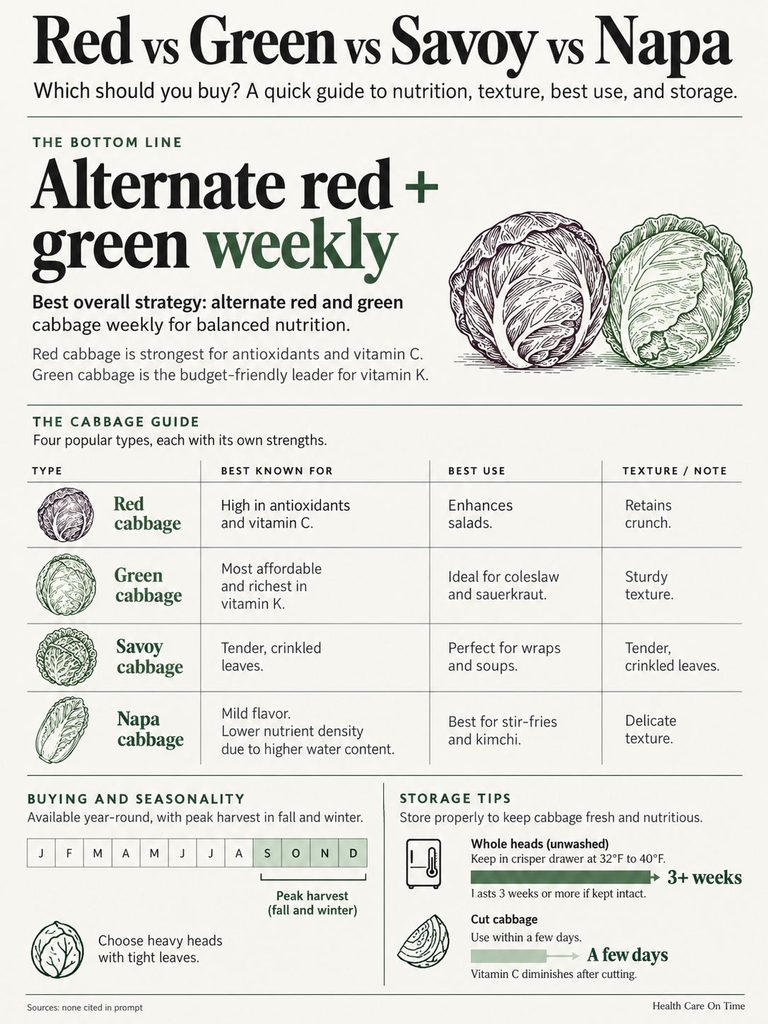
Green cabbage is the cheapest, highest in vitamin K, and the classic base for coleslaw and sauerkraut. Savoy has crinkled, tender leaves that work as wraps and in soups.
Napa cabbage is mild and watery, ideal for stir-fries and kimchi. It has fewer nutrients per cup simply because it holds more water. If you buy only one, alternate red and green week to week.
Buying and Storing Cabbage
Cabbage is sold year-round in US stores, with peak local harvests in fall and early winter. Pick heads that feel heavy for their size, with tight, crisp leaves and no black spots.
Store whole heads unwashed in the crisper drawer at 32°F to 40°F. A tight head often keeps three weeks or more. Once cut, wrap it and use it within a few days, since cut edges lose vitamin C.
Raw, Cooked, or Fermented: How Preparation Changes the Benefits
How you prepare cabbage may matter as much as how much you eat. The Polish study found benefits only with raw or short-cooked cabbage, and plant chemistry helps explain why.
Why Chopping and Waiting Helps
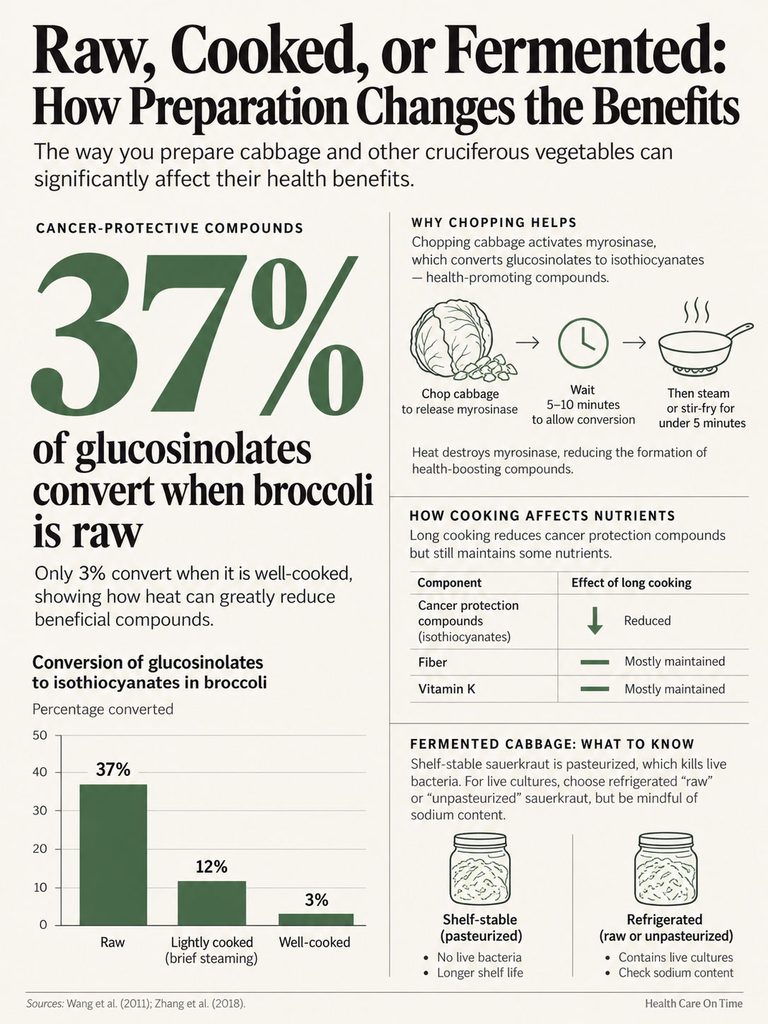
Glucosinolates need an enzyme called myrosinase to convert into active isothiocyanates. Myrosinase is released when you cut or chew the leaves, and heat destroys it.
In a 2008 broccoli study, about 37% of glucosinolates converted when eaten raw versus about 3% when well cooked. Cabbage works the same way. Chop it, let it sit 5 to 10 minutes, then steam or stir-fry for under 5 minutes.
Long simmering still gives you fiber and vitamin K. It just gives you fewer of the compounds tied to cancer protection.
Sauerkraut: Live vs Shelf-Stable
Shelf-stable canned sauerkraut is pasteurized, which kills its live bacteria. For live cultures, buy refrigerated sauerkraut labeled “raw” or “unpasteurized,” or make your own.
The catch is sodium. Canned sauerkraut has about 660 mg of sodium per 100 grams, so a half cup carries around 470 mg. That is about 20% of the 2,300 mg daily limit. Rinsing cuts sodium but washes away some bacteria too.
What to Expect When You Start Eating Cabbage Regularly
Patients commonly ask us what they will actually notice. Here is a realistic picture, not a promise.
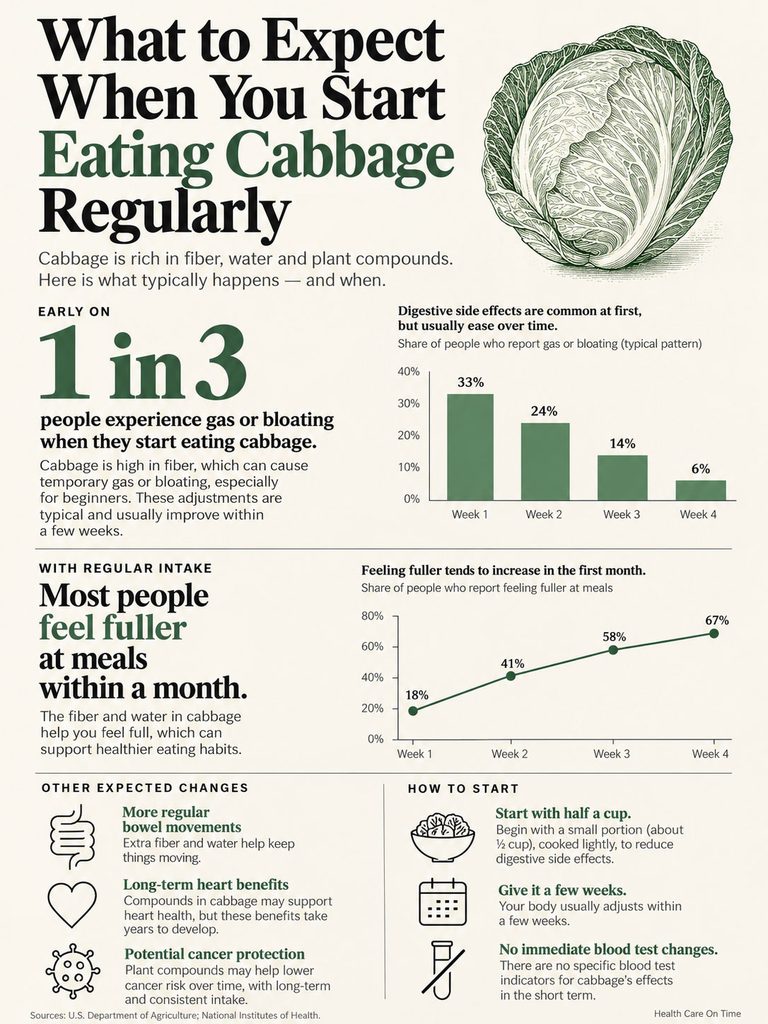
In the first week or two, many people notice more gas or bloating. That is your gut bacteria fermenting new fiber. Starting at half a cup and cooking it lightly usually helps, and most people adjust within a few weeks.
Within the first month, people often feel fuller at meals and have more regular bowel movements, thanks to the extra fiber and water. Heart and cancer benefits, if they come, build over years of steady eating. No blood test will “show cabbage” in a month.
The Numbers: Cabbage and Americans
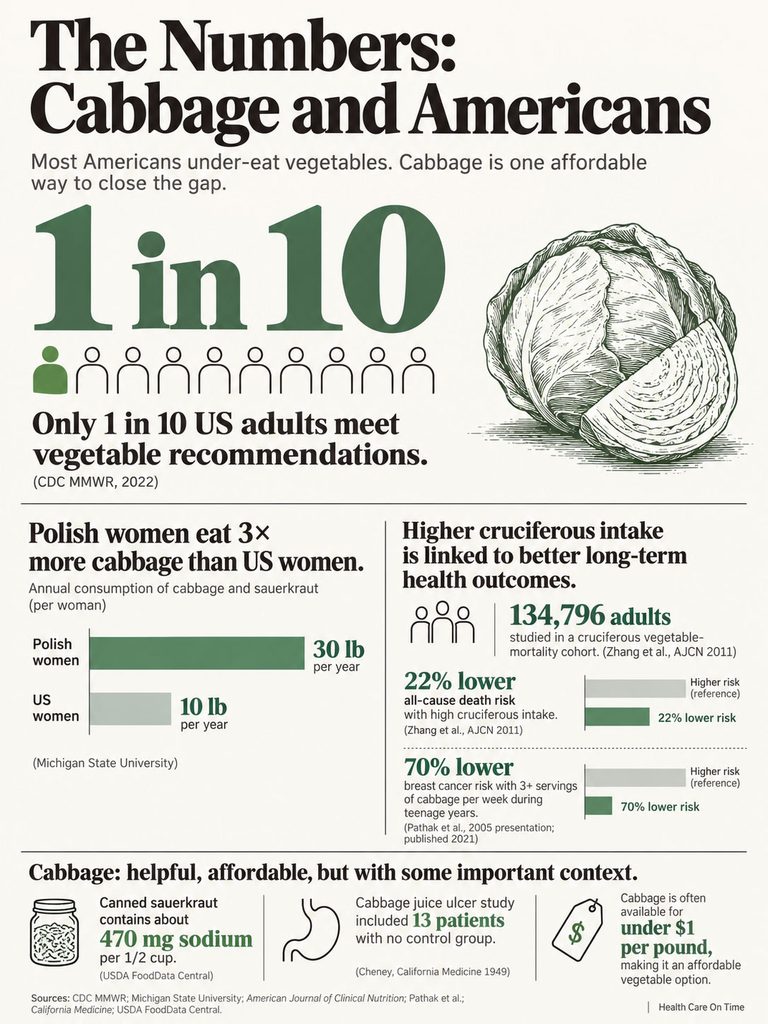
| Statistic | Figure | Source |
| US adults meeting vegetable recommendations | About 1 in 10 (10.0%) | CDC MMWR, 2022 |
| Cabbage and sauerkraut eaten per year, Poland vs US women | About 30 lb vs 10 lb | Michigan State University, Polish Women’s Health Study |
| Adults in the largest cruciferous-mortality cohort | 134,796 | Zhang et al., AJCN 2011 |
| Lower all-cause death risk, highest vs lowest crucifer intake | 22% (HR 0.78) | Zhang et al., AJCN 2011 |
| Lower breast cancer risk, 3+ weekly teen servings of raw or short-cooked cabbage | About 70% | Pathak et al., 2005 presentation; published 2021 |
| Patients in the famous cabbage juice ulcer study | 13 (no control group) | Cheney, California Medicine 1949 |
| Sodium in a half cup of canned sauerkraut | About 470 mg | USDA FoodData Central |
The most important number is the first. Nine in ten American adults fall short on vegetables. Cabbage is one of the cheapest ways to close that gap, often under $1 a pound.
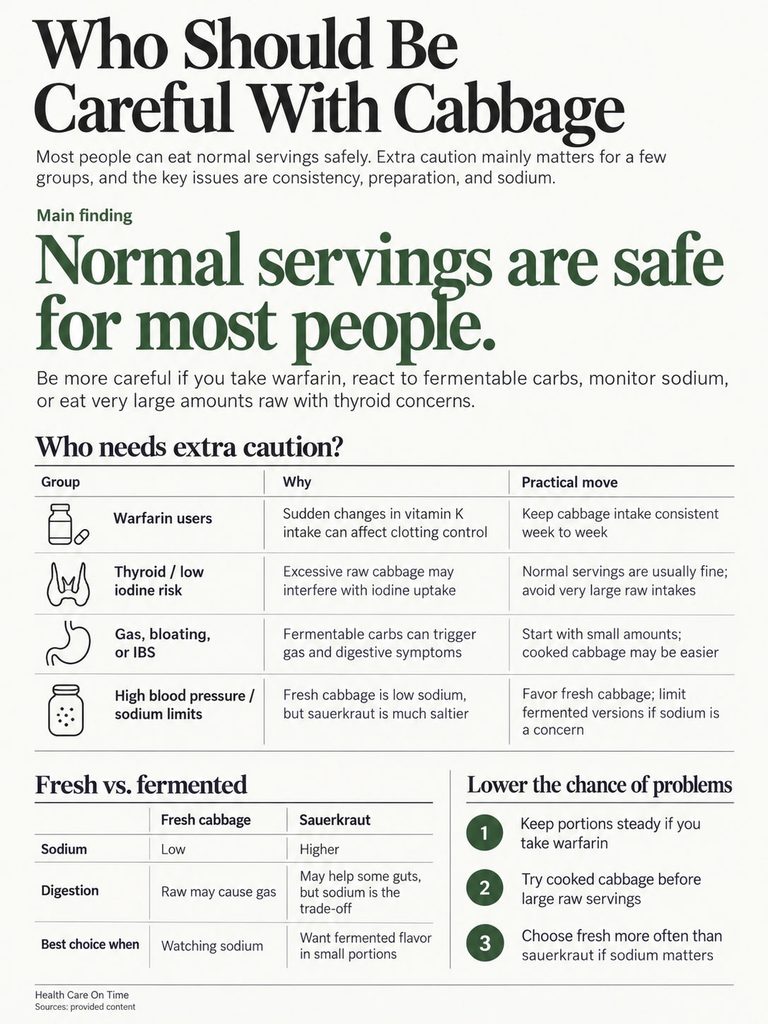
Who Should Be Careful With Cabbage
Cabbage is safe for nearly everyone. A few groups should adjust how they eat it, not whether they eat it.
Warfarin Users
Warfarin works by blocking vitamin K. A sudden jump in green cabbage intake can lower your INR and raise clot risk, while a sudden drop can raise bleeding risk.
In medication questions our clinicians see, the fix is consistency, not avoidance. Eat a similar amount of vitamin K foods each week and tell your doctor before big diet changes. Newer blood thinners such as apixaban are not affected by vitamin K. Our warfarin guide covers this in detail.
Thyroid and Iodine
Some glucosinolate breakdown products can interfere with iodine uptake by the thyroid. In practice, this matters mainly with iodine deficiency and very large daily amounts of raw cabbage.
Normal servings are not a concern for most people with healthy thyroids, especially those who use iodized salt. Our article on kale and thyroid health explains the dose math for the whole cabbage family.
Gas, Bloating, and IBS
Cabbage contains raffinose and other fermentable carbs that gut bacteria turn into gas. Monash University’s FODMAP testing rates common green and red cabbage low-FODMAP at about 75 grams, roughly one cup shredded.
If cabbage bloats you, start with half a cup, cook it lightly, and build up slowly. Some people find small amounts of sauerkraut easier, since bacteria pre-digest part of the sugars.
High Blood Pressure and Sauerkraut
Fresh cabbage is nearly sodium-free. Sauerkraut, kimchi, and store-bought coleslaw are not. If you are limiting sodium, choose fresh cabbage most days and keep fermented versions to a couple of tablespoons.
How to Eat More Cabbage Without Getting Bored
Cabbage is cheap, keeps for weeks, and works in nearly every cuisine. Here are easy ways to reach three servings a week:
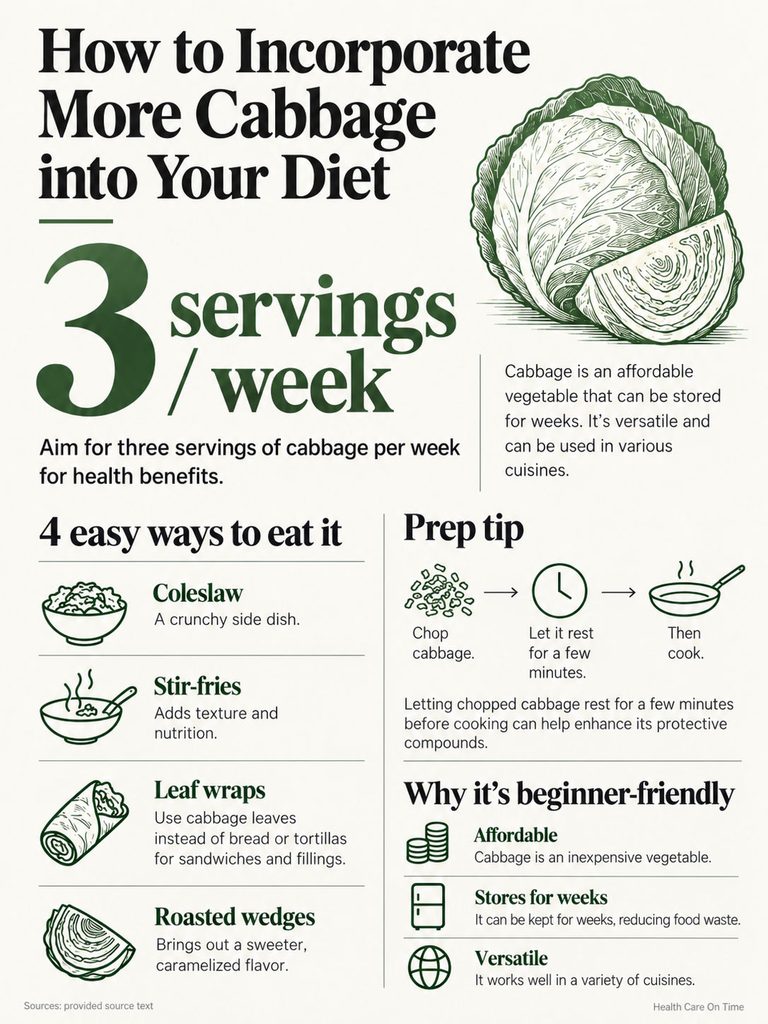
- Quick slaw: red and green cabbage with lime, olive oil, and cilantro on tacos.
- Five-minute stir-fry: napa cabbage with garlic, ginger, and eggs.
- Roasted wedges: green cabbage wedges at 425°F for 25 minutes with olive oil and pepper.
- Soup boost: a cup of chopped savoy added in the last 5 minutes of cooking.
- Wraps: blanched savoy leaves in place of tortillas.
- Sauerkraut topper: two tablespoons of refrigerated raw sauerkraut on eggs or a sandwich.
- Smoothie add-in: a small handful of raw red cabbage blended with berries.
Chop it first and let it rest a few minutes, even before roasting. That small step keeps more of the protective compounds.
Your Action Plan
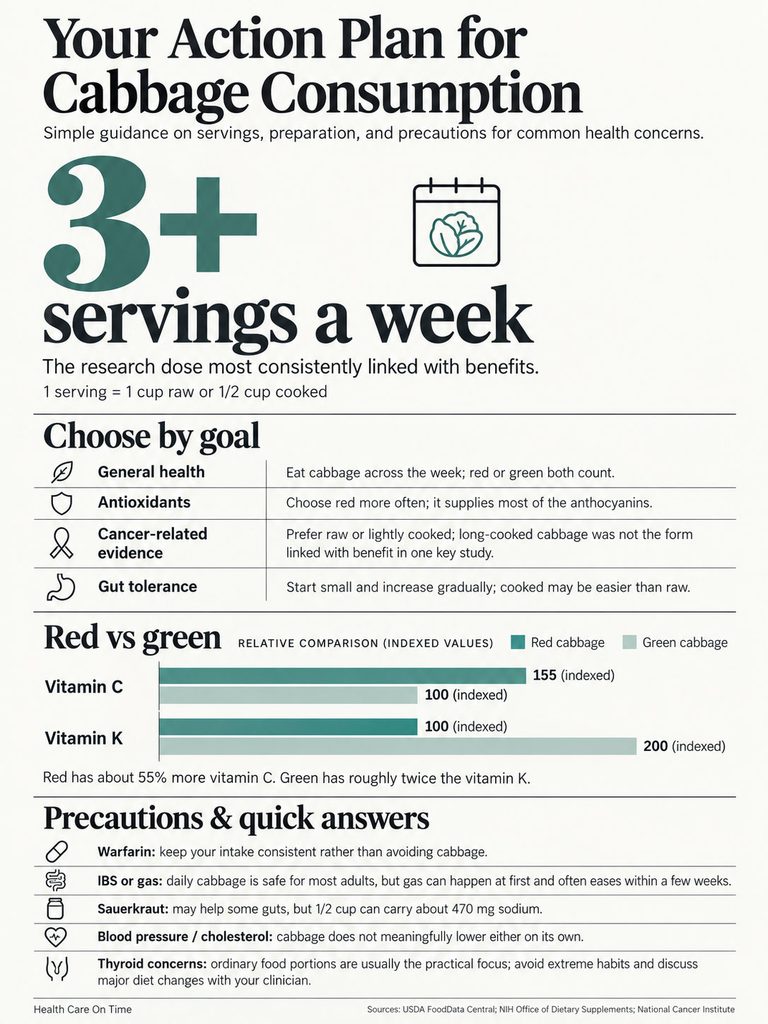
Across the diet questions HealthCareOnTime receives, most people want a simple rule. Here is a scenario guide.
| Scenario | Recommended action | Why |
| You want general health benefits | Eat 3 or more half-cup servings a week, mixing red and green | Matches intake levels linked to benefits in studies |
| You want the most antioxidants | Choose red cabbage, raw or lightly steamed | Red holds nearly all the anthocyanins and more vitamin C |
| You want cancer-related benefits | Eat raw or short-cooked; chop and wait 5 to 10 minutes | Long-cooked cabbage showed no link in the Polish study |
| You take warfarin | Keep weekly cabbage intake steady; tell your doctor before changes | Vitamin K swings shift your INR |
| You have IBS or bloating | Start at half a cup cooked; stay near 75 g (2.6 oz) per serving | Larger servings add fermentable carbs |
| You limit sodium | Use fresh cabbage; cap sauerkraut at 2 tablespoons | Half a cup of sauerkraut carries about 470 mg sodium |
| You have a thyroid condition with low iodine | Favor cooked cabbage; use iodized salt; ask your doctor | Raw glucosinolates may affect iodine uptake |
| You have stomach pain or a suspected ulcer | Get tested for H. pylori; don’t rely on cabbage juice | Ulcers need proper diagnosis and treatment |
Frequently Asked Questions
What happens if you eat cabbage every day?
Most people get more fiber, vitamin C, and vitamin K, and may feel fuller on fewer calories. Daily cabbage can cause gas at first, which usually eases within a few weeks. If you take warfarin, keep the daily amount steady. Eating cabbage every day is safe for most healthy adults.
How much cabbage should you eat per week?
Studies linking cabbage to lower disease risk point to about three or more servings a week. A serving is half a cup cooked or one cup raw. You can eat more if you enjoy it, but spread it across the week and rotate in other vegetables for variety.
Is red cabbage healthier than green cabbage?
Red cabbage has about 55% more vitamin C and nearly all of the anthocyanin antioxidants. Green cabbage has roughly twice the vitamin K. Neither is clearly healthier overall. Alternating between them, or mixing both in one slaw, gives you the strengths of each.
Is raw or cooked cabbage healthier?
Raw or lightly cooked cabbage keeps more vitamin C and more active cancer-protective compounds. In one study, long-cooked cabbage showed no link to lower breast cancer risk. Cooked cabbage still provides fiber and vitamin K and may cause less gas. Steaming under five minutes is a good middle ground.
Is sauerkraut as healthy as fresh cabbage?
Raw, refrigerated sauerkraut adds live bacteria that may help gut health, and a small trial found it eased IBS symptoms. But it is high in sodium, about 470 mg per half cup, and canned versions lose their live cultures. Use sauerkraut as a topping, with fresh cabbage as your main serving.
Does cabbage help with inflammation?
Cruciferous vegetables, including cabbage, are linked to lower inflammatory markers in observational studies. One study of 1,005 women found lower IL-6 and TNF-alpha in those eating the most. This doesn’t prove cabbage treats inflammation, but it supports making cabbage part of an anti-inflammatory eating pattern.
Can cabbage juice heal stomach ulcers?
The idea comes from a 1949 study of 13 patients with no control group. Most ulcers are caused by H. pylori bacteria or NSAID pain relievers and need proper testing and treatment. Cabbage juice is safe for most people to drink, but it should not replace medical care.
Does cabbage affect your thyroid?
Cabbage contains compounds that can interfere with iodine uptake in very large raw amounts, mainly in people with iodine deficiency. Normal servings are not a concern for most people. If you have a thyroid condition, favor cooked cabbage, use iodized salt, and check with your doctor.
Can you eat cabbage if you take warfarin?
Yes. The key is consistency. Green cabbage is high in vitamin K, which affects how warfarin works. Eat similar amounts each week rather than having big swings, and tell your doctor before major diet changes. Newer blood thinners like apixaban are not affected by vitamin K.
Why does cabbage cause gas?
Cabbage contains raffinose and other carbs your small intestine can’t fully digest. Bacteria in your colon ferment them, producing gas. Start with smaller servings, cook cabbage lightly, and increase slowly. Monash University rates green and red cabbage low-FODMAP at about one cup shredded.
Is cabbage good for weight loss?
Cabbage is very low in calories and high in water and fiber, so it adds volume to meals and helps you feel full. That can support weight loss as part of a balanced diet. The “cabbage soup diet” is too low in protein and calories to be a healthy long-term plan.
Who should not eat cabbage?
Almost everyone can eat cabbage. People on warfarin should keep intake steady, people with IBS may need smaller portions, and people with iodine deficiency should avoid large daily amounts of raw cabbage. Anyone limiting sodium should watch sauerkraut and kimchi. True cabbage allergy is rare.
Disclaimer: This article is for general information only and is not medical advice. It has been reviewed for accuracy by the HealthCareOnTime medical content team. Talk to your doctor or a registered dietitian before making major diet changes, especially if you take blood thinners, have a thyroid condition, or have digestive symptoms.
References
- Zhang X, et al. Cruciferous vegetable consumption is associated with a reduced risk of total and cardiovascular disease mortality. Am J Clin Nutr. 2011
- Pathak DR, et al. Cabbage and sauerkraut consumption in adolescence and adulthood and breast cancer risk among US-resident Polish migrant women. Int J Environ Res Public Health. 2021
- Cheney G. Rapid healing of peptic ulcers in patients receiving fresh cabbage juice. California Medicine. 1949
- Nielsen ES, et al. Lacto-fermented sauerkraut improves symptoms in IBS patients independent of product pasteurisation. Food Funct. 2018
- Schropp N, et al. The impact of regular sauerkraut consumption on the human gut microbiota: a crossover intervention trial. 2025
- USDA FoodData Central
- NIH Office of Dietary Supplements. Vitamin K Fact Sheet for Health Professionals
- CDC MMWR. Adults Meeting Fruit and Vegetable Intake Recommendations. 2022
- Monash University FODMAP Diet
- Michigan State University. Cabbage May Cut Cancer Risk