One of the most-shared “zucchini benefits” comes from a rat study that never used zucchini. A thyroid claim on a top-ranking health site cites research on mango, muskmelon, and watermelon peel instead.
Table of Contents
That doesn’t make zucchini a bad food. It’s a very good one. But you deserve to know which benefits rest on real evidence and which rest on borrowed studies. Our medical review team traced each popular claim back to its source, and here’s what held up.
Quick Answer: Yes, zucchini is good for you. Its best-supported health benefits are eye protection from lutein and zeaxanthin, easier digestion from fiber and water, weight control from very low calorie density, and gentler blood sugar when it replaces pasta. It also supplies potassium and vitamin C. Claims about thyroid, prostate, cancer, and anemia come from animal, test-tube, or pumpkin-seed studies, not people eating zucchini. Eat it with the skin on.
At a Glance
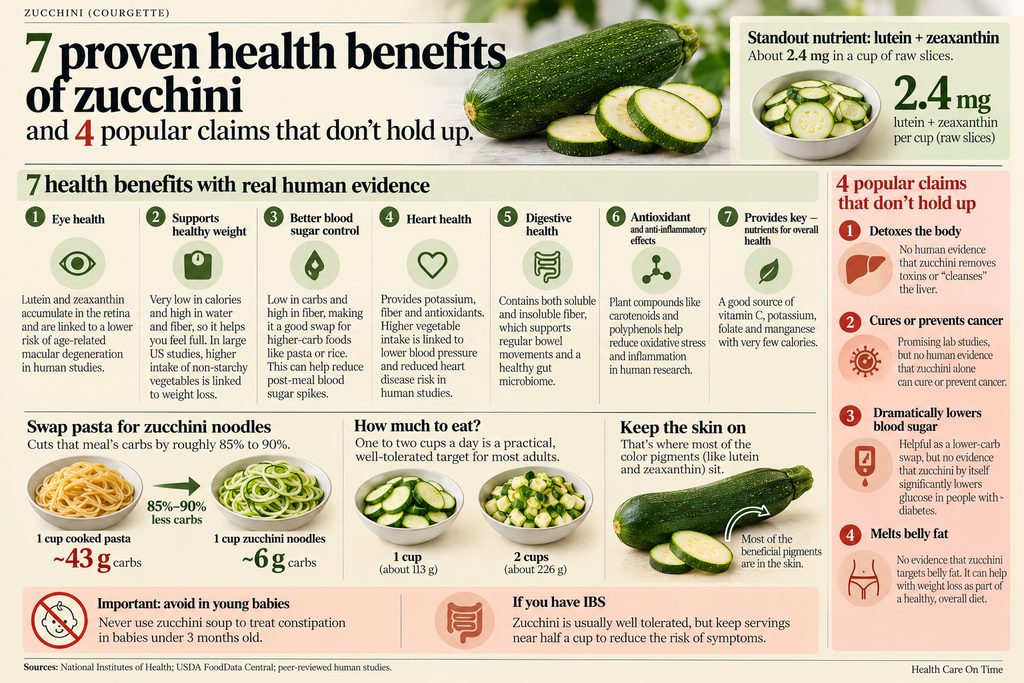
- Zucchini has 7 health benefits with real human evidence behind them, and 4 popular claims that don’t hold up.
- Its standout nutrient is lutein plus zeaxanthin: about 2.4 mg in a cup of raw slices.
- Swapping a cup of pasta for zucchini noodles cuts that meal’s carbs by roughly 85% to 90%.
- One to two cups a day is a practical, well-tolerated target for most adults.
- Keep the skin on. That’s where most of the color pigments sit.
- Never use zucchini soup to treat constipation in babies under 3 months old.
- With IBS, keep servings near half a cup.
Is Zucchini Good for You? The Short Answer
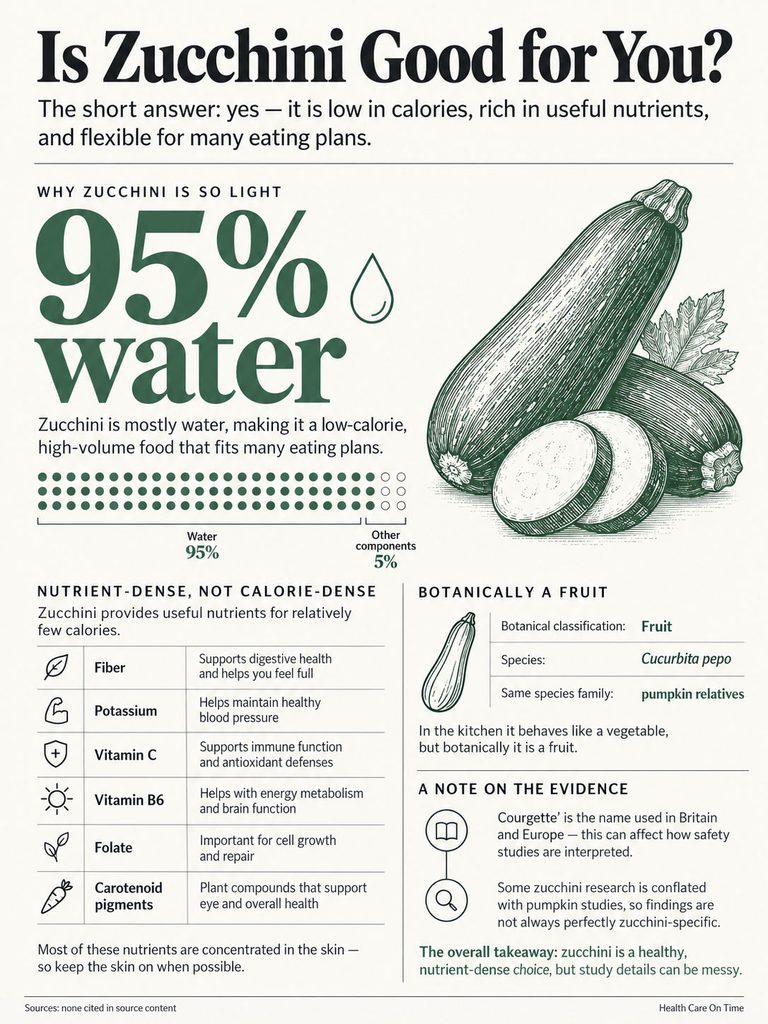
Yes. Zucchini is a nutrient-dense, very low-calorie food that fits almost any eating plan. It’s not a “superfood” that cures disease. Think of it as a high-value everyday vegetable that’s easy to eat more of.
What Zucchini Actually Is
Zucchini (Cucurbita pepo) is a summer squash, and botanically it’s a fruit. It belongs to the same species as many pumpkins, just harvested young and tender.
That shared species name explains a lot of confusion online. Research on pumpkin seeds and pumpkin flesh often gets relabeled as “zucchini research.” In Britain and much of Europe, zucchini is called courgette, which matters when you read European safety studies.
Where Its Benefits Come From
Zucchini is about 95% water. The rest delivers fiber, potassium, vitamin C, vitamin B6, folate, and carotenoid pigments, mostly packed into the skin.
For the full calorie and nutrient breakdown by serving size, see How Many Calories in Zucchini?. This article focuses on what those nutrients actually do for your health.
7 Health Benefits of Zucchini Backed by Real Evidence
Patients reviewing nutrition plans with us often ask why one website lists 12 zucchini benefits and another lists 5. The difference usually comes down to whether animal and test-tube studies get counted the same as human evidence.
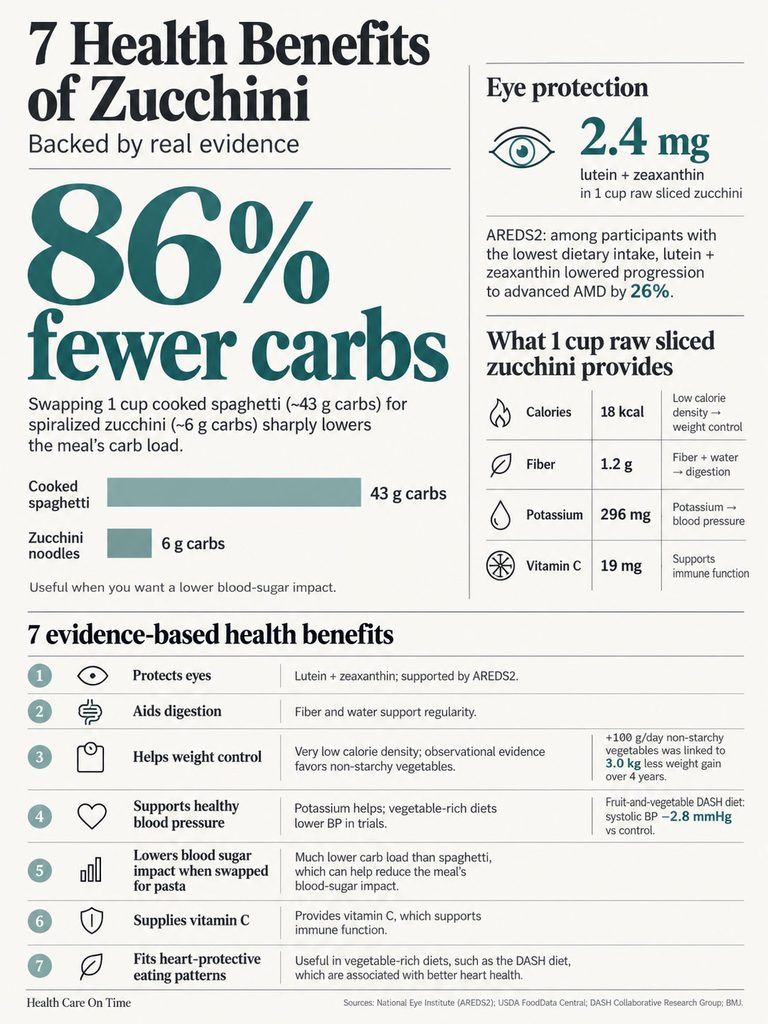
Here’s the full picture in one table, graded by the type of study behind each claim.
| Claim | What was actually studied | Study type | Verdict |
| Protects eyes | Lutein and zeaxanthin; AREDS2 used 10 mg lutein and 2 mg zeaxanthin | Large human trials (supplement form) | Real |
| Aids digestion | Dietary fiber and water intake | Human evidence on fiber | Real |
| Helps weight control | 133,468 US adults; non-starchy vegetables linked to weight loss | Human prospective cohorts | Real |
| Supports blood pressure | Potassium intake and blood pressure | Human trials on potassium | Real (modest) |
| Better blood sugar | Low-carb swap math; pumpkin trials mixed | Human, indirect | Real as a swap |
| Vitamin C for immunity | Vitamin C’s role in immune cells | Established nutrition science | Real (normal function) |
| Heart-healthy eating | Fiber, potassium, vegetable-rich diets | Human cohorts and diet trials | Real (pattern, not zucchini alone) |
| Thyroid support | Mango, melon, and watermelon peel extracts | Rat study | Hyped |
| Prostate health | Cucurbita pepo seed oil extract | Rats; one human seed-oil trial | Hyped |
| Cancer prevention | Zucchini extract on leukemia cells | Test tube | Hyped |
| Prevents anemia | 0.73 mg iron per medium zucchini | Nutrient math | Hyped |
1. Protects Your Eyes With Lutein and Zeaxanthin
This is zucchini’s strongest benefit, yet most articles give it one line. Lutein and zeaxanthin collect in the macula, the part of the retina that handles sharp central vision. They filter blue light and help limit oxidative damage.
The best evidence comes from the National Eye Institute’s AREDS2 trial. After 10 years of data, a formula with 10 mg lutein and 2 mg zeaxanthin slowed AMD progression better than the older beta-carotene version (NIH).
This matters to millions of Americans. CDC estimates 19.8 million people aged 40 and older, or 12.6%, were living with age-related macular degeneration (AMD) in 2019 (CDC).
The Dose Math Nobody Shows You
USDA data lists about 2,401 mcg of lutein plus zeaxanthin in one cup of sliced raw zucchini with skin. That’s roughly 2.4 mg per cup.
So it takes about 4 cups of raw zucchini slices, or roughly 2.5 medium zucchini, to match the AREDS2 lutein dose. That’s a lot for one day. It’s also far more than most people expect from a pale green squash.
Two honest caveats apply. AREDS2 tested supplements in people who already had AMD, not food in healthy people. And lutein is fat-soluble, so a drizzle of olive oil helps your body absorb it.
2. Keeps Digestion Regular
Zucchini brings two things your gut needs: water and fiber. A medium zucchini delivers about 2 grams of fiber, a mix of soluble fiber (which feeds gut bacteria) and insoluble fiber (which adds bulk).
Most Americans fall short on fiber. Research cited by Cleveland Clinic suggests that roughly 1 in 20 people in the U.S. meet their fiber needs (Quagliani and Felt-Gunderson).
Two grams won’t fix constipation by itself. But zucchini makes it easy to add volume and moisture to meals. Grated zucchini in oatmeal, pasta sauce, or ground meat adds fiber with almost no change in taste.
3. Helps With Weight Control
Zucchini has very low calorie density. Raw zucchini runs about 17 calories per 100 grams, so you can eat a large, filling portion for very little energy.
The strongest US evidence comes from Harvard researchers who followed 133,468 American men and women for up to 24 years (PLOS Medicine). Adding starchy vegetables such as corn, peas, and potatoes tracked with weight gain. Adding non-starchy vegetables tracked with weight loss.
The study also found that vegetables with more fiber and a lower glycemic load had the strongest link to weight loss. Zucchini fits that profile well. To be fair, the study didn’t report zucchini as its own line item, so this is a strong fit, not a direct finding.
4. Supports Healthy Blood Pressure
A medium zucchini (about 7 ounces) carries roughly 512 mg of potassium. Potassium helps your kidneys clear sodium and relaxes blood vessel walls.
The NIH sets the Adequate Intake at 3,400 mg a day for men and 2,600 mg for women aged 19 to 50 (NIH ODS). One medium zucchini covers about 20% of a woman’s target and 15% of a man’s.
High blood pressure is common. In CDC’s latest national survey, covering August 2021 to August 2023, 47.7% of US adults had hypertension (CDC). If your reading is creeping up, our guide to blood pressure 140/90 explains what the numbers mean.
People with kidney disease or on potassium-sparing drugs should check with their doctor first. For them, more potassium isn’t always better.
5. Lowers the Blood Sugar Hit of Pasta Meals
Here’s where many articles overreach. No solid human trial shows zucchini itself lowers blood sugar. The benefit is real, but it comes from what zucchini replaces.
According to USDA data, a cup of cooked spaghetti has roughly 43 grams of carbs. A whole medium zucchini, spiralized, has about 6 grams. Swapping one for the other cuts that meal’s carb load by roughly 85% to 90%.
What about the “zucchini lowers glucose” headlines? Most come from animal research. A recent systematic review found that Cucurbita extracts reduced blood sugar in diabetic animal models, and it left human trials out on purpose (F1000Research).
The human data on pumpkin, zucchini’s close relative, is mixed. A 2025 review pooled 9 controlled trials with 316 people and found the results on blood sugar were still inconsistent (PubMed).
The stakes are high. CDC estimates 40.1 million Americans had diabetes in 2023, about 12.0% of the population (CDC). Patients booking HbA1c tests with us often ask which foods “lower” blood sugar. The honest answer is that zucchini helps most by replacing refined carbs, not by acting like a medicine.
6. Supplies Vitamin C for Normal Immune Function
A medium zucchini gives you about 35 milligrams of vitamin C, close to 40% of the Daily Value. Vitamin C supports white blood cells, wound healing, and collagen production.
There’s a catch. USDA figures drop from about 17.9 mg of vitamin C per 100 grams in raw zucchini to about 4.6 mg after boiling. That’s a loss of roughly three-quarters, so eat some zucchini raw or lightly sautéed if vitamin C matters to you.
“Supports immune function” means it helps your immune system work normally. It doesn’t mean zucchini prevents colds or flu. No study shows that.
7. Fits Heart-Protective Eating Patterns
Zucchini delivers fiber, potassium, and carotenoids with almost no sodium or saturated fat. Those are the building blocks of heart-healthy diets like DASH and the Mediterranean pattern.
But no trial has tested zucchini alone for heart disease. The cholesterol claims online lean on a study of rats fed high-fat diets, and rats on lab chow aren’t people eating side dishes.
Our medical reviewers rate this benefit as real but indirect. Zucchini helps your heart as part of a vegetable-rich diet. If you’re tracking cholesterol, a lipid panel shows whether your overall diet is working.
4 Zucchini Claims That Don’t Hold Up
These four claims appear across page one of Google. Each falls apart once you check the original study.
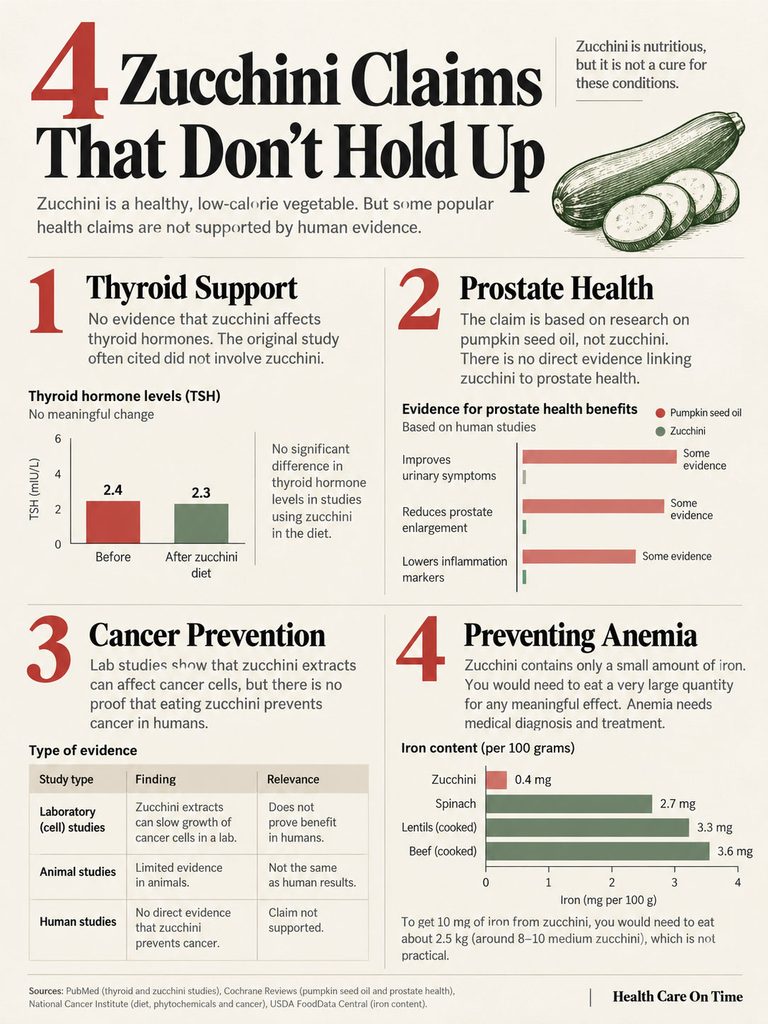
Thyroid Support
The thyroid claim traces back to a 2008 rat study (PubMed). The extracts tested came from the peels of mango, muskmelon, and watermelon. Zucchini isn’t in the study at all.
There’s no human or animal evidence that zucchini changes thyroid hormone levels. If you’re worried about your thyroid, a TSH blood test will tell you far more than any food.
Prostate Health
This claim borrows from pumpkin seed oil. The source is a rat study on a fatty extract from Cucurbita pepo seeds, not the zucchini flesh you buy at the grocery store.
There is one human trial on the seed oil. In a 2021 Iranian study of men with an enlarged prostate, the oil eased urinary symptoms without side effects, but the standard drug tamsulosin worked better (BMC Urology). That tells you nothing about eating zucchini.
Cancer Prevention
The most-cited zucchini cancer study was done in a lab dish. Researchers found that zucchini extracts slowed the growth of a leukemia cell line and pushed some of those cells to die off (Nutrients).
Cancer cells in a dish are a starting point, not proof. A vegetable-rich diet is linked to lower risk of some cancers, but zucchini on its own hasn’t been shown to prevent any cancer in people.
Preventing Anemia
Cleveland Clinic suggests zucchini’s B6, iron, and vitamin C work together to help prevent anemia. Yet its own nutrient list shows just 0.73 mg of iron per medium zucchini, about 4% of the Daily Value.
Women aged 19 to 50 need 18 mg of iron a day. You’d need about 25 medium zucchini to get there, and plant iron absorbs poorly compared with iron from meat. In cases reviewed by our medical team, anemia needs a real diagnosis, usually a CBC and ferritin test, not a vegetable fix.
What the Evidence Can’t Tell You Yet
Even the “real” benefits come with limits worth knowing:
- No zucchini-only human trials exist for eyes, heart, weight, or blood sugar. Every benefit is built from nutrient research and diet-pattern studies.
- AREDS2 used supplements in people who already had eye disease. Food-based lutein in healthy people hasn’t been tested the same way.
- The Harvard weight study was observational. It shows a link, not proof that eating more vegetables caused the weight loss.
How Much Zucchini Should You Eat?
There’s no official zucchini target, but the Dietary Guidelines for Americans give a useful frame. Most adults should aim for 2 to 3 cup-equivalents of vegetables a day. One cup of raw or cooked zucchini counts as one cup-equivalent.
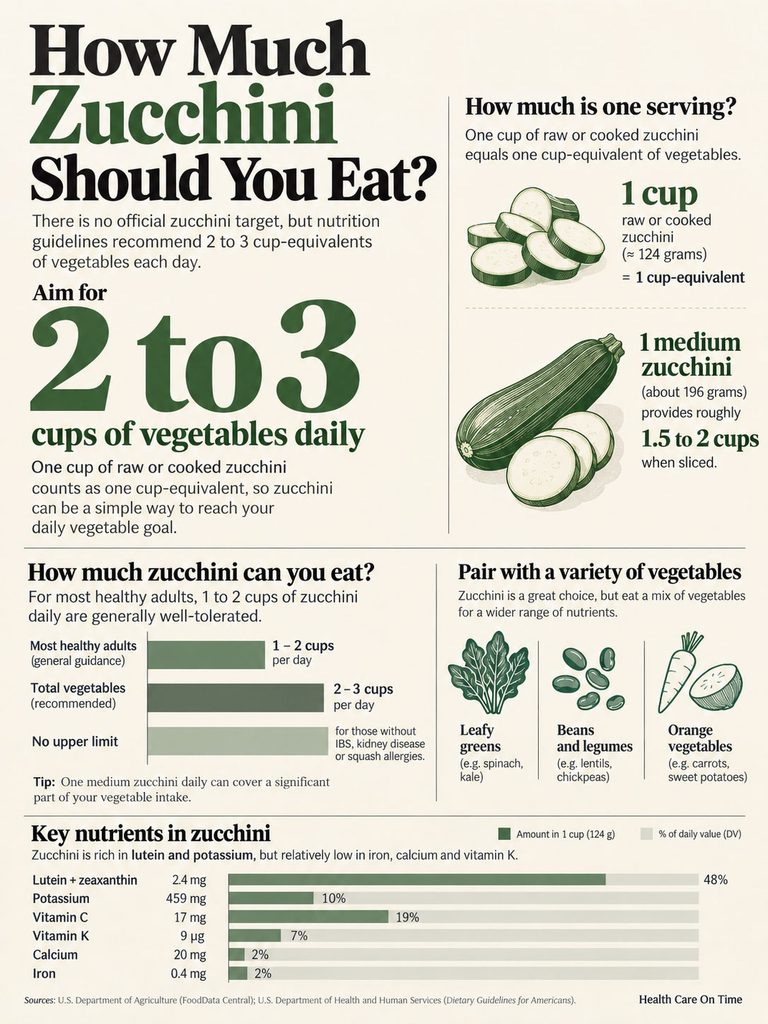
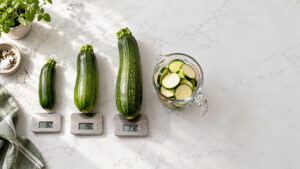
A medium zucchini (about 196 grams) gives you roughly 1.5 to 2 cups once sliced. So one medium zucchini a day can cover a big part of your vegetable target on its own.
For most healthy adults, 1 to 2 cups a day is easy to tolerate and delivers the benefits above. There’s no known upper limit for people without IBS, kidney disease, or a squash allergy.
The bigger point is variety. Zucchini is strong on lutein and potassium, but weak on iron, calcium, and vitamin K. Pair it with leafy greens, beans, and orange vegetables to fill those gaps.
How to Get the Most From Zucchini
How you buy, cut, and cook zucchini changes how much benefit you get.
Eat the Skin
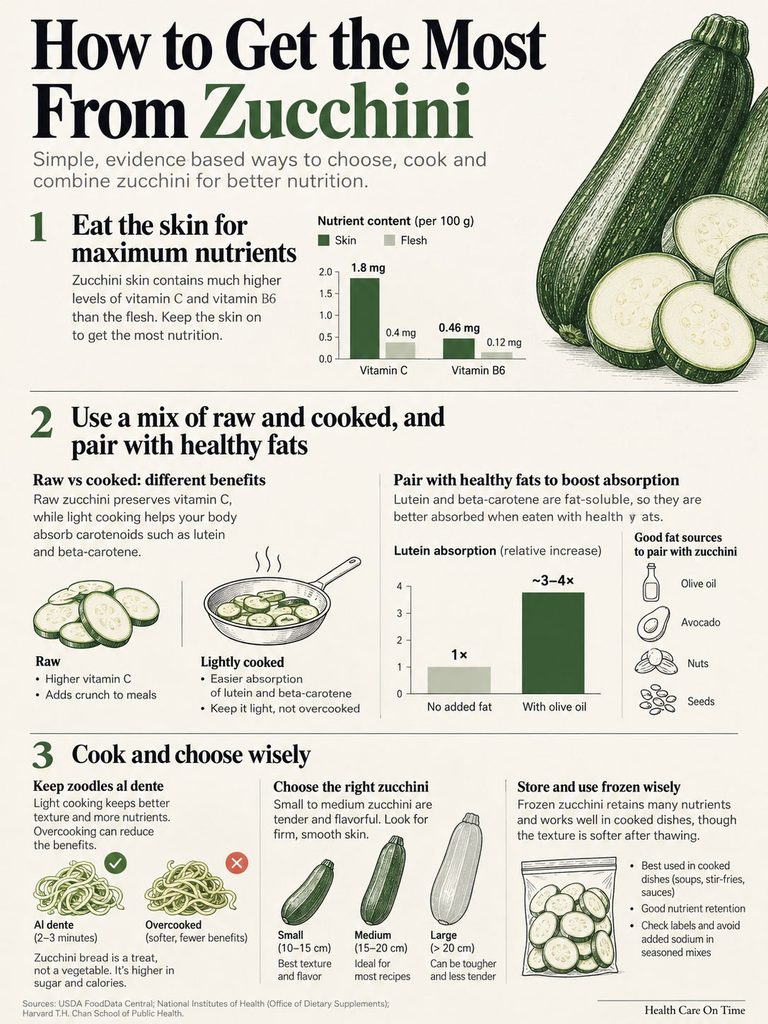
The dark green skin holds most of the color pigments. Cleveland Clinic’s dietitian points out that much of zucchini’s vitamin C and B6 sits in the skin, so wash it and leave it on.
Yellow zucchini works just as well. Lab research suggests yellow varieties may carry slightly more antioxidants than light green ones.
Raw vs Cooked: What Changes
Raw zucchini keeps more vitamin C. Light cooking softens cell walls, which can make carotenoids easier to absorb. Neither wins across the board.
A simple rule: mix it up. Eat some raw, in salads, ribbons, or with dip, and some lightly cooked by sautéing, roasting, or grilling. Skip long boiling, which pours nutrients down the drain.
Pair It With a Little Fat
Lutein, zeaxanthin, and beta-carotene are fat-soluble. A teaspoon of olive oil, a sprinkle of Parmesan, or a handful of nuts helps your body absorb them. Plain steamed zucchini with nothing on it delivers less of its eye-friendly pigments.
Zoodles, Roasting, and Baking
Zucchini noodles keep nearly all the benefits if you don’t overcook them. Sauté for 2 to 3 minutes, just until tender.
Zucchini bread is a different story. Most recipes add a cup or more of sugar plus plenty of oil. The zucchini in it is still nutritious, but the bread is a treat, not a vegetable serving.
Buy and Store It Right
Pick small to medium zucchini, about 6 to 8 inches long, with firm, glossy skin and no soft spots. Oversized garden zucchini tend to be watery, seedy, and more likely to taste bitter.
Store zucchini unwashed in a loose bag in your refrigerator’s crisper drawer, ideally around 41 to 50°F. Use it within 4 to 5 days. Wash it just before cutting, since moisture speeds up spoilage.
Zucchini is in peak season across most of the US from June through August, when prices drop and farmers markets overflow. It’s sold year-round in grocery stores, so you don’t have to wait for summer.
Frozen Zucchini Counts Too
Frozen zucchini is a solid backup, especially in winter. USDA data lists about 4,652 mcg of lutein plus zeaxanthin in one cup of frozen zucchini that’s been boiled and drained. That’s nearly double a cup of raw slices, mostly because cooked zucchini packs down into a denser cup.
Frozen zucchini does lose some vitamin C, and it turns soft once thawed. Use it in soups, stews, sauces, casseroles, and baked dishes rather than in salads or zoodles.
Check the label before you buy. Plain frozen zucchini has almost no sodium, but some seasoned blends and Italian-style canned versions add a lot of salt, which works against the blood pressure benefit.
The Numbers Behind Zucchini and Your Health
These US statistics show why zucchini’s benefits matter beyond one plate.
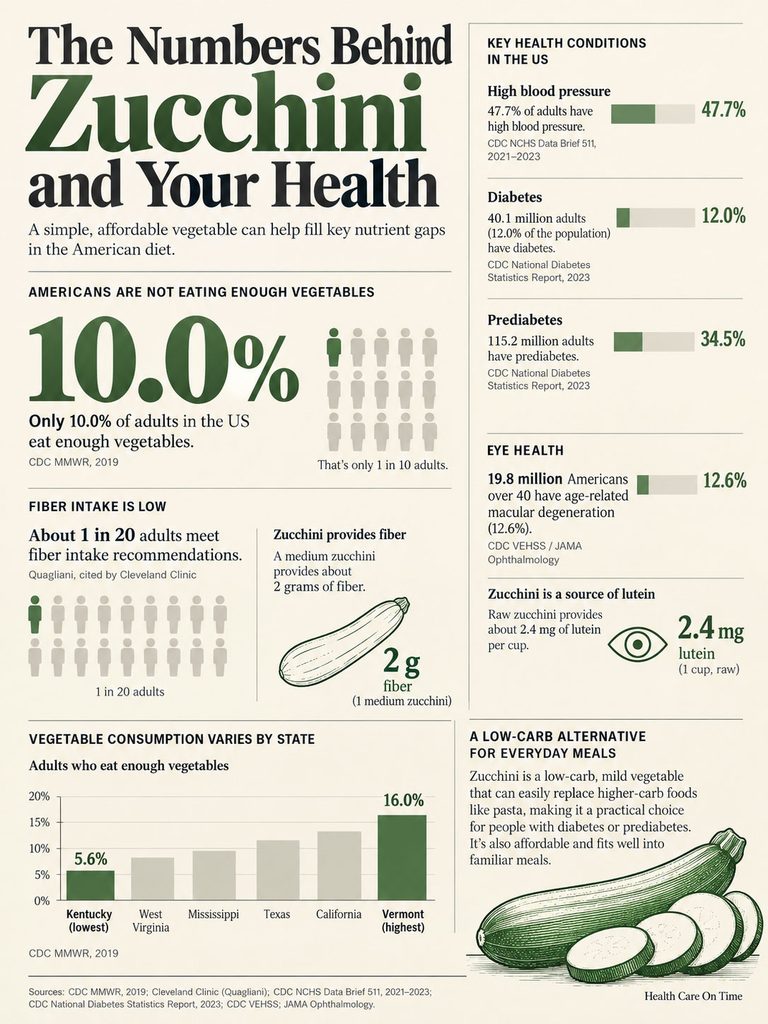
| Health issue | Latest US figure | Source | Where zucchini fits |
| Adults eating enough vegetables | 10.0% | CDC MMWR, 2019 BRFSS data | Cheap, mild vegetable serving |
| Adults getting enough fiber | About 1 in 20 | Quagliani, cited by Cleveland Clinic | About 2 g fiber per medium zucchini |
| Adults with high blood pressure | 47.7% | CDC NCHS Data Brief 511 (2021 to 2023) | About 512 mg potassium per medium zucchini |
| People with diabetes | 40.1 million (12.0%) | CDC National Diabetes Statistics Report (2023) | Pasta swap cuts carbs about 85% to 90% |
| Adults with prediabetes | 115.2 million | CDC National Diabetes Statistics Report | Lower-carb base for meals |
| Americans 40+ with AMD | 19.8 million (12.6%) | CDC VEHSS / JAMA Ophthalmology | About 2.4 mg lutein per raw cup |
The vegetable gap stands out most. CDC found that only 10.0% of adults met vegetable recommendations, with states ranging from 5.6% in Kentucky to 16.0% in Vermont (CDC MMWR).
Across the patients we serve, the food changes that stick tend to be cheap, mild, and easy to hide in familiar meals. Zucchini checks all three boxes.
Who Should Be Careful With Zucchini
Zucchini is safe for almost everyone. A few groups should take extra care.
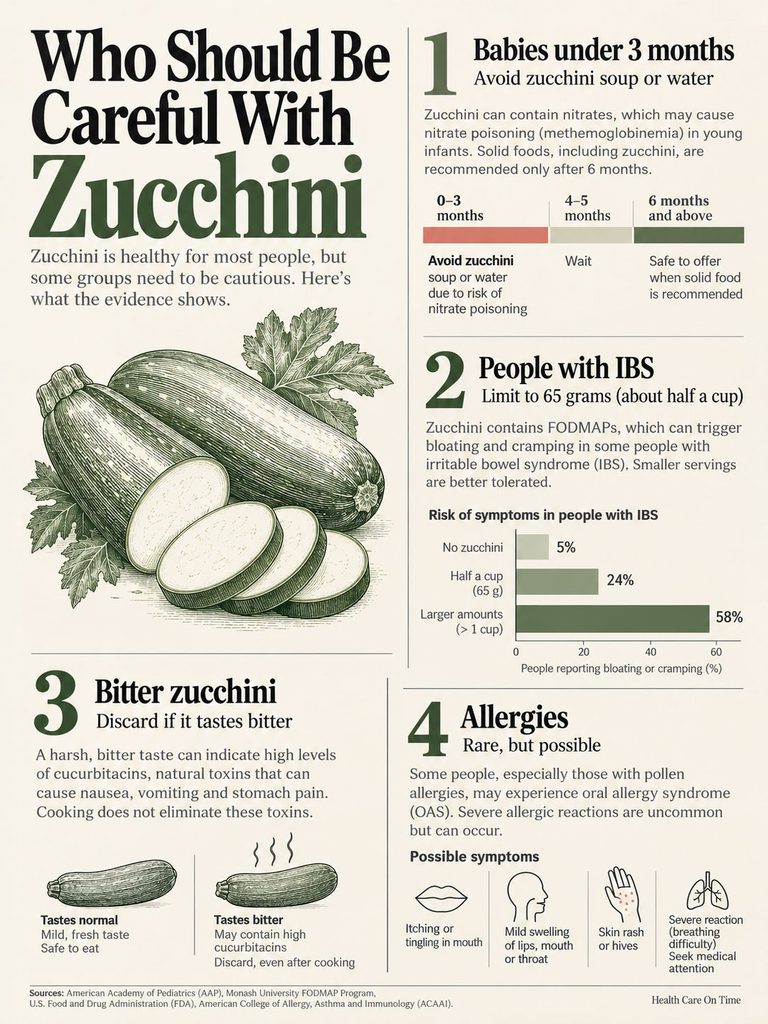
Babies Under 3 Months
Never give young infants zucchini soup or water to treat constipation. A 2006 Italian case report describes two babies, 1 and 2 months old, whose formula was mixed with concentrated courgette soup (Savino et al.). Both developed severe cyanosis, a bluish skin color from low blood oxygen, and recovered only after hospital treatment.
The cause was nitrate, which young infants can’t clear well. The American Academy of Pediatrics notes that home-made vegetable foods still cause infant nitrate poisoning, while commercial baby foods in the US carry little risk (Pediatrics). Cooked, pureed zucchini is generally fine once your pediatrician says your baby is ready for solids, usually around 6 months.
People With IBS
Zucchini is low-FODMAP only in small amounts. Monash University testing puts the low-FODMAP serving at about 65 grams, roughly half a cup. Larger portions add fructans, which can trigger bloating and cramping.
A whole spiralized medium zucchini weighs about 196 grams, roughly 3 times that tested limit. If you have IBS, keep zoodles to a side portion or mix them half-and-half with regular pasta.
Bitter Zucchini: Stop Eating It
A zucchini that tastes harshly bitter may contain high levels of cucurbitacins. These natural toxins can cause vomiting, cramps, and diarrhea, and cooking doesn’t destroy them. Spit it out and throw the whole squash away.
This is rare with store-bought zucchini, but it does happen. We cover the full research, including French poison center data, in Cucumber vs Zucchini.
Allergies
Zucchini allergy is uncommon. Some people with pollen allergies feel mouth itching from raw zucchini, called oral allergy syndrome, and cooking usually solves it. Stop eating it and get medical care if you have hives, swelling, or trouble breathing.
Who Benefits Most, and What to Do Next
Use this table to match zucchini to your own health goal.
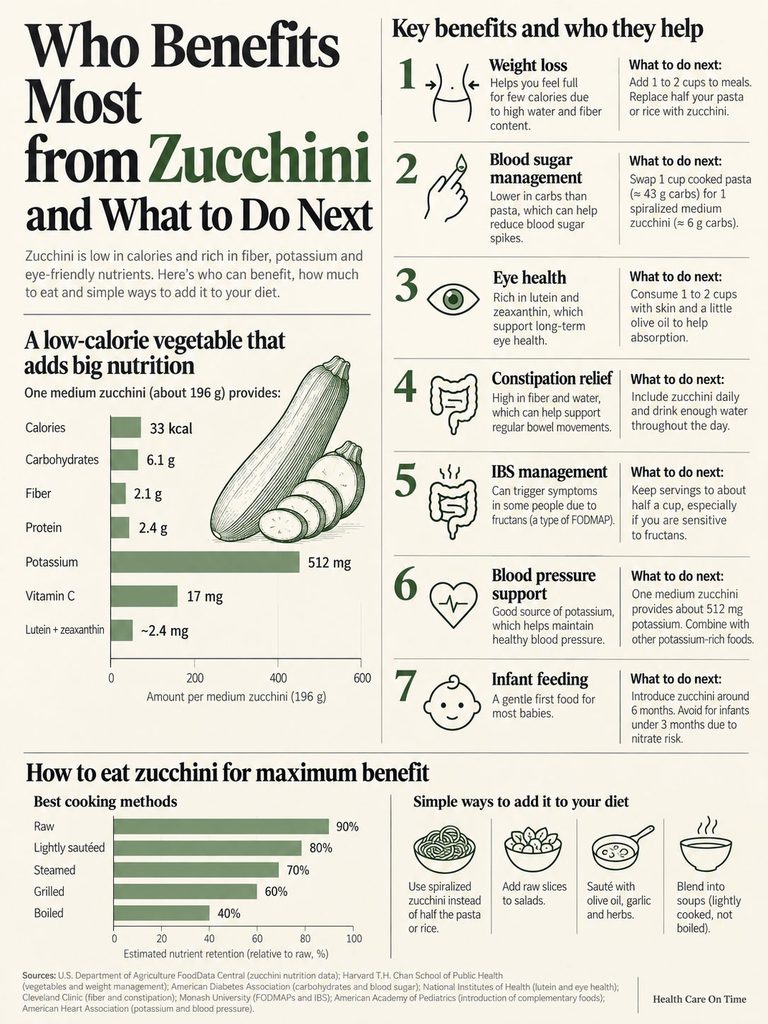
| Your goal | What to do with zucchini | Why it works |
| Lose weight | Add 1 to 2 cups to meals; replace half your pasta or rice with it | Large volume for about 17 calories per 100 g |
| Manage blood sugar | Swap 1 cup cooked pasta for 1 spiralized medium zucchini | Cuts that meal’s carbs from about 43 g to about 6 g |
| Protect your eyes | Eat 1 to 2 cups with skin, plus a little olive oil | About 2.4 mg lutein per raw cup; fat aids absorption |
| Ease constipation (adults) | Add zucchini daily and drink more water | Fiber plus about 95% water softens stools |
| Live with IBS | Keep servings near half a cup (65 g) | Larger portions push fructans into the high range |
| Lower blood pressure | Pair zucchini with other potassium foods; cut salt | About 512 mg potassium per medium zucchini |
| Feed a baby | Wait for solids (around 6 months); never use it for infant constipation | Nitrate risk in babies under 3 months |
If you’re managing diabetes, high blood pressure, or cholesterol, measure the effect with real numbers. Across the lab orders we process, the patients who make the most progress pair food changes with regular HbA1c, fasting glucose, and lipid panel checks. Our HbA1c test guide explains what to expect.
Frequently Asked Questions
Is it healthy to eat zucchini every day?
Yes, for most people. Daily zucchini adds fiber, potassium, vitamin C, and eye-friendly lutein for very few calories. One to two cups a day is a practical target. Vary how you cook it and eat other vegetables too. With IBS, keep servings near half a cup. Throw away any zucchini that tastes bitter.
Is zucchini good for weight loss?
Yes. Zucchini is about 95% water and very low in calories, so it fills you up for little energy. A Harvard study of more than 133,000 Americans linked non-starchy, higher-fiber vegetables with weight loss over time. The biggest win comes from using zucchini to replace pasta, rice, or bread.
Is zucchini good for diabetics?
Yes, mainly as a swap. A spiralized medium zucchini has about 6 grams of carbs, compared with roughly 43 grams in a cup of cooked spaghetti. That swap can soften blood sugar spikes. Human evidence that zucchini itself lowers glucose is lacking, so keep taking your prescribed medication.
Is raw zucchini healthier than cooked?
Neither wins outright. Raw zucchini keeps far more vitamin C, since boiling cuts it by about three-quarters. Light cooking may make carotenoids like beta-carotene easier to absorb. Eating both raw and lightly cooked zucchini gives you the best of each. Avoid long boiling.
Should you eat zucchini skin?
Yes. The skin holds most of zucchini’s color pigments, including lutein, zeaxanthin, and beta-carotene, along with a large share of its vitamin C and B6. Wash it well under running water before cutting. Peeling throws away a big part of the nutrition.
Is zucchini anti-inflammatory?
Zucchini contains antioxidants, like vitamin C and carotenoids, that help limit oxidative damage. Diets rich in vegetables are linked with lower inflammation markers. But no human study shows zucchini alone reduces inflammation. Treat it as one helpful part of an anti-inflammatory eating pattern.
Does zucchini help with constipation?
It can help adults. Zucchini combines water with soluble and insoluble fiber, which softens stools and adds bulk. Pair it with plenty of fluids and other fiber-rich foods. Never give zucchini soup to infants under 3 months for constipation because of nitrate risk.
Is zucchini good for high blood pressure?
It helps. A medium zucchini has about 512 mg of potassium, which helps your body clear sodium and relax blood vessels. Combine it with less salt and other potassium-rich foods. People with kidney disease or on potassium-sparing medications should check with their doctor first.
Why does zucchini upset your stomach?
Large servings contain fructans, a FODMAP that can cause gas and bloating, especially with IBS. Raw zucchini can also cause mouth itching in people with pollen allergies. A bitter taste signals cucurbitacin toxins, which cause vomiting and cramps. Throw bitter zucchini away.
Is bitter zucchini safe to eat?
No. Strong bitterness means high levels of cucurbitacins, natural toxins that can cause vomiting, stomach cramps, and diarrhea. Cooking doesn’t destroy them. Spit it out and discard the whole squash. Call Poison Help at 1-800-222-1222 if symptoms are severe or don’t ease.
Can babies eat zucchini?
Yes, once they start solids, usually around 6 months, with your pediatrician’s okay. Cooked, pureed zucchini makes a gentle first vegetable. Don’t give homemade zucchini soup or water to infants under 3 months, because nitrate can cause methemoglobinemia, a dangerous drop in blood oxygen.
Is zucchini healthier than cucumber?
They’re close. Zucchini has more potassium, more vitamin C, and far more lutein. Cucumber has more vitamin K and slightly more water. Both are very low in calories. For the full side-by-side, see our Cucumber vs Zucchini comparison.
Disclaimer: This article is for general information and isn’t medical advice. It has been reviewed by the HealthCareOnTime medical team, but it doesn’t replace care from your own doctor or registered dietitian. If you have diabetes, kidney disease, high blood pressure, IBS, or a thyroid condition, or are feeding an infant, talk to a qualified healthcare provider before changing your diet. For severe symptoms after eating bitter squash, call Poison Help at 1-800-222-1222 or 911.
References
- USDA FoodData Central: Zucchini, includes skin, raw
- Bertoia ML, et al. Changes in Intake of Fruits and Vegetables and Weight Change in US Men and Women. PLOS Medicine, 2015
- NIH: AREDS2 10-year results on lutein and zeaxanthin
- CDC: Prevalence of Age-Related Macular Degeneration in the US
- CDC NCHS Data Brief 511: Hypertension Prevalence, 2021 to 2023
- CDC National Diabetes Statistics Report
- CDC MMWR: Adults Meeting Fruit and Vegetable Intake Recommendations, 2019
- NIH Office of Dietary Supplements: Potassium Fact Sheet
- Quagliani D, Felt-Gunderson P. Closing America’s Fiber Intake Gap
- Effects of Pumpkin on Glycemic and Type 2 Diabetes Biomarkers: Systematic Review, 2025
- Preclinical Evidence of Cucurbita Plants in Diabetes Management: Systematic Review
- Martínez-Valdivieso D, et al. Role of Zucchini in Degenerative Processes. Nutrients, 2017
- Parmar HS, Kar A. Peel Extracts of Mango, Melon, and Watermelon in Rats, 2008
- Pumpkin Seed Oil vs Tamsulosin for BPH: Randomized Clinical Trial, 2021
- Savino F, et al. Methemoglobinemia From Courgette Soup in Two Infants, 2006
- Greer FR, et al. Infant Methemoglobinemia: The Role of Dietary Nitrate. Pediatrics, 2005
- Cleveland Clinic: Is Zucchini Good for You?
- Healthline: 12 Health and Nutrition Benefits of Zucchini