
You check your underwear a few days before your period and find something thick, white, and creamy. Is your period coming? Is it a yeast infection? Could you be pregnant?
Table of Contents
Here’s the surprising part. In a study of women buying yeast infection treatment at US drugstores, nearly 1 in 7 had no infection at all. Their discharge was normal. Knowing what healthy pre-period discharge looks like can save you money, worry, and a week of the wrong medicine.
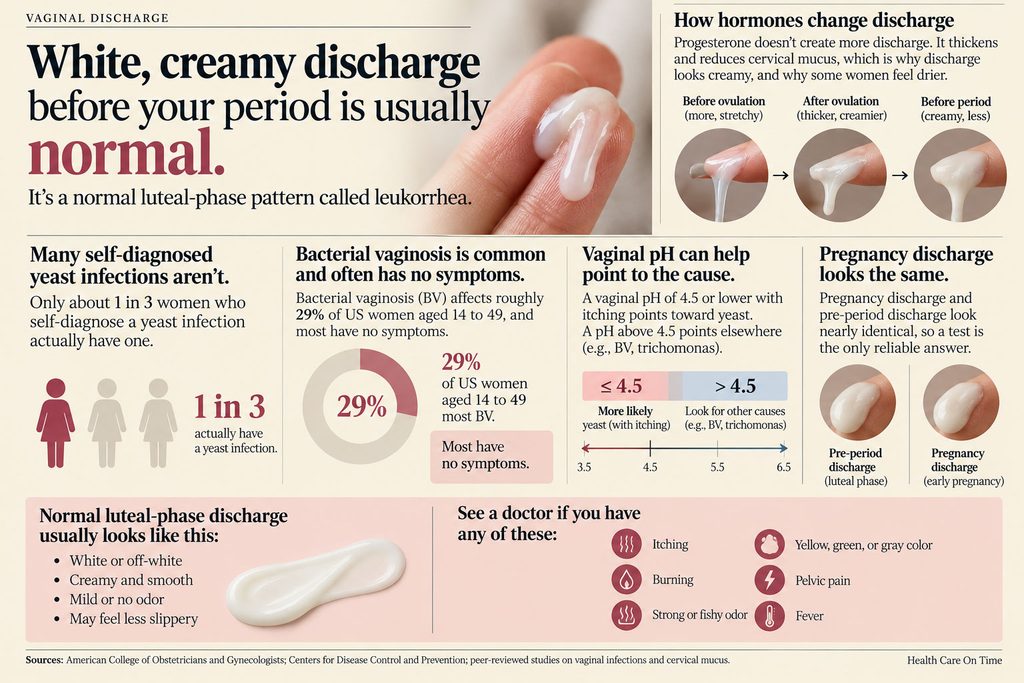
Quick Answer: White creamy discharge before your period is usually normal. After ovulation, progesterone makes cervical mucus thicker and scantier, so what you see looks white, opaque, and lotion-like. It’s healthy if it’s white or off-white, mild-smelling, and not itchy. Itching, a cottage-cheese texture, a fishy odor, gray or green color, or pelvic pain suggest infection. Discharge alone can’t confirm pregnancy; test on the first day of a missed period.
At a Glance
- White creamy discharge in the week before your period is a normal luteal-phase pattern called leukorrhea.
- Progesterone doesn’t create more discharge. It thickens and reduces cervical mucus, which is why discharge looks creamy, and why some women feel drier.
- Only about 1 in 3 women who self-diagnose a yeast infection actually have one.
- Bacterial vaginosis affects roughly 29% of US women aged 14 to 49, and most have no symptoms.
- A vaginal pH of 4.5 or lower with itching points toward yeast; a pH above 4.5 points elsewhere.
- Pregnancy discharge and pre-period discharge look nearly identical, so a test is the only reliable answer.
- See a doctor for itching, burning, odor, color changes, pelvic pain, or fever.
What White Creamy Discharge Before Your Period Actually Is
Vaginal discharge is your body’s built-in cleaning system. It carries away old cells and bacteria, keeps tissue moist, and helps protect against infection.
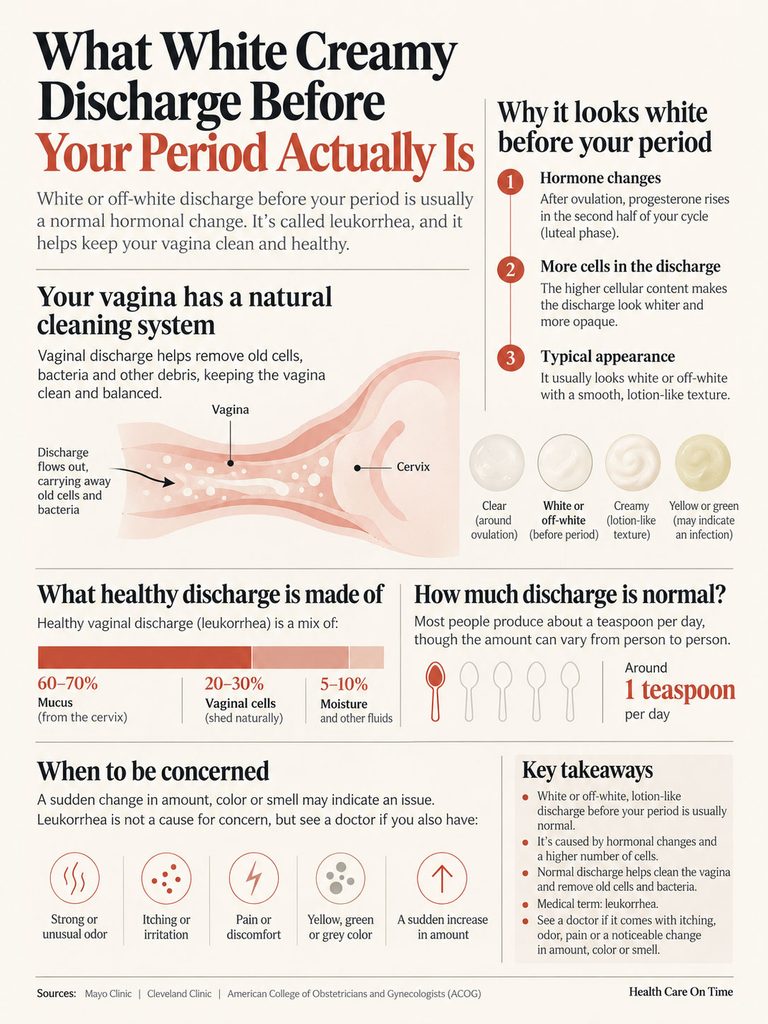
Before your period, that discharge often turns white or off-white with a texture like hand lotion. It’s one of the most common things women notice, and in most cases it means your cycle is working as expected.
What’s in It
Healthy discharge is a mix of three main things:
- Cervical mucus, made by glands in the cervix and shaped by your hormones.
- Shed vaginal cells, which the vaginal lining replaces constantly.
- Good bacteria, mostly Lactobacillus species, which keep the vagina acidic.
When mucus volume drops and cells make up a bigger share of the mix, discharge looks whiter and more opaque. That shift is exactly what happens in the days before a period.
How Much Is Normal
Most women produce about a teaspoon of discharge a day, though this varies by person, age, and cycle day. Some women barely notice it; others need a panty liner most days.
What matters most is your normal. A sudden change in amount, color, or smell means more than any single number.
The Medical Term: Leukorrhea
Doctors call normal white or clear vaginal discharge leukorrhea. The word sounds clinical, but it simply describes healthy discharge.
Patients who book women’s health panels through HealthCareOnTime often ask whether “leukorrhea” on a chart means something is wrong. Usually it doesn’t. Leukorrhea alone is normal, while leukorrhea with itching, odor, or pain needs a closer look.
Why It Turns White and Creamy (The Progesterone Paradox)
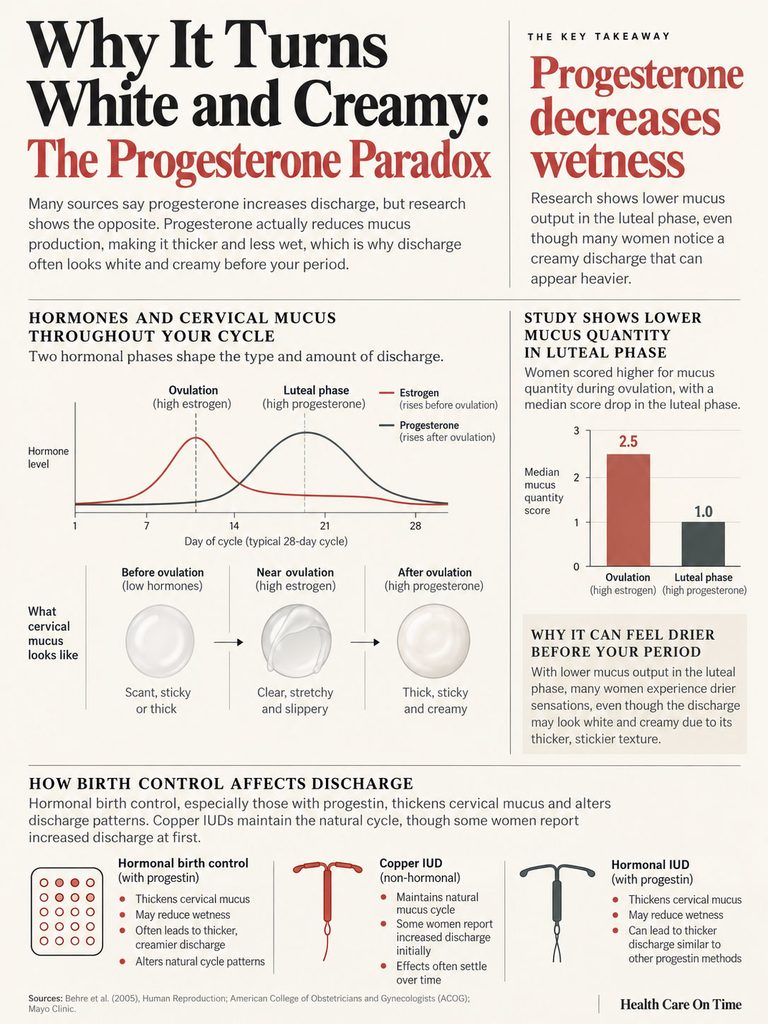
Most websites say progesterone “increases” discharge before your period. The research tells a different story, and knowing it makes your body’s signals easier to read.
For the full range of colors you might see in this phase, including clear, yellow, and brown, see our color guide to discharge before your period. This article focuses on white and creamy only.
Ovulation vs. Luteal Mucus
Your cycle has two hormonal halves. In the first half, rising estrogen produces wet, clear, stretchy mucus that peaks around ovulation. It looks like raw egg white and helps sperm travel.
After ovulation, the empty follicle becomes the corpus luteum and releases progesterone. Progesterone does the opposite of estrogen: it makes mucus thick, sticky, and sparse, forming a barrier at the cervix.
Researchers at Oregon Health & Science University measured this directly. Using a standard mucus scoring scale, every woman in their study scored 10 or higher near ovulation. In the natural luteal phase, the median score dropped to 1, with a range of 1 to 3.
In plain terms, cervical mucus near ovulation is abundant and watery. Before your period, it’s thick, scant, and cloudy. With less water, the white cells and bacteria show up more, giving discharge its creamy look.
Why Some Women Feel Drier Before a Period
Because progesterone cuts mucus output, many women notice less wetness in the luteal phase, not more. That’s normal.
Others notice a creamy layer that seems heavier. Thicker discharge sits in the vagina longer and collects on underwear in visible amounts, even when total volume is lower. Both experiences fit a healthy cycle.
Birth Control, IUDs, and Progestin
Hormonal birth control changes the pattern. Most pills, the shot, the implant, and hormonal IUDs contain a progestin, a lab-made cousin of progesterone.
Progestins keep cervical mucus thick most of the month. That’s one way they prevent pregnancy. So if you use hormonal birth control, you may see creamy or sticky discharge for many days in a row, without the clear, stretchy phase in between.
Copper IUDs don’t contain hormones, so your natural mucus cycle usually continues. Some women do report more discharge in the first months after placement.
Your Cycle Day by Day: When White Discharge Shows Up
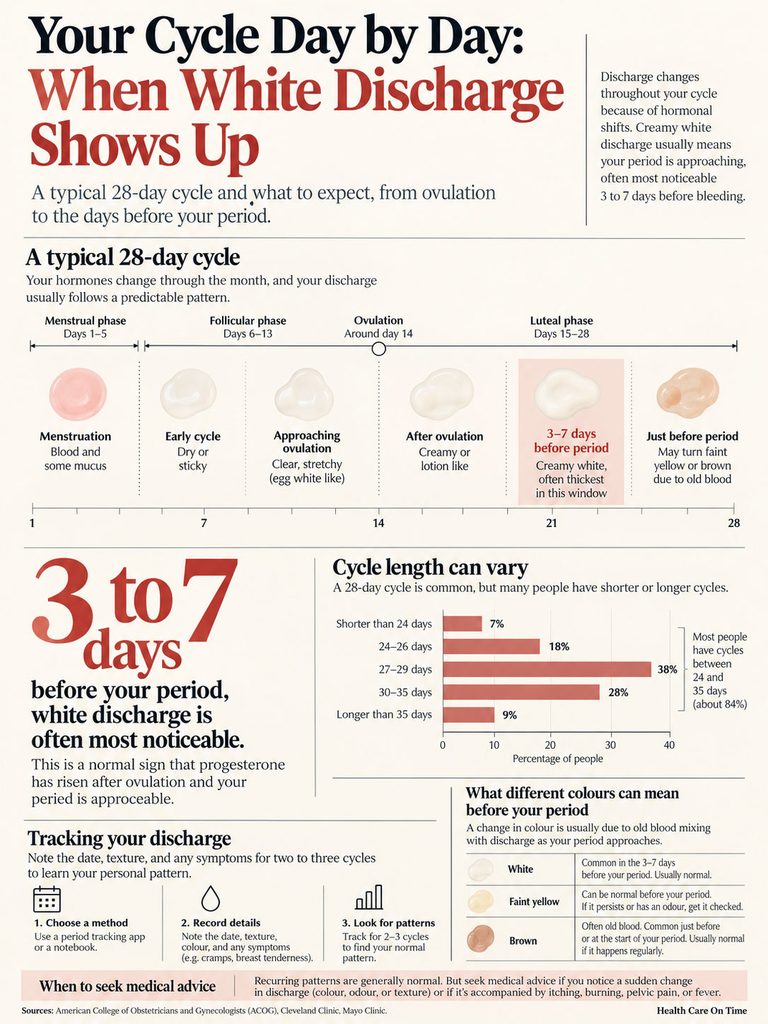
Every cycle is different, but a typical 28-day pattern looks like this:
- Days 1 to 5 (period): Menstrual blood covers any discharge.
- Days 6 to 9 (after period): Often dry or very little discharge. Some women see light, sticky white discharge.
- Days 10 to 13 (approaching ovulation): Discharge increases, turns wetter, and may go from cloudy to clear.
- Days 14 to 15 (ovulation): Clear, slippery, stretchy discharge peaks.
- Days 16 to 28 (luteal phase): Discharge thickens and turns white, creamy, or sticky. Volume drops for many women.
3 to 7 Days Before Your Period
This is when creamy white discharge is most noticeable for many women. It’s often the “period is coming” signal women learn to recognize after a few cycles.
In the last day or two before bleeding, discharge may pick up a faint yellow or brown tinge as small amounts of old blood mix in. If you see brown spotting, our guide on brown discharge before your period explains what’s normal there.
Cycles shorter than 24 days or longer than 35 days shift this timeline. Tracking your discharge for two or three cycles in an app or notebook shows you your own pattern, which is more useful than any textbook calendar. Note the date, the texture (sticky, creamy, wet, or stretchy), and any smell or itch. Patterns that repeat month after month are almost always normal; a sudden one-off change is the thing to watch.
Normal, Yeast, or BV? How to Tell the Difference
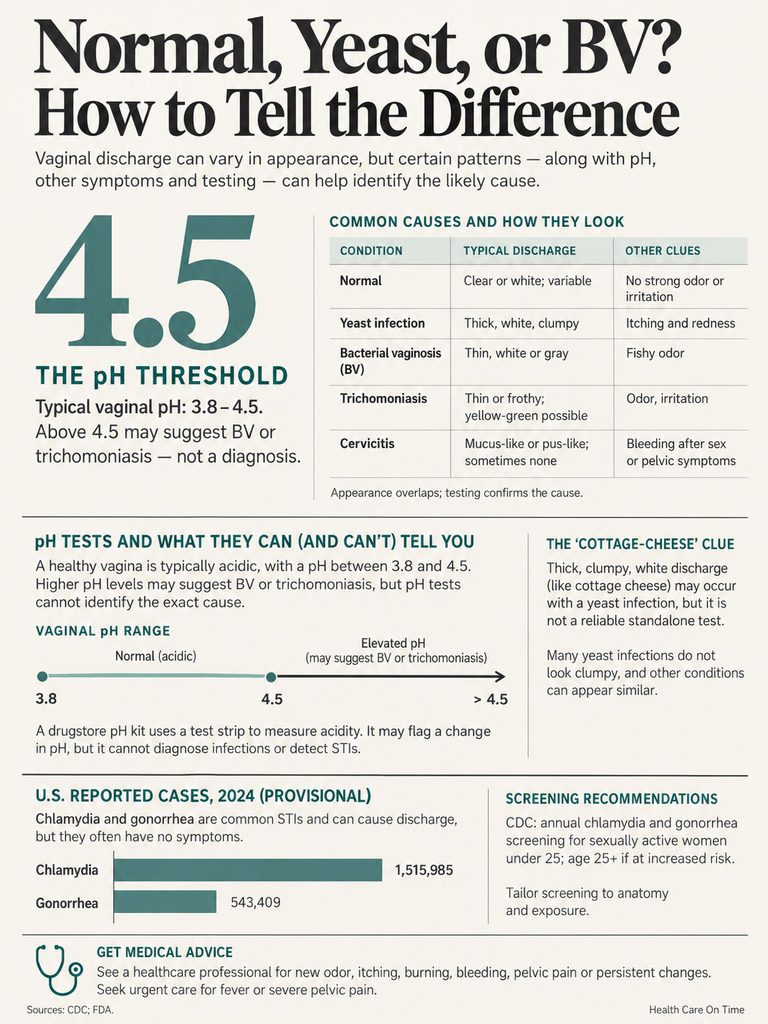
White discharge isn’t always healthy discharge. Several common infections also produce white or off-white fluid. The table below shows how they usually differ.
| Type | Color | Texture | Odor | Itching or Burning | Vaginal pH | Next Step |
| Normal pre-period (luteal) | White to off-white | Creamy, lotion-like, sticky | Mild or none | None | 3.8 to 4.5 | No treatment needed |
| Yeast infection (Candida) | Bright white | Thick, clumpy, cottage-cheese | Little or none | Strong itching, burning, redness | 4.5 or lower | OTC antifungal if previously diagnosed; otherwise see a provider |
| Bacterial vaginosis (BV) | Thin gray-white or milky | Watery, coats vaginal walls | Fishy, often worse after sex | Mild or none | Above 4.5 | Prescription antibiotic (metronidazole or clindamycin) |
| Trichomoniasis | White, yellow, or green | Frothy or thin | Unpleasant | Itching, pain with urination | Above 4.5 | Prescription antibiotic; partner treatment |
| Cervicitis (chlamydia, gonorrhea) | White, cloudy, or yellow | Thin to thick | Often none | Burning with urination, bleeding after sex | Varies | STI test (NAAT swab or urine); antibiotics |
The Cottage-Cheese Test and Its Limits
A thick, clumpy texture plus itching is the classic yeast pattern. Normal pre-period discharge is smooth and creamy, not lumpy, and it doesn’t itch.
But appearance alone misleads often. BV discharge is described in clinical criteria as milky and evenly spread across the vaginal walls, which can look a lot like normal creamy discharge on a liner. Doctors diagnose BV when three of four signs are present: that milky discharge, a pH above 4.5, a fishy smell, and “clue cells” under a microscope. Meeting three of the four signals about a 90% likelihood of BV.
Mixed infections are also common. If symptoms don’t match the classic picture, or this is your first time, a quick exam gives a real answer.
Why “White” Can Still Mean an STI
Chlamydia and gonorrhea often cause no symptoms. When they do, discharge may be white or cloudy rather than the yellow-green people expect.
The CDC reported more than 2.2 million cases of chlamydia, gonorrhea, and syphilis in 2024, even as chlamydia cases fell 8% from the year before. The CDC recommends yearly chlamydia and gonorrhea screening for sexually active women under 25, and for older women with new or multiple partners.
The Under-$20 Vaginal pH Check
Drugstore vaginal pH kits usually cost $10 to $20 in the US. A healthy vagina sits around pH 3.8 to 4.5. Yeast infections usually keep pH in that normal range, while BV and trichomoniasis usually push it above 4.5.
This simple check works. In one study, limiting antifungal use to women with symptoms and a pH of 4.5 or lower cut inappropriate use by about 50%. More than 96% of participants found the device easy to use and read.
How to Read It
- Test when you’re not bleeding and haven’t had sex or used vaginal products in the past 24 hours.
- Hold the swab against the vaginal wall for a few seconds, following the kit directions.
- Match the color to the chart right away.
- A reading of 4.5 or lower plus itching fits yeast. A reading above 4.5 means skip the antifungal and see a provider.
A pH test can’t diagnose an STI, and a normal reading doesn’t rule one out. Treat it as a helpful filter, not a final answer.
Why So Many Women Get It Wrong (The Self-Diagnosis Data)
Itching or odor makes a quick trip to the pharmacy tempting. The evidence suggests slowing down first.
The 95-Woman Pharmacy Study
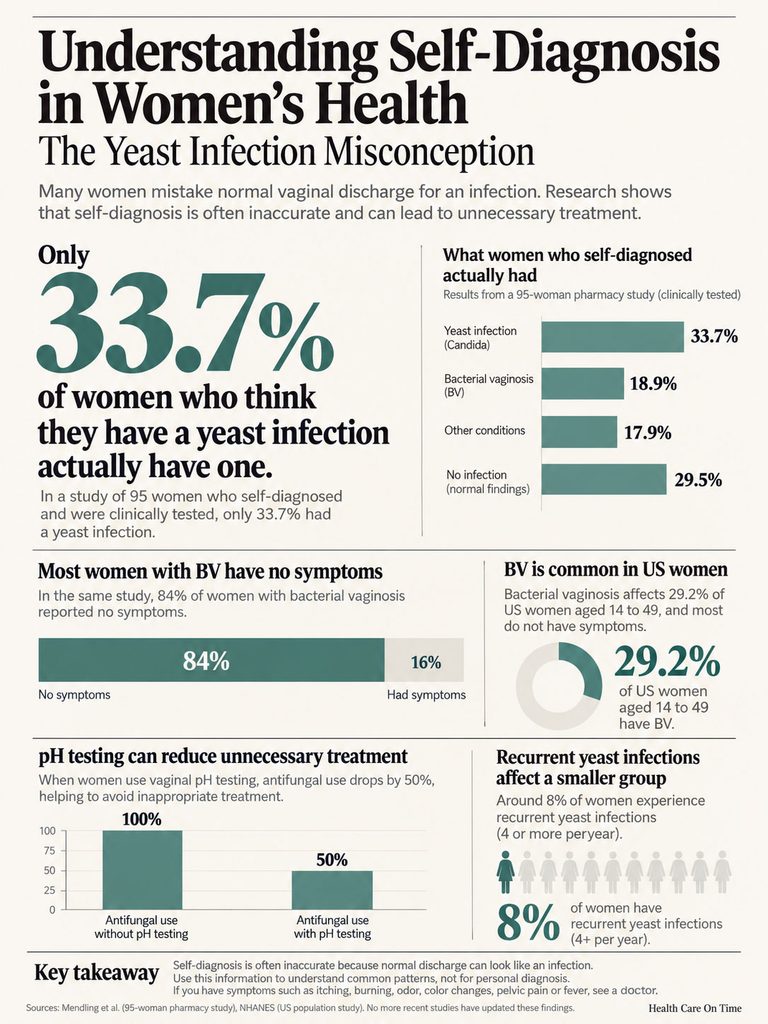
Researchers approached 95 women at the moment they were buying OTC yeast infection treatment, then examined and tested each one. Published in Obstetrics & Gynecology, the results were striking: only 33.7% actually had a yeast infection.
The rest broke down this way: 18.9% had BV, 21.1% had mixed vaginitis, 2.1% had trichomoniasis, 10.5% had other conditions, and 13.7% were completely normal. Women who’d had a yeast infection before, and women who read the package label, were no more accurate than anyone else.
That 13.7% matters for this topic. Some women see thick, white pre-period discharge, assume yeast, and treat a healthy body. Our medical review team sees the same pattern in patient questions: normal luteal discharge is one of the most common reasons women worry about an infection they don’t have.
BV Is Common and Mostly Silent
Bacterial vaginosis is the most common cause of abnormal discharge in women of reproductive age. A national NHANES study estimated BV prevalence at 29.2%, or about 21 million US women aged 14 to 49.
Most of those women had no idea. In the same study, 84% of women with BV reported no symptoms. BV also appeared in 18.8% of women who had never had sex, so it isn’t only a sexual health issue.
Why care about silent BV? Untreated BV raises the risk of picking up STIs and, during pregnancy, of preterm birth. It also tends to come back; one clinical review notes that about 60% of women relapse within three months after single-dose treatment. Treating BV with an antifungal does nothing, which is why the wrong guess delays the right fix.
The “75% of Women Get Yeast Infections” Claim
Nearly every article repeats that 75% of women will have at least one yeast infection. The number may be close, but its source is weak.
A peer-reviewed analysis traced these widely cited estimates and found them inadequately documented, with many studies relying on self-reported history. Two population-based studies did find that roughly 8% of women have recurrent yeast infections, defined as four or more a year.
Yeast infections are common. Just keep in mind that “common” doesn’t mean every itchy, white-discharge episode is yeast.
| Metric | Figure | Source |
| US women aged 14 to 49 with BV | 29.2% (about 21 million) | Koumans et al., Sex Transm Dis 2007 (NHANES 2001 to 2004) |
| Women with BV reporting no symptoms | 84% | Koumans et al., 2007 |
| Self-diagnosed “yeast” that was actually yeast | 33.7% | Ferris et al., Obstet Gynecol 2002 (n=95) |
| Self-diagnosed “yeast” that was normal discharge | 13.7% | Ferris et al., 2002 |
| Drop in inappropriate antifungal use with pH 4.5 rule | About 50% | Roy et al., Infect Dis Obstet Gynecol 2003 |
| Women with recurrent yeast infections (4+ per year) | About 8% | Population studies cited in Foxman et al., 2013 |
| Pregnancies not yet detectable on first missed-period day | 10% (14 of 136) | Wilcox et al., JAMA 2001 |
| Reported US chlamydia, gonorrhea, and syphilis cases | More than 2.2 million (chlamydia down 8%) | CDC STI Surveillance 2024 (Provisional) |
| Luteal-phase cervical mucus score (median) | 1, vs 10 or higher at ovulation | OHSU study, NCT02969590 |
What the Evidence Can and Can’t Tell You
Some of the most useful data here is not new. The self-diagnosis study dates from 2002, the pH-kit study from 2003, and the national BV estimate from 2001 to 2004 testing.
No newer US study has replaced them, and diagnostic methods have only grown more precise since then. Still, today’s numbers could differ, and the OHSU mucus study included only six women. Use these figures to understand the pattern, not as exact odds for you.
Is White Creamy Discharge a Sign of Pregnancy?
This is the question behind many searches. The honest answer: it can’t tell you either way.
Why Pregnancy Discharge and Pre-Period Discharge Look the Same
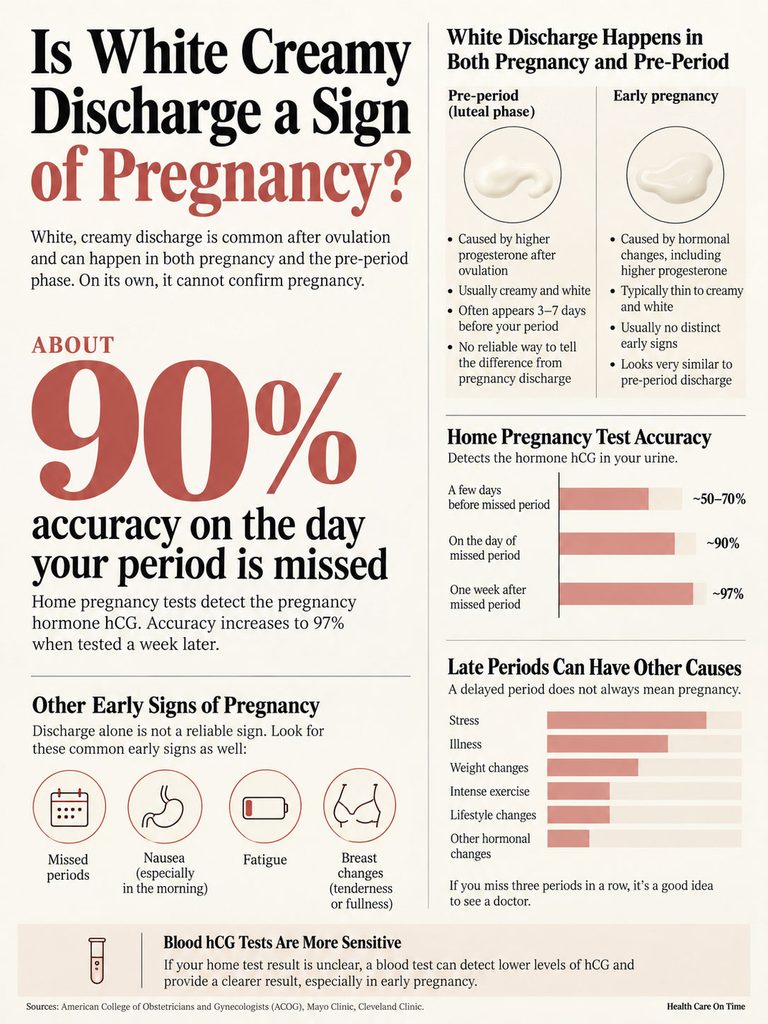
Both are driven by progesterone. After ovulation, progesterone rises whether or not an egg is fertilized. If you’re not pregnant, progesterone falls and your period starts. If you are, it keeps climbing.
Early pregnancy discharge is usually thin to creamy, white or milky, and mild-smelling. That’s exactly how normal luteal discharge looks. Some women notice more discharge as pregnancy goes on, but this usually becomes obvious weeks later, not in the days before a missed period.
Signs That Matter More Than Discharge
These point toward pregnancy more strongly, especially together:
- A missed period, the most reliable early sign
- Breast tenderness or swelling that feels different from your usual PMS
- Unusual tiredness
- Nausea, with or without vomiting
- Needing to urinate more often
None of these alone confirms pregnancy. Many overlap with PMS, which is why testing beats guessing.
When to Take a Test
Home pregnancy tests detect hCG, a hormone made only after a fertilized egg implants in the uterus. Implantation timing varies with ovulation, so it doesn’t always happen before your period is due.
A JAMA study followed 136 pregnancies and found that 14 of them (10%) had not yet implanted on the first day of the missed period. That caps the best possible test accuracy at about 90% on that day. One week later, it rises to about 97%.
So a negative test on the day your period is due isn’t the final word. If your period still hasn’t come, retest in 3 to 7 days, ideally with first-morning urine.
In tests ordered through HealthCareOnTime, a blood hCG test is a common next step when home results are unclear. Blood tests pick up lower hCG levels than most urine tests and give an exact number your provider can track.
White Discharge Instead of a Period
If your period is late and you only have white discharge, take a pregnancy test. If it’s negative, common causes of a late period include stress, illness, travel, weight change, intense exercise, thyroid problems, and polycystic ovary syndrome.
One late period is common. Three missed periods in a row (when you’re not pregnant) deserves a visit to your doctor. If bleeding happens during a confirmed or suspected pregnancy, read Can You Be Pregnant and Still Have a Period?
What Changes Your Pre-Period Discharge
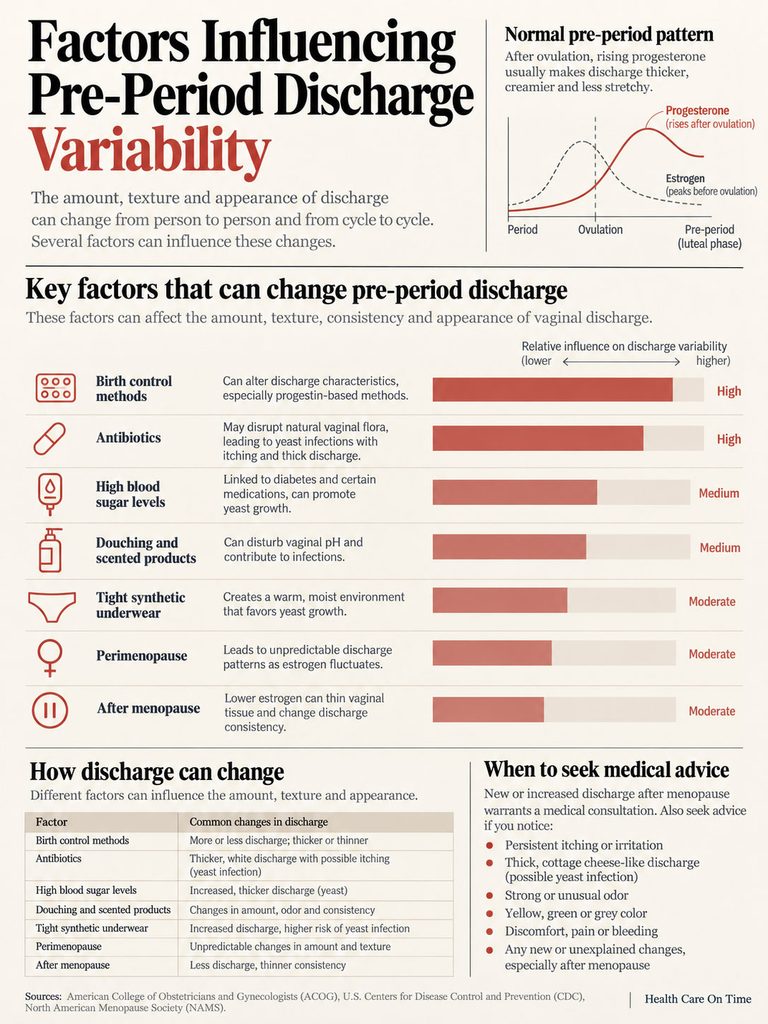
Your discharge responds to more than your cycle. These factors can shift its amount, texture, or balance.
Birth Control and IUDs
As covered above, progestin-based methods keep mucus thick and creamy for much of the month. Estrogen-containing pills can increase discharge for some women. Changes are most noticeable in the first three months after starting or switching a method.
Antibiotics, Diabetes, and High Blood Sugar
Antibiotics kill protective Lactobacillus along with harmful bacteria. That gives yeast room to grow, so itching and thick white discharge during or after a course of antibiotics is a classic yeast setup.
High blood sugar feeds yeast too. Diabetes, pregnancy, antibiotic use, and a weakened immune system are all linked to genital yeast infections. SGLT2 inhibitor diabetes drugs, such as empagliflozin and dapagliflozin, list genital yeast infections among their known side effects because they push sugar into the urine. If you get frequent yeast infections, an HbA1c blood test is a reasonable check.
Douching, Scented Products, and Tight Underwear
Douching washes away good bacteria and raises pH. In NHANES data, BV prevalence was 45.2% among women who had douched in the previous month, compared with 23.3% among those who hadn’t.
Scented soaps, sprays, wipes, and bubble baths can irritate tissue and mimic infection symptoms. Tight synthetic underwear traps heat and moisture, which yeast likes.
Perimenopause
In your 40s, ovulation becomes irregular and estrogen swings up and down. Discharge patterns become less predictable, and some cycles skip the clear, stretchy phase entirely. You may see creamy discharge for longer stretches, or very little at all.
After menopause, lower estrogen thins vaginal tissue, raises vaginal pH, and reduces discharge. That higher pH means a pH strip is less useful for telling yeast from BV after menopause. New or increased discharge after menopause, especially with any bleeding, should be checked by a doctor.
When to See a Doctor (and What to Expect)
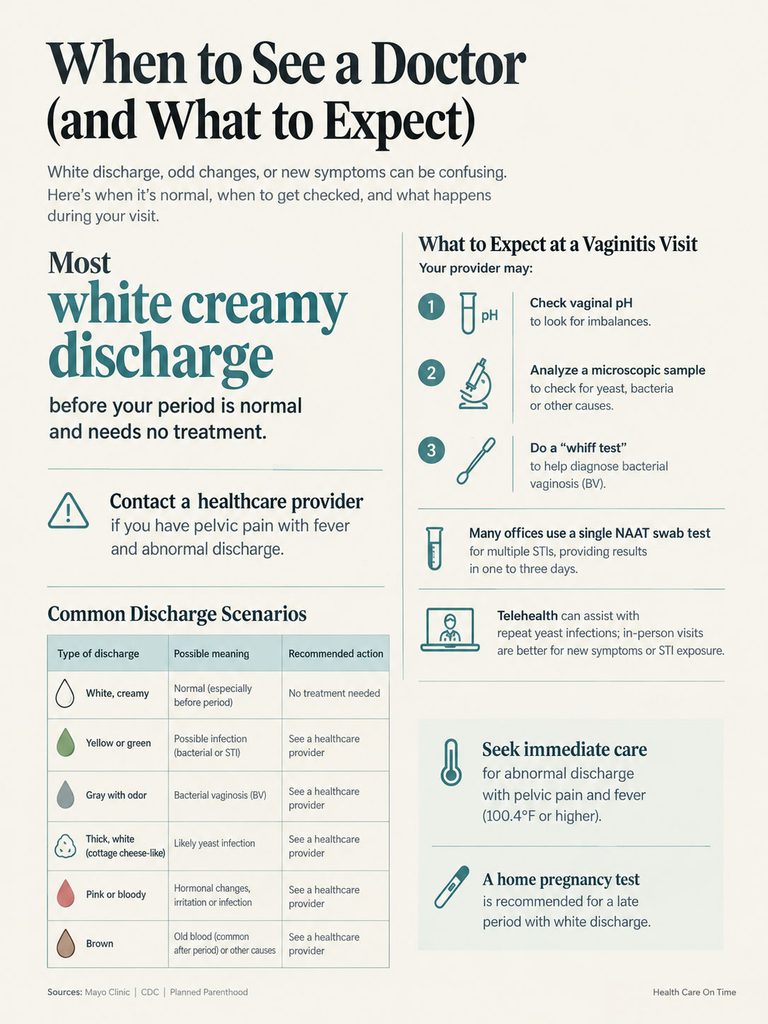
Most white creamy discharge before your period needs nothing at all. These signs are the exception.
Red Flags
Contact a healthcare provider if you notice:
- Itching, burning, swelling, or redness around the vagina or vulva
- A fishy smell, especially after sex
- Gray, green, or yellow-green discharge
- A frothy or cottage-cheese texture
- Pain during sex or urination
- Bleeding between periods or after sex
- Pelvic or lower belly pain, especially with fever
Pelvic pain with fever and abnormal discharge can signal pelvic inflammatory disease, which can damage fertility. That combination needs same-day care.
What the Visit Involves
A vaginitis visit is usually quick. A provider may check your vaginal pH, look at a sample under a microscope, and do a “whiff test” for BV, following the CDC’s STI treatment guidelines.
Many offices now use a single swab tested by NAAT (a DNA-based lab test) for BV, yeast, trichomoniasis, chlamydia, and gonorrhea together. Results typically take one to three days. Across lab orders our team coordinates, a combined swab panel is often the fastest way to stop guessing between look-alike causes.
Telehealth can help with repeat, previously diagnosed yeast infections. For a first episode, new symptoms, or possible STI exposure, an in-person exam or lab swab is more reliable.
| Scenario | What It Likely Means | Recommended Action |
| White, creamy, mild smell, no itch, 3 to 7 days before your period | Normal luteal-phase leukorrhea | No treatment; wear breathable cotton underwear |
| Thick, clumpy white discharge with strong itching, pH 4.5 or lower | Likely yeast infection | OTC antifungal (clotrimazole or miconazole) if you’ve had a confirmed yeast infection before; see a provider if it’s your first or it doesn’t clear in 7 days |
| Thin gray-white or milky discharge with fishy odor, pH above 4.5 | Likely bacterial vaginosis | See a provider for prescription antibiotics; skip antifungals |
| White or cloudy discharge plus burning urination or bleeding after sex | Possible chlamydia, gonorrhea, or trichomoniasis | Get STI testing within a few days; avoid sex until results are back |
| Period 5 or more days late with white discharge | Possible pregnancy or delayed ovulation | Take a home pregnancy test; retest in 3 to 7 days if negative and still no period |
| Yeast-like symptoms 4 or more times in a year | Recurrent vulvovaginal candidiasis | See a provider for culture, species testing, and possibly an HbA1c check |
| Abnormal discharge with pelvic pain and fever of 100.4°F or higher | Possible pelvic inflammatory disease | Seek same-day care or urgent care |
How to Keep Discharge Healthy
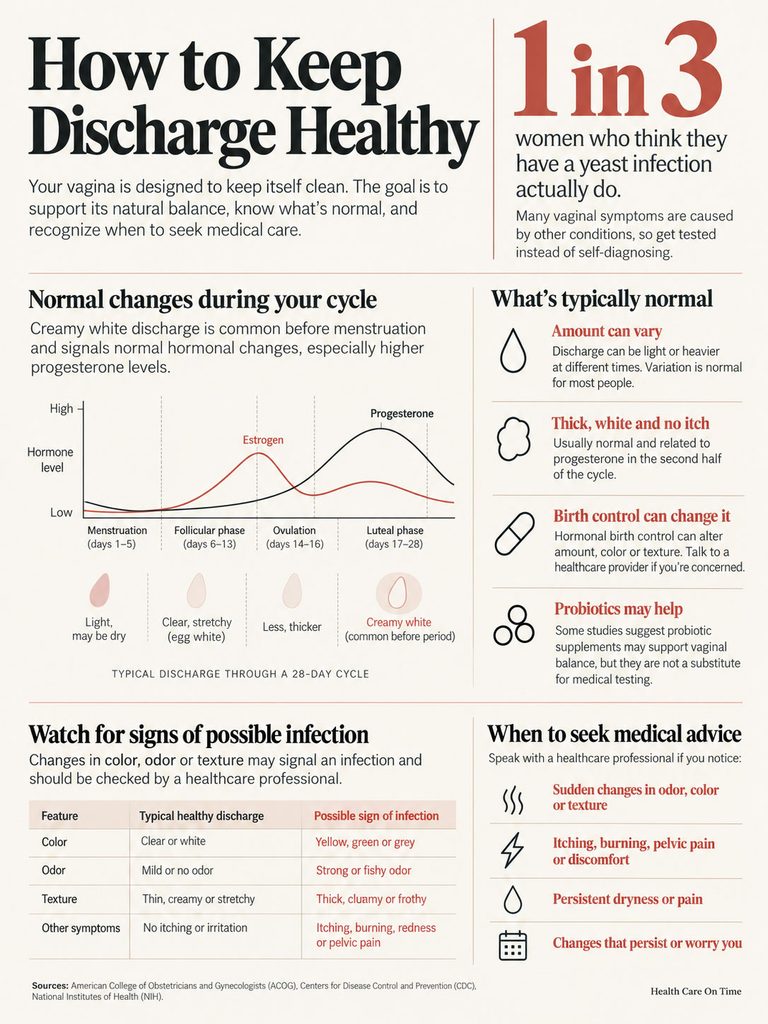
Your vagina cleans itself. The goal is to stay out of its way.
What Helps
- Wash the vulva (outside only) with warm water or a mild, unscented soap.
- Wear cotton or cotton-lined underwear, and change out of wet swimsuits or workout clothes quickly.
- Use unscented panty liners if discharge bothers you, and change them often.
- Use condoms with new partners to lower STI and BV risk.
- Track your discharge for a few cycles so changes stand out.
- Keep blood sugar in range if you have diabetes.
What to Skip
- Douching, which is linked to higher BV rates
- Scented washes, sprays, and wipes
- Repeated OTC yeast treatments without a confirmed diagnosis
- Leftover antibiotics or a friend’s prescription
Patients commonly ask us whether probiotic supplements prevent infections. Evidence is mixed, and results from one product don’t apply to another. They’re generally safe, but they aren’t a substitute for testing when symptoms appear.
For itching relief while you wait for answers, see our guide to home remedies for vaginal itching.
Frequently Asked Questions
Does white creamy discharge mean your period is coming?
Often, yes. Creamy white discharge is typical in the luteal phase, the one to two weeks after ovulation. Many women notice it 3 to 7 days before bleeding. It shows your hormones have shifted after ovulation, but it can’t predict the exact day your period will start.
How many days before your period does white discharge start?
It usually appears shortly after ovulation, around day 15 to 16 of a 28-day cycle, and can last until your period. It’s often most noticeable 3 to 7 days before bleeding. Cycles that are shorter or longer move this window earlier or later.
Is creamy white discharge a sign of pregnancy?
Not reliably. Progesterone rises after ovulation whether or not you’re pregnant, so pregnancy discharge and pre-period discharge look almost the same. A missed period is a much better clue. Test on the first day your period is late, and retest a week later if it’s negative.
Why is your discharge thick and white but not itchy?
Thick, white, non-itchy discharge with a mild smell is usually normal luteal-phase discharge. Progesterone thickens cervical mucus and lowers its water content, so it looks creamy. Without itching, burning, odor, or color change, there’s typically no infection and no need for treatment.
Is a lot of white discharge before your period normal?
Amounts vary widely between women. Some notice only a little; others need a liner. A sudden, clear increase compared with your usual pattern, especially with odor, itching, or a gray or green tint, is worth checking with a provider or a vaginal pH test.
Can white discharge before your period have a smell?
Normal discharge can have a mild, slightly tangy scent from healthy Lactobacillus bacteria. A strong fishy odor, especially after sex, points to bacterial vaginosis. A foul smell with frothy discharge may suggest trichomoniasis. Both need prescription treatment, not antifungals.
What does yeast infection discharge look like vs normal?
Yeast discharge is usually bright white, thick, and clumpy, like cottage cheese, with strong itching and redness. Normal pre-period discharge is smooth, creamy, and not itchy. If you’re unsure, a pH test helps: yeast usually stays at 4.5 or lower, while BV usually goes higher.
Why do you feel dry before your period?
After ovulation, progesterone reduces cervical mucus output. Many women notice less wetness in the luteal phase, and that’s normal. Persistent dryness, pain during sex, or dryness after menopause can relate to low estrogen and is worth discussing with your doctor.
Can birth control change your discharge before your period?
Yes. Most hormonal methods contain progestin, which keeps cervical mucus thick and creamy for much of the month. You may not see the clear, stretchy ovulation phase at all. Changes are most common in the first three months on a new method.
What does white discharge instead of a period mean?
If your period is late and you only see white discharge, take a pregnancy test first. If it’s negative, stress, illness, weight change, thyroid problems, or PCOS can delay a period. Retest in a few days, and see a doctor after three missed periods.
Should you use a yeast infection cream if you’re not sure?
It’s safest only if a provider diagnosed a yeast infection before and your symptoms match. In one US study, just one in three women self-diagnosing yeast actually had it. The wrong treatment can delay care for BV or an STI. When in doubt, get tested.
When should you see a doctor about white discharge?
See a provider for itching, burning, fishy odor, gray or green color, frothy or clumpy texture, pain with sex or urination, bleeding between periods, or pelvic pain. Pelvic pain with fever needs same-day care. Also get checked for four or more infections a year.
Medical Disclaimer: This article is for general education and isn’t a substitute for professional medical advice, diagnosis, or treatment. Vaginal symptoms can have several causes that look alike. If you have symptoms of infection, are pregnant, or are unsure what’s causing a change in your discharge, talk with a licensed healthcare provider. Call 911 for severe pain, heavy bleeding, or fainting.
References
- Koumans EH, et al. The prevalence of bacterial vaginosis in the United States, 2001 to 2004. Sex Transm Dis. 2007
- CDC. Bacterial Vaginosis (BV) Statistics
- Ferris DG, et al. Over-the-counter antifungal drug misuse associated with patient-diagnosed vulvovaginal candidiasis. Obstet Gynecol. 2002
- American Family Physician. Women frequently misdiagnose vulvovaginal infections. 2002
- Roy S, et al. Improving appropriate use of antifungal medications: the role of an OTC vaginal pH self-test device. Infect Dis Obstet Gynecol. 2003
- Foxman B, et al. Highly-cited estimates of the cumulative incidence and recurrence of vulvovaginal candidiasis are inadequately documented. 2013
- Wilcox AJ, et al. Natural limits of pregnancy testing in relation to the expected menstrual period. JAMA. 2001
- OHSU. Appraising cervical mucus: a new approach to evaluating contraceptives (NCT02969590)
- ClinicalTrials.gov. Regulation of Cervical Mucus Secretion (NCT02969590)
- American Family Physician. Management of Vaginitis. 2004
- Spence D, Melville C. Vaginal discharge. BMJ. 2004
- CDC. Release of 2024 National STI Data
- CDC. Sexually Transmitted Infections Surveillance, 2024 (Provisional)
- CDC. Prevalence of bacterial vaginosis in the United States, 2001 to 2002 (conference abstract)
- CDC. Sexually Transmitted Infections Treatment Guidelines
- Healthline. White Discharge Before Period