Scroll through social media long enough and someone will credit a prenatal vitamin for their thick, glossy hair. They’re not pregnant. They’re not planning to be. They just heard it works.
Table of Contents
Here’s the twist: prenatal vitamins do have real value outside of pregnancy. It just isn’t the value most people buy them for.
Quick Answer: Yes, most healthy women can take prenatal vitamins when not pregnant, and the biggest real benefit is folic acid. If there’s any chance you could become pregnant, a daily 400 to 800 mcg dose cuts the risk of serious birth defects. For men, postmenopausal women, and anyone with normal iron levels, the extra iron in prenatals offers little benefit and can cause side effects over time.
At a Glance
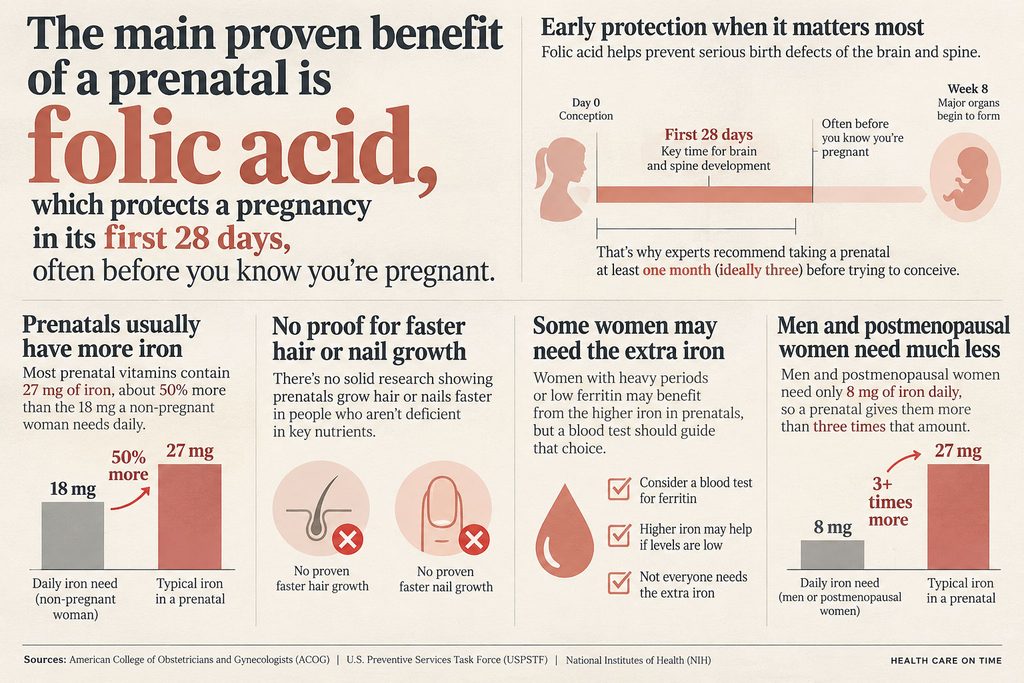
- The main proven benefit of a prenatal is folic acid, which protects a pregnancy in its first 28 days, often before you know you’re pregnant.
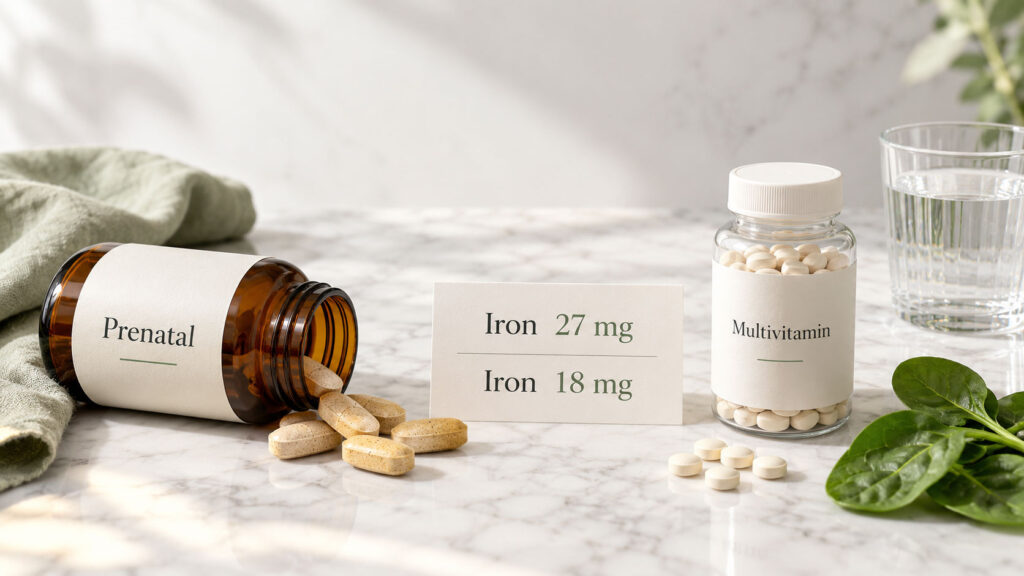
- Most prenatals contain 27 mg of iron, 50% more than the 18 mg a non-pregnant woman needs daily.
- No solid research shows prenatals grow hair or nails faster in people who aren’t deficient.
- Women with heavy periods or low ferritin may benefit from the extra iron, but a blood test should guide that choice.
- Men and postmenopausal women need only 8 mg of iron daily, so a prenatal gives them more than three times that.
- Start a prenatal at least one month (ideally three) before trying to conceive.
What Makes a Prenatal Vitamin Different From a Regular Multivitamin
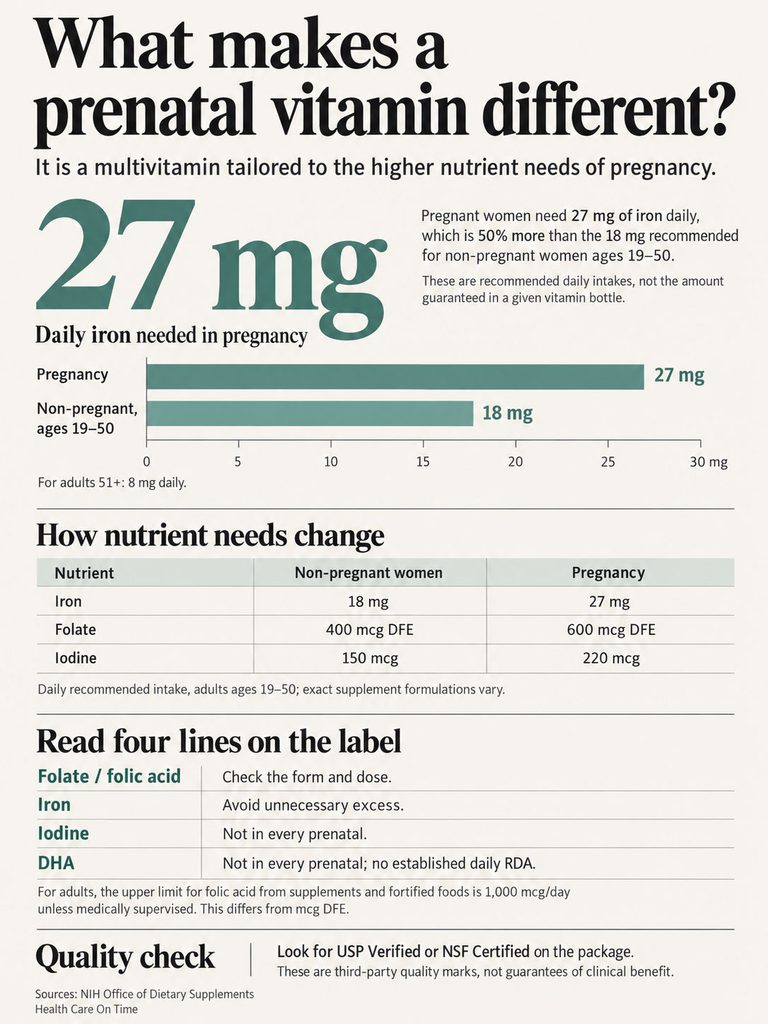
A prenatal vitamin is a multivitamin built for pregnancy, with more folic acid, iron, iodine, and often DHA. It isn’t a “stronger” or “better” multivitamin. It’s a targeted product designed around what a growing baby needs.
That difference matters when you take it for months or years without being pregnant.
The Four Nutrients That Set Prenatals Apart
Most prenatal formulas stand out in four areas:
- Folic acid: Usually 400 to 1,000 mcg, to help prevent neural tube defects like spina bifida.
- Iron: Usually 27 mg, because blood volume rises by about 45% during pregnancy.
- Iodine: Usually 150 mcg, to support the baby’s brain and thyroid development.
- DHA (omega-3): Often 200 mg or more, for fetal brain and eye growth.
Many also add vitamin D and choline. A standard women’s multivitamin usually has less iron, less folic acid, and often no DHA.
How Your Daily Needs Change When You’re Not Pregnant
Your needs drop once pregnancy is off the table. The NIH Office of Dietary Supplements sets iron at 18 mg daily for women ages 19 to 50, 27 mg during pregnancy, and just 8 mg for men and women over 50.
Our medical team has reviewed dozens of popular prenatal labels, and the gap is clear. The table below compares a typical prenatal with what a non-pregnant woman actually needs.
| Nutrient | Typical Prenatal | Typical Women’s Multivitamin | Daily Need (Not Pregnant, Ages 19 to 50) | Upper Limit (Adults) |
| Folic acid | 400 to 1,000 mcg | 400 mcg | 400 mcg DFE (food + supplement) | 1,000 mcg (from supplements) |
| Iron | 27 mg | 8 to 18 mg | 18 mg | 45 mg |
| Iodine | 150 mcg | 0 to 150 mcg | 150 mcg | 1,100 mcg |
| Calcium | 150 to 300 mg | 200 to 500 mg | 1,000 mg | 2,500 mg |
| Vitamin D | 400 to 1,000 IU | 600 to 1,000 IU | 600 IU | 4,000 IU |
| Vitamin A | 770 to 1,300 mcg RAE | 700 to 900 mcg RAE | 700 mcg RAE | 3,000 mcg (preformed) |
| Choline | 0 to 450 mg | 0 to 55 mg | 425 mg | 3,500 mg |
Sources: NIH Office of Dietary Supplements fact sheets; product ranges reflect common US over-the-counter formulas.
Two numbers stand out. Iron in a prenatal runs 9 mg above a non-pregnant woman’s need. Folic acid can hit the upper limit on its own, before you count fortified cereal, bread, and pasta.
How to Read a Prenatal Label in 60 Seconds
Labels can be confusing, so focus on four lines:
- Folate (as folic acid or methylfolate): Look for 400 to 800 mcg. Labels often show “mcg DFE,” where 400 mcg folic acid equals about 680 mcg DFE.
- Iron: Note the number. If it’s 27 mg and you’re not pregnant or low in iron, that’s more than you need.
- Vitamin A: Check whether it comes from beta-carotene (safer) or retinol/retinyl palmitate (can build up).
- % Daily Value: Anything far above 100% deserves a second look, especially iron and vitamin A.
Then check for a USP Verified or NSF Certified seal. It’s the quickest quality signal on the bottle.
The Real Benefits of Prenatal Vitamins When You’re Not Pregnant
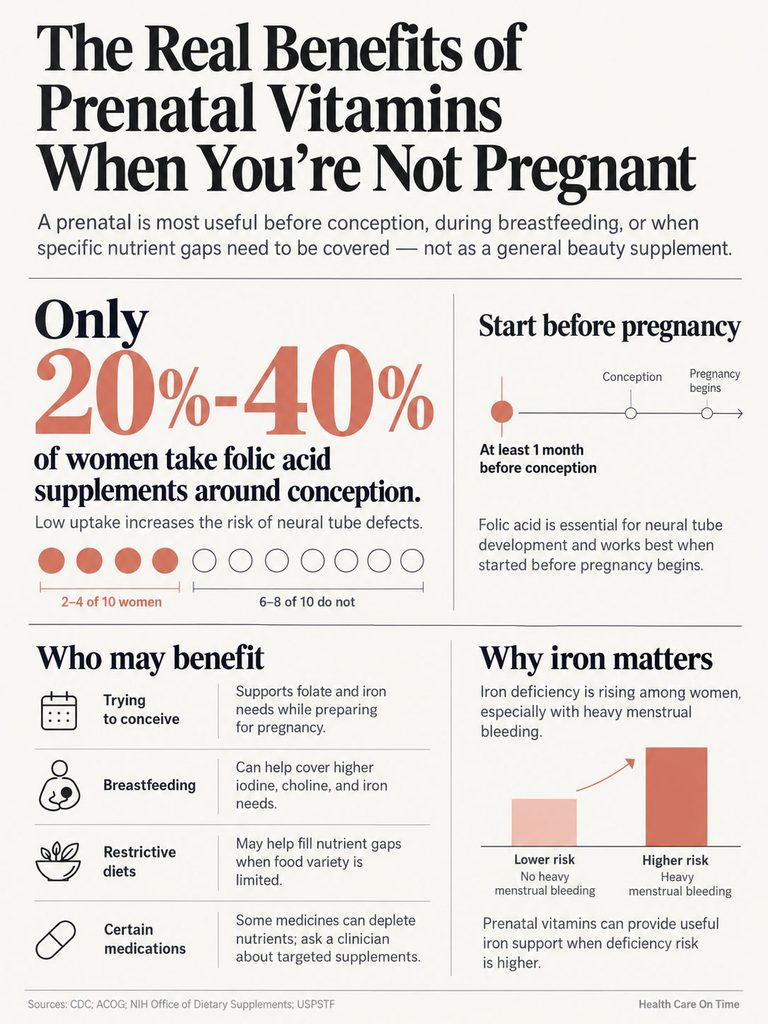
The real benefits of prenatal vitamins when not pregnant come down to folic acid, iron for women who are low, and nutrient support while trying to conceive or breastfeeding. Here’s where the evidence holds up.
Folic Acid Protection Before You Know You’re Pregnant
Folic acid is the single most proven reason to take a prenatal before pregnancy.
The U.S. Preventive Services Task Force gives a Grade A rating, its highest, to a daily 400 to 800 mcg folic acid supplement for anyone planning to or able to become pregnant. Grade A means high certainty of substantial benefit.
Why Timing Matters So Much
The neural tube, which becomes the baby’s brain and spine, closes about 26 to 28 days after fertilization. That’s often before a missed period and well before most people test.
If folic acid levels are low during those first weeks, the window to prevent a defect has already closed. Starting after a positive test is often too late.
That’s why the USPSTF says supplements should start at least one month before conception and continue through the first two to three months of pregnancy.
Most Women Still Miss This Window
The USPSTF reports that survey data from 1998 to 2016 found only about 20% to 40% of recently pregnant women, or women trying to conceive, took folic acid supplements around conception.
Women with an unintended pregnancy were 4 to 5 times less likely to have taken it. Patients booking preconception visits with us are often surprised by that gap.
It matters because unplanned pregnancies are common. The most recent national estimate from the Guttmacher Institute put 45% of US pregnancies as unintended.
According to the CDC, folic acid fortification of US grain foods prevents about 1,300 neural tube defects each year. Yet about 3,000 still occur annually, and low folic acid intake is one reason.
You don’t need a prenatal to get this benefit, though. A plain folic acid supplement or a standard multivitamin with 400 mcg covers it.
Filling an Iron Gap If You Have Heavy Periods
Iron deficiency is rising among American women. The CDC’s 2026 Nutrition Report found low ferritin in women of reproductive age climbed from about 13% in 2003-2004 to about 18% in 2021-2023.
Heavy menstrual bleeding is one of the top causes. If you lose more blood each month, 18 mg of iron may not keep up.
For these women, the 27 mg in a prenatal can help rebuild stores. In cases reviewed by our medical team, women with confirmed low ferritin and heavy periods often see the most real-world benefit. The key word is confirmed, by a blood test.
Signs You May Be Low in Iron
Low iron often builds slowly, so the signs are easy to brush off. Watch for:
- Tiredness that doesn’t improve with sleep
- Shortness of breath on stairs or short walks
- Cold hands and feet
- Brittle nails or more hair in your brush
- Cravings for ice or other non-food items
None of these prove a deficiency on their own. A ferritin test costs little and gives you a clear answer in a day or two.
Support While Trying to Conceive
If you’re actively trying to get pregnant, a prenatal makes complete sense. It loads up folic acid, iron, iodine, and choline so your stores are ready from day one.
Some observational research also links regular multivitamin use with a lower risk of ovulation-related infertility. Harvard’s Nurses’ Health Study II found this pattern, though it can’t prove the vitamins caused it.
So a prenatal won’t make you fertile. But it does prepare your body for a healthy start.
Support During Breastfeeding and Postpartum Recovery
Breastfeeding raises your iodine need to 290 mcg daily, higher than during pregnancy. Choline and DHA also pass into breast milk.
That’s why the American College of Obstetricians and Gynecologists and many doctors suggest continuing a prenatal while nursing. Women who lost a lot of blood during delivery may also benefit from the extra iron.
Covering Gaps on Restrictive Diets
Some people struggle to get enough nutrients from food alone. That includes:
- Vegans and vegetarians, who may run low on iron, B12, iodine, and DHA
- People with celiac disease or Crohn’s disease, which reduce absorption
- People who’ve had bariatric surgery (who usually need a specialized bariatric formula)
For these groups, a prenatal can cover several gaps in one pill. A doctor or dietitian should still guide the choice.
Medications That Can Lower Your Nutrient Levels
Certain common medications can drain nutrients over time:
- Birth control pills: May slightly lower folate, B6, and B12.
- Metformin: Can lower B12 with long-term use.
- Acid reducers (PPIs and H2 blockers): Can reduce B12 and iron absorption.
- Some seizure drugs: Can interfere with folate.
If you take one of these, ask your doctor which nutrients to check. A targeted supplement often works better than a full prenatal.
The Hair, Skin, and Nail Claims: What the Science Says
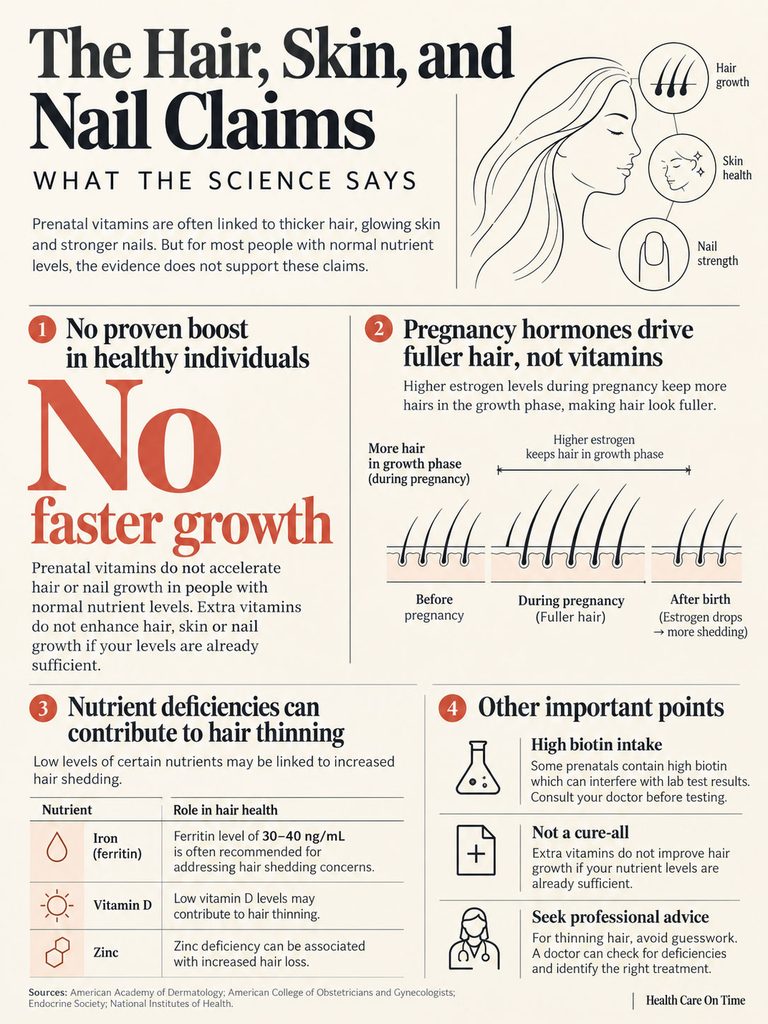
Prenatal vitamins don’t grow hair or nails faster in people with normal nutrient levels. This is where most of the online hype lives, and where the evidence is weakest.
Patients often ask us whether prenatals will thicken their hair. The honest answer: only if you’re low in something to begin with.
Why Pregnancy Hair Looks Fuller
Thick, shiny hair during pregnancy comes mostly from hormones, not vitamins.
High estrogen keeps hair in its growth phase longer, so less falls out each day. After delivery, estrogen drops and that extra hair sheds, which is why many new moms notice hair loss three to four months postpartum.
The vitamins happened to be in the picture, so they got the credit.
When a Supplement Might Actually Help Hair
Nutrient gaps can cause thinning. Low iron, low vitamin D, and low zinc are the most common culprits in women.
Many dermatologists look for a ferritin level of at least 30 to 40 ng/mL when hair shedding is a concern. If you’re below that, correcting it may slow shedding over three to six months.
If your levels are already normal, extra vitamins won’t push hair to grow faster. Mayo Clinic has noted that hair and nail claims for prenatals haven’t been proven.
There’s one more catch. Some prenatals contain biotin, and the FDA has warned that high biotin intake can throw off certain lab tests, including thyroid and heart tests. Tell your doctor before any blood work.
Better First Steps for Thinning Hair
If your hair is thinning, skip the guesswork:
- Ask your doctor for ferritin, vitamin D, and thyroid (TSH) tests.
- See a board-certified dermatologist if shedding lasts more than three months.
- Treat any confirmed deficiency with a targeted supplement, not a pregnancy formula.
Risks and Side Effects of Prenatal Vitamins If You’re Not Pregnant
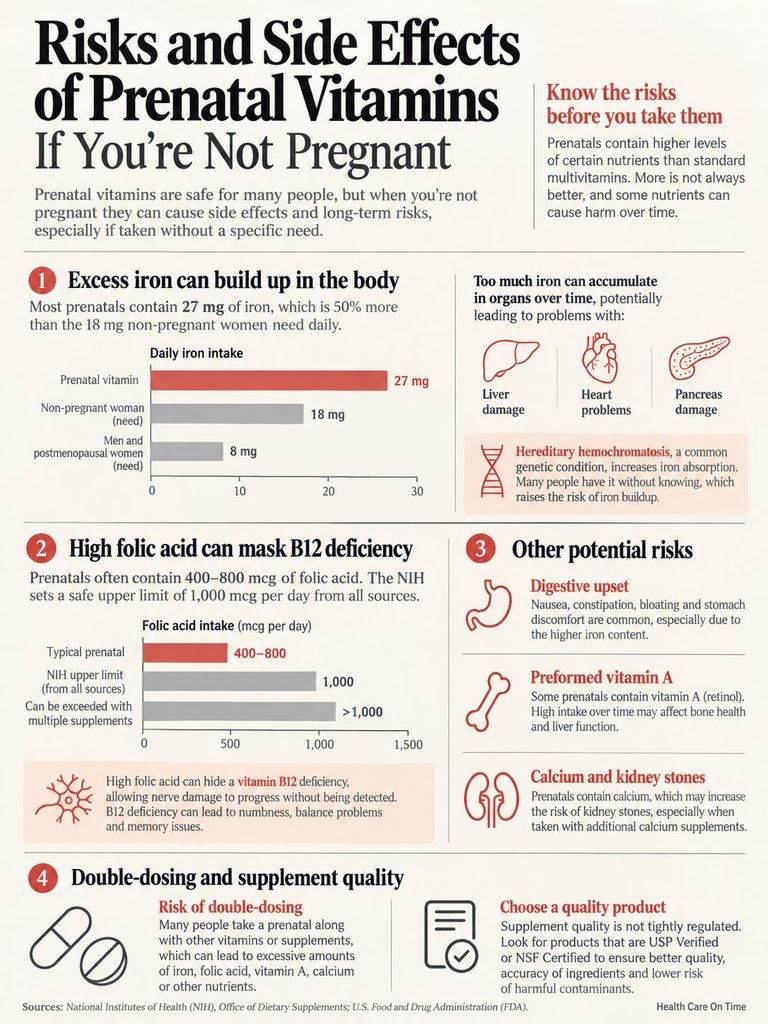
The main side effects of prenatal vitamins when not pregnant are digestive upset and, with long-term use, too much iron or folic acid. Short-term use is generally safe. Problems tend to show up when people who don’t need the extra nutrients take them for years.
Too Much Iron
Iron is the most common source of side effects. Even at 27 mg, many people get:
- Constipation
- Nausea, especially on an empty stomach
- Stomach cramps
- Dark stools
The bigger concern is buildup. Your body has no good way to get rid of extra iron, so it stores it in the liver, heart, and pancreas.
People with hereditary hemochromatosis absorb too much iron from food alone. The National Institute of Diabetes and Digestive and Kidney Diseases notes it’s one of the most common genetic disorders in the US, especially among people of Northern European descent.
Many people with it don’t know. Across lab results reviewed through our diagnostic network, a simple iron panel often flags it before years of extra iron cause damage.
High Folic Acid and Hidden B12 Deficiency
Large doses of folic acid can mask the anemia caused by low vitamin B12. Your blood counts may look normal while nerve damage from low B12 quietly progresses.
The NIH sets the upper limit for folic acid from supplements and fortified food at 1,000 mcg per day. A 1,000 mcg prenatal plus fortified cereal can push you past it.
This matters most for older adults, vegans, and people on metformin or acid reducers, who are more likely to be low in B12.
Vitamin A, Calcium, and Kidney Stone Concerns
Some prenatals include preformed vitamin A (retinol). Too much over time may affect bone health and the liver.
Calcium supplements have also been linked to a higher risk of kidney stones in some people. The amount in most prenatals is modest, but it adds up if you also take a separate calcium pill.
The Double-Dosing Mistake
A common error: taking a prenatal plus a multivitamin, a hair gummy, and an iron pill. Each seems harmless alone.
Together, they can push iron, folic acid, and vitamin A well above safe limits. Read every label and add up the totals.
Supplement Quality Isn’t Guaranteed
The FDA doesn’t approve dietary supplements for safety or effectiveness before they’re sold. What’s on the label may not match what’s in the bottle.
A USP Verified or NSF Certified seal means a third party tested that the product contains what it claims and isn’t contaminated.
Who Should and Shouldn’t Take Prenatal Vitamins When Not Pregnant
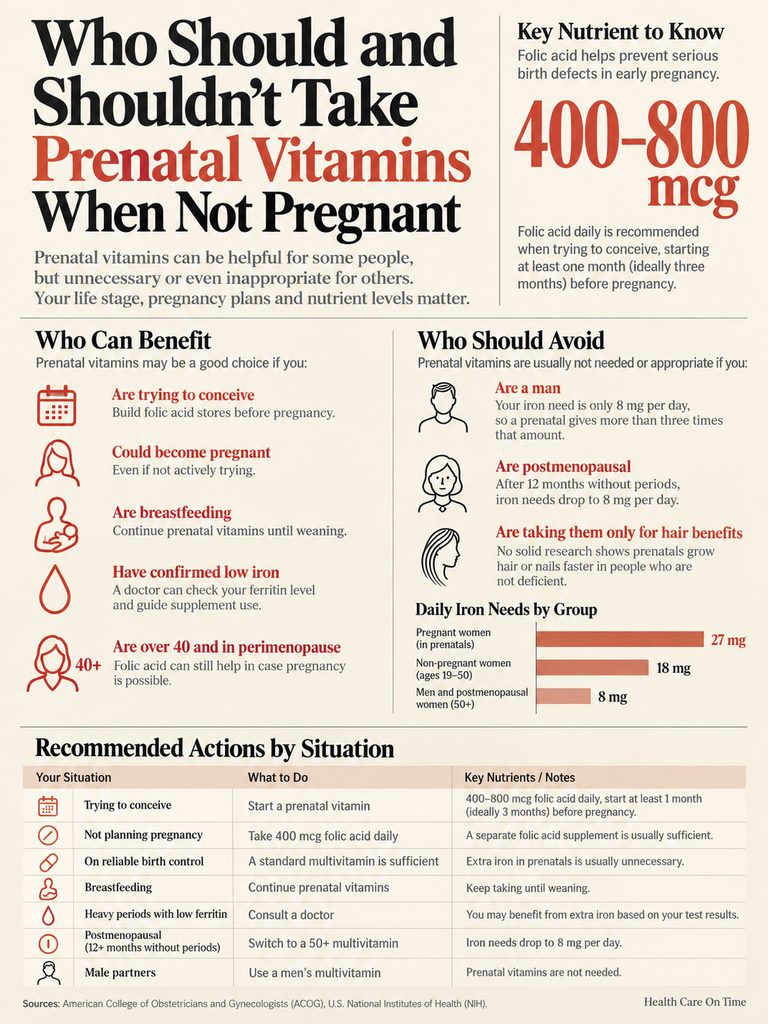
Prenatal vitamins fit women who are trying to conceive, could become pregnant, are breastfeeding, or have confirmed low iron. They’re a poor fit for men, postmenopausal women, and anyone taking them only for hair.
Good Candidates
- Women actively trying to conceive
- Women who could become pregnant and want full folic acid coverage
- Breastfeeding mothers
- Women recovering from childbirth with low iron
- Women with heavy periods and confirmed low ferritin
- Vegans or people with absorption problems, under a doctor’s guidance
Poor Candidates
- Men of any age
- Postmenopausal women
- Anyone with hemochromatosis or high iron levels
- People with kidney disease
- Anyone taking it only for hair or nails, with normal lab results
What About Women Over 40?
Women in their 40s are a gray zone. Many still have periods and can still get pregnant, so folic acid remains useful.
But periods often get lighter or less regular during perimenopause, and iron needs start to fall. Once periods stop for 12 months, the need drops to 8 mg a day.
If you’re over 40 and not planning a pregnancy, ask your doctor to check your ferritin before choosing between a prenatal and a 50+ multivitamin.
Our medical reviewers use a simple rule: if you can’t name the specific nutrient you need more of, a prenatal probably isn’t the right tool.
| Your Situation | Recommended Action | Why |
| Trying to conceive in the next 3 to 12 months | Start a prenatal with 400 to 800 mcg folic acid now | Builds folate stores before the neural tube closes at 26 to 28 days |
| Could get pregnant but not planning to | Take 400 mcg folic acid daily (prenatal or standard multivitamin) | USPSTF Grade A; 45% of US pregnancies are unintended |
| On reliable birth control, no pregnancy plans | Use a standard women’s multivitamin, if any | Extra 9 mg iron offers no benefit and may cause constipation |
| Breastfeeding | Continue your prenatal until weaning | Iodine need rises to 290 mcg; DHA and choline pass into milk |
| Heavy periods with ferritin below 30 ng/mL | Ask your doctor about a prenatal or iron supplement | 27 mg iron can help rebuild stores |
| Postmenopausal | Switch to a 50+ multivitamin | Iron need drops to 8 mg; prenatal gives over 3 times that |
| Male partner trying to conceive | Use a men’s multivitamin, not a prenatal | Men need 8 mg iron; excess can build up in organs |
US Data: Folic Acid, Iron, and Unplanned Pregnancy
These US figures cut through the noise and show who really benefits.
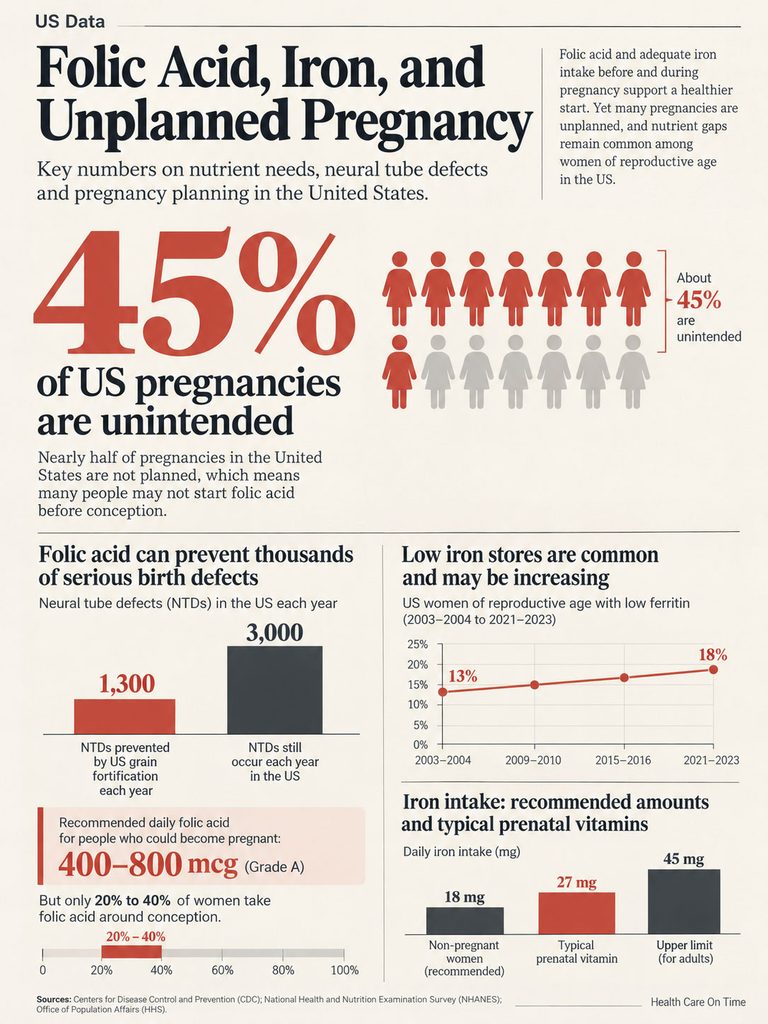
| Statistic | Figure | Source |
| Recommended daily folic acid for people who could become pregnant | 400 to 800 mcg (Grade A) | USPSTF, 2023 |
| Women taking folic acid around conception | About 20% to 40% | USPSTF review of 1998 to 2016 survey data |
| Neural tube defects prevented yearly by US grain fortification | About 1,300 | CDC |
| Neural tube defects still occurring each year in the US | About 3,000 | CDC |
| Low ferritin in US women of reproductive age | About 13% to about 18% (2003-2004 to 2021-2023) | CDC 2026 Nutrition Report |
| Share of US pregnancies that are unintended | 45% | Guttmacher Institute (latest national estimate) |
| Daily iron: non-pregnant women vs. typical prenatal vs. upper limit | 18 mg vs. 27 mg vs. 45 mg | NIH Office of Dietary Supplements |
Two takeaways jump out. Folic acid gaps still cause preventable birth defects every year. And iron deficiency is rising, not falling, among women of childbearing age.
So some women truly benefit from more iron, while others take it for no reason. Testing is the only way to know which group you’re in.
How to Take Prenatal Vitamins the Smart Way
If a prenatal is right for you, a few habits make a real difference.
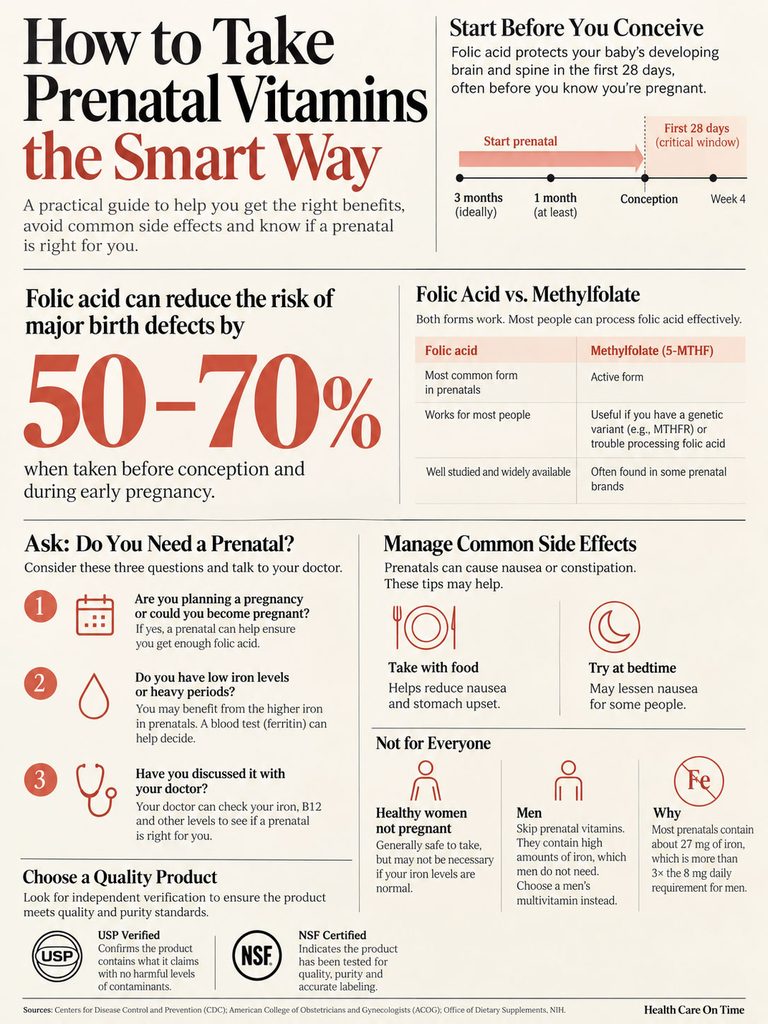
When to Start Before Pregnancy
Start at least one month before you begin trying. Many OB-GYNs suggest three months, which gives folate and iron stores time to build.
If you’re unsure when you’ll try, starting early carries little risk for women of reproductive age with normal iron levels.
Folic Acid vs. Methylfolate
Some prenatals use methylfolate (5-MTHF) instead of folic acid. It’s often marketed to people with an MTHFR gene variant.
The USPSTF recommendation is based on folic acid, and most people with common MTHFR variants process it fine. Methylfolate is a reasonable option, but it isn’t proven better at preventing birth defects.
How to Cut Nausea and Constipation
- Take your prenatal with food, not on an empty stomach.
- Try a bedtime dose if mornings upset your stomach.
- Drink at least 8 cups of water daily and add fiber.
- Ask about gentler iron forms, like iron bisglycinate.
- Avoid taking it with coffee, tea, or calcium-rich foods, which block iron absorption.
Prenatal or Multivitamin: A Quick Way to Decide
Ask yourself three questions:
- Could I get pregnant in the next year?
- Has a blood test shown low iron?
- Am I breastfeeding?
If you answered yes to any of them, a prenatal is a reasonable choice. If you answered no to all three, a standard multivitamin with 400 mcg folic acid is usually the better fit, and often the cheaper one too.
What to Ask Your Doctor
Before making a prenatal a long-term habit, ask for these tests:
- Ferritin and CBC: Shows whether you need extra iron.
- Vitamin B12: Rules out a deficiency that folic acid might hide.
- TSH: Checks thyroid function, which relies on iodine.
- Vitamin D: Many Americans run low, especially in winter.
In tests booked through HealthCareOnTime, a basic panel like this often answers the “do I need a prenatal?” question in a single visit.
Frequently Asked Questions
Can I take prenatal vitamins if I’m not pregnant?
Yes, most healthy women can take prenatal vitamins when not pregnant without harm in the short term. The main benefit is folic acid if pregnancy is possible. If you have no pregnancy plans and normal iron levels, a standard women’s multivitamin usually fits your needs better and carries fewer side effects.
Do prenatal vitamins make your hair grow faster?
Not if your nutrient levels are already normal. Fuller hair during pregnancy comes mainly from high estrogen, not vitamins. If you’re low in iron, vitamin D, or zinc, correcting that may reduce shedding. A ferritin test and a dermatologist visit are better first steps than buying a prenatal for hair.
Is it bad to take prenatal vitamins every day long-term?
For women of reproductive age with normal iron, it’s usually low-risk but often unnecessary. Long-term problems can include constipation, iron buildup, and high folic acid masking low B12. Men, postmenopausal women, and people with hemochromatosis face the highest risk. Ask your doctor to check your iron and B12 yearly.
Can prenatal vitamins cause weight gain?
No, prenatal vitamins have almost no calories and don’t cause fat gain. Some people notice bloating from the iron, which can feel like weight gain. If you feel more energetic after fixing an iron deficiency, your appetite may improve, but the vitamin itself doesn’t add pounds.
Can men take prenatal vitamins?
It isn’t recommended. Men need only 8 mg of iron daily, and most prenatals contain 27 mg, more than three times that amount. Over time, extra iron can build up in organs. Men who want a supplement, including those trying to conceive, should choose a men’s multivitamin instead.
Can I take prenatal vitamins while on birth control?
You can, but most women on reliable birth control don’t need one. Some pills may lower folate, B6, and B12 slightly, and a standard multivitamin with 400 mcg folic acid covers that. If you plan to stop birth control soon, starting a prenatal a few months early is a smart move.
How long before pregnancy should I start prenatal vitamins?
At least one month before trying to conceive, and ideally three months. The neural tube closes about 26 to 28 days after fertilization, often before you know you’re pregnant. Starting early gives your folate stores time to build so protection is in place from the very first day.
Do prenatal vitamins boost fertility?
They don’t directly make you more fertile. Some observational studies, including Harvard’s Nurses’ Health Study II, link regular multivitamin use to fewer ovulation problems. That’s a possible link, not proof. Prenatals mainly prepare your body for a healthy pregnancy once conception happens, which is still a strong reason to take them.
Should I keep taking prenatals after I stop breastfeeding?
Most women can switch to a standard women’s multivitamin after weaning, unless they plan another pregnancy soon. If you’re trying again within a year, staying on your prenatal makes sense. If you had heavy blood loss at delivery, ask your doctor to check your ferritin before making the switch.
Is a prenatal better than a regular multivitamin?
Only if you’re pregnant, trying, breastfeeding, or low in iron. A prenatal isn’t a stronger multivitamin; it’s designed for pregnancy needs. For most non-pregnant adults, a regular multivitamin matches daily needs more closely, with less iron and fewer side effects, often at a lower price too.
Can prenatal vitamins make you nauseous if you’re not pregnant?
Yes. The iron in prenatal vitamins is the most common cause of nausea, especially when taken on an empty stomach. Try taking it with a meal or at bedtime. If nausea continues, ask about a formula with gentler iron, like iron bisglycinate, or a lower-iron multivitamin.
Are prescription prenatals better than over-the-counter ones?
Not necessarily. Prescription prenatals may be covered by insurance and sometimes contain higher folic acid for special cases. Many over-the-counter brands contain similar amounts. The most important thing is choosing a product with a USP Verified or NSF Certified seal, which confirms the label matches the contents.
Disclaimer: This article is for general information only and isn’t medical advice. Supplement needs vary based on age, health conditions, medications, and lab results. Talk to your doctor, OB-GYN, or a registered dietitian before starting or stopping any supplement, especially if you’re pregnant, trying to conceive, breastfeeding, or managing a chronic condition.
References
- U.S. Preventive Services Task Force: Folic Acid Supplementation to Prevent Neural Tube Defects
- CDC: Are Women Getting Enough Folic Acid?
- CDC 2026 Nutrition Report: Iron Factsheet
- NIH Office of Dietary Supplements: Iron Fact Sheet
- NIH Office of Dietary Supplements: Folate Fact Sheet
- NIH Office of Dietary Supplements: Iodine Fact Sheet
- NIDDK: Hemochromatosis
- ACOG: Nutrition During Pregnancy
- Mayo Clinic: Prenatal Vitamins
- Cleveland Clinic: Can You Take Prenatal Vitamins Without Being Pregnant?
- Guttmacher Institute: Unintended Pregnancy in the United States
- FDA: Dietary Supplements