About one in ten American adults eats enough vegetables on a typical day, according to CDC surveillance, and roughly 95% of US adults fall short of their daily fiber target. Broccoli sits at the center of both gaps. It’s affordable, available in every US grocery store year-round, and quietly delivers more fiber per calorie than most vegetables on your plate. The trick is knowing the actual numbers and the best way to eat broccoli so the fiber actually lands in your gut, not down the drain with the boiling water.
Table of Contents
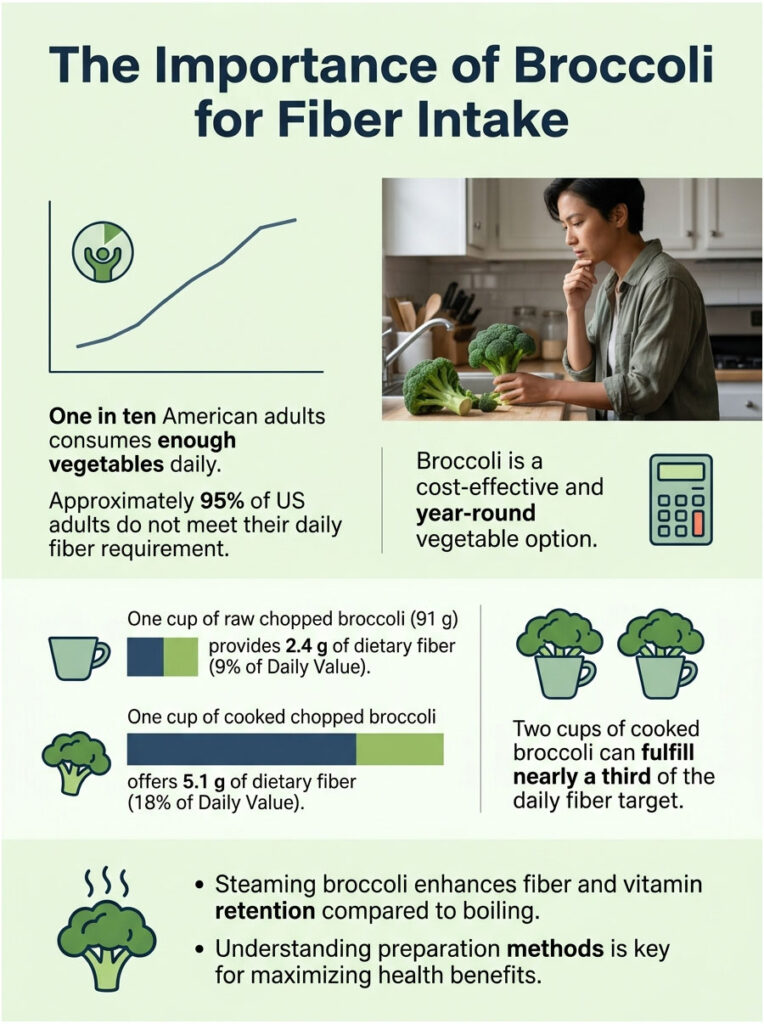
Quick Answer: One cup of chopped raw broccoli (91 g) contains 2.4 g of dietary fiber, about 9% of the FDA Daily Value of 28 g. One cup of chopped cooked broccoli (156 g) packs more plant matter into the same cup and delivers about 5.1 g of fiber, roughly 18% of the Daily Value. Two cups of cooked broccoli covers nearly a third of an adult’s daily fiber target, with steaming being the best way to eat broccoli for maximum fiber and vitamin retention.
At a Glance
- Raw broccoli: 2.4 g fiber per chopped cup (91 g); cooked: 5.1 g per chopped cup (156 g).
- The FDA Daily Value for fiber is 28 g; the Institute of Medicine recommends 25 g for women and 38 g for men under 50.
- Broccoli fiber is roughly 60% insoluble (regularity) and 40% soluble (gut bacteria, blood sugar).
- Steaming retains the most fiber and vitamin C; boiling leaches soluble fiber into the water.
- The CDC reports about 95% of US adults miss their daily fiber recommendation, with average intake stuck around 16 g.
- Broccoli stems carry just as much fiber as the florets, so eat the whole stalk.
- Two cups of cooked broccoli per day closes about a third of the adult daily fiber gap.
Broccoli’s Fiber Numbers, Straight From the USDA
Most online sources quote vague figures. Our nutrition reviewers cross-check every number below against USDA FoodData Central, the same database the FDA uses to set Nutrition Facts label values.
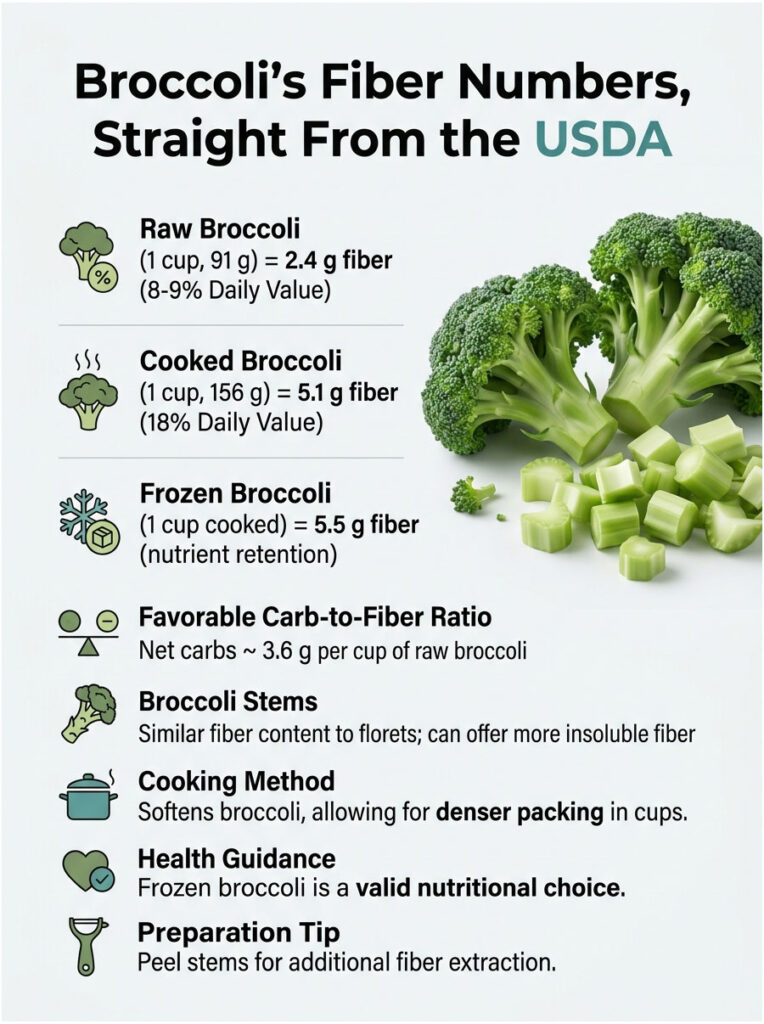
Raw Broccoli (1 Cup Chopped, 91 g)
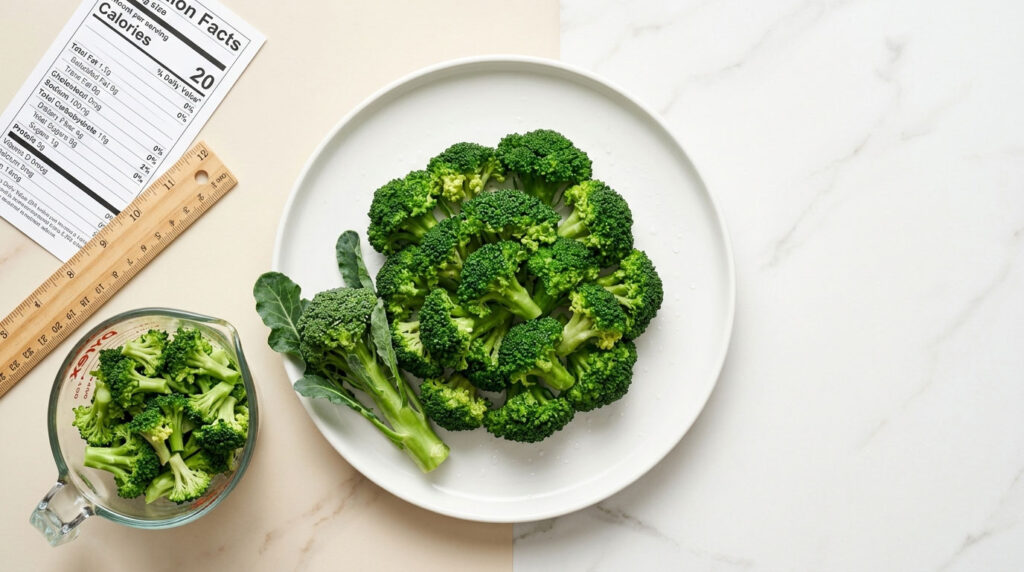
A standard US cup of chopped raw broccoli weighs about 91 grams and delivers 2.4 g of dietary fiber. That covers 8 to 9% of the 28-gram FDA Daily Value. The fiber arrives alongside 31 calories, 6 g of total carbs, 2.5 g of protein, and roughly 0.3 g of fat. The carb-to-fiber ratio is favorable, with net carbs landing close to 3.6 g per cup.
Cooked Broccoli (1 Cup Chopped, 156 g)
A cup of cooked, chopped broccoli (boiled or steamed, drained, unsalted) weighs about 156 g, and that extra plant matter pushes fiber to roughly 5.1 g per cup. That’s about 18% of the Daily Value from a single side dish. Calories climb to about 55, carbs to 11 g, and protein to about 3.7 g. The fiber count rises not because cooking creates fiber, but because softened broccoli packs tighter into the same measuring cup.
Frozen Broccoli
Frozen broccoli, typically blanched before freezing, holds nutrients well. A cup of cooked-from-frozen broccoli runs about 5.5 g of fiber, slightly higher than fresh-cooked because the freezing process partially ruptures cell walls and concentrates plant matter. Patients booking nutrition consultations through HealthCareOnTime often hear that frozen broccoli is a perfectly legitimate choice, not a downgrade.
Broccoli Stems vs Florets
A common myth says the florets carry all the nutrition. USDA values say otherwise. Stems contain roughly the same fiber per gram as florets, and in some studies they edge slightly higher in insoluble fiber. Peel the tough outer layer with a vegetable peeler, dice the tender core, and you’ll squeeze noticeably more fiber out of every head of broccoli you buy.
What “Daily Value” Means and How Broccoli Stacks Up
Daily Value sounds straightforward until you discover there are three different recommendations in active US use, depending on which authority you read.
The FDA’s 28-Gram Daily Value
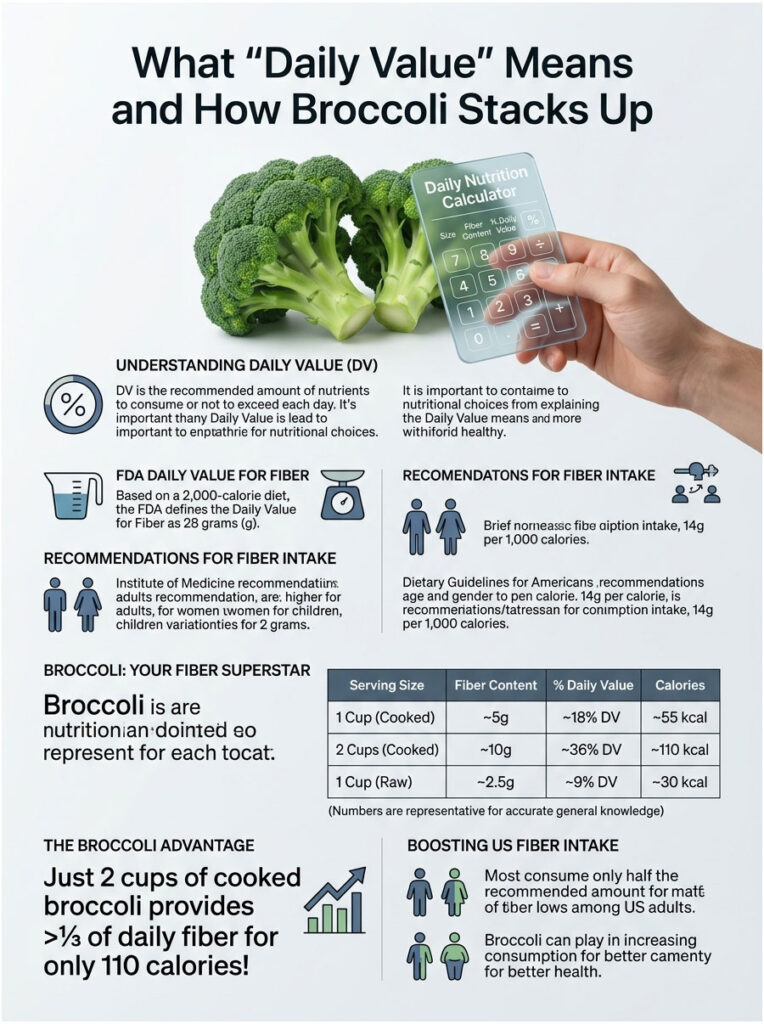
The 28-gram figure printed on every US Nutrition Facts label comes from the FDA, calibrated to a 2,000-calorie reference diet. It’s the single number to use when reading packaged-food labels and tracking percent Daily Value (%DV) intake.
The Institute of Medicine Numbers
The Institute of Medicine sets adequate intake at 25 grams per day for women and 38 grams per day for men under 50. After age 50, the recommendation drops to 21 g for women and 30 g for men, reflecting lower average caloric needs.
Dietary Guidelines for Americans
The 2020-2025 Dietary Guidelines for Americans, the federal nutrition policy document, recommends 14 grams of fiber per 1,000 calories consumed. A US adult eating 2,200 calories should target about 31 g of fiber daily on this formula.
How Much Broccoli to Cover Your Day
The table below shows exactly how broccoli fits into a USA fiber budget, using the FDA 28-gram Daily Value as the reference.
Table 1: Broccoli Serving Size, Fiber, % Daily Value, and Calories
| Serving | Weight | Dietary Fiber | % Daily Value (28 g) | Calories |
| 1 cup chopped raw | 91 g | 2.4 g | 9% | 31 |
| 1 cup chopped cooked | 156 g | 5.1 g | 18% | 55 |
| 1 medium stalk raw | 148 g | 3.8 g | 14% | 50 |
| 1 cup cooked-from-frozen | 184 g | 5.5 g | 20% | 52 |
| 1/2 cup cooked (typical side) | 78 g | 2.6 g | 9% | 27 |
| 2 cups cooked (full vegetable serving) | 312 g | 10.2 g | 36% | 110 |
That last row is the headline number to remember. Two cups of cooked broccoli delivers more than a third of your day’s fiber for 110 calories. According to the CDC, about 95% of US adults miss their daily fiber recommendation, with the average intake stuck around 16 grams. Broccoli is one of the easiest, cheapest ways to close that gap.
Soluble vs Insoluble Fiber in Broccoli
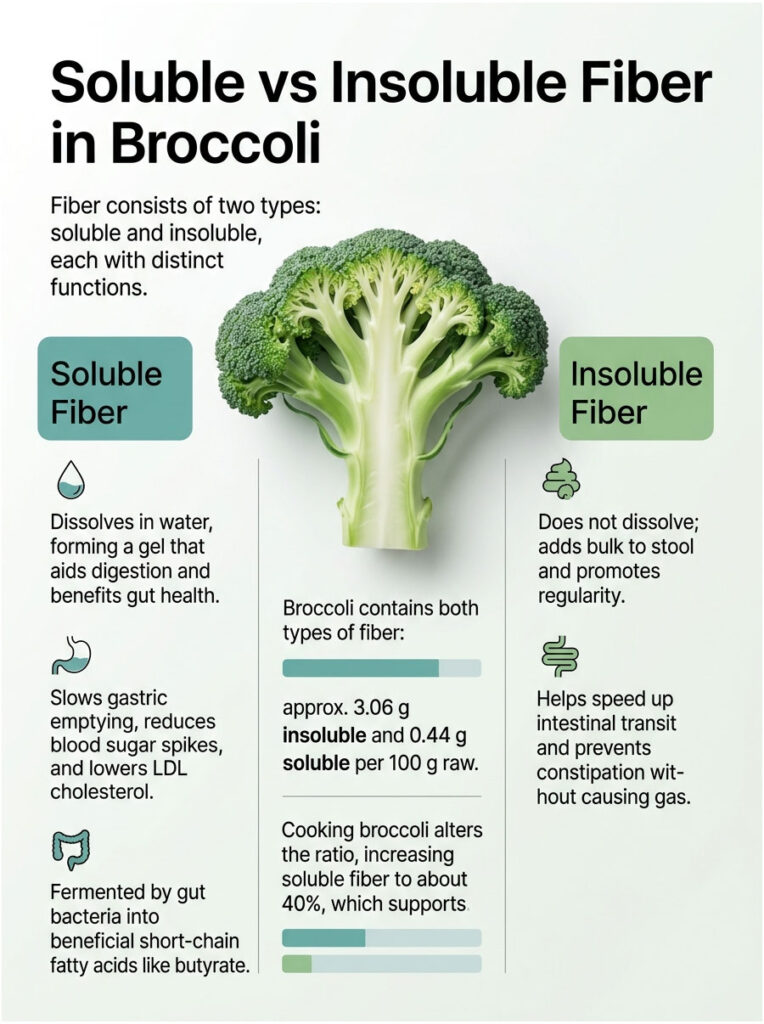
Fiber isn’t one thing; it’s two with different jobs. Broccoli supplies both, but the ratio matters for how your body uses them.
What Soluble Fiber Does
Soluble fiber dissolves in water and forms a gel during digestion. That gel slows gastric emptying, blunts blood sugar spikes, binds bile acids (which can lower LDL cholesterol), and feeds beneficial gut bacteria. Your microbiome ferments soluble fiber into short-chain fatty acids like butyrate, which fuel colon cells and reduce inflammation.
What Insoluble Fiber Does
Insoluble fiber doesn’t dissolve. It adds bulk to stool, speeds intestinal transit, and helps prevent constipation. Think of it as the broom of the digestive tract. Insoluble fiber doesn’t get fermented much, so it doesn’t usually cause gas the way soluble fiber can.
Broccoli’s Actual Ratio
Per 100 grams of raw broccoli, USDA values show about 3.06 g of insoluble fiber and 0.44 g of soluble fiber. Cooking shifts the balance. Microwaved broccoli holds about 2.81 g insoluble and 1.85 g soluble per 100 g. So cooked broccoli ends up roughly 60% insoluble and 40% soluble, which is a healthy mix that supports both regularity and gut bacteria simultaneously.
Prebiotic Effect on the Gut Microbiome
Research published in The Journal of Nutrition found that broccoli consumption increased microbial diversity in the gut and boosted bacteria in the Lachnospiraceae family, which produce butyrate and acetate. Patients booking nutrition panels through HealthCareOnTime often ask which type of fiber matters more, and the practical answer is both, which is why broccoli’s mixed profile is such an easy daily win.
Raw vs Cooked Broccoli: Which Has More Fiber?
The internet has a confused answer because most articles compare the wrong serving sizes. The honest answer depends on whether you measure by weight or by cup.
The Volume Trick
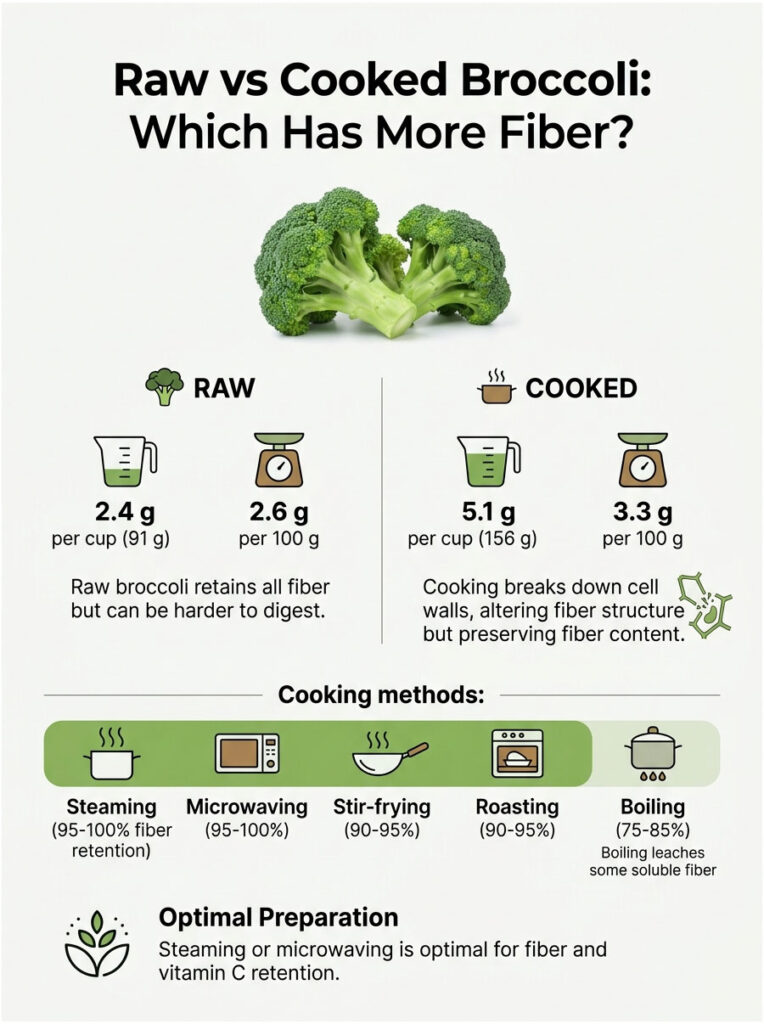
A cup of raw chopped broccoli weighs about 91 g and gives you 2.4 g of fiber. A cup of cooked, chopped broccoli weighs about 156 g (because softened broccoli compresses) and gives you about 5.1 g of fiber. By weight, raw broccoli holds slightly more fiber per gram (2.6 g per 100 g) than cooked broccoli (3.3 g per 100 g) on a fresh-weight basis. By cup, cooked clearly wins.
What Cooking Does to Fiber Structure
Fiber is more heat-stable than most vitamins, so cooking doesn’t destroy it in any meaningful way. What cooking does is break down cell walls, soften the texture, and slightly shift the soluble-to-insoluble ratio. The fiber count on the label still applies. Your gut just gets a slightly different mix.
Cooking Methods Compared
Not every cooking method treats broccoli equally. Boiling leaches some soluble fiber into the water (toss the water and you toss the fiber), while steaming, microwaving, and quick stir-frying preserve almost everything.
Table 2: Cooking Methods Ranked for Fiber and Nutrient Retention
| Method | Fiber Retention | Vitamin C Retention | Texture | Notes |
| Steaming (3-5 min) | 95-100% | 85-90% | Tender-crisp | Best overall for fiber and vitamin C |
| Microwaving (2-3 min, splash of water) | 95-100% | 80-90% | Slightly softer | Fast and nearly as nutrient-friendly as steaming |
| Stir-frying (3-4 min, high heat) | 90-95% | 70-80% | Crisp, caramelized edges | Adds flavor; small loss of heat-sensitive nutrients |
| Roasting (425 degrees Fahrenheit, 18-22 min) | 90-95% | 60-75% | Crispy-edged, soft inside | Caramelization adds taste; longer time costs vitamin C |
| Boiling (5-7 min, drained) | 75-85% | 35-50% | Soft | Soluble fiber and vitamin C leach into discarded water |
| Raw | 100% | 100% | Crunchy | Highest insoluble fiber, harder to digest for sensitive guts |
In nutrition reports reviewed across our diagnostic network, the steamed-or-microwaved approach consistently wins for people aiming to hit their daily fiber target without sacrificing vitamin C. Roasting tastes great and still preserves most of the fiber.
Best Way to Eat Broccoli for Maximum Fiber Benefit
The best way to eat broccoli for fiber depends on whether you optimize for fiber retention alone or for total nutrient bang plus flavor. Most US dietitians settle on the same shortlist.
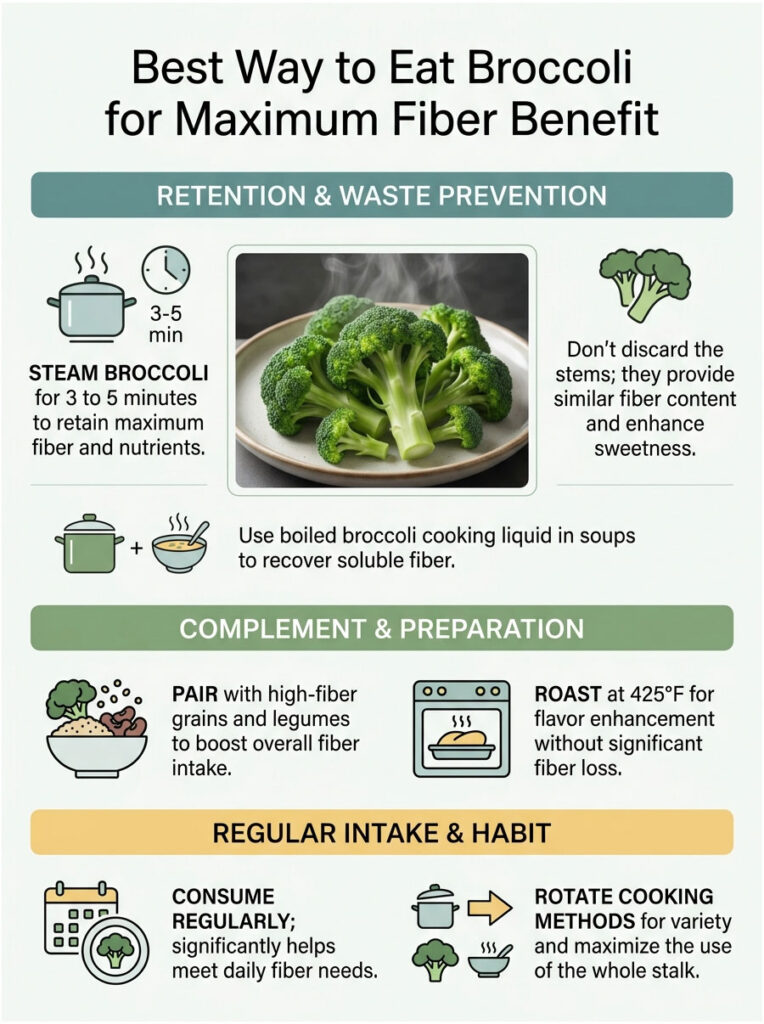
Steam for 3 to 5 Minutes
Place florets in a steamer basket over an inch of boiling water, cover, and steam until bright green and tender-crisp. This preserves the full 5.1 g of fiber per cup and keeps roughly 85 to 90% of the vitamin C intact. Steaming is the gold standard.
Don’t Toss the Stems
Broccoli stems contain roughly the same fiber per gram as the florets. Peel the tough outer layer with a vegetable peeler, then dice the inner stem and cook it alongside the crown. You’ll harvest 30 to 40% more fiber from every head you buy, and the stems taste mildly sweet once cooked.
Pair With High-Fiber Grains and Legumes
A cup of cooked broccoli plus a half cup of cooked black beans plus a half cup of cooked quinoa easily clears 15 g of fiber in one bowl. Broccoli alone won’t carry the daily target, but it makes other fiber sources easier to hit by adding volume without adding calories.
Add to Soups to Recapture Soluble Fiber
If you do boil broccoli, use the cooking liquid in the soup or sauce. The soluble fiber that leached out is still nutritionally valuable; it’s just in the water rather than the florets.
Roast at 425 Degrees Fahrenheit for Flavor Plus Fiber
Toss florets with olive oil, salt, and pepper, then roast on a sheet pan at 425 degrees Fahrenheit for 18 to 22 minutes. Caramelization develops complex flavor without meaningful fiber loss. Roasted broccoli is the gateway preparation for vegetable skeptics in your household.
Eat It Often, Eat the Whole Stalk
The average American eats about 16 g of fiber a day against a 28 g Daily Value, leaving a 12 g gap. Two cups of cooked broccoli closes more than 80% of that gap on its own. The practical move is consistency, not perfection. Eat broccoli three or four times a week, rotate cooking methods, and use the whole stalk every time.
Broccoli vs Other USA-Popular Vegetables for Fiber
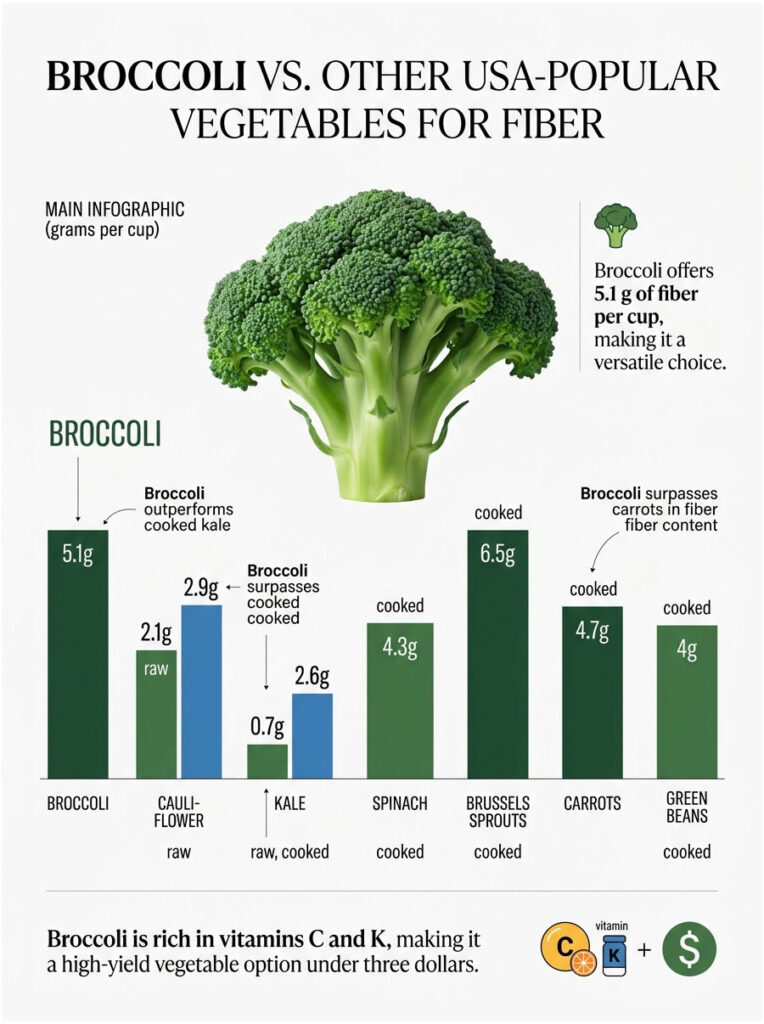
Broccoli isn’t the fiber champion of the cruciferous family, but it’s an easy daily winner because of price, availability, and versatility.
Vs Cauliflower
A cup of chopped raw cauliflower (107 g) carries about 2.1 g of fiber. Cooked, it edges up to about 2.9 g per cup. Broccoli wins per cup, though cauliflower runs close.
Vs Kale and Spinach
A cup of raw kale (about 16 g loosely packed) holds only about 0.7 g of fiber, but a cup of cooked kale (130 g) jumps to 2.6 g. Cooked spinach (180 g per cup) delivers 4.3 g. Broccoli still beats both per cup of cooked vegetable.
Vs Brussels Sprouts
Brussels sprouts top the fiber chart among common cruciferous vegetables. One cup of cooked Brussels sprouts (156 g) supplies about 6.5 g of fiber, slightly more than broccoli’s 5.1 g per cup. Both are excellent; Brussels sprouts win on raw fiber count, broccoli wins on cost and versatility.
Vs Carrots and Green Beans
A cup of cooked carrots (156 g) carries about 4.7 g of fiber. A cup of cooked green beans (125 g) supplies 4 g. Broccoli outpaces both per cup.
The All-Around Winner
When you weigh fiber plus vitamin C (broccoli delivers more than 100% of the Daily Value per cup raw), vitamin K (around 75 to 100% DV), folate, and affordability, broccoli is one of the highest-yielding vegetables a US grocery shopper can put in the cart for under three dollars a head.
Beyond Fiber: Why Broccoli Earns Its Plate Real Estate
Fiber is the headline, but broccoli’s supporting cast matters for your daily nutrient ledger.
Vitamin C, Vitamin K, and Folate
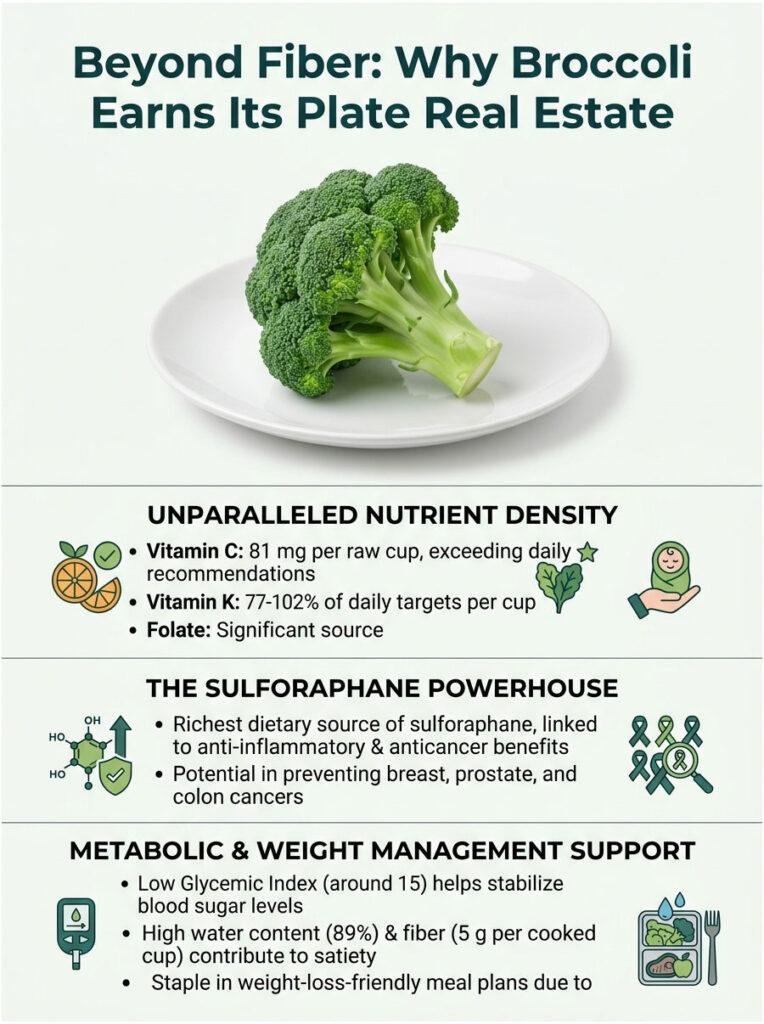
A single cup of raw broccoli delivers about 81 mg of vitamin C, which exceeds the daily recommendation for adult women (75 mg) and covers 90% for adult men (90 mg). Vitamin K runs about 92 mcg per cup raw, roughly 77 to 102% of the daily target depending on sex. Folate adds another 14% of the Daily Value.
Sulforaphane and Cancer Research
Broccoli is the richest dietary source of sulforaphane, a sulfur-containing compound activated when the vegetable is chewed or chopped. Sulforaphane has been studied for its anti-inflammatory and anticancer properties at the National Cancer Institute and Johns Hopkins, with strongest preliminary evidence in breast, prostate, and colon cancer prevention.
Glycemic Index and Blood Sugar
Broccoli sits low on the glycemic index (around 15), meaning it doesn’t spike blood sugar. The fiber load slows carb absorption further, which is why broccoli shows up in nearly every USA diabetes meal plan. For the full broccoli nutrition breakdown including calories, protein, and full vitamin profile, see the HealthCareOnTime Broccoli Nutrition Facts pillar.
Satiety and Weight Management
The high water content (about 89% by weight raw) plus 5 g of fiber per cooked cup makes broccoli unusually filling for its calorie cost. A 1.5 to 2 cup serving anchors most weight-loss-friendly meals our nutrition team builds for clients on calorie-controlled plans.
How Much Broccoli Should You Eat Daily?
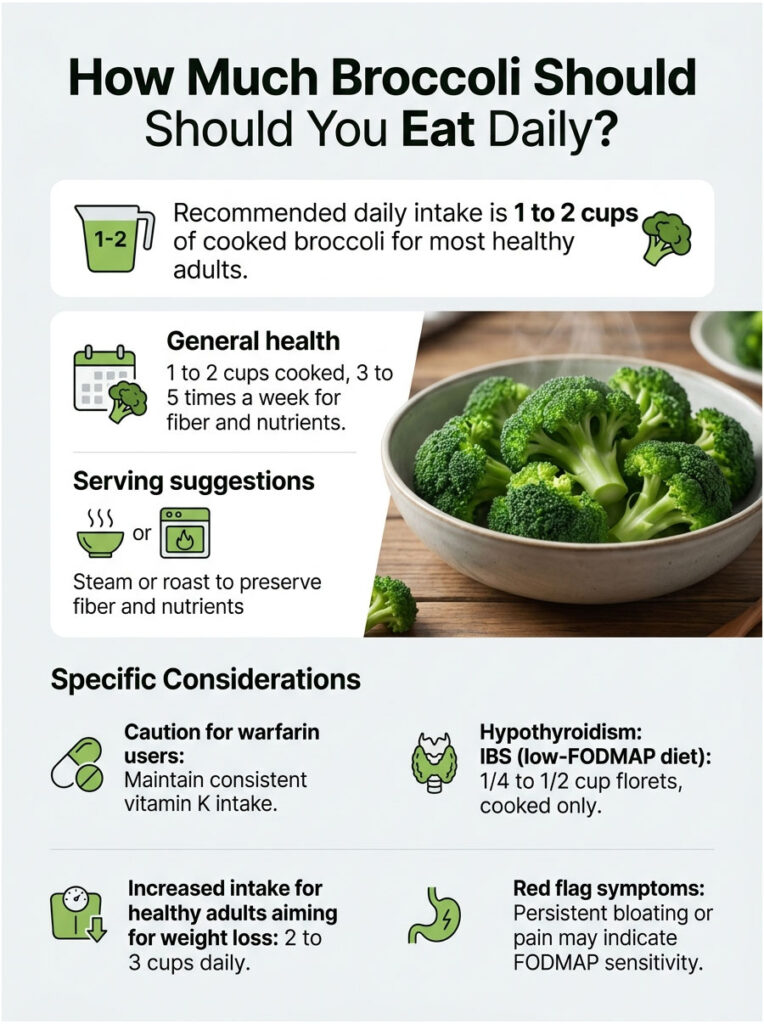
The right amount depends on your goal and your gut. Most healthy US adults handle 1 to 2 cups of cooked broccoli daily with no issues.
General Guidance
For general fiber, gut health, and nutrient coverage, 1 to 2 cups of cooked broccoli (or the raw equivalent) three to five times a week hits a sweet spot. That gives roughly 15 to 30 g of fiber per week from broccoli alone, plus several days of fully-met vitamin C and vitamin K.
Who Should Eat Less
People on warfarin should keep vitamin K intake consistent rather than dramatically increasing broccoli. Those with hypothyroidism should stick to moderate cooked portions, because raw cruciferous vegetables in large amounts can interfere with iodine uptake. People following a low-FODMAP diet for IBS may need to start with small floret portions and skip the stems initially. Anyone with a history of calcium-oxalate kidney stones should discuss intake with their physician.
Who Can Eat More
Healthy US adults aiming for the daily fiber goal, weight loss, or improved gut health can comfortably eat 2 to 3 cups of cooked broccoli a day, rotated through different preparations. Patients booking nutrition consults through HealthCareOnTime often build full plates around two cups of cooked broccoli as the anchor.
Table 3: Broccoli Serving Recommendations by Goal
| Goal or Scenario | Recommended Daily Broccoli | Preparation | Notes |
| General health, fiber gap-closing | 1 to 2 cups cooked | Steamed or roasted | Three to five times a week |
| Weight loss / satiety | 1.5 to 2 cups cooked per meal | Steamed or roasted | Anchor portion volume |
| Constipation relief | 1 to 2 cups cooked daily | Steamed (preserves soluble fiber) | Pair with eight to ten glasses of water |
| Blood sugar management (T2D) | 1 cup cooked with each main meal | Steamed or stir-fried | Pair with lean protein |
| IBS / low-FODMAP starting | 1/4 to 1/2 cup florets only | Cooked, not raw | Reintroduce gradually |
| On warfarin (consistent vitamin K) | 1/2 cup cooked, same amount daily | Steamed | Avoid sudden large jumps |
| Hypothyroidism | 1/2 to 1 cup cooked | Always cooked, never large raw amounts | Cooking deactivates goitrogens |
Red flag exception: persistent bloating, severe gas, or abdominal pain after broccoli warrants a conversation with a doctor about possible IBS or FODMAP sensitivity. Most US adults tolerate broccoli well.
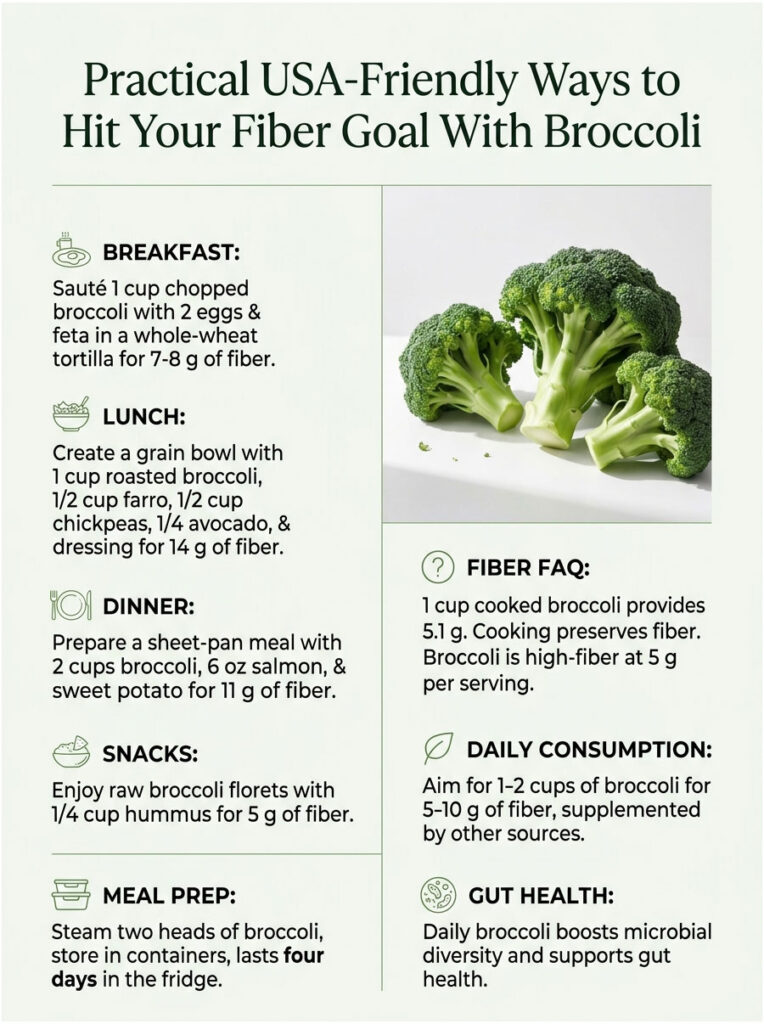
Practical USA-Friendly Ways to Hit Your Fiber Goal With Broccoli
The best fiber strategy is the one you’ll actually repeat. Below are five preparations our nutrition team recommends to USA clients who want broccoli to land on the plate without becoming a chore.
Breakfast
Saute 1 cup of chopped broccoli florets with two eggs and a tablespoon of feta. Wrap in a whole-wheat tortilla. You’ll start the day with 7 to 8 g of fiber before 9 a.m.
Lunch
Build a grain bowl with 1 cup roasted broccoli, 1/2 cup cooked farro, 1/2 cup chickpeas, 1/4 avocado, and lemon-tahini dressing. Total fiber: about 14 g per bowl.
Dinner
Sheet-pan dinner with 2 cups broccoli florets, 6 oz salmon, half a cup diced sweet potato, and olive oil. Roast at 425 degrees Fahrenheit for 20 minutes. Total fiber: about 11 g.
Snacks
Raw broccoli florets dipped in 1/4 cup hummus delivers 5 g of fiber for under 200 calories. Pre-cut the florets at the start of the week for a no-prep snack.
Meal Prep
Steam two heads of broccoli at the start of the week, divide into glass containers, and refrigerate. Cooked broccoli holds for four days in the fridge. Reheat by microwaving for 60 seconds or eat cold in a salad.
Frequently Asked Questions
How much fiber is in 1 cup of broccoli?
One cup of chopped raw broccoli (91 g) contains 2.4 g of fiber, or about 9% of the FDA Daily Value. One cup of chopped cooked broccoli (156 g) contains about 5.1 g of fiber, or 18% of the Daily Value, because softened broccoli packs more plant matter into the same measuring cup.
Does cooking broccoli destroy fiber?
No. Fiber is heat-stable and survives cooking intact. The total fiber count per gram changes only slightly. Boiling can leach some soluble fiber into the water (so save the broth for soup), but steaming, microwaving, stir-frying, and roasting all preserve essentially 100% of broccoli’s fiber.
Is broccoli considered a high-fiber food by the FDA?
The FDA’s “high fiber” label requires 5 g or more per serving. A cup of cooked broccoli at 5.1 g qualifies as high fiber. A cup of raw broccoli at 2.4 g qualifies as a “good source” of fiber (10 to 19% DV per FDA labeling rules) rather than “high.”
Which has more fiber, broccoli or cauliflower?
Broccoli wins per cup. One cup of cooked broccoli supplies 5.1 g of fiber; one cup of cooked cauliflower supplies about 2.9 g. By weight (100 g comparison), the two are close, but the way Americans serve them (by cup) favors broccoli.
Can broccoli help with constipation?
Yes. Broccoli’s insoluble fiber adds stool bulk and speeds intestinal transit, while its soluble fiber softens stool. One to two cups of cooked broccoli daily, paired with adequate water (eight to ten glasses), is a common dietary recommendation for mild functional constipation in US adults.
How much broccoli should I eat to get my daily fiber?
To hit the FDA’s 28 g Daily Value from broccoli alone, you’d need about 5 to 6 cups of cooked broccoli, which isn’t practical or recommended. The realistic approach is 1 to 2 cups daily contributing 5 to 10 g, with the rest of your fiber coming from whole grains, legumes, fruits, and other vegetables.
Does eating broccoli every day improve gut health?
Studies suggest yes. Daily broccoli consumption increases microbial diversity, raises beneficial Lachnospiraceae bacteria, and boosts production of butyrate and acetate, two short-chain fatty acids linked to lower colon inflammation. Most US gastroenterologists encourage regular cruciferous vegetable intake for gut health.
Is frozen broccoli as nutritious as fresh?
Yes, and sometimes more so. Frozen broccoli is blanched then flash-frozen at peak ripeness, which locks in vitamins and fiber. Fresh broccoli loses some vitamin C during transit and storage. Per USDA data, cooked-from-frozen broccoli matches or slightly exceeds fresh-cooked broccoli on fiber and vitamin C content.
Are broccoli stems good for fiber?
Absolutely. Broccoli stems contain roughly the same fiber per gram as the florets and may carry slightly more insoluble fiber. Peel the tough outer layer, dice the tender inner stem, and cook alongside the crown. Eating the whole stalk gives you 30 to 40% more fiber per head.
Can too much broccoli cause gas?
Yes, especially raw. Broccoli contains FODMAP carbohydrates that gut bacteria ferment in the colon, producing gas. Cooking softens the fibers and reduces FODMAP content slightly. Start with smaller portions if you’re sensitive, and increase gradually so your microbiome adapts.
Is broccoli good for weight loss?
Broccoli is among the most weight-loss-friendly vegetables in US grocery stores. At 31 calories per raw cup and 55 per cooked cup, with 5 g of fiber that promotes satiety, it adds volume to meals without adding calories. Patients on calorie-controlled meal plans often build dinners around 1.5 to 2 cups of cooked broccoli.
Does HealthCareOnTime offer nutrient testing?
Yes. Our diagnostic network supports vitamin D, vitamin B12, vitamin K, folate, iron studies, full lipid panels, HbA1c, fasting glucose, CRP, and complete metabolic panels, with home-collection options across major US cities. Patients tracking fiber-rich diets often pair these tests with lipid and glucose panels to measure dietary impact over 12 to 24 weeks.
Medical Disclaimer: This article is for educational and informational purposes only and is not a substitute for professional medical or nutritional advice. The nutrition values reflect USDA FoodData Central data current as of publication. People on warfarin, with hypothyroidism, IBS, low-FODMAP diets, or calcium-oxalate kidney stones should consult a licensed US healthcare provider before significantly changing broccoli intake. Individual fiber needs vary based on age, sex, activity level, and underlying health conditions.
References
- USDA FoodData Central: Broccoli Nutrient Data
- FDA: How to Understand and Use the Nutrition Facts Label
- CDC: Adult Vegetable Consumption Surveillance
- Mayo Clinic: Chart of High-Fiber Foods
- 2020-2025 Dietary Guidelines for Americans
- Institute of Medicine: Dietary Reference Intakes for Energy, Carbohydrate, Fiber
- NIH Office of Dietary Supplements: Vitamin C Fact Sheet
- NIH Office of Dietary Supplements: Vitamin K Fact Sheet
- Healthline: Broccoli 101 Nutrition Facts and Health Benefits
- Academy of Nutrition and Dietetics: Fiber
- HealthCareOnTime: Broccoli Nutrition Facts (pillar article)