Two fruits sit in your kitchen bowl. One red, one yellow. You grab one for your morning snack and log it in your tracking app. But did you pick the smarter fruit for the goal you actually have?
Table of Contents
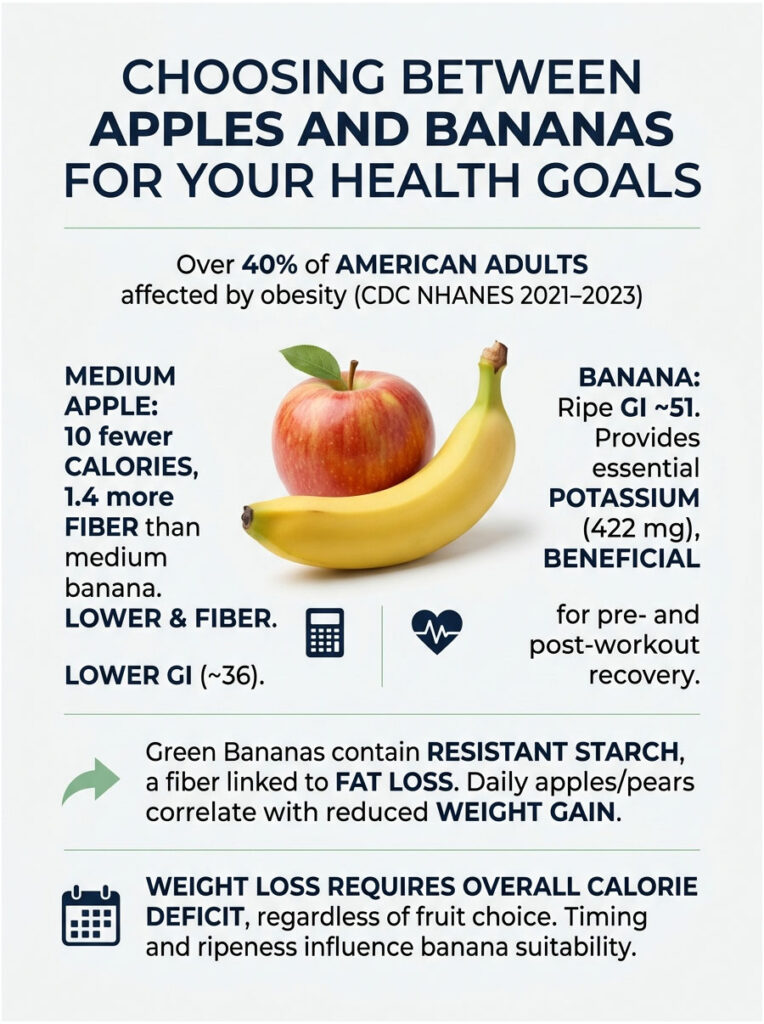
Quick Answer: Apples have a slight edge for weight loss. A medium apple holds 95 calories and 4.4 grams of fiber. A medium banana holds 105 calories and 3 grams of fiber, plus a higher glycemic load. Bananas still earn a spot on your plate around workouts. Your goal, timing, and the banana’s ripeness decide the winner.
At a Glance
• A medium apple has roughly 10 fewer calories and 1.4 more grams of fiber than a medium banana
• Apples score lower on the glycemic index (around 36) than ripe bananas (around 51)
• Green bananas pack resistant starch, a digestion-resistant fiber linked to fat loss
• Harvard’s 24-year US cohort tied each daily apple or pear serving to 1.24 fewer pounds gained over four years
• Bananas win pre-workout fuel and post-exercise recovery thanks to 422 mg of potassium
• More than 4 in 10 American adults now live with obesity (CDC NHANES 2021-2023)
• Neither fruit produces weight loss without an overall calorie deficit
The Calorie and Macronutrient Showdown
Weight loss starts with math. Before pectin and resistant starch enter the conversation, let’s put both fruits on the scale and see what they actually deliver.
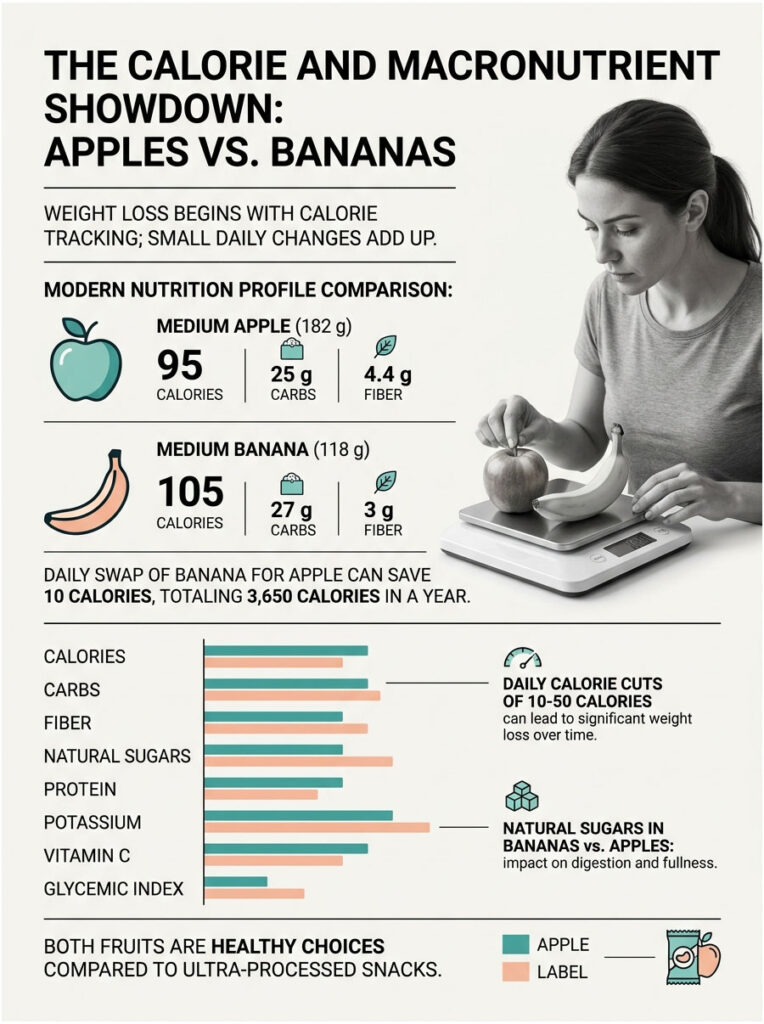
A medium apple weighs about 182 grams, roughly the size of a tennis ball. It carries 95 calories, 25 grams of carbs, and 4.4 grams of fiber, per USDA FoodData Central. A medium banana weighs about 118 grams and brings 105 calories, 27 grams of carbs, and 3 grams of fiber, per Harvard’s Nutrition Source.
Ten calories sounds trivial. Swap a banana for an apple every day for a year, though, and you’ve cut 3,650 calories. That’s about one pound of body fat with zero willpower. Our medical reviewers note that the patients who hit their goal weight rarely do anything heroic; they shave 50 to 150 calories daily and stay consistent.
Side-by-Side Nutrition Profile
Table 1: Medium Apple vs Medium Banana Nutrition (per fruit, USDA data)
| Nutrient | Medium Apple (182 g) | Medium Banana (118 g) | DV % (Apple) | DV % (Banana) | Edge |
| Calories | 95 | 105 | 5% | 5% | Apple |
| Total Carbs | 25 g | 27 g | 9% | 10% | Apple |
| Fiber | 4.4 g | 3.1 g | 16% | 11% | Apple |
| Natural Sugars | 19 g | 14.4 g | — | — | Banana |
| Protein | 0.5 g | 1.3 g | 1% | 3% | Banana |
| Potassium | 195 mg | 422 mg | 4% | 9% | Banana |
| Vitamin C | 8.4 mg | 10.3 mg | 9% | 11% | Banana |
| Glycemic Index | 36 (low) | 51 (low-medium) | — | — | Apple |
Both fruits clear well under 5% of the Food and Drug Administration’s 2,000-calorie reference. Neither will wreck your day. The real question is which one keeps you full longer per calorie spent.
Why 10 Calories a Day Actually Matters
You’ve probably heard “a calorie is a calorie.” That holds true on a thermodynamic chalkboard. In real life, foods behave very differently, and small daily gaps compound faster than people expect.
Take a 175-pound American adult chasing a 20-pound goal. A 10-calorie daily cut removes one pound across a year. A 50-calorie cut (the gap between a small apple and a large banana) removes five. The math is unglamorous and consistent.
What “Natural Sugar” Really Means on a Weight-Loss Plate
Bananas carry more sugar per fruit than apples. That sugar arrives bundled with fiber, water, and resistant starch, all of which slow absorption. You won’t get the spike-and-crash you’d get from soda.
Apples carry slightly less sugar, most of it tucked behind a pectin gel. That gel forms in your stomach within minutes and acts like a speed bump for digestion. Both fruits beat ultra-processed snacks. The question is which beats the other.
Fiber, Pectin, and Resistant Starch (The Satiety Story)
If you remember one nutrient from this article, make it fiber. Fiber predicts satiety better than calorie count alone, and the type of fiber matters more than the gram total.
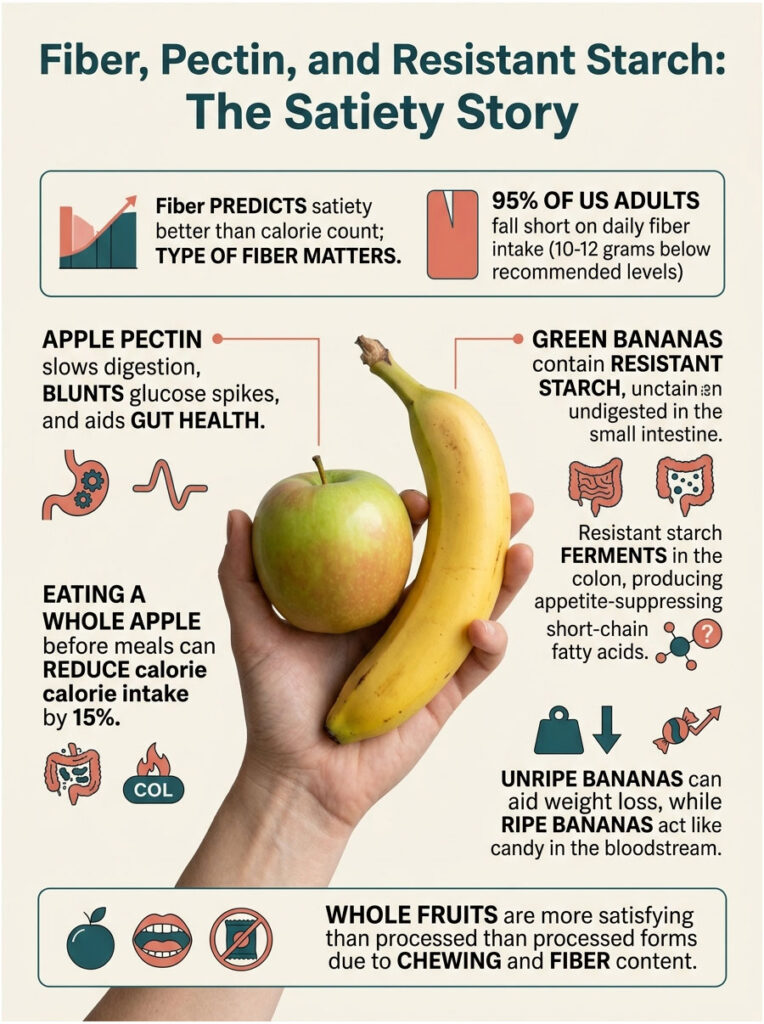
The CDC NHANES data shows that 95% of US adults fall short on daily fiber. The American gap averages 10 to 12 grams below the 25 to 38 gram target set by the Academy of Nutrition and Dietetics. That shortfall shows up as cravings, snack creep, and gradual weight gain.
How Apple Pectin Slows Digestion
Apples contain pectin, a soluble fiber that swells into a gel inside your gut. The gel slows stomach emptying, blunts glucose spikes, and feeds beneficial bacteria in your colon.
Harvard’s Nutrition Source credits pectin with modest LDL cholesterol reduction and short-chain fatty acid production that supports bowel health. For weight loss, the practical payoff is simpler. You stay satisfied longer after an apple than after a calorie-matched processed snack.
Our medical team has reviewed dozens of pre-meal apple studies. The pattern repeats. People who eat a whole apple 15 minutes before lunch consume fewer calories at lunch without feeling deprived.
Resistant Starch in Green Bananas (The Hidden Weight-Loss Tool)
Here’s what most weight-loss articles miss. A green banana is not the same food as a brown-spotted one. Green bananas contain up to 80% of their dry weight as resistant starch, which your small intestine cannot digest.
That starch travels intact to your colon. There, gut bacteria ferment it into short-chain fatty acids like butyrate. These compounds suppress appetite hormones, improve insulin sensitivity, and may shrink visceral fat. A six-month randomized trial published in the British Journal of Nutrition (Costa et al., 2019) showed that daily green banana biomass consumption produced measurable reductions in body weight, BMI, and HbA1c in adults with prediabetes or type 2 diabetes.
As bananas ripen, that resistant starch converts to simple sugars. A black-spotted banana behaves more like candy in your bloodstream. A green-tipped one acts like a slow-release fiber capsule. Patients booking glucose panels through HealthCareOnTime often ask whether ripeness really matters. It does, and a lot.
The Whole-Apple Effect (What the Appetite Journal Found)
A Penn State study by Flood-Obbagy and Rolls, published in Appetite (2009), compared 58 adults across five conditions. Subjects consumed apple segments, applesauce, apple juice with fiber, apple juice without fiber, or no preload, then ate lunch 15 minutes later.
The whole-apple group consumed 187 fewer total calories (preload plus lunch) than the no-preload control, a 15% reduction. Fullness ratings followed the same hierarchy: apple beat applesauce, which beat juice. Same fruit, three forms, three different outcomes. The whole-apple advantage came from chewing time, satiety signaling, and intact fiber.
The lesson scales. Whole fruit beats processed fruit. Crunching an apple takes minutes. Sipping juice takes seconds. Your hormones need that gap to register “full.”
Glycemic Index, Blood Sugar, and Hunger Spikes
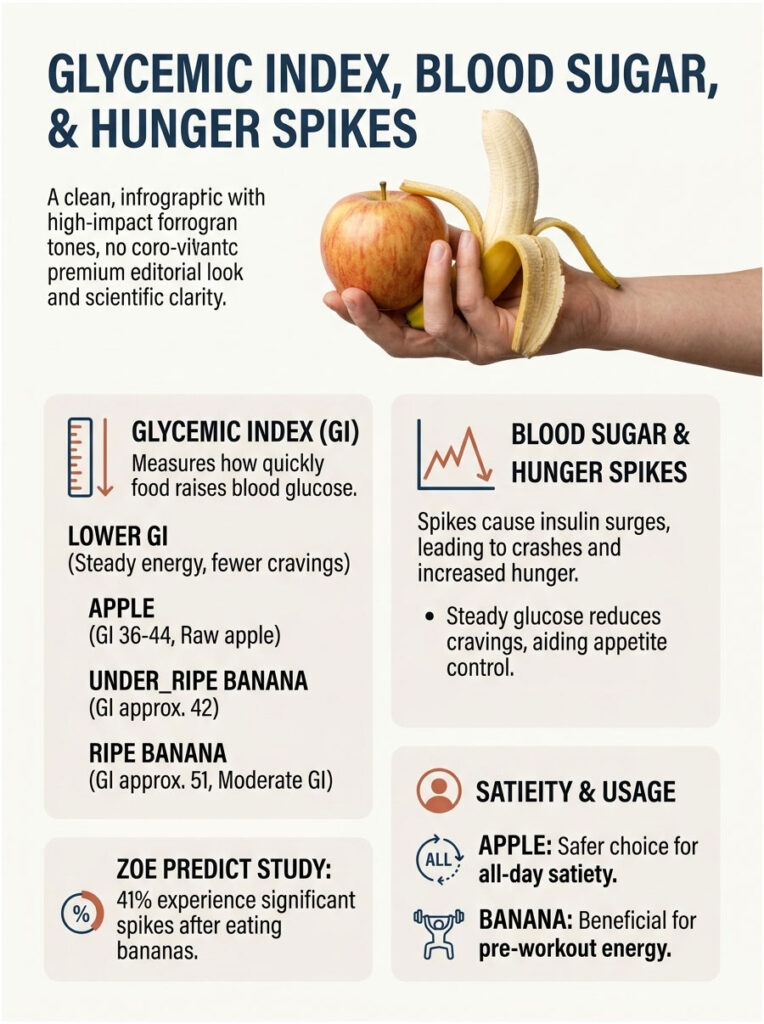
Blood sugar control sits at the center of every successful weight-loss plan. The glycemic index (GI) measures how fast a food raises blood glucose on a 0 to 100 scale. Lower numbers mean steadier energy and fewer cravings.
A raw apple scores 36 to 44, firmly in the low-GI zone. A ripe banana scores around 51, which is low-medium. A slightly underripe banana drops to about 42. A fully green banana scores around 30.
Why Blood Sugar Swings Sabotage Weight Loss
When blood glucose spikes hard, your pancreas releases a flood of insulin. That insulin pulls sugar out of the bloodstream into cells, often overshooting. You crash, get hungry again, and reach for another snack within 90 minutes.
That cycle quietly kills most diet plans. The ZOE PREDICT study of over 10,000 adults found that 41% experience large blood sugar spikes after eating a banana. Apples produce far more uniform responses across individuals, which is why most low-glycemic meal plans default to apples as the safer fruit anchor.
The Cravings Connection
Steady glucose means fewer cravings. If you’ve ever held the line on a salad lunch Monday and demolished the vending machine Tuesday, blood sugar swings probably explain most of the gap.
For all-day appetite control, apples are the safer pick. For a controlled pre-workout energy hit, bananas pull ahead.
What the Research Actually Says About Weight Loss
Most comparison articles wave at the science. Let’s get specific about what the controlled trials and large US cohorts have actually shown.
The Harvard Cohort (133,000+ US Adults, 24 Years)
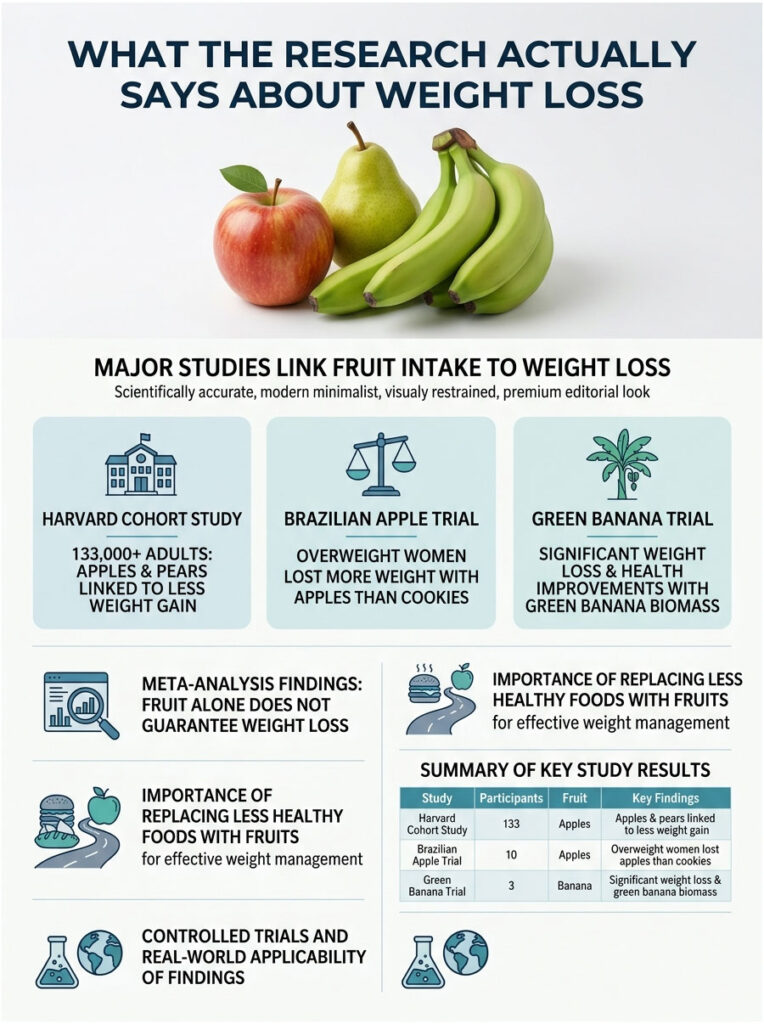
Researchers at the Harvard T.H. Chan School of Public Health pooled three prospective cohorts totaling 133,468 American men and women across 24 years of follow-up. The study, published in PLOS Medicine (Bertoia et al., 2015), tracked how changes in specific fruits and vegetables correlated with body weight over rolling four-year windows.
Every extra daily serving of apples or pears was linked to 1.24 fewer pounds gained over four years. Berries clocked in at 1.11 fewer pounds per serving. Bananas, which fall into the higher-glycemic-load fruit category in the same analysis, did not show a comparably strong inverse association with weight maintenance.
This is the largest US dataset connecting specific fruits to long-term weight outcomes. It clearly favors apples.
The Brazilian Apple Trial (Real Pounds Lost)
A 12-week randomized trial by Conceição de Oliveira and colleagues, published in the journal Nutrition (2003), assigned overweight Brazilian women to add three apples, three pears, or three oat cookies daily to their usual diet. Energy and fiber contents of the additions were similar; energy density differed.
The apple group lost about 1.21 kilograms (roughly 2.7 pounds) more than the cookie control. The mechanism likely combined pectin-driven satiety, polyphenol effects, and modest calorie displacement. Our medical reviewers note that small trials like this one often understate real-world results, since participants underreport cheat foods in food diaries.
The Green Banana Resistant Starch Trial
A 2019 randomized controlled trial (Costa et al., British Journal of Nutrition, vol. 121) followed adults with prediabetes or type 2 diabetes for six months. Half received daily green banana biomass rich in resistant starch. The other half followed diet counseling alone.
The green-banana group saw significant reductions in body weight, BMI, fasting glucose, and hemoglobin A1c. The diet-only group lost some A1c too, but with a less favorable lipid profile, including loss of HDL cholesterol (the protective kind), which the banana group preserved.
This is the strongest published evidence for any banana-based weight-loss benefit. Note the form. It was green banana biomass, not the typical ripe yellow grocery-store banana.
Table 2: Apple and Banana Weight-Loss Research at a Glance
| Study | Population | Intervention | Result | Journal |
| Bertoia et al., 2015 | 133,468 US adults, 24 years | Apple/pear daily intake | -1.24 lb per serving / 4 yr | PLOS Medicine |
| de Oliveira et al., 2003 | Overweight women, 12 weeks | 3 apples/day | -1.21 kg vs. cookie control | Nutrition |
| Costa et al., 2019 | Adults w/ pre/diabetes, 6 mo | Daily green banana biomass | Lower BMI, weight, HbA1c | Br. J. Nutrition |
| Flood-Obbagy & Rolls, 2009 | 58 adults, pre-lunch trial | Whole apple vs. juice | 187 fewer calories (15% less) | Appetite |
| Berry et al., 2020 (ZOE) | 10,000+ adults | Banana glucose response | 41% had large spikes | Nature Medicine |
What the Data Does Not Support
Neither fruit is a fat-burning miracle. No published trial shows you can eat unlimited bananas or apples and lose weight while ignoring everything else on your plate. A meta-analysis in the American Journal of Clinical Nutrition (Kaiser et al., 2014) concluded that adding fruit without cutting other calories produces no meaningful weight loss.
Translation. Fruit helps when it replaces something worse, not when it joins everything else.
Goal-Based Recommendations (Choose by Scenario)
The “which is healthier” question deserves a “depends on what you’re doing today” answer. Here’s how to pick the right fruit for the right moment.
For Everyday Calorie Control: Apple Wins
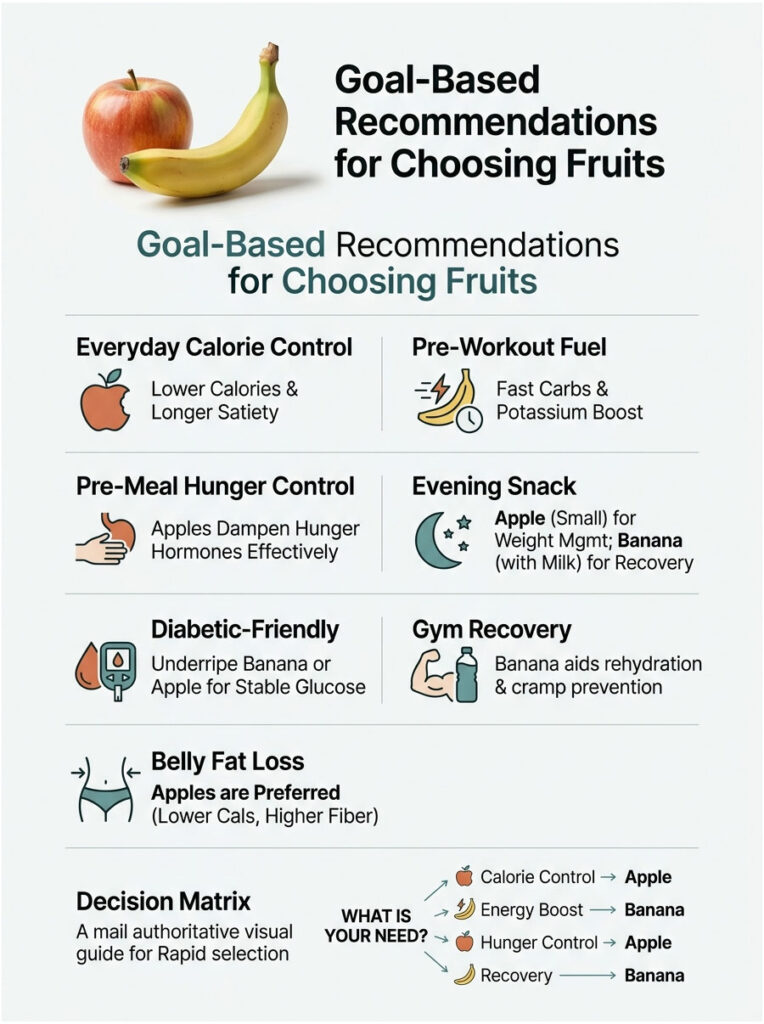
If your only goal is hitting a calorie target with minimal hunger, the apple is your default. More fiber, fewer calories, lower glycemic load, longer chew time, longer satiety window. Eat one whole apple with the skin on, ideally 15 to 30 minutes before a meal.
For Pre-Workout Fuel: Banana Wins
About 30 to 60 minutes before moderate exercise, a banana delivers fast-access carbs, 422 mg of potassium for muscle function, and a small magnesium dose for cramp prevention. Apples digest slower and can leave you sluggish during the first 10 minutes of cardio.
Pair the banana with a small protein source like a few almonds for longer training sessions. The combination keeps energy steady past the 45-minute mark when straight carbs alone start to dip.
For Pre-Meal Hunger Control: Apple Wins
Eating an apple 15 minutes before lunch or dinner reliably cuts the calorie load of the next meal. The pectin gel and chewing time work together to dampen hunger hormones. The Appetite journal trial covered above shows the effect at 187 calories per meal.
For Evening Snack: Context-Dependent
For most adults trying to lose weight, a small apple is the safer evening pick. Its lower glycemic load means less blood sugar disruption before sleep, which supports overnight fat metabolism. Add a tablespoon of almond butter for sustained satiety.
If you trained hard late in the day and need glycogen replenishment, a banana with a glass of milk works well. For a simple sweet craving, half an apple beats a whole banana.
For Diabetics and Prediabetics: Slightly Unripe Banana or Apple
Both fruits fit a diabetes-friendly plate when portioned correctly. Apples produce a steadier glucose curve. A slightly underripe banana (still firm, not soft) is acceptable thanks to higher resistant starch. Avoid black-spotted bananas if blood sugar control is the priority.
In cases reviewed by our diagnostic network, patients managing HbA1c often respond better to apples paired with a small portion of nuts or cheese.
For Gym Recovery and Cramp Prevention: Banana Wins
The 422 mg of potassium in a medium banana is roughly twice an apple’s contribution. After a sweaty workout, that electrolyte hit reduces cramping risk and supports rehydration. Apples don’t compete here.
For Belly Fat Loss: Apple Edges Ahead
No single fruit “burns” belly fat. Apples have a slight edge thanks to lower calories, higher fiber, and stronger long-term US cohort evidence. Visceral fat responds to overall calorie deficit, sleep quality, strength training, and stress management. Apples support that broader strategy more reliably for most people.
Table 3: When to Pick Which Fruit (Decision Matrix)
| Scenario | Recommended Fruit | Why | Best Pairing |
| Pre-meal hunger control | Medium apple | Pectin gel, low GI, longer chew time | Eat solo, 15 min before meal |
| Pre-workout energy (30-60 min) | Medium banana | Fast carbs, potassium for cramps | A few almonds for protein |
| Post-workout recovery | Medium banana | Glycogen refill, electrolytes | 1 cup milk or Greek yogurt |
| Evening craving (non-athlete) | Small apple | Lower calorie, gentler on blood sugar | 1 tbsp almond or peanut butter |
| Diabetic snack | Small apple or green banana | Lower GI, resistant starch | String cheese or 1 oz cashews |
| Office desk snack | Medium apple | Portable, satiating, no peel mess | Whole, with skin |
| All-day hiking / endurance | Medium banana | Energy density, electrolytes | Granola bar, water |
Common Pitfalls That Sabotage Fruit-Based Weight Loss
Even the right fruit can backfire if you handle it wrong. Here are the traps that show up most often in food diaries reviewed by our medical team.
Drinking Your Fruit (The Juice Trap)
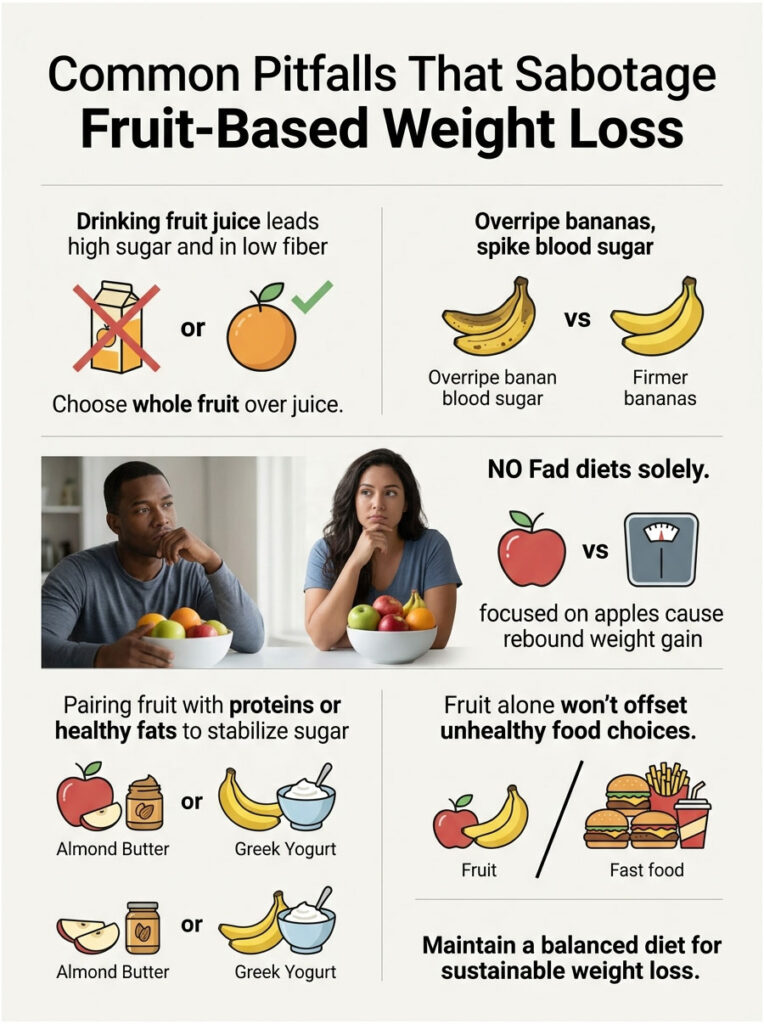
A 12-ounce glass of apple juice carries roughly 165 calories, almost no fiber, and the sugar load of about two whole apples concentrated into a few sips. Your body processes it like soda. Smoothies fare slightly better since they retain fiber, but only if they skip added sweeteners.
Whole fruit, every time. If you want apple flavor in a drink, slice an apple into your water.
Overripe Bananas and Blood Sugar
A black-spotted banana tastes almost like dessert. It also acts more like starchy candy in your bloodstream than the firm green-tipped version. If you’re tracking carbs or managing blood sugar, eat bananas while they’re still slightly firm.
Apple-Only Fad Diets
Every few years a “three-day apple diet” or “apple cleanse” makes the rounds online. These plans cause water weight loss that returns within a week. They also create rebound binge cycles. Apples support weight loss as part of a balanced plate, not as a solo act.
Pairing Fruit With the Wrong Foods
Eating an apple with a slice of cake doesn’t cancel the cake. Pairing a banana with sugary cereal doubles the glycemic load. Fruit works best alongside protein, healthy fat, or fiber-rich whole grains. Apple slices with almond butter. Banana with Greek yogurt. Both pairings flatten the blood sugar curve and stretch satiety.
How to Build a Daily Plan Using Apples and Bananas
The USDA Dietary Guidelines for Americans 2025-2030 recommend 1.5 to 2 cups of fruit daily for most adults. One medium apple or one medium banana counts as roughly one cup-equivalent.
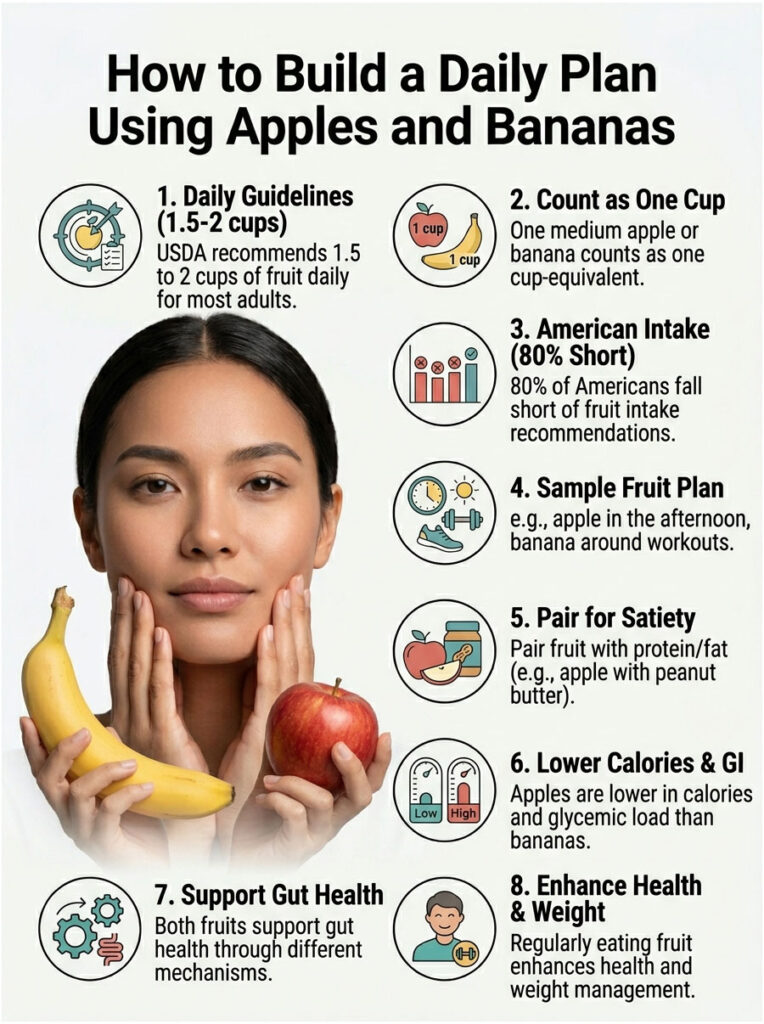
USDA Economic Research Service data shows that about 80% of Americans fall short of that recommendation. The average American eats 26.8 pounds of fresh bananas and 17 pounds of fresh apples per year, which sounds like a lot until you spread it across 365 days.
A Simple Daily Plan That Works
A practical weight-loss-friendly fruit pattern looks like this. Eat one medium apple in the afternoon as a pre-dinner appetite buffer. Eat one medium banana around your workout window (before or after, depending on intensity). That covers both fruit servings, captures the best of each fruit, and stays under 200 calories.
If you don’t exercise that day, swap the banana for a second apple or a cup of berries. Berries beat both apples and bananas on polyphenols per calorie, but US cost-per-serving makes daily intake unrealistic for many households.
Pairing Strategies That Multiply the Benefit
Protein and fat pairings turn a fruit snack into a small meal. Apple slices with one tablespoon of peanut butter creates a 200-calorie satiety bomb that holds for three hours. Banana sliced into half a cup of Greek yogurt with a sprinkle of chia delivers protein, probiotics, and slow-release carbs in one bowl.
Our lab partners often see better lipid panels in patients who consistently pair fruit with protein or fat. The combination flattens glucose curves and supports stable all-day energy.
Frequently Asked Questions
Which has fewer calories, apple or banana?
A medium apple has about 95 calories. A medium banana has about 105 calories. The apple wins by roughly 10 calories per fruit. Over a year of daily swaps, that gap equals about one pound of body fat. For pure calorie minimization, apples come out ahead, though the difference is small enough that fiber content, glycemic load, and personal hunger response matter more than the raw number.
Can I eat a banana every day and still lose weight?
Yes, absolutely. One medium banana fits inside almost any calorie target, including aggressive weight-loss plans down to 1,400 calories per day. The trick is to count it as part of your daily fruit budget, not as a free food. Pair it with a small protein or fat source to stabilize blood sugar. Time it near workouts when fast carbs are most useful.
Is it better to eat apple or banana at night?
A small apple is the safer evening pick for most adults trying to lose weight. Its lower glycemic load means less blood sugar disruption before sleep, which supports overnight fat metabolism. If you’re an athlete who trained late, a banana with a small protein source like Greek yogurt can support muscle recovery while you sleep without major blood sugar disruption.
Which fruit is best before a workout?
Bananas win the pre-workout slot. The fast-release carbs deliver ready energy within 30 to 60 minutes, and the 422 mg of potassium per fruit supports muscle contraction and cramp prevention. Eat a medium banana 30 to 60 minutes before training. For workouts lasting longer than 75 minutes, a banana plus a few salted almonds works even better.
Do bananas spike blood sugar more than apples?
Yes, on average. Ripe bananas score around 51 on the glycemic index, while apples score around 36. The ZOE PREDICT study of over 10,000 adults found that 41% of participants had large blood sugar spikes after bananas. Individual responses vary, so a continuous glucose monitor offers the most personalized data. Green-tipped bananas have a much lower glycemic impact than fully ripe ones.
How many apples a day is too many?
Two to three medium apples a day works fine for most healthy adults. Beyond that, the sugar load and fiber volume can trigger bloating, loose stools, or unwanted calorie creep. The Brazilian trial that produced clear weight-loss benefits used three apples daily for 12 weeks. Stick to one or two daily for ongoing maintenance, three short-term if you’re using apples as a pre-meal hunger tool.
Are green bananas better than ripe ones for weight loss?
Yes, modestly so. Green bananas contain higher levels of resistant starch, which acts like fiber and resists digestion in the small intestine. This resistant starch feeds beneficial gut bacteria, supports satiety, and may improve insulin sensitivity. As bananas ripen, the resistant starch converts to simple sugars, raising both calorie absorption rate and glycemic impact.
Is apple skin important for weight loss?
Yes, significantly. The skin holds most of the apple’s pectin fiber, polyphenols like quercetin, and antioxidants. Peeling an apple removes roughly half its fiber and the majority of its weight-loss-supporting compounds. Always eat apples with the skin on, after a thorough rinse to remove pesticide residue. Choose organic when budget allows, especially since apples sit high on the Environmental Working Group’s pesticide-residue list.
Can diabetics eat banana?
Yes, in moderation and with smart timing. A small or slightly underripe banana paired with protein or fat fits most diabetic meal plans. The American Diabetes Association does not restrict bananas. Apples are generally easier on glucose curves for diabetic patients, but a green-tipped banana with peanut butter is a reasonable alternative.
What burns belly fat faster, apple or banana?
No single fruit burns belly fat. Apples have a slight edge thanks to higher fiber, lower calories, and stronger evidence in long-term US cohort studies. Visceral belly fat responds to overall calorie deficit, sleep quality, strength training, and stress management. Apples support that broader strategy better than bananas for most people, though neither fruit alone produces dramatic abdominal fat loss.
Is banana smoothie good for weight loss?
It can be, if you control the ingredients. A smoothie with one medium banana, one cup of unsweetened almond milk, a scoop of protein powder, and a handful of spinach delivers around 250 calories and 25 grams of protein. The trap is “healthy” smoothie shops adding juice, honey, and granola, which can push a single drink past 600 calories. Make it at home for full control.
Which fruit is better for gut health?
Both support gut health, in different ways. Apple pectin feeds beneficial bacteria like Bifidobacterium and Lactobacillus. Banana resistant starch (mostly in green bananas) feeds butyrate-producing bacteria that protect the colon lining. Eating both fruits across a week gives your gut microbiome a more diverse fiber supply than relying on either one alone.
Disclaimer: This article is for informational purposes only and does not replace medical advice, diagnosis, or treatment from a licensed healthcare provider. Individual responses to fruit, fiber, and carbohydrates vary based on genetics, gut microbiome, medications, and existing health conditions. Speak with your physician or a registered dietitian before making major dietary changes, especially if you have diabetes, kidney disease, or are taking blood-thinning medications. For personalized blood sugar, lipid, or hormone test panels, book a consultation with HealthCareOnTime.
References
- USDA FoodData Central: Apples, Raw, with Skin
- USDA FoodData Central: Bananas, Raw
- Harvard T.H. Chan School of Public Health: Apples
- Harvard T.H. Chan School of Public Health: Bananas
- Bertoia et al., 2015, PLOS Medicine: Changes in Fruit and Vegetable Intake and Weight Change
- CDC NCHS Data Brief No. 508: Obesity Prevalence in US Adults, 2021-2023
- USDA Economic Research Service: Trends in US Fruit Consumption
- USDA & HHS: 2025-2030 Dietary Guidelines for Americans
- Costa et al., 2019, British Journal of Nutrition: Green Banana Biomass in Pre-diabetes and Diabetes
- Flood-Obbagy & Rolls, 2009, Appetite: The Effect of Fruit in Different Forms on Energy Intake
- de Oliveira et al., 2003, Nutrition: Weight Loss with Daily Intake of Three Apples or Pears
- Kaiser et al., 2014, American Journal of Clinical Nutrition: Fruit and Vegetable Intake and Weight Loss Meta-Analysis
- American Diabetes Association: Fruit Recommendations