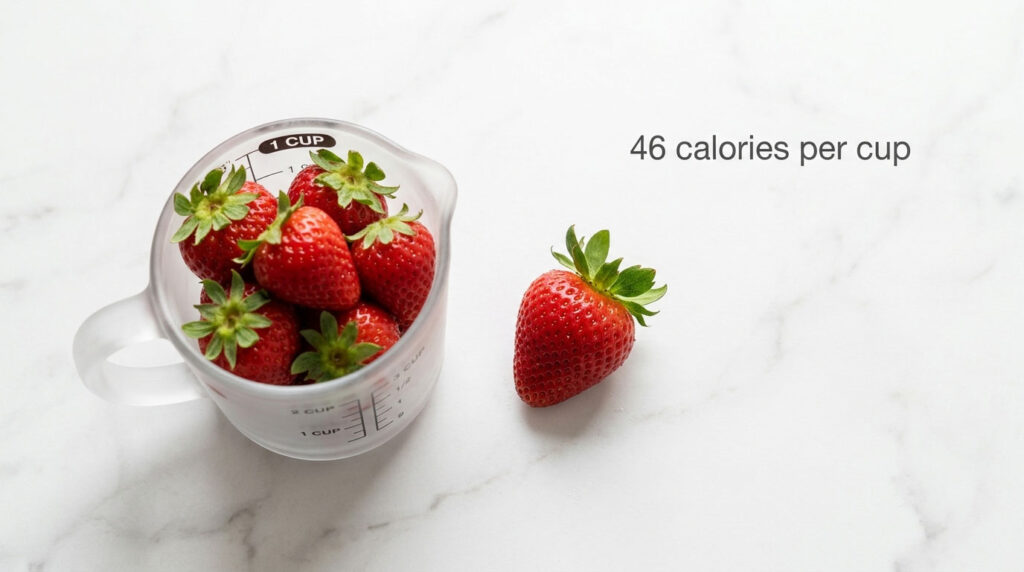
Americans eat close to seven pounds of fresh strawberries per person every year, yet most people have no idea what that ruby-red handful actually costs them in calories. The answer is almost comically small. A whole cup of fresh strawberries carries fewer calories than a single slice of bread, and one berry barely registers at all.
Table of Contents
That gap between how good strawberries taste and how little they cost is exactly why they appear in so many diet plans, smoothie bowls, and school lunchboxes across the country. Strawberries deliver the sensory payoff of a sweet treat without the calorie penalty that usually comes with it.
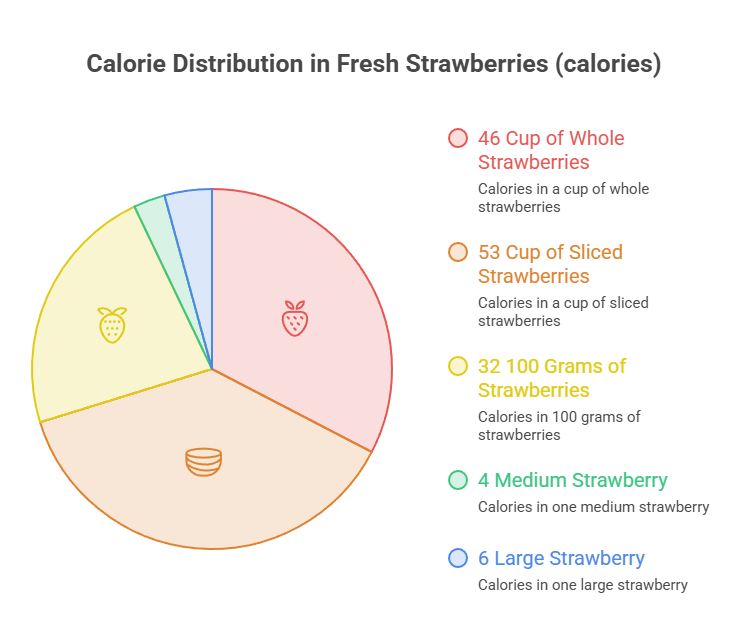
The numbers below come straight from USDA data, broken down by every serving size you actually use, from a single berry to a heaping two-cup bowl. By the end, you will know not just how many calories are in strawberries but how to fit them into whatever goal you are chasing.
Quick Answer: A cup of whole fresh strawberries has about 46 calories, while a cup of sliced strawberries has roughly 53 calories. Per 100 grams, strawberries contain just 32 calories, according to USDA FoodData Central. One medium berry is about 4 calories, and one large berry is around 6. Strawberries are nearly fat-free, low in sugar, and pack 65% of your daily vitamin C in 100 grams.
At a Glance
- A cup of whole strawberries has only about 46 calories; sliced runs about 53.
- One medium strawberry is roughly 4 calories; one large is about 6.
- 100 grams of strawberries contains 32 calories, per USDA data.
- Strawberries are about 91% water and almost entirely fat-free.
- One cup delivers more than 100% of the daily value for vitamin C.
- The sugar in fresh strawberries is natural, not added, with a low glycemic index of 40.
- They provide about 2 grams of fiber per 100 grams to support fullness.
How Many Calories Are in Strawberries? (The Short Answer)
If you came here for a single number, here it is: 100 grams of raw strawberries contains about 32 calories, based on the USDA FoodData Central entry for raw strawberries. That figure is the anchor every reliable nutrition source traces back to.
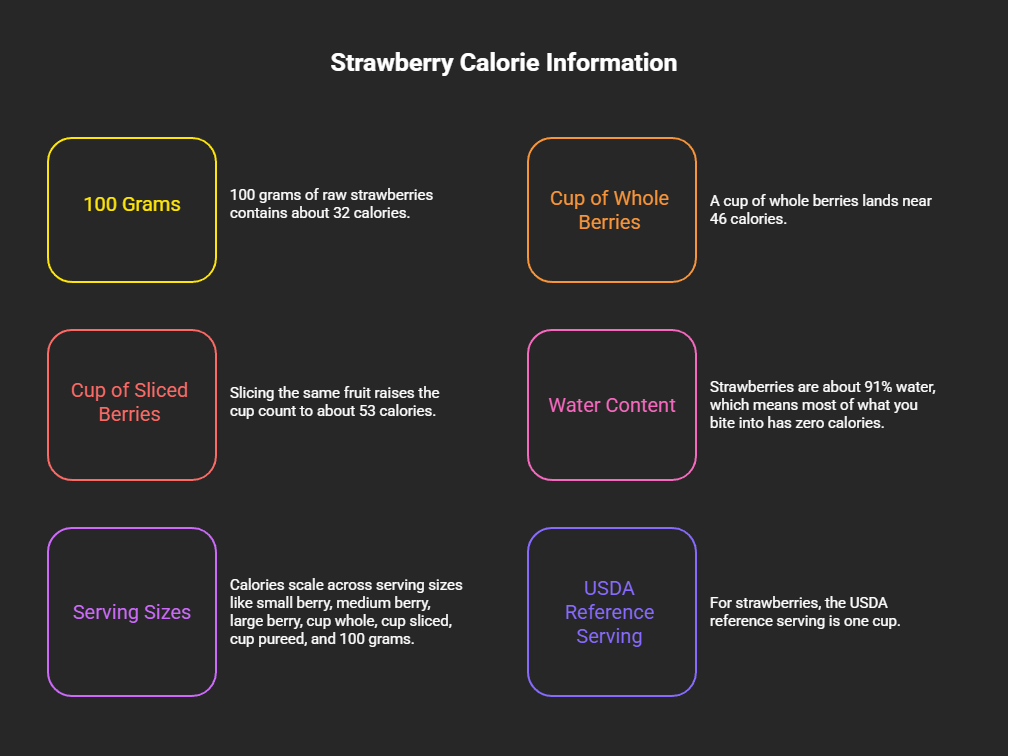
Most people, though, do not eat strawberries by the gram. They eat them by the cup or by the handful, so the practical numbers matter more. A cup of whole berries lands near 46 calories, and slicing the same fruit raises the cup count to about 53 because slices pack more tightly into the measuring cup.
Our nutrition team points out that the calorie count barely moves whether you eat them whole or sliced. The difference is only how many berries fit in the cup, not the fruit gaining calories from being cut. A strawberry holds the same energy on either side of the knife.
The reason the number stays so low is water. Healthline reports that strawberries are about 91% water, which means most of what you bite into has zero calories. That high water content is the quiet engine behind their reputation as a near free snack.
To make portion planning simple, here is how the calories scale across the serving sizes you are most likely to use day to day.
| Serving | Approx. Weight | Calories | Total Carbs |
| 1 small berry | 7 g | ~2 cal | 0.5 g |
| 1 medium berry | 12 g | ~4 cal | 0.9 g |
| 1 large berry | 18 g | ~6 cal | 1.4 g |
| 1 cup, whole | 144 g | ~46 cal | 11 g |
| 1 cup, sliced | 166 g | ~53 cal | 12.7 g |
| 1 cup, pureed | 232 g | ~74 cal | 17.8 g |
| 100 grams | 100 g | 32 cal | 7.7 g |
Table 1: Strawberry Calories by Serving Size. Source: USDA FoodData Central.
Patients who book tests through HealthCareOnTime often ask whether a serving means a cup or a piece. For strawberries, the USDA reference serving is one cup, and that single cup is what most dietary targets and nutrition labels are built around.
Strawberry Calories Per Berry (Small, Medium, Large)
People who track food by the piece rather than by weight need per-berry math, and strawberries make that easy because each one is so light. The calorie load of a single berry is small enough that it rounds to almost nothing on a daily tracker.
How Many Calories in One Strawberry
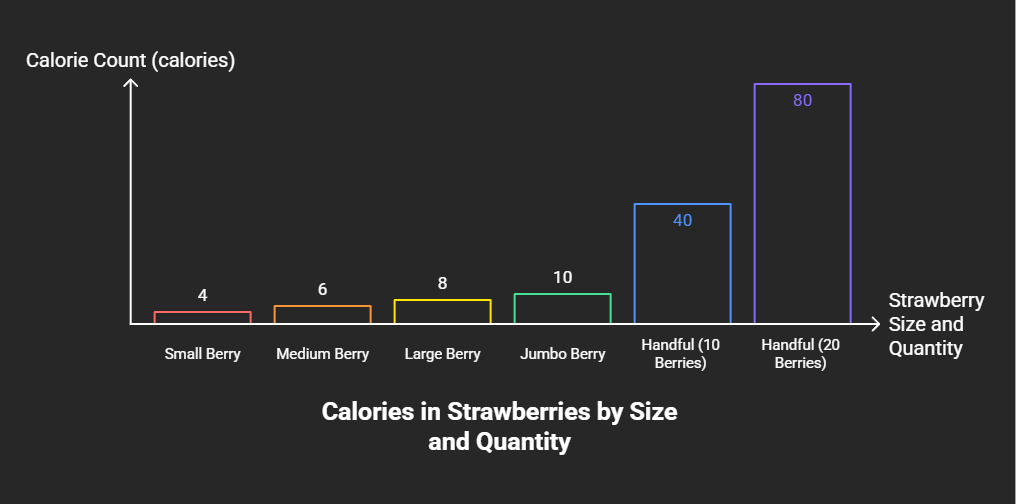
A single medium strawberry weighs about 12 grams and carries roughly 4 calories. A large berry, closer to 18 grams, comes in around 6 calories, while a small one is barely 2 calories. Mayo Clinic Health System frames a cup as about eight medium berries totaling roughly 45 calories, which lines up almost exactly with the per-berry math.
Across the readers we serve, this is the figure that surprises people most. You can eat three or four berries for the calorie cost of a single saltine cracker, which reshapes how a sweet craving fits into a daily budget. Few naturally sweet foods give you that kind of room.
Berry size varies more than people expect, which is why these numbers are estimates rather than fixed values. A jumbo supermarket strawberry can weigh 25 grams or more and push past 8 calories, while a tiny end-of-season berry might land under 2. Ripeness matters too, since riper berries hold slightly more sugar.
Counting by the Handful (10 to 20 Berries)
A handful of about 10 medium strawberries adds up to roughly 40 calories, while 20 berries land near 80. Even a generous bowl of two full cups stays under 100 calories if you are eating them plain and whole.
That math is why strawberries work so well as a high-volume snack. Our medical reviewers note that foods offering a large physical portion for very few calories tend to satisfy hunger better than calorie-dense snacks of the same weight. A big bowl of berries simply feels more filling than a small handful of crackers carrying the same calories.
For anyone counting calories, this is the practical takeaway: you would have to eat an unusually large pile of plain strawberries to make a real dent in a daily target. The fruit polices its own portions through sheer volume and water content.
Full USDA Nutrition Breakdown of Strawberries
Calories are only the headline. The fuller picture explains why strawberries earn a spot in nearly every healthy-eating guideline in the country, from MyPlate to the Dietary Guidelines for Americans.
Macronutrients (Carbs, Protein, Fat)
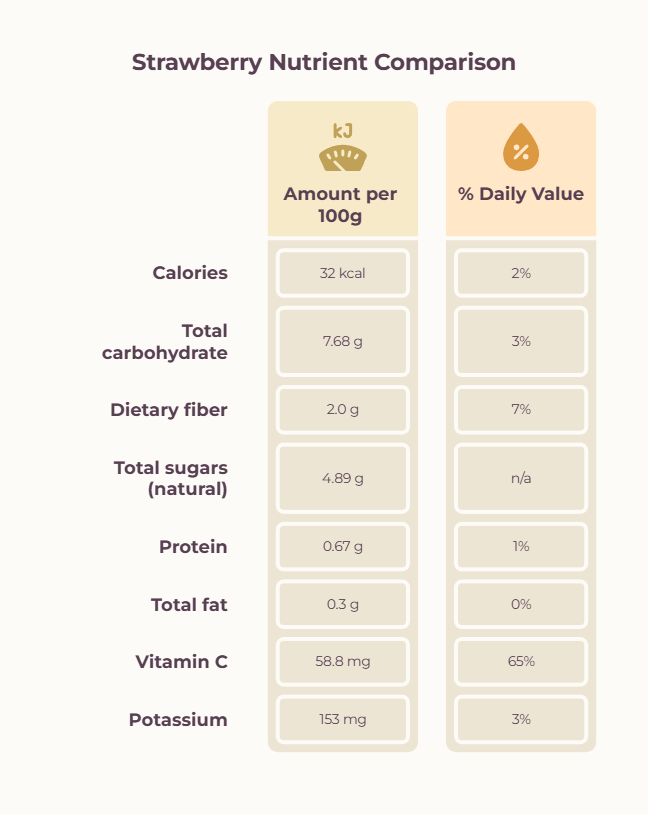
Strawberries are a carbohydrate food, but a light one. Healthline lists about 7.7 grams of carbs per 100 grams, with only 0.7 grams of protein and 0.3 grams of fat. In plain terms, strawberries are fat-free for practical purposes and contain just a trace of protein.
The carbs are what give strawberries their gentle sweetness and their small calorie count. Because the fruit is mostly water and fiber, those carbs do not translate into a heavy energy load the way the carbs in bread, rice, or pasta do.
That macro profile also explains why strawberries pair so well with protein and fat. A cup of berries with Greek yogurt or a small handful of nuts turns a near-zero-protein snack into a balanced one without piling on calories.
Sugar and Net Carbs (Natural vs Added)
Here is the distinction that trips up a lot of dieters. The sugar in fresh strawberries is naturally occurring, not added. USDA SNAP-Ed lists zero grams of added sugar for a cup of sliced strawberries, which sets plain berries apart from jam, syrup, or sweetened toppings.
Raw strawberries hold about 4.9 grams of sugar per 100 grams. After subtracting the 2 grams of fiber, the net digestible carb content drops to under 6 grams per 100 grams, which is why low-carb and keto eaters can usually fit them in.
Patients commonly ask us whether the natural sugar in fruit counts the same as table sugar. The fiber in strawberries slows how fast that sugar enters the bloodstream, which is a meaningful difference from a spoonful of refined sugar that carries no fiber at all.
For context, a single cup of whole strawberries holds roughly the same sugar as one small handful of grapes, but with more fiber and fewer calories. That is a favorable trade for anyone watching both sugar and energy intake.
Fiber
Each 100-gram serving of strawberries provides about 2 grams of fiber, both soluble and insoluble. A full cup pushes that closer to 3 grams, which is a solid contribution toward the 25 to 38 grams most American adults need daily but rarely hit.
The CDC notes that fiber helps people feel fuller for longer, which is part of why a low-calorie, fiber-containing fruit fits so neatly into weight management. Fiber also supports digestive regularity and feeds the beneficial bacteria in your gut.
Soluble fiber, the kind that forms a gel in the digestive tract, is also linked to steadier cholesterol and blood sugar. Strawberries carry a useful share of it, which adds to their value beyond the simple calorie count.
Vitamins and Minerals
Strawberries punch far above their calorie weight on vitamin C. The USDA reports 58.8 milligrams per 100 grams, which is 65% of the daily value, and a full cup tips past 100%. That makes strawberries a stronger vitamin C source than the same weight of orange.
Beyond vitamin C, strawberries supply potassium (about 153 mg per 100 g), manganese, and folate. The NIH Office of Dietary Supplements lists strawberries among recommended food sources of vitamin C, a nutrient your body needs to make collagen, support immune function, and absorb iron from plant foods.
Manganese deserves a mention because strawberries are a notably good source. This trace mineral supports bone formation and helps the body process carbohydrates and fats. Folate, meanwhile, matters for cell growth and is especially important during pregnancy.
| Nutrient | Amount per 100g | % Daily Value |
| Calories | 32 kcal | 2% |
| Total carbohydrate | 7.68 g | 3% |
| Dietary fiber | 2.0 g | 7% |
| Total sugars (natural) | 4.89 g | n/a |
| Protein | 0.67 g | 1% |
| Total fat | 0.3 g | 0% |
| Vitamin C | 58.8 mg | 65% |
| Potassium | 153 mg | 3% |
Table 2: USDA Nutrient Profile of Raw Strawberries (per 100g). Source: USDA FoodData Central, FDC ID 167762. Daily values based on a 2,000-calorie diet.
Our lab partners report that vitamin C status questions come up often during routine wellness panels, and fresh fruit like strawberries is one of the simplest dietary fixes for borderline-low readings.
The Antioxidant Layer
Strawberries also carry plant compounds that calorie charts never capture. Their bright red color comes from anthocyanins, a class of antioxidants linked in research to heart and brain health. These compounds are part of why berries, as a group, get so much attention from nutrition researchers.
Strawberries additionally contain ellagic acid and other polyphenols that help the body manage oxidative stress. These are not calories you can count, but they are a real part of the value you get from each near-calorie-free bite.
Why Strawberries Are a Smart Low-Calorie Choice
The calorie math is only useful if it changes what ends up on your plate. Strawberries earn their healthy reputation through three traits that work together: low energy density, fullness from fiber and water, and a gentle effect on blood sugar.
Calorie Density and Fullness
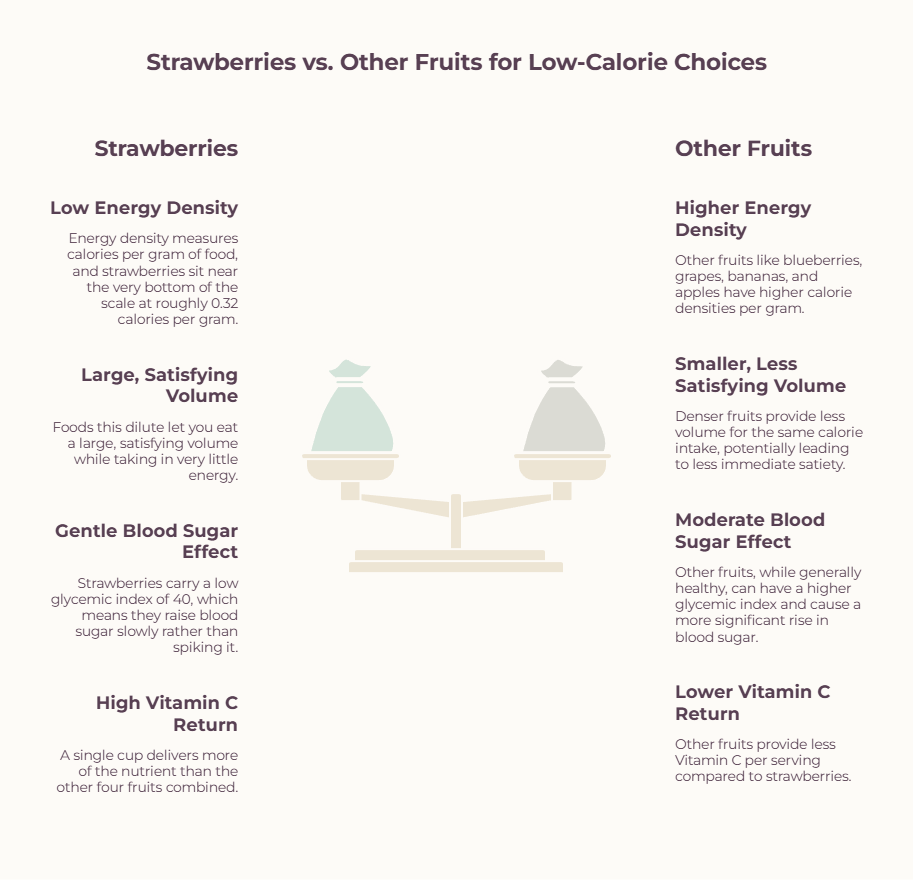
Energy density measures calories per gram of food, and strawberries sit near the very bottom of the scale at roughly 0.32 calories per gram. Foods this dilute let you eat a large, satisfying volume while taking in very little energy.
That is the entire appeal for anyone watching their weight. A heaping bowl of strawberries delivers the sensory reward of a sweet dessert for a fraction of the calories of cookies, candy, or ice cream of the same size.
Volume eating is a recognized strategy among dietitians for exactly this reason. Filling part of your plate with low-density foods like strawberries lets you keep portions generous while the total calorie count stays modest.
This is also why strawberries rarely trigger the urge to keep snacking. The water and fiber add physical bulk that signals fullness to the body, so a bowl of berries tends to end a craving rather than feed it. Many calorie-dense snacks do the opposite, leaving you reaching for more.
Weight Management Context
A cup of strawberries at about 46 calories can replace a 200-calorie processed snack while delivering fiber, water, and vitamin C in the trade. Over a week, swaps like that add up to a meaningful calorie reduction without any sense of deprivation.
In questions sent to our diagnostic network, readers managing weight frequently ask which fruits are allowed. Strawberries are among the safest answers, since their low calorie load and fiber make overdoing them on calories genuinely difficult.
The psychological side matters too. A diet that bans sweetness rarely lasts, and strawberries let people satisfy that craving honestly. That makes them a tool for adherence, not just a number on a chart.
Strawberries and Blood Sugar
Strawberries carry a low glycemic index of 40, which means they raise blood sugar slowly rather than spiking it. Healthline notes that this low GI makes strawberries a reasonable choice for people managing blood sugar.
The combination of fiber, water, and modest sugar is what keeps that response gentle. Eating strawberries at the end of a meal, rather than alone on an empty stomach, can blunt the rise even further by slowing digestion of the whole plate.
How Strawberries Compare to Other Fruits
Put side by side with other popular fruits, strawberries hold their own as one of the lightest options on the shelf. A cup of whole strawberries at about 46 calories undercuts a cup of blueberries and sits well below a banana or a cup of grapes, all while leading the group on vitamin C.
None of these fruits is unhealthy, and calorie count is only one piece of the picture. What sets strawberries apart is the rare mix of a very low calorie load, a high vitamin C return, and a large physical portion, which together make them simple to recommend for nearly any goal.
| Fruit | Serving | Calories | Vitamin C |
| Strawberries (whole) | 1 cup | ~46 cal | ~85 mg |
| Blueberries | 1 cup | ~84 cal | ~14 mg |
| Grapes | 1 cup | ~104 cal | ~5 mg |
| Banana | 1 medium | ~105 cal | ~10 mg |
| Apple | 1 medium | ~95 cal | ~8 mg |
Table 4: Strawberry Calories Compared to Common Fruits. Source: USDA FoodData Central.
The vitamin C column is where strawberries pull ahead most clearly. A single cup delivers more of the nutrient than the other four fruits combined, which is a strong return for the lowest calorie cost in the group. Our medical reviewers point to that ratio as the reason strawberries show up so often in dietitian-built meal plans.
Fresh vs Frozen vs Dried vs Sweetened (Calories Compared)
Not all strawberries are nutritionally equal once they leave the produce aisle. The fresh berry is the low-calorie benchmark; everything done to it afterward tends to push calories up, sometimes dramatically.
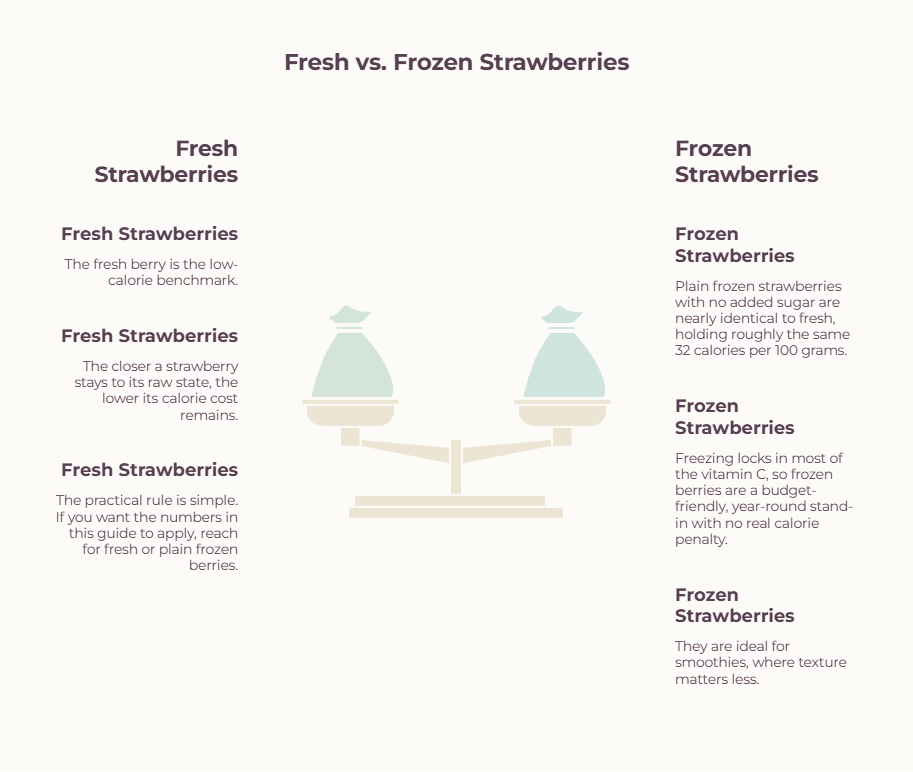
Plain frozen strawberries with no added sugar are nearly identical to fresh, holding roughly the same 32 calories per 100 grams. Freezing locks in most of the vitamin C, so frozen berries are a budget-friendly, year-round stand-in with no real calorie penalty. They are ideal for smoothies, where texture matters less.
Dried strawberries are a different story. Removing the water concentrates everything, so the same calories pack into a much smaller, denser piece, and many dried versions add sugar on top. A small handful of sweetened dried strawberries can carry several times the calories of the equivalent fresh weight, often topping 300 calories per 100 grams.
Sweetened and processed forms climb fastest of all. Strawberry jam, syrup, canned berries in heavy syrup, chocolate-dipped berries, and strawberry milkshakes load on added sugar and fat, which is where the low-calorie advantage disappears entirely. A single chocolate-dipped strawberry can carry more calories than a whole cup of plain ones.
Our medical reviewers note that the word strawberry on a label tells you almost nothing about calories. A strawberry toaster pastry and a fresh strawberry share little beyond the name. The closer a strawberry stays to its raw state, the lower its calorie cost remains.
To put rough numbers on it, a tablespoon of strawberry jam can carry about 50 calories, a single chocolate-covered strawberry roughly 50 to 100 depending on size, and a fast-food strawberry milkshake several hundred. The same calories in fresh berries would fill a large bowl. That contrast is worth remembering whenever a product leans on the strawberry name to sound healthy.
The practical rule is simple. If you want the numbers in this guide to apply, reach for fresh or plain frozen berries. The moment cream, sugar, chocolate, or syrup enters the picture, you are eating a different food with different math.
How Strawberries Fit US Diet Guidelines
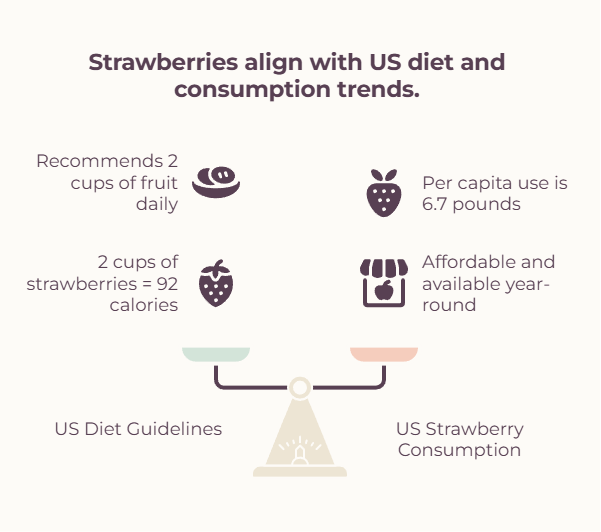
Federal nutrition guidance has long pushed Americans toward more fruit, and strawberries fit the recommendation cleanly. The Dietary Guidelines for Americans and the USDA MyPlate program suggest about two cups of fruit per day for most adults.
MyPlate and Daily Fruit Targets
Two cups of whole strawberries would total only about 92 calories while covering a full day’s fruit recommendation. Few foods let you meet a federal nutrition target so completely for under 100 calories.
That efficiency is why dietitians reach for berries so often. You hit the fruit goal, bank a large dose of vitamin C, and add fiber without crowding out room in your calorie budget for the rest of the day.
Despite guidance like this, most Americans still fall short on fruit. USDA research has shown per capita fruit intake sitting well below recommended levels, which makes an easy, low-calorie option like strawberries a useful gateway for closing the gap.
US Strawberry Consumption Trends
Strawberries are not a niche fruit in America; they are a staple. USDA data shows per capita fresh strawberry use climbing over the decades, reaching about 6.7 pounds in recent years after a record near 7.9 pounds, according to the USDA Economic Research Service.
That growth tracks rising awareness of healthy eating and near year-round availability from domestic and imported supply. Strawberries now rank among the most commonly eaten fresh fruits in the country, alongside bananas, apples, oranges, and grapes.
California and Florida drive most domestic production, while imports from Mexico fill in the winter and spring months. The result is a fruit that stays affordable and available almost any week of the year, which keeps it firmly in the American snacking rotation.
For readers, the takeaway is reassuring rather than alarming. Eating strawberries regularly lines up with both national habits and national guidance, and the low calorie cost means even daily servings rarely conflict with a weight or health goal.
How Many Strawberries Should You Eat? (Action Guide)
There is no strict cap on how many fresh strawberries you can eat, since the calorie cost is so low. The right portion depends less on hard limits and more on what you are trying to achieve.
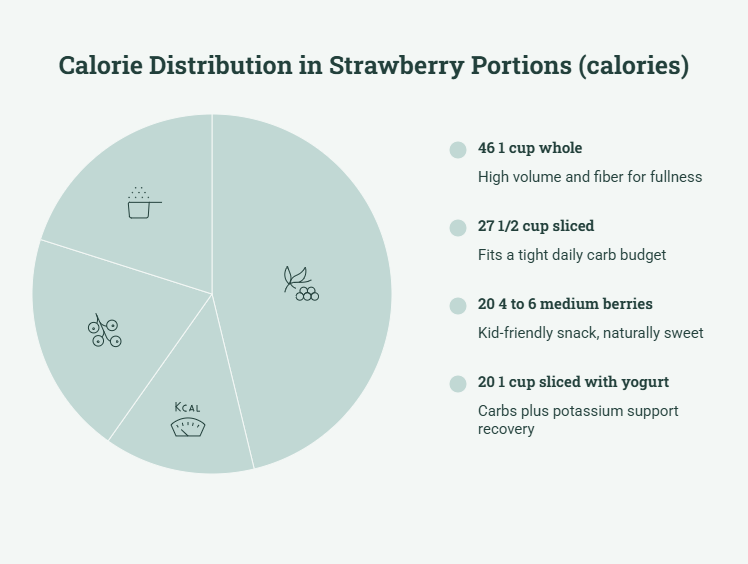
For most people, one to two cups a day fits comfortably into a healthy pattern and covers the daily fruit target. The table below translates common goals into a practical portion you can act on today.
| Your Goal | Recommended Portion | Why It Works |
| Weight loss | 1 cup whole (~46 cal) | High volume and fiber for fullness at low calories |
| Low-carb or keto | 1/2 cup sliced (~27 cal, ~6 g carb) | Fits a tight daily carb budget |
| Blood sugar control | 1 cup paired with protein | Low GI of 40; fiber and protein slow absorption |
| Vitamin C boost | 1 cup (over 100% DV) | One cup beats a whole orange for vitamin C |
| Kid-friendly snack | 4 to 6 medium berries (~20 cal) | Naturally sweet, no added sugar, easy to grab |
| Post-workout refuel | 1 cup sliced with yogurt | Carbs plus potassium support recovery |
Table 3: How Many Strawberries to Eat Based on Your Goal.
Patients who book tests through HealthCareOnTime sometimes worry that eating fruit daily will sabotage a diet. For plain strawberries, the evidence points the other way; the calorie load is so light that they tend to help, not hurt, most eating plans.
The one caveat is preparation. The moment you add sugar, cream, chocolate, or syrup, the friendly numbers in this guide stop applying, and the portion logic shifts toward those add-ons rather than the berries themselves. Keep the fruit close to its natural state and the math stays on your side.
Frequently Asked Questions
How many calories in 1 strawberry?
One medium strawberry has about 4 calories, a large one about 6, and a small one roughly 2. Because each berry weighs only 7 to 18 grams and is mostly water, a single strawberry barely affects your daily calorie total, making it one of the lowest-calorie snacks available anywhere.
How many calories in a cup of strawberries?
A cup of whole fresh strawberries contains about 46 calories, while a cup of sliced strawberries has roughly 53 calories because slices pack more tightly. A cup of pureed strawberries reaches about 74 calories. All figures assume plain berries with no added sugar or toppings.
Are strawberries good for weight loss?
Yes. Strawberries are low in calories, high in water, and provide fiber that supports fullness, which makes them a strong choice for weight management. Swapping a 200-calorie processed snack for a cup of strawberries cuts calories sharply while adding vitamin C and fiber to your day.
How many carbs are in strawberries?
Strawberries contain about 7.7 grams of total carbohydrate per 100 grams, or roughly 11 grams per cup of whole berries. After subtracting fiber, net carbs drop to under 6 grams per 100 grams. Most of these carbs come from naturally occurring sugar, not added sugar.
Are strawberries high in sugar?
No. Fresh strawberries hold only about 4.9 grams of sugar per 100 grams, and that sugar is natural, not added. USDA SNAP-Ed lists zero added sugar for plain strawberries. The fiber in the fruit also slows sugar absorption, keeping the glycemic impact low at a GI of 40.
How much vitamin C is in strawberries?
Strawberries provide about 58.8 milligrams of vitamin C per 100 grams, which is 65% of the daily value. A full cup delivers more than 100% of your daily vitamin C, surpassing the same weight of orange. Vitamin C supports immune function, collagen production, and iron absorption.
How many calories in frozen strawberries?
Plain frozen strawberries without added sugar contain about the same calories as fresh, near 32 per 100 grams. Freezing preserves most nutrients, including vitamin C. Check the label carefully, since some frozen strawberries are packed in syrup or sugar, which raises the calorie count considerably.
How many calories in dried strawberries?
Dried strawberries are far more calorie-dense than fresh because removing water concentrates the sugar into a smaller piece, and many brands add sugar. A small handful can carry several times the calories of an equal weight of fresh berries, so portion size matters much more here.
Can diabetics eat strawberries?
Generally yes. Strawberries have a low glycemic index of 40 and modest sugar content, so they tend to cause only a gentle rise in blood sugar. Pairing them with protein and watching portion size helps. Anyone managing diabetes should confirm their personal plan with a clinician or dietitian.
How many strawberries can I eat a day?
There is no strict limit on fresh strawberries because they are so low in calories. One to two cups a day fits most healthy eating patterns and covers the daily fruit target. Plain berries are difficult to overeat on calories, though added sugar or toppings change that quickly.
Do strawberries have any fat or protein?
Barely. Strawberries contain about 0.3 grams of fat and 0.7 grams of protein per 100 grams, both negligible amounts. For practical purposes, strawberries are a fat-free, very-low-protein fruit, with almost all of their small calorie count coming from naturally occurring carbohydrates.
Are strawberry calories different when sliced?
The berries themselves do not gain calories from slicing. A cup of sliced strawberries simply weighs more than a cup of whole ones because slices pack tighter, so the cup reads about 53 calories versus 46 whole. Per gram, the calorie content stays identical either way.
Medical Disclaimer: This article is for general informational purposes only and is not a substitute for professional medical or nutritional advice. Calorie and nutrient values are estimates based on USDA data and can vary by berry size, ripeness, and variety. Consult a licensed physician or registered dietitian before making changes to your diet, especially if you have diabetes, allergies, or other health conditions.
References
- USDA FoodData Central, Raw Strawberries (FDC ID 167762)
- Mayo Clinic Health System, Strawberries: A Nutrient Powerhouse
- Healthline, Strawberries: Nutrition Facts and Health Benefits
- USDA SNAP-Ed, Strawberries Seasonal Produce Guide
- NIH Office of Dietary Supplements, Vitamin C Fact Sheet
- CDC, Healthy Eating for a Healthy Weight
- USDA Economic Research Service, U.S. Strawberry Consumption
- Dietary Guidelines for Americans