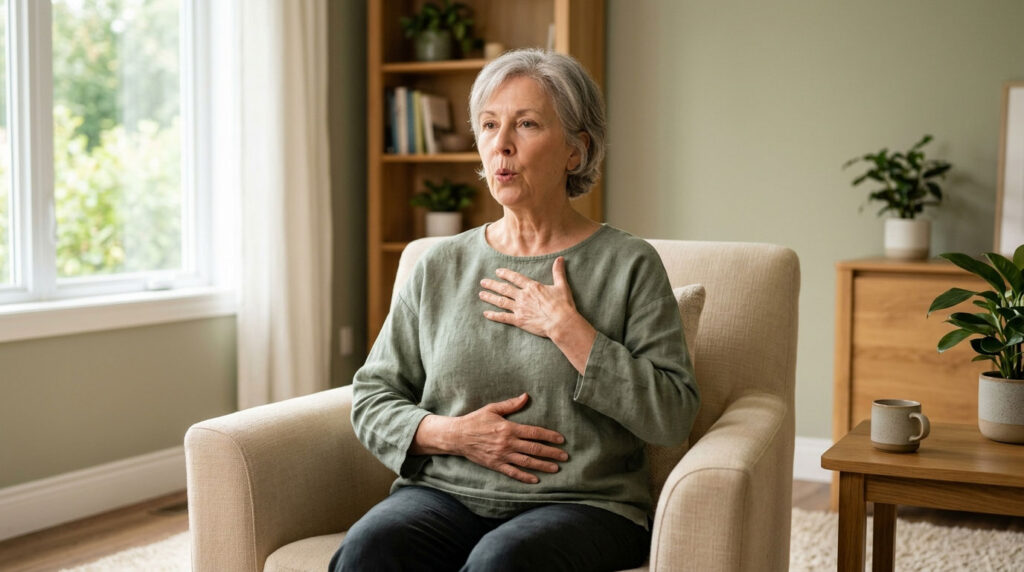
When you’re fighting for air, every instinct tells you to breathe harder and faster. With COPD, that instinct works against you. The fix is almost backward: breathe slower, breathe out longer, and let trapped air escape so fresh air has somewhere to go.
Table of Contents
The good news is that the best breathing techniques for COPD are simple, free, and learnable at home. Used consistently, they take the edge off shortness of breath and hand you a plan for the moments that used to feel out of control.
Quick Answer: The best breathing techniques for COPD are pursed-lip breathing and diaphragmatic (belly) breathing, backed by deep breathing, huff coughing, coordinated breathing, paced “blow as you go” breathing, recovery positions, and relaxed breathing for anxiety. When shortness of breath hits, stop, sit, relax your shoulders, and use pursed-lip breathing until you recover. Practice daily so the techniques become automatic. They support your medications and pulmonary rehab, but they don’t replace them.
At a Glance
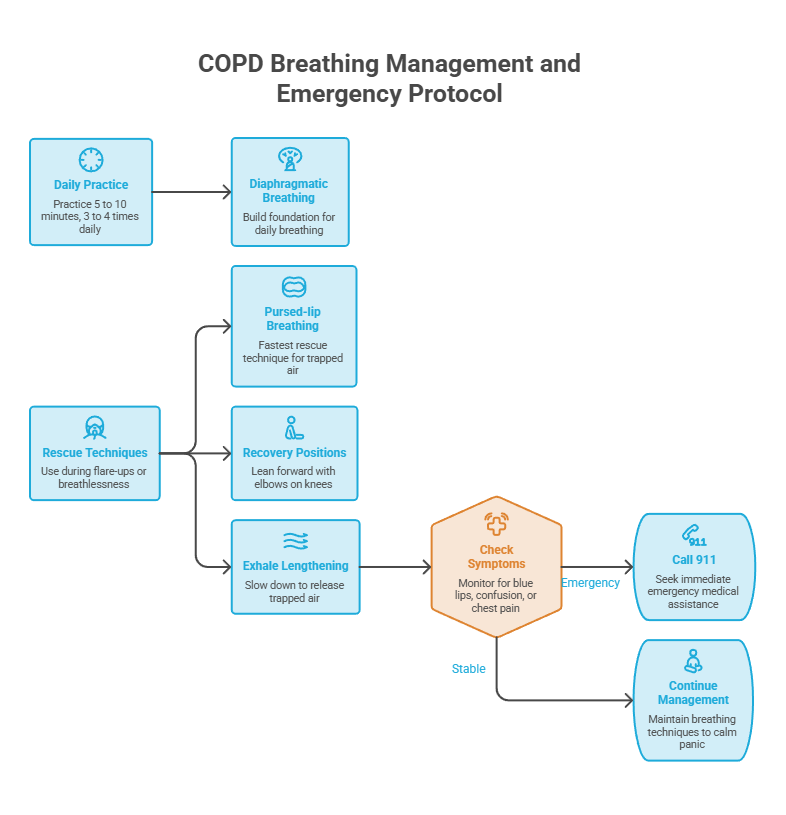
- COPD shortness of breath comes from trapped air and a diaphragm that’s working at a disadvantage, not from a lack of effort.
- Pursed-lip breathing is the fastest rescue technique; diaphragmatic breathing is the foundation you build daily.
- Slowing down and lengthening your exhale releases trapped air so you can take in more fresh air.
- Recovery positions, like leaning forward with your elbows on your knees, ease the work of breathing during a flare.
- Aim for 5 to 10 minutes of practice, 3 to 4 times a day, so the skills are ready when you need them.
- Breathing techniques calm the panic that makes breathlessness worse, but blue lips, confusion, or chest pain mean call 911.
Why COPD Leaves You Short of Breath
Healthy lungs empty easily. With chronic obstructive pulmonary disease (COPD), the airways narrow and the air sacs lose their stretch, so stale air gets trapped before you finish exhaling. That trapped air takes up room that fresh, oxygen-rich air needs.
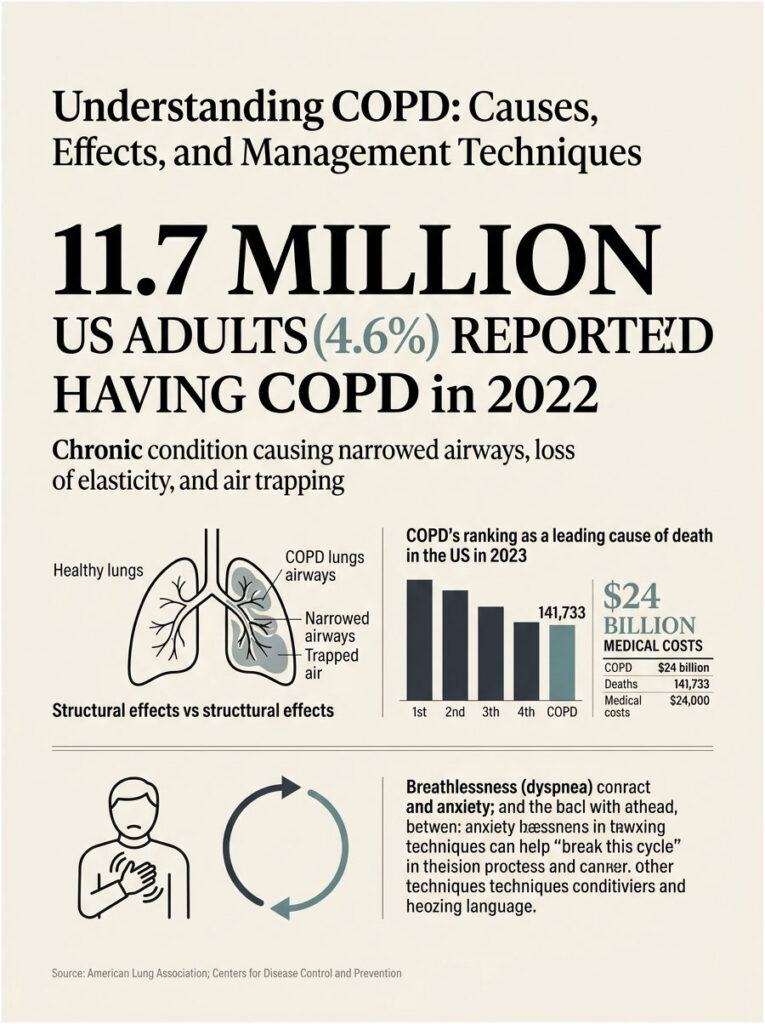
This is why pushing harder rarely helps. The problem isn’t getting air in; it’s getting the old air out. Slow, controlled breathing gives your lungs time to empty, which is the principle behind nearly every technique below.
Over time the trapped air keeps your lungs slightly over-inflated, which flattens the diaphragm and weakens its pull. In people with COPD, the diaphragm doesn’t function to its fullest capacity, and the result is shortness of breath, so the body starts recruiting neck and shoulder muscles that tire quickly. Retraining the diaphragm shifts the work back to where it belongs.
Shortness of breath, sometimes called dyspnea, can feel like air hunger, a tight band around the chest, or breathing through a narrow straw. None of it means you should fight harder; it means you should slow down and lengthen each breath. That single shift, a longer out-breath, is the thread running through all eight techniques below.
The Breathlessness and Anxiety Loop
Shortness of breath is frightening, and fear speeds up your breathing, which traps more air, which makes you more breathless. Patients with COPD often tell us that the panic feels as bad as the physical symptom itself.
Breathing techniques interrupt that loop on both ends. They physically release trapped air, and they signal your nervous system to settle, which slows your breathing rate back down.
How Common COPD Is in the United States
COPD is one of the most widespread chronic illnesses in the country. In 2022, about 11.7 million people, or 4.6% of US adults, reported a COPD diagnosis, according to American Lung Association analysis of CDC data.
The burden is heavy. COPD was the fifth leading cause of death in the United States in 2023, with 141,733 deaths, and it carries about $24 billion in annual medical costs among adults age 45 and older. Learning to manage daily breathlessness is a practical, low-cost skill that supports the medical care already in place. If you’ve recently had a spirometry or pulmonary function test, these techniques pair naturally with what your care team is tracking.
The 8 Best Breathing Techniques for COPD
Here are the eight techniques worth knowing, with what each one is best for. Our medical reviewers note that you don’t need all eight every day; most people lean on two or three and keep the rest for specific situations.
| Technique | Best Used For | How Often | What It Does |
| Pursed-lip breathing | Sudden breathlessness, exertion | Anytime symptoms hit; daily | Slows breathing, releases trapped air |
| Diaphragmatic (belly) breathing | Building everyday efficiency | 5 to 10 min, 3 to 4x daily | Retrains the diaphragm, eases chest strain |
| Deep breathing | Preventing trapped air | 10 min, 3 to 4x daily | Expands the chest, brings in fresh air |
| Coordinated breathing | Lifting, bending, daily tasks | During the activity | Stops breath-holding during effort |
| Paced “blow as you go” | Stairs, walking, carrying | During the activity | Matches breath to exertion |
| Huff coughing | Clearing mucus | When chest feels congested | Moves mucus without exhausting you |
| Recovery positions | Flare-ups, post-exertion | When very breathless | Lowers the work of breathing |
| Relaxed breathing | Anxiety, panic, winding down | During stress; before sleep | Breaks the panic and breathlessness cycle |
1. Pursed-Lip Breathing
If you learn only one technique, make it this one. Pursed-lip breathing helps people with asthma or COPD when they experience shortness of breath, slowing your pace of breathing and making each breath more effective.
It works by creating a little back-pressure in your airways, which holds them open longer so trapped air can escape. Across the patients we serve, this is the go-to move the moment breathlessness strikes. Many people find it doubles as an instant calm-down cue, which is part of why it works so well in the middle of an activity.
How to Do It
Relax your neck and shoulders, then breathe in slowly through your nose for about two counts, keeping your mouth closed. Purse your lips as if you’re about to whistle or blow out a candle.
Breathe out gently through those pursed lips for about four counts, roughly twice as long as you breathed in. Don’t force the air out; go slowly. Use it whenever you climb stairs, lift something, or feel winded.
2. Diaphragmatic (Belly) Breathing
Also called belly breathing, this is the foundation technique you practice when you’re calm so it strengthens over time. Diaphragmatic breathing can help you breathe more efficiently and relieve shortness of breath and chest tightness by retraining the muscle that should do most of the work.
It can feel awkward at first, especially if you’ve spent years breathing with your chest and shoulders. That’s normal, and it improves with repetition. If lying down leaves you more breathless, practice it sitting upright in a supportive chair instead.
How to Do It
Lie on your back with your knees bent, or sit comfortably. Place one hand on your chest and the other on your belly, just below your rib cage.
Breathe in slowly through your nose for a count of three, feeling your belly rise while your chest stays still. Breathe out slowly through relaxed or pursed lips, feeling your belly fall. Work up to 5 to 10 minutes at a time.
3. Deep Breathing
Deep breathing helps you take in more fresh air and stops air from pooling in your lungs. Deep breathing prevents air from getting trapped in your lungs, which can cause you to feel short of breath, so you can breathe in more fresh air.
It’s simple enough to fold into other exercises, and it doubles as a quick reset between activities.
How to Do It
Sit or stand with your elbows positioned slightly back, which lets your chest expand more fully. Breathe in deeply and slowly through your nose, then hold for a count of about five if that’s comfortable.
Exhale slowly and completely. For best results, perform deep breathing along with your other breathing exercises for about 10 minutes at a time, 3 to 4 times per day.
4. Coordinated Breathing
Many people unconsciously hold their breath during effort, which spikes breathlessness right when they need air most. Coordinated breathing fixes that by tying your breath to the movement.
The rule is simple: breathe in before the hard part, breathe out during it. Patients commonly ask us how to bend down to tie their shoes without getting winded, and this is the answer.
How to Do It
Inhale through your nose before you start the effort, such as before you stand up, bend, or lift. Exhale slowly through pursed lips during the effort itself.
Breathe in as you lower back down or rest. Keeping this rhythm prevents the breath-holding that triggers a sudden shortness of breath. With practice, the pattern becomes automatic, so getting dressed, cooking, and other daily tasks cost you less air.
5. Paced Breathing, or “Blow as You Go”
Stairs, hills, and carrying groceries are classic triggers. Paced breathing lets you keep moving by matching your pace to your breath instead of forcing your breath to keep up with your pace.
The phrase “blow as you go” captures it: you exhale during the most demanding moment. Our pulmonary health team recommends breaking any tiring activity into smaller segments with built-in pauses.
How to Do It
Inhale through your nose while you’re at rest or on the easy part. As you take a step up the stairs or push through the hard part, exhale slowly through pursed lips.
Climb two or three steps per breath cycle, then pause if you need to. Let your breathing set the speed, not the clock. The same idea works on a flat stretch: breathe in for one or two steps, then breathe out for two or three.
6. Huff Coughing
COPD makes mucus build up, and a hard, hacking cough is exhausting and irritating. Huff coughing clears mucus more gently. Huff coughing breaks up mucus and secretions that build up in your lungs, and it’s gentle and part of an airway clearance routine.
It moves mucus up the airway in stages so you can clear it with less effort and less coughing fatigue. It’s gentler on your airways than a forceful hacking cough, so you finish with energy to spare.
How to Do It
Sit upright and take a slow breath in until your lungs are about three-quarters full. Hold for two or three seconds.
Exhale in short, quick bursts while saying “ha, ha, ha,” as if you’re trying to fog up a mirror. Repeat two or three huffs, then rest and breathe normally before going again.
7. Recovery Positions
When breathlessness hits hard, your body position matters as much as your breathing. Leaning your upper body forward takes strain off your diaphragm and lets it move more freely.
These postures pair perfectly with pursed-lip breathing during a flare. The COPD Foundation’s recovery approach is to stop your activity, sit down, relax your shoulders, and do pursed-lip breathing until you catch your breath, then continue at a slower pace.
How to Do It
Sit and lean forward, resting your forearms on your thighs or on a table with a pillow. If you’re standing, lean forward against a counter or wall, or rest your hands on your knees.
At night, propping your head and chest up with pillows, or lying on your side with a pillow between your knees, can ease breathing for sleep. Let your shoulders drop, use pursed-lip breathing, and stay there until your breathing settles before you move again.
8. Relaxed Breathing to Break the Anxiety Cycle
Because fear feeds breathlessness, calming techniques are genuine medicine here, not an afterthought. The link is strong: roughly 49.5% of adults with COPD have received an anxiety or depression diagnosis, compared with 22.7% of those without COPD.
Relaxed breathing slows your rate, lengthens your exhale, and signals safety to your nervous system. In cases reviewed by our team, patients who practice this before bed often report easier nights.
How to Do It
Sit or lie in a comfortable, supported position and consciously relax your shoulders, jaw, and hands. Breathe in slowly and quietly through your nose.
Let the exhale be slow and longer than the inhale, through pursed or softly parted lips. Focus on one calming word or the rise and fall of your belly to keep your attention off the panic.
Do Breathing Exercises for COPD Actually Work?
The honest answer is yes, with realistic expectations. Breathing techniques won’t reverse COPD or replace your inhaler, but they can make daily life easier and steadier.
What the Evidence Shows
Research is encouraging on activity tolerance. A Cochrane review found that people with COPD who practiced breathing exercises for four to 15 weeks improved their exercise capacity compared with those who didn’t practice.
The picture is more mixed elsewhere. Studies show mixed results for reducing shortness of breath or improving overall quality of life, yet many people find these exercises genuinely helpful for getting through daily activities and staying calmer during breathing difficulties. That practical, day-to-day benefit is exactly what most patients are after. The techniques are also free, low-risk, and always available, which is rare for any COPD intervention.
Where They Fit in Your Care
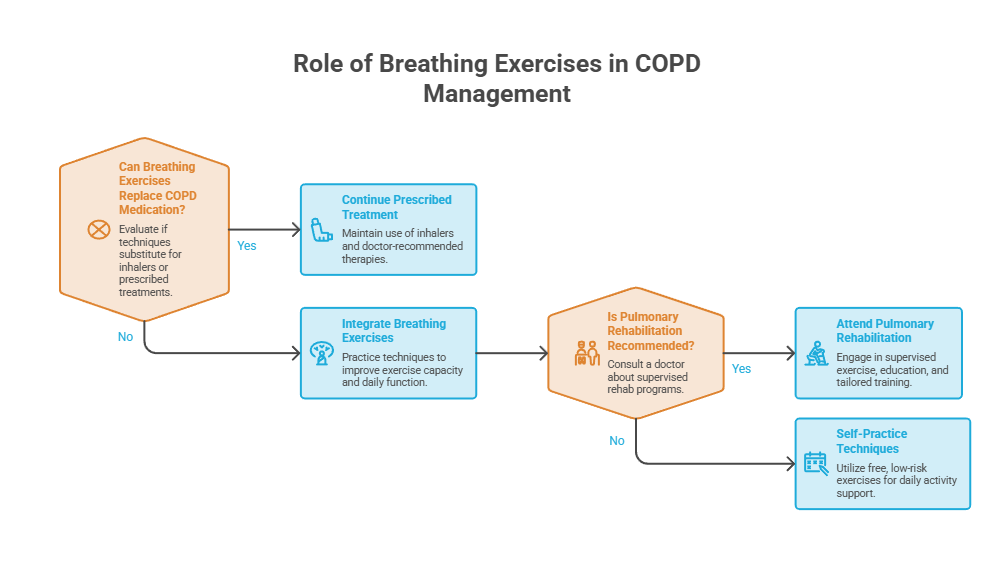
Think of breathing techniques as one tool alongside your prescribed treatment, not a swap for it. Breathing exercises should not replace your medications; they work best as part of your overall COPD treatment plan, alongside inhalers and other therapies your doctor recommends.
These same techniques are taught in pulmonary rehabilitation, the supervised programs that combine exercise, education, and breathing training. A respiratory therapist can tailor the set to your stage of COPD, so the techniques fit your lungs rather than a generic checklist. If you haven’t been referred yet, it’s worth asking whether you qualify, since many people with COPD benefit from a rehab program.
Building a Daily Breathing Routine
Skills you only try during a crisis rarely work when it counts. The goal is to practice when you’re calm so the techniques feel automatic the moment you’re breathless.
How Often and How Long
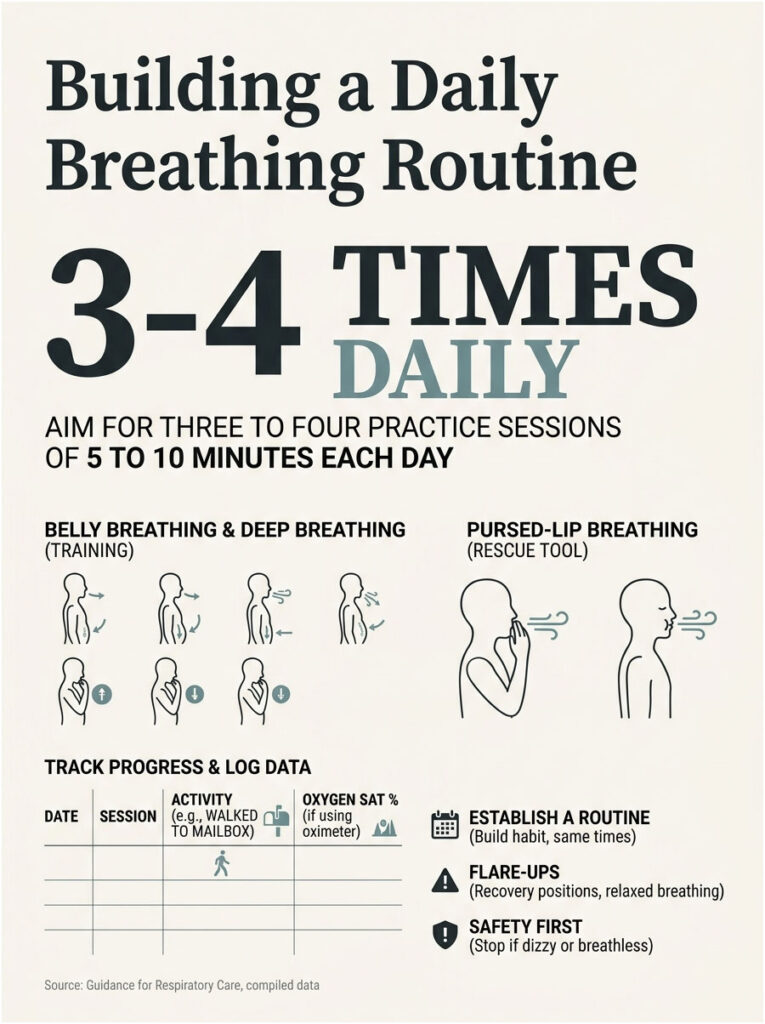
A practical target is steady, short sessions. Work up to 5 to 10 minutes, three to four times a day. On harder days, shorter and more frequent is fine.
Daily repetition is what builds the muscle memory. Aim for three to four practice sessions spread throughout your day, since the more regularly you practice, the more natural these techniques become.
Pairing Techniques
Use belly breathing and deep breathing as your training sessions, then keep pursed-lip breathing as your rescue tool. Add coordinated and paced breathing for specific tasks like stairs or chores.
Recovery positions and relaxed breathing are your flare-up kit, the combination to reach for when symptoms spike or a chest infection sets in. Patients commonly ask us which to start with, and belly breathing first usually makes the others easier to learn.
Tracking Your Progress
Notice what you can do this month that left you winded last month, such as walking to the mailbox or finishing a shower without stopping. Those real-world wins matter more than any single number.
If you use a pulse oximeter, your care team may ask you to log your oxygen saturation during activity. Bring that record to appointments so adjustments can be made. Small, steady gains are the realistic goal with COPD, and noticing them helps you stay motivated to keep practicing.
A Simple 10-Minute Daily Routine
Putting the techniques together is easier than it sounds. Here’s a gentle daily sequence many patients use, scaled up or down to match how the day is going.
- Minutes 1 to 2: Sit comfortably and do relaxed breathing to settle, keeping the exhale longer than the inhale.
- Minutes 3 to 5: Practice diaphragmatic (belly) breathing with one hand on your stomach.
- Minutes 6 to 7: Switch to pursed-lip breathing, the technique you’ll actually reach for in real life.
- Minute 8: If your chest feels congested, do two or three rounds of huff coughing.
- Minutes 9 to 10: Finish with slow deep breathing, elbows slightly back, then rest.
Stop sooner if you feel dizzy or more breathless, and never push through real distress. Our pulmonary health team recommends practicing at the same times each day so it locks in as a habit.
Lifestyle Habits That Make Breathing Easier
Breathing techniques work best inside a wider routine that protects your lungs. A few daily habits can lower how often you feel breathless in the first place.
Stay Active and Pace Yourself
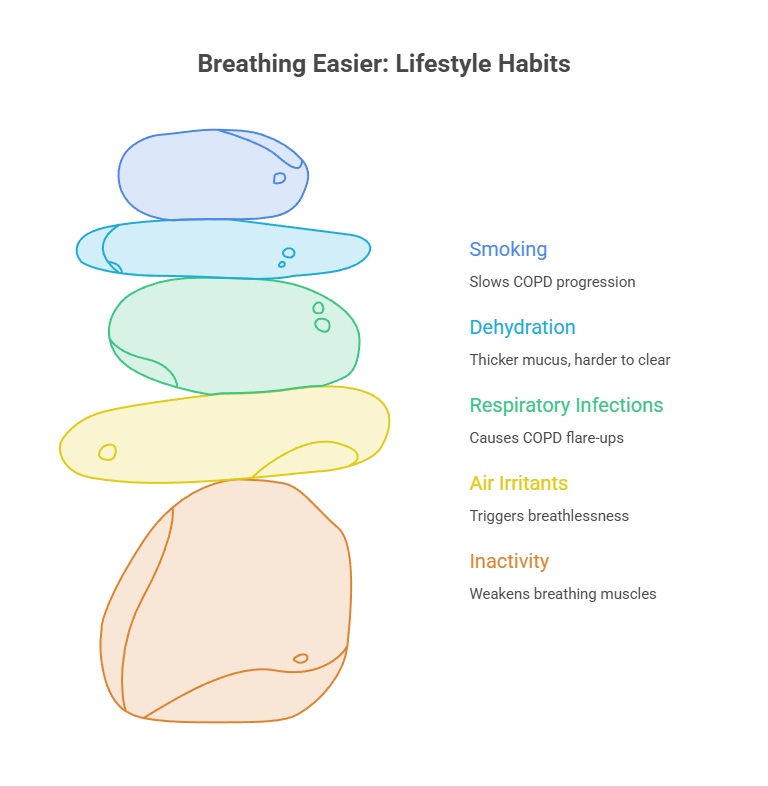
It’s tempting to avoid activity when breathing is hard, but inactivity weakens the muscles that support breathing and makes things worse over time. Gentle, regular movement like walking gradually builds the stamina that makes everyday tasks feel easier.
Pacing is the partner skill. Break tasks into smaller steps, sit to do chores when you can, and rest before you’re exhausted rather than after. Across the patients we serve, smart pacing often does as much for daily comfort as any single exercise.
Protect Your Lungs from Triggers
Airborne irritants can set off breathlessness fast. On poor air-quality days, during wildfire smoke, or through high-pollen stretches, stay indoors when you can, keep windows closed, and run air conditioning or a filter.
Cold, dry air and strong fumes from cleaning products or perfumes are common triggers too. Covering your nose and mouth with a scarf in winter and switching to unscented products can both reduce flare-ups.
Vaccines, Hydration, and Quitting Smoking
Respiratory infections are a leading cause of COPD flare-ups, so staying current on flu, COVID-19, and the recommended pneumonia and RSV vaccines matters. Ask your doctor which ones are right for you.
Drinking enough water keeps mucus thinner and easier to clear with huff coughing. And if you smoke, quitting is the single most effective step to slow COPD, even after a long history, and your care team can connect you with proven cessation support.
None of these habits replace your breathing techniques or your medication; they stack with them. The patients who breathe easiest tend to combine daily practice, steady activity, trigger control, and consistent medical care.
Common Mistakes That Make Breathlessness Worse
Small habits can undo good technique. Recognizing them helps you correct course quickly.
The biggest one is forcing the exhale. Breathing out should be slow and unforced; don’t push the air out. Forcing it can collapse the airways and trap more air.
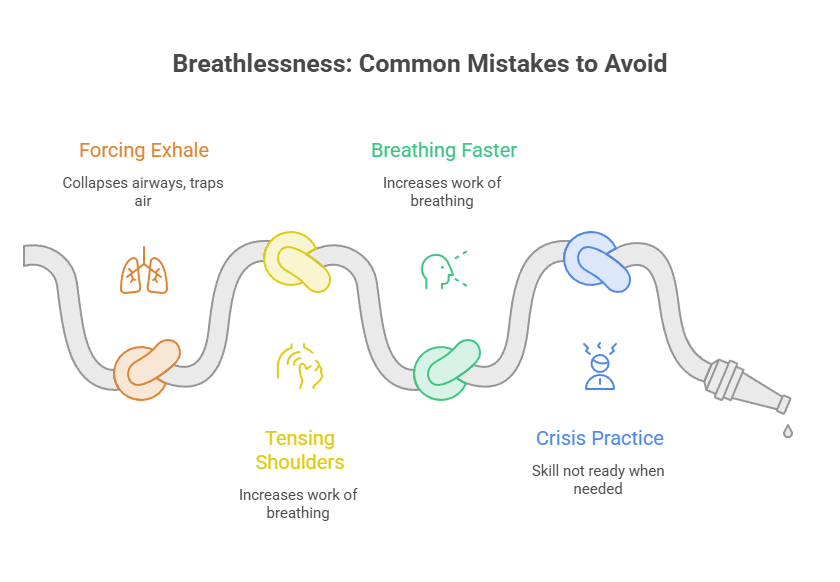
Two others come up again and again. Tensing your shoulders and breathing faster both increase the work of breathing, so relax your neck and shoulders first. And waiting until a crisis to practice means the skill isn’t ready, so build it into calm moments daily.
When Breathlessness Is an Emergency
Breathing techniques are for manageable, familiar shortness of breath. They are not a substitute for emergency care when something is clearly wrong.
Call 911 or get emergency help for blue or gray lips or fingertips, confusion or trouble staying awake, chest pain, a fast or irregular heartbeat, or being unable to speak in full sentences. If your rescue inhaler isn’t helping and your breathing keeps getting worse, treat it as urgent.
The table below is a quick guide for common situations. Our pulmonary health team recommends keeping it somewhere visible until the responses feel second nature.
| Your Situation | What to Try First | Why |
| Sudden breathlessness on stairs | Stop, then paced “blow as you go” with pursed-lip breathing | Slows breathing and releases trapped air |
| A wave of panic with breathlessness | Recovery position plus relaxed, slow breathing | Breaks the anxiety and faster-breathing loop |
| Chest feels full of mucus | Huff coughing, then rest | Clears secretions without exhausting you |
| Winded after light activity | Sit, lean forward, pursed-lip breathing | Lowers the work of breathing and resets |
| Breathless during chores or lifting | Coordinated breathing (exhale on effort) | Prevents breath-holding that triggers symptoms |
| Blue lips, confusion, or chest pain | Call 911 | These are emergency signs, not a breathing fix |
COPD by the Numbers (United States)
A little context shows why daily breathing skills are worth the effort. COPD is common, costly, and closely tied to quality of life across the country.
| Metric | Figure | Source |
| US adults with diagnosed COPD (2022) | 11.7 million (4.6%) | American Lung Association |
| US ranking as a cause of death (2023) | 5th, 141,733 deaths | CDC NCHS |
| Annual US medical costs (adults 45+) | About $24 billion | CDC NCHS |
| State prevalence range (2022) | 3% to 12% | CDC |
| Adults with COPD who also have anxiety or depression | About 49.5% | US Pharmacist |
These numbers also explain why the anxiety angle deserves real attention. COPD has no cure and worsens over time, so techniques that improve daily function and calm have lasting value.
Frequently Asked Questions
What is the best breathing technique for COPD?
Pursed-lip breathing is widely considered the single most useful technique because it quickly slows your breathing and releases trapped air during shortness of breath. Diaphragmatic (belly) breathing is the best daily foundation. Most people use both, with pursed-lip breathing as the rescue tool.
How do I stop COPD shortness of breath fast?
Stop what you’re doing, sit down, and relax your shoulders. Lean slightly forward, then use pursed-lip breathing, breathing in through your nose for two counts and out through pursed lips for about four. Stay there until your breathing settles, then move slowly.
How does pursed-lip breathing help?
It creates gentle back-pressure that keeps your airways open longer, so trapped, stale air can escape and fresh air can come in. It also slows your breathing rate and calms you down, which makes each breath more effective during shortness of breath.
How often should I do COPD breathing exercises?
Aim for 5 to 10 minutes, three to four times a day, especially when you’re calm. Daily practice builds the muscle memory that makes techniques automatic during a flare. On harder days, shorter and more frequent sessions still help.
Can breathing exercises improve my lung function?
They won’t reverse COPD or change your underlying lung function much, but a Cochrane review found that several weeks of practice improved exercise capacity. Many people breathe with less effort, stay calmer, and do more daily activity, which is a meaningful gain.
What is the best position for COPD shortness of breath?
Leaning forward helps most. Sit and rest your forearms on your thighs or a table, or stand and lean against a counter or wall. These recovery positions take strain off your diaphragm, and they work best combined with pursed-lip breathing.
Are breathing exercises a substitute for my inhaler?
No. Breathing techniques support your treatment but never replace prescribed medications, inhalers, or therapies. Keep taking everything exactly as prescribed unless your doctor tells you otherwise. Think of breathing exercises as one extra tool in your overall COPD plan.
Which breathing technique helps when climbing stairs?
Use paced breathing, or “blow as you go.” Inhale through your nose at rest, then exhale slowly through pursed lips as you step up during the hardest part. Climb two or three steps per breath cycle and pause whenever you need to.
Can breathing exercises help during a COPD flare-up?
Yes, for manageable symptoms. Recovery positions, pursed-lip breathing, and relaxed breathing can ease a flare and calm the panic. But if you have blue lips, confusion, chest pain, or your rescue inhaler isn’t working, treat it as an emergency and call 911.
Is diaphragmatic breathing safe for everyone with COPD?
For most people it’s gentle and helpful, but it can feel harder for some and isn’t right for everyone. Work with your pulmonologist or respiratory therapist to confirm which techniques suit you, especially if belly breathing leaves you more breathless or tired.
What if breathing exercises make me dizzy or more breathless?
Stop and return to your normal breathing for a few minutes. Dizziness can come from breathing too fast or too deeply at first. Slow down, shorten the session, and check with your doctor or respiratory therapist if it keeps happening.
Do breathing techniques help with breathlessness anxiety?
Yes. Slow, relaxed breathing with a longer exhale signals your nervous system to calm down, which slows your breathing rate and eases the panic that makes breathlessness worse. Given how often COPD and anxiety overlap, this benefit is genuinely valuable.
Disclaimer: This article is for general educational purposes only and is not a substitute for professional medical advice, diagnosis, or treatment. COPD care should be guided by your doctor, pulmonologist, or respiratory therapist, and breathing techniques work alongside, not instead of, your prescribed treatment. If you experience severe or sudden shortness of breath, blue lips, confusion, or chest pain, seek emergency care or call 911.
References
- Breathing Exercises for Better Lung Health, American Lung Association
- COPD Trends Brief: Prevalence, American Lung Association
- Breathing Exercises for COPD, Cleveland Clinic
- Breathing Techniques, COPD Foundation
- COPD Prevalence and Mortality Data Brief, CDC NCHS
- State-Level Estimates of COPD, CDC
- COPD and Exercise: Breathing Programs, WebMD
- COPD Prevalence, Risks, and Mortality, US Pharmacist