
Your toddler is burning up with a cold, and then, without warning, their whole body stiffens and starts to shake. For most parents, a febrile seizure is one of the most frightening things they will ever witness, yet the truth is that it is almost always harmless.
Table of Contents
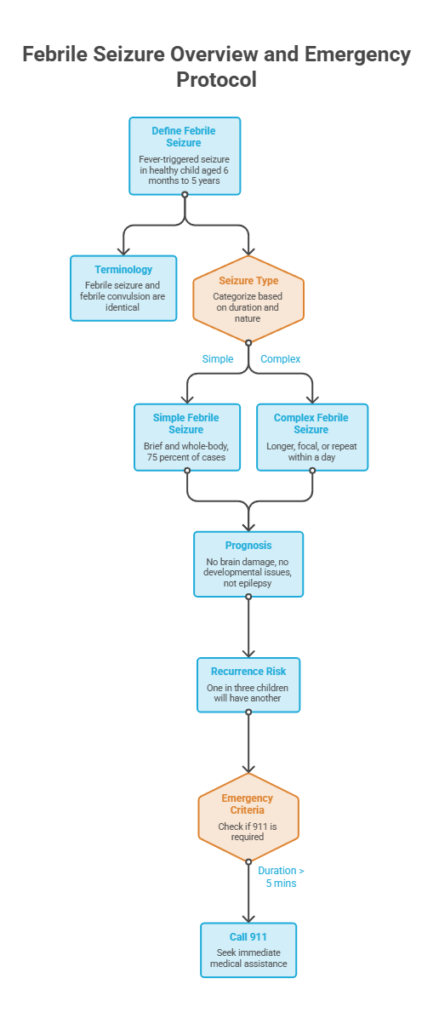
Quick Answer: A febrile seizure (also called a febrile convulsion) is a seizure triggered by a fever in an otherwise healthy child between 6 months and 5 years old. It usually causes stiffening, whole-body shaking, and a brief loss of consciousness, and most last under five minutes. These seizures look terrifying but rarely cause harm. Stay calm, ease your child to a safe surface, turn them on their side, time the seizure, and call 911 if it lasts longer than five minutes.
At a Glance
• A febrile seizure is a fever-triggered seizure in a healthy child aged 6 months to 5 years, peaking at 12 to 18 months.
• “Febrile seizure” and “febrile convulsion” are two names for the same event.
• Simple febrile seizures (about 75 percent of cases) are brief and whole-body; complex ones are longer, focal, or repeat within a day.
• Most cause no brain damage, no developmental problems, and do not mean your child has epilepsy.
• Roughly one in three children who have one will have another.
• Call 911 if a seizure lasts over five minutes, your child struggles to breathe, or it is their first seizure.
What Is a Febrile Seizure (or Febrile Convulsion)?
A febrile seizure is a convulsion brought on by a fever in a young child whose brain is still developing. The NINDS defines it as a seizure caused by a fever in healthy infants and young children, and most occur within 24 hours of a child getting sick.
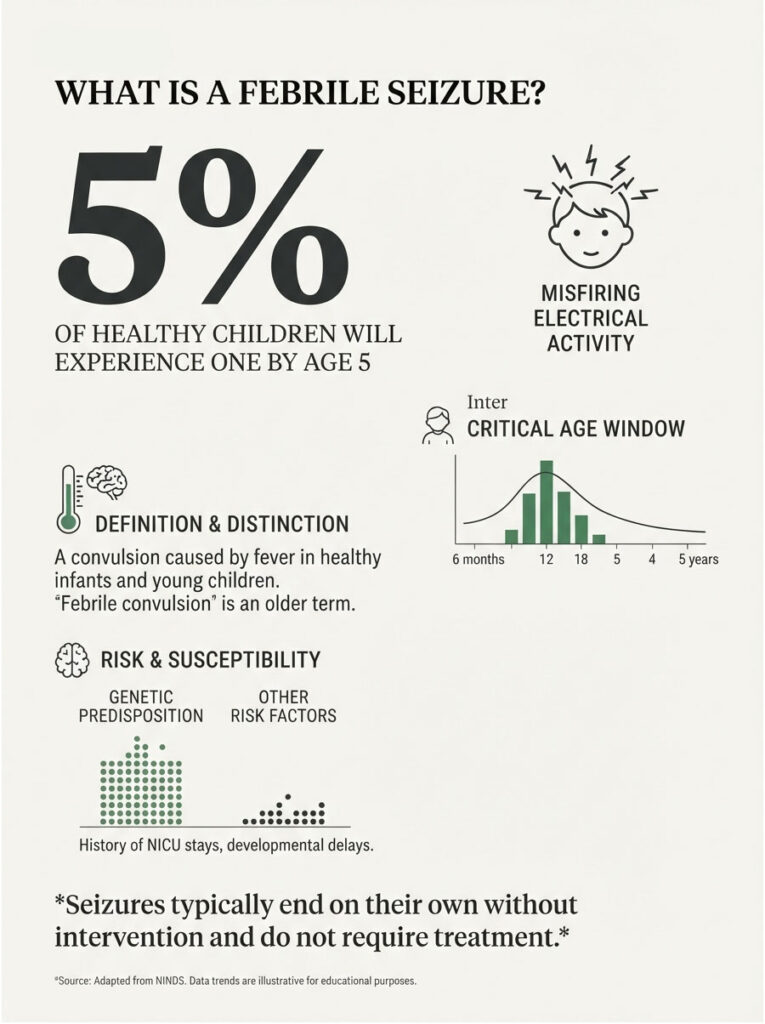
During one, the electrical activity in the brain briefly misfires in response to the rising temperature. The result is the shaking, stiffening, or twitching that parents find so alarming.
Parents call our support line most often after a first fever seizure, usually convinced their child is in danger. In the large majority of cases, the child is fine within minutes and back to normal by the next day.
Febrile Seizure vs Febrile Convulsion: Same Thing?
Yes. “Febrile convulsion” is simply the older and more British term, while “febrile seizure” is the phrase used most in US pediatric care today.
There is no medical difference between the two. If your pediatrician says one and a website says the other, they are describing the identical event, so there is no need to hunt for a hidden distinction.
What Happens in the Brain During a Fever Seizure
A fever changes the chemistry and excitability of a child’s developing brain. In some children, a fast rise in temperature tips groups of neurons into firing together in an uncontrolled burst.
That burst is the seizure. Once the brain settles, the seizure ends on its own, which is why these episodes are usually brief and stop without any treatment.
Researchers believe genetics play a real role, since susceptibility often runs in families and several genes have been linked to it. A child is not doing anything wrong, and neither is a parent, when a fever crosses that threshold.
Who Gets Them, and at What Age
Febrile seizures affect children between 6 months and 5 years of age, with the greatest risk between 12 and 18 months. A seizure with fever in a child 6 years or older is generally not classified as a febrile seizure.
They tend to run in families, so a parent or sibling who had one raises the odds. Otherwise, these seizures strike healthy, typically developing children, not those with an existing brain or developmental condition. A few children carry a somewhat higher baseline risk, including those who spent more than 28 days in a neonatal intensive care unit or who have a developmental delay, as the NINDS notes.
Febrile seizures are the most common type of seizure in children under 5. The Merck Manual reports they occur in about 2 to 5 percent of children aged 6 months to 5 years, and Cincinnati Children’s estimates that about 1 in 25 children will have one by age 5.
What a Febrile Seizure Looks Like
Knowing what to expect makes a febrile seizure far less terrifying if it happens again. The picture is fairly consistent from child to child, even though every episode feels unique in the moment.
Common Signs and Symptoms
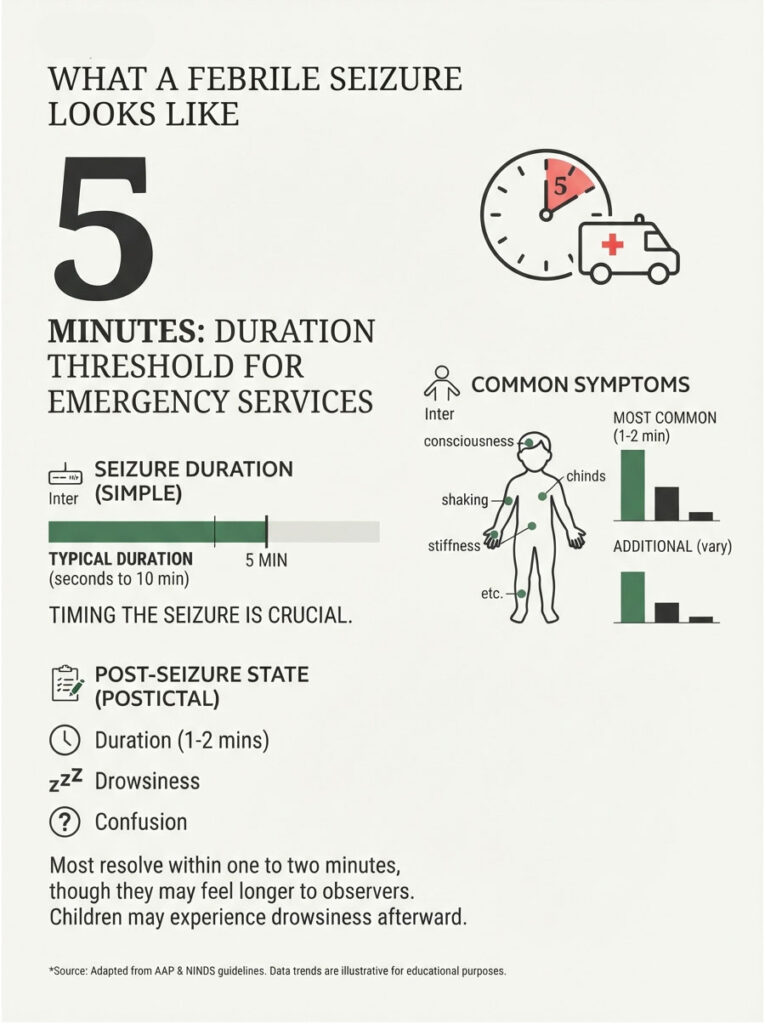
Most children lose consciousness and shake all over. Some go stiff, some twitch in just one area, and the eyes often roll back.
Other signs include clenched teeth, moaning or crying out, and loss of bladder or bowel control. A febrile seizure can also be as mild as the eyes rolling or the limbs briefly stiffening, so not every event involves dramatic shaking.
Skin may look pale or slightly bluish around the lips during the seizure, which alarms parents but usually passes as the seizure ends. The team members who staff our parent line hear this detail often, and it is one of the most common reasons a first seizure feels life-threatening.
How Long They Usually Last
A simple febrile seizure stops by itself within a few seconds to about ten minutes. Most are over in one to two minutes, though those minutes can feel far longer to a watching parent.
Timing the seizure, even roughly by glancing at a clock or phone, is one of the most useful things a parent can do. The five-minute mark is the key threshold for calling 911, so a rough count genuinely guides your next move.
What Happens Right After
After the seizure, most children are drowsy, groggy, or briefly confused. This recovery phase, called the postictal period, can last from a few minutes to about an hour.
Your child may want to sleep, and that is fine. Stay nearby, keep them on their side, and let them rest as their body recovers from both the seizure and the fever that triggered it. Offer small sips of water once your child is fully alert again, and hold off on food until the grogginess has completely passed.
Simple vs Complex Febrile Seizures
Not all febrile seizures are the same, and the difference guides how doctors respond. The two categories are simple and complex, and most parents are relieved to learn which one applies.
Simple Febrile Seizures
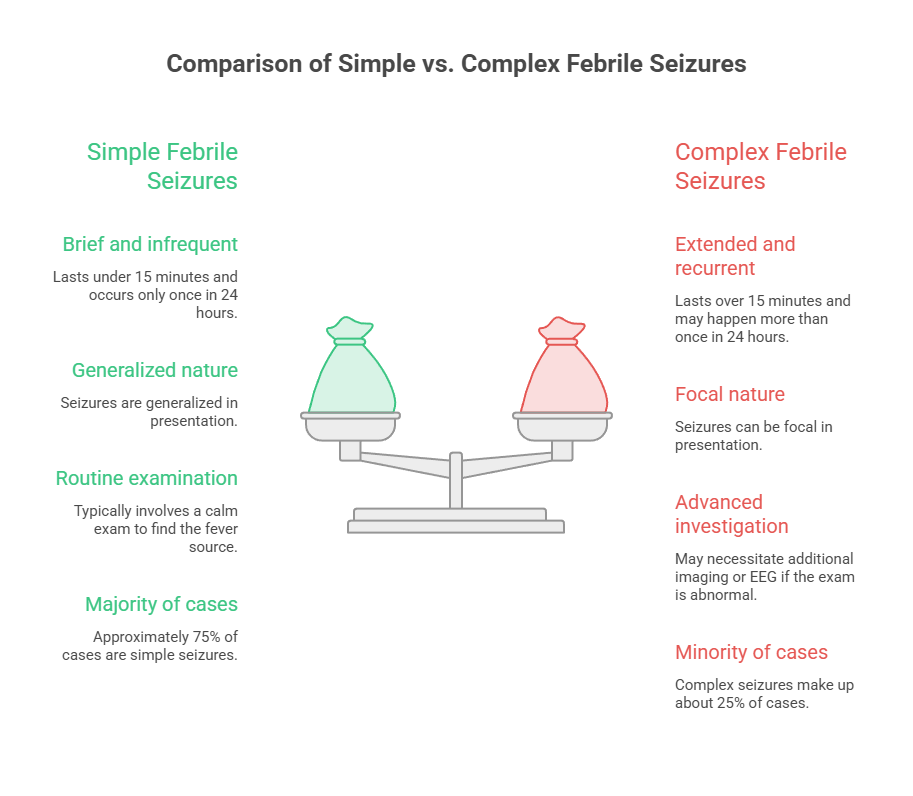
A simple febrile seizure is generalized, meaning it involves the whole body, lasts less than 15 minutes, and does not happen more than once in 24 hours. This is by far the most common type.
These are the seizures that carry the most reassuring outlook. They do not signal a brain problem, and they rarely lead to anything serious in an otherwise healthy child.
Complex Febrile Seizures
A complex febrile seizure has at least one of three features: it lasts longer than 15 minutes, it affects one side or one part of the body (focal), or it happens more than once within 24 hours.
Complex seizures are less common and prompt a closer look. They do not automatically mean something is wrong, but they change the evaluation a doctor may recommend and slightly shift the long-term odds.
Why the Difference Matters
The simple-versus-complex split shapes both the workup and the long-term outlook. Simple seizures usually need only a calm exam to find the source of the fever, while complex ones may warrant more evaluation.
In cases reviewed by our pediatric advisors, most families learn their child had the simple type and can be fully reassured. The table below breaks down the two side by side.
| Feature | Simple Febrile Seizure | Complex Febrile Seizure | Why It Matters |
| Duration | Under 15 minutes | Longer than 15 minutes | Longer seizures need closer evaluation |
| Pattern | Whole-body (generalized) | One side or one area (focal) | Focal features prompt a neurological exam |
| Number in 24 hours | Just one | Two or more | Repeats can signal a complex course |
| Share of cases | About 75 percent | About 25 percent | Most children have the milder type |
| Typical evaluation | Exam plus finding the fever source | May add imaging or EEG if the exam is abnormal | Tests are targeted, not routine |
What Causes Febrile Seizures?
The trigger is the fever, not a seizure disorder. Understanding what drives that fever helps put the whole event in context and lowers the fear around it.
The Fever, Not the Illness Itself
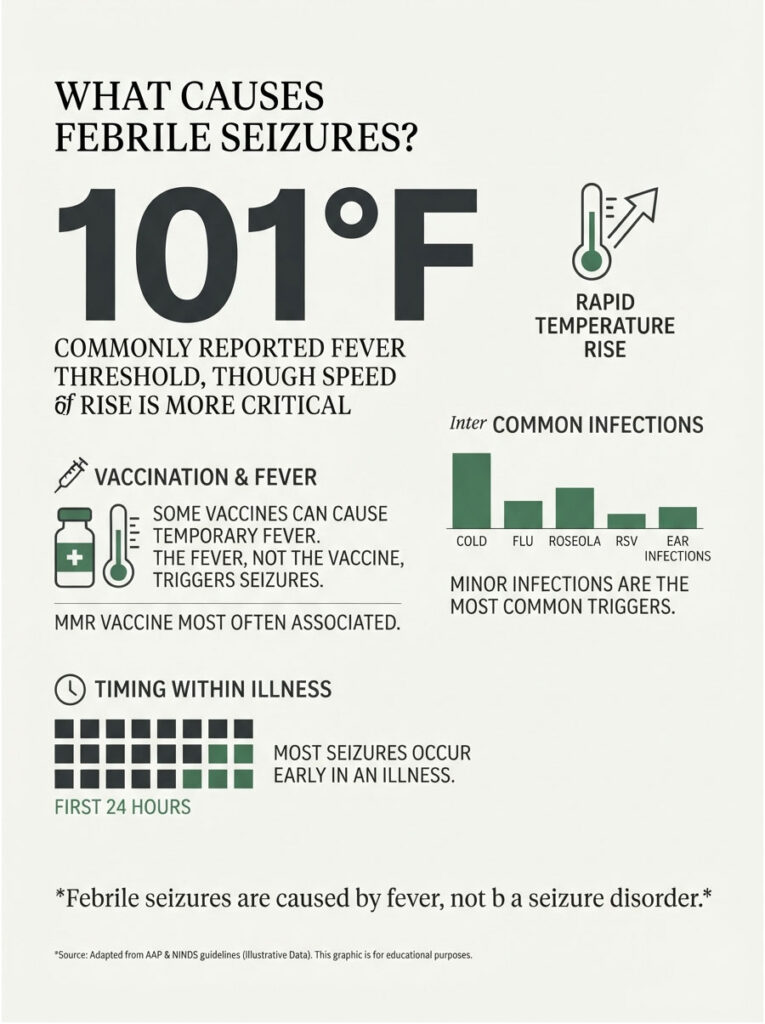
Febrile seizures usually result from the fever itself, most often caused by an otherwise minor infection. In these cases, both the infection and the seizure are harmless.
Doctors examine the child to confirm the fever has a common cause. Less often, a seizure with fever can be the first sign of a more serious problem, which is why a first seizure always deserves a medical look.
Common Infections That Trigger Them
The usual culprits are everyday childhood illnesses. These seizures may happen when a child has a cold, the flu, roseola, chickenpox, COVID-19, RSV, or an ear infection.
Roseola in particular is a frequent trigger because it can cause a sudden high fever in toddlers. Most febrile seizures occur within the first 24 hours of an illness, sometimes before parents even realize the child is sick.
Vaccines and Febrile Seizures
Some childhood vaccines can cause a fever as a side effect, and rarely a febrile seizure follows. It is important to understand that the fever, not the vaccine itself, is what triggers the seizure.
The MMR (measles, mumps, rubella) shot is the one most often linked to this small, temporary rise in fever. Guidance from the CDC and pediatric bodies is consistent: vaccine-associated febrile seizures are uncommon and brief, and the protection vaccines provide against serious fever-causing diseases far outweighs this small risk.
What Temperature Triggers a Seizure?
Any fever can trigger a febrile seizure. A commonly reported temperature is above 101 degrees Fahrenheit, but there is no fixed cutoff, and a seizure can occur at a lower reading.
The speed of the temperature rise seems to matter more than the peak. That is why a seizure often strikes during the first few hours of a fever, sometimes before the fever reaches its highest point, and why a lower fever does not mean your child is in the clear.
What to Do During a Febrile Seizure (First Aid)
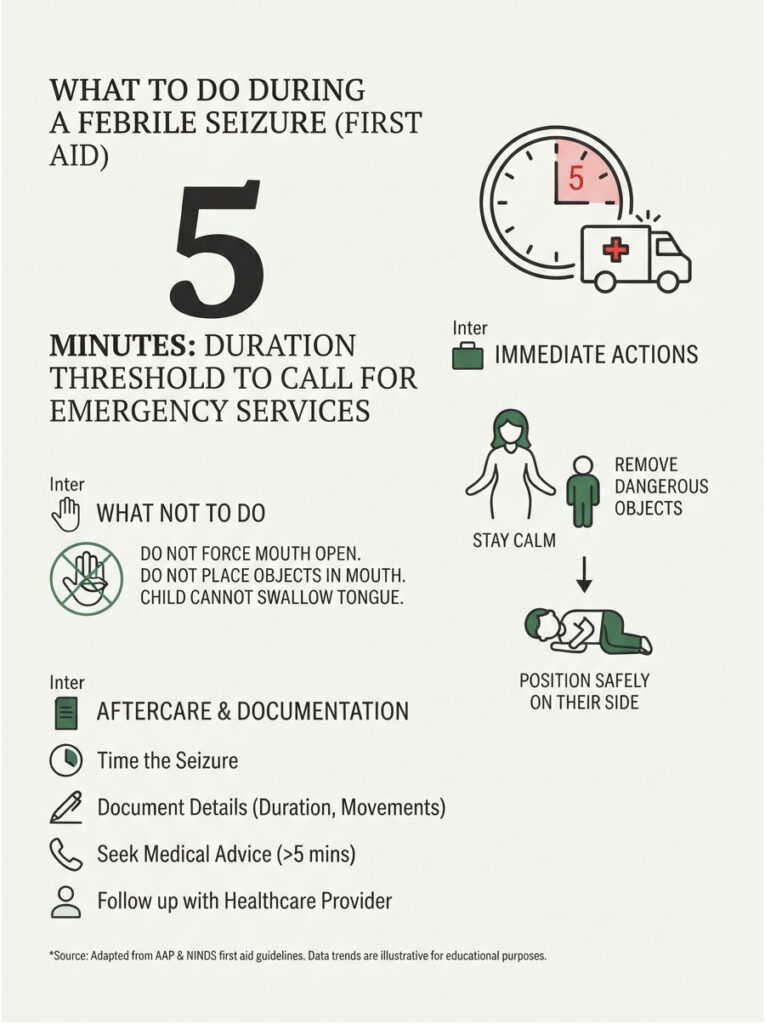
The right response is simple, and doing it well protects your child. The goal is safety, not stopping the seizure, which will end on its own.
Step by Step: Stay Calm and Protect Your Child
Keeping a clear head is the hardest and most helpful part. Follow these steps:
- Note the time the seizure starts so you can track how long it lasts.
- Gently place your child on the floor or a bed, away from stairs and hard edges.
- Turn your child onto their side so saliva can drain and breathing stays clear.
- Loosen any tight clothing around the neck.
- Clear away nearby objects, and put something soft under the head.
- Stay with your child and watch closely until the seizure ends and recovery begins.
What NOT to Do
Some instincts do more harm than good during a seizure. Avoid these actions:
- Do not try to hold or restrain your child.
- Do not put anything, including your fingers or medicine, in your child’s mouth.
- Do not try to give fever-reducing medicine mid-seizure.
- Do not place your child in cool or lukewarm water to bring the fever down.
Families we work with often ask whether they should force the mouth open to protect the tongue. You should not; a child cannot swallow their tongue, and objects in the mouth can cause choking or injury. After it ends, note what you saw so you can describe it clearly to the doctor.
When to Call 911 or Head to the ER
Most febrile seizures do not require an ambulance, but a few situations do. Knowing the red flags removes the guesswork in a stressful moment.
Emergency Red Flags
Call 911 or go to the emergency room right away if the seizure lasts longer than five minutes, if your child has trouble breathing or turns blue, or if seizures happen one after another without full recovery in between.
You should also seek urgent care for a first-ever febrile seizure, or if your child has a stiff neck, a spreading rash, persistent vomiting, or will not wake up afterward. These can point to a more serious infection, such as meningitis, that needs prompt attention.
When a Same-Day Doctor Visit Is Enough
If the seizure was brief, your child is known to have simple febrile seizures, and they recover normally, a same-day call to your pediatrician is usually enough. The visit focuses on finding and treating the source of the fever.
The table below turns these situations into clear actions.
| Scenario | Likely Meaning | What to Do |
| Seizure stops within 5 minutes, child is breathing | Typical simple febrile seizure | Comfort your child, then call your pediatrician |
| Seizure lasts longer than 5 minutes | Possible prolonged seizure | Call 911 now |
| Child stops breathing or lips turn blue | Airway emergency | Call 911 now |
| First febrile seizure your child has ever had | Needs a cause check | Contact your doctor same day, ER if any red flag |
| More than one seizure in the same illness | Complex pattern | Seek same-day medical care |
| Seizure with stiff neck, rash, or won’t wake up | Possible serious infection | Call 911 or go to the ER |
Are Febrile Seizures Dangerous? Long-Term Effects
This is the question that keeps parents awake, and the evidence is genuinely reassuring. For the vast majority of children, a febrile seizure leaves no mark at all.
The Reassuring Truth About Brain Damage and Development
Most febrile seizures produce no lasting effects. According to Mayo Clinic, simple febrile seizures do not cause brain damage, intellectual disability, or learning problems, and they do not mean a child has a more serious underlying disorder.
Long-term studies back this up. A single febrile seizure has not been linked to lower intelligence, behavioral problems, or trouble with learning and memory later in childhood.
One rare exception is worth naming: a seizure lasting longer than about 30 minutes, or clustered seizures without recovery, is called febrile status epilepticus and needs emergency treatment. This is precisely why the five-minute rule for calling 911 exists, so a long seizure gets care quickly.
Do Febrile Seizures Cause Epilepsy?
Febrile seizures are provoked seizures, meaning they are triggered by fever, and they are not the same as epilepsy, which involves recurrent unprovoked seizures. Having a febrile seizure does raise the odds of epilepsy slightly, but the absolute risk stays low.
The numbers put this in perspective. Research summarized by the AAFP shows the risk of epilepsy ranges from about 2.4 percent after simple febrile seizures to 6 to 8 percent after complex ones, compared with roughly 1 percent in the general population. Children with febrile seizures are about five times more likely to develop later unprovoked seizures than children who never had one, yet the great majority never develop epilepsy at all.
Will It Happen Again? Recurrence Risk
If your child has had one febrile seizure, the odds of a second are worth knowing. This is one of the most common follow-up questions parents ask us after that first frightening night.
The Odds of a Second Seizure
About one third of children who have a febrile seizure will have another during a later illness. Most children who have a recurrence have only one or two more in total.
The risk is highest in the first year or two after the first seizure. After age 5, febrile seizures almost always stop as the developing brain matures.
What Raises the Recurrence Risk
A few factors push the recurrence odds higher. According to StatPearls, children younger than 12 months at their first febrile seizure have about a 50 percent chance of a second one within the first year.
Other risk factors include a lower fever at the time of the seizure, a short interval between the fever starting and the seizure, and a family history of febrile seizures. A review published by the NIH notes that children with all of these risk factors have about a 76 percent recurrence rate, compared with roughly 4 percent for children with none.
Febrile Seizures by the Numbers
Numbers can steady a worried mind. The data consistently shows these events are common and, for most children, benign.
| Measure | Figure | Source |
| US children who have a febrile seizure (ages 6 months to 5 years) | 2 to 5 percent (about 1 in 25 by age 5) | NINDS / Cincinnati Children’s |
| Peak age of risk | 12 to 18 months | Mayo Clinic |
| Share that are simple (not complex) | About 75 percent | NIH review |
| Chance of a second febrile seizure | About 33 percent (one third) | AAFP |
| Epilepsy risk after a simple febrile seizure | About 2.4 percent | AAFP |
| Epilepsy risk after a complex febrile seizure | 6 to 8 percent | AAFP / StatPearls |
Read together, these figures tell a hopeful story. Febrile seizures are widespread, mostly of the milder simple type, and only a small fraction of children go on to have any lasting neurological condition.
Diagnosis, Treatment, and Fever Management
Care after a febrile seizure is usually straightforward. The focus is on finding the fever’s cause and keeping your child comfortable while the illness runs its course.
What to Expect at the Visit
A doctor will examine your child and ask you to describe the seizure in detail, so your notes on timing and appearance help a great deal. In most cases of a simple febrile seizure, no other treatment is needed beyond treating the underlying illness.
Routine blood tests, brain imaging, and EEG are generally not recommended for uncomplicated simple febrile seizures. Guidance from the American Academy of Pediatrics, echoed at HealthyChildren.org, also holds that a lumbar puncture is no longer routinely recommended for a child with a simple febrile seizure who otherwise looks well.
Do Fever Reducers Prevent Seizures?
This surprises many parents: lowering the fever does not prevent a febrile seizure. Giving acetaminophen or ibuprofen at the start of a fever may make your child more comfortable, but it will not stop a seizure from happening.
That is because the rapid rise in temperature, not the peak, is the trigger. The clinicians who guide our content stress this point often, because parents sometimes blame themselves for not medicating fast enough, and that guilt is misplaced.
Medications for Prolonged or Recurrent Seizures
Daily anti-seizure medicine is rarely used, because the side effects usually outweigh the benefit for such a benign condition. For children prone to long febrile seizures, a doctor may prescribe a rescue medicine such as rectal diazepam or nasal midazolam to use if a seizure runs long.
These rescue medicines are reserved for specific situations and always come with clear instructions from the treating physician. Most children never need them at all.
Managing Fevers Safely
For the everyday fevers that trigger these seizures, acetaminophen or ibuprofen plus plenty of fluids is the standard approach. Dress your child lightly and keep the room comfortable rather than cold, and skip cold baths and rubbing alcohol. Always follow the dosing on the label for your child’s age and weight, and call your pediatrician if you are unsure, since getting the dose right matters more than driving the fever down fast.
One firm rule: never give aspirin to children or teenagers with a viral illness. Aspirin is linked to Reye’s syndrome, a rare but potentially life-threatening condition, in children recovering from illnesses like the flu or chickenpox.
Frequently Asked Questions
What is the difference between a febrile seizure and epilepsy?
A febrile seizure is provoked by a fever in a young child and is a one-off response to illness. Epilepsy involves recurrent seizures that happen without a fever or other trigger. Having febrile seizures raises the epilepsy risk only slightly, and most children who have them never develop epilepsy.
Are febrile seizures dangerous?
For the vast majority of children, no. Simple febrile seizures do not cause brain damage, developmental delays, or death, and children recover fully. They look frightening but are usually harmless. The main danger during a seizure is injury from falling or choking, which safe positioning prevents.
Can a febrile seizure cause brain damage?
Simple febrile seizures do not cause brain damage or affect intelligence, learning, or behavior, even when studied years later. Very rarely, an extremely prolonged seizure needs urgent treatment, which is why the five-minute rule matters. For typical brief seizures, parents can be genuinely reassured on this point.
What should I do during a febrile seizure?
Stay calm, note the start time, and ease your child onto a safe surface. Turn them on their side, loosen tight clothing, and clear away hard objects. Do not restrain your child or put anything in their mouth. Call 911 if the seizure lasts longer than five minutes.
When should I call 911 for a febrile seizure?
Call 911 if the seizure lasts more than five minutes, if your child has trouble breathing or turns blue, or if seizures occur back to back. Also seek emergency care for a first-ever seizure, a stiff neck, a spreading rash, or if your child will not wake up afterward.
What temperature causes a febrile seizure?
There is no exact temperature. Any fever can trigger one, though a temperature above 101 degrees Fahrenheit is commonly reported. The speed at which the fever rises appears to matter more than how high it climbs, which is why seizures often strike early in an illness.
Do fever reducers prevent febrile seizures?
No. Acetaminophen or ibuprofen can make a feverish child more comfortable, but studies show they do not prevent febrile seizures. Because the rapid rise in temperature is the trigger, medicine given after the fever appears cannot reliably stop a seizure. Use fever reducers for comfort only.
Will my child have another febrile seizure?
About one in three children who have a febrile seizure will have another. The risk is higher if the first seizure happened before 12 months, if the fever was relatively low, or if there is a family history. Most children outgrow febrile seizures entirely by age 5.
Do febrile seizures lead to epilepsy?
Usually not. The epilepsy risk after a simple febrile seizure is about 2.4 percent, only slightly above the roughly 1 percent baseline. Complex febrile seizures carry a somewhat higher risk of 6 to 8 percent. The overwhelming majority of children with febrile seizures never develop epilepsy.
Can vaccines cause febrile seizures?
Rarely, a vaccine can cause a fever that triggers a febrile seizure, most often after the MMR shot. The fever, not the vaccine, is the cause. These events are uncommon and brief, and the protection vaccines offer against dangerous fever-causing diseases far outweighs this small risk.
How long does a febrile seizure last?
Most febrile seizures last from a few seconds to a couple of minutes, and a simple one is defined as lasting under 15 minutes. Seizures longer than five minutes are considered prolonged and require calling 911. After the seizure, brief drowsiness or confusion is normal.
Can my child return to daycare after a febrile seizure?
Yes, once the underlying illness has passed and your child feels well, they can return to daycare. Follow your pediatrician’s advice and any daycare policy on fevers. Let caregivers know about the seizure history so they can respond calmly and appropriately if another fever occurs.
Disclaimer: This article is for general educational purposes and does not replace professional medical advice, diagnosis, or treatment. Any first seizure, any seizure lasting longer than five minutes, and any seizure with breathing trouble, a stiff neck, or failure to wake up needs prompt medical care. Always consult your pediatrician or a qualified healthcare provider about your child’s specific situation, and call 911 in an emergency.
References
- Febrile Seizures, National Institute of Neurological Disorders and Stroke (NIH)
- Febrile Seizures, American Academy of Pediatrics (HealthyChildren.org)
- Vaccine Safety, Centers for Disease Control and Prevention
- Febrile Seizure: Symptoms and Causes, Mayo Clinic
- Febrile Seizure: What It Is, Symptoms and Treatment, Cleveland Clinic
- Febrile Seizures: Risks, Evaluation, and Prognosis, American Academy of Family Physicians
- Febrile Seizure, StatPearls (NIH National Library of Medicine)
- Febrile Seizures: A Review, NIH / PMC