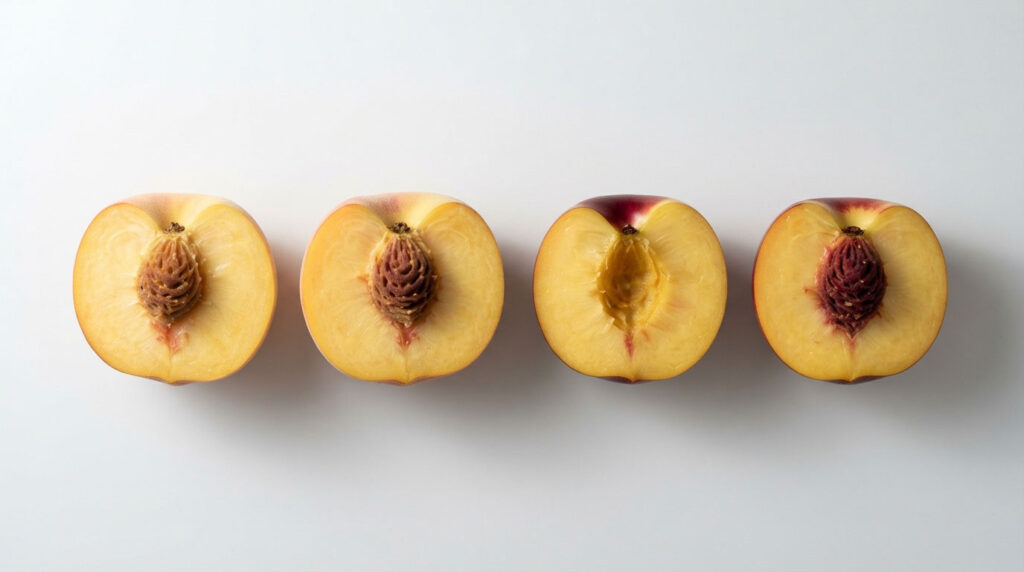
Here’s the part that trips up almost everyone: the fruit most Americans swear tastes sweeter is the one carrying less sugar.
Nectarines wear a name built on the word “nectar,” and shoppers assume that signals a sugar bomb. USDA data says the opposite. Per 100 grams, a nectarine holds about 7.9 grams of sugar while a yellow peach holds about 8.4 grams.
Table of Contents
So the peach vs nectarine question is not the clean swap most people assume. These are close cousins with small, measurable differences that matter in some situations and vanish in others.
Quick Answer
Peaches and nectarines are the same species, separated by a single gene that controls skin fuzz. Per 100 grams, a peach has fewer calories (39 vs 44) and more vitamin C (6.6 mg vs 5.4 mg). A nectarine has more fiber (1.7 g vs 1.5 g), more potassium (201 mg vs 190 mg), more copper, more niacin, and slightly less sugar. Neither is meaningfully healthier. Pick the one you’ll actually eat.
At a Glance
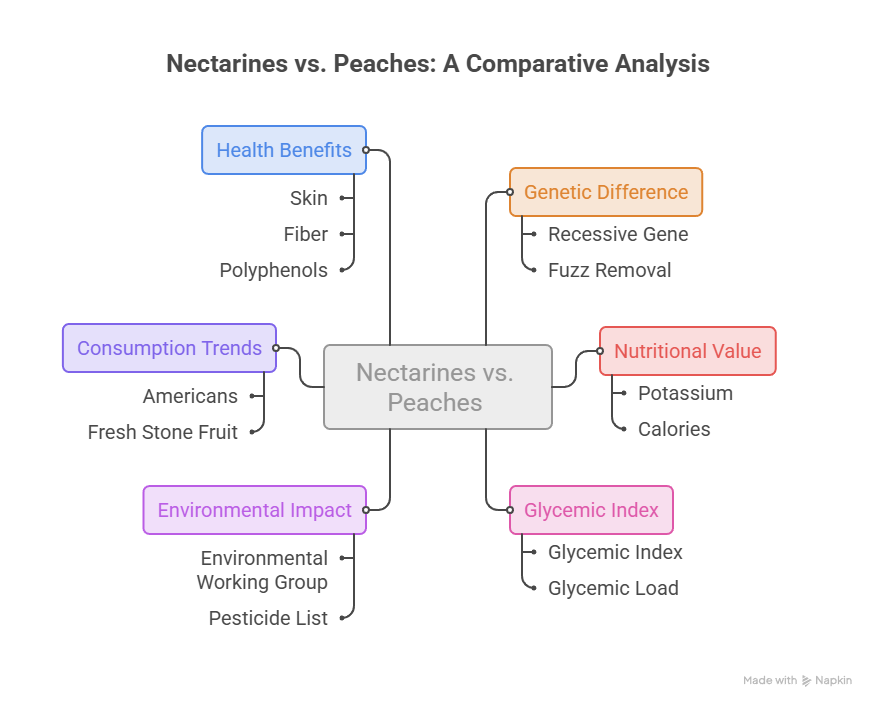
Nectarines are peaches. One recessive gene removes the fuzz, and nothing else about the plant changes.
Per medium fruit, both deliver an identical 285 mg of potassium, roughly 6% of the Daily Value.
A medium peach runs about 59 calories; a medium nectarine about 63 calories.
Both sit in low-glycemic territory (GI around 42 to 43) with a glycemic load near 5.
Nectarines rank No. 5 and peaches No. 6 on the most recent Environmental Working Group pesticide list.
Americans eat roughly one third the fresh stone fruit they ate in 2000, and that gap matters far more than which one you pick.
The skin carries a large share of the fiber and polyphenols in both fruits.
Peach vs Nectarine: Same Species, One Gene Apart
Both fruits are Prunus persica. Botanists classify the nectarine as a variety of peach, not a separate species, and definitely not a peach-plum hybrid.
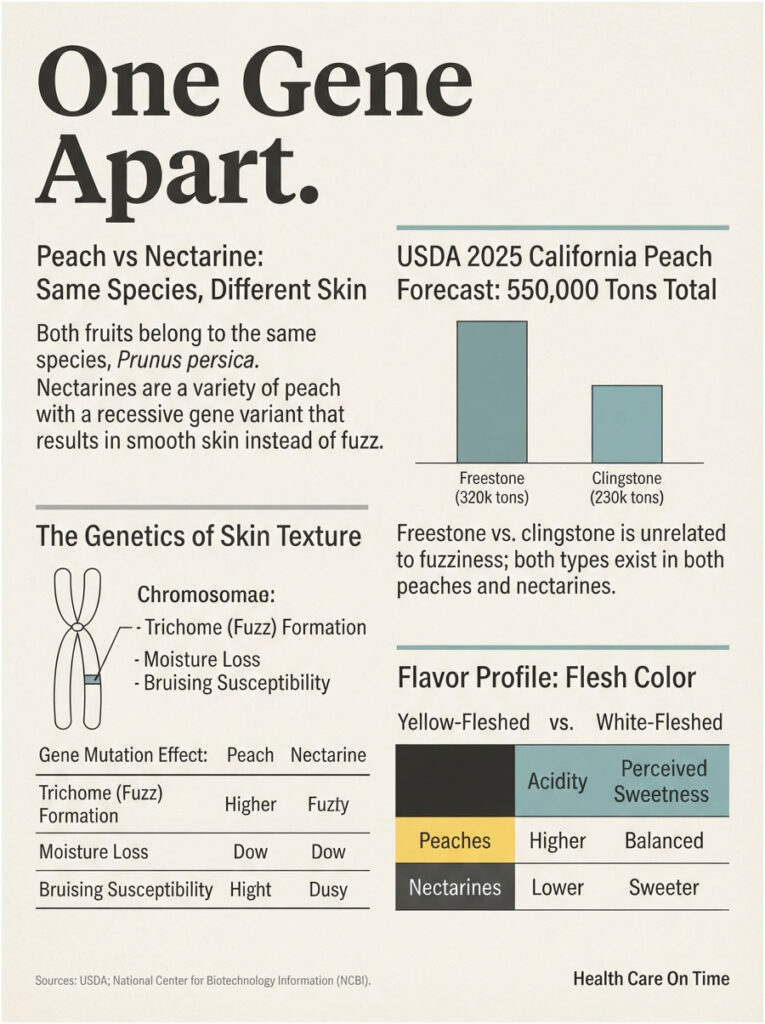
A gene variant between the two causes peaches to grow fuzzy skin and nectarines to grow smooth skin. Nectarines are not genetically modified peaches. Picture a nectarine as a peach that skipped the fuzz.
The mutation is recessive. A peach tree can throw a nectarine and a nectarine tree can throw a peach, something orchard crews in California’s Central Valley encounter every season.
What Actually Makes a Nectarine Smooth
The gene governs trichome formation, the microscopic hairs covering the fruit surface. No fuzz means a thinner, more permeable skin.
That single change carries real downstream effects. Nectarines bruise faster, lose moisture faster, and absorb pesticide residue more readily than fuzzy peaches do.
It also changes how the fruit eats. Nectarine flesh runs firmer and holds its shape better on a grill, in a salad, or under a broiler.
Freestone vs Clingstone Has Nothing to Do With Fuzz
This is the distinction shoppers most often confuse with the peach vs nectarine split. Freestone means the pit pulls away cleanly. Clingstone means the flesh grips it.
Both peaches and nectarines come in freestone, clingstone, and semi-freestone forms. Fuzz and pit behavior are governed by entirely separate traits.
The USDA forecast for the 2025 California peach crop was 550,000 tons, with freestone at 320,000 tons and clingstone at 230,000 tons. Clingstones head almost entirely to canning lines while freestones fill the fresh produce aisle.
If you are buying fruit to slice for a pie, the freestone label saves you a genuinely annoying twenty minutes.
White Flesh vs Yellow Flesh, the Real Sweetness Variable
Want to predict how sweet a piece of stone fruit will taste? Skip the fuzz question and look at the flesh color.
White-fleshed peaches and nectarines carry less malic and citric acid than yellow-fleshed varieties. Lower acid reads as sweeter on the tongue even when measured sugar content is nearly identical.
Ripeness moves the needle further still. A rock-hard nectarine picked green will never develop the sugar of one that ripened on your counter for three days.
Our medical reviewers note that readers asking about “sweet” fruit and blood sugar are usually reacting to perceived sweetness rather than measured carbohydrate. The two disagree more often than people expect.
A Quick Word on What a Nectarine Is Not
Nectarines are not a cross between a peach and a plum. That fruit exists and it’s called a pluot or an aprium depending on the parent mix.
They are also not a laboratory creation. Nectarines have shown up in orchards for well over two thousand years, long before anyone could edit a genome.
And they are not lower in calories, despite a stubborn internet myth. Gram for gram, they run slightly higher.
The Nutrition Numbers, Side by Side
This is where the top-ranking pages on this topic go soft. Numbers first, interpretation second.
All figures below come from USDA FoodData Central Standard Reference entries for peaches (yellow, raw) and nectarines (raw). The per-fruit columns use USDA’s own medium-fruit weights: 150 grams for a peach, 142 grams for a nectarine.
Table 1: Peach vs Nectarine Nutrition, Side by Side
| Nutrient | Peach (100 g) | Nectarine (100 g) | Medium Peach (150 g) | Medium Nectarine (142 g) | Practical Winner |
| Calories | 39 kcal | 44 kcal | 59 kcal | 63 kcal | Peach |
| Total carbohydrate | 9.5 g | 10.6 g | 14.3 g | 15.0 g | Peach |
| Sugars | 8.4 g | 7.9 g | 12.6 g | 11.2 g | Nectarine |
| Dietary fiber | 1.5 g | 1.7 g | 2.3 g | 2.4 g | Nectarine |
| Protein | 0.9 g | 1.1 g | 1.4 g | 1.5 g | Nectarine |
| Vitamin C | 6.6 mg | 5.4 mg | 9.9 mg | 7.7 mg | Peach |
| Potassium | 190 mg | 201 mg | 285 mg | 285 mg | Tie |
| Vitamin A (RAE) | 16 mcg | 17 mcg | 24 mcg | 24 mcg | Tie |
| Copper | 0.07 mg | 0.08 mg | 0.10 mg | 0.12 mg | Nectarine |
| Niacin (B3) | 0.8 mg | 1.1 mg | 1.2 mg | 1.6 mg | Nectarine |
| Vitamin E | 0.73 mg | 0.77 mg | 1.1 mg | 1.1 mg | Tie |
Source: USDA FoodData Central, SR Legacy entries 169928 and 169914.
Per 100 Grams, the Lab Comparison
On a gram-for-gram basis the nectarine looks denser. It carries about 13% more calories, 12% more carbohydrate, and 13% more fiber than a peach.
The peach answers with about 22% more vitamin C. That percentage sounds dramatic until you convert it: 1.2 mg per 100 grams, roughly 1% of an adult’s Daily Value.
Water content explains most of the calorie gap. Peaches run about 89% water; nectarines run about 88%.
Per Medium Fruit, the Grocery-Aisle Comparison
Nobody buys 100 grams of stone fruit. People buy one piece, and USDA’s medium nectarine weighs less than USDA’s medium peach.
That size difference erases most of the per-gram advantage. A medium peach and a medium nectarine both deliver exactly 285 mg of potassium and 24 mcg of vitamin A.
The fiber gap collapses to 0.1 grams. The calorie gap collapses to four calories, less than a single almond.
Why the Per-Piece Numbers Flip the Story
Nearly every competing article on peach vs nectarine nutrition reports per-100-gram data and stops. That framing inflates differences no human being ever experiences at the table.
Real portions are what count. Patients booking metabolic panels through HealthCareOnTime often ask which fruit to cut, and the honest answer is that neither one is the variable worth adjusting.
What the Difference Adds Up To Over a Week
Say you eat one piece of stone fruit daily for seven days. Choosing nectarines over peaches nets you 0.7 grams of extra fiber and 28 extra calories across the entire week.
Switching to peaches nets you roughly 15 mg of extra vitamin C, about what sits in two tablespoons of orange juice.
These are rounding errors inside a daily diet. The difference between eating stone fruit and skipping it is enormous; the difference between the two fruits is not.
How Both Fruits Stack Up Against Other Common Picks
Context helps. Placing peaches and nectarines beside other supermarket staples shows where stone fruit actually sits.
| Fruit (medium, raw) | Calories | Sugar | Fiber | Potassium |
| Peach (150 g) | 59 | 12.6 g | 2.3 g | 285 mg |
| Nectarine (142 g) | 63 | 11.2 g | 2.4 g | 285 mg |
| Apple with skin (182 g) | 95 | 19 g | 4.4 g | 195 mg |
| Banana (118 g) | 105 | 14 g | 3.1 g | 422 mg |
| Plum (66 g) | 30 | 6.6 g | 0.9 g | 104 mg |
| Apricot (35 g) | 17 | 3.2 g | 0.7 g | 91 mg |
Values from USDA FoodData Central. Stone fruit lands in a useful middle zone: fewer calories and less sugar than an apple or banana, more substance than a single plum or apricot.
Where Each Fruit Genuinely Wins
Small advantages still exist, and a few matter if you have a specific target in mind.
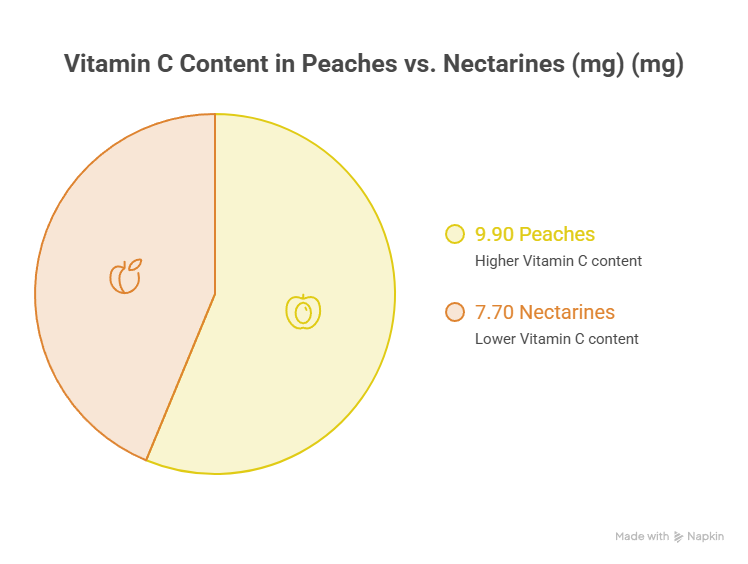
Peach Wins on Vitamin C, Water and Calorie Density
A medium peach supplies about 9.9 mg of vitamin C, close to 11% of the Daily Value. A medium nectarine supplies about 7.7 mg.
Peaches also hold more water per bite, which explains why they read as juicier and why they run slightly lower in calories per gram.
For anyone counting calories tightly, peaches offer marginally more food volume per calorie. The effect is small, but it is consistent.
Peaches edge ahead on vitamin K and riboflavin as well, though both fruits are minor contributors of either.
Nectarine Wins on Fiber, Potassium, Copper and Niacin
Gram for gram, nectarines lead on four nutrients. Nectarine provides more vitamin B1, vitamin B3, iron, phosphorus, and copper, while peach contains more vitamin C, vitamin B2, and vitamin K.
Copper is the standout. A medium nectarine covers roughly 14% of the Daily Value, which is respectable for a fruit that size, and copper supports collagen formation and iron metabolism.
Niacin runs about 33% higher in nectarines per gram. Neither fruit qualifies as a serious niacin source, but the gap shows up consistently across USDA sampling.
Antioxidants and Phenolics, a Near Tie With One Twist
Both fruits carry the same four phenolic families: chlorogenic acids, catechins, anthocyanins, and quercetins.
Research on thinned stone fruit found that thinned nectarine had the highest content of total phenols and total flavonoids, along with the highest antioxidant activity, among six stone fruits tested including apricot, cherry, flat peach, peach, and plum.
That study examined immature thinned fruit rather than supermarket produce, so treat it as a directional signal instead of a verdict.
Variety matters more than fuzz here. A deep-red-blushed nectarine and a deep-red-blushed peach will both out-measure their paler siblings on anthocyanin content.
Chlorogenic Acid, Catechins and Beta-Cryptoxanthin
Chlorogenic acid is the dominant phenolic acid in both fruits, the same compound that draws attention in coffee research.
Beta-cryptoxanthin is the more interesting carotenoid in this comparison. Nectarines carry roughly 98 mcg per 100 grams against 67 mcg in peaches, and the body converts it into vitamin A.
Peaches lead slightly on beta-carotene at about 162 mcg versus 150 mcg. The two fruits effectively split the carotenoid honors.
Work from Texas A&M AgriLife Research reported that peaches, plums and nectarines contain bioactive compounds with anti-obesity, anti-inflammatory and anti-diabetic properties in cell models, and may reduce oxidation of LDL cholesterol.
Cell and animal findings do not translate directly into human outcomes. Our nutrition reviewers treat these as reasons to eat the fruit, not reasons to expect a therapeutic effect.
Skin Matters More Than Fuzz
A large share of the fiber and nearly all of the anthocyanins in both fruits sit in or just beneath the skin.
Peel a peach and you lose roughly a third of its fiber along with much of its polyphenol content. The same holds for nectarines.
Because nectarine skin is thin and hairless, most people eat it without a second thought. Peach skin gets peeled far more often, which is a quiet nutritional cost of choosing peaches.
Blood Sugar, Weight and Heart Health
Here the peach vs nectarine question stops being trivia and starts shaping decisions.
Glycemic Index and Glycemic Load
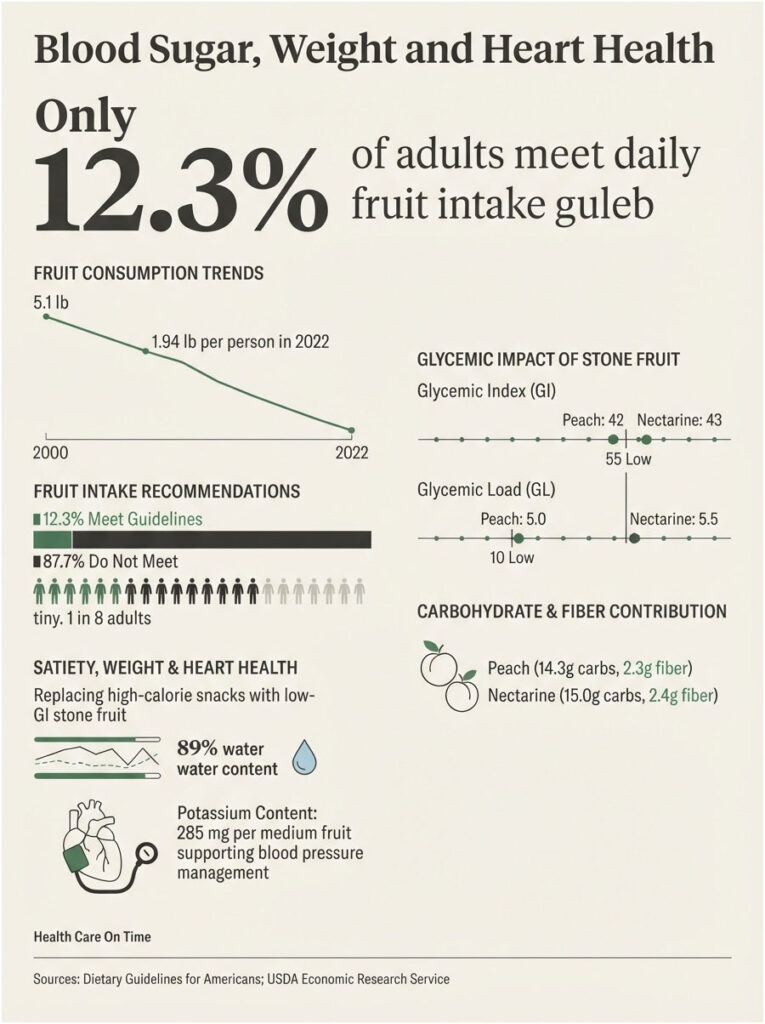
Both fruits land in low-GI territory. Nectarine has a glycemic index of about 43 and peach about 42, and both are considered low GI foods.
Glycemic load is the more useful figure because it accounts for portion size. A medium peach lands near 5 and a medium nectarine near 5.5, both well below the low-GL threshold of 10.
For scale, a single slice of white bread carries a glycemic load around 10. One piece of stone fruit is half that.
What One Medium Fruit Does to a Carb Budget
A medium peach contributes about 14.3 grams of carbohydrate, of which 2.3 grams are fiber. A medium nectarine contributes about 15.0 grams with 2.4 grams of fiber.
Both count as roughly one standard carbohydrate serving in American diabetes meal planning, which uses a 15-gram unit.
That equivalence is the practical takeaway. If your plan allows one fruit serving, a peach and a nectarine are interchangeable within it.
Pairing Rules That Flatten the Curve
Eating stone fruit alongside protein or fat slows gastric emptying and blunts the glucose rise. Sliced nectarine with plain Greek yogurt behaves very differently from the same nectarine eaten alone at 3 p.m.
Eating the skin helps for the same reason, since fiber slows sugar absorption.
Whole fruit beats juice every time. The Dietary Guidelines for Americans specifically emphasize whole fruit over juice, and stone fruit juice strips out the fiber that makes the fruit metabolically friendly.
Patients preparing for HbA1c and fasting glucose testing through HealthCareOnTime frequently ask whether summer fruit skewed their numbers. A single piece the day before rarely does, though a sustained fruit-heavy pattern over months can register.
Weight Management, Water and Satiety
Both fruits are close to 89% water, which is why one piece feels more filling than its 60-calorie label suggests.
Water and fiber together drive satiety. Swapping a 250-calorie snack bar for a peach or a nectarine cuts roughly 190 calories while adding fiber, potassium, and vitamin C.
Neither fruit burns fat, boosts metabolism, or does anything the marketing world likes to claim. They simply crowd out worse options, and that is how fruit helps with weight.
Portion discipline still applies. Four nectarines in one sitting delivers about 60 grams of carbohydrate, which is a meal’s worth.
Potassium, Blood Pressure and the DASH Connection
Potassium is the most underrated nutrient in this comparison. Both fruits deliver 285 mg per medium piece.
The DASH eating pattern promoted by the NIH leans on potassium-rich produce to help counter sodium’s effect on blood pressure. Two pieces of stone fruit a day supply over 570 mg toward that target.
Anyone with reduced kidney function or taking potassium-sparing medication should treat potassium as a clinical matter rather than a lifestyle preference, and confirm targets with a physician.
Table 2: US Stone Fruit Data Points Worth Knowing
| US Data Point | Figure | Period | Source |
| Adults meeting federal fruit intake recommendations | 12.3% | 2019 BRFSS | CDC MMWR |
| Range across states | 8.4% (West Virginia) to 16.1% (Connecticut) | 2019 BRFSS | CDC MMWR |
| Fresh peach and nectarine consumption per person | 1.94 lb | 2022 | USDA ERS |
| Decline in that figure since 2000 | Over 60% (from about 5.3 lb) | 2000 to 2022 | USDA ERS |
| California peach crop forecast | 550,000 tons | 2025 | USDA NASS |
| California share of US peach and nectarine output | About 80% | Recent average | USDA NASS / FAS |
| Nectarine and peach rank on Dirty Dozen list | No. 5 and No. 6 | 2026 guide | EWG |
| USDA samples analyzed for that ranking | 54,344 across 47 crops | 2026 guide | EWG |
The Number That Should Actually Worry You
The consumption trend is the figure worth reacting to. US per capita consumption of fresh peaches was approximately 1.94 pounds in 2022, down over 60 percent since 2000 when it stood at about 5.3 pounds per person.
Set that against CDC findings that only 12.3% of surveyed adults met fruit intake recommendations, ranging from 8.4% in West Virginia to 16.1% in Connecticut.
Across the readers HealthCareOnTime serves, the fruit-versus-fruit debate almost always distracts from the real gap, which is total intake. Adults need 1.5 to 2 cup-equivalents of fruit daily and most fall well short of it.
Pesticides, Peeling and Buying Smart in the USA
Thin skin has a cost, and this is where nectarines take a genuine hit.
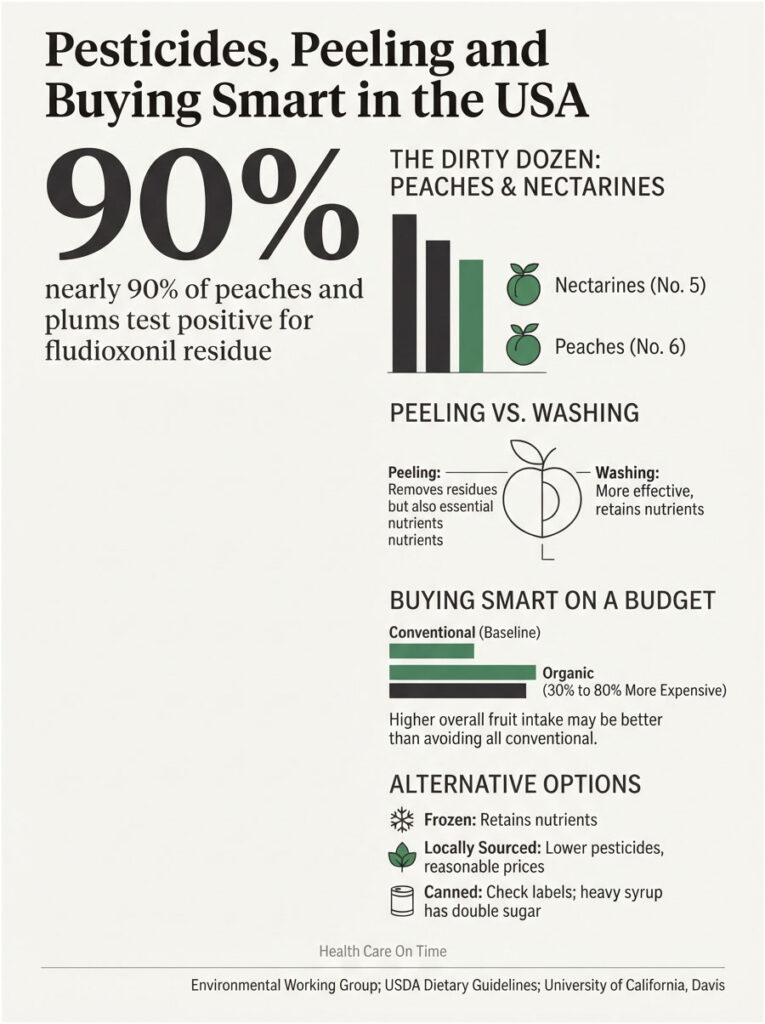
Where Nectarines and Peaches Land on the Dirty Dozen
In the 2026 Environmental Working Group ranking, nectarines rank No. 5 and peaches No. 6, continuing a long run as frequent Dirty Dozen crops, with the analysis drawing on USDA residue data from 54,344 samples of 47 fruits and vegetables.
The 2026 edition added a new data layer. PFAS pesticides appeared on 63% of Dirty Dozen samples, and residue of the PFAS pesticide fludioxonil was found in nearly 90% of peaches and plums.
Nectarines outrank peaches largely because thin, hairless skin absorbs sprays more readily and holds them through washing.
Context belongs here. EWG’s own position is that the guide should not discourage produce consumption, and independent risk assessments generally place typical dietary exposure well below thresholds associated with harm.
Our medical reviewers regularly see pesticide anxiety push people away from fruit entirely, which trades a small theoretical risk for a large and well-documented one.
Does Peeling Solve It, and What You Lose
Peeling removes a meaningful share of surface residue. It also removes fiber, anthocyanins, and much of the carotenoid content sitting just below the skin.
Washing under running water while rubbing the surface removes a good portion of residue without the nutritional penalty. Soap, bleach, and commercial produce washes are not recommended by the FDA.
A 30-second rub under cool running water followed by a pat dry is the practical standard.
Organic vs Conventional, an Honest Cost Calculation
Organic stone fruit in most US markets runs roughly 30% to 80% above conventional pricing, and the spread swings widely by region and season.
If your grocery budget is fixed, buying organic peaches while skipping other produce is a poor trade. Buying conventional and eating more fruit is the better one.
If the budget has room, stone fruit is a reasonable place to spend it given the consistent Dirty Dozen placement. Local farmers market fruit, often grown under lower spray loads, sits in between on price.
Canned, Frozen and Dried, How the Numbers Change
Most American peach consumption is not fresh. California supplies close to all domestically canned peaches, and clingstone varieties exist almost entirely for that channel.
Frozen peaches and nectarines hold their nutrients well. They are picked riper than fresh-shipped fruit and frozen within hours.
Dried peaches concentrate everything, sugar included. A quarter cup carries roughly the sugar of two fresh peaches, which surprises people building trail mix.
Juice Pack vs Heavy Syrup
Canned peaches in heavy syrup can double the sugar content compared with fresh fruit. Juice-packed and water-packed versions stay close to fresh.
Read the panel rather than the front label. “No sugar added” and “in light syrup” are different claims with different numbers behind them.
Draining and rinsing syrup-packed fruit removes a portion of the added sugar, though not all of it.
When to Buy: US Seasons, States and Imports
Timing affects quality more than variety does, and Americans buy a surprising amount of stone fruit at exactly the wrong moment.
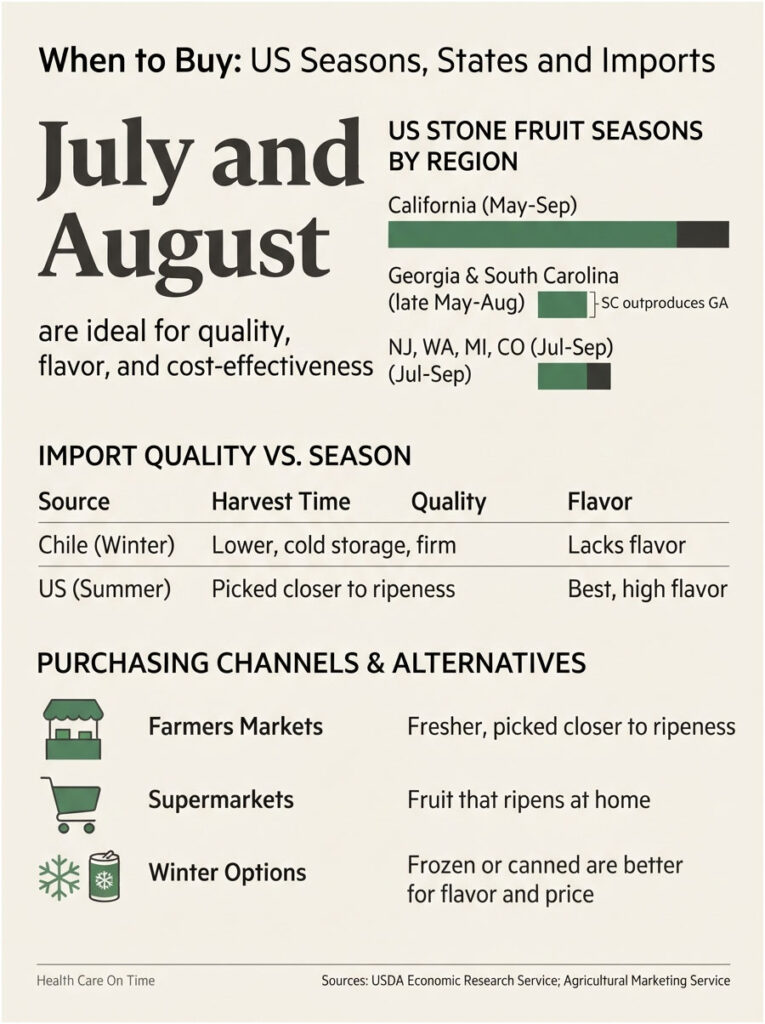
Peak Season by Region
California starts first and runs longest, roughly May through September, with the Central Valley supplying both fresh and processing fruit.
Georgia and South Carolina peak from late May through August. South Carolina actually out-produces Georgia despite the Peach State nickname, and both concentrate on fresh-market freestones.
New Jersey, Washington, Michigan, and Colorado round out the domestic picture with shorter windows, mostly July into September.
July and August are the sweet spot nationwide. Fruit bought in those months has traveled less, ripened longer, and costs less.
Winter Fruit and Why It Disappoints
Stone fruit sold in American supermarkets from December through March is almost entirely imported, largely from Chile.
Fruit shipped that distance is harvested firm and cold-stored for transit, which is the exact treatment that produces mealy texture and muted flavor.
If a January nectarine tastes like nothing, the variety is not at fault. The supply chain is.
Frozen or juice-packed canned fruit is usually the better winter choice, both on flavor and on price.
Farmers Market vs Supermarket
Market fruit is generally picked closer to ripe because it does not need to survive a cross-country truck.
That means better flavor and a shorter shelf life. Plan to eat market stone fruit within two or three days.
Supermarket fruit benefits from a few days on the counter. Buying slightly firm and ripening at home usually beats buying soft.
How to Choose, Store and Eat Them
Ripeness affects the eating experience far more than the peach vs nectarine choice ever will.
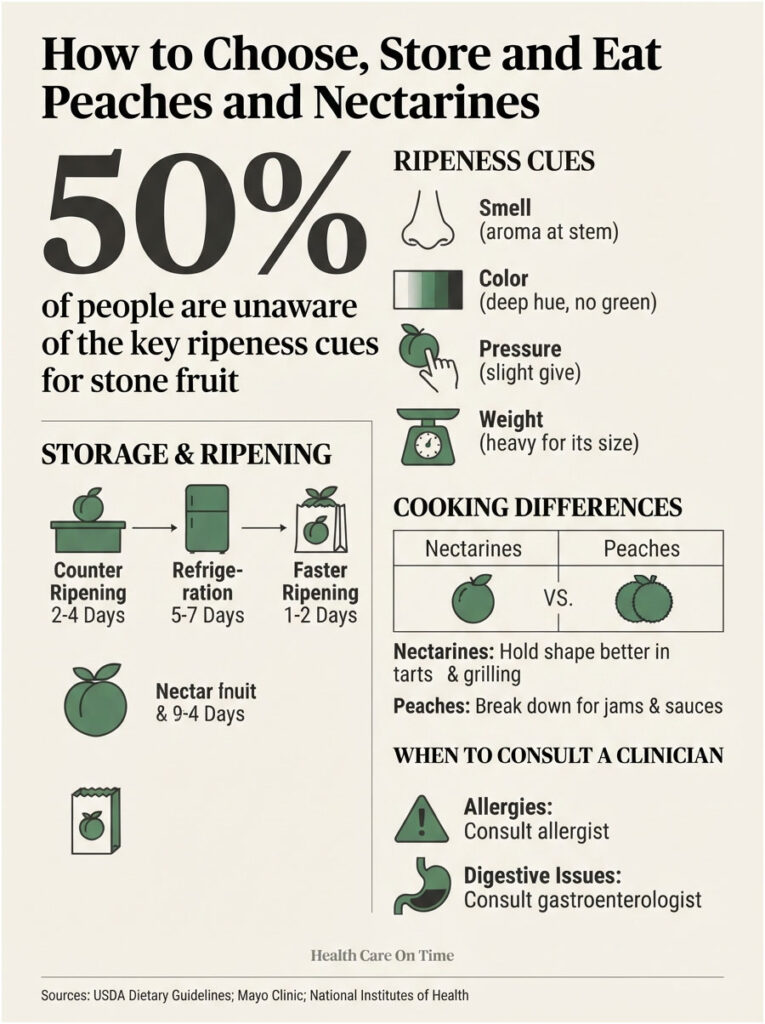
Ripeness Cues That Beat the Squeeze Test
Smell the stem end. Ripe stone fruit gives off a clear floral sweetness; unripe fruit smells like nothing at all.
Check the background color, meaning the base shade underneath the red blush. Green background means the fruit was picked early and will soften without ever getting sweet.
Press gently near the shoulder rather than the belly. Slight give means ready.
Weight is a reliable tell. Heavier fruit for its size holds more juice.
Counter First, Fridge Second
Both fruits keep ripening after harvest. Cold storage halts that process and can turn the flesh mealy.
Leave firm fruit stem-side down on the counter for two to four days. A paper bag speeds things up by trapping ethylene.
Once ripe, refrigerate and eat within three to five days. Bring the fruit back to room temperature before eating, since cold mutes flavor and aroma.
Cooking: Where the Two Fruits Behave Differently
Nectarines hold their shape under heat. Halve them, brush lightly with oil, and grill cut-side down for three to four minutes for a dessert with no added sugar.
Peaches break down more readily, which makes them the better choice for cobblers, jams, and pie fillings. Their softer flesh releases juice and thickens naturally.
Peach skin toughens when cooked, so most baking recipes call for peeling. Blanching for 30 seconds followed by an ice bath makes the skins slip off in seconds.
Nectarine skin stays tender, which is why it needs no peeling in salads, salsas, or roasted dishes.
Portion Guidance for Common Goals
One medium piece is one fruit serving. Two to three servings of fruit a day suits most adults under the Dietary Guidelines.
Cut fruit oxidizes fast. A squeeze of lemon juice slows browning without changing the nutrition in any meaningful way.
Table 3: Which One Should You Pick?
| Your Scenario | Pick This | Why It Works |
| Watching blood sugar | Nectarine (slight edge) | 1.4 g less sugar and 0.1 g more fiber per medium fruit, though either fits one 15 g carb serving |
| Tracking calories closely | Peach | 59 calories vs 63 per medium fruit, with higher water content for more volume per calorie |
| Chasing fiber | Nectarine | 1.7 g per 100 g vs 1.5 g, and the thin skin means you’ll actually eat it |
| Chasing vitamin C | Peach | 9.9 mg per medium fruit vs 7.7 mg, about 11% of the Daily Value |
| Grilling, roasting or salads | Nectarine | Firmer flesh holds shape under heat and needs no peeling |
| Baking a pie or cobbler | Freestone peach | Pit releases cleanly and softer flesh breaks down into filling |
| Feeding a toddler | Peach, peeled and diced | Softer flesh, easier to mash, lower choking risk than firm nectarine chunks |
| Fuzz sensitivity or itchy mouth | Nectarine, or cooked peach | No trichomes to irritate; heat degrades the proteins behind oral allergy symptoms |
| Concerned about pesticide residue | Peach (marginally) | Ranks No. 6 vs nectarine at No. 5 on the most recent EWG list; organic removes the question for either |
| Shopping in January | Neither, buy frozen | Winter imports are cold-stored and mealy; frozen fruit was picked riper |
When to Talk to a Clinician Instead of a Chart
If you have diabetes, chronic kidney disease, or take medication affecting potassium handling, fruit portions belong in a conversation with your care team.
If a piece of fruit reliably triggers throat tightness, swelling, or breathing trouble, that is not a preference issue and needs medical evaluation.
Blood work gives you a real baseline. Fasting glucose, HbA1c, a lipid panel, and a basic metabolic panel reveal far more about how your diet is working than any single-food comparison can.
Common Mistakes People Make With Stone Fruit
Refrigerating Unripe Fruit
The single most common error. Cold-stored unripe stone fruit develops a dry, cottony texture that never recovers.
Counter-ripen first. Refrigerate only once the fruit yields to gentle pressure.
Assuming Canned Equals Fresh
Canned peaches in heavy syrup can carry roughly twice the sugar of fresh fruit along with less vitamin C after heat processing.
Juice-packed versions make a reasonable substitute. Syrup-packed versions are closer to dessert.
Peeling Away the Antioxidants
Removing the skin strips a large share of the fiber and most of the anthocyanins from both fruits.
If texture is the objection, blend the fruit into a smoothie instead of peeling it.
Treating Low Sugar as Unlimited
Low glycemic load applies to one medium fruit, not four. Five nectarines in an afternoon delivers about 56 grams of carbohydrate.
Portion still governs the outcome, regardless of how the food ranks on a GI chart.
Ignoring Oral Allergy Symptoms
Itching or tingling after eating raw stone fruit often reflects oral allergy syndrome, a cross-reaction with birch pollen proteins.
Cooked fruit is usually tolerated because heat breaks down the proteins involved. Persistent or escalating symptoms call for an allergist rather than a workaround.
Readers who write to HealthCareOnTime about this are often surprised that the culprit is pollen cross-reactivity rather than the fruit itself.
Frequently Asked Questions
Is a nectarine just a peach without fuzz?
Close to exactly that. Nectarines and peaches are the same species, Prunus persica, separated by a recessive gene that suppresses the tiny hairs on the skin. Everything else about the tree, the flower, and the fruit chemistry stays nearly identical. A peach tree can produce a nectarine and vice versa.
Which has more sugar, a peach or a nectarine?
The peach, slightly. USDA data puts yellow peaches at about 8.4 grams of sugar per 100 grams and nectarines at about 7.9 grams. Per medium fruit the peach carries roughly 12.6 grams and the nectarine about 11.2 grams. Nectarines taste sweeter to many people because they run less acidic, not sweeter.
Are nectarines healthier than peaches?
Not in any way that changes health outcomes. Nectarines lead on fiber, potassium, copper, and niacin per gram. Peaches lead on vitamin C and run slightly lower in calories. Per medium fruit the two are almost interchangeable. Choose based on taste, texture, and what looks ripe at the store.
Can people with diabetes eat peaches and nectarines?
Generally yes. Both are low glycemic index foods (around 42 to 43) with a glycemic load near 5 per medium fruit, and one piece counts as roughly one 15-gram carbohydrate serving. Eating the skin and pairing the fruit with protein slows the glucose rise further. Individual targets should come from your care team.
How many calories are in one medium nectarine?
About 63 calories for a 142-gram medium nectarine, based on USDA figures. That includes 15 grams of carbohydrate, 2.4 grams of fiber, 1.5 grams of protein, and 285 mg of potassium. A 150-gram medium peach comes in around 59 calories, a difference too small to matter in practice.
Do peaches or nectarines have more fiber?
Nectarines, by a small margin. USDA lists 1.7 grams of fiber per 100 grams for nectarines against 1.5 grams for peaches. Per medium fruit the gap narrows to roughly 0.1 grams. The bigger fiber variable is whether you eat the skin, which holds about a third of the total.
Should you eat the skin?
Yes, on both. The skin and the layer just beneath it carry a large share of the fiber, anthocyanins, and carotenoids. Wash under running water and rub the surface for about 30 seconds first. Skip soap and commercial produce washes, which the FDA does not recommend.
Are nectarines and peaches on the Dirty Dozen list?
Both are. In the Environmental Working Group’s 2026 Shopper’s Guide, nectarines rank No. 5 and peaches No. 6 out of 47 crops tested across 54,344 USDA samples. Thin skin makes nectarines more absorbent. EWG’s own guidance is not to reduce produce intake because of the ranking.
Are canned peaches as healthy as fresh ones?
It depends entirely on the packing liquid. Water-packed or juice-packed peaches stay close to fresh in calories and sugar, though vitamin C drops during heat processing. Heavy syrup can roughly double the sugar content. Draining and rinsing helps. Frozen peaches hold their nutrients better than canned.
Why do peaches make some people’s mouths itch?
Usually oral allergy syndrome, where proteins in raw stone fruit cross-react with birch pollen antibodies. Symptoms stay limited to the lips, mouth, and throat for most people. Cooking breaks down the proteins, so cooked fruit is often tolerated. Swelling or breathing difficulty needs urgent medical attention.
What is the difference between freestone and clingstone?
Freestone fruit releases the pit cleanly; clingstone flesh grips it. Both peaches and nectarines come in either form, so it has nothing to do with fuzz. Freestones dominate the fresh market. Clingstones go almost entirely to canning, which is why supermarket canned peaches are nearly always clingstone.
How many peaches or nectarines can you eat in a day?
Two to three pieces fits comfortably inside the 1.5 to 2 cup-equivalent daily fruit target for adults set by the Dietary Guidelines for Americans. That works out to roughly 120 to 190 calories and 4 to 7 grams of fiber. People managing blood sugar or potassium should confirm their own limits with a clinician.
Medical Disclaimer
This article is for general information only and is not a substitute for professional medical advice, diagnosis, or treatment. Nutrient values reflect USDA averages and vary with variety, ripeness, and growing conditions. If you have diabetes, kidney disease, a food allergy, or any condition affected by diet, consult a qualified healthcare provider before making changes. Never disregard professional medical advice because of something you read here.
References
- USDA FoodData Central, Peaches, yellow, raw (SR Legacy 169928)
- USDA FoodData Central, Nectarines, raw (SR Legacy 169914)
- CDC MMWR, Adults Meeting Fruit and Vegetable Intake Recommendations, United States
- USDA Economic Research Service, Fruit and Tree Nuts Outlook
- USDA Economic Research Service, California Continues to Lead the US Peach Harvest
- USDA NASS, Crop Production Report
- Environmental Working Group, Dirty Dozen Summary
- Texas A&M AgriLife Research, Stone Fruit Bioactive Compounds and Metabolic Syndrome
- Thinned Stone Fruits Are a Source of Polyphenols and Antioxidant Compounds, JSFA
- USDA ERS via Statista, Per Capita Consumption of Fresh Peaches and Nectarines in the US
- USDA Foreign Agricultural Service, Fresh Peaches and Cherries: World Markets and Trade