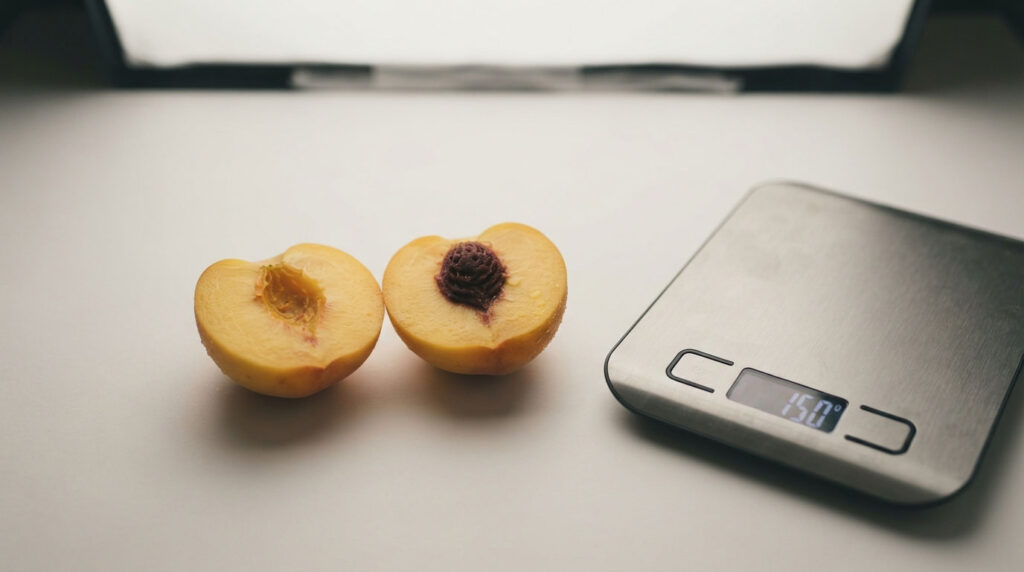
Four trusted nutrition sources will hand you four different calorie counts for the same piece of fruit. One says 50, another says 58, a third says 59, and a fourth says 74. None of them are lying. They are measuring different peaches, and almost nobody bothers to explain that.
Table of Contents
QUICK ANSWER
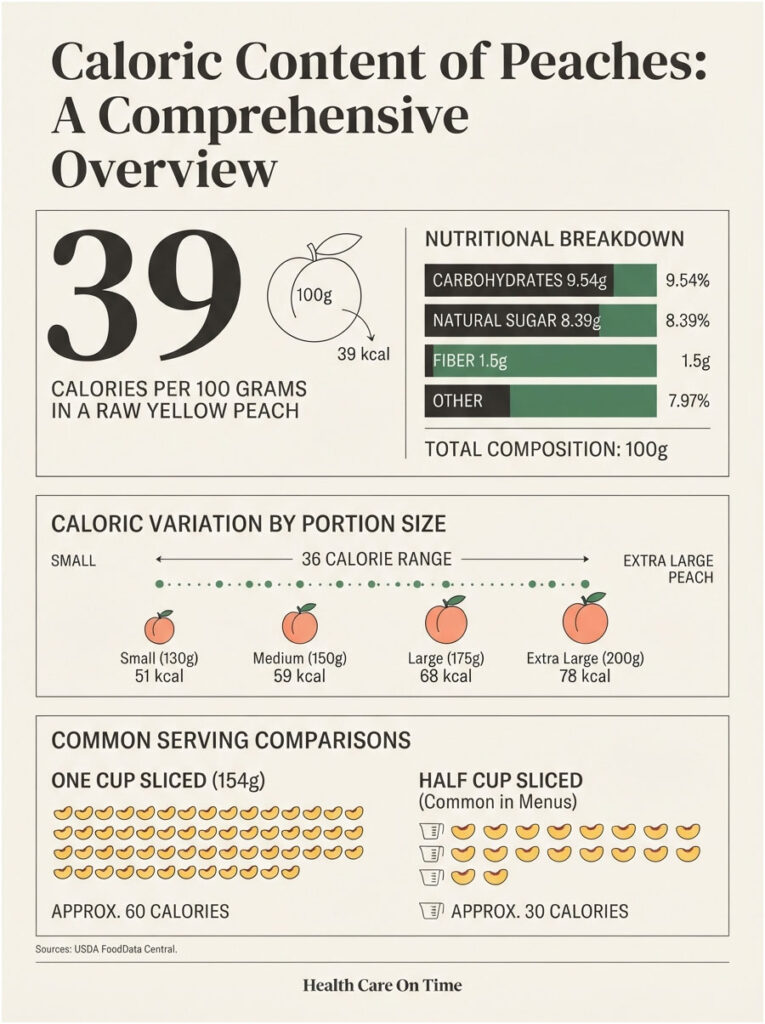
A medium peach contains 59 calories. That figure comes from USDA FoodData Central and applies to a raw yellow peach weighing 150 grams, or 2 and 2/3 inches across. Raw peach measures 39 calories per 100 grams. A small peach (130 g) has 51 calories, a large peach (175 g) has 68, and an extra large peach (224 g) has 87.
AT A GLANCE
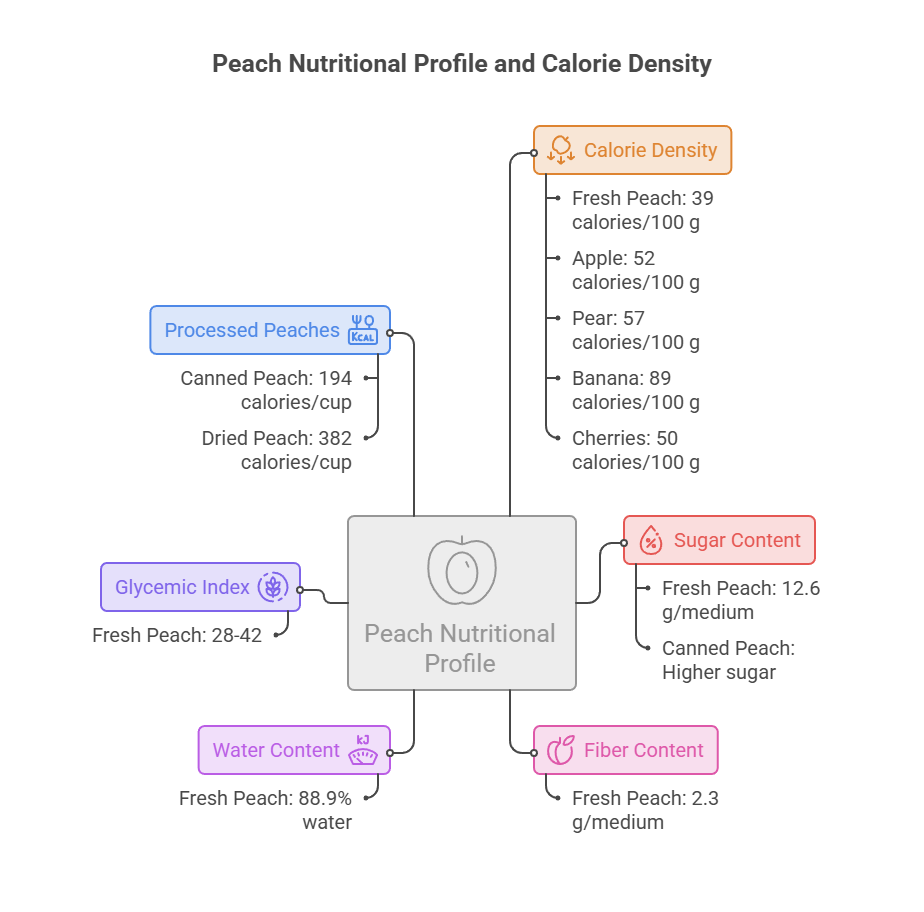
• A medium peach delivers 59 calories, 14.3 g carbs, 12.6 g sugar, and 2.3 g fiber
• Raw peach is 88.9% water, which is why the calorie density is so low
• Peach calories range from 51 to 87 based on fruit size alone
• Canned peaches in heavy syrup jump to 194 calories per cup
• Dried peaches reach 382 calories per cup, more than six times fresh
• Peach carries a low glycemic index (28 to 42) and a glycemic load near 5
• At 39 calories per 100 g, peach beats apple, pear, banana, and cherries on calorie density
How Many Calories in a Peach? The Direct Answer
The answer depends entirely on which peach you are holding. USDA measures raw yellow peach at 39 calories per 100 grams of edible fruit, and every other number is arithmetic from there.
Our medical reviewers watch this trip people up constantly. Someone logs “1 peach” in a tracking app, the app picks a default weight, and the entry is off by 30% before breakfast is finished.
The USDA baseline: 39 calories per 100 grams
Raw yellow peach carries 39 calories, 9.54 g of carbohydrate, 8.39 g of natural sugar, and 1.5 g of fiber per 100 grams. That profile comes from record 169928 in USDA FoodData Central, the federal reference database for food composition.
Protein sits at 0.91 g and total fat at 0.25 g. Sodium is zero. Cholesterol is zero.
What “medium” actually means in USDA terms
USDA does not leave “medium” to guesswork. A medium peach is defined by diameter: 2 and 2/3 inches across, weighing 150 grams, which is about 5.3 ounces of edible fruit.
That precision matters, because the federal database recognizes six distinct portions for raw peach. Each produces a different calorie count, and the gap from smallest to largest is 36 calories.
Table 1: Peach Calories and Nutrition by USDA Serving Size
| Serving Size | Weight (g) | Weight (oz) | Calories | Carbs (g) | Sugars (g) | Fiber (g) |
| Small (2-1/2″ diameter) | 130 | 4.6 | 51 | 12.4 | 10.9 | 2.0 |
| NLEA label serving | 147 | 5.2 | 57 | 14.0 | 12.3 | 2.2 |
| Medium (2-2/3″ diameter) | 150 | 5.3 | 59 | 14.3 | 12.6 | 2.3 |
| 1 cup, sliced | 154 | 5.4 | 60 | 14.7 | 12.9 | 2.3 |
| Large (2-3/4″ diameter) | 175 | 6.2 | 68 | 16.7 | 14.7 | 2.6 |
| Extra large (3″ diameter) | 224 | 7.9 | 87 | 21.4 | 18.8 | 3.4 |
| Per 100 g reference | 100 | 3.5 | 39 | 9.5 | 8.4 | 1.5 |
Source: USDA FoodData Central, SR Legacy record 169928. Calculated from the per-100-gram profile using official USDA portion weights.
If you log fruit by cups instead of pieces
One cup of sliced peach weighs 154 grams, which lands within four grams of a medium whole peach. For practical logging, a cup of slices and a medium peach are interchangeable at roughly 60 calories.
Half a cup, the portion most school and hospital menus use, comes to 30 calories.
Full USDA Nutrition Breakdown of a Fresh Peach
Calories tell you what a peach costs. The rest of the profile tells you what it buys.
Macronutrients in a medium peach
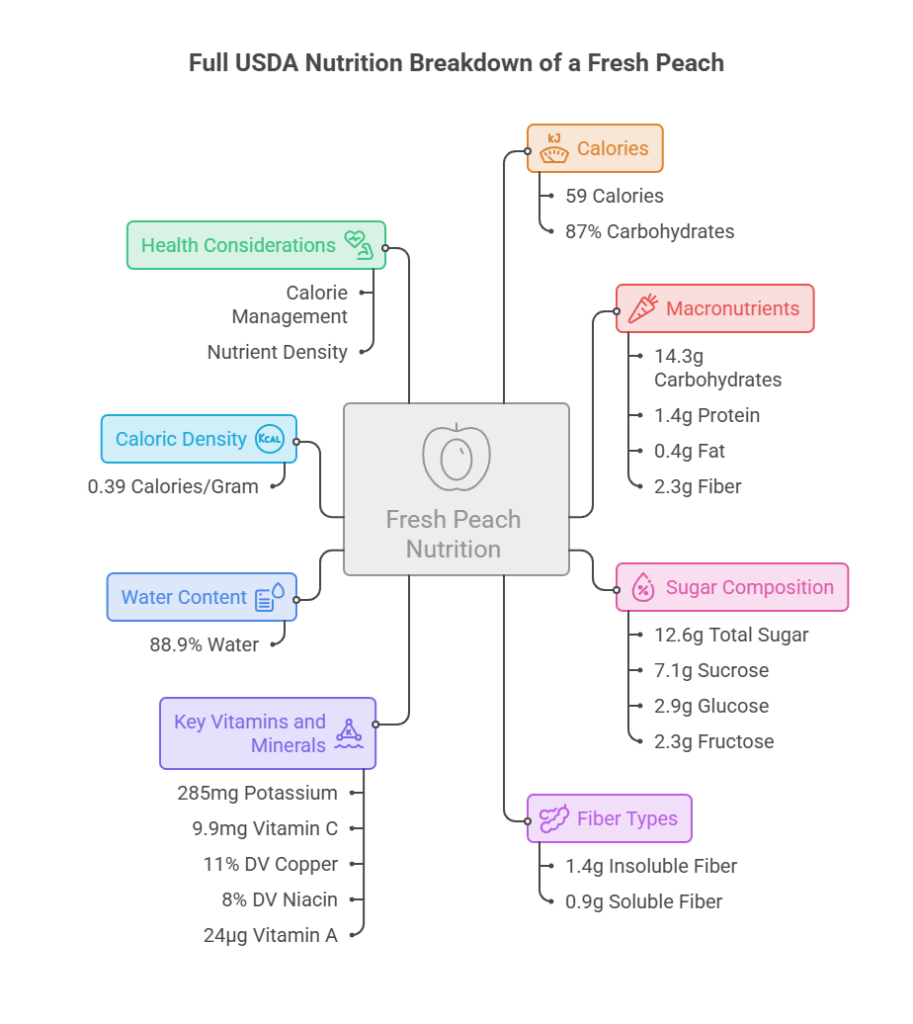
A 150-gram medium peach supplies 14.3 g of total carbohydrate, 1.4 g of protein, and 0.4 g of fat. Roughly 87% of its calories come from carbohydrate.
Fiber accounts for 2.3 g, covering 8% of the 28-gram Daily Value set by the FDA. Subtract fiber from total carbs and net carbs land at 12.0 g.
Where the sugar actually comes from
The 12.6 g of sugar in a medium peach is not one thing. USDA breaks it into 7.1 g sucrose, 2.9 g glucose, 2.3 g fructose, plus trace maltose and galactose.
All of it is intrinsic sugar, packaged with fiber, water, and plant compounds. The Dietary Guidelines for Americans cap added sugars at under 10% of daily calories, and whole fruit sugar does not count toward that limit.
The fiber split: soluble versus insoluble
The USDA Foundation Foods record for yellow peach (number 325430) separates fiber into 0.9 g insoluble and 0.6 g soluble per 100 grams. In a medium peach, that works out to roughly 1.4 g insoluble and 0.9 g soluble.
Soluble fiber slows gastric emptying and blunts the rise in blood glucose. Insoluble fiber adds stool bulk and speeds transit. A peach gives you both, and most of it sits in and just beneath the skin.
Vitamins and minerals worth counting
Potassium is the headline mineral at 285 mg per medium peach, about 6% of the 4,700 mg Daily Value tracked by the NIH Office of Dietary Supplements. Vitamin C reaches 9.9 mg, or 11% DV.
Copper also lands at 11% DV, niacin at 8%, and vitamin E at 7%. Vitamin A totals 24 micrograms RAE, delivered mainly as beta-carotene (243 mcg) and beta-cryptoxanthin (101 mcg).
The yellow flesh is not decorative. Those carotenoids are the pigment itself, which is why white-flesh varieties carry noticeably less vitamin A activity.
Water content and why calorie density matters
Raw peach is 88.9% water by weight. That single number explains almost everything about its calorie profile.
At 0.39 calories per gram, peach sits in the lowest calorie-density tier of common foods. Rutgers New Jersey Agricultural Experiment Station makes the same point in its consumer nutrition guidance: peaches deliver real volume and nutrients at a very low energy cost.
Patients booking metabolic panels through HealthCareOnTime often ask which fruits fill them up without wrecking a calorie target. Water content and fiber are the two variables that answer that question, and peach scores well on both.
Why Every Website Gives a Different Peach Calorie Number
This is the part no competing article explains, and it is exactly why people stop trusting nutrition data.
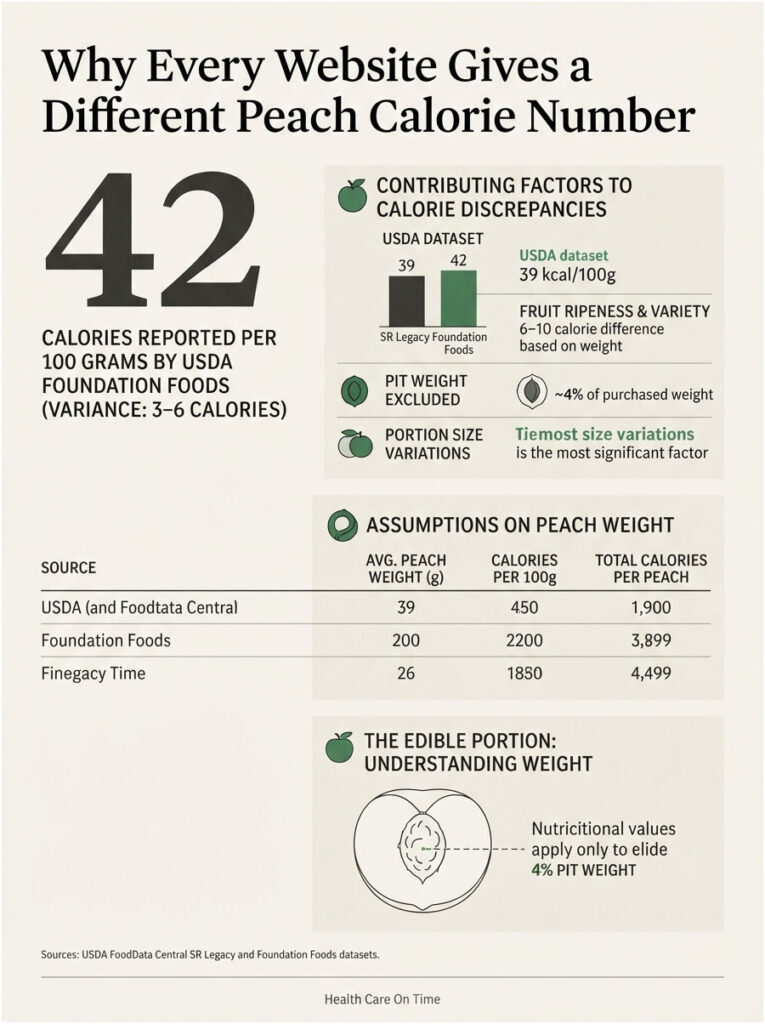
Two USDA records, two answers
USDA maintains more than one dataset. The SR Legacy record for yellow peach reports 39 calories per 100 grams. The newer Foundation Foods record for the same fruit reports 42.
The gap comes from different sample sets and different analytical methods. Foundation Foods also lists 10.1 g carbohydrate against SR Legacy’s 9.54 g, and 122 mg potassium against 190 mg.
Neither is wrong. Most tracking apps pull SR Legacy, which is why 39 and 59 are the figures you see most often.
The pit problem: as-purchased versus edible portion
A whole peach on a grocery scale includes the stone. USDA nutrient values apply only to the edible portion, and the pit accounts for roughly 4% of the fruit’s purchased weight.
So a peach that reads 156 grams at the register yields about 150 grams of edible flesh. Weigh the whole fruit and log that number, and you overstate your intake every single time.
Ripeness, variety, and the 15 to 25 gram swing
Two peaches that look identical can differ by 15 to 25 grams, which moves the calorie count by 6 to 10. Ripening converts starch to sugar and softens texture, but it barely changes total carbohydrate.
Clingstone, freestone, donut, white, and yellow varieties all cluster between 39 and 44 calories per 100 grams. In cases reviewed by our medical team, variety is almost never the reason someone’s numbers look off. Portion size is.
Table 2: Same Fruit, Different Answers
| Source | “Medium” weight used | Calories reported | Why it differs |
| USDA FoodData Central, SR Legacy | 150 g | 59 | Federal reference, edible portion only |
| USDA FoodData Central, Foundation Foods | 150 g | 63 | Newer sample set at 42 kcal per 100 g |
| CalorieKing | 150 g (5.5 oz as purchased) | 58 | Rounds down from an earlier SR release |
| Eat This Much | 150 g | 59 | Pulls SR Legacy directly |
| Healthline | 161 g | 74 | Assumes a larger fruit than USDA’s medium |
| Rutgers NJAES | 147 g | 50 | Page also states 39 kcal per 100 g, which cannot both hold |
| FatSecret (“1 medium”) | About 98 g | 38 | Uses a far smaller default medium |
Source: publisher figures as displayed, compared against USDA FoodData Central reference values.
Before you compare calorie counts, compare the gram weights sitting behind them.
Fresh vs Canned vs Dried vs Frozen
This is where peach calories genuinely explode, and where most people get caught.
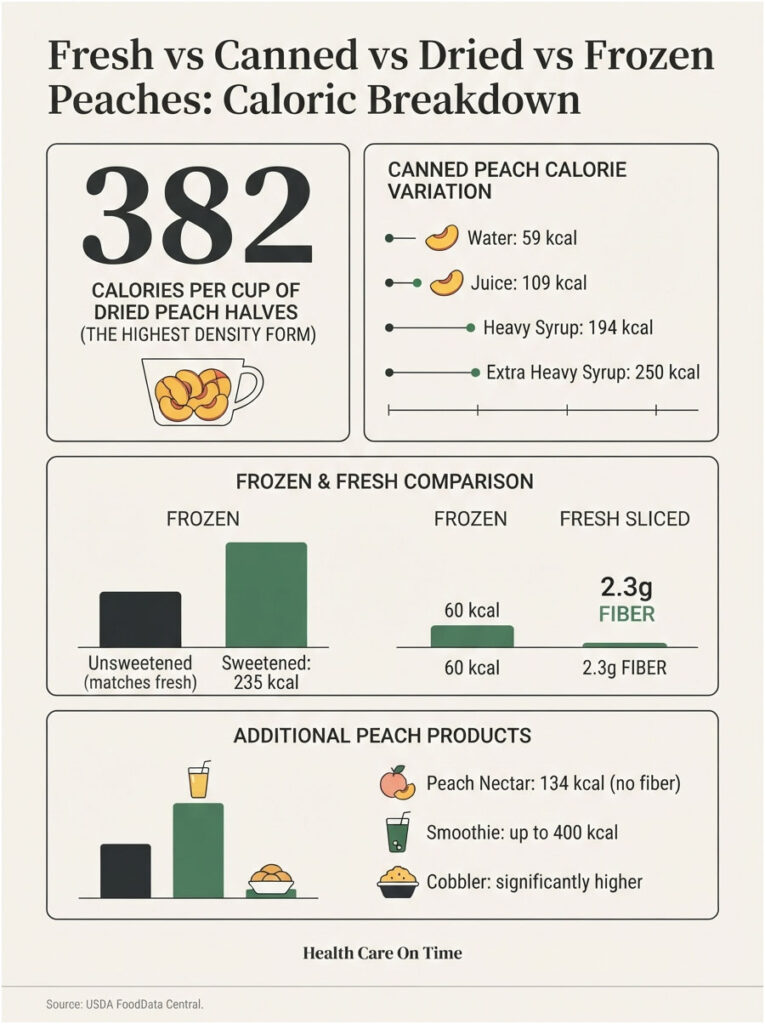
Canned peaches: water, juice, and syrup
The peach inside the can is close to the peach on the tree. What surrounds it is not.
Canned in water, a cup of peaches with liquid runs 59 calories. Canned in juice, the same cup hits 109. Canned in heavy syrup it reaches 194, and extra heavy syrup pushes past 250.
That is a fourfold swing driven entirely by packing liquid. Draining syrup-packed fruit helps, but sugar migrates into the flesh during processing, so draining recovers only part of the difference.
Dried peaches: the concentration trap
Removing water removes volume, not calories. Dried sulfured peach measures 239 calories per 100 grams, six times the fresh figure.
A cup of dried halves delivers 382 calories, 66.7 g of sugar, and 1,594 mg of potassium. The fiber is real at 13.1 g per cup, but so is how fast five halves disappear.
Frozen peaches: the year-round swap that holds
Unsweetened frozen peach slices track fresh almost exactly on a per-gram basis. Frozen sweetened slices do not, landing at 235 calories and 55.5 g of sugar per thawed cup.
Read the bag. “No sugar added” and “sweetened” sit inches apart in most freezer cases.
Table 3: Peach Calories by Form, per Cup
| Form | Serving | Weight (g) | Calories | Carbs (g) | Sugars (g) | Fiber (g) |
| Fresh, sliced | 1 cup | 154 | 60 | 14.7 | 12.9 | 2.3 |
| Canned, water pack, with liquid | 1 cup | 244 | 59 | 14.9 | 11.7 | 3.2 |
| Canned, juice pack, with liquid | 1 cup | 248 | 109 | 28.8 | 25.5 | 3.2 |
| Canned, heavy syrup, with liquid | 1 cup | 262 | 194 | 52.1 | 48.7 | 3.4 |
| Spiced, canned, heavy syrup | 1 cup | 262 | 197 | 52.7 | 49.3 | 3.4 |
| Frozen, sliced, sweetened | 1 cup | 250 | 235 | 60.0 | 55.5 | 4.5 |
| Dried, sulfured, uncooked | 1 cup halves | 160 | 382 | 98.1 | 66.7 | 13.1 |
Source: USDA FoodData Central, SR Legacy records 169929, 169930, 169112, 169114, 169116, and 169934.
Cobbler, nectar, and smoothies
Peach nectar runs about 134 calories per cup with essentially no fiber. Peach cobbler and peach crisp climb into the 400 to 500 calorie range per cup once flour, butter, and sugar join the pan.
Our nutrition reviewers flag this pattern more than any other. A two-cup peach smoothie built on a banana, honey, and full-fat yogurt can clear 400 calories, and the peach contributed maybe 60 of them.
Sugar, Carbs, and Blood Sugar
Peaches taste sweet, and that sweetness makes people nervous. The data is more reassuring than the flavor suggests.
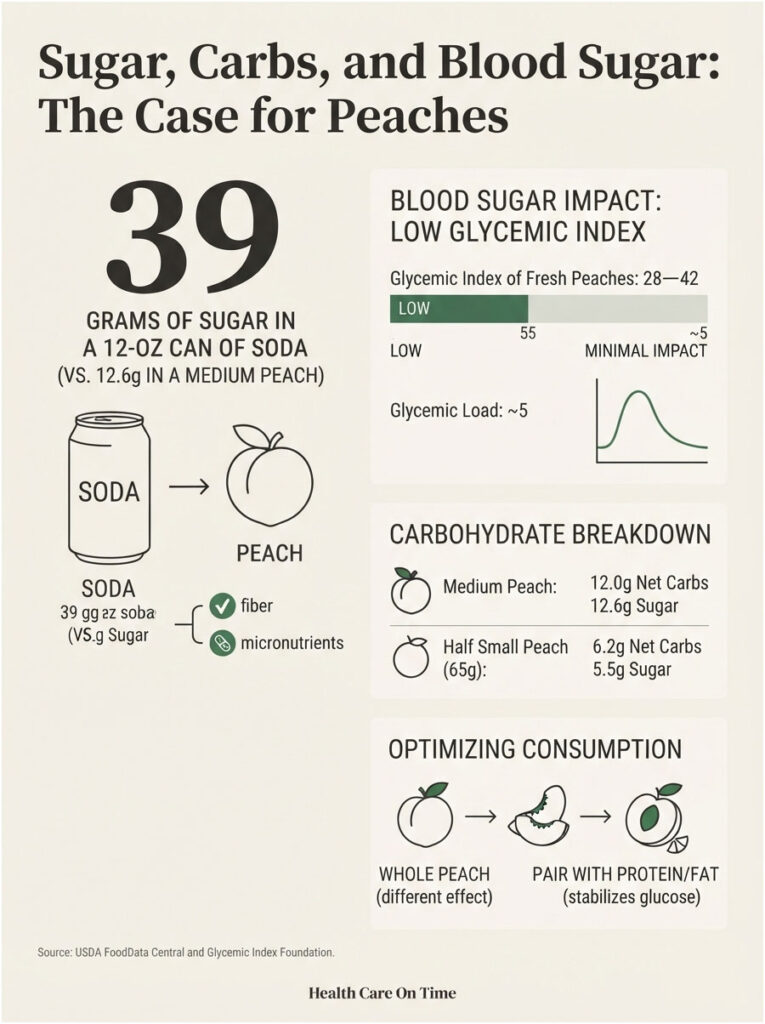
Putting 12.6 grams of sugar in context
A medium peach carries 12.6 g of sugar. A 12-ounce can of regular soda carries roughly 39 g, all of it added, with zero fiber and zero micronutrients.
The peach also brings 2.3 g of fiber, 133 g of water, 285 mg of potassium, and a full carotenoid profile. Sugar quantity on its own is a poor way to judge a food.
Glycemic index and glycemic load
Published values place fresh peach between 28 and 42 on the glycemic index, well inside the low range of under 55. Glycemic load for a medium peach lands near 5, which is very low.
Glycemic load is the more useful figure because it accounts for portion size. A food can score moderate on GI and still barely register on blood sugar when the serving carries few carbs.
Net carbs, keto, and low-carb plans
Net carbs for a medium peach come to 12.0 g. On a strict ketogenic plan capped at 20 to 50 g daily, one medium peach can absorb half the allowance.
Half a small peach (65 g) holds 6.2 g of carbs and 5.5 g of sugar, which is a workable compromise. Moderate low-carb plans in the 100 to 150 g range accommodate a whole peach without trouble.
What to watch if you track A1C
Whole peach with the skin on behaves differently than peeled, juiced, or syrup-packed peach. Pairing it with protein or fat, such as cottage cheese, Greek yogurt, or a small handful of almonds, flattens the glucose curve further.
Patients commonly ask us whether one fruit can move an A1C reading. It cannot, in either direction. What moves A1C is the pattern across roughly 90 days, which is why periodic HbA1c and fasting glucose testing tells you far more than any single meal.
Peach vs Other Fruits: The Calorie Comparison
Calorie density is the fair comparison here, because serving sizes across fruits are wildly inconsistent.
The stone fruit family
Peach, nectarine, plum, apricot, and cherry are close relatives with different profiles. Peach comes in lowest per 100 grams at 39 calories. Nectarine follows at 44, plum at 46, apricot at 48, and sweet cherries at 63.
A nectarine is essentially a fuzz-free peach, and the nutritional gap between the two is small. Cherries are the outlier, carrying about 60% more calories per gram than peach.
Everyday swaps
Against the fruits Americans actually eat most, peach wins on calorie density and loses on fiber. A medium apple with skin brings 4.4 g of fiber against peach’s 2.3 g, but costs 95 calories against 59.
Across the food logs our team reviews, people rarely need the lowest-calorie fruit. They need the one they will actually finish, which is why swaps matter more than rankings. Compare peach against the apple, banana, and pear calorie breakdowns to find the fit for your own routine.
Table 4: Peach vs Common US Fruits
| Fruit | Typical Serving | Weight (g) | Calories | Sugars (g) | Fiber (g) | Calories per 100 g |
| Peach | 1 medium | 150 | 59 | 12.6 | 2.3 | 39 |
| Nectarine | 1 medium | 142 | 62 | 11.2 | 2.4 | 44 |
| Plum | 1 medium | 66 | 30 | 6.5 | 0.9 | 46 |
| Apricot | 1 medium | 35 | 17 | 3.2 | 0.7 | 48 |
| Orange | 1 medium | 131 | 62 | 12.2 | 3.1 | 47 |
| Apple, with skin | 1 medium | 182 | 95 | 18.9 | 4.4 | 52 |
| Pear | 1 medium | 178 | 101 | 17.4 | 5.5 | 57 |
| Sweet cherries | 1 cup, pitted | 154 | 97 | 19.7 | 3.2 | 63 |
| Banana | 1 medium | 118 | 105 | 14.4 | 3.1 | 89 |
Source: USDA FoodData Central SR Legacy records. Serving weights are official USDA portions.
For maximum volume per calorie, peach and orange lead. For fiber per bite, pear and apple pull ahead.
Are Peaches Good for Weight Loss?
Short answer: yes, with a caveat about what you do to them.
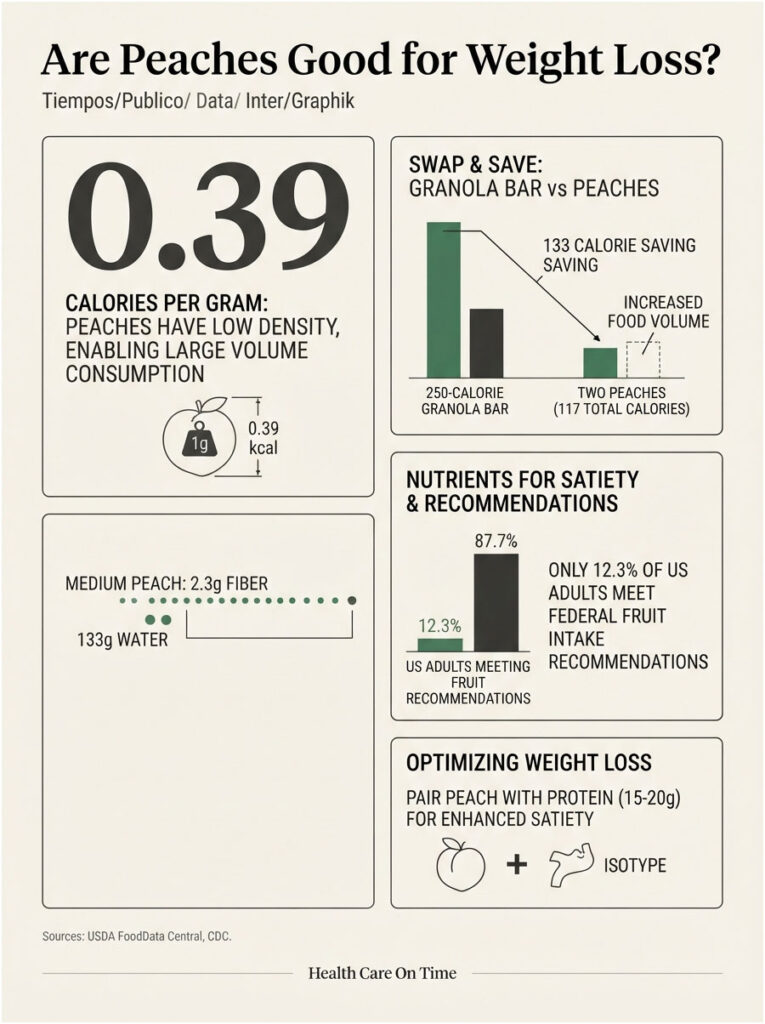
Calorie density and volume eating
At 0.39 calories per gram, peach lets you eat a large physical volume of food for very few calories. Swapping a 250-calorie granola bar for two medium peaches saves 133 calories while roughly tripling the volume on the plate.
Repeat that swap five days a week and the arithmetic starts to matter, with no restriction involved.
Fiber, water, and satiety
The 2.3 g of fiber plus 133 g of water in a medium peach produce genuine stomach distension, which triggers the stretch receptors that signal fullness. Fiber also slows gastric emptying.
A peach on its own will not hold most adults for three hours. Paired with 15 to 20 g of protein, it will.
Where peaches quietly go wrong
Peach rarely causes problems. Peach cobbler, syrup-packed fruit cups, sweetened frozen slices, and peach-flavored yogurt cause them regularly.
The fruit is 59 calories. The delivery vehicle is often 300.
How peaches fit federal fruit targets
Federal guidance calls for 1.5 to 2 cup-equivalents of fruit per day for adults. One large peach counts as roughly one cup-equivalent under MyPlate rules, so two large peaches essentially cover the day.
Most Americans are nowhere near that target, which reframes the whole conversation.
Table 5: Peaches and US Fruit Intake, By the Numbers
| Metric | Figure | Period | Source |
| US adults meeting federal fruit intake recommendations | 12.3% | 2019 | CDC, MMWR (BRFSS analysis) |
| State range for meeting fruit recommendations | 8.4% (West Virginia) to 16.1% (Connecticut) | 2019 | CDC, MMWR |
| Per capita fresh peach and nectarine availability | 1.94 pounds per person | 2022 | USDA Economic Research Service |
| Same measure two decades earlier | About 5.3 pounds per person | 2000 | USDA Economic Research Service |
| Recommended daily fruit intake, adults | 1.5 to 2 cup-equivalents | 2020 to 2025 | Dietary Guidelines for Americans |
| Calories in 100 g raw yellow peach | 39 kcal | SR Legacy release | USDA FoodData Central |
| Water content of raw peach | 88.9 g per 100 g | SR Legacy release | USDA FoodData Central |
Source: agency publications as attributed in the final column.
The consumption trend is the striking part. Fresh peach availability has dropped by more than 60% since 2000, while CDC surveillance data shows roughly seven in eight adults still miss federal fruit targets.
How to Buy, Store, and Eat Peaches Without Adding Calories
Small handling choices change both the accuracy of your log and the nutrition you actually absorb.
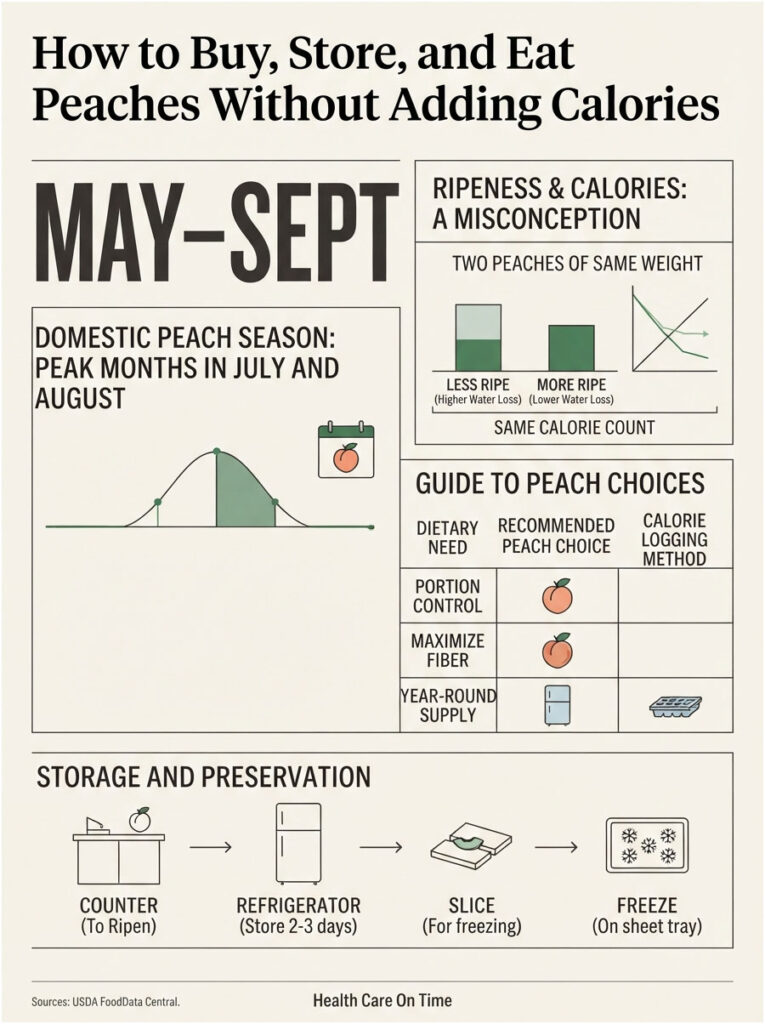
When US peaches are actually in season
Domestic peach season runs from roughly May through September, peaking in July and August. California grows about half the country’s crop, with South Carolina and Georgia supplying most of the rest.
Out-of-season fresh peaches are usually imported and picked underripe, which costs you flavor rather than calories. Frozen is the better off-season choice on both counts.
Ripeness and calorie accuracy
Two peaches of the same weight carry nearly identical calories whether rock-hard or dead-ripe. What ripeness changes is water loss: a peach left on the counter for five days sheds several grams, trimming the whole-fruit total slightly.
Skin on or skin off
Peeling removes a meaningful share of the fiber and most of the carotenoid and polyphenol content, both of which concentrate in and directly under the skin. It saves you almost no calories.
Peaches appear on the Environmental Working Group’s Dirty Dozen residue list, so wash under running water and rub the fuzz before eating. Peeling out of caution is reasonable. Peeling for calories is not.
Portion strategies that hold
Buy small or medium peaches instead of extra large and the 36-calorie spread disappears on its own. Slice into a bowl rather than eating from the hand, since a bowl makes the second peach a decision instead of a reflex.
Our lab partners report that people who weigh fruit for two weeks stop needing to. Calibrating your eye once is usually enough.
Storing without losing nutrition
Ripen on the counter, then refrigerate and eat within two to three days. Refrigerating an unripe peach stalls ripening and produces mealy, flavorless flesh.
For year-round supply, freeze slices in a single layer on a sheet tray, then bag them.
Table 6: Your Situation, Your Peach Move
| If You Are | Best Peach Choice | What to Log | Skip This |
| Counting calories strictly | Fresh peach, weighed on a kitchen scale | 59 calories per 150 g medium | Eyeballing size, which swings the count from 51 to 87 |
| Managing type 2 diabetes | Fresh peach with skin, paired with protein | 14.3 g carbs, glycemic load near 5 | Canned in heavy syrup at 48.7 g sugar per cup |
| On strict keto (20 to 50 g carbs) | Half a small peach | 6.2 g carbs, 5.5 g sugar | A whole large peach at 16.7 g carbs |
| On a potassium-restricted renal diet | Half a small peach, or canned water pack, drained | 124 mg potassium per half small peach | Dried peaches at 1,594 mg potassium per cup |
| Packing a child’s lunch | Canned in water, or unsweetened frozen slices | 59 calories per cup, water pack | Syrup-packed fruit cups at 194 calories per cup |
| Shopping out of season | Unsweetened frozen slices | About 39 calories per 100 g thawed | Frozen sweetened slices at 235 calories per cup |
| Getting mouth itching from stone fruit | Cooked or canned peach | Same calories, heat-altered proteins | Raw peach skin until an allergist evaluates you |
Source: USDA FoodData Central values applied to common dietary scenarios. Confirm restrictions with your clinician.
Who Should Be Careful With Peaches
Peach is a low-risk food for most people. A few groups need a closer look before making it a daily habit.
Oral allergy syndrome
People allergic to birch pollen sometimes react to raw peach, because peach proteins resemble birch allergens closely enough to confuse the immune system. Symptoms are usually mild and local: itchy mouth, tingling lips, a scratchy throat.
Cooking and canning denature the responsible proteins, so many people tolerate cooked peach without any reaction. Our medical team’s standing advice here is straightforward: anything past mild oral itching belongs with an allergist, not with self-management.
Potassium and kidney disease
At 285 mg per medium peach, fresh peach is moderate in potassium and generally workable on most renal diets in controlled portions. Dried peach is not, at 1,594 mg per cup.
Anyone on a potassium restriction should clear fruit portions with their nephrologist or renal dietitian, in line with NIDDK guidance on diet in chronic kidney disease.
FODMAPs and IBS
Peach is high in the sugar alcohol sorbitol and carries excess fructose, which places it on the high-FODMAP list. People with irritable bowel syndrome may get bloating, gas, or cramping from a full peach.
Tolerance varies widely. A quarter or half peach is often fine where a whole one is not.
Sulfites in dried peaches
Commercially dried peaches are usually treated with sulfites to preserve their orange color. Sulfite-sensitive individuals, including a subset of people with asthma, can react with wheezing or hives.
Unsulfured dried peaches are darker brown and widely stocked in natural food aisles.
Frequently Asked Questions
How many calories are in a large peach?
A large peach, defined by USDA as 2 and 3/4 inches in diameter and weighing 175 grams, contains 68 calories. It also supplies 16.7 g of carbohydrate, 14.7 g of sugar, 2.6 g of fiber, and 333 mg of potassium. An extra large peach at 224 grams reaches 87 calories.
How many calories are in half a peach?
Half a medium peach (75 g) has about 29 calories. Half a small peach (65 g) has about 25 calories, and half a large peach (roughly 88 g) has about 34. Because peach calories scale linearly with weight, halving the fruit halves every value on the nutrition panel.
Does the pit count toward a peach’s calories?
No. USDA nutrient values cover only the edible portion, and the pit represents roughly 4% of a peach’s as-purchased weight. If you weigh a whole peach with the stone, subtract about 4% before logging. A 156-gram whole peach yields close to 150 grams of edible flesh.
How many calories are in a cup of sliced peaches?
One cup of fresh peach slices weighs 154 grams and contains 60 calories, 14.7 g of carbohydrate, 12.9 g of sugar, and 2.3 g of fiber. That makes a cup of slices nutritionally near-identical to one medium whole peach, which helps if your tracking app measures fruit by volume.
Are white peaches lower in calories than yellow peaches?
No. White and yellow peaches sit within a few calories of each other per 100 grams, since water and carbohydrate content are similar. The real difference is pigment: yellow varieties carry substantially more beta-carotene and beta-cryptoxanthin. White peaches taste sweeter mainly because they carry less acid.
How many calories are in canned peaches in heavy syrup?
One cup of peaches canned in heavy syrup, including the liquid, contains 194 calories and 48.7 g of sugar. Extra heavy syrup pushes past 250. Canned in juice drops to 109 calories, and canned in water falls to 59, which essentially matches fresh fruit.
How many calories are in dried peaches?
One cup of dried sulfured peach halves (160 g) contains 382 calories, 98.1 g of carbohydrate, 66.7 g of sugar, and 13.1 g of fiber. Per 100 grams, dried peach measures 239 calories, over six times fresh. Portion control matters far more with dried fruit than with fresh.
How much sugar is in a peach?
A medium peach contains 12.6 grams of natural sugar: roughly 7.1 g sucrose, 2.9 g glucose, and 2.3 g fructose. None counts as added sugar under federal labeling rules, and it arrives packaged with 2.3 g of fiber and 133 g of water, both of which moderate the blood-sugar response.
Can people with diabetes eat peaches?
Generally yes, in measured portions. Fresh peach has a low glycemic index (28 to 42) and a glycemic load near 5, so a whole peach has modest blood-sugar impact. Eat it with the skin on, pair it with protein, and avoid syrup-packed versions. Confirm portion targets with your care team.
Are peaches good for weight loss?
Peaches support weight loss through low calorie density (0.39 calories per gram), high water content, and fiber that promotes fullness. Swapping a processed snack for a peach cuts calories while increasing food volume. The fruit is rarely the obstacle. Cobbler, syrup-packed cups, and sweetened frozen slices are.
How many peaches can you eat in a day?
For most healthy adults, one to three medium peaches daily fits comfortably inside federal fruit guidance of 1.5 to 2 cup-equivalents. Three medium peaches total roughly 176 calories and 38 g of sugar. People on low-carb plans, potassium restrictions, or low-FODMAP protocols need tighter limits.
Do peaches have more calories than an apple?
No. A medium peach (150 g) has 59 calories while a medium apple with skin (182 g) has 95. Per 100 grams, peach measures 39 calories against apple’s 52. Apple wins on fiber, delivering 4.4 g against peach’s 2.3 g, so the better pick depends on what you are optimizing for.
MEDICAL DISCLAIMER
This content is for general education and does not replace professional medical advice, diagnosis, or treatment. Nutrient values reflect USDA reference data and vary with variety, ripeness, and growing conditions. Consult your physician or a registered dietitian before changing your diet, particularly with diabetes, kidney disease, or food allergies.
References
- USDA FoodData Central. SR Legacy record 169928 and Foundation Foods record 325430, Peaches, yellow, raw
- USDA FoodData Central. Records 169929, 169930, 169112, 169114, 169116, 169934 for canned, frozen, and dried peach
- CDC, Morbidity and Mortality Weekly Report. Adults Meeting Fruit and Vegetable Intake Recommendations, United States, 2019
- Dietary Guidelines for Americans, 2020-2025. U.S. Departments of Agriculture and Health and Human Services
- USDA MyPlate. Fruit group serving equivalents
- USDA Economic Research Service. Fruit and Tree Nuts Outlook and food availability data
- NIH Office of Dietary Supplements. Potassium fact sheet for health professionals
- NIH Office of Dietary Supplements. Vitamin C fact sheet for health professionals
- FDA. Daily Value reference amounts for nutrition labels
- Rutgers New Jersey Agricultural Experiment Station. Health Benefits of Peaches
- NIDDK, National Institutes of Health. Diet and chronic kidney disease guidance
- Environmental Working Group. Dirty Dozen pesticide residue list