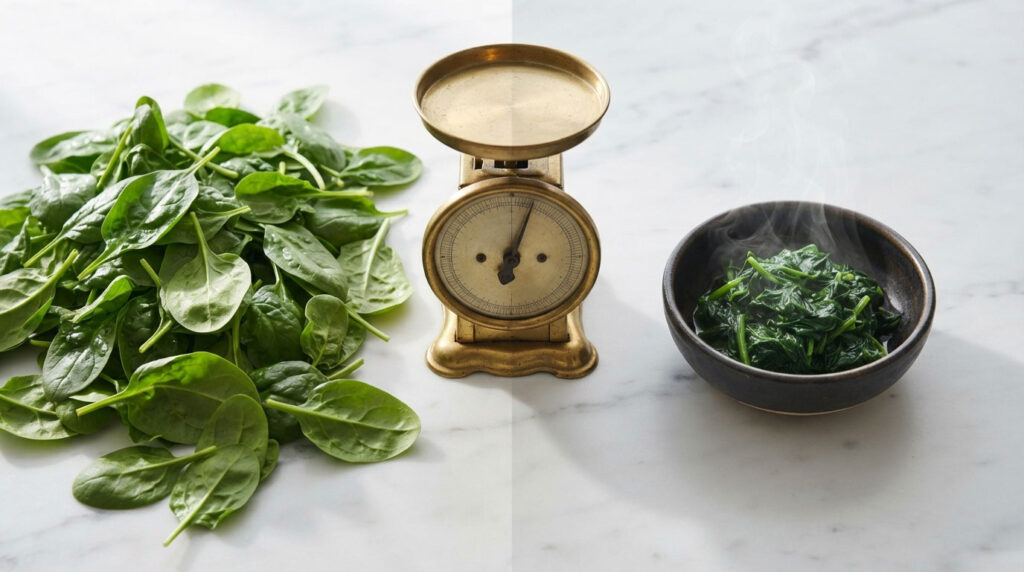
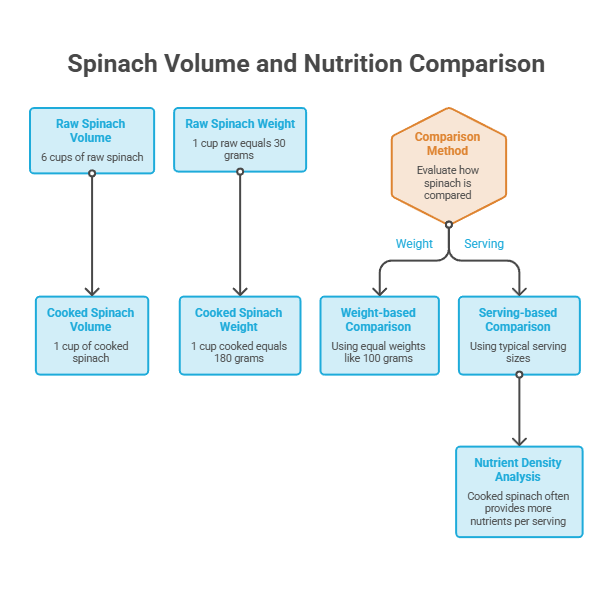
A cup of raw spinach weighs 30 grams. A cup of cooked spinach weighs 180 grams. That single fact quietly breaks almost every raw vs cooked spinach comparison published online, because the two “cups” are not remotely the same amount of food.
Table of Contents
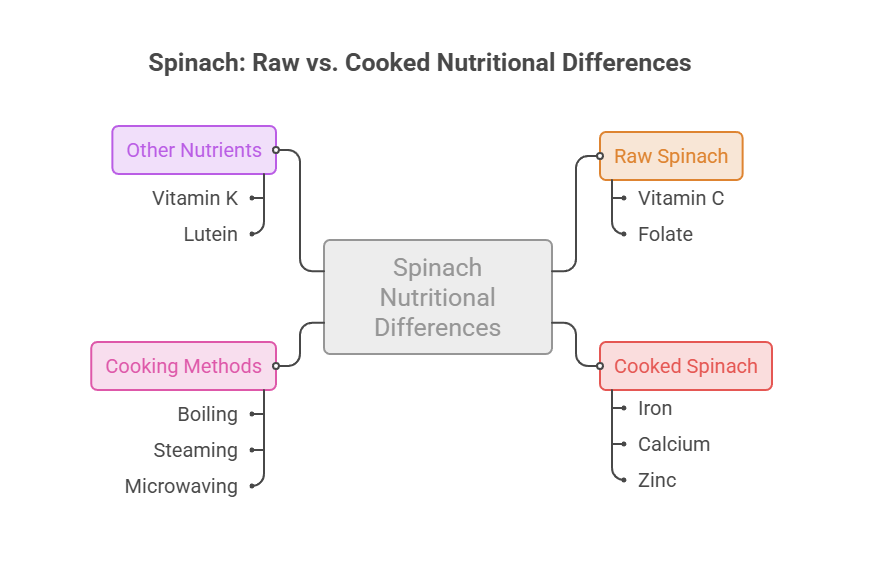
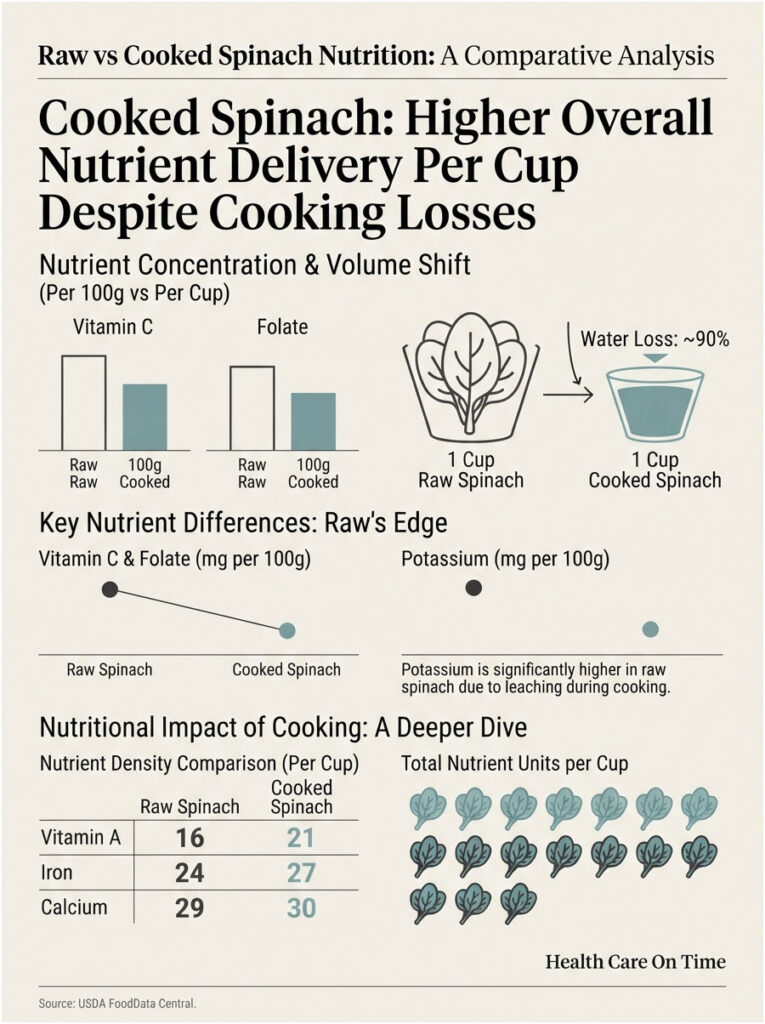
Quick Answer: Per 100 grams, raw spinach has more vitamin C and folate. Cooked spinach has more iron, calcium, magnesium, zinc, and vitamin A. Per actual cup eaten, cooked spinach wins nearly every category, because heat shrinks six cups of leaves into one. Cooking also removes roughly half the oxalate that blocks mineral absorption. Best move: eat both, and steam more than you boil.
At a Glance
• Raw spinach holds about 2.9 times more vitamin C per 100 grams than boiled spinach, plus roughly 33 percent more folate.
• Cooked spinach carries about 32 percent more iron, 37 percent more calcium, and 43 percent more zinc per 100 grams.
• One cup of cooked spinach delivers around 6.4 mg of iron. One cup of raw delivers 0.81 mg. That gap is real-plate reality, not a lab technicality.
• Boiling cuts soluble oxalate by 30 to 87 percent, freeing calcium and iron your body can actually absorb.
• Steaming and microwaving preserve far more vitamin C and folate than boiling while still softening the leaf.
• Vitamin K barely changes with heat, which matters if you take warfarin.
• The lutein claim repeated across most health sites appears to be backward.
The Short Answer, and Why Both Sides of the Internet Are Half Right
Search this question and you will find two confident camps. One says heat destroys nutrients, so eat spinach raw. The other says cooking releases minerals, so eat it cooked.
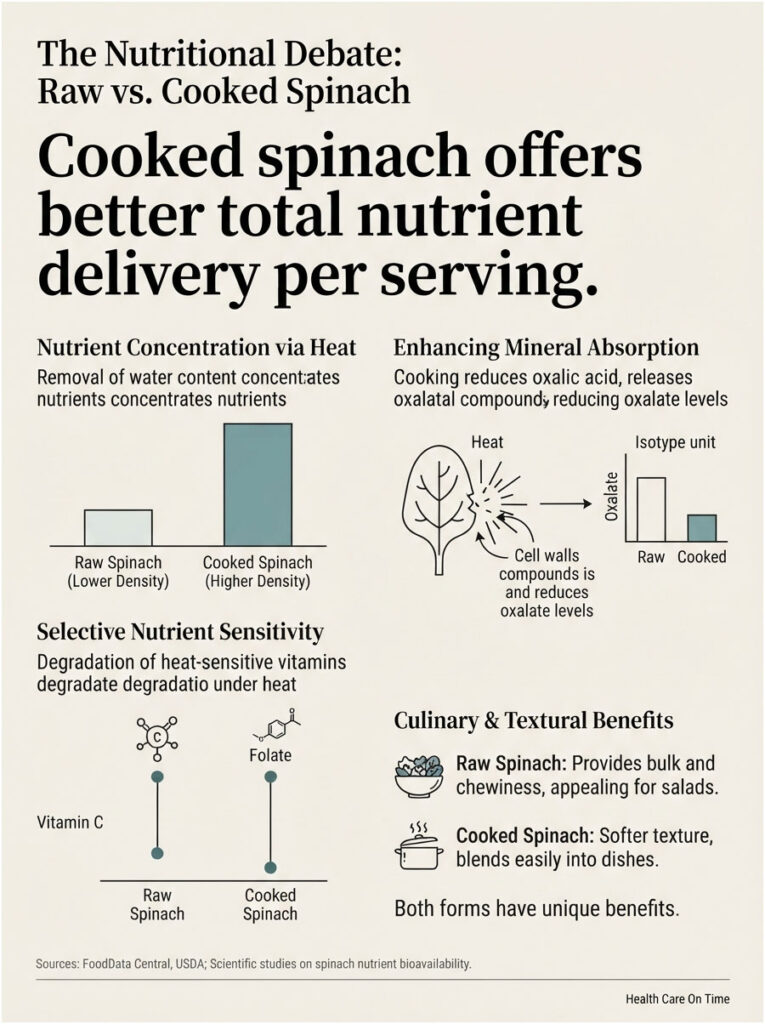
Both describe something real. They just describe different nutrients and quietly ignore the rest.
What Raw Spinach Holds Onto
Vitamin C and folate are water-soluble and heat-sensitive. They degrade under sustained heat and they dissolve straight into cooking water.
Raw spinach protects both. A cup of raw baby spinach in a lunch salad keeps its vitamin C intact and its folate structure unbroken.
Raw leaves also keep the cell structure that gives spinach bulk and chew. For people who eat spinach mainly as a salad base, that texture is the whole reason they buy it.
What Cooked Spinach Gains
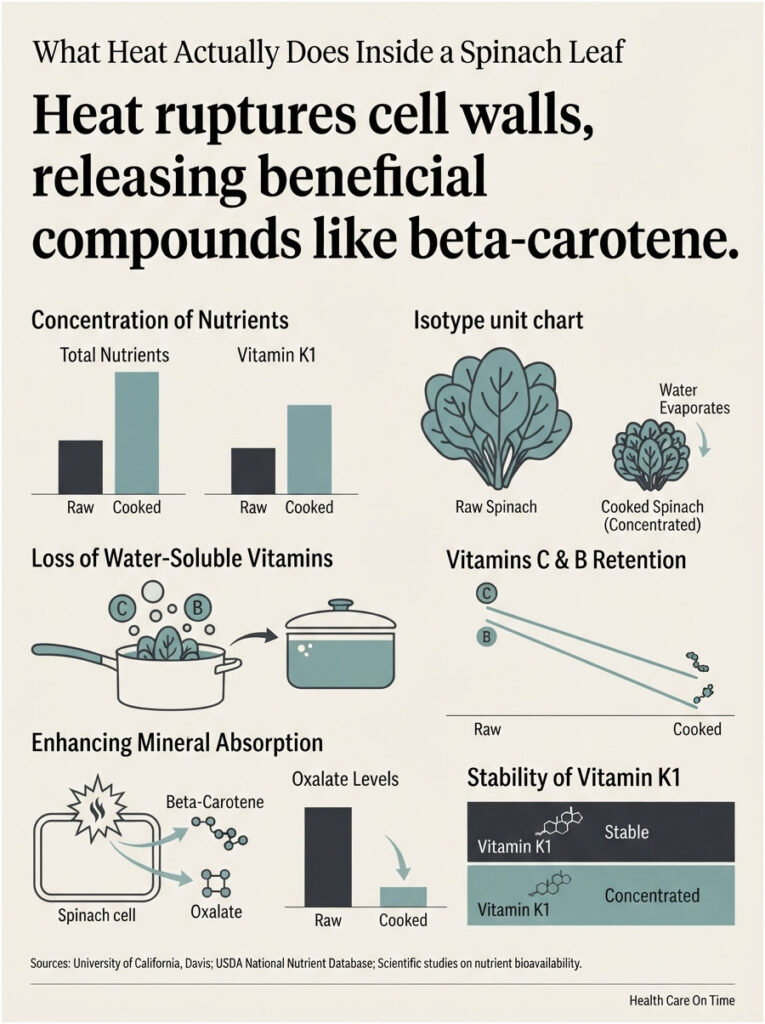
Heat drives out water. Because nutrient values are reported per 100 grams, removing water concentrates everything left behind.
Heat also ruptures cell walls, releasing compounds trapped inside plant cells. And it dissolves a large share of the oxalic acid that binds minerals in your gut.
Our medical reviewers note that this last point matters more than the raw numbers suggest. A mineral present in food is not the same thing as a mineral your body absorbs.
The Verdict in One Sentence
For total nutrient delivery per realistic serving, cooked spinach wins. For vitamin C and folate specifically, raw spinach wins. For everything else, how you cook it matters more than whether you cook it.
The Cup Problem: Why Most Raw vs Cooked Spinach Comparisons Are Rigged
Here is the trick almost nobody explains. When you cook spinach, roughly six packed cups of raw leaves collapse into one cup of cooked spinach.
30 Grams Versus 180 Grams
The USDA lists one cup of raw spinach at 30 grams and one cup of cooked, boiled, drained spinach at 180 grams. That is a sixfold difference in actual food weight.
So when an article says cooked spinach has “only slightly more iron,” it is comparing 100 grams of leaves against 100 grams of leaves. Nobody eats that way.
Nobody sits down to 3.3 cups of raw spinach as a side dish. Plenty of Americans eat a full cup of sauteed spinach next to a chicken breast without thinking twice.
What a Real Serving Looks Like on a Plate
A typical raw spinach salad uses 2 to 3 cups of loose leaves, which is 60 to 90 grams. A typical cooked spinach side runs half a cup to a full cup, which is 90 to 180 grams.
Measured that way, the cooked portion usually delivers more of nearly everything. It just does not look like more food.
Patients who book nutrition-related lab panels through HealthCareOnTime frequently underestimate this. They report eating spinach “every day” and mean a small handful in a smoothie, which is closer to 20 grams than 100.
Why This Distinction Decides the Whole Debate
Once you understand the shrinkage, most of the confusion in the raw vs cooked spinach argument dissolves. Two writers can look at identical USDA data and reach opposite conclusions depending on which denominator they choose.
Per 100 grams is a laboratory question. Per serving is a kitchen question.
This article answers both, and the table below shows them side by side so you can see exactly where the answer flips.
Raw vs Cooked Spinach Nutrition, Side by Side
The values below come from USDA FoodData Central: spinach, raw (entry 168462) and spinach, cooked, boiled, drained, without salt (entry 168463).
| Nutrient | Raw, per 100 g | Cooked, per 100 g | Raw, per 1 cup (30 g) | Cooked, per 1 cup (180 g) |
| Calories | 23 kcal | 23 kcal | 7 kcal | 41 kcal |
| Protein | 2.86 g | 2.97 g | 0.86 g | 5.35 g |
| Fiber | 2.2 g | 2.4 g | 0.7 g | 4.3 g |
| Vitamin C | 28.1 mg | 9.8 mg | 8.4 mg | 17.6 mg |
| Folate (DFE) | 194 mcg | 146 mcg | 58 mcg | 263 mcg |
| Vitamin K | 483 mcg | 494 mcg | 145 mcg | 888 mcg |
| Vitamin A (RAE) | 469 mcg | 524 mcg | 141 mcg | 943 mcg |
| Calcium | 99 mg | 136 mg | 30 mg | 245 mg |
| Iron | 2.71 mg | 3.57 mg | 0.81 mg | 6.43 mg |
| Magnesium | 79 mg | 87 mg | 24 mg | 157 mg |
| Potassium | 558 mg | 466 mg | 167 mg | 839 mg |
| Zinc | 0.53 mg | 0.76 mg | 0.16 mg | 1.37 mg |
| Lutein + zeaxanthin | 12,198 mcg | 11,308 mcg | 3,659 mcg | 20,354 mcg |
Table 1. Raw versus cooked spinach nutrition, per 100 grams and per cup. Source: USDA FoodData Central entries 168462 and 168463.
How to Read This Table Without Getting Fooled
Look at the two middle columns first. Per 100 grams, raw spinach beats cooked on exactly two nutrients that matter much: vitamin C and folate. Potassium also favors raw, because potassium leaches heavily into boiling water.
Now look at the two right-hand columns. Per cup, cooked spinach wins every single row, including vitamin C, because volume overwhelms the percentage loss.
That is the honest answer to the raw vs cooked spinach question. Concentration and delivery point in different directions, and most articles only tell you one of them.
What Heat Actually Does Inside a Spinach Leaf
Understanding the mechanism makes the numbers stop feeling arbitrary. Four things happen when spinach meets heat.
Water Leaves and Nutrients Concentrate
Raw spinach is roughly 91 percent water. Cooking drives much of that out, so whatever remains packs into a smaller mass.
This is why cooked spinach shows higher per-gram calcium, iron, and magnesium. Nothing was created. The water simply left.
Water-Soluble Vitamins Escape Into the Pot
Vitamin C and the B vitamins, folate included, dissolve readily in water. Drop spinach into a boiling pot and those nutrients migrate out of the leaf and into the liquid.
Blanching spinach for five minutes can more than halve its vitamin C, and after 15 minutes more than 90 percent has dissolved into the cooking water. The vitamin was not so much destroyed as relocated, then poured down the drain.
Folate follows the same escape route. A controlled multi-method cooking trial found spinach folate losses reached 62 percent after boiling, with steaming only about 5 percent better, while sous-vide and combi-oven methods retained above 50 percent.
Cell Walls Rupture and Compounds Get Released
Plant cells sit inside tough cellulose walls that human digestion handles poorly. Heat breaks those walls open.
That release is why cooked carrots give up more beta-carotene than raw ones, and the same physics applies to spinach. Chewing does part of this work, but nowhere near as thoroughly as a hot pan.
Oxalate Leaches Out
Spinach is one of the highest-oxalate foods in the American diet. Oxalic acid binds calcium, iron, magnesium, and zinc inside your digestive tract, forming compounds you excrete instead of absorbing.
Water pulls oxalate out of the leaf. This is the strongest single argument for cooked spinach, and it earns its own section below.
Why Vitamin K Barely Notices the Heat
Vitamin K1, or phylloquinone, is fat-soluble and heat-stable. It does not dissolve into water and it does not readily break down at cooking temperatures.
Raw spinach carries 483 mcg per 100 grams. Cooked carries 494 mcg. That small increase reflects concentration, not creation.
The Oxalate Question: Kidney Stones, Calcium, and Gritty Teeth
If you have ever finished a large raw spinach salad and felt a chalky film on your teeth, you have met oxalate. Those are microscopic calcium oxalate crystals.
How Much Oxalate Is in Raw Spinach
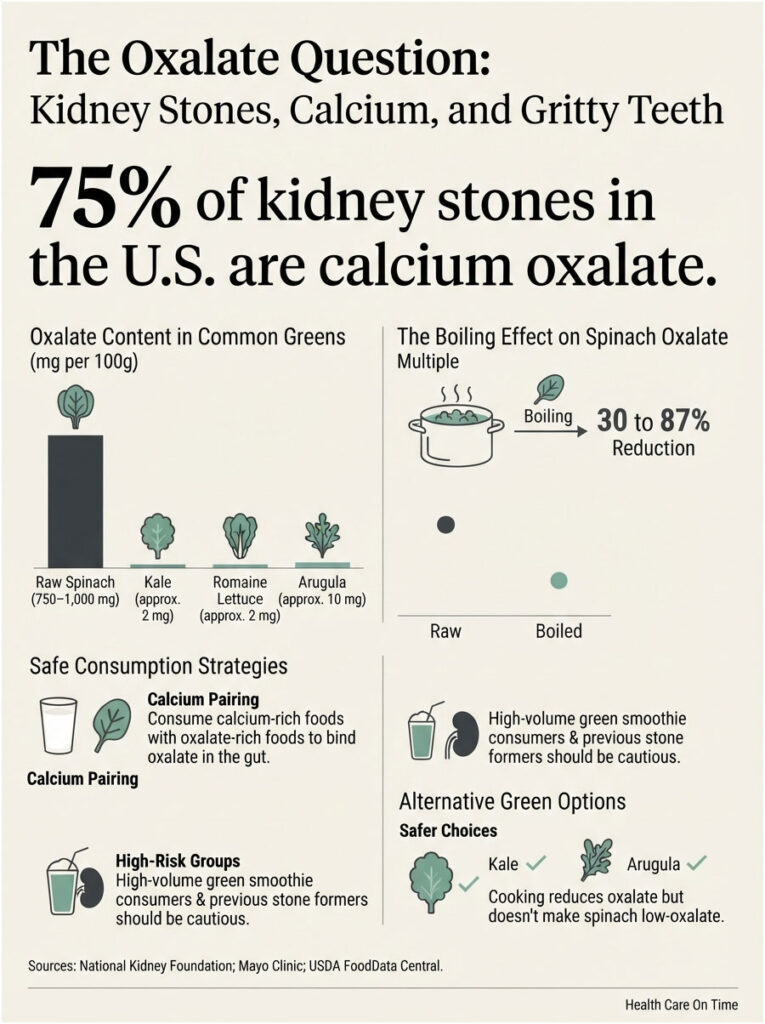
Raw spinach runs roughly 750 to 1,000 mg of total oxalate per 100 grams depending on cultivar, soil, and season. One HPLC analysis measured raw spinach at 978 mg per 100 grams of fresh weight.
By comparison, a low-oxalate green such as kale or romaine sits in the single digits or low tens of milligrams. Spinach is in a different category entirely.
What Boiling Actually Removes
Here is where cooking earns its keep. Research in the Journal of Agricultural and Food Chemistry found boiling reduced soluble oxalate content by 30 to 87 percent, more effectively than steaming at 5 to 53 percent, while baking produced no oxalate loss at all.
The same HPLC study that measured 978 mg per 100 grams raw found the figure dropped to 477 mg after 12 to 15 minutes of boiling. Roughly half the oxalate ended up in the water.
Method details matter. An optimization study found that boiling water for two minutes, with spinach cut into 1 cm pieces, removed 72 percent of the oxalic acid while retaining 79 percent of the lutein. Short, hot, and chopped beats long and whole.
Who Genuinely Needs to Worry
Most healthy adults with normal kidney function handle dietary oxalate without incident. The concern narrows to specific groups.
Across the patients we serve who book kidney function panels, the recurring pattern is rarely casual spinach eating. It is high-volume green smoothies consumed daily, often two or three cups of raw leaves at a time.
Stone Formers and Calcium Oxalate
Roughly three of every four kidney stones in the United States are calcium oxalate. If you have formed one, dietary oxalate shifts from theoretical to relevant.
Standard guidance from kidney specialists is not to cut calcium but to pair oxalate-rich foods with calcium-rich ones. Calcium binds oxalate in the gut so it exits in stool rather than reaching the kidneys.
Yogurt with a spinach-containing meal, or cheese on a spinach salad, works better than avoiding both.
Why Cooked Spinach Is Still a High-Oxalate Food
Halving 978 mg still leaves around 477 mg. That remains higher than most vegetables deliver raw.
Boiling helps meaningfully, but it does not convert spinach into a low-oxalate green. Anyone actively managing stone risk is usually better served rotating in kale, arugula, or romaine than trying to boil the problem away.
Iron and Calcium: Content Versus What You Actually Absorb
Spinach’s reputation as an iron powerhouse is one of the most durable myths in American nutrition. The numbers deserve a closer look.
The Popeye Story, Corrected
The popular version says a nineteenth-century chemist misplaced a decimal point, inflating spinach’s iron content tenfold, and Popeye cartoons cemented the error into American culture. Food historians have largely debunked the decimal-point tale itself.
What survives the debunking is the substance of the correction. Spinach does contain iron, and the amount is respectable for a plant food, but the body absorbs a small fraction of it.
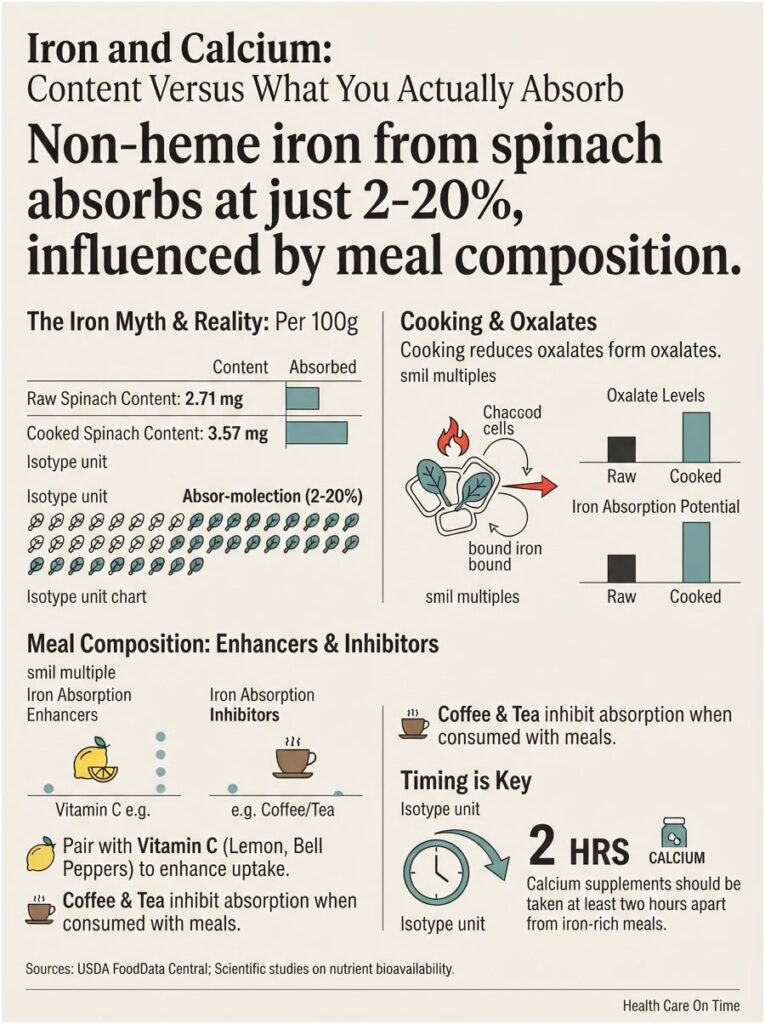
Raw spinach carries 2.71 mg of iron per 100 grams. Cooked carries 3.57 mg. Neither figure tells you what reaches your bloodstream.
Non-Heme Iron and the Absorption Gap
Spinach supplies non-heme iron, the plant form. Heme iron from meat absorbs at roughly 15 to 35 percent, while non-heme iron typically lands somewhere between 2 and 20 percent depending on what else is on the plate.
Oxalate pushes spinach toward the bottom of that range. This is the core reason cooked spinach outperforms raw for iron: less oxalate in the leaf means more iron crossing into circulation.
Patients booking iron studies with us often ask why their ferritin stays low despite eating spinach daily. The usual answer combines three things: small portions, raw preparation, and no vitamin C anywhere on the plate.
Pairing Spinach With Vitamin C
Vitamin C converts non-heme iron into a form your intestine absorbs far more readily. A squeeze of lemon, a handful of cherry tomatoes, or sliced red bell pepper alongside spinach measurably improves uptake.
This creates a clean workaround for cooked spinach. Cook it to cut the oxalate, then add the vitamin C back after the heat is off.
Squeezing fresh lemon over sauteed spinach at the end of cooking gives you both benefits at once. It may be the single most practical takeaway in this article.
What Blocks Absorption
Coffee and tea contain polyphenols that inhibit non-heme iron absorption significantly. Drinking either alongside a spinach-heavy meal works against you.
Calcium supplements taken at the same sitting compete for the same absorption pathways. Space them at least two hours from your iron-focused meal.
Whole grains and legumes contain phytates, which also bind iron. That does not make those foods bad, but a spinach-and-lentil bowl delivers less usable iron than the label math implies.
Lutein, Beta-Carotene, and the Eye-Health Claim Most Sites Get Backward
Nearly every article on this topic states confidently that cooking increases lutein bioavailability. The published evidence does not support that as cleanly as the claim suggests.
What the Cell-Transport Evidence Showed
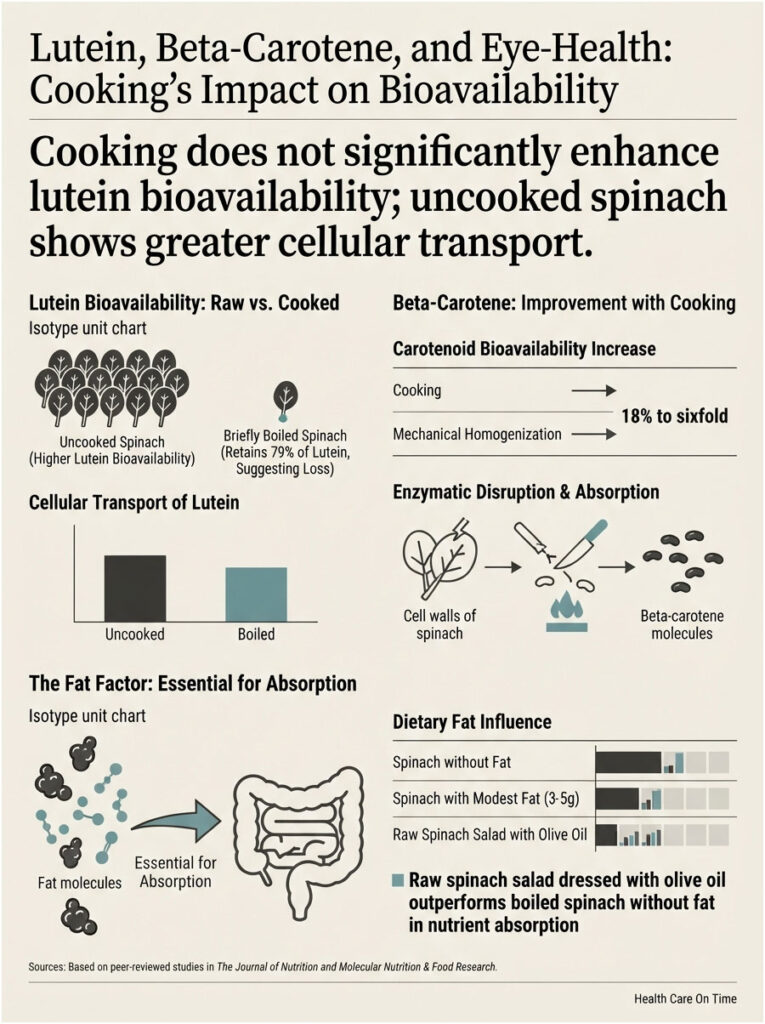
A study pairing an in vitro digestion procedure with a human intestinal Caco-2 cell model tested fresh, frozen, and canned spinach, both uncooked and after boiling or microwaving. Cellular transport of lutein turned out greater from uncooked spinach regardless of which form was tested.
That is the opposite of the standard claim. Heat may liberate lutein from the leaf, but liberation and absorption are separate steps, and the second one is what counts.
Even the well-optimized two-minute boil described earlier retained 79 percent of the lutein, meaning roughly a fifth was lost. Cooking is not free for this compound.
Where Cooking Genuinely Helps
Beta-carotene is a different story. Research on the spinach food matrix concluded that enzymatic disruption of the cell wall structure enhanced beta-carotene bioavailability from whole-leaf and minced spinach, while the lutein response did not differ among spinach preparations.
Processing through mechanical homogenization or heat treatment has been shown to raise carotenoid bioavailability from vegetables anywhere from 18 percent to a sixfold increase, depending on the compound and the matrix.
The accurate statement is narrower than the popular one. Cooking and chopping help beta-carotene substantially and lutein marginally or not at all.
The Fat Rule That Beats Both Raw and Cooked
Lutein, zeaxanthin, beta-carotene, vitamin A, vitamin E, and vitamin K are all fat-soluble. Without dietary fat in the same meal, absorption drops sharply regardless of preparation.
The fat requirement appears modest, in the range of 3 to 5 grams per meal. That is roughly one teaspoon of olive oil.
A raw spinach salad with olive oil dressing outperforms plain boiled spinach eaten dry. A salad with fat-free dressing wastes most of the carotenoids you just paid for.
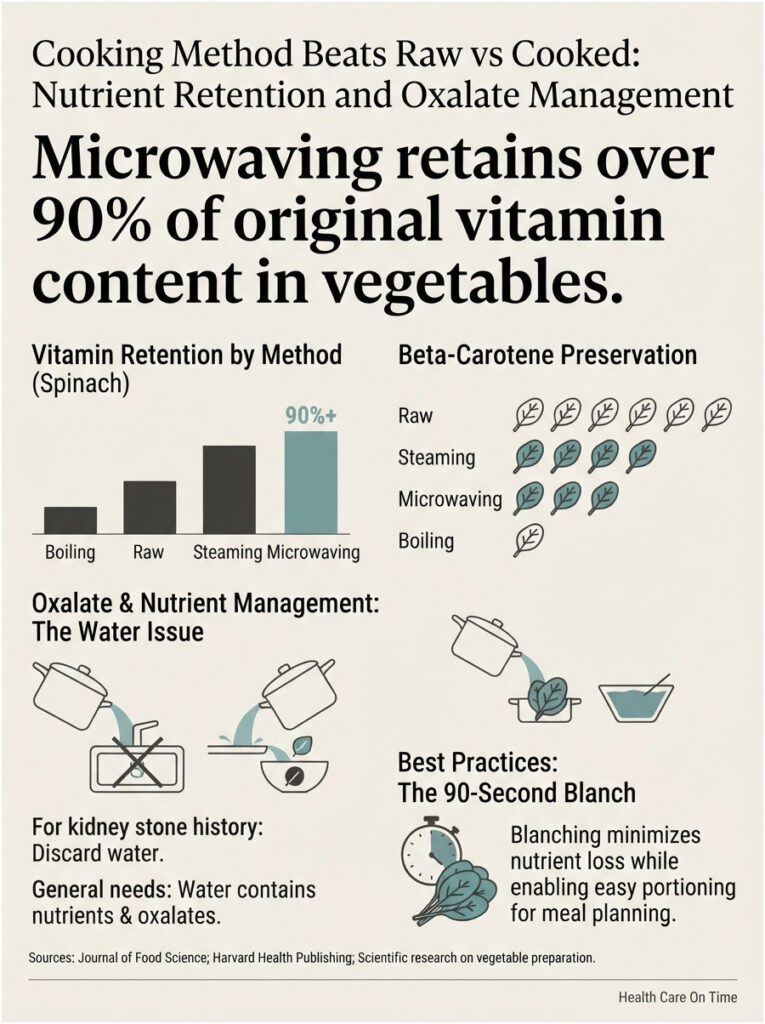
Cooking Method Beats Raw vs Cooked
The framing of this debate is slightly off. The real variable is not heat versus no heat. It is water contact and duration.
| Method | Vitamin C Retention | Folate Retention | Oxalate Reduction | Best For |
| Raw | 100% | 100% | 0% | Vitamin C, folate, nitrate, salad texture |
| Microwave, covered, no water | Above 90% | 45 to 55% | Minimal | Best all-around retention with softening |
| Steam, 3 to 5 minutes | 65 to 75% | 40 to 45% | 5 to 53% | Balanced retention with a mild oxalate drop |
| Saute in oil, 2 to 4 minutes | 60 to 75% | 50 to 60% | Minimal | Fat-soluble vitamins and carotenoid uptake |
| Blanch and shock, 90 seconds | 45 to 55% | 50 to 60% | 25 to 40% | Meal prep, freezing, color retention |
| Boil and drain, 10 to 15 minutes | 10 to 30% | 38% | 30 to 87% | Maximum oxalate removal only |
Table 2. How cooking method changes nutrient retention and oxalate removal in spinach.
Comparative cooking research found boiling produced the largest ascorbic acid decline of any method tested, with spinach showing the steepest drop of the vegetables studied, while microwaving preserved over 90 percent of the original content.
The same work found steam-cooked vegetables retained a higher percentage of beta-carotene than raw, boiled, or microwaved versions in most cases.
The 90-Second Blanch
If you cook a large batch for the week, drop spinach into already-boiling water for 90 seconds, then transfer it straight into an ice bath. The short contact time limits leaching while the cold shock halts enzymatic degradation.
This method also makes portioning simple. A blanched, squeezed, frozen puck of spinach reheats without collapsing into mush.
Our lab partners report that people who batch-prep this way eat greens more consistently than people who plan to cook fresh each night.
Should You Keep the Cooking Water?
This is a genuine trade-off, and your answer depends entirely on your priority. Analysis of cooking water after boiling and steaming showed approximately 100 percent recovery of the oxalate lost from the vegetable.
Save the water for soup and you recover the vitamin C, folate, and potassium. You also recover the oxalate you just spent ten minutes removing.
Our medical reviewers suggest a simple rule. If kidney stones are not part of your history, save the liquid. If they are, pour it out.
Fresh, Frozen, Canned, and Bagged: How Form Changes the Math
Grocery reality complicates this question further. Not all “fresh” spinach is actually fresh.
Why Frozen Often Beats Day-Five Fresh
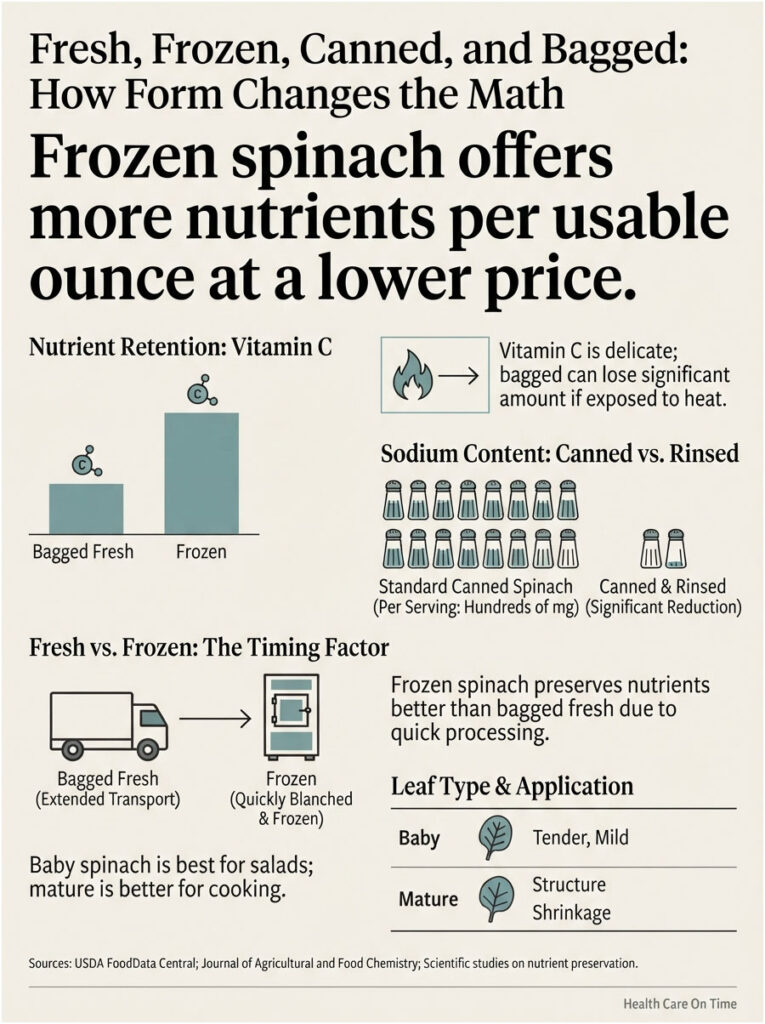
Spinach destined for freezing is typically blanched and frozen within hours of harvest, locking nutrients near peak levels. Bagged fresh spinach may spend five to ten days in trucks and refrigerated cases before you open it.
Vitamin C in spinach is particularly fragile in storage, and even bagged spinach exposed to a hot day can lose close to half of it.
Frozen spinach does carry less vitamin C than genuinely fresh leaves because of the blanching step. It holds folate and vitamin K well, and it costs considerably less per usable ounce.
Canned Spinach and Sodium
Canned spinach is fully cooked and heavily drained, so it behaves like the boiled column in the table above. Oxalate is low. Water-soluble vitamins are largely gone.
The larger issue is sodium. Standard canned spinach can carry several hundred milligrams per serving unless you buy the no-salt-added version and rinse it before use.
Baby Spinach Versus Mature Leaves
Baby spinach is harvested young, with tender leaves and a milder flavor. Nutrient profiles are broadly similar to mature spinach, though mature leaves tend to run somewhat higher in oxalate and fiber.
For raw eating, baby spinach is the practical pick. For cooking, mature spinach holds structure better and shrinks less dramatically in the pan.
Safety, Nitrates, and Digestive Tolerance
Beyond nutrient counts, three practical factors shape whether raw or cooked fits your situation.
Raw Leafy Greens and Recall History
Leafy greens rank among the most frequent sources of foodborne illness outbreaks tracked by the CDC and FDA. Contamination generally happens in the field, and home washing does not reliably remove pathogens bound to leaf surfaces.
Cooking to a safe temperature does. For people with weakened immune systems, during pregnancy, or in older adults, cooked spinach carries a real safety advantage.
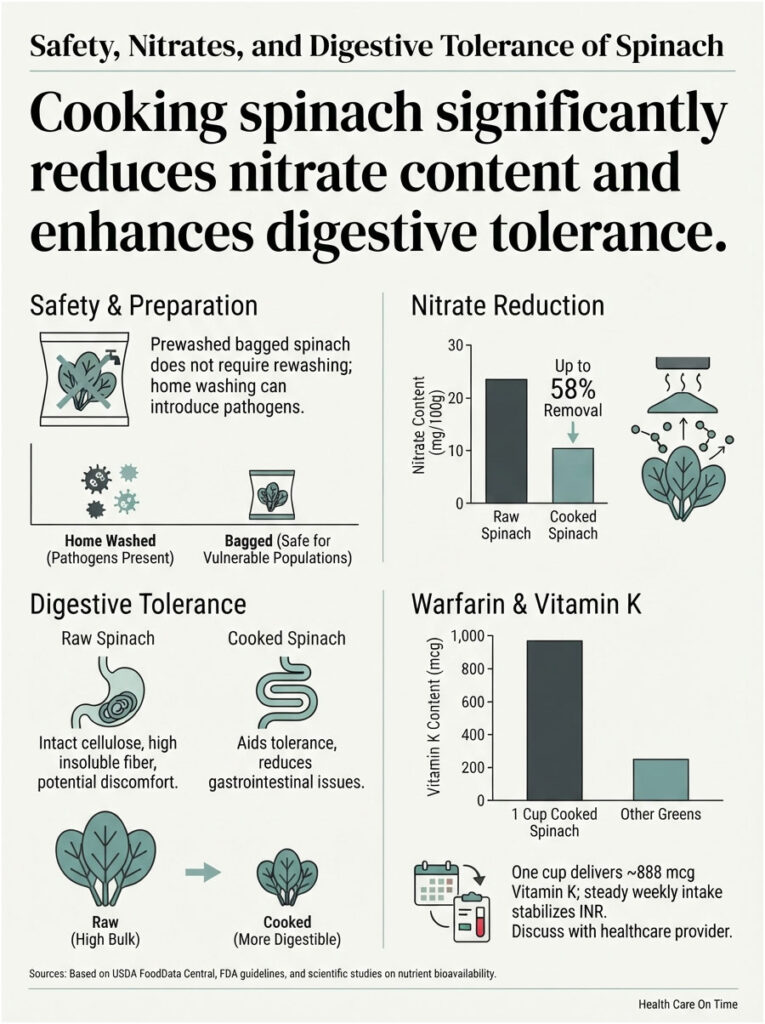
Prewashed bagged spinach labeled triple washed does not require rewashing, and rewashing it in a home sink can introduce contamination rather than remove it.
Nitrate Loss and Blood Pressure
Spinach is naturally rich in dietary nitrate, which the body converts to nitric oxide. That pathway supports blood vessel dilation and modest reductions in blood pressure.
Water-based cooking pulls nitrate out along with everything else. One study measured 58 percent removal of nitrate ion under optimized boiling conditions.
If cardiovascular benefit is your main reason for eating spinach, raw or dry-heat sauteed preserves more of the compound doing that work.
Bloating, IBS, and Why Cooked Is Often Gentler
Raw spinach carries intact cellulose and a high volume of insoluble fiber relative to its weight. For some people that produces gas, cramping, and bloating.
Cooking softens the fiber matrix without eliminating the fiber itself. In cases reviewed by our medical team, people with irritable bowel symptoms consistently tolerate cooked greens better than large raw salads.
Vitamin K and Warfarin: Consistency, Not Avoidance
This point deserves stating plainly. One cup of cooked spinach delivers roughly 888 mcg of vitamin K, well above the daily adequate intake for adults.
If you take warfarin, the goal is not avoiding spinach. It is eating a steady amount week to week so your INR stays predictable.
Sudden swings in vitamin K intake are what destabilize warfarin dosing. Someone who eats spinach every Tuesday is far easier to manage than someone who eats none for a month and then starts a daily green smoothie habit.
Anyone on warfarin should discuss dietary vitamin K with their prescribing clinician and keep INR monitoring on schedule.
How Much Spinach Should You Actually Eat?
Portion guidance gets skipped in most articles on this topic, which leaves readers optimizing preparation without knowing the target.
A Reasonable Daily Range
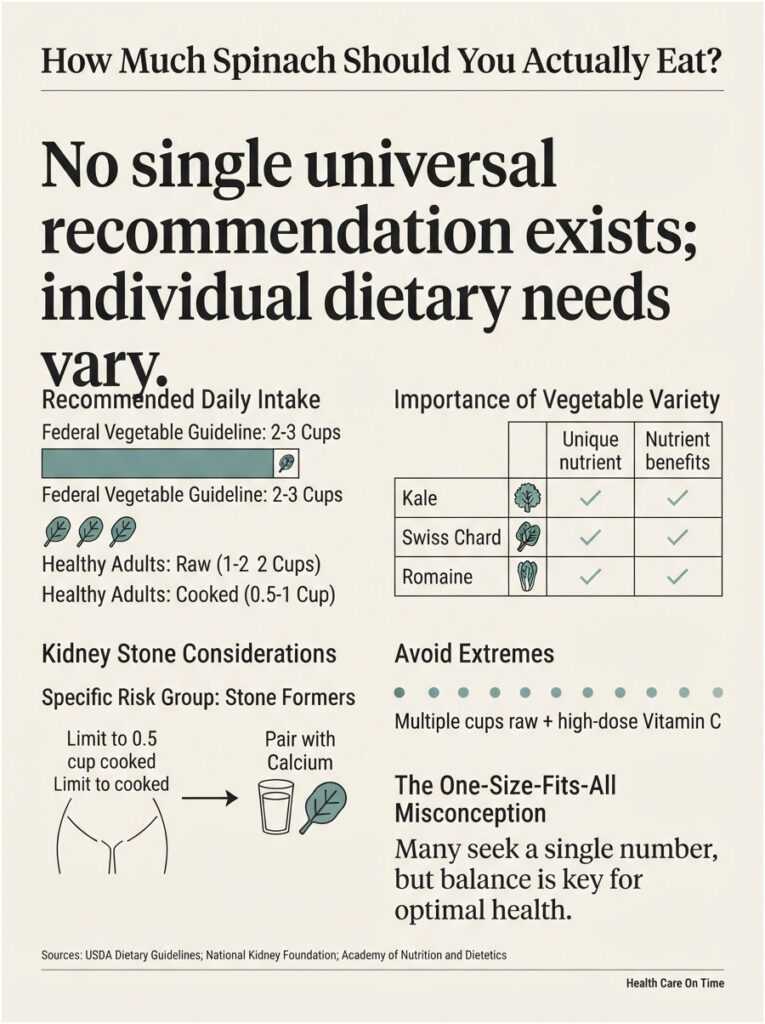
For healthy adults, one to two cups of raw spinach or half a cup to one cup of cooked spinach per day sits comfortably within general dietary guidance. That covers a salad base or a solid side dish.
The federal vegetable recommendation for most adults runs 2 to 3 cups of vegetables daily across all types. Spinach should be part of that, not the whole of it.
Rotation matters more than volume. Different greens deliver different mineral and phytonutrient profiles, and none of them should carry your entire vegetable intake.
Where the Ceiling Sits
People with kidney stone history are commonly advised to cap spinach at roughly half a cup cooked and to pair it with a calcium source. That is a clinical judgment call, not a universal rule.
The documented problem cases in the medical literature involve extremes. Multiple cups of raw spinach blended daily, often alongside high-dose vitamin C supplements, is where trouble tends to appear.
Patients commonly ask us for a single number that works for everyone. There is not one, and any source offering one is oversimplifying to sound authoritative.
The Numbers on Americans and Their Greens
Context matters here. The raw vs cooked spinach debate is a fine-tuning question for a population that mostly is not eating vegetables at all.
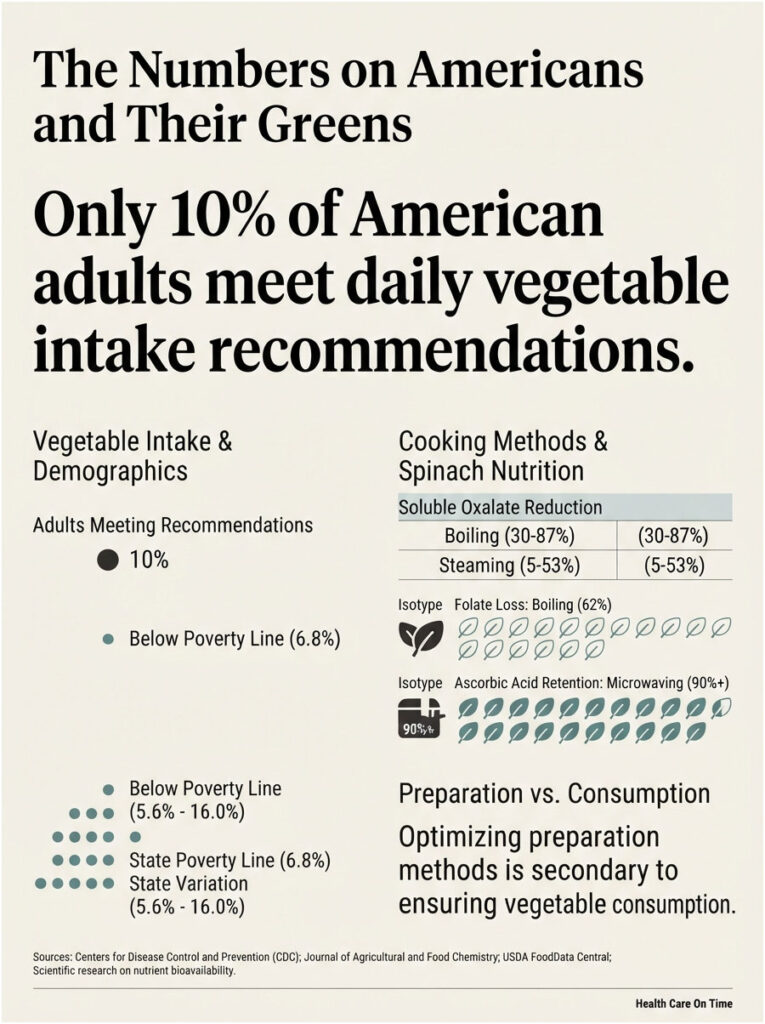
| Finding | Figure | Population or Sample | Source |
| US adults meeting daily vegetable intake recommendations | 10.0% | 294,566 BRFSS respondents, 49 states plus DC | CDC MMWR, 2019 BRFSS analysis |
| State range for meeting vegetable recommendations | 5.6% to 16.0% | Kentucky lowest, Vermont highest | CDC MMWR |
| Adults below or near poverty meeting vegetable recommendations | 6.8% | Income-to-poverty ratio under 1.25 | CDC MMWR |
| Soluble oxalate reduction from boiling | 30% to 87% | Nine raw and cooked vegetable types, enzymatic assay | Chai and Liebman, J. Agric. Food Chem. |
| Soluble oxalate reduction from steaming | 5% to 53% | Same study sample | Chai and Liebman, J. Agric. Food Chem. |
| Spinach folate loss after boiling | 62% | Controlled multi-method cooking trial | LWT Food Science and Technology |
| Ascorbic acid retention when microwaving | Above 90% | Multi-vegetable cooking comparison | Food Chemistry, Sylhet vegetable study |
| Nitrate ion removed under optimized boiling | 58% | Whole and cut spinach, additive trial | Food Science and Technology Research |
| Total oxalate in raw spinach | 978 mg per 100 g | HPLC analysis, fresh weight | Int. J. Food Properties |
Table 3. Key United States consumption figures and published cooking-loss data for spinach.
The message in the first three rows is blunt. Only about one in ten American adults meets vegetable intake recommendations, and the figure drops further among lower-income households.
Getting spinach onto your plate at all outweighs optimizing the preparation method. The cooking question is a refinement, not a gate you have to clear first.
Your Goal, Your Prep: A Decision Guide
Different goals point to different preparations. Use this as a quick reference.
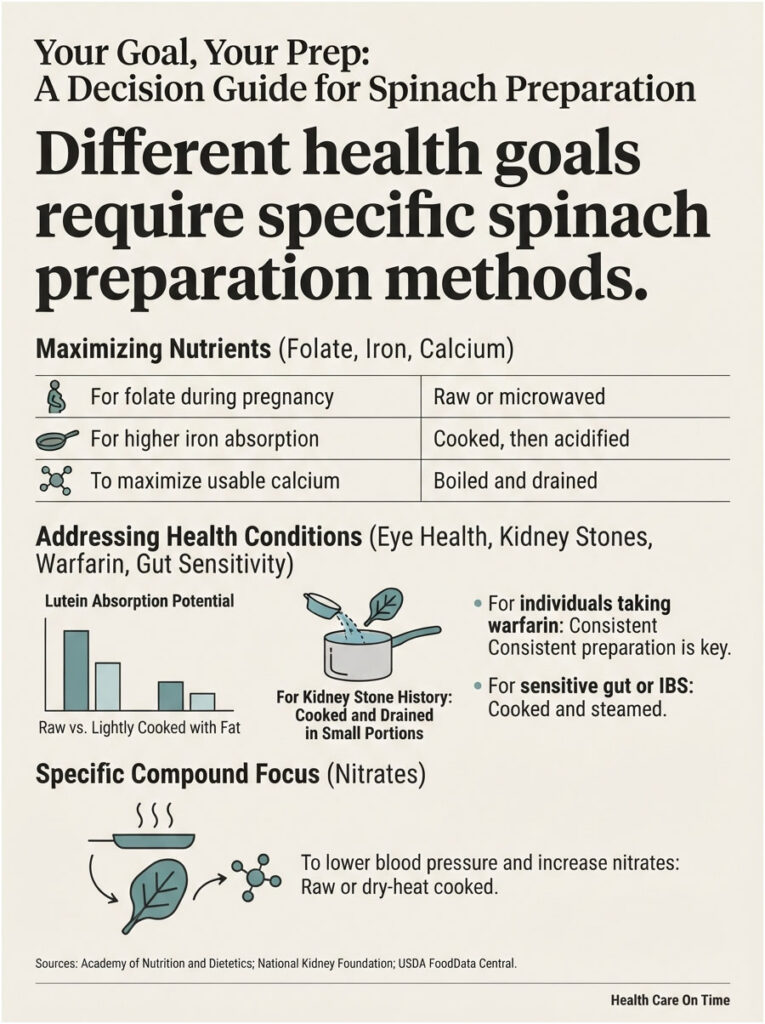
| If your goal is… | Eat spinach this way | Do this specifically | Why it works |
| Higher iron absorption | Cooked, then acidified | Saute 3 minutes, squeeze fresh lemon after heat is off | Cooking cuts oxalate; vitamin C converts non-heme iron into an absorbable form |
| More usable calcium | Boiled and drained | Boil 5 to 8 minutes, discard the water | Oxalate binds calcium in the gut; removing it frees the mineral |
| Folate for pregnancy | Raw or microwaved | 2 cups raw in a salad, or covered microwave 60 to 90 seconds | Boiling destroys up to 62 percent of folate; raw and microwave preserve most |
| Eye health and lutein | Raw or lightly cooked, always with fat | Olive oil dressing on raw leaves, or a 2-minute saute | Lutein transport may be higher from uncooked spinach; fat is required either way |
| Kidney stone history | Cooked, drained, small portions | Boil, discard water, cap at 1/2 cup, add a calcium source to the meal | Boiling removes up to 87 percent of soluble oxalate; calcium binds the rest in the gut |
| Taking warfarin | Either, but consistent | Pick a weekly amount and hold it steady | Vitamin K is heat-stable; steady intake, not avoidance, protects INR |
| Sensitive gut or IBS | Cooked | Steam 3 to 5 minutes until fully wilted | Heat softens insoluble fiber and reduces fermentable bulk |
| Blood pressure and nitrate | Raw or dry-heat cooked | Raw in smoothies, or saute without added water | Boiling leaches up to 58 percent of nitrate into the water |
| Maximum nutrients per serving | Cooked | 1 cup cooked as a side dish | Six cups of raw leaves reduce to a single cooked cup |
| Meal prep for the week | Blanched and frozen | 90-second blanch, ice bath, squeeze, freeze in portions | Short water contact limits leaching while halting enzyme activity |
Table 4. Match your health goal to the right spinach preparation.
Five Mistakes That Waste Spinach’s Nutrients
- Boiling for ten minutes and pouring the water down the drain. You lose most of the vitamin C, folate, and potassium in one step. Cut the time or switch to steaming.
- Eating spinach with no fat at all. Vitamin A, vitamin K, lutein, and zeaxanthin all need dietary fat to absorb. Fat-free dressing on a spinach salad wastes most of them.
- Drinking coffee or tea with a spinach meal. Polyphenols in both meaningfully block non-heme iron absorption. Move the caffeine an hour away from the meal.
- Treating a smoothie handful as a serving. Twenty grams of baby spinach blended into a drink is two-thirds of a raw cup. It contributes, but it is not a vegetable serving.
- Storing spinach warm or damp. Vitamin C degrades quickly at room temperature and moisture accelerates leaf breakdown. Refrigerate promptly at 34 to 38 degrees Fahrenheit and keep the leaves dry.
The Bottom Line
Cooked spinach delivers more total nutrition per realistic serving, mainly because six cups of raw leaves collapse into one cooked cup, and because heat removes a large share of the oxalate that would otherwise block mineral absorption.
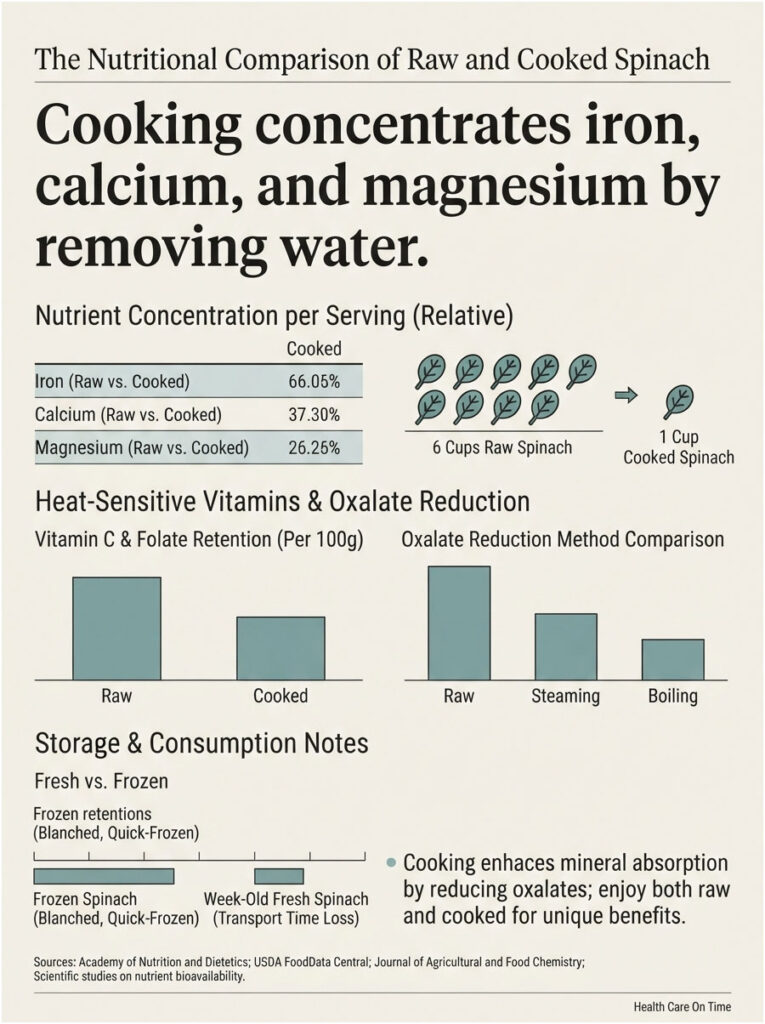
Raw spinach protects vitamin C, folate, and dietary nitrate, all of which boiling damages heavily. If those are your priorities, keep part of your intake raw.
The most useful approach is not picking a side. Steam or saute spinach for dinner, keep raw leaves for lunch salads, add a little fat and a little acid to both, and stop worrying about optimizing a food that most Americans are not eating enough of in the first place.
Frequently Asked Questions
Is spinach healthier raw or cooked?
Both, for different reasons. Raw spinach holds roughly three times more vitamin C and one-third more folate per 100 grams. Cooked spinach delivers more iron, calcium, magnesium, and zinc, and far more of everything per actual serving, since six cups of raw leaves shrink to one cooked cup.
Does cooking spinach destroy the iron?
No. Iron is a mineral and does not break down with heat. Cooked spinach shows higher iron per 100 grams, at 3.57 mg versus 2.71 mg raw, because water loss concentrates it. Cooking also removes oxalate, which improves how much of that iron your body absorbs.
How much does spinach shrink when cooked?
Roughly six to one by volume. The USDA lists a cup of raw spinach at 30 grams and a cup of cooked spinach at 180 grams. A 10-ounce bag of fresh spinach cooks down to about one cup, which is why cooked portions look so much smaller on the plate.
Does boiling spinach remove oxalates?
Yes, substantially. Published research found boiling reduced soluble oxalate by 30 to 87 percent, considerably more than steaming at 5 to 53 percent. One HPLC analysis measured total oxalate dropping from 978 mg to 477 mg per 100 grams. The removed oxalate ends up in the cooking water.
Is raw spinach bad for your kidneys?
For most people with normal kidney function, no. The concern applies mainly to those with a history of calcium oxalate stones, which account for roughly three of every four kidney stones in the US. Large daily volumes of raw spinach in juices and smoothies carry more risk than occasional salads.
Can you eat raw spinach every day?
Most healthy adults can. Daily raw spinach in normal salad portions of one to two cups is generally fine. If you have kidney stone history, take anticoagulants, or drink multiple cups of spinach smoothie daily, discuss your intake with your physician before continuing.
How much vitamin C is lost when spinach is cooked?
A large share, depending on method. Boiled spinach retains roughly 35 percent of its vitamin C per 100 grams, dropping from 28.1 mg to 9.8 mg. Blanching for five minutes can more than halve it. Microwaving without added water preserves over 90 percent.
Is spinach in a smoothie still healthy?
Yes. Blending applies no heat, so vitamin C and folate stay intact, and mechanical rupture of cell walls may help carotenoid release. Add a fat source such as avocado or nut butter for absorption, and watch total volume if you have kidney stone history.
Is frozen spinach as good as fresh spinach?
Often better than week-old fresh. Frozen spinach is blanched and frozen shortly after harvest, locking in folate and vitamin K near peak levels. It carries less vitamin C than truly fresh leaves because of blanching, but it beats bagged spinach that has sat refrigerated for a week.
Which has more calcium, raw or cooked spinach?
Cooked, by a wide margin in practical terms. Per 100 grams, cooked spinach carries 136 mg versus 99 mg raw. Per cup, the gap widens to 245 mg versus 30 mg. Cooking also reduces the oxalate that would otherwise bind that calcium in your gut.
Why does raw spinach make my teeth feel gritty?
That chalky film is microscopic calcium oxalate crystals binding with calcium in your saliva and on tooth enamel. It is harmless and temporary. Cooking spinach reduces the oxalate responsible, which is why cooked spinach rarely produces the same sensation.
Should I stop eating spinach if I take warfarin?
No. Vitamin K is heat-stable, so raw and cooked spinach are both high in it, and stopping abruptly can destabilize your INR just as much as starting suddenly. Keep intake consistent week to week and follow your prescribing clinician monitoring schedule.
Medical Disclaimer: This article provides general information only and does not constitute medical advice, diagnosis, or treatment. Nutrient values are drawn from USDA FoodData Central and represent averages, not the exact composition of any individual product. If you have kidney disease, a history of kidney stones, an iron disorder, or take warfarin or other anticoagulants, consult your physician or a registered dietitian before making significant changes to your spinach intake. HealthCareOnTime does not replace evaluation by a licensed healthcare provider.
References
- USDA FoodData Central — spinach, raw (168462) and spinach, cooked, boiled, drained, without salt (168463)
- CDC MMWR: Adults Meeting Fruit and Vegetable Intake Recommendations, United States, 2019
- Chai W, Liebman M. Effect of Different Cooking Methods on Vegetable Oxalate Content. Journal of Agricultural and Food Chemistry
- Effect of Cooking on Soluble and Insoluble Oxalate Contents in Selected Vegetables and Beans. International Journal of Food Properties
- Cellular transport of lutein is greater from uncooked rather than cooked spinach. PubMed
- Changes in Oxalate, Nitrate, and Lutein Contents in Whole and Cut Spinach Boiled with Different Additives. Food Science and Technology Research
- Effect of different cooking methods on the folate content and functional properties of broccoli and spinach. LWT Food Science and Technology
- Effect of cooking methods on the nutritional quality of selected vegetables. PMC
- The Food Matrix of Spinach Is a Limiting Factor in Determining the Bioavailability of Beta-Carotene and Lutein in Humans. Journal of Nutrition
- Tufts Health & Nutrition Letter: Do raw and cooked spinach provide the same nutritional benefits?
- NutritionFacts.org: Kidney Stones and Spinach, Chard, and Beet Greens