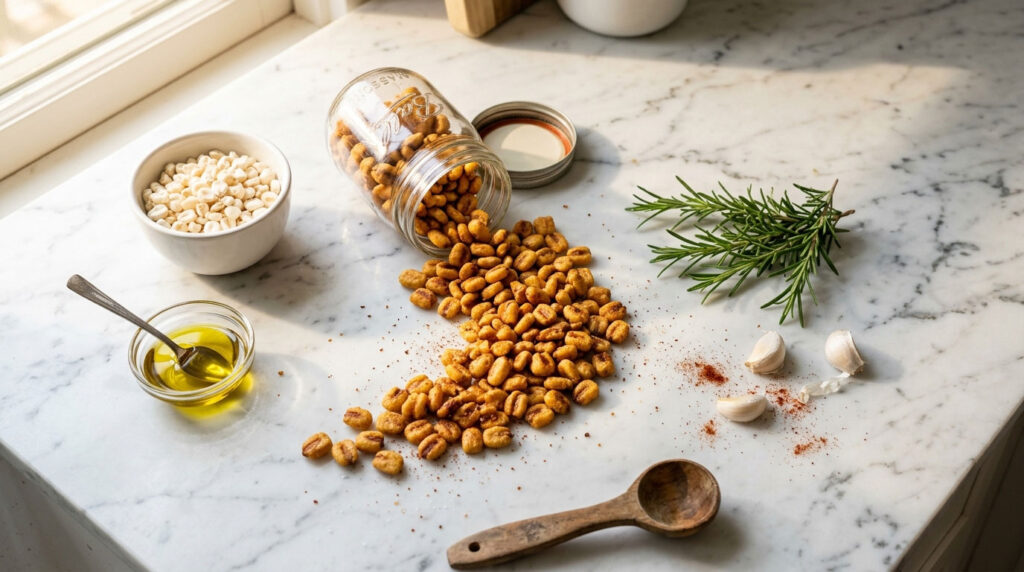
There’s a small bag of corn nuts at every American gas station, every Costco snack aisle, every airport kiosk. They taste like comfort food. They’re also one of the saltiest convenience snacks on the shelf. A single 4-ounce bag of Frito-Lay Corn Nuts carries roughly 800 mg of sodium, more than half of what the American Heart Association says you should eat in an entire day. The good news is you can recreate that exact crunch at home with about 70% less salt and four pantry ingredients.
Table of Contents
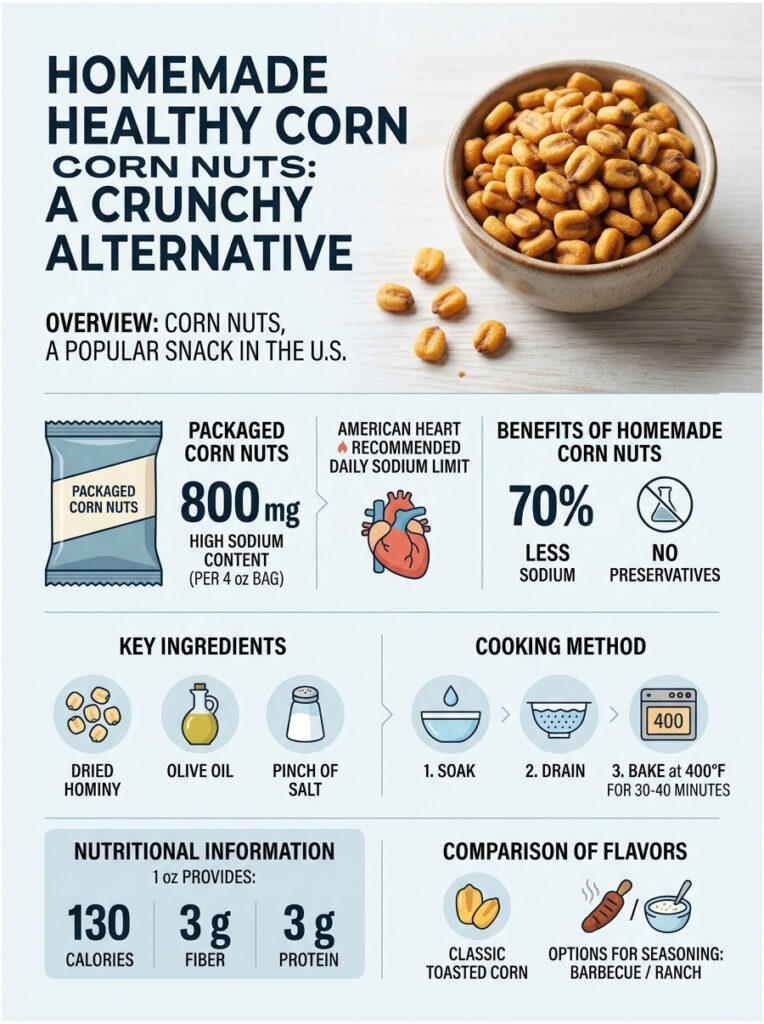
Quick Answer: Homemade healthy corn nuts use dried hominy, soaked overnight, drained, then baked at 400°F for 30 to 40 minutes with 1 teaspoon of olive oil and a pinch of salt. They deliver the same crunch as Frito-Lay Corn Nuts with 70% less sodium and zero preservatives. One ounce provides 130 calories, 3 g fiber, and 3 g protein.
At a Glance
- One ounce of Frito-Lay Corn Nuts contains 180 to 200 mg sodium; this homemade version cuts that to about 60 mg.
- The recipe uses just 4 pantry ingredients: dried hominy, olive oil, salt, and your favorite herbs.
- Soaking is required: dried hominy needs 8 to 12 hours in water before baking.
- Bake at 400°F for 30 to 40 minutes for maximum crunch with minimum oil.
- Air fryer method takes only 25 minutes at 380°F.
- Stays fresh in an airtight jar for 2 to 3 weeks.
- Naturally gluten-free, vegan, and DASH-diet friendly.
If you grew up snacking on Corn Nuts, the brand owned by Hormel Foods, you know that crunch can border on dangerous to a back molar. The flavor is what keeps people loyal: deep toasted corn, salt, sometimes a hit of barbecue or ranch powder. Our nutrition reviewers have walked through every step of the homemade alternative, comparing FDA sodium targets, real grocery brands, and three different cooking methods, so the version you bake this weekend tastes as good as the gas-station version your dad still eats.
Why You Need a Healthier Corn Nuts Recipe
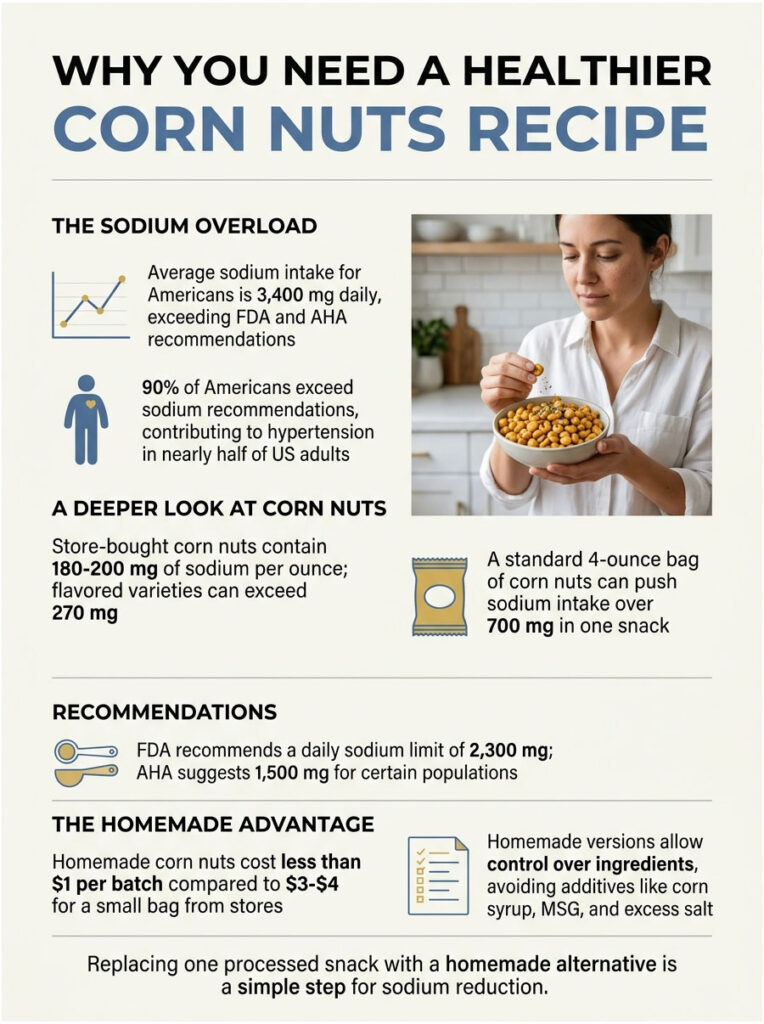
Most Americans don’t know how much sodium they eat in a day. The CDC reports the average adult takes in around 3,400 mg, well above the FDA’s 2,300 mg upper limit and more than double the AHA’s ideal target of 1,500 mg. Snack foods are quietly responsible for a big share of that intake.
Store-bought corn nuts pack a surprising punch in a small serving. Switching to a homemade version isn’t about avoiding the snack you love; it’s about taking back control of how much sodium you serve yourself.
The Sodium Problem in Store-Bought Corn Nuts
A 1-ounce serving of original-flavor Frito-Lay Corn Nuts contains roughly 180 to 200 mg of sodium, per the brand’s own nutrition panel. Flavored versions (BBQ, Ranch, Chile Picante) often climb to 270 mg or higher because of added seasoning blends.
Most people don’t stop at 1 ounce. The standard 4-ounce bag pushes the total past 700 mg, more than a quarter of your full daily allowance from a single snack. Patients booking blood pressure panels through HealthCareOnTime are routinely surprised when our team reviews their snack labels with them.
What the FDA, AHA, and CDC Say About American Sodium Intake
The FDA recommends capping daily sodium at 2,300 mg for healthy adults. The American Heart Association sets a more aggressive ideal limit of 1,500 mg, particularly for adults over 51 and anyone with high blood pressure, diabetes, or chronic kidney disease.
The CDC reports that nine out of ten Americans exceed sodium recommendations. Hypertension affects nearly half of US adults, and excess sodium is one of the most addressable contributors. Cutting 100 to 200 mg per snack adds up fast over a year.
Why Homemade Wins on Cost, Sodium, and Ingredient Control
A 1-pound bag of dried hominy from Bob’s Red Mill or a Goya brand at your local grocery costs about $4 and yields four to five batches of corn nuts. That works out to less than $1 per batch, compared to $3 to $4 for a small bag of Corn Nuts brand at the gas station.
You also control everything that goes in. No corn syrup solids, no MSG (which appears in some flavored varieties), no soybean oil, and no salt overload. In wellness consultations conducted across our team, replacing one daily processed snack with a homemade version is the single easiest sodium reduction step for most patients.
Ingredients: What You Need (and Where to Buy It)
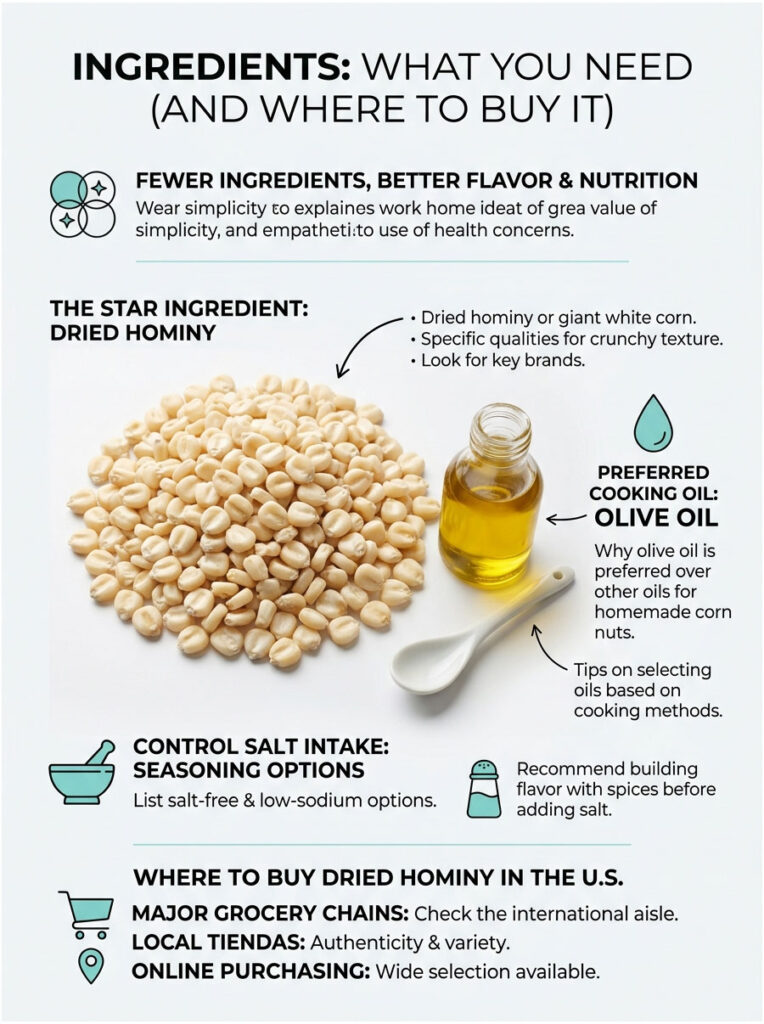
The ingredient list is short on purpose. The fewer items in the bowl, the more control you have over flavor and nutrition. Four ingredients carry this recipe.
The Star Ingredient: Dried Hominy or Giant White Corn
Dried hominy (sometimes labeled “pozole” or “maize mote”) and giant white corn (also called Cuzco or Peruvian corn) are the only kernels that produce real corn-nut crunch. Regular dried corn or popcorn kernels won’t work because they’re too small and dense.
Look for kernels about the size of a pinto bean, white or pale yellow, sold in 1-pound bags. Goya, Bob’s Red Mill, and Rancho Gordo are the most reliable USA brands. Mexican grocery stores often stock the same product at half the price under regional Spanish-language labels.
Why Olive Oil Beats Other Cooking Oils
Frito-Lay’s commercial corn nuts are typically deep-fried in corn or soybean oil. The home version only needs 1 to 2 teaspoons of oil to coat the kernels, which is why your choice of oil matters less for calories and more for flavor and stability under heat.
Extra virgin olive oil works for baked recipes at 400°F because the smoke point sits around 410°F. Avocado oil (smoke point 520°F) is the best pick for air-frying or stovetop methods. Coconut oil and peanut oil also work; canola is acceptable but flavor-neutral and slightly less heart-friendly.
Salt-Free and Low-Sodium Seasoning Options
The whole point of homemade corn nuts is controlling salt. Skip standard table salt and reach for one of these instead: Mrs. Dash Original (zero sodium), Trader Joe’s Everything but the Bagel (slightly higher; use sparingly), or simply a quarter teaspoon of sea salt for the entire batch.
Spice blends without salt deliver flavor without the sodium load. Smoked paprika, garlic powder, onion powder, dried oregano, cumin, chili powder, and nutritional yeast are all sodium-free workhorses. Our nutrition team commonly recommends building flavor with at least three spices before reaching for any salt at all.
Where to Buy Dried Hominy in the United States
Major grocery chains like Walmart, Kroger, Publix, and Whole Foods stock Goya brand giant white corn in their Hispanic foods aisle. Trader Joe’s carries similar products seasonally. For dried hominy specifically, Bob’s Red Mill is widely available at Sprouts Farmers Market, Whole Foods, and Amazon.
If you live in a region with a strong Mexican-American population (California, Texas, Arizona, Illinois, New York), local tiendas usually carry the freshest dried hominy at the lowest price. Online options include Rancho Gordo, Mexican Grocer, and Amazon Fresh.
Equipment: What You’ll Need from Your Kitchen
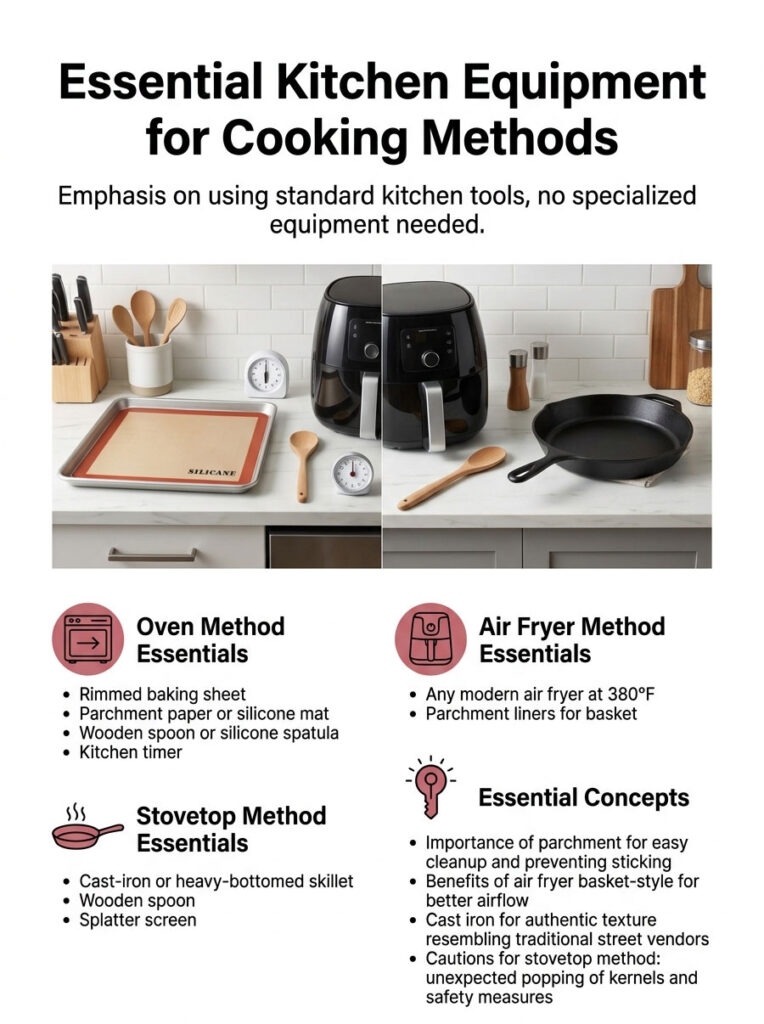
You don’t need anything specialized. Three cooking paths exist, and each uses standard equipment most American kitchens already own.
Oven Method Essentials
A rimmed baking sheet (half-sheet pan, 13 x 18 inches) and a sheet of parchment paper or a silicone baking mat are all you need. The parchment makes cleanup trivial and prevents kernels from sticking once they start to brown.
A wooden spoon or silicone spatula for turning, plus a kitchen timer, complete the toolkit. Avoid using a non-stick pan with worn coating because the high heat can degrade older non-stick surfaces.
Air Fryer Method Essentials
Any modern air fryer (Ninja, Cosori, Instant Vortex, Philips, or comparable models) at 380°F handles this recipe well. The basket-style models give better airflow than oven-style air fryers for small kernels.
You’ll also want parchment liners cut to fit your basket, available in pre-cut packs at most grocery stores. They prevent kernels from falling through perforated baskets and reduce post-cook scrubbing.
Stovetop Method Essentials
A cast-iron or heavy-bottomed stainless skillet (10 to 12 inches), a wooden spoon, and a splatter screen are essential. Cast iron holds heat evenly and gives the most authentic corn-nut texture, closest to traditional Peruvian street vendors.
Stovetop is the trickiest method because kernels can pop unexpectedly when wet. Always use a splatter screen and never lean directly over the pan during the first few minutes.
How to Make Homemade Healthy Corn Nuts (Step-by-Step)
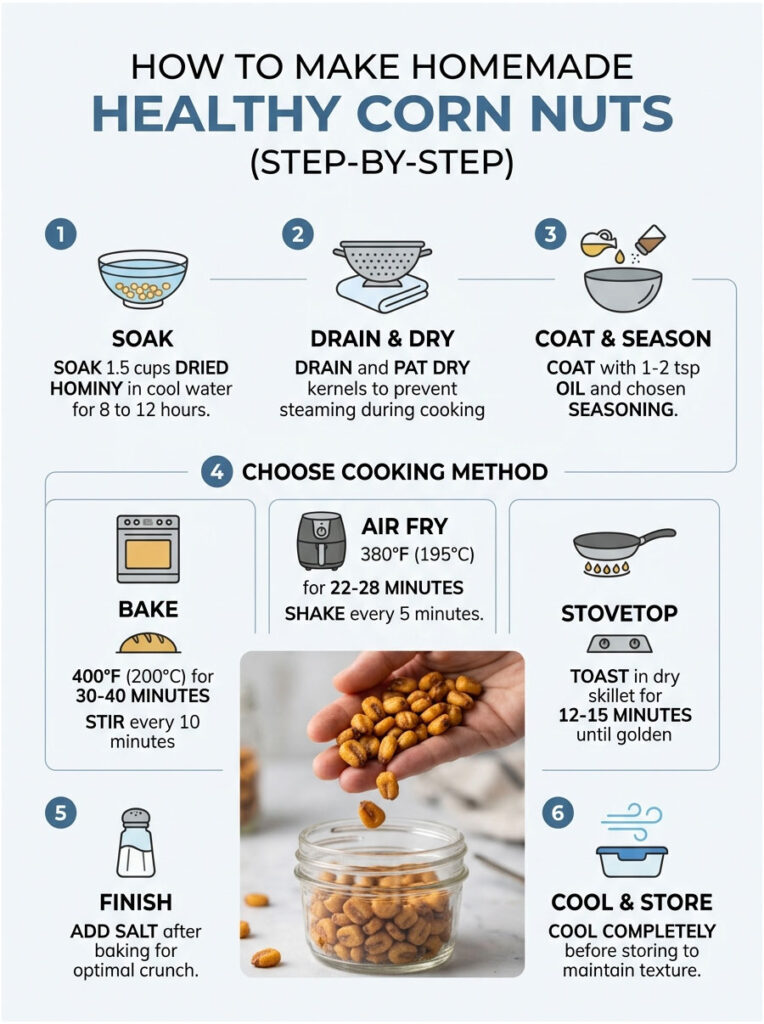
The total active time is about 15 minutes, but plan ahead because soaking takes 8 to 12 hours. Most home cooks soak overnight and bake the next morning.
Step 1: Soak the Dried Hominy (8 to 12 Hours)
Place 1.5 cups of dried hominy or giant white corn in a large bowl. Cover with at least 2 inches of cool water; the kernels will roughly double in size as they rehydrate.
Cover loosely with a clean towel or plate and let sit at room temperature for 8 to 12 hours, or overnight. Don’t soak longer than 16 hours; the kernels can ferment and develop an off smell.
Step 2: Drain and Pat Dry
Drain the soaked hominy in a colander, rinse under cool running water for 30 seconds, and shake well. Spread the kernels in a single layer on a paper-towel-lined baking sheet.
Press another layer of paper towels firmly on top to absorb surface moisture. Let air-dry for 30 to 60 minutes. This step is non-negotiable; wet kernels steam in the oven instead of crisping.
Step 3: Coat with Oil and Seasoning
Transfer the dried kernels to a large mixing bowl. Drizzle 1 to 2 teaspoons of olive oil or avocado oil over them and toss until every kernel is lightly coated. More oil isn’t better; it makes the final result greasy without improving crunch.
Add your chosen seasoning blend (typically 1 to 2 teaspoons total) and toss again. Save the salt for after baking. Adding salt too early pulls moisture back out of the kernels and prevents proper crisping.
Step 4: Bake, Air Fry, or Pan Roast
For oven baking, spread the seasoned kernels in a single layer on a parchment-lined baking sheet. Bake at 400°F for 30 to 40 minutes, stirring every 10 minutes for even browning. They’re done when deeply golden and a single kernel cracks audibly when tapped on the counter.
For air fryer, set to 380°F and cook for 22 to 28 minutes, shaking the basket every 5 minutes. For stovetop, heat a dry cast-iron skillet over medium heat, add kernels in a single layer, and toast for 12 to 15 minutes, stirring constantly until golden.
Step 5: Cool, Store, and Enjoy
Transfer the hot corn nuts to a clean bowl. Add a final pinch of salt now (between 1/4 and 1/2 teaspoon for the whole batch) so it sticks to the warm oil-coated kernels. Toss thoroughly.
Cool completely (about 20 minutes) before storing. Crunch reaches its peak after they’ve fully cooled. Eat warm, room temperature, or chilled.
Three Cooking Methods Compared: Oven, Air Fryer, Stovetop
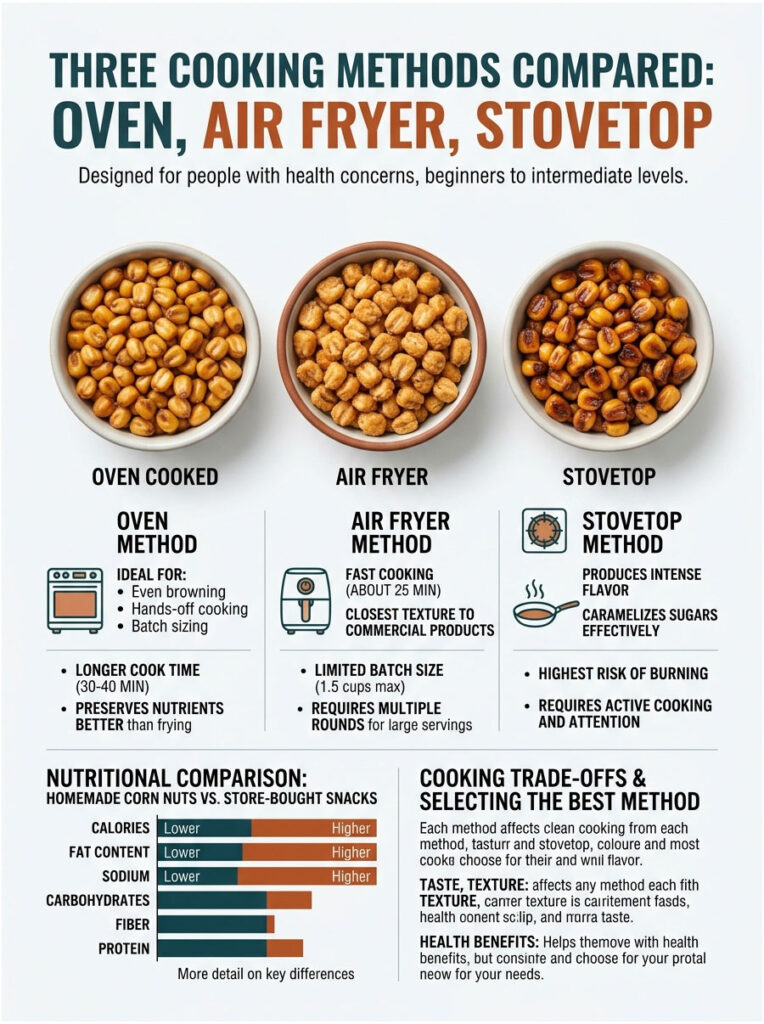
Each method delivers slightly different results. Knowing the trade-offs helps you pick based on your kitchen, your time, and your texture preference.
Oven Method (Baked)
The oven is the most forgiving option, especially for first-time makers. Even browning, hands-off cooking, and easy batch-sizing for crowds are the main wins. The downside is the longer cook time (30 to 40 minutes) and the need to preheat.
Patients commonly ask our medical team if oven-baking really preserves nutrients better than frying. The answer is yes; baking with 1 to 2 teaspoons of oil keeps total fat to about 4 g per serving, compared to 8 to 10 g in deep-fried versions.
Air Fryer Method (Faster, Crunchier)
Air frying produces the closest texture to commercial Corn Nuts brand kernels. The fast circulating heat at 380°F drives moisture out faster than a conventional oven, giving you that signature jaw-testing crunch in about 25 minutes.
The main limitation is batch size. A standard 6-quart air fryer fits about 1.5 cups of soaked kernels per batch. If you’re feeding a Super Bowl crowd, plan to run two or three rounds.
Stovetop Method (Quick but Riskier)
Stovetop is the traditional Peruvian street-vendor approach and produces the most intense corn flavor. The cast iron caramelizes the natural sugars in the kernel exterior in a way the oven and air fryer can’t quite match.
It’s also the easiest method to ruin. Kernels can pop when very wet, and burnt corn nuts taste bitter rather than just dark. Stay at the stove and stir continuously. This method is best for home cooks comfortable with active cooking.
Table 1: Homemade Healthy Corn Nuts vs Store-Bought vs Other Crunchy Snacks (per 1 oz / 28 g serving)
| Nutrient | Homemade Healthy Corn Nuts | Frito-Lay Corn Nuts (Original) | Lay’s Classic Potato Chips | Roasted Chickpeas (homemade) |
| Calories | 130 | 130 | 160 | 120 |
| Total Fat (g) | 4 | 4 | 10 | 3 |
| Saturated Fat (g) | 0.5 | 0.5 | 1.5 | 0.5 |
| Sodium (mg) | 60 | 200 | 170 | 75 |
| Carbohydrates (g) | 19 | 19 | 15 | 18 |
| Fiber (g) | 3 | 2 | 1 | 5 |
| Protein (g) | 3 | 3 | 2 | 6 |
| Added Preservatives | None | Multiple | TBHQ, others | None |
Source: USDA FoodData Central and brand nutrition labels.
Nutrition Breakdown: How Much Sodium Did You Just Save?
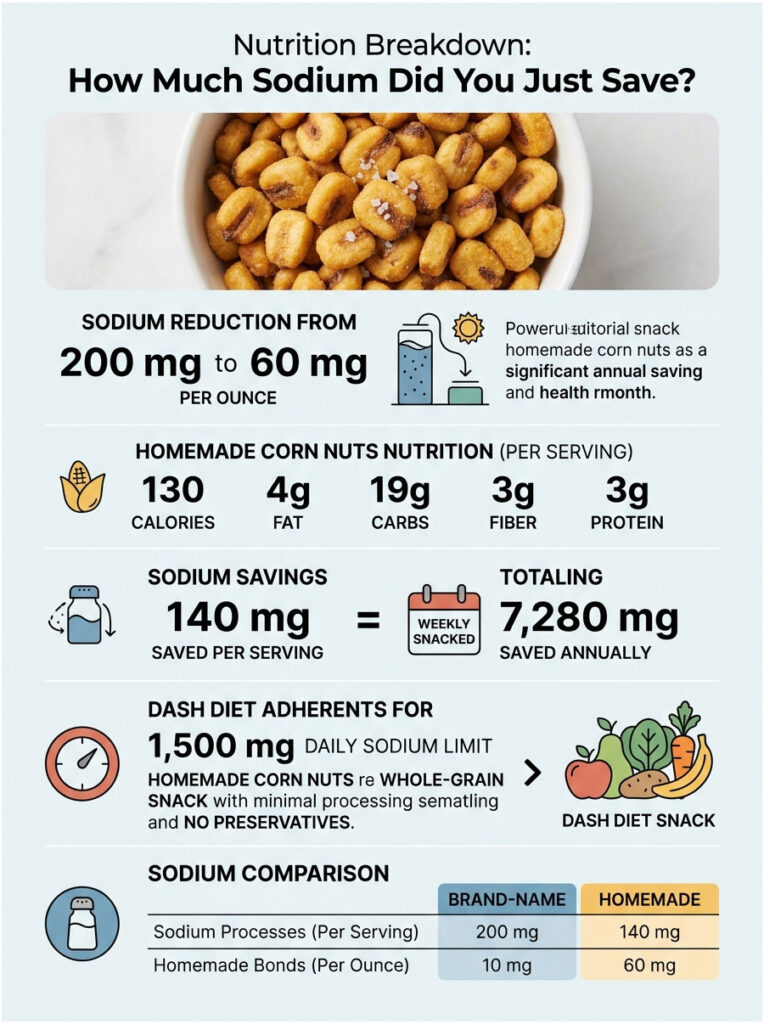
The headline number is the sodium reduction. Cutting from 200 mg to 60 mg per ounce sounds small until you do the math across a year of weekly snacking.
Calorie, Fat, Carb, Protein, Fiber Profile
A 1-ounce homemade serving lands at about 130 calories, 4 g fat, 19 g carbs, 3 g fiber, and 3 g protein. Calorie-wise, this is essentially identical to the store-bought version because the kernel itself is the same food; what changes is the sodium and the absence of preservatives.
The fiber number (3 g per ounce) is genuinely useful. The American diet averages only 15 g of fiber per day against a recommended 25 to 38 g, so any snack that contributes 3 g earns its place.
Sodium Math: Homemade vs Brand-Name
A 60-mg homemade ounce versus a 200-mg store-bought ounce saves 140 mg per serving. If you eat corn nuts once a week, that’s 7,280 mg of sodium saved per year. For someone with hypertension on a 1,500-mg DASH diet, this is meaningful.
Across patients we serve with elevated blood pressure, our team has observed that swapping just two processed snacks per week often translates to measurable reductions in sodium intake without any dietary suffering. Corn nuts are one of the easiest swaps.
Why This Recipe Fits the DASH Diet
The NIH DASH eating plan targets 1,500 to 2,300 mg sodium daily, alongside emphasis on whole grains, lean protein, and produce. Homemade corn nuts qualify as a whole-grain snack because they’re made from a single ingredient (corn), processed only by soaking and baking, with minimal added oil and salt.
A 1-ounce portion fits comfortably into a DASH snack slot, especially when paired with vegetables or a small piece of fruit. The fiber and modest protein help blunt blood-sugar spikes typical of refined-carb snacks.
Table 2: Sodium Comparison Per 1 oz Serving (US Brands and Daily Value)
| Brand / Version | Sodium (mg) | % FDA Limit (2,300 mg) | % AHA Ideal (1,500 mg) | Source |
| Frito-Lay Corn Nuts (Original) | 180 to 200 | 8% to 9% | 12% to 13% | Brand label |
| Frito-Lay Corn Nuts (BBQ) | 270 | 12% | 18% | Brand label |
| Frito-Lay Corn Nuts (Ranch) | 290 | 13% | 19% | Brand label |
| Inka Crops Inka Corn (Original) | 100 | 4% | 7% | Brand label |
| Trader Joe’s Roasted Corn | 140 | 6% | 9% | Brand label |
| Homemade (this recipe) | 60 | 3% | 4% | USDA estimate |
| Homemade (no added salt) | 5 | <1% | <1% | USDA estimate |
Source: Brand nutrition labels and USDA FoodData Central.
Low-Sodium Seasoning Blends That Actually Taste Great
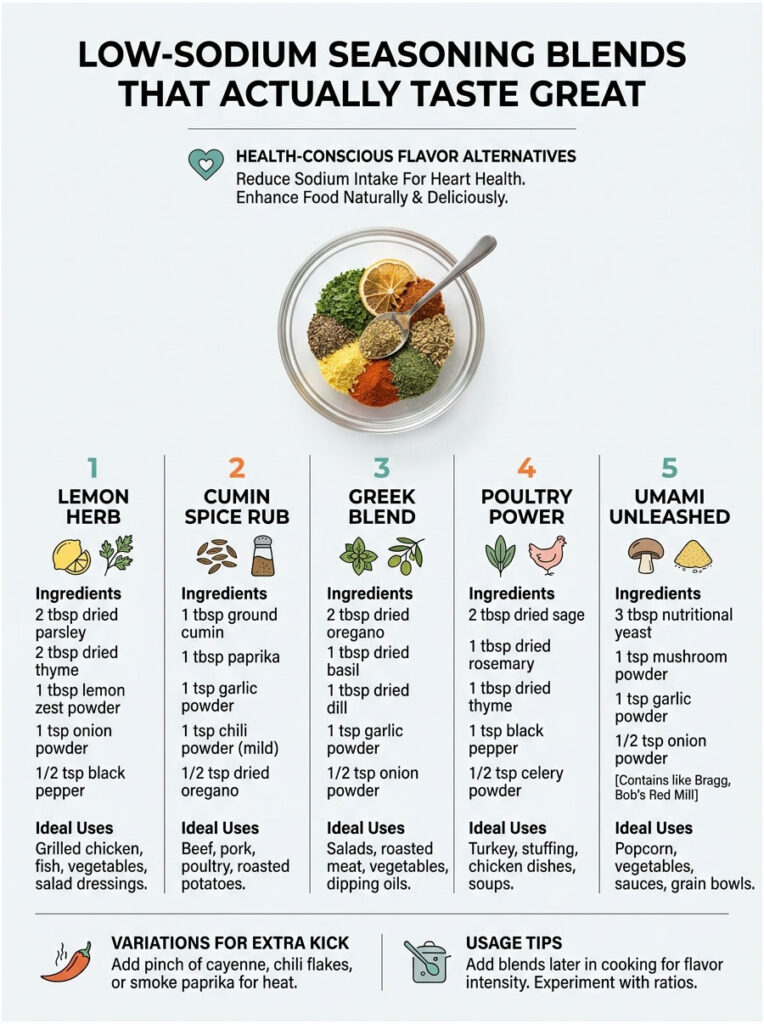
Salt isn’t the only flavor option. Five blends below deliver the savory hit of commercial corn nuts without the sodium overload.
Smoky Paprika and Garlic
Combine 1 teaspoon smoked paprika, 1/2 teaspoon garlic powder, 1/4 teaspoon onion powder, and 1/8 teaspoon black pepper. This blend mimics BBQ corn nuts flavor with zero added sodium. Apply after baking so the spices stick to the warm oil.
Lemon Pepper and Herb
Use 1 teaspoon Mrs. Dash Lemon Pepper (sodium-free), 1/2 teaspoon dried thyme, and the zest of half a lemon added during cooling. Bright, slightly tangy, and Mediterranean-leaning.
This is the blend our team often suggests for patients exploring DASH-diet snacks. It satisfies the salt-craving brain pathway through tang and aromatic intensity rather than sodium.
Italian Seasoning and Nutritional Yeast
Mix 1 teaspoon Italian seasoning, 1 tablespoon nutritional yeast, and 1/4 teaspoon garlic powder. The nutritional yeast adds a cheesy, umami quality that fills the same flavor slot as MSG-laden seasonings.
Bragg, Bob’s Red Mill, and Trader Joe’s all sell reliable nutritional yeast options. Fortified varieties also deliver B vitamins, particularly B12.
Mexican Chili-Lime
Combine 1 teaspoon chili powder, 1/2 teaspoon cumin, 1/4 teaspoon garlic powder, the zest of one lime, and a few drops of fresh lime juice (added after cooling). This riffs on Tajín-style flavor without the sodium of the original blend.
For extra heat, add 1/4 teaspoon cayenne or chipotle powder. Pairs naturally with a Mexican lager or a simple lime-and-soda.
Everything Bagel Style (Reduced-Sodium)
Use 1 tablespoon Trader Joe’s Everything but the Bagel seasoning, but cut it with 1 teaspoon poppy seeds and 1 teaspoon sesame seeds. Diluting maintains the flavor profile while cutting sodium per serving roughly in half.
This blend goes especially well in mixed snack bowls (corn nuts plus pretzels plus cheese) for game-day spreads.
Common Mistakes That Ruin Your Corn Nuts
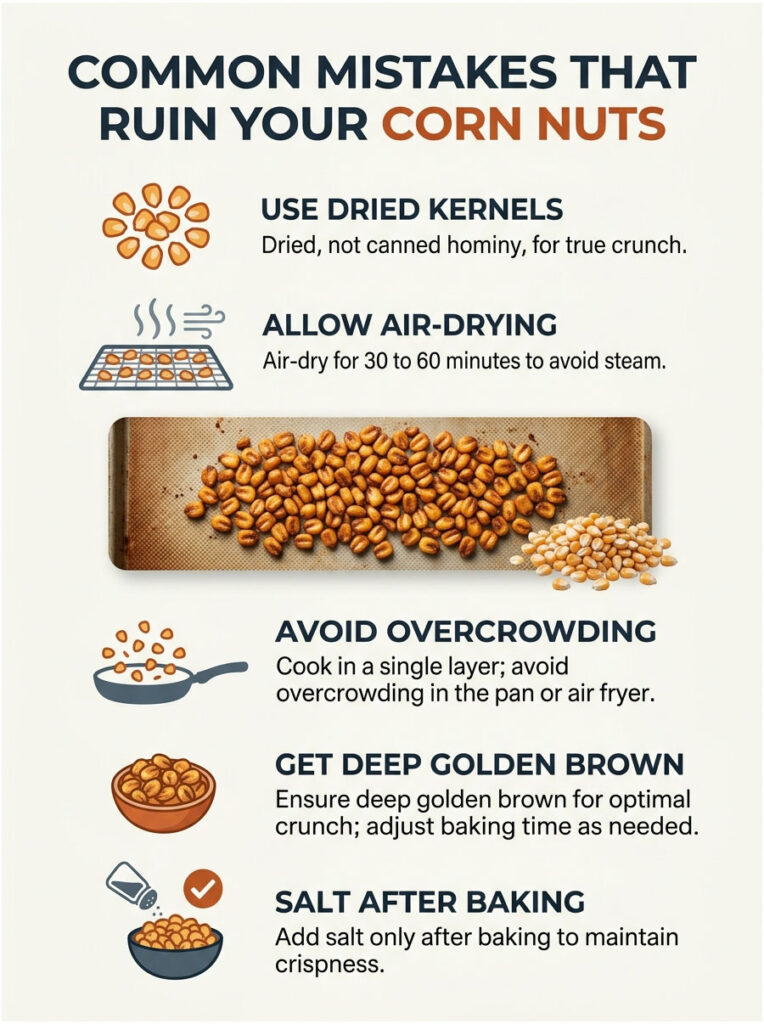
The first batch is rarely perfect. Five errors account for almost every “my corn nuts didn’t crunch” complaint our nutrition team hears about. Avoiding these guarantees a successful first try.
Using Canned Hominy Instead of Dried
Canned hominy is already cooked and waterlogged. Even after thorough drying, it produces a chewy, slightly leathery result rather than the deep crunch of true corn nuts. Always start with dried kernels.
If a recipe site claims canned hominy works, they’ve either lowered their texture standards or never tasted the real thing. Stick with dried.
Skipping the Pat-Dry Step
Surface moisture is the enemy. Wet kernels steam in the oven, producing a dull, slightly tough exterior instead of a crisp shell. Spend the full 30 to 60 minutes letting them air-dry on paper towels.
If you’re rushed, blot aggressively with multiple paper towels, then place the baking sheet in the oven on its lowest setting (170°F) for 10 minutes before adding oil and seasoning.
Crowding the Pan or Air Fryer
Single-layer cooking is essential. Overlapping kernels create cold spots and uneven browning. Use a half-sheet pan for 1.5 cups of soaked kernels, or work in two air-fryer batches if needed.
This is one of the easiest mistakes to make and one of the easiest to fix. Spread, don’t pile.
Underbaking (Chewy Instead of Crunchy)
The visual cue is deep golden brown, not pale yellow. The audio cue is a sharp crack when you tap a cooled kernel against the counter. If they bend or chew softly, return to the oven for 5 more minutes.
Every oven runs differently. The first batch is your calibration round; note your exact time and temperature for future use.
Adding Salt Too Early
Salt is hygroscopic; it pulls water out of food. Adding salt to soaked kernels before baking re-introduces the moisture you just removed, leading to soggy results.
Add the final pinch of salt only after the kernels come out of the oven, while they’re still hot and oil-coated. The salt will stick perfectly without compromising crunch.
Storage, Shelf Life, and Make-Ahead Tips
Properly stored, homemade corn nuts last longer than most people expect. The key is keeping them dry and at room temperature.
How to Keep Them Crunchy for 2 to 3 Weeks
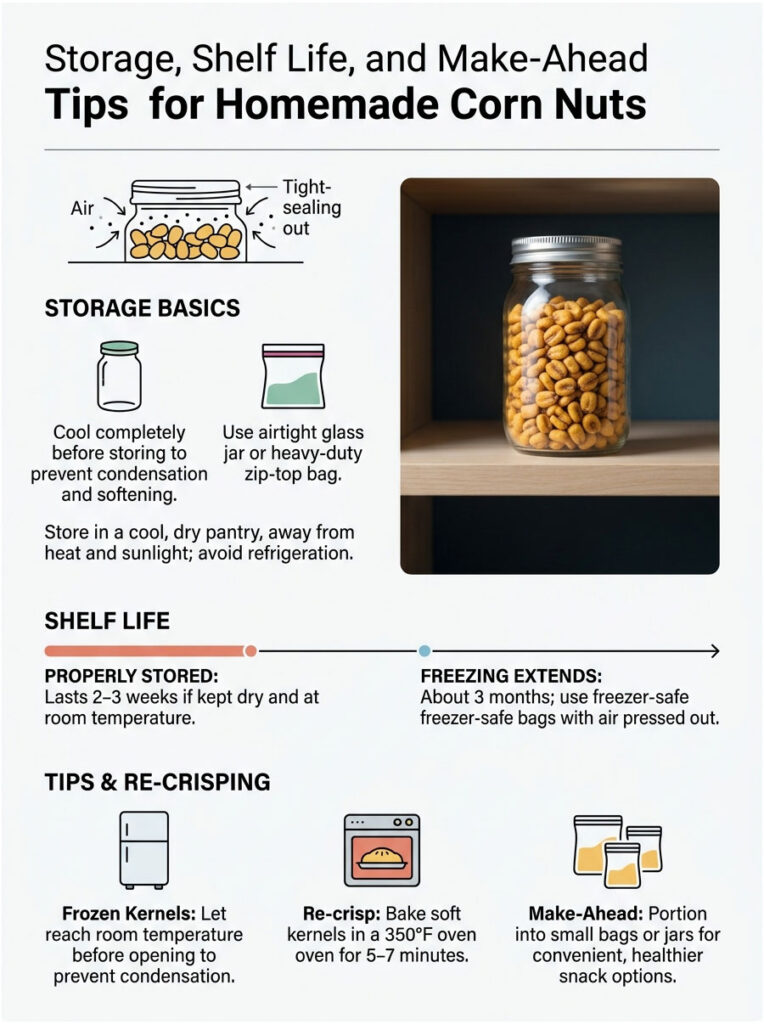
Cool completely before storing. Any residual warmth creates condensation inside the container, which softens the kernels within 24 hours. Use an airtight glass jar (a quart-size mason jar fits two batches nicely) or a heavy-duty zip-top bag.
Store at room temperature in a cool dry pantry, away from direct sunlight or stovetop heat. Avoid the refrigerator; humidity inside most fridges accelerates softening. They stay crunchy for 2 to 3 weeks.
Freezer Storage and Re-Crisping Tips
Freezing extends shelf life to about 3 months. Use freezer-safe bags with all the air pressed out, and let frozen kernels return to room temperature for 30 minutes before opening (this prevents condensation).
If kernels go slightly soft after a few weeks, refresh them in a 350°F oven for 5 to 7 minutes. They re-crisp completely and taste as fresh as the day you made them.
Travel and Lunch-Pack Friendly Portions
Portion into small reusable snack bags or 4-ounce mason jars for grab-and-go use. A 1-ounce serving (about 1/4 cup) is the standard, which fits perfectly into a school or office lunch.
Patients commonly ask our medical team about lunchbox alternatives to chip bags. Homemade corn nuts solve this elegantly: less sodium, more fiber, and no plastic bag waste.
Who Should Be Careful with Corn Nuts (Even Homemade)
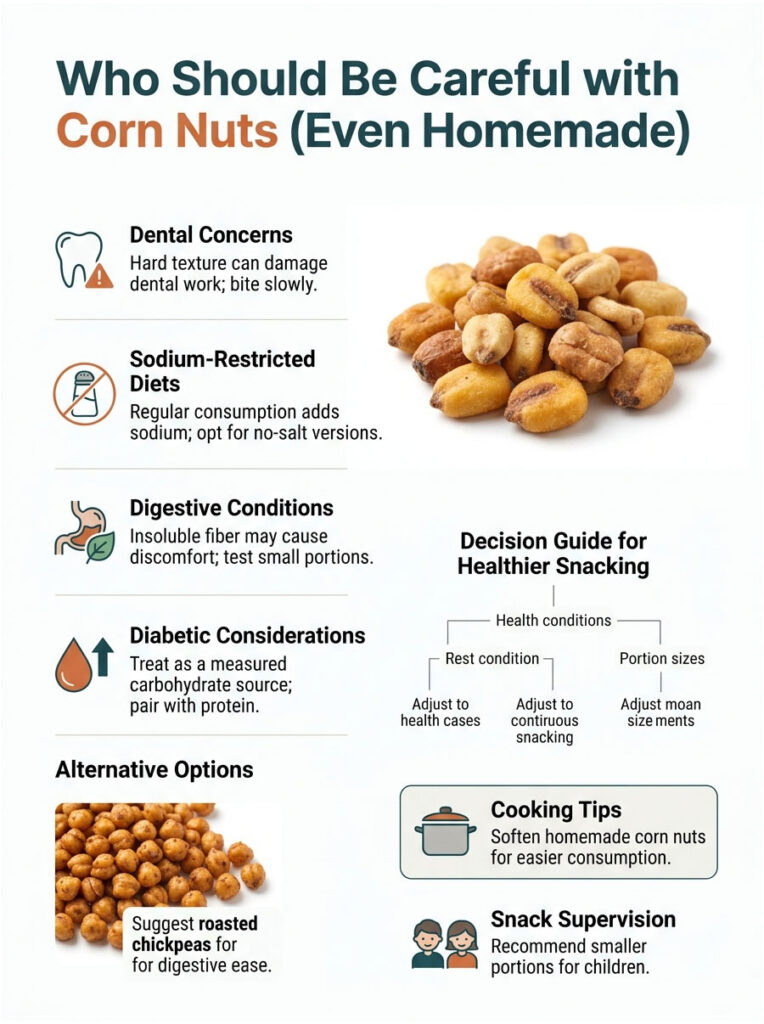
Most people enjoy corn nuts safely. A handful of groups should adjust portion size or skip the recipe altogether.
People with Dental Concerns
Corn nuts are notoriously hard. Anyone with crowns, veneers, recent dental work, or temporomandibular joint (TMJ) issues should approach them carefully. Bite slowly, one or two at a time, rather than handfuls.
If you’ve ever cracked a tooth on commercial Corn Nuts, the homemade version is no gentler. Consider toasted corn (Inka Corn brand or stovetop method, toasted lightly) for a softer texture.
Patients on Sodium-Restricted Diets
Even at 60 mg per ounce, regular consumption adds up. Patients on strict heart-failure diets (often capped at 1,500 mg or 2,000 mg sodium daily) should make the no-salt-added version and treat it as an occasional snack, not a daily habit.
Our medical team recommends discussing your specific sodium target with your physician or registered dietitian before adding any new processed-style snack to a restricted diet.
IBS, Diverticulitis, and Other Digestive Conditions
The insoluble fiber in corn kernels can be hard to digest. People with active diverticulitis flares were historically warned away from corn entirely; current guidance is more nuanced, but patients with IBS, IBD, or diverticular disease should test small portions first.
Bloating, gas, and abdominal discomfort within a few hours of eating signal that this snack doesn’t agree with your gut. Roasted chickpeas (with soluble fiber) are a gentler alternative.
Diabetics: Carb Considerations
A 1-ounce serving carries 19 g of carbohydrate. Diabetic patients tracking carbs should treat corn nuts the way they treat a slice of bread: a measured portion that fits within the meal plan, not a free-pour snack.
Pair with a protein source (cheese cubes, hard-boiled eggs, or a handful of almonds) to slow the glucose response. Across patients we serve with diabetes, this pairing strategy keeps post-snack glucose curves much smoother.
Table 3: Decision Guide – “If You Are X, Adjust the Recipe This Way”
| Your Situation | Recipe Adjustment | Daily Portion |
| Healthy adult, no restrictions | Standard recipe with salt | 1 oz (1/4 cup) |
| Hypertension or DASH diet | No-salt-added version, salt-free seasoning blends | 1 oz, 2 to 3 times per week |
| Heart failure (≤1,500 mg/day) | No-salt version only, herbs and citrus zest for flavor | 0.5 oz, occasional |
| Diabetic / prediabetic | Standard recipe paired with protein | 1 oz with cheese or nuts |
| IBS or diverticular disease | Small test portion first | 0.5 oz, monitor symptoms |
| Dental work / TMJ | Soften with quick steam before serving | 0.5 oz, eat slowly |
| Kids ages 4+ | No-salt version, smaller portions, supervise chewing | 0.5 oz |
How This Snack Fits a Heart-Healthy American Diet
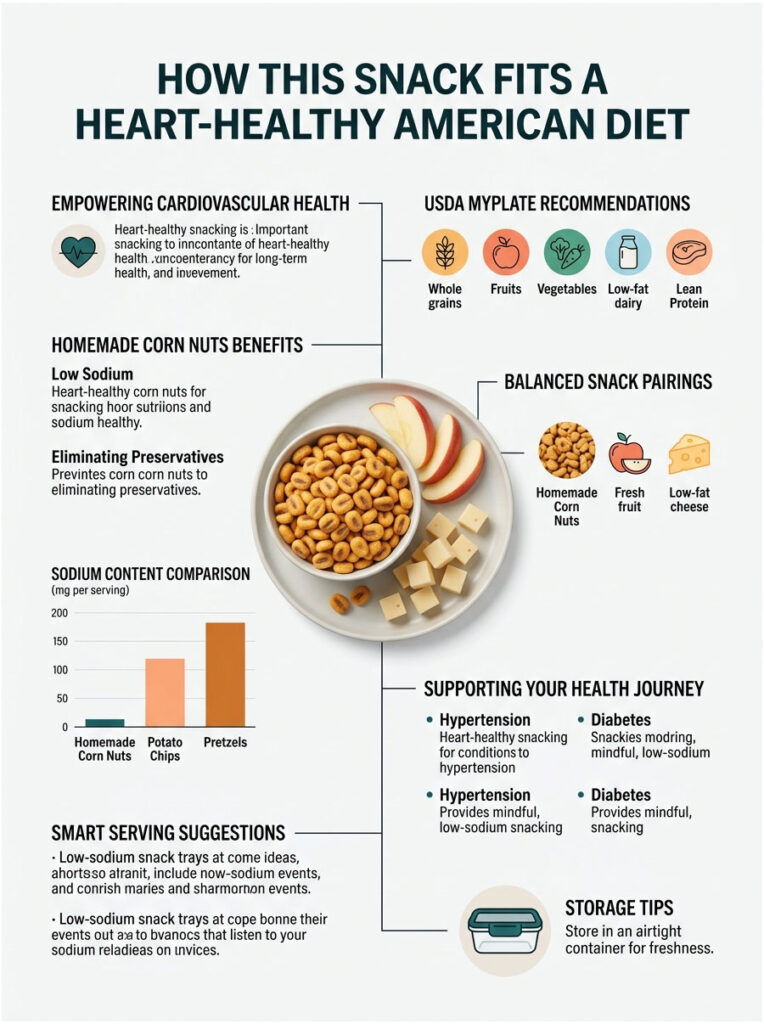
A snack isn’t just a snack; it’s a daily habit that adds up over years. Building heart-healthy snacking into your routine is one of the most leveraged moves you can make for long-term cardiovascular health.
USDA MyPlate and Snack Recommendations
USDA MyPlate recommends snacks built around whole grains, fruits, vegetables, low-fat dairy, and lean protein. Homemade corn nuts qualify as a whole-grain snack and pair naturally with several other MyPlate categories.
The 2020 to 2025 Dietary Guidelines for Americans specifically encourage Americans to reduce sodium intake from snacks and processed foods, where most excess salt hides. Homemade corn nuts directly answer that recommendation.
Pairing Ideas for a Balanced Snack
Combine 1 ounce of homemade corn nuts with a piece of fresh fruit (apple slices, orange wedges, grapes) for a mid-afternoon snack that hits whole grains, fiber, vitamin C, and natural sugars. Add a small piece of cheddar or string cheese for protein.
For game day, set out a low-sodium snack tray with corn nuts, raw vegetables, hummus, and unsalted mixed nuts. Guests get plenty of crunch without the sodium overload of typical Super Bowl spreads.
Easy Swaps to Replace Chips, Pretzels, and Other High-Sodium Snacks
Replace 1 ounce of potato chips (170 mg sodium) with 1 ounce of homemade corn nuts (60 mg sodium). Replace 1 ounce of pretzels (300 mg or higher) with the same. Across a week of office snacking, the savings add up to 800 to 1,500 mg less sodium.
Patients booking annual physicals through HealthCareOnTime often see their sodium markers improve simply by making three to five swaps like this consistently for 8 to 12 weeks.
Frequently Asked Questions
Are homemade corn nuts actually healthier than store-bought?
Yes, in two clear ways. Homemade versions cut sodium by roughly 70% (60 mg vs 200 mg per ounce) and eliminate preservatives, MSG, and seed oils common in commercial brands. Calories and total fat are similar, but the nutritional quality of the fat (olive or avocado oil at home vs corn or soybean oil commercially) is meaningfully better.
Can I make corn nuts in the air fryer?
Yes, and many home cooks prefer it. Set your air fryer to 380°F and cook soaked, dried hominy for 22 to 28 minutes, shaking the basket every 5 minutes. Air fryers produce a slightly crunchier result than conventional ovens because of stronger air circulation, and the cook time is roughly 30% shorter.
What’s the difference between hominy and giant white corn?
Hominy is dried corn that’s been treated with an alkaline solution (lime or lye) in a process called nixtamalization, which removes the hull and softens the kernel. Giant white corn (also called Cuzco corn) is simply large untreated corn kernels. Both work for corn nuts, though nixtamalized hominy has slightly higher bioavailable niacin and easier-to-digest texture.
Why didn’t my homemade corn nuts get crunchy?
The most common culprit is moisture. If you skipped the pat-dry step or under-baked, the kernels stayed too wet to crisp. Other causes include using canned hominy (already cooked, won’t crisp), crowding the pan (steam instead of roast), or baking below 400°F. Try again at 400°F for the full 40 minutes after thorough drying.
Can I use canned hominy for this recipe?
Technically yes, but the results are noticeably inferior. Canned hominy is pre-cooked and waterlogged, producing a chewy, leathery texture rather than the signature corn-nut crunch. Even after extensive drying, canned versions don’t crisp the way dried hominy does. Spend a little more for the dried product; the difference is dramatic.
How long do homemade corn nuts last?
Stored in an airtight glass jar at room temperature, they stay crunchy for 2 to 3 weeks. Avoid the refrigerator (humidity softens them) and direct sunlight (degrades the oil). For longer storage, freeze in airtight bags for up to 3 months and re-crisp in a 350°F oven for 5 minutes when ready to eat.
Are corn nuts gluten-free?
Yes, corn is naturally gluten-free, and the homemade recipe uses only corn, oil, salt, and spices. Just verify any pre-mixed seasonings (Mrs. Dash blends, Trader Joe’s Everything but the Bagel) don’t contain wheat-based fillers. Most don’t, but read labels if you have celiac disease or non-celiac gluten sensitivity.
Are corn nuts good for weight loss?
In moderation, yes. A 1-ounce serving provides 130 calories with 3 g of fiber and 3 g of protein, helping with satiety. They’re more filling than chips of equal calories. The risk is portion control: it’s easy to eat 3 ounces while watching a movie. Pre-portion into 1-ounce bags before storing to prevent over-snacking.
Can diabetics eat corn nuts?
Yes, with carb-counting awareness. A 1-ounce serving has 19 g of carbohydrates, similar to a slice of bread. Pair with a protein and fat source (cheese, nuts) to slow glucose response. Across patients we serve with diabetes, this pairing strategy keeps post-snack blood sugar much more stable than eating corn nuts alone.
Are homemade corn nuts safe for kids?
For kids age 4 and up with adult supervision, yes. The texture is hard, so younger toddlers and children with developing molars are at choking and dental risk. Make the no-salt version for kids, serve in 0.5-ounce portions, and remind them to bite slowly rather than chew handfuls quickly.
Can I freeze homemade corn nuts?
Yes, freezing works well. Place fully cooled corn nuts in a freezer-safe airtight bag, press out all air, and freeze flat for up to 3 months. Let them return to room temperature in the sealed bag for 30 minutes before opening (prevents condensation). If they soften slightly, refresh in a 350°F oven for 5 to 7 minutes.
What’s the lowest-sodium way to flavor corn nuts?
Skip salt entirely and lean on aromatic spices and citrus. Smoked paprika, garlic powder, onion powder, cumin, oregano, lemon zest, and lime zest deliver layered flavor with effectively zero sodium. Mrs. Dash Original and salt-free Tony Chachere’s are also reliable commercial blends. The brain reads aromatic intensity as savory, even without salt.
Disclaimer: This article is for educational purposes only and does not replace professional medical advice. Patients with hypertension, heart failure, kidney disease, diabetes, or digestive conditions should consult a licensed physician or registered dietitian before making significant dietary changes. Diagnostic testing through HealthCareOnTime can clarify individual nutritional needs and sodium targets.