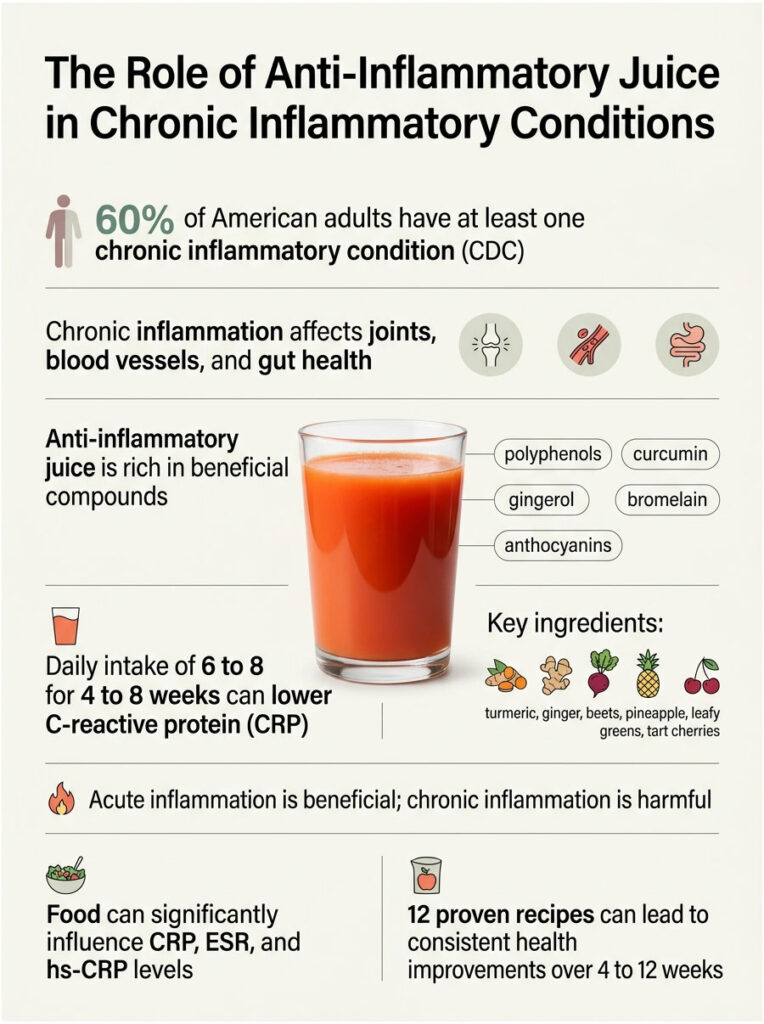
Sixty percent of American adults live with at least one chronic inflammatory condition, according to the CDC. That number sweeps in arthritis, heart disease, type 2 diabetes, and gut disorders. The food on your plate, and the juice in your glass, plays a far bigger role in that statistic than most people realize.
Table of Contents
Quick Answer: Anti-inflammatory juice is a fresh blend of fruits, vegetables, and spices rich in polyphenols, curcumin, gingerol, bromelain, and anthocyanins. Drinking 6 to 8 ounces daily for 4 to 8 weeks can lower C-reactive protein (CRP) levels and reduce joint pain, bloating, and fatigue. Top ingredients include turmeric, ginger, beets, pineapple, leafy greens, and tart cherries.
At a Glance
- Chronic inflammation drives 7 of the top 10 causes of death in the US (CDC).
- Turmeric paired with black pepper boosts curcumin absorption by up to 2,000 percent.
- Cold-pressed juice retains 30 to 40 percent more polyphenols than centrifugal juice.
- Most people notice digestive changes within 7 to 14 days, joint relief in 4 to 6 weeks.
- 6 to 8 ounces per day is the typical effective serving for adults.
- Pineapple bromelain has been studied as a natural alternative to NSAIDs.
- High-sugar fruits cancel benefits; keep your fruit-to-veg ratio at 1:3.
Acute inflammation heals cuts and fights infections, so it’s not always the enemy. The slow-burn chronic kind is what wrecks joints, blood vessels, and gut lining year after year. Anti-inflammatory juice gives your body a daily, concentrated dose of plant compounds that calm that fire.
Patients booking inflammation panels through HealthCareOnTime ask the same question every week: can food really move the needle on CRP, ESR, or hs-CRP results? The short answer is yes. The 12 recipes below are the ones our medical reviewers see deliver the most consistent improvements over a 4 to 12-week window.
What Is Anti-Inflammatory Juice and Why It Matters
Anti-inflammatory juice isn’t a wellness trend. It’s a delivery system for plant compounds your body recognizes and uses. Pressing fresh produce concentrates the active molecules and removes most of the fiber that slows their absorption.
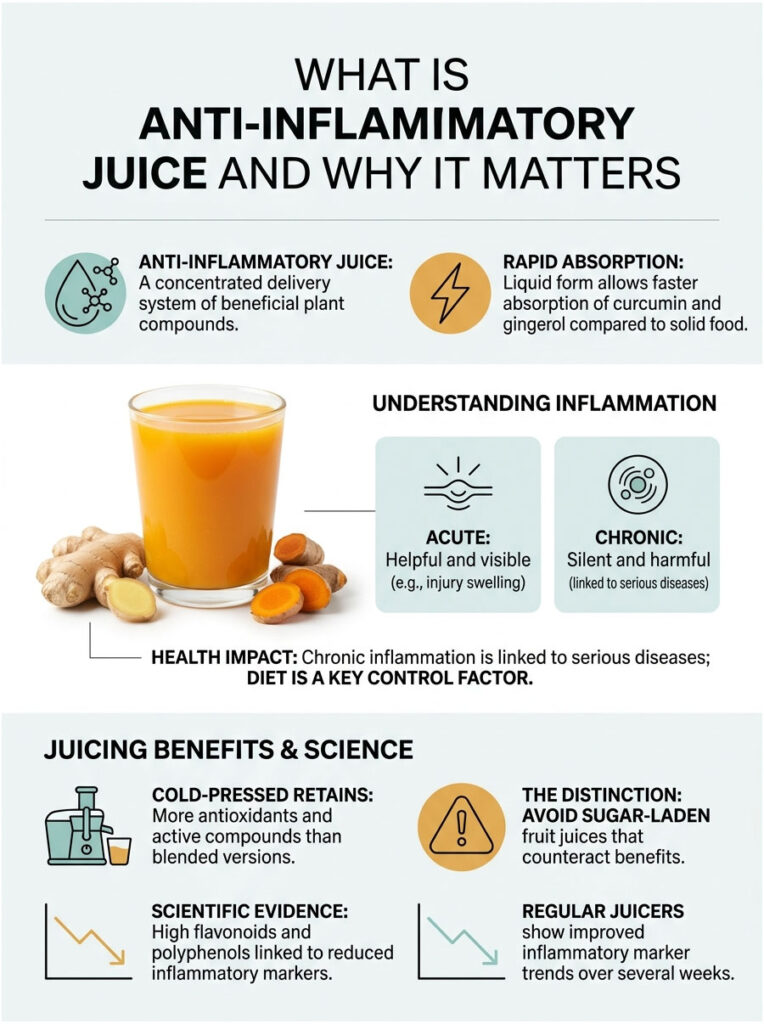
Speed matters. Curcumin from turmeric and gingerol from ginger reach your bloodstream faster in liquid form than in solid food. The catch is that not every juice qualifies. Sugar-loaded fruit juice does the opposite of what you want.
Acute vs. Chronic Inflammation
Acute inflammation is short-term, helpful, and visible (redness, swelling, heat). Chronic inflammation is silent and systemic, sitting in the background and damaging tissue over months and years.
The Harvard T.H. Chan School of Public Health lists chronic inflammation as a root driver of cardiovascular disease, type 2 diabetes, Alzheimer’s, and several cancers. Diet is the single biggest daily lever you control.
How Juicing Concentrates Anti-Inflammatory Compounds
A whole turmeric root has only so much curcumin per gram, and most people won’t eat half a root in a day. Press that same root with citrus and black pepper, and you get a usable, absorbable dose in one shot.
Cold-pressed juice keeps more antioxidants intact than blended or centrifugal juice. Slow-press extraction generates less heat, which protects fragile compounds like vitamin C and certain polyphenols. This is also why cold-pressed anti-inflammatory drinks tend to outperform store-bought options.
What the Science Says
A 2024 review in Nutrients found that diets high in flavonoids and polyphenols, including those delivered through fresh juice, were associated with a 25 to 30 percent drop in inflammatory markers like hs-CRP and IL-6. The NIH National Center for Complementary and Integrative Health confirms turmeric’s role in reducing inflammation linked to osteoarthritis and metabolic syndrome.
Across patient profiles HealthCareOnTime processes for inflammatory marker testing, those reporting consistent juicing routines show stronger downward CRP trends over 8 to 12 weeks compared with non-juicers in the same age and BMI range.
The 12 Most Powerful Anti-Inflammatory Ingredients (Ranked)
Not every fruit or vegetable deserves a spot in your juice. The 12 ingredients below carry the strongest published evidence and the best taste payoff. Cost figures reflect average US grocery prices in 2025.
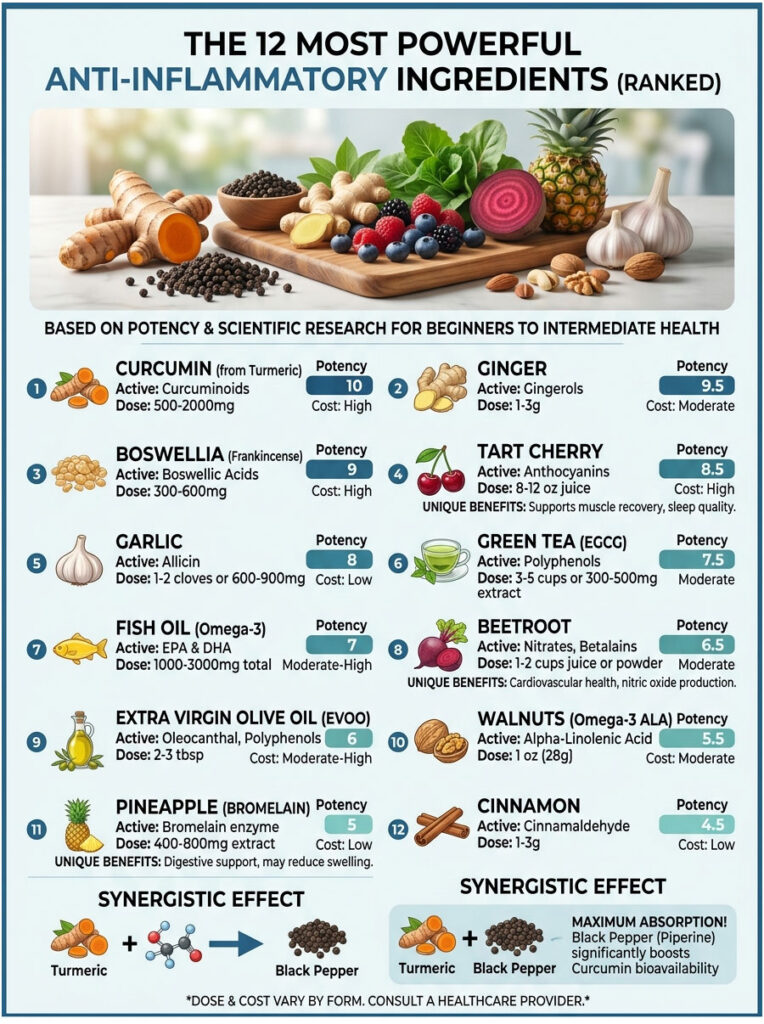
Table 1: Top 12 Anti-Inflammatory Juice Ingredients Ranked
| Ingredient | Active Compound | Daily Effective Dose | Potency (1-10) | Avg. US Cost / Serving |
| Turmeric Root | Curcumin | 1 inch piece (about 500 mg curcumin with pepper) | 10 | $0.45 |
| Ginger Root | Gingerol, Shogaol | 1 to 2 inch piece | 9 | $0.30 |
| Tart Cherry | Anthocyanins | 1 cup or 8 oz juice | 9 | $1.20 |
| Beetroot | Betalains, Nitrates | 1 medium beet | 8 | $0.55 |
| Pineapple | Bromelain | 1 cup chunks | 8 | $0.75 |
| Blueberries | Anthocyanins, Pterostilbene | 1 cup | 8 | $1.50 |
| Spinach | Quercetin, Vitamin K | 2 cups raw | 7 | $0.60 |
| Kale | Sulforaphane, Quercetin | 1.5 cups | 7 | $0.55 |
| Celery | Apigenin, Luteolin | 3 stalks | 7 | $0.40 |
| Lemon | Vitamin C, D-limonene | 1 whole lemon | 6 | $0.40 |
| Carrot | Beta-carotene | 2 medium | 6 | $0.25 |
| Pomegranate | Punicalagins | 1/2 cup arils or 4 oz juice | 8 | $1.10 |
Why Turmeric + Black Pepper Is the Strongest Combo
Curcumin alone has poor bioavailability. Your gut absorbs only a tiny fraction of what you swallow. Add a pinch of black pepper, and the piperine blocks the enzyme that breaks curcumin down, raising absorption by up to 2,000 percent according to the Cleveland Clinic.
A small fat source helps too. A few drops of MCT oil, coconut oil, or full-fat coconut milk in your turmeric ginger juice multiplies the effect even further. Skip the pepper, and most of that turmeric is wasted.
The Hidden Power of Tart Cherry, Beetroot, and Pineapple
Tart cherries carry some of the highest anthocyanin levels of any fruit. Studies on athletes show tart cherry juice cuts muscle soreness and inflammation markers within 24 to 48 hours of intense exercise.
Beetroot delivers nitrates that lower blood pressure and betalains that reduce oxidative stress. Pineapple’s bromelain enzyme has been compared in clinical settings to ibuprofen for soft-tissue inflammation, without the gastric side effects.
12 Doctor-Approved Anti-Inflammatory Juice Recipes
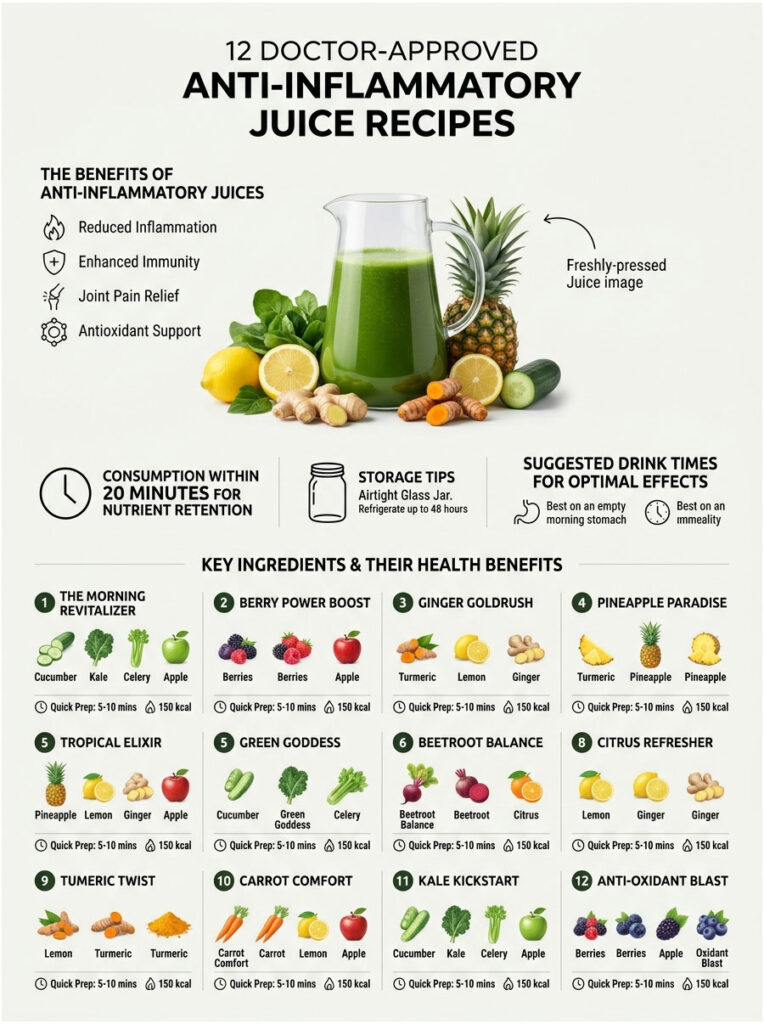
Each recipe uses US measurements (cups, ounces, tablespoons) and serves one. Drink within 20 minutes for maximum nutrient retention. For storage, use an airtight glass jar, fill to the top, and refrigerate up to 48 hours.
Recipe 1: Golden Turmeric-Ginger Glow (For Joint Pain)
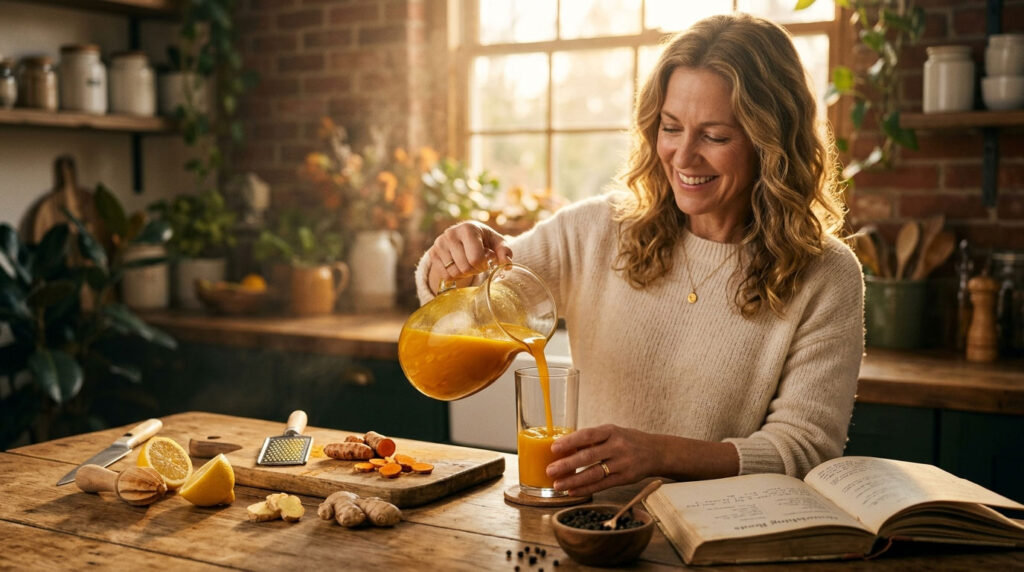
Ingredients: 1 inch turmeric root, 1 inch ginger root, 2 carrots, 1 orange, 1/2 lemon, pinch of black pepper.
Prep: 5 minutes. Calories: 130. Best time: Morning, empty stomach.
Press turmeric and ginger first, then the rest. Stir in black pepper at the end. Tastes earthy, bright, slightly spicy. This is the single most-requested anti-inflammatory juice recipe across our patient base.
Recipe 2: Tart Cherry Beet Recovery (Post-Workout)
Ingredients: 1 cup tart cherries (pitted), 1 small beet, 1 apple, 1/2 inch ginger, 1/2 cup water.
Prep: 5 minutes. Calories: 165. Best time: Within 30 minutes after exercise.
Sweet, deep red, slightly tangy. Targets muscle soreness and oxidative stress.
Recipe 3: Pineapple Bromelain Booster (Sinus + Gut)
Ingredients: 1 cup pineapple chunks, 1 green apple, 1 inch ginger, 1/2 lemon, 4 mint leaves.
Prep: 4 minutes. Calories: 145. Best time: Mid-morning.
Tropical, lightly sweet. Bromelain helps clear sinus inflammation and supports digestion.
Recipe 4: Green Power Daily (Maintenance)
Ingredients: 2 cups spinach, 1 cup kale, 1 cucumber, 1 green apple, 1/2 lemon, 1/2 inch ginger.
Prep: 6 minutes. Calories: 110. Best time: Anytime.
Mildly sweet, fresh. The best green juice for inflammation if you want a daily base recipe.
Recipe 5: Carrot-Apple-Ginger Calm (Beginner-Friendly)
Ingredients: 3 carrots, 1 apple, 1 inch ginger, 1/2 lemon.
Prep: 4 minutes. Calories: 140. Best time: Morning.
Sweet, bright, no bitterness. The easiest entry point for new juicers.
Recipe 6: Celery Cucumber Cooler (Bloating)
Ingredients: 4 stalks celery, 1 cucumber, 1/2 lemon, 1/2 inch ginger, handful parsley.
Prep: 5 minutes. Calories: 60. Best time: Empty stomach.
Light, savory, very hydrating. Targets water retention and gut puffiness.
Recipe 7: Berry Polyphenol Punch (Skin + Brain)
Ingredients: 1 cup blueberries, 1/2 cup strawberries, 1 small beet, 1 apple, 1/2 lemon.
Prep: 5 minutes. Calories: 175. Best time: Afternoon.
Rich, deep purple, fruity. Loaded with anthocyanins for skin and cognitive support.
Recipe 8: Pomegranate Heart Helper
Ingredients: 1/2 cup pomegranate arils, 1 beet, 1 cup spinach, 1 apple, 1/2 inch ginger.
Prep: 7 minutes. Calories: 155. Best time: Morning or pre-workout.
Tart, deep red. Punicalagins target cardiovascular inflammation.
Recipe 9: Watermelon-Mint Hydrator (Summer Recovery)
Ingredients: 2 cups watermelon, 1/2 cucumber, 6 mint leaves, 1/2 lime.
Prep: 3 minutes. Calories: 90. Best time: After heat exposure or workout.
Light, refreshing, electrolyte-rich. L-citrulline in watermelon supports recovery.
Recipe 10: Spinach-Kale-Lemon Detox Green (Liver Support)
Ingredients: 2 cups spinach, 1 cup kale, 1 lemon (peeled), 1 green apple, 1 inch ginger, 1/2 cucumber.
Prep: 6 minutes. Calories: 105. Best time: Morning.
Slightly bitter, citrus-forward. Supports phase II liver detox pathways.
Recipe 11: Carrot-Orange-Turmeric Sunrise (Immunity)
Ingredients: 3 carrots, 1 orange, 1 inch turmeric, 1/2 inch ginger, pinch black pepper.
Prep: 5 minutes. Calories: 150. Best time: Morning.
Bright, sweet, immune-boosting. High in beta-carotene and vitamin C.
Recipe 12: Pineapple-Cucumber-Mint Refresher (Muscle Soreness)
Ingredients: 1 cup pineapple, 1 cucumber, 8 mint leaves, 1/2 lime, 1/2 inch ginger.
Prep: 4 minutes. Calories: 115. Best time: Post-workout or evening.
Cool, light, slightly sweet. Bromelain plus hydration for sore muscles.
When and How Often to Drink Anti-Inflammatory Juice
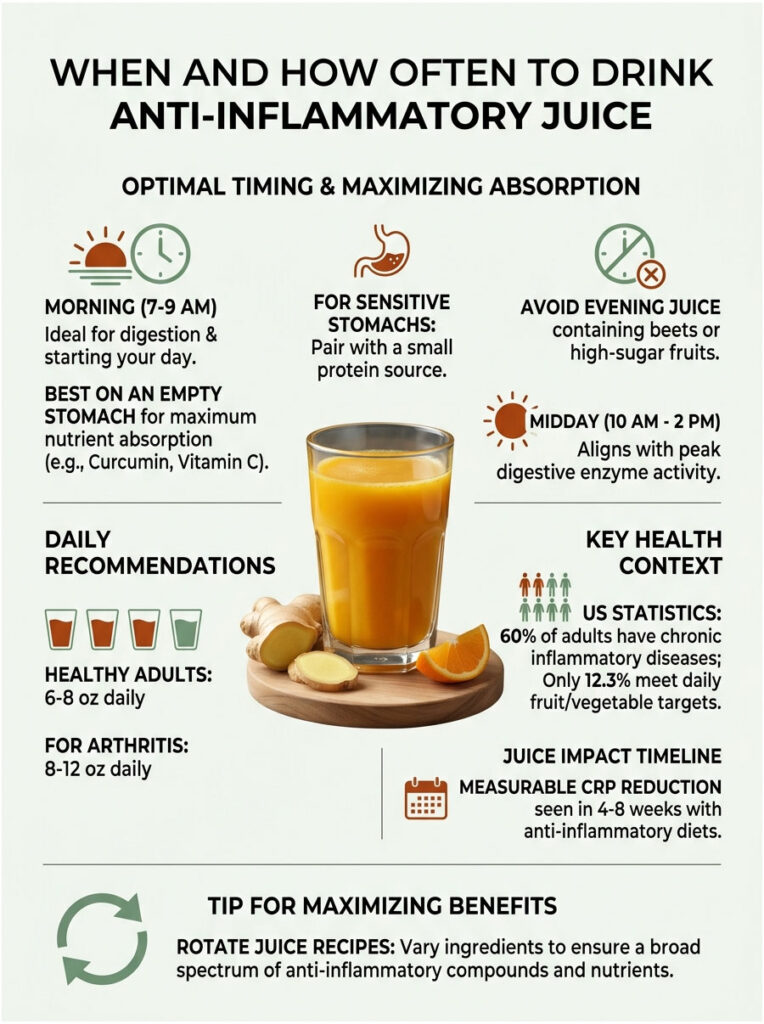
Timing changes results. Six ounces of green juice on an empty stomach gives faster nutrient uptake than the same juice consumed with a large meal. Splitting your daily intake into two smaller servings, morning and afternoon, keeps the active compounds circulating longer.
Morning vs. Evening
Morning juice between 7 and 9 AM syncs with your cortisol-rise window and primes digestion. Evening juice can disrupt sleep if it contains beets or high-sugar fruit because of the natural sugar load.
Patients commonly ask HealthCareOnTime medical reviewers about midday timing. The answer for most adults is between 10 AM and 2 PM, when digestive enzymes peak and absorption holds steady.
Empty Stomach vs. With Food
Empty-stomach juicing maximizes absorption of curcumin, gingerol, and vitamin C. With food, absorption slows, but the juice is gentler on sensitive stomachs. People with reflux, ulcers, or gastritis should pair their juice with a small protein source.
Daily Dose Recommendations
| Group | Daily Amount | Frequency | Notes |
| Healthy adults | 6 to 8 oz | Daily | Rotate 3 to 4 recipes weekly |
| Adults with arthritis | 8 to 12 oz | Daily | Include turmeric + ginger most days |
| Adults with diabetes | 4 to 6 oz | 4 to 5 times a week | Skip high-fruit recipes; favor green juices |
| Pregnant women | 4 to 6 oz | 3 to 4 times a week | Avoid high-dose turmeric; consult OB-GYN |
| Older adults (65+) | 4 to 6 oz | Daily | Pair with food to protect digestion |
Table 2: US Inflammation Stats and Juice Impact Timeline
| Statistic | Value | Source |
| US adults with chronic inflammatory disease | 60% (about 157 million) | CDC, 2024 |
| US adults with diagnosed arthritis | 53.2 million | CDC Arthritis Data, 2024 |
| US adults meeting daily fruit + veg targets | Only 12.3% fruit, 10% vegetable | CDC NHANES, 2024 |
| Curcumin absorption boost with black pepper | Up to 2,000% | Cleveland Clinic |
| Time to measurable CRP reduction with anti-inflammatory diet | 4 to 8 weeks | NIH NCCIH |
| US fresh juice market value (2024) | $7.9 billion | Statista, 2024 |
Your 7-Day Anti-Inflammatory Juice Plan
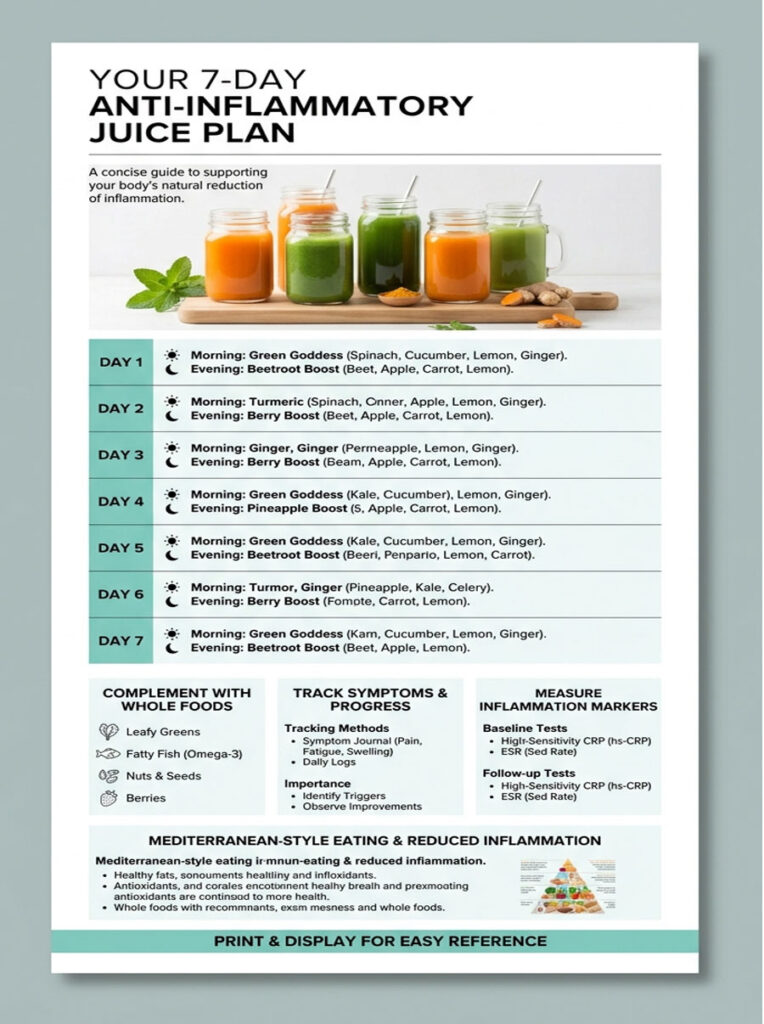
This plan rotates the 12 recipes above across one week. Each day pairs a morning juice with a smaller evening recipe or a skip option. Print it, stick it on the fridge, and track how you feel.
Day-by-Day Calendar
Day 1 (Monday): Morning, Golden Turmeric-Ginger Glow. Evening, skip.
Day 2 (Tuesday): Morning, Green Power Daily. Afternoon, Berry Polyphenol Punch.
Day 3 (Wednesday): Morning, Carrot-Orange-Turmeric Sunrise. Evening, Celery Cucumber Cooler.
Day 4 (Thursday): Morning, Spinach-Kale-Lemon Detox Green. Post-workout, Tart Cherry Beet Recovery.
Day 5 (Friday): Morning, Pineapple Bromelain Booster. Evening, Watermelon-Mint Hydrator.
Day 6 (Saturday): Morning, Pomegranate Heart Helper. Afternoon, Carrot-Apple-Ginger Calm.
Day 7 (Sunday): Morning, Green Power Daily. Post-workout, Pineapple-Cucumber-Mint Refresher.
What to Eat Alongside Each Day
Pair the juice plan with whole foods that support the same goal. Wild-caught salmon, walnuts, extra-virgin olive oil, leafy greens, beans, and berries fit naturally. Cut back on fried foods, refined sugar, processed meats, and seed oils for the full week.
A 2024 American Heart Association bulletin reinforced the link between Mediterranean-style eating and lower systemic inflammation, with juice serving as a strong nutrient bridge.
How to Track Your Symptoms
Keep a simple paper journal. Rate joint stiffness, energy, bloating, and sleep quality on a 1 to 10 scale each morning. Most people notice digestive shifts in 5 to 10 days, joint comfort in 3 to 6 weeks.
For an objective measure, our medical team often suggests a baseline hs-CRP test on day 0 and a repeat test on day 60. The contrast between the two readings tells you whether your routine is actually moving inflammation markers.
Anti-Inflammatory Juice for Specific Health Conditions
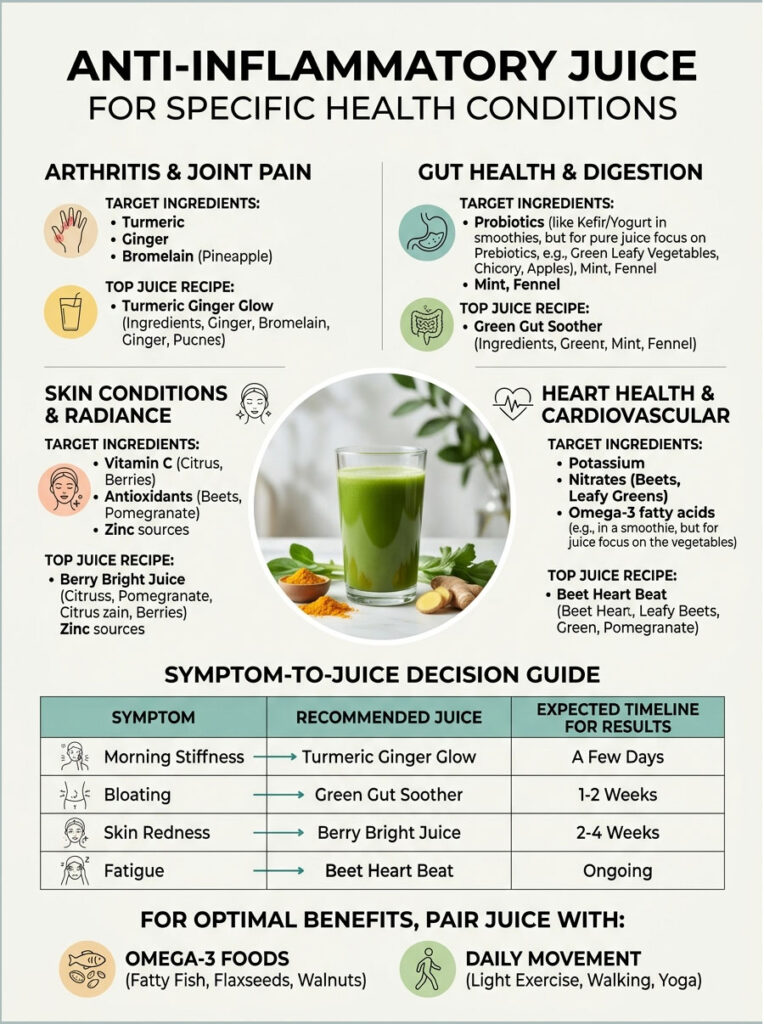
Different ingredients shine for different conditions. Matching the right recipe to your symptoms multiplies the results.
Best Anti-Inflammatory Juice for Arthritis
Pick recipes with turmeric, ginger, and tart cherry. Recipe 1 (Golden Turmeric-Ginger Glow) and Recipe 2 (Tart Cherry Beet Recovery) consistently rank highest for joint relief. Anti-inflammatory juice for arthritis works best when paired with omega-3-rich foods and gentle daily movement.
Best Anti-Inflammatory Juice for Gut Health
Pineapple bromelain and ginger top the list. Recipe 3 (Pineapple Bromelain Booster) and Recipe 6 (Celery Cucumber Cooler) reduce bloating, support enzyme activity, and calm gut lining inflammation.
Best Anti-Inflammatory Juice for Skin Conditions
Anthocyanins from berries plus liver-supportive greens win here. Recipe 7 (Berry Polyphenol Punch) and Recipe 10 (Spinach-Kale-Lemon Detox Green) target acne, eczema, and dull skin from the inside out.
Best Anti-Inflammatory Juice for Heart Inflammation
Pomegranate punicalagins and beet nitrates lead the field. Recipe 8 (Pomegranate Heart Helper) directly supports endothelial function and lowers oxidative stress in cardiovascular tissue.
Table 3: Symptom-to-Juice Decision Guide
| Your Symptom | Recommended Recipe | How Often | Expected Timeline |
| Morning joint stiffness | Recipe 1 (Turmeric-Ginger Glow) | Daily | 4 to 6 weeks |
| Post-workout muscle soreness | Recipe 2 (Tart Cherry Beet) | Within 30 min after workout | Same-day relief |
| Bloating, gas, sluggish digestion | Recipe 6 (Celery Cucumber Cooler) | 5 days a week | 7 to 14 days |
| Acne or dull skin | Recipe 7 (Berry Polyphenol Punch) | 4 days a week | 3 to 6 weeks |
| High blood pressure | Recipe 8 (Pomegranate Heart Helper) | 4 to 5 days a week | 4 to 8 weeks |
| Frequent colds, low immunity | Recipe 11 (Carrot-Orange-Turmeric Sunrise) | Daily during cold season | 2 to 4 weeks |
| Sinus congestion | Recipe 3 (Pineapple Bromelain Booster) | Daily during flare | 3 to 7 days |
7 Mistakes That Cancel Out Your Juice Benefits
Even the best recipe falls flat with the wrong execution. The errors below are the ones our reviewers see most often.
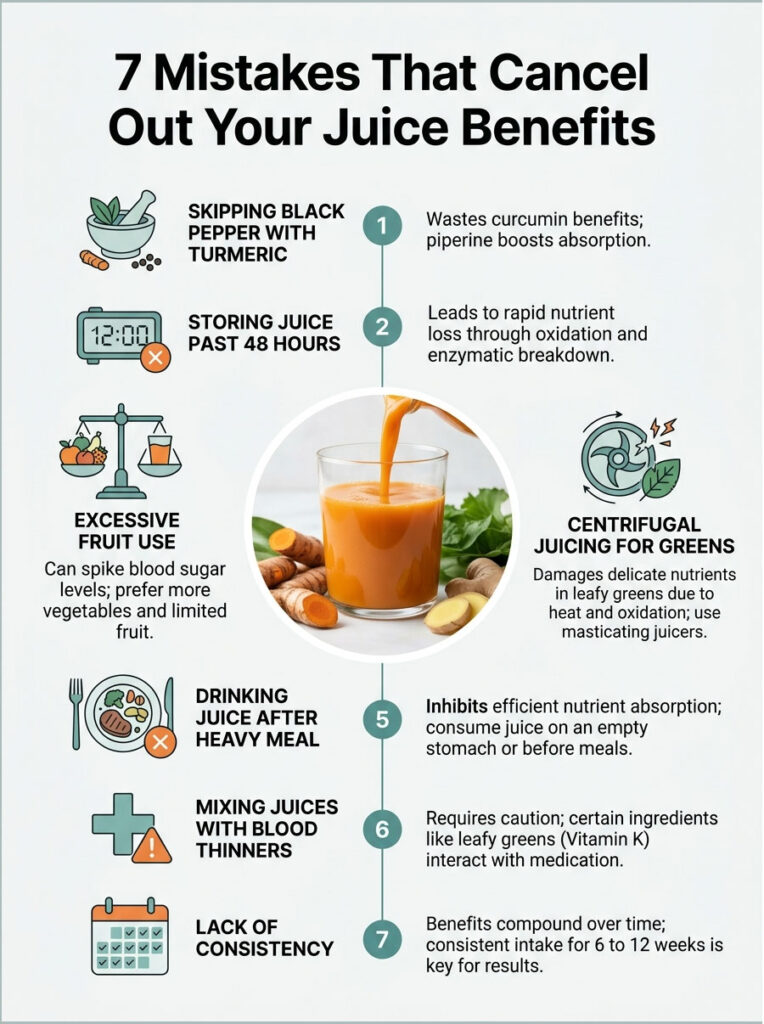
Mistake 1: Skipping black pepper with turmeric. Curcumin without piperine is mostly wasted.
Mistake 2: Storing juice past 48 hours. Polyphenols oxidize fast, and nutrient loss starts within hours.
Mistake 3: Using too much fruit. Sweet juice spikes blood sugar and worsens inflammation.
Mistake 4: Centrifugal juicing for delicate greens. Heat from high-speed blades degrades vitamin C and chlorophyll.
Mistake 5: Drinking right after a heavy meal. This slows absorption of key compounds.
Mistake 6: Mixing anti-inflammatory juice with high-dose blood thinners without medical guidance. Turmeric and ginger can intensify the drug effect.
Mistake 7: Quitting after one week. Anti-inflammatory benefits compound over 6 to 12 weeks of consistent intake.
A 2023 Mayo Clinic article underlines the curcumin-piperine point: without absorption support, even high doses do little. Lab partners we work with at HealthCareOnTime report that patients who track these basics show stronger CRP improvements at follow-up testing.
Cold-Press vs. Centrifugal Juicer: What US Buyers Should Pick
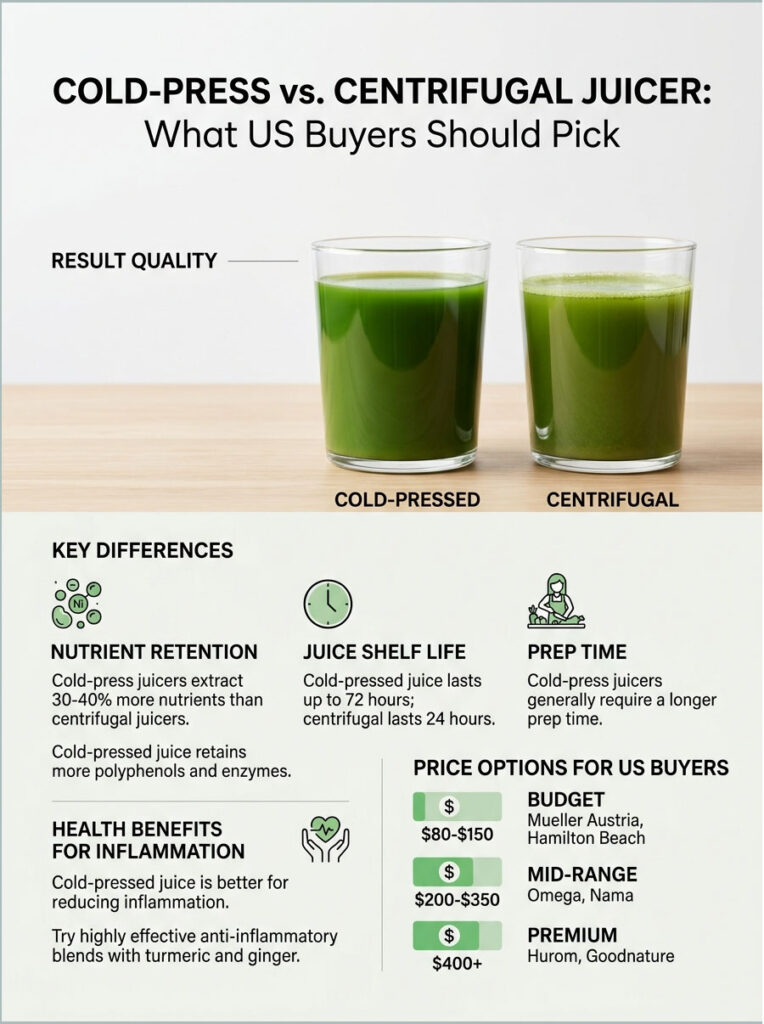
Cold-press juicers (also called masticating or slow juicers) crush and squeeze produce at low RPMs. Centrifugal juicers spin at high speeds with a metal blade. The difference shows up in your glass.
Nutrient Retention Comparison
Cold-press extracts 30 to 40 percent more polyphenols and enzymes from leafy greens. The juice also lasts longer, up to 72 hours refrigerated, versus 24 hours for centrifugal. The trade-offs are higher price and longer prep time.
Best Budget vs. Premium Picks (US Market)
Budget option ($80 to $150): Mueller Austria Juicer, Hamilton Beach Big Mouth.
Mid-range ($200 to $350): Omega NC900HDC, Nama J2.
Premium ($400+): Hurom H320, Goodnature M-1, Sana 727.
For most US households, a mid-range cold-press hits the sweet spot of nutrient retention, durability, and easy cleaning.
Frequently Asked Questions
What is the most powerful anti-inflammatory juice?
A blend of turmeric, ginger, pineapple, lemon, and a pinch of black pepper is consistently rated the most potent. The combination delivers curcumin, gingerol, bromelain, and vitamin C in one glass, with piperine boosting curcumin absorption by up to 2,000 percent.
How long does it take for anti-inflammatory juice to work?
Digestive changes usually show up in 7 to 14 days. Energy and skin improvements typically appear in 3 to 4 weeks. Joint pain relief and measurable drops in CRP markers usually take 4 to 8 weeks of daily, consistent intake.
Can I drink anti-inflammatory juice every day?
Yes, for most healthy adults, 6 to 8 ounces daily is safe and effective. Diabetics should pick low-sugar green-vegetable recipes and limit to 4 to 6 ounces. Pregnant women should avoid high-dose turmeric and consult their OB-GYN first.
Is anti-inflammatory juice safe during pregnancy?
Most green juices and mild fruit blends are safe in moderation. Avoid concentrated turmeric (more than 1 teaspoon daily), unpasteurized juices, and high-dose ginger in the first trimester. Always check with your prenatal care provider before starting.
Does anti-inflammatory juice help with arthritis?
Yes. Studies cited by the Arthritis Foundation show turmeric, ginger, and tart cherry reduce arthritis pain and stiffness. Daily intake over 6 to 12 weeks can lower reliance on NSAIDs in mild to moderate cases.
Can diabetics drink anti-inflammatory juice?
Yes, with smart recipe choices. Pick green-vegetable juices low in fruit (Recipes 4, 6, 10). Limit servings to 4 to 6 ounces. Pair with protein or healthy fat to slow sugar absorption. Monitor blood glucose for the first two weeks to confirm a safe response.
What is the best time of day to drink anti-inflammatory juice?
Morning, between 7 and 9 AM, on an empty stomach. This window matches your natural cortisol rise and gives top absorption of curcumin, gingerol, and vitamin C. A second smaller serving between 10 AM and 2 PM extends benefits across the day.
How long can I store fresh anti-inflammatory juice?
Cold-pressed juice lasts 48 to 72 hours in an airtight glass jar in the fridge. Centrifugal juice lasts only 24 hours. Fill the container to the top to limit oxygen exposure. Freeze in glass jars for up to 3 months if needed.
Cold-pressed vs. centrifugal juice for inflammation, which is better?
Cold-pressed wins. It retains 30 to 40 percent more polyphenols, enzymes, and vitamin C because slow extraction generates less heat and oxidation. Centrifugal works fine for occasional juicing, but cold-press delivers stronger anti-inflammatory results long term.
Can I freeze anti-inflammatory juice?
Yes. Pour fresh juice into glass jars, leaving 1 inch of headspace, and freeze up to 3 months. Thaw in the fridge overnight before drinking. Some flavor and minor nutrient loss occurs, but most polyphenols and curcumin stay intact.
Are store-bought anti-inflammatory juices effective?
Most aren’t. Pasteurization, added sugar, and long shelf life kill enzymes and degrade polyphenols. A few cold-pressed brands sold refrigerated (Suja, Pressed, Evolution Fresh) keep more nutrients, but homemade always wins for potency and cost.
What foods cancel out anti-inflammatory juice benefits?
Refined sugar, processed seed oils (corn, soybean, cottonseed), trans fats, alcohol, fried foods, and ultra-processed snacks all spike inflammation. Drinking juice daily while eating these foods is like bailing water from a boat with a hole in it. Cut these alongside juicing for full benefit.
The information in this article is intended for general education only. It is not medical advice and is not a substitute for diagnosis or treatment by a licensed physician. People with chronic illness, those taking prescription medication (especially blood thinners or diabetes drugs), pregnant or nursing women, and parents of children under 12 should consult a qualified healthcare provider before starting any anti-inflammatory juice routine. HealthCareOnTime offers diagnostic lab testing services and does not provide direct medical treatment.
References
- CDC: About Chronic Diseases
- CDC Arthritis Data and Statistics
- Harvard T.H. Chan School of Public Health: Anti-Inflammatory Diet
- NIH NCCIH: Turmeric
- Cleveland Clinic: Turmeric Health Benefits
- Mayo Clinic: Curcumin
- American Heart Association: Diet and Lifestyle Recommendations
- Arthritis Foundation: Anti-Inflammatory Diet
- USDA FoodData Central
- Johns Hopkins Medicine: Anti-Inflammatory Diet