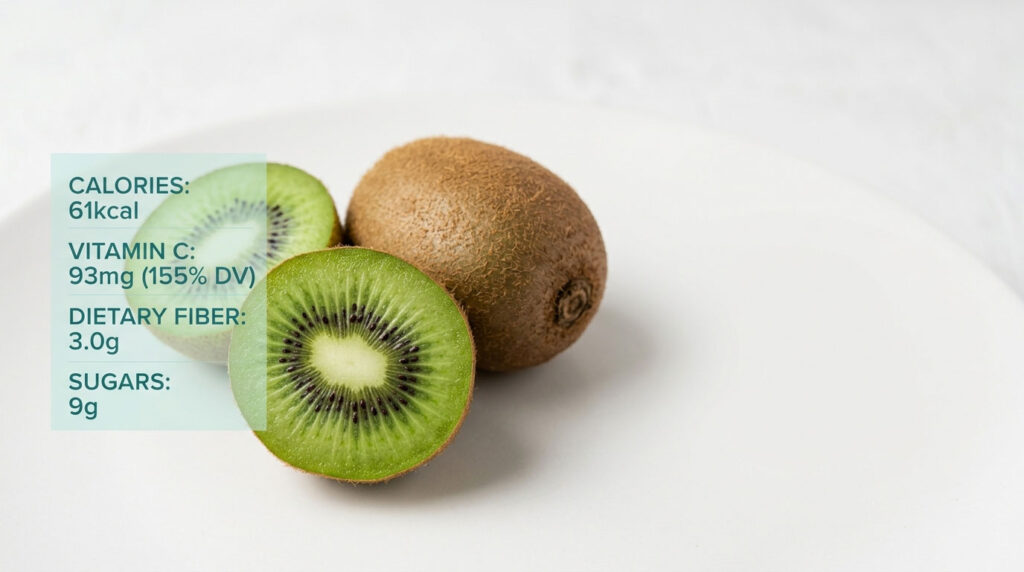
One small kiwi holds more vitamin C than a whole orange, and it does it for about 42 calories. That is the quiet superpower of this fuzzy little fruit. It is light enough to snack on guilt-free, yet dense enough with nutrients to earn a place in almost any healthy diet.
Table of Contents
Quick answer: A medium green kiwi (about 69 grams) has roughly 42 calories. Per 100 grams, green kiwi runs about 61 calories. A gold (SunGold) kiwi is slightly higher at around 50 calories per fruit. Nearly all of those calories come from natural carbohydrates, with about 2 grams of fiber and 6 grams of sugar per medium fruit, plus a big dose of vitamin C.
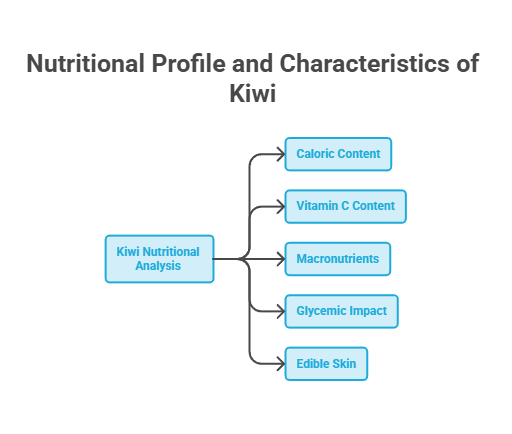
At a glance
- A medium green kiwi has about 42 calories; a gold kiwi about 50.
- Per 100 grams, green kiwi is roughly 61 calories.
- One medium kiwi delivers around 71% of your daily vitamin C.
- Kiwi carries about 2 grams of fiber and 6 grams of natural sugar per fruit.
- Kiwi has a low glycemic index, so it raises blood sugar gently.
- The fuzzy skin is edible and roughly doubles the fiber.
Kiwifruit is about 83% water, which is a big reason the calorie count stays so low. What is left is mostly carbohydrate, along with a standout amount of vitamin C and a useful hit of fiber, potassium, and vitamin K.
This guide breaks down kiwi calories by size and type, lays out the full USDA nutrition profile with US Daily Values, compares green against gold, and covers the health angles that matter most.
How Many Calories Are in a Kiwi?
The short version: not many. Kiwi is one of the lower-calorie fruits by weight, sitting comfortably below grapes, bananas, and mangoes per serving.
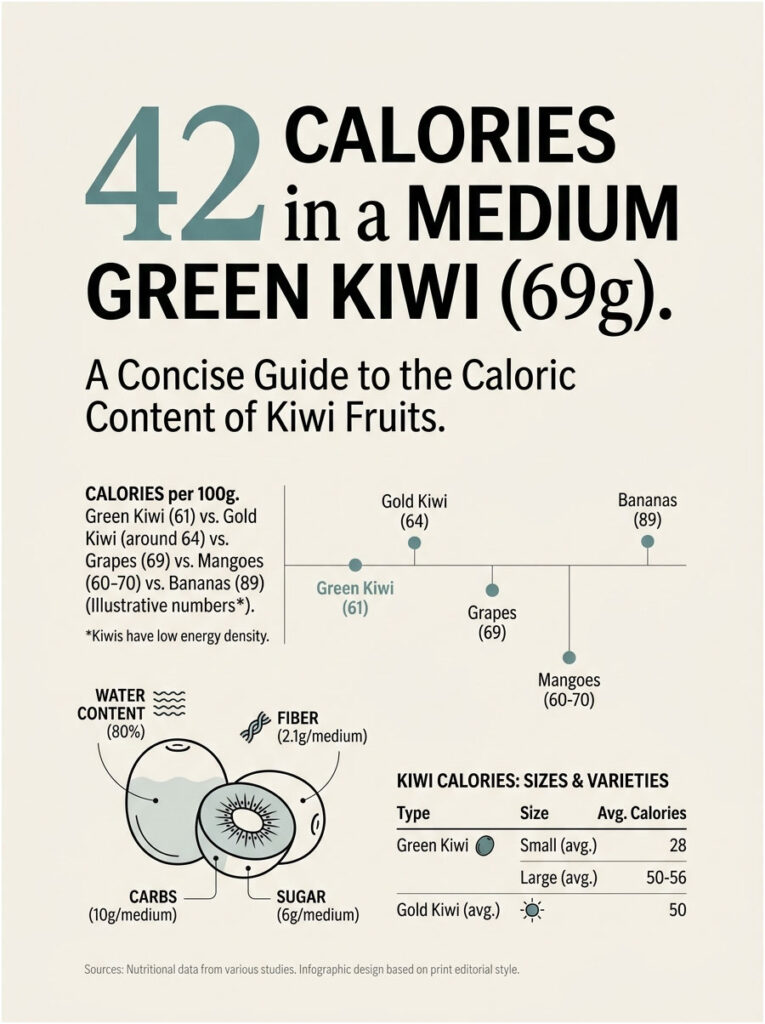
The exact number depends on size and variety. Our medical reviewers note that portion size, not the fruit itself, is what changes the math for most people.
Kiwi Calories by Size
A single kiwi’s calories scale with its weight. A medium green kiwi weighing about 69 grams contains roughly 42 calories, with 10 grams of carbohydrate, 6 grams of sugar, and 2.1 grams of fiber.
Scale up or down from there. A small kiwi lands closer to 28 calories, while a large one reaches into the mid-50s. Per 100 grams, green kiwifruit provides about 61 calories, and one 148-gram serving of two fruits is about 90 calories.
Green vs Gold (SunGold) Calories
Gold kiwi, often sold as SunGold, is a little sweeter and slightly higher in calories. Gold kiwi has about 50 calories per fruit compared to 42 for green, with nearly double the vitamin C but slightly less fiber.
The difference is small enough that it rarely matters for calorie counting. Patients booking tests with us often ask which to pick, and the honest answer is whichever you enjoy eating more often.
The table below puts the common serving sizes side by side so you can match your portion to the numbers.
| Serving or type | Weight | Calories | Carbs | Fiber | Sugar |
| Small green kiwi | about 46 g | 28 | 6.7 g | 1.4 g | 4.1 g |
| Medium green kiwi | about 69 g | 42 | 10.1 g | 2.1 g | 6.2 g |
| Large green kiwi | about 91 g | 56 | 13.3 g | 2.7 g | 8.2 g |
| Gold (SunGold) kiwi | about 81 g | 50 | 12.0 g | 1.4 g | 9.0 g |
| Per 100 grams (green) | 100 g | 61 | 14.7 g | 3.0 g | 9.0 g |
| 1 cup sliced (green) | 180 g | 110 | 26.4 g | 5.4 g | 16.2 g |
Why Kiwi Is So Low in Calories
The secret is water and fiber. Since kiwifruit is roughly four-fifths water, most of its weight carries no calories at all.
The rest is largely carbohydrate, and a good chunk of that is fiber, which the body does not fully absorb for energy. There is almost no fat and only a trace of protein.
That combination gives kiwi a low energy density, meaning you get a lot of food for very few calories. In cases reviewed by our medical team, low-energy-density foods like this help people feel full while keeping their total calories in check.
Full USDA Nutrition Breakdown
Calories only tell part of the story. What makes kiwi worth eating is how much nutrition it packs into that small package, and the USDA numbers show it clearly.
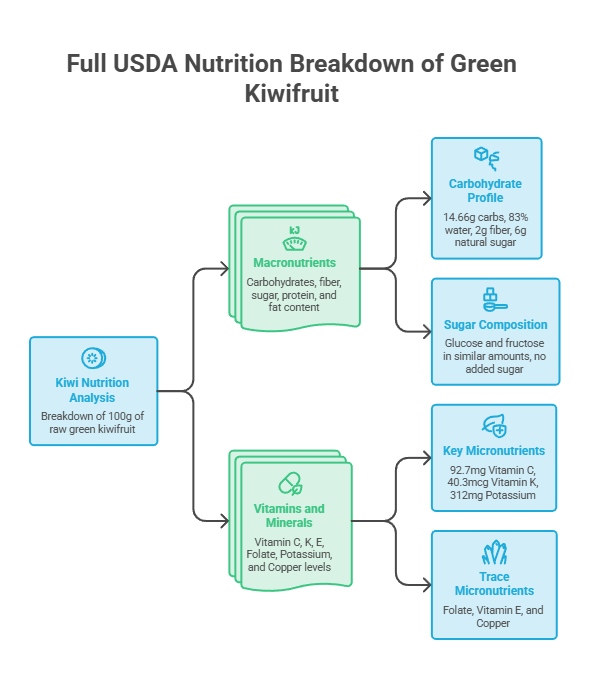
The figures below come from USDA FoodData Central for green kiwifruit, raw. Across the patients we serve, this fruit routinely surprises people with how nutrient-dense it is for its size.
Macronutrients
Kiwi is a carbohydrate food at heart, and a gentle one. One hundred grams of kiwifruit contains 14.66 grams of carbohydrate, and the fruit is about 83% water.
Of those carbs, a healthy share is fiber. A medium kiwi carries about 2 grams of fiber and 6 grams of natural sugar, with only trace protein and fat. That fiber-to-sugar balance is part of why kiwi feels satisfying without spiking blood sugar.
The main sugars in kiwi are glucose and fructose in similar amounts, which is typical of fresh fruit. There is no added sugar, so every gram is naturally occurring.
Vitamins and Minerals with % Daily Value
This is where kiwi shines. Green kiwifruit contains about 92.7 milligrams of vitamin C per 100 grams, well above the roughly 53 milligrams in an orange.
One medium kiwi covers most of your daily vitamin C, plus meaningful vitamin K, potassium, and a bit of folate and vitamin E. The table lays out the full profile with US Daily Values.
| Nutrient | Per 100 g | Per medium kiwi (69 g) | % Daily Value |
| Calories | 61 kcal | 42 kcal | 2% |
| Total carbohydrate | 14.7 g | 10.1 g | 4% |
| Dietary fiber | 3.0 g | 2.1 g | 7% |
| Total sugars | 9.0 g | 6.2 g | not established |
| Protein | 1.1 g | 0.8 g | 2% |
| Total fat | 0.5 g | 0.4 g | 1% |
| Vitamin C | 92.7 mg | 64 mg | 71% |
| Vitamin K | 40.3 mcg | 28 mcg | 23% |
| Potassium | 312 mg | 215 mg | 5% |
| Folate | 25 mcg | 17 mcg | 4% |
| Vitamin E | 1.5 mg | 1.0 mg | 7% |
| Copper | 0.13 mg | 0.09 mg | 10% |
Percent Daily Values are based on FDA Daily Values for a 2,000-calorie diet, shown per medium fruit. Full source data is available at USDA FoodData Central.
The headline is vitamin C. A single kiwi handles the bulk of what an adult needs in a day, which supports immune function and collagen production. The vitamin K and potassium are welcome bonuses in such a low-calorie food.
Green vs Gold Kiwi: Nutrition Compared
Green and gold kiwi come from related plants and share a similar base, but they diverge in a few ways worth knowing. Green is the classic tart, fuzzy Hayward variety. Gold, or SunGold, is sweeter with a smooth, thin skin.
The biggest gap is vitamin C. Gold kiwi varieties reach up to 161 milligrams of vitamin C per 100 grams, among the highest of any common fruit, while green kiwi sits around 85 to 93 milligrams.
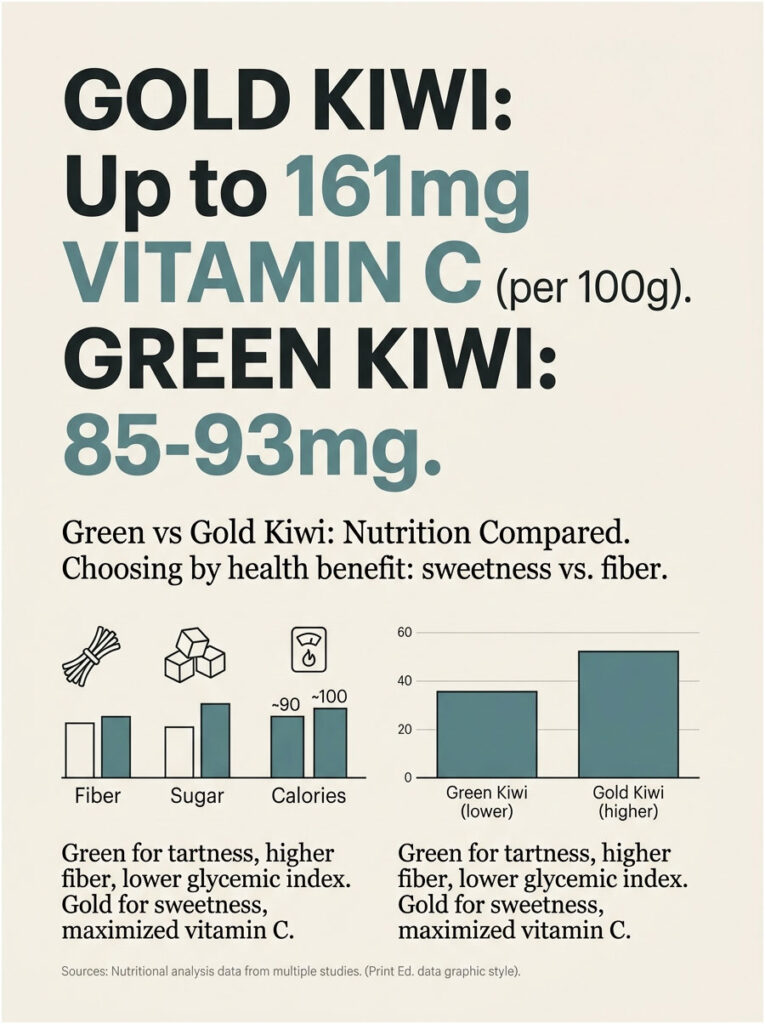
Green kiwi tends to carry a bit more fiber, while gold is a touch higher in calories and sugar. A serving of two green kiwifruit is about 90 calories, and two SunGold about 100, with green rating low on the glycemic index.
For most goals, the choice comes down to taste. Choose green for more fiber and a tangy bite, or gold for a sweeter flavor and even more vitamin C. Our lab partners report that both varieties deliver strong nutrition per calorie.
How Kiwi Compares to Other Fruits
Seeing kiwi next to other fruits puts its calories in context. Gram for gram, it is lighter than many popular choices while carrying more vitamin C than almost all of them.
A medium kiwi’s 42 calories undercut a medium banana (about 105) and a cup of grapes (about 104). It lands near an orange but delivers more vitamin C by weight.
Where kiwi truly separates from the pack is nutrient density. Few fruits pack this much vitamin C, fiber, and potassium into so few calories, which is why it earns a spot on so many healthy-eating lists.
Against berries, kiwi holds its own. A cup of strawberries is about 50 calories and a cup of blueberries about 85, and kiwi matches their vitamin punch while adding more vitamin C per bite.
Compared to a medium apple at about 95 calories, a single kiwi is lighter and far richer in vitamin C, though the apple offers more total fiber. Each fruit has its strengths.
The takeaway is not that other fruits are bad; they are all healthy choices. It is that kiwi delivers unusually high nutrition for its modest calorie cost, which makes it an easy default when you want the most value per bite.
Dried Kiwi vs Fresh Kiwi: A Calorie Warning
The calorie counts above are for fresh kiwi, and that distinction matters. Dried kiwi is a very different food when it comes to calories and sugar.
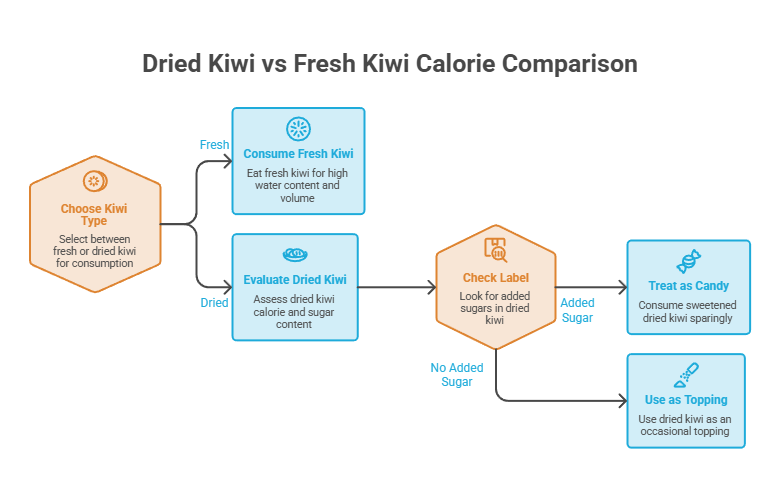
Drying removes the water that keeps fresh kiwi so light, which concentrates the sugar and calories into a much smaller piece. A single ounce of dried kiwi can carry several times the calories of a fresh slice of the same weight.
Many dried kiwi products also add sugar, pushing the total higher still. If you are watching calories, check the label and treat sweetened dried kiwi more like candy than fruit.
Fresh kiwi is the better choice for filling up on fewer calories. Our medical reviewers note that the water and volume in fresh fruit are a big part of why it satisfies. Save dried kiwi for an occasional topping rather than a handful snack.
Health Benefits of Kiwi
Kiwi’s nutrition profile translates into real, everyday benefits. None of them are magic, but together they make a solid case for keeping kiwi in your rotation.
A Vitamin C Powerhouse
Kiwi is one of the most vitamin-C-dense fruits you can buy. A medium kiwi contains about 64 milligrams of vitamin C, which is 71% of the recommended daily value, and per gram it beats an orange.
Vitamin C supports your immune system, helps your body make collagen for skin and joints, and improves how well you absorb iron from plant foods. For anyone trying to get more of it from whole foods, kiwi is a smart, low-calorie pick.
Fiber, Actinidin, and Digestion
Kiwi is a gentle friend to your gut. The fiber supports regularity, and kiwi also contains a natural enzyme that helps break down protein. Kiwifruit contains actinidin, an enzyme that breaks down protein and can improve digestion, and studies show eating kiwi with a high-protein meal speeds gastric digestion.
Green kiwi in particular has been studied for easing constipation and supporting normal bowel function. Two kiwis a day is a common amount used for digestive benefit.
Skin and Eye Health
Kiwi does quiet work for your skin and eyes. Its vitamin C is central to making collagen, the protein that keeps skin firm and helps wounds heal.
The fruit also supplies small amounts of lutein and other plant pigments that support eye health over time. Combined with its antioxidants, kiwi is a friendly food for looking and feeling well.
Low Glycemic Index and Blood Sugar
Despite its natural sugar, kiwi does not send blood sugar soaring. Kiwi has a glycemic index around 52, in the low-to-medium range, and its fiber helps regulate glucose absorption.
That makes it a reasonable fruit choice for people watching their blood sugar, especially when paired with protein or fat. If blood sugar is a concern for you, a simple blood sugar test through HealthCareOnTime can help you and your doctor plan a diet that fits.
Heart Health and Antioxidants
Kiwi supports the heart in a few quiet ways. Its potassium helps balance sodium and supports healthy blood pressure, and the fiber can help manage cholesterol over time.
The fruit is also rich in antioxidants, including vitamin C and plant polyphenols, which help the body handle everyday oxidative stress. These are the same compounds that give kiwi its bright color and tang.
None of this replaces medicine or a doctor’s guidance, but as part of a balanced diet, kiwi is a heart-friendly, low-calorie choice.
Hydration and Fullness
Because kiwi is mostly water, it doubles as a small hydration boost, which is handy on hot days or after a workout. The water and fiber together also help you feel full.
That sense of fullness for so few calories is part of why kiwi works well as a between-meal snack. It takes the edge off hunger without weighing you down.
For anyone trying to eat more mindfully, a piece of whole fruit like kiwi is far more satisfying than the same calories from a drink or a processed bite.
Kiwi and Sleep
There is even some early research on kiwi and rest. A study from Taipei Medical University found that eating two kiwis one hour before bed improved sleep onset, duration, and quality, with participants falling asleep faster after four weeks.
This is a small study, so treat it as promising rather than proven. Still, a low-calorie evening snack that might help you wind down is an easy thing to try.
Is Kiwi Good for Weight Loss?
Yes, kiwi fits a weight-loss plan nicely. The reason is energy density, which is how many calories a food packs per bite.
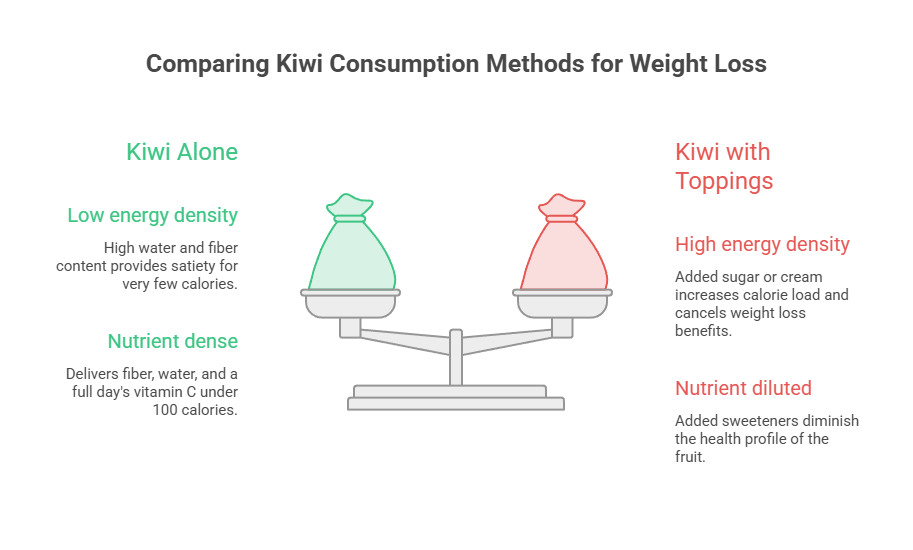
Because kiwi is about 83% water and rich in fiber, it fills you up for very few calories. You get satisfying volume and a sweet taste without the calorie load of many snacks.
Two medium kiwis run under 100 calories yet deliver fiber, water, and a full day’s vitamin C. In cases reviewed by our medical team, swapping a processed snack for fruit like this is one of the simplest wins people make.
The catch is portions and pairings. Kiwi is friendly to weight loss on its own, but drowning it in sugar or cream cancels the benefit, so keep it simple.
Kiwi for Pregnancy: The Folate Angle
Kiwi is a pregnancy-friendly fruit for a simple reason: folate. This B vitamin supports healthy cell growth and early development, which is why it matters so much before and during pregnancy.
A kiwi also brings vitamin C, which helps with iron absorption, and gentle fiber that eases the constipation many expecting mothers face. Its low calorie count makes it an easy, nourishing snack.
Patients booking tests with us often ask about safe fruits during pregnancy, and kiwi is generally a good pick. The main exception is a known kiwi allergy, so anyone with one should steer clear and speak with their doctor.
Can You Eat Kiwi Skin?
You can, and there is a good reason to. The skin of a kiwi is edible and adds a real nutritional boost, roughly tripling the fiber compared to eating only the flesh, along with more vitamin C, vitamin E, and folate.
Wash the fruit well, then eat it like an apple. The fuzz softens as you chew, and gold kiwi has a smoother, thinner skin that many people find easier to enjoy.
If the texture bothers you, rubbing off some of the fuzz with a towel helps. Either way, keeping the skin on is an easy way to get more fiber from the same fruit.
Kiwi Risks and Who Should Be Careful
Kiwi is safe and healthy for most people, but a few situations call for care. Being aware of them keeps a healthy habit from backfiring.
Kiwi is a known allergen. Some people, especially those with pollen or latex allergies, get an itchy mouth or throat after eating it, a reaction called oral allergy syndrome. Severe reactions are possible but uncommon, and young children can be more sensitive.
Kiwi also contains oxalates, natural compounds that can contribute to kidney stones in people who are prone to them. Moderation and good hydration usually keep this a non-issue.
The table below matches common goals and situations to a practical next step.
| Your goal or situation | What kiwi offers | What to do |
| Want to lose weight | About 42 calories, high fiber, high water | Eat 1 to 2 as a snack, skin on, in place of higher-calorie treats |
| Managing blood sugar or diabetes | Low glycemic index, 2g or more fiber | Enjoy in moderation, pair with protein, and ask about a blood sugar test |
| Need more vitamin C | One medium kiwi is about 71% of the DV | One kiwi a day covers most of your daily vitamin C |
| Prone to kidney stones | Contains natural oxalates | Keep portions moderate, stay well hydrated, and ask your doctor |
| Itchy mouth or throat after kiwi | Possible kiwi allergy | Stop eating it and see a doctor; consider allergy testing |
| Constipation or sluggish digestion | Fiber plus the actinidin enzyme | Try 1 to 2 kiwis daily with the skin for gentle regularity |
If you notice allergy symptoms or you form kidney stones, talk with a healthcare provider before making kiwi a daily habit. Relevant testing, from allergy panels to kidney function checks, is available so your doctor can guide you.
How to Add More Kiwi to Your Diet
Getting more kiwi into your week is easy, and variety keeps it interesting. The fruit works in both sweet and savory dishes without adding many calories.
A few simple ideas:
- Slice one into your morning yogurt or oatmeal
- Blend kiwi into a smoothie for natural sweetness
- Toss diced kiwi into a green or fruit salad
- Make a quick kiwi salsa for fish or chicken
- Eat one whole, skin on, as a grab-and-go snack
Two kiwis a day is a practical target that delivers most of the benefits without overdoing sugar. Patients commonly ask us whether that is too much, and for most healthy adults it is a sensible, nutritious amount.
Keep firm kiwis at room temperature to ripen, then refrigerate once they yield to a gentle squeeze. Ripe kiwi is sweeter and easier to digest.
How Kiwi Is Grown and Where It Comes From
Kiwi may feel exotic, but it is widely available across the US year-round. The fruit originally came from China, where it was known as Chinese gooseberry before growers in New Zealand renamed it kiwifruit.
Today, most kiwi sold in American stores comes from California during the domestic season and from countries like New Zealand, Italy, and Chile the rest of the year. That rotation keeps shelves stocked in every month.
Kiwi grows on climbing vines and is harvested firm, then ripens after picking. This is why the kiwi you buy is often hard at first and softens over several days at home.
Because it is available all year, kiwi is an easy fruit to build into a routine. Our lab partners report that consistency, eating a fruit like this regularly, tends to matter more than any single superfood claim.
How to Pick and Store Kiwi
Choosing a good kiwi is easy once you know the feel. A ripe kiwi gives slightly when you press it gently with your thumb, much like a ripe peach, without being mushy or wrinkled.
Firm kiwis are fine to buy; they simply need a few days on the counter to ripen. To speed things up, store them in a paper bag with an apple or banana, which release a natural gas that hastens ripening.
Once ripe, kiwi keeps in the refrigerator for up to a week or two, which slows further softening. Whole, unwashed kiwi stores best, so wash it only right before you eat it. A ripe kiwi you cannot finish in time can also be peeled, sliced, and frozen for smoothies later.
Frequently Asked Questions
How many calories are in one kiwi?
One medium green kiwi (about 69 grams) has roughly 42 calories. A small kiwi is closer to 28 calories and a large one about 56. Almost all of those calories come from natural carbohydrates, with about 2 grams of fiber and 6 grams of sugar per fruit.
How many calories in a gold (SunGold) kiwi?
A gold kiwi has about 50 calories per fruit, slightly more than the 42 in a green kiwi. Gold kiwi is a little sweeter and higher in sugar, but it also carries nearly double the vitamin C. The calorie difference is small enough to ignore for most diets.
How many calories in 2 kiwis?
Two medium green kiwis total about 84 to 90 calories, and a 148-gram serving is commonly listed at 90 calories. Two gold kiwis run closer to 100 calories. Either way, two kiwis stay under 100 calories while delivering a full day’s worth of vitamin C.
Is kiwi good for weight loss?
Yes. Kiwi is low in calories, high in water, and rich in fiber, so it fills you up for very little energy. That low energy density makes it a satisfying snack that supports portion control. Swapping a processed snack for a kiwi or two is an easy calorie-smart move.
How much vitamin C is in a kiwi?
A medium green kiwi contains about 64 milligrams of vitamin C, roughly 71% of the daily value. Per 100 grams, green kiwi has about 93 milligrams, more than an orange. Gold kiwi is even higher, reaching up to 161 milligrams per 100 grams, among the richest fruit sources.
Can you eat kiwi skin?
Yes, the skin is fully edible and nutritious. Eating it roughly triples the fiber compared to the flesh alone and adds more vitamin C, vitamin E, and folate. Just wash the fruit well first. Gold kiwi has a smoother, thinner skin that many people find easier to eat.
Is kiwi good for diabetics?
For most people watching blood sugar, kiwi is a reasonable choice. It has a low-to-medium glycemic index around 52, and its fiber slows sugar absorption. Pairing kiwi with protein or fat helps further. Portion control still matters, so check with your doctor about your personal plan.
How many carbs and how much sugar are in a kiwi?
A medium green kiwi has about 10 grams of total carbohydrate, including roughly 2 grams of fiber and 6 grams of natural sugar. Per 100 grams, kiwi has about 14.7 grams of carbs and 9 grams of sugar. The fiber helps offset the sugar’s effect on blood glucose.
Green vs gold kiwi, which is healthier?
Both are healthy. Green kiwi has slightly more fiber and a tangy taste, while gold kiwi is sweeter with nearly double the vitamin C and a smoother skin. Calories are similar, around 42 for green and 50 for gold. The best choice is the one you will eat regularly.
How many kiwis can you eat a day?
For most healthy adults, one to two kiwis a day is a sensible, nutritious amount, and many digestive studies use two. That covers your vitamin C and adds fiber without excess sugar. If you have allergies, kidney stones, or blood sugar concerns, ask your doctor about the right amount.
Can kiwi cause an allergic reaction?
Yes. Kiwi is a recognized allergen, and some people get an itchy mouth or throat after eating it, especially those with pollen or latex allergies. Most reactions are mild, but severe ones can happen. If you notice symptoms, stop eating kiwi and talk with a healthcare provider.
Is it good to eat kiwi at night?
It can be. A small study found that eating two kiwis an hour before bed improved sleep quality and helped people fall asleep faster over several weeks. Kiwi is also low in calories, so it makes a light evening snack. The evidence is early, but trying it is harmless.
Disclaimer: This article is for general nutrition education and is not a substitute for professional medical or dietary advice. Nutrition values are approximate and vary by fruit size, ripeness, and variety. If you have a food allergy, diabetes, kidney concerns, or other health conditions, talk with a qualified healthcare provider about what is right for you.