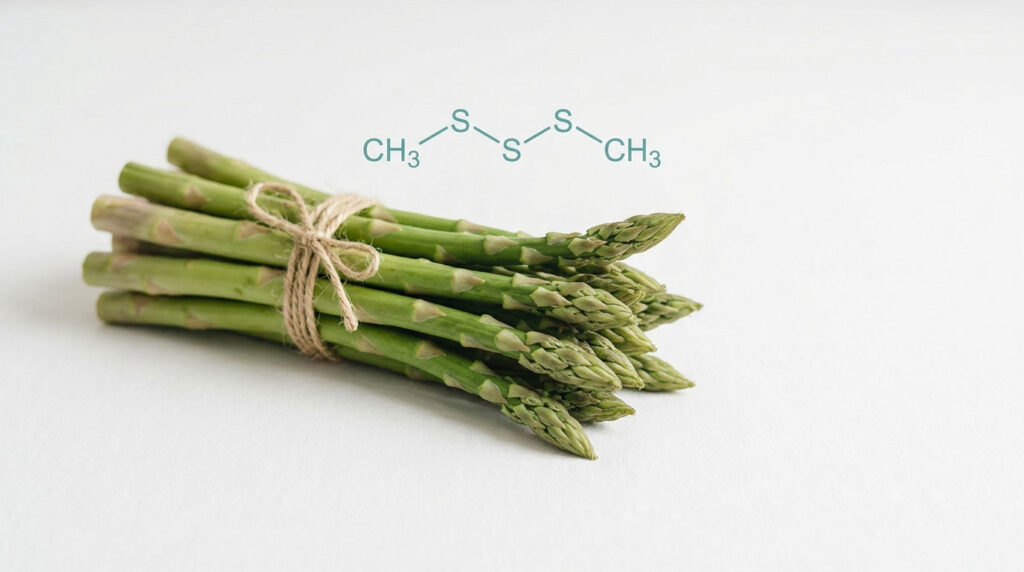
Benjamin Franklin noticed it more than two centuries ago, writing that asparagus gives urine “a disagreeable odor.” Millions of Americans rediscover the same thing about a half hour after dinner. The smell is strange, it is fast, and it is completely harmless. The real puzzle is not why it happens, but why more than half of people never smell it at all.
Table of Contents
Quick answer: Asparagus contains asparagusic acid, a sulfur compound found nowhere else. When your body digests it, the acid breaks down into small, volatile sulfur molecules like methanethiol. These vaporize the instant your urine meets the air and drift up to your nose. Nearly everyone produces this asparagus urine smell, but genetics decide who can actually detect it, a trait called asparagus anosmia.
At a glance
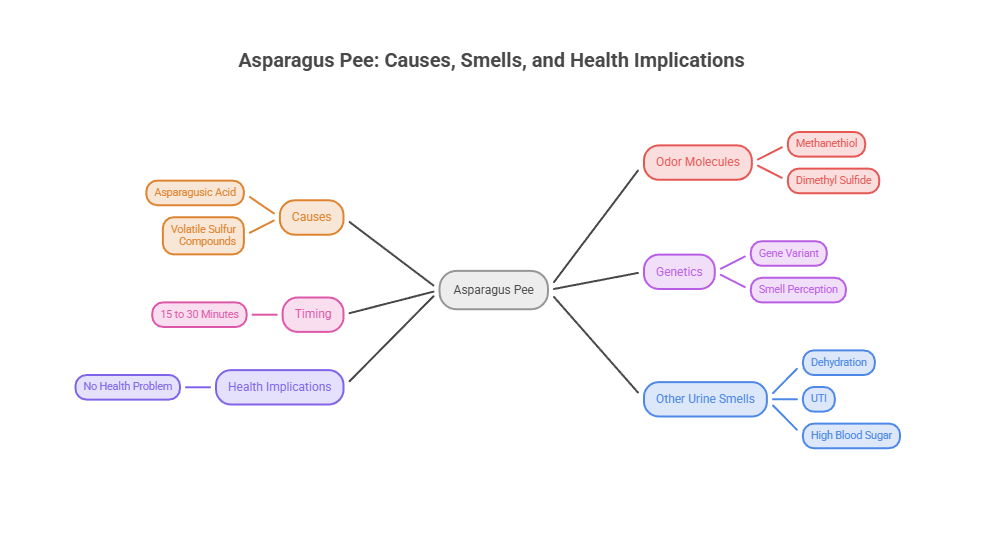
- The smell comes from asparagusic acid breaking down into volatile sulfur compounds.
- Methanethiol and dimethyl sulfide are the main odor molecules.
- Asparagus pee can start within 15 to 30 minutes of eating.
- Roughly 6 in 10 people carry a gene variant that blocks them from smelling it.
- Asparagus pee is not a sign of any health problem.
- A different, lingering urine smell can point to dehydration, a UTI, or high blood sugar.
Asparagus is one of the more nutritious vegetables on your plate, rich in folate, fiber, and vitamins K, A, and C. The odd effect on your urine says nothing bad about you or the vegetable.
This guide covers the chemistry in plain English, the surprising genetics of who can smell it, how long it lasts, and the point where a urine smell actually deserves attention.
The Short Answer: What Makes Asparagus Pee Smell
The smell traces back to a single compound and the tiny sulfur molecules it becomes. Get those two steps and you understand almost everything about asparagus pee.
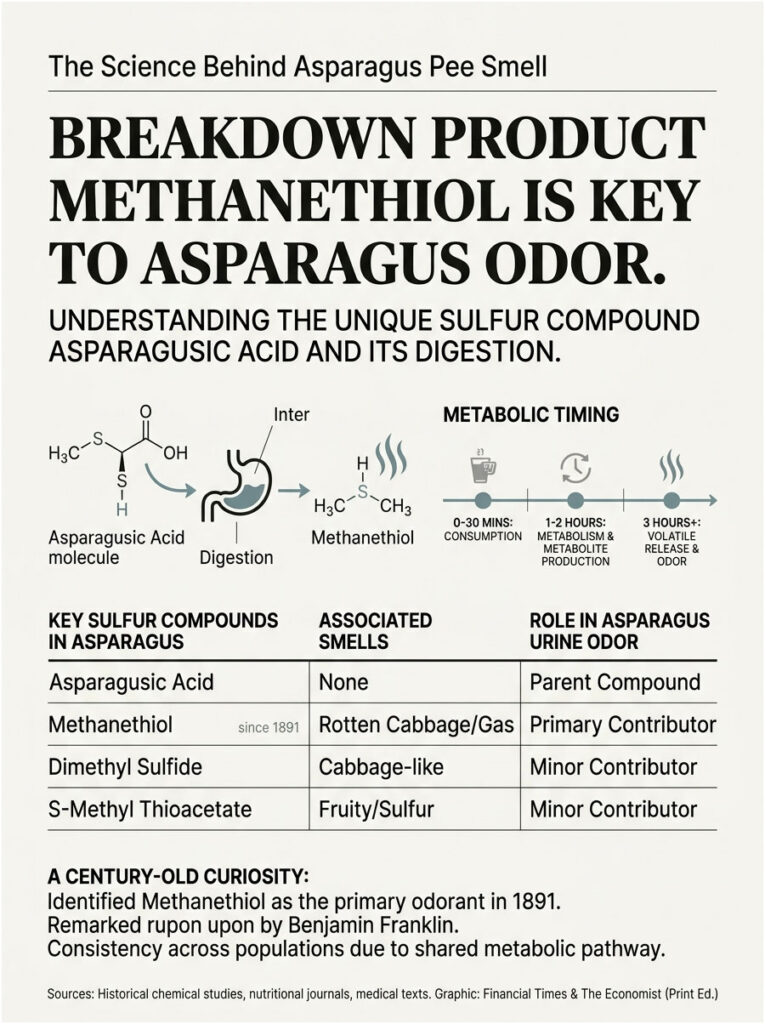
Our medical reviewers note that this process runs the same way in nearly everyone, which is why the odor is so consistent from one person to the next.
Meet Asparagusic Acid
Asparagusic acid is a sulfur-containing compound found only in asparagus. It is harmless, and on its own it carries no strong smell. When your body digests asparagusic acid, it breaks the compound down into several sulfur-containing molecules.
Sulfur is the whole story here. The same element gives rotten eggs, skunk spray, and cooked cabbage their punch, so sulfur byproducts doing something similar to urine is no surprise.
The Sulfur Compounds Behind the Smell
Once asparagusic acid is broken apart, it yields a handful of small sulfur molecules. These are volatile, which means they turn to vapor easily and fast.
When you urinate, these compounds evaporate almost immediately, which lets them travel from the urine up to your nose, and methanethiol is the compound most widely mentioned in the research.
Scientists have not pinned the odor on one single molecule. The asparagus urine smell is likely the combined effect of methanethiol and its chemical cousins. Patients often ask us whether the asparagus itself smells this way, and it does not; the odor forms only after digestion.
The table below breaks down the main compounds, what each smells like, and the part it plays.
| Compound | What it is | Described smell | Role in asparagus pee |
| Methanethiol (methyl mercaptan) | A volatile sulfur gas | Rotten cabbage, garlic | Most-cited culprit; found in asparagus urine since the 1800s |
| Dimethyl sulfide | A volatile sulfur compound | Sweetish, cabbage-like | Adds to the overall odor |
| Dimethyl disulfide | A volatile sulfur compound | Sharp, oniony | Part of the smelly mixture |
| Dimethyl sulfoxide (DMSO) | A less volatile sulfur compound | Faint, slightly sweet | Present but only mildly odorous |
| Dimethyl sulfone | A stable sulfur compound | Nearly odorless | Present, contributes little smell |
Why Asparagus and Not Broccoli or Onions
Plenty of vegetables contain sulfur, so why does asparagus get singled out? The answer is asparagusic acid itself, a compound with an unusual double-sulfur ring structure that asparagus alone produces in meaningful amounts.
Garlic and onions carry their own sulfur compounds, and they can nudge urine odor too. What sets asparagus apart is that its breakdown products are both highly volatile and distinctive, creating that unmistakable smell rather than a vague change.
Cooking or eating other cruciferous vegetables like broccoli and Brussels sprouts can shift how urine smells, yet none produce the signature odor as reliably as asparagus. In tests booked through HealthCareOnTime, asparagus is by far the food people connect to a sudden urine smell.
The vegetable’s reputation is earned. No other common food turns urine pungent so quickly, so consistently, and in so many people at once.
How Your Body Turns Dinner Into the Smell
The path from plate to odor is quick and simple. You eat asparagus, your gut and liver break down the asparagusic acid, and the volatile sulfur compounds enter your bloodstream.
Your kidneys filter those compounds into your urine within a short window. The moment that urine hits the toilet bowl and open air, the volatile molecules escape as vapor.
That vapor is what reaches your nose, which is why the smell seems to appear out of nowhere. The compounds are too light to stay put, so they announce themselves almost instantly.
A Smell With a Long History
This is not new science. Curiosity about asparagus pee goes back centuries, with Benjamin Franklin and the French novelist Marcel Proust both remarking on it in writing.
The chemistry was chased down long ago too. Methanethiol was traced in asparagus urine through 19th-century experiments and was identified in the urine after asparagus by 1891.
Researchers have literally volunteered to eat kilograms of asparagus in the name of understanding this odor. Few vegetables can claim that kind of scientific devotion.
Why Some People Can’t Smell It (Asparagus Anosmia)
Here is where the story turns genuinely strange. If you have ever eaten asparagus and noticed nothing, you are not imagining it, and your body is not unusual.
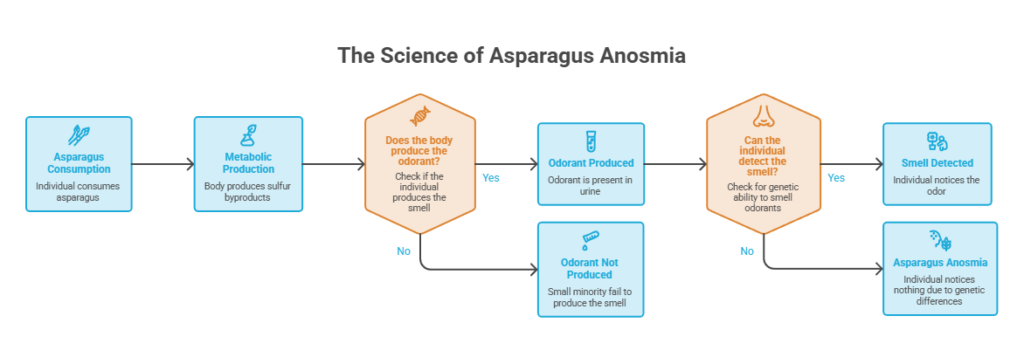
The inability to detect the smell even has a name: asparagus anosmia. Your genes affect whether you can smell these sulfur byproducts, and if you cannot, that is called asparagus anosmia.
Producers Versus Smellers
For a long time, people assumed some of us simply do not make the smell. Research has largely overturned that idea, since studies suggest nearly everyone produces the odorant and only a small minority fail to make it.
The real variable is detection. People who notice nothing still produce the same chemicals; certain genetic differences make them unable to smell the odor.
So the odor is almost always present. Whether it registers depends on your nose, not your metabolism. Across the patients we serve, that fact surprises people far more than the chemistry does.
Historically, scientists floated three explanations: some people do not produce the odorant, some produce it but cannot smell it, and some have a mix of both. Careful testing has favored the second idea.
In one psychophysical study, only a small share of participants, in the range of 6 to 8 percent, actually failed to produce the smell. The far more common reason for noticing nothing is being unable to detect it. That is why anosmia, a smelling trait, is the term researchers now use.
The Genetics of Who Can Smell It
Your ability to smell asparagus pee is written into your DNA, specifically the genes that build your smell receptors. The trait was traced to a cluster of olfactory receptor genes on chromosome 1.
One gene in particular, OR2M7 on chromosome 1, produces an olfactory receptor that helps you detect certain airborne chemicals, and small DNA differences around it leave you more or less able to smell the odor. Early consumer-genetics research first flagged this gene.
The largest look came from a Harvard-led team. In a genome-wide study of 6,909 people of European-American descent, 58.0% of men and 61.5% of women had asparagus anosmia, and 871 genetic markers tied to the trait sat on chromosome 1q44 among olfactory receptor genes.
That means more than half of the people around you may miss the show entirely. Our lab partners note that this single finding settles most family debates about whose urine actually smells.
Interestingly, women were slightly more likely than men to report anosmia in that study, though the gap was small. Researchers are still untangling why, since smell perception can shift with genetics, age, and even hormones. The takeaway holds either way: a large share of both men and women simply cannot detect the odor.
The numbers below pull the key figures into one place.
| Metric | Figure | Source |
| Adults with asparagus anosmia (cannot smell it) | 58% of men, 61.5% of women | BMJ 2016 (Harvard) |
| People analyzed in the genetics study | 6,909 (European-American) | BMJ 2016 |
| Genetic markers tied to anosmia | 871 SNPs on chromosome 1q44 | BMJ 2016 |
| Gene most linked to detection | OR2M7 (olfactory receptor) | OMIM / Eriksson |
| When the smell first appears | About 15 to 30 minutes after eating | Cleveland Clinic |
| Half-life of the odor | About 4 to 5 hours (7 hours in another study) | Healthline |
Can You Test Your Own Ability?
You do not need a lab to find out. The simplest home experiment is to eat a normal serving of asparagus and check your urine within an hour.
If you smell the classic sulfur odor, you are a detector. If several servings over different days produce nothing, you likely carry the anosmia variant, and so may your close relatives, since the trait runs in families.
Consumer DNA tests now include this trait too, reading markers near the OR2M7 gene to predict whether you should be able to smell it. It is a low-stakes but oddly satisfying thing to learn about yourself.
Keep one thing in mind while testing. Your own nose adapts quickly, so if you have already been around the smell you may notice it less; a fresh check on a day you have not eaten asparagus gives the clearest read.
How Fast It Starts and How Long It Lasts
Asparagus pee arrives quickly. The sulfur compounds are absorbed and processed fast, so the smell can appear soon after the meal.
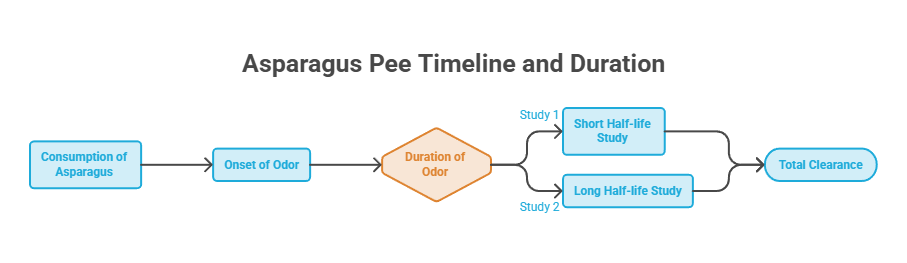
Asparagus pee usually shows up between 15 and 30 minutes after eating and hangs around for several hours, and one study found the smell could last up to 14 hours.
How long it truly lingers depends on the study. One study in 87 people who ate 3 to 9 spears put the half-life of the smell at 4 to 5 hours, while another in 139 people reported a half-life of about 7 hours.
A half-life is the time it takes for a substance to fall to half its amount. Since full clearance takes several half-lives, the faint effect can stretch across most of a day. For practical purposes, expect it within the hour and gone by the next morning.
How Much Asparagus Triggers the Smell?
You do not need a huge plate to notice the effect. Most studies used just three to nine spears, a normal side-portion, and that was plenty to produce a clear odor.
The more asparagus you eat, the more asparagusic acid your body processes, so a large serving tends to create a stronger, longer-lasting smell than a few bites. Portion size is the main dial for intensity.
Fresh, canned, frozen, and grilled asparagus all contain asparagusic acid, so any form can trigger the smell. Some people believe thicker spears or the tips produce more odor, though the evidence for that is thin.
Patients commonly ask us whether white asparagus behaves differently from green. Both are the same plant grown differently, and both carry asparagusic acid, so both can cause asparagus pee.
Even a single serving in a mixed dish, like asparagus in a stir-fry or quiche, is usually enough. If your urine smells within an hour of a meal that included asparagus, the vegetable is almost certainly the reason.
Is Asparagus Pee Bad for You?
No. This is the reassuring part, and it deserves a straight answer. Asparagus pee is a normal, harmless quirk of digestion.
The smell does not mean your kidneys are struggling, that you are dehydrated, or that anything is wrong. It is simply the aroma of sulfur compounds doing what sulfur compounds do.
It also does not mean asparagus is bad for you. The opposite is closer to the truth, since asparagus is low in calories and a solid source of folate and fiber. In cases reviewed by our medical team, the smell is never the concerning part of a urine question.
If anything, detecting the odor is a small sign your sense of smell is sharp, given how many people cannot pick it up at all.
The Health Benefits of Asparagus
Since the smell is harmless, it helps to remember what asparagus actually does for you. This is a vegetable worth keeping on your plate.
Asparagus is low in calories yet dense with nutrients. A single cup delivers a meaningful share of your daily folate, along with vitamins K, A, and C and a good dose of fiber.
Folate matters for cell growth and is especially important during pregnancy, which is one reason asparagus is often recommended to expecting mothers. Our medical reviewers note that folate-rich foods support healthy development in early pregnancy.
The fiber in asparagus feeds beneficial gut bacteria and supports regular digestion. Asparagus also contains inulin, a prebiotic fiber that acts as food for the healthy microbes in your gut.
On top of that, asparagus provides antioxidants that help the body manage everyday oxidative stress, plus potassium, which supports healthy blood pressure.
So the tradeoff is lopsided. A few hours of an odd urine smell in exchange for folate, fiber, antioxidants, and gut support is a bargain most people are glad to take once they understand it.
Does Asparagus Change Urine Color Too?
Occasionally, yes, though far less often than the smell. Asparagus is high in natural compounds and, in large amounts, can give urine a faint greenish tint in some people.
This is harmless and temporary, much like the smell. B vitamins, beets, and food dyes are more common reasons urine changes color.
A green tint from a vegetable is nothing to worry about. Dark brown, pink, red, or cola-colored urine is a different matter and is worth a prompt medical check, since it can signal blood or a liver issue.
Other Foods and Things That Change Urine Smell
Asparagus gets the fame, but it has plenty of company. Several foods and everyday factors can shift how your urine smells for a short time.
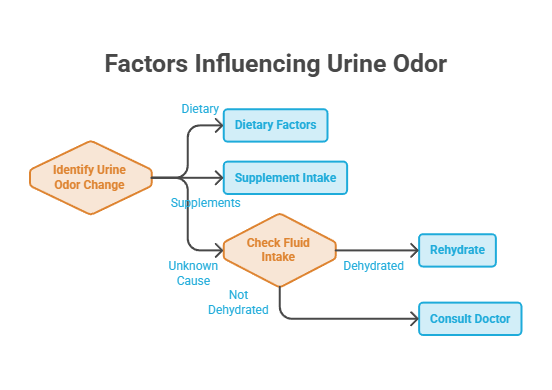
Common culprits include:
- Coffee, which can give urine a strong, roasted odor
- Garlic and onions, which share asparagus’s sulfur chemistry
- Brussels sprouts and other cruciferous vegetables
- Fenugreek, which can produce a maple-syrup smell
- Vitamin B6 and some supplements
- Dehydration, which concentrates urine and sharpens its smell
Asparagus is not the only food that can temporarily change the smell of your pee. These shifts are almost always brief and clear on their own once the food passes through or you rehydrate.
The one factor worth watching is dehydration, since a strong smell there is a signal to drink more water rather than a harmless food quirk.
If you notice a new, strong urine smell and have not eaten any of these foods, look at your fluid intake first. Most of the time the fix is a glass of water, not a doctor’s visit.
When Smelly Urine Is a Sign of a Problem
Most urine odors are harmless and food-related. A different kind of smell, one that lingers without a clear food cause or arrives with other symptoms, is the version that deserves attention.
Patients commonly ask us how to tell the two apart. The difference usually shows up in the extra symptoms and the timing.
A strong, foul smell with burning, urgency, or cloudy urine can point to a urinary tract infection. A sweet or fruity odor can signal high blood sugar. A strong ammonia smell most often just means you are low on fluids.
Timing is the first clue. A food-related smell shows up soon after eating and fades within a day, while a smell tied to infection or illness tends to persist and travel with other symptoms.
Dehydration is the most common non-food cause, and it is easily fixed. When you are low on fluids, urine becomes concentrated and darker, and the odor grows sharper until you drink more water.
A urinary tract infection usually brings burning, urgency, and cloudy or bloody urine alongside the smell. These are the cases where a quick urine test earns its keep, since guessing is unreliable.
The table below sorts common scenarios and what each one calls for.
| Urine smell or scenario | Possible cause | What to do |
| Sulfur or cabbage smell hours after eating asparagus | Normal asparagus pee | Nothing; it clears within a day |
| Strong ammonia smell with dark yellow urine | Dehydration | Drink more water; the smell should ease |
| Foul or strong smell with burning, urgency, or cloudy urine | Possible UTI | See a doctor; a urine test can confirm it |
| Sweet or fruity smell with extra thirst and frequent urination | Possible high blood sugar or diabetes | See a doctor and ask about a blood sugar test |
| Musty or unusual smell with fatigue or yellowing skin | Possible liver or kidney issue | See a doctor for evaluation and testing |
| Persistent odd smell with no clear food cause | Worth checking | Book a urinalysis and talk with a provider |
If a smell falls into one of the lower rows, a simple test removes the guesswork. A urinalysis can flag infection, and a blood sugar check can rule out diabetes. HealthCareOnTime offers urine and blood tests that let your doctor confirm the cause quickly.
For symptoms like fever, back pain, blood in the urine, or a fruity odor with confusion, treat it as urgent and seek care promptly rather than waiting it out. More on infections is available from Mayo Clinic.
Can You Reduce Asparagus Pee Smell?
Somewhat, but not entirely. You cannot switch off the chemistry, since your body will break down asparagusic acid either way. A few steps can soften the effect.
Drinking plenty of water dilutes your urine, which can make the odor less concentrated and less noticeable. Smaller servings of asparagus produce less smell than a large plateful.
Beyond that, no proven trick eliminates it. Our medical reviewers note that the smell is temporary and harmless, so most people simply let it pass. Given the vegetable’s nutrition, skipping asparagus to dodge the odor is rarely worth it.
If the smell truly bothers you, spacing out asparagus meals and staying well hydrated is the practical middle ground.
Myths and Facts About Asparagus Pee
A few misunderstandings float around this topic, so it helps to set them straight.
The first myth is that only some people’s bodies make the smell. In reality, nearly everyone produces it; the difference is who can detect it.
A second myth is that asparagus pee signals a health problem, like a kidney or bladder issue. It does not, since the odor is a harmless byproduct of normal digestion.
Some people believe drinking coffee or taking a supplement can cancel the smell. Nothing reliably stops the chemistry, though water can dilute it.
Another common belief is that the smell means you are dehydrated. Dehydration can make any urine smell stronger, but asparagus pee happens regardless of how hydrated you are.
Finally, many assume the effect lasts only a few minutes. In fact, the faint smell can linger for hours, well after you have forgotten about dinner.
Frequently Asked Questions
Why does asparagus make your pee smell?
Asparagus contains asparagusic acid, a sulfur compound unique to the vegetable. When your body digests it, the acid breaks down into small, volatile sulfur molecules like methanethiol. These evaporate quickly when you urinate and travel up to your nose, creating the distinct asparagus urine smell within about half an hour.
Why can’t some people smell asparagus in their pee?
Because of genetics. Nearly everyone produces the smell, but detecting it depends on your olfactory receptor genes, especially a region on chromosome 1 near the OR2M7 gene. People with certain variants have asparagus anosmia and cannot perceive the odor, even though their urine still contains it.
Is asparagus pee bad for you?
Not at all. Asparagus pee is a normal, harmless byproduct of digesting sulfur compounds. It does not signal dehydration, kidney trouble, or any disease. Asparagus itself is nutritious, offering folate and fiber, so the odor is simply a quirky side effect worth ignoring.
How long does asparagus pee smell last?
Usually several hours. The smell can appear within 15 to 30 minutes of eating, and studies put its half-life at roughly 4 to 7 hours. Because full clearance takes several half-lives, the faint effect can stretch across most of a day, but it is typically gone by the next morning.
Does everyone’s pee smell after eating asparagus?
Effectively yes, since almost everyone produces the odorant. The twist is that many people cannot smell it. In a large genetics study, about 58% of men and 61.5% of women had asparagus anosmia, meaning more than half could not detect the odor at all.
What is asparagus anosmia?
Asparagus anosmia is the genetic inability to smell the sulfur compounds in urine after eating asparagus. It is not a disorder or a health problem. It reflects natural variation in the smell receptors your DNA builds, so the odor is present but simply does not register for you.
How soon after eating asparagus does pee smell?
Quite fast. The sulfur compounds are absorbed and processed rapidly, so the odor commonly appears within 15 to 30 minutes of your meal, and sometimes sooner. That quick onset is one reason the effect feels so directly linked to eating asparagus.
What chemical in asparagus causes the smell?
The starting point is asparagusic acid, found only in asparagus. On its own it is odorless, but digestion breaks it into volatile sulfur molecules. Methanethiol, also called methyl mercaptan, is the compound most often blamed, alongside dimethyl sulfide and related sulfur compounds.
Can you stop your pee from smelling after asparagus?
Not completely, since your body breaks down asparagusic acid regardless. Drinking more water dilutes urine and can make the odor less obvious, and smaller portions produce less smell. No proven method eliminates it entirely, and it clears on its own within a day anyway.
Do other foods make your urine smell?
Yes. Coffee, garlic, onions, Brussels sprouts, and fenugreek can all shift urine odor briefly, and some supplements like vitamin B6 do too. Dehydration also concentrates urine and strengthens its smell. These changes are temporary and usually resolve once the food clears or you rehydrate.
When should you worry about smelly urine?
Worry when a strong or unusual smell has no food explanation and comes with other symptoms. Burning and cloudy urine may mean a UTI, a sweet or fruity odor can signal high blood sugar, and fatigue with a musty smell warrants a checkup. A simple urine test settles it.
Does cooking asparagus change whether pee smells?
Not meaningfully. Whether you eat asparagus roasted, steamed, or grilled, digestion still breaks asparagusic acid into the same sulfur compounds. Cooking method does not remove the acid, so the odor forms either way. Portion size affects the intensity far more than preparation does.
Disclaimer: This article is for general education and is not a substitute for professional medical advice, diagnosis, or treatment. If a change in urine smell comes with pain, fever, blood, or other symptoms, talk with a qualified healthcare provider. If you think you have a medical emergency, call 911 or go to the nearest emergency room.
References
- Healthline – Why Does Asparagus Make Your Pee Smell?
- Cleveland Clinic – Why Does Asparagus Make Your Pee Stink?
- University of Utah Health – Why Asparagus Makes Your Urine Smell
- Indiana University Health – Urine Trouble If You Eat Asparagus
- BMJ (Markt et al.) – Genome-Wide Association Study of Asparagus Anosmia
- OMIM – OR2M7 Olfactory Receptor Gene
- WebMD – Things That Can Affect the Smell of Your Pee
- Mayo Clinic – Urinary Tract Infection