
A mango tastes like dessert, so most people assume it must be loaded with calories. The reality is the opposite. A whole cup of fresh mango comes in under 100 calories, and the fruit is more than 80% water by weight.
Table of Contents
That gap between how sweet a mango tastes and how light it actually is trips up a lot of dieters. This guide gives you the exact calorie counts by serving size, the full USDA nutrition breakdown, the truth about its sugar, and how to fit mango into a weight or blood-sugar goal.
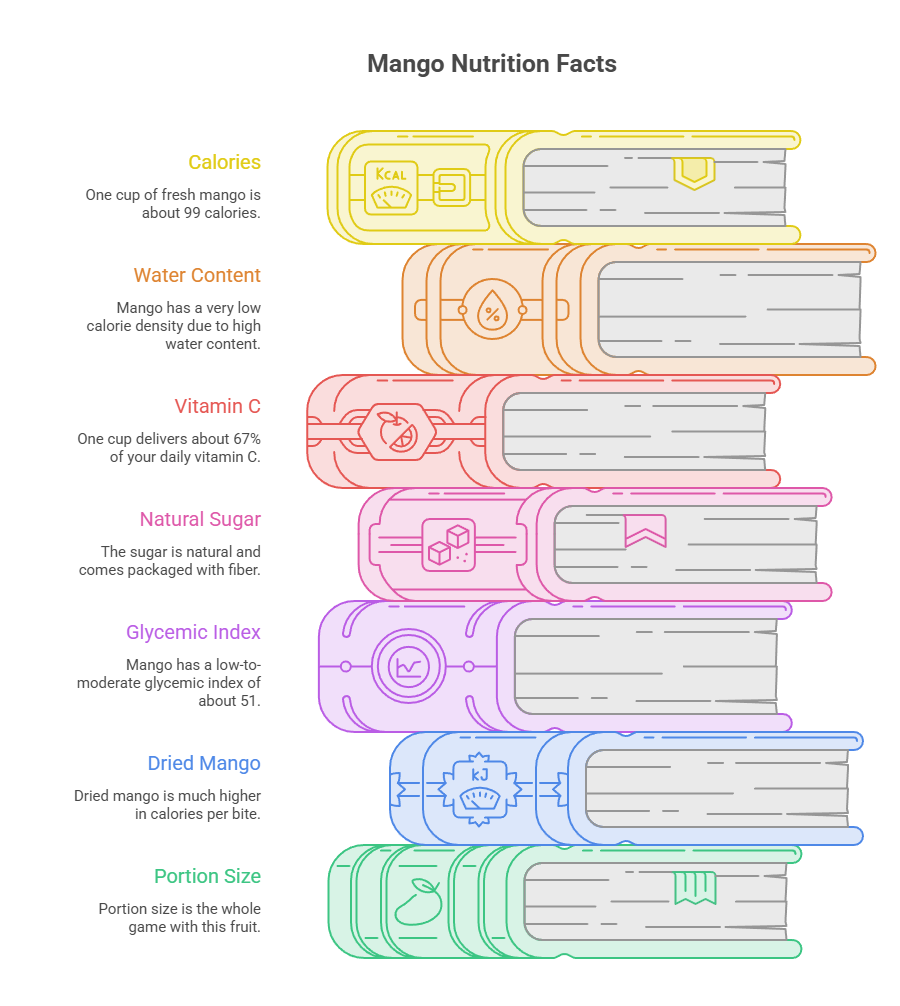
Quick Answer: Fresh mango has about 60 calories per 100 grams and roughly 99 calories per cup of pieces (165 grams), according to USDA data. A whole mango ranges from about 120 calories (medium) to 200 calories (large), depending on size. Dried mango is far more concentrated, with about 100 calories per ounce. Most of those calories come from natural sugar, balanced by fiber, vitamin C, and very little fat.
At a Glance
- One cup of fresh mango is about 99 calories.
- Mango has a very low calorie density (over 80% water).
- One cup delivers about 67% of your daily vitamin C.
- The sugar is natural and comes packaged with fiber.
- Mango has a low-to-moderate glycemic index (about 51).
- Dried mango is much higher in calories per bite.
- Portion size is the whole game with this fruit.
How Many Calories in a Mango? The Quick Answer
Let’s settle the number first, then explain why it moves around. Calories in a mango depend entirely on how much you eat and whether the fruit is fresh or dried.
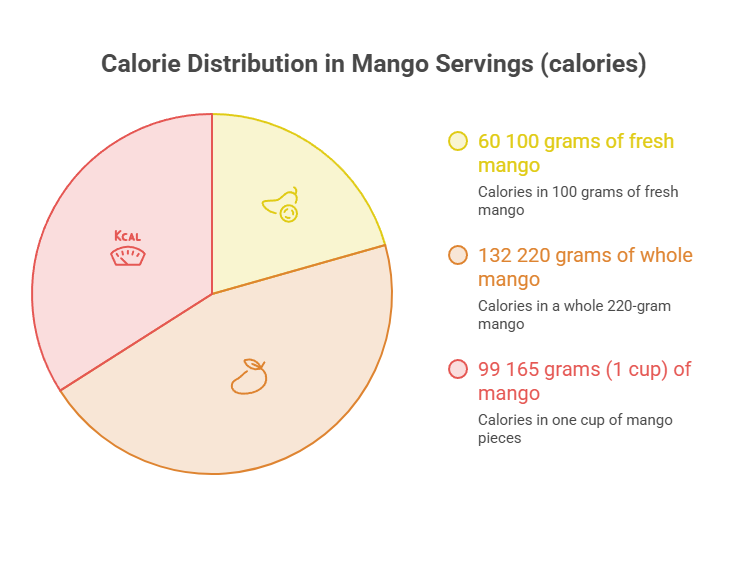
For fresh mango, the USDA FoodData Central entry is the reference point. About 100 grams of mango contains roughly 60 calories, which means one whole mango of about 220 grams is approximately 132 calories.
The per-cup figure is the one most people need, since that is how mango is usually eaten. One serving of mango is 165 grams (one cup of pieces), which contains 99 calories.
Calories Per 100 Grams, Per Cup, and Per Whole Fruit
Think of it in three reference points. Per 100 grams sits near 60 calories, a full cup of pieces lands at about 99, and a whole fruit falls somewhere between 120 and 200 calories based on its size.
The Cleveland Clinic uses the same cup measure. According to Cleveland Clinic, one cup of chopped mango has 99 calories and 2.6 grams of fiber.
Dried mango is a different animal. Because drying removes the water, the sugar and calories concentrate, so an ounce of dried mango carries roughly the same calories as a half-cup of the fresh fruit.
Why the Number Varies (Size, Ripeness, Variety)
No two mangoes are identical, which is why calorie counts are always approximate. Calorie numbers can vary depending on the season, fruit size, and ripeness.
Variety matters too. A small Honey (Ataulfo) mango weighs a few ounces, while a large Tommy Atkins or Kent can top a pound, and that weight difference drives the calorie spread.
Ripeness nudges the sugar up as starches convert, though the total calories stay close. The table below gives you the real numbers across the forms you are most likely to eat.
| Serving | Weight | Calories | Carbs | Sugar |
| Raw mango, per 100 g | 100 g | 60 | 15 g | 13.7 g |
| 3/4 cup pieces (FDA serving) | 124 g | 70 | 19 g | 17 g |
| 1 cup pieces | 165 g | 99 | 25 g | 22.5 g |
| 1 medium mango (flesh) | ~200 g | ~120 | ~30 g | ~27 g |
| 1 large mango (flesh) | ~300 g | ~180 | ~45 g | ~41 g |
| Dried mango, no sugar added | 1 oz (28 g) | ~100 | ~24 g | ~20 g |
Do Different Mango Varieties Have Different Calories?
The grocery store usually carries several mango types, and people wonder if a small Honey mango is lighter than a big red one. The reassuring answer is that calories per 100 grams are nearly identical across varieties.
What changes is the size, and therefore the calories per whole fruit. The six varieties most common in the United States are Tommy Atkins, Kent, Keitt, Haden, Francis, and the small Ataulfo, also sold as the Honey mango.
A petite Ataulfo might hold 70 to 110 calories of flesh, while a large Keitt or Kent can carry well over 200. Ripeness shifts the flavor and sugar balance, but the calorie total per gram barely moves, so portion size, not variety, is what really counts.
Full USDA Nutrition Breakdown of Mango
Calories are only part of the story. The reason mango earns its superfood reputation is everything that rides along with those calories, and the USDA numbers show it clearly.
Mango is what nutritionists call nutrient-dense, meaning it packs a lot of vitamins into few calories. By USDA data, the calories in mango come from about 90% carbs, 5% protein, and 5% fat, and the fruit is roughly 84% water.
Patients booking tests with HealthCareOnTime often ask which fruits give the most nutrition per calorie, and mango ranks high on that list. The breakdown below explains why.
Macronutrients (Carbs, Sugar, Fiber, Protein, Fat)
The macros are simple. Mango is almost entirely carbohydrate, with a small amount of fiber and only trace protein and fat.
Per cup, you get roughly 25 grams of carbohydrate, of which about 22 to 23 grams are natural sugars and 2.6 grams are fiber. Protein and fat each come in under 1.5 grams.
That fiber is the quiet hero. It slows digestion and softens the blood-sugar impact of the natural sugar, which is why whole mango behaves very differently from mango juice or candy.
Vitamins and Minerals
Here is where mango shines. Just one cup (165 grams) of fresh mango provides nearly 67% of the Daily Value for vitamin C, which aids your immune system and helps your body absorb iron.
It is also a meaningful source of two pregnancy-important nutrients. Mango is a good source of the minerals copper and folate, which support healthy fetal growth and development.
The full per-cup breakdown, drawn from USDA FoodData Central, is below. Daily Values use a 2,000-calorie reference diet.
| Nutrient | Per 1 cup (165 g) | % Daily Value |
| Calories | 99 | — |
| Total carbohydrate | 24.7 g | 9% |
| Total sugars | 22.5 g | — |
| Dietary fiber | 2.6 g | 9% |
| Protein | 1.4 g | 3% |
| Total fat | 0.6 g | 1% |
| Vitamin C | 60 mg | 67% |
| Copper | 0.18 mg | 20% |
| Folate | 71 mcg | 18% |
| Vitamin B6 | 0.2 mg | 12% |
| Vitamin A | 89 mcg RAE | 10% |
| Vitamin E | 1.5 mg | 10% |
| Potassium | 277 mg | 6% |
| Vitamin K | 6.9 mcg | 6% |
Sugar, Carbs, and Blood Sugar Impact
The word sugar scares people away from mango, so let’s put it in context. Yes, mango is one of the sweeter fruits, but the type of sugar and how your body handles it matter more than the gram count alone.
How Much Sugar a Mango Really Has
A cup of mango carries real sugar. Fresh mango is relatively high in natural sugar compared with other fresh fruits, containing over 22 grams per cup.
The key word is natural. Mango has fructose and glucose packaged with fiber, and that fiber slows down sugar absorption in the body.
Our medical reviewers note the distinction that matters most: this is intrinsic sugar inside whole fruit, not the added sugar in sodas and snacks that public-health guidance warns against.
Glycemic Index and Glycemic Load
Sweetness does not equal a blood-sugar spike, and mango is a good example. With a glycemic index of about 51, mango sits in the low-to-moderate range, which makes it acceptable for many people managing diabetes when eaten wisely.
Glycemic load, which factors in the actual carbs in a portion, tells the fuller story. A cup of fresh mango contains roughly 22 to 25 grams of carbohydrate, giving it a glycemic load of around 8 to 12, which falls in the low-to-moderate range.
Portion is the lever. For people with diabetes or prediabetes, keeping portions to about a half-cup to one cup of fresh mango at a time is a practical guideline. There is even early evidence of benefit: a study in adults with overweight found that insulin was significantly lowered with mango compared to a control, and insulin resistance measured by HOMA-IR improved.
Fresh vs. Dried Mango Calories
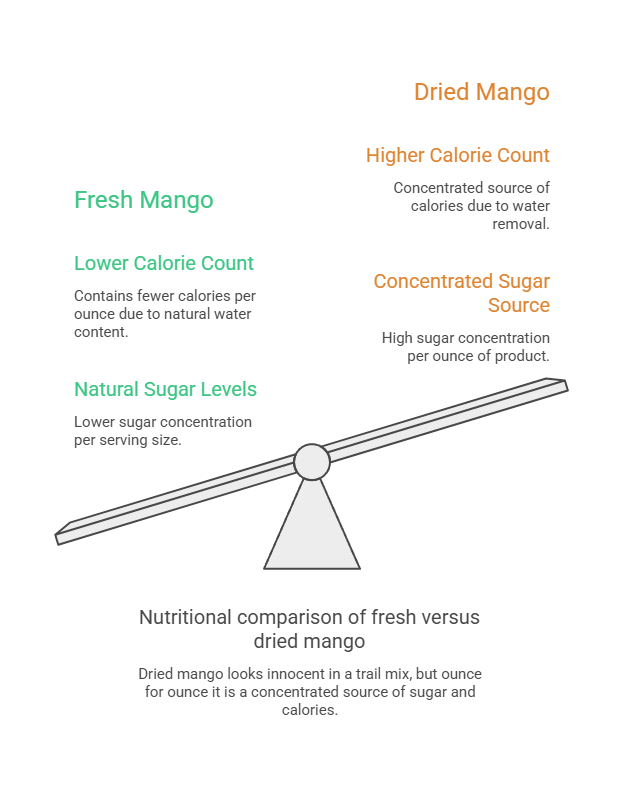
This is where calorie counts go sideways for a lot of snackers. Dried mango looks innocent in a trail mix, but ounce for ounce it is a concentrated source of sugar and calories.
Why Dried Mango Calories Multiply
Drying does one main thing: it removes water. A 40-gram portion of dried mango typically has 130 to 150 calories, while the same weight of fresh mango has less than 70.
The sugar concentrates right along with the calories. Dried mango has roughly 25 to 30 grams of sugar per 40 grams, compared with about 13 to 14 grams in fresh mango.
There is a nutrition trade-off too. Vitamin A as beta-carotene stays relatively stable through drying, but vitamin C is sensitive to heat and oxygen, so most of it is lost during dehydration.
Smart Dried-Mango Portions
The fix is not to avoid dried mango but to measure it. A useful rule comes straight from federal portion guidance.
According to the USDA, one-third of a cup of dried mango equals one cup of fresh fruit, an exception to the usual half-cup-dried rule for most dried fruits.
Two cautions help here. Buy the no-sugar-added version when you can, since many products add sugar on top of the natural concentration, and treat a small handful as a full serving rather than a mindless grab.
Calories in Mango Smoothies, Juice, and Lassi
Whole mango is light, but the drinks built from it often are not. The moment you blend, juice, or sweeten mango, the calorie math changes, mostly because of what gets added and what gets removed.
Mango juice is the clearest example. Juicing strips the fiber and concentrates the sugar, and because liquid calories are easy to over-drink, a glass can deliver far more sugar than a cup of the whole fruit.
A mango smoothie depends entirely on its build. Mango blended with water or plain yogurt stays reasonable, while versions with ice cream, sweetened yogurt, honey, or fruit juice can climb past 300 calories fast.
Mango lassi follows the same rule. The yogurt adds protein and calcium, but added sugar is what drives the calories up, so an unsweetened or lightly sweetened lassi is the better pick. Across patients we serve, the simplest fix is to sweeten mango drinks with the fruit alone and skip the added sugar.
Mango Calories in Frozen, Canned, and Other Forms
Fresh and dried are not the only ways mango reaches your plate, and the form changes the calorie picture. Frozen mango is the easy win, since freezing does not add anything.
A cup of plain frozen mango carries about the same calories as fresh, roughly 90 to 100, which makes it a budget-friendly staple for smoothies and oatmeal year-round.
Canned mango is where to read the label. Mango canned in heavy syrup can nearly double the sugar and calories of the fruit alone, so choose versions packed in water or 100% juice, and drain them before eating.
Sweetened products climb fastest. Mango nectar, mango sorbet, and mango ice cream carry added sugar that pushes them into dessert territory, so our nutrition team treats them as occasional treats rather than a fruit serving.
How Mango Compares to Other Fruits
People often ask whether mango is a high-calorie fruit. The honest answer is that it sits squarely in the middle of the pack, lighter than a banana or grapes and heavier than berries.
The comparison that surprises people most is that a cup of mango has fewer calories than a cup of sliced banana. The table below stacks mango against other popular fruits per one-cup serving.
| Fruit (1 cup) | Calories | Sugar | Glycemic Index |
| Strawberries, sliced (166 g) | 53 | 8 g | ~40 |
| Apple, sliced (125 g) | 65 | 13 g | ~36 |
| Orange sections (180 g) | 85 | 17 g | 40 to 47 |
| Mango, pieces (165 g) | 99 | 22.5 g | ~51 |
| Grapes (151 g) | 104 | 23 g | ~53 |
| Banana, sliced (150 g) | 134 | 18 g | 48 to 62 |
The takeaway is balance, not avoidance. Mango carries more natural sugar than berries, but it also delivers more vitamin C than most of these fruits, so the calories come with real nutritional return.
Is Mango Good for Weight Loss?
Mango can absolutely fit a weight-loss plan, and its biggest asset is something the calorie number alone hides: it fills you up for very little.
Calorie Density and Fullness
Calorie density measures calories per gram, and mango scores low. One cup of fresh mango contains fewer than 100 calories and has a very low calorie density, meaning few calories for the volume of food it provides.
Fiber adds to the staying power. According to Cleveland Clinic, mangoes take longer to digest than low-fiber foods, so you feel fuller longer without consuming a lot of calories.
There may even be a timing benefit. One study found that eating fresh fruit like mango at the start of a meal could help keep you from overeating later in the meal.
Where Mango Can Trip Up a Calorie Goal
The pitfalls are predictable and easy to avoid. The first is dried mango, which can quietly add hundreds of calories in a small handful.
The second is volume. It is easy to eat two or three mangoes in a sitting, and while the fruit is healthy, the calories and sugar still add up like any food.
Our nutrition team frames it simply: fresh mango in a measured portion supports a calorie goal, while unmeasured dried mango or oversized servings work against it.
How Mango Fits Your Daily Fruit Needs
It helps to anchor mango to how much fruit you should eat in a day. Federal guidance gives a clear target that makes portioning easy.
According to USDA MyPlate, most adults are advised to eat about 1.5 to 2 cups of fruit a day, which means a single cup of mango covers a large share of that goal on its own.
That framing keeps things realistic. One cup of mango plus a handful of berries can meet a full day’s fruit target for under 150 calories, which is a strong return for the nutrition you get.
Health Benefits Backed by the Nutrition
The calorie question often leads to a bigger one: is mango actually good for you? The nutrient breakdown says yes, and several benefits trace directly back to specific vitamins and antioxidants.
Immunity, Skin, and Antioxidants
Vitamin C does double duty for immunity and skin. The vitamin C in a cup of mango can help your body produce more disease-fighting white blood cells and improve your skin’s defenses.
Mango also carries plant antioxidants under study for bigger effects. It contains mangiferin, which studies suggest may protect heart cells against inflammation and oxidative stress, though human research is still limited.
Our medical reviewers add the standard caveat here: antioxidants in food support health as part of a whole diet, and no single fruit prevents or treats disease on its own.
Digestion, Eye, and Heart Support
The fruit supports digestion in two ways. Mango contains digestive enzymes called amylases that break down food, plus both soluble and insoluble fiber.
Its color signals an eye-friendly nutrient. Mango is rich in beta-carotene, the antioxidant pigment behind its yellow-orange flesh, which the body uses to support vision and skin.
For the heart, the minerals do the work. Mango is a good source of magnesium and potassium, both connected to lower blood pressure and a steady pulse.
Gut Health and Polyphenols
Mango’s benefits may reach the gut as well. The fruit is rich in polyphenols, plant compounds like mangiferin and gallotannins that act as antioxidants in the body.
Early research suggests these polyphenols, along with mango’s fiber, may help support a healthy gut microbiome, the community of bacteria that aids digestion. The evidence is still developing, so our medical reviewers treat it as a promising bonus rather than a proven claim.
How to Enjoy Mango Without Overdoing Calories
Mango is one of the easiest fruits to enjoy in a healthy way, as long as portion size leads the decision. A little planning keeps the calories where you want them.
Portion Sizes and Pairings
A practical serving for most people is a half-cup to one cup of fresh mango. Pairing it with protein or fat, like Greek yogurt or a small handful of nuts, slows digestion and steadies blood sugar.
Skip the peel. It is best to avoid eating the peel, since it contains urushiol, the same natural oil responsible for the itchy rash from poison ivy.
The table below matches a portion to your goal, so you can enjoy mango with intention rather than guesswork.
| Your goal | Recommended mango portion | Why |
| Weight loss | 3/4 to 1 cup fresh (70 to 99 cal) | Low calorie density, high fiber and water |
| Managing blood sugar | 1/2 to 1 cup, paired with protein | Keeps glycemic load low to moderate |
| Pre- or post-workout fuel | 1 cup fresh, or 1 oz dried | Quick natural carbs for energy |
| Kids’ snack | 1/2 cup fresh, chopped | Vitamin C and fiber in an easy portion |
| Pregnancy nutrition | 1 cup fresh | Folate and copper support development |
| On-the-go snacking | 1 oz dried, no sugar added | Portable, but calorie-dense, so measure it |
Easy, Lower-Calorie Ways to Use It
You do not need recipes to keep mango healthy. Add a few cubes to plain yogurt or oatmeal, blend a half-cup into a smoothie, or toss it into a salsa with lime and red onion for fish tacos.
Frozen mango is a smart staple. It keeps for months, blends into smoothies straight from the freezer, and carries the same calories as fresh.
The guiding idea is to let mango replace a sweeter treat rather than add to one. A cup of mango instead of a cookie is a trade that saves calories and adds vitamins.
Best Times to Eat Mango
Timing will not change a mango’s calorie count, but it can change how those calories work for you. Morning and midday are ideal, when your body has the whole day to use the natural sugar for energy.
Around workouts is another smart window. The quick carbs in mango help fuel exercise and refill energy stores afterward, especially when paired with a little protein.
The one time to go easy is right before bed, when activity is low. A large, sugary serving late at night is simply harder to burn off, so keep evening portions small.
Mango Calories and Your Daily Budget
It helps to see where a mango lands in a full day of eating. For someone targeting 2,000 calories, a cup of mango is about 5% of the day, which leaves plenty of room for other foods.
On a tighter 1,500-calorie plan for weight loss, that same cup is closer to 7%, still a modest cost for a filling, nutrient-dense snack.
The math only breaks down with oversized or dried portions. Across patients we serve, a measured cup of fresh mango fits almost any calorie goal, while a mindless bag of dried mango can quietly eat up a quarter of the day.
Frequently Asked Questions
How many calories are in one whole mango?
A whole fresh mango has roughly 120 to 200 calories, depending on size. A medium mango of about 200 grams of flesh runs near 120 calories, while a large mango can reach 200. Because so much of a mango’s weight is water, the calories stay modest for the volume you eat.
How many calories in a cup of mango?
One cup of fresh mango pieces (165 grams) contains about 99 calories, according to USDA data. That cup also provides roughly 25 grams of carbohydrate, 22 to 23 grams of natural sugar, 2.6 grams of fiber, and nearly 67% of your daily vitamin C, all for under 100 calories.
How much sugar is in a mango?
A cup of fresh mango has about 22 to 23 grams of natural sugar. The whole fruit’s sugar comes packaged with fiber, which slows absorption and softens the blood-sugar impact. This natural sugar is different from the added sugar in processed foods that dietary guidance recommends limiting.
Is mango good for weight loss?
Yes, in measured portions. A cup of fresh mango is under 100 calories and has low calorie density, so it fills you up for relatively few calories. The fiber helps you feel full longer. Watch dried mango and oversized servings, which add calories and sugar quickly.
Can diabetics eat mango?
Often yes, in moderation. Mango has a low-to-moderate glycemic index near 51 and a glycemic load of about 8 to 12 per cup. Keeping portions to a half-cup to one cup and pairing with protein helps. Anyone managing diabetes should confirm a personal plan with their doctor or dietitian.
How many calories in dried mango vs fresh?
Dried mango is far more calorie-dense. A 40-gram portion of dried mango has about 130 to 150 calories, while the same weight of fresh mango has under 70. By USDA portion rules, one-third of a cup of dried mango equals one cup of fresh, so measure dried mango carefully.
Is mango high in carbs?
Mango is a carbohydrate-rich fruit, with about 25 grams per cup, nearly all from natural sugar plus 2.6 grams of fiber. It has very little protein or fat. For most people this is a healthy carb source, but those counting carbs for diabetes should account for the portion.
What vitamins does a mango have?
Mango is richest in vitamin C, with about 67% of the Daily Value per cup. It also supplies copper, folate, vitamin B6, vitamin A as beta-carotene, vitamin E, potassium, and vitamin K. This vitamin profile is a big reason mango is considered nutrient-dense despite its modest calorie count.
How many calories in half a mango?
Half of a medium mango has roughly 60 calories, and half of a large mango about 90 to 100. Since mango size varies widely, these are estimates. Using a half-cup of pieces, which is about 50 calories, is a more precise way to track a smaller serving.
Is it OK to eat a whole mango a day?
For most healthy people, yes. Eating one medium mango a day is a healthy amount of fruit that provides good nutrients. Individual needs vary with health, activity, and goals, and people managing blood sugar should mind the portion and pair it with protein.
Does mango have more calories than a banana?
No, a cup of mango is actually lighter. A cup of mango pieces has about 99 calories, while a cup of sliced banana has roughly 134. Bananas are higher in calories and in some minerals like potassium, while mango offers about four times the vitamin C.
Are the calories in mango healthy?
Yes. The calories in mango come from natural carbohydrates that arrive with fiber, vitamin C, antioxidants, and minerals. That makes them nutrient-dense calories rather than empty ones. As with any food, the benefit depends on portion size and how mango fits into your overall diet.
Disclaimer: This article is for general nutrition education and is not medical or dietary advice. Calorie and nutrient values are approximate and vary by mango size, ripeness, and variety. Our medical reviewers recommend discussing blood-sugar concerns, diabetes management, or specific dietary needs with a qualified doctor or registered dietitian.
References
- Mangos, raw, USDA FoodData Central (#169910) https://fdc.nal.usda.gov/food-details/169910/nutrients
- Fruits, USDA MyPlate https://www.myplate.gov/eat-healthy/fruits
- Mango: Nutrition, Health Benefits, and How to Eat It, Healthline https://www.healthline.com/nutrition/mango
- Mango-licious: The Top 6 Health Benefits of Mango, Cleveland Clinic https://health.clevelandclinic.org/mango-benefits
- Mango: Health Benefits and Nutrients per Serving, WebMD https://www.webmd.com/diet/health-benefits-mango
- Mango nutrition: calories, carbs, GI, protein, fiber, FoodStruct https://foodstruct.com/food/mango
- Mango Glycemic Index: How It Affects Blood Sugar, ScienceInsights https://scienceinsights.org/mango-glycemic-index-how-it-affects-blood-sugar/
- Mango Consumption and Insulin Sensitivity, NIH (PMC) https://www.ncbi.nlm.nih.gov/pmc/articles/PMC11820656/
- Are Dried Mangoes Good for You or High in Sugar?, MedicineNet https://www.medicinenet.com/are_dried_mangoes_good_for_you_high_in_sugar/article.htm