
You got your blood work back, scanned the numbers, and one three-letter code is flagged: MPV. A routine checkup suddenly feels like a test you didn’t study for. Take a breath. That flag rarely means what your gut fears, and in the next few minutes you’ll know exactly how to read it.
Table of Contents
| Quick Answer: MPV, or mean platelet volume, measures the average size of your platelets, the tiny cells that clot your blood. A normal MPV is usually 7.5 to 11.5 femtoliters (fL), though the range varies by lab. High MPV means larger, younger platelets and faster production; low MPV means smaller, older platelets and slower production. On its own, an abnormal MPV is a clue, never a diagnosis, and it is always read next to your platelet count. |
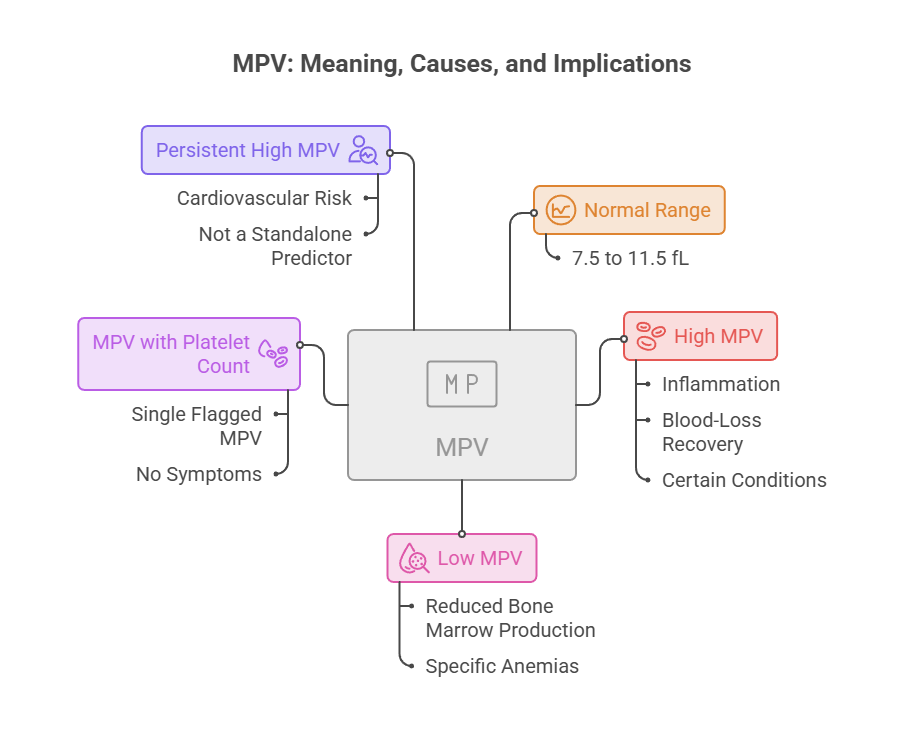
| At a Glance Normal MPV usually runs 7.5 to 11.5 fL, but the range printed on your own report is the one that counts.High MPV often reflects rapid platelet turnover from inflammation, blood-loss recovery, or certain conditions.Low MPV often reflects reduced bone marrow production or specific anemias.MPV means little by itself; it turns useful only when paired with your platelet count.A single flagged MPV with no symptoms is usually harmless and worth a simple recheck.Research links persistently high MPV to higher cardiovascular risk, though it is not a standalone predictor. |
What Is an MPV Blood Test?
MPV stands for mean platelet volume. It reports the average physical size of the platelets in your blood sample, measured in femtoliters, a unit so small only a machine can register it.
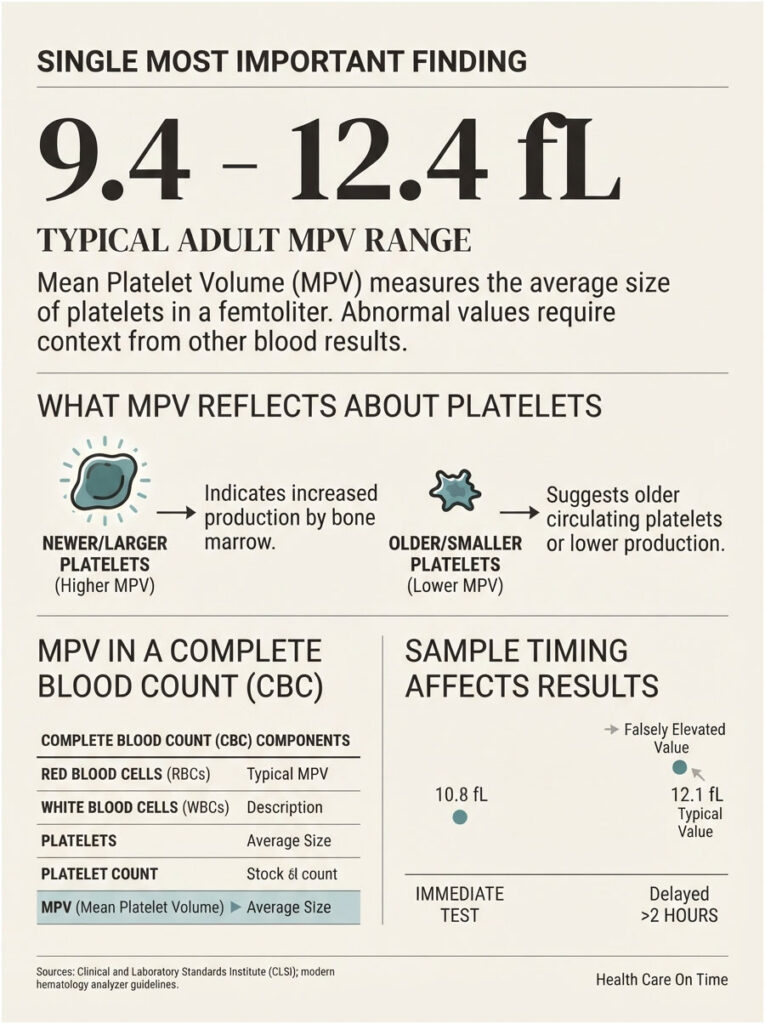
Platelets, also called thrombocytes, are cell fragments that rush to any leak in a blood vessel and clump together to stop bleeding. Their size turns out to be a quiet signal of how your body makes and uses them.
You almost never order an MPV on its own. It rides along inside a complete blood count, one of the most frequently run panels in American medicine.
How MPV Fits Into a Complete Blood Count (CBC)
A CBC measures your red blood cells, white blood cells, and platelets, plus finer details like cell size. MPV is one of several platelet indices tucked into that report.
Two of its neighbors matter most here. Your platelet count tells you how many platelets you have; platelet distribution width (PDW) tells you how much their sizes vary. MPV adds the average-size piece.
Patients who book CBC panels through HealthCareOnTime often ask why a test they never requested shows up at all. The answer is simple: MPV comes free with the count, and it adds context a raw number can’t provide.
Why Platelet Size Matters
Platelets are born in your bone marrow from giant parent cells called megakaryocytes. Fresh platelets enter your bloodstream larger and more active, then shrink and settle as they age over roughly a week to ten days.
That aging pattern is what gives size its meaning. When your marrow pumps out new platelets quickly, the average size climbs, because young, big platelets flood the mix.
When production slows, or the platelets in circulation are mostly older survivors, the average size falls. So MPV is really a snapshot of platelet turnover, the balance between how fast you make platelets and how fast you use them.
How Labs Measure MPV
Modern hematology analyzers, the same automated machines used across US labs, calculate MPV as part of the CBC in seconds. No special test, no separate needle stick.
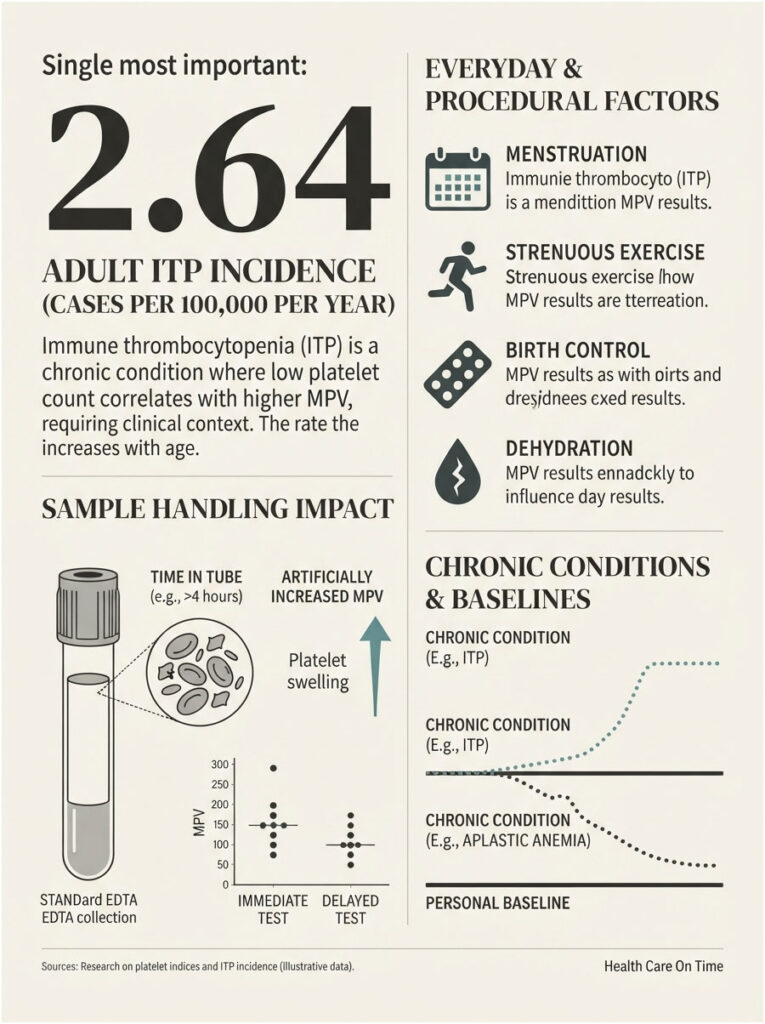
One technical wrinkle affects accuracy. Platelets sitting in the standard EDTA collection tube slowly swell over time, so a sample run hours late can read a slightly higher MPV than a fresh one. Well-run labs process samples promptly to limit this drift, but it is worth knowing when a borderline value shows up.
In cases reviewed by our clinical team, a mildly elevated MPV with nothing else abnormal sometimes traces back to nothing more than sample timing. That alone is a good reason a single odd value is rarely treated as urgent.
MPV Normal Range: What Counts as Healthy
Here is where readers get tripped up. Search around and you’ll find several different “normal” ranges, which feels contradictory until you see why they differ.
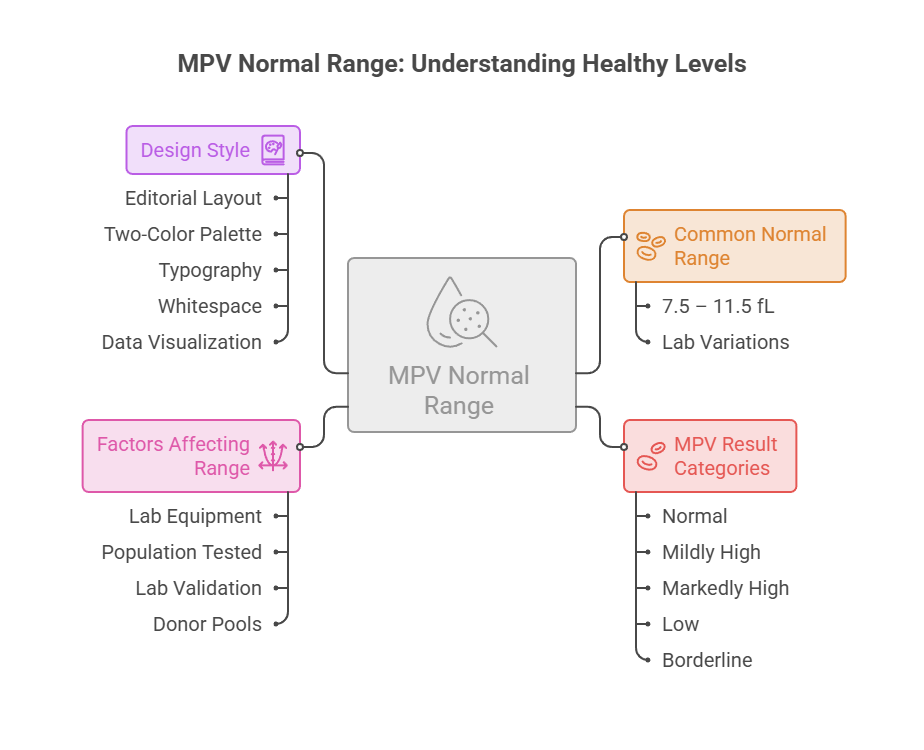
The variation comes from equipment, methods, and the population each lab tested. A commonly used normal range is 7.5 to 11.5 femtoliters, and it shifts slightly from lab to lab. Cleveland Clinic uses a tighter band for adults, while Roswell Park lists a slightly wider one.
The table below turns that confusion into something you can act on. Our medical reviewers built it to map each result category to what it suggests and what usually happens next.
Normal MPV by the Numbers
| Result category | Typical MPV (fL) | What it suggests | Commonly associated with | Typical next step |
| Normal | 7.5 – 11.5 | Balanced production and turnover | Healthy adults, routine checkups | None; note it and move on |
| Mildly high | 11.6 – 13.0 | Slightly faster turnover, more young platelets | Inflammation, blood-loss recovery, sample timing | Recheck CBC, review platelet count |
| Markedly high | Above 13.0 | Notably increased production or activation | Marrow disorders, clotting conditions, chronic inflammation | Repeat labs, hematology input if it persists |
| Low | Below 7.5 | Older, smaller platelets, slower production | Certain anemias, marrow suppression, IBD | Review count and symptoms, targeted labs |
| Borderline / artifactual | Near either cutoff | Possibly lab-related, not a true change | EDTA storage time, minor day-to-day variation | Confirm with a fresh sample |
Read the range on your own report first. If your printed reference band says 7.0 to 9.0 fL, then a 10.5 is “high” for you, even though another lab would call the same number normal.
Why “Normal” Varies Between Labs
Two accredited US labs can post different MPV reference ranges and both be right. Each validates its numbers against its own instruments and its own pool of healthy local donors.
Different labs use different cutoff points for what counts as low, normal, or high. Age, sex, and even the analyzer model nudge the boundaries, and pregnancy can shift them too.
Across the lab reports our diagnostic partners process, the most common reason a patient believes their MPV is abnormal is comparing it against a range from a different lab found online. Anchor to your own report every time.
What Does a High MPV Mean?
A high MPV means your platelets are, on average, larger than expected. Because young platelets are the big ones, an elevated average usually says your bone marrow is releasing fresh platelets faster than normal.
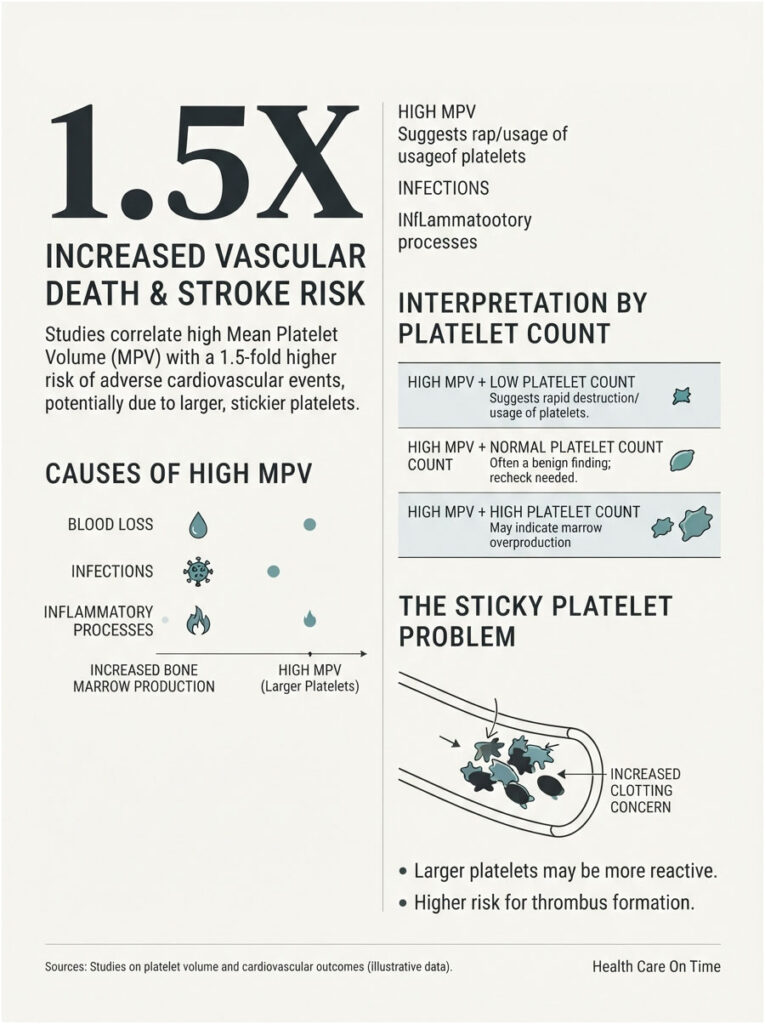
That acceleration is often healthy and appropriate. If you recently lost blood, fought an infection, or ran an inflammatory process, your marrow ramps up and the average platelet size rises with it.
The number earns its meaning from the company it keeps. A high MPV reads very differently depending on whether your platelet count is low, normal, or high.
Common Causes of High MPV
Several everyday and medical situations push MPV up. The range runs from harmless to serious, which is exactly why one value alone settles nothing.
- Recovery after bleeding, surgery, or trauma, as the marrow replaces lost platelets
- Inflammation and infection, including severe bacterial or viral illness
- Chronic inflammatory conditions and certain thyroid disorders
- Bone marrow conditions that overproduce platelets, such as myeloproliferative disorders
- Nutritional gaps, including vitamin B12 or folate deficiency, which can alter platelet size
High MPV has been reported alongside conditions ranging from cardiovascular disease and preeclampsia to Crohn’s disease, hyperthyroidism, and vitamin B12 or folate deficiency. Notice how broad that list is; it underscores that MPV points toward a category, not a verdict.
High MPV With Low, Normal, or High Platelet Count
This pairing is the heart of interpretation. A high MPV with a low platelet count often means platelets are being destroyed or used up quickly while the marrow compensates by shipping out large, young ones.
A high MPV combined with a low platelet count can indicate that new platelets are entering circulation very quickly. That pattern shows up in immune-mediated platelet loss and some infections.
A high MPV with a high platelet count raises different questions and sometimes points toward a marrow overproduction issue. A high MPV with a normal count is frequently a mild, passing finding worth nothing more than a recheck.
When High MPV Points to Clotting or Cardiovascular Risk
Larger platelets are not just younger; they tend to be stickier and more reactive. That biological fact is why researchers have studied MPV as a marker of clotting and heart risk for decades, and recent reviews keep reinforcing the link.
The signal is real at the population level. In a large study published in an American Heart Association journal, among more than 206,000 patients, those in the highest MPV group carried a 1.5-fold higher risk of overall vascular death and up to a 1.8-fold higher risk tied to ischemic heart disease compared with the lowest group.
Stroke research echoes it. In a study of atrial fibrillation patients, an MPV around 11.65 fL predicted ischemic stroke with about 67% sensitivity, and separate work identified MPV as an independent predictor of stroke risk in people with prior cerebrovascular disease. These are associations across large groups, not a personal forecast from your single result.
What Does a Low MPV Mean?
A low MPV means your platelets skew smaller and older on average. The usual message is that your bone marrow is making fewer new platelets, so the young, large ones make up less of the mix.
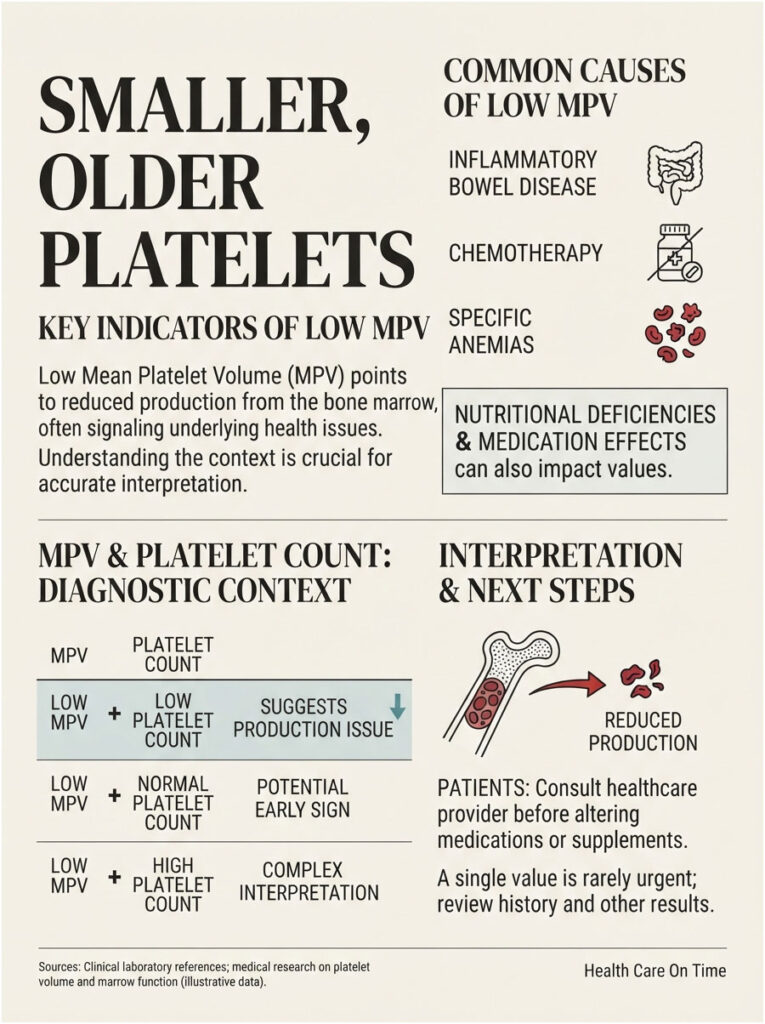
Low MPV draws less attention online than high MPV, yet it carries its own useful clues. Our medical reviewers note that a low value paired with a falling platelet count deserves a closer look than a low value standing alone.
As with high results, the cause spans a wide range. Some triggers are benign or temporary; others reflect how well your marrow is working.
Common Causes of Low MPV
Reduced production and specific illnesses tend to sit behind a low MPV. The pattern points toward the marrow slowing down rather than speeding up.
- Reduced bone marrow activity or marrow suppression
- Certain types of anemia
- Inflammatory bowel disease, such as Crohn’s or ulcerative colitis
- Cancer treatments, including chemotherapy
- Some long-term inflammatory conditions
Low MPV has been linked with inflammatory bowel disease, chemotherapy, and certain anemias. A question we hear constantly from patients is whether a low value means their marrow is failing. In most everyday cases it does not, but it is the kind of result a doctor confirms rather than assumes.
Low MPV, Bone Marrow, and Autoimmune Conditions
When MPV and platelet count both run low together, the combination often points toward a production problem in the marrow itself. Fewer platelets are being made, and the ones present are the smaller, older type.
Marrow suppression from medication, infection, or an underlying disorder can drive this. Some giant-platelet and inherited platelet conditions complicate the picture and call for specialist evaluation.
This is precisely why doctors rarely act on MPV alone. The same low number carries different weight depending on your count, your history, and your symptoms.
Medications and Deficiencies That Lower MPV
Everyday factors can nudge MPV down with no disease behind them. Certain drugs affect platelet production or size, and nutritional gaps can shift the numbers.
Chemotherapy is the clearest example, since it deliberately slows fast-dividing cells, including those in the marrow. Other medications and long-standing deficiencies play smaller supporting roles.
Patients commonly ask us whether stopping a supplement or switching a prescription will fix a borderline MPV. That is a conversation for the prescribing clinician, since abruptly changing medication can cause far more trouble than a mildly small platelet size ever would.
Reading MPV Alongside Your Platelet Count
If you take one idea from this page, make it this: MPV is a supporting actor. The platelet count is the lead, and MPV only makes sense in the same scene.
A doctor reads your MPV alongside your platelet count and other results to see the full picture. For reference, a normal platelet count runs about 150,000 to 450,000 per microliter, and too few platelets can signal infection or other problems, while too many may raise the risk of clots or stroke.
The grid below is the tool clinicians keep in their heads. It crosses your platelet count with your MPV to suggest what might be happening.
The Four Combinations, Decoded
| Platelet count and MPV | Likely interpretation | Example causes |
| Low count, high MPV | Platelets destroyed or consumed; marrow compensating with large young ones | Immune thrombocytopenia (ITP), some infections |
| Low count, low MPV | Reduced production in the marrow | Marrow suppression, aplastic conditions, chemotherapy |
| High count, low MPV | Reactive overproduction of many small platelets | Iron deficiency, inflammation, infection |
| High count, high MPV | Possible marrow overproduction disorder | Myeloproliferative conditions |
| Normal count, high MPV | Often mild, early, or temporary turnover | Recent inflammation, sample timing |
Find your two numbers, locate the matching row, and you already understand more than most people ever learn about their platelet report. Confirming which cause actually applies, though, is your doctor’s job.
Why One Number Alone Rarely Tells the Story
An isolated MPV is like a single frame from a movie. It hints at motion but can’t show direction, and it certainly can’t name the plot.
That is why credible sources keep repeating the same caution. One abnormal MPV value is rarely a cause for concern, and doctors interpret it alongside the rest of the panel.
Trends beat snapshots. A value that drifts across two or three tests tells a doctor far more than any single reading, high or low.
What Can Affect Your MPV Results?
Plenty of ordinary things move MPV a little without signaling illness. Knowing them helps you skip unnecessary worry over a borderline flag.
Some influences are about your body in the moment; others are about how the sample was drawn and handled. Both categories matter for reading a result honestly.
Our lab partners see these day to day and routinely factor them in before flagging anything as clinically meaningful.
Everyday Factors
A surprising number of routine variables can tilt MPV. Menstruation, regular strenuous exercise, and certain medications like birth control pills can all affect the result.
Dehydration can concentrate your blood and shift the indices. Hard workouts on the day of a draw may temporarily change platelet measurements, which is why avoiding intense exercise before testing is sensible.
Then there is the collection tube itself. Time spent in EDTA before analysis can inch MPV upward, a purely technical effect with no bearing on your health.
Chronic Conditions That Shift MPV
Beyond momentary factors, ongoing conditions can hold MPV above or below your personal baseline. Chronic inflammation, thyroid disease, and marrow disorders all leave fingerprints on platelet size.
Immune thrombocytopenia is a useful example, because it shows how MPV and count move together. In ITP, the immune system destroys platelets and the marrow answers with large young ones, so a low count can pair with a higher MPV.
ITP is uncommon. Drawing on data from the National Organization for Rare Disorders and hematology literature, adult ITP occurs at roughly 2.64 cases per 100,000 people per year and rises with age. That rarity is a reminder that most abnormal MPVs trace to something far more ordinary.
MPV and Long-Term Health: What the Research Shows
MPV has quietly become one of the more studied “throwaway” lab values. Researchers keep circling back to it because platelet size loosely tracks platelet reactivity, which ties into clotting.
The findings are consistent enough to take seriously and preliminary enough to keep in perspective. Our medical reviewers frame it plainly: interesting at the population level, not a crystal ball for any one person.
The table below gathers hard figures with their sources so you can weigh the evidence yourself.
MPV as a Cardiovascular Risk Marker
| Finding | Figure | Study / population | Source |
| Higher vascular mortality with high MPV | 1.5x risk | 206,554 hospital patients | AHA journal (Slavka et al.) |
| Higher ischemic heart disease risk | Up to 1.8x | Same cohort | AHA journal (Slavka et al.) |
| Stroke prediction in atrial fibrillation | MPV ~11.65 fL, 67% sensitivity | 370 AF patients | BMC Cardiovascular Disorders |
| Adult immune thrombocytopenia | ~2.64 per 100,000/yr | US-relevant estimate | J. Thrombosis and Haemostasis |
| Platelet count normal band | 150,000–450,000/µL | Standard US reference | Cleveland Clinic / NIH |
Figures like a 1.5-fold risk sound dramatic until you remember they describe large groups over years, not your Tuesday morning draw. They matter most for people who already carry heart or stroke risk factors.
MPV, Inflammation, and Other Conditions
Beyond the heart, elevated MPV shows up alongside inflammatory and metabolic conditions. Studies have connected it to diabetes, obesity, and metabolic syndrome, where platelets tend to run larger and more active.
There is also an infection angle. Some studies have found MPV runs higher in people with COVID-19 than in those without, though these findings are still new. Acute infections in general can push platelet size up as the marrow responds, which is one more reason a single elevated reading during an illness rarely means much on its own.
None of this makes MPV a screening test for those conditions. It is better understood as a background signal that gains meaning only inside a fuller clinical picture.
The Limits of MPV as a Standalone Test
Honesty about limitations is part of reading any lab value well. MPV is cheap, automatic, and informative, and it is also easily thrown off and non-specific.
Lab methods differ, results vary between studies, and correlation is not causation. A high or low MPV cannot confirm or rule out any single disease on its own.
That is the balanced takeaway our clinical team stands behind: treat MPV as a prompt for good questions, not a source of answers. Anyone worried about cancer or heart disease based on an MPV alone should hear it clearly, MPV is not a diagnostic tool for either.
What to Do If Your MPV Is Abnormal
A flagged MPV is a starting point, not an emergency. The right response depends almost entirely on your platelet count, your symptoms, and whether the value keeps showing up.
Most abnormal MPVs need nothing more than context and, sometimes, a repeat test. A smaller share point toward something a doctor should look into.
The guide below sorts common situations into clear actions, so you know when to relax and when to pick up the phone.
When an Abnormal MPV Is Usually Harmless
If your platelet count is normal, you feel fine, and only your MPV is slightly off, the odds strongly favor a benign explanation. Sample timing, a recent workout, or ordinary variation covers most of these.
Small changes in MPV are common and not always a concern, and your provider weighs them against your other results and symptoms. A single mildly abnormal value in an otherwise clean panel rarely changes anything.
The sensible move is a recheck at your next routine draw, not a spiral of anxious searching. Trends, again, matter more than any one number. If the repeat comes back normal, the first result was almost certainly noise, and no further workup is usually needed.
Red-Flag Symptoms That Warrant a Call
Certain signs deserve prompt attention regardless of the exact MPV. Unusual or easy bruising, tiny red skin spots, bleeding gums, frequent nosebleeds, or blood in your urine or stool all warrant a call.
On the clotting side, unexplained leg swelling and pain, sudden shortness of breath, or stroke-like symptoms are urgent and not something to research first. Those symptoms, not the MPV number, drive the urgency.
Pairing symptoms with an abnormal count is what turns a lab curiosity into a reason to act. Our medical reviewers stress the order: symptoms lead, the number supports.
Your Next Steps
| If your result is… | And you have… | Recommended action |
| Slightly high or low MPV | Normal platelet count, no symptoms | Note it; recheck at your next routine CBC |
| Abnormal MPV | An abnormal platelet count | Ask your provider to review both together |
| Persistently abnormal MPV | Repeated flags over multiple tests | Request targeted labs (iron, B12, folate, thyroid) |
| High or low MPV | Bleeding or easy bruising | Contact your provider promptly for evaluation |
| High MPV | Clotting symptoms or known heart risk | Seek timely care and mention the result |
Bring the actual report to your appointment. A doctor reading your full CBC in context will settle in minutes what hours of searching cannot.
Frequently Asked Questions
What is an alarming MPV level?
There is no universal “alarm” number, since ranges differ by lab. Values well above roughly 13 fL or clearly below 7 fL draw more attention, especially with an abnormal platelet count or symptoms. A slightly off value with a normal count is usually not alarming at all.
Is a high MPV something to worry about?
Usually not on its own. A high MPV with a normal platelet count and no symptoms is often mild and temporary. It gains weight when paired with an abnormal count, ongoing symptoms, or the heart and clotting risk factors your doctor already tracks. Context decides everything.
What does a low MPV mean?
A low MPV means your platelets are smaller and older on average, typically pointing to slower bone marrow production. It can accompany certain anemias, inflammatory bowel disease, or chemotherapy. Like high MPV, it carries real meaning only when read next to your platelet count and symptoms.
Can a high MPV indicate cancer?
Some studies have associated elevated MPV with certain cancers, but MPV is not a cancer screening or diagnostic test. An abnormal value alone cannot detect or rule out cancer. If you have risk factors or worrying symptoms, targeted testing, not MPV, is the right path forward.
Does high MPV mean I have a clotting problem?
Not by itself. Larger platelets tend to be more reactive, and population studies link high MPV to higher clotting and cardiovascular risk over time. That is a group-level association, not a personal diagnosis. Your doctor evaluates clotting risk from your full history, not a single index.
What is a normal MPV for adults?
A commonly cited adult range is 7.5 to 11.5 femtoliters, though some labs use a narrower or wider band. The reference range printed on your own report is the one that applies to you. Compare your value against that, not against a number from another lab’s website.
Can dehydration or exercise change my MPV?
Yes, both can nudge your results. Dehydration concentrates your blood, and intense exercise close to a draw can temporarily shift platelet measurements. For the most reliable reading, stay hydrated and avoid strenuous workouts on the day of your blood test.
What’s the difference between MPV and platelet count?
Platelet count measures how many platelets you have; MPV measures their average size. Count answers “how many,” MPV answers “how big and how young.” Together they reveal whether a platelet issue reflects production, destruction, or nothing meaningful at all.
Does a high MPV always mean disease?
No. High MPV frequently reflects normal, healthy processes like recovery after minor bleeding or a passing inflammatory response. Sample handling can also raise it artificially. A high value with a normal count and no symptoms is commonly benign and simply worth a recheck.
Can medications affect my MPV?
Yes. Chemotherapy can lower platelet production and size, and other drugs, including some birth control pills, can shift the value. Never stop or change a prescription based on an MPV result. Discuss any medication concerns with the clinician who prescribed it.
How is a high or low MPV treated?
MPV itself is not treated; the underlying cause is, if one exists. Often no treatment is needed. When a real condition drives the value, addressing that condition, whether a deficiency, an inflammatory illness, or a marrow issue, is what matters, and the MPV usually follows.
Should I get retested if my MPV is abnormal?
Frequently, yes. A repeat CBC confirms whether the finding is real or a one-off from timing or variation. For people with normal results and no symptoms, checking MPV during routine blood work is generally enough; abnormal or symptomatic cases may need closer follow-up.
| Medical Disclaimer: This article is for general educational purposes and does not replace professional medical advice, diagnosis, or treatment. MPV results must be interpreted by a qualified healthcare provider alongside your full blood count, history, and symptoms. Always consult your doctor about your specific results and before making any change to medication, diet, or care. |
References
- Cleveland Clinic — MPV Blood Test: High MPV, Low MPV & Normal Ranges
- Cleveland Clinic — Platelet Count (PLT): Normal Range, Results & Meaning
- Roswell Park Comprehensive Cancer Center — Understanding Your Blood Test Results
- Arteriosclerosis, Thrombosis, and Vascular Biology (AHA) — MPV and Vascular Mortality
- Stroke (AHA) — MPV and Risk of Stroke
- BMC Cardiovascular Disorders — MPV as a Predictor of Ischaemic Stroke in AF
- National Organization for Rare Disorders — Immune Thrombocytopenia