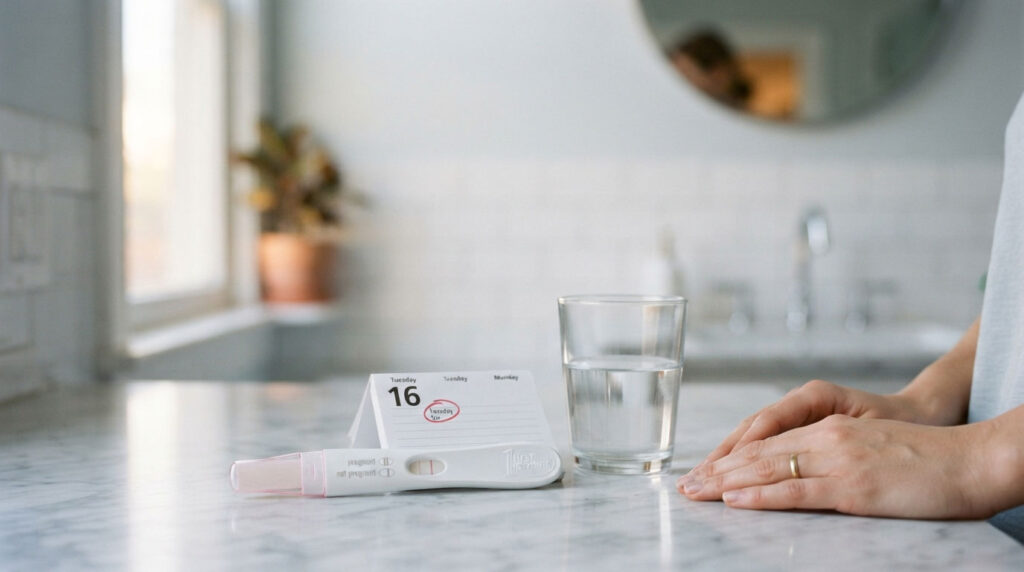
Two things are true at once, and that contradiction is why this question refuses to die. A real menstrual period during pregnancy is biologically impossible. Yet roughly one in four pregnant women in the United States bleeds anyway, often around the date her period was due, sometimes heavily enough to soak a liner. Both facts hold.
The space between them is where you find out whether tonight is a wait-and-see night or a call-someone night.
Table of Contents
Quick Answer
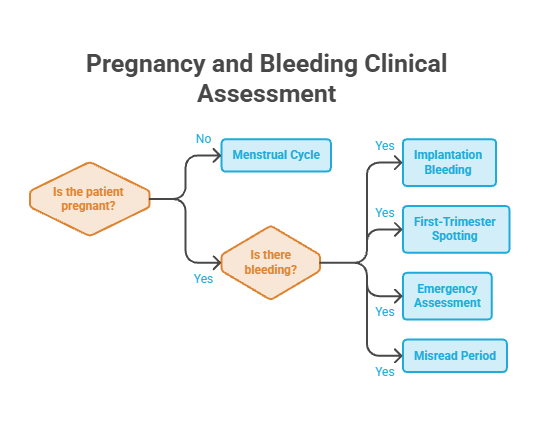
No, you cannot have a true period while pregnant. Menstruation requires ovulation followed by a drop in progesterone, and pregnancy blocks both. But bleeding during pregnancy is common. About 25% of women bleed in the first trimester, and most of those pregnancies continue normally. Heavy bleeding, especially with pain, is the pattern that needs urgent evaluation.
At a Glance
- A period sheds the uterine lining. Pregnancy holds onto that lining, so the machinery that produces a period is switched off.
- Around 25% of first-trimester pregnancies involve some bleeding, and in the most recent large US cohort, bleeding alone did not raise the odds of pregnancy loss.
- Light spotting lasting one to two days behaves very differently from heavy bleeding with cramping. The research separates them cleanly.
- Implantation bleeding usually arrives 6 to 12 days after ovulation, runs pink or brown, and stops within a day or two.
- Bleeding plus one-sided pain, shoulder-tip pain, dizziness, or fainting is an emergency until proven otherwise.
- A negative home pregnancy test does not rule out pregnancy, and neither does bleeding.
- “She had periods her whole pregnancy” is not folklore so much as a misread. The research explains what those women were actually experiencing.
Why a Real Period and Pregnancy Cannot Coexist
Your body builds a lining every cycle that it hopes to use. Estrogen thickens the endometrium through the first half of the cycle, and after ovulation, progesterone from the corpus luteum holds that lining in place.
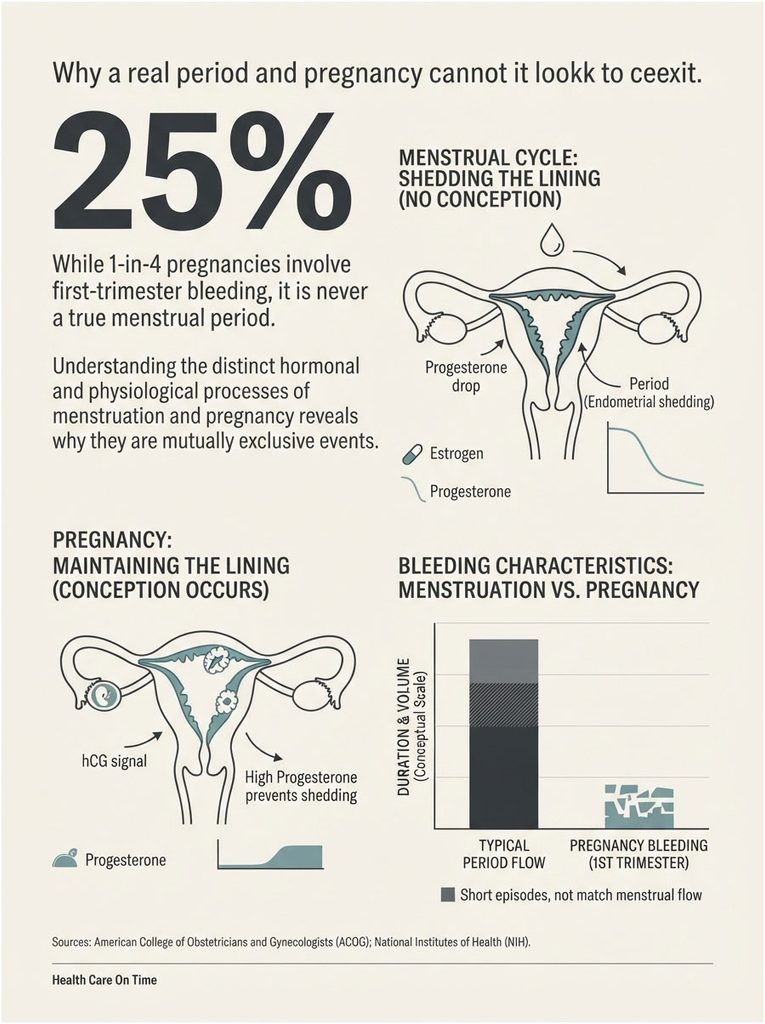
No embryo, no reason to keep it. The corpus luteum fades on schedule, progesterone drops off a cliff, blood supply to the lining collapses, and the whole layer sheds. That shedding is your period.
Patients booking hormone panels through HealthCareOnTime often describe their period as something that just happens. It is actually the end point of a chain, and every link has to fire in order.
What Changes the Moment You Conceive
Implantation breaks the chain. The developing placenta begins producing human chorionic gonadotropin (hCG), and hCG signals the corpus luteum to keep working instead of winding down.
Progesterone stays high. The lining stays put, because a growing pregnancy depends on it. Ovulation stops for the duration.
The withdrawal signal that triggers menstruation never arrives. There is no route left for a period to happen. As Cleveland Clinic puts it, once you are pregnant your body has nothing to shed, because it needs that blood and tissue.
So What Is the Blood You Are Seeing?
Bleeding during pregnancy comes from somewhere other than endometrial shedding. It might be small vessels disrupted at the implantation site, a softened cervix that bleeds on contact, a pocket of blood trapped between the placenta and the uterine wall, or a genuine complication that needs treatment.
The blood is real. Calling it a period is the part that misleads, because that label sends you toward the wrong explanation and away from the right questions.
Scale matters here. According to the American Academy of Family Physicians, approximately one-fourth of pregnant women will experience bleeding in the first trimester, with a differential that includes threatened abortion, early pregnancy loss, and ectopic pregnancy.
Our medical reviewers note a pattern in how these calls come in. Most women who report “a period while pregnant” are describing an episode that lasted hours rather than days and never reached their normal flow. The mismatch usually becomes obvious once somebody asks the right four questions.
Period vs Pregnancy Bleeding: How to Tell Them Apart
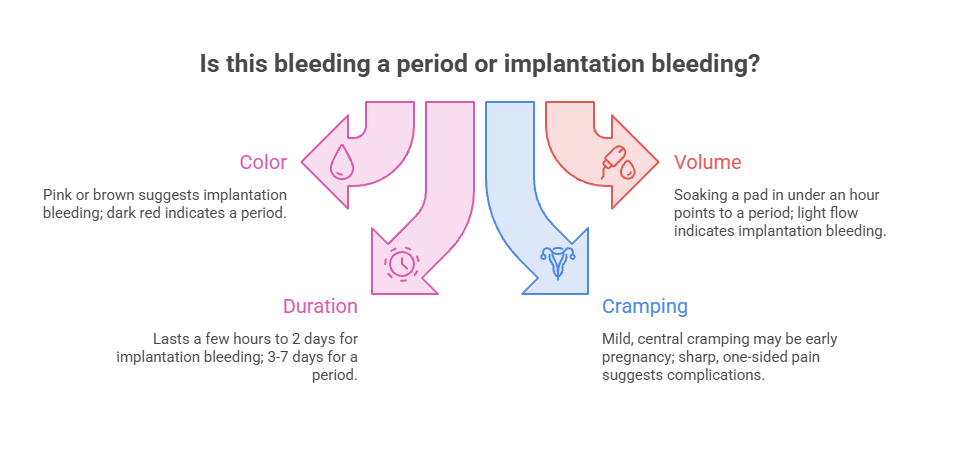
You do not need a lab to make a useful first assessment. Four features carry most of the signal: color, volume, duration, and the character of the cramping.
Color, Flow, Duration, and Timing
A typical period follows an arc. It starts light, builds to red or dark red across a day or two, then tapers over three to seven days total, usually with some small clotting along the way.
Implantation bleeding has no arc. It stays light from start to finish, runs pink or brown rather than bright red, and resolves within a few hours to about two days.
Timing is where people get caught. Implantation occurs roughly 6 to 12 days after ovulation, which lands squarely on the date your period was expected. That single overlap is the reason this question gets searched millions of times a year in the United States alone.
Color deserves one more note, because it generates a whole search cluster of its own. Brown blood is simply older blood that oxidized before it exited. It shows up in implantation bleeding, at the tail end of ordinary periods, and with hormonal spotting, which makes it a poor standalone clue in either direction.
The Pad Test
Volume is the one thing you can measure at home with reasonable accuracy, and it is the number providers ask for first.
If bleeding soaks a regular pad or tampon within an hour, that is not spotting and it is not implantation bleeding. If you are passing clots larger than a quarter, the same applies.
Patients commonly ask us how to describe bleeding to a nurse line without sounding vague. Pads per hour, color, and whether the pain sits on one side are the three details that move triage fastest.
What Cramping Tells You
Mild, central, period-like cramping shows up frequently in early pregnancy as the uterus expands. It tends to be low, dull, and even across both sides.
Sharp pain locked to one side is a different animal. So is pain that shoots to the tip of your shoulder, which can signal internal bleeding irritating the diaphragm from below.
When Pain Changes the Meaning of the Blood
The research is unusually specific on this point rather than reassuring in general. In the Right From the Start community-based cohort, heavy bleeding accompanied by pain was the combination that accounted for most of the elevated risk. Spotting and light episodes carried no measurable increase.
Pain is not a detail attached to the bleeding. It is an independent variable that changes what the bleeding means, which is why every triage script asks about it separately.
Table 1. True Period vs Pregnancy Bleeding: Side by Side
| Feature | True Menstrual Period | Implantation Bleeding | Hormonal or Cervical Spotting | Bleeding Needing Same-Day Care |
| Timing | Day 1 of a new cycle, roughly every 21 to 35 days | 6 to 12 days after ovulation, near the expected period date | Any point in the first trimester, often after sex or a pelvic exam | Any gestational age, often sudden |
| Color | Starts pink or light red, turns dark red, tapers brown | Light pink or brown, rarely bright red | Pink, brown, or streaked | Bright red, sometimes with tissue |
| Flow volume | 30 to 80 mL total across the full period | A few drops to light spotting, well under a pad | Spotting only, often just on wiping | Soaks a pad in under 1 hour |
| Duration | 3 to 7 days | Hours up to about 2 days | Hours to 1 to 2 days | Ongoing or worsening |
| Cramping | Dull, central, peaks day 1 to 2 | Mild or absent, some feel light twinges | Usually none | Severe, one-sided, or radiating to shoulder |
| Clots | Common, usually small | None | None | Clots larger than a quarter |
| What to do | Nothing, this is a normal cycle | Take a pregnancy test in 2 to 3 days | Mention at your next prenatal visit | Call your provider or go to the ER now |
The 8 Real Causes of Bleeding During Pregnancy
Once you accept that the blood is not menstruation, the productive question becomes what it is instead. Eight explanations account for the large majority of cases seen in US practice.
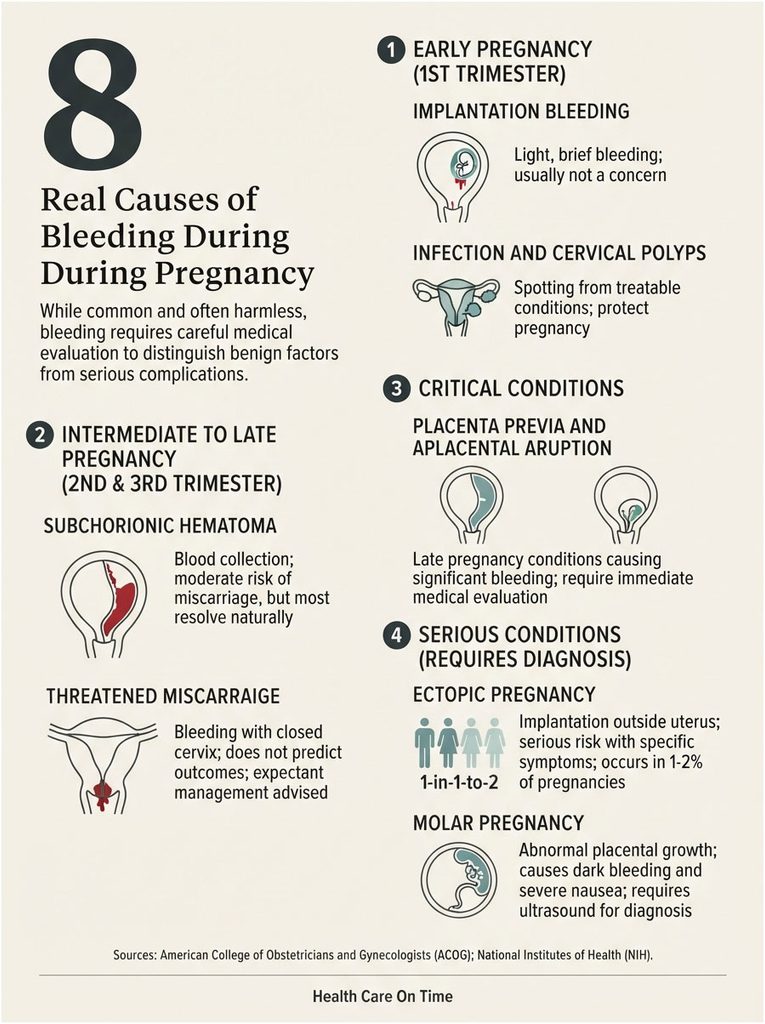
Implantation Bleeding
The embryo burrows into a lining dense with small blood vessels. A few of those vessels break, and a small amount of blood works its way out over the following hours.
It is brief, light, and self-limiting. It also does not happen to most women, so its absence proves nothing about whether you are pregnant.
Cervical Changes, Sex, and Pelvic Exams
Pregnancy sends more blood to the cervix and softens the tissue. That tissue bleeds more readily on contact than it did before.
Bleeding after intercourse, after a transvaginal ultrasound, or after a cervical exam is common and usually harmless. Report it anyway, because harmless should be your provider’s conclusion rather than your assumption.
Subchorionic Hematoma
This is a collection of blood sitting between the uterine wall and the chorionic membrane. On an early ultrasound it typically appears as a crescent-shaped pocket alongside the gestational sac.
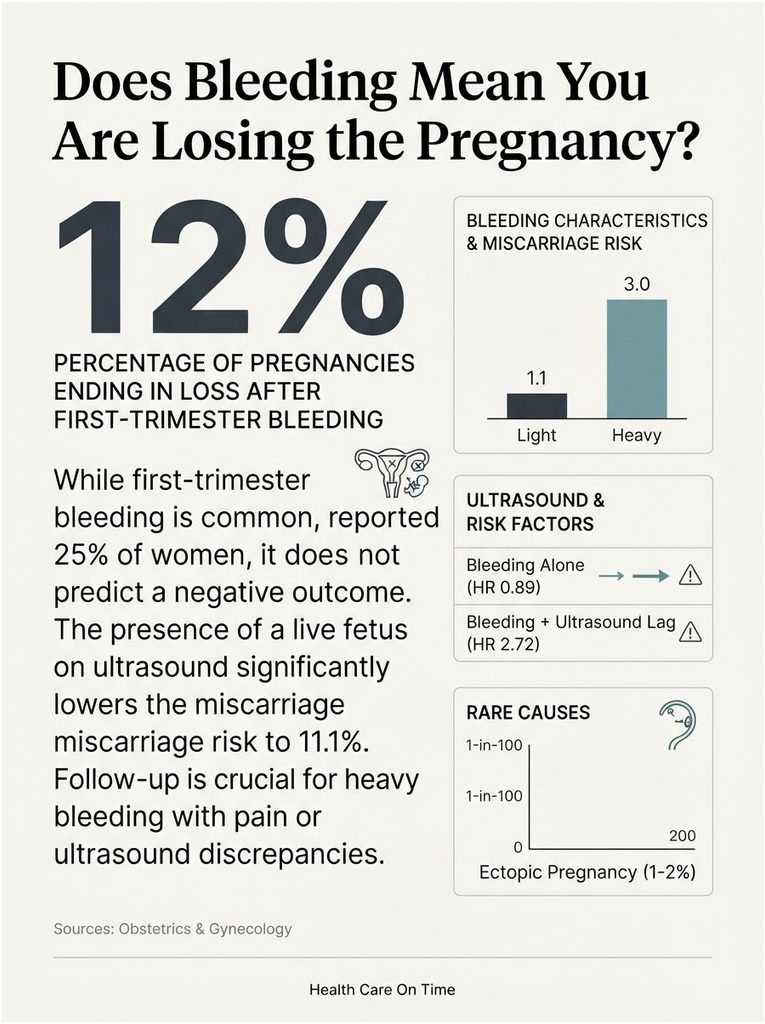
The numbers are worth carrying. In a prospective study of 370 women with vaginal bleeding and a live singleton fetus on scan, the overall miscarriage rate was 11.1% and almost 90% of pregnancies continued to viability, while 14% of women had an intrauterine hematoma and that group was 2.6 times more likely to miscarry, at 23% versus 9%.
Most of these resolve without intervention as the body reabsorbs the blood. The elevated risk is real but moderate, and a live fetus on ultrasound remains a strong positive signal either way.
Infection and Cervical Polyps
Bacterial vaginosis, trichomoniasis, chlamydia, gonorrhea, and yeast overgrowth can inflame the cervix enough to cause spotting. A benign cervical polyp can do the same thing mechanically.
Bleeding paired with itching, odor, burning, or unusual discharge points toward this group. These causes are treatable, and treating them protects the pregnancy rather than just the symptom.
Threatened Miscarriage
This is the clinical label applied when bleeding occurs in the first half of pregnancy, the cervix stays closed, and the pregnancy remains viable on ultrasound. It describes a situation. It does not predict an outcome.
The AAFP review is blunt about what to do: treatment of threatened abortion is expectant management, bed rest does not improve outcomes, and there is insufficient evidence supporting the use of progestins.
That last finding lifts a weight off a lot of people. Whatever you lifted, ate, worried about, or skipped that day almost certainly did not cause this.
Ectopic Pregnancy
An ectopic pregnancy implants outside the uterine cavity, most often inside a fallopian tube. It cannot survive there, and as it grows it can rupture the tube and cause serious internal bleeding.
Both the frequency and the stakes are documented. Per StatPearls, ectopic pregnancy affects approximately 1% to 2% of pregnancies in the United States, accounts for 2.7% of pregnancy-related deaths, and roughly 97% occur within the fallopian tube. ACOG adds the detail people underestimate most: about half of all women who have an ectopic pregnancy do not have known risk factors.
Light bleeding with one-sided pain is the textbook presentation. It is also the presentation most often written off as a strange period, which is precisely why it earns its own row in the triage table below.
Molar Pregnancy
A molar pregnancy develops when placental tissue grows abnormally in place of a viable embryo. It can produce dark bleeding, unusually severe nausea, and hCG levels well above the expected range.
It is uncommon. It is also one of the clearer reasons an ultrasound rather than a home test settles the question.
Placenta Previa and Placental Abruption
These belong to the second half of pregnancy. Placenta previa means the placenta covers or sits very close to the cervix, and it typically causes painless bright red bleeding after 20 weeks.
Placental abruption means the placenta separates from the uterine wall before delivery. It usually brings bleeding alongside constant severe abdominal pain and a firm, tender uterus. Both need immediate evaluation at labor and delivery, not a phone call.
Does Bleeding Mean You Are Losing the Pregnancy?
This is the real question sitting underneath the search. It is also where the newest evidence is meaningfully more reassuring than the older, hospital-recruited studies most articles still lean on.
What the Newest US Cohort Data Actually Shows
A prospective cohort published in Obstetrics & Gynecology enrolled women before conception or in early pregnancy and ran standardized study ultrasounds rather than relying on chart review. Among 5,425 participants, 25.0% reported first-trimester bleeding and 12.0% of pregnancies ended in loss, but bleeding itself was not associated with risk of pregnancy loss, at a hazard ratio of 0.89 (95% CI 0.75 to 1.07).
Read that a second time. In a large modern US cohort, bleeding on its own did not move the needle.
One combination did move it. First-trimester bleeding paired with ultrasound measurements lagging more than five days behind last menstrual period dating carried a hazard ratio of 2.72 (95% CI 2.10 to 3.53), and the authors concluded that reassurance is appropriate for most patients experiencing first-trimester bleeding when ultrasound measurements align with LMP dating.
The ultrasound is doing the predictive work, not the bleeding. That reframes what you should actually be asking for when you call.
Why Heavy Bleeding Is a Different Signal Than Spotting
Older cohort data arrived at the same boundary from a different direction. In Right From the Start, among 4,510 participants, 1,204 (27%) reported first-trimester bleeding or spotting and 8% of those reported heavy episodes; any bleeding carried an unadjusted odds ratio of 1.1 (95% CI 0.9 to 1.3), while heavy bleeding carried an odds ratio of 3.0 (95% CI 1.9 to 4.6).
The authors left no ambiguity in the conclusion: heavy bleeding in the first trimester, particularly when accompanied by pain, is associated with higher risk of miscarriage, while spotting and light episodes are not, especially if lasting only one to two days.
The One Combination That Changes the Odds
Stack the two studies and a workable rule falls out. Light, short bleeding with no pain and an ultrasound that dates on schedule sits in the reassuring zone. Heavy bleeding with pain, or bleeding alongside a pregnancy measuring behind, sits in the concerning zone and earns faster follow-up.
In beta-hCG and progesterone panels booked through HealthCareOnTime, our lab partners report that trend requests now outnumber single-value orders in early pregnancy work. One number in isolation rarely answers the question a worried patient is actually asking.
Table 2. What US Research Says About Bleeding in Early Pregnancy
| Finding | Figure | Source | What It Means for You |
| First-trimester bleeding is common | 25.0% of 5,425 participants | Obstetrics & Gynecology prospective cohort | You are far from alone, and it is not automatically a warning sign |
| Bleeding alone did not predict loss | HR 0.89 (95% CI 0.75 to 1.07) | Obstetrics & Gynecology prospective cohort | Bleeding by itself did not raise statistical risk in this cohort |
| Bleeding plus lagging ultrasound did | HR 2.72 (95% CI 2.10 to 3.53) | Obstetrics & Gynecology prospective cohort | The scan matters more than the bleeding, so get dated early |
| Heavy bleeding behaves differently | OR 3.0 (95% CI 1.9 to 4.6) vs OR 1.1 for any bleeding | Right From the Start, n=4,510 | Volume is the variable worth reporting accurately |
| Live fetus on scan is strongly reassuring | 11.1% miscarriage, about 90% reached viability | Poulose et al., n=370 with bleeding | A heartbeat on ultrasound shifts the odds heavily in your favor |
| Subchorionic hematoma raises risk moderately | Present in 14%, 23% vs 9% miscarriage | Poulose et al., n=370 with bleeding | Common on early scans, and most resolve without treatment |
| Ectopic pregnancy is uncommon but serious | 1% to 2% of US pregnancies, 2.7% of pregnancy-related deaths | StatPearls, National Center for Biotechnology Information | Rare, and the reason one-sided pain is never dismissed |
Bleeding by Trimester: What Each Stage Means
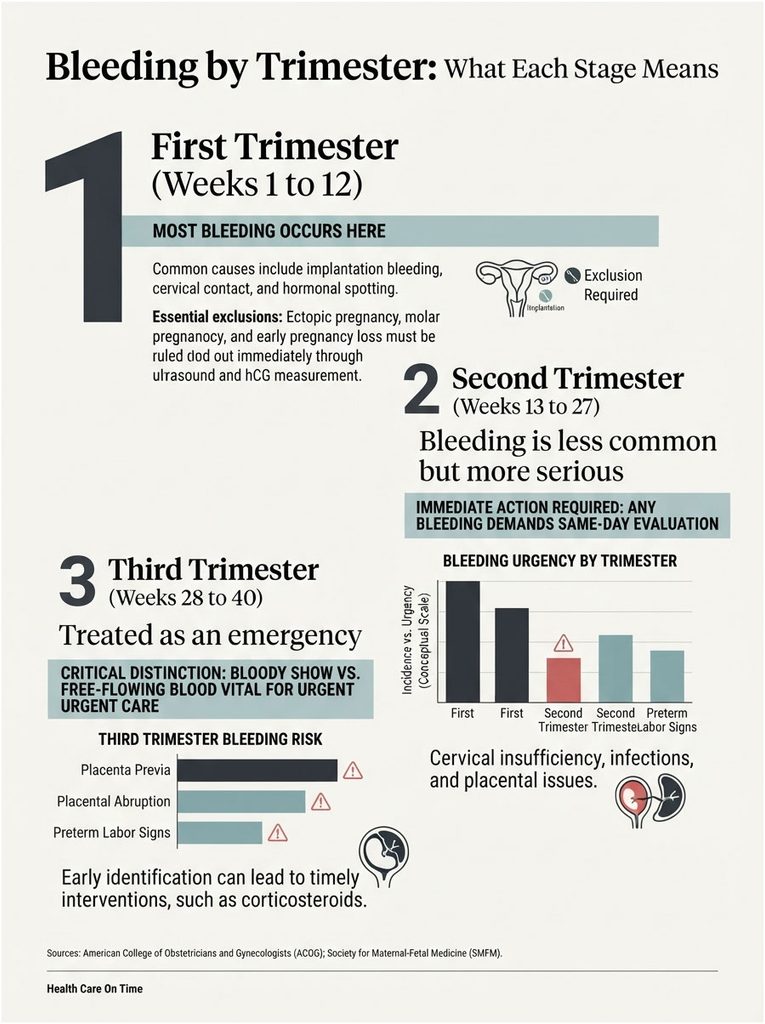
The identical symptom carries different weight depending on when it happens. Gestational age is the first thing any clinician establishes, before anything else about the bleeding gets discussed.
First Trimester, Weeks 1 to 12
Most pregnancy bleeding happens here, and most of it turns out fine. Implantation bleeding, cervical contact bleeding, subchorionic hematoma, and hormonal spotting all cluster in these twelve weeks.
Three conditions have to be excluded regardless of how light the bleeding looks: ectopic pregnancy, molar pregnancy, and early pregnancy loss. That exclusion happens through ultrasound and serial hCG measurement, not through waiting to see whether the bleeding stops.
The exclusion work is also time-sensitive in one specific direction. An ectopic pregnancy caught before rupture is usually manageable with methotrexate or laparoscopic surgery. One caught after rupture is a surgical emergency with blood loss attached.
Second Trimester, Weeks 13 to 27
Bleeding becomes less common and more consequential. Cervical insufficiency, infection, placental problems, and preterm labor all enter the picture at this stage.
The threshold shifts accordingly. Any bleeding after 12 weeks deserves a same-day call rather than a wait-and-see approach, even when it stops on its own within an hour.
Second-trimester bleeding also changes what your provider examines. Cervical length measurement by ultrasound becomes relevant, and so does screening for infection, neither of which is routine in a first-trimester bleeding workup.
Third Trimester, Weeks 28 to 40
Bleeding at this stage is treated as an obstetric emergency until proven otherwise. Placenta previa and placental abruption drive that posture, and both can escalate quickly.
There is one more reason for urgency that has nothing to do with the placenta. Bleeding after 28 weeks can accompany preterm labor, and identifying it early opens a window for corticosteroids that measurably improve newborn lung function.
Bloody Show vs Bleeding You Should Not Ignore
Close to term, many women pass a small amount of blood-tinged mucus as the cervix begins to soften and open. That is bloody show, and it belongs to normal labor.
The distinction comes down to mucus versus flow. Blood-streaked mucus is a labor sign worth mentioning. Free-flowing blood is not a labor sign, and it means going in now rather than in the morning.
“But My Friend Had Periods Her Whole Pregnancy”
Almost everyone has heard this story, usually delivered with complete conviction and a real name attached. Dismissing it as internet folklore does not work, partly because it is rude and partly because the person telling it is not lying. The research offers something better than dismissal.
What the Research Actually Found
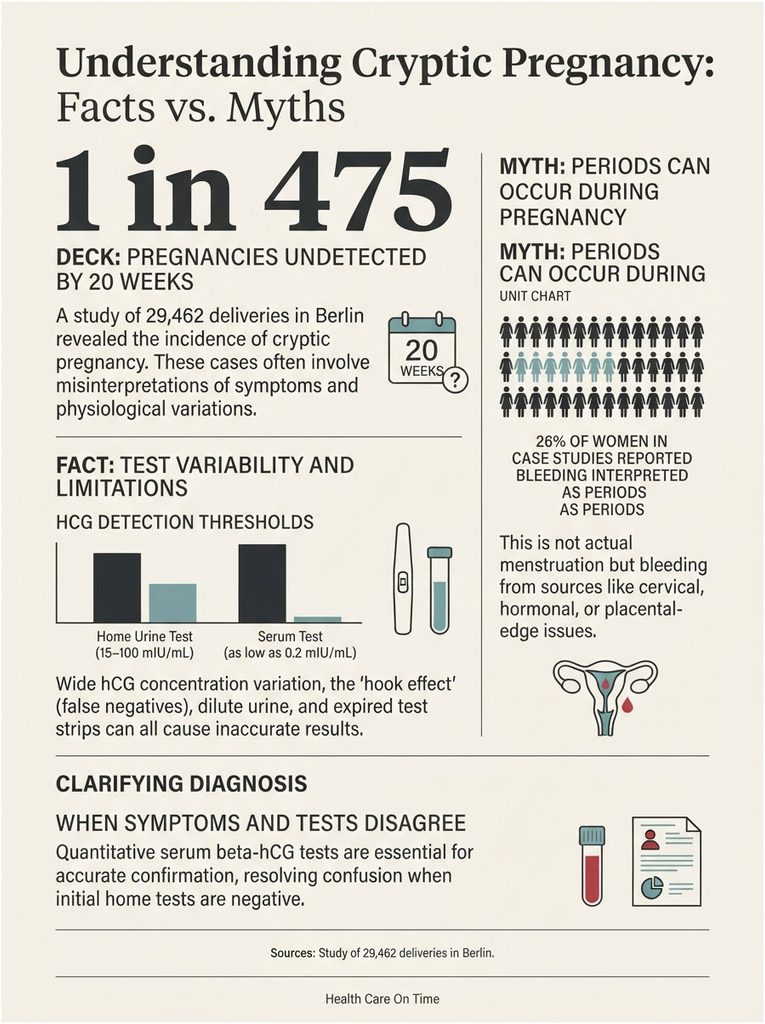
A prospective, population-based study in Berlin captured every delivery across a metropolitan area for a full year, which is a study design that leaves very little room for selection bias. Across 29,462 deliveries, 62 valid cases produced a ratio of 1 in 475 for pregnancies not subjectively perceived by 20 weeks, and 1 in 2,455 for totally unexpected births where the pregnancy was diagnosed only during labor.
That is not vanishingly rare. Cleveland Clinic cites the same figures in its patient-facing material on cryptic pregnancy.
Why Some Women Bleed Monthly and Still Deliver
Here is the finding that settles the argument. In a case series examined within the cryptic pregnancy literature, 26% of women had amenorrhea while the majority reported bleeding they interpreted as regular periods.
Those episodes were not menstruation. They were cervical, hormonal, or placental-edge bleeding arriving on a roughly cyclical schedule, in women who had no reason to suspect pregnancy and therefore no reason to reinterpret what they were seeing.
Your friend was not menstruating through a pregnancy. She was bleeding through one and calling it a period, which is an entirely reasonable thing to do when nothing else in her body is contradicting that reading.
Why a Pregnancy Test Can Read Negative When You Are Pregnant
The second half of the cryptic pregnancy puzzle is testing, and this is where most articles stop short. A negative result feels definitive. Frequently it is not.
Test Sensitivity, Dilute Urine, and the Hook Effect
Home and clinic urine tests differ substantially in what they can pick up. Reported detection thresholds for point-of-care urine tests run between 15 and 100 mIU/mL00542-7/fulltext), while serum testing reaches far lower, with a lower limit of detection ranging from 0.2 to 2 mIU per mL compared with 6.3 to 100 mIU per mL for point-of-care urine tests.
Then there is biological spread, which is wider than most people expect. In the week after a missed menstrual period, serum hCG concentrations can range broadly from 6 to 19,950 mIU/mL. Two women at an identical gestational age can land on opposite sides of the same test’s cutoff.
A rarer mechanism runs in the opposite direction. In the hook effect, hCG is present in such excess that it saturates both antibodies separately and blocks the sandwich the test depends on, producing a false negative. In urine hCG tests, this is generally not observed until concentrations reach around 1,000,000 mIU/mL, as seen in gestational trophoblastic disease, though variant forms of hCG can cause a similar failure at lower concentrations.
Dilute urine from heavy fluid intake, testing before implantation has occurred, and expired strips fill out the list of ordinary explanations. Across the diagnostic network we work with, a quantitative serum beta-hCG resolves nearly every case where symptoms and a home test disagree.
What to Do Right Now: Your Action Plan
Reading helps. Knowing your next three steps helps more, especially at an hour when calling anyone feels like an overreaction.
Bleeding and You Have Not Tested Yet
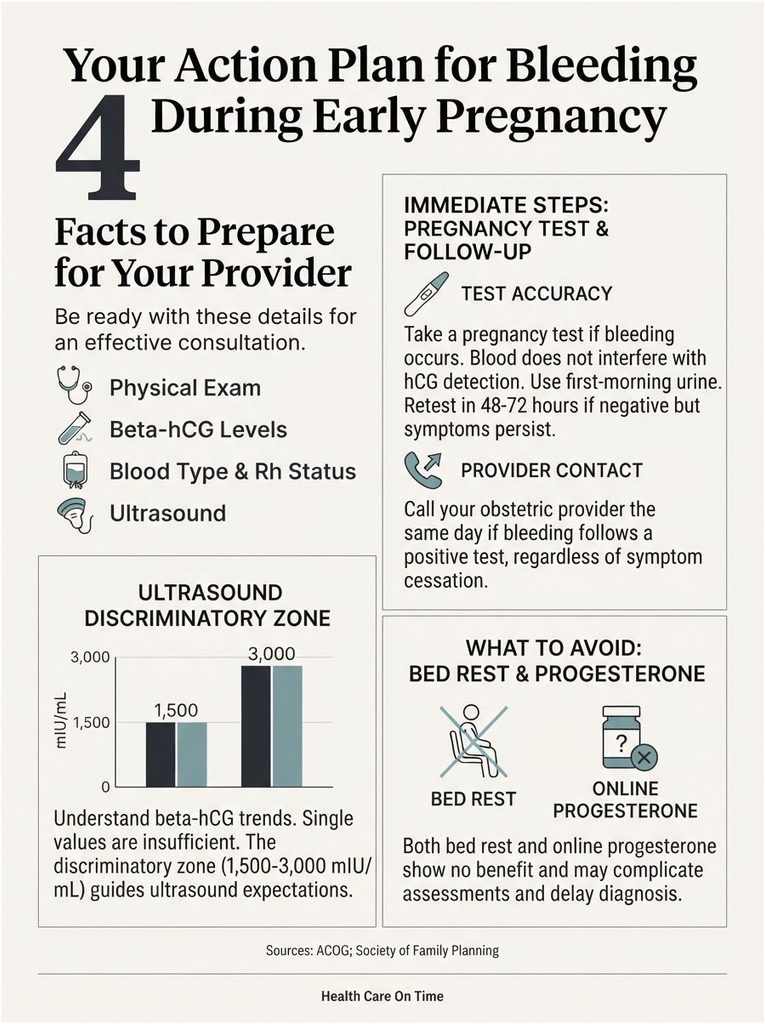
Take a pregnancy test. Blood mixing with urine does not interfere with hCG detection, so bleeding is never a reason to postpone testing.
Use first-morning urine for the highest concentration, follow the timing on the package exactly, and retest in 48 to 72 hours if the result is negative but symptoms continue. If a second test is negative and you still feel pregnant, ask for a quantitative serum beta-hCG rather than buying a third box.
Bleeding and You Have a Positive Test
Call your obstetric provider the same day, even if the bleeding has already stopped. The purpose of that call is not treatment. It is establishing location and dating.
Have four facts ready before you dial:
- How many weeks along you are, by last menstrual period or by a prior scan.
- How much you are bleeding, measured in pads per hour rather than adjectives.
- What color the blood is, and whether you have passed clots or tissue.
- Whether there is pain, how severe it is, and exactly where it sits.
What Your Provider Will Check
Expect a physical exam, a quantitative beta-hCG, a blood type and Rh status, and a transvaginal ultrasound. Rh-negative women may need Rh immune globulin, and that treatment window is narrow enough that it should not wait for a follow-up appointment.
Depending on findings, your provider may schedule a repeat beta-hCG in 48 hours. In a normally progressing early intrauterine pregnancy, that value should show a substantial rise. A plateau or a fall changes the working diagnosis.
Beta-hCG Trends, the Discriminatory Zone, and Ultrasound
Single hCG values answer almost nothing on their own. Trends answer a great deal, which is why one draw is rarely the end of the conversation.
The AAFP sets out the standard framework: the discriminatory level of 1,500 to 3,000 mIU per mL is the beta-hCG level above which an intrauterine pregnancy should be visible on transvaginal ultrasonography, and failure to detect an intrauterine pregnancy combined with beta-hCG levels above that threshold should raise concern for early pregnancy loss or ectopic pregnancy.
That threshold is the reason your provider may order the scan and the bloodwork together rather than one after the other. The two results only mean something in combination.
What Does Not Help
Bed rest does not change outcomes, and the evidence on that is settled rather than emerging. Self-dosing progesterone bought online is unsupported and can muddy your provider’s assessment of what is happening.
Waiting a week to see how things develop is the one choice with genuine downside attached. Ectopic pregnancy becomes more dangerous with time, not less, and the treatment options narrow as it grows.
Table 3. Scenario to Action Triage Guide
| Your Situation | What It Could Be | Recommended Action | Urgency |
| Light pink spotting for a few hours near your expected period date | Implantation bleeding | Take a pregnancy test in 2 to 3 days | Routine |
| Spotting after sex or a pelvic exam, no pain | Cervical contact bleeding | Mention at your next prenatal visit | Routine |
| Positive test, light bleeding, no pain, under 12 weeks | Threatened miscarriage or subchorionic hematoma | Call your provider today for dating ultrasound and beta-hCG | Same day |
| Bleeding soaking a pad per hour, or clots larger than a quarter | Early pregnancy loss or hemorrhage | Go to the emergency department | Emergency |
| Bleeding with sharp one-sided pelvic pain | Ectopic pregnancy | Go to the emergency department, do not drive yourself | Emergency |
| Bleeding with shoulder-tip pain, dizziness, or fainting | Ruptured ectopic, internal bleeding | Call 911 | Emergency |
| Bleeding with fever, chills, or foul-smelling discharge | Infection | Same-day appointment or urgent care | Same day |
| Any bleeding after 20 weeks | Placenta previa, abruption, preterm labor | Go to labor and delivery triage | Emergency |
Mistakes That Delay the Right Care
The delays that cause harm are rarely dramatic. They are small, sensible-sounding assumptions that anyone might make.
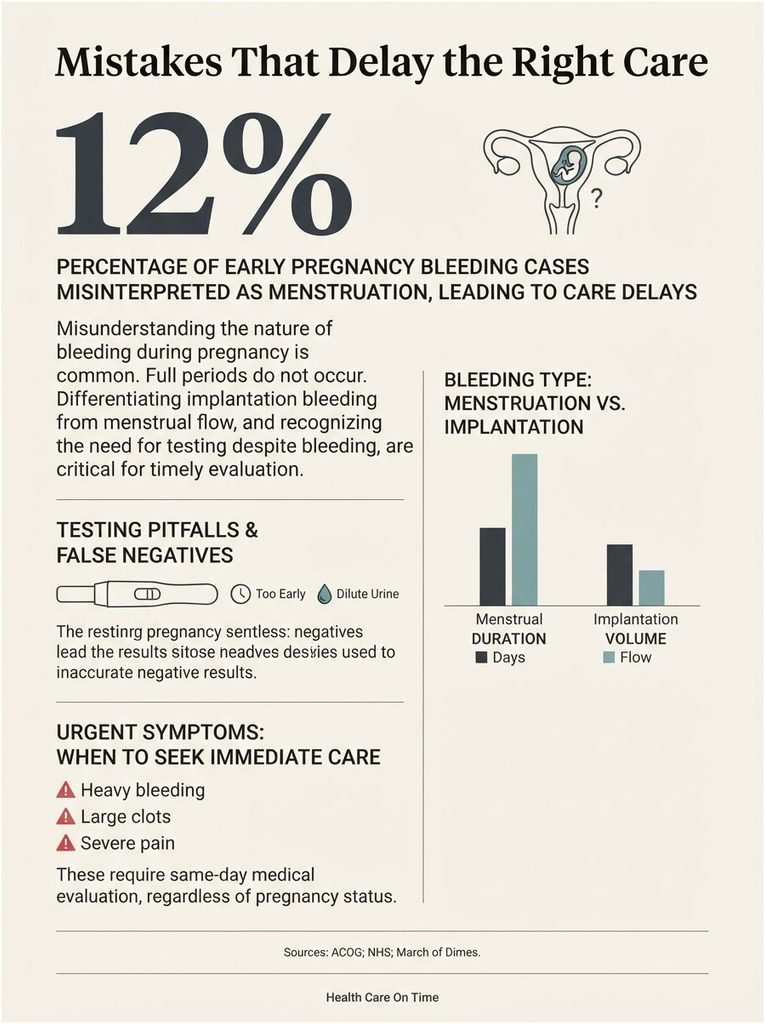
- Assuming a negative test rules out pregnancy. It does not, particularly when you test early, use dilute urine, or use a low-sensitivity strip. Symptoms plus a negative test is a reason to order a serum beta-hCG, not a reason to move on.
- Assuming bleeding rules out pregnancy. This is the most common version of the mistake and the mechanism behind most late-recognized pregnancies. Bleeding and pregnancy coexist routinely, and the Berlin data shows how far that misreading can run.
- Treating light bleeding as automatically safe. Volume matters, and so does pain. Light bleeding with one-sided pain outranks heavy bleeding with none, because it is the classic ectopic presentation.
- Skipping Rh status confirmation. An Rh-negative woman who bleeds during pregnancy may need Rh immune globulin within a defined window. Patients commonly ask us whether blood type is relevant here. It is, and it affects future pregnancies as well as this one.
- Assuming your last pregnancy predicts this one. Bleeding patterns differ between pregnancies in the same person. A previous uneventful pregnancy is not a baseline for evaluating this one.
- Trusting a viral video over an evaluation. Social platforms surface the dramatic outlier, never the typical case, because the typical case is not watchable. A twenty-minute ultrasound answers what forty videos cannot.
Frequently Asked Questions
Can you have a full, normal period and still be pregnant?
No. A full menstrual period requires shedding the uterine lining, which pregnancy prevents by keeping progesterone elevated. What people describe as a period during pregnancy is bleeding from a different source, and it is usually lighter and shorter than their normal flow even when it feels similar at the time.
How do I tell implantation bleeding from my period?
Compare volume, color, and duration. Implantation bleeding is light pink or brown, rarely fills a pad, and typically stops within a few hours to two days. A period starts light, builds to red, runs three to seven days, and usually brings small clots and central cramping.
How long does implantation bleeding usually last?
Most women who experience it describe a few hours up to roughly two days. Bleeding that runs past three days, increases in volume, or turns bright red is behaving like something other than implantation, and it deserves a call to your provider for evaluation rather than continued watching.
Can I take a pregnancy test while I am bleeding?
Yes. Blood mixed with urine does not interfere with hCG detection, so bleeding is never a reason to delay testing. Use first-morning urine for the strongest concentration, follow the package timing precisely, and retest in two to three days if the first result comes back negative.
Why is my pregnancy test negative if I have pregnancy symptoms?
Common explanations include testing too early, dilute urine, a low-sensitivity strip, or ovulating later than usual. Point-of-care urine tests detect roughly 15 to 100 mIU/mL, while serum testing detects far lower. A quantitative blood beta-hCG resolves the disagreement between your symptoms and the strip.
Is brown blood a sign of early pregnancy?
Brown blood is simply older blood that oxidized before leaving the body. It can accompany implantation bleeding, but it also shows up at the end of ordinary periods and with hormonal spotting. Color alone cannot confirm or rule out pregnancy. Only a pregnancy test can do that.
How much bleeding is too much during pregnancy?
Soaking through a regular pad or tampon in under an hour is too much at any gestational age, and so is passing clots larger than a quarter. That level of bleeding warrants emergency evaluation rather than a phone call, particularly when it comes with cramping, dizziness, or one-sided pain.
Can you bleed at 6 weeks and still have a healthy baby?
Frequently, yes. In a study of 370 women with bleeding and a live fetus visible on ultrasound, nearly 90% of those pregnancies continued to viability. Seeing a heartbeat on a scan remains one of the strongest positive predictors available anywhere in early pregnancy care.
Does bleeding during pregnancy mean I will miscarry?
Not by itself. In a prospective cohort of 5,425 pregnancies, first-trimester bleeding was not associated with pregnancy loss overall. Risk rose specifically when bleeding was heavy, when it came with pain, or when ultrasound measurements lagged more than five days behind expected dating.
Can stress cause bleeding in early pregnancy?
Stress is not an established direct cause of bleeding during pregnancy. Bleeding nearly always traces to a physical source such as implantation, the cervix, a hematoma, infection, or a placental issue. Attributing it to stress tends to delay finding the real explanation, so get it evaluated properly.
What is a subchorionic hematoma and is it dangerous?
It is a pocket of blood between the uterine wall and the pregnancy membranes, found on ultrasound in about 14% of women who bleed early. That group faced a 23% miscarriage rate compared with 9% without one. Most resolve on their own without any treatment at all.
When should I go to the emergency room for bleeding while pregnant?
Go immediately for heavy bleeding, clots larger than a quarter, severe or one-sided pain, shoulder-tip pain, dizziness, fainting, or any bleeding after 20 weeks. Call 911 instead of driving yourself if you feel faint, since a ruptured ectopic pregnancy can deteriorate very quickly.
Medical Disclaimer
This article is provided by HealthCareOnTime for general information and education. It does not replace evaluation, diagnosis, or treatment by a licensed healthcare professional. Bleeding during pregnancy always warrants individual assessment by an obstetric provider. If you are experiencing heavy bleeding, severe pain, dizziness, or fainting, seek emergency care or call 911 immediately.
References
- First Trimester Bleeding: Evaluation and Management, American Family Physician, American Academy of Family Physicians
- First-Trimester Bleeding and the Risk of Pregnancy Loss in a Prospective Cohort, Obstetrics & Gynecology
- Association Between First-Trimester Vaginal Bleeding and Miscarriage, Right From the Start cohort, PubMed
- Probability of Early Pregnancy Loss in Women With Vaginal Bleeding and a Singleton Live Fetus at Ultrasound Scan, PubMed
- Ectopic Pregnancy, StatPearls, National Center for Biotechnology Information
- Ectopic Pregnancy FAQ, American College of Obstetricians and Gynecologists
- Frequency of Denial of Pregnancy: A 1-Year Prospective Study in Berlin, Acta Obstetricia et Gynecologica Scandinavica
- Cryptic Pregnancy: Causes, Symptoms and Risks, Cleveland Clinic
- False-Negative Urine Human Chorionic Gonadotropin Testing in the Clinical Laboratory, Laboratory Medicine, Oxford Academic
- Hook-like Effect Causes False-Negative Point-of-Care Urine Pregnancy Testing in Emergency Patients, Journal of Emergency Medicine
- Can You Be Pregnant but Still Get Your Period?, Cleveland Clinic Health Essentials
- Can You Still Have Your Period if You’re Pregnant?, Nemours KidsHealth