
Quick Answer
ADHD limerence describes an involuntary, obsessive preoccupation with one person, called the limerent object, experienced by someone with ADHD. It combines limerence, a state of intrusive longing and mood swings tied to that person’s attention, with ADHD traits like hyperfocus, impulsivity, and emotional dysregulation. It is not a formal diagnosis and does not appear in the DSM-5-TR. It is real, common, and manageable.
Table of Contents
Here is the part almost nobody tells you: the grip tightens when you know less, not more. A clear yes or a clear no tends to loosen it. Ambiguity keeps the loop spinning for months.
If you have ADHD and one person has taken over your mental bandwidth, that pattern has a name.
At a Glance
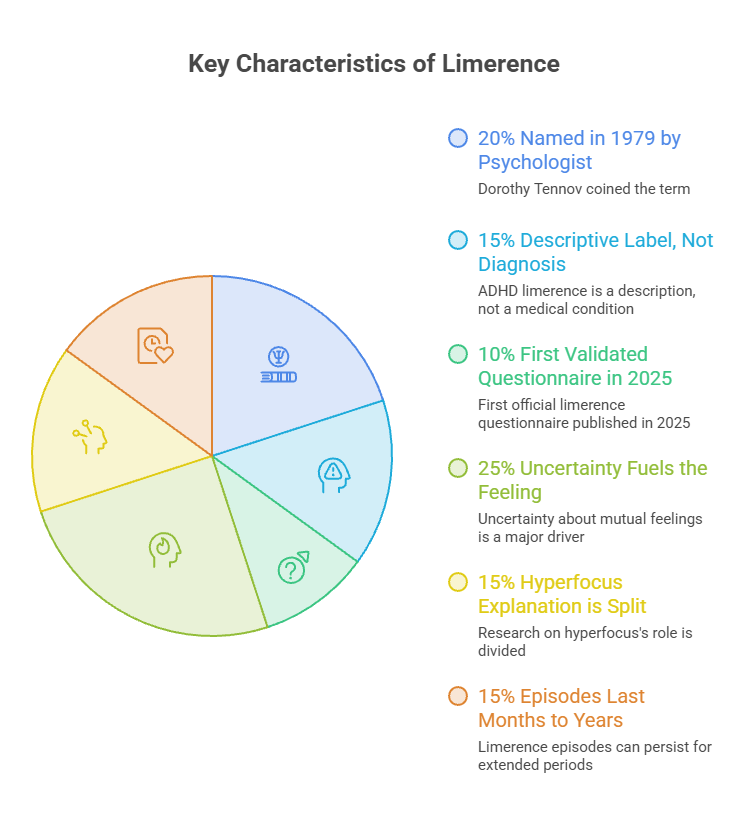
• Limerence was named in 1979 by psychologist Dorothy Tennov, not by social media.
• ADHD limerence is a descriptive label, not a diagnosis you can be given.
• The first validated limerence questionnaire was published in November 2025.
• Uncertainty about whether the feeling is mutual is the main fuel.
• The hyperfocus explanation is popular, but the research behind it is split.
• Episodes commonly run from several months to several years.
• Treatment evidence is thin, though the available approaches are practical.
What ADHD Limerence Actually Means
Limerence is an involuntary state of intense longing for a specific person, paired with obsessive thinking about them and a mood that rises and falls with their signals. The term was first described in the 1970s by psychologist Dorothy Tennov, who interviewed people about romantic love and found a group describing an experience that was involuntary, almost always unreciprocated, and dominated by an overwhelming longing for another person’s positive regard.
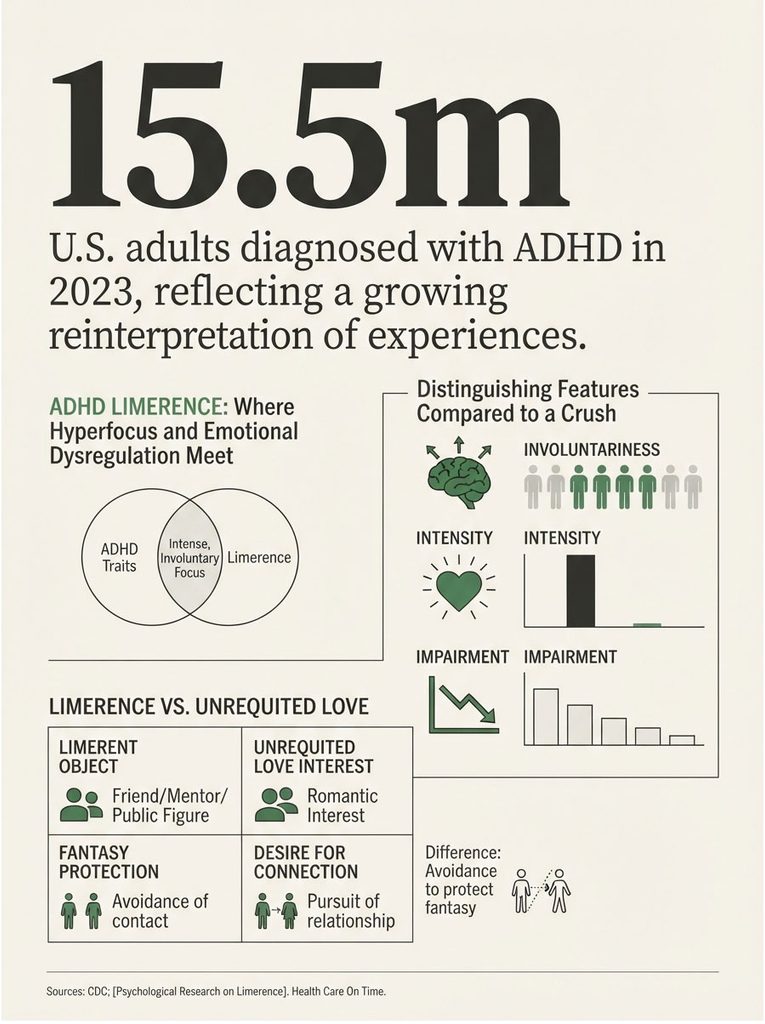
The label ADHD limerence stacks that state on top of ADHD. It is not a formal medical condition or diagnosis, but a term for a shared experience that combines ADHD’s hyperfocus and emotional regulation symptoms with the psychological state of limerence.
That distinction matters more than it sounds. You cannot be diagnosed with ADHD limerence, billed for it, or prescribed a drug for it. What you can do is treat the recognized parts underneath it.
Readers write to our editorial team asking whether they should mention this at their next appointment. The answer is yes, and the wording is straightforward, covered later in this article.
What Separates It From a Strong Crush
Three features do the separating: involuntariness, intensity, and impairment.
A crush is pleasant background noise. Limerence takes the foreground and refuses to give it back. Researchers distinguish limerence from ordinary early-stage infatuation on the grounds that the person becomes so preoccupied with the limerent object that day-to-day functioning suffers.
The mental activity is the symptom, not the feeling itself. People in this state replay past interactions repeatedly and over-analyze small signals for evidence of what the other person might feel, with each interaction charged enough that mood swings from elation at perceived affection to despair at perceived disapproval.
A crush survives a boring Tuesday. Limerence turns a boring Tuesday into four hours of analyzing a two-word reply.
The Limerent Object Is Not Always Romantic
The person at the center does not have to be a potential partner. People also experience limerence toward friends, mentors, and public figures.
Our medical reviewers hear this variant often from readers who feel embarrassed that the person is a coworker or a professor rather than a date. The mechanism is identical, and so is the treatment path.
It Is Not the Same as Unrequited Love
In unrequited love, people usually try to initiate contact. In limerence, contact is frequently avoided because approaching the person risks rejection and threatens the fantasy that has been built.
That avoidance explains something readers often find confusing about their own behavior. You can spend two years thinking about someone and never once ask them a direct question. Avoiding the answer protects the fantasy, and the fantasy is what the loop feeds on.
Why the Term Spread So Fast
ADHD limerence became a search term because it named something people were already living. CDC data show about 15.5 million U.S. adults had an ADHD diagnosis in 2023, and more than half of those adults, 55.9%, were first diagnosed in adulthood.
That means millions of Americans are reinterpreting their own history through a diagnosis they received recently. Old patterns get renamed. Limerence is one of the patterns that gets renamed most often.
Limerence, Love, Hyperfixation, and OCD Are Not the Same Thing
Readers arrive at this topic with five different experiences and one word for all of them. Sorting them changes what you should do next.
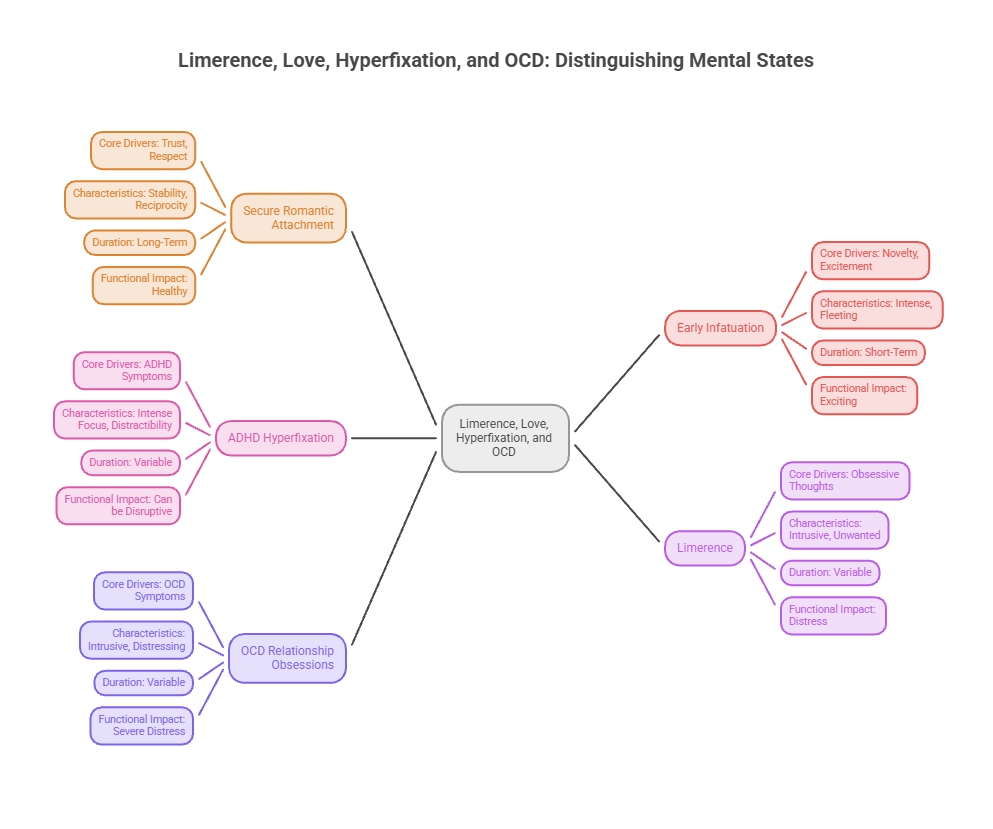
Table 1: Five States People Confuse
| State | Core driver | Typical duration | Needs reciprocation? | Functional impact | How it usually ends |
| Secure romantic attachment | Mutual safety and familiarity | Years to decades | Already present | Neutral to positive | Does not end abruptly; deepens or dissolves gradually |
| Early infatuation | Novelty and attraction | Weeks to a few months | Preferred, not required | Mild distraction | Fades into attachment or fizzles out |
| ADHD hyperfixation on a person | Interest-driven attention lock | Days to months | Not required | Time loss, neglected tasks | Interest shifts to a new subject |
| Limerence | Uncertainty about reciprocation | One to seven years | Craved constantly | Sleep, appetite, work, and other relationships suffer | Rejection, consummation, transformation, or renegotiated friendship |
| OCD relationship obsessions | Anxiety about doubt itself | Months to years without treatment | Not the point; certainty is | Compulsive checking and reassurance-seeking | Responds to exposure-based therapy |
The practical read is simple. If the thinking is driven by wanting them, that leans limerence. If it is driven by needing to resolve a doubt that never stays resolved, that leans into obsessive-compulsive territory and needs a different treatment path.
Patients who contact HealthCareOnTime about this often describe a mix of two or three columns. Mixed pictures are normal, and they are exactly why a clinician’s read beats any online quiz.
Why the ADHD Brain Appears More Vulnerable
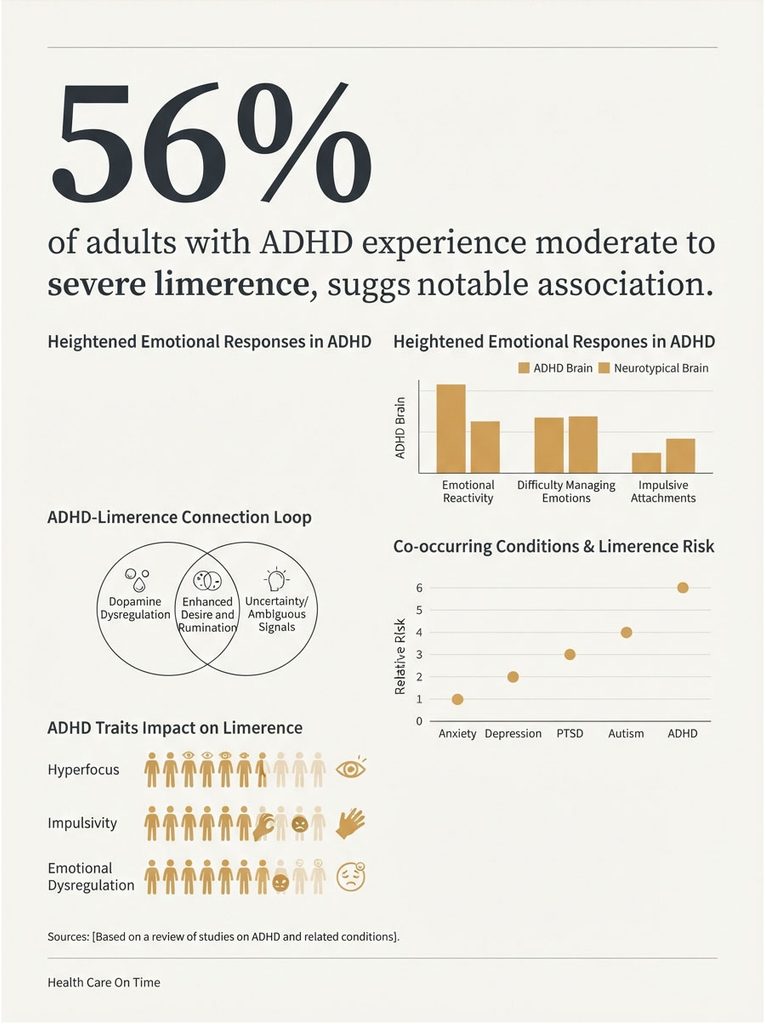
Several ADHD features plausibly raise the odds of a limerence episode. None of them prove ADHD causes limerence.
Dopamine and the Uncertainty Loop
Unpredictable rewards are stickier than reliable ones. A text that might arrive holds the brain’s reward system more tightly than a text that always arrives.
The research points the same way: the greater the uncertainty about the limerent object’s feelings, the higher the desire and the rumination. Layer that on a brain already tuned toward stimulation and novelty, and the loop reinforces itself faster than it would otherwise.
This explains something counterintuitive. When someone pulls back and gets vague, ADHD limerence usually gets worse, not better. Ambiguity is the accelerant.
Hyperfocus, and Why the Evidence Is Split
Hyperfocus is the popular explanation for ADHD limerence. It is also the shakiest part of the story, and nearly every competing article states it as settled fact.
Hupfeld and colleagues introduced an Adult Hyperfocus Questionnaire and tested whether hyperfocus is more prevalent in people with high ADHD symptomology, using a pilot sample of 251 adults and a replication sample of 372. Those with higher ADHD symptomology reported more frequent hyperfocus across school, hobbies, and screen time, plus real-world scenarios. A follow-up validation of the 12-item dispositional version was published in 2024 with 347 adults, showing high factor loadings between 0.57 and 0.81 on a single hyperfocus factor.
The picture is not clean, though. The evidence that people with ADHD are more prone to hyperfocus is mixed, with some studies failing to replicate the effect.
One likely reason is definitional. Studies that build reward and enjoyment into their definition of hyperfocus find the ADHD difference, while studies using a neutral definition often do not.
Read that carefully, because it supports the ADHD limerence link rather than undermining it. The attention difference shows up specifically when the target is rewarding. A person you are infatuated with is about as rewarding a target as exists.
Emotional Dysregulation and Rejection Sensitivity
Emotional intensity is the second ingredient. Small signals produce large internal responses, and large responses are hard to put down.
You have probably seen this called rejection sensitive dysphoria, or RSD. Being accurate here protects you. RSD is widely used in online communities but is not recognized as an official diagnosis in the DSM-5-TR or ICD-11, and there is not yet a strong empirical base establishing it as a distinct clinical construct.
What is well documented in the ADHD literature is the underlying pattern: heightened emotional reactivity and difficulty down-regulating emotions once triggered. The DSM-5 text revision does acknowledge quickness to anger, frustration, and overreactive emotionality as associated features of ADHD.
The experience is real even though the label is unofficial. In a 2023 qualitative study of 43 adults aged 18 to 35, about 77% reported struggling with rejection sensitive dysphoria, even though it is not a core DSM-5-TR symptom. The absence of a formal label does not reduce how much these experiences matter in treatment, and clinicians address the symptoms causing distress regardless of whether a term carries a billing code.
This distinction is worth carrying into a doctor’s office. If a provider says RSD is not a real diagnosis, they are technically correct, and you can still describe the experience accurately using the language of emotional dysregulation.
Impulsivity and Fast Attachment
Impulsivity may make it easier to latch on emotionally to someone quickly, without thinking it through.
Attachment formed in three days is attachment built on very little real information. That leaves a large gap, and fantasy fills the gap. The less you actually know about someone, the easier it is to imagine them as exactly what you need.
The Honest Caveat
Association is not causation. Not everyone with ADHD becomes limerent, and most limerent people do not have ADHD.
Limerence has been linked in the literature to anxiety and depression, PTSD, autism, borderline personality disorder, OCD, and ADHD, which suggests it is a common final pathway rather than an ADHD-specific phenomenon.
Signs You Are in a Limerence Loop
The 2025 validation study found that limerence organizes into two dimensions rather than one undifferentiated feeling. The researchers labeled them Intense Need for Attachment and Neglect to Self and Others.
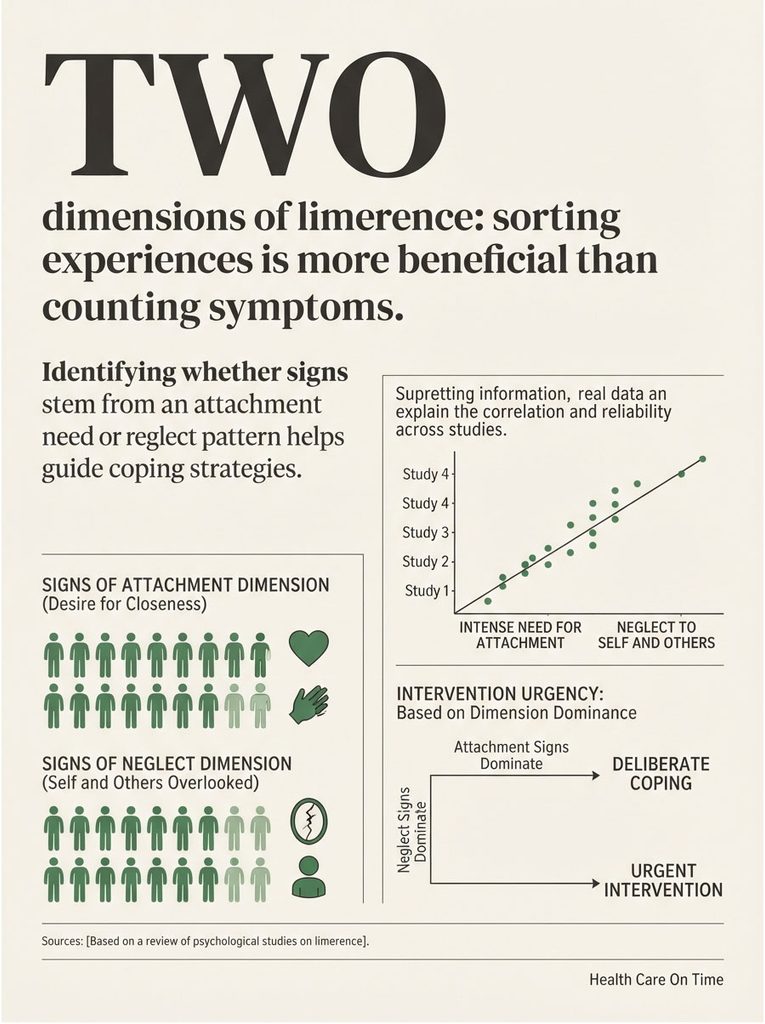
Sorting your own experience into those two buckets is more useful than counting symptoms on a list.
Signs From the Attachment Dimension
- You feel a longing for them to feel the same way that sits closer to need than preference.
- Any hint of reciprocation produces something closer to euphoria than ordinary pleasure.
- Your feelings toward this one person outrank your feelings toward everyone else in your life.
- Being near them, or planning to be near them, quietly organizes your week.
- The pull feels like something you did not choose and cannot argue yourself out of.
Signs From the Neglect Dimension
- Responsibilities slide because thinking about them consumes the available time.
- Other relationships have thinned out and you have not noticed until now.
- Sleep is disrupted, either from late-night rumination or from checking your phone.
- Appetite has changed without any deliberate reason.
Both dimensions showed excellent internal reliability across two independent samples, and the two are strongly correlated, meaning most people in a limerence episode show elements of each.
Which Dimension Is Louder Tells You Where to Start
If the attachment signs dominate and daily life is intact, you have time to work through this deliberately.
If the neglect signs dominate, the intervention is more urgent. Missed deadlines and two weeks of poor sleep compound into problems that outlast the limerence itself.
The Self-Check Is Not a Diagnosis
Recognizing yourself in nine bullet points is a starting point, not a conclusion. Our clinical review team applies the same standard across every topic: self-assessments generate good questions for an appointment, not answers.
What the Research Actually Shows, and What It Doesn’t
For decades, limerence research had a foundational problem. There was no validated way to measure it, so studies leaned on unpublished scales that had never passed peer review.
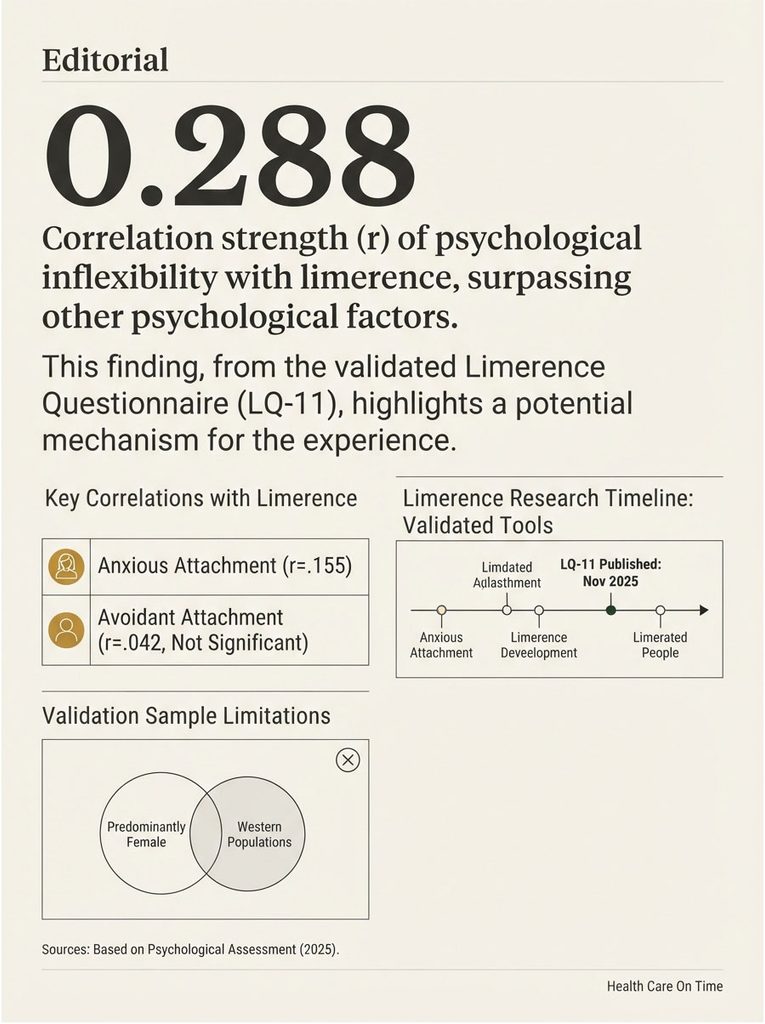
That changed in November 2025 with the publication of the Limerence Questionnaire (LQ-11) in Psychological Reports, developed across two samples of people who had experienced or were currently experiencing limerence.
The Claim Almost Everyone Overstates
You will read online that limerence is strongly linked to anxious attachment. The actual data from the validation study do not support the word strongly.
In the second sample, anxious attachment correlated with the total limerence score at r = .155, and avoidant attachment showed no significant relationship at all, r = .042.
Those are small effects. Psychological inflexibility and need to belong performed somewhat better, but still in the modest range.
Table 2: What the Evidence Says, With Sources
| Finding | Figure | Source | Data year |
| U.S. adults with an ADHD diagnosis | 15.5 million | CDC, NCHS Data Brief 543 | 2023 |
| Share first diagnosed as adults | 55.9% | CDC, NCHS Data Brief 543 | 2023 |
| Health center visit rate, adults with ADHD | 52.6 per 10,000 | CDC, NCHS Data Brief 543 | 2023 |
| Visit rate, adults ages 18 to 24 | 92.6 per 10,000 | CDC, NCHS Data Brief 543 | 2023 |
| LQ-11 validation sample sizes | 269 and 401 | Psychological Reports | 2025 |
| Limerence and anxious attachment | r = .155 | Psychological Reports | 2025 |
| Limerence and avoidant attachment | r = .042 (not significant) | Psychological Reports | 2025 |
| Limerence and psychological inflexibility | r = .288 | Psychological Reports | 2025 |
| Limerence and self-esteem | r = −.150 | Psychological Reports | 2025 |
The CDC figures come from the National Center for Health Statistics, which reported that about 15.5 million U.S. adults had an ADHD diagnosis in 2023, with more than half first diagnosed in adulthood, and a health center visit rate of 52.6 per 10,000 adults that was highest among those ages 18 to 24 at 92.6.
How to Read a Small Correlation
A small correlation does not mean the relationship is fake. It means attachment style is one contributor among many, not the explanation.
Our medical reviewers flag this distinction constantly across health topics. Statistical significance answers whether there is a signal. Effect size answers how much that signal matters. Content that reports the first and hides the second is not being straight with you.
The practical takeaway for ADHD limerence: do not conclude you have an anxious attachment style because you got limerent. The data do not carry that weight, and self-labeling on thin evidence tends to make people more anxious rather than less.
What the Study Cannot Tell You
The validation samples were predominantly female, averaged around 29 to 32 years of age, and drew mostly from Western, educated, industrialized populations, which the authors themselves flag as limiting generalizability. Just over a third of the second sample lived in the USA, with most of the remainder in the United Kingdom.
For American readers, that means the numbers are directionally useful rather than precisely transferable. There is currently no U.S. prevalence estimate for limerence at all, in the general population or among adults with ADHD. Anyone who quotes one is guessing.
How Long It Lasts and How It Ends
This is the question people actually want answered, and no page on the first results screen answers it with a number.
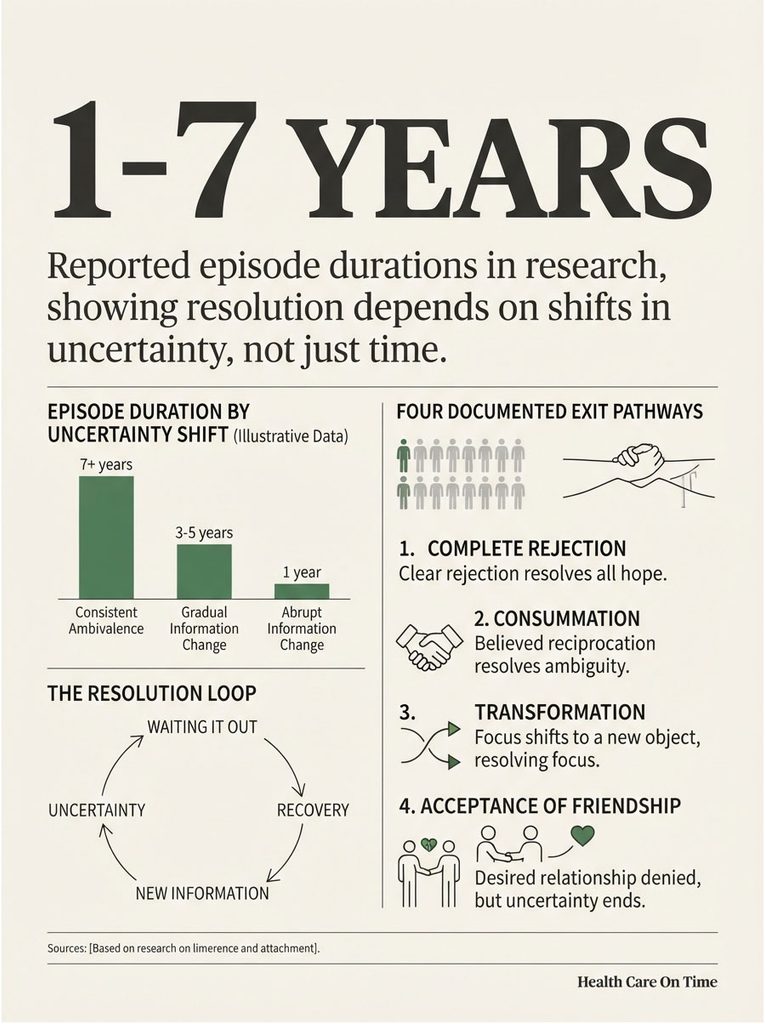
Reported episode durations typically range from one to seven years.
That range is wide because the ending depends on what happens to the uncertainty, not on how much time passes.
The Four Documented Exit Pathways
Tennov described three ways limerent episodes end: complete rejection by the limerent object, consummation where the person believes their feelings have been reciprocated, and transformation where attention shifts suddenly to a new limerent object.
A fourth pathway was later proposed, in which the person accepts a form of friendship while recognizing it will not become the relationship they wanted.
Notice what all four share. Each one resolves the uncertainty. That is the actual mechanism of recovery, and it is why the management steps below focus on the information supply rather than on trying harder to stop caring.
Why Waiting It Out Is the Slow Route
Many episodes do not end quickly or gently, and people can spend extended stretches perceiving consistent ambivalence with no clear signal in either direction.
Time alone does not resolve ambiguity. Something has to change the information you receive, or change how you relate to not knowing. Left alone, ADHD limerence can idle for years at a low but constant cost.
How to Manage ADHD Limerence: 8 Practical Steps
The clinical evidence base here is thin, so honesty about strength matters. What follows blends the small amount of published literature with well-established ADHD and anxiety management principles.
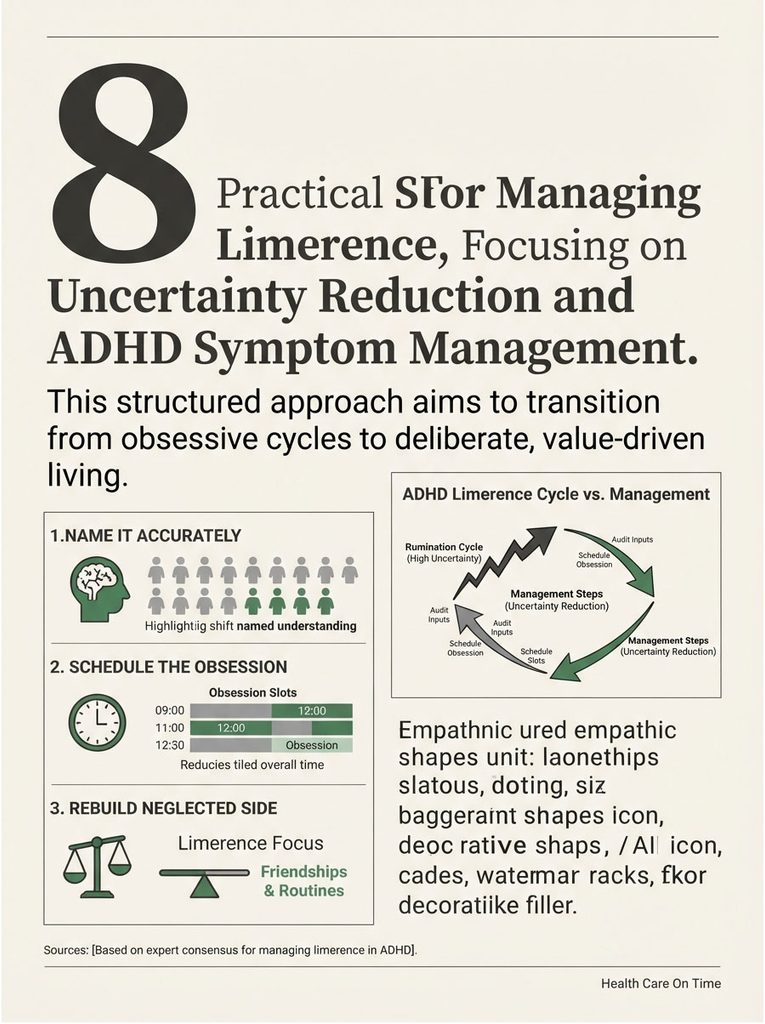
Step 1: Name It Accurately
Call it limerence, not love and not a character flaw. Naming reduces the shame layer, and shame is what stops people from telling anyone.
Readers frequently tell our team they have never said this out loud to a single person. That silence extends episodes, because a second perspective is one of the few things that reliably punctures a fantasy.
Step 2: Cut the Uncertainty Supply
Uncertainty is the fuel, so the first structural move is reducing the ambiguous signals you feed yourself.
Audit the inputs. Their social media, mutual friends who report back, the group chat you stay in only to see their messages, the route you take that passes their desk. Each delivers small ambiguous data points that restart the analysis.
Mute rather than block where you can. Blocking sometimes becomes its own dramatic event that generates fresh rumination for a week.
Step 3: Interrupt Rumination Instead of Suppressing It
Telling yourself to stop thinking about someone reliably produces more thinking about them. Suppression is not a strategy.
Psychological inflexibility, which includes suppression and avoidance of unwanted internal experiences, was positively associated with limerence in the validation study. The direction of that finding argues against white-knuckling it.
Redirect instead. Notice the thought, label it as a limerence thought, and return attention to something physical. Repeat without judging yourself for how many repetitions it takes.
Step 4: Schedule the Obsession
Containment beats prohibition. Set a fixed window, 15 minutes at a consistent time, where you allow yourself to think about them deliberately.
Outside the window, note the thought and postpone it to the next session. This works because it removes the internal fight, and the fight is the part that keeps the topic energized.
Step 5: Rebuild the Neglected Side
The second research dimension is neglect, and it is the one you can act on today without anyone else’s cooperation.
Pick three specific things that slid: one friendship, one routine, one responsibility. Restore them on a schedule rather than by motivation, since motivation is currently allocated elsewhere.
Short, defined, repeatable actions beat ambitious plans here, the same principle that works for other ADHD task systems.
Step 6: Work on Flexibility, Not Willpower
Acceptance-based approaches target exactly the pattern the research identified: rigid attachment to an imagined future that the evidence does not support.
The goal is not to stop caring. It is to hold the thought without organizing your life around it.
Step 7: Get Your ADHD Treatment Reviewed Separately
If emotional dysregulation and impulsivity are amplifying the loop, treating ADHD addresses the amplifier even though it does not touch limerence directly.
Access is a real obstacle. CDC data show that among adults with ADHD taking stimulant medication, 71.5% had difficulty filling a prescription because the medication was unavailable, and about half of adults with ADHD have used telehealth for ADHD services. An estimated 41.7% of health center visits by adults with ADHD included a documented amphetamine prescription.
No medication is approved for limerence, and nobody should expect one to erase it. Some people find that better-controlled ADHD lowers the overall emotional volume, which makes the other steps workable.
Step 8: Bring It to a Clinician
The published clinical evidence amounts to a single case study, which is worth knowing before you assume a proven protocol exists.
Wyant applied exposure and response prevention, an approach normally used for OCD, and reported that the number and type of compulsive rituals decreased at nine months along with improvements in dysfunctional thought patterns.
A 2024 scoping review suggested therapeutic work should focus on building traits that support self-regulation, such as locus of control. Researchers openly acknowledge that limited research in this area makes firm treatment recommendations difficult.
One sentence is enough to open the conversation: “I have an obsessive preoccupation with one person that is affecting my sleep and my work, and I would like help with it.”
You do not need to use the phrase ADHD limerence, explain Tennov, or justify why it matters. Impairment is the clinically relevant part, and impairment is what you should lead with.
When It Is More Than Limerence
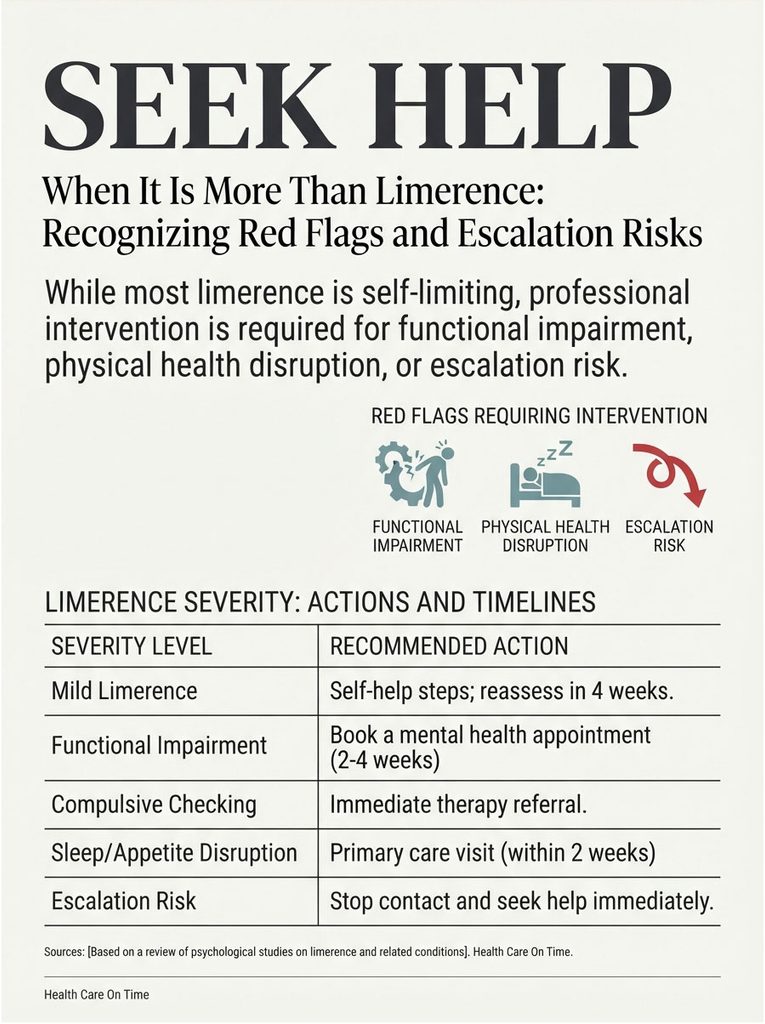
Most limerence is painful and self-limiting. A minority of situations need professional help now rather than a self-help plan.
Red Flags Worth Taking Seriously
Monitoring behavior is the clearest line. Limerence has been proposed as a factor in situations including stalking and self-harm, which is why escalating contact or surveillance is treated seriously in the literature.
Overlap with other conditions is the second. If the preoccupation arrives alongside mood episodes, persistent doubt-driven checking, or a broader pattern of unstable relationships, the correct label changes the correct treatment.
The third is despair after rejection. If hopelessness sets in, that is a reason to reach out immediately rather than wait and see.
Table 3: What to Do, Based on Where You Are
| Your situation | What it likely reflects | Recommended action | Timeframe |
| Thinking about them daily, life otherwise running normally | Early or mild limerence | Apply Steps 1 through 5 yourself and track for change | Reassess in 4 weeks |
| Missing work, classes, or deadlines because of it | Functional impairment | Book a mental health appointment | Within 2 to 4 weeks |
| Checking their profiles many times daily | Compulsive reassurance-seeking | Contact and information audit, then therapy referral | Start today |
| Sleep or appetite disrupted for over two weeks | Neglect dimension is active | Primary care visit, request a mental health referral | Within 2 weeks |
| Following, monitoring, or unwanted repeated contact | Escalation risk | Stop contact and seek professional help | Same week |
| Never formally assessed for ADHD | Untreated amplifier | Request a full adult ADHD evaluation | Within 1 to 2 months |
| Hopelessness or thoughts of harming yourself | Requires immediate support | Call or text 988, the Suicide and Crisis Lifeline | Immediately |
In cases reviewed by our team, the middle rows are where people wait longest. Two weeks of disrupted sleep is a reasonable trigger to make an appointment, not something to tolerate for a year while hoping it resolves on its own.
Frequently Asked Questions
Is limerence a mental illness?
No. Limerence is not listed in the DSM-5-TR or ICD-11 as a disorder. It is a described psychological state that can cause genuine impairment. Treatment targets the distress and any associated conditions rather than a limerence diagnosis, since no formal diagnostic criteria exist yet.
Is limerence a symptom of ADHD?
It is not a recognized ADHD symptom. There is limited research on limerence in ADHD, though features like hyperfocus, impulsivity, and emotional regulation difficulties may raise the likelihood. Limerence also appears alongside anxiety, OCD, and autism, so it is not ADHD-specific.
How long does ADHD limerence last?
Reported durations typically span one to seven years. Length depends mainly on whether the uncertainty gets resolved rather than on time passing. Episodes that receive a clear answer, in either direction, tend to end faster than those left permanently ambiguous.
What is the difference between limerence and hyperfixation?
Hyperfixation is an attention pattern that can attach to anything, including a person, and shifts when interest moves elsewhere. Limerence specifically involves craving reciprocation from one person, with mood tracking their signals. Hyperfixation is about focus; limerence is about longing.
Does no contact work for limerence?
Reducing contact removes the ambiguous signals that keep rumination running, which usually helps. It works far better paired with rebuilding neglected areas of life. Going no contact while spending the freed hours checking their social media accomplishes very little.
Can ADHD medication reduce limerence?
No medication is approved for limerence. Treating ADHD may reduce the emotional intensity and impulsivity that amplify the loop, which some people find lowers the overall volume. Discuss this with your prescriber rather than adjusting anything on your own.
Is limerence the same as OCD?
They overlap but differ. Models of limerence reflect elements of both OCD and addiction, though limerence involves interpersonal dynamics with a real person that OCD models do not typically capture. OCD-focused therapy has been used for limerence in at least one published case.
Why is limerence stronger when the person is unavailable?
Unavailability creates uncertainty, and uncertainty is the primary driver. Higher uncertainty about whether feelings are mutual predicts higher desire and more rumination. Clear reciprocation and clear rejection both tend to reduce intensity over time.
Can you experience limerence for a friend or coworker?
Yes. Limerence occurs across friendships, mentorships, and admiration of public figures, not only romantic contexts. Non-romantic limerence carries extra embarrassment for many people, which delays help-seeking. The management steps are identical.
Can you be limerent while in a happy relationship?
Yes, and it is a common source of distress. Limerence targets someone outside the relationship and runs on fantasy and uncertainty, neither of which an established partnership supplies. Individual therapy, sometimes alongside couples work, is a reasonable route.
Does limerence mean I have an anxious attachment style?
Not necessarily. The validation study found only a small correlation between limerence and anxious attachment, r = .155, and no significant link to avoidant attachment. Attachment style is one contributing factor, not something you can infer from being limerent.
When should I see a therapist about ADHD limerence?
Book an appointment if it is affecting your work, sleep, or other relationships for more than two to three weeks, if you are monitoring the person, or if rejection triggers hopelessness. Earlier is better, since longer episodes tend to become harder to interrupt.
Medical Disclaimer
This article is for general education and does not replace evaluation by a licensed clinician. It does not diagnose any condition or recommend treatment for any individual. If limerence is affecting your daily functioning, speak with a licensed mental health professional or your primary care provider. If you are in crisis or having thoughts of harming yourself, call or text 988 to reach the Suicide and Crisis Lifeline in the United States, available 24 hours a day.
References
- Marshall L, Waldeck D, Pancani L, Churchill S, Tyndall I. Development and Validation of the Limerence Questionnaire (LQ-11). Psychological Reports, 2025
- CDC, National Center for Health Statistics. Visits to Health Centers by Adults With ADHD: United States, 2023. NCHS Data Brief No. 543
- CDC. Attention-Deficit/Hyperactivity Disorder Diagnosis and Treatment Among Adults. MMWR 73(40)
- Hupfeld KE, Abagis TR, Shah P. Living “in the zone”: hyperfocus in adult ADHD. ADHD Attention Deficit and Hyperactivity Disorders, 2019
- Hupfeld KE, et al. Validation of the dispositional adult hyperfocus questionnaire (AHQ-D). Scientific Reports, 2024
- The lived experience of rejection sensitivity in ADHD: a qualitative exploration. PMC
- 988 Suicide and Crisis Lifeline