Penn State researchers once served a group of women the same casserole two different ways. One version came with a glass of water on the side. The other had that identical water blended into the dish as soup. Only the soup group ate less at the course that followed.
Table of Contents
Same food. Same water. Opposite outcome. That 1999 finding explains more about cucumbers than every “96% water” headline written since, and almost nobody writing about cucumber weight loss has ever mentioned it.
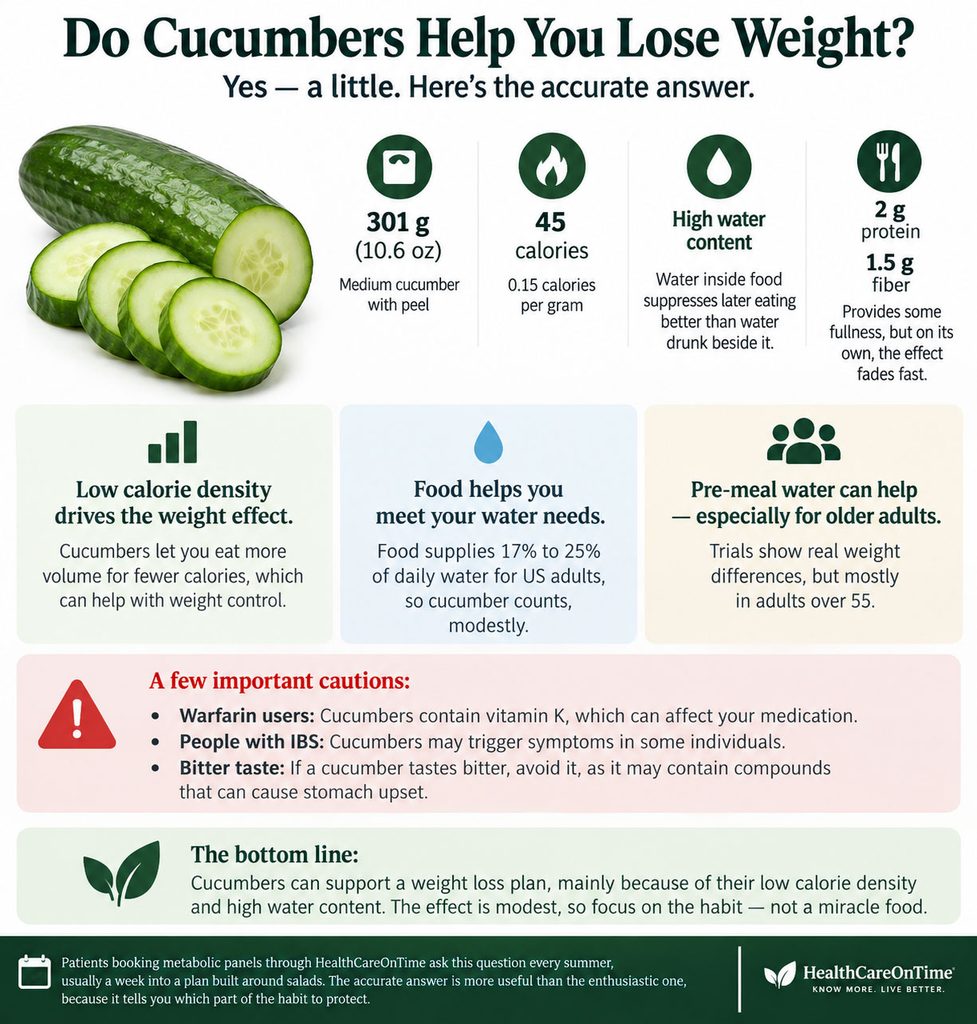
Quick Answer: Yes, cucumber helps with both, through one mechanism rather than magic. At 15 calories and 95% water per 100 grams (3.5 ounces), it lowers the calorie density of any plate it joins, so you eat the same volume for fewer calories. A medium cucumber also supplies about 9.7 fluid ounces of water, slightly more than a standard glass. It burns no fat, flushes no toxins, and cannot replace drinking water.
Six things to know before you scroll:
- Cucumber works by displacement, not by burning anything.
- Eaten as a first course, a low-calorie vegetable cut total meal intake by up to 12% in controlled trials.
- Dressing reverses the effect entirely. The same salad can raise intake 17% instead.
- One medium cucumber gives roughly 9.7 fluid ounces of water, about one glass.
- It is a weak rehydration tool after heavy sweating, carrying only 6 mg of sodium.
- Cucumber water and cucumber are not the same intervention, and the research says so.
At a Glance
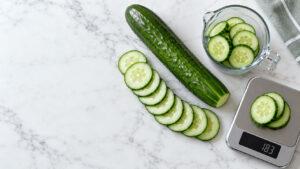
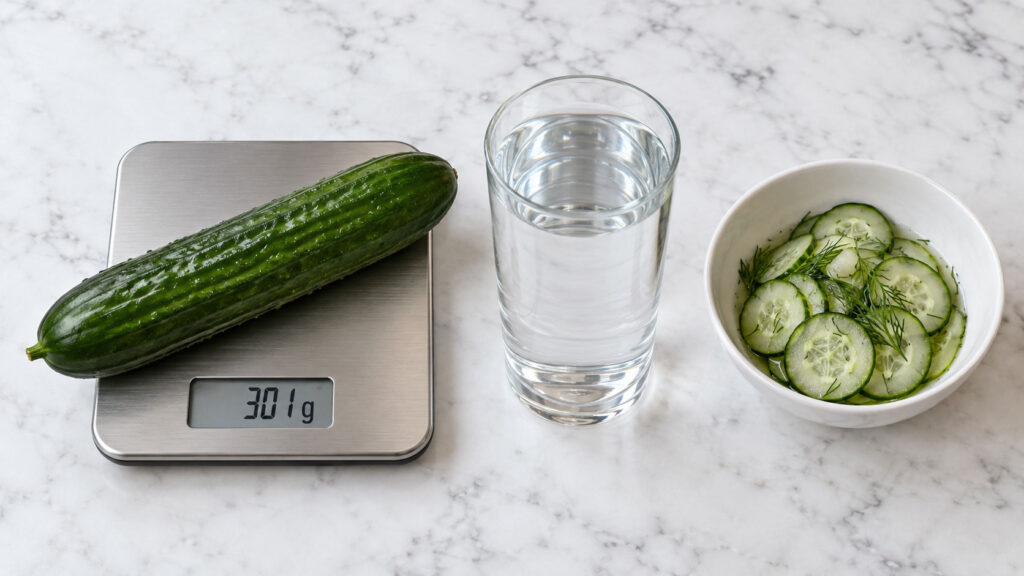
A medium cucumber with peel weighs 301 grams (10.6 ounces), holds 45 calories, and runs 0.15 calories per gram.
Calorie density, not any compound inside cucumber, drives the weight effect.
Water bound inside food suppresses later eating better than water drunk beside it.
Pre-meal water trials show genuine weight differences, but mostly in adults over 55.
Food supplies 17% to 25% of daily water for US adults, so cucumber counts, modestly.
A whole cucumber holds 2 grams of protein and 1.5 grams of fiber, so fullness on its own fades fast.
Warfarin users, people with IBS, and anyone holding a bitter cucumber need the section near the end.
Patients booking metabolic panels through HealthCareOnTime ask this question every summer, usually a week into a plan built around salads. The accurate answer turns out to be more useful than the enthusiastic one, because it tells you which part of the habit to protect.
What a Cucumber Actually Delivers
Strip away the spa imagery and a cucumber is a specific nutritional object: water with a small amount of carbohydrate suspended in it, wrapped in a thin skin carrying most of the micronutrients. Everything useful about it follows from that structure.
The three numbers that matter
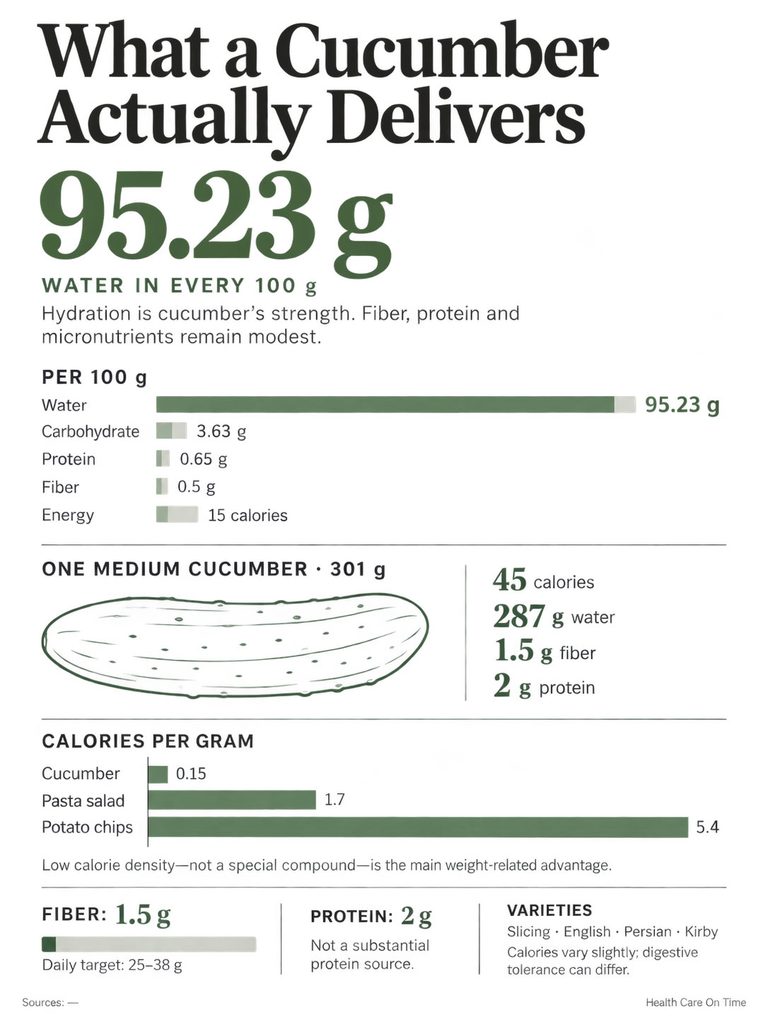
Per 100 grams (3.5 ounces) of raw cucumber with the peel on, USDA FoodData Central lists 15 calories, 95.23 grams of water, 3.63 grams of carbohydrate, 0.5 grams of fiber, and 0.65 grams of protein. Sodium sits at 2 mg, potassium at 147 mg.
Scale that to a whole medium cucumber, the 8-and-a-quarter-inch size USDA weighs at 301 grams (10.6 ounces), and you land at 45 calories, roughly 287 grams of water, 1.5 grams of fiber, and 2 grams of protein.
The figure doing the real work is calorie density: 0.15 calories per gram. Cooked pasta salad runs near 1.7. Potato chips run 5.4. Full portion math for every cucumber size sits in our cucumber calories breakdown.
What it does not give you
Cucumber is not a fiber food. A whole one delivers 1.5 grams against a daily target of 25 to 38 grams, which is about 5% of a day of fiber inside a vegetable that takes real time to chew.
It is not a protein food either. Two grams will not blunt appetite for long, which is exactly why a cucumber-only snack leaves people hungry an hour later and then puzzled about it.
And it is not an electrolyte food. Six milligrams of sodium in a whole cucumber becomes the deciding number later, once the question shifts from hydration to rehydration.
Not every cucumber on the shelf is the same
American grocery stores stock at least four types, and the differences matter more for tolerance than for calories. USDA analyses place every raw cucumber variety in the same narrow band of 15 to 16 calories per 100 grams.
The standard American slicing cucumber runs 8 to 9 inches with a waxed skin and developed seeds. English or hothouse cucumbers run 12 to 14 inches, arrive shrink-wrapped, and carry a thinner skin with smaller seeds, which is why people who bloat on slicing cucumbers often tolerate them.
Persian cucumbers weigh about 3 ounces each, roughly a third of a medium slicer, and Kirby pickling cucumbers run smaller still at 2 to 2.5 ounces. Our nutrition reviewers point out that portion confusion usually traces back here, since three Persian cucumbers make one medium slicer.
| Food or drink | Typical serving | Calories | Water (fl oz) | Calories per gram | Protein + fiber (g) |
| Cucumber, with peel | 1 medium, 301 g (10.6 oz) | 45 | 9.7 | 0.15 | 3.5 |
| Cucumber, sliced | 1 cup, 104 g (3.7 oz) | 16 | 3.3 | 0.15 | 1.2 |
| Plain water | 8 fl oz | 0 | 8.0 | 0.00 | 0.0 |
| Watermelon, diced | 1 cup, 152 g (5.4 oz) | 46 | 4.7 | 0.30 | 1.5 |
| Celery, chopped | 1 cup, 101 g (3.6 oz) | 14 | 3.3 | 0.14 | 2.3 |
| Greek yogurt, plain nonfat | 6 oz, 170 g | 100 | 4.9 | 0.59 | 17.0 |
Table 1. Cucumber against common weight-loss and hydration foods. Source: USDA FoodData Central.
Read that table across rather than down and the picture sharpens. Cucumber wins decisively on calorie density and loses just as decisively on protein. Celery edges it on fiber. Plain water still delivers the most fluid per serving by a wide margin, and it takes twenty seconds.
The Weight Loss Case, and What Actually Drives It
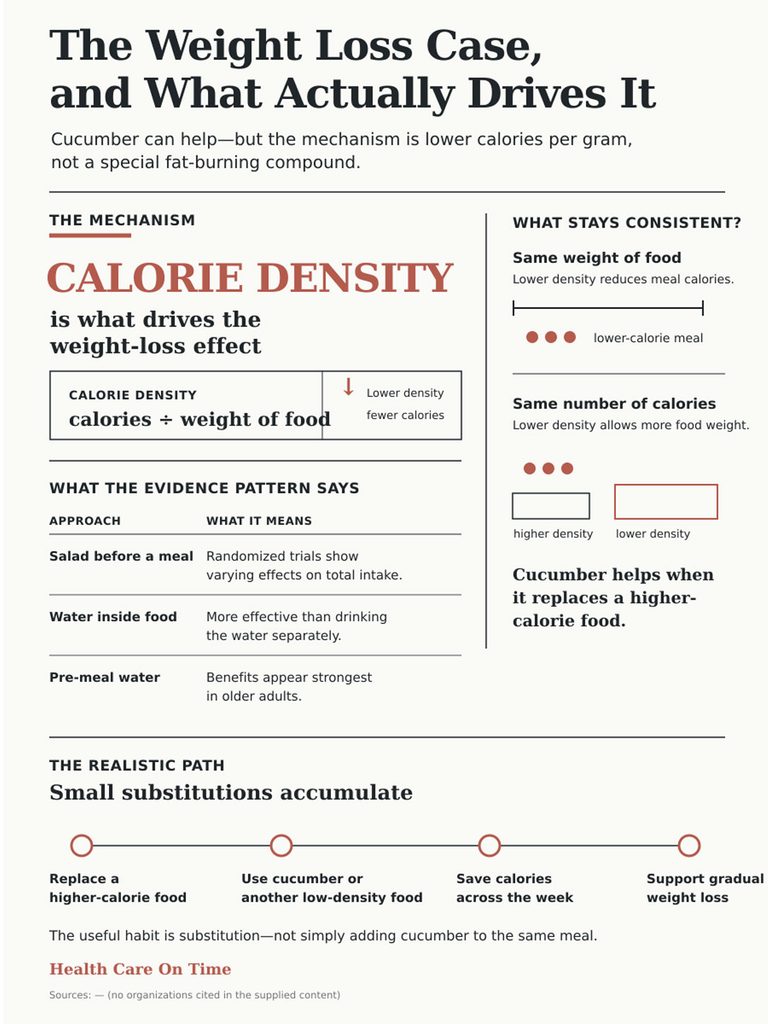
No compound in cucumber raises metabolic rate. Nothing in it signals fat cells to release energy. What cucumber changes is the arithmetic of the plate it lands on, and that turns out to be enough.
Calorie density is the whole mechanism
People eat a fairly consistent weight of food from day to day, not a consistent number of calories. Barbara Rolls at Penn State built three decades of research on that single observation.
Several clinical trials have shown that reducing the energy density of the diet by adding water-rich foods such as fruits and vegetables was associated with substantial weight loss even when patients were not told to restrict calories. The loss came from changing what filled the plate, not from counting anything on it.
Cucumber sits close to the theoretical floor for calorie density in a solid food. Adding 150 grams (5.3 ounces) to a lunch adds bulk, chew time, and 23 calories.
The salad trials
The cleanest test of this using an actual vegetable course comes from a randomized crossover trial of 42 women at Penn State. Participants ate lunch in the laboratory once a week for seven weeks, receiving one of six first-course salads or no salad at all, followed by a pasta main course they could eat freely. The salads varied in energy density at 0.33, 0.67, or 1.33 calories per gram and in portion size at 150 or 300 grams.
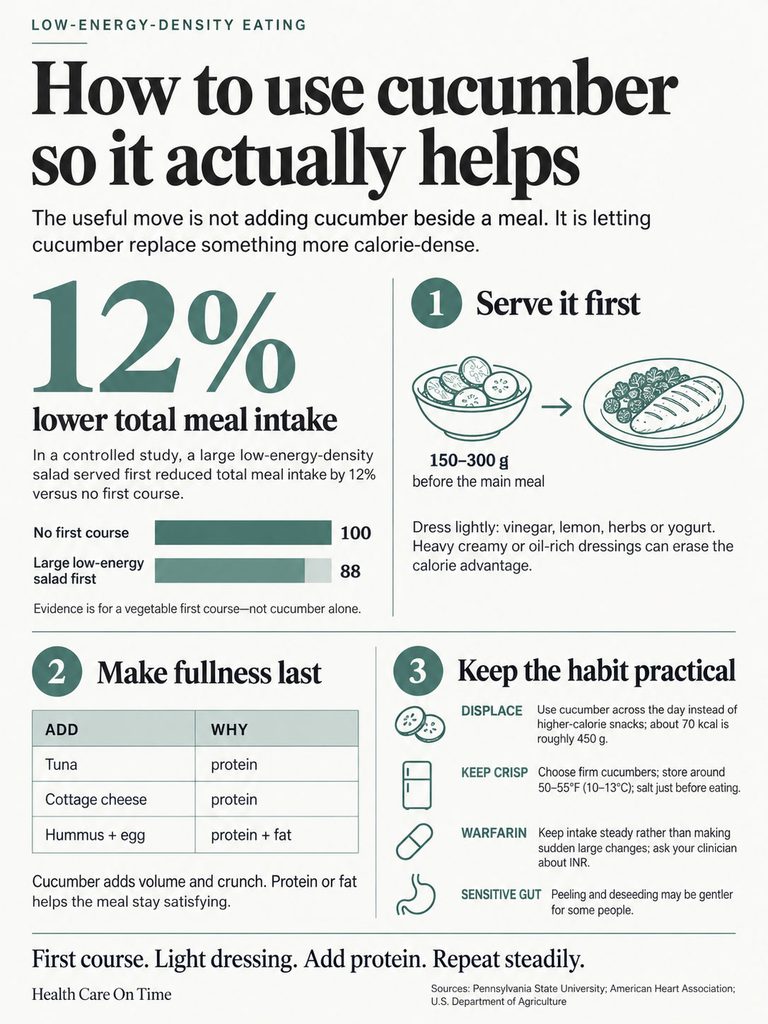
The results split hard in both directions. Compared with having no first course, the low-calorie-dense salads reduced total meal intake by 7% for the small portion and 12% for the large, while the high-calorie-dense salads increased intake by 8% and 17%.
Read that twice. The same bowl of vegetables either cut the meal by 12% or added 17% to it, depending entirely on what went on top.
A later trial from the same lab tested timing rather than composition. Compared with having no salad, consuming a 300-gram low-density salad first decreased intake at the following course by 123 calories.
One honest accounting note that competitor pages skip: that 123-calorie figure describes the pasta course alone, not the meal including the salad. The 7% and 12% numbers from the earlier trial are the ones that already net out the calories of the vegetable itself, which is why this article leans on those.
These trials date from 2004 and 2012. The mechanism has been replicated many times since, but the specific percentages come from small single-site samples of women, and nobody has run the equivalent study using cucumber by itself.
Water inside food beats water beside it
Back to the casserole. Rolls, Bell, and Thorwart published that experiment in the American Journal of Clinical Nutrition in 1999 under a title that gives away the finding: water incorporated into a food, but not served with a food, decreases energy intake.
Energy intake at the following course was significantly lower after the soup than after the casserole served either with or without a glass of water. Consuming foods with high water content reduced later energy intake more effectively than drinking water alongside food did.
Our medical reviewers flag this as the single most misunderstood point in the cucumber conversation. It is the reason eating a cucumber and drinking cucumber water are not interchangeable, however similar the ingredient list looks.
What the pre-meal water trials add
Drinking water before meals does help some people, and cucumber routinely gets credit for results that belong to these studies instead.
In a 12-week randomized trial published in Obesity, 48 adults aged 55 to 75 with a BMI between 25 and 40 followed either a reduced-calorie diet alone or the same diet plus 500 mL (about 17 fluid ounces) of water before each of three daily meals. The water group lost roughly 2 kg (4.4 pounds) more across 12 weeks, a 44% greater decline.
A UK primary care trial replicated the direction with a smaller effect. Among 84 adults with obesity, those drinking 500 mL of water 30 minutes before main meals lost 1.3 kg (2.9 pounds) more than the comparison group at 12 weeks.
The catch is age. Consuming 375 to 500 mL of water half an hour before a meal has been shown to reduce energy intake in older adults but not in younger ones. If you are 32, the glass of water before dinner is a weaker lever than the marketing implies, and the cucumber, because its water is bound inside food, may do what the glass cannot.
The swap arithmetic
Most of the real-world value of cucumber shows up as substitution rather than addition. Here is what that looks like in calories across a week.
| The swap | Calories before | Calories after | Saved per week |
| 1 oz potato chips to 1 cup cucumber slices | 152 | 16 | 952 |
| 12 oz regular cola to 12 oz cucumber water | 140 | 0 | 980 |
| 2 tbsp ranch dip to 2 tbsp hummus | 130 | 50 | 560 |
| Afternoon crackers to half a cucumber | 120 | 23 | 679 |
| Small fries to a cucumber and tomato side | 230 | 30 | 1,400 |
| 1 cup pasta salad to 1 cup cucumber salad | 250 | 45 | 1,435 |
Table 2. Weekly calorie savings from single daily swaps. Calorie values from USDA FoodData Central.
A single daily swap from the middle of that range covers roughly 700 to 1,000 calories a week. Sustained, that is meaningful, and it is also the entire story. No cucumber protocol will beat plain substitution.
What a realistic week actually produces
Run the 12% figure against a typical American 700-calorie dinner and a cucumber first course saves about 84 calories after its own calories are counted. Do it at lunch and dinner and the daily figure lands near 168 calories.
Across a week that is roughly 1,176 calories, or about a third of a pound of body weight at the standard 3,500-calorie estimate. Over a month, somewhere between 1 and 1.5 pounds.
That number disappoints people, and it should not. Weight change compounds, and a habit that costs nothing and requires no willpower beats an aggressive plan abandoned in nine days. In cases reviewed by our medical team, the patients who hold weight off are almost always the ones running small permanent swaps rather than short intense ones.
Context for the scale of the problem: CDC data show adult obesity prevalence at 40.3% during August 2021 through August 2023, with severe obesity at 9.4%. The rate among adults aged 40 to 59 reached 46.4%, higher than 35.5% in adults 20 to 39 or 38.9% in those 60 and older.
The Hydration Case, in Fluid Ounces
“Cucumbers are 96% water” is technically correct and practically useless. What people need is the figure in the units printed on their water bottle.
One cucumber versus one glass
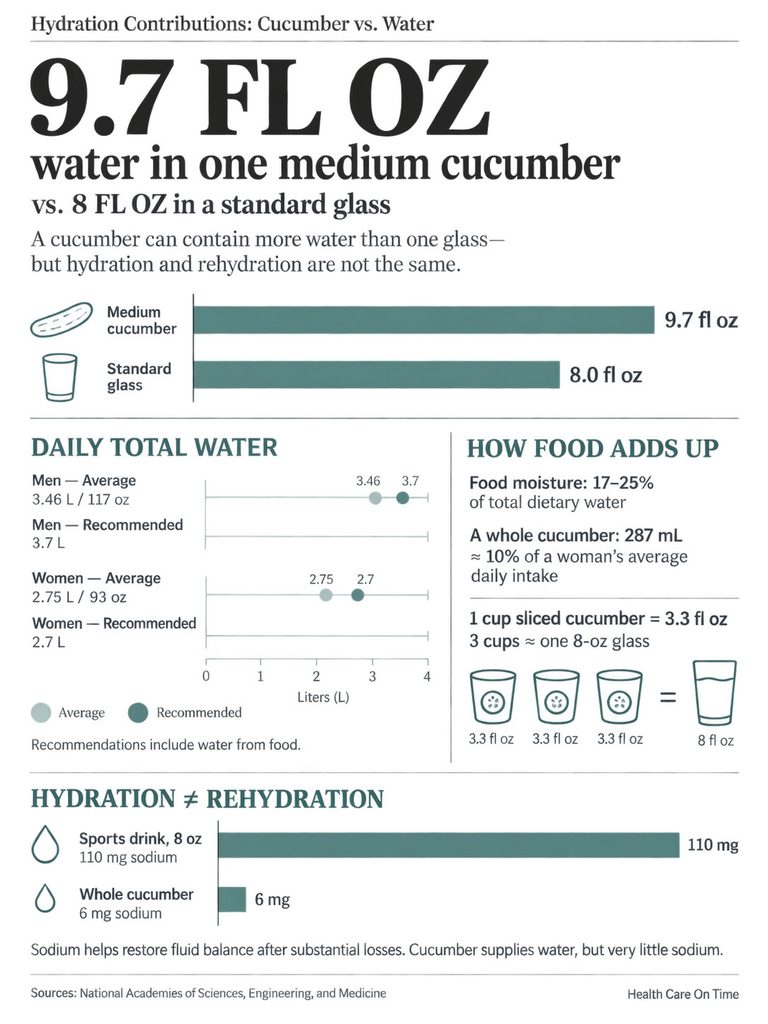
A medium 301-gram cucumber carries about 287 grams of water, which converts to roughly 9.7 fluid ounces. That is slightly more than a standard 8-ounce glass.
So one cucumber does equal about one glass of water, with 45 calories and several minutes of chewing attached. That is the honest comparison no competing page bothers to run.
A cup of sliced cucumber, the portion most people actually eat, contributes about 3.3 fluid ounces. Three cups are needed to match one glass.
Where food water fits into the American day
Food moisture is a real and underrated contributor. An analysis of 15,702 US adults from NHANES 2005 through 2010 found that water in foods supplied 17% to 25% of total dietary water depending on age, while plain water contributed 30% to 37%.
The totals are larger than most people assume. Between 2009 and 2012, average daily total water intake from all foods and liquids reached 3.46 liters (117 ounces) for US men, with 30% coming from plain water, and 2.75 liters (93 ounces) for women, with 34% from plain water.
Measured against a woman daily total of 2.75 liters, the 287 mL inside one cucumber represents about 10% of her full day of water from every source combined. Not trivial, and not a substitute for a water bottle.
When cucumber is the wrong hydration tool
Hydration and rehydration are different problems with different solutions. Holding fluid balance on an ordinary day is hydration. Replacing what left through sweat, vomiting, or diarrhea is rehydration, and that requires sodium.
A whole cucumber contains 6 mg of sodium. A standard sports drink carries around 110 mg per 8 ounces, and an oral rehydration solution carries considerably more. Fluid without sodium passes through faster and does less to restore blood volume.
Research on fluid retention supports the distinction. In a trial testing 13 beverages, only four scored significantly above plain water for retention at two hours. Coffee, tea, cola, lager, sparkling water, and a sports drink showed no difference from water at all, while an oral rehydration solution and milk retained roughly 1.5 times as much.
The common feature among the winners is electrolytes plus a little energy. Cucumber offers almost neither.
Summer, heat, and outdoor work
This matters most from June through September, and most of all for people working outdoors. A roofer in Phoenix at 105 degrees Fahrenheit or a landscaper in Houston humidity can lose one to two quarts of sweat per hour, carrying 500 to 1,500 mg of sodium with every quart.
Replacing that with cucumber alone would take an impossible volume and still leave the sodium debt unpaid. Worse, high-volume plain fluid without electrolytes can push blood sodium down rather than restoring it.
Across the patients our diagnostic network serves, the late-summer electrolyte panels that come back abnormal usually belong to people who did everything right on fluid volume and nothing at all on sodium. Cucumber belongs in the cooler as food, not as the rehydration plan.
Does it count toward your daily goal?
Yes. The National Academies set adequate total water intake at 3.7 liters daily for men and 2.7 liters for women, and both figures explicitly include water from food.
The practical limit is speed. Drinking 9.7 ounces takes twenty seconds. Eating 9.7 ounces of cucumber takes several minutes and adds 45 calories. As a hydration strategy it is slow. As a vegetable strategy it is excellent.
| Statistic | Figure | Population | Source |
| Adult obesity prevalence | 40.3% | US adults 20 and older | CDC NCHS Data Brief 508 |
| Severe obesity prevalence | 9.4% | US adults 20 and older | CDC NCHS Data Brief 508 |
| Obesity, ages 40 to 59 | 46.4% | US adults | CDC NCHS Data Brief 508 |
| Total daily water, all sources | 3.46 L men, 2.75 L women | US adults 20 and older | CDC NCHS Data Brief 242 |
| Share of water from food moisture | 17% to 25% | US adults, n = 15,702 | BMC Public Health, 2013 |
| Adults inadequately hydrated | 32.6% | US adults 18 to 64, n = 9,528 | Annals of Family Medicine, 2016 |
| Adults meeting vegetable recommendations | 10.0% | US adults | CDC BRFSS |
Table 3. US weight and hydration statistics with source attribution.
Three Claims That Fall Apart
“Cucumber water flushes fat and toxins”
There is no mechanism behind this. Detoxification runs through the liver and kidneys, and neither organ works faster because a vegetable soaked in a pitcher for an hour.
What cucumber water genuinely does is make plain water more appealing, which raises total intake among people who find water boring. That is a behavioral win worth having, just not a metabolic one.
Nutrient transfer is also minimal. Most of the potassium and vitamin K stays locked inside the slices, which is the practical argument for eating them rather than fishing them out.
“You are not hungry, you are thirsty”
This claim traces to a real study that gets consistently oversold. Among 9,528 US adults aged 18 to 64, those classified as inadequately hydrated by urine osmolality carried BMIs 1.32 kg/m2 higher and 1.59 times the odds of obesity after adjustment for age, race, sex, and income.
The authors also report that 32.6% of the sample was inadequately hydrated, and they state directly that causality and directionality cannot be established from a cross-sectional design.
The arrow could point either way. Larger bodies need more water, and people eating more processed food take in less water from food. Patients commonly ask us whether drinking water can substitute for eating, and the answer stays the same: it postpones hunger by a few minutes, it does not replace a meal.
“The cucumber diet drops 15 pounds in a week”
The cucumber diet is severe calorie restriction wearing a vegetable costume. It works the way all severe restriction works, and it ends the same way.
Most of what moves on the scale in seven days is water and stored glycogen rather than fat. Each gram of glycogen holds roughly three grams of water with it, so depleting stores drops scale weight fast and refilling them restores it just as fast.
There is also no published trial of the cucumber diet. Any specific pound figure attached to it was invented by whoever wrote the page carrying it.
How to Use Cucumber So It Actually Helps
The pre-meal plate
Treat cucumber as a first course, not a side dish. The trials that produced measurable results made the vegetable course compulsory and served it before the main plate arrived.
A workable portion is 150 to 300 grams (5.3 to 10.6 ounces), which is half to one whole medium cucumber. Eat it in the five to ten minutes before the main meal rather than alongside it.
Keep the total topping under roughly 100 calories. That is the ceiling the Penn State work points toward, and crossing it flips the effect.
The dressing trap
Two tablespoons of ranch add about 130 calories to a 23-calorie pile of cucumber. The vegetable is now 15% of the dish by calories and the dressing is 85%.
This is precisely how a low-density salad becomes the version that raised meal intake by 17%. The cucumber did not fail. It got outvoted.
Better anchors: rice vinegar with dill, lemon and cracked pepper, two tablespoons of hummus, or a spoonful of plain Greek yogurt with garlic. Each lands under 60 calories and holds the ratio.
Pairing so fullness lasts
Cucumber alone produces short satiety because there is almost no protein or fat to slow gastric emptying. Pair it with something that has staying power.
Combinations that stay under 200 calories: cucumber with 3 ounces of canned tuna, cucumber with half a cup of cottage cheese, or cucumber with two tablespoons of hummus plus a hard-boiled egg.
Our medical reviewers note that the patients who report success with vegetable-forward eating are nearly always pairing rather than substituting. The ones who stall are usually eating cucumber instead of protein rather than alongside it.
Buying and storing so you actually eat it
Habits die in the crisper drawer. Choose firm cucumbers with no soft spots, and skip any that feel light for their size, which usually means they have started drying out.
Store them between 50 and 55 degrees Fahrenheit rather than in the coldest part of the refrigerator, where they develop watery pits within a few days. The door shelf or the front of a middle shelf works better than the back wall.
Slice for the week only two or three days ahead, keep the slices in a sealed container with a paper towel, and salt them at the moment of eating rather than in advance. Salted early, they weep and go limp.
A realistic day
Breakfast stays normal. Mid-morning, half a cucumber with a wedge of cheese. Lunch opens with a cucumber and tomato bowl in vinegar, followed by the usual meal.
Afternoon, cucumber spears in place of the cracker habit. Dinner opens the same way lunch did. That runs roughly one and a half cucumbers across the day, about 70 calories, and it displaces several hundred.
| Your situation | Do this | Skip this | Why |
| Trying to eat less at dinner | Eat 150 to 300 g of cucumber 10 minutes before the meal | Serving it as a side alongside | Pre-meal vegetable courses cut total meal intake up to 12% |
| Just finished a hot outdoor shift | Fluids containing sodium, then food | Relying on cucumber to rehydrate | A whole cucumber carries 6 mg of sodium |
| Hungry at 9 pm | Cucumber plus a protein anchor | Cucumber alone | 2 g of protein will not hold you |
| Taking warfarin | Keep cucumber intake steady week to week | Sudden large increases | Vitamin K shifts the INR |
| IBS or frequent bloating | Peel it, deseed it, start at 75 g (2.6 oz) | Large raw portions | Lowers the fermentable load |
| On a GLP-1 with low appetite | Protein first, cucumber second | Filling up on cucumber early | Calorie-free volume crowds out needed protein |
| Wanting the hydration benefit | Drink water and eat cucumber | Replacing water with cucumber | One cucumber equals about one glass |
Table 4. Scenario-to-action guide for using cucumber effectively.
Where Cucumber Fits in Federal Guidance
The Dietary Guidelines for Americans 2025-2030 place cucumber in the other vegetables subgroup, alongside onions, green beans, and mushrooms. A cup of raw cucumber counts as one cup-equivalent toward the vegetable target.
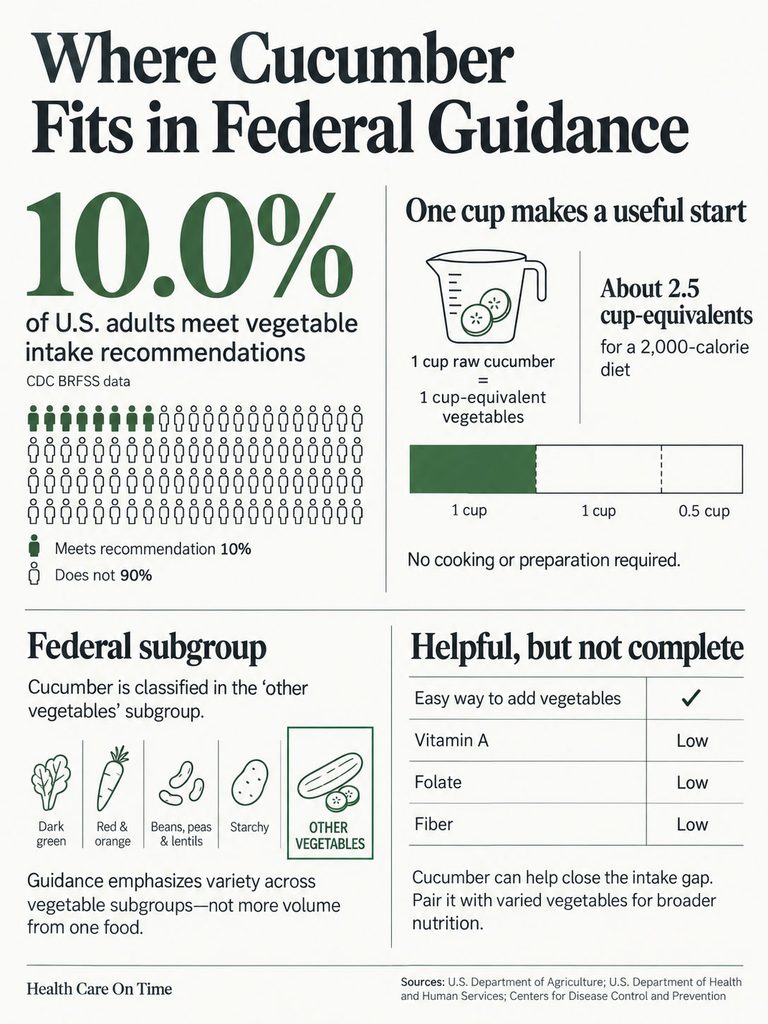
Most adults on a 2,000-calorie pattern are advised toward about 2.5 cup-equivalents of vegetables daily. Almost nobody reaches it. CDC BRFSS data put the share of US adults meeting vegetable recommendations at 10.0%.
That gap is the strongest case for cucumber that exists, and it has nothing to do with weight. A vegetable people will genuinely eat, uncooked, without preparation, closes part of a national shortfall that fancier vegetables have failed to close for decades.
The limitation is that cucumber is nutritionally thin compared with the vegetables Americans skip most. Meeting a target with cucumber alone would supply very little vitamin A, folate, or fiber, which is why the guidance emphasizes variety across subgroups rather than volume from one.
Who Should Be Careful
Warfarin and vitamin K
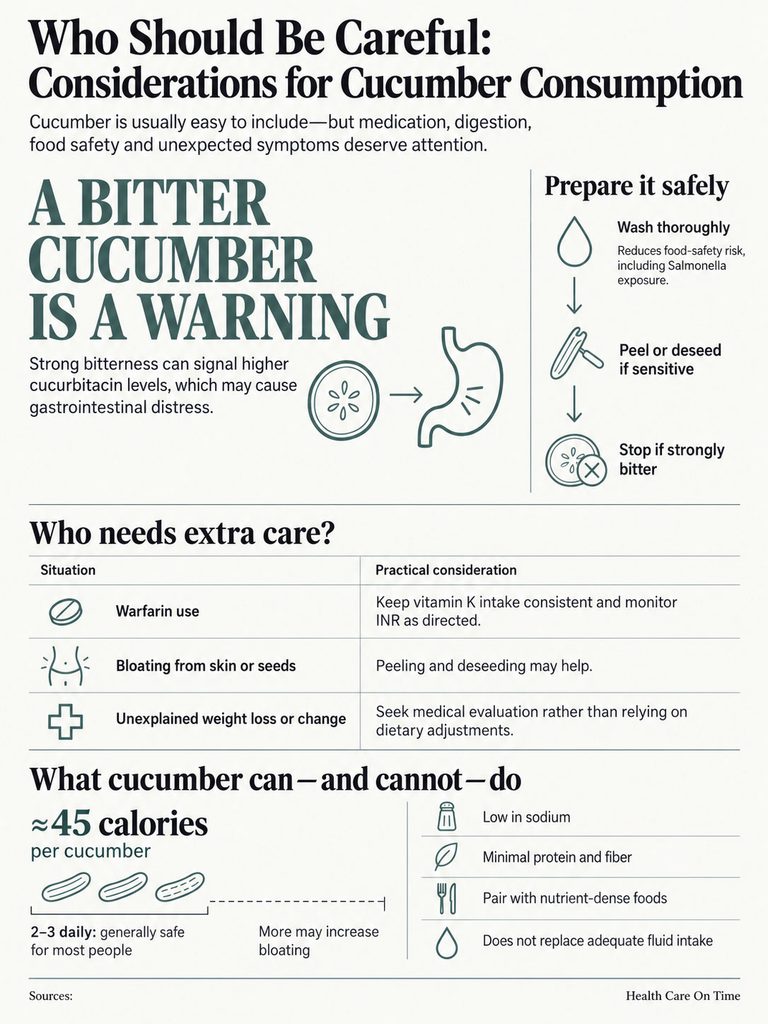
A whole medium cucumber carries roughly 49 mcg of vitamin K1, most of it in the peel. That is not a high figure, but consistency matters far more than quantity on warfarin.
Going from no cucumber to two a day changes your weekly vitamin K load and can shift your INR. Talk to whoever manages your anticoagulation before making that change, and see our warfarin guidance for the wider food list.
Bloating and IBS
Cucumber gets blamed for bloating constantly, and for some people the blame is earned. The skin and seeds carry most of the fermentable material.
Peeling and deseeding resolves it for many. Starting at 75 grams (2.6 ounces) and building gradually is the standard low-FODMAP approach, and English cucumbers with their thinner skin and smaller seeds are usually the easiest tolerated.
Food safety
This is missing from nearly every cucumber article online. Cucumbers have been tied to three multistate Salmonella outbreaks in the US since 2024, investigated jointly by CDC and FDA, producing hundreds of illnesses and dozens of hospitalizations across dozens of states.
Wash cucumbers under running water and scrub the skin before slicing, even when you plan to peel, since the knife carries surface bacteria into the flesh. Check FDA recall notices before buying in bulk.
Bitter cucumbers
A strongly bitter cucumber holds elevated cucurbitacin, a compound that causes vomiting and diarrhea in sensitive people. Poison control centers use a memorable rule: if it is bitter, it is not dinner.
Cooking does not inactivate it. Spit it out and discard the rest of that cucumber.
When weight loss is not the goal to chase
Not every reader arriving at this question should be pursuing weight loss at all. Weight that falls without effort, alongside fatigue, night sweats, or appetite loss, needs medical evaluation rather than a dietary plan.
Our lab partners report that unexplained weight change is one of the more common reasons a basic metabolic panel and thyroid test get ordered. If the scale is moving and you did not move it, that is a clinic visit, not a cucumber question.
Frequently Asked Questions
How many calories are in a whole cucumber?
A medium cucumber with the peel, 301 grams by USDA weight, contains about 45 calories. A cup of slices holds 16 calories and 100 grams holds 15. Peeling lowers the count slightly and removes most of the vitamin K. Our cucumber calories breakdown covers every portion size.
Does cucumber water burn belly fat?
No. No food or drink targets fat in a specific region of the body, and cucumber water contains essentially no calories to work with. Its genuine value lies in replacing sugary drinks and making plain water more appealing, which raises total fluid intake. Real benefits, just not the advertised ones.
How much water does one cucumber give you?
About 287 grams, or roughly 9.7 fluid ounces, from a medium 301-gram cucumber. That is slightly more than a standard 8-ounce glass. A cup of slices supplies about 3.3 fluid ounces, so three cups are needed to equal one glass of water.
Can cucumber replace drinking water?
No, for practical reasons more than physiological ones. Meeting a 2.7-liter daily target from cucumber alone would take about nine and a half whole cucumbers and 430 calories. Food water supplements drinking water, supplying 17% to 25% of the daily total for US adults.
How many cucumbers a day is too many?
No toxicity threshold exists, but two to three whole cucumbers daily is a sensible practical ceiling. Beyond that, bloating becomes common and the vegetable starts crowding out protein and fiber sources you need. Warfarin users should hold intake steady rather than maximizing it.
Is cucumber good for rehydrating after a workout?
Not on its own. Sweat removes sodium as well as water, and a whole cucumber carries only 6 mg of sodium. Eat it if you want, but pair it with a fluid containing electrolytes. Retention research consistently favors sodium-containing drinks over plain low-solute fluids.
Does eating cucumber before a meal really help?
The evidence supports it. In a controlled crossover trial, a low-calorie-density vegetable first course reduced total meal intake by 7% to 12%, and a 300-gram version cut intake at the following course by 123 calories. The effect depends entirely on keeping toppings light.
Is cucumber a good late-night snack?
It is a reasonable low-calorie option that will not hold you long. With 2 grams of protein and 1.5 grams of fiber in a whole cucumber, satiety fades quickly. Pairing it with cottage cheese, hummus, or a hard-boiled egg makes it considerably more useful at night.
Does peeling a cucumber change anything?
Yes. The peel carries most of the vitamin K, a share of the fiber, and most of the antioxidant content. Peeling drops a 100-gram serving from 15 to about 12 calories, which is negligible, but the micronutrient loss is real. Peel only if bloating or texture is the problem.
Why does cucumber cause bloating?
Usually the skin and seeds, which carry fermentable carbohydrates that gut bacteria act on. People with IBS notice it most. Peeling, deseeding, and starting at a 75-gram portion resolves it for many. Persistent bloating after small portions is worth raising with a clinician.
Is cucumber better than watermelon for hydration?
Per serving, watermelon wins slightly on convenience. A cup of diced watermelon gives 4.7 fluid ounces at 46 calories, while a cup of cucumber slices gives 3.3 fluid ounces at 16 calories. Per calorie, cucumber delivers roughly twice the water.
Can cucumber help with weight loss on a GLP-1 medication?
Use it carefully. Appetite is already suppressed on these medications, so the priority shifts to protein and micronutrients rather than volume. Filling limited stomach capacity with a near-zero-protein vegetable can worsen the muscle loss these drugs are already linked with. Protein first, cucumber second.
Disclaimer: This article provides general information and does not replace personalized medical advice. Anyone taking warfarin or another anticoagulant, managing diabetes, using a GLP-1 medication, or living with kidney disease should discuss dietary changes with their clinician first. Rapid or unexplained weight loss, persistent bloating, or ongoing dehydration symptoms call for medical evaluation rather than a dietary fix.
References
- CDC NCHS Data Brief 508, Obesity and Severe Obesity Prevalence in Adults. https://www.cdc.gov/nchs/products/databriefs/db508.htm
- CDC NCHS Data Brief 242, Daily Water Intake Among US Men and Women. https://www.cdc.gov/nchs/products/databriefs/db242.htm
- Rolls BJ, Roe LS, Meengs JS. Salad and satiety. J Am Diet Assoc. 2004;104(10):1570-6. https://pubmed.ncbi.nlm.nih.gov/15389416/
- Rolls BJ. The relationship between dietary energy density and energy intake. Physiol Behav. 2009;97(5):609-15. https://pubmed.ncbi.nlm.nih.gov/19303887/
- Dennis EA et al. Water Consumption Increases Weight Loss During a Hypocaloric Diet Intervention. Obesity. 2010. https://onlinelibrary.wiley.com/doi/full/10.1038/oby.2009.235
- Parretti HM et al. Efficacy of water preloading before main meals. Obesity. 2015. https://onlinelibrary.wiley.com/doi/10.1002/oby.21167
- Chang T et al. Inadequate Hydration, BMI, and Obesity Among US Adults. Ann Fam Med. 2016;14(4):320-4. https://www.annfammed.org/content/14/4/320
- Drewnowski A et al. Water and beverage consumption among adults in the United States. BMC Public Health. 2013;13:1068. https://link.springer.com/article/10.1186/1471-2458-13-1068
- Maughan RJ et al. Development of a beverage hydration index. Am J Clin Nutr. 2016;103(3):717-23. https://pubmed.ncbi.nlm.nih.gov/26702122/
- USDA FoodData Central. https://fdc.nal.usda.gov/food-search/