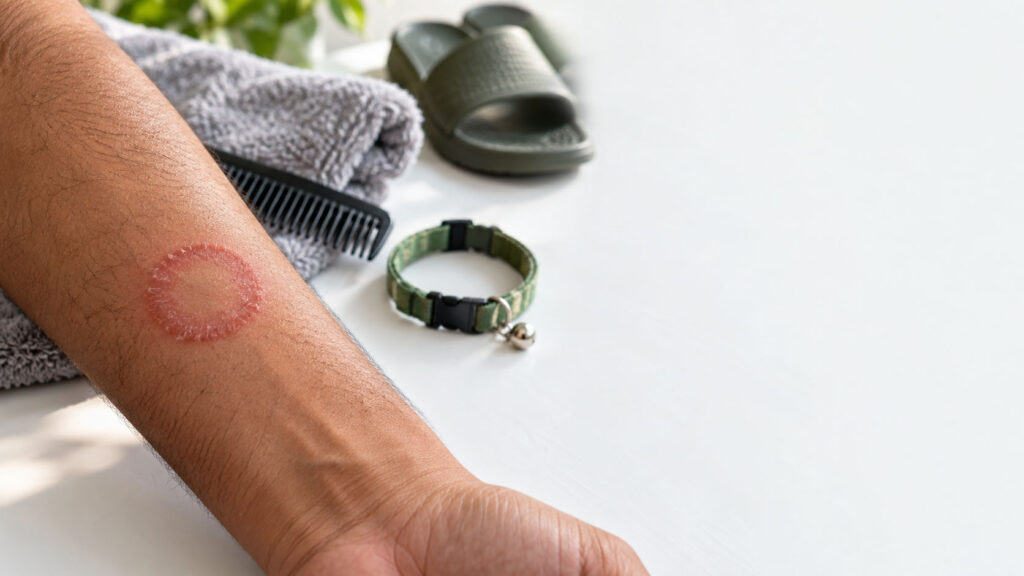
Most people who spot a red, scaly ring on their skin blame the family cat first. The data points somewhere else. If you’re wondering how do you get ringworm, the most likely answer in the United States is another person, and quite often your own feet.
Table of Contents
Our medical team has reviewed the latest CDC, state health department, and peer-reviewed data for this guide. That includes two new strains now spreading in the US.
Quick Answer: You get ringworm when a dermatophyte fungus lands on your skin, scalp, or nails and finds warm, damp skin to grow on. The most common routes are skin-to-skin contact with an infected person, spreading it from your own athlete’s foot or nail fungus, sharing towels or combs, walking barefoot on damp public floors, and touching an infected pet. Symptoms usually appear 4 to 14 days later.
The 7 main ways you get ringworm, from most to least common in the US:
- Skin-to-skin contact with an infected person
- Spreading it from your own feet or nails to other body parts
- Sharing towels, combs, hats, helmets, or bedding
- Walking barefoot on damp floors in locker rooms, showers, and pool decks
- Contact sports such as wrestling and jiu-jitsu
- Touching an infected pet or farm animal
- Sexual or intimate skin contact
How this order was built: no US study tracks every ringworm route directly. The ranking reflects which fungi labs find most often in American rashes, since each fungus has a known source, along with how many people face each type of exposure.
At a Glance:
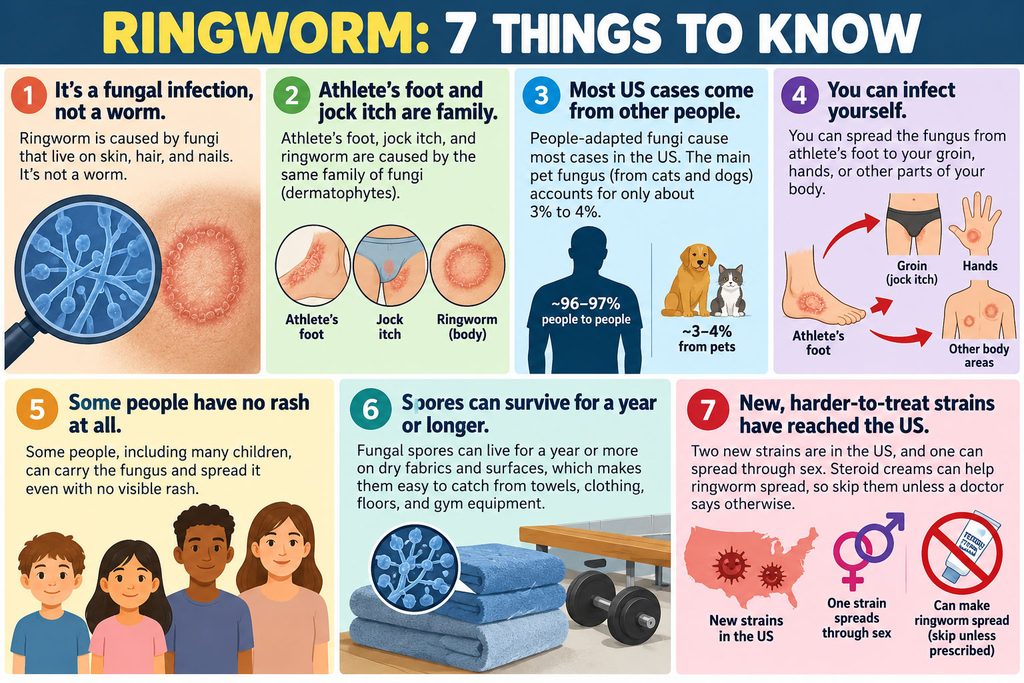
- Ringworm is a fungal infection, not a worm. Athlete’s foot and jock itch belong to the same family.
- People-adapted fungi cause most US cases; the main pet fungus accounts for only about 3% to 4%.
- You can infect yourself by spreading athlete’s foot to your groin, hands, or body.
- Some people, including many children, carry the fungus with no rash at all.
- Spores can survive a year or longer on dry fabrics and surfaces.
- Two new, harder-to-treat strains have reached the US, and one spreads through sex.
- Steroid creams can help ringworm spread, so skip them unless a doctor says otherwise.
What Ringworm Actually Is (and Why There’s No Worm)
Ringworm is a skin infection caused by a group of molds called dermatophytes. They feed on keratin, the tough protein in the outer layer of your skin, hair, and nails. The name comes from the ring-shaped rash, not from any worm.
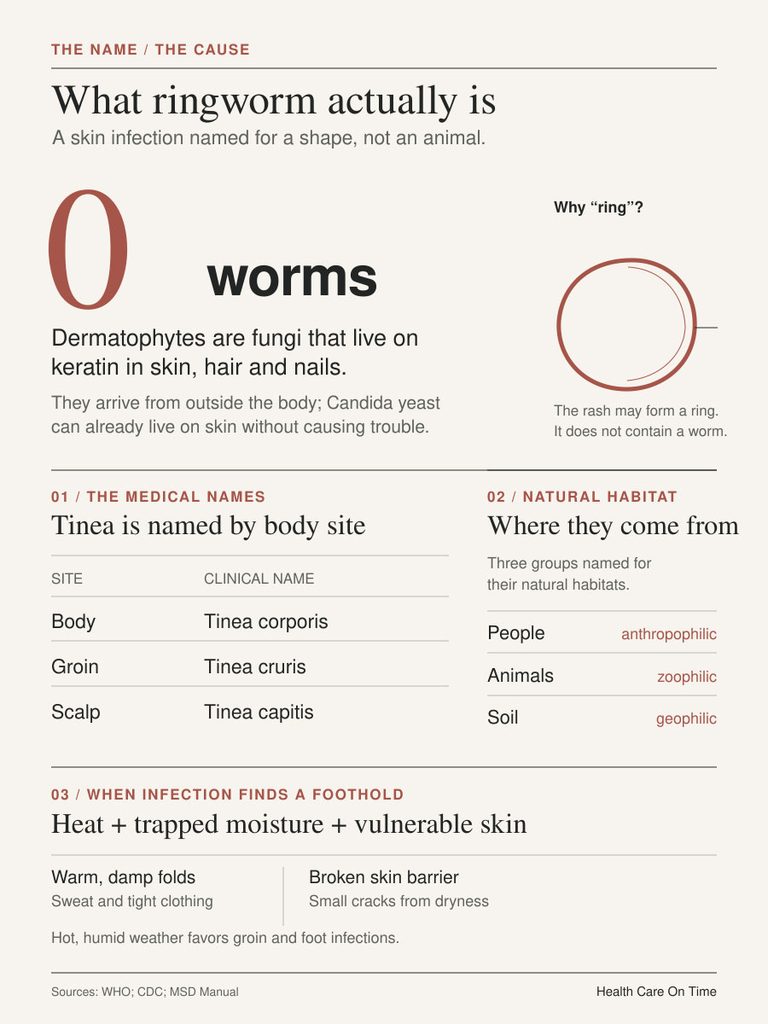
Doctors call it tinea, followed by the Latin name for the body part. Athlete’s foot, jock itch, and most fungal nail infections are all forms of ringworm, according to the CDC. Tinea corporis is body ringworm, tinea cruris is jock itch, and tinea capitis is scalp ringworm.
Some health pages say the ringworm fungus lives on everyone’s skin and only grows when things turn hot and damp. That describes yeasts like Candida. Dermatophytes come from an outside source, so every case has a real answer to where it came from.
The Three Fungus Families
Dermatophytes fall into three groups based on where they naturally live:
- People-loving fungi, such as Trichophyton rubrum and Trichophyton tonsurans. They pass from person to person and often cause mild, slow rashes that people ignore for months.
- Animal-loving fungi, such as Microsporum canis from cats and dogs, and Trichophyton verrucosum from cattle. In people, they tend to cause red, angry, fast-growing rashes.
- Soil-loving fungi, such as Nannizzia gypsea. Human cases are uncommon.
Why Warm, Damp Skin Opens the Door
Touching the fungus doesn’t guarantee an infection. The fungus needs skin that stays moist, rubbed, or slightly damaged. That’s why skin folds, sweaty feet, and the groin get hit most.
Tight clothing, heavy sweating, and extra body weight all raise the odds. So does skin that’s cracked from dryness or scratching.
Weather plays a part too. Groin and foot infections show up more often in hot, humid conditions, and they tend to return if the skin isn’t kept dry.
How Do You Get Ringworm? The 7 Main Ways
Every case starts with a source. The table below compares each route: how it happens, which fungus usually drives it, who’s most exposed, and the single best way to block it.

| Route | How It Happens | Main Fungus in the US | Evidence or Share of Cases | Most Exposed | Best Way to Block It |
| Another person | Hugs, shared beds, touching a rash | T. rubrum, T. tonsurans | T. rubrum 41% to 55% and T. tonsurans 31% to 45% of US isolates (older lab studies) | Families, teammates, daycare kids | Cover rashes; no shared beds or towels until treated |
| Your own body | Fungus moves from feet or nails to groin, hands, or body | T. rubrum | A main route for jock itch; nail fungus affects up to 14% of people | Anyone with athlete’s foot or nail fungus | Treat feet and nails; socks on before underwear |
| Shared items | Towels, combs, hats, helmets, sheets | Any dermatophyte | Spores survive 12+ months on dry surfaces | Households, barbershops, sports teams | Own items; hot wash and high-heat dry |
| Damp public floors | Bare feet in showers, locker rooms, pool decks | T. rubrum, T. interdigitale | Classic athlete’s foot source | Swimmers, gym members | Shower shoes every time |
| Contact sports | Skin and mat contact | T. tonsurans | 4.3% of wrestlers per season with skin checks; 24% in older snapshots | Wrestlers, jiu-jitsu, judo | Pre-meet skin checks; shower right after practice |
| Pets | Petting, grooming, pets on your pillow | M. canis | About 3% to 4% of US human cases | Kids, new kitten owners, shelter staff | Vet check for bald or scaly patches; wash hands |
| Farm animals | Handling cattle, horses, goats | T. verrucosum, T. equinum | Mostly work-related | Farmers, ranchers, 4-H kids | Gloves and handwashing |
| Sexual contact | Intimate skin contact | TMVII | 30+ Minnesota cases since July 2025 | People with multiple partners | Pause contact until lesions heal; get tested |
| Soil | Long barehanded digging | N. gypsea | Rare | Gardeners, farmers | Garden gloves |
1. Skin-to-Skin Contact With Another Person
This is the main way ringworm spreads for the people-loving fungi behind most American cases. Hugs, shared beds, kids wrestling on the living room floor, and hands-on caregiving can all pass it along.
Scratching a rash puts fungus on the fingers and under the nails, and it spreads when that person touches someone else. Patients who book fungal skin tests through HealthCareOnTime often ask how they caught it when nobody nearby has a visible rash. The answer is often a carrier with no symptoms, covered below.
2. From Your Own Body
This route gets little attention online, yet it drives a large share of jock itch. Groin ringworm can spread through contaminated items or through self-infection from fungus already on the hands, feet, or nails, as a Cutis review of tinea cruris explains.
In plain terms, athlete’s foot can travel to your groin on your hands, a shared towel, or underwear pulled up over bare feet. Jock itch is about three times more common in men than in women.
Nail fungus acts as a long-term reservoir, and it may affect up to 14% of people. A simple habit helps: on days your feet are infected, put your socks on before your underwear, and dry your feet last or with a separate towel.
3. Shared Towels, Combs, Hats, Helmets, and Bedding
Objects carry flakes of infected skin and broken hairs. Scalp ringworm spreads through close contact with infected people or their personal items, including combs, brushes, pillowcases, and hats.
Football helmets, wrestling headgear, barber clippers, and shared hair ties belong on the same list. Because spores can outlast a school year on a dry surface, washing matters more than most people assume.
4. Damp Public Floors
Locker rooms, gym showers, pool decks, and hotel bathrooms are classic sources of athlete’s foot. The infection most often starts between the pinky toe and the toe next to it. A pair of shower shoes costs less than a tube of antifungal cream.
5. Contact Sports and Mats
Wrestlers get ringworm often enough that it has its own name: tinea gladiatorum. One cross-sectional study found body ringworm lesions on 24% of high school wrestlers and on none of the track runners they were compared with.
Jiu-jitsu, judo, and mixed martial arts carry similar risk. Sweat, friction, and shared mats make a near-perfect setup for the fungus.
Skin checks help. In a Minnesota study of 510 high school wrestlers screened before every meet, only 4.3% developed tinea gladiatorum over a 12-week season. That’s far below the one-time rates reported before routine skin checks became standard.
6. Pets and Farm Animals
Dogs and cats can spread ringworm to people, especially kittens and puppies, and so can cows, goats, pigs, and horses. An infected animal won’t always look sick.
Cats vs. Dogs
Cats seed the home with more spores than dogs do. In an Italian household study, every home with an infected cat had fungus on its surfaces or in the air, compared with only four of nine homes with an infected dog.
A much older CDC field survey from the 1950s pointed the same way. Presumptive ringworm appeared in 63% of families living with infected cats, but in only 12% of families living with infected dogs.
In cases reviewed by our medical team, a recent kitten or puppy adoption is still one of the first questions worth asking. Farm animals matter too, especially for ranchers and kids who show animals in 4-H.
7. Sexual and Intimate Contact
CDC lists skin-to-skin contact, including sexual contact, among the ways ringworm spreads. Most of these cases behave like ordinary ringworm, but one newer strain spreads mainly through sexual networks. It’s covered in the emerging strains section below.
Rare: Soil and Gardening
Soil-to-human spread is rare and would likely take prolonged contact with heavily infected soil, according to Mayo Clinic. Garden gloves solve most of the risk.
Which Source Is Most Likely? What US Data Shows
The best clue to how you get ringworm is which fungi turn up when labs culture American rashes, since each fungus has a known home. The pet fungus M. canis causes only about 3% to 4% of human ringworm in the US, while T. rubrum causes 41% to 55%, T. tonsurans 31% to 45%, and T. mentagrophytes 6% to 9%, per a Patient Care review.

That split means people, including you, cause most cases. One caveat: these figures come from older US lab studies, and the mix may have shifted since then.
| Statistic | Number | Source |
| US outpatient visits for dermatophyte infections | 4,981,444 visits per year, $802 million (2017 dollars) | Benedict et al., Clinical Infectious Diseases, 2019 |
| All US fungal disease outpatient visits (not only ringworm) | About 13 million per year; $19 billion total cost | CDC, based on 2021 to 2023 claims data |
| Time from contact to first symptoms | 4 to 14 days | CDC |
| Share of US human ringworm from the pet fungus M. canis | About 3% to 4% | US isolate studies, via Patient Care |
| Scalp ringworm in US schoolchildren | 0% to 19.4% by school; 12.9% among Black children | Cutis, study of 10,000+ children |
| Culture-positive children with no symptoms | 13% positive; 60% of those had no signs | Cleveland survey, 937 elementary students |
| Tinea gladiatorum over one wrestling season | 4.3% (22 of 510 wrestlers) | Berg et al., Asian Journal of Sports Medicine, 2020 |
| Fungal nail infections | Up to 14% of the population | CDC |
| TMVII cases in Minnesota | 30+ confirmed or suspected since July 2025 | Minnesota Department of Health, 2026 |
People Who Spread It Without a Rash
Carriers are a big reason ringworm seems to appear out of nowhere. In an older Cleveland study of 937 children across eight elementary schools, 13% had positive fungal cultures, and 60% of those children showed no signs of infection.
Trichophyton tonsurans causes an estimated 90% to 95% of US scalp ringworm, and it passes easily through shared combs and pillows. That’s why a whole household sometimes needs checking when one child keeps getting scalp ringworm.
Rates vary widely by school and group, but people of any race or age can develop scalp ringworm.
Why Pets Get More Blame Than They Deserve
Animal fungi cause angrier, more noticeable rashes, so those cases stick in memory. Very few dogs and cats carry ringworm without symptoms, with Yorkshire terriers and long-haired cats such as Persians as the main exceptions.
None of that clears a kitten with bald, scaly patches. It just means a pet shouldn’t be the only suspect.
This matters for repeat infections. If the real source is a family member or your own feet, treating the dog won’t stop the rash from coming back. The overall burden is large: dermatophyte infections account for roughly 10% to 20% of all visits to US dermatologists.
Is Ringworm Contagious? How Long It Lives and How Soon It Shows
Yes, ringworm is contagious, and the fungus can outlive the rash that spread it. Three timelines matter: how long spores survive, how long symptoms take to appear, and how long you stay contagious.
On Surfaces and Fabrics
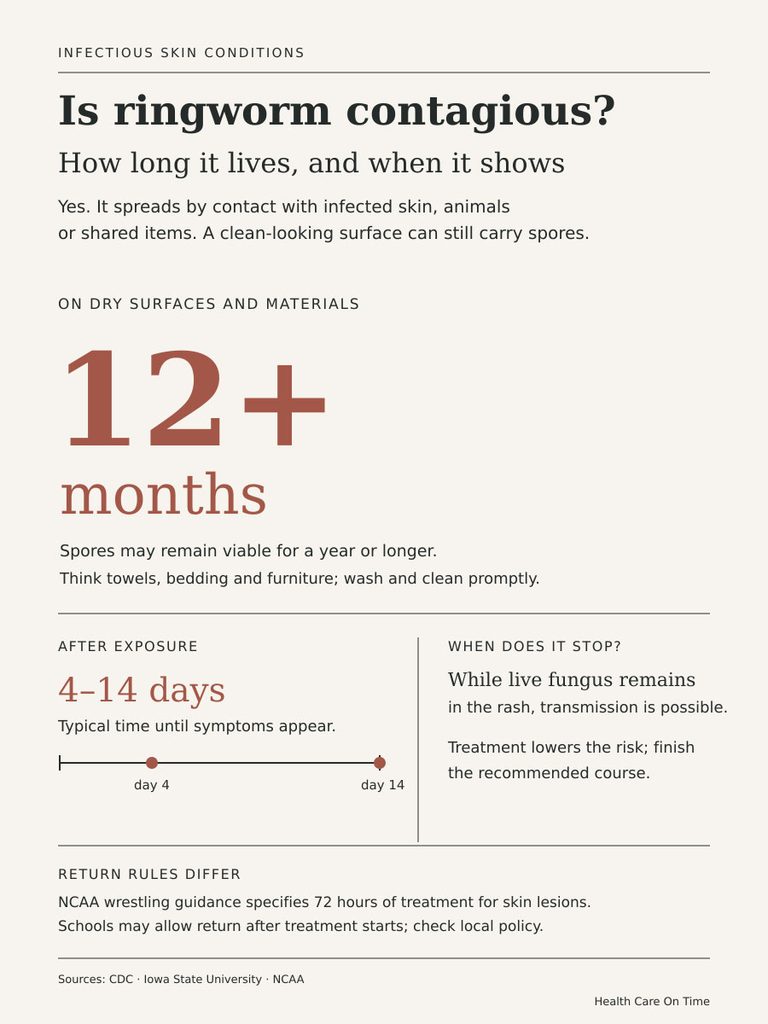
Dermatophyte spores can survive 12 months or more in a dry environment, according to feline ringworm management guidelines. They don’t last long in humid conditions, and temperatures around 212°F destroy them quickly. A dry hat, brush, or couch cushion can hold live spores long after a rash heals.
Wash towels, sheets, and clothing on the hottest setting the fabric allows, then dry on high heat. Vacuum carpets and upholstery where an infected pet sleeps, and wipe hard surfaces with a household disinfectant.
The 4 to 14 Day Window
Symptoms typically appear between 4 and 14 days after the skin touches the fungus, per the CDC. That delay is why many people can’t pinpoint the source. The exposure that answers how you got ringworm may be ten days in the past by the time the ring shows up.
How Long Ringworm Stays Contagious
Ringworm stays contagious as long as live fungus sits in the rash. The risk drops quickly once treatment begins, even though the rash may take weeks to fade.
Sports rules offer a useful benchmark. The NCAA and the National Federation of State High School Associations require at least 72 hours of topical treatment before a wrestler with body ringworm competes, and 14 days of oral antifungal therapy for scalp ringworm. Many schools let children return once treatment has started, so check your district’s policy.
Just Exposed? What to Do in the Next 24 Hours
If you hugged someone with a rash, handled an infected pet, or borrowed a teammate’s towel, a few quick steps lower your odds:
- Wash the skin that made contact with soap and water, then dry it fully, including between your toes and in skin folds.
- Put the clothes and towels involved into a hot wash.
- Check your skin once a day for the next two weeks, since that covers the full incubation window.
- Save antifungal cream for an actual rash. If your skin looks normal, watching it closely is a reasonable plan.
Who Is Most Likely to Get Ringworm
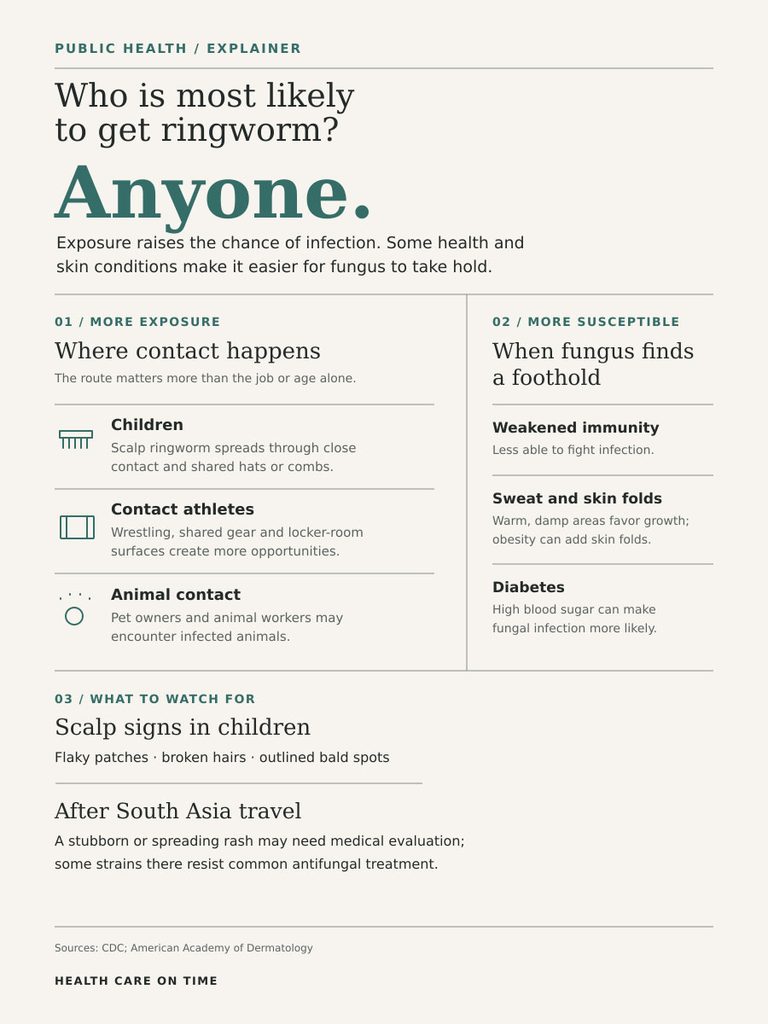
Anyone can get ringworm, but people with weakened immune systems face higher risk and may struggle to clear the infection. A few other groups face more exposure or skin conditions that suit the fungus.
Children and Scalp Ringworm
Scalp ringworm is far more common in children than adults. Shared hats, combs, pillows, and close play make schools and daycares easy places for it to spread.
Parents who contact our team often notice flaky patches first and assume dandruff. Scaly patches with broken hairs or black dots on a child’s scalp deserve a closer look.
Scalp ringworm doesn’t always cause obvious bald spots. It can show up as broken hairs that look like black dots, a widespread scale that resembles dandruff, or sharply outlined patches. Some children have only white flakes with no visible hair loss at all.
Athletes, Pet Owners, and Animal Workers
Wrestlers, grapplers, and anyone who shares showers face repeated exposure from sweat, friction, reused gear, and bare feet. In NCAA injury surveillance data, tinea ranked as the second most common skin infection in wrestlers, behind only herpes.
Vets, shelter staff, farmers, and new kitten owners meet animal fungi far more often than most people.
Heavy Sweating, Diabetes, and Extra Weight
Moist skin folds and a slower immune response give the fungus more time to settle in. If ringworm keeps coming back, an HbA1c blood test is a reasonable step, since undiagnosed diabetes can make skin infections harder to clear.
Recent Travelers to South Asia
A drug-resistant strain now widespread in India and nearby countries has started showing up in US travelers and their families. The next section explains why that matters.
New, Harder-to-Treat Ringworm in the US
TMVII: The Sexually Spread Strain
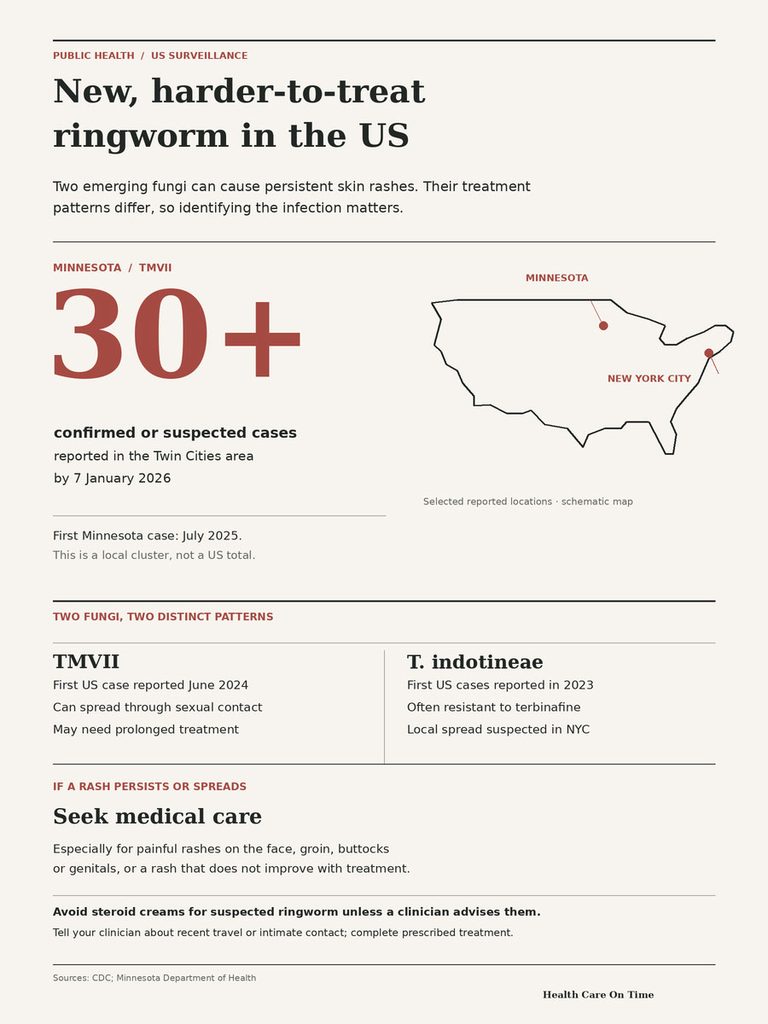
Trichophyton mentagrophytes genotype VII, or TMVII, spreads mainly through sexual contact. The first US case was reported in June 2024, and four more were diagnosed in New York City between April and July 2024 among men who have sex with men, according to CDC’s MMWR. The rashes appeared on the face, buttocks, or genitals, and all were treated successfully.
After Minnesota confirmed its first case in July 2025, more than 30 confirmed or suspected cases followed in the metro area, the largest known TMVII outbreak in the US. Washington State confirmed a single case in 2026. Health officials say most other US cases so far have turned up sporadically in larger cities.
TMVII can be mistaken for eczema or psoriasis, often needs oral antifungal pills, and can cause painful, lasting lesions that scar. If a groin, buttock, or facial rash won’t clear, tell your clinician about new partners.
Trichophyton indotineae: The Terbinafine-Resistant Strain
This species often carries genetic changes that make it resistant to terbinafine, a first-line ringworm drug, and it tends to cause severe rashes over large areas of the body, per CDC’s clinician brief.
The first US cases were confirmed in New York City in 2023, and one patient had not traveled abroad, which suggested local spread.
The strain can spread fast once it arrives. In the United Kingdom, it has made up more than 30% of all dermatophyte samples sent to the national reference lab in every quarter since spring 2024. US numbers are still small, which is why early recognition matters. Colorado received reports of five TMVII cases and two T. indotineae cases between July 2024 and March 2026.
A 2026 US case series found that every patient had recently traveled to India or Nepal except one, the spouse of a traveler. The authors flagged steroid cream use, skipping itraconazole as the first drug, and short fixed treatment courses as common gaps in care.
Why Steroid Creams Make Ringworm Worse
Many over-the-counter rash creams contain steroids, and steroid creams can make ringworm infections worse. Steroids calm redness and itch for a while, which lets the fungus spread quietly. Doctors call the result tinea incognito.
Our lab partners often see skin scrapings that are harder to interpret after weeks of steroid use, which can delay the right diagnosis. Prescription combo creams that pair an antifungal with a strong steroid carry the same risk when used for weeks without follow-up.
6 Myths About How Ringworm Spreads
- “Only people with poor hygiene get it.” Clean people get ringworm all the time. Skipping showers raises the odds, but one hug or shared towel is enough.
- “It comes from worms.” No worm is involved at any stage.
- “It always comes from a pet.” Pets cause a minority of US cases. Other people and your own feet are more common sources.
- “Pool water spreads it.” The risk sits on wet decks, benches, and shower floors, not usually in chlorinated water.
- “Toilet seats are a major source.” CDC doesn’t list toilet seats among common routes. Towels, beds, and wet floors matter far more.
- “Once the ring fades, you’re cured.” Fungus can linger after the rash improves, which is a leading reason ringworm comes back.
How to Avoid Getting or Spreading Ringworm
At Home
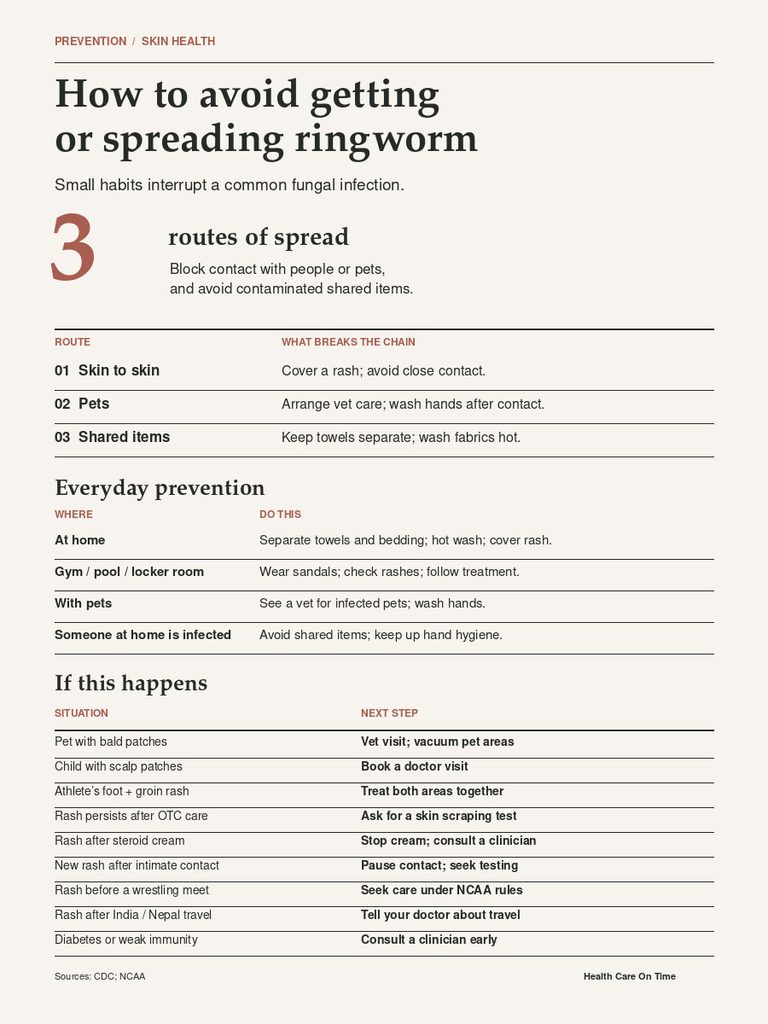
- Use your own towels, combs, hats, and razors.
- Wash bedding and towels hot, and dry them on high heat.
- Change socks and underwear daily, and keep fingernails short and clean.
- Dry skin folds, the groin, and between your toes fully after bathing.
At the Gym, Pool, and Locker Room
- Wear protective footwear in public showers and locker rooms.
- Shower soon after workouts.
- Don’t share gear, towels, or headgear.
- Cover any rash, and skip mat sports until it’s treated.
With Pets
- Wash your hands after touching pets.
- Book a vet visit for bald, scaly, or crusty patches.
- Wear gloves when handling an infected animal, and vacuum where it sleeps.
- Expect pet treatment to take a while. It usually means repeated lime-sulfur dips or similar treatments for 21 to 126 days.
When Someone at Home Has Ringworm
- Keep the rash covered.
- Use separate towels and bedding until treatment is underway.
- Avoid skin-to-skin contact, including intimate contact, with anyone who has known or suspected ringworm.
- Check siblings’ scalps and feet, and treat everyone with symptoms at the same time.
The table below turns common situations into clear next steps.
| Scenario | What to Do | Why |
| Your pet has round bald or scaly patches | See a vet, wash hands after contact, vacuum pet areas | Infected cats contaminate homes more than dogs |
| Your child has a scaly scalp patch with broken hairs | Book a doctor visit; don’t rely on cream alone | Scalp ringworm needs oral medicine |
| You have athlete’s foot plus a new groin rash | Treat both at once; socks before underwear | Fungus often travels from feet to groin |
| An OTC antifungal hasn’t helped after 2 weeks | Get a skin scraping test | It may not be ringworm, or it may be a resistant strain |
| The rash spread after using a steroid cream | Stop the steroid and see a clinician | Steroids can hide and spread the fungus |
| A new genital, buttock, or face ring after a new partner | Pause intimate contact and ask for testing | TMVII needs special lab confirmation |
| A wrestler has a rash before a meet | Get it checked; complete 72 hours of treatment | NCAA and NFHS rules require it |
| A widespread rash appeared after travel to India or Nepal | Tell your doctor about the trip | T. indotineae often resists terbinafine |
| Someone at home has ringworm | Separate towels and bedding; hot wash; cover the rash | Spores survive a year or more on dry fabric |
| You have diabetes or a weak immune system | See a clinician early instead of self-treating | Infections can be harder to clear |
Treating a Simple Case and When to See a Doctor
Treating Simple Body Ringworm at Home
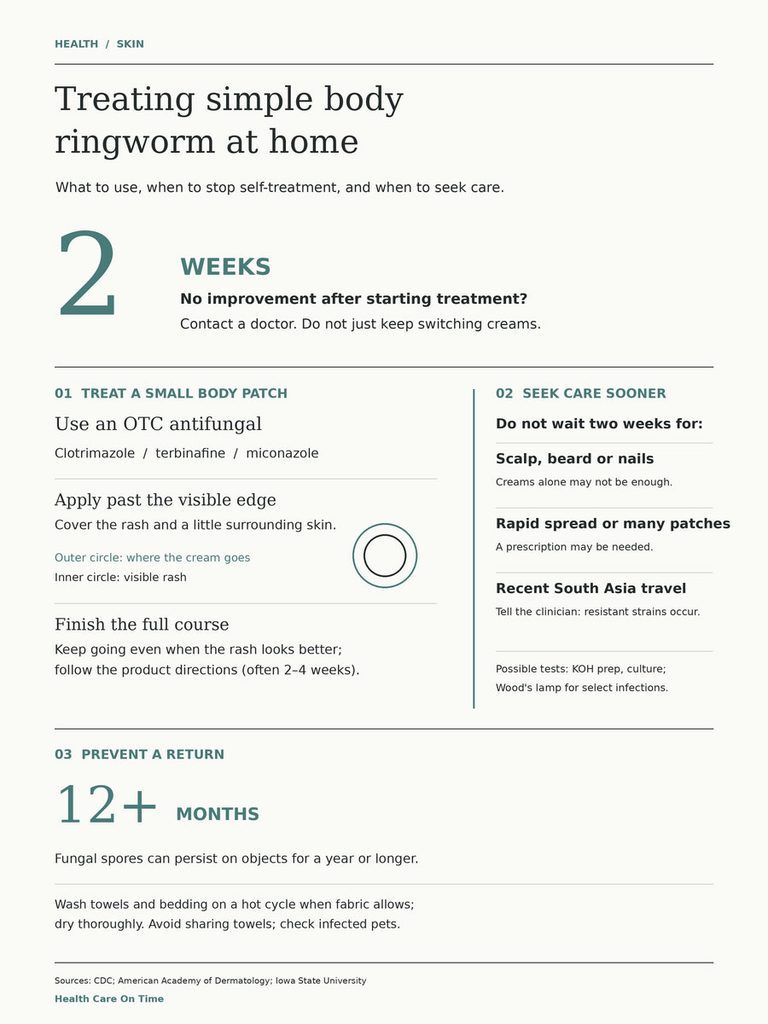
Some forms of ringworm respond to over-the-counter antifungals, while others need prescription medicine. Common drugstore options include clotrimazole, terbinafine, and miconazole, sold as creams, sprays, or powders.
Rings start small and grow outward, so spread the cream a little past the visible edge. Follow the package directions and finish the full course even after the itch stops.
One of the questions our team hears most is whether it’s safe to stop once the rash fades. It isn’t, since leftover fungus is a common reason ringworm returns. Skip hydrocortisone and other steroid creams on any rash that might be ringworm.
When to See a Doctor
See a doctor if a rash hasn’t started to improve within two weeks of using an over-the-counter antifungal. Go sooner for ringworm on the scalp, beard, or nails. Those usually need prescription pills, and severe infections may need several weeks of them.
Also go early for a fast-spreading rash, many patches at once, a genital or facial rash after a new partner, or a widespread rash after travel to South Asia. Pregnant people should ask before starting any oral antifungal.
Ringworm symptoms look like other skin and nail conditions, so testing helps confirm the right treatment, and CDC encourages patients to ask for it.
Tests Your Doctor May Order
KOH Prep
A clinician gently scrapes a few skin flakes and checks them under a microscope. It’s billed under CPT code 87220, and one US hospital lab lists a four-hour turnaround once the sample arrives.
Fungal Culture
A culture grows the fungus so the lab can name the species. It’s billed under CPT 87101, and results on hair, skin, and nail samples are reported after about three weeks.
Wood’s Lamp
This is a handheld ultraviolet light. M. canis usually glows apple green under it. The common people-loving scalp fungus usually doesn’t glow, so a normal result can’t rule out scalp ringworm.
Genetic Testing for Resistant Strains
A KOH prep can show fungal elements and a culture can identify Trichophyton, but confirming TMVII requires genotyping. T. indotineae likewise needs sequencing or PCR at a specialty lab.
Our medical reviewers suggest asking for a self-pay price before the scraping, since cash prices vary widely between clinics and labs. Most insurance plans cover these tests when a clinician orders them.
Frequently Asked Questions
Can You Get Ringworm From Being Dirty?
Not directly. Ringworm always needs contact with the fungus, so the cleanest person in the room can catch it from a shared towel or a hug. Going days without showering and reusing socks do raise your risk, because damp, unwashed skin gives the fungus a better place to grow.
Can You Get Ringworm From a Dog or Cat?
Yes. Cats, kittens, and puppies are the most common animal sources in US homes. Pets still account for only about 3% to 4% of human cases, though. If your pet has round bald or scaly patches, book a vet visit and wash your hands after every contact.
How Long Does Ringworm Live on Sheets, Towels, or Furniture?
Ringworm spores can survive 12 months or longer on dry fabrics and surfaces. They die faster in humid conditions and at high heat. Washing sheets and towels on the hottest setting the fabric allows, then drying on high heat, is the most practical way to clear them.
Can You Get Ringworm From a Toilet Seat?
It’s very unlikely. CDC doesn’t list toilet seats among the common ways ringworm spreads, and brief contact with a dry seat is a low-risk exposure. Shared towels, beds, damp shower floors, and skin-to-skin contact are far more common sources worth focusing on.
How Long After Exposure Does Ringworm Show Up?
Symptoms usually appear 4 to 14 days after the fungus touches your skin. That gap explains why many people can’t name the source. When tracing how you got ringworm, think back about two weeks to gyms, pets, houseguests, and shared items.
Is Ringworm Contagious Once Treatment Starts?
The risk drops quickly after treatment begins, but it doesn’t vanish overnight. Sports rules require wrestlers to use topical treatment for at least 72 hours before competing. Keep the rash covered, skip shared towels, and finish the full treatment course even after the ring fades.
Can Ringworm Spread to Other Parts of the Body?
Yes, and it happens often. Athlete’s foot commonly spreads to the groin through hands, towels, or underwear, and scratching can carry fungus to your body, scalp, or nails. Treat every infected area at the same time, and wash your hands after touching a rash.
Can You Get Ringworm From Sex?
Yes. Any close skin contact can spread ringworm, and CDC lists sexual contact as a route. A newer strain called TMVII spreads mainly through sexual networks and often causes genital, buttock, or facial rashes. If a new ring appears after a new partner, ask for testing.
Can You Catch Ringworm at a Swimming Pool?
Yes, but usually not from the water itself. The risk comes from wet decks, benches, locker rooms, and shower floors where people walk barefoot. Wear shower shoes, dry your feet fully, and change out of damp swimwear soon after swimming.
Why Does Ringworm Keep Coming Back?
Common reasons include stopping treatment too early, an untreated source such as nail fungus, reinfection from a family member or pet, and spores left on towels or bedding. Steroid creams and resistant strains can also play a role. Repeated cases deserve a skin scraping test.
Can Adults Catch Ringworm From Children?
Yes. Children often bring ringworm home from school, daycare, or sports, and adults can catch it through hugs, shared beds, or towels. Scalp ringworm in a child can also spread to an adult’s body or beard. Cover the rash and keep personal items separate until treatment starts.
Does Ringworm Come From Worms?
No. Ringworm is caused by fungi called dermatophytes, not by any worm or parasite. The name comes from the ring-shaped rash the infection often forms. Because it’s fungal, it needs antifungal treatment, and deworming medicine won’t help at all.
Disclaimer: This article is for general education only and does not replace diagnosis or treatment from a licensed healthcare provider. Rashes that look like ringworm can have other causes. If you have a rash on your scalp, face, or genitals, a rash that is spreading, a weakened immune system, diabetes, or you are pregnant, contact a healthcare professional before starting treatment.
References
- CDC: Ringworm Basics
- CDC: What Causes Ringworm
- CDC: Symptoms of Ringworm
- CDC: Clinician Brief on Emerging Ringworm
- CDC: Fungal Disease Burden by the Numbers
- CDC MMWR: Trichophyton mentagrophytes Genotype VII, New York City, 2024
- CDC MMWR: First Reported US Cases of Trichophyton indotineae, 2023
- CDC EIS Conference: TMVII and T. indotineae in Colorado, 2024 to 2025
- Benedict et al.: Direct Healthcare Costs of Fungal Diseases in the US, Clinical Infectious Diseases
- Recalcitrant T. indotineae Infections in the United States, 2025 to 2026 (PubMed)
- UKHSA Data: Rapid Emergence of Trichophyton indotineae in the United Kingdom, up to August 2025
- Minnesota Department of Health: TMVII Laboratory Alert, 2026
- Public Health Seattle and King County: TMVII Health Advisory, 2026
- San Francisco Department of Public Health: TMVII Health Update
- Mayo Clinic: Ringworm (Body), Symptoms and Causes
- Berg et al.: Tinea Gladiatorum Prevalence Among Wrestlers, Asian Journal of Sports Medicine
- Skin Infections in Athletes: NCAA and NFHS Return Rules
- Cutis: Tinea Capitis Across the Skin Color Spectrum
- Cutis: Tinea Cruris in Pediatric and Adolescent Patients
- Patient Care: What Treatment for the Family Pet When a Child Has Tinea
- Podiatry Today: Treating Tinea Capitis (Cleveland School Survey)
- Microsporum canis in Cats: Prevention and Management Guidelines
- Mancianti et al.: Household Contamination by M. canis From Infected Pets
- CDC Public Health Reports, 1957: Ringworm in Animals and Human Contacts
- Labcorp: Fungus Culture With Stain
- Children’s Minnesota: KOH Prep Lab Reference