The clinical trials people quote to prove cucumber fights inflammation came with an unusual instruction for participants: stop eating cucumber before we measure you.
Table of Contents
That detail sits in the inclusion criteria of a 2025 trial of a standardized cucumber extract, where volunteers had to avoid cucumber, gherkins and melon for two days before each assessment. The researchers treated the vegetable as noise to remove, not as the thing being tested.
That gap, between what cucumber extract does in a capsule and what a cucumber does on your plate, is where most writing about this vegetable loses its footing. Here is what a daily cucumber genuinely earns you, backed by numbers you can check.
Quick Answer: Eating cucumber daily delivers real hydration (about 9.8 fluid ounces of water in one large cucumber), 41% to 60% of a man’s daily vitamin K, very low energy density that helps with appetite control, and a small polyphenol contribution. It does not detox anything, is not a strong potassium or fiber source, and the anti-inflammatory research people cite used concentrated extracts rather than the vegetable.
The eight benefits that hold up:
- Adds roughly 9.8 fluid ounces of water per large cucumber with almost no calories
- Supplies 49 to 72 micrograms of vitamin K1, a substantial share of daily need
- Displaces higher-calorie snacks through exceptionally low energy density
- Produces almost no blood sugar response because the carbohydrate load is tiny
- Contributes potassium, magnesium, copper and silica in small but real amounts
- Adds a vegetable serving when only 1 in 10 US adults meets the federal target
- Delivers flavonoids and tannins with measurable antioxidant activity
- Replaces salty crunch foods without the sodium that comes with them
At a Glance
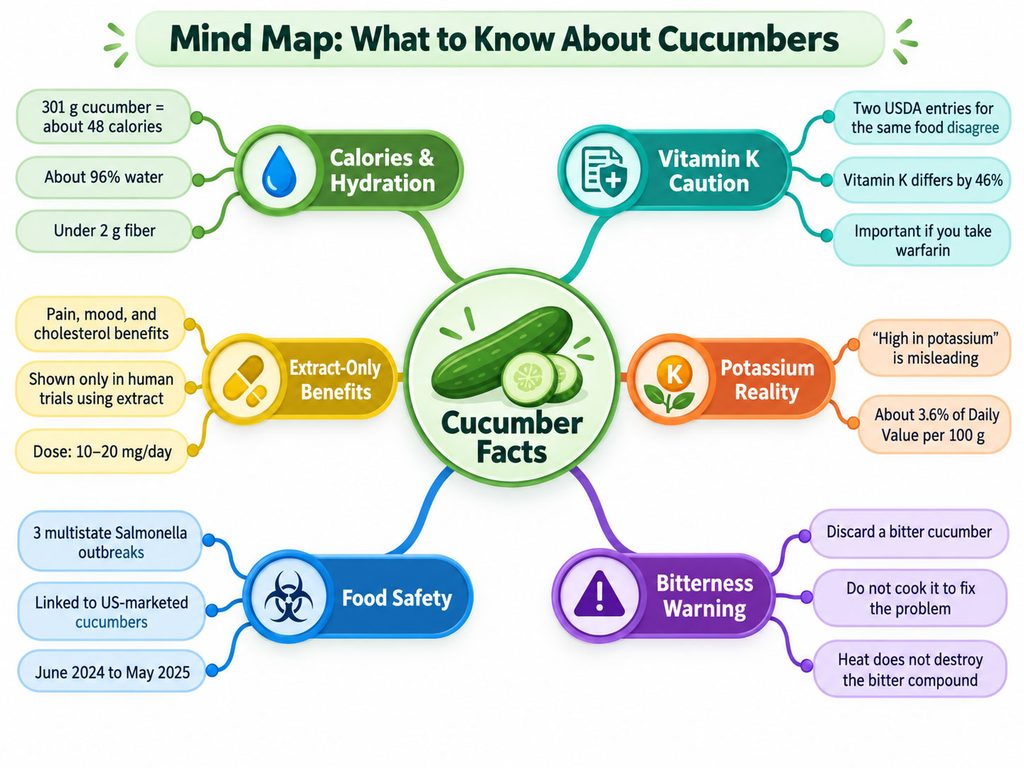
A large 301-gram cucumber runs about 48 calories, is roughly 96% water, and carries under 2 grams of fiber.
Two USDA entries for the same food disagree on vitamin K by 46%, which matters if you take warfarin.
Every human trial showing pain, mood or cholesterol benefits used an extract at 10 to 20 mg per day.
“High in potassium” is wrong at the serving level: cucumber supplies about 3.6% of the Daily Value per 100 grams.
Three multistate Salmonella outbreaks were linked to US-marketed cucumbers between June 2024 and May 2025.
A bitter cucumber should be discarded, not cooked, because heat does not destroy the compound behind the bitterness.
What a Daily Cucumber Actually Puts in Your Body
Before the benefit claims, the baseline. A standard 8.25-inch slicing cucumber weighs about 301 grams with the peel on.
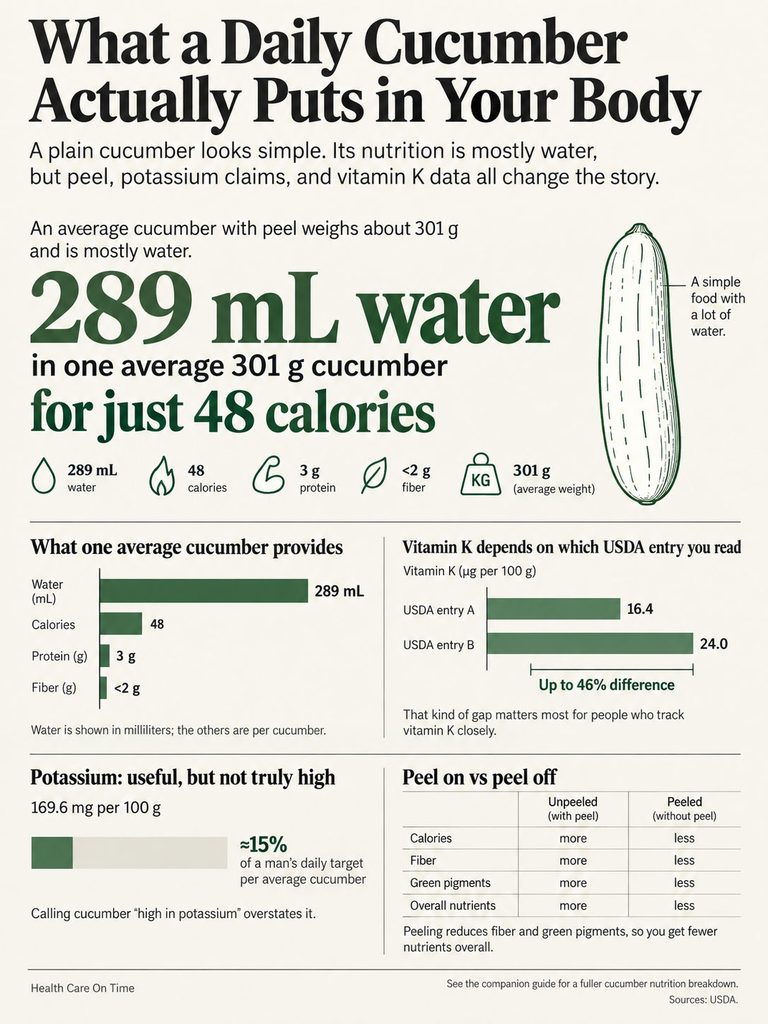
At that weight it carries roughly 48 calories, 3 grams of protein, under 2 grams of fiber, and about 289 milliliters of water. Everything else arrives in small amounts, which is the honest starting point for any conversation about this vegetable.
The Two USDA Entries That Disagree by 46%
USDA FoodData Central holds more than one analysis of raw cucumber with peel, and they do not match each other. The Foundation Foods entry (FDC 2346406) reports 16 calories, 24 micrograms of vitamin K, 169.6 mg of potassium and 95.9 grams of water per 100 grams.
The older Standard Reference entry reports 15 calories, 16.4 micrograms of vitamin K and 147 mg of potassium for the same food. That is a 46% spread on vitamin K between two federal analyses of the same vegetable.
Neither number is an error. They are separate laboratory analyses of different cucumber samples, and cucumber vitamin K shifts with cultivar, growing conditions and how much peel ends up in the sample.
Our medical reviewers flag this because readers on blood thinners are routinely told to watch vitamin K foods without being told that published values for a single food can differ by nearly half.
Why “High in Potassium” Is the Most Repeated Cucumber Error
Several large health sites describe cucumber as high in potassium and credit it with blood pressure benefits on that basis. Run the arithmetic and the claim thins out quickly.
At 169.6 mg per 100 grams, cucumber supplies about 3.6% of the 4,700 mg Daily Value. A whole large cucumber reaches roughly 510 mg, which is about 15% of the adequate intake for men and 20% for women.
That is a useful contribution to a daily total. It is not a potassium food the way a baked potato at around 900 mg or a cup of cooked spinach is, and describing it that way sets readers up to expect blood pressure changes that a cucumber cannot deliver on its own.
Peel On or Peel Off
The peel carries the difference. The USDA entry for peeled cucumber drops to about 10 to 12 calories per 100 grams and roughly 7 micrograms of vitamin K, less than a third of the with-peel figure.
Peeling also removes most of the fiber and the green pigments. If you are eating cucumber for anything beyond water, the skin stays on.
For the full portion-by-portion breakdown, including cup weights and slice counts, see our companion guide on how many calories are in a cucumber.
The Cucumber Benefits That Hold Up
1. Hydration You Can Actually Measure
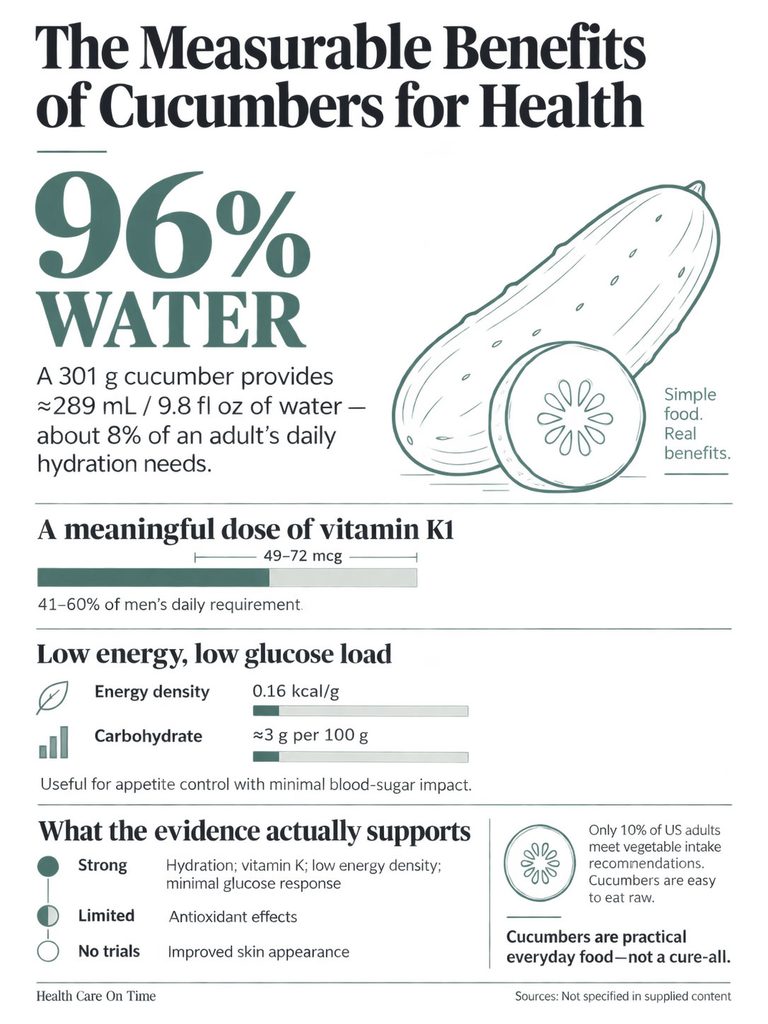
Every cucumber article states that the vegetable is 96% water. Almost none converts that into a number you can use at the kitchen counter.
A 301-gram cucumber holds about 289 milliliters of water, or 9.8 fluid ounces. That is slightly more than one standard drinking glass, arriving with fiber, vitamin K and potassium attached.
The National Academy of Medicine sets total daily water adequate intake at 3.7 liters (125 oz) for men and 2.7 liters (91 oz) for women, counting all food and drink together. One large cucumber therefore covers roughly 8% of either target.
That fits how Americans already hydrate. NHANES data covering 15,702 adults found beverages supply 75% to 84% of dietary water, with food providing the remaining 17% to 25% depending on age.
Harvard’s Nutrition Source names cucumbers specifically among the water-rich foods carrying that food share. The same NHANES analysis surfaced a group where this matters more than average.
Older adults fell well short of the adequate intake, with 83% of women and 95% of men aged 71 and over under target. For people whose thirst signaling has faded, water-dense food is a practical route to fluid rather than a wellness flourish.
2. Vitamin K, the Nutrient Nobody Mentions
This is the most underreported thing about daily cucumber consumption. One large cucumber with peel supplies roughly 49 to 72 micrograms of vitamin K1, depending on which USDA entry you use.
Against an adequate intake of 120 micrograms for adult men and 90 micrograms for women, that is 41% to 60% of a man’s daily need from one vegetable. Vitamin K1 supports blood clotting and the synthesis of osteocalcin, a protein involved in bone mineralization.
Patients booking coagulation panels through HealthCareOnTime regularly ask which everyday foods move vitamin K. Cucumber almost never appears on the handouts they bring in, and it belongs there.
3. Energy Density and Appetite Control
Cucumber sits close to the theoretical floor for energy density at about 0.16 calories per gram. Foods this dilute occupy stomach volume without contributing meaningful energy.
The practical benefit is displacement rather than fat burning. Swapping a 1-ounce serving of chips (roughly 150 calories and 170 mg of sodium) for a cup of cucumber slices (about 16 calories and almost no sodium) changes a snack habit without asking anyone to eat less food.
What cucumber does not do is accelerate metabolism, burn fat or target the abdomen. Nothing in the published record supports any of those framings, and pages that promise them are selling an outcome the vegetable cannot produce.
4. A Blood Sugar Profile That Stays Flat
A 100-gram serving carries about 3 grams of total carbohydrate. Even at a high glycemic index, a load that small cannot generate a meaningful glucose excursion.
That makes cucumber one of the few foods where “eat freely” is close to accurate for people managing blood sugar. It works as a filler food alongside a meal plan, not as a treatment for anything.
Claims that cucumber lowers blood sugar rest mainly on rodent studies of seed and peel extracts at doses unrelated to eating a vegetable. Human data on fresh cucumber and glycemic control does not currently exist at a standard worth quoting.
5. Silica, Skin and What the Evidence Supports
Cucumber contains silica, and silica has a documented role in connective tissue and hair structure. This is where most benefit lists jump straight to glowing skin, and where the evidence stops keeping pace.
No human trial has tested whether eating cucumber changes skin appearance. What is established is that hydration status affects skin turgor, and that a food supplying nearly 10 ounces of water contributes to hydration status.
The famous cucumber slices on the eyes work through temperature and gentle pressure, which reduce periorbital swelling the same way any chilled compress would. That is a real effect with a boring mechanism, and it has nothing to do with eating the vegetable.
6. Adding a Vegetable at All
CDC surveillance has repeatedly found that only about 10.0% of US adults meet federal vegetable recommendations. Against that baseline, the strongest argument for a daily cucumber is not any single nutrient.
Cucumber is one of the few vegetables people will eat with no cooking, no seasoning and no planning. Adherence beats micronutrient density when adherence is the actual bottleneck, and a cucumber someone eats outperforms kale they do not.
| Claimed benefit | What the evidence shows | Study type and size | Whole cucumber or extract? | Evidence strength | Verdict |
| Hydration | 289 mL (9.8 fl oz) per 301 g cucumber; food supplies 17-25% of dietary water | USDA composition plus NHANES, n=15,702 | Whole food | Strong | Real |
| Vitamin K intake | 49-72 mcg per large cucumber against a 90-120 mcg adequate intake | USDA FDC 2346406 and 168409 | Whole food | Strong | Real |
| Low energy density | 0.16 kcal per gram, among the lowest of all foods | USDA composition data | Whole food | Strong | Real |
| Minimal glucose response | About 3 g carbohydrate per 100 g | USDA composition data | Whole food | Strong | Real |
| Antioxidant activity | Cucumber powder raised antioxidant markers over 30 days | Human trial, n=30 older adults | Powder at a dose above a normal serving | Moderate | Partly real |
| Knee osteoarthritis pain | WOMAC and VAS improved against glucosamine-chondroitin over 180 days | RCT, n=122, no placebo arm | Extract, 10 mg twice daily | Moderate, industry-funded | Extract only |
| Mild to moderate joint pain | WOMAC gains at day 30 and day 60 against placebo | RCT, n=80, 60 days | Extract, 20 mg per day | Moderate | Extract only |
| Cholesterol and triglycerides | Total cholesterol, LDL-C and triglycerides fell against placebo | RCT, n=47 completers, 6 weeks | Cucumber seed extract, 500 mg per day | Weak, small sample | Extract only |
| Mood, anxiety and sleep | Outcomes assessed alongside the joint pain cohort | RCT, n=80 | Extract | Preliminary | Extract only |
| Fisetin and longevity | Cucumber contains roughly 0.1 mcg per gram | Food composition analyses | Whole food | Strong data, trivial dose | Hyped |
| Glowing skin from eating it | No human trial has tested the question | None | Not applicable | None | Hyped |
| Detoxification | No mechanism; kidneys and liver handle clearance | None | Not applicable | None | Hyped |
Table 1. Claim-by-claim evidence audit for daily cucumber consumption.
The Three Claims That Don’t Survive a Close Look
Hyped Claim 1: “Cucumber Is Anti-Inflammatory”
There is real science behind this one. It simply is not about the vegetable in your refrigerator.
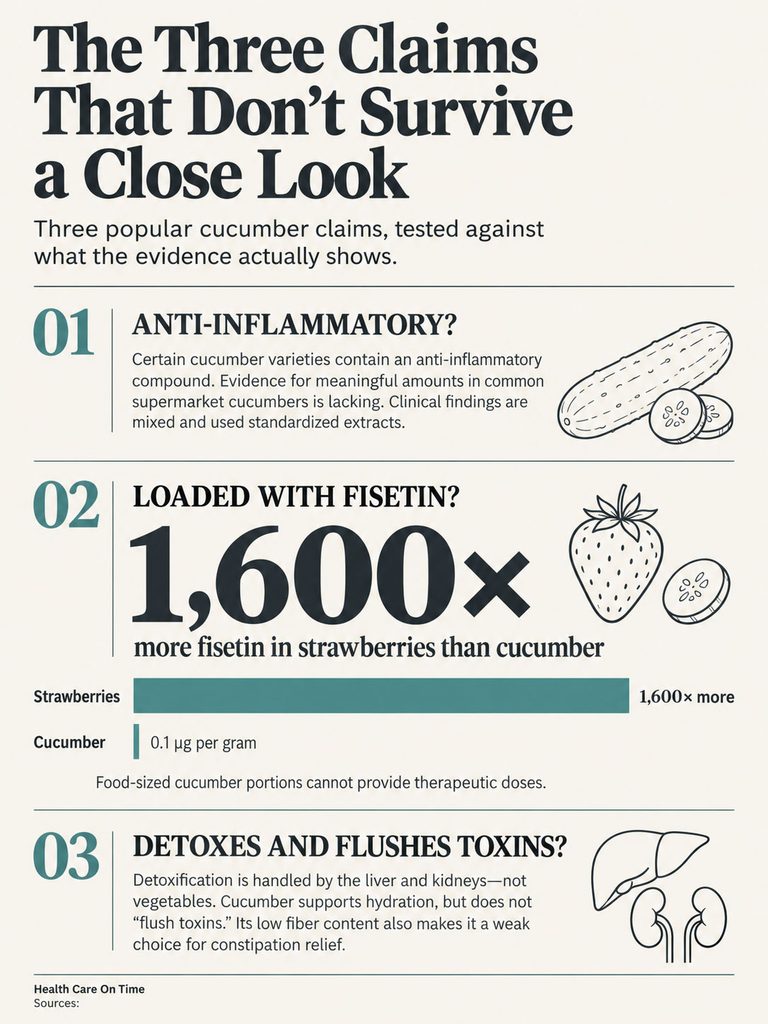
In 2020, researchers published the identification of idoBR1, an iminosugar amino acid with anti-inflammatory activity in laboratory cell models. The paper describes it as isolated from the fruits of certain cucumbers, and closes by stating that its importance in the diet should be further evaluated.
The word “certain” carries the weight here. Nobody has established whether a supermarket cucumber contains a useful amount, and the discovering team said plainly that the dietary question remains open.
The trials that followed all used a standardized commercial extract. A 2018 randomized trial of 122 adults aged 40 to 75 with moderate knee osteoarthritis gave 10 mg of cucumber extract twice daily against glucosamine-chondroitin at 1,350 mg twice daily across 180 days, and the extract performed well on pain and function scores.
Two design facts limit how far that result travels. There was no placebo arm, only an active comparator, and the company that discovered the compound funded and ran the work.
A 2025 trial in 80 adults with mild to moderate joint pain did include a rice-protein placebo and found WOMAC improvements at day 30 and day 60 on 20 mg per day. A companion paper reported on mood, anxiety and sleep in the same cohort.
These are reasonable early results for a supplement ingredient. They are not evidence that eating cucumber reduces inflammation, and the trial that asked participants to stop eating cucumber before measurement makes the distinction as clearly as anyone could.
Hyped Claim 2: “Cucumber Is Loaded With Fisetin”
Fisetin is a flavonol under study as a senolytic, a compound that clears aging cells. Cucumber appears on nearly every published list of fisetin food sources.
The concentration is about 0.1 micrograms per gram. A whole 301-gram cucumber therefore supplies roughly 30 micrograms, which is 0.03 milligrams.
Strawberries carry around 160 micrograms per gram, roughly 1,600 times more. Research senolytic protocols use doses near 20 mg per kilogram of body weight, which for a 155-pound adult works out to about 1,400 mg.
Reaching that from cucumber would take something on the order of 15 tons. Cucumber belongs on the fisetin list the way a single raisin belongs on a list of iron foods: technically present, practically irrelevant.
Hyped Claim 3: “Cucumber Detoxes and Flushes Toxins”
Your kidneys filter roughly 180 liters of plasma daily and your liver handles biotransformation of most compounds the body needs to clear. Neither organ is waiting on a vegetable to begin working.
What cucumber can do is supply fluid, and adequate fluid supports normal urine output. That is hydration described accurately, and it needs no detox framing to be worth doing.
One related correction belongs here. Cucumber is frequently recommended for constipation on the strength of its fiber, but a whole large cucumber carries about 1.5 grams against a daily target of 25 to 38 grams.
The water helps with stool consistency. The fiber, on its own, is not going to resolve anything, and readers who need a fiber strategy should be looking at beans, oats and whole fruit instead.
What Changes, and When
A fair question from anyone starting this habit is what to expect and how soon. The honest answer separates into three timeframes.
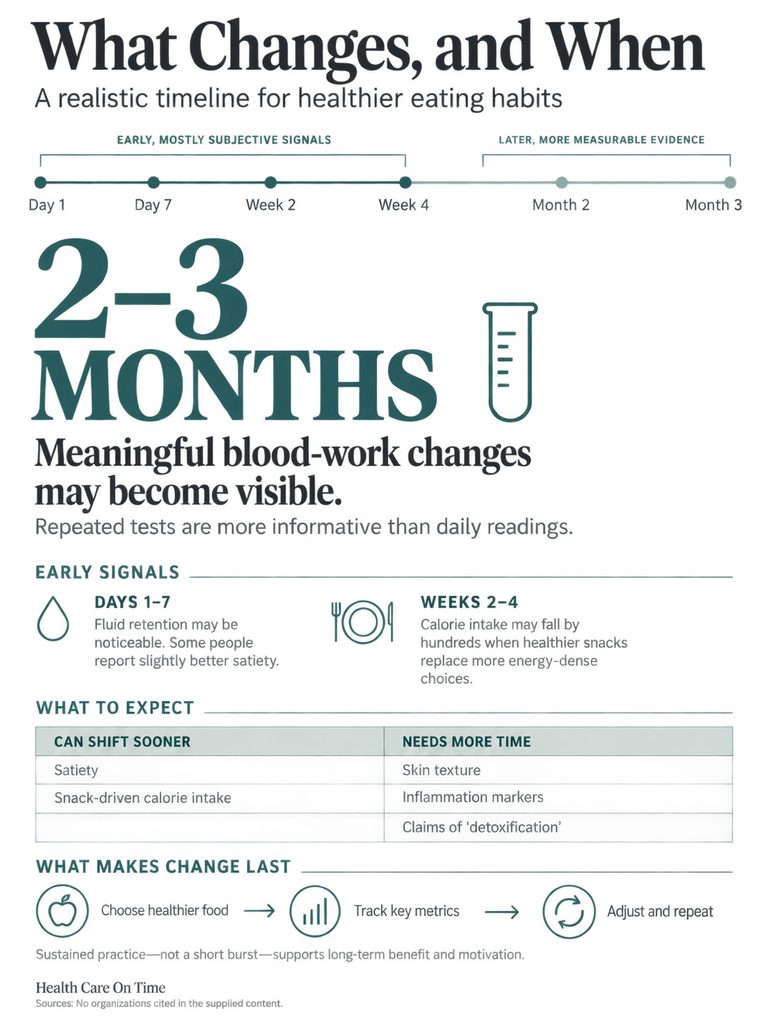
Days 1 to 7. The only thing you should reliably notice is fluid. Some people report slightly better satiety at snack time, which is the displacement effect working as intended.
Weeks 2 to 4. If cucumber is replacing chips, crackers or a mid-afternoon pastry, daily calorie intake shifts by a few hundred. That is enough to show on a scale over a month, though the cucumber is the vehicle rather than the cause.
Months 2 to 3. Any change worth measuring in blood work shows up on this timeline, not sooner. Patients who track through HealthCareOnTime typically get more useful information from a repeat lipid panel or metabolic panel at three months than from daily readings that mostly capture normal variation.
What will not change on any timeline: skin texture, inflammation markers, or anything described as detoxification. Setting that expectation up front is the difference between a habit someone keeps and one they abandon at week three because nothing visible happened.
How Much Is Too Much, and Who Should Be Careful
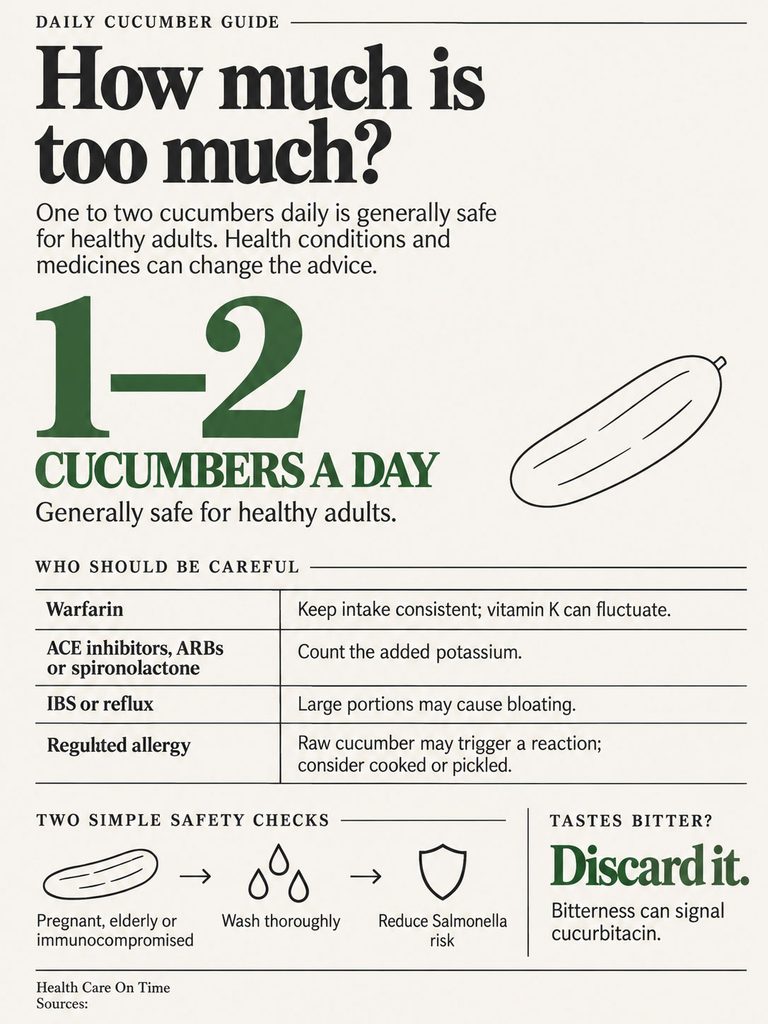
For most healthy adults, one to two cucumbers a day is unremarkable eating. Four situations deserve more care.
If You Take Warfarin
Warfarin works by interfering with vitamin K-dependent clotting factors, so swings in vitamin K intake move your INR. A daily cucumber with peel adds a steady 49 to 72 micrograms to your total.
The instruction is consistency, not avoidance. Starting a daily cucumber habit is a change worth mentioning at your next INR check, and stopping one abruptly is the same magnitude of change in the opposite direction.
The USDA discrepancy noted earlier matters directly here. Two federal entries differ by 46%, so no one should treat any published cucumber vitamin K figure as precise to the microgram.
If You Take an ACE Inhibitor, ARB, or Spironolactone
These medications raise serum potassium, and so does advanced chronic kidney disease. A large cucumber contributes about 510 mg.
That is modest, but it stacks with everything else on the plate, and people on potassium-sparing regimens are usually managing a daily ceiling rather than judging foods one at a time. Anyone with a recent potassium result above the reference range should run the arithmetic past their prescriber before adding a daily food.
If You Have IBS or Reflux
Cucumber is not a high-FODMAP food, but volume still matters. Eating a large quantity of any raw, water-heavy vegetable can produce bloating and gas in sensitive digestive systems.
Burping after cucumber is common enough to have its own folklore. Removing the peel and seeds helps some people, while others do better with smaller portions spread through the day.
If You Have Ragweed Allergy
Cucumber sits in the gourd family alongside melon, watermelon, zucchini and pumpkin. Immunochemical work summarized in the allergy literature91336-9/fulltext) found that roughly half of sera from ragweed-allergic individuals contained IgE specific for at least one gourd family member.
The usual presentation is pollen-food allergy syndrome: itching or tingling of the lips, tongue and throat within minutes of eating raw cucumber. The driver is profilin, a heat-labile protein, which is why cooked or pickled cucumber is often tolerated when raw is not.
Symptoms typically intensify during ragweed season, which runs from late summer into fall across most of the United States. With CDC data placing adult seasonal allergy prevalence at 25.2%, this affects a larger share of daily-cucumber eaters than the search results suggest.
| Your situation | What to do | Why |
| On warfarin, starting a daily cucumber | Keep the portion identical each day and tell your INR clinic | Steady vitamin K matters more than low vitamin K |
| On an ACE inhibitor, ARB or spironolactone | Count the roughly 510 mg toward your daily potassium ceiling | Small contributions stack across a day |
| CKD stage 3 or higher | Ask your nephrology team before making it a daily habit | Potassium clearance is already reduced |
| Ragweed allergy with mouth itching after raw cucumber | Try peeled, cooked or pickled; see an allergist if symptoms spread | Profilin is destroyed by heat |
| Bloating or reflux after cucumber | Halve the portion, remove seeds, split across meals | Raw volume, not the vegetable, is usually the trigger |
| Pregnant, over 65, or immunocompromised | Wash under running water and check active recall notices | Higher risk of severe Salmonella infection |
| The cucumber tastes bitter | Spit it out and discard the whole fruit | Cucurbitacin is not destroyed by cooking |
| Trying to lose weight | Use cucumber to replace a snack, not to replace a meal | Displacement works; restriction rebounds |
| Want the effect seen in the joint pain trials | Discuss the standardized extract with a clinician | Those trials used 10-20 mg of extract, not the vegetable |
Table 2. Scenario-to-action guide for daily cucumber consumption.
The Safety Section Every Other Cucumber Page Skips
Not one page currently ranking for cucumber benefits mentions food safety. That is a strange omission given the last two years of US outbreak history.
Three Multistate Outbreaks in Eighteen Months
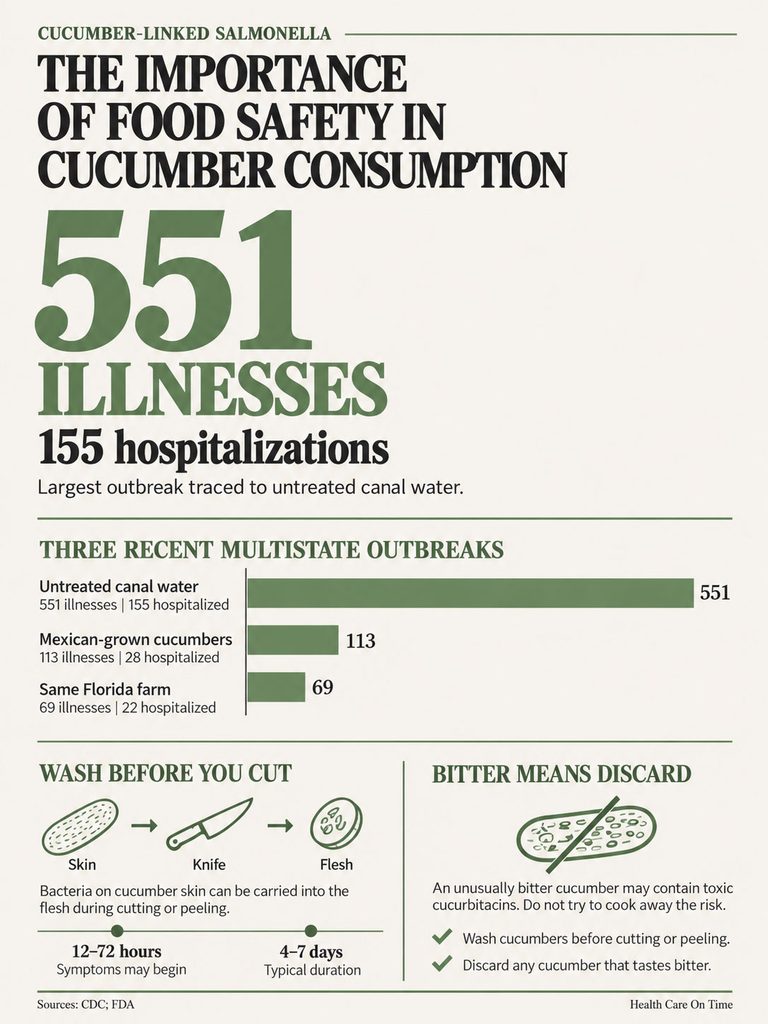
Between June 2024 and May 2025, the FDA and CDC investigated three separate multistate Salmonella outbreaks tied to cucumbers sold in the United States.
The largest involved 551 illnesses across 34 states and the District of Columbia, with 155 of 456 people hospitalized. Cases ranged in age from under 1 to 94 years, and investigators identified the outbreak strain in untreated canal water at a Florida grower.
The second traced to American slicer cucumbers grown in Sonora, Mexico: 113 illnesses across 23 states, 28 hospitalized, with 81% of those interviewed reporting cucumber consumption.
The third returned to the same Florida farm as the first, producing 69 illnesses and 22 hospitalizations across 21 states. FDA issued that grower a Warning Letter on November 17, 2025.
None of this makes cucumber dangerous. It makes cucumber a raw produce item carrying the risk profile of raw produce, which is a different message from the one benefit pages currently deliver.
Wash It Even If You Plan to Peel It
Bacteria on the outside of a cucumber transfers to the flesh on the knife blade. CDC guidance is to rinse produce under running water before eating, cutting or peeling.
Symptoms of Salmonella infection usually begin 12 to 72 hours after eating contaminated food and last four to seven days. Children under five, adults over 65 and immunocompromised people face the highest risk of severe illness, and those are the same groups most often told to eat more vegetables.
If It’s Bitter, It’s Not Dinner
Cucumbers, squash, zucchini and pumpkins all produce cucurbitacins, bitter compounds the plant makes as a defense against insects. Commercial varieties are bred to contain almost none, but heat stress, drought, poor soil and cross-pollination can push levels up.
America’s Poison Centers gives a plain rule: taste a small amount, and if it is bitter, spit it out and throw the whole thing away. The critical part is what comes next in their guidance.
Do not cook, boil or bake bitter squash or cucumber. The toxin is not inactivated by heat, so cooking a bitter cucumber does nothing to rescue it.
Symptoms of cucurbitacin poisoning include vomiting, diarrhea and abdominal pain, sometimes progressing to dehydration and low blood pressure. A French poison center documented more than 350 cases linked to bitter squash across a four-year window, and a 2018 case report in JAMA Dermatology described two women who lost substantial scalp hair weeks after eating bitter gourds.
The syndrome is rare and the prevention is free. Home gardeners who save their own seed are the group most likely to encounter it, because saved seed is where cross-pollination shows up.
| Figure | Number | Period | Source |
| Salmonella illnesses, largest cucumber outbreak | 551 across 34 states plus DC | March to July 2024 | CDC and FDA |
| Hospitalizations in that outbreak | 155 of 456 with data available | 2024 | CDC |
| Illnesses, Mexico-grown slicer cucumbers | 113 across 23 states, 28 hospitalized | Oct 2024 to Jan 2025 | FDA and CDC |
| Illnesses, second Florida grower outbreak | 69 across 21 states, 22 hospitalized | April to May 2025 | FDA |
| US Salmonella burden, all food sources | 1.35 million infections, 26,500 hospitalizations, 420 deaths | Annual estimate | CDC |
| US fresh vegetable availability | 148 lb per person, down 3% year over year | 2024 | USDA ERS |
| US adults meeting vegetable recommendations | 10.0% | BRFSS surveillance | CDC |
| Adults reporting seasonal allergy | 25.2% | 2026 data brief | CDC NCHS |
Table 3. United States cucumber consumption and outbreak data.
Getting the Most From a Daily Cucumber
Peel On, Washed, Whole
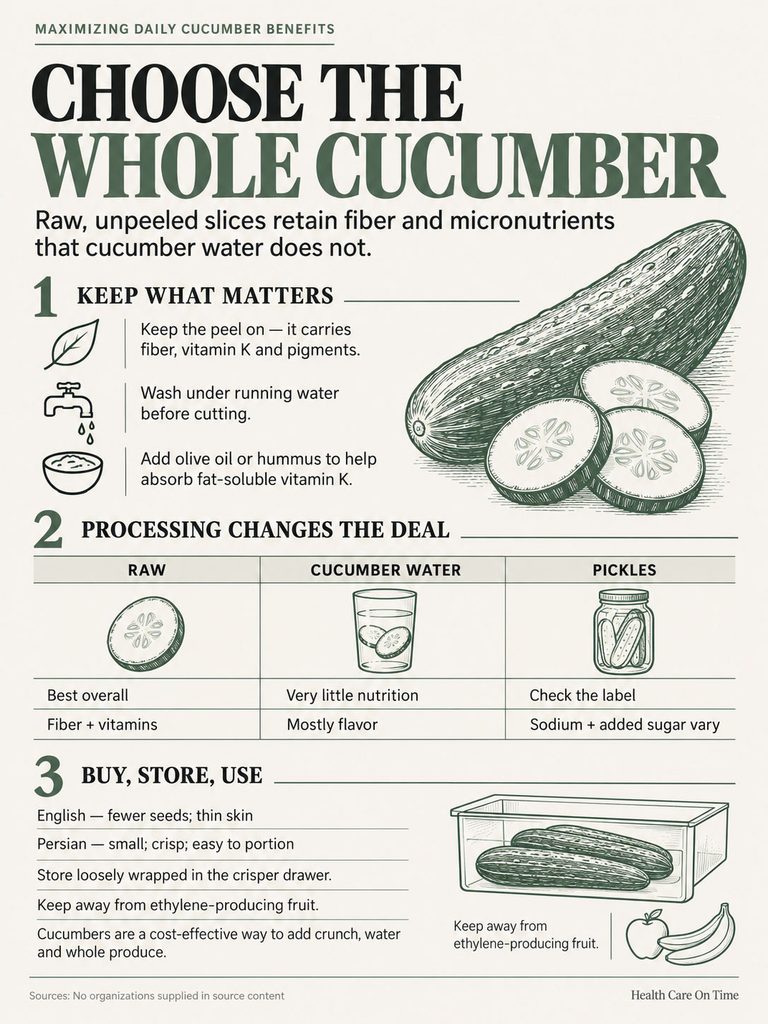
The peel carries the vitamin K, most of the fiber and the pigments. Washing under running water handles the safety side without costing you any of that.
Waxed cucumbers respond well to a vegetable brush under the tap. English and Persian varieties are usually sold unwaxed, which is one practical reason people find them easier to eat skin-on.
Pair It With Fat
Vitamin K1 is fat-soluble, and absorption improves meaningfully when it arrives alongside dietary fat. Cucumber eaten plain gives up part of the benefit that made it worth mentioning.
Olive oil, yogurt dip, hummus, feta or a few slices of avocado all solve this. Cucumber with hummus is not just a snack convention; it is better nutrition than cucumber alone.
Buying and Storing Without Wasting Half of It
Cucumbers are among the cheapest vegetables in the US produce aisle, usually running well under a dollar each for slicing varieties and somewhat more for English types sold in plastic film. That price is part of why a daily habit is realistic in a way that daily berries are not.
Storage is where most of the waste happens. Cucumbers suffer chilling injury below about 50 degrees Fahrenheit, so the coldest part of the refrigerator turns them soft and pitted within days.
Store them in the crisper drawer, loosely wrapped, and away from apples, bananas and tomatoes. Those fruits release ethylene gas, which accelerates cucumber breakdown noticeably.
Cucumber Water Versus Eating the Cucumber
Infused cucumber water contributes water and trace flavor compounds. The vitamin K, fiber, potassium and polyphenols stay behind in the slices you eventually throw away.
If flavored water genuinely gets you drinking more, that is a real benefit on its own terms. It just does not count as having eaten a vegetable.
Pickles Are a Different Food
Pickling changes the nutrition profile entirely. Fermented and brined cucumbers pick up substantial sodium, and sweet varieties pick up substantial sugar.
Readers who ask our team whether pickles count toward their daily cucumber are usually surprised by the sodium arithmetic on a single spear. Brands vary widely, so the Nutrition Facts panel is the only reliable source.
| Form | Calories per typical serving | Sodium | Vitamin K | Best used for |
| Raw, with peel (1 large, 301 g) | About 48 kcal | About 5 mg | 49-72 mcg | The full benefit set |
| Raw, peeled (1 large) | About 33 kcal | About 4 mg | About 21 mcg | Sensitive digestion only |
| Dill pickle (1 medium spear) | About 10 kcal | Several hundred mg, check label | Reduced | Flavor, not nutrition |
| Bread-and-butter slices (100 g) | About 90 kcal | Several hundred mg, check label | Reduced | A condiment, nothing more |
| Cucumber-infused water (1 pitcher) | About 0 kcal | About 0 mg | Negligible | Drinking more fluid |
| Standardized extract capsule | About 0 kcal | 0 mg | None | Only under clinical guidance |
Table 4. How cucumber form changes what you actually get.
A Realistic Daily Plan
A Sensible Ceiling
“Eat as much as you want” is lazy advice for any food. One to two medium cucumbers daily covers every benefit described above without displacing more nutrient-dense vegetables from your plate.
Going well past that mostly adds water and volume. It also multiplies the vitamin K load, which is the one number worth watching if you are anticoagulated.
Three Ways to Work It In
Rotation prevents the boredom that kills most food habits by week three. Sliced into a yogurt-and-herb dip covers the fat pairing and the vitamin K absorption in one step.
Cut into spears alongside hummus replaces an afternoon chip habit directly. Diced into a grain bowl with olive oil adds volume to a meal without adding a meaningful calorie load.
What to Track for Four Weeks
If you want to know whether the habit is doing anything for you, pick things you can actually measure. Daily fluid intake, snack substitutions made, and bowel regularity are all reasonable to note.
Blood pressure and weight are slower signals and need consistent measurement conditions to mean anything at all. Anything showing up in blood work belongs on a three-month timeline, which is the interval most clinicians use for repeat panels after a dietary change.
Frequently Asked Questions
Is it OK to eat a whole cucumber every day?
For most healthy adults, yes. One to two medium cucumbers daily is well within normal eating, adds fluid and vitamin K, and carries no known risk. People on warfarin, potassium-sparing medications or with advanced kidney disease should keep portions consistent and mention the habit to their clinician.
Does cucumber hydrate you better than drinking water?
No. A large cucumber supplies about 9.8 fluid ounces of water, slightly more than one standard glass. Water is faster and cheaper. Cucumber earns its place by delivering fluid alongside nutrients, which helps people who struggle to drink enough, particularly older adults.
Should I peel cucumbers or leave the skin on?
Leave it on after washing. The peel carries most of the vitamin K and fiber, and the peeled USDA entry drops to under a third of the with-peel vitamin K value. Peel only if raw skin reliably triggers digestive symptoms for you.
Can eating cucumber daily lower blood sugar?
Cucumber will not raise your blood sugar meaningfully, which is a different claim from lowering it. Human evidence for a glucose-lowering effect from fresh cucumber does not exist at a useful standard. Animal work used seed and peel extracts at doses unrelated to eating the vegetable.
Does cucumber help you lose belly fat?
No food targets belly fat. Cucumber supports weight management through displacement, replacing calorie-dense snacks with a food at 0.16 calories per gram. That mechanism is real, but it depends on the swap actually happening rather than on cucumber itself.
Why does my cucumber taste bitter, and is it safe?
Bitterness signals cucurbitacins, which can cause vomiting, diarrhea and abdominal pain. Spit it out and discard the whole cucumber. Do not cook it, because heat does not destroy the compound. Home-grown cucumbers from saved seed carry the highest risk of this.
Do I need to wash a cucumber before peeling it?
Yes. Bacteria on the skin transfers to the flesh on the knife blade during peeling. CDC guidance is to rinse produce under running water before eating, cutting or peeling, which applies whether or not the peel reaches your mouth.
Are English, Persian and slicing cucumbers nutritionally different?
Differences are small. All common varieties run roughly 12 to 16 calories per 100 grams and 95% to 96% water. The real distinctions are textural: English cucumbers have fewer seeds, Persian cucumbers are crunchier, and thin-skinned types are easier to eat unpeeled.
Is cucumber safe if I am on a blood thinner?
Cucumber is safe on warfarin, but consistency matters. One large cucumber with peel supplies 49 to 72 micrograms of vitamin K1, a real share of daily intake. Keep the portion steady day to day and tell your INR clinic if you start or stop the habit.
Does cucumber water have any real benefit?
Its benefit is behavioral. Infused water contributes fluid and flavor while leaving the vitamin K, fiber, potassium and polyphenols in the discarded slices. If it helps you drink more, that is worthwhile on its own, but it does not replace eating the vegetable.
Can cucumbers cause bloating or gas?
Large quantities of any raw, water-heavy vegetable can produce bloating in sensitive digestive systems. Cucumber is not high-FODMAP, so volume is usually the issue rather than the food itself. Smaller portions spread through the day, with seeds removed, resolve it for most people.
Are pickles as healthy as fresh cucumbers?
No. Pickling adds substantial sodium, and sweet varieties add substantial sugar, while reducing several nutrients. A single medium dill spear can carry several hundred milligrams of sodium. Treat pickles as a condiment and fresh cucumber as the vegetable.
Medical Disclaimer: This article provides general information and does not replace personalized medical advice. The vitamin K and potassium guidance above is general; anyone taking warfarin, ACE inhibitors, ARBs, potassium-sparing diuretics, or living with chronic kidney disease should discuss dietary changes with their prescribing clinician before making them. If you develop vomiting, diarrhea or abdominal pain after eating a bitter-tasting cucumber or squash, contact Poison Control at 1-800-222-1222 or seek medical care.
References
- USDA FoodData Central, Cucumber, with peel, raw (FDC 2346406)
- USDA FoodData Central, Cucumber, peeled, raw (FDC 169225)
- FDA, Outbreak Investigation of Salmonella: Cucumbers (June 2024)
- FDA, Outbreak Investigation of Salmonella: Cucumbers (November 2024)
- FDA, Outbreak Investigation of Salmonella: Cucumbers (May 2025)
- CDC, Investigation Update: Salmonella Outbreak, Cucumbers
- Poison Control, Toxic Squash Syndrome: If It’s Bitter, It’s Not Dinner
- Harvard T.H. Chan School of Public Health, The Nutrition Source: Water
- Water and beverage consumption among adults in the United States, NHANES 2005-2010
- CDC NCHS, Daily Water Intake Among US Men and Women, 2009-2012
- Nash et al., Cucumis sativus extract versus glucosamine-chondroitin in moderate osteoarthritis, Clinical Interventions in Aging 2018
- Hausenblas et al., Cucumis sativus L. supplementation on mild to moderate joint pain, Cureus 2025
- Hausenblas et al., Cucumis sativus L. supplementation on mood, anxiety and sleep quality, Health Science Reports 2025
- Nash et al., Iminosugar idoBR1 isolated from cucumber reduces inflammatory activity, ACS Omega 2020
- Oral supplement trial of standardized cucumber extract in healthy older adults
- Soltani et al., Cucumis sativus seed extract on serum lipids in hyperlipidemic patients, Journal of Food Science 2017
- USDA Economic Research Service, Vegetables and Pulses
- Rodriguez-Perez et al., Profilin as a relevant melon allergen in oral allergy syndrome, Journal of Allergy and Clinical Immunology91336-9/fulltext)