In the last 12 months, the FDA rewrote the warning labels on menopause hormones and the nation’s ob-gyns issued their biggest menopause update in over a decade. Yet one line barely moved: the age-60 mark.
Table of Contents
So if you’re 61, 66, or 72 and still waking up drenched, the question is fair. Is hormone therapy safe for women over 60, or did the new rules change the answer?
Quick Answer: For many healthy women over 60, hormone therapy can be safe, but it depends on three things: whether you are starting or continuing, how many years have passed since menopause, and the route. Guidelines favor starting before 60 or within 10 years of menopause. After that window, risks of blood clots, stroke, and heart disease climb, so a skin patch or low-dose vaginal estrogen and a yearly review matter more.
At a Glance
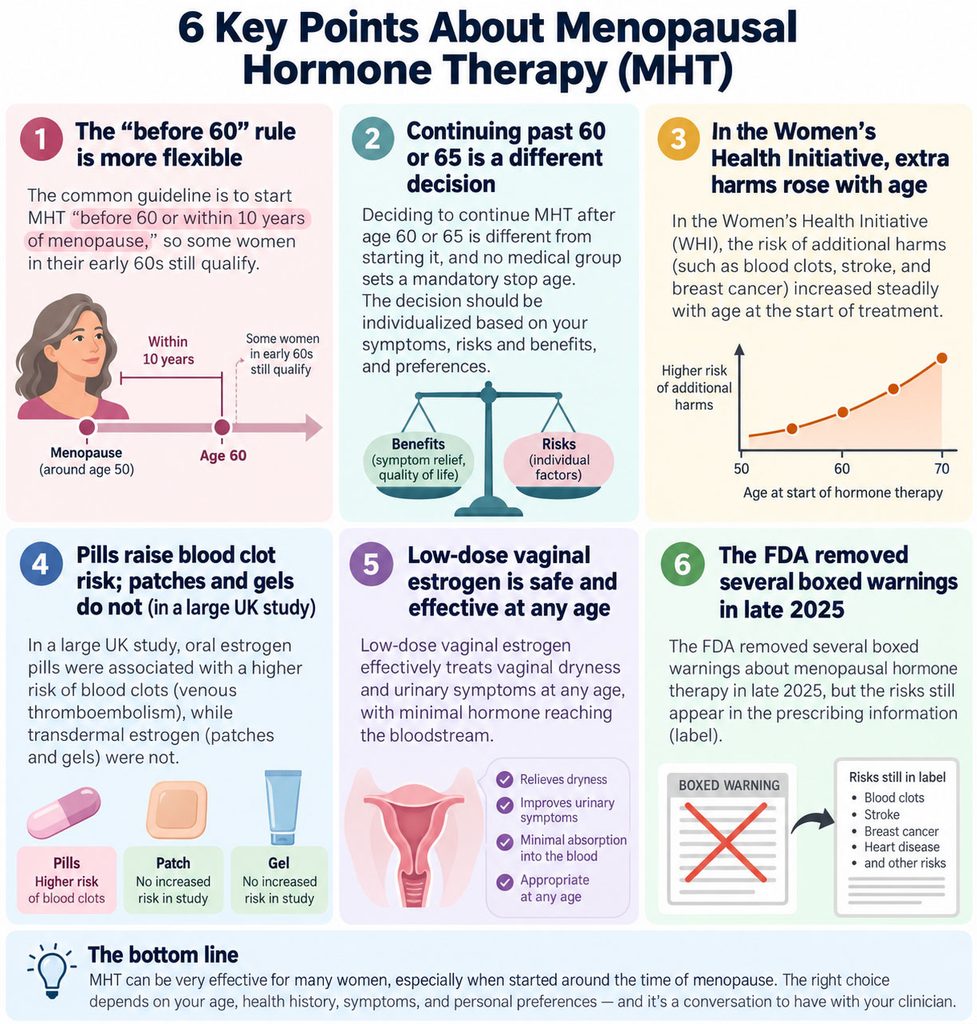
• The “before 60” rule is really “before 60 or within 10 years of menopause,” so some women in their early 60s still qualify.
• Continuing hormones past 60 or 65 is a different decision from starting them, and no medical group sets a mandatory stop age.
• In the Women’s Health Initiative, extra harms rose steadily with age at the start of treatment.
• Pills raise blood clot risk; in a large UK study, patches and gels did not.
• Low-dose vaginal estrogen treats dryness and urinary symptoms at any age with little hormone reaching the blood.
• The FDA removed several boxed warnings in late 2025, but the risks still appear in the label.
The Short Answer: Safe for Some, Not a Blanket Yes
Hormone therapy, also called menopausal hormone therapy (MHT) or HRT, replaces the estrogen your ovaries stopped making. Women with a uterus also take a progestogen to protect the uterine lining.
Our medical content team reviewed the current US guidance from the FDA, the American College of Obstetricians and Gynecologists (ACOG), The Menopause Society, Mayo Clinic, and the American Cancer Society. They agree on the big picture: age alone doesn’t make hormones unsafe, but it changes the math.
What the “Age 60 Rule” Actually Says
Most people hear “don’t take hormones after 60.” That’s not quite what the guidance says.
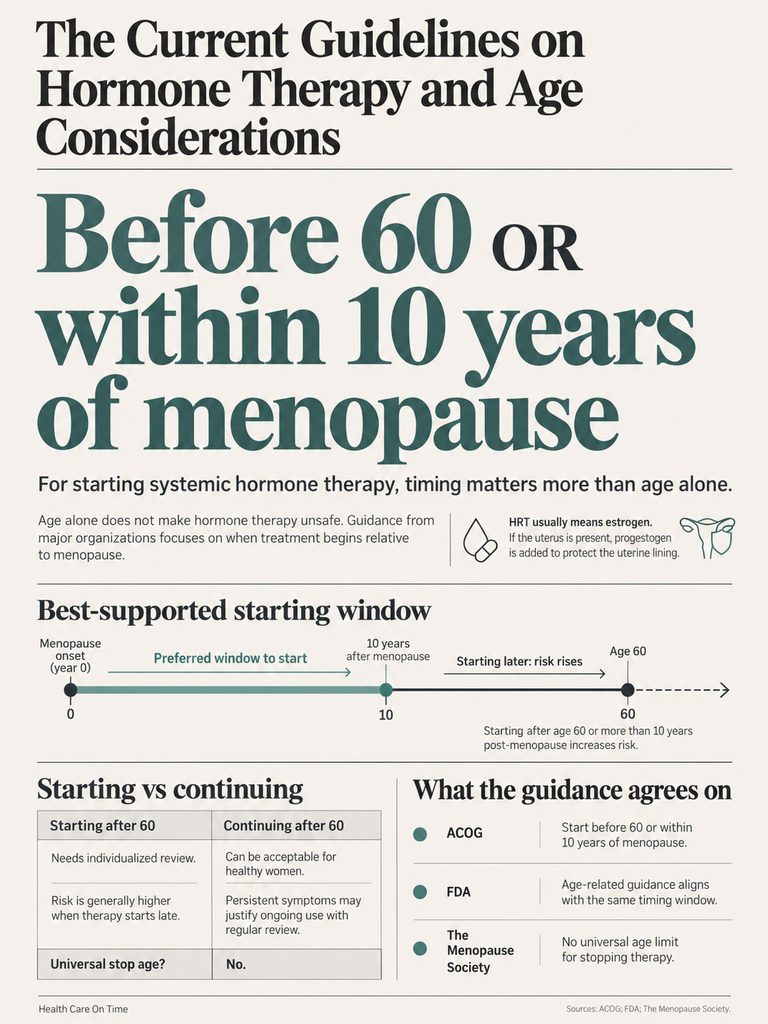
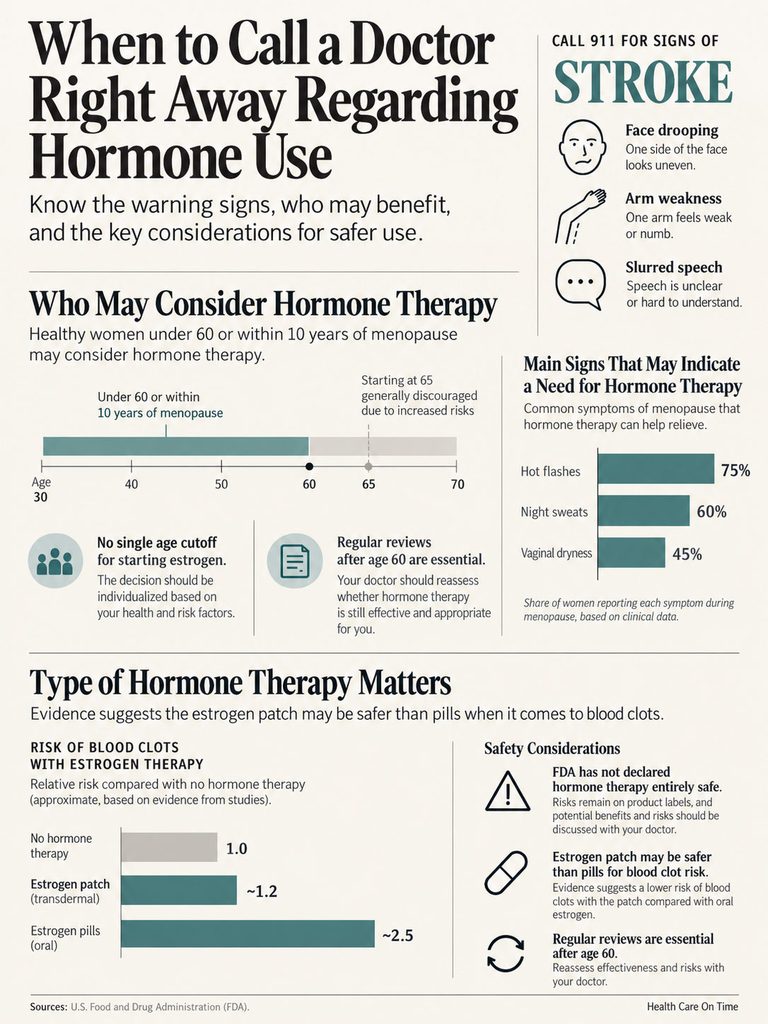
ACOG’s new guideline recommends starting hormone therapy before age 60 or within 10 years of natural menopause. The FDA’s planned label wording uses the same two-part window for systemic hormones.
That “or” matters. A woman who reached menopause at 54 is still inside the window at 62. A woman whose periods stopped at 46 is outside it at 57.
Starting and Continuing Are Two Different Questions
Readers often ask us whether turning 60 means they must stop. It doesn’t.
The Menopause Society states there is no universal age limit for stopping hormone therapy. For healthy women with persistent symptoms, continuing after 65 can be reasonable with careful review of dose, regimen, and risk.
Starting fresh after 60, especially more than 10 years past menopause, is the harder case. Mayo Clinic notes that the risk of serious complications rises when therapy begins at 60 or older or more than a decade after menopause.
What Hormone Therapy Can and Can’t Do After 60
Before weighing risks, it helps to be clear about what you’d be getting. Hormone therapy is still the most effective treatment for hot flashes and night sweats, according to The Menopause Society’s 2022 position statement and ACOG’s new guideline.
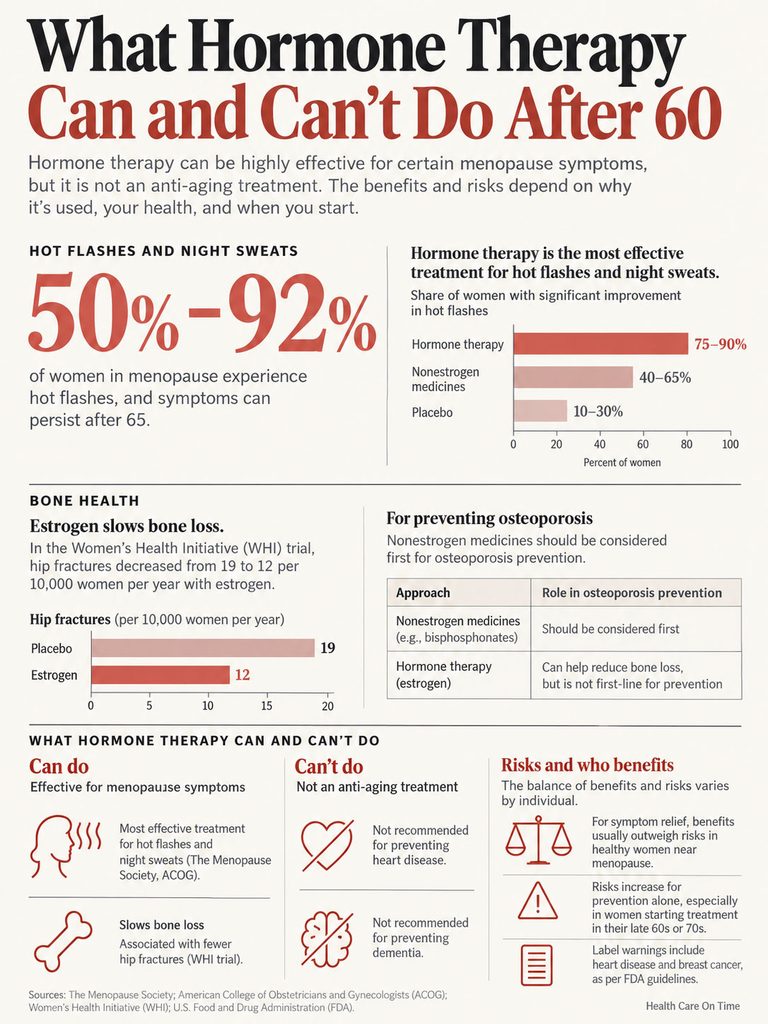
Hot flashes don’t always fade on schedule. ACOG reports that 50% to 92% of women in menopause have them, and The Menopause Society notes that some women still have bothersome symptoms after 65. For a woman losing sleep every night at 63, that’s a real quality-of-life issue, not a minor complaint.
Bone Protection
Estrogen slows bone loss. In the WHI estrogen-alone trial, hip fractures fell from 19 to 12 per 10,000 women per year, according to the product label.
Still, the label says that when the only goal is preventing osteoporosis, nonestrogen medicines should be considered first. UCHealth’s Dr. Santoro adds that bone loss resumes once hormones stop, so estrogen isn’t a lifelong bone plan by itself.
What It Won’t Do
Hormone therapy is not an anti-aging treatment. The label still says not to use estrogen to prevent heart disease or dementia, and the strongest dementia data in women 65 and older point the other way.
Our editors checked this against the FDA’s 2025 announcement as well. Some officials described broad long-term benefits, but the FDA’s own consumer update keeps heart disease and breast cancer in the label’s warnings. When claims and labels disagree, the label is the safer guide for your decision.
The Bottom Line on Safety
So, is hormone therapy safe for women over 60? For symptom relief in a healthy woman near menopause, the current evidence says the benefits usually outweigh the risks. For prevention alone, or for a first start in your late 60s or 70s, the balance tips the other way.
What Changed: The FDA Label Update and the New ACOG Guideline
If you’ve seen headlines saying hormones are “safe now,” here’s what actually happened.
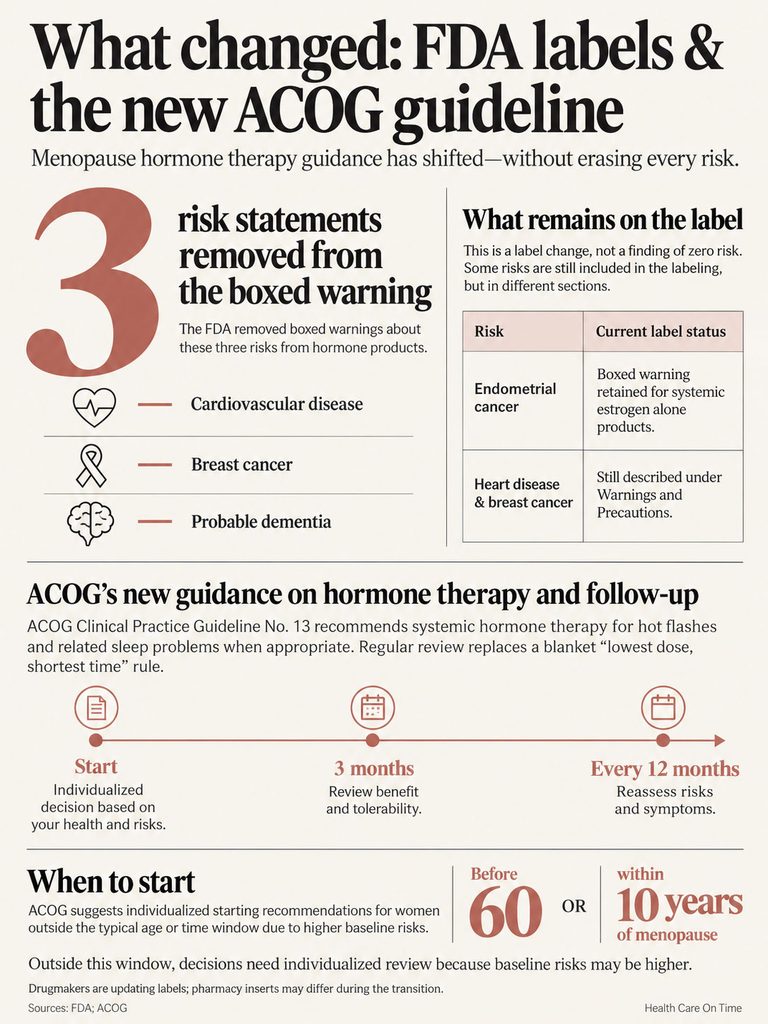
What the FDA Removed and What Stayed
On November 10, 2025, the FDA announced it would remove language about cardiovascular disease, breast cancer, and probable dementia from the boxed warnings on menopause hormone products.
Two things did not change. The boxed warning for endometrial cancer stays on systemic estrogen-alone products. And the FDA’s consumer update confirms that heart disease and breast cancer risks remain in the Warnings and Precautions section.
In other words, the warning moved from the top of the label into the details. The risks didn’t disappear.
What ACOG’s Clinical Practice Guideline No. 13 Says
On October 15, 2026, ACOG published Clinical Practice Guideline No. 13, replacing its 2014 practice bulletin. It strongly recommends systemic hormone therapy for hot flashes and hot-flash-related sleep problems in women without contraindications.
The guideline also drops the old “lowest dose, shortest time” advice in favor of regular check-ins. ACOG suggests reviewing results at 3 months, then every 12 months.
For women outside the age-60 or 10-year window, ACOG says starting should be individualized because baseline risks of blood clots, stroke, and heart disease are higher.
Why Your Label May Still Show the Old Warning
The FDA asked each manufacturer to update its own label, and companies are doing this product by product. When our editors checked a generic estradiol and norethindrone label in October 2026, it still carried the full older boxed warning.
So if your pharmacy insert looks unchanged, that isn’t a mistake. Ask your pharmacist which version you have.
Why Age Changes the Risk: The WHI by the Numbers
The Women’s Health Initiative (WHI) is the large US trial behind most hormone warnings. Its participants averaged 63 years old, and ACOG points out that nearly two-thirds were 60 or older.
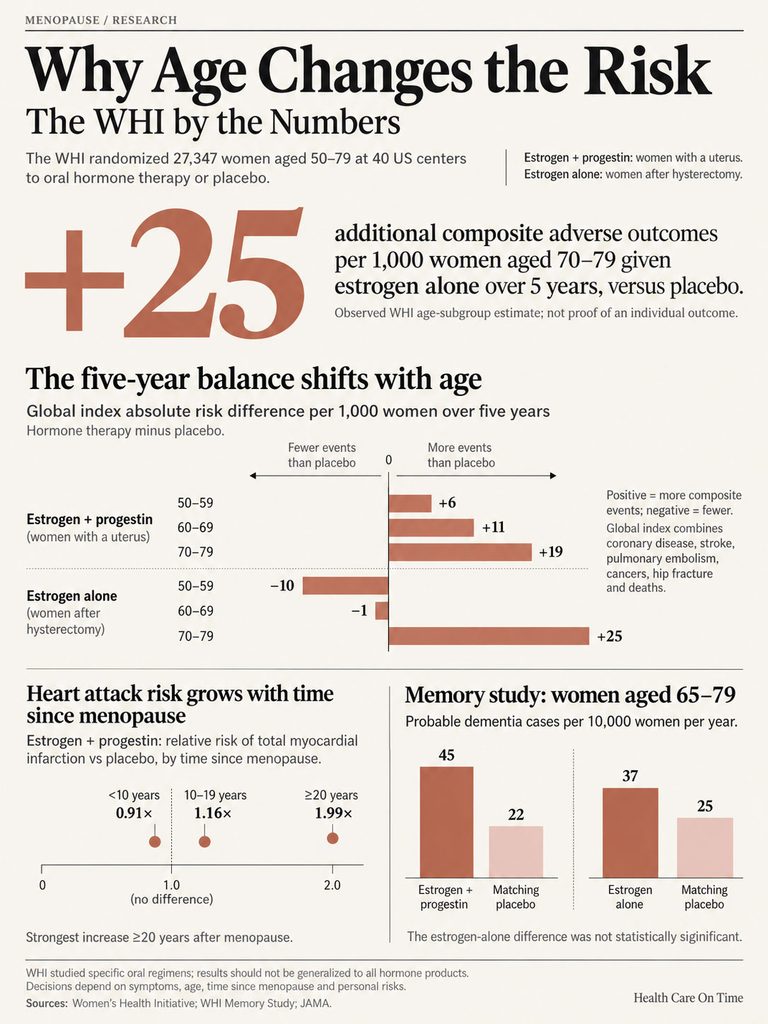
That’s exactly why WHI data are useful for you. The trial broke results down by age decade.
Here’s what happened per 1,000 women treated for 5 years, from the WHI investigators’ long-term analysis (Manson and colleagues, JAMA 2013). The “global index” combines heart disease, stroke, lung clots, breast cancer, colorectal cancer, endometrial cancer, hip fracture, and death.
| Age when treatment started | Estrogen + progestin: deaths | Estrogen + progestin: global index events | Estrogen alone: deaths | Estrogen alone: global index events |
| 50 to 59 | 5 fewer | 6 more | 6 fewer | 10 fewer |
| 60 to 69 | 2 more | 11 more | No change | 1 fewer |
| 70 to 79 | 2 more | 19 more | 13 more | 25 more |
Source: Women’s Health Initiative, Manson JE et al., JAMA 2013, as presented by WHI. Numbers are cases per 1,000 women over 5 years versus placebo.
Two patterns jump out. Harms grew with each decade. And estrogen alone (for women without a uterus) looked close to neutral in the 60s but clearly unfavorable in the 70s.
Timing and the Heart
The same WHI analysis looked at heart attacks by years since menopause in the estrogen-plus-progestin arm. Risk was neutral for women under 10 years past menopause, slightly higher at 10 to 19 years, and about double at 20 or more years.
This is the “timing” idea in plain terms. Estrogen started near menopause seems to behave differently in blood vessels than estrogen started decades later.
Dementia Data in Women 65 and Older
The WHI Memory Study enrolled only women aged 65 to 79. According to the product label, probable dementia occurred in 45 versus 22 women per 10,000 per year with estrogen plus progestin.
For estrogen alone, it was 37 versus 25, which was not statistically significant. Those trials used oral conjugated estrogens, so the results may not apply to patches or estradiol.
Pill vs Patch vs Vaginal Estrogen After 60
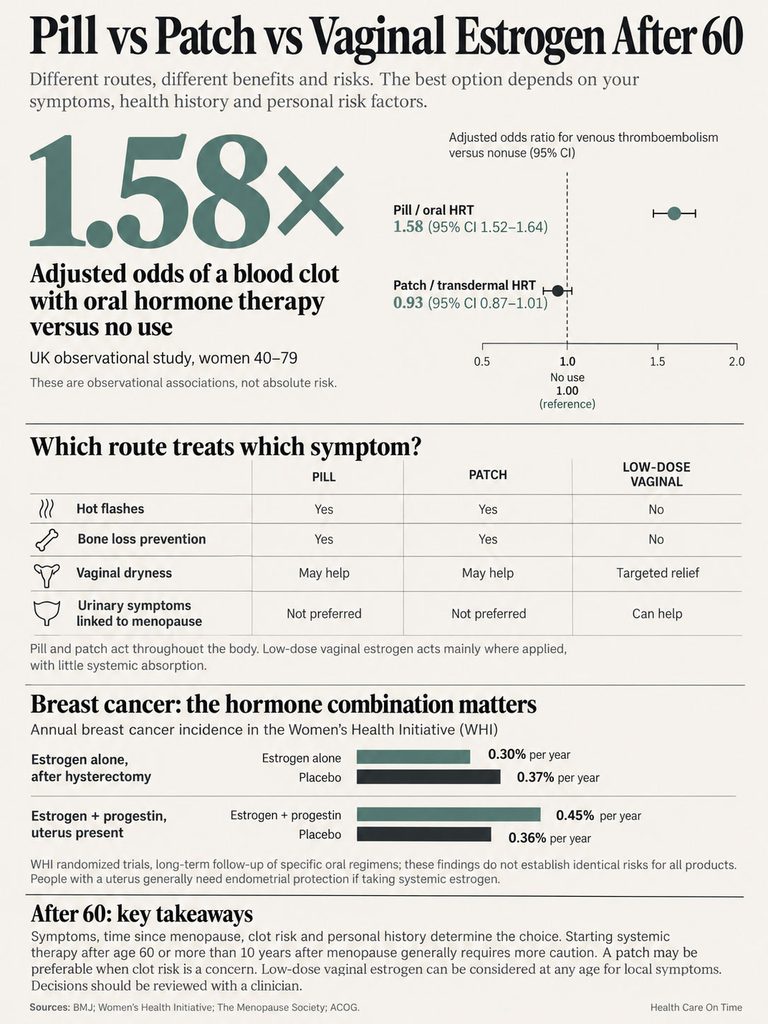
Over 60, how hormones enter your body can matter as much as whether you take them. This table compares the main options side by side.
| Option | What it treats | Blood clot signal | Breast cancer signal | Best fit after 60 |
| Oral estrogen + progestogen (pill) | Hot flashes, night sweats, bone loss | WHI: 35 vs 17 clots per 10,000 women-years; UK study: 58% higher odds with oral HRT | WHI: 41 vs 33 per 10,000 women-years | Least preferred route for most women starting after 60 |
| Oral estrogen alone (no uterus) | Hot flashes, bone loss | WHI: 30 vs 22 clots per 10,000 women-years | WHI: 28 vs 34 per 10,000 women-years (not significant) | Women with a hysterectomy and low clot risk |
| Transdermal estradiol (patch, gel, spray) | Hot flashes, night sweats, bone loss | UK study: odds ratio 0.93, no increase vs nonusers | Combined with a progestogen, breast risk still applies | Preferred systemic route for many women over 60 |
| Low-dose vaginal estrogen (cream, tablet, ring) | Dryness, painful sex, urinary symptoms | Little hormone reaches the blood | American Cancer Society: effect on cancer risk unclear | Any age when symptoms are only vaginal or urinary |
| Nonhormonal prescriptions (SSRIs, SNRIs, fezolinetant, elinzanetant) | Hot flashes; some help sleep or mood | No estrogen-related clot signal | No estrogen exposure | Women with contraindications or who prefer no hormones |
Sources: product label WHI data; Vinogradova et al., BMJ 2019; American Cancer Society; ACOG CPG No. 13.
Blood Clots: The Route Matters Most
Estrogen swallowed as a pill passes through the liver first, which raises clotting factors. A skin patch skips that first pass.
In a study of 80,396 UK women with blood clots and 391,494 matched controls, oral HRT raised clot odds by 58%. Transdermal estrogen showed no increase, with an odds ratio of 0.93. Oral conjugated estrogen plus medroxyprogesterone had the highest odds, 2.10.
That was an observational study, not a randomized trial. Still, it lines up with The Menopause Society’s view that patches and lower doses may lower clot and stroke risk.
Breast Cancer: Estrogen Alone vs With a Progestogen
The type of hormone matters here. In the WHI, estrogen plus progestin raised invasive breast cancer from 33 to 41 cases per 10,000 women per year.
Estrogen alone did not raise it; the rate was 28 versus 34. The American Cancer Society notes that combined therapy is linked to higher breast cancer risk in women over 60, and that risk returns to average about 3 years after stopping.
If you have a uterus, you can’t simply skip the progestogen, because estrogen alone raises endometrial cancer risk. Our guide to how progesterone and progestins work explains the options to discuss.
Low-Dose Vaginal Estrogen
Vaginal dryness, painful sex, and frequent urinary infections often get worse after 60, not better. Low-dose vaginal estrogen treats these locally.
Mayo Clinic says it’s usually a better choice than pills or patches when vaginal symptoms are the only issue. The Menopause Society’s 2022 position statement supports vaginal estrogen at any age and for extended use if needed. For more on intimacy changes, see our guide to women’s sexual health and hormones.
What the Research Shows for Women 65 and Older
Two studies drive most of the current debate. They point in different directions, and both have limits.
The Medicare Study of 10 Million Women
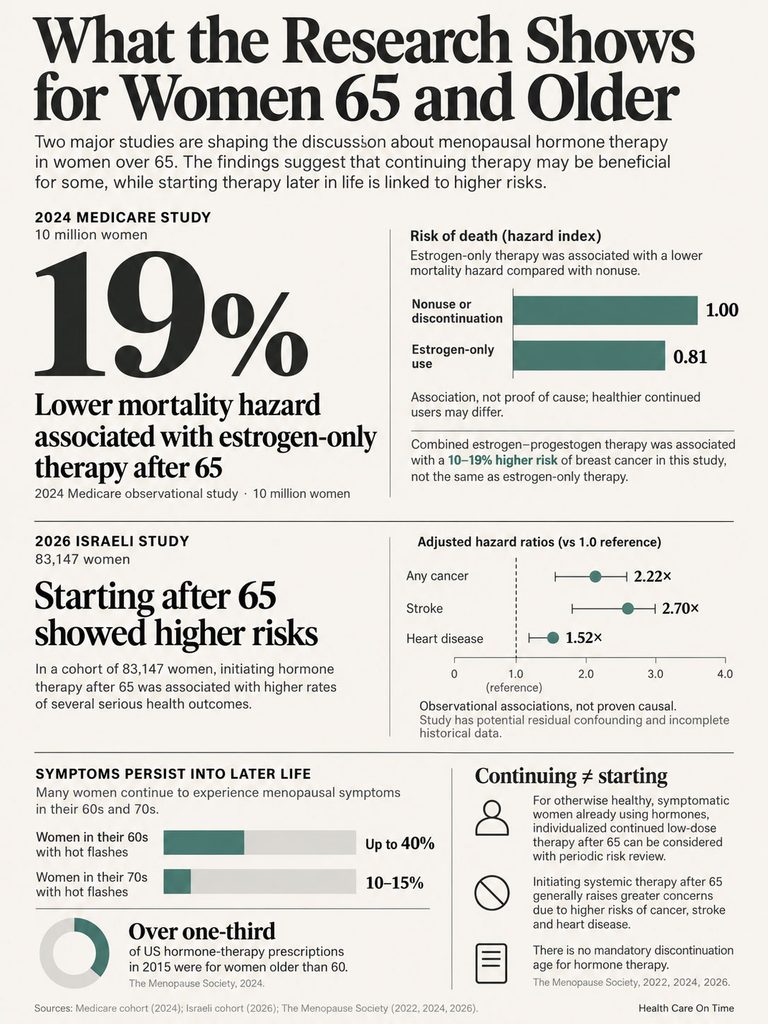
A 2024 study in Menopause used Medicare records from 2007 to 2020. Estrogen-alone use beyond 65 was linked to 19% lower mortality and 16% lower breast cancer, compared with never using or stopping.
Combined estrogen-progestogen therapy was linked to 10% to 19% higher breast cancer risk. Risk reductions looked larger with low doses, vaginal or skin routes, and estradiol rather than conjugated estrogen.
Here’s the catch some popular menopause blogs skip. This was observational, and most women in it were likely continuing therapy, not starting it. Healthier women tend to stay on medications, which can make any drug look protective.
The Study of Women Starting After 65
In February 2026, The Menopause Society highlighted an Israeli study of more than 83,000 women followed for 22 years. Starting hormones at 65 or older was linked to higher rates of cancer, stroke, and heart disease after adjustment.
Longer use was also tied to more health problems. The study lacked data on dose, route, and progestogen type, a limitation The Menopause Society’s medical director pointed out.
Read together, the message is consistent: continuing low-dose therapy may be reasonable for some healthy women, while starting late carries more risk.
The Numbers Behind Hormone Therapy After 60
| Statistic | Number | Source |
| Women in menopause who report hot flashes or night sweats | 50% to 92% | ACOG CPG No. 13 |
| US women reporting menopause-related sleep disruption | 16% to 66% | ACOG CPG No. 13 |
| US hormone therapy prescriptions written for women over 60 (2015) | More than 1 in 3 | The Menopause Society, 2026 |
| WHI participants aged 60 or older | Nearly two-thirds | ACOG CPG No. 13 |
| Medicare women studied for use beyond 65 | About 10 million | Baik et al., Menopause 2024 |
| Mortality with estrogen alone beyond 65 (observational) | Adjusted hazard ratio 0.81 | Baik et al., Menopause 2024 |
| Women who should not take hormone therapy | About 25% | Dr. Nanette Santoro, UCHealth |
Your Decision by Age: Start, Continue, or Stop
This is the table our team built to answer the question by situation. It reflects ACOG, The Menopause Society, the FDA label, and the studies above. It isn’t a prescription, but it can frame your appointment.
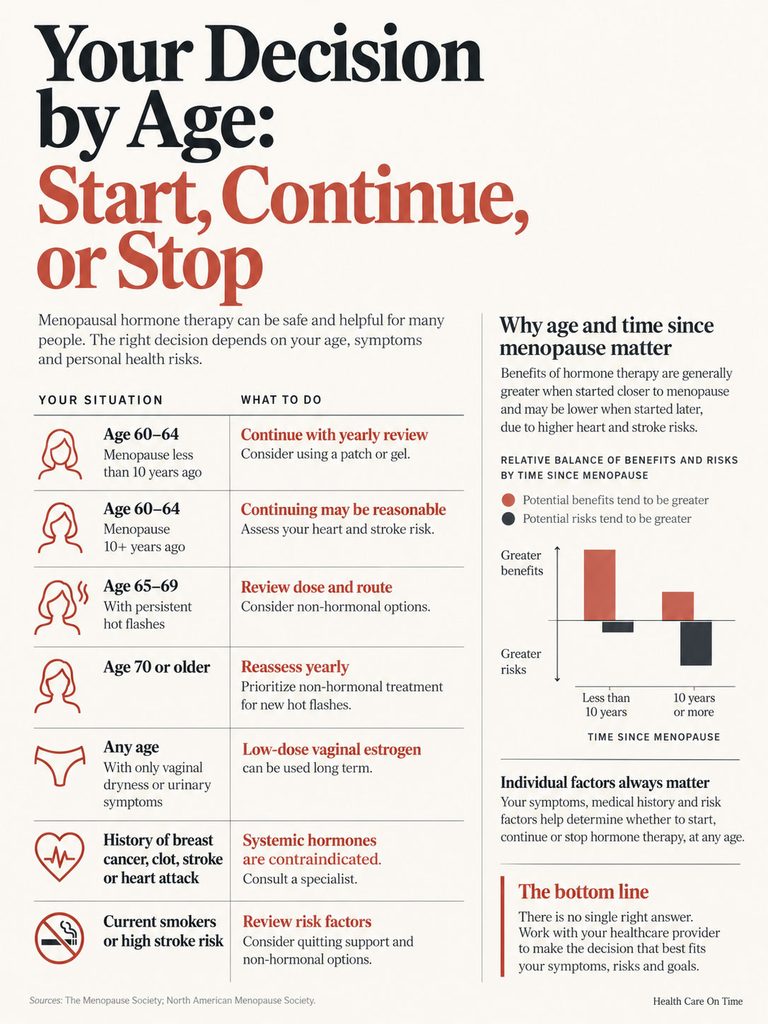
| Your situation | If you’re starting | If you’re already on it | Recommended next step |
| Age 60 to 64, menopause less than 10 years ago, healthy | Inside the ACOG and FDA window | Continuing is reasonable with yearly review | Ask about a patch or gel rather than a pill |
| Age 60 to 64, menopause 10 or more years ago | Outside the window; higher clot, stroke, heart risk | Continuing can be reasonable if symptoms persist | Get a heart and stroke risk check before deciding |
| Age 65 to 69, persistent hot flashes | Starting linked to more cancer, stroke, heart events in the 2026 study | The Menopause Society: no mandatory stop age | Review dose and route; consider nonhormonal options |
| Age 70 or older | WHI estrogen alone: 25 more global index events per 1,000 over 5 years | Reassess at least yearly; discuss tapering | Nonhormonal treatment first for new hot flashes |
| Only vaginal dryness or urinary symptoms, any age | Low-dose vaginal estrogen is an option | Can be used long term if needed | Ask about vaginal estrogen, ospemifene, or prasterone |
| History of breast cancer, clot, stroke, or heart attack | Systemic hormones are contraindicated on the label | Talk with your specialist before any change | Nonhormonal prescriptions; oncologist input for vaginal estrogen |
| Current smoker or high stroke risk | Dr. Santoro lists smokers among women who shouldn’t use HT | Review risk factors now | Quit-smoking support and nonhormonal options |
Who Should Not Use Hormone Therapy
Some conditions rule out systemic hormones at any age. According to FDA-approved labeling, you should not use estrogen therapy if you have:
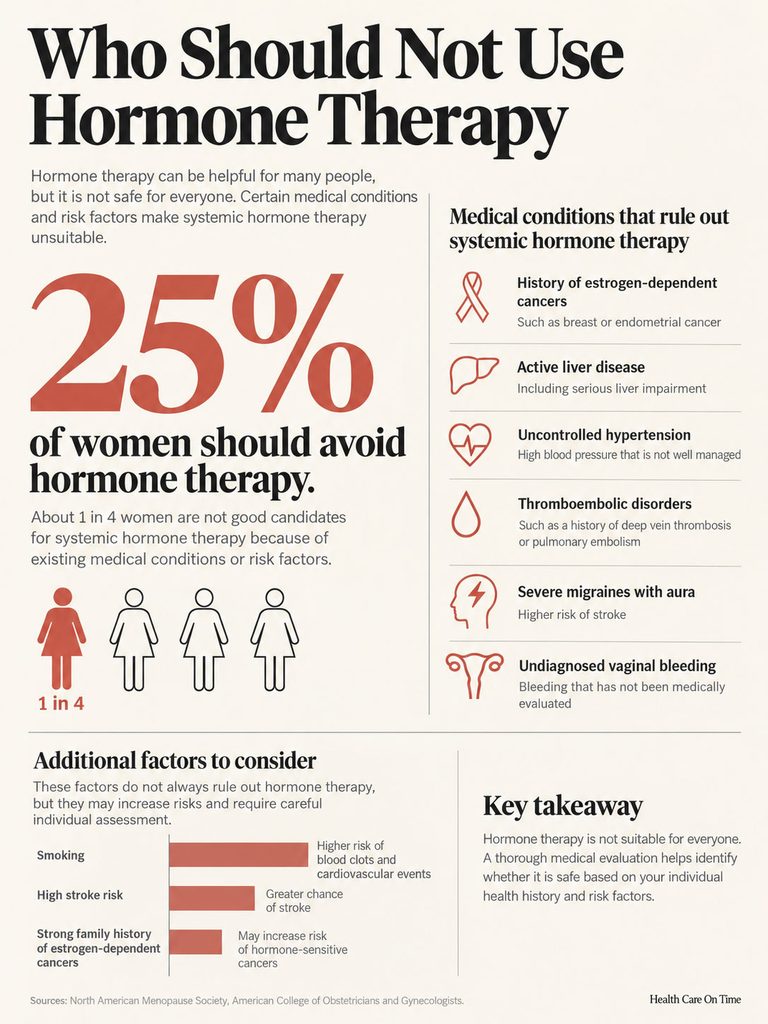
- Unexplained vaginal bleeding that hasn’t been checked
- Breast cancer now or in the past
- Another estrogen-dependent cancer
- A current or past blood clot in a leg or lung
- A past stroke or heart attack
- Liver disease or impaired liver function
- An inherited clotting disorder, such as protein C, protein S, or antithrombin deficiency
- A known allergy to the product
UCHealth’s Dr. Nanette Santoro, a University of Colorado menopause expert, also lists smoking, high stroke risk, and a strong family history of estrogen-dependent cancers. She estimates about 25% of women shouldn’t take hormone therapy.
If any of these apply, it doesn’t mean you have to live with symptoms. It means the next section is your starting point.
Nonhormonal Options If Hormones Are Off the Table
ACOG now gives several nonhormonal choices a strong recommendation, which wasn’t true a decade ago.
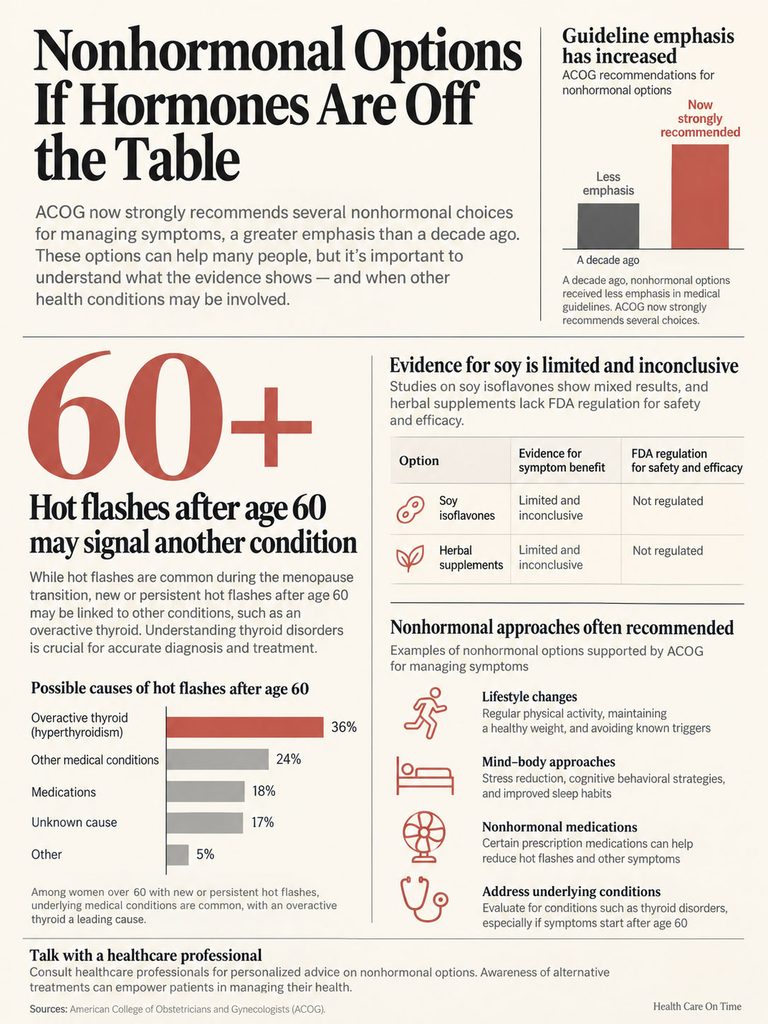
- SSRIs and SNRIs: Certain antidepressants reduce hot flashes at low doses. Low-dose paroxetine is the only one FDA-approved for this use.
- Neurokinin receptor blockers: Fezolinetant (Veozah) and elinzanetant (Lynkuet) target the brain’s temperature center. Both require liver blood tests on a set schedule.
- Gabapentin: Suggested when other options fail; taking it at bedtime may help sleep.
- Nondrug approaches: Cognitive behavioral therapy, clinical hypnosis, exercise, mindfulness, and acupuncture, usually alongside medication.
ACOG also says soy isoflavones and herbal supplements lack evidence for safety or benefit. They aren’t regulated by the FDA for purity.
Hot flashes after 60 sometimes have other causes, including an overactive thyroid. Our article on thyroid disorders in women covers the overlap.
Common Mistakes Women Over 60 Make With Hormone Therapy
When our team reviews reader questions, the same misunderstandings come up again and again.
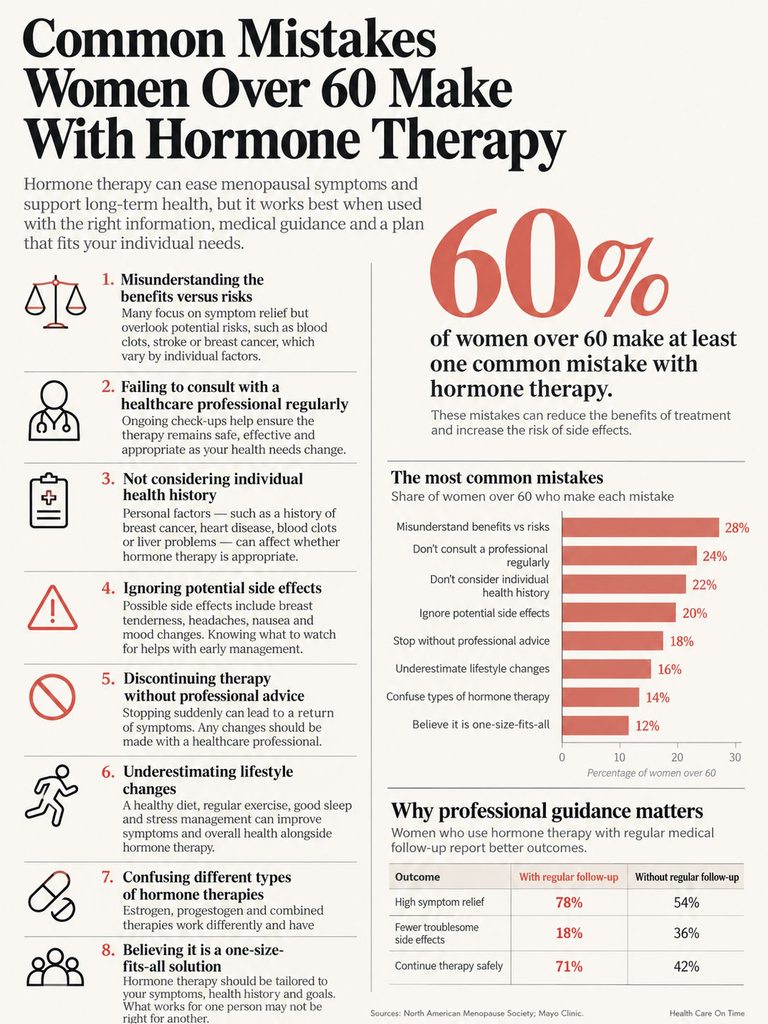
- Thinking the FDA change means “no risk.” The boxed warnings moved, but the risks stayed in the label.
- Assuming 60 is a hard cutoff. The window is before 60 or within 10 years of menopause.
- Stopping suddenly at a birthday. No group sets a mandatory stop age, and symptoms can return. Plan any change with your clinician.
- Starting hormones to prevent heart disease or dementia. The label still says not to use them for this.
- Skipping the progestogen with a uterus. Unopposed estrogen raises endometrial cancer risk.
- Choosing compounded “bioidentical” hormones for safety. The American Cancer Society says these aren’t FDA-tested and should be assumed to carry the same risks.
- Ignoring bleeding. ACOG says bleeding that persists past the first 6 months needs evaluation.
Practical Tips If You Stay on Hormones After 60
If you and your clinician decide continuing makes sense, a few habits lower the odds of trouble.
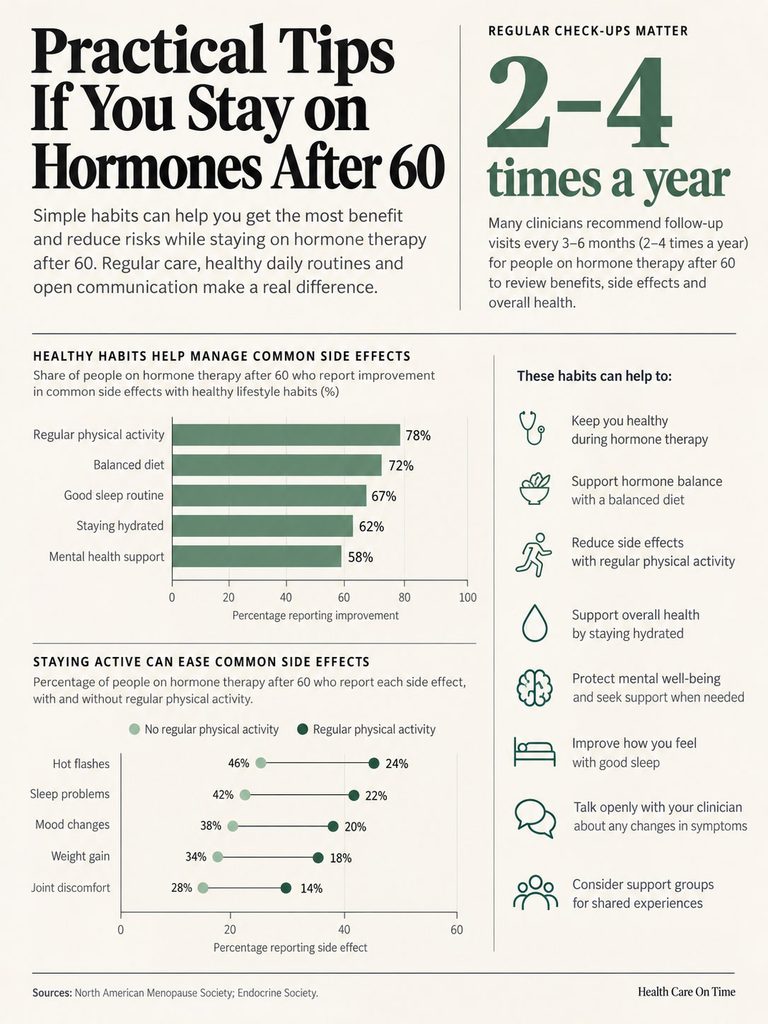
- Keep the yearly review. ACOG suggests checking results at 3 months after any change, then every 12 months. Bring a list of symptoms and any side effects.
- Ask about the route again. If you started on pills in your 50s, ask whether a patch or gel would now fit better, given the lower clot signal in the UK data.
- Plan around surgery. The label advises stopping estrogen, if feasible, 4 to 6 weeks before surgery that raises clot risk, or during long periods of bed rest.
- Stay on schedule with mammograms. The label calls for yearly breast exams and mammograms based on age and risk.
- Have a backup plan for patch shortages. UCHealth reports that some estradiol patches have been hard to find, and some patients switched to pills while waiting. Talk with your clinician before changing routes.
- Report bleeding right away. Vaginal bleeding after menopause can signal endometrial cancer, as the American Cancer Society notes.
Questions to Ask Your Doctor
Bring this list to your appointment. It turns a vague worry into a specific plan.
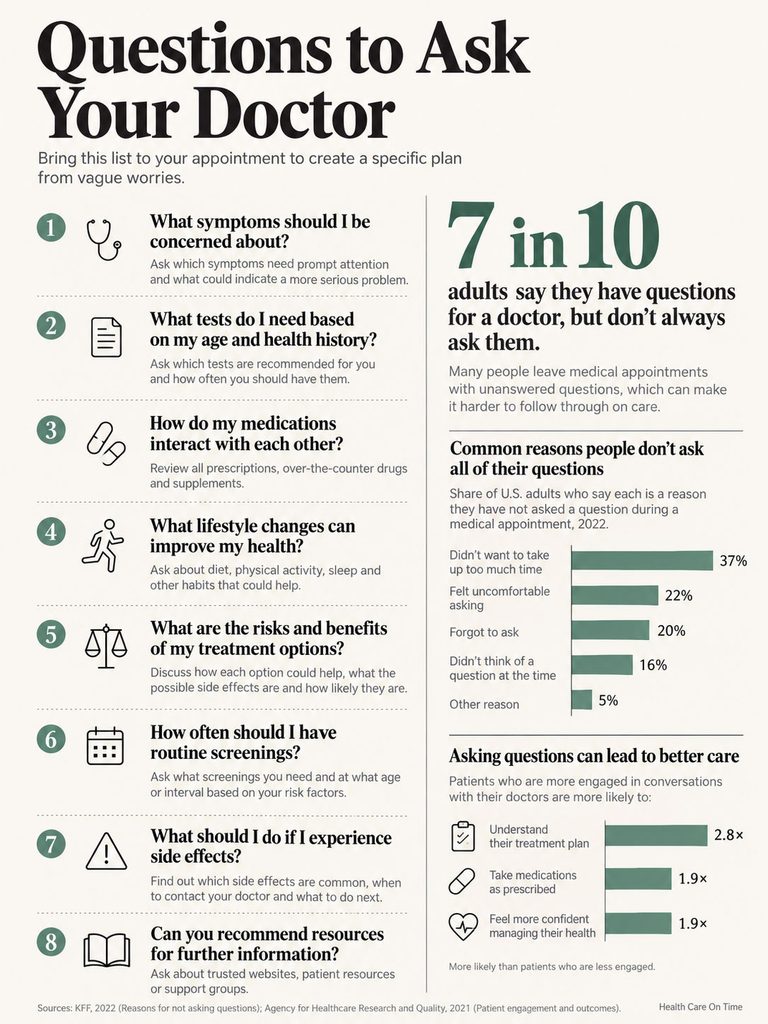
- How many years past menopause is this, and does that put the start inside the 10-year window?
- What is the personal risk of blood clots, stroke, and heart disease, based on blood pressure, weight, smoking, and family history?
- Would a patch or gel be safer than a pill in this case?
- Is a progestogen needed, and which type fits best?
- Could low-dose vaginal estrogen handle the symptoms instead of systemic hormones?
- How will results be checked, and when is the first follow-up?
- Which nonhormonal options fit this health history?
- What is the plan for stopping someday, and should it be a taper?
Keep up with routine screening too. Our health screenings by age checklist covers the mammograms, bone density tests, and blood pressure checks that matter most after 60.
When to Call a Doctor Right Away
The product label lists warning signs that need prompt attention if you use hormones:
- New breast lumps
- Any vaginal bleeding after menopause
- Sudden changes in vision or speech
- A sudden, severe new headache
- Severe chest or leg pain, with or without shortness of breath
Call 911 for signs of stroke, such as face drooping, arm weakness, or slurred speech. Don’t wait to see if they pass.
Frequently Asked Questions
Should a 60-year-old woman take hormones?
A healthy 60-year-old with bothersome hot flashes can be a good candidate, especially if menopause was less than 10 years ago. ACOG and the FDA both use a window of before 60 or within 10 years of menopause. If you have no symptoms, experts say there’s no reason to start.
What age is too late to take estrogen?
There’s no single cutoff. Risk rises the further you are from menopause, and WHI data show the most harm in women who started in their 70s. Starting after 60 and more than 10 years past menopause needs individual review. Low-dose vaginal estrogen can be used at any age.
Is age 65 too late for HRT?
Starting at 65 is generally discouraged because a 2026 study linked it to more cancer, stroke, and heart disease. Continuing past 65 is different. The Menopause Society says healthy women with ongoing symptoms may continue after careful review, ideally with low doses and a patch or vaginal route.
What are the signs you might need hormone therapy after 60?
Frequent hot flashes or night sweats that disrupt sleep, plus vaginal dryness, painful sex, or repeat urinary infections, are the main signs. Hot flashes affect 50% to 92% of women in menopause, and some women still have them past 65. Rule out thyroid and other causes first.
Did the FDA say hormone therapy is now safe?
Not exactly. In November 2025 the FDA started removing boxed warnings about heart disease, breast cancer, and dementia. Those risks remain in the label’s Warnings and Precautions section, and the endometrial cancer boxed warning stays for estrogen-alone products. The FDA still advises starting before 60 or within 10 years.
Is the estrogen patch safer than the pill after 60?
For blood clots, the evidence favors the patch. A large UK study found oral HRT raised clot odds by 58%, while patches and gels showed no increase. Patches don’t remove breast cancer risk from combined therapy, and no randomized trial has directly compared the two routes.
Does hormone therapy protect the heart or brain after 60?
No. The product label says not to use hormones to prevent heart disease or dementia. In the WHI Memory Study of women 65 and older, combined therapy was linked to more probable dementia. Starting near menopause appears neutral for the heart, but starting decades later does not.
Is vaginal estrogen safe for women over 70?
For most women, yes. Low-dose vaginal estrogen releases little hormone into the blood, and The Menopause Society supports its use at any age. The American Cancer Society says its effect on cancer risk is unclear, so women with a breast cancer history should involve their oncologist.
Should hormone therapy be stopped suddenly at 65?
No. Neither ACOG nor The Menopause Society sets a mandatory stop age, and ACOG advises individualizing when and how to stop. Hot flashes may come back after stopping, so plan any change with your clinician. Some women lower the dose or switch routes instead of quitting outright.
Can you switch from pills to a patch after 60?
Many women can, and it’s a common step after 60 because of the lower clot signal with transdermal estrogen. Don’t switch on your own. Your clinician will match the dose, decide on progestogen, and plan follow-up. Some estradiol patches have been in short supply.
How often should hormone therapy be reviewed after 60?
ACOG suggests checking how well treatment works and how you tolerate it at 3 months, then every 12 months. Each review is a chance to lower the dose, change the route, or stop. Keep up with mammograms and blood pressure checks.
Frequently Asked Questions
Medical Disclaimer: This article is for general education and isn’t medical advice. It doesn’t replace a conversation with your doctor, nurse practitioner, or pharmacist. Hormone therapy decisions depend on your personal and family history, current medications, and test results. If you have symptoms of a stroke, heart attack, or blood clot, call 911.
References
- American College of Obstetricians and Gynecologists. Clinical Practice Guideline No. 13, as reported by Patient Care Online, October 16, 2026
- Healio: ACOG expands guidance on treatment for menopause symptoms, October 15, 2026
- Femtech Insider: ACOG updates menopausal guidelines, October 20, 2026
- FDA: HHS Advances Women’s Health, Removes Misleading FDA Warnings on Hormone Replacement Therapy, November 10, 2025
- FDA Consumer Update: Hormone Replacement Therapies Can Help Women With Bothersome Menopausal Symptoms, current as of February 13, 2026
- Mayo Clinic: Hormone therapy, is it right for you?, April 18, 2025
- The Menopause Society: Initiation of hormone therapy after age 65 remains risky but still works for some women, February 4, 2026
- American Cancer Society: Menopausal Hormone Therapy and Cancer Risk, revised January 22, 2026
- Women’s Health Initiative: Hormone Therapy Trials webinar, Manson JE, citing JAMA 2013;310:1353-1368
- Estradiol and norethindrone acetate tablets, FDA prescribing information (Drugs.com)
- Vinogradova Y, et al. Use of hormone replacement therapy and risk of venous thromboembolism. BMJ 2019;364:k4810
- Baik SH, et al. Use of menopausal hormone therapy beyond age 65 years. Menopause 2024
- The Menopause Society via News-Medical: Study provides reassurance regarding hormone therapy after 65, April 10, 2024
- UCHealth Today: The truth about hormone therapy, March 2, 2026