Nearly half of American women in their 40s and 50s have high blood pressure, and this is the exact age when hot flashes and night sweats show up. So one of the most common questions our medical content team sees is simple: can you take hormone therapy with high blood pressure, or does one problem rule out fixing the other?
Table of Contents
Quick Answer: Yes. Most women with high blood pressure can take hormone therapy (HRT) if their blood pressure is treated and controlled, they start before age 60 or within 10 years of menopause, and they have no history of stroke, heart attack or blood clots. Estrogen through the skin (patch, gel or spray) is usually the preferred form, because estrogen pills were linked to a 14% higher risk of developing high blood pressure in a study of more than 112,000 women.
At a Glance
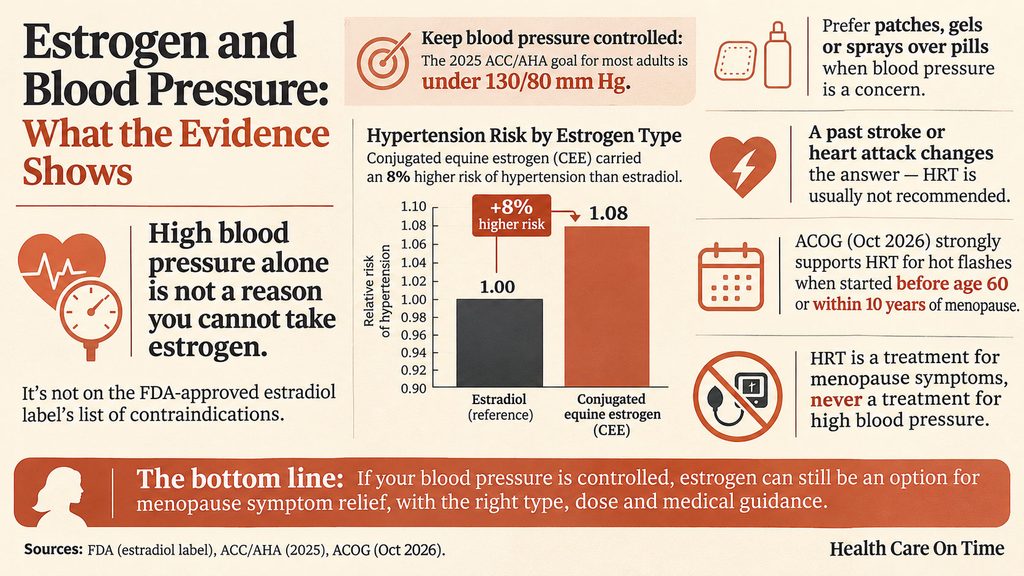
- High blood pressure alone is not on the FDA-approved estradiol label’s list of reasons you cannot take estrogen.
- Controlled blood pressure is the goal before and during HRT; the 2025 ACC/AHA target for most adults is under 130/80.
- Patches, gels and sprays are generally favored over pills when blood pressure is a concern.
- Pills and the type of estrogen matter: conjugated equine estrogen carried an 8% higher hypertension risk than estradiol.
- A past stroke or heart attack changes the answer; HRT is usually not recommended.
- ACOG’s new guideline (October 2026) strongly supports HRT for hot flashes when started before 60 or within 10 years of menopause.
- HRT is a treatment for menopause symptoms, never a treatment for high blood pressure.
The Short Answer: Yes for Most Women, With Conditions
Having high blood pressure does not automatically take hormone therapy off the table. The FDA-approved estradiol label our editors reviewed lists the conditions that rule estrogen out, such as active blood clots, a stroke or heart attack within the past year, certain cancers and liver disease. High blood pressure is not on that list. Instead, the label asks doctors to check blood pressure at regular intervals while you use estrogen.
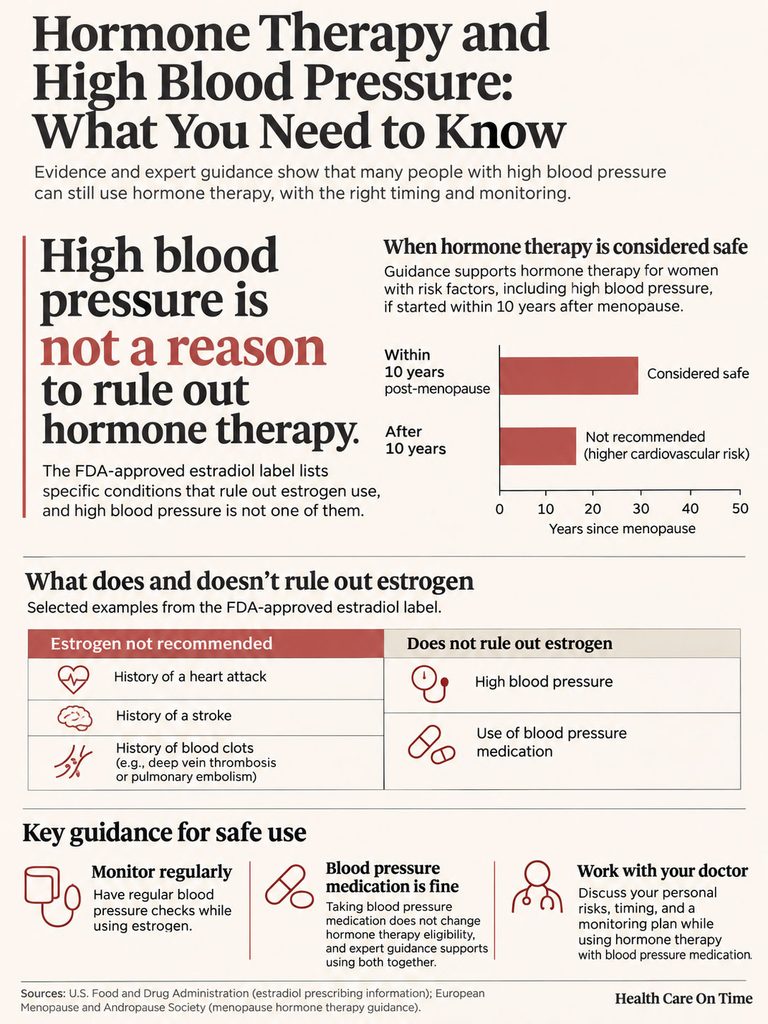
US academic centers say the same thing in plain words. A September 2026 article from Mass General Brigham notes that hormone therapy is considered safe for women with risk factors like high blood pressure, high cholesterol or obesity when it starts within 10 years of the menopause transition. The same article is clear that it is not recommended after a heart attack, stroke or other cardiovascular event.
So the real question is not “yes or no.” It is three smaller questions:
- Is your blood pressure controlled right now?
- Which form of estrogen will you use?
- Do you have other heart or clot risks that change the math?
Readers often ask us whether the answer changes if they already take a blood pressure pill. It does not, by itself. The European Menopause and Andropause Society states in its 2026 guidance that hormone therapy can be taken alongside blood pressure medicine, and a UK interview with a menopause specialist on Blood Pressure UK gives the same advice: keep taking your medicine and let your doctor watch your readings.
Why Blood Pressure Climbs Around Menopause
Blood pressure tends to rise in midlife, and it often rises in women right when menopause begins. That timing makes it easy to blame hormones for everything. The real picture is more mixed.
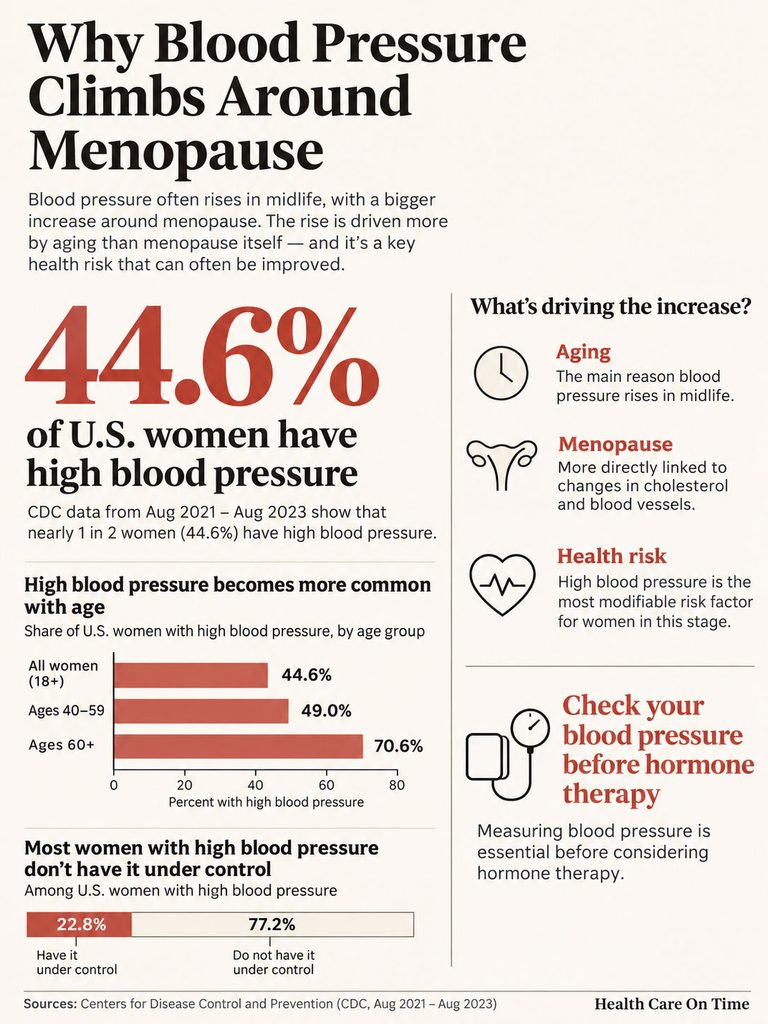
An American Heart Association scientific statement found that blood pressure changes in midlife track more closely with getting older than with the menopause transition itself. Cholesterol changes and changes in the blood vessel walls are more tied to menopause. The same statement calls high blood pressure the most important risk factor women can change during this stage.
The CDC numbers show how common this is. In its August 2021 to August 2023 survey, 44.6% of US women had high blood pressure (130/80 or higher, or taking medicine for it). Among women aged 40 to 59, it was 49.0%. Among women 60 and older, it was 70.6%.
Here is the part that matters for HRT decisions: only 22.8% of US women with high blood pressure had it under control. That means many women asking about hormone therapy have high blood pressure that is either unknown or not yet treated to goal. If you have not checked your numbers lately, the blood pressure chart for women by age is a good place to start before your appointment.
Does HRT Raise Blood Pressure? What the Studies Show
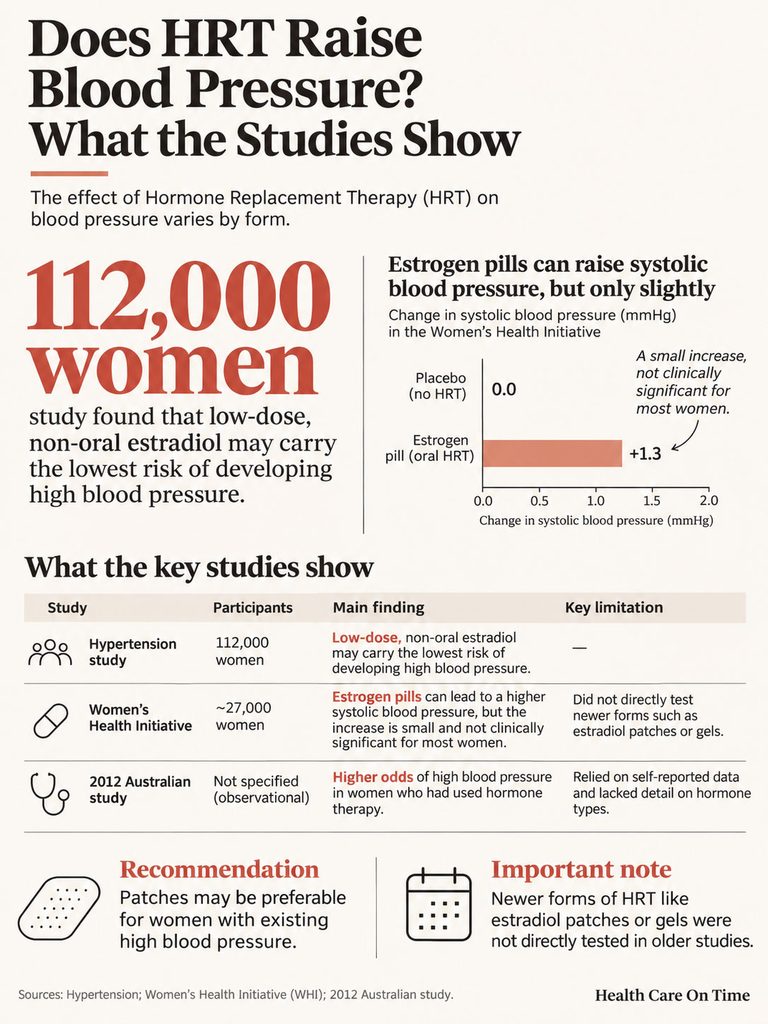
The honest answer: it depends on the form. For most women the effect is small, but pills and patches do not behave the same way. Our editors checked the main studies against their original sources, and three stand out.
The 112,000-Woman Study on Pills vs Patches
The largest study to compare routes was published in the American Heart Association journal Hypertension in June 2023. Researchers at the University of Calgary followed more than 112,000 women aged 45 and older who used estrogen-only therapy in Alberta, Canada, between 2008 and 2019. They looked at who developed high blood pressure at least one year after starting.
The results:
- Estrogen pills carried a 14% higher risk of high blood pressure than estrogen through the skin.
- Pills carried a 19% higher risk than vaginal creams or suppositories.
- Conjugated equine estrogen (the type in Premarin) carried an 8% higher risk than estradiol.
- The link with pills was stronger in women under 70.
- Longer use and higher doses were linked to higher risk.
The study has real limits. It used medical records only, it included only estrogen-only users (so women with a uterus who also take a progestogen were not studied), and it was done in Canada. Still, the lead author told the American Heart Association that low-dose, non-oral estradiol may be linked to the lowest risk.
The Women’s Health Initiative Data
The Women’s Health Initiative (WHI) was the large US trial that tested estrogen pills against placebo in women aged 50 to 79. A 2023 analysis in the journal Menopause looked only at women who already had high blood pressure when the trial began, more than 9,000 of them.
Both estrogen alone (conjugated equine estrogen 0.625 mg) and estrogen plus medroxyprogesterone acetate (2.5 mg) were linked to higher systolic blood pressure than placebo. But the number of blood pressure medicines women needed did not differ between groups over 16 years of follow-up. A Cleveland Clinic menopause specialist described the rise as small and not clinically meaningful for most women, and suggested patches for women with high blood pressure or worsening control.
Note that the WHI used older-style oral hormones. Many women today use estradiol patches or gels, which these results do not directly test.
An Older Study and Why It Ranks So High
You may see a 2012 study at the top of Google results. It looked at 43,405 Australian women and found that women who had ever used hormone therapy had higher odds of high blood pressure: 1.59 times the odds under age 56, 1.58 at ages 56 to 61, and 1.26 at ages 62 to 70. There was no link at 71 and older.
When our team reviewed this paper, the limits were clear. It was a one-time snapshot, so it cannot show cause and effect. Women reported their own history. And it did not record which type, dose or form of hormone they used, which is exactly the detail that newer research shows matters most.
Patch vs Pill: Why the Route Matters
This is the gap in nearly every article ranking for this question. The form of estrogen you take is the biggest lever you control.
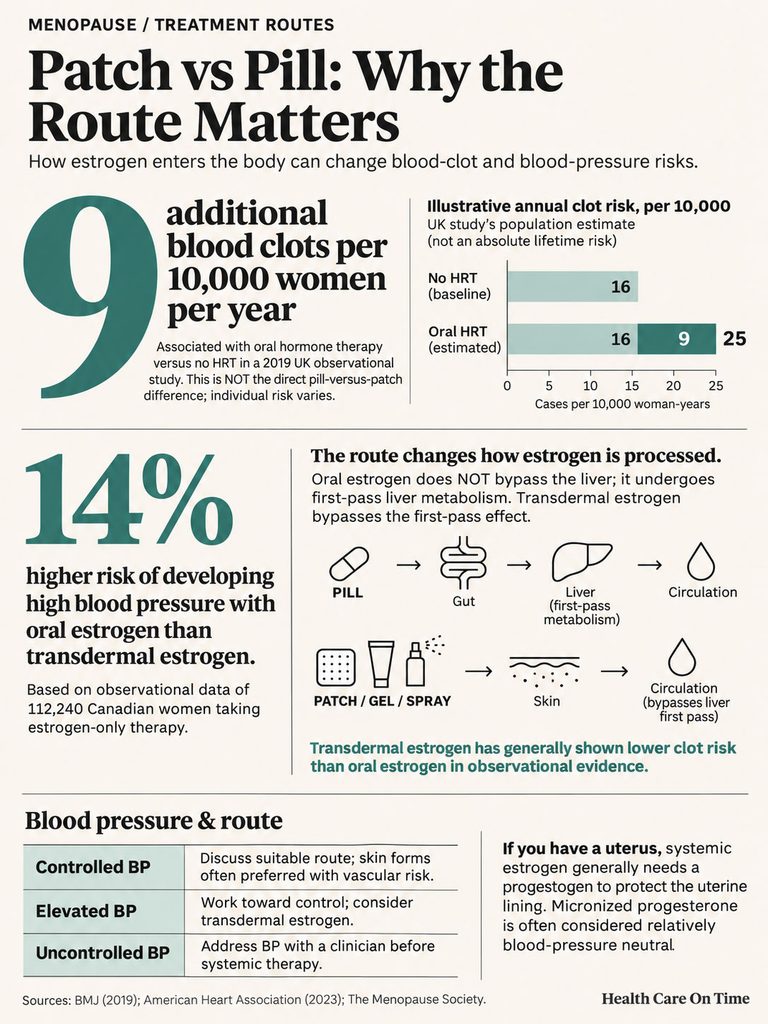
When you swallow estrogen, it passes through your liver first. When it goes through your skin, it skips that first pass. A Cleveland Clinic expert noted that oral hormone therapy may switch on the body’s renin-angiotensin-aldosterone system, a hormone chain that helps control blood pressure and can push it up. That is one likely reason pills and patches showed different results in the Canadian study.
Blood clots are a second reason. A large UK study published in The BMJ compared more than 80,000 women with blood clots to more than 390,000 women without them. Most HRT tablets were linked to about 9 extra clots per 10,000 women per year, while patches, gels and creams showed no increase. Because high blood pressure already raises stroke risk, avoiding added clot risk matters more for you than for a woman with normal readings. The Menopause Society’s 2022 position statement also says transdermal routes and lower doses may lower the risk of clots and stroke.
The table below is the decision matrix our team built from US guidance and the studies above. It is the side-by-side view the top-ranking pages do not give.
| Your blood pressure situation | Estrogen through the skin (patch, gel, spray) | Estrogen pill | What your doctor typically checks |
| Normal (under 120/80) | Generally acceptable; route chosen by symptoms and preference | Generally acceptable; label still advises regular BP checks | Baseline BP, age, years since menopause, clot and breast cancer history |
| Elevated or Stage 1 (120 to 139 / 80 to 89), controlled | Usually the preferred form | Possible, but linked to 14% higher hypertension risk than skin estrogen | Home readings, target under 130/80, recheck after starting |
| Stage 2 (140/90 or higher) but controlled on medicine | Usually preferred; EMAS says skin estrogen seems preferable with hypertension | Less favored; older WHI data showed higher systolic BP with pills | Medicine list, kidney function, cholesterol, recheck within weeks |
| Uncontrolled (above target despite treatment, or untreated) | Treat blood pressure first; no US guideline sets a separate cutoff for starting HRT | Least favored option | Confirm with home or ambulatory readings, adjust BP medicine |
| 180/120 or higher | Not the time to start HRT; this is a hypertensive crisis range | Not the time to start HRT | Urgent care; 911 if symptoms like chest pain or weakness |
| High BP plus past stroke, heart attack or blood clot | Usually not recommended; specialist decision only | Not recommended | Cardiology input, nonhormonal options |
Does the Progestogen Matter Too?
If you still have a uterus, you need a progestogen with estrogen to protect the lining of the uterus. ACOG’s guidance confirms this pairing. The type matters less in the research so far, but the menopause specialist interviewed by Blood Pressure UK said micronized progesterone does not appear to raise blood pressure, and EMAS suggests micronized progesterone or a non-androgenic progestogen for women after stroke who still need treatment. Ask your doctor which progestogen fits your blood pressure history.
Controlled vs Uncontrolled: Where Your Numbers Fit
“Controlled” is a word competitors use without defining. Here is what it means under the 2025 ACC/AHA high blood pressure guideline:
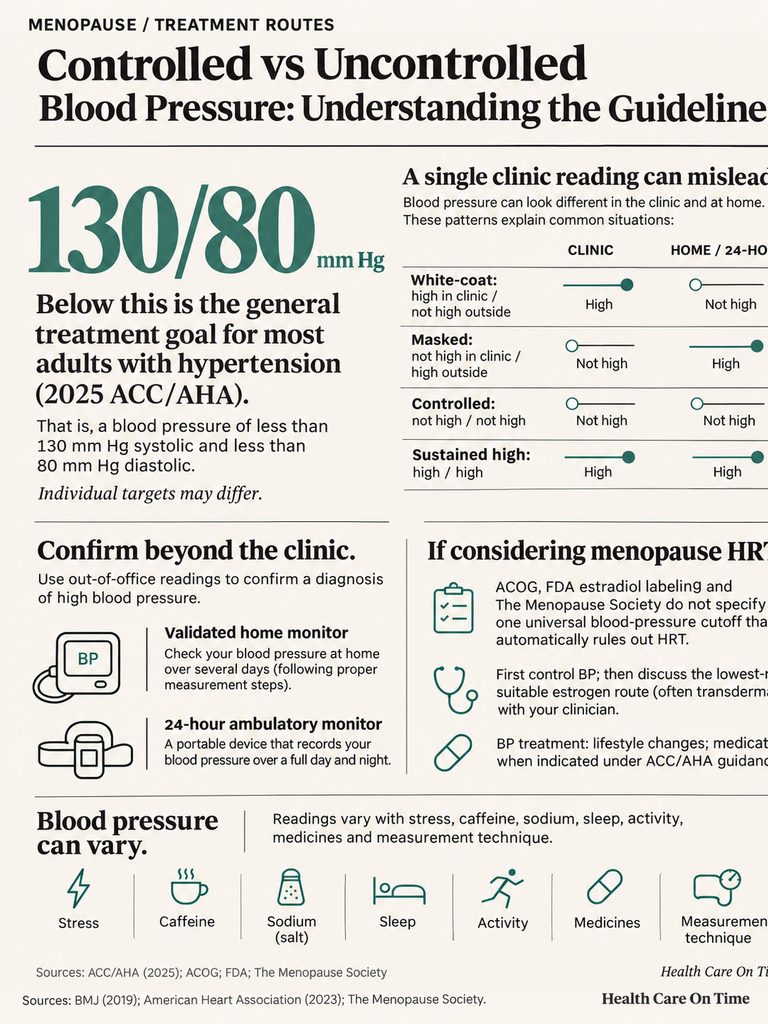
- Normal: under 120/80
- Elevated: systolic 120 to 129
- Stage 1: systolic 130 to 139 or diastolic 80 to 89
- Stage 2: 140/90 or higher
- Treatment target for most adults: under 130/80
The guideline also says a diagnosis should be confirmed with readings taken outside the office, at home or with a 24-hour monitor. That matters because white-coat readings can make blood pressure look worse than it is, and masked high blood pressure can hide it.
Our team looked for a specific US blood pressure number that blocks HRT. There is none in ACOG’s new guideline, the FDA label or The Menopause Society’s statement. In practice, that means your doctor’s goal is simple: get your blood pressure to target, then choose the lowest-risk form of estrogen. If you need a refresher on what drives your numbers, the high blood pressure guide covers causes and treatment.
What Changed: ACOG’s New Guideline and the FDA Label Update
Two big US updates landed this year, and the pages ranking for this question predate both.
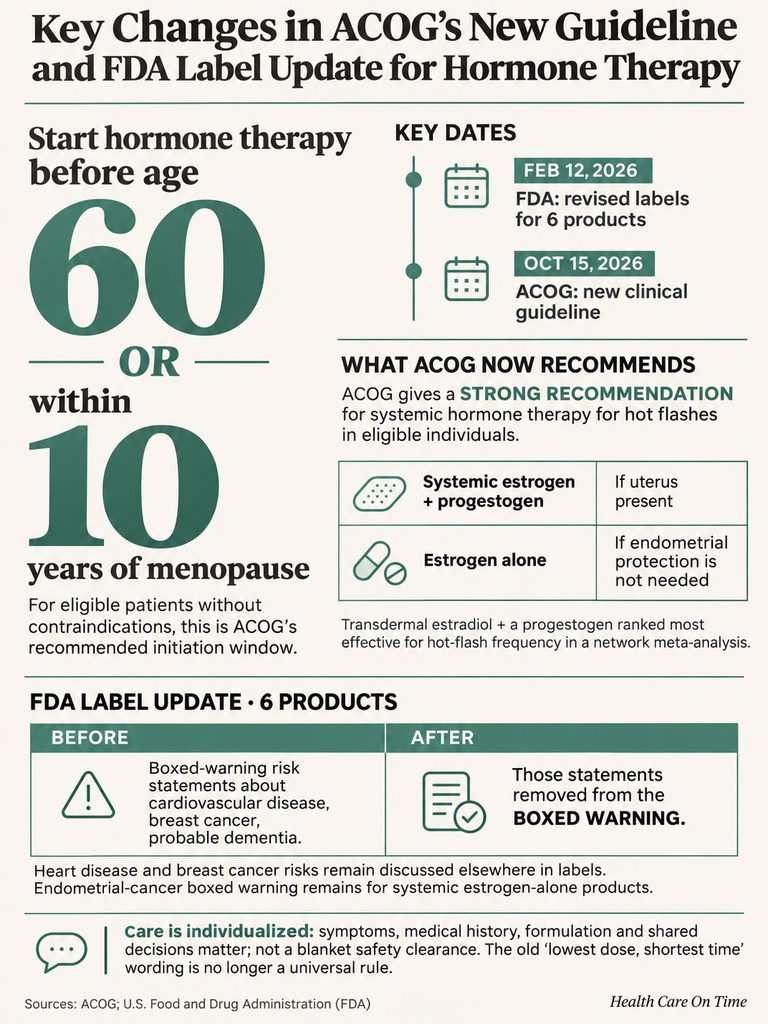
ACOG Clinical Practice Guideline No. 13. On October 15, 2026, the American College of Obstetricians and Gynecologists published new guidance on menopause symptoms, replacing its 2014 bulletin. It strongly recommends systemic hormone therapy for hot flashes and related sleep problems in people without contraindications. It strongly recommends starting before age 60 or within 10 years of menopause. In a network analysis it reviewed, transdermal estradiol plus a progestogen ranked highest for reducing hot flash frequency. Reports on the update also note it moves away from the old “lowest dose, shortest time” rule toward individual decisions.
What it does not do: it does not give hypertension-specific advice. It asks doctors to weigh baseline cardiovascular, blood clot and breast cancer risk through shared decision-making. That is why the route decision in the table above still matters.
FDA label changes. On February 12, 2026, the FDA approved label changes for six hormone therapy products, removing risk statements about cardiovascular disease, breast cancer and probable dementia from the boxed warning. The FDA cited studies showing that women who start within 10 years of menopause, generally before 60, had lower all-cause death rates and fewer fractures.
None of this means HRT is now risk-free for everyone with high blood pressure. It means the timing window and the form you choose carry more weight than a blanket fear of hormones. For a closer look at age, see our article on whether hormone therapy is safe for women over 60.
The Numbers Behind HRT and Blood Pressure
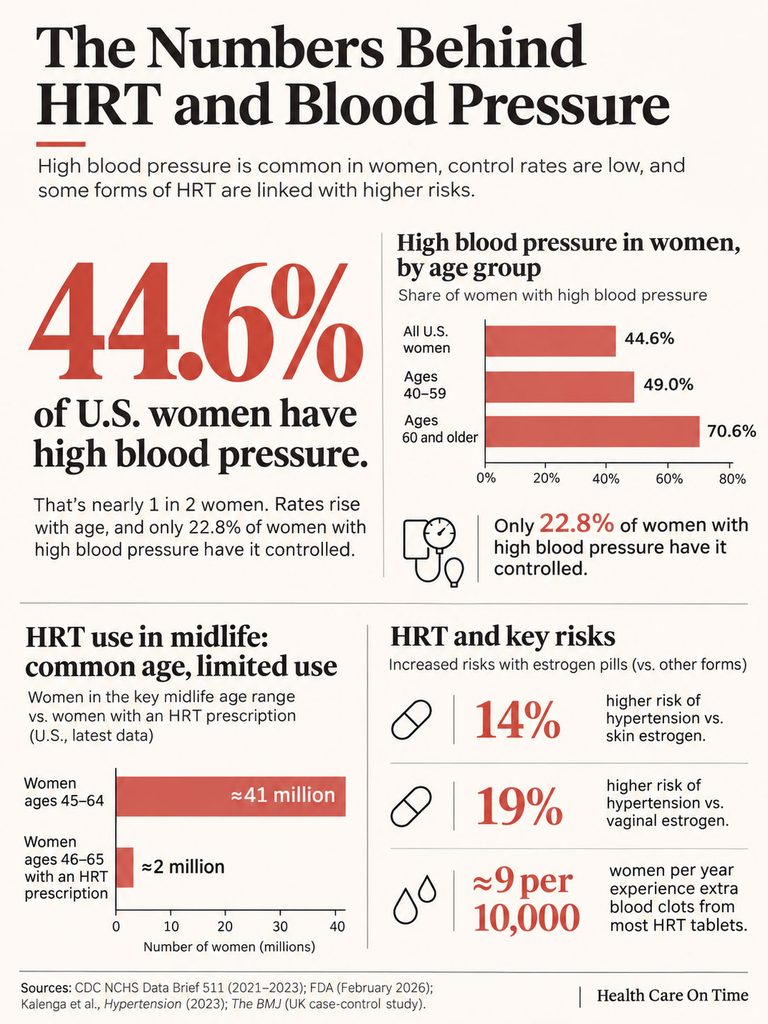
| Data point | Number | Source |
| US women with high blood pressure | 44.6% | CDC NCHS Data Brief 511 (2021 to 2023) |
| US women aged 40 to 59 with high blood pressure | 49.0% | CDC NCHS Data Brief 511 |
| US women 60 and older with high blood pressure | 70.6% | CDC NCHS Data Brief 511 |
| US women with high blood pressure who have it controlled | 22.8% | CDC NCHS Data Brief 511 |
| US women aged 45 to 64 (2020) vs those aged 46 to 65 with an HRT prescription | About 41 million vs about 2 million | FDA, February 2026 |
| Higher hypertension risk, estrogen pill vs skin estrogen | 14% | Kalenga et al., Hypertension, 2023 |
| Higher hypertension risk, estrogen pill vs vaginal estrogen | 19% | Kalenga et al., Hypertension, 2023 |
| Higher hypertension risk, conjugated equine estrogen vs estradiol | 8% | Kalenga et al., Hypertension, 2023 |
| Extra blood clots with most HRT tablets | About 9 per 10,000 women per year | The BMJ, UK case-control study |
| Women with hot flashes or night sweats in midlife | About 80% | AHA scientific statement, 2020 |
Two things jump out. First, high blood pressure is common enough that millions of women who could benefit from HRT will have it. Second, the route effects are moderate, not huge. A 14% relative increase is worth avoiding when a patch works just as well, but it is not a reason to rule out treatment for disabling symptoms.
Who Should Not Take HRT
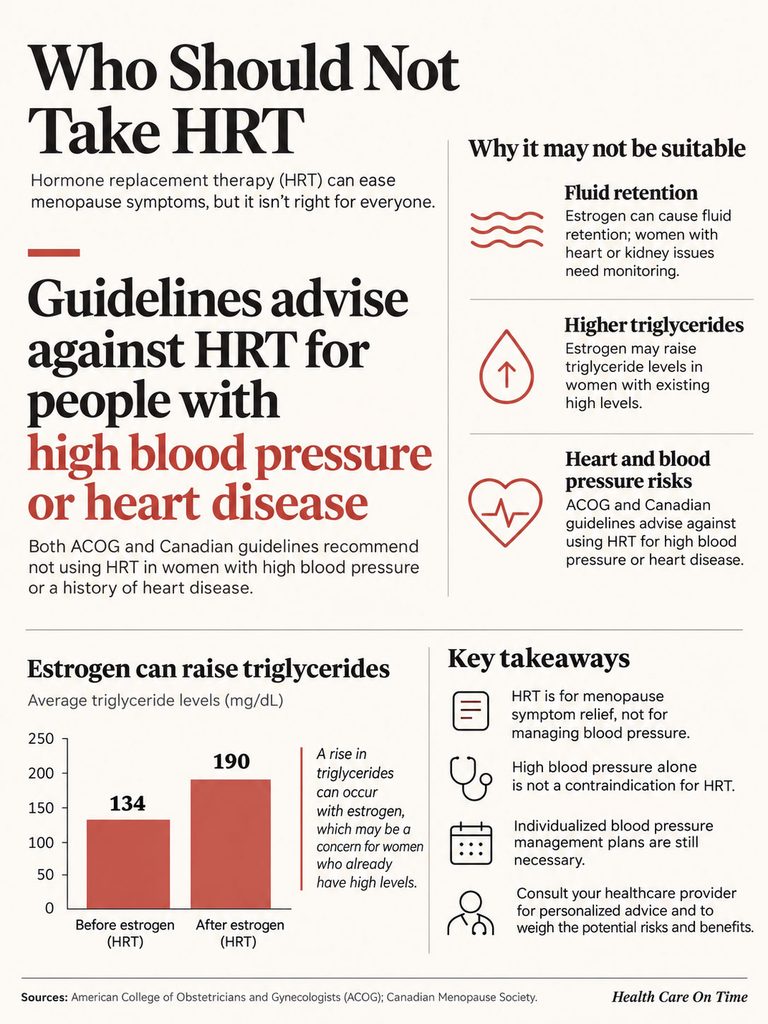
High blood pressure alone is not a reason to say no. These situations usually are. Based on the FDA label and Mayo Clinic guidance, hormone therapy is generally not appropriate if you have:
- A stroke or heart attack, especially within the past year
- Known heart or blood vessel disease
- A current or past blood clot in the legs or lungs
- Breast cancer or another estrogen-driven cancer
- Liver disease
- Unexplained vaginal bleeding that has not been checked
- A possible pregnancy
The estrogen label also flags two issues that overlap with blood pressure care. Estrogen can cause some fluid retention, so women with heart or kidney problems need closer watching. And estrogen can raise triglycerides in women who already have high levels.
One more line belongs here. Both ACOG and Canadian guidelines, as quoted by the American Heart Association, say hormone therapy should not be used to prevent or treat high blood pressure or heart disease. It treats menopause symptoms. Your blood pressure still needs its own plan.
What Your Doctor Will Check
When our team reviews reader questions about this topic, many women say they were not sure what to bring to the appointment. Here is what a typical evaluation covers:
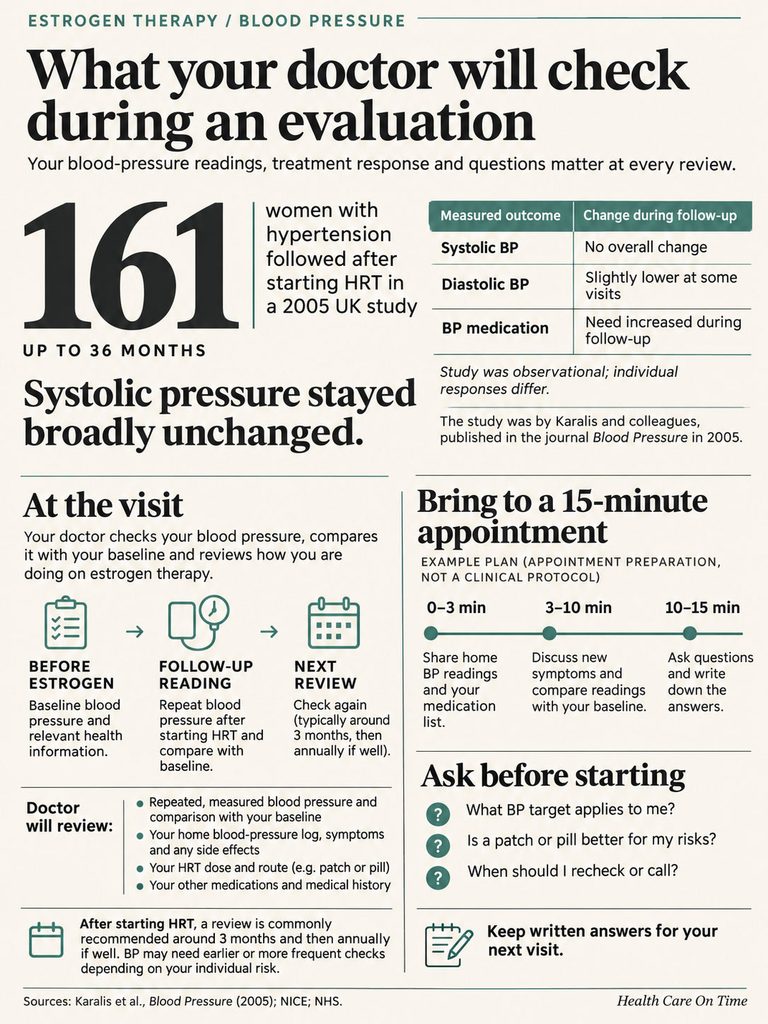
- Blood pressure history and current readings. Bring two weeks of home readings if you can. A validated upper-arm cuff makes them more useful; see our guide to home blood pressure monitors.
- Your medicine list. Include over-the-counter pain relievers. Some, like ibuprofen, can nudge readings up, which our article on whether ibuprofen raises blood pressure explains.
- Age and years since your last period. This sets your timing window.
- Clot, stroke and heart history, plus family history of early clots.
- Breast cancer risk, including your last mammogram.
- Labs as needed, often cholesterol, triglycerides and kidney function.
After you start, expect a blood pressure recheck. The estrogen label says blood pressure should be monitored at regular intervals with estrogen use. The 2005 study described on Blood Pressure UK followed 161 women with careful monitoring and medicine adjustment, and HRT did not push their blood pressure higher. Monitoring is the safety net that makes this work.
Questions to Ask Before You Start
Short, specific questions get better answers in a 15-minute visit. Our editors suggest bringing these:
- Is this blood pressure at target right now, based on home readings and not just today’s office reading?
- Why this form of estrogen, and would a patch, gel or spray be a better fit for someone with high blood pressure?
- Which progestogen is planned, and does it affect blood pressure?
- When should blood pressure be rechecked after starting, and what reading should prompt a call?
- Do any current medicines change the plan?
- If blood pressure rises, will the dose or route change before stopping treatment?
Writing down the answers helps at follow-up visits, when you compare your new readings with your baseline.
Your Decision Guide
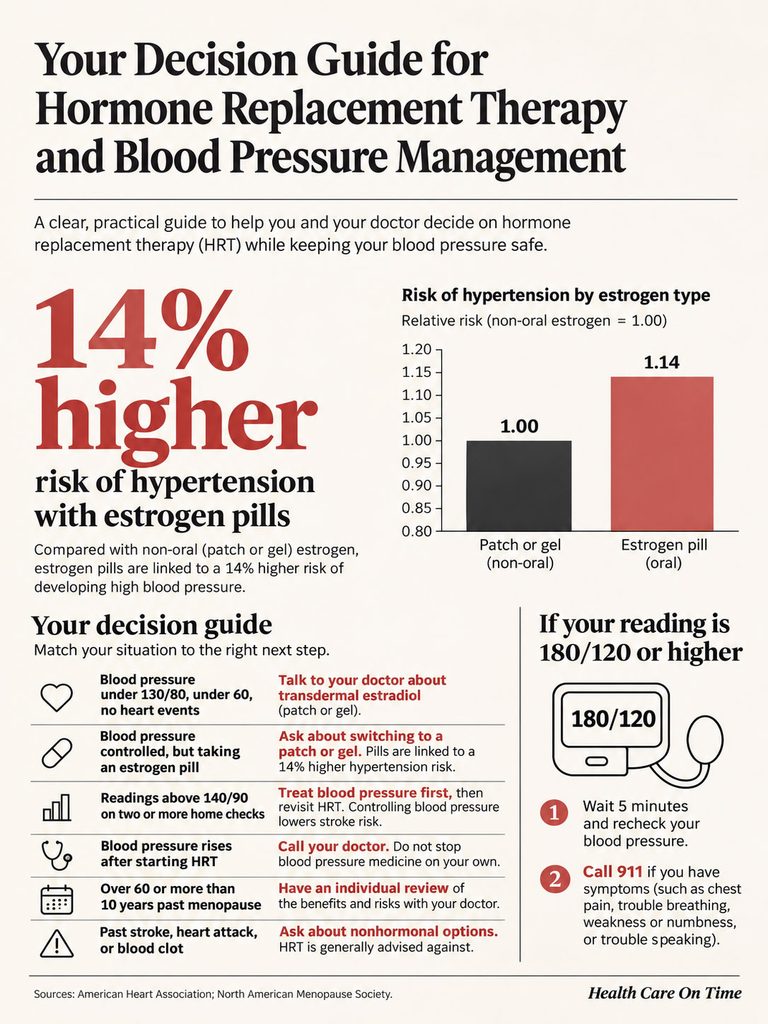
| Scenario | Recommended action | Why |
| Blood pressure controlled under 130/80, under 60, no heart events | Talk with your doctor about transdermal estradiol | Fits ACOG’s timing window and the lowest-risk route for blood pressure |
| Blood pressure controlled but you already take an estrogen pill | Ask whether switching to a patch or gel makes sense | Pills were linked to 14% higher hypertension risk than skin estrogen |
| Readings above 140/90 on two or more home checks | Treat blood pressure first, then revisit HRT | No US cutoff exists, but control lowers stroke risk before adding hormones |
| Blood pressure rises after starting HRT | Call your doctor; do not stop BP medicine on your own | Label notes rare large rises from individual reactions; route or dose can change |
| Over 60 or more than 10 years past menopause | Individual review of benefits and risks | ACOG notes higher baseline clot, stroke and heart risks beyond the window |
| Past stroke, heart attack or blood clot | Ask about nonhormonal options | Mass General Brigham and the label advise against HRT in these cases |
| Reading of 180/120 or higher | Wait 5 minutes and recheck; call 911 if symptoms | AHA hypertensive crisis guidance |
Common Mistakes to Avoid
Assuming high blood pressure means “never.” Many women skip effective treatment for hot flashes based on outdated fears. Current US guidance does not list high blood pressure alone as a reason to avoid HRT.
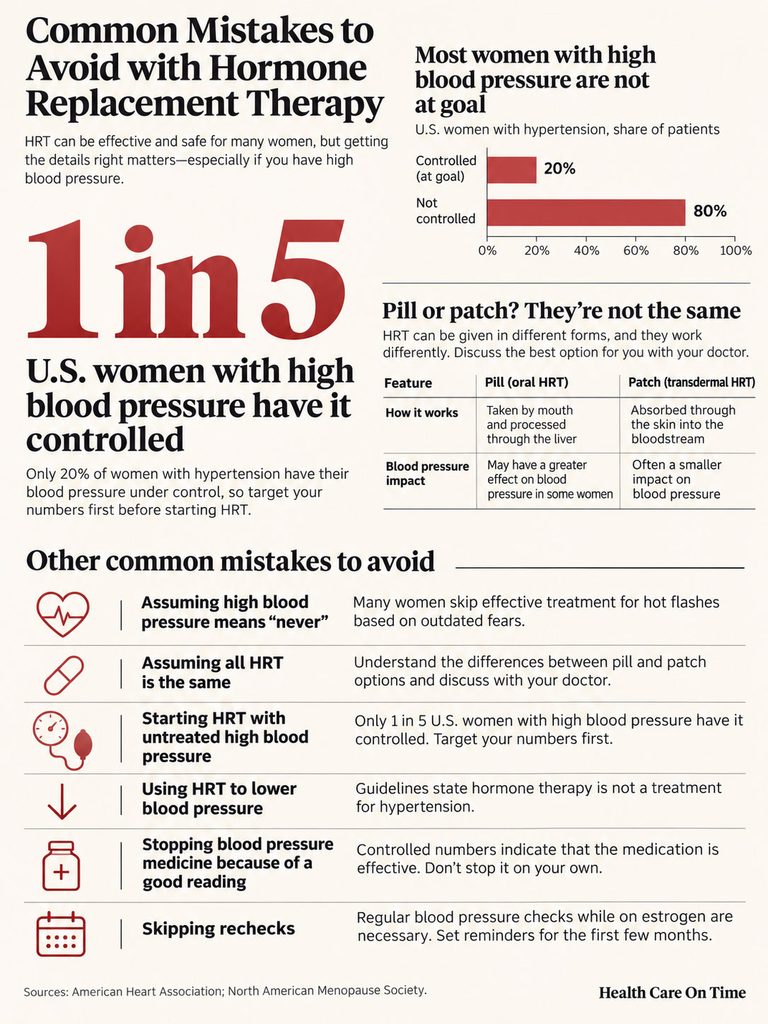
Assuming all HRT is the same. The pill vs patch difference is the biggest one you control. If a doctor offers a pill and you have high blood pressure, ask why that form was chosen.
Starting HRT with untreated high blood pressure. Only about 1 in 5 US women with high blood pressure has it controlled. Get your numbers to target first.
Using HRT to lower blood pressure. Guidelines are clear that hormone therapy is not a blood pressure treatment.
Stopping blood pressure medicine because of a good reading. Controlled numbers on medicine mean the medicine is working.
Skipping rechecks. The label calls for regular blood pressure checks while on estrogen. Put a reminder in your phone for the first few months.
When to Call a Doctor or 911
Call your doctor soon if your home readings climb above your usual range after starting HRT, if you notice new swelling in your legs, or if headaches become more frequent. Our guide to blood pressure of 140/90 explains when that number needs a same-day call.
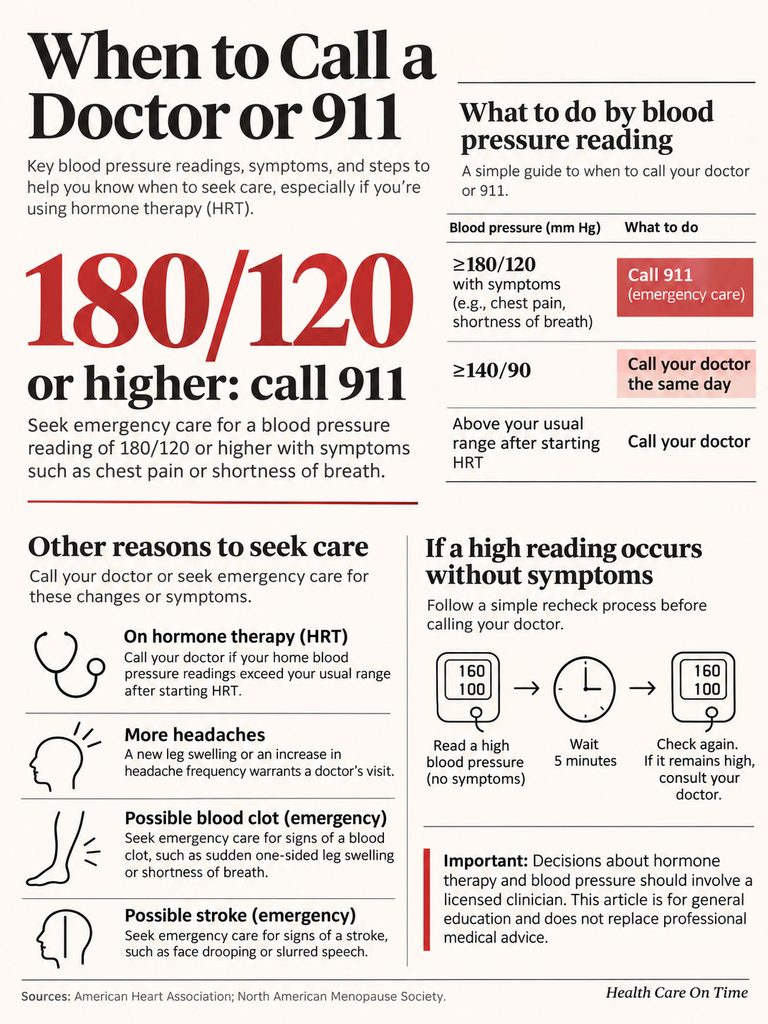
Call 911 if your reading is 180/120 or higher and you have chest pain, shortness of breath, back pain, numbness or weakness, vision changes or trouble speaking. The American Heart Association says not to wait to see if it comes down. If the reading is that high with no symptoms, wait about five minutes, check again and call your doctor if it stays high.
Also seek emergency care for signs of a blood clot or stroke: sudden one-sided leg swelling or pain, sudden shortness of breath, face drooping, arm weakness or slurred speech.
Frequently Asked Questions
Can you take hormone replacement therapy if you have high blood pressure?
Yes, in most cases. High blood pressure is not listed as a reason to avoid estrogen on the FDA-approved estradiol label. The usual conditions are that your blood pressure is controlled, you start before 60 or within 10 years of menopause, and you have no past stroke, heart attack or blood clot. Skin estrogen is usually preferred.
Does HRT raise blood pressure?
It can, slightly, depending on the form. A study of more than 112,000 women found estrogen pills carried a 14% higher risk of developing high blood pressure than skin estrogen. WHI data showed small systolic increases with older oral hormones. Skin estrogen has not shown the same pattern in this research.
Is the estrogen patch safe with high blood pressure?
For most women with controlled blood pressure, the patch is the form doctors usually prefer. It skips the liver, was linked to lower hypertension risk than pills, and a large UK study found no increase in blood clots with patches, gels or creams. Your doctor still needs to monitor your readings.
Can you take HRT and blood pressure medicine together?
Yes. European menopause guidance states hormone therapy can be taken alongside blood pressure medicine, and the large WHI analysis found women on hormones did not need more blood pressure medicines over 16 years. Keep taking your prescribed medicine and share your full medicine list with the doctor who prescribes HRT.
What blood pressure is too high to start HRT?
No US guideline sets a single cutoff. The practical goal is getting to the 2025 ACC/AHA target of under 130/80 for most adults before starting. A reading of 180/120 or higher is a hypertensive crisis range and needs urgent care, not new hormone prescriptions.
What hormone is linked to high blood pressure?
Several are. Aldosterone, part of the renin-angiotensin-aldosterone system, directly affects blood pressure, and oral estrogen may activate this system. That is one reason estrogen pills showed a higher hypertension risk than patches. Conjugated equine estrogen also carried an 8% higher risk than estradiol in the Canadian study.
Does lack of estrogen raise blood pressure?
Partly, but age plays a bigger role. An American Heart Association scientific statement found midlife blood pressure changes track more with chronological aging than with the menopause transition itself. Cholesterol and blood vessel changes are more closely tied to menopause. Earlier natural menopause may also raise hypertension risk, according to EMAS.
Is estrogen good for high blood pressure?
No, estrogen should not be used to treat high blood pressure. ACOG and Canadian guidelines say hormone therapy should not be used to prevent or treat hypertension or heart disease. It is a treatment for menopause symptoms such as hot flashes. Your blood pressure needs its own treatment plan.
Is HRT safe after a stroke if you have high blood pressure?
Usually not. The estradiol label lists a stroke or heart attack within the past year as a reason not to use estrogen, and Mass General Brigham does not recommend hormone therapy after a cardiovascular event. If symptoms are severe, a specialist may consider low-dose skin estrogen, but that is an individual decision.
Should you switch from an estrogen pill to a patch?
If you have high blood pressure, it is worth asking. Pills were linked to a 14% higher hypertension risk than skin estrogen and to more blood clots in UK data. Switching is usually simple, but do it with your doctor so the dose and progestogen are matched correctly.
How often should blood pressure be checked on HRT?
The estrogen label says blood pressure should be monitored at regular intervals, without setting an exact schedule. Many women check at home a few times a week in the first months, then report readings at follow-up visits. Bring your home log to every appointment.
Medical Disclaimer: This article is for general education and does not replace advice from your doctor. HealthCareOnTime does not provide medical care in the United States. Decisions about hormone therapy and blood pressure treatment should be made with a licensed clinician who knows your full health history. If you have chest pain, sudden weakness, trouble speaking or a reading of 180/120 or higher with symptoms, call 911.
References
- American College of Obstetricians and Gynecologists guideline coverage, Contemporary OB/GYN, October 2026: https://www.contemporaryobgyn.net/view/acog-guideline-expands-menopause-vms-sleep-and-mood-recommendations
- ACOG guideline coverage, Patient Care, October 2026: https://www.patientcareonline.com/view/acog-issues-expanded-guideline-on-managing-menopause-related-vasomotor-sleep-and-mood-symptoms
- Femtech Insider, ACOG update, October 2026: https://femtechinsider.com/acog-updates-menopausal-guidelines-strengthens-recommendations-for-hormone-therapy/
- FDA, labeling changes for menopausal hormone therapy, February 12, 2026: https://www.fda.gov/news-events/press-announcements/fda-approves-labeling-changes-menopausal-hormone-therapy-products
- Estradiol cypionate (Depo-Estradiol) prescribing information, DrugCentral: https://drugcentral.org/label/4165ef14-8dfc-4165-859c-dcf06174d69c/view
- CDC NCHS Data Brief 511, hypertension prevalence, awareness, treatment and control: https://www.cdc.gov/nchs/products/databriefs/db511.htm
- Kalenga et al., Hypertension, 2023, news release: https://www.eurekalert.org/news-releases/990697
- American Heart Association News, June 5, 2023: https://heart.org/en/news/2023/06/05/oral-estrogen-therapy-for-menopause-may-increase-high-blood-pressure-risk
- Jiang et al., Menopause, 2023, WHI secondary analysis (Healio): https://www.healio.com/news/endocrinology/20230201/systolic-bp-significantly-increases-with-ht-for-postmenopausal-women
- Chiu et al., PLoS ONE, 2012: https://pmc.ncbi.nlm.nih.gov/articles/PMC3394783/
- The BMJ newsroom, HRT tablets and blood clot risk: https://beta-www.bmj.com/company/newsroom/hrt-tablets-associated-with-increased-risk-of-blood-clots/
- The Menopause Society 2022 position statement coverage (HCPLive): https://www.hcplive.com/view/north-american-menopause-society-updates-hormone-therapy-guidance
- 2025 ACC/AHA High Blood Pressure Guideline quick reference: https://www.2minutemedicine.com/guidelines/high-blood-pressure/
- American Heart Association, hypertensive crisis: https://u1-cd-heart.sc.heart.org/en/health-topics/high-blood-pressure/understanding-blood-pressure-readings/hypertensive-crisis-when-you-should-call-911-for-high-blood-pressure
- AHA scientific statement on menopause and CVD risk (ACC summary): https://www.acc.org/Latest-in-Cardiology/ten-points-to-remember/2020/12/10/18/54/Menopause-Transition-and-CVD-Risk
- Mass General Brigham, September 2026: https://www.massgeneralbrigham.org/en/health-wellness/menopause-heart-disease-hormone-therapy
- Mayo Clinic content, who should not take hormone therapy: https://www.mymlc.com/health-information/faqs/m/menopause-hormone-therapy-who-shouldnt-take-it/
- EMAS Menopause Essentials 2026, stroke and hypertension: https://emas-online.org/wp-content/uploads/2026/07/Menopause-Essentials-2026-Menopause-management-for-women-after-stroke-and-those-with-hypertension.pdf
- Blood Pressure UK, February 2021: https://www.bloodpressureuk.org/news/news/blood-pressure-the-menopause-and-hrt-.html