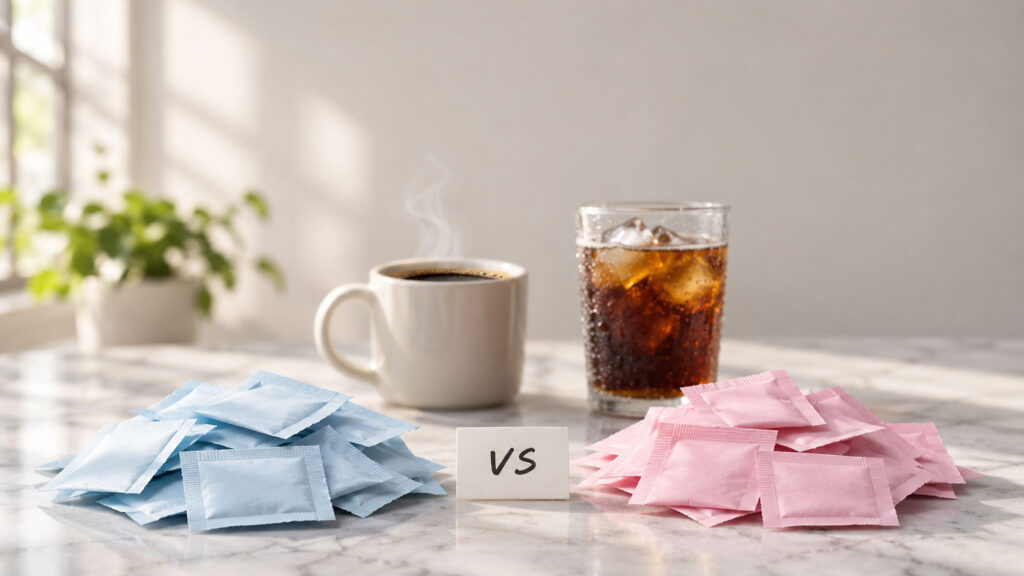
Both sweeteners are approved by the FDA and considered safe at the amounts people normally use, so the aspartame vs saccharin choice mostly depends on what you’re sweetening and who’s eating it. Aspartame loses its sweetness in the oven and must be avoided by anyone with phenylketonuria (PKU); saccharin holds up to heat but leaves a bitter edge that some people can’t get past.
Table of Contents
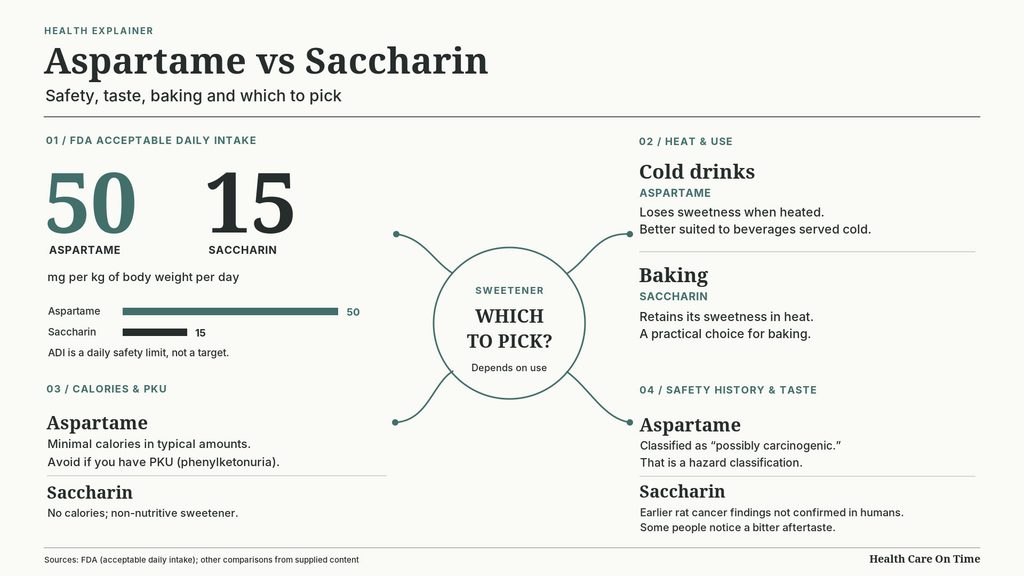
Quick Answer: Aspartame (Equal, NutraSweet) is about 200 times sweeter than sugar, adds a trace of calories and breaks down when heated. Saccharin (Sweet’N Low) is 200 to 700 times sweeter, has no calories and works in baking. The FDA allows both. People with PKU must avoid aspartame. Neither has been shown to cause cancer in people at normal intakes, and neither is a proven long-term weight-loss tool.
Aspartame and Saccharin Side by Side
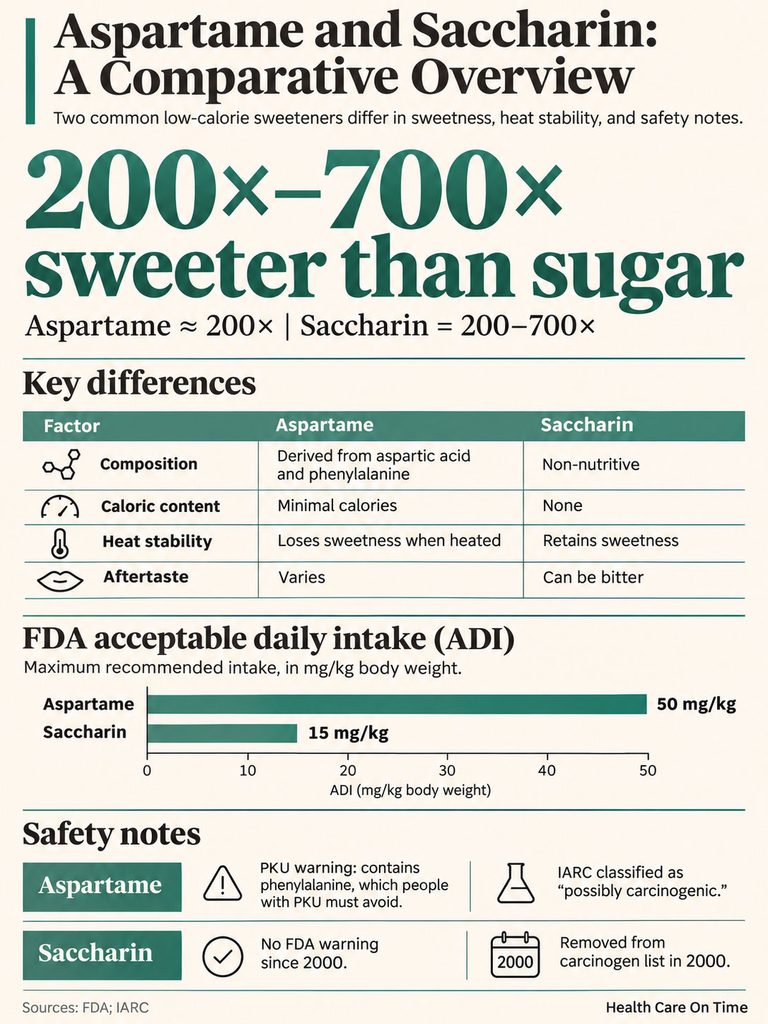
Aspartame is made from two amino acids, aspartic acid and phenylalanine. Your body digests it like a tiny bit of protein, so it carries a few calories, and people with PKU, who can’t process phenylalanine, have to stay away from it. Saccharin goes through the body without being used for energy and adds nothing to your calorie count. Strictly speaking, that makes aspartame a nutritive sweetener and saccharin a non-nutritive one, though a packet of aspartame gives you only a sliver of the energy in the two teaspoons of sugar it replaces.
| Feature | Aspartame | Saccharin | What it means for you |
| US brand names | NutraSweet, Equal | Sweet’N Low, Sweet Twin, Necta Sweet | Check the ingredient line, since store brands use the same compounds |
| Sweetness vs table sugar | About 200 times | 200 to 700 times | A pinch replaces a spoonful of sugar with either one |
| Calories | Contains calories, but the amount used is tiny | None | Both fit a low-calorie eating plan |
| FDA acceptable daily intake (ADI) | 50 mg per kg (22.7 mg per pound) of body weight | 15 mg per kg (6.8 mg per pound) of body weight | Both limits sit well above what a packet or two delivers |
| Packets to reach the ADI, 132-pound adult | 75 | 45 | Hard to hit with tabletop use alone |
| Heat and baking | Not heat stable; loses sweetness when heated | Keeps its sweetness when heated | Bake with saccharin; add aspartame after cooking |
| Aftertaste | Varies from person to person | Bitter aftertaste for some people | Saccharin bothers bitter-sensitive tasters more |
| Who should avoid it | People with PKU | No FDA group warning; pregnancy advice is mixed | PKU is the one firm rule in this comparison |
| Required US label warning | “PHENYLKETONURICS: CONTAINS PHENYLALANINE” | None since 2000 | Look for the PKU line on diet sodas and gum |
| Cancer history | Classified “possibly carcinogenic” (Group 2B) by IARC in 2023; FDA disagrees | Linked to bladder cancer in rats in the 1970s; dropped from the US carcinogen list in 2000 | Human studies haven’t confirmed a cancer link for either one |
Don’t read too much into the different ADIs. Each limit comes from its own set of animal and human test data, and a higher number for aspartame doesn’t make it the safer of the two in any simple way.
Two Sweeteners, Two Very Different Histories
Saccharin was discovered in 1879, nearly a century before aspartame, and for decades it was the main choice for anyone who wanted sweetness without sugar. It was often sold alongside cyclamate, a sweetener the US later banned over cancer concerns, and saccharin came close to the same fate in the early 1970s, when lab studies tied high doses to bladder cancer in rats. Congress responded by ordering more research and a warning label.
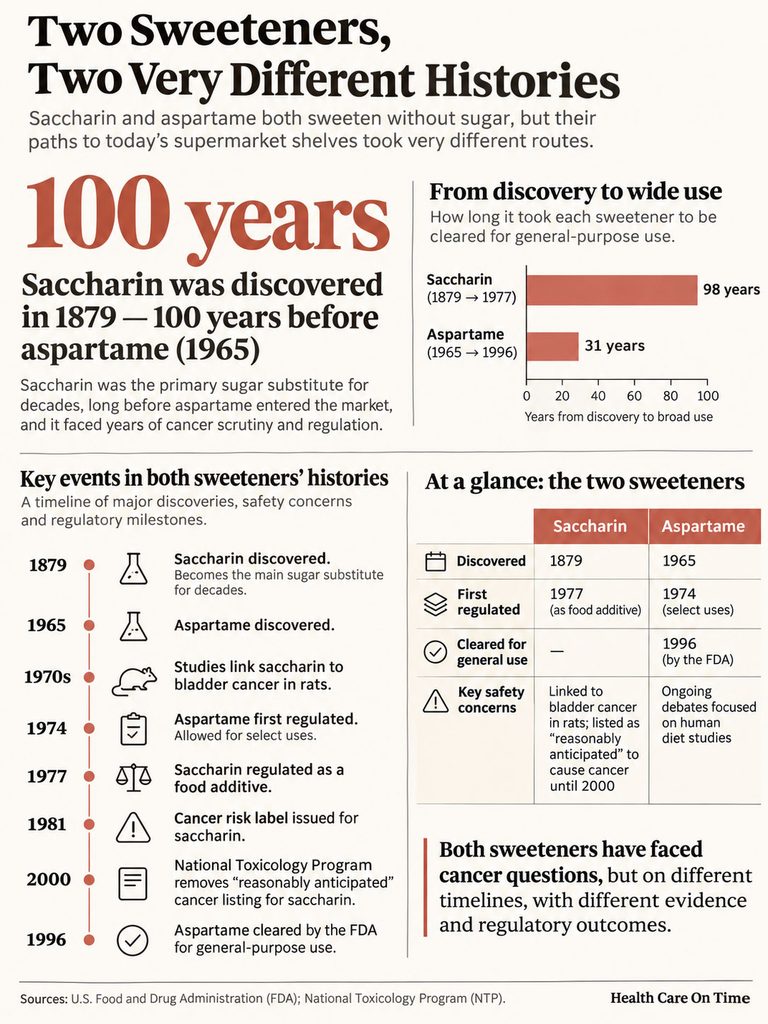
Saccharin has been regulated as a food additive since 1977, was listed by the National Toxicology Program in 1981 as “reasonably anticipated” to cause cancer in humans, and came off that list in 2000, when the warning labels also went away.
The FDA first regulated aspartame in 1974 for a few uses such as tabletop sweeteners and chewing gum, then cleared it as a general-purpose sweetener in 1996. The arguments over its safety came later and have centered on large human diet studies, where people report what they eat for years, rather than on high-dose rat experiments.
The Cancer Question
Both sweeteners have been questioned on cancer, and in both cases the human evidence has so far failed to show that normal use causes it.
Saccharin: a rat finding that didn’t carry over to people
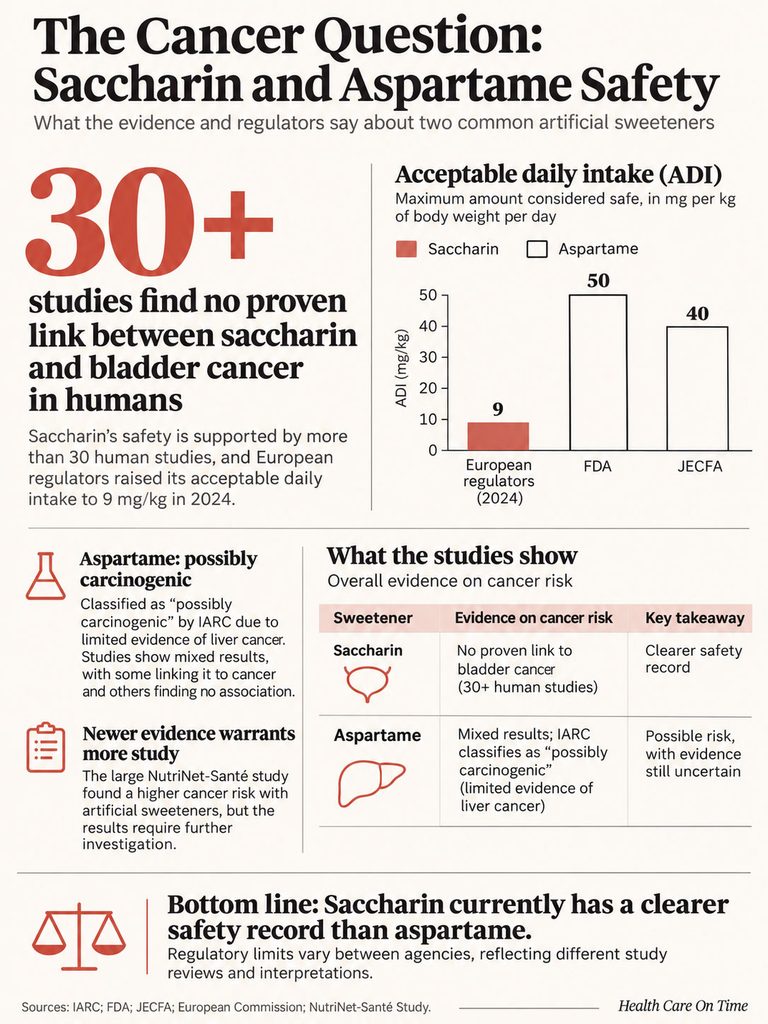
The rat bladder tumors from the 1970s showed up at very high doses, through a process that later mechanistic work found doesn’t happen in human bladders. Studies in people back that up, with no clear link between saccharin and bladder cancer in population research and more than 30 human studies that judged the rat results irrelevant to people. In November 2024, European regulators decided the tumors were specific to male rats and raised their acceptable daily intake for saccharin to 9 mg per kg of body weight, up from a limit first set in 1995 but still lower than the FDA’s 15 mg per kg.
The old warning printed on restaurant packets reflected 1970s rat data, and nothing found in people since has brought it back.
Aspartame: what “possibly carcinogenic” means
In July 2023, after a June meeting, the World Health Organization’s cancer agency (IARC) placed aspartame in Group 2B, “possibly carcinogenic to humans.” Group 2B is the third-highest of four levels. IARC based the call on “limited” evidence for one type of liver cancer in humans and limited evidence from animal and lab work, and a hazard rating of this kind says nothing about how much aspartame a person would have to consume for any risk to appear.
Two other bodies looked at the same evidence and reached different conclusions. JECFA, the WHO’s food additive committee, kept its acceptable daily intake at 0 to 40 mg per kg of body weight, and the WHO’s nutrition director, Francesco Branca, summed up the joint findings by saying “safety is not a major concern at the doses which are commonly used.” The FDA rejected IARC’s classification, citing significant shortcomings in the studies behind it.
Of the three human studies IARC relied on, one found an association with liver cancer overall, one found it only among people with diabetes, and one found none, and a fourth published after the meeting also found no link. The large NIH-AARP Diet and Health Study saw no connection between aspartame-sweetened drinks and lymphoma, leukemia or brain cancer over more than five years. The French NutriNet-Santé study is the main exception: people with the highest artificial sweetener intake were slightly more likely to develop cancer, and higher aspartame intake was slightly linked to overall, breast and obesity-related cancers. Research on diet drinks in general is just as uneven: a US cohort of postmenopausal women tied artificially sweetened beverages to a higher risk of kidney cancer, a European cohort found no such link, and an umbrella review of the field turned up only weak evidence connecting these drinks to cancer overall.
NutriNet-Santé, like most diet research, depends on people reporting what they eat, and heavy diet soda drinkers tend to differ from everyone else in weight, health history and habits that are hard to adjust for completely. Its results show an association worth following up, which is what WHO’s own experts asked for when they called for longer studies with repeated diet questionnaires.
For a shopper choosing on cancer risk alone, saccharin has the cleaner official record right now, since every major regulator that has reviewed it lately has moved toward reassurance. Aspartame is still allowed everywhere it was allowed before 2023, and the agencies that set intake limits left those limits alone. If the IARC news made you give up diet soda, going back to a can or two a day fits what JECFA and the FDA concluded.
Why the agencies’ numbers don’t match
The safe-intake figures differ from one agency to the next. For aspartame, the FDA’s limit is 50 mg per kg while JECFA’s is 40 mg per kg; for saccharin the gap runs the other way, with 15 mg per kg in the US and 9 mg per kg in Europe since 2024. Each agency reviews its own set of studies, picks its own starting point in the animal data and rounds in its own way, so small differences like these are normal and don’t mean any of them considers the sweetener dangerous.
How Much Is Too Much? ADIs in Packets and Cans
The acceptable daily intake is the amount regulators consider safe to eat every day over a lifetime. The FDA’s limits, 50 mg per kg of body weight for aspartame and 15 mg per kg for saccharin, come to about 22.7 mg and 6.8 mg per pound. For a 132-pound (60 kg) adult, the FDA calculated that reaching those limits would take 75 packets of aspartame or 45 packets of saccharin in one day, counting each packet as about two teaspoons of sugar’s worth of sweetness. For diet soda, the WHO worked out that a 154-pound (70 kg) adult would need more than 9 to 14 cans a day, with no other aspartame in the diet, to pass JECFA’s limit.
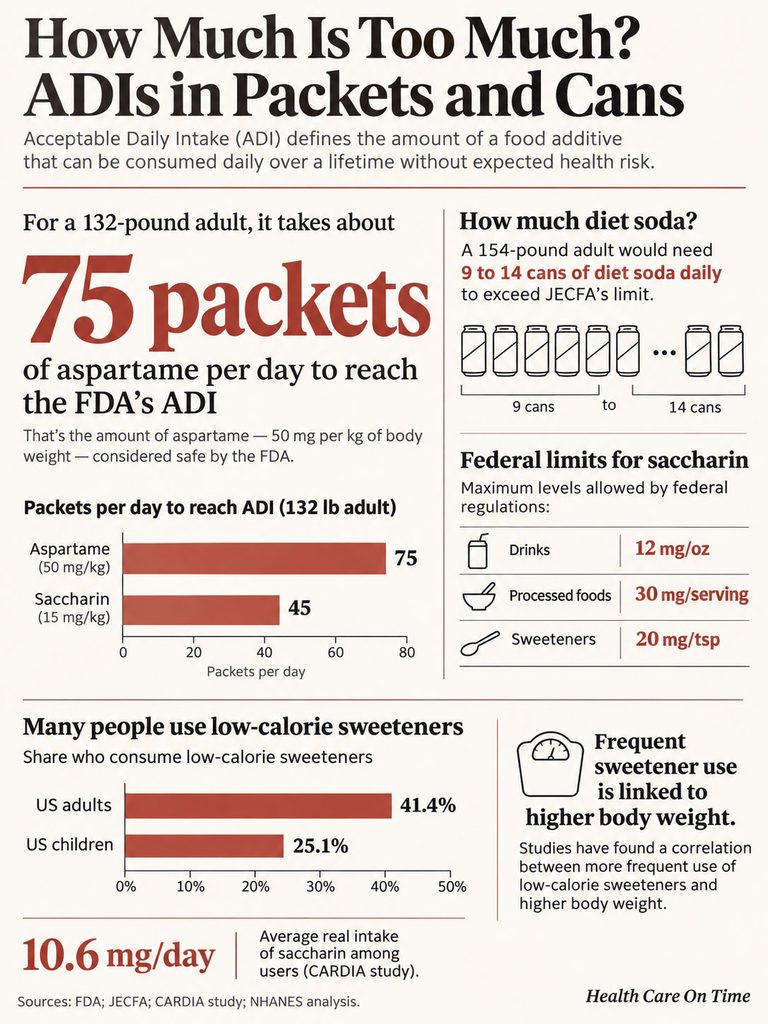
Federal rules also put a ceiling on how much saccharin a manufacturer can add. Under 21 CFR 180.37, drinks can contain no more than 12 mg per fluid ounce, processed foods no more than 30 mg per serving, and tabletop sweeteners no more than 20 mg for each teaspoon of sugar they replace.
Real intake is much lower. Saccharin users in the 2025 CARDIA study averaged 10.6 mg a day.
| Measure | Figure | Source |
| US adults who consumed low-calorie sweeteners, 2009-2012 | 41.4% | NHANES analysis, J Acad Nutr Diet 2017 |
| US children who consumed them | 25.1% | Same NHANES analysis |
| Adult consumers who used them once a day | 56% | Same NHANES analysis |
| Packets to reach the FDA ADI, 132-pound adult | 75 aspartame, 45 saccharin | FDA |
| Diet soda cans to pass the aspartame ADI, 154-pound adult | More than 9 to 14 a day | WHO and JECFA, 2023 |
| European saccharin ADI after the 2024 review | 9 mg per kg of body weight | EFSA |
| Average saccharin intake among users, 2,160-adult US study | 10.6 mg a day | CARDIA study, J Diabetes 2025 |
| US babies born with PKU | About 1 in 15,000 | NIH Consensus Statement |
The same national survey found that adults who used these sweeteners more often tended to weigh more. A survey can’t show cause, and people trying to lose weight are the ones most likely to buy diet products in the first place.
Taste, Aftertaste and Cooking
In coffee, tea and cold drinks
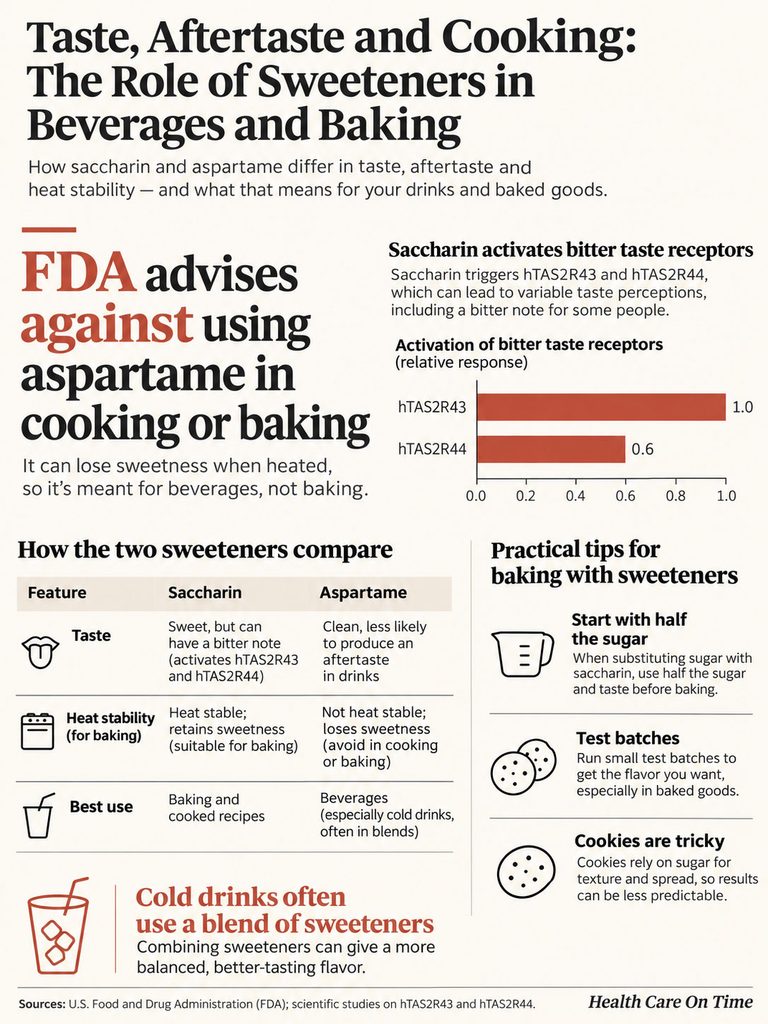
Saccharin’s bitter edge has a physical cause. In a 2004 Journal of Neuroscience study, saccharin switched on two human bitter taste receptors, hTAS2R43 and hTAS2R44, at concentrations known to taste bitter. Sensitivity to those receptors varies, so one person tastes nothing odd in a Sweet’N Low coffee and the person next to them can’t finish the cup. Aspartame’s flavor bothers fewer people, though some still pick up an aftertaste, and the only reliable test is your own cup.
In coffee and tea, aspartame works fine; a quick stir into a hot cup is nothing like the long, dry heat of baking. Both are easy in cold drinks, and plenty of diet sodas blend more than one sweetener, Coca-Cola Zero Sugar among them.
Baking and hot dishes
Aspartame isn’t heat stable and loses sweetness when heated, so the FDA describes it as a poor fit for baked goods, and federal rules make aspartame tabletop sweeteners carry an instruction not to use them in cooking or baking. For oatmeal, a fruit sauce or anything else warm, add it after the pan comes off the heat.
Saccharin keeps its sweetness when heated, and Sweet’N Low’s baking guidance gives these starting points:
- Sauces and drinks: replace all of the sugar.
- Most baked goods: replace about half, because sugar also gives cakes and cookies their volume, moisture and texture.
- A handy conversion: 6 packets stand in for 1/4 cup of sugar.
If you’re converting a family recipe, change one thing at a time. Swap half the sugar on the first try, keep the baking time and temperature the same, and taste the batter before it goes in the oven, since saccharin’s bitterness is easier to judge cold than after baking. Sugar also helps baked goods brown, so a reduced-sugar cake may look paler even when it’s fully done.
Plan on a test batch. A pumpkin pie with half saccharin and half sugar usually tastes closer to the original than one made with saccharin alone, which can come out thin and a little bitter. Cookies are the toughest case, since their spread and chew depend so much on real sugar, while custards, fruit fillings and sauces handle the swap well.
Blood Sugar, Weight and Gut Bacteria
Neither sweetener raises blood sugar the way table sugar does, and people with diabetes have relied on both for decades. Sugar substitutes may help with weight in the short term, while their long-term effect is still unknown.
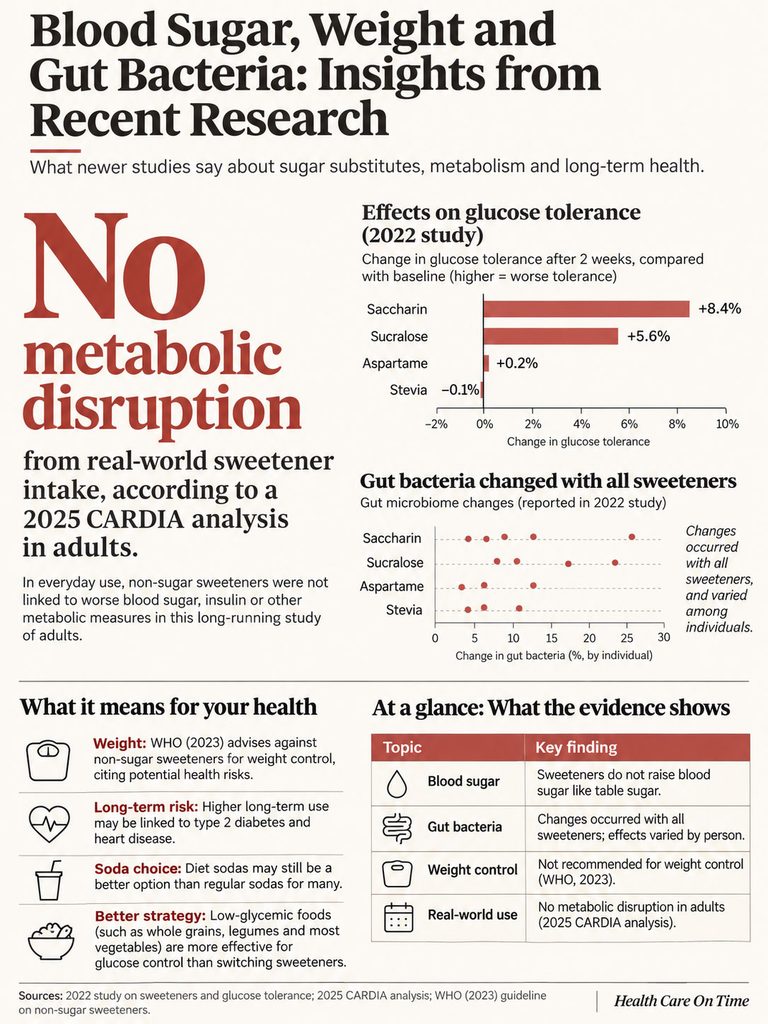
The newer questions are about blood sugar response and gut bacteria, and the two best recent studies don’t fully agree. A small randomized trial in Cell in 2022 gave 120 healthy adults who didn’t normally use sweeteners either saccharin, sucralose, aspartame, stevia or a control for two weeks. Saccharin at 180 mg a day (20% of its ADI) and sucralose both worsened people’s results on a glucose tolerance test, which measures how quickly the body clears a standard dose of sugar, while aspartame at 240 mg a day (8% of its ADI) and stevia had no significant effect. All four changed gut and mouth bacteria, the size of the effect varied from person to person, and transferring participants’ microbes into germ-free mice reproduced the changes. With 20 people per group, it was a small trial, and gut bacteria are now a busy research area, including lab-dish work on sweeteners and antidepressants that has yet to be tested in people.
The 2025 CARDIA analysis looked at ordinary habits instead of assigned doses. In 2,160 US adults with a mean age of 32.1, blood metabolites showed no sign of metabolic disruption from real-world aspartame or saccharin intake. About 90% of the group used no saccharin, leaving only 219 saccharin consumers, and the authors warned against extending the results to much heavier intakes. Read side by side, the two studies suggest neither sweetener throws metabolism off at everyday amounts, though saccharin may nudge glucose response in some people.
The WHO’s May 2023 guideline recommends against using non-sugar sweeteners to control body weight, names both aspartame and saccharin, and rests on a review that found no long-term body-fat benefit in adults or children and possible links between long-term use and type 2 diabetes, heart disease and death in adults. The advice is conditional and excludes people who already have diabetes. A 2019 BMJ analysis of 56 studies came to a similar conclusion, with no clear benefit and harms that couldn’t be ruled out.
Some researchers also suspect intense sweeteners keep the palate tuned to very sweet tastes and may encourage people to make up the calories elsewhere, for example by adding dessert because the drink was “free.” The Harvard Health review treats those ideas as speculation, and they’re hard to test, because people who switch to diet drinks usually change other habits at the same time.
For most people, a diet soda is still a better trade than a regular one. Many diet colas keep their caffeine, and caffeine affects blood sugar on its own, so a higher reading after a diet cola doesn’t automatically point to the sweetener. Meals built around low-glycemic foods will do more for glucose control than any change of packet.
How to Spot Each One on a Label
Aspartame is easy to find. US labels name it directly, and federal rules require any food containing it to print the bold line “PHENYLKETONURICS: CONTAINS PHENYLALANINE” on the principal display panel or the information panel. When that line shows up on sugar-free gum, light yogurt or flavored water, aspartame is almost always the reason.
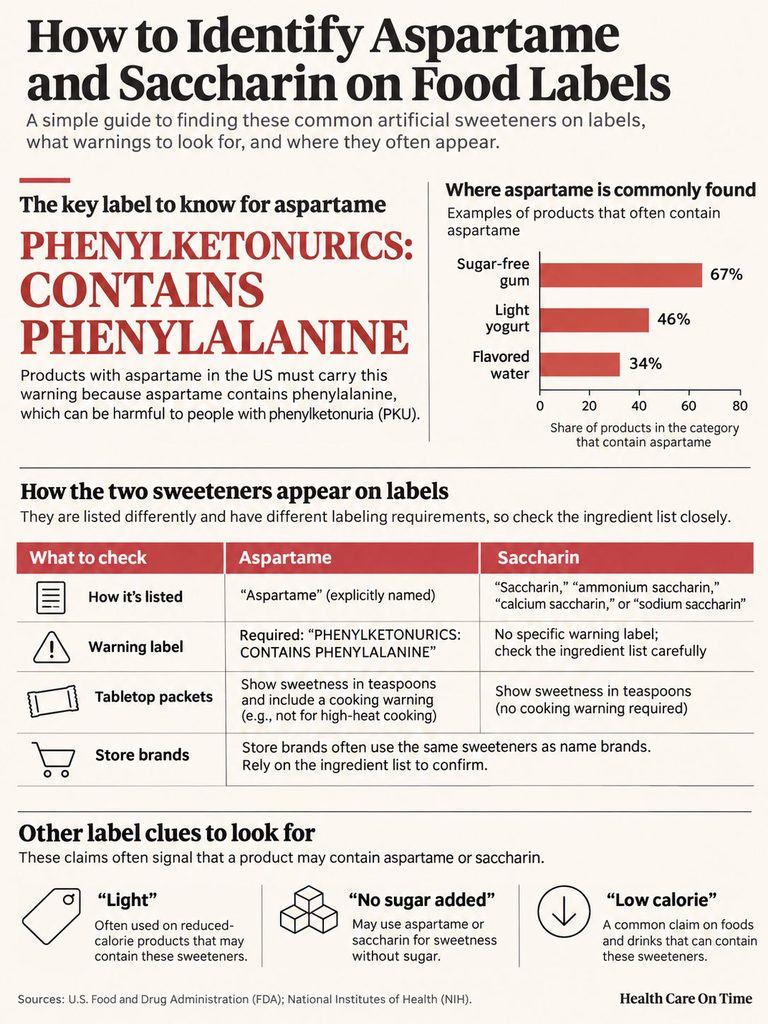
Saccharin is less obvious, since the same regulations cover four forms of it, saccharin, ammonium saccharin, calcium saccharin and sodium saccharin, and an ingredient list may use any of those names with no warning label attached. Tabletop packets of either sweetener have to state their sweetness in teaspoons of sugar, and aspartame packets add the line about not using them in cooking or baking.
Store brands sit beside the name brands in nearly identical packaging, so the ingredient line is a better guide than the box. Check it on products labeled “light,” “no sugar added” or “low calorie,” too, since they often contain one of these sweeteners or a blend of several.
What’s in Your Diet Soda and Sweetener Packet
US Coca-Cola Zero Sugar contains no saccharin. Its ingredient list shows aspartame, acesulfame potassium and stevia extract with a PKU warning, plus 34 mg of caffeine and no calories in a 12-ounce can. The caffeine-free version has no caffeine and leaves stevia extract off its ingredient list, so even two cans from the same brand can differ.
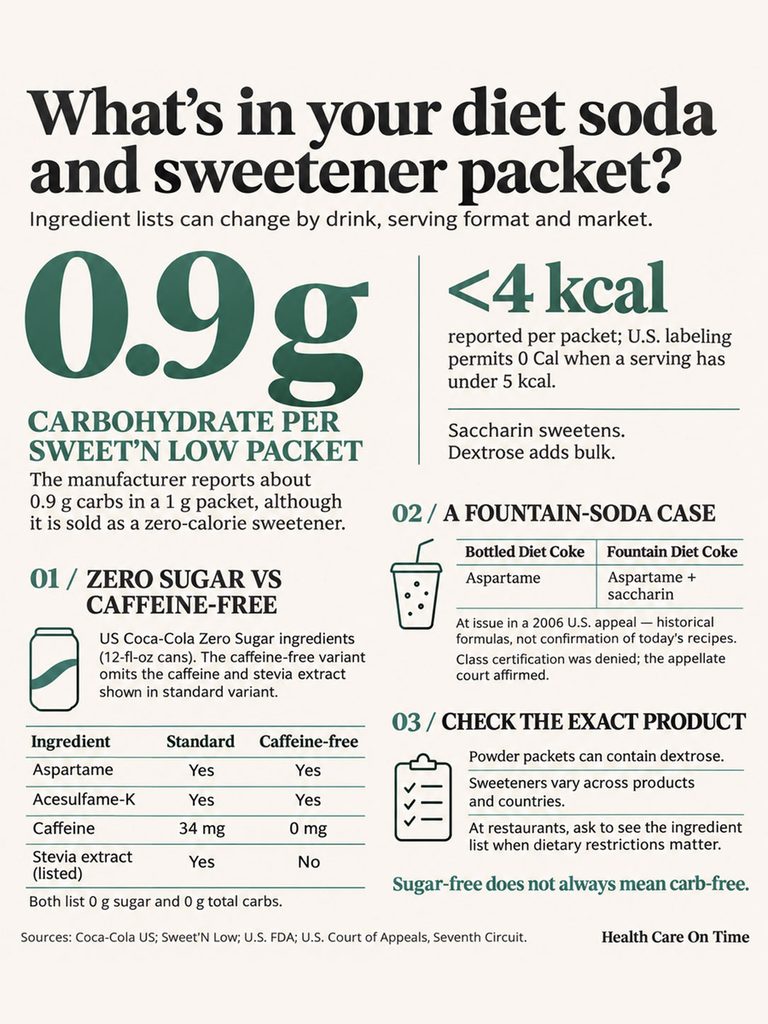
Fountain soda can differ from the can in your fridge. During a Missouri class action filed in 2004, it came out that fountain Diet Coke contained both aspartame and saccharin, while bottles and cans used aspartame alone, and Coca-Cola explained that it had used saccharin in fountain syrup since 1984 because it holds sweetness better during long storage. The company won the case. Formulas change, so ask the restaurant or check the posted ingredient list if it matters to you.
A Sweet’N Low packet is mostly dextrose, a corn-derived carbohydrate added so the tiny amount of saccharin can be measured out. That adds 1 gram of carbohydrate and fewer than 4 calories per packet, and FDA rules let anything under 5 calories per serving be labeled zero. Carb counters should read the whole label on sugar-free products, from packets to a sugar-free coffee creamer, because fillers and other ingredients can add more carbohydrate than the sweetener does.
Old Beliefs That Don’t Hold Up
Several ideas about these sweeteners outlived the facts behind them.
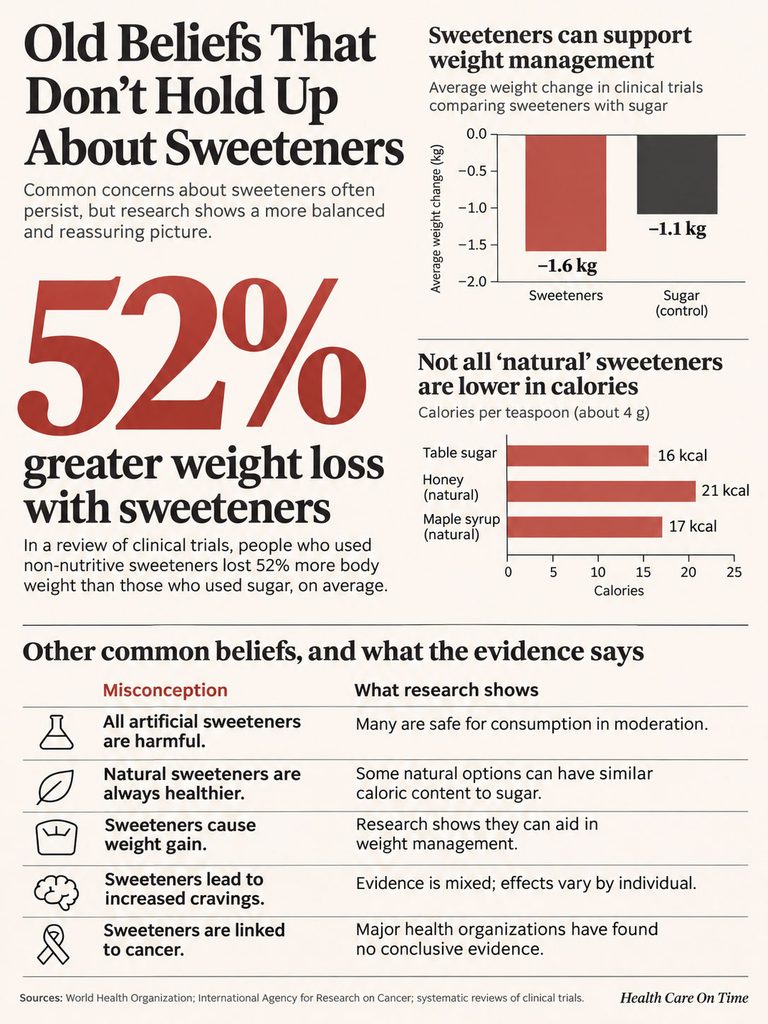
- Saccharin is banned. It never was in the US. It’s an approved food additive, and the warning label requirement ended in 2000.
- Aspartame has zero calories. It contains calories, though so little is used that a product sweetened with it can still be labeled calorie-free.
- Sugar-free packets have no carbs. Sweet’N Low packets contain 1 gram of carbohydrate from dextrose, which matters only if you count every gram.
- A diet soda is a diet soda, whether it comes from a can or a fountain. Fountain Diet Coke has used a saccharin blend, at least in the past, while bottles and cans used aspartame alone.
- The 2023 IARC label banned aspartame or lowered the safe limit. Neither happened; JECFA kept its limit and the FDA disagreed with the classification.
Who Should Avoid or Limit Each One
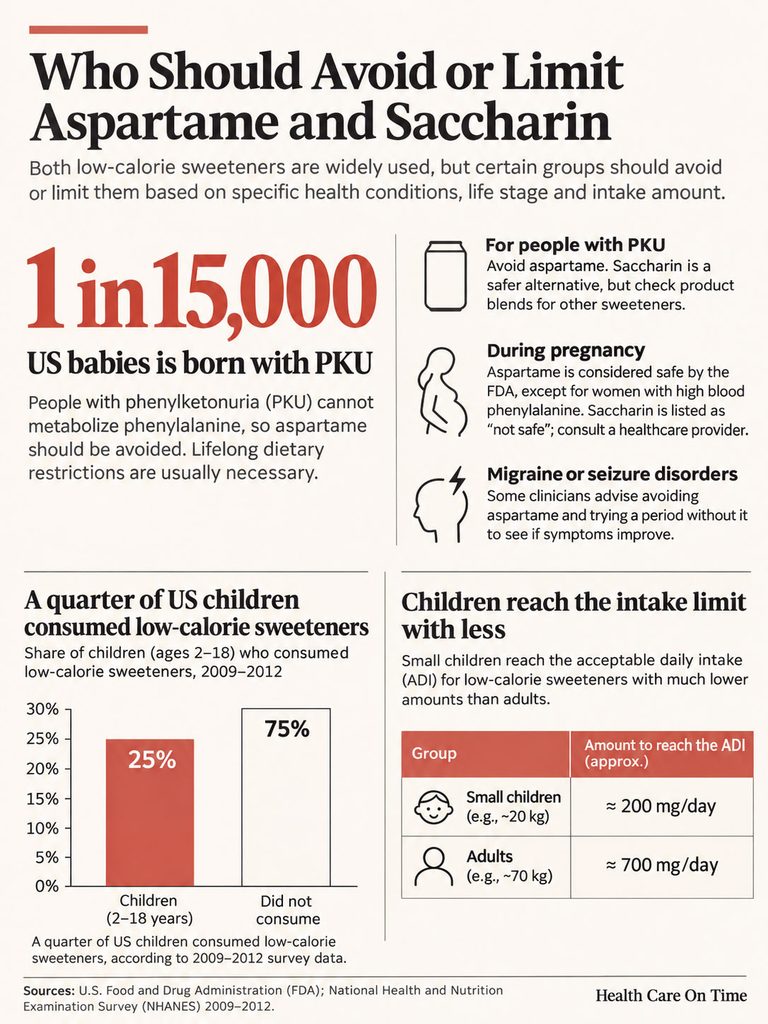
People with phenylketonuria can’t break down phenylalanine, one of aspartame’s building blocks, and it builds up to harmful levels in their blood. About 1 in 15,000 US babies is born with PKU, every state screens newborns for it, and the restricted diet is usually needed for life. Saccharin contains no phenylalanine, so it’s the obvious swap, but blends need checking, since a drink with saccharin can also contain aspartame.
Day to day, living with PKU means reading labels on products you might never think of as sweetened. Sugar-free gum, flavored waters, light yogurts, sugar-free desserts and many “diet” or “zero” drinks can contain aspartame, and the bold PKU line is the quickest way to catch it. Teaching a child with PKU to spot that line on their own helps when they eat away from home.
Pregnancy is murkier. The American Pregnancy Association lists aspartame as safe in pregnancy and while breastfeeding, following the FDA’s position, except for women with high blood phenylalanine, and it puts saccharin on its “not safe” list because studies show saccharin crosses the placenta and may remain in fetal tissue. Sweet’N Low’s own FAQ calls saccharin safe for pregnant and breastfeeding women. Given that split, choosing aspartame or skipping both is the cautious route, and your OB can weigh it against the rest of your diet. If you’re nursing a baby with PKU, tell the pediatric metabolic team about any aspartame you use.
Some clinicians are cautious about aspartame for people with migraine or seizure disorders. Melissa Young, MD, a functional medicine physician at Cleveland Clinic, advises those patients to avoid it, though that’s one physician’s view and not a formal guideline. If diet drinks seem to set off your headaches, try two weeks without them, and rule out the caffeine in the same drinks while you’re at it.
Children follow the same FDA limits per pound of body weight, so a small child reaches the ADI with much less than an adult. A quarter of US children consumed low-calorie sweeteners in the 2009-2012 survey data, mostly once a day.
Which One Should You Choose?
For most healthy adults, either sweetener is fine in modest amounts, and the better pick depends on the job. Choose saccharin when heat is involved or when PKU is in the picture. Choose aspartame for cold drinks if saccharin tastes bitter to you, and during pregnancy if your doctor agrees. If weight loss is the goal, the evidence points toward cutting sweetness overall rather than trading one sweetener for another.
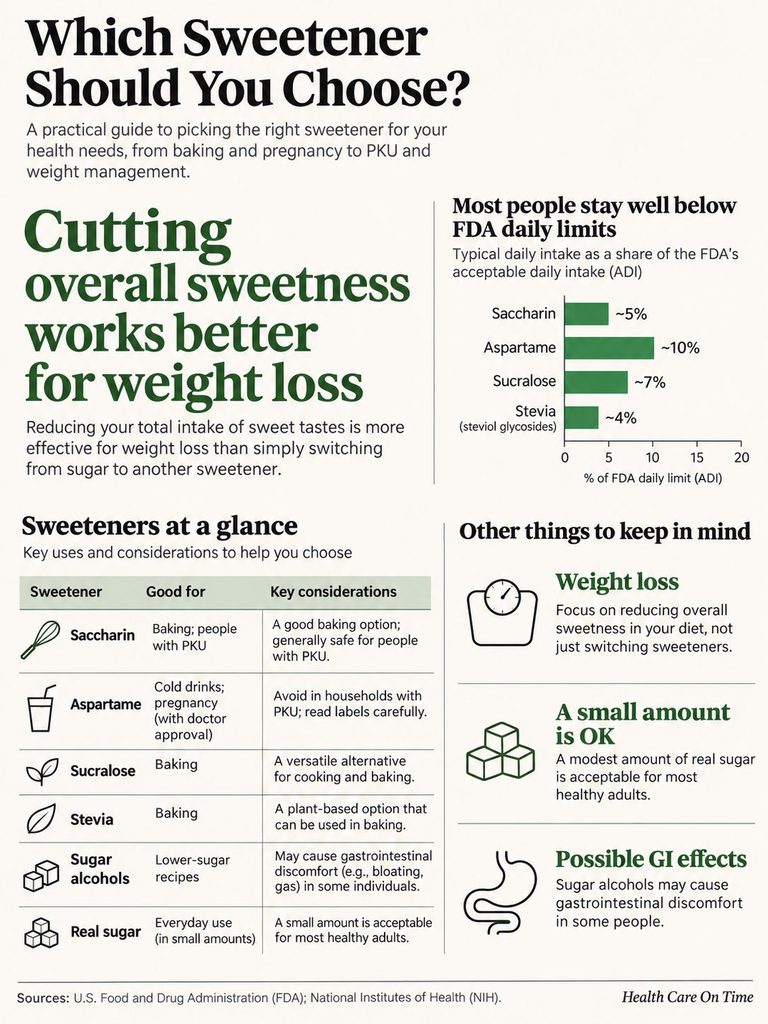
Most people’s daily use, a couple of coffees with a packet each and a diet soda at lunch, comes to a small fraction of the FDA ceiling. If you drink fountain sodas often and want to avoid saccharin, ask what’s in the syrup, since the can and the fountain version may differ.
A household with someone who has PKU needs a simple system: keep aspartame products out of the shared pantry, read every diet drink label and keep a saccharin sweetener on hand for coffee and baking. If you mostly sweeten iced tea and cold drinks and saccharin’s bitterness has never bothered you, there’s little reason to change what you already like.
If neither one suits you
Some people find saccharin too bitter and also want something they can bake with, which rules out both. Acesulfame potassium, sucralose, neotame and advantame all hold up in the oven, so a sucralose baking blend, sold in the US under the Splenda name, is the usual next step, and a range of human studies has found no evidence that sucralose causes cancer. Stevia products are another option, and the same WHO weight-control advice covers them too. Acesulfame potassium, the second sweetener in Coke Zero, has thin human data: NutriNet-Santé linked it to a slightly higher overall cancer risk, and no other study has looked at it in people. Sugar alcohols such as sorbitol and xylitol are a separate group that can cause bloating, gas and diarrhea, and the amount that triggers trouble varies widely from one person to the next.
Small amounts of real sugar remain a fair choice as well. A teaspoon in your morning coffee is a modest amount for most healthy adults, and cutting back gradually lets your taste adjust to less sweetness.
| Your situation | Better fit | Why |
| Baking cookies, cakes or pie | Saccharin, replacing about half the sugar | Aspartame loses sweetness when heated |
| Sweetening hot coffee or tea | Either one | Aspartame handles a hot cup; long oven heat is the problem |
| You or your child has PKU | Saccharin or another aspartame-free option | Aspartame contains phenylalanine |
| You’re pregnant | Aspartame, unless your phenylalanine is high; confirm with your OB | Saccharin crosses the placenta, and advice on it is split |
| You have diabetes | Either one, in moderation | Neither raises blood sugar directly; saccharin worsened glucose response in a small 2-week trial |
| Saccharin tastes bitter to you | Aspartame | Saccharin triggers two bitter taste receptors |
| You want to lose weight | Neither as a main strategy | The WHO advises against sweeteners for weight control |
Questions to Bring to Your Doctor or Dietitian
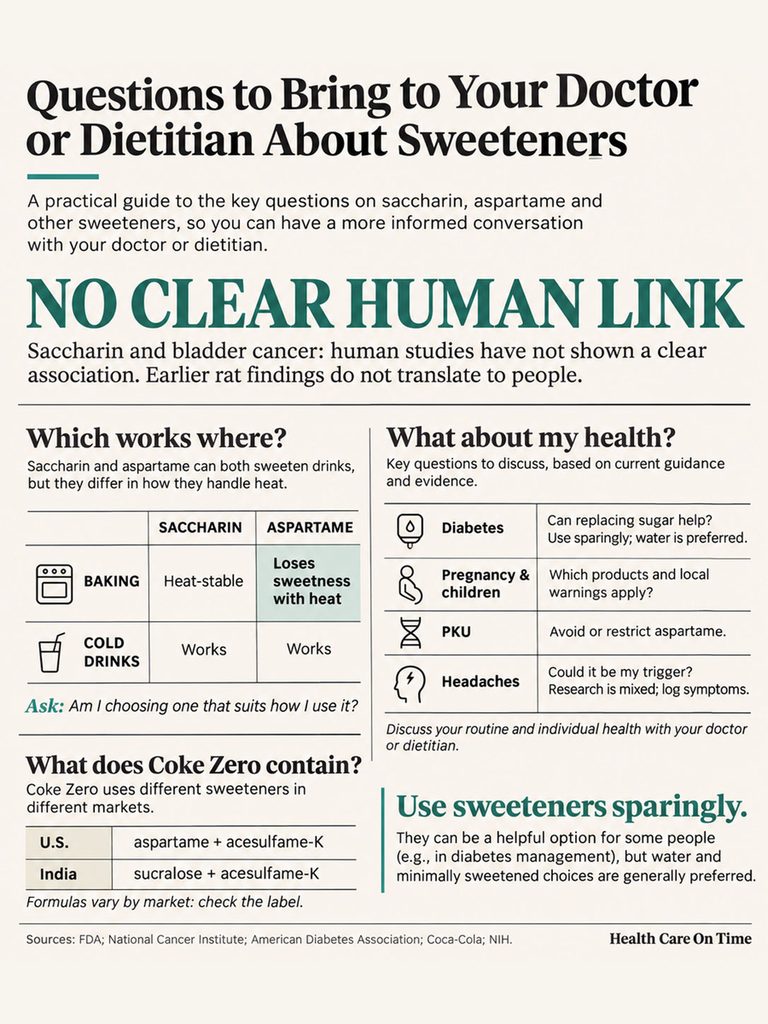
If you use sweeteners every day, bring a couple of these to your next visit.
- Since our daughter has PKU, should the whole family stop buying aspartame products?
- Is a packet of Sweet’N Low in coffee fine during pregnancy, or is aspartame the safer switch?
- Could diet soda explain why these blood sugar readings keep going up?
- Are these headaches more likely from aspartame or from caffeine?
- For losing weight, should we cut sweet drinks altogether instead of switching sweeteners?
Frequently Asked Questions
What is better, saccharin or aspartame?
It depends on how you’ll use it. Saccharin wins for baking because it stays sweet when heated, and it’s the only one of the two that’s safe for people with PKU. Aspartame may suit you better in cold drinks if saccharin tastes bitter, and it draws fewer cautions during pregnancy. Both are FDA-approved, both sit well under their safety limits at normal use, and neither has been shown to cause cancer in people.
What is the safest sweetener to use?
Every sweetener has open questions, and the WHO advises against relying on any of them for weight control. Among the FDA-approved options, the safest one for you is whichever you use sparingly and that fits your health: aspartame-free if you have PKU, aspartame over saccharin in pregnancy, and small amounts either way. Unsweetened drinks avoid the issue altogether.
Does Coke Zero use saccharin?
No. In the US, Coca-Cola Zero Sugar is sweetened with aspartame, acesulfame potassium and stevia extract.
Is saccharin still considered bad for you?
US and European regulators don’t consider it harmful at normal intakes. The bladder cancer worry came from high-dose rat studies, and the National Toxicology Program dropped saccharin from its list of suspected carcinogens in 2000 once researchers showed the rat mechanism doesn’t apply to people. Europe raised its safe intake limit in 2024. What’s still being studied is a possible effect on gut bacteria and blood sugar response.
Can you bake with aspartame?
Not well, since heat breaks down its sweetness. Use saccharin for baking, or stir aspartame in after cooking.
Is aspartame or saccharin better for people with diabetes?
Both can fit a diabetes eating plan, because neither raises blood sugar the way table sugar does, and the WHO’s 2023 advice against sweeteners specifically excludes people who already have diabetes. One small two-week trial in healthy adults found that saccharin, but not aspartame, worsened glucose tolerance, which might tip some people toward aspartame, while a larger 2025 US study found no metabolic disruption from real-world intake of either. Keep an eye on the foods these sweeteners come in, since a sugar-free dessert can still be high in carbohydrates and fat, and check your readings after you make a change.
Is Sweet’N Low safe during pregnancy?
Advice is divided. The FDA allows saccharin for the general public, but because it crosses the placenta and may remain in fetal tissue, the American Pregnancy Association lists it as not safe in pregnancy, while the manufacturer calls it safe. Many women switch to aspartame or avoid both after talking with their OB.
Which has more calories, aspartame or saccharin?
Aspartame, technically, though a packet’s worth is so small that both are sold as zero-calorie.
Is aspartame or saccharin safe for kids?
Both are approved for the general public, with the same FDA limits per pound of body weight. Because a smaller child reaches those limits with less, occasional use makes more sense than daily diet sodas, and children with PKU must avoid aspartame completely.
Does aspartame cause headaches?
Headaches have been reported after aspartame, but research hasn’t confirmed that it causes them. Some physicians suggest people with migraine avoid it, and taking a break from diet drinks is a simple way to see whether it makes a difference for you.
Medical disclaimer: This article is for general information only and isn’t a substitute for advice from your doctor, dietitian or pharmacist. If you have PKU, are pregnant, have diabetes or take medications, talk with your health care provider before changing how you use sweeteners.
References
- US Food and Drug Administration. Aspartame and Other Sweeteners in Food. Updated February 27, 2025. https://www.fda.gov/food/food-additives-petitions/aspartame-and-other-sweeteners-food
- National Cancer Institute. Artificial Sweeteners and Cancer (fact sheet). Reviewed August 2023. https://www.cancer.gov/about-cancer/causes-prevention/risk/diet/artificial-sweeteners-fact-sheet
- World Health Organization. Aspartame hazard and risk assessment results released. July 14, 2023. https://www.who.int/news/item/14-07-2023-aspartame-hazard-and-risk-assessment-results-released
- World Health Organization. WHO advises not to use non-sugar sweeteners for weight control in newly released guideline. May 15, 2023. https://www.who.int/news/item/15-05-2023-who-advises-not-to-use-non-sugar-sweeteners-for-weight-control-in-newly-released-guideline
- European Food Safety Authority. Re-evaluation of saccharin and its sodium, potassium and calcium salts (E 954) as food additives. November 15, 2024. https://www.efsa.europa.eu/da/node/19141
- Steffen BT, et al. No evidence of metabolomic disruptions from real-world intakes of aspartame or saccharin: the CARDIA study. Journal of Diabetes. 2025;17(8):e70138. https://pmc.ncbi.nlm.nih.gov/articles/PMC12340425/
- Suez J, Cohen Y, et al. Personalized microbiome-driven effects of non-nutritive sweeteners on human glucose tolerance. Cell. 2022. https://www.weizmann.ac.il/immunology/elinav/sites/immunology.elinav/files/2022-08/Personalized%20microbiome-driven%20effects%20of%20nonnutritive%20sweeteners%20on%20human%20glucose%20tolerance.pdf
- Sylvetsky AC, et al. Consumption of low-calorie sweeteners among children and adults in the United States. Journal of the Academy of Nutrition and Dietetics. 2017;117(3):441-448. https://pubmed.ncbi.nlm.nih.gov/28087414/
- Kuhn C, et al. Bitter taste receptors for saccharin and acesulfame K. Journal of Neuroscience. 2004. https://read.qxmd.com/read/15537898/bitter-taste-receptors-for-saccharin-and-acesulfame-k
- Code of Federal Regulations. 21 CFR 172.804, Aspartame. https://www.law.cornell.edu/cfr/text/21/172.804
- Code of Federal Regulations. 21 CFR 180.37, Saccharin, ammonium saccharin, calcium saccharin, and sodium saccharin. https://www.law.cornell.edu/cfr/text/21/180.37
- National Institutes of Health. Phenylketonuria (PKU): Screening and Management. NIH Consensus Statement, 2000. https://www.nichd.nih.gov/publications/pubs/pku/sub3
- Mayo Clinic. Artificial sweeteners and other sugar substitutes. January 21, 2026. https://www.mayoclinic.org/healthy-lifestyle/nutrition-and-healthy-eating/in-depth/artificial-sweeteners/art-20046936
- Shmerling RH. Sweeteners: time to rethink your choices? Harvard Health Blog. February 22, 2019. https://www.health.harvard.edu/blog/sweeteners-time-to-rethink-your-choices-2019022215967
- Cleveland Clinic Health Essentials. This is why artificial sweeteners are bad for you. April 20, 2023. https://health.clevelandclinic.org/whats-worse-sugar-or-artificial-sweetener
- American Pregnancy Association. Artificial sweeteners and pregnancy. https://americanpregnancy.org/pregnancy/artificial-sweeteners-and-pregnancy/
- Baum JI, Hawley A. Strategies to Reduce Sugar Intake: The Role of Artificial Sweeteners Versus Sugar Alcohols. University of Arkansas Cooperative Extension, FSFCS137. https://www.uaex.uada.edu/publications/pdf/FSFCS137.pdf
- Sweet’N Low. Frequently asked questions (manufacturer). https://www.sweetnlow.com/media/snl-faq-english.pdf
- Coca-Cola Company. Coca-Cola Zero Sugar product information (US). https://coca-cola.com/us/en/brands/coca-cola/products/zero
- FoodNavigator-USA. Coca-Cola wins sweetener legal battle. https://www.foodnavigator-usa.com/Suppliers2/Coca-Cola-wins-sweetener-legal-battle