
Yes, for adults with type 2 diabetes who already have heart disease. In the main Ozempic heart trial, people on semaglutide had 26% fewer heart attacks, strokes and heart-related deaths combined than people on placebo, and the FDA label now lists that heart benefit as an approved use.
Table of Contents
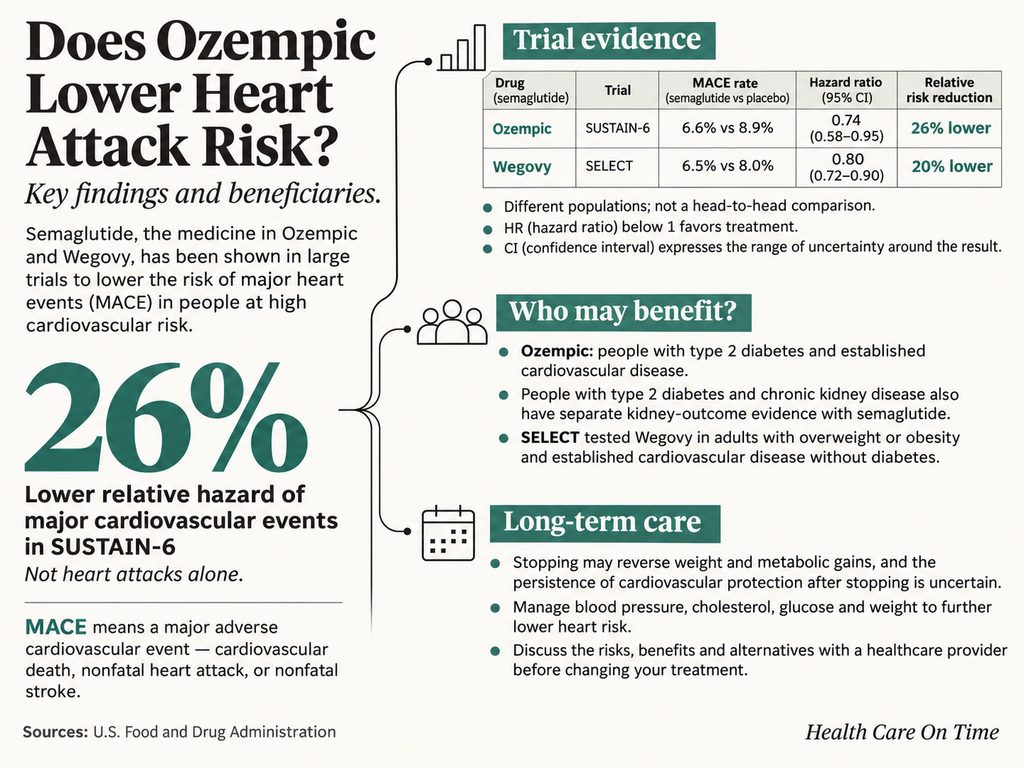
Quick Answer: Ozempic (semaglutide) lowers the combined risk of heart attack, stroke and cardiovascular death by about 26% in adults with type 2 diabetes and heart disease, based on a two-year placebo trial. Heart attacks alone fell too, but that piece wasn’t statistically clear in the Ozempic trial; it was in the Ozempic pill and Wegovy trials. The 20% figure you may have seen comes from Wegovy, tested in people without diabetes.
What the heart trials found, side by side
Several different numbers circulate for semaglutide and the heart: 26%, 20%, 14%, 23%, even 18%. All of them are real. They come from different drugs, different patients and different comparison groups, so they don’t match, and mixing them up leads people to expect more (or less) than the evidence shows.
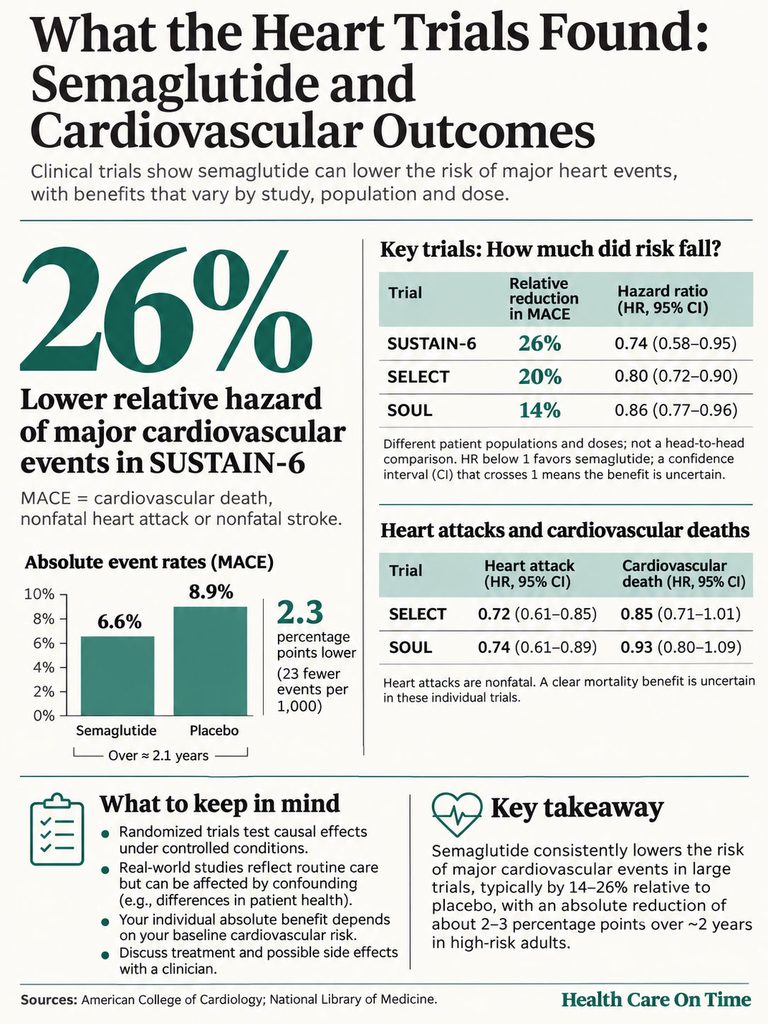
Cardiologists judge drugs like this by an outcome called MACE, short for major adverse cardiovascular events. In these trials it means the first of three things to happen: death from a heart or blood vessel cause, a nonfatal heart attack, or a nonfatal stroke. A person is counted once, at whichever event comes first, so a trial’s headline number blends all three.
That blending means a single percentage can hide uneven results across the three parts.
In the table, the first four rows are randomized trials against placebo, the strongest kind of evidence there is. The last three are real-world studies that compared semaglutide with another drug, and those can only show an association.
| Drug and form | Who was studied | Compared with | Study type | Main outcome | Result |
| Ozempic injection 0.5 or 1 mg (SUSTAIN-6) | 3,297 adults with type 2 diabetes and heart disease | Placebo | Randomized trial, about 2 years | Heart death, heart attack or stroke | 6.6% vs 8.9%: 26% lower (HR 0.74) |
| Ozempic pill / Rybelsus 14 mg (SOUL) | 9,650 adults 50+ with type 2 diabetes and heart disease, kidney disease or both | Placebo | Randomized trial, about 4 years | Heart death, heart attack or stroke | 12.0% vs 13.8%: 14% lower (HR 0.86) |
| Ozempic injection 1 mg (FLOW) | 3,533 adults with type 2 diabetes and chronic kidney disease | Placebo | Randomized trial, median 41 months | Kidney failure, major kidney decline, or kidney or heart death | 18.7% vs 23.2%: 24% lower (HR 0.76); heart death alone 29% lower (HR 0.71) |
| Wegovy injection 2.4 mg (SELECT) | 17,604 adults 45+ with heart disease and BMI 27+, no diabetes | Placebo | Randomized trial, about 40 months | Heart death, heart attack or stroke | 6.5% vs 8.0%: 20% lower (HR 0.80) |
| Ozempic injection (REACH) | 58,336 Medicare patients 66+ with type 2 diabetes and heart disease | Dulaglutide (Trulicity) | Real-world claims study, meeting data | Heart attack, stroke or death | 23% lower than dulaglutide |
| Semaglutide (TriNetX records) | 171,105 matched pairs with type 2 diabetes | Dulaglutide | Real-world records study, 3 years | Death; heart attack; stroke | Death 25% lower; heart attack 6% lower; stroke 10% lower |
| GLP-1 drugs incl. semaglutide (VA) | 132,551 veterans with type 2 diabetes on GLP-1s | Sulfonylureas | Real-world target trial emulation, 3 years | Heart attack, stroke or death | 18% lower with 3 years of steady use |
Sources: Ozempic injection label, Rybelsus and Ozempic tablets label, Wegovy label, REACH summary, TriNetX study, VA study summary.
The “compared with” column changes what each number means. A 23% drop next to dulaglutide is a different claim from a 23% drop next to placebo, because dulaglutide is itself a GLP-1 drug with heart data of its own; if semaglutide beats it, the gain over no treatment would be larger, though no single trial measured it that way. REACH was presented at the European Association for the Study of Diabetes meeting in 2025 and hadn’t appeared in a journal at the time of writing, so treat it as early data.
Heart attack alone vs the combined outcome
Heart attacks on their own tell a more mixed story. In SUSTAIN-6, nonfatal heart attacks happened in 2.9% of people on Ozempic and 3.9% on placebo, a 26% lower rate on paper (hazard ratio 0.74). The confidence interval ran from 0.51 to 1.08, though, which crosses 1.0, so the trial couldn’t rule out chance for heart attacks on their own. Strokes did better (1.6% vs 2.7%), and deaths from heart causes barely moved at 2.7% vs 2.8%.
The bigger, longer trials filled in that gap. Nonfatal heart attacks in SOUL, which tested the semaglutide pill, dropped from 5.2% to 4.0%, with a confidence interval of 0.61 to 0.89 that stays clear of 1.0, and in SELECT, heart attacks (fatal or nonfatal) fell from 3.8% to 2.8%, a hazard ratio of 0.72. So the heart attack signal appears in three trials, and in the two largest it’s statistically solid.
That surprises people, because the weekly shot is the version most of them picture when they hear the word Ozempic, yet its own trial gave the least certain heart attack result of the three.
The Wegovy result also gets stretched sometimes into a 20% cut in cardiac death. Cardiovascular death on its own fell from 3.0% to 2.5% in SELECT, a hazard ratio of 0.85 with an interval of 0.71 to 1.01, which just misses significance; the 20% belongs to the three outcomes counted together.
How to read the numbers
A hazard ratio compares the rate of events in the drug group with the rate in the placebo group. At 0.74, events happened at about 74% of the placebo rate, which is where “26% lower” comes from. The confidence interval is the range the true effect probably falls in, and when the whole range sits below 1.0, chance is an unlikely explanation. A wide interval that crosses 1.0 usually means a trial had too few of that particular event to be sure, which is a different thing from showing the drug didn’t work.
Relative numbers sound bigger than absolute ones.
In SUSTAIN-6, 8.9 of every 100 people on placebo had a major heart event over about two years, compared with 6.6 of every 100 on semaglutide: roughly 2 fewer people out of 100. The gap in SELECT was 1.5 per 100 over about 40 months, and in SOUL it was 1.8 per 100 over about four years; measured at three years, the SOUL absolute difference was 2%, meaning about 50 people treated for three years to prevent one major heart event. Those gains came on top of the statins and blood pressure drugs most trial patients were already taking, so they’re extra protection layered over standard care. They also explain why the drug makes the most sense for people whose starting risk is high, which is who these trials enrolled.
Ozempic vs Wegovy for your heart
Ozempic and Wegovy contain the same molecule, semaglutide, made by Novo Nordisk. The dose, the approved uses and the people in the trials are what differ.
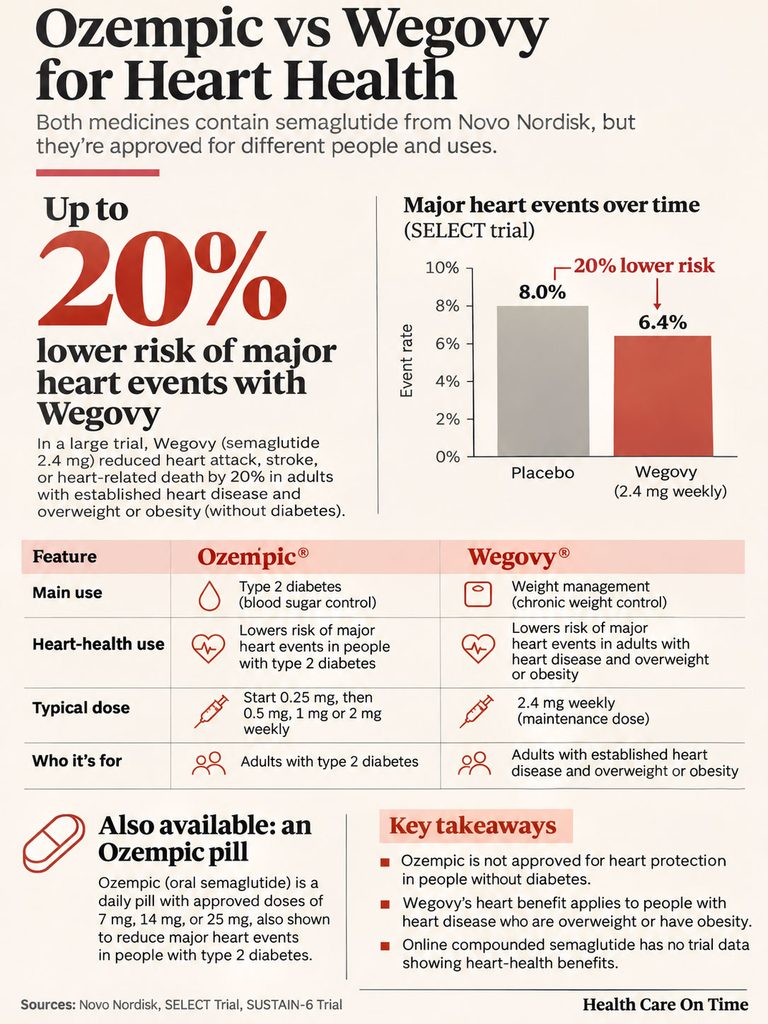
Ozempic is a type 2 diabetes drug. The injection comes in maintenance doses of 0.5 mg, 1 mg or 2 mg once a week, after starting at 0.25 mg for four weeks, and its label lists three uses: lowering blood sugar, lowering the risk of major heart events in adults with type 2 diabetes and established heart disease, and lowering the risk of kidney decline, end-stage kidney disease and heart death in adults with type 2 diabetes and chronic kidney disease. There’s no separate heart dose. Standard diabetes dosing applies.
Wegovy is a weight drug. For heart protection, the injection is usually kept at 2.4 mg a week (1.7 mg if the higher dose isn’t tolerated), and the indication covers adults with established heart disease and either obesity or overweight. Wegovy also comes as a 25 mg daily tablet, and the current Wegovy label extends the same heart indication to it. SELECT, the trial behind it, excluded anyone with type 1 or type 2 diabetes.
Then there’s the Ozempic pill. The FDA approved the Ozempic name for daily semaglutide tablets in 1.5 mg, 4 mg and 9 mg strengths, the same drug that was sold as Rybelsus in 3 mg, 7 mg and 14 mg tablets, and both sets of tablets carry a label for cutting major heart events in adults with type 2 diabetes who are at high risk for them. They aren’t interchangeable milligram for milligram, so any switch follows the conversion chart in the tablet label; Rybelsus 14 mg matches Ozempic tablets 9 mg, for example.
So if you have type 2 diabetes and heart disease, Ozempic (shot or pill) is the version with trial evidence in people like you. Without diabetes, Ozempic isn’t approved for you, and the heart data that applies is Wegovy’s. Online compounded semaglutide was never part of any of these trials, so none of their heart results can be assumed for it.
Who the benefit applies to
Type 2 diabetes with heart disease
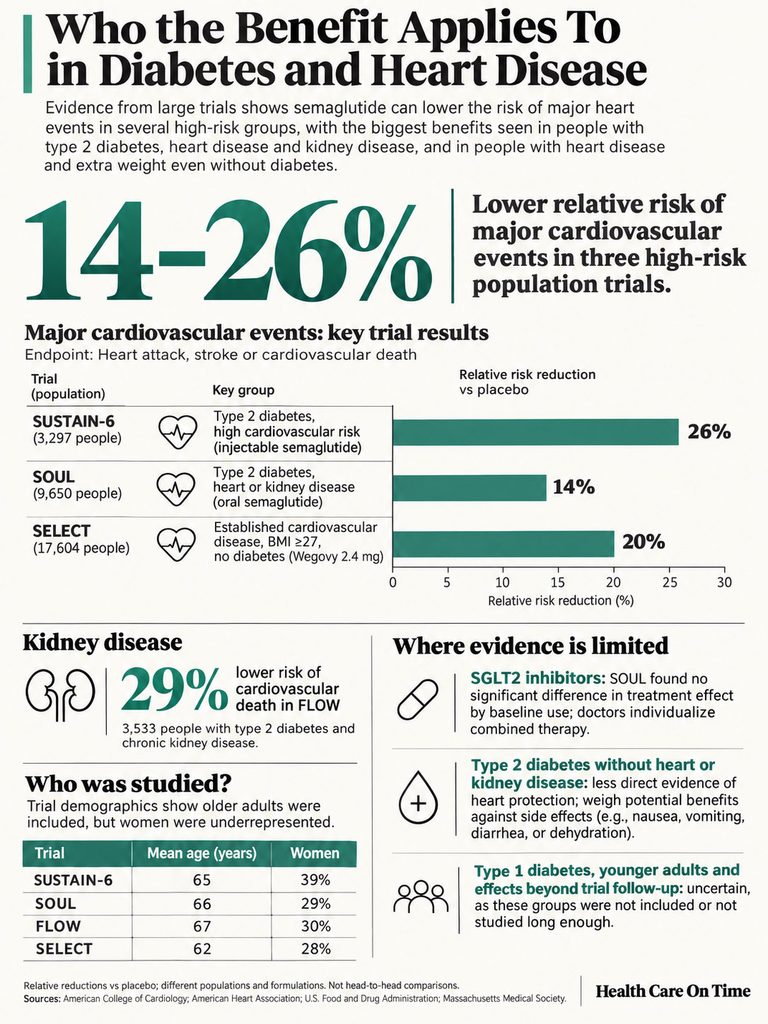
SUSTAIN-6 enrolled adults with type 2 diabetes whose blood sugar wasn’t under control and who had heart disease; their average age was 64.6, and 39% were women. SOUL took an older group, average age 66.1 and everyone 50 or older, with heart disease, kidney disease or both, and found its 14% drop on top of standard care. If you’ve had a heart attack, a stent, a bypass or a stroke, or you’ve been told you have blocked arteries in your legs, you match the people these drugs were tested in.
Someone with type 2 diabetes who had a stent placed after a heart attack, and who already takes a statin, aspirin and a blood pressure pill, fits SUSTAIN-6 and SOUL closely, and the label covers adding semaglutide in that case.
Type 2 diabetes with kidney disease
FLOW was designed as a kidney trial, but heart deaths were part of its main outcome. Among 3,533 people with type 2 diabetes and chronic kidney disease, heart deaths fell from 9.6% to 7.0% on Ozempic 1 mg, a 29% lower rate. That result underpins Ozempic’s kidney indication, and it matters for the heart because damaged kidneys sharply raise heart risk. The dose for this use is 1 mg weekly, reached after at least four weeks on 0.5 mg.
If you already take an SGLT2 inhibitor
Many people with type 2 diabetes and heart or kidney disease already take an SGLT2 inhibitor such as empagliflozin (Jardiance) or dapagliflozin (Farxiga), a drug class with heart and kidney data of its own. In SOUL, more than half of participants took one at some point during the trial, and a prespecified analysis found the semaglutide benefit was consistent either way. Doctors often use the two together, and the choice between SGLT2 inhibitors and GLP-1 drugs usually comes down to side effects, cost and which organ needs the most protection.
No diabetes, but heart disease and extra weight
SELECT enrolled 17,604 adults aged 45 or older with a body mass index of at least 27 and a past heart attack (76%), stroke (23%) or symptomatic artery disease in the legs (9%). Major heart events fell 20%, and death from any cause fell from 5.2% to 4.3%.
People in this group sometimes ask for Ozempic by name, but the drug with heart evidence and an FDA heart label for them is Wegovy, and insurance plans often treat the two brands very differently, so the name on the prescription matters.
Older adults and women
All three placebo trials leaned older. SOUL’s average age was 66.1, SUSTAIN-6’s was 64.6, and the REACH Medicare study only included people 66 and older. Women are less well covered: they made up 39% of SUSTAIN-6, 28.9% of SOUL and 28% of SELECT. For women in SELECT the result pointed the same way as for men (hazard ratio 0.84 vs 0.79), though with fewer events the confidence interval for women was wide and crossed 1.0.
Diabetes, but no heart disease yet
Here the evidence is thinner. Every Ozempic trial in the table enrolled people with heart disease, kidney disease or both. The tablet label uses the words “at high risk,” which covers some people who haven’t had a heart attack, and the real-world studies included people without a prior event, yet no large placebo trial has tested semaglutide in people with diabetes and low heart risk, so blood sugar, weight and kidney benefits carry more of the argument for starting it. A doctor may still lean toward semaglutide here, simply because the downside of waiting for a first heart attack is high and the drug helps with several problems at once.
Several other groups sit outside the trials too: people with type 1 diabetes, adults under middle age, and anyone hoping to know what happens past four or five years on the drug. Semaglutide may well help them; the trials simply weren’t built to show it.
Why heart risk is the bigger story in diabetes
For many people with type 2 diabetes, the long-term threat isn’t the blood sugar number. Heart disease and stroke are what shorten lives, and heart results now shape which diabetes drug a doctor reaches for first.
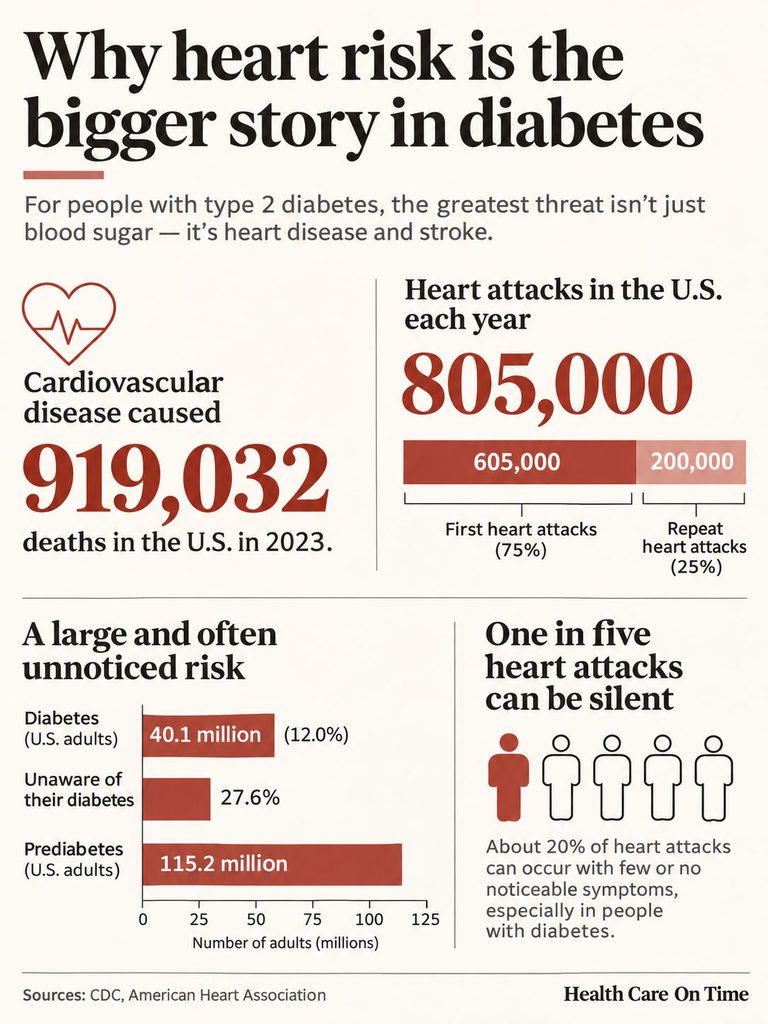
| Measure | US figure | Source |
| Heart attacks each year | About 805,000 | CDC Heart Disease Facts |
| First heart attacks among them | About 605,000 | CDC Heart Disease Facts |
| Repeat heart attacks | About 200,000 | CDC Heart Disease Facts |
| Heart attacks that are silent | About 1 in 5 | CDC Heart Disease Facts |
| Deaths from cardiovascular disease, 2023 | 919,032 (about 1 in 3 deaths) | CDC Heart Disease Facts |
| People with diabetes, 2023 | 40.1 million (12.0% of the population) | CDC National Diabetes Statistics Report |
| Adults with diabetes who don’t know it | 27.6% (11.0 million) | CDC National Diabetes Statistics Report |
| Adults with prediabetes | 115.2 million | CDC National Diabetes Statistics Report |
Sources: CDC Heart Disease Facts and the CDC National Diabetes Statistics Report, updated September 16, 2026.
About 200,000 of those yearly heart attacks happen to people who have already had one, and preventing that second event is the job SUSTAIN-6, SOUL and SELECT tested. Diabetes, high blood pressure, high cholesterol, smoking and extra weight all add to that risk, and part of the risk is seasonal, since heart attacks are more common in winter. Silent heart attacks matter more than usual in diabetes, since nerve damage can dull chest pain and an old heart attack sometimes turns up only on an ECG.
How semaglutide seems to protect the heart
The full mechanism is still unknown. Semaglutide lowers blood sugar and trims weight, both of which help arteries, but weight loss on its own doesn’t explain most of the benefit.
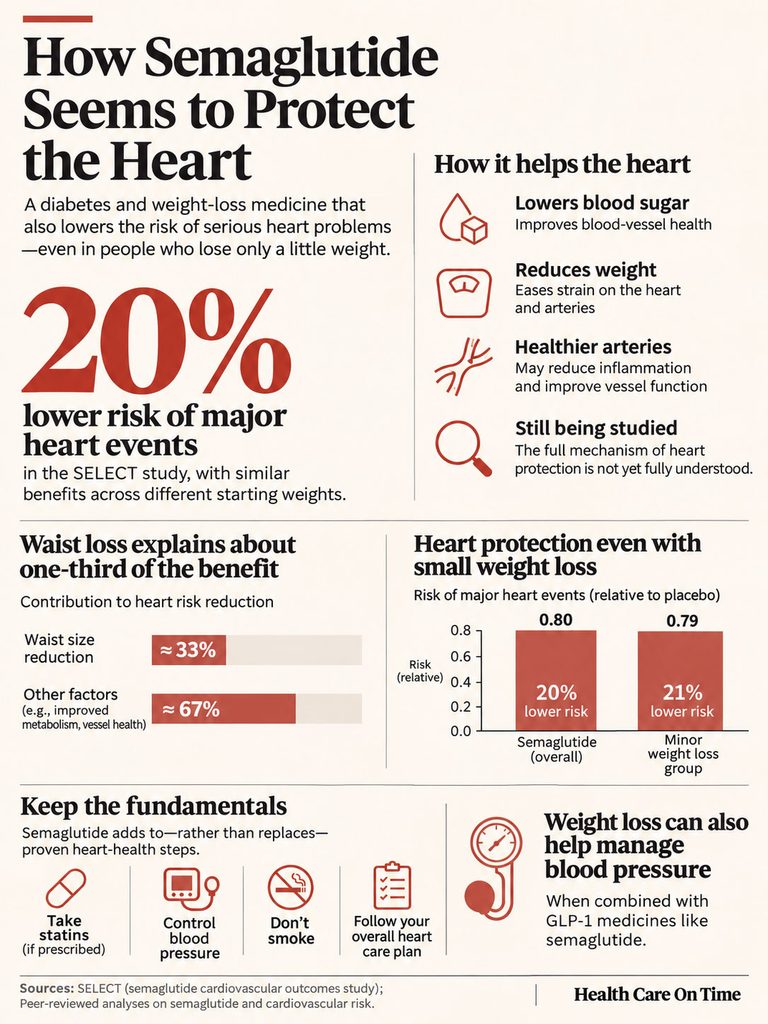
A prespecified analysis of SELECT, published in The Lancet in 2025, asked whether people who lost more weight got more heart protection. The drop in major heart events was similar across every starting weight and waist size, and shrinking waist size accounted for about a third of the benefit. The rest probably works through inflammation, blood vessel walls and plaque, which researchers are still sorting out.
Someone who loses only a little weight may still be getting a real share of the heart benefit, so a stalled scale isn’t by itself a reason to quit. Blood sugar doesn’t tell the whole story either: in SELECT, people with near-normal A1C (below 5.7%) showed a benefit in the same direction as those with higher readings.
None of this replaces the basics. Statins, blood pressure control, not smoking and the everyday habits that help prevent a heart attack remain the foundation, and every trial result above was measured on top of standard heart care. Weight loss can also lower blood pressure enough that a pill needs trimming, one of the things to watch when combining a GLP-1 with blood pressure medication.
Heart side effects and safety
For major heart events, the large trials point toward protection rather than harm, though a few heart-related effects are real.
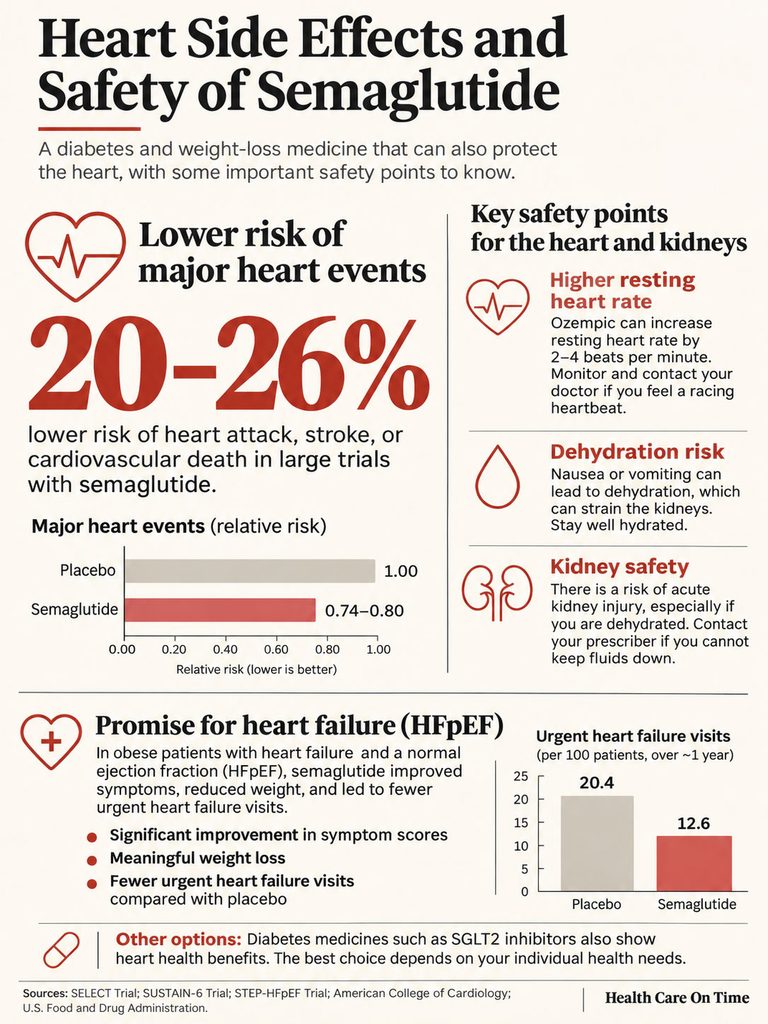
Faster heart rate. In placebo-controlled trials, Ozempic 0.5 mg and 1 mg raised resting heart rate by an average of 2 to 3 beats per minute, while placebo lowered it slightly. At Wegovy’s higher dose the rise was 1 to 4 beats, and a jump of 20 beats per minute or more showed up at some point in 26% of people on Wegovy vs 16% on placebo. Most people never notice.
A small rise like that is usually harmless for someone with a healthy heart rhythm, but a racing or pounding heartbeat at rest is worth reporting, and your doctor should know about it sooner if you have atrial fibrillation or another rhythm problem.
Dehydration and the kidneys. Nausea, vomiting and diarrhea top the side-effect list, with nausea in 15.8% to 20.3% of people on Ozempic vs 6.1% on placebo. Fluid loss can strain the kidneys, and the label describes acute kidney injury, sometimes needing dialysis, mostly in people who got dehydrated from stomach side effects. Add heart failure and a water pill, and that risk climbs.
If you can’t keep fluids down, call your prescriber about whether to hold the water pill or the semaglutide dose until you’re eating and drinking again, rather than guessing. Small, frequent sips, a daily weight check and a quick call when your urine turns dark or scant can catch dehydration before it reaches the kidneys.
The label’s other warnings cover pancreatitis, gallbladder disease (gallstones in 1.5% at 0.5 mg), low blood sugar when combined with insulin or sulfonylureas, a boxed warning about thyroid C-cell tumors seen in rodents, and food left in the stomach during anesthesia. Eye complications from diabetic retinopathy appeared in 3.0% on semaglutide vs 1.8% on placebo in SUSTAIN-6, so anyone with existing eye disease needs regular eye exams.
Heart failure and weight-loss injections
Unlike a heart attack or cardiac arrest, heart failure develops over time, and it comes in two broad types. With reduced ejection fraction, the heart muscle squeezes weakly. With preserved ejection fraction (HFpEF), it squeezes normally but is stiff, and that type is closely tied to obesity.
For HFpEF with obesity, the results so far are encouraging. In STEP-HFpEF, 529 people with an average BMI of 37 took semaglutide 2.4 mg or placebo for a year; symptom scores rose 16.6 points vs 8.7, weight fell 13.3% vs 2.6%, and six-minute walking distance grew 21.5 meters vs 1.2 meters (about 70 feet vs 4 feet). Only one person on semaglutide had a heart failure hospital stay or urgent visit, against 12 on placebo, and serious side effects were rarer on the drug (13.3% vs 26.7%). In SUSTAIN-6, hospital stays for heart failure came to 3.6% on semaglutide and 3.3% on placebo, too close to call a real difference (p = 0.57). SELECT points the same way from a different angle: about a quarter of its participants had some form of heart failure, and the drop in major heart events held for both types.
The American Diabetes Association’s 2026 Standards of Care added GLP-1 drugs with proven heart failure benefit to the medicines recommended for HFpEF in people with diabetes. Reduced-ejection-fraction heart failure has less behind it, since no large trial has made it the main target, so the decision there rests with a cardiologist.
Where semaglutide sits among heart-protecting diabetes drugs
Semaglutide isn’t the only diabetes medicine with heart evidence. SGLT2 inhibitors have their own heart and kidney data, and the ADA now lists dual GIP/GLP-1 drugs such as tirzepatide alongside GLP-1 drugs with proven benefit for HFpEF. Older choices like sulfonylureas lower blood sugar but carry no heart benefit of this kind, which is why the VA researchers used them as the comparison group. For someone with type 2 diabetes and heart disease, the usual question today is less about whether to use one of these newer drugs and more about which one, or which pair, suits their heart, kidneys, weight, budget and stomach.
What happens to heart risk if you stop
The heart benefit seems to last only while you keep taking the drug, and in the best real-world data it had faded within a year or two of stopping.
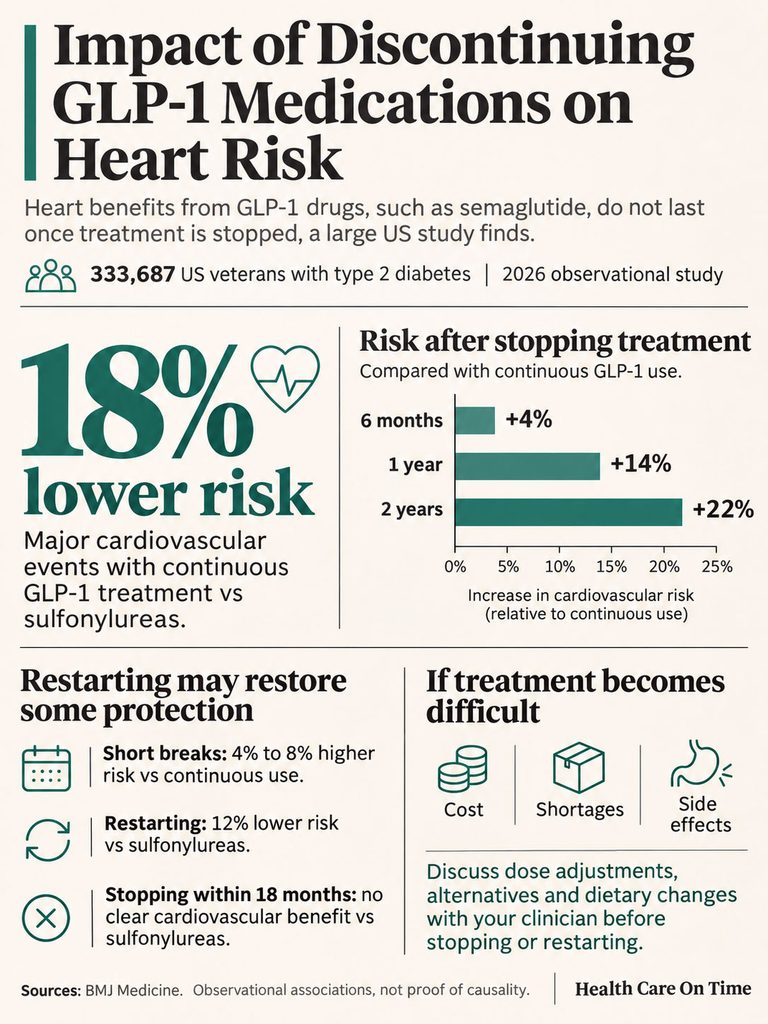
A 2026 study in BMJ Medicine followed 333,687 US veterans with type 2 diabetes for three years: 132,551 on GLP-1 drugs such as semaglutide and tirzepatide, and 201,136 on older sulfonylurea pills. Veterans who stayed on a GLP-1 drug for all three years had an 18% lower risk of heart attack, stroke or death than the sulfonylurea group, about 4 fewer events per 100 people. Those who stopped within 18 months had no clear benefit left by the end. Stopping after two years left a 7% reduction, and stopping after two and a half years left 15%.
Measured against staying on the drug, one year off was tied to a 14% higher risk and two years off to a 22% higher risk. Even a six-month gap before restarting raised risk by 4% to 8%, while restarting brought some protection back, with an average 12% reduction for people who paused and resumed. In this group, 26% stopped for good and about 23% had a gap of six months or more.
Unlike SUSTAIN-6 or SELECT, this was an observational study of mostly older men, and the comparison drug was a sulfonylurea rather than placebo, so the exact percentages are softer than trial results. Still, the direction matches what happens to weight and blood sugar after people stop.
You can stop Ozempic, and sometimes a doctor will tell you to, for example before surgery or if pancreatitis is suspected. If you started it partly for your heart, stopping gives that part back, and blood sugar usually climbs again. Cost, shortages and stomach side effects are the usual reasons people quit, and each has fixes to try first: a slower dose increase, a lower maintenance dose, the pill form, an insurance appeal, or eating patterns that ease nausea, like the ones in this Ozempic meal plan. When a break can’t be avoided, a short one appears to cost less than a long one.
Matching the evidence to your situation
Where you start decides which number applies to you. Two situations cause the most confusion: people without diabetes who ask for Ozempic by name, and people with diabetes but no heart disease who expect the full trial benefit. The first group should be talking about Wegovy, and the second should hear an honest “probably helps, not proven” from their doctor.
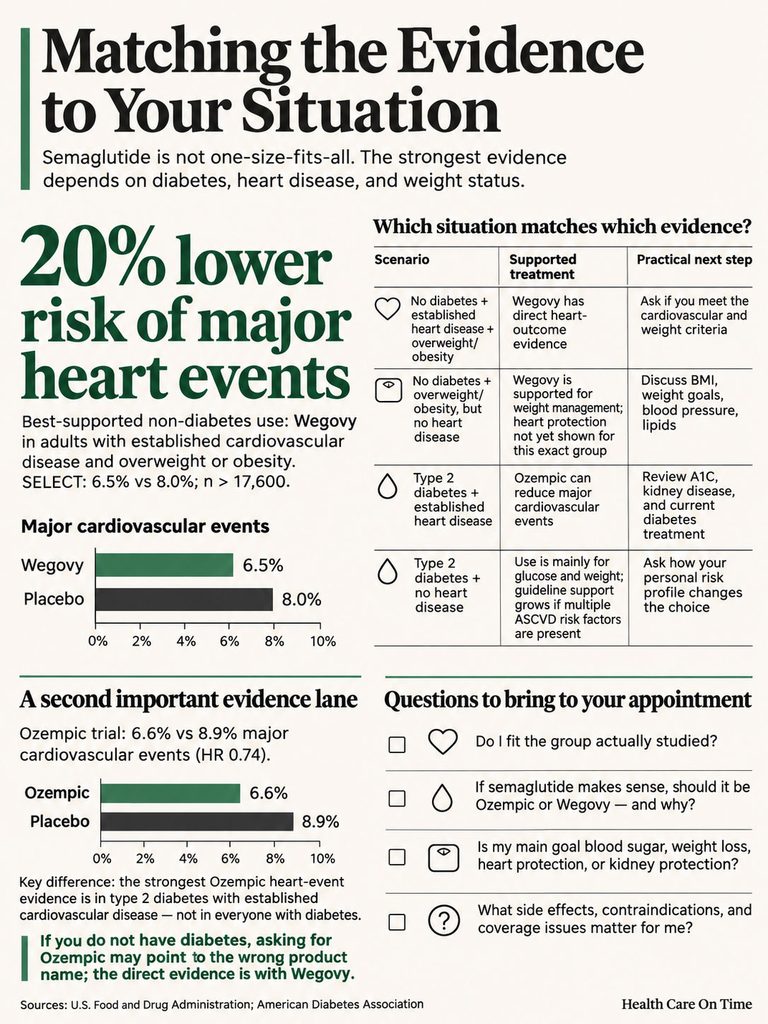
| Your situation | What the evidence supports | Practical next step |
| Type 2 diabetes plus a past heart attack, stent, bypass or stroke | Ozempic injection cut major heart events 26% vs placebo; pill cut them 14% | Ask whether semaglutide (shot or pill) fits alongside your statin and blood pressure plan |
| Type 2 diabetes plus chronic kidney disease | Ozempic 1 mg cut heart deaths 29% and the kidney composite 24% | Ask about the 1 mg weekly dose after 4 weeks at 0.5 mg |
| No diabetes, heart disease, BMI 27 or higher | Wegovy cut major heart events 20% (SELECT); Ozempic isn’t approved for you | Ask about Wegovy injection or tablets, not Ozempic |
| Type 2 diabetes, no heart or kidney disease | No dedicated placebo trial; real-world data suggest a benefit | Discuss blood sugar, weight and overall risk; heart benefit is less certain |
| Heart failure with preserved ejection fraction and obesity | Symptoms and walking improved in STEP-HFpEF; ADA 2026 lists proven GLP-1s for HFpEF | Let your cardiologist decide timing and dose, especially if you take water pills |
| Thinking about stopping because of cost or side effects | Off the drug 1 year: 14% higher risk; 2 years: 22% higher (VA study) | Talk to your prescriber before stopping; ask about lower doses or the pill |
| Already on dulaglutide (Trulicity) | Real-world data favor semaglutide by 23%, not yet in a journal | Don’t switch on your own; ask whether a change makes sense for you |
Questions to bring to your appointment
Appointments run short, so it helps to have these written down:
- Does a stent from years ago count as heart disease for the Ozempic heart indication?
- Is the pill an option, or does the shot make more sense for the heart?
- Should the dose go up for the kidneys, or stay where it is?
- What happens if the nausea never settles down?
- How fast is too fast for a resting pulse on this drug?
- Does the water pill need adjusting as the weight comes off?
- Is an SGLT2 inhibitor worth adding too, or is one of the two enough?
When to call 911 or your doctor
Call 911 right away for chest pain or pressure, pain spreading to the arm, jaw, neck or back, sudden shortness of breath, a cold sweat, or sudden weakness, numbness, face drooping or trouble speaking. Don’t drive yourself to the hospital. Those are heart attack and stroke signs whether or not you take semaglutide.
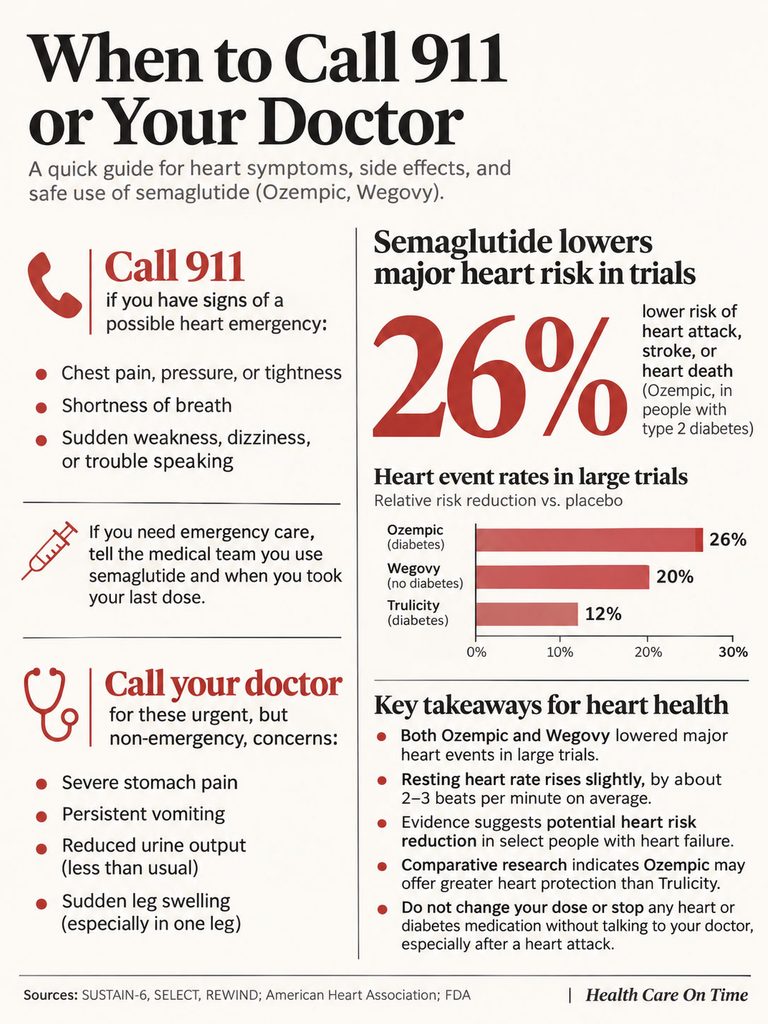
If you ever need emergency heart care while on semaglutide, such as a catheter procedure for a heart attack, tell the team you take it and when your last dose was. Because the drug slows how fast the stomach empties, the label warns about food in the stomach during anesthesia or deep sedation, and the care team may change how they sedate you. A note in your wallet or phone with the drug name, dose and day of the week you inject saves time when you can’t answer questions yourself.
Call your doctor the same day for severe stomach pain that won’t ease (a possible sign of pancreatitis), vomiting that keeps you from holding down fluids, much less urine than usual, a resting heartbeat that feels fast or irregular, sudden swelling in your legs, or vision changes.
Frequently Asked Questions
Does Ozempic lower heart attack risk if you don’t have diabetes?
Ozempic isn’t approved for people without type 2 diabetes. For that group the evidence comes from Wegovy, the same drug at 2.4 mg, tested in SELECT.
Is the 20% heart benefit from Ozempic or Wegovy?
Wegovy. SELECT enrolled 17,604 adults with heart disease and a BMI of at least 27 who did not have diabetes. Ozempic’s main heart number is 26%, from SUSTAIN-6 in people with type 2 diabetes, and since the patients and doses differ, the two figures can’t be compared head to head.
Can Ozempic cause problems with your heart?
Major heart events went down in every large semaglutide trial. Resting heart rate rises slightly, by 2 to 3 beats per minute on average with Ozempic, and dehydration from vomiting or diarrhea can strain the kidneys, which matters for people with heart failure. Contact your doctor about a racing heartbeat at rest, new leg swelling or chest discomfort, and call 911 for chest pain that doesn’t pass quickly.
Does Ozempic lower stroke risk?
In SUSTAIN-6, nonfatal strokes fell from 2.7% to 1.6%, a 39% lower rate. Stroke changes in the pill and Wegovy trials were smaller and not statistically clear.
Does the Ozempic pill protect the heart like the shot?
Yes, with a smaller measured effect: 14% fewer major heart events in SOUL vs 26% for the shot in SUSTAIN-6. The trials enrolled different patients and ran for different lengths of time, so part of that gap may come from study design. Ozempic tablets and Rybelsus both carry the heart indication.
How long does it take for Ozempic to help your heart?
The trials ran two to four years, so the firmest evidence is for steady use over years. In the VA study, people who stopped before 18 months had no clear heart benefit left at three years.
Can you take weight loss injections if you have heart failure?
Many people can, but the type of heart failure matters. With preserved ejection fraction and obesity, semaglutide 2.4 mg improved symptoms, walking distance and weight in STEP-HFpEF, and the ADA’s 2026 Standards list GLP-1 drugs with proven heart failure benefit for this group. Evidence for reduced ejection fraction is limited. Dehydration from stomach side effects can be risky for people on water pills, so a cardiologist should plan the dose and follow-up visits.
Is Ozempic better than Trulicity for the heart?
Possibly. A Medicare study found 23% fewer major heart events than with dulaglutide, and a records study found lower death, heart attack and stroke rates, but neither was a randomized head-to-head trial.
Should you start Ozempic after a heart attack?
With type 2 diabetes, a past heart attack puts you squarely in the group Ozempic’s heart indication covers, and SUSTAIN-6 and SOUL both enrolled many people like you. How it fits with your statin, blood thinner and blood pressure pills is a decision for your cardiologist and diabetes doctor together. Without diabetes, the drug to ask about is Wegovy; 76% of SELECT’s participants had a past heart attack.
Medical disclaimer: This article is for general information and isn’t medical advice. Don’t start, stop or change Ozempic, Wegovy or any heart medicine without talking to your doctor or pharmacist. If you have chest pain or stroke symptoms, call 911.
References
- U.S. Food and Drug Administration. Ozempic (semaglutide) injection prescribing information, revised May 2026.
- U.S. Food and Drug Administration. Rybelsus and Ozempic (semaglutide) tablets prescribing information, revised January 2026.
- U.S. Food and Drug Administration. Wegovy (semaglutide) injection and tablets prescribing information, revised May 2026.
- American College of Cardiology. SUSTAIN-6 trial summary.
- American College of Cardiology. SELECT trial summary, updated September 2024.
- American College of Cardiology. SOUL trial summary.
- Healio. Oral semaglutide cuts risk for heart events by 14% in high-risk type 2 diabetes.
- American College of Cardiology. STEP-HFpEF trial summary.
- Kishimori T, et al. Comparative cardiovascular outcomes of semaglutide to dulaglutide in patients with type 2 diabetes. Sci Rep. 2025.
- Cardiovascular Business. Semaglutide tops dulaglutide when treating patients with type 2 diabetes and CVD (REACH, EASD 2025).
- HCPLive. GLP-1 discontinuation tied to loss of cardiovascular protection (Xie Y, Choi T, Al-Aly Z. BMJ Medicine. 2026).
- Epocrates. Stopping GLP-1 therapy may reverse cardiovascular benefits in patients with type 2 diabetes.
- Epocrates. Semaglutide cuts heart risk in people with obesity, even without significant weight loss (Deanfield J, et al. Lancet. 2025).
- Diabetes & Primary Care. The 2026 ADA Standards of Care: What’s new?
- Centers for Disease Control and Prevention. Heart Disease Facts.
- Centers for Disease Control and Prevention. National Diabetes Statistics Report.