About 1 in 10 American adults eats enough vegetables on a typical day, per CDC surveillance data. That stat is sobering, and it’s the reason broccoli keeps landing on every “eat more of this” list a US dietitian writes. The question most people actually want answered, though, is not whether broccoli is good for them; it is how much of what they’re getting in a single cup. Calories, carbs, protein, fiber, vitamins, the works. Here is the per-cup, USDA-sourced answer, plus the context that turns the numbers into something you can use this week.
Table of Contents
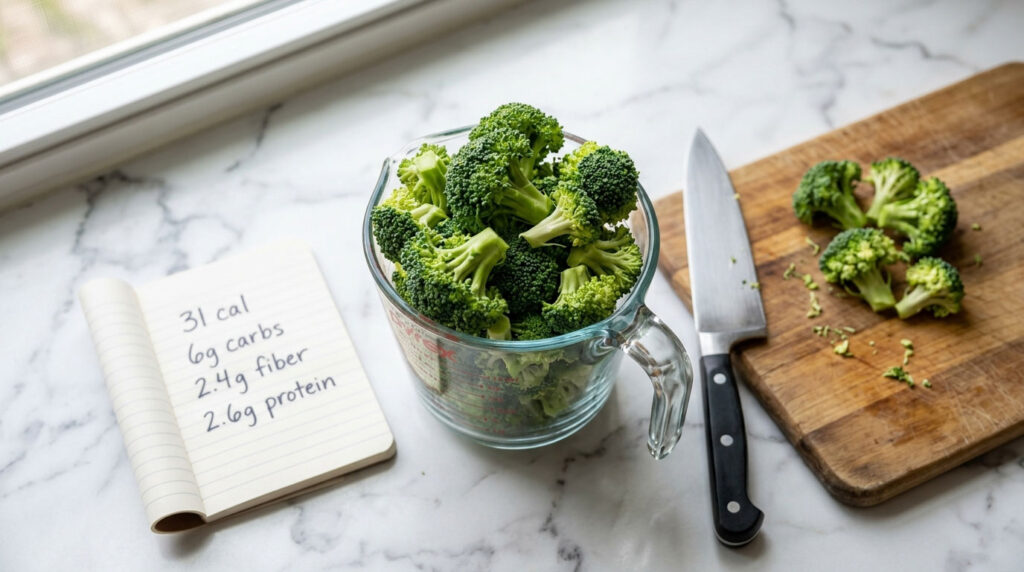
Quick Answer: A 1-cup chopped serving of raw broccoli (91 g) contains about 31 calories, 6 g carbs, 2.4 g fiber, 2.6 g protein, and 0.3 g fat, per USDA FoodData Central. Cooked broccoli is more nutrient-dense per cup because it compresses, delivering roughly 55 calories, 11 g carbs, 5 g fiber, and 3.7 g protein. Both forms are excellent sources of vitamin C, vitamin K, and folate, with very low calories per gram.
At a Glance
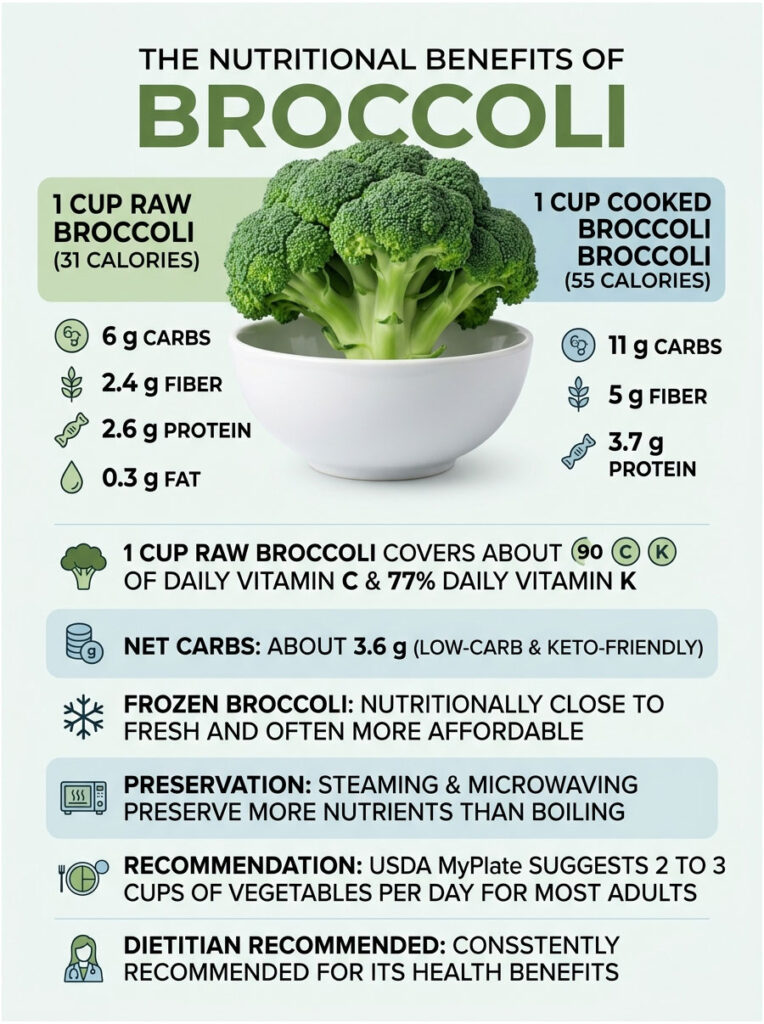
• 1 cup raw broccoli: 31 calories, 6 g carbs, 2.4 g fiber, 2.6 g protein, 0.3 g fat
• 1 cup cooked broccoli: 55 calories, 11 g carbs, 5 g fiber, 3.7 g protein
• 1 cup raw broccoli covers about 90% of your daily vitamin C and 77% of your daily vitamin K
• Net carbs (digestible carbs) per cup raw: about 3.6 g, making broccoli low-carb and keto-friendly
• Frozen broccoli is nutritionally close to fresh and often more affordable in US grocery stores
• Steaming and microwaving preserve more nutrients than boiling
• USDA MyPlate recommends 2 to 3 cups of vegetables a day for most US adults
Broccoli Nutrition Facts at a Glance (USDA Per Cup)
Broccoli (Brassica oleracea var. italica) is one of the most studied cruciferous vegetables in the American diet. Every nutrient figure in this guide comes from the USDA FoodData Central database, the official US reference for food composition.
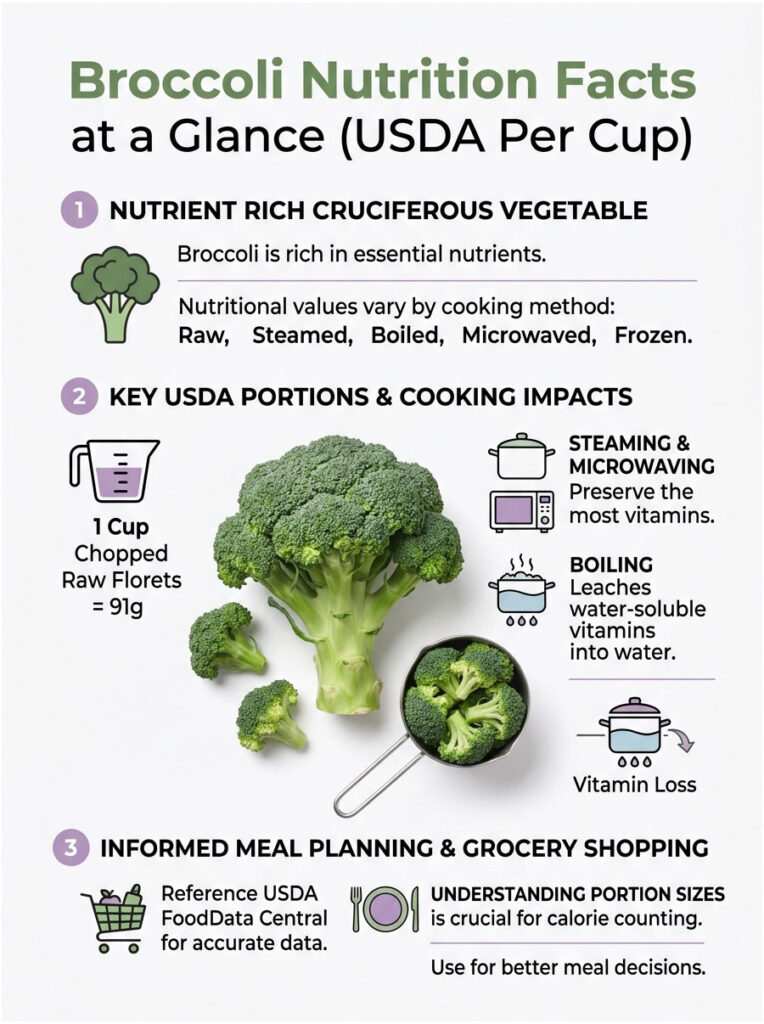
The numbers shift depending on whether you are eating it raw, steamed, boiled, microwaved, or frozen-then-cooked. They also shift by serving size, since 1 cup of chopped raw florets weighs only 91 g, while 1 cup of cooked weighs about 156 g. That detail trips up most online “calories in broccoli” answers.
In tests booked through HealthCareOnTime, patients ask us almost weekly which cooking method preserves the most nutrition. The short answer: steaming and microwaving win on vitamin retention, while boiling leaches the most water-soluble vitamins out into the cooking water.
A complete USDA breakdown of both raw and cooked broccoli is laid out in Table 2 below. The rest of this article translates those numbers into what they actually mean for your plate, your weight goals, and your weekly grocery list.
How Many Calories Are in Broccoli? (Per Cup, Floret, Stalk, 100 g)
Broccoli is one of the lowest-calorie vegetables on the produce shelf. That makes it a staple in almost every US registered dietitian’s meal plan for weight loss, blood sugar management, and general health.
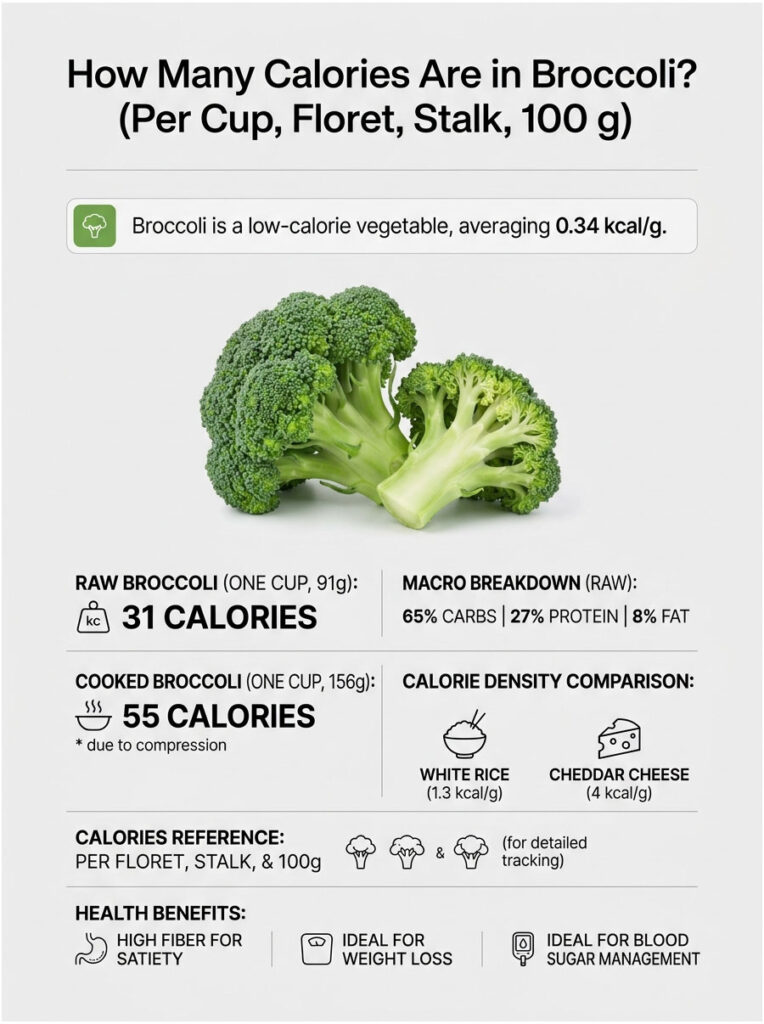
Calorie density (calories per gram) for raw broccoli is about 0.34 kcal/g. For comparison, white rice runs roughly 1.3 kcal/g cooked, and cheddar cheese around 4 kcal/g. You would have to eat a remarkable volume of broccoli to overshoot a calorie goal.
Calories in 1 Cup of Raw Broccoli
A 1-cup chopped serving of raw broccoli weighs 91 g and contains 31 calories. About 65% of those calories come from carbs (most of which is fiber), 27% from protein, and 8% from a tiny amount of fat. That macro split is unusually protein-leaning for a vegetable.
Calories in 1 Cup of Cooked Broccoli
A 1-cup chopped serving of cooked broccoli weighs 156 g and contains 55 calories. The cup holds more calories than raw not because cooking adds energy, but because florets compress as they soften, packing more grams into the same volume.
Calories Per Floret, Per Stalk, Per 100 g
Useful reference points across other common US serving sizes:
- 1 medium floret (about 11 g): roughly 4 calories
- 1 medium stalk (about 148 g): roughly 50 calories
- 1 large stalk (280 g): roughly 95 calories
- 100 g of raw broccoli: 34 calories
- 1 lb of raw broccoli: 154 calories
- 1 standard bag of frozen florets (10 oz): about 95 calories
Across patients we serve, this floret-level granularity is what most weight-loss plans ask for. It matters because you rarely measure broccoli in cups when you are mid-prep at the kitchen counter.
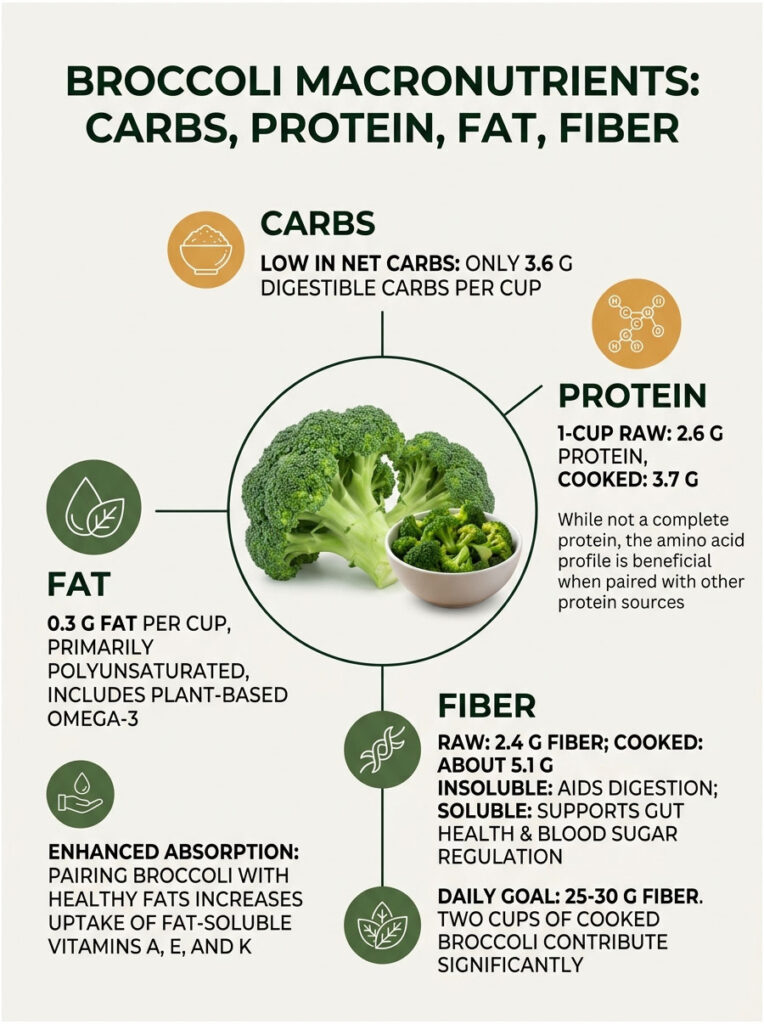
Broccoli Macronutrients: Carbs, Protein, Fat, Fiber
Macronutrients are where broccoli quietly outperforms its reputation. It looks like a low-impact veggie, but per calorie, it is a meaningful protein source, a strong fiber source, and remarkably low in net carbs.
Carbohydrates
A 1-cup chopped serving of raw broccoli has 6 g of total carbs. Of that, 2.4 g is fiber and about 1.5 g is naturally occurring sugars (fructose, glucose, sucrose).
Subtract fiber from total carbs and you get roughly 3.6 g of digestible carbs, also called net carbs. That number is why broccoli features in nearly every US keto meal plan. At under 4 g net carbs per cup, you can eat it generously without breaking a typical 20 to 50 g daily carb cap.
Protein
Raw broccoli has 2.6 g of protein per cup, and cooked broccoli has 3.7 g per cup. That is more protein per calorie than most vegetables.
It is not a complete protein in the strict sense; broccoli is low in methionine, meaning it does not contain all nine essential amino acids in ideal ratios. But broccoli’s amino acid profile is more useful than most green vegetables, and pairing it with grains, legumes, dairy, or animal protein covers any gaps. Patients commonly ask us if vegetables can carry the protein side of a meal; broccoli is one of the few that genuinely contributes.
Fiber
A 1-cup raw serving has 2.4 g of fiber, and a cooked cup has about 5.1 g. Both forms blend roughly 60% insoluble fiber and 40% soluble fiber.
Insoluble fiber adds bulk and supports regular bowel movements; soluble fiber feeds the gut microbiome and helps moderate blood sugar response after meals. The American Heart Association recommends about 25 to 30 g of fiber per day for US adults, and most Americans hit only about 15 g. Two cups of cooked broccoli a day brings you a third of the way to that target on its own.
Fat
Broccoli contains 0.3 g of fat per raw cup, mostly polyunsaturated. The amount is small but includes a trace of plant-based omega-3 (alpha-linolenic acid).
It is not a meaningful source of dietary fat, but the fat-soluble vitamins (A, E, K) absorb better when broccoli is paired with a small amount of olive oil, butter, avocado, or nuts. Our nutrition reviewers routinely flag this pairing tip for patients trying to maximize vitamin K absorption.
Broccoli Vitamins and Minerals (USDA %DV Chart)
Broccoli’s vitamin and mineral profile is what earns it the “superfood” label. A single cup raw covers most of an adult’s daily vitamin C, a big chunk of vitamin K, and meaningful folate, all for 31 calories.
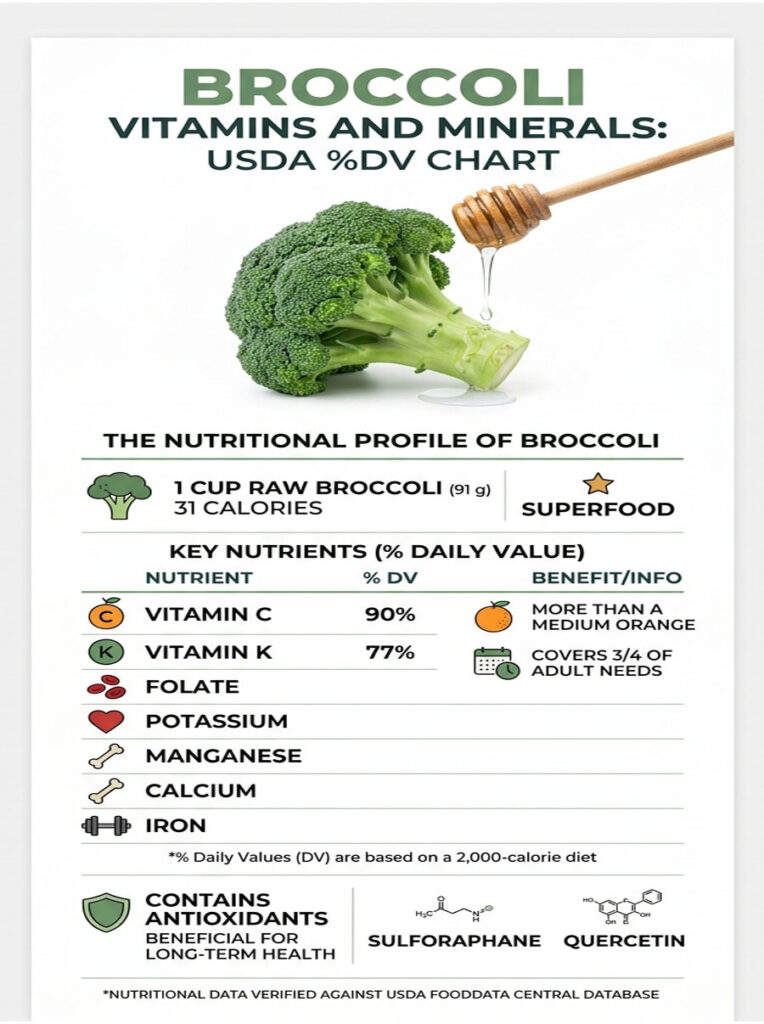
The %DV figures below use the FDA’s general 2,000-calorie reference values, which is what you see on US Nutrition Facts panels. Our nutrition reviewers verified each entry against the live USDA FoodData Central database.
Table 2: USDA Nutrient Profile of Broccoli Per 1 Cup (Raw, 91 g)
| Nutrient | Amount Per Cup | % Daily Value (DV) | Source |
| Calories | 31 kcal | 1.5% | USDA FDC |
| Total Carbohydrate | 6 g | 2% | USDA FDC |
| Dietary Fiber | 2.4 g | 9% | USDA FDC |
| Protein | 2.6 g | 5% | USDA FDC |
| Total Fat | 0.3 g | <1% | USDA FDC |
| Vitamin C | 81.2 mg | 90% | USDA FDC + NIH ODS |
| Vitamin K | 92.5 mcg | 77% | USDA FDC + NIH ODS |
| Folate (B9) | 57 mcg DFE | 14% | USDA FDC + NIH ODS |
| Potassium | 288 mg | 6% | USDA FDC |
| Manganese | 0.19 mg | 8% | USDA FDC |
| Calcium | 43 mg | 3% | USDA FDC |
| Iron | 0.66 mg | 4% | USDA FDC |
Two numbers stand out: vitamin C and vitamin K. According to the NIH Office of Dietary Supplements, a single cup of raw broccoli delivers more vitamin C than a medium orange, and roughly three-quarters of an adult’s daily vitamin K need.
Broccoli is also a quiet source of antioxidants like sulforaphane, kaempferol, quercetin, lutein, and zeaxanthin. Those are not on the standard nutrition label but show up in research as drivers of broccoli’s longer-term health benefits.
Raw vs Cooked vs Frozen Broccoli (Per-Cup Comparison)
This is where most online broccoli articles get vague. The honest answer is each form has tradeoffs, and the right choice depends on what you cook for and how long it sits in your freezer.
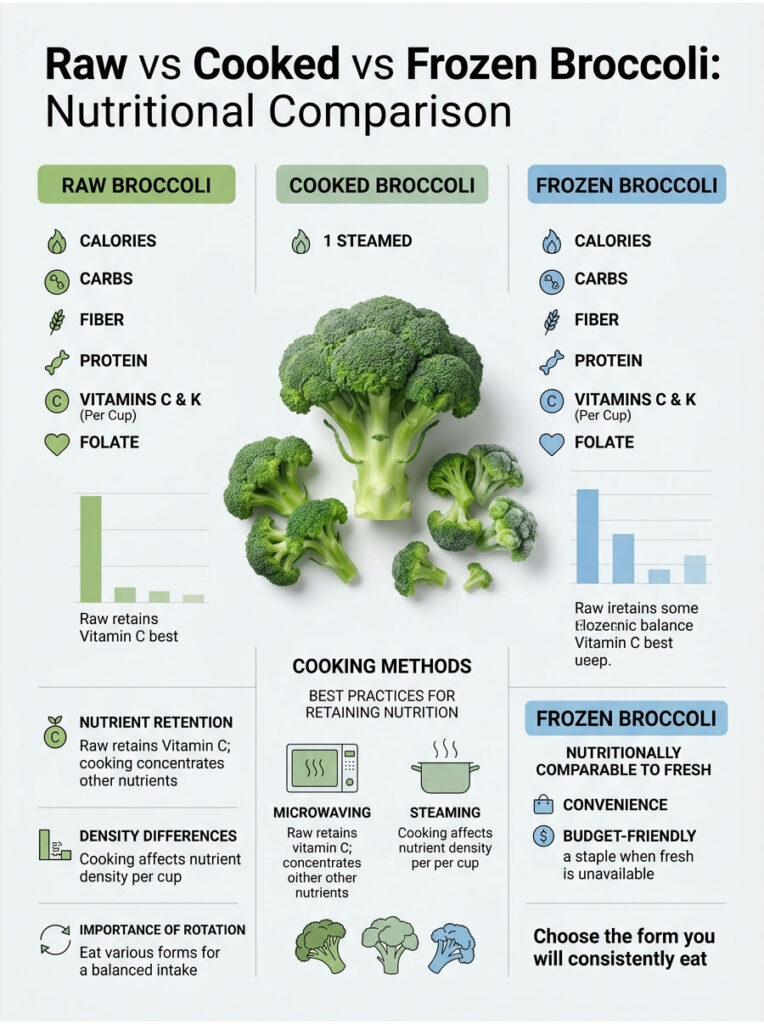
In cases reviewed by our nutrition team, the practical guidance is: eat the form you are most likely to actually eat consistently, and rotate methods through the week to capture the full nutrient spectrum.
Table 1: Raw vs Cooked vs Frozen Broccoli (Per 1 Cup)
| Nutrient | Raw, Chopped (91 g) | Cooked, Boiled (156 g) | Frozen, Cooked (184 g) | Notes |
| Calories | 31 kcal | 55 kcal | 52 kcal | More grams per cup once cooked |
| Carbs | 6 g | 11 g | 10 g | Net carbs raw: ~3.6 g |
| Fiber | 2.4 g | 5.1 g | 5.0 g | Fiber largely preserved through cooking |
| Protein | 2.6 g | 3.7 g | 5.7 g | Cooked frozen often shows highest per cup |
| Vitamin C | 81 mg (90% DV) | 101 mg (112% DV) | 74 mg (82% DV) | Boiling lowers C; raw retains best per gram |
| Vitamin K | 92 mcg (77% DV) | 220 mcg (183% DV) | 162 mcg (135% DV) | Heat-stable, concentrates per cup |
| Folate | 57 mcg | 168 mcg | 104 mcg | Cooking concentrates per cup |
| Best for | Salads, snacks, slaws | Sides, soups, stir-fry | Quick meals, year-round price | All three count toward MyPlate |
Why Cooked Broccoli Has More Calories Per Cup
Cooking softens cell walls, so florets pack denser into the measuring cup. That extra mass is why a cooked cup carries more calories, more carbs, and more of nearly every nutrient. Calorie density per gram actually drops slightly with cooking because broccoli absorbs water.
Best Cooking Method for Maximum Nutrition
A 2018 review in the Journal of Food Science and a 2020 sulforaphane study cited in Healthline’s Broccoli 101 both point to microwaving and steaming as the top performers. Boiling leaches the most water-soluble vitamins (especially C and folate) into the cooking water.
Stir-frying with a small amount of oil retains more flavonoids than boiling and helps fat-soluble vitamin K absorb. Across patients we serve, the simplest reliable method is a 3-minute steam over a quarter cup of water in the microwave, covered. Quick, no special equipment, and minimal nutrient loss.
Is Frozen Broccoli as Nutritious as Fresh?
Yes, with small caveats. Commercial frozen broccoli is blanched (briefly boiled) before freezing, which knocks out a percentage of vitamin C but locks in most other nutrients near peak harvest quality. The result is often nutritionally close to fresh, sometimes better than fresh that has spent a week in transit and another week in your crisper.
Per the USDA SNAP-Ed program, frozen broccoli is a budget-friendly, nutritionally sound staple, especially when fresh is out of season or expensive at your local US supermarket. Frozen florets are also pre-portioned, which makes calorie tracking easier for patients on structured meal plans.
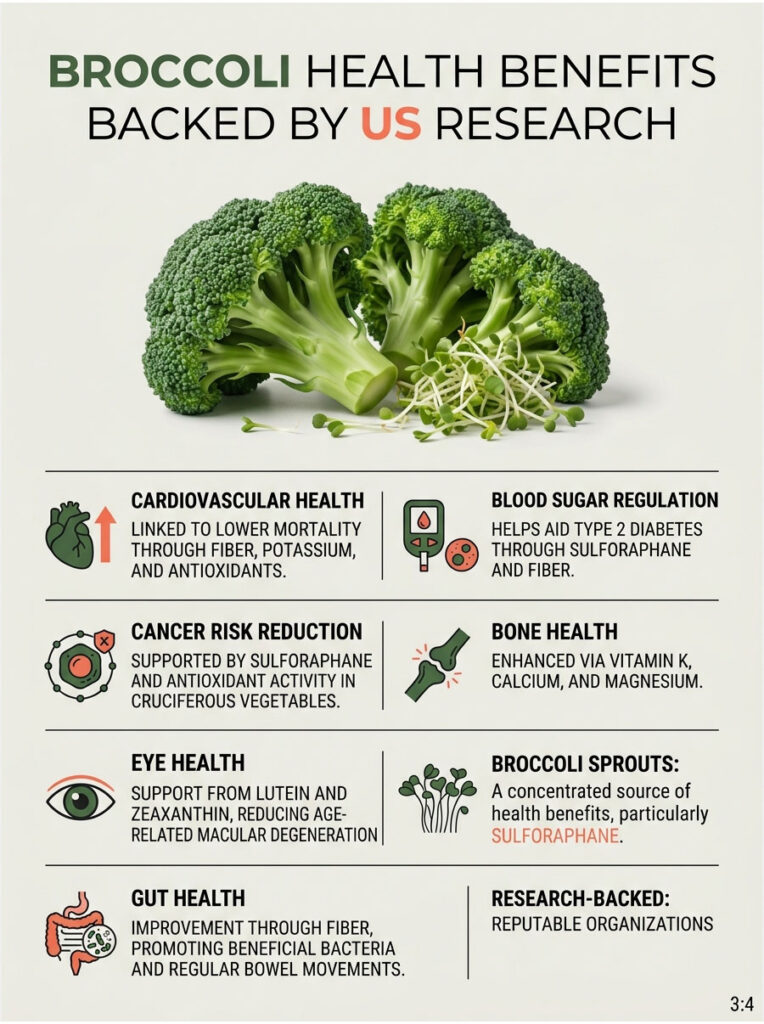
Broccoli Health Benefits Backed by US Research
The macros and micros explain why broccoli appears in so many evidence-based dietary recommendations. Here is what the US research community has actually found.
Cardiovascular Health
A long-running cohort analysis from the Harvard T.H. Chan School of Public Health linked higher cruciferous vegetable intake (broccoli included) with lower cardiovascular mortality. Fiber, potassium, vitamin K, and folate all contribute, along with the antioxidant load.
The American Heart Association lists vegetables as a foundation of the DASH eating pattern, which clinically lowers blood pressure within weeks when followed consistently.
Blood Sugar Regulation
Sulforaphane, a sulfur-containing compound made when broccoli is chewed or chopped, has been studied in human trials for its effect on fasting blood sugar in adults with type 2 diabetes and obesity. Results suggest meaningful, if modest, improvements when broccoli sprouts or extracts are added consistently to the diet.
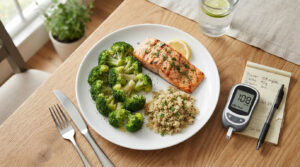
The fiber in whole broccoli also slows post-meal glucose spikes, which is why the American Diabetes Association places broccoli among the foundation non-starchy vegetables in its diabetes plate method.
Cancer Risk
Cruciferous vegetables like broccoli are flagged by the American Institute for Cancer Research as one of the most evidence-backed plant categories for reducing risk across several cancer types. The mechanisms involve sulforaphane, indole-3-carbinol, and antioxidant activity at the cellular level.
Broccoli sprouts in particular contain 10 to 100 times more sulforaphane than mature broccoli per gram, which is why some US health-food stores stock them as a concentrated option.
Bone Health
A single cup of cooked broccoli covers nearly twice an adult’s daily vitamin K need, which the NIH ODS ties to bone mineralization and calcium binding. Combined with calcium, magnesium, and phosphorus, broccoli supports skeletal health, especially in older Americans.
Eye Health
Broccoli contains lutein and zeaxanthin, two carotenoids concentrated in the macula of the eye. Both are linked to lower risk of age-related macular degeneration in observational US studies. Vitamin A and beta-carotene contribute as well.
Gut Health
The fiber content (about 5 g per cooked cup) feeds beneficial gut bacteria, supports regular bowel movements, and may modulate inflammation. Patients commonly ask us about food-first approaches to gut health, and broccoli routinely lands in the top three suggestions our team gives, alongside legumes and oats.
Broccoli for Weight Loss, Blood Sugar, and Heart Health
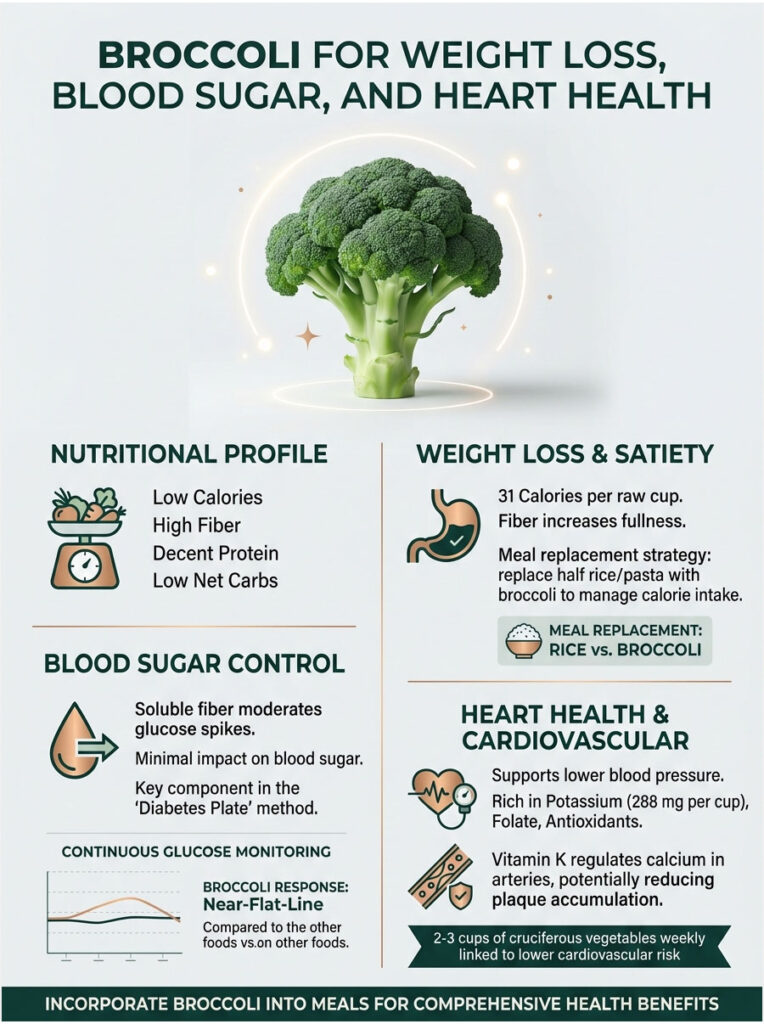
The overall nutritional profile (low calories, high fiber, decent protein, low net carbs) makes broccoli a triple win for the most common American health goals.
Weight Loss
At 31 calories per raw cup, broccoli adds bulk and satiety without meaningful calorie cost. Fiber slows gastric emptying, helping you feel full longer. Patients on calorie-controlled plans often build meals around 1.5 to 2 cups of cooked broccoli to anchor portion volume without driving up calories.
A common practical move our nutrition team sees work: replace half the rice or pasta on the plate with chopped broccoli to instantly cut about 150 to 200 calories per meal while keeping the visual portion the same.
Blood Sugar
Soluble fiber moderates the post-meal glucose spike. The protein and minimal net carb load mean broccoli barely moves blood sugar at all. The American Diabetes Association lists non-starchy vegetables, broccoli among them, as the foundation of the “diabetes plate” method, where half the plate is non-starchy vegetable.
For patients tracking continuous glucose monitor (CGM) data, broccoli typically registers as a near-flat-line food, an unusual quality for any carb-containing item.
Heart Health
The combination of fiber, potassium (288 mg per raw cup), folate, and antioxidants supports lower blood pressure and healthier blood vessel function. Two to three cups of cruciferous vegetables a week have been associated with lower cardiovascular risk in multiple US cohorts.
Vitamin K plays a role here too, helping regulate calcium deposition in arteries rather than letting it accumulate as plaque, an emerging area of cardiovascular research.
How Much Broccoli Should You Eat Per Day? (USDA + MyPlate)
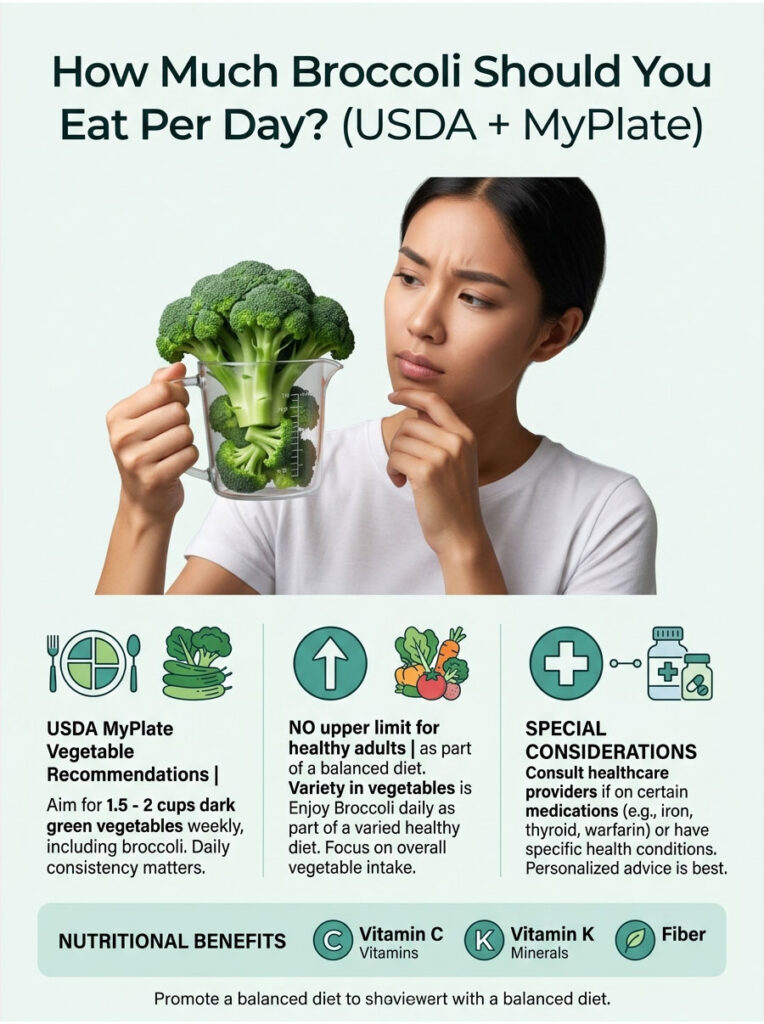
The Dietary Guidelines for Americans 2020-2025 and USDA MyPlate recommend the following daily vegetable totals (any combination, broccoli welcome):
- Adult women (19-50): 2.5 cups vegetables daily
- Adult women (51+): 2 cups daily
- Adult men (19-50): 3 cups daily
- Adult men (51+): 2.5 cups daily
- Children ages 4 to 8: 1.5 cups daily
- Teens 9 to 18: 2 to 3 cups daily
Within those totals, MyPlate suggests roughly 1.5 to 2 cups per week of dark green vegetables specifically. Broccoli, kale, spinach, and collards all count. There is no documented upper limit for healthy adults eating whole broccoli, though specific medical conditions (covered below) may warrant moderation.
In tests booked through HealthCareOnTime, patients on iron, thyroid, or warfarin medications often ask about safe broccoli amounts. Our medical reviewers consistently flag the importance of consistency over restriction; eating roughly the same amount daily is more important than eating less.
How to Eat More Broccoli (US-Style Tips & Pairings)
Most people who say they “don’t like broccoli” had it boiled into mush at some point. Modern US prep methods are far better. The decision matrix below maps health goal to the most effective preparation, drawn from the most-asked questions across our diagnostic network.
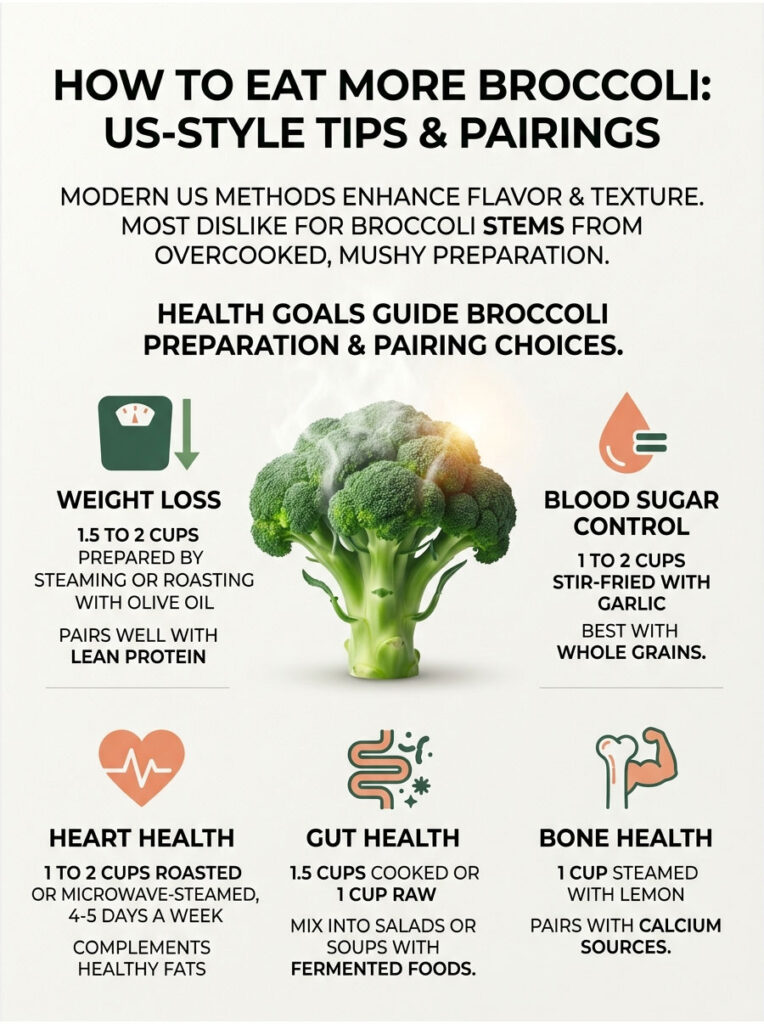
Table 3: Broccoli By Goal (Recommended Daily Amount, Best Prep, Pairing Tips)
| Health Goal | Recommended Daily Broccoli | Best Prep Method | Pairing Tip |
| Weight loss | 1.5 to 2 cups cooked | Steam or roast at 425°F with olive oil | Pair with lean protein (chicken, fish, tofu) |
| Blood sugar control | 1 to 2 cups cooked | Stir-fry with garlic and a teaspoon of olive oil | Pair with whole grains (quinoa, brown rice) |
| Heart health | 1 to 2 cups cooked, 4-5 days/wk | Roast or microwave-steam | Pair with healthy fats (avocado, walnuts) |
| Gut health | 1.5 cups cooked or 1 cup raw | Mix raw in salads, cooked in soups | Pair with fermented foods (yogurt, kimchi) |
| Bone health | 1 cup cooked | Steam with lemon and a drizzle of olive oil | Pair with calcium sources (dairy, fortified plant milk) |
A few simple US-friendly preparation shortcuts our team recommends:
- Roast at 425°F with olive oil, salt, garlic, and lemon, for 18 to 22 minutes
- Microwave-steam in a glass dish with 2 tablespoons of water, covered, for 3 minutes
- Throw raw florets into smoothies (you will not taste them, especially with banana and peanut butter)
- Add chopped broccoli to omelets, frittatas, pasta sauces, soups, and grain bowls
- Buy frozen florets in bulk for cheap, year-round availability
- Try broccoli sprouts on sandwiches and salads for a sulforaphane-concentrated option
Risks, Side Effects, and Who Should Limit Broccoli
Broccoli is safe for nearly everyone, but a handful of US patient groups should watch their intake or talk with their physician before changing eating patterns.
People on Warfarin (Coumadin)
Broccoli is rich in vitamin K, which interacts with this blood thinner. Drastic intake changes (suddenly eating much more or less) can shift INR results. Consistency matters more than avoidance.
People with Hypothyroidism
Cruciferous vegetables contain small amounts of goitrogens, plant compounds that can interfere with thyroid function in very large quantities. Cooking deactivates most of them. Normal portions (1 to 2 cups daily) pose no documented thyroid risk in iodine-sufficient adults, per the American Thyroid Association.
People with IBS or Low-FODMAP Needs
Broccoli stalks are higher in fructans (a FODMAP) than florets. Sticking to 3/4 cup of florets and limiting stems often resolves bloating issues. Our medical reviewers see this question frequently from patients on elimination diets.
People with a History of Kidney Stones
Broccoli contains some oxalate, though less than spinach. If you have calcium oxalate stones, ask your urologist whether moderation is appropriate.
Babies Under 6 Months
Whole broccoli is not appropriate before solid food introduction. Once introduced, soft-cooked, mashed broccoli is a US pediatrician staple from around 8 to 10 months on.
Frequently Asked Questions
How many calories are in 1 cup of broccoli?
A 1-cup chopped serving of raw broccoli (91 g) contains 31 calories. A 1-cup chopped serving of cooked broccoli (156 g) contains about 55 calories. The cooked version has more calories per cup because florets compress, packing more grams into the same volume.
How much protein is in a cup of broccoli?
Raw broccoli has 2.6 g of protein per cup, and cooked broccoli has about 3.7 g per cup, per USDA FoodData Central. Frozen-then-cooked can run a touch higher. That is more protein per calorie than most vegetables, though broccoli alone is not a complete protein.
How much fiber is in a cup of broccoli?
A 1-cup raw serving has 2.4 g of fiber, and a 1-cup cooked serving has about 5.1 g. The fiber is split roughly 60% insoluble (helps regularity) and 40% soluble (feeds gut bacteria, moderates blood sugar). Two cups of cooked broccoli a day covers about a third of the daily US fiber target.
Is broccoli good for weight loss?
Yes, broccoli is one of the most weight-loss-friendly foods available in US grocery stores. At 31 calories per raw cup with high water and fiber content, it adds satiety without driving up calorie intake. Patients on calorie-controlled meal plans often build meals around 1.5 to 2 cups of cooked broccoli to anchor portion volume.
Is broccoli high in carbs or keto-friendly?
Broccoli is low-carb and keto-friendly. A 1-cup raw serving has 6 g total carbs, but 2.4 g is fiber, leaving about 3.6 g of net carbs. That fits comfortably within typical keto carb caps of 20 to 50 g per day. It is one of the most-recommended vegetables on US ketogenic eating plans.
Does cooking broccoli destroy nutrients?
Cooking changes nutrient availability rather than destroying it outright. Boiling loses the most vitamin C and folate (water-soluble vitamins leach into cooking water). Steaming and microwaving retain the most. Vitamin K, fiber, and protein survive cooking well. Mixing raw and cooked across the week captures the broadest nutrient spectrum.
Is frozen broccoli as healthy as fresh?
Mostly yes. Commercial frozen broccoli is blanched and frozen near harvest, which preserves most nutrients. It loses a bit of vitamin C compared to peak-fresh, but often beats fresh that has been in transit and storage for a week. Per USDA SNAP-Ed, frozen broccoli is a budget-friendly, nutritionally sound option.
How much broccoli should you eat per day?
US adults should aim for 2 to 3 cups of total vegetables daily per USDA MyPlate, with 1.5 to 2 cups per week of dark green vegetables specifically. Eating 1 to 2 cups of broccoli most days is well within this range. There is no documented upper limit for healthy adults eating whole broccoli.
Is broccoli a complete protein?
Not quite. Broccoli contains all nine essential amino acids but is low in methionine, so it is not a “complete” protein in the strict sense. Pairing it with grains, legumes, dairy, eggs, or animal protein covers any gaps. As far as vegetable protein sources go, broccoli punches above its weight class.
Can you eat broccoli every day?
Yes, daily broccoli is safe for most adults and recommended for many. The main exceptions involve warfarin therapy (where consistency matters), hypothyroidism (where moderation is wise), and IBS/FODMAP issues (where stems may bloat). Talk with your physician before major dietary changes if you are on medications affected by vitamin K.
Does broccoli have more vitamin C than an orange?
Yes, by weight. A 1-cup raw broccoli serving (91 g) delivers 81 mg of vitamin C, while a medium orange delivers about 70 mg. Cooked broccoli concentrates further to roughly 100 mg per cup. Both are excellent vitamin C sources, but per cup, broccoli edges ahead, per USDA FDC values.
Who should avoid or limit broccoli?
People on warfarin should keep intake consistent due to vitamin K. Those with hypothyroidism should stick to moderate cooked portions. People with IBS or on low-FODMAP diets may need to limit stems and stick to small floret portions. People with calcium oxalate kidney stones should discuss intake with their physician. Otherwise, broccoli is safe for the general US population.
Medical Disclaimer: This article is for educational purposes only and is not a substitute for professional medical or dietary advice. The nutrition values reflect USDA FoodData Central data current as of publication and have been reviewed by the HealthCareOnTime nutrition content team. Always speak with your physician or a registered dietitian about dietary changes, especially if you take medications, manage a chronic condition, or are pregnant or breastfeeding.
References
- USDA FoodData Central, Broccoli, raw and cooked entries: https://fdc.nal.usda.gov/
- USDA MyPlate, Vegetable group recommendations: https://www.myplate.gov/
- Dietary Guidelines for Americans 2020-2025: https://www.dietaryguidelines.gov/
- Centers for Disease Control and Prevention (CDC), Fruit and vegetable intake: https://www.cdc.gov/nutrition/data-statistics/index.html
- NIH Office of Dietary Supplements, Vitamin C: https://ods.od.nih.gov/factsheets/VitaminC-HealthProfessional/
- NIH Office of Dietary Supplements, Vitamin K: https://ods.od.nih.gov/factsheets/VitaminK-HealthProfessional/
- NIH Office of Dietary Supplements, Folate: https://ods.od.nih.gov/factsheets/Folate-HealthProfessional/
- Harvard T.H. Chan School of Public Health, The Nutrition Source: https://www.hsph.harvard.edu/nutritionsource/
- American Heart Association, Dietary fiber and whole grains: https://www.heart.org/
- American Diabetes Association, Non-starchy vegetables: https://diabetes.org/
- American Institute for Cancer Research, Cruciferous vegetables: https://www.aicr.org/
- USDA SNAP-Ed Connection, Broccoli: https://snaped.fns.usda.gov/resources/nutrition-education-materials/seasonal-produce-guide/broccoli
- American Thyroid Association: https://www.thyroid.org/
- Cleveland Clinic Health Essentials, Broccoli benefits: https://health.clevelandclinic.org/broccoli-benefits
- USDA Economic Research Service, Vegetable consumption per capita: https://www.ers.usda.gov/