Spinach holds more calcium per cup than broccoli, but your body absorbs almost none of it. Broccoli holds less calcium, and your body absorbs most of what’s there. That one fact flips the whole conversation about non-dairy calcium and bone health.
Table of Contents
This is HealthCareOnTime’s U.S.-focused walkthrough: real numbers, real comparisons, and how to actually build strong bones using this everyday vegetable in an American diet. It was put together by HealthCareOnTime’s editorial medical team using NIH, CDC, Mayo Clinic, and Cleveland Clinic guidance.
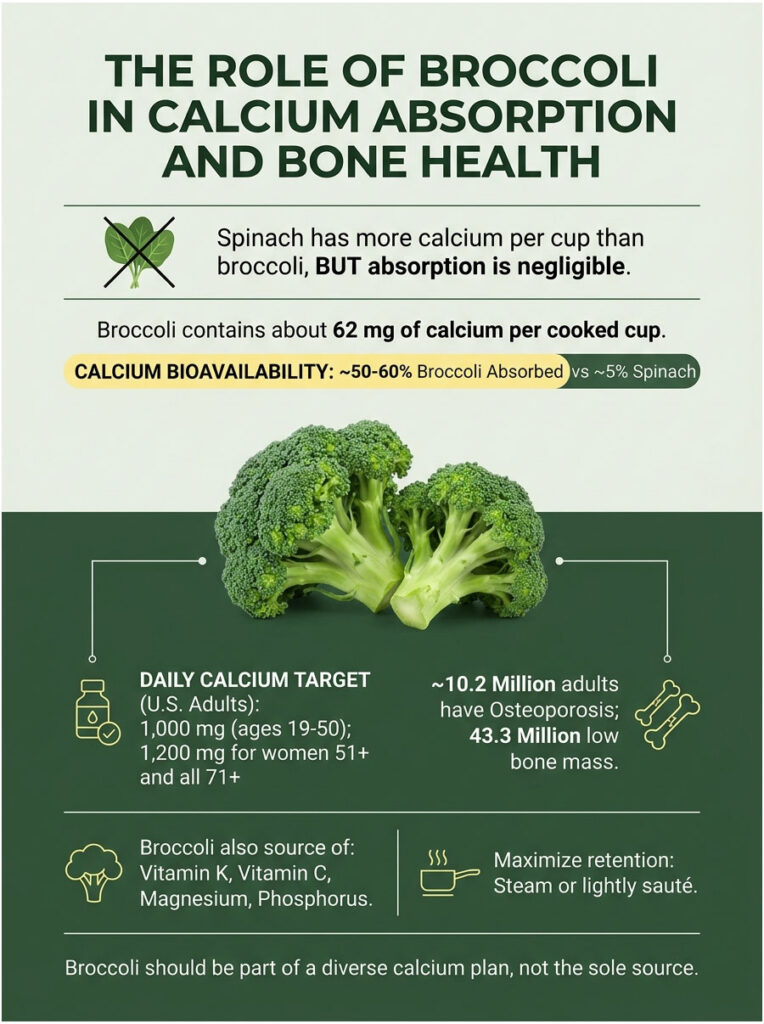
Quick Answer: Yes, broccoli contains calcium, roughly 62 mg per cup of cooked broccoli (about 6% of the daily recommended intake). What makes it stand out is bioavailability: your body absorbs an estimated 50 to 60% of broccoli’s calcium, compared with about 30% from milk and only 5% from spinach. Combined with vitamin K, vitamin C, magnesium, and phosphorus, broccoli is a real contributor to long-term bone health.
At a Glance:
• One cup of cooked broccoli delivers about 62 mg calcium (Cleveland Clinic / NIH data)
• Calcium absorption from broccoli runs 50 to 60%, much higher than spinach (~5%)
• Adult U.S. daily calcium target: 1,000 mg (ages 19 to 50); 1,200 mg (women 51+; all 71+)
• About 10.2 million U.S. adults have osteoporosis; 43.3 million more have low bone mass (CDC NHANES)
• Broccoli also supplies vitamin K (activates osteocalcin), vitamin C, magnesium, and phosphorus
• Steaming or light sautéing preserves the most calcium and vitamin K
• Broccoli works best as one piece of a varied calcium plan, not as a standalone source
Does Broccoli Have Calcium? The Honest Answer
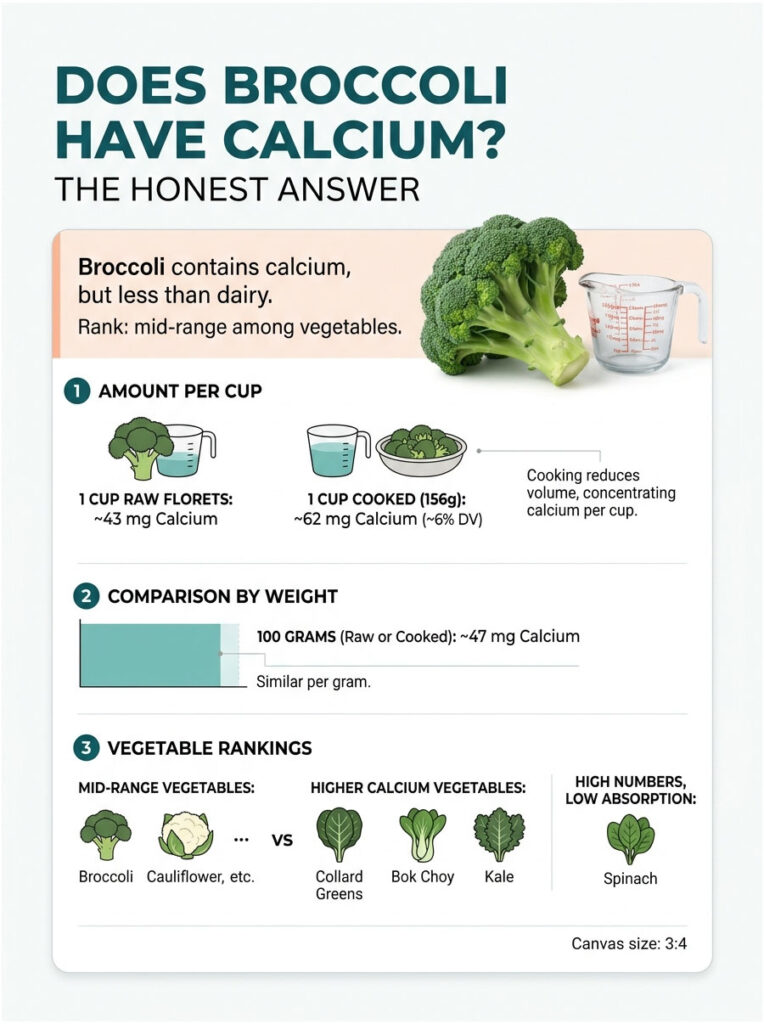
Yes. Broccoli contains a meaningful amount of calcium, but it is not in the same league as dairy. The number that matters most is per cup of cooked broccoli.
Our medical reviewers note that most online confusion starts because raw and cooked numbers get mixed up, and people compare per-100-gram values to per-cup values without realizing the difference.
How Much Calcium Is in One Cup of Broccoli
One cup of cooked broccoli (about 156 grams) contains approximately 62 mg of calcium. That’s roughly 6% of the recommended daily value for most U.S. adults, according to nutrition data summarized by the Cleveland Clinic and the NIH Office of Dietary Supplements.
A cup of raw broccoli florets holds about 43 mg of calcium. Cooking shrinks the volume, concentrating the nutrient density per cup measurement.
Raw vs Cooked: Why Cooked Broccoli Has More Calcium per Cup
The total calcium in a broccoli plant doesn’t change much when you cook it. The difference is purely volume. A cup of raw florets contains a lot of air gaps. A cup of cooked broccoli packs the same plant tighter, so more calcium fits into the cup measure.
Per gram, raw and cooked broccoli contain similar calcium. Per cup served on your plate, cooked wins.
Calcium Per 100 Grams vs Per Cup
For label-reading clarity: 100 grams of broccoli (raw or cooked) contains about 47 mg of calcium. A cup of cooked broccoli weighs roughly 156 grams. Multiply that out and you land around the 60 to 62 mg figure most U.S. nutrition databases report.
Where Broccoli Ranks Among Vegetables
Broccoli sits in the middle of the calcium-vegetable pack by total milligrams, but near the top once you factor in absorption. Collard greens, bok choy, and kale beat it on raw calcium content. Spinach beats almost everyone on paper, then loses badly on actual delivery.
The Bioavailability Story (Why Broccoli Beats Spinach for Calcium)
This is where broccoli quietly wins. Total calcium printed on a nutrition label is not the same as the calcium your bones can use. The difference is bioavailability.
What Bioavailability Means in Plain English
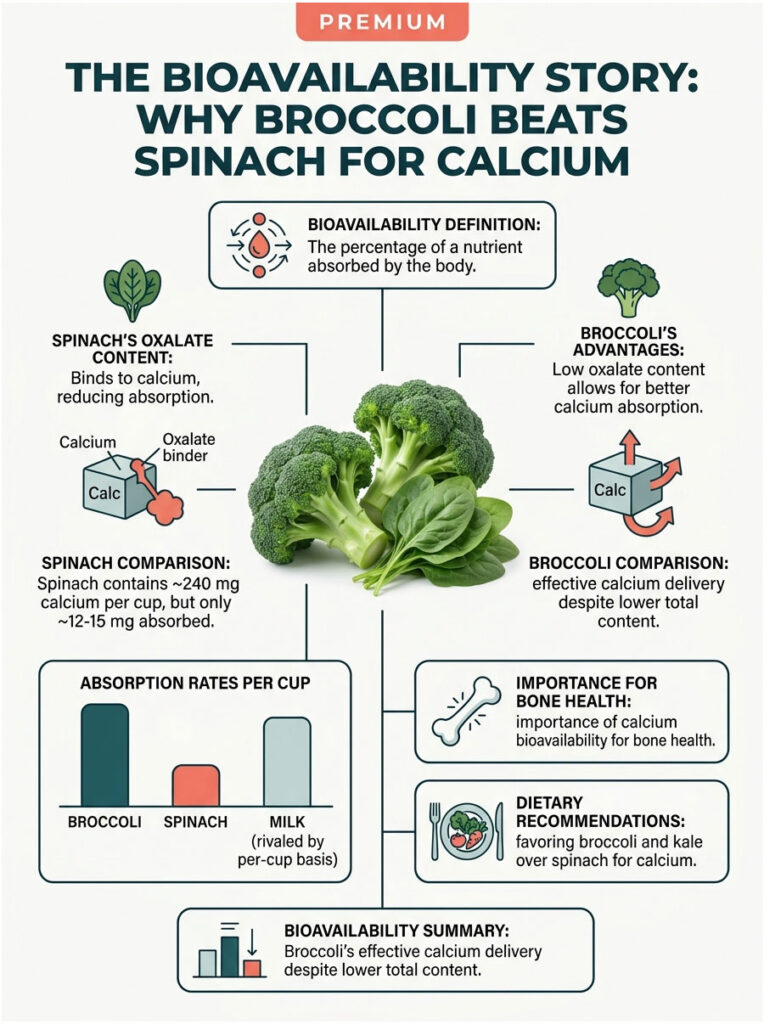
Bioavailability is the percentage of a nutrient that your digestive system actually absorbs and your tissues can use. A food can be labeled high in calcium, but if compounds inside the food bind to the mineral in the gut, that calcium passes through you instead of reaching your bones.
In nutrition reviews our editorial team has examined, the absorption gap between high-oxalate and low-oxalate plants is one of the most under-explained ideas in popular nutrition writing.
Oxalates: Spinach’s Calcium-Blocking Secret
Spinach contains roughly 240 mg of calcium per cup cooked, far more than broccoli on paper. But spinach is also rich in oxalic acid (oxalates), compounds that bind tightly to calcium inside the digestive tract. The result: about 95% of spinach calcium is locked up and excreted, leaving you with maybe 12 to 15 mg actually absorbed.
That’s less absorbable calcium than a cup of broccoli delivers from a much smaller starting number.
Why Broccoli’s Low Oxalate Content Matters
Broccoli, kale, bok choy, collard greens, and Chinese cabbage are all low in oxalates. The calcium they contain stays free and available. The body’s absorption machinery (mostly in the small intestine) can lock onto it and shuttle it into the bloodstream, then to bone and other tissues that need it.
This is why dietitians who design plant-based diets lean on broccoli and kale rather than spinach for daily calcium.
Absorption Rates: Broccoli vs Milk vs Spinach vs Tofu
Roughly speaking, U.S. nutrition literature reports absorption rates of:
- Broccoli: 50 to 60%
- Kale: about 50%
- Cow’s milk: about 30%
- Calcium-set tofu: about 30%
- Spinach: about 5%
Across U.S. nutrition consultations we coordinate, patients are often surprised that broccoli beats milk on percentage, even though milk wins by total grams.
How Bioavailability Changes the Real Calcium You Get
Multiply absorption rate by total calcium to estimate what your body actually gets:
- 1 cup cooked broccoli: 62 mg × 55% ≈ 34 mg absorbable
- 1 cup cooked spinach: 240 mg × 5% ≈ 12 mg absorbable
- 1 cup cow’s milk: 305 mg × 30% ≈ 92 mg absorbable
Milk still leads in net delivery, but broccoli outperforms spinach on a per-cup basis despite a much smaller starting number. That’s the bioavailability story in one line.
How Broccoli Supports Strong Bones (Beyond Just Calcium)
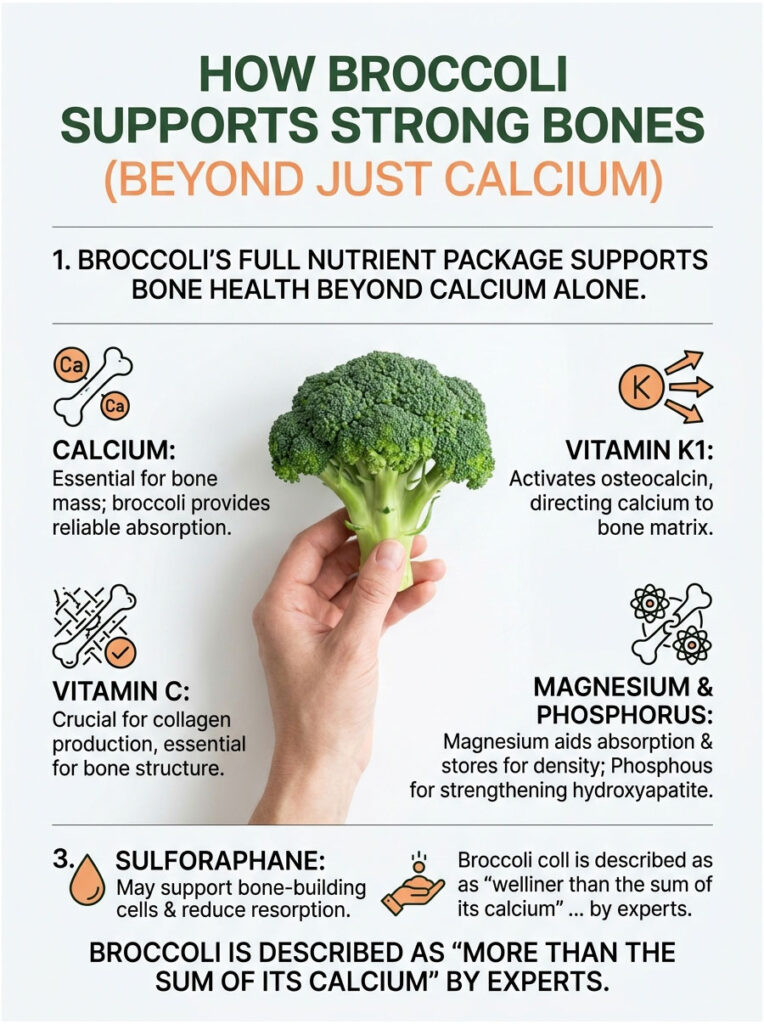
If broccoli only provided calcium, it would be a modest player in bone health. What sets it apart is the full nutrient package, which acts like a small bone-building toolkit in a single vegetable.
Calcium: The Foundation
Calcium makes up about 30 to 35% of bone mass by weight, according to global dietary calcium research summarized by NIH. Without enough dietary calcium, the body pulls calcium out of bone to keep blood levels stable, weakening the skeleton over time.
Broccoli’s contribution is modest in milligrams but reliable in absorption.
Vitamin K1 and the Osteocalcin Connection
Broccoli is rich in vitamin K1. One cup of cooked broccoli contains about 220 micrograms, well above the daily target for most U.S. adults (90 micrograms for women, 120 for men).
Vitamin K activates a protein called osteocalcin, which directs calcium into bone matrix. Without enough vitamin K, calcium intake doesn’t translate into bone strength as efficiently. Some K1 in your body is also converted to K2, which is even more directly involved in bone calcium placement.
Vitamin C and Collagen (the Scaffold Bone Sits On)
Bone is not pure calcium. It’s calcium crystals deposited on a collagen scaffold. Without strong collagen, calcium has nothing solid to anchor to.
One cup of cooked broccoli provides over 100% of the daily vitamin C requirement for U.S. adults. Vitamin C is essential for collagen production, which is why long-term vitamin C deficiency weakens bone as well as connective tissue.
Magnesium: Calcium’s Quiet Partner
Magnesium helps convert vitamin D into its active form, which in turn helps the gut absorb calcium. Roughly 60% of the body’s magnesium is stored in bone, where it contributes to crystal structure and density.
Broccoli supplies a moderate dose, about 20 mg per cup cooked. Combined with magnesium from nuts, seeds, and whole grains, daily intake builds up quickly.
Phosphorus and Bone Crystal Structure
Phosphorus pairs with calcium to form hydroxyapatite, the mineral compound that gives bone its hardness. A cup of cooked broccoli delivers about 100 mg of phosphorus.
Sulforaphane and Bone Cell Activity (Early Research)
Broccoli contains sulforaphane, a sulfur compound studied for its anti-inflammatory and antioxidant effects. Early laboratory research suggests sulforaphane may help support osteoblast activity (bone-building cells) and slow osteoclast activity (bone-resorbing cells), though human evidence is still emerging.
This is one reason our medical reviewers describe broccoli as “more than the sum of its calcium.”
How Much Calcium Do You Actually Need? (USA Recommendations)
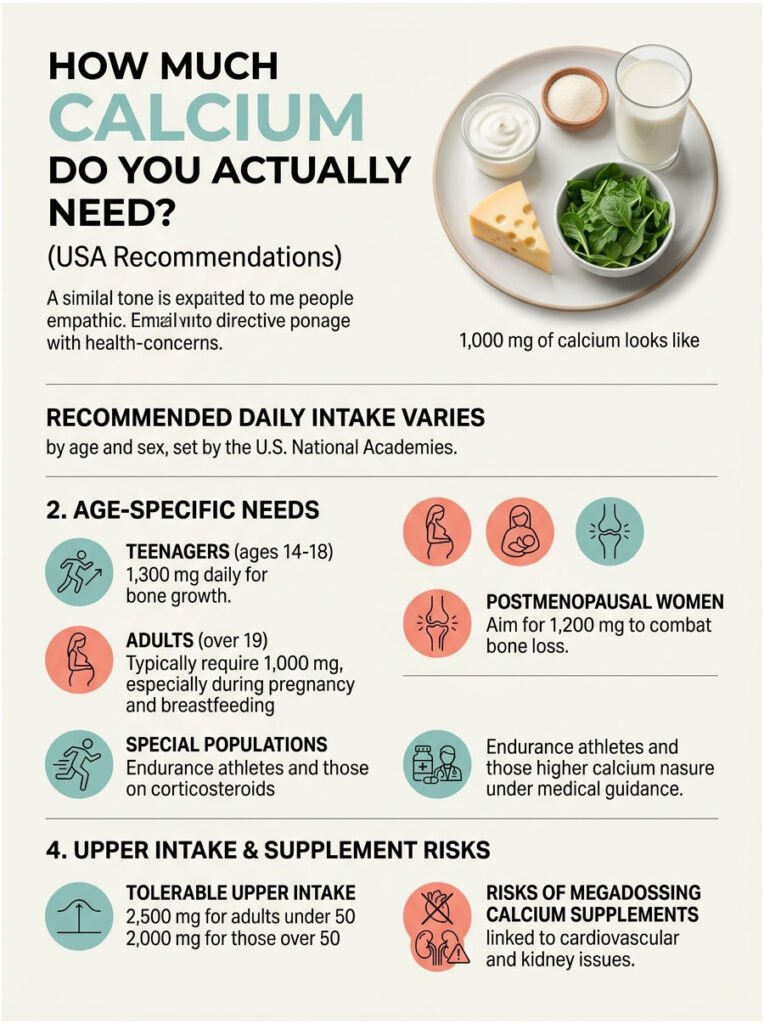
The recommended daily intake set by the U.S. National Academies (formerly the Institute of Medicine) and adopted by the NIH Office of Dietary Supplements varies by age and sex.
Calcium RDA by Age and Sex (Adults)
For most U.S. adults:
- Ages 19 to 50: 1,000 mg per day
- Women ages 51 to 70: 1,200 mg per day
- Men ages 51 to 70: 1,000 mg per day
- All adults 71 and older: 1,200 mg per day
Teenagers (ages 14 to 18) need 1,300 mg per day to support bone growth during peak skeletal development.
Special Needs: Pregnancy, Menopause, Athletes
Pregnant and breastfeeding adults follow age-based recommendations (typically 1,000 mg for those over 19). Postmenopausal women need extra attention because the drop in estrogen accelerates bone loss; the Bone Health & Osteoporosis Foundation emphasizes hitting the 1,200 mg target consistently after age 50.
Endurance athletes and people on long-term corticosteroids may benefit from higher dietary calcium under physician guidance.
What “1,000 mg a Day” Looks Like on a Real Plate
Hitting 1,000 mg from food, not supplements, is easier than people think:
- 1 cup milk (300 mg) + 1 cup yogurt (300 mg) + 1 cup cooked broccoli (62 mg) + 1 ounce cheddar (200 mg) + a calcium-fortified cereal (150 mg) = about 1,012 mg
For dairy-free diets, the math shifts to fortified plant milks, calcium-set tofu, sardines, and a broader use of low-oxalate greens.
Tolerable Upper Limit (and Why You Shouldn’t Megadose)
The NIH sets a tolerable upper intake of 2,500 mg per day for adults under 50 and 2,000 mg per day for adults over 50. Megadosing calcium (especially through supplements) has been linked in some research to cardiovascular and kidney concerns.
Table 1: Calcium per Serving and Net Absorbable Calcium for Common Foods
| Food | Calcium per Serving | Absorption Rate | Net Absorbed | Best For |
| 1 cup cow’s milk | 300 to 310 mg | ~30% | ~92 mg | Daily anchor, if dairy-tolerant |
| 1 cup cooked broccoli | ~62 mg | 50 to 60% | ~34 mg | Plant-based bone support, vitamin K |
| 1 cup cooked kale | ~94 mg | ~50% | ~47 mg | Plant-based, lower-oxalate green |
| 1 cup cooked spinach | ~240 mg | ~5% | ~12 mg | Iron, not calcium |
| 3 oz canned sardines (with bones) | ~325 mg | ~27% | ~88 mg | Calcium + omega-3 + vit D |
| 1/2 cup calcium-set firm tofu | ~250 mg | ~30% | ~75 mg | Vegan-friendly anchor |
| 1 cup calcium-fortified soy milk | ~300 mg | ~25 to 30% | ~75 to 90 mg | Dairy-free anchor |
| 1 oz cheddar cheese | ~200 mg | ~30% | ~60 mg | Compact, calorie-dense option |
Values reflect typical USDA / NIH-cited ranges; individual products vary, especially fortified plant milks.
How to Maximize the Calcium You Absorb From Broccoli
Eating broccoli well matters as much as eating it often. Small changes preserve more calcium and boost absorption.
Best Cooking Methods (Steam, Roast, Sauté)
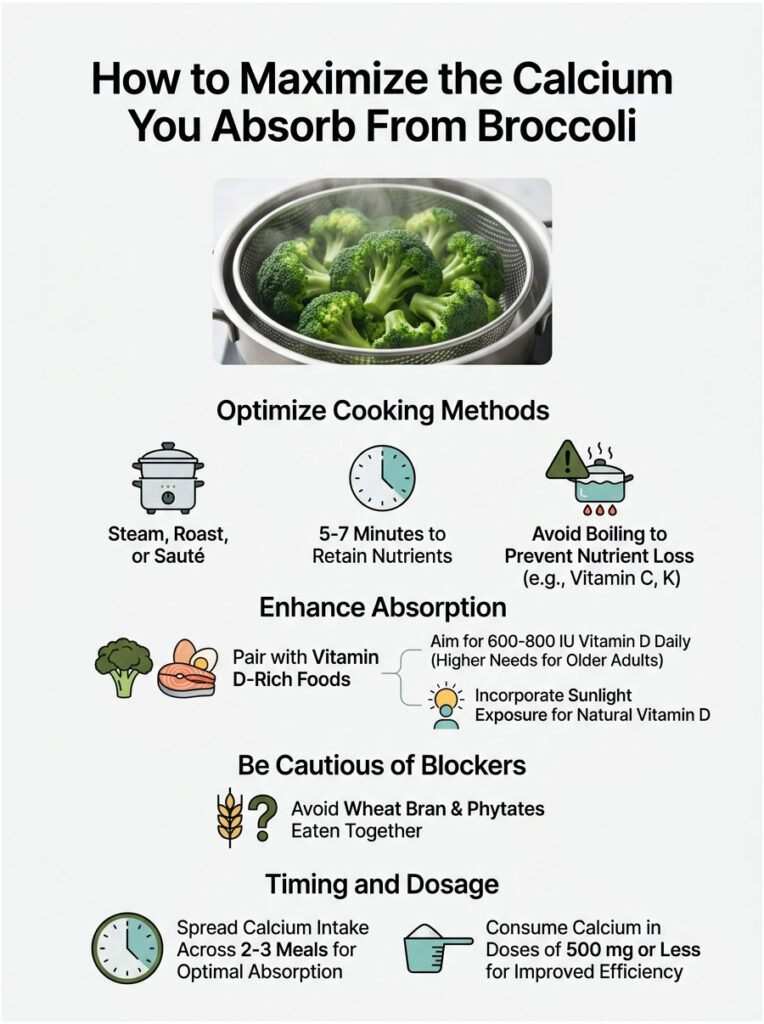
Boiling broccoli for long periods can leach water-soluble nutrients (mostly vitamin C, not calcium directly). Calcium itself is fairly heat-stable, but vitamin K and vitamin C losses indirectly weaken the bone benefit.
Patients booking nutrition consultations through HealthCareOnTime are often advised to steam or roast broccoli for 5 to 7 minutes, or do a quick sauté with olive oil. These methods retain texture, vitamin K, and bone-related nutrients better than long boiling.
What to Pair With Broccoli for Better Absorption
Calcium absorption improves with:
- Adequate vitamin D (sunlight, fortified milk, salmon, eggs)
- Healthy fats (a drizzle of olive oil aids vitamin K1 absorption, which is fat-soluble)
- Acidic preparation (a squeeze of lemon may slightly improve mineral solubility)
Foods and Drinks That Block Calcium Absorption
Three habits commonly reduce calcium delivery:
- Very high sodium intake increases calcium loss in urine
- Excessive caffeine (more than 4 cups of coffee daily) modestly reduces calcium retention
- High alcohol intake interferes with bone formation and calcium balance
Wheat bran and certain phytates can also reduce absorption when eaten in the same meal as calcium, though normal everyday amounts rarely matter for bone health.
Vitamin D: The Calcium Multiplier
Without enough vitamin D, your gut absorbs only a small fraction of dietary calcium. U.S. adults need 600 to 800 IU per day, with many older adults benefiting from higher amounts under physician guidance.
Sunlight (15 minutes on arms and legs a few times per week in most U.S. latitudes), fortified milk, salmon, sardines, and supplements all contribute. Across U.S. nutrition consultations we coordinate, patients are often surprised that better vitamin D status, not more calcium, is the real missing piece.
Timing: Spread Calcium Throughout the Day
The body absorbs calcium most efficiently in doses of 500 mg or less at one time. Spreading intake across 2 to 3 meals beats trying to load it all into a single sitting. This also makes a broccoli serving at lunch and dinner work harder.
U.S. Bone Health by the Numbers
Bone health in the U.S. is a quiet epidemic. The data make a strong case for thinking about calcium years before symptoms appear.
Osteoporosis Prevalence in American Adults
The most recent CDC NHANES analysis found that 12.6% of U.S. adults aged 50 and over have osteoporosis at the femur neck or lumbar spine. Another 43.1% have low bone mass, the precursor condition that increases the risk of progressing to osteoporosis.
Women vs Men: The Stark Gap
Among adults 50 and older, women have osteoporosis at 19.6%, men at 4.4%. By age 65 and over, prevalence among women jumps to 27.1%. The biggest single driver is the post-menopausal drop in estrogen.
Why Americans Often Fall Short on Calcium
Despite the recommendations, many U.S. adults don’t hit the daily target. The Mayo Clinic notes that calcium under-consumption is common across age groups. Plant-forward eating without thoughtful planning, dairy avoidance for any reason, and reliance on coffee or soda over milk all contribute.
Patients booking bone-health and DEXA screenings through HealthCareOnTime often discover their calcium intake has been sitting around 500 to 700 mg per day for years.
Table 2: U.S. Bone Health and Calcium Statistics
| Data Point | Figure | Source |
| Osteoporosis prevalence, U.S. adults 50+ | 12.6% | CDC NHANES Data Brief 405 |
| Low bone mass prevalence, U.S. adults 50+ | 43.1% | CDC NHANES Data Brief 405 |
| Osteoporosis prevalence, women 50+ | 19.6% | CDC NHANES Data Brief 405 |
| Osteoporosis prevalence, men 50+ | 4.4% | CDC NHANES Data Brief 405 |
| Osteoporosis prevalence, women 65+ | 27.1% | CDC NHANES Data Brief 405 |
| Estimated U.S. adults with osteoporosis | 10.2 million | International Osteoporosis Foundation |
| Estimated U.S. adults with low bone mass | 43.3 million | International Osteoporosis Foundation |
| Adult U.S. daily calcium RDA | 1,000 to 1,200 mg | NIH Office of Dietary Supplements |
A Broccoli-Forward Weekly Calcium Template
This is a sample structure, not a prescription. The goal is to show that broccoli can be the recurring base of a strong-bone week without becoming repetitive.
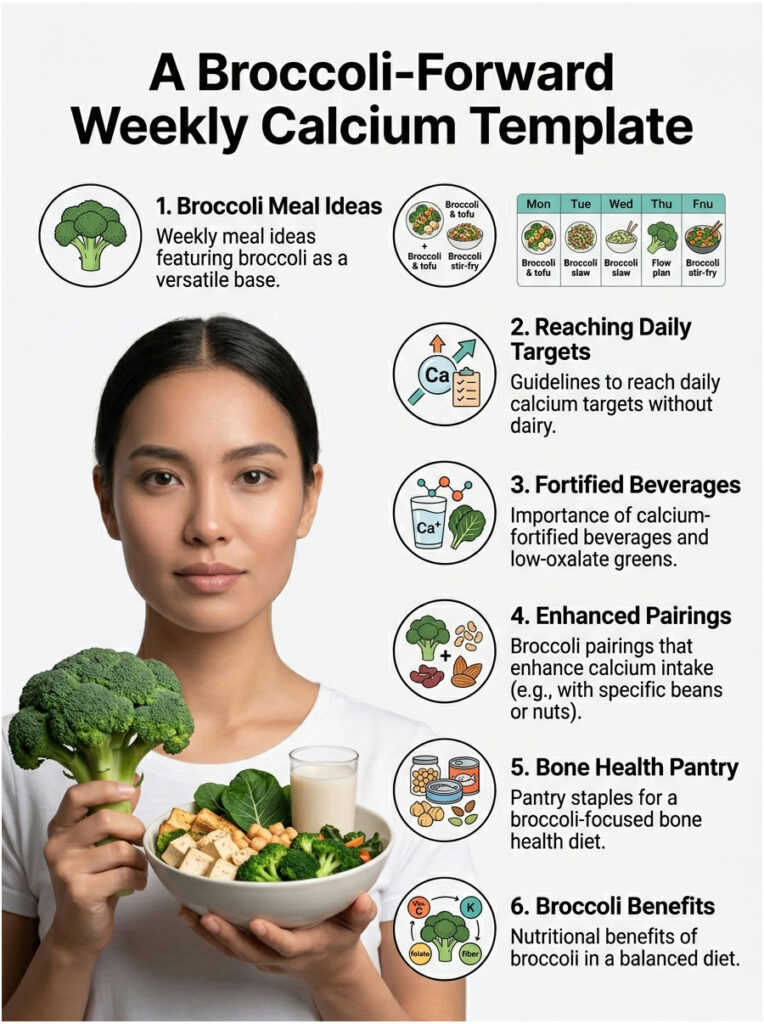
Weekly Meal Ideas
- Roasted broccoli with lemon and parmesan as a side; calcium-fortified yogurt for breakfast
- Broccoli stir-fry with tofu and brown rice; fortified plant milk in oatmeal
- Broccoli cheddar soup; sardines on whole-grain toast for lunch
- Steamed broccoli over salmon; calcium-fortified orange juice with breakfast
- Broccoli salad with tahini-lemon dressing (sesame paste adds calcium)
- Broccoli and kale frittata; Greek yogurt with almonds for snack
- Roasted broccoli, sweet potato, and white beans bowl; milk-based latte mid-morning
How to Hit Your Daily Calcium Target Without Dairy
For dairy-free eaters, the structural rule is: one calcium-fortified beverage daily (soy milk, almond milk, oat milk), one calcium-set tofu or sardine meal daily, and two low-oxalate green vegetable servings (broccoli, kale, bok choy, collards). That structure reliably puts most adults near 1,000 mg.
Easy Broccoli Pairings
Broccoli partners well with calcium-dense companions: cheddar and parmesan in baked dishes; tofu in stir-fries; sardines in pasta or on toast; tahini and almonds in dressings and toppings. These pairings stack calcium without needing supplements.
Pantry and Grocery Checklist
Useful staples for a broccoli-forward bone-health pantry: fresh and frozen broccoli, kale, bok choy, calcium-set firm tofu, canned sardines with bones, calcium-fortified plant milk, plain Greek yogurt, sesame seeds and tahini, almonds, fortified breakfast cereal, salmon.
When Broccoli Isn’t Enough (and What to Add)
For many people, broccoli alone won’t close the daily calcium gap. Knowing what to add (and when supplements make sense) keeps the plan realistic.
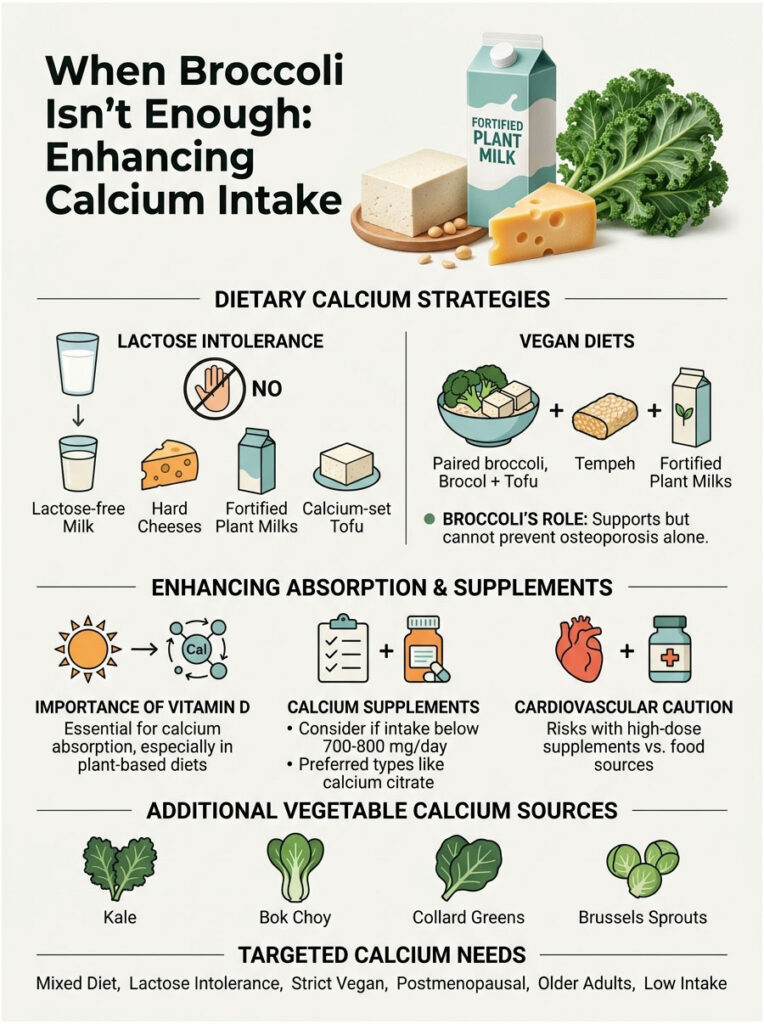
Lactose Intolerance: Best Non-Dairy Alternatives
Lactose-intolerant Americans (estimated at 30 to 50 million people) benefit from lactose-free milk, hard cheeses (which contain very little lactose), calcium-fortified plant milks, and calcium-set tofu. These deliver dairy-level calcium without the digestive issue.
Vegan Diets: Pairing Broccoli With Tofu, Tempeh, Fortified Plant Milks
A well-planned vegan diet can absolutely meet calcium needs. The key is consistency: calcium-fortified plant milk at one meal, calcium-set tofu or tempeh at another, broccoli and kale as recurring sides, tahini or almonds in dressings and snacks.
The Mayo Clinic notes that vegans should be especially vigilant about combining vitamin D (often supplemental in plant-based diets) with calcium-rich foods.
When to Consider Calcium Supplements
If dietary calcium consistently falls below 700 to 800 mg per day despite real effort, talk to your provider about a supplement. Calcium citrate is generally easier to absorb (and doesn’t need to be taken with food) than calcium carbonate.
The Cardiovascular Caution on Calcium Supplements
Several studies, including a meta-analysis cited by the Physicians Committee for Responsible Medicine, have linked high-dose calcium supplementation to a modest increase in cardiovascular events. The signal is weaker for food-based calcium.
In cases reviewed by our editorial medical team, the general guidance is food first, supplements only when food can’t close the gap, and always with physician input for older adults.
Table 3: If Your Situation Is X, Then Do This
| Scenario | Best Calcium Strategy | Foods to Prioritize |
| Healthy adult, dairy-tolerant | Mixed diet, food-first | Milk, yogurt, cheese, broccoli, sardines |
| Lactose intolerant | Lactose-free dairy + plants | Lactose-free milk, hard cheeses, broccoli, tofu |
| Strict vegan | Fortified + low-oxalate plants | Fortified soy/oat milk, tofu, broccoli, kale, tahini |
| Postmenopausal woman | 1,200 mg/day with vitamin D | Yogurt, sardines, broccoli, fortified cereals |
| Teen athlete | 1,300 mg/day | Milk, yogurt, cheese, broccoli, salmon |
| Older adult 71+ | 1,200 mg/day with vitamin D + protein | Mixed sources, regular DEXA screening |
| Low dietary intake (<700 mg) | Talk to provider about supplements | Add fortified foods first; supplement second |
Frequently Asked Questions
Does broccoli have more calcium than milk?
No. One cup of milk contains about 300 to 310 mg of calcium versus 62 mg in a cup of cooked broccoli. However, broccoli has a higher absorption rate (50 to 60%) compared with milk (~30%), so the per-cup gap in actually absorbed calcium is narrower than it looks. Milk still wins overall on net calcium delivery.
How much broccoli do I need to eat for daily calcium?
To get the 1,000 mg daily target from broccoli alone, you’d need roughly 16 cups of cooked broccoli, which isn’t realistic. Treat broccoli as one of several calcium contributors. Two cups across a day, paired with tofu, fortified plant milk, sardines, or dairy, makes the target achievable.
Is raw or cooked broccoli better for calcium?
Per cup, cooked broccoli contains more calcium (about 62 mg vs 43 mg raw) because cooking shrinks the volume. Per gram, calcium content is similar. Cooking also slightly improves digestibility and reduces goitrogen activity. Steaming or light roasting preserves nutrients better than long boiling.
Why does spinach have more calcium but it’s not absorbed?
Spinach is rich in oxalic acid (oxalates), compounds that bind tightly to calcium inside the gut and block absorption. Only about 5% of spinach calcium reaches your bloodstream, compared to 50 to 60% from broccoli. That’s why dietitians recommend broccoli, kale, and bok choy over spinach as practical plant calcium sources.
Can broccoli prevent osteoporosis?
Broccoli supports bone health but cannot prevent osteoporosis on its own. Bone health depends on adequate calcium, vitamin D, vitamin K, magnesium, protein, weight-bearing exercise, hormone balance, and avoiding smoking and excessive alcohol. Broccoli is a useful contributor to the calcium and vitamin K parts of that equation.
Is broccoli a good calcium source for vegans?
Yes, when combined with other foods. Vegans should pair broccoli with calcium-set tofu, calcium-fortified plant milks (soy, oat, almond), tahini, almonds, and other low-oxalate greens like kale and bok choy. With consistent planning, plant-based diets reliably hit the 1,000 to 1,200 mg daily target.
Does broccoli interact with thyroid medication?
Broccoli contains small amounts of goitrogens, compounds that can interfere with thyroid hormone production in very large quantities. Normal serving sizes (1 to 2 cups daily) are safe for most people. Patients with hypothyroidism or on levothyroxine should discuss intake patterns and timing with their physician.
How much vitamin K does broccoli have?
One cup of cooked broccoli contains roughly 220 micrograms of vitamin K, well above the daily recommended intake (90 mcg for women, 120 mcg for men). Vitamin K activates osteocalcin, the protein that directs calcium into bone. People on warfarin (Coumadin) should keep their vitamin K intake consistent rather than restrict it.
Can children eat broccoli for bone development?
Yes, and it’s especially valuable during peak bone-building years (ages 9 to 18). Children need 1,000 to 1,300 mg of calcium daily depending on age. Broccoli helps but should be combined with milk, yogurt, cheese, fortified cereals, and other calcium-rich foods to consistently hit pediatric targets.
What is the best cooking method for retaining calcium in broccoli?
Calcium is heat-stable, so all cooking methods retain it well. Steaming or quick roasting preserves vitamin K and vitamin C best, which matters for the full bone-health benefit. Long boiling leaches water-soluble vitamins. A quick sauté in olive oil also boosts the absorption of fat-soluble vitamin K1.
Should I take a calcium supplement if I eat broccoli daily?
Not necessarily. If your total daily calcium from food sits in the 1,000 to 1,200 mg range, supplements likely aren’t needed. If your intake is chronically below 700 to 800 mg, talk to your provider. Food-based calcium is generally preferred over supplements, which have been linked in some research to cardiovascular concerns.
What other vegetables have absorbable calcium like broccoli?
Kale, bok choy, collard greens, Chinese cabbage, and Brussels sprouts all share broccoli’s low-oxalate profile, meaning their calcium is well absorbed. The NIH Office of Dietary Supplements lists these alongside broccoli as preferred non-dairy plant calcium sources for U.S. adults.
Disclaimer: This article is for educational purposes and does not replace personalized medical or nutritional advice. People with chronic conditions, on thyroid medication, on warfarin, or with a history of kidney stones should consult a licensed clinician or registered dietitian before making significant changes to dietary calcium intake. If you suspect osteoporosis or have a family history of bone disease, ask your provider about a DEXA scan.
References
- NIH Office of Dietary Supplements: Calcium Health Professional Fact Sheet
- CDC NHANES: Osteoporosis or Low Bone Mass in Older Adults (Data Brief 405)
- Cleveland Clinic: Calcium Benefits and How Much You Need
- Mayo Clinic: Calcium and Calcium Supplements
- Harvard Health: How Much Calcium Do You Really Need?
- Bone Health & Osteoporosis Foundation: Calcium / Vitamin D Requirements
- Global Dietary Calcium Intake Among Adults: Systematic Review (PMC / NIH)