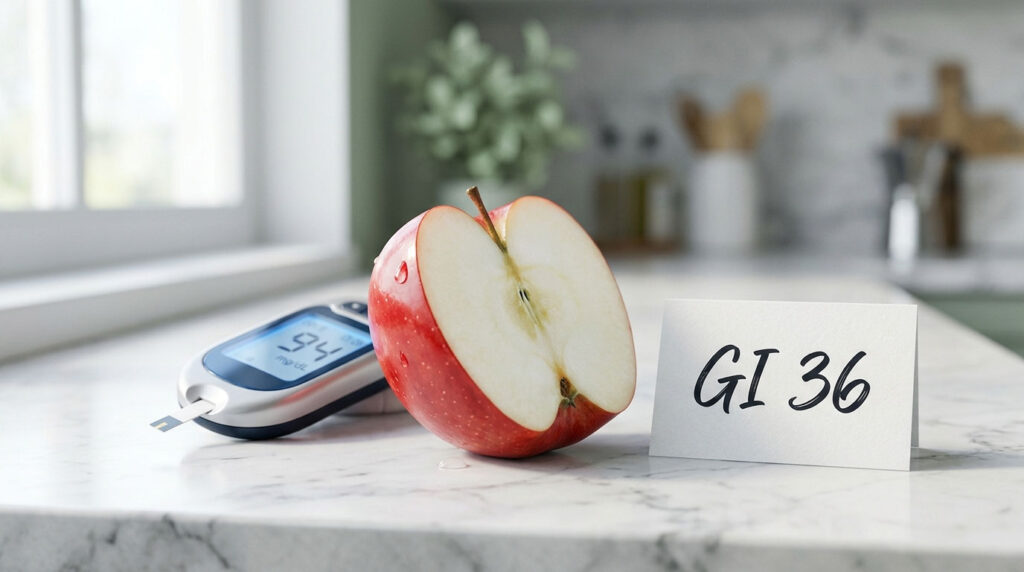
An apple a day keeps the doctor away, the saying goes. For the 40.1 million Americans living with diabetes, the harder question is whether that apple keeps blood sugar in range.
Table of Contents
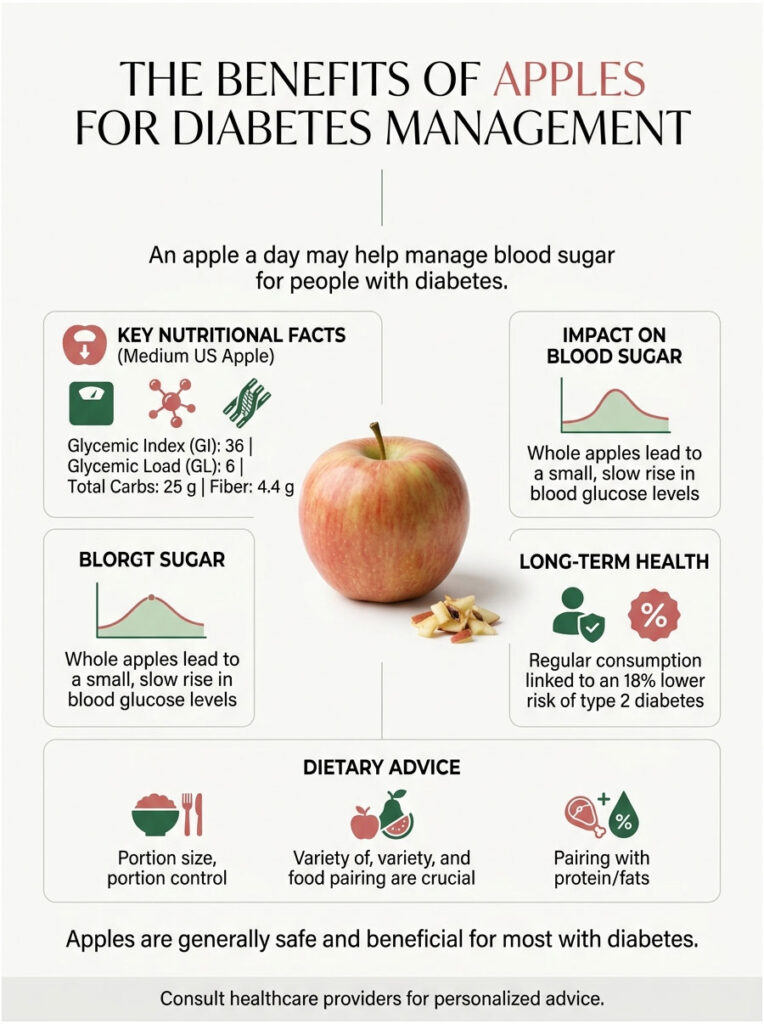
Quick Answer: Yes, apples are safe and beneficial for most people with diabetes. A medium US apple has a glycemic index of 36, a glycemic load of 6, and 25 g of total carbs with 4.4 g of fiber. Whole apples cause a small, slow rise in blood glucose, and a 2017 meta-analysis links regular apple intake with an 18% lower risk of type 2 diabetes. Portion, variety, and pairing matter more than yes-or-no.
At a Glance
- Apples score 36 to 39 on the glycemic index (low) and around 6 on glycemic load.
- One medium US apple has 25 g carbs, 4.4 g fiber, and about 19 g natural sugar.
- Granny Smith carries the least sugar; Honeycrisp and Fuji carry the most.
- Apple juice raises blood sugar 2 to 3 times faster than a whole apple does.
- Pairing apple with protein (peanut butter, cheese, walnuts) blunts post-meal spikes.
- 40.1 million Americans have diabetes (CDC, January 2026).
- CGM users report 50+ mg/dL variation in personal apple response; test your own.
The Short Answer: Where Apples Stand on the Diabetic Plate
Apples earn a green light from almost every major American diabetes authority. The American Diabetes Association places whole fruit, apples included, inside the recommended fruit quarter of the Diabetes Plate Method. The CDC names apples among the high-fiber fruits worth eating daily for blood sugar control.
Why the consensus? Apples deliver three blood-sugar-friendly properties in one package: a low glycemic index, soluble fiber that slows sugar absorption, and polyphenols concentrated in the skin that improve insulin sensitivity. That trio is uncommon in the produce aisle.
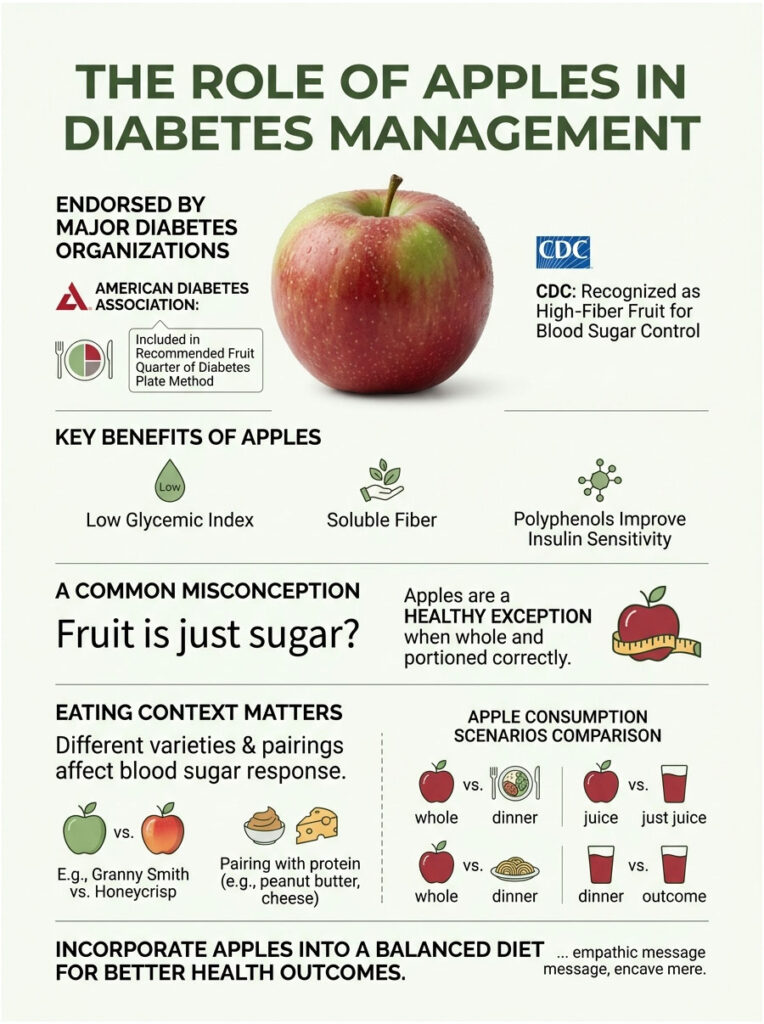
A worry shows up again and again in patient intake forms across the HealthCareOnTime network: the fear that fruit is just sugar in disguise. Apples are one of the cleanest exceptions to that worry, as long as the apple stays whole and the portion stays sensible.
The full answer has nuance. A Honeycrisp eaten at 9 p.m. with nothing on the side hits the bloodstream differently than a small Granny Smith eaten before lunch with peanut butter. The rest of this guide unpacks those differences with real numbers and clear rules.
Apple Glycemic Index, Glycemic Load & Carb Breakdown
What Is Glycemic Index and Why It Matters
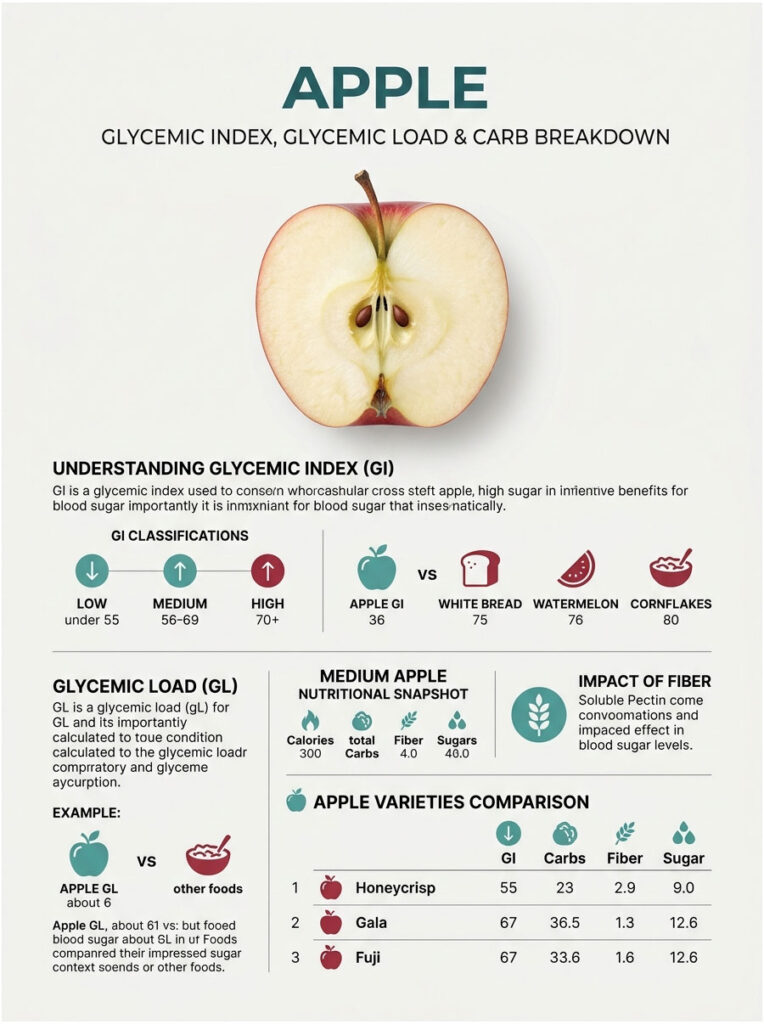
The glycemic index (GI) ranks carbohydrate foods on a 0 to 100 scale based on how quickly they raise blood glucose compared with pure glucose. Anything under 55 counts as low, 56 to 69 is medium, and 70 or above is high. Apples sit firmly in the low zone.
White bread sits around 75. Watermelon hits 76. Cornflakes climb past 80. By contrast, an apple at 36 looks gentle on the bloodstream by any benchmark you choose.
For diabetics, low-GI eating is not a fad. It is one of the few dietary patterns supported by decades of clinical trials for improving HbA1c, fasting glucose, and post-meal glucose variability.
Apple GI vs Glycemic Load: The Difference That Changes Everything
GI alone can mislead. A food might post a low GI, but if you eat a large serving the cumulative carb hit still climbs your blood sugar. That is where glycemic load (GL) comes in.
Glycemic load multiplies GI by grams of carbs in a typical serving and divides by 100. A medium apple lands at a GL of about 6, well under the low-load threshold of 10. Carrots, by comparison, have a higher GI but lower GL because the carb content per serving is tiny.
GI tells you the speed. GL tells you the speed plus the size of the truck. Apples score low on both.
Carb, Fiber, and Sugar in a US Medium Apple (USDA Data)
The USDA FoodData Central reports a medium raw apple with skin (about 182 g, the standard US reference) at 95 calories, 25.1 g of carbs, 4.4 g of fiber, and 18.9 g of total sugars. Subtract the fiber and the net carb count drops to roughly 20.7 g.
That fiber content is the secret weapon. Soluble pectin in apple flesh forms a gel in the gut that slows the release of sugar into the bloodstream. The result is a slower glucose curve and a smaller peak.
Apple variety changes the picture more than most people realize. The chart below uses USDA and published nutrition data for common US supermarket apples.
Table 1: Apple Varieties by GI, Carbs, Fiber & Sugar (per medium fruit, ~180 g)
| Variety | Glycemic Index | Net Carbs (g) | Fiber (g) | Sugar (g) |
| Granny Smith | 34 | 17 | 4.4 | 12 |
| Gala | 36 | 19 | 3.8 | 16 |
| Red Delicious | 37 | 20 | 4.1 | 17 |
| Pink Lady | 38 | 21 | 4.2 | 18 |
| Fuji | 38 | 22 | 3.5 | 19 |
| Honeycrisp | 39 | 23 | 3.6 | 20 |
Granny Smith stands out as the most diabetes-friendly variety. The tart bite comes from lower fructose content, and the firmer flesh tends to digest more slowly. Honeycrisp, the modern American favorite, sits at the high end on both sugar and total carbs, partly because growers select for sweetness.
Patients switching from juice to whole Granny Smith apples often see meaningful drops in post-meal glucose within two to four weeks, well before lab markers like HbA1c catch up. This is one of the most consistent food swaps the HealthCareOnTime nutrition desk recommends to newly diagnosed patients.
How Apples Actually Affect Your Blood Sugar
The Fiber-Polyphenol Slowdown Effect
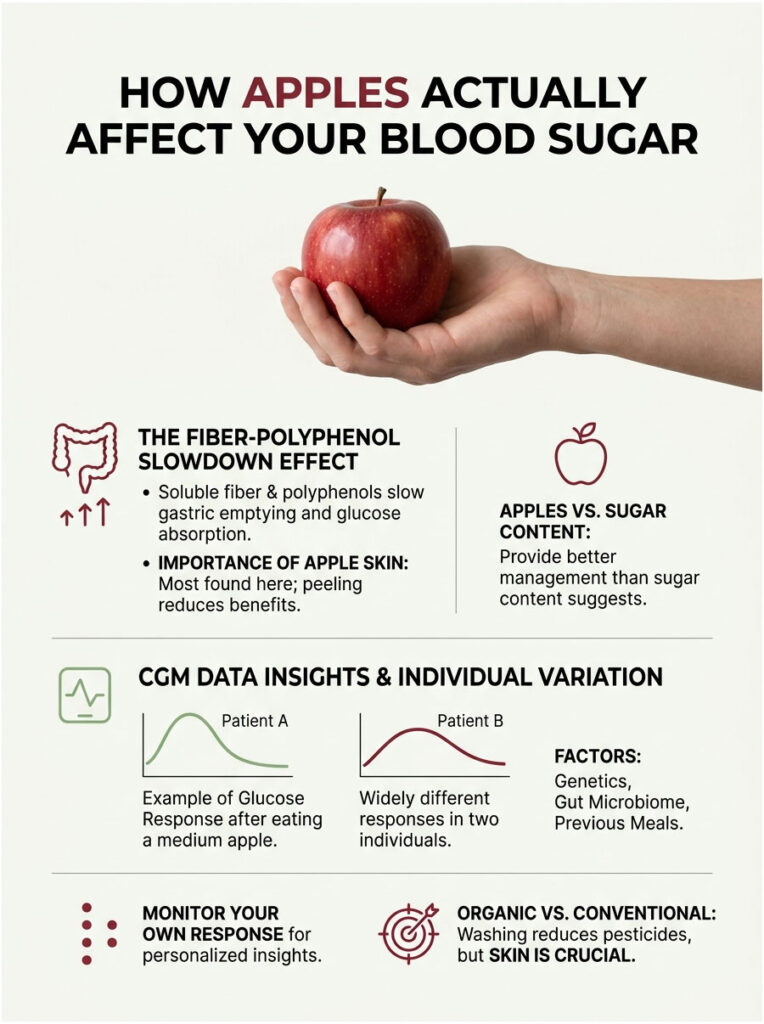
Apples do more than deliver low-GI carbs. The soluble fiber pectin slows gastric emptying, which means the carb load reaches the small intestine in waves rather than a flood. Slower absorption equals smaller blood sugar spikes.
Polyphenols add a second layer of defense. Quercetin, chlorogenic acid, and phlorizin (found mostly in the skin) appear to slow the breakdown of complex carbs into glucose and improve how cells respond to insulin. Phlorizin in particular has been studied for its ability to reduce intestinal glucose uptake.
The combined effect, fiber plus polyphenols plus low-GI carbs, is why apples consistently outperform their sugar content in real-world glucose data.
Why the Apple Skin Matters
Peel an apple and you toss out most of its fiber and nearly all of its polyphenols. The skin holds roughly two-thirds of the total fiber and almost all of the quercetin. For diabetics, eating the skin is non-negotiable.
A scrub under running water handles surface residue. Buying organic where the budget allows reduces pesticide exposure on a fruit consistently named on the Environmental Working Group’s Dirty Dozen list. Conventional apples remain a reasonable choice when washed; skipping the skin is the bigger nutritional loss.
Individual Variation: What CGM Data Reveals
Continuous glucose monitor (CGM) studies from companies like Dexcom and FreeStyle Libre have surfaced a striking finding. Two people can eat the exact same medium apple and see post-meal glucose readings 50 mg/dL apart.
Genetics, gut microbiome, insulin sensitivity, time of day, and what was eaten in the previous meal all shape personal response. A Reddit thread of CGM users comparing the same Honeycrisp will produce 20 different curves across 20 different people. There is no “the” apple response.
A Worked Example: 90-Minute Apple Curve
Take two hypothetical type 2 patients, both with a fasting glucose of 110 mg/dL, both eating one medium Gala apple at 10 a.m.
Patient A, who exercised the previous evening and slept well, may peak at 135 mg/dL at the 45-minute mark and return to baseline by 90 minutes. Patient B, who skipped exercise and slept five hours, may peak at 175 mg/dL at the 60-minute mark and still sit at 145 mg/dL at the 2-hour mark. Same apple, very different curves.
This pattern repeats often enough across the patient panels HealthCareOnTime works with that the team treats CGM testing as the first recommendation for any newly diagnosed diabetic asking which fruits to eat.
The practical takeaway: test your own apple on your own meter. A single fingerstick reading 90 minutes after eating shows you what your body, not a study average, is doing.
Apple Form Matters: Whole Fruit vs Juice vs Sauce vs Dried
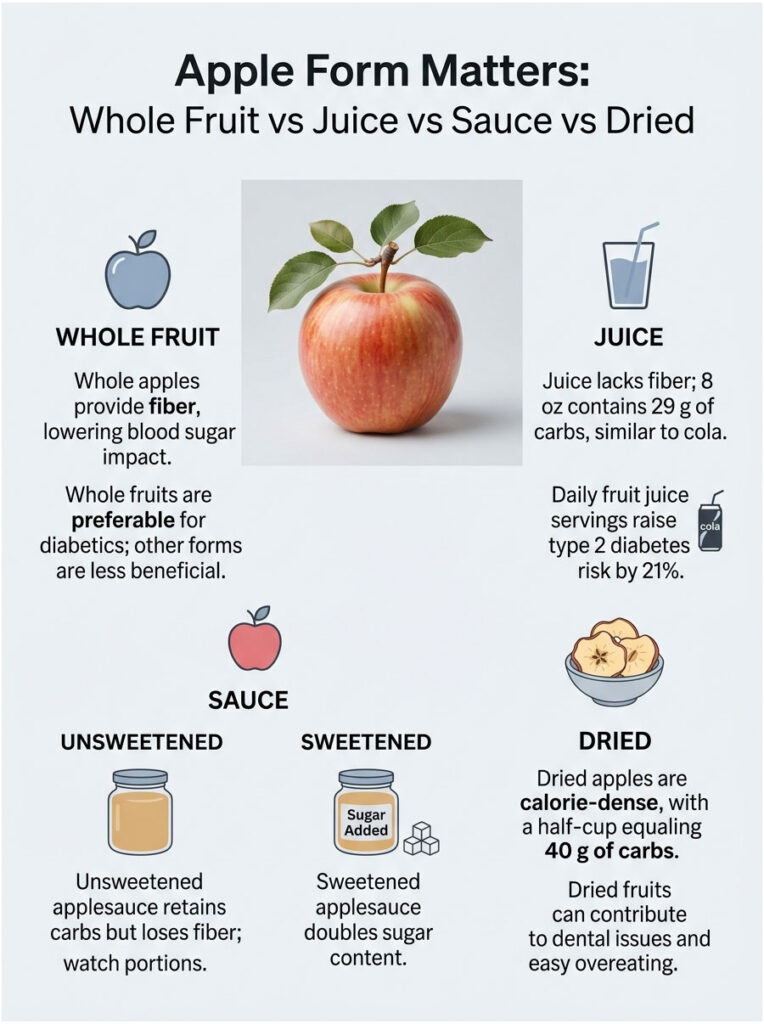
Not every apple product behaves like an apple. Processing strips the fiber, concentrates the sugar, and turns a low-GI food into a fast-acting carb. The form you choose may matter more than the variety.
Why Juice Fails Diabetics
Eight ounces of apple juice contains 29 g of carbs and essentially zero fiber. That is more sugar than a can of cola, with the same blood-sugar trajectory. Worse, juice empties the stomach in minutes, hitting peak absorption fast.
Harvard School of Public Health analysis of over 187,000 participants found that one or more daily servings of fruit juice raised type 2 diabetes risk by up to 21%, even as whole fruit lowered it by 7%. The contrast inside the same study is the clearest argument against juice for any diabetic.
Even “100% pure” or “no added sugar” labels do not change the math. The sugar in apple juice is still sugar, only now stripped of the fiber that would otherwise slow its absorption.
The Applesauce Trap
Unsweetened applesauce keeps most of the carbs but loses much of the fiber, because the skin is removed and the flesh is pureed. Sweetened versions can double the sugar load. If applesauce is the only option, choose unsweetened, watch the portion (a half-cup is one carb serving at about 15 g), and pair with protein.
Applesauce earns its place in some kitchens as a baking substitute for oil or sugar. As a snack for diabetics, it lands well below whole fruit.
Dried Apples: A Hidden Sugar Bomb
Drying removes water and shrinks the apple while leaving the sugar fully intact. A half-cup of dried apple rings can pack 40 g of carbs, the equivalent of nearly two whole fresh apples in a handful. Easy to overeat, easy to spike.
Dried fruit also tends to stick to the teeth, raising cavity risk on top of the glucose impact. If dried apples appear in a trail mix, count the carbs carefully and limit to a small portion.
Diabetes Statistics & The Apple-Diabetes Evidence Base
What the Numbers Say About US Diabetes
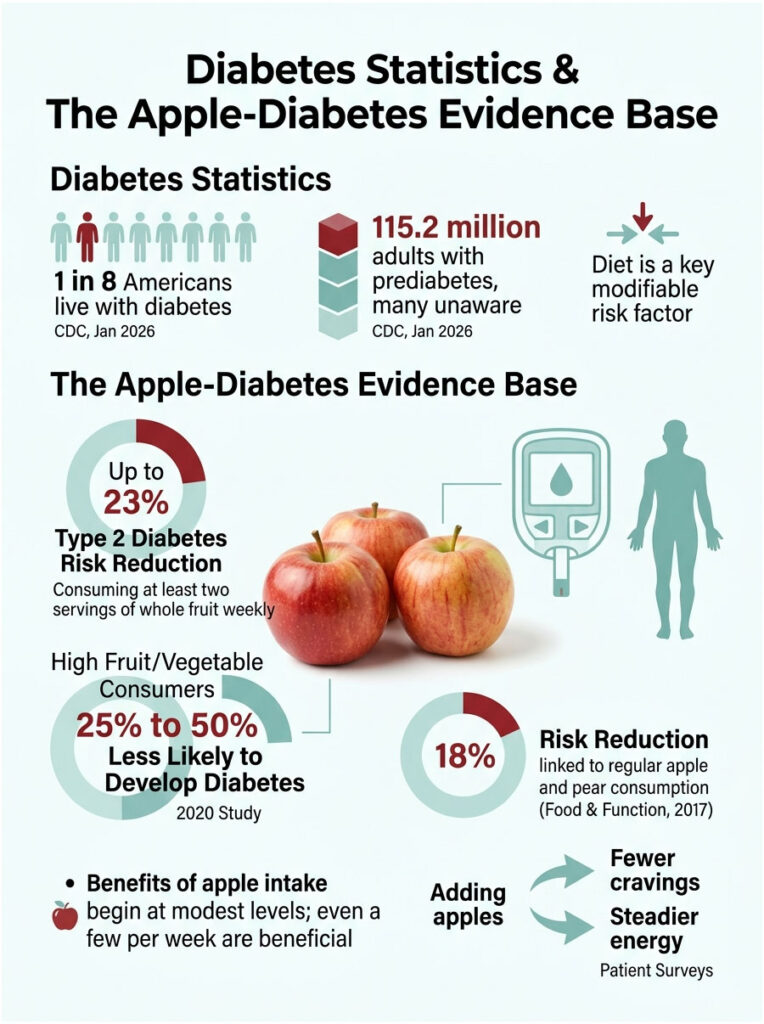
The latest CDC National Diabetes Statistics Report (January 2026) paints a stark picture. About 1 in 8 Americans now lives with diabetes. Another 115.2 million adults, more than 2 in 5, have prediabetes, and most do not know it.
Diet remains one of the strongest modifiable risk factors. Fruit choice, specifically, has emerged in multiple cohort studies as a meaningful lever on long-term diabetes risk, both for prevention and for ongoing management.
What 200,000+ Participants Found
Three large Harvard cohort studies (Nurses’ Health Study, Nurses’ Health Study II, and Health Professionals Follow-up Study) followed more than 187,000 men and women for over two decades. People who ate at least two servings of whole fruit per week, with blueberries, grapes, and apples leading the list, reduced their type 2 diabetes risk by up to 23%.
A 2020 BMJ study of about 23,000 European adults reached a similar conclusion: highest fruit and vegetable consumers were 25% to 50% less likely to develop diabetes than the lowest consumers. The effect size held even after adjusting for total calorie intake, body weight, and exercise.
The 18% Risk-Reduction Finding
A 2017 meta-analysis published in Food & Function pooled five prospective cohort studies covering 228,315 participants and 14,120 type 2 diabetes cases. The summary estimate showed an 18% reduction in T2D risk for the highest apple and pear consumers compared with the lowest.
Importantly, the dose-response curve from that analysis suggests benefit begins at modest intakes. Even a few apples per week, not a daily two-apple commitment, is enough to bend the risk curve.
Follow-up dietary surveys conducted by the HealthCareOnTime clinical team consistently find that patients who add apples to their weekly rotation report fewer between-meal cravings and steadier energy. The science aligns with what patients describe in their own words.
Table 2: US Diabetes & Apple Research at a Glance
| Statistic | Number | Source / Year |
| Americans living with diabetes | 40.1 million (12.0% of population) | CDC National Diabetes Statistics Report, Jan 2026 |
| Americans with prediabetes | 115.2 million adults | CDC, Jan 2026 |
| Adults 65+ with diabetes | 28.8% | CDC, Jan 2026 |
| T2D risk reduction from regular apple/pear intake | 18% lower | Food & Function meta-analysis, 2017 (n=228,315) |
| Lower diabetes risk in highest fruit/veg consumers | 25% to 50% | BMJ, July 2020 |
| Increased T2D risk from daily fruit juice | Up to 21% higher | BMJ, August 2013 (n=187,000) |
How Many Apples Can a Diabetic Eat? Portion Guidance
The ADA Carb-Counting View
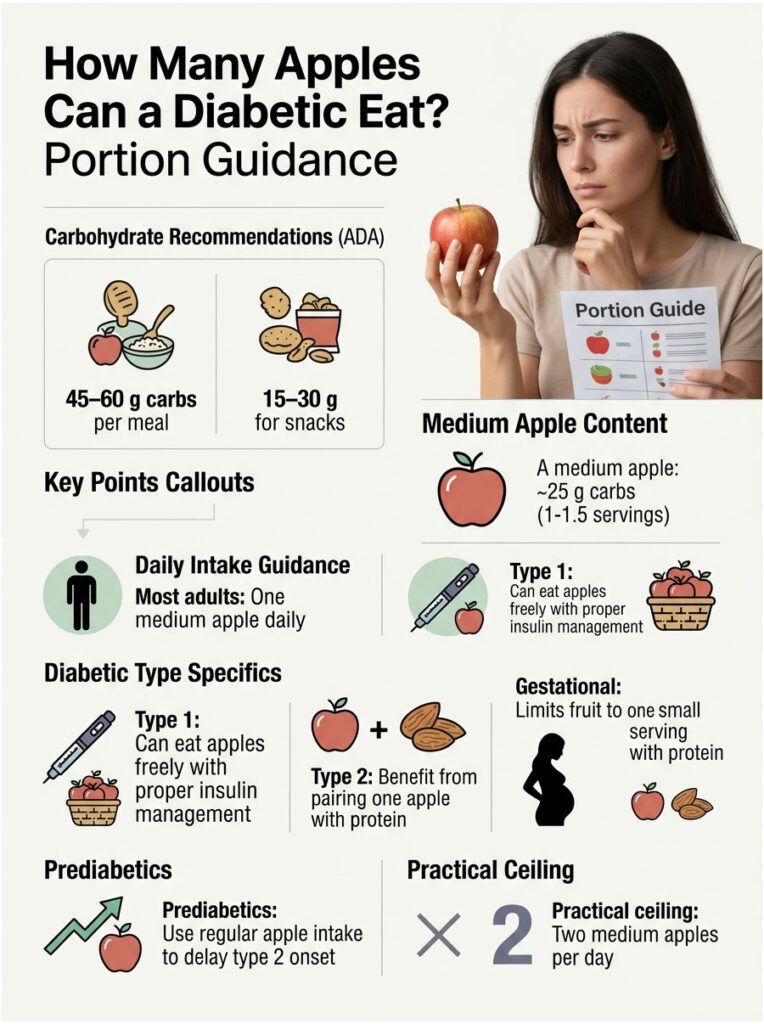
The American Diabetes Association suggests most adults with diabetes aim for 45 to 60 g of carbs per meal, with snacks holding 15 to 30 g. A medium apple at 25 g carbs counts as roughly one to one-and-a-half carb servings.
For most adults with well-controlled diabetes, one medium apple per day is comfortable. Some can handle two if spread across separate meals or snacks. The math, not the fruit itself, sets the ceiling.
Type 1 vs Type 2 vs Gestational vs Prediabetes
Insulin-dependent type 1 diabetics can eat apples freely as long as carbs are counted and insulin is dosed correctly. The fiber and polyphenols still slow absorption, which can actually make insulin timing easier than with juice or applesauce.
Type 2 diabetics on oral medications usually do best with one apple at a time, paired with protein. Two apples in the same sitting often produces glucose readings 30 to 50 mg/dL higher than the same patient eating one apple plus an ounce of cheese.
Gestational diabetes raises the bar. Many obstetric dietitians cap fruit at one small serving per sitting, often eaten with cheese, nuts, or yogurt, because pregnancy hormones blunt insulin sensitivity. Prediabetics, on the other hand, may benefit most: regular apple intake is one of the cleanest diet swaps for delaying or preventing type 2 onset.
Daily Upper Limit Reasoning
Two medium apples in a day is the practical ceiling for most diabetics. Beyond that, the cumulative carb load starts to crowd out the protein, fat, and non-starchy vegetables that should anchor the diabetic plate.
Stacking apples back-to-back also dulls the satiety benefit. Spread them across different times of day, and pair each one with protein or fat for the smoothest glucose curve.
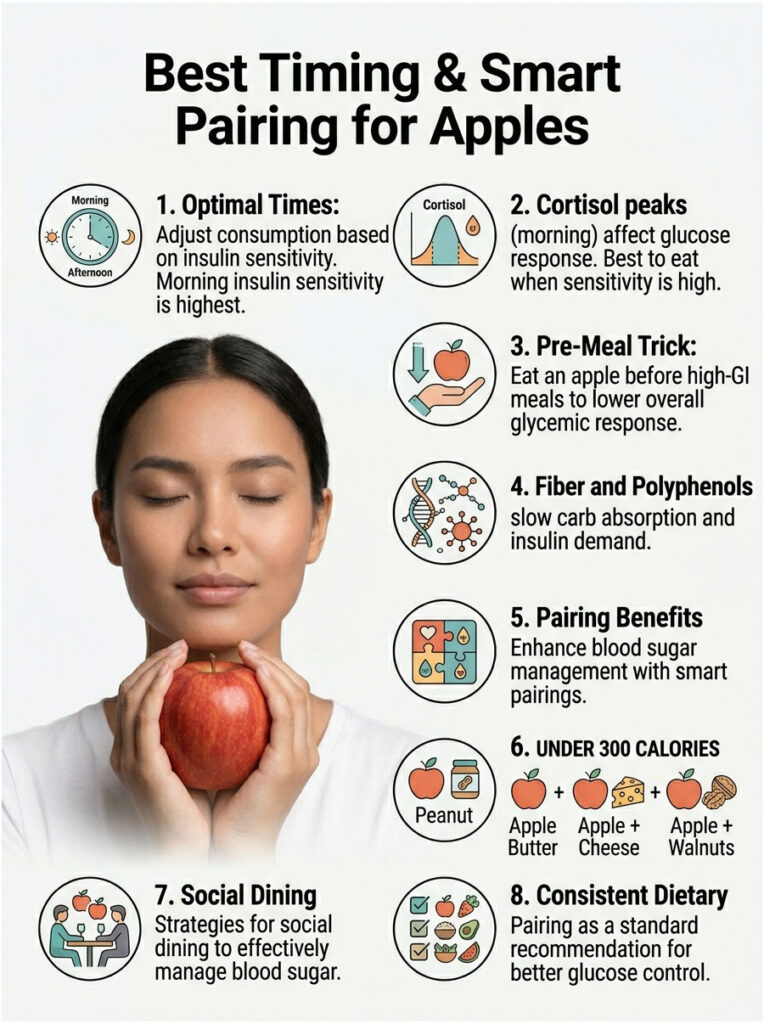
Best Timing & Smart Pairing for Apples
Morning vs Afternoon vs Evening Response
Cortisol peaks in the early morning, which makes the body slightly less insulin-sensitive at 7 a.m. than at 1 p.m. CGM data from diabetic users tends to show smaller post-apple spikes when the fruit is eaten as a mid-morning or mid-afternoon snack rather than at breakfast on an empty stomach.
Late-evening apples bring a different issue. Glucose clearance slows during sleep, so an apple eaten at 10 p.m. may sit in the bloodstream longer than the same apple at 2 p.m. Fasting glucose the next morning may run higher as a result.
Before-Meal Apple: The GI-Lowering Trick
Published research has found that eating an apple roughly 30 minutes before a higher-GI meal (white rice, pasta, bread) lowers the glycemic response of the whole meal. The fiber primes the gut to slow subsequent carb absorption, and the polyphenols dampen the post-meal insulin demand.
This is a useful hack for restaurant dinners or social occasions where the main course will not be diabetic-friendly. A small apple as appetizer, then portion-control the rest, and the post-meal glucose curve often lands 20 to 30 mg/dL lower than the same meal without the pre-load.
Pairing With Protein and Healthy Fat
Pairing transforms an apple from a solo carb hit into a balanced snack. The protein and fat slow digestion further, flatten the glucose curve, and keep hunger at bay longer.
The same Honeycrisp eaten plain at 9 p.m. versus eaten with two tablespoons of natural peanut butter at 9 p.m. can produce dramatically different glucose curves on a CGM. The peanut butter version routinely shows a 30 to 50 mg/dL lower peak. This effect comes up often enough in patient feedback that the HealthCareOnTime nutrition team treats pairing as a default recommendation, not an optional tip.
Apple + Peanut Butter, Apple + Cheese, Apple + Walnuts
Three reliable pairings, each under 300 calories and each blunting blood sugar:
- Apple slices with 1 to 2 tbsp natural peanut butter (no added sugar)
- Apple wedges with 1 oz cheddar or string cheese
- Apple with a small handful of walnuts or almonds (about 14 nuts)
Almond butter, sunflower seed butter, cottage cheese, and Greek yogurt also work. The principle holds: pair the carb with protein or fat.
Decision Matrix: What to Do Based on Your Diabetes Type
Different diabetes types call for different apple strategies. The table below distills the practical playbook.
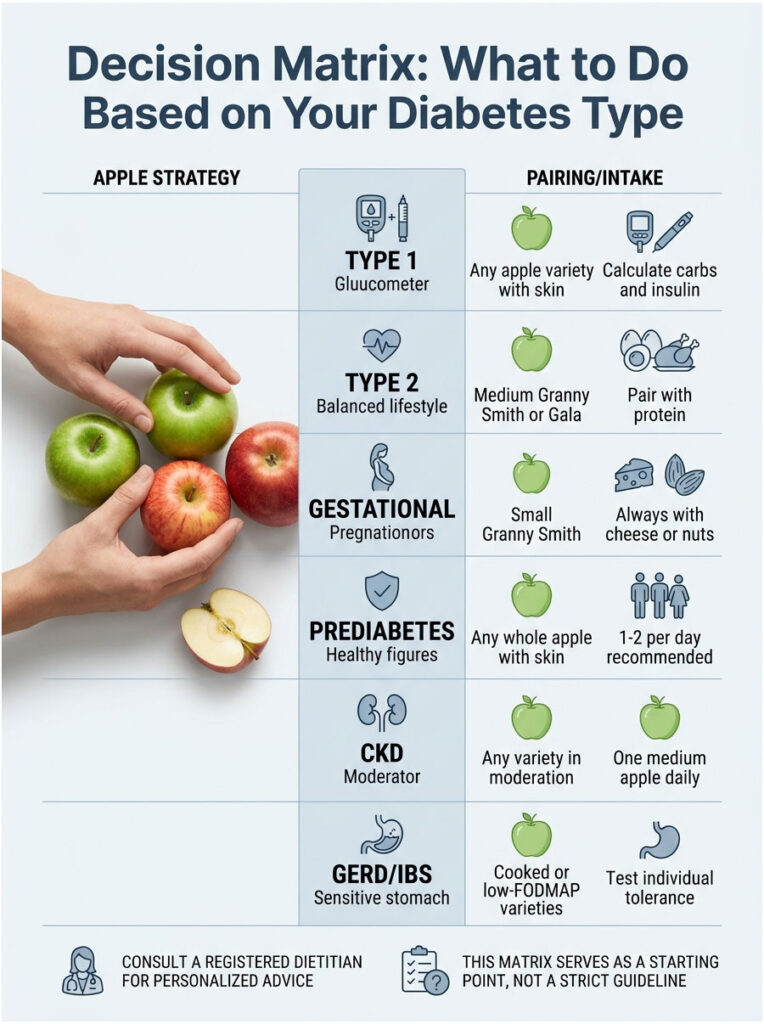
Table 3: Apple Strategy by Diabetes Type
| Your Situation | Best Apple Choice | Action Step |
| Type 1 diabetes (insulin) | Any variety, eat with skin | Count 25 g carbs per medium apple, dose insulin accordingly, test 90 min post-meal |
| Type 2 diabetes (oral meds) | Granny Smith or Gala, medium size | One per day, pair with protein, swap out other carb at the same meal |
| Gestational diabetes | Small Granny Smith only | Half to one small apple, always with cheese, nuts, or Greek yogurt |
| Prediabetes | Any whole apple with skin | One to two per day; one of the cleanest swaps for preventing T2D onset |
| Diabetes + kidney disease (CKD) | Any variety in moderation | Apples are low-potassium-friendly; stick to one medium per day |
| Diabetes + GERD/IBS | Cooked or low-FODMAP varieties | Test tolerance; sometimes peeled or baked apples sit better than raw |
The decision matrix is a starting point, not a prescription. A registered dietitian familiar with your medications and labs can refine it further, especially if you take insulin or sodium-glucose cotransporter-2 (SGLT2) inhibitors.
Common Mistakes Diabetics Make With Apples
Five patterns show up repeatedly in patient food diaries reviewed by the HealthCareOnTime nutrition desk.
First, peeling the apple. The skin holds two-thirds of the fiber and most of the polyphenols. A peeled apple becomes a higher-GI snack with weaker insulin-sensitizing power.
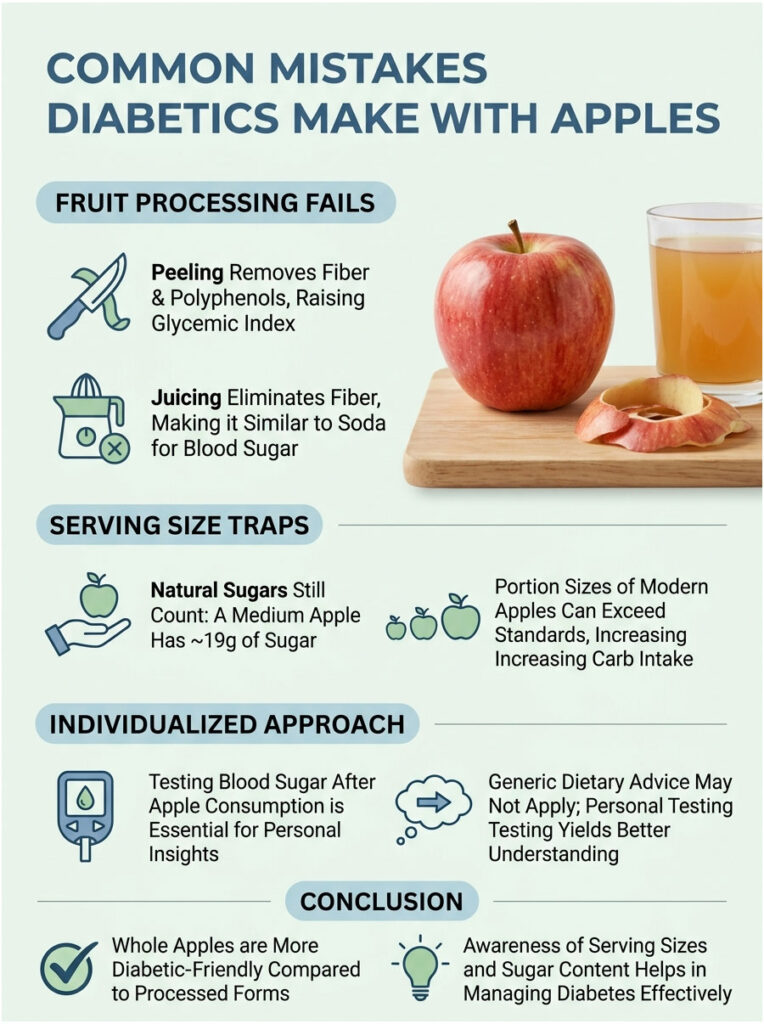
Second, replacing whole fruit with juice for “convenience.” A glass of apple juice is closer to a soda than a piece of fruit when it comes to blood sugar. The fiber that makes whole apples diabetic-friendly is filtered out during juicing.
Third, treating “natural sugar” as “free sugar.” A medium apple still delivers 19 g of total sugar. Natural origin does not change the glycemic math, only the speed of absorption.
Fourth, ignoring portion creep. Modern Honeycrisp and Fuji apples often weigh 250 to 300 g, well above the standard medium reference of 180 g. A “large” Honeycrisp can pack 35 to 40 g of carbs, the equivalent of two carb servings in a single snack.
Fifth, skipping the personal test. Without a fingerstick or CGM check 60 to 120 minutes after eating, you have no idea how your body actually handles apples. Generic advice cannot replace personal data, and most diabetics learn more from one week of post-meal testing than from a stack of articles.
When Apples Are NOT the Right Choice
Honest medicine acknowledges exceptions. Apples are not universally ideal.
Patients with severe gastroparesis often struggle with raw apple fiber, which can sit in the stomach for hours and trigger nausea or bloating. Cooked or pureed apples may work better, in smaller portions. The Mayo Clinic typically recommends well-cooked, low-fiber fruit for gastroparesis flares.
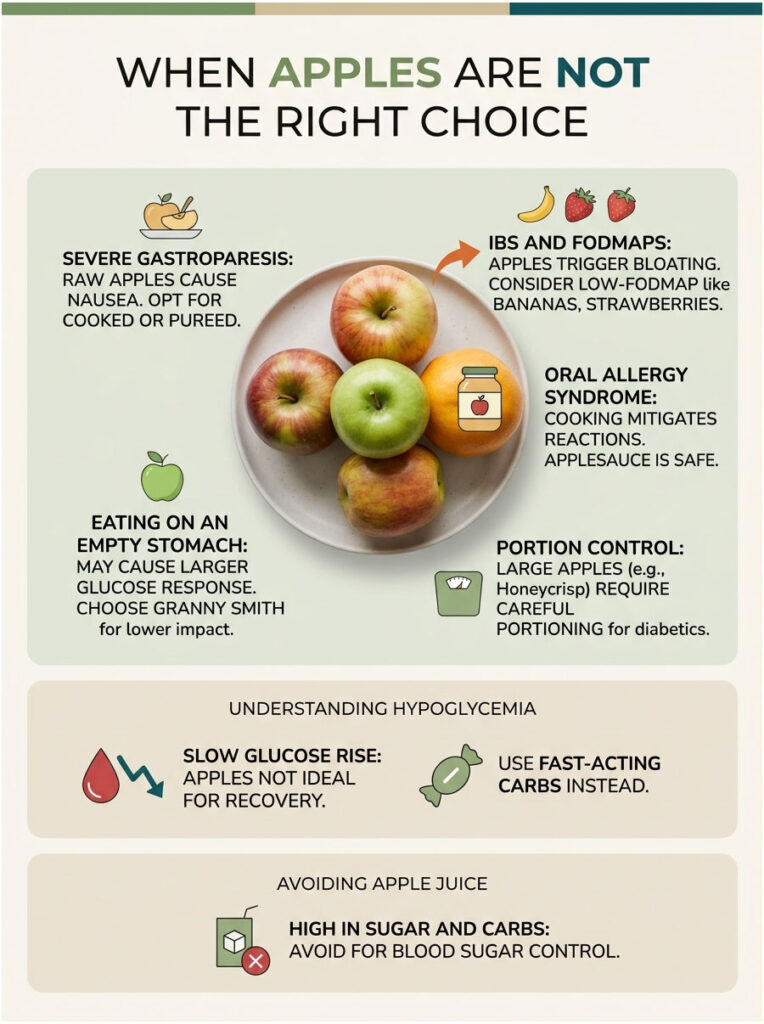
Some people with IBS triggered by FODMAPs find apples high in fructose and sorbitol, both of which can spark bloating, gas, or diarrhea. Low-FODMAP fruit alternatives like firm bananas, strawberries, or kiwi may suit better.
During an acute low blood sugar episode (hypoglycemia under 70 mg/dL), an apple is too slow to be rescue food. Fast-acting carbs like 4 oz of juice, glucose tablets, or hard candy are the standard ADA treatment. Save the apple for prevention, not rescue.
Oral allergy syndrome, often linked to birch pollen allergy, can cause itchy mouth or throat after raw apple. Cooking destroys the trigger proteins, so applesauce or baked apple may still be enjoyable. The Cleveland Clinic notes that this cross-reactivity affects up to 50% to 75% of birch-pollen-allergic adults.
Frequently Asked Questions
Are apples high in sugar for diabetics?
Apples contain about 19 g of natural sugar per medium fruit, but the 4.4 g of fiber slows absorption and prevents quick spikes. Whole apples score low on both glycemic index (36) and glycemic load (6), which makes them one of the safer fruit choices for managing blood sugar.
How many apples can a diabetic eat per day?
One medium apple per day is comfortable for most adults with well-controlled diabetes. Some can handle two if spread across separate meals or snacks. Each medium apple counts as roughly 25 g of carbs, so fit it into your daily carb target alongside other meals.
Which apple variety has the lowest sugar?
Granny Smith holds the title with about 12 g of sugar per medium fruit and a glycemic index of 34. The tart bite signals lower fructose content. Honeycrisp and Fuji sit at the high end with 19 to 20 g of sugar each, useful to know when portioning.
Should diabetics eat apple skin or peel it?
Eat the skin. It holds roughly two-thirds of the fiber and most of the polyphenols (quercetin, chlorogenic acid, phlorizin) that slow sugar absorption and improve insulin sensitivity. Peeling an apple removes its biggest blood-sugar benefits. Wash thoroughly or buy organic to reduce pesticide exposure.
Is apple juice OK for diabetics?
No, apple juice is a poor choice for diabetics. Eight ounces contains about 29 g of carbs with no fiber, which spikes blood sugar fast. Harvard research links daily fruit-juice consumption to up to 21% higher type 2 diabetes risk. Stick to whole apples with skin instead.
Do apples spike blood sugar?
Whole apples cause a small, slow rise in blood sugar rather than a sharp spike, thanks to fiber and polyphenols. Individual response varies widely, with some CGM users reporting 50+ mg/dL differences between people eating the same apple. Test your personal response with a fingerstick reading 90 minutes after eating.
Can I eat an apple on an empty stomach with diabetes?
Yes, but expect a larger glucose response than when paired with protein or fat. Mid-morning or mid-afternoon is gentler than first thing in the morning, when cortisol levels reduce insulin sensitivity. If eating an apple on an empty stomach, choose Granny Smith for the lowest glycemic impact.
Is applesauce safe for diabetics?
Unsweetened applesauce is acceptable in small portions, but it loses much of the fiber found in whole apples because the skin is removed. Sweetened versions double the sugar load and should be avoided. A whole apple with skin remains the better choice for blood sugar control.
Is it OK to eat an apple at night if I have diabetes?
A late-night apple is fine in moderation, but glucose clearance slows during sleep, so the same apple at 10 p.m. may sit longer in the bloodstream than at 2 p.m. Pair with a protein like cheese or nuts to flatten the curve, or save the apple for daytime snacks.
Can apples help reverse prediabetes?
Apples support, but do not single-handedly reverse, prediabetes. A 2017 meta-analysis links regular apple intake with 18% lower type 2 diabetes risk. Combined with weight loss, exercise, and reduced refined-carb intake, apples are one of the cleanest dietary swaps for slowing or preventing progression to type 2 diabetes.
Are Honeycrisp apples bad for diabetics?
Not bad, but worth portioning carefully. Honeycrisp apples have about 20 g of sugar and 23 g of net carbs per medium fruit, plus they often grow large (250 to 300 g). A “large” Honeycrisp can deliver 35 to 40 g of carbs. Eat half, or pair with protein to balance the load.
Can gestational diabetes patients eat apples?
Yes, but in smaller portions than non-pregnant diabetics. Most obstetric dietitians suggest half to one small Granny Smith apple per sitting, always paired with protein like Greek yogurt, cheese, or nut butter. Pregnancy hormones reduce insulin sensitivity, so check blood sugar one to two hours after eating to confirm tolerance.
Disclaimer: This article is for educational purposes only and does not replace personalized medical advice. Diabetes management is highly individual, and dietary changes should be discussed with your endocrinologist, primary care physician, or registered dietitian, especially if you take insulin or other glucose-lowering medications. Always test your personal blood sugar response before making lasting changes to your meal plan.
References
- CDC National Diabetes Statistics Report (January 2026)
- American Diabetes Association
- USDA FoodData Central, Apples raw with skin
- Harvard Health: Even a small apple a day may help keep diabetes away
- Harvard School of Public Health: Whole fruits linked to lower T2D risk (BMJ 2013)
- Food & Function: Apple and pear consumption and T2D risk meta-analysis (2017)
- NIH/PMC: Apple consumption and postprandial blood glucose
- Harvard Health: Glycemic index and glycemic load for 100 foods
- WebMD: Best fruits for diabetes
- Healthline: Apples and diabetes