Type “how many calories in a pomegranate” into Google and you get four different answers: 83, 105, 144, and 234. All four are correct. Not one of the pages serving them explains why they disagree, and that silence quietly wrecks the accuracy of every food log it touches.
Table of Contents
Quick Answer
One cup of pomegranate arils (174g) contains 144 calories, according to USDA FoodData Central. One large 4-inch pomegranate yields about 282g of arils, which works out to 234 calories. A 100-gram portion contains 83 calories, and a half-cup serving contains 72 calories. Conflicting figures online come down to one thing: whether the number counts whole fruit, edible arils, or a measured cup.
At a Glance
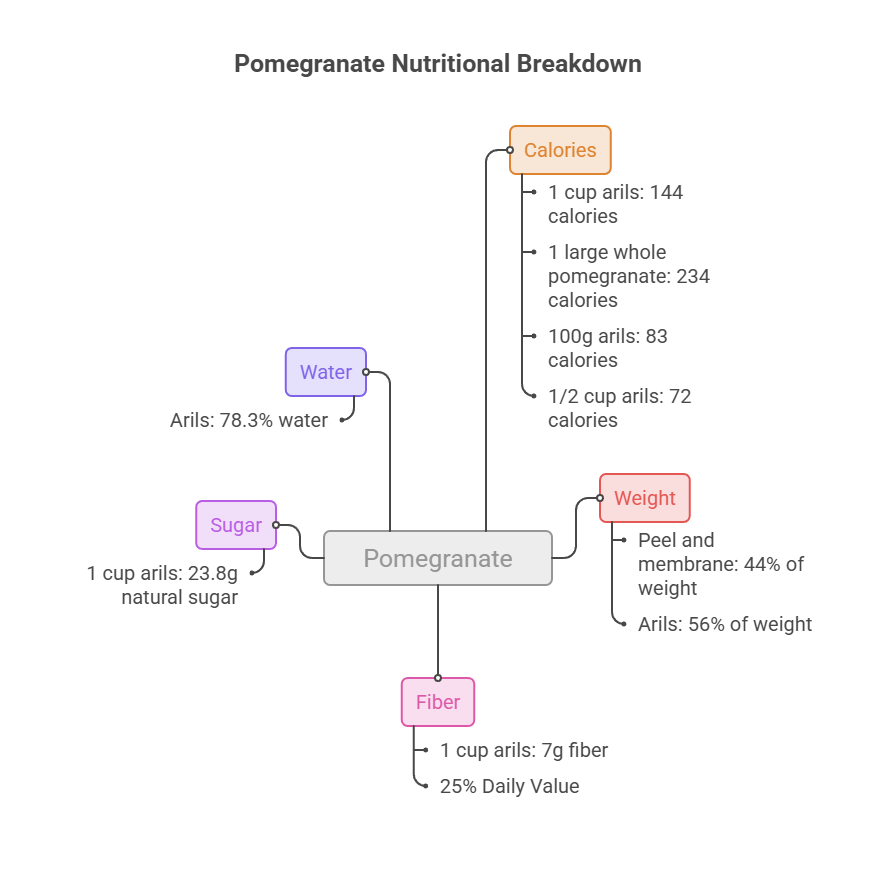
• 1 cup of pomegranate arils (174g) = 144 calories
• 1 large whole pomegranate (4-inch diameter) = 234 calories from 282g of arils
• 100g of arils = 83 calories; 1/2 cup (87g) = 72 calories
• About 44% of a pomegranate’s weight is peel and membrane, which is not food
• One cup delivers 7g of fiber (25% Daily Value) and 23.8g of natural sugar
• Pomegranate juice carries similar calories with almost none of the fiber
• Arils are 78.3% water, which explains the low calorie density
The Short Answer: Pomegranate Calories by Serving Size
Every trustworthy pomegranate calorie figure traces back to one place: USDA FoodData Central, entry 169134, “Pomegranates, raw.” What changes from website to website is not the data. It is the serving attached to it.
One Whole Pomegranate (Large, 4-Inch Diameter)
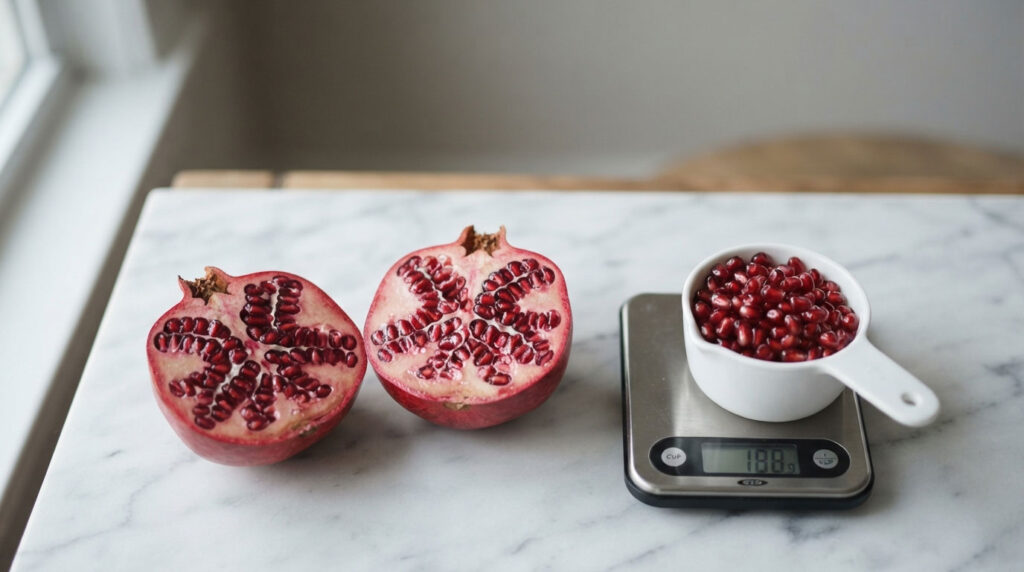
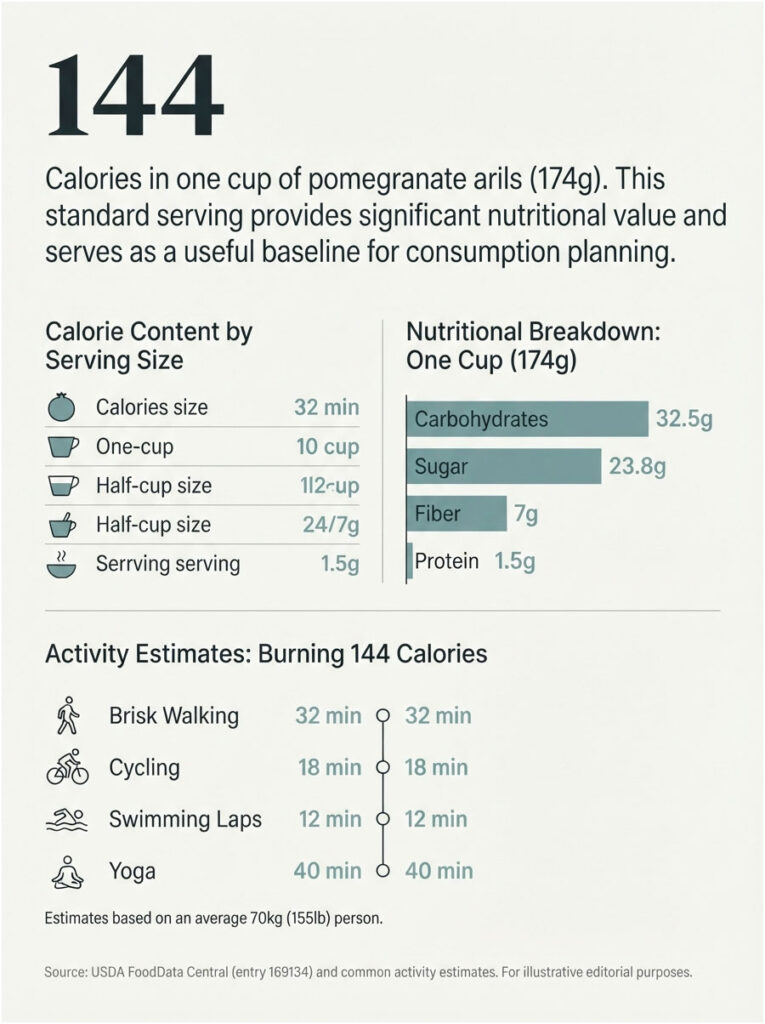
USDA lists one 4-inch pomegranate as yielding 282 grams of edible arils. That comes to 234 calories, alongside 53g of carbohydrate, 11g of fiber, and 39g of total sugar.
This is the largest number you will see quoted anywhere, and it is the one most likely to spook someone counting calories. Remember what it describes: a 4-inch fruit is a big pomegranate, roughly 1.1 pounds before you cut into it.
One Cup of Pomegranate Arils
A measured cup of arils weighs 174 grams and contains 144 calories. That cup carries 32.5g of carbohydrate, 7g of fiber, 23.8g of sugar, 2.9g of protein, and 2g of fat.
Most calorie apps default to this serving, and it is the most practical figure if you are eating from a pre-seeded container.
Half a Cup, 100 Grams, and a Single Ounce
Smaller portions scale cleanly from the same data. Half a cup (87g) gives you 72 calories. A 100-gram portion gives you 83 calories.
A single ounce (28g), roughly what you would scatter across a salad or a bowl of Greek yogurt, costs you 23 calories. That is the cheapest way to put pomegranate on a plate.
Our medical reviewers at HealthCareOnTime note that the half-cup portion is what most Americans actually eat, and yet it is the single hardest figure to find on page one of Google.
Small and Medium Fruit: The Numbers Shoppers Actually Need
USDA publishes household data for the 4-inch fruit only. Most pomegranates stacked at Kroger, Costco, or a Saturday farmers market are smaller than that.
The table below fills the gap using the USDA refuse figure of 44% and typical retail fruit dimensions.
| Serving | Edible Aril Weight | Calories | Total Carbs | Fiber | Total Sugar |
| 1 oz arils | 28 g | 23 | 5.2 g | 1.1 g | 3.8 g |
| 1/2 cup arils | 87 g | 72 | 16.3 g | 3.5 g | 11.9 g |
| 100 g arils | 100 g | 83 | 18.7 g | 4.0 g | 13.7 g |
| 1 cup arils | 174 g | 144 | 32.5 g | 7.0 g | 23.8 g |
| Small whole pomegranate (approx. 3 in) | ~120 g | ~100 | ~22.4 g | ~4.8 g | ~16.4 g |
| Medium whole pomegranate (approx. 3.5 in) | ~190 g | ~158 | ~35.5 g | ~7.6 g | ~26.0 g |
| Large whole pomegranate (4 in, USDA) | 282 g | 234 | 53 g | 11 g | 39 g |
Rows for 1 oz through 1 cup and for the large fruit come straight from USDA FoodData Central. The small and medium rows are HealthCareOnTime calculations derived from the USDA 44% refuse value.
They are estimates, and they are labeled that way on purpose. Nobody should hand you a calculation dressed up as a government measurement.
Putting 144 Calories in Physical Terms
Some readers find a number easier to judge against movement. The estimates below assume a 155-pound adult and standard activity intensities, so your own figures will differ with body weight and effort.
| Activity | Approximate Time to Expend 144 Calories |
| Brisk walking (3.5 mph) | About 32 minutes |
| Running (6 mph) | About 12 minutes |
| Cycling (moderate, 12 to 14 mph) | About 15 minutes |
| Swimming laps (moderate) | About 20 minutes |
| Vinyasa yoga | About 30 minutes |
| Weight training (general) | About 39 minutes |
Read this as context, not as a rule. Food does not need to be earned back through exercise, and treating fruit that way tends to make eating harder rather than healthier.
Why the Internet Gives You Three Different Calorie Numbers
The confusion is not carelessness. It comes from a real technical distinction that consumer nutrition pages almost never bother to spell out.
The Whole-Fruit vs. Edible-Aril Trap
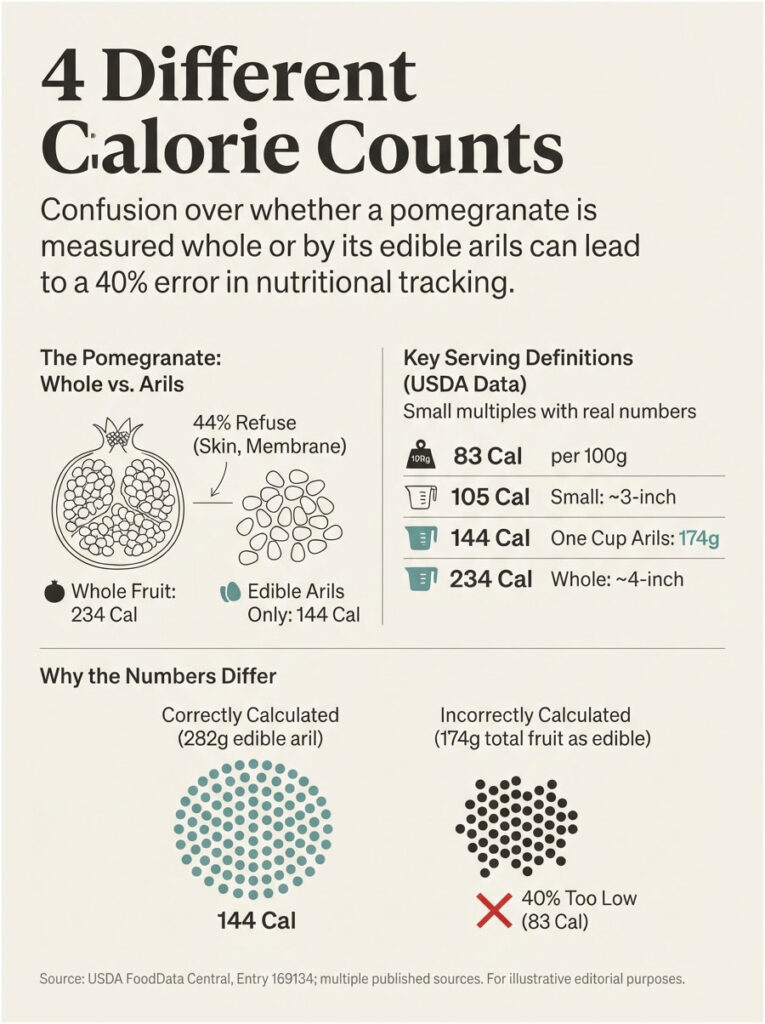
A pomegranate is not an apple. You do not eat most of it. The leathery rind, the pith, and those papery white membranes all go in the trash, and together they account for a large share of what you carried home.
So the question “how many calories in a pomegranate” has two defensible readings: calories in the object you bought, or calories in the part you swallow. Only the second one matters, and only the second one is what USDA reports.
How USDA Treats “Refuse” (44 Percent of the Fruit Is Not Food)
USDA assigns pomegranate a refuse value of 44%. Skin and membrane make up that share by weight, and the nutrient data applies strictly to the remaining 56%.
Household gram weights in the USDA database always describe the edible portion. When USDA says “1 pomegranate, 4-inch diameter, 282g,” it means 282 grams of arils, not 282 grams of whole fruit.
Doing the Math: From a 1.1-Pound Fruit to 282 Grams of Arils
Run the arithmetic backward. If 282g of arils represent 56% of the fruit, the whole pomegranate weighed roughly 504 grams, or about 1.1 pounds.
That checks out physically. A sphere four inches across holds close to 500 cubic centimeters, and pomegranate arils sit near the density of water. The USDA figure is internally consistent, which is exactly why it deserves to be the anchor for everything else.
Why Calorie Apps Disagree With Each Other
With the refuse rule understood, all four competing numbers snap into focus. Each is attached to a different serving definition, and each is honest on its own terms.
| Published Figure | What It Actually Measures | Verdict |
| 83 calories | 100 grams of arils | Correct, but nobody eats in 100-gram units |
| 105 calories | A smaller “1 pomegranate” definition (about 126 g of arils) | Correct for a small fruit, misleading as a default |
| 144 calories | 1 measured cup of arils (174 g) | Correct and the most useful everyday figure |
| 234 calories | 1 large 4-inch pomegranate (282 g of arils) | Correct for a large fruit only |
At least one page currently ranking for this query treats the 282g figure as whole-fruit weight, then back-calculates a much lower aril number from it. That is a genuine error, and it produces pomegranate calorie counts roughly 40% too low.
Patients booking metabolic panels through HealthCareOnTime raise this exact problem more often than any other food-tracking question, usually after their food log stopped agreeing with their bathroom scale.
How Many Arils Are Inside One Pomegranate?
Horticulture references from the University of California note that pomegranate cultivars can carry as many as 1,300 seeds per fruit, with the commercial “Wonderful” variety grown across California’s San Joaquin Valley sitting comfortably in that range.
Divide 282 grams of arils across roughly a thousand of them and each aril weighs about a quarter of a gram. That works out to somewhere around 0.23 calories per aril.
You would need to eat more than 600 individual arils to reach 144 calories. This is the whole reason pomegranate is difficult to overeat.
Full USDA Nutrition Breakdown of Pomegranate
Calories are the headline. The rest of the label is where pomegranate earns the attention it gets.
Macronutrients: Carbs, Fiber, Protein, and Fat
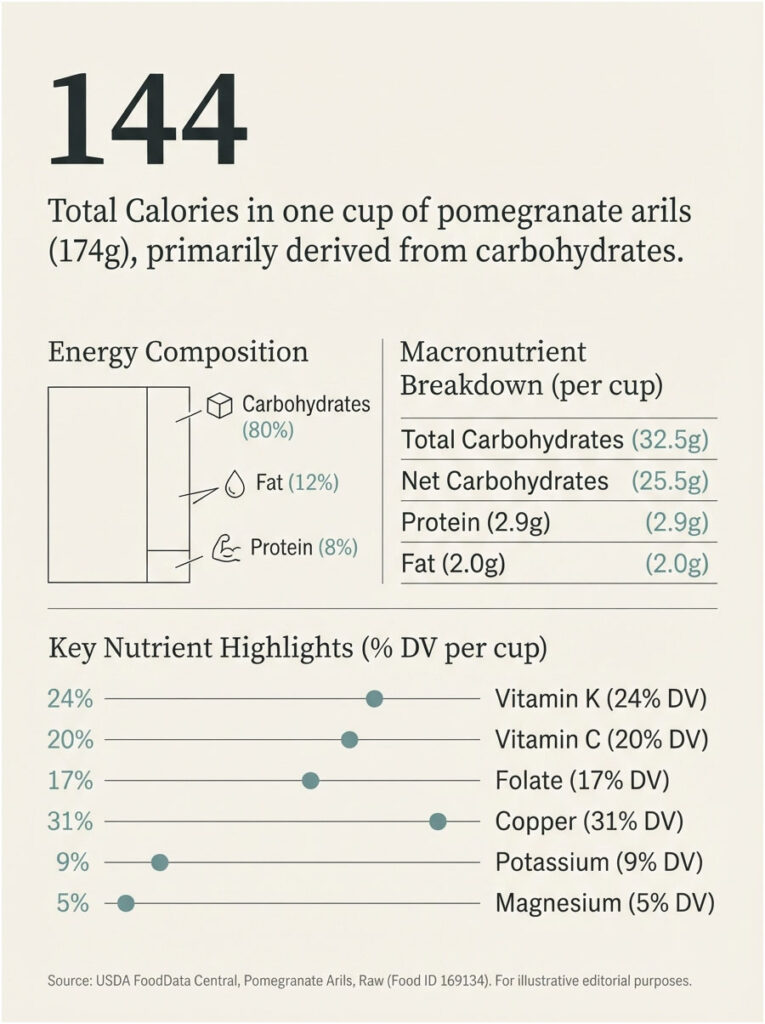
One cup of arils carries 32.5g of total carbohydrate. Take away the 7g of fiber and you land at 25.5g of net carbs.
Protein comes in at 2.9g per cup, which is high for a fruit. Fat sits at 2g, which is also unusual, and it comes from the crunchy seed buried inside each aril.
Where the Calories Actually Come From
The energy split runs roughly 80% carbohydrate, 12% fat, and 8% protein. That fat share is not a rounding artifact. It is punicic acid, stored in the seeds you either chew or spit out.
Arils are 78.3% water by weight. That single fact is why a full cup lands at only 144 calories despite carrying nearly 24 grams of sugar.
Vitamins and Minerals Worth Knowing
A cup of arils is not a token amount of nutrition. It delivers meaningful percentages of several nutrients Americans routinely fall short on.
Vitamin K, Vitamin C, and Folate
Vitamin K reaches 28.5 mcg per cup, or 24% of the FDA Daily Value. Vitamin C hits 17.7 mg (20% DV), and folate contributes 66.1 mcg (17% DV).
That vitamin K number carries real weight for anyone on a blood thinner, and it gets its own section further down.
Potassium, Copper, and Magnesium
Copper is the standout: 0.27 mg per cup, or 31% of the Daily Value, which is more than most people get from any single fruit. Potassium follows at 410.6 mg (9% DV), with magnesium at 20.9 mg (5% DV).
Across the diagnostic panels our network processes, potassium and folate are two of the values patients most often want to move through diet rather than supplements. Pomegranate contributes to both.
| Nutrient | Amount per 1 Cup (174 g) | % Daily Value | Why It Matters |
| Calories | 144 | 7% | About 7% of a 2,000-calorie day |
| Total Fat | 2 g | 3% | Punicic acid, stored in the seeds |
| Saturated Fat | 0.21 g | 1% | Negligible |
| Sodium | 5.2 mg | 0% | Naturally sodium-free |
| Total Carbohydrate | 32.5 g | 12% | Primary energy source |
| Dietary Fiber | 7 g | 25% | Slows sugar absorption, supports gut health |
| Total Sugars | 23.8 g | Not applicable | All naturally occurring, 0 g added |
| Protein | 2.9 g | 6% | High for a fruit |
| Vitamin C | 17.7 mg | 20% | Immune function, collagen synthesis |
| Vitamin K | 28.5 mcg | 24% | Blood clotting, bone metabolism |
| Folate | 66.1 mcg | 17% | Cell division, pregnancy support |
| Potassium | 410.6 mg | 9% | Blood pressure, muscle function |
| Copper | 0.27 mg | 31% | Iron metabolism, connective tissue |
| Vitamin E | 1 mg | 7% | Antioxidant activity |
| Magnesium | 20.9 mg | 5% | Nerve and muscle function |
| Water | 135.6 g | Not applicable | 78.3% of total weight |
The Compounds That Never Show Up in the Calorie Count
Pomegranate’s reputation does not rest on its macros. It rests on punicalagins and anthocyanins, the polyphenols that give the arils their color and give researchers something to study.
These compounds carry essentially zero calories. They are why a fruit that is 80% carbohydrate by energy still gets called a superfruit, and they are also why the marketing around pomegranate juice tends to outrun the evidence.
Antioxidant content is a reason to eat pomegranate. It is not a reason to ignore the 234 calories in a large one.
What a Pomegranate Does Not Contain
No cholesterol. No added sugar. Almost no sodium, at 5.2 mg per cup.
Those three absences do quiet work when you are building a heart-friendly eating pattern, and they are worth noticing precisely because nobody advertises them.
Whole Fruit vs. Packaged Arils vs. Juice
Walk into an American supermarket in November and pomegranate shows up in three forms at three price points. Their calorie counts are similar. Their value to your body is not.
Fresh Arils You Seed Yourself
Cheapest per gram, most fiber, most work. This is the version USDA measured, and the version every number in this article is built on.
The Five-Minute Water-Bowl Method
Slice off the crown, score the rind along its natural ridges, then break the fruit apart underwater in a large bowl. The arils sink and the white membrane floats.
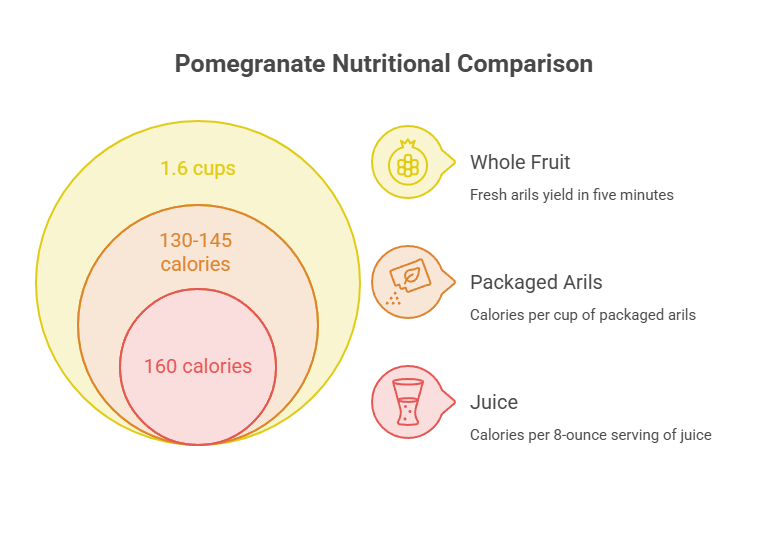
Skim the membrane off the surface, drain, and you are done. A large fruit takes about five minutes and yields close to 1.6 cups of arils.
Pre-Packaged Aril Cups
Convenience costs money, not nutrition. Packaged arils from POM Wonderful, Costco, and store brands run roughly 130 to 145 calories per cup, with the spread coming from label rounding rather than any real difference in the food.
Read the panel instead of assuming. Serving sizes on these containers are almost always half a cup, which is not the same as the container.
100% Pomegranate Juice: Same Calories, Almost Zero Fiber
Here is where the trade goes bad. Juicing strips out nearly all of the fiber and leaves every gram of sugar behind.
POM Wonderful on the Label vs. USDA Generic Juice
POM Wonderful 100% Pomegranate Juice lists 160 calories per 8-ounce serving, with 39g of carbohydrate, 34g of total sugars, zero added sugar, and zero fiber. The Environmental Working Group calculates that as roughly 8 teaspoons of natural sugar in a single glass.
USDA’s generic bottled pomegranate juice runs a little lower at about 134 calories per cup. Either way, you are drinking the sugar load of a large pomegranate with none of the fiber that would have slowed it down.
Juice Blends, Cocktails, and Teas
Pomegranate-flavored blends belong in a separate category entirely. Many contain a small percentage of real juice plus added sugar, which puts the calorie count anywhere the manufacturer wants it.
The word to look for on the front of the bottle is “100%.” Everything else needs the Nutrition Facts panel turned over and read.
| Form | Serving | Calories | Fiber | Total Sugar | Potassium |
| Fresh arils | 1/2 cup (87 g) | 72 | 3.5 g | 11.9 g | 205 mg |
| Fresh arils | 1 cup (174 g) | 144 | 7 g | 23.8 g | 411 mg |
| Packaged aril cup | 1 cup | 130 to 145 | 6 to 7 g | 22 to 24 g | About 400 mg |
| USDA bottled 100% juice | 8 fl oz | 134 | 0.3 g | 31 g | 536 mg |
| POM Wonderful 100% juice | 8 fl oz | 160 | 0 g | 34 g | 470 mg |
Our lab partners regularly see fasting glucose results that surprise patients who had been drinking pomegranate juice daily, convinced it was interchangeable with eating the fruit. It is not, and the fiber column above is the reason.
Pomegranate Calories in the Context of the American Diet
A calorie number means nothing on its own. It starts to mean something once you set it against a daily target.
What 144 Calories Buys You Against a 2,000-Calorie Day
One cup of arils uses about 7% of a 2,000-calorie budget. In return you collect a quarter of your daily fiber, a fifth of your vitamin C, and close to a third of your copper.
Measured as nutrition per calorie, that is a strong exchange. Very few foods that taste like dessert return anything close to it.
How a Cup of Arils Counts Toward Your Daily Fruit Target
The Dietary Guidelines for Americans, 2025 to 2030, released in January 2026, continue to place adult fruit intake at roughly 1.5 to 2 cup-equivalents per day. One cup of pomegranate arils counts as a full cup-equivalent.
That means a single cup can cover half to two-thirds of an adult’s entire daily fruit requirement in one sitting.
Most Americans Are Not Close to Their Fruit Goal
| Data Point | Figure | Source |
| US adults meeting daily fruit recommendation | 12.3% | CDC, MMWR (BRFSS) |
| US adults meeting fruit recommendation, 2017 to March 2020 | 14.7% | USDA Economic Research Service |
| Share of US population eating less fruit than recommended | About 80% | USDA Economic Research Service |
| Average US fruit intake per person, per day | 0.93 cup-equivalents | USDA ERS (NHANES 2017 to 2018) |
| Recommended daily fruit for adults | 1.5 to 2 cup-equivalents | Dietary Guidelines for Americans, 2025 to 2030 |
| Share of US pomegranates grown in California | Over 90% | USDA / Agricultural Marketing Resource Center |
| California bearing pomegranate acreage | About 30,000 acres | Pomegranate Council |
| Fiber in 1 cup of pomegranate arils | 7 g (25% DV) | USDA FoodData Central |
Set those two facts side by side. Roughly 80% of Americans fall short on fruit, and a single pomegranate can close most of one day’s gap by itself.
Why California Timing Matters
California grows more than 90% of the American pomegranate supply, almost all of it in the San Joaquin Valley. The retail season runs October through January.
Pomegranates do not ripen after picking. Buying in season is not a preference; it is the difference between a fruit worth its 144 calories and one that is not worth eating at all.
How to Pick a Pomegranate That Is Worth Its Calories
Weight is the tell. Pick up two fruits of the same size and buy the heavier one, because density means juice rather than air.
Look for skin that is firm and slightly angular rather than perfectly round. A little surface scarring is fine. Soft spots and a rattle when you shake it are not.
How Pomegranate Compares to Other Popular US Fruits
Calorie counts only become useful when you can rank them against whatever else is sitting in the same produce aisle.
| Fruit (1 cup) | Calories | Total Sugar | Fiber | Vitamin C |
| Pomegranate arils (174 g) | 144 | 23.8 g | 7.0 g | 17.7 mg |
| Banana, sliced (150 g) | 134 | 18.3 g | 3.9 g | 13.1 mg |
| Grapes (151 g) | 104 | 23.4 g | 1.4 g | 4.8 mg |
| Blueberries (148 g) | 84 | 14.7 g | 3.6 g | 14.4 mg |
| Apple, sliced (109 g) | 57 | 11.3 g | 2.6 g | 5.0 mg |
| Strawberries, halved (152 g) | 49 | 7.4 g | 3.0 g | 89.4 mg |
| Watermelon, diced (152 g) | 46 | 9.4 g | 0.6 g | 12.3 mg |
Reading That Table Honestly
Pomegranate is the highest-calorie fruit on the list. It also carries the most sugar per cup. Anyone selling it as a low-calorie fruit is not reading the same USDA data.
What it also carries is nearly double the fiber of anything else shown, and that changes the entire calculation.
The Sugar-to-Fiber Ratio Nobody Talks About
Sugar in isolation is a bad metric. Sugar divided by fiber tells you how fast that sugar is likely to reach your bloodstream.
| Fruit (1 cup) | Sugar per Gram of Fiber |
| Strawberries | 2.5 : 1 |
| Pomegranate arils | 3.4 : 1 |
| Blueberries | 4.1 : 1 |
| Apple, sliced | 4.3 : 1 |
| Banana, sliced | 4.7 : 1 |
| Watermelon, diced | 15.7 : 1 |
| Grapes | 16.7 : 1 |
Now look at grapes. They deliver almost exactly the same sugar as pomegranate, 23.4g against 23.8g, with 1.4g of fiber against 7g. That is nearly five times the sugar per gram of fiber.
Across the nutrition questions our team fields each month, the most common surprise is that pomegranate is not a low-calorie fruit. It is a high-fiber fruit carrying a moderate calorie load, and those are two very different claims.
What Pomegranate Calories Mean for Your Health Goals
Weight Loss: Calorie Density, Water Content, and Satiety
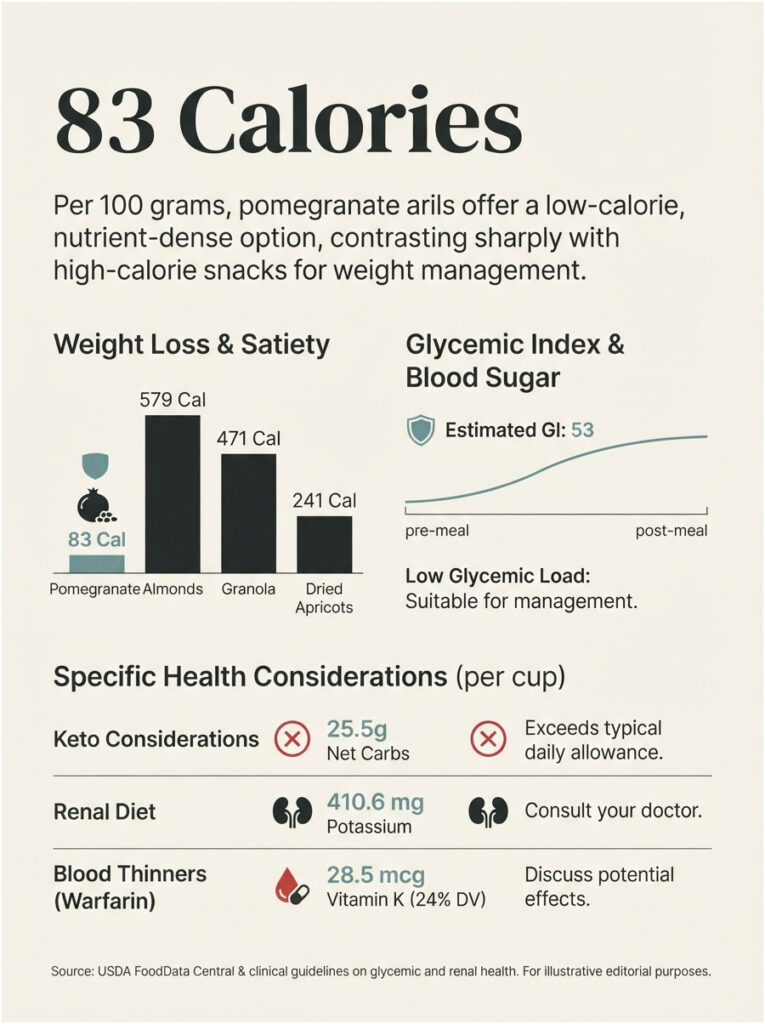
Calorie density is what matters on a deficit, not the number attached to a single serving. At 83 calories per 100 grams, pomegranate sits far below almonds (579), granola (471), or any dried fruit mix.
Water at 78.3% and fiber at 7g per cup give arils real physical volume. A half-cup portion costs 72 calories and takes a genuinely long time to eat, because you work through it one aril at a time.
That slowness is the feature, not the flaw. It is very hard to inhale a pomegranate the way you can inhale a handful of raisins.
Blood Sugar: Glycemic Index, Glycemic Load, and the Fiber Buffer
Published glycemic index estimates for pomegranate cluster near 53, at the low end of the medium range. USDA does not publish an official GI value, and the number shifts with cultivar and ripeness, so treat it as a guide rather than a guarantee.
Glycemic load is the more honest metric because it accounts for portion size. A half-cup serving carries a low glycemic load, reflecting both the moderate GI and the modest carbohydrate quantity in a realistic helping.
What the Numbers Say for Type 2 Diabetes
Those 7 grams of fiber per cup do measurable work slowing glucose absorption. That is the entire mechanical advantage whole pomegranate holds over pomegranate juice, which has almost none.
In cases reviewed by our medical team, the thing that causes trouble is rarely the fruit. It is the juice, taken daily, at 34 grams of sugar a glass, logged in a food diary as a serving of fruit. Anyone tracking blood sugar seriously should be watching their fasting glucose and HbA1c results, not just their calorie app.
Keto and Low-Carb: The Net-Carb Reality Check
One cup of arils delivers 25.5g of net carbs. Against a 20g daily ceiling, a single cup blows through your entire allowance and then some.
Pomegranate can still appear on a keto plate as a garnish. Two to three tablespoons, about 20 grams, costs roughly 17 calories and around 3g of net carbs, which is workable and still tastes like something.
Kidney Disease and the Potassium Question
A cup of arils supplies 410.6 mg of potassium. Bottled juice supplies more, at 470 to 536 mg per glass, because juicing concentrates the mineral while discarding the fiber.
Anyone on a potassium-restricted renal diet should treat pomegranate as a food to clear with their nephrologist first, and should know their current potassium and kidney function numbers before making it a habit. This is not a general caution. It is a specific one for people with reduced kidney function.
Blood Thinners and Vitamin K
At 28.5 mcg per cup (24% DV), pomegranate carries enough vitamin K to matter for patients taking warfarin, where consistency of intake is what keeps INR stable. The issue is never the food itself. It is a sudden change in how much of it you eat.
Separately, pomegranate juice has been examined for effects on drug-metabolizing enzymes, with possible relevance to certain blood pressure medications. Anyone on daily prescription medication should raise pomegranate juice with their pharmacist before turning it into a routine.
How Much Pomegranate Should You Actually Eat?
The Portion Most People Should Start With
Half a cup of arils, at 72 calories, is the sensible default. It counts as a half cup-equivalent toward the daily fruit target, fits inside almost any calorie budget, and still delivers 3.5g of fiber.
Scale up to a full cup once you know your calorie allowance and your blood sugar response can both absorb it.
The dietitians HealthCareOnTime works with tend to start patients at the half-cup mark for exactly this reason: it is the largest serving that almost never causes a problem, in any dietary pattern.
Reading the Nutrition Facts Label on a Packaged Aril Cup
Serving size on most retail aril containers is half a cup, not the whole tub. A 12-ounce container holds roughly 340 grams of arils, close to two full cups.
Eat the tub in one sitting and you have logged something near 280 calories, not 72. That is not a hypothetical mistake, and it is the most common one we hear about.
Tracking Pomegranate Accurately in a Calorie App
Log arils by weight in grams whenever you can, and pick the USDA entry rather than a user-submitted one. If your app only offers “1 pomegranate,” find out whether it means 105, 144, or 234 calories before you trust a single day of data to it.
| If Your Goal Is | Recommended Serving | Calorie Impact | Why It Works |
| Weight loss / calorie deficit | 1/2 cup arils (87 g) | 72 calories | 3.5 g fiber plus 78% water adds volume for very little energy |
| Type 2 diabetes or prediabetes | 1/2 cup arils paired with protein or fat | 72 calories, 11.9 g sugar | Medium GI plus fiber blunts the glucose curve; pairing slows it further |
| Keto or strict low-carb | 2 to 3 tbsp as garnish (about 20 g) | About 17 calories, about 3 g net carbs | A full cup carries 25.5 g net carbs and would consume a full day’s allowance |
| Chronic kidney disease | Clear any serving with your nephrologist first | 1 cup = 410.6 mg potassium | Potassium load is significant on a restricted renal diet |
| Endurance training / pre-workout | 1 cup arils, 60 to 90 minutes before | 144 calories, 32.5 g carbs | Carbohydrate with fiber gives usable fuel without a sharp crash |
| Pregnancy (folate support) | 1 cup arils | 144 calories, 66.1 mcg folate (17% DV) | Adds dietary folate alongside prenatal supplementation |
| Kids’ snack or lunchbox | 1/2 cup arils | 72 calories | Counts as a half cup-equivalent toward the daily fruit goal |
Common Mistakes That Wreck Your Pomegranate Calorie Count
Logging the Whole Fruit Instead of the Arils
Weigh a pomegranate on a kitchen scale at 500 grams, log 500 grams of pomegranate, and you have just recorded 415 calories for a fruit that actually gave you 234.
Weigh the arils after seeding. Never the fruit before.
Treating Juice as a Fruit Serving
An 8-ounce glass of 100% pomegranate juice is not a serving of pomegranate. It carries the sugar of a large fruit with under half a gram of fiber.
The Dietary Guidelines state plainly that juice should never make up more than half of total fruit intake. The fiber column in the table above is why.
Eyeballing the Cup Instead of Weighing It
Arils pack unevenly. A loosely filled cup and a firmly packed cup can differ by 20 grams or more, which is a 17-calorie swing every single time you scoop.
Assuming All Pomegranates Are the Same Size
A small pomegranate carries about 100 calories. A large one carries 234. Treating them as interchangeable builds in a 134-calorie error, which is more than the entire fruit you thought you were logging.
Forgetting What You Put on Top
Pomegranate rarely arrives alone. Arils scattered over full-fat Greek yogurt, granola, feta, or candied walnuts can triple the calorie count of the bowl while the fruit takes all the blame.
Log the bowl, not the garnish.
Frequently Asked Questions
How many calories are in one whole pomegranate?
A large 4-inch pomegranate yields about 282 grams of edible arils, which USDA lists at 234 calories. A medium fruit lands near 158 calories and a small one near 100. The number depends entirely on fruit size, because roughly 44% of the weight is inedible peel and membrane.
How many calories are in 1 cup of pomegranate seeds?
One cup of pomegranate arils weighs 174 grams and contains 144 calories per USDA FoodData Central. That cup also delivers 32.5g of carbohydrate, 7g of fiber, 23.8g of natural sugar, 2.9g of protein, and 2g of fat, plus 20% of the Daily Value for vitamin C.
How many calories are in half a pomegranate?
Half of a large 4-inch pomegranate supplies roughly 141 grams of arils, or about 117 calories. Half of a medium fruit comes closer to 79 calories. Weighing the arils you actually removed will always beat estimating from the size of the fruit.
Is pomegranate good for weight loss?
Pomegranate fits well in a calorie deficit thanks to low calorie density: 83 calories per 100 grams, driven by 78.3% water and 7g of fiber per cup. Eating arils one at a time also slows you down. It is not a fat-burning food, and portion size still decides the outcome.
How much sugar is in one pomegranate?
A large 4-inch pomegranate contains about 39 grams of naturally occurring sugar across its 282 grams of arils. A cup contains 23.8 grams, and a half-cup serving contains 11.9 grams. None of it is added sugar, and all of it comes packaged with fiber.
Can people with diabetes eat pomegranate?
Many people with diabetes include pomegranate in moderation. Published glycemic index estimates sit near 53, and 7g of fiber per cup slows glucose absorption. A half-cup portion paired with protein or fat is a reasonable starting point. Discuss your individual targets with your physician or a registered dietitian.
Is pomegranate keto friendly?
Not at normal serving sizes. One cup of arils carries 25.5 grams of net carbohydrate, which exceeds a standard 20-gram daily keto allowance on its own. A garnish portion of two to three tablespoons, around 3g of net carbs and 17 calories, can fit inside a strict low-carb plan.
How many calories are in a glass of pomegranate juice?
An 8-ounce serving of POM Wonderful 100% Pomegranate Juice lists 160 calories, 39g of carbohydrate, and 34g of sugar with zero fiber. USDA’s generic bottled pomegranate juice runs closer to 134 calories per cup. Juicing removes nearly all the fiber while keeping every gram of sugar.
Are pomegranate seeds safe to swallow?
Yes. The crunchy seed inside each aril is edible and supplies the fiber and the small amount of fat that pomegranate contains. Spitting the seeds out costs you both. There is no safety reason to avoid swallowing them.
How many pomegranates can you eat in a day?
For most healthy adults, one medium pomegranate a day fits comfortably in a balanced diet, contributing roughly 158 calories and a full cup-equivalent of fruit. Anyone managing blood sugar, kidney disease, or a tight calorie budget should scale down and confirm the amount with their healthcare provider.
Which has more calories, a pomegranate or an apple?
Pomegranate, by a wide margin. One cup of pomegranate arils supplies 144 calories against 57 calories for a cup of sliced apple. Pomegranate also delivers 7g of fiber to the apple’s 2.6g, so the extra calories are not empty ones.
Does pomegranate interact with any medications?
Pomegranate supplies 28.5 mcg of vitamin K per cup, which matters for warfarin patients, where consistent intake affects INR stability. Pomegranate juice has also been studied for effects on drug-metabolizing enzymes relevant to some blood pressure medications. Check with your pharmacist before making it a daily habit.
Medical Disclaimer
This article is published by HealthCareOnTime for general educational purposes and does not constitute medical advice, diagnosis, or treatment. Nutrient values reflect USDA reference data and will vary with cultivar, ripeness, and growing conditions. Anyone managing diabetes, chronic kidney disease, or taking prescription medication should consult a qualified healthcare professional before making dietary changes.
References
- USDA FoodData Central, Pomegranates, raw (SR Legacy 169134)
- Dietary Guidelines for Americans, 2025 to 2030
- USDA MyPlate: Fruits
- CDC, Adults Meeting Fruit and Vegetable Intake Recommendations, MMWR
- USDA Economic Research Service, Peeling Open U.S. Fruit Consumption Trends
- FDA, Daily Value on the Nutrition and Supplement Facts Labels
- POM Wonderful, 100% Pomegranate Juice product information
- Environmental Working Group Food Scores, POM Wonderful 100% Pomegranate Juice
- Agricultural Marketing Resource Center, Pomegranates
- Pomegranate Council, Why California
- University of California, Fruit and Nut Research and Information Center: Pomegranate
- Harvard T.H. Chan School of Public Health, The Nutrition Source
- National Institutes of Health, Office of Dietary Supplements: Vitamin K