
The most widely repeated claim about brown spotting and early pregnancy happens to be the one with the thinnest evidence behind it. Search “implantation bleeding” and you get a dozen confident pages assigning it a percentage, a color, and a day of your cycle. Then you read the studies that actually tracked women daily, with urine samples, and the confidence evaporates.
Table of Contents
That gap matters right now, because you are standing in a bathroom trying to read a smudge on toilet paper like a diagnostic test. It cannot carry that much weight. What follows is what the color actually tells you, what your cycle timing tells you instead, and the point at which guessing should stop and testing should start.
Quick Answer: Brown discharge before your period can occur in early pregnancy, but on its own it is a weak signal. Brown simply means the blood is old and oxidized. Far more often it is leftover blood from your last cycle or the slow start of your next one. A pregnancy test taken on or after the day your period is due is the only reliable answer.
At a Glance
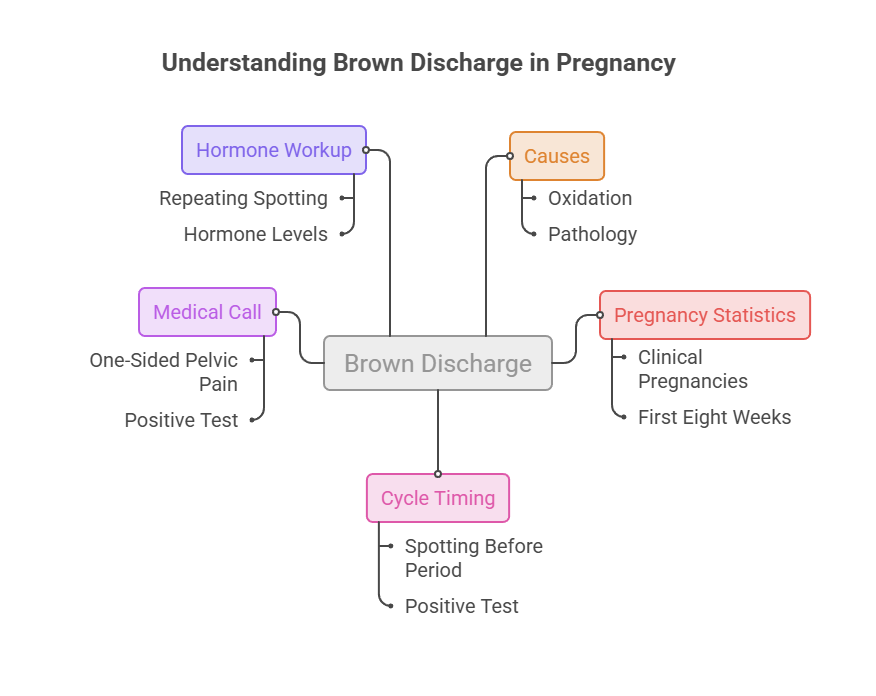
- Brown means old blood, not dangerous blood. Oxidation causes the color, not pathology.
- In a prospective study tracking women daily, only about 9 percent of clinical pregnancies involved any bleeding during the first eight weeks.
- Spotting before an expected period is statistically more likely to precede a period than a positive test.
- Cycle timing separates the possibilities far better than color does.
- A home pregnancy test on the day of your missed period, using first-morning urine, is the practical cutoff.
- Brown discharge plus one-sided pelvic pain plus a positive test is a same-day medical call, not a wait-and-see.
- Brown spotting repeating across three or more cycles deserves a hormone workup rather than reassurance.
What Brown Discharge Before Your Period Actually Is
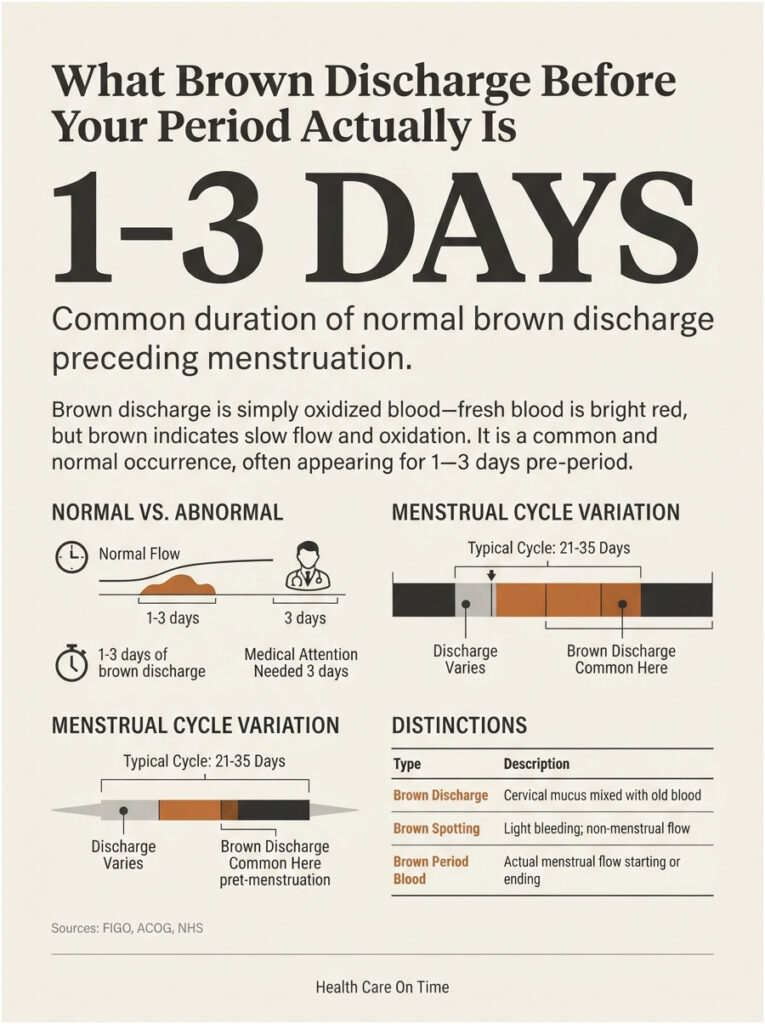
Brown discharge is vaginal discharge mixed with blood that has been sitting around. Blood that leaves the body quickly looks bright red. Blood that moves slowly meets oxygen, the iron in hemoglobin oxidizes, and the color shifts toward rust, dark brown, or nearly black.
That is the whole mechanism. There is nothing inherently abnormal about it.
Patients booking cycle-tracking panels through HealthCareOnTime ask about this more than almost any other menstrual symptom, and the anxiety nearly always attaches to the color rather than the timing or the volume. The color is the least informative part of what you are looking at.
Why Blood Turns Brown
Fresh menstrual blood carries oxygenated hemoglobin, which reflects red light. As blood lingers in the uterus or the vaginal canal, iron oxidizes. The same chemistry browns a cut apple and rusts a nail left out in the rain.
Slow flow gives oxidation time to work. That is why brown discharge appears most reliably at the very start and very end of a period, when flow is lightest.
What Normal Looks Like Across a Cycle
A typical menstrual cycle runs 21 to 35 days, and discharge changes character throughout it. Light brown streaks at certain points are common enough to be unremarkable.
Right after a period, discharge is often scant and may carry brown traces. Around ovulation it turns clear, stretchy, and abundant. In the luteal phase it thickens and turns creamy or white.
In the days before menstruation, progesterone drops and the uterine lining begins loosening. Small amounts of blood trickle out ahead of the main flow and arrive brown instead of red.
The One-to-Three-Day Baseline
Premenstrual brown discharge that lasts one to three days, carries no odor, brings no pain beyond familiar cramping, and leads directly into a recognizable period is the pattern most women describe. That is the baseline everything else gets measured against.
Brown discharge that runs past three days, appears mid-cycle repeatedly, smells foul, or arrives with fever or pelvic pain sits outside that baseline and deserves a closer look.
Discharge, Spotting, and Period Blood Are Not the Same Thing
Three terms get used interchangeably, and the blur makes self-assessment harder than it needs to be.
Brown discharge is cervical mucus tinted by old blood, usually noticed only when wiping. Brown spotting is light bleeding that marks underwear or a liner but never requires a pad or tampon. Brown period blood is actual menstrual flow that happens to look dark, most often on day one or the final day.
Clinicians sort persistent abnormal bleeding using the FIGO PALM-COEIN framework, which separates structural causes (polyps, adenomyosis, leiomyoma, malignancy) from non-structural ones (coagulopathy, ovulatory dysfunction, endometrial, iatrogenic, and not yet classified). Knowing that framework exists explains why a doctor asks about your whole cycle history rather than the shade you saw this morning.
Can Brown Discharge Mean You Are Pregnant? The Honest Answer
Yes, it can. And most of the time it does not. Both statements are true simultaneously, and nearly every article on this topic tells you the first half while quietly skipping the second.
Our medical reviewers flag this as the single most common misconception in the menstrual health questions HealthCareOnTime receives.
What Implantation Bleeding Is Supposed to Be
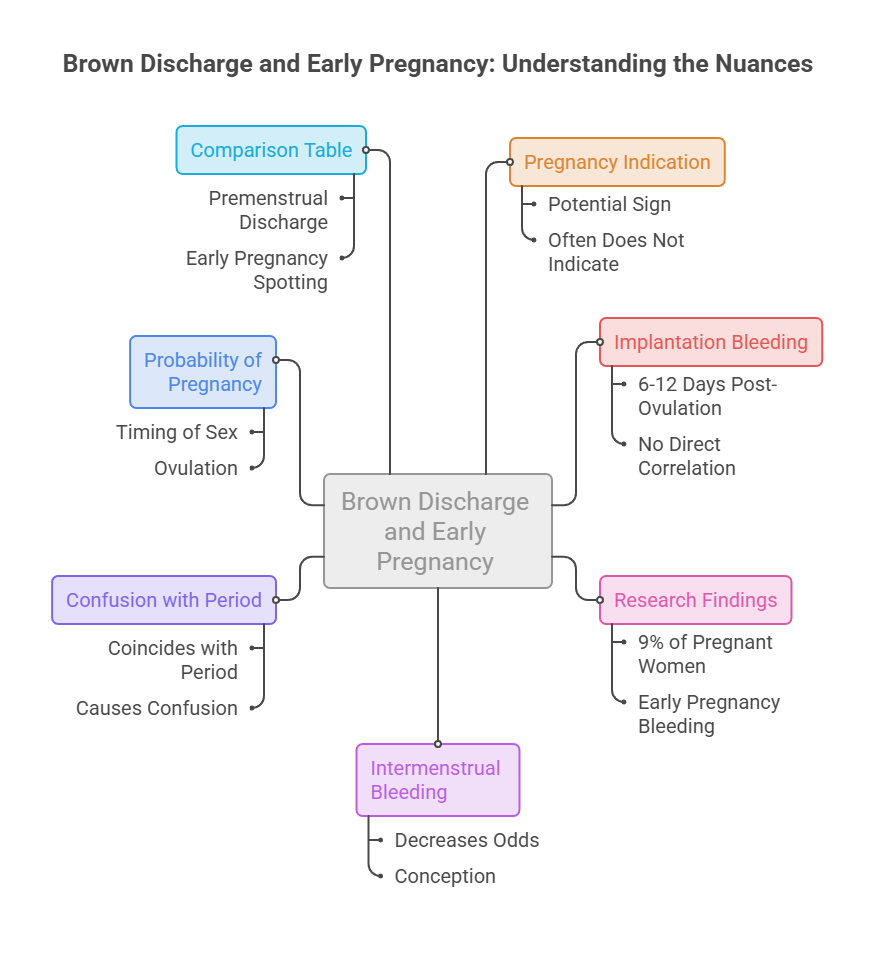
The standard account runs like this. Six to twelve days after ovulation, a fertilized egg burrows into the uterine lining. The process disrupts small blood vessels, releasing a trace of blood that appears a day or two later as pink or brown spotting.
The story is biologically plausible. Implantation genuinely involves tissue invasion, and small vessels genuinely get disrupted.
The problem is that when researchers set out to catch it happening, they could not.
What the Prospective Research Found
The Daily Diary Study
Researchers at the University of North Carolina at Chapel Hill built a study designed to observe this in real time rather than reconstruct it from memory. A total of 221 healthy women kept daily diaries and provided daily urine samples while trying to conceive, and 151 of them became clinically pregnant.
Urine hormone assays pinpointed the exact day of ovulation and the exact day of implantation for every participant. The diaries logged every single day of bleeding.
The finding: 14 women, or 9 percent, recorded at least one day of vaginal bleeding across the first eight weeks of pregnancy. Bleeding clustered around the time women would have expected their periods, but rarely fell on the day of implantation itself.
The authors were direct about it. They found no support for the hypothesis that implantation can produce vaginal bleeding, intercourse did not cause bleeding either, and nearly all women who did bleed went on to have successful pregnancies. The abstract sits in Human Reproduction via PubMed.
Why This Study Still Stands
Published in 2003 and not overturned since. The design is the reason. Recruiting women before conception, collecting daily urine to time ovulation and implantation hormonally, and capturing bleeding prospectively rather than by recall is expensive and slow, and no larger study has repeated it.
Everything published afterward relies on recall, which is exactly the weakness this design was built to remove. Newer is not automatically better when the newer work uses a weaker method.
The Fertility Finding That Points the Other Way
A separate analysis in Fertility and Sterility followed 549 women trying to conceive and examined bleeding between periods specifically. Its conclusion was that intermenstrual bleeding statistically significantly decreases the odds of conceiving in that cycle.
Read that twice, because it inverts the advice circulating online. Spotting before an expected period tracked with lower conception odds, not higher.
Why the Idea Persists Anyway
Two reasons, and neither is dishonest. First, bleeding really does occur in early pregnancy, just not at the moment of implantation. Second, the timing overlap is genuinely confusing.
Early bleeding in clinical pregnancies clusters around the date a period would have been due, which is precisely when someone who conceived that cycle is watching hardest. Correlation gets promoted to causation.
The term also survives because it gives a name to something frightening and makes it sound harmless. That is a real service, even without a proven mechanism behind it.
The Realistic Probability Picture
If you had unprotected sex during your fertile window and you now see brown spotting a few days before your period is due, pregnancy is possible. It is simply not the leading explanation, and the spotting itself does not move the odds upward.
What moves the odds is the timing of sex relative to ovulation and whether your period actually arrives. Not the color of what you are seeing.
| Feature | Premenstrual Brown Discharge | Early-Pregnancy Spotting | Start of Period | Ovulation Spotting | Breakthrough Bleeding |
| Typical cycle day | Day 25 to 28 | Day 24 to 32, often after a missed period | Day 28, counted as cycle day 1 | Day 12 to 16 | Any day, method-dependent |
| Duration | 1 to 3 days | A few hours to 3 days | 4 to 7 days | Under 2 days | 1 to 7 days, often recurring |
| Color | Light to dark brown | Pink, light brown, rarely bright red | Brown then bright red | Pink or light brown | Brown, pink, or rust |
| Volume | Wiping only, or a liner | Wiping only, a few spots | Fills pads or tampons | Wiping only | Liner to light pad |
| Cramping pattern | Familiar premenstrual ache | Mild, lighter than usual cramps | Builds then eases over 48 hours | Brief one-sided twinge | Usually absent |
| Next step | Wait for your period | Test on or after the missed period | None needed | None needed | Track 3 cycles, then discuss |
Timing Is Everything: Reading Your Cycle Day by Day
Color tells you how old the blood is. Timing tells you where it came from. Knowing roughly when you ovulated narrows the field dramatically.
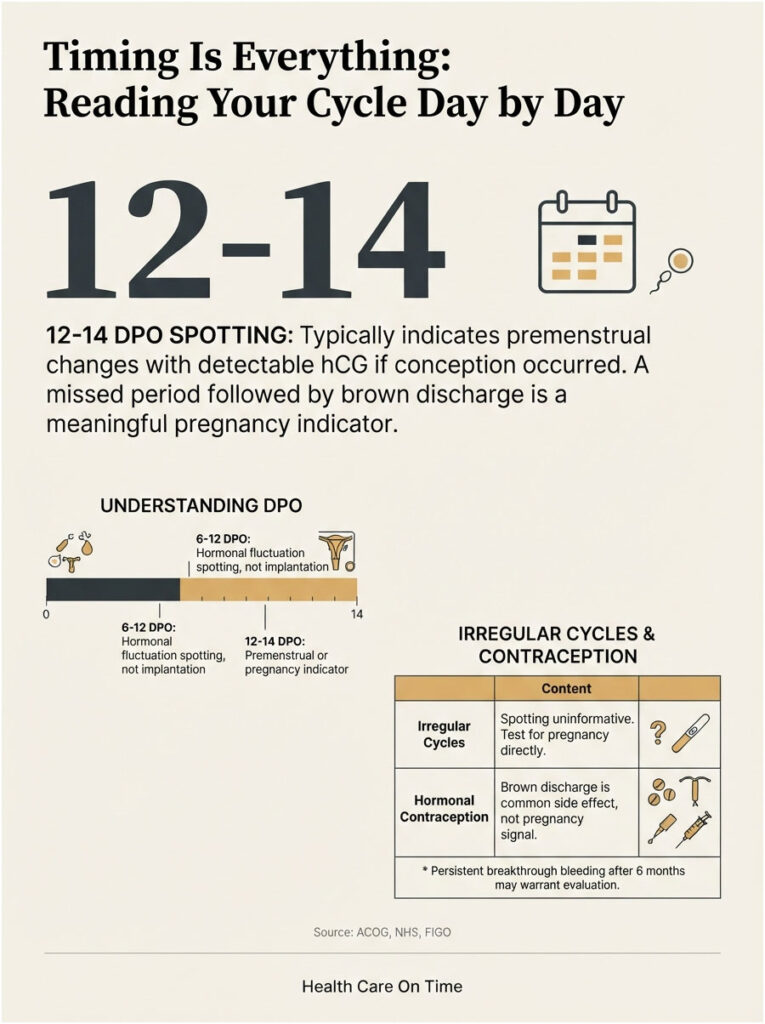
Days past ovulation, written as DPO, is the frame that works. Counting from your last period is less useful, because ovulation day shifts between people and between cycles for the same person.
What Spotting Means at Each Window
Six to Twelve DPO
This is the window the internet assigns to implantation. Brown spotting here is reported often and is entirely real, but the daily-diary evidence suggests implantation itself is rarely the cause.
Hormonal fluctuation is the likelier driver. Estrogen and progesterone are both shifting, and a small dip can destabilize the endometrium enough to release a trace of blood.
A pregnancy test at this stage is close to useless. hCG has not accumulated enough in urine to register on most tests, and a negative here means nothing at all.
Twelve to Fourteen DPO
Brown discharge here is the classic premenstrual pattern. Progesterone is falling, the lining is beginning to release, and the first blood out travels slowly enough to oxidize on the way.
If you did conceive, this is roughly when hCG starts becoming detectable on sensitive tests. A negative result still carries little weight.
After a Missed Period
Here brown discharge finally becomes informative. Spotting with no period arriving on schedule shifts the odds meaningfully toward pregnancy.
Test now. Testing on or after the first day of your missed period matches the guidance from the Office on Women’s Health.
If Your Cycles Are Irregular
Irregular cycles wreck DPO estimation, and they make brown spotting more common in general. Ovulatory dysfunction produces an unstable lining that sheds on no particular schedule.
If your cycle length varies by more than seven to nine days month to month, treat spotting as uninformative and go straight to testing if pregnancy is possible. Waiting for a “missed” period is meaningless when there was never a predictable date to miss.
Cycles that swing this widely across six months deserve their own workup regardless of the spotting question.
If You Are Using Hormonal Contraception
This is the largest overlooked group in the entire conversation. Brown discharge is among the most common side effects of every hormonal method, and it carries no pregnancy signal at all.
Method by Method
Combined pills cause breakthrough bleeding most often during the first three months, and after any missed or late dose. Extended-cycle and continuous regimens produce more spotting, not less, because there is no scheduled withdrawal bleed to clear the lining.
Hormonal IUDs thin the endometrium substantially and commonly cause irregular brown spotting for three to six months after insertion. Many users then stop bleeding altogether, which is expected rather than concerning.
The contraceptive implant is the method most associated with unpredictable spotting, and unlike the others, the pattern often does not settle over time.
Depo-Provera injections typically cause irregular bleeding early, trending toward no bleeding after a year. The vaginal ring behaves much like the combined pill.
If you are using any of these correctly and consistently, brown discharge before an expected withdrawal bleed is the method working, not failing. Persistent breakthrough bleeding past six months is worth a conversation about switching formulations.
When to Take a Pregnancy Test, and Why Timing Beats Brand
Across beta hCG tests booked through HealthCareOnTime, the most common avoidable error is testing three or four days early and then trusting the negative.
How hCG Appears and Rises
Human chorionic gonadotropin is produced only after a fertilized egg implants. It enters the bloodstream first and reaches urine afterward.
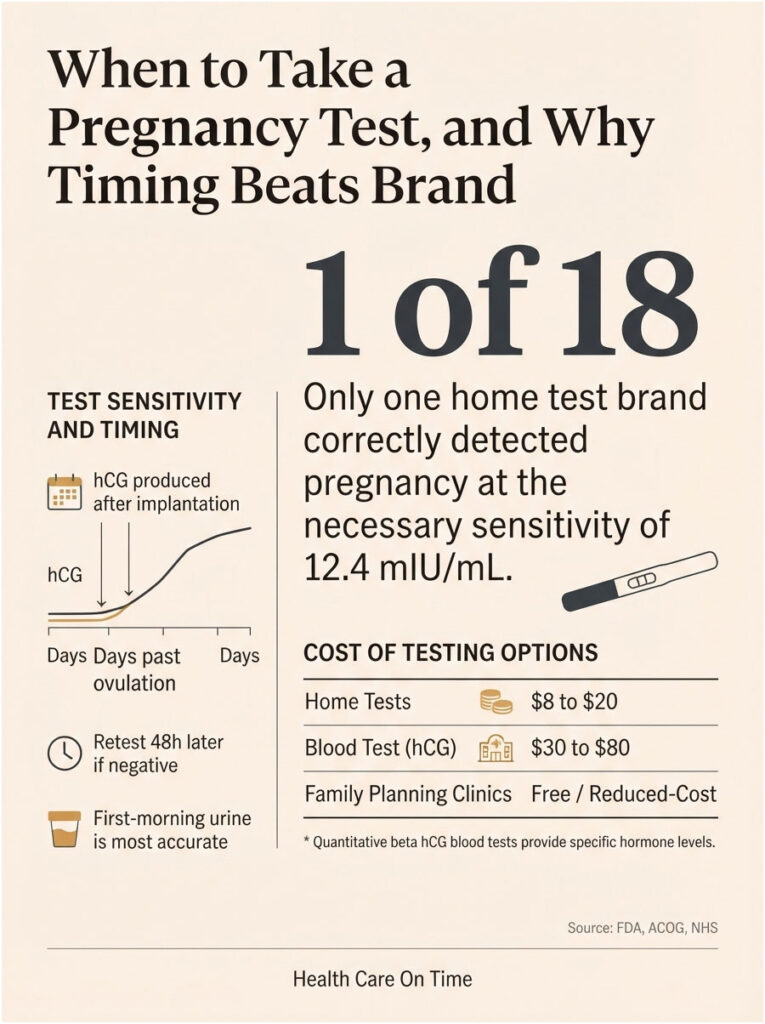
In early pregnancy, hCG in blood and urine rises quickly, roughly doubling every two to three days. That doubling explains why waiting 48 hours can convert a faint negative into an unambiguous positive.
In up to 10 percent of women, implantation does not happen until after the first day of a missed period, so even a well-timed test can miss a real pregnancy.
The Sensitivity Numbers That Actually Matter
Packaging claims and laboratory performance are different things. A study evaluating 18 home pregnancy test brands put real numbers on the gap.
Mean urine hCG after missed menses measured 49 mIU per mL, with a 5th percentile of 12.4 mIU per mL. To confirm intrauterine pregnancies 95 percent of the time, a test needed to detect 12.4 mIU per mL. Of the 18 brands assessed, only one reached that sensitivity, and read at the manufacturer’s suggested time, only 44 percent of brands produced a clearly positive result even at 100 mIU per mL.
A test with 100 mIU per mL sensitivity would catch roughly 16 percent of pregnancies at the time of missed menses. The American Academy of Family Physicians summary carries the full breakdown.
Test chemistry has improved since that evaluation, and several current strips claim detection down to 10 mIU per mL. The point that still holds is that sensitivity varies enormously between products and the number on the box is worth checking before you buy.
Why “Six Days Early” Claims Underperform
Manufacturers advertise detection several days ahead of a missed period, but a 99 percent detection rate refers to performance on the day the period is missed, and assumes optimal timing with instructions followed precisely.
Real-world use rarely matches laboratory conditions. Ovulation shifts, implantation timing varies, and urine gets diluted by ordinary hydration.
Morning Urine, Dilution, and False Negatives
First-morning urine gives the most concentrated hCG reading, and drinking large volumes of fluid beforehand thins the sample. If morning testing is impractical, hold urine for at least three hours first.
A negative result with continuing suspicion warrants retesting one week later, or contacting a clinician. Read the result inside the stated window, since lines appearing hours later are evaporation artifacts rather than positives.
Home Test Versus Quantitative Beta hCG
A home test answers yes or no. A quantitative beta hCG blood test returns an actual number in mIU per mL, which allows tracking over time.
That number becomes important when spotting continues, when pain is present, or when ectopic pregnancy needs ruling out. Two draws 48 hours apart show whether levels are rising the way they should.
Access and Cost in the United States
Home tests run roughly 8 to 20 dollars at any pharmacy, and store-brand strips perform comparably to name brands at a fraction of the price. Dollar-store tests are typically less sensitive, which matters most when testing early.
Title X funded family planning clinics and Planned Parenthood health centers offer pregnancy testing free or on a sliding scale, and many provide same-day results. Community health centers do the same.
A quantitative beta hCG blood test ordered through a lab generally costs 30 to 80 dollars out of pocket, and is usually covered when a clinician orders it for a diagnostic reason. Telehealth visits can produce that order without an in-person appointment in most states.
| Metric | Figure | What It Means for You | Source |
| Clinical pregnancies with any bleeding in first 8 weeks | 9 percent, 14 of 151 women | Early bleeding is uncommon, not typical | Harville et al., Human Reproduction |
| Women reporting first-trimester bleeding, US cohort | About 25 percent, 1,207 of 4,539 | Bleeding across the full trimester is more common than in the first 8 weeks alone | Right From the Start cohort, NIH PMC |
| Heavy bleeding among those who bled | 8 percent | Most early bleeding is spotting, not flow | Right From the Start cohort, NIH PMC |
| Mean urine hCG at missed menses | 49 mIU/mL | Sets the bar a test must clear | Cole et al., via AAFP |
| 5th percentile urine hCG at missed menses | 12.4 mIU/mL | Only the most sensitive tests catch these pregnancies | Cole et al., via AAFP |
| Brands detecting 12.5 mIU/mL | 1 of 18 tested | Sensitivity varies far more than marketing suggests | Cole et al., via AAFP |
| Ectopic pregnancy share of US pregnancies | 1 to 2 percent | Uncommon, and the reason pain plus bleeding is urgent | StatPearls, NIH |
| Ectopic share of pregnancy-related deaths | 2.7 percent | Why the red flags below are non-negotiable | StatPearls, NIH |
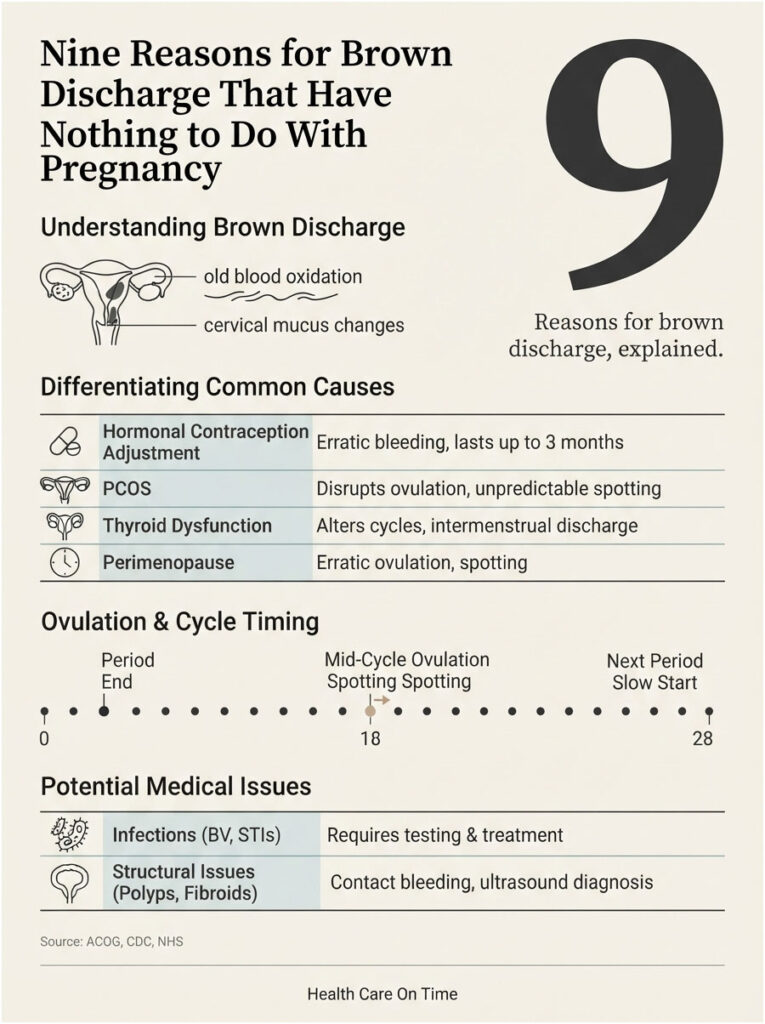
Nine Reasons for Brown Discharge That Have Nothing to Do With Pregnancy
When the test reads negative and the spotting keeps returning, this is the list worth working through in order.
1. Leftover Blood From Your Last Period
The uterus does not always empty completely. Residual blood can sit for several days and exit later as brown discharge, sometimes a full week after flow stopped.
This is the most common explanation of all and needs no treatment.
2. The Slow Start of Your Next Period
Some women open every single cycle with one to two days of brown before red flow appears. If that is your consistent pattern, it is your normal.
Consistency is the reassuring signal. A sudden change in a long-stable pattern is what earns attention.
3. Ovulation Spotting
Around day 12 to 16, the estrogen surge that triggers egg release can briefly destabilize the lining. A minority of women notice pink or light brown discharge for under two days.
It frequently arrives with a short one-sided twinge and resolves without intervention.
4. Hormonal Contraception Adjustment
Covered above, and worth repeating because it explains a large share of cases. Any method delivering progestin thins the endometrium, and thin linings shed erratically.
Give a new method three full months before judging it.
5. PCOS and Ovulatory Dysfunction
Polycystic ovary syndrome disrupts regular ovulation. Without a predictable progesterone rise and fall, the lining builds unevenly and sheds unpredictably, often showing up as brown spotting between widely spaced periods.
Supporting clues include cycles beyond 35 days, acne, unwanted hair growth, and difficulty conceiving. A hormone panel plus pelvic ultrasound is the standard workup.
6. Thyroid Dysfunction
Both underactive and overactive thyroid function alter menstrual patterns. Hypothyroidism tends toward heavier, longer, more frequent bleeding, while hyperthyroidism tends toward lighter and less frequent.
Either can surface as intermenstrual brown spotting. A TSH test is inexpensive and settles the question quickly.
7. Perimenopause
In the years before menopause, ovulation becomes erratic and estrogen swings widely. Brown spotting between increasingly irregular periods is a hallmark of that transition.
Most women enter perimenopause in their mid-forties, though it can start in the late thirties. Bleeding after twelve consecutive months without a period is a different situation entirely.
8. Infection
Bacterial vaginosis, trichomoniasis, chlamydia, gonorrhea, and pelvic inflammatory disease can all produce brown or blood-tinged discharge.
The distinguishing features are odor, itching, burning with urination, pain during sex, and fever. Discharge that smells fishy or foul is not normal at any point in the cycle.
Our lab partners report that a basic STI panel resolves this question faster than any amount of symptom tracking.
9. Structural and Mechanical Causes
Endometrial or cervical polyps, uterine fibroids, and plain cervical irritation from a Pap smear, pelvic exam, or vigorous sex all cause contact bleeding that shows up brown a day or two later.
Polyps and fibroids are the structural categories inside PALM-COEIN, and both are diagnosed by ultrasound rather than by symptom description.
Brown Discharge at Different Life Stages
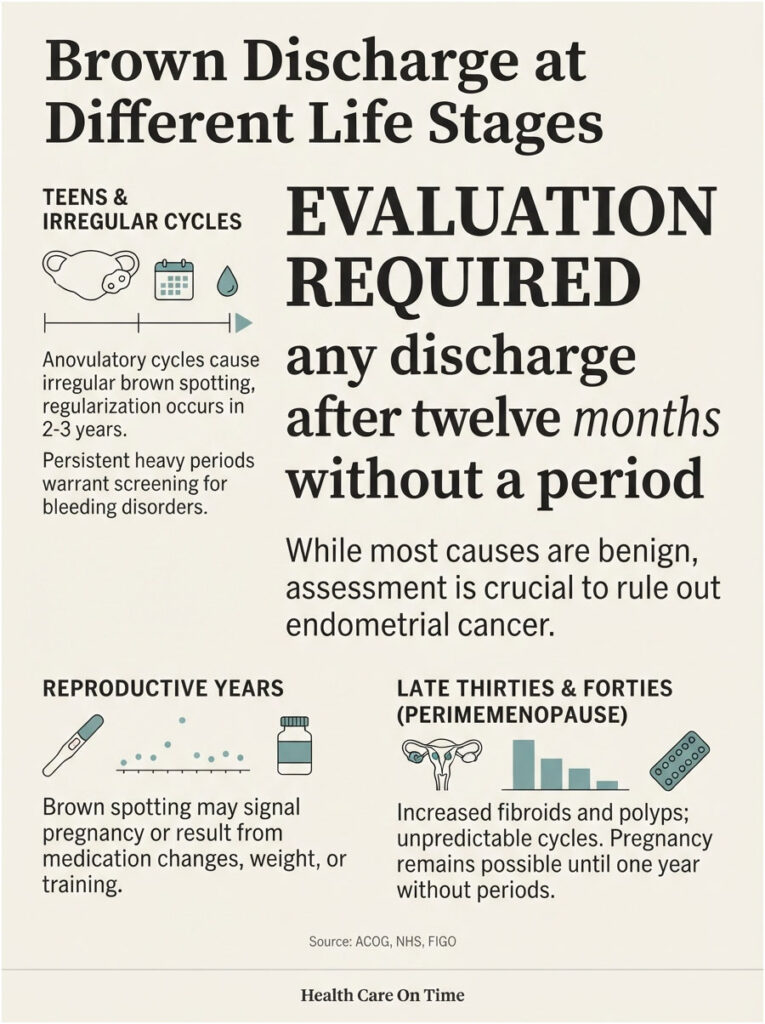
The same symptom carries different weight depending on your age and reproductive stage. Reading it correctly means knowing which baseline applies to you.
Teens and Early Twenties
Cycles in the first few years after menarche are frequently anovulatory, which makes irregular brown spotting expected rather than alarming. Most cycles regularize within two to three years.
Persistent spotting alongside very heavy periods deserves a bleeding disorder screen, since conditions like von Willebrand disease often first show up in adolescence.
Reproductive Years
This is where the pregnancy question dominates, and where the guidance above applies most directly. It is also the stage where contraception, PCOS, thyroid dysfunction, and infection account for most non-pregnancy cases.
Brown spotting that begins after starting a new medication, losing significant weight, or increasing training volume usually traces back to that change.
Late Thirties and Forties
Fibroids and polyps become more common, and perimenopause enters the picture. Cycles shorten before they lengthen, and spotting between periods becomes more frequent.
Pregnancy is still possible during perimenopause, which surprises people. Contraception remains necessary until twelve months have passed without a period.
After Menopause
Any bleeding or brown discharge after twelve consecutive period-free months requires evaluation without exception. Most causes turn out benign, including vaginal atrophy and polyps, but endometrial cancer must be excluded.
This is the one stage where waiting to see whether it repeats is never the right choice.
Red Flags: When Brown Discharge Needs a Same-Day Call
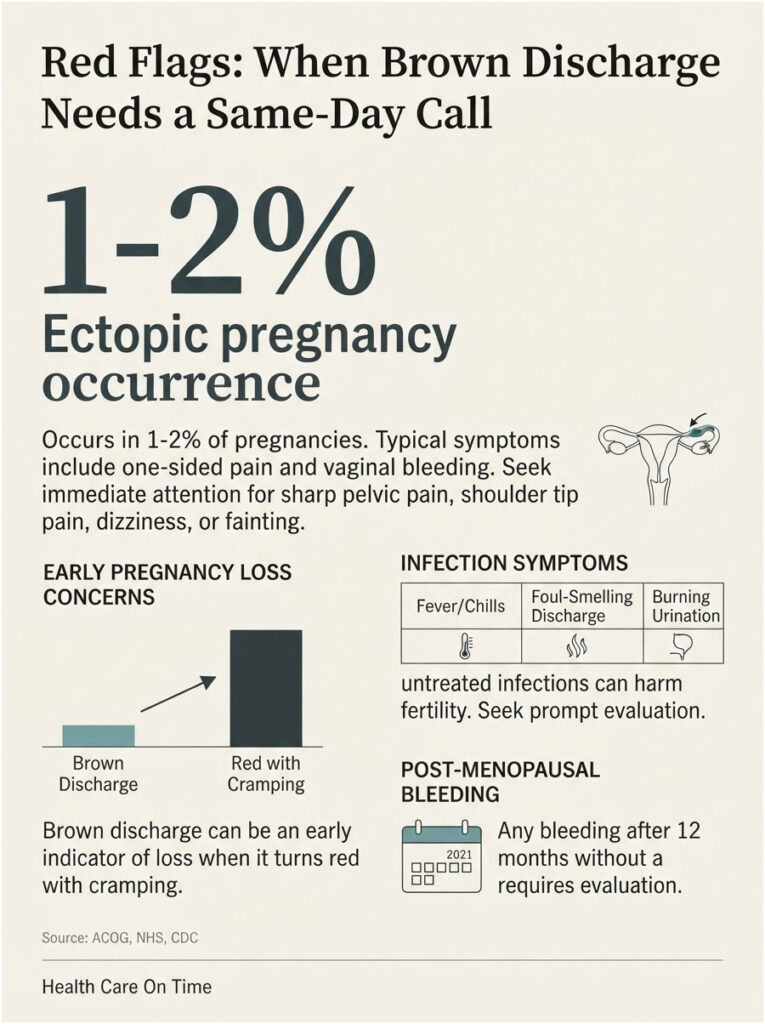
Most brown discharge is uneventful. A small subset is not, and the separator is almost always pain, fever, or a positive pregnancy test.
In cases reviewed across our diagnostic network, one-sided pelvic pain alongside a positive test is the pattern that most often needs same-day imaging.
Ectopic Pregnancy
An ectopic pregnancy occurs when a fertilized egg implants outside the uterine cavity, most often in a fallopian tube. It affects approximately 1 to 2 percent of pregnancies in the United States and accounts for an estimated 2.7 percent of pregnancy-related deaths.
Typical symptoms are lower abdominal pain and vaginal bleeding in early pregnancy, particularly when an intrauterine pregnancy has not been confirmed. Risk factors include pelvic inflammatory disease, smoking, prior ectopic pregnancy, fallopian tube surgery, and infertility.
The StatPearls entry hosted by the NIH covers the clinical picture in full. CDC has tracked ectopic pregnancy incidence and case fatality since 1970 through national surveillance.
The Signs That Cannot Wait
Sharp or persistent pain on one side of the pelvis. Pain at the shoulder tip, which signals internal bleeding irritating the diaphragm. Dizziness, fainting, or rectal pressure.
Any of these with a positive pregnancy test means the emergency department, not the next available appointment.
Early Pregnancy Loss
Brown discharge that becomes red bleeding with cramping and passage of tissue, in a confirmed pregnancy, suggests miscarriage. Roughly 10 to 15 percent of recognized pregnancies end this way, the large majority in the first trimester.
Bleeding alone is a poor predictor. In the Right From the Start cohort, 12 percent of women with bleeding and 13 percent of those without went on to miscarry, a difference small enough to matter less than most people fear when they see it.
Infection Warning Signs
Fever, chills, foul-smelling discharge, burning with urination, or general malaise alongside brown discharge points toward infection rather than cycle variation. Untreated pelvic inflammatory disease can damage fertility permanently.
Bleeding After Menopause
Restated because it is the most consequential single rule in this article. Any bleeding after twelve period-free months needs evaluation, promptly, every time.
| Your Situation | Most Likely Explanation | Recommended Action | Timeframe |
| Brown discharge 1 to 3 days before an on-time period, no pain | Oxidized blood starting your period | No action needed, note it in a cycle log | Ongoing |
| Brown spotting, period now 3 or more days late, sexually active | Possible pregnancy | Take a home test with first-morning urine | Today |
| Brown spotting, negative test, period still absent after 7 more days | Late implantation, anovulation, or hormonal issue | Retest, then book a beta hCG and hormone panel | Within 1 week |
| Brown discharge with foul odor, itching, or burning | Bacterial vaginosis, yeast, or STI | Book an STI and vaginal infection panel | Within 48 hours |
| Brown discharge, positive test, one-sided pelvic or shoulder pain | Possible ectopic pregnancy | Go to an emergency department | Immediately |
| Brown spotting between periods for 3 or more consecutive cycles | Ovulatory dysfunction, polyps, thyroid issue, or PCOS | Book thyroid profile, hormone panel, pelvic ultrasound | Within 2 to 4 weeks |
| Any brown discharge 12 or more months after your last period | Atrophy, polyp, or endometrial pathology | Contact a gynecologist for evaluation | Within 1 week |
What to Do Next: A Five-Step Plan
Patients who arrive at an appointment with a written two-cycle log reach an answer faster, in our experience, than those describing symptoms from memory.
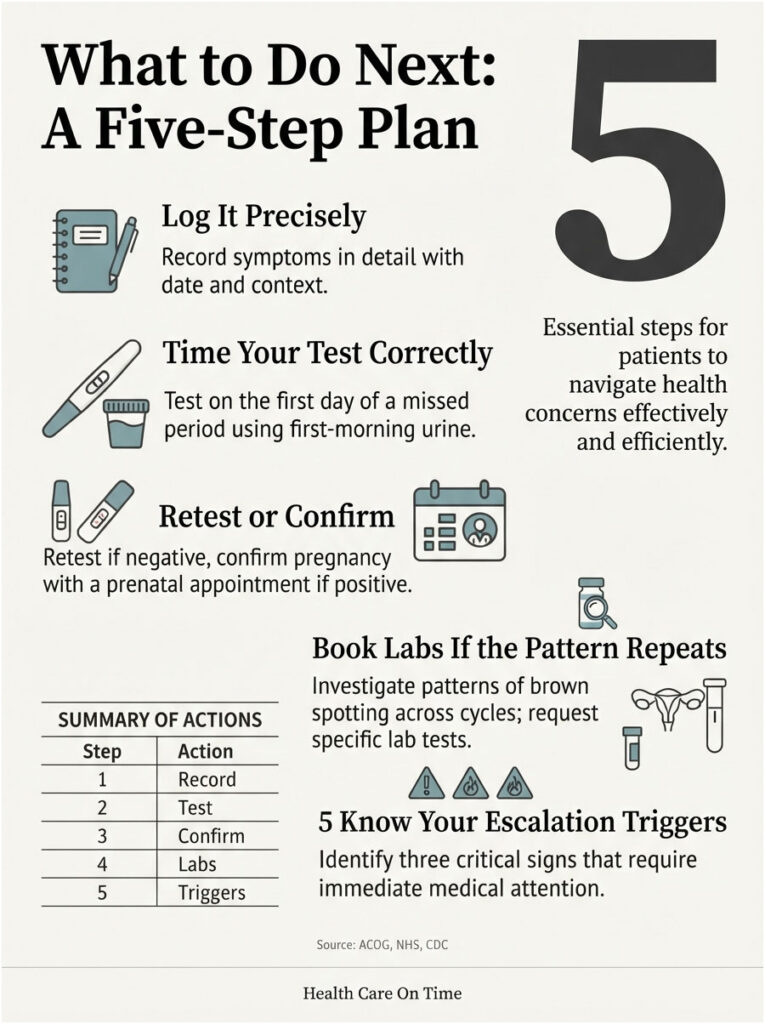
Step 1: Log It Precisely
Record the date, the cycle day, the color, whether it appeared on a liner or only when wiping, and any pain, odor, or accompanying symptom. Note the date of your most recent unprotected sex.
Apps work. So does a notes file on your phone. Precision matters more than the format.
Step 2: Time Your Test Correctly
If pregnancy is possible, wait for the first day of your missed period. Use first-morning urine. Pick a test that prints its sensitivity in mIU per mL and choose the lowest number available.
Testing earlier is not harmful, but a negative before your period is due tells you close to nothing.
Step 3: Retest or Confirm
A negative test with no period after another seven days means retest. A positive test means booking a prenatal appointment to confirm and date the pregnancy.
Step 4: Book Labs If the Pattern Repeats
Brown spotting across three or more cycles is a pattern, and patterns get investigated rather than waited out.
Which Panels Are Worth Requesting
A thyroid profile including TSH. A reproductive hormone panel covering FSH, LH, estradiol, and prolactin. A complete blood count to check for anemia from cumulative blood loss. An STI panel if any infection symptom is present. A quantitative beta hCG if pregnancy has not been excluded.
Ask about a pelvic ultrasound if bleeding is heavy, painful, or has changed character over the past year.
Step 5: Know Your Escalation Triggers
Write down the three signs that mean stop tracking and get seen: severe or one-sided pain, fever, and soaking a pad in under an hour. Everything else can wait for a scheduled appointment, which is worth knowing at 2am when the internet is trying to convince you otherwise.
Frequently Asked Questions
Can brown discharge before your period mean you are pregnant?
It can, but it is a weak indicator on its own. Brown discharge is old, oxidized blood, and most cases before a period come from the previous cycle or the start of the next. Prospective research found early pregnancy bleeding in only about 9 percent of clinical pregnancies. Test on the day your period is due.
How many days before a period does implantation bleeding usually happen?
Popular sources place it 6 to 12 days after ovulation, meaning roughly 2 to 8 days before an expected period. The prospective evidence is far weaker than that specificity implies, since early pregnancy bleeding tended to occur near the expected period date rather than on the implantation day itself.
What color is implantation bleeding?
Descriptions cluster around light pink to brown rather than bright red, reflecting small volume and slow transit. Color alone cannot separate it from premenstrual spotting, ovulation spotting, or breakthrough bleeding on contraception. Timing relative to your missed period and a properly timed pregnancy test are far more useful than shade.
How long does implantation bleeding last?
Reported duration runs from a few hours to about three days, always lighter than a period. Menstrual bleeding typically lasts four to seven days and grows heavier before tapering off. Bleeding that fills pads or tampons, or continues past three days, is unlikely to match the pattern described for implantation.
Is dark brown discharge before a period normal?
Usually yes. Darker shades simply mean the blood spent longer oxidizing, not that something is wrong. Dark brown discharge for one to three days before a period, with no odor, itching, fever, or unusual pain, sits within the common range. Change from your own established pattern matters more than the shade itself.
Can you have brown discharge, a negative pregnancy test, and still be pregnant?
Yes. In up to 10 percent of women implantation happens after the first day of a missed period, so hCG may not have reached detectable levels yet. Test sensitivity also varies widely between brands. Retest one week later using first-morning urine, or request a quantitative beta hCG blood test.
Does brown discharge before a period mean your period is coming?
Often, yes. Falling progesterone loosens the uterine lining, and the first small amount of blood moves slowly enough to oxidize before it appears. If your period reliably follows brown discharge within one to three days every cycle, that sequence is simply how your body begins menstruating.
Can stress cause brown discharge before your period?
Indirectly, yes. Sustained stress raises cortisol, which can suppress the hormonal signals driving ovulation. Disrupted ovulation leaves an unstable uterine lining that sheds unpredictably, sometimes as brown spotting. Major weight change, intense training, illness, and long-haul travel act through the same pathway and produce similar effects.
Is brown discharge before a period a sign of PCOS?
It can be one feature among several, though never diagnostic alone. PCOS disrupts regular ovulation, and irregular shedding often appears as brown spotting between long or unpredictable cycles. Look for cycles beyond 35 days, acne, unwanted hair growth, or difficulty conceiving. Diagnosis requires a hormone panel and pelvic ultrasound.
Why does brown discharge happen before a period on birth control?
Hormonal methods thin the uterine lining, and thin linings shed erratically. Breakthrough bleeding is most common during the first three months on a new method, after a missed or late pill, and with implants or hormonal IUDs. It reflects the method working as designed rather than contraceptive failure.
Can brown discharge before a period signal perimenopause?
Yes. During the transition years, ovulation becomes irregular and estrogen fluctuates widely, producing spotting between increasingly unpredictable periods. Most women enter perimenopause in their mid-forties. Bleeding after twelve consecutive months without a period is a separate situation that always requires medical evaluation.
When is brown discharge before a period an emergency?
Seek immediate care for brown discharge with a positive pregnancy test plus one-sided pelvic pain, shoulder-tip pain, dizziness, or fainting, since these can indicate ectopic pregnancy. Also seek prompt care for fever, foul-smelling discharge, soaking a pad hourly, or any bleeding occurring after menopause.
Medical Disclaimer: This article is for general education and does not replace personalized medical advice, diagnosis, or treatment. Menstrual bleeding patterns vary widely between individuals, and the same symptom can have very different causes in different people. Contact a licensed healthcare professional about any new, persistent, or worsening symptom, and seek emergency care immediately for the red flags described above.
References
- Vaginal bleeding in very early pregnancy, Harville et al., Human Reproduction, PubMed
- Patterns and Predictors of Vaginal Bleeding in the First Trimester, Right From the Start cohort, NIH PMC
- Characteristics of prospectively measured vaginal bleeding among women trying to conceive, NIH PMC
- Accuracy of Early Results with Home Pregnancy Test Kits, American Academy of Family Physicians
- Ectopic Pregnancy, StatPearls, National Library of Medicine
- Ectopic Pregnancy Surveillance, CDC MMWR
- Pregnancy tests, Office on Women’s Health, US Department of Health and Human Services
- Home pregnancy tests: Can you trust the results?, Mayo Clinic
- Pregnancy Test: When To Take, Types and Accuracy, Cleveland Clinic
- How early can home pregnancy tests show positive results?, UT Southwestern Medical Center