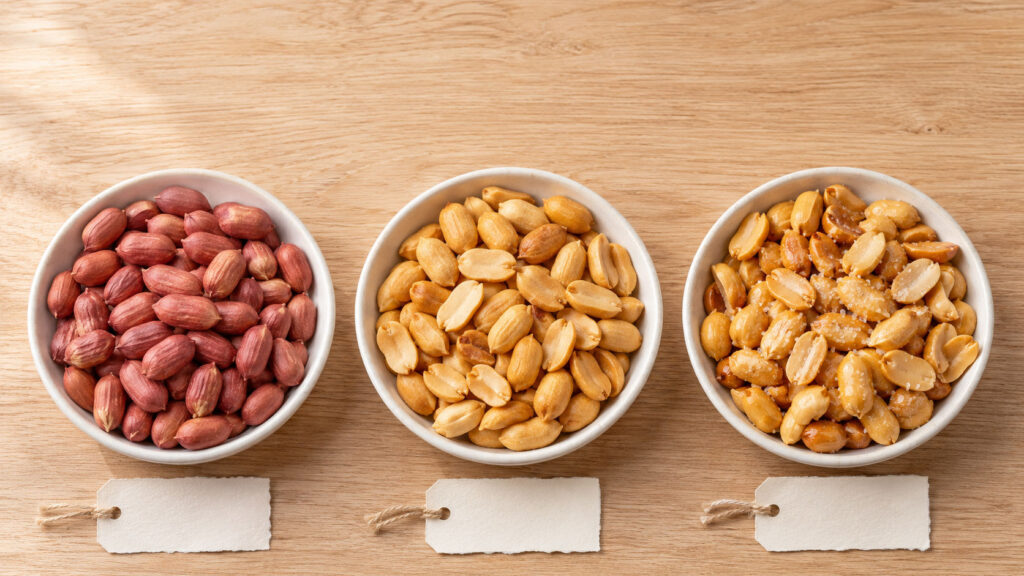
Gram for gram, raw and dry-roasted peanuts are close to identical in calories, protein and fat, because roasting mostly drives off water. Salt, and sometimes oil, changes a peanut snack far more than the oven does.
Table of Contents
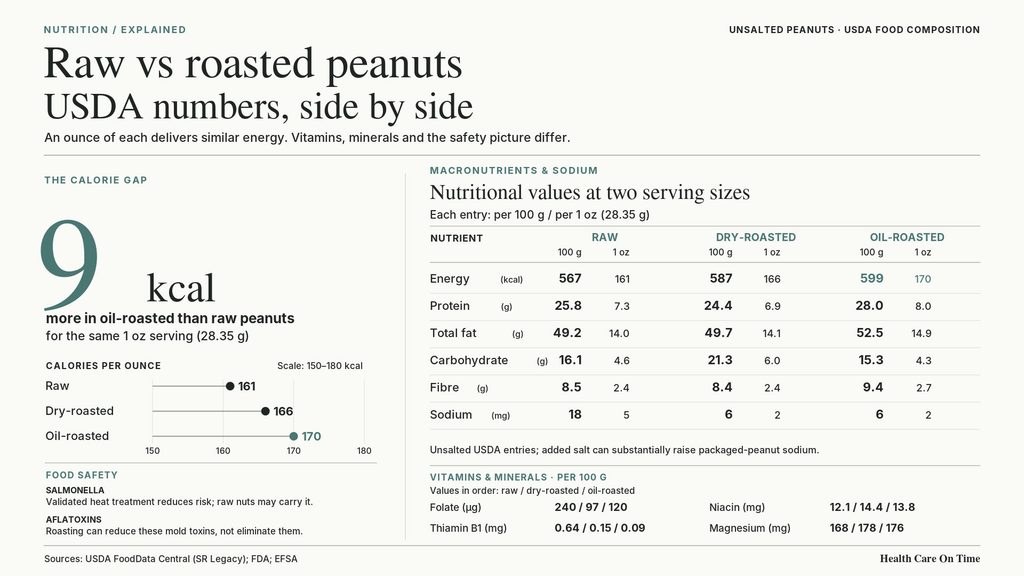
Quick Answer: Raw peanuts have 161 calories, 7.3 g of protein and 14 g of fat per ounce. Dry-roasted peanuts have 166 calories, 6.9 g of protein and 14.1 g of fat. Oil-roasted peanuts have 170 calories and 14.9 g of fat. The biggest real difference is sodium: about 5 mg per ounce raw versus 116 mg for salted dry-roasted. For most people, unsalted dry-roasted peanuts are the best everyday choice.
Raw vs Roasted Peanuts Nutrition, Ounce by Ounce
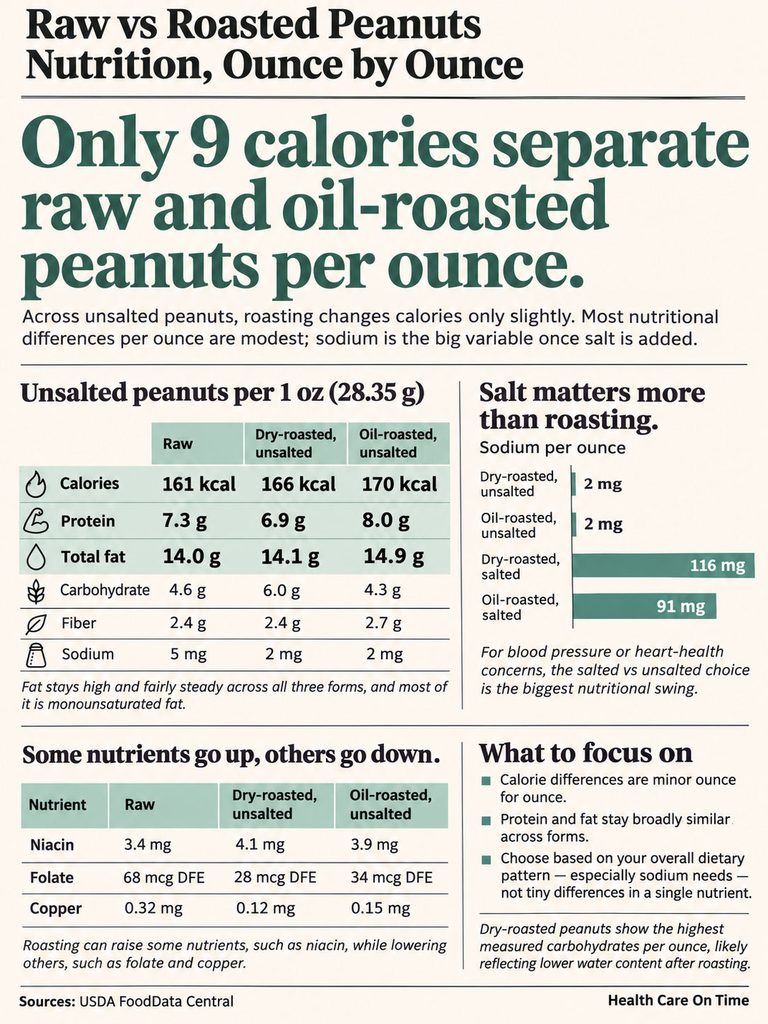
The figures below are from USDA FoodData Central and use its “all types” records, which blend Runner, Virginia, Spanish and Valencia peanuts. Each cell gives the amount in a 1-ounce serving (28.35 g) first and the amount per 100 g in parentheses, so you can line it up with a snack bag or with a recipe that’s written in grams.
| Per 1 oz (per 100 g) | Raw | Dry-roasted, unsalted | Dry-roasted, salted | Oil-roasted, unsalted | Oil-roasted, salted |
| Calories | 161 (567) | 166 (587) | 166 (587) | 170 (599) | 170 (599) |
| Protein, g | 7.3 (25.8) | 6.9 (24.4) | 6.9 (24.4) | 7.9 (28.0) | 7.9 (28.0) |
| Total fat, g | 14.0 (49.2) | 14.1 (49.7) | 14.1 (49.7) | 14.9 (52.5) | 14.9 (52.5) |
| Saturated fat, g | 1.8 (6.28) | 2.2 (7.7) | 2.2 (7.72) | 2.5 (8.7) | 2.5 (8.65) |
| Carbohydrate, g | 4.6 (16.1) | 6.0 (21.3) | 6.0 (21.3) | 4.3 (15.3) | 4.3 (15.3) |
| Fiber, g | 2.4 (8.5) | 2.4 (8.4) | 2.4 (8.4) | 2.7 (9.4) | 2.7 (9.4) |
| Sodium, mg | 5.1 (18) | 1.7 (6) | 116 (410) | 1.7 (6) | 90.7 (320) |
The calorie spread is only 161, 166 and 170, roughly one extra peanut’s worth for dry-roasted and a peanut and a half for oil-roasted. Most of that gap is concentration. A raw peanut holds 6.5 g of water per 100 g and a dry-roasted one holds 1.81 g, so once the water is gone, an ounce of roasted peanuts simply contains a little more peanut.
You’d never notice the protein gap across a day of eating: 7.3 g per ounce raw against 6.9 g dry-roasted. Fat is almost the same, 14.0 g versus 14.1 g, and in all three forms most of it is monounsaturated, with 24.4 g per 100 g in raw peanuts, 26.2 g dry-roasted and 26.0 g oil-roasted. The oil-roasted record shows the most protein of all, 7.95 g per ounce in the salted entry, and the reason has nothing to do with oil (the next section gets to it).
In the USDA records, salted and unsalted roasted peanuts match on every nutrient but sodium. Salting lifts dry-roasted peanuts to 116 mg per ounce and oil-roasted to 90.7 mg, while the unsalted versions stay at 1.7 mg, which makes the bottom row of the table the one that really separates these snacks.
Carbohydrate is the other number that jumps, from 16.1 g per 100 g raw to 21.3 g in the dry-roasted record, even though fiber barely moves (8.5 g versus 8.4 g). Some of that rise is water loss. A fresh peanut can’t gain carbohydrate in a hot oven, though, so part of it has to be sample-to-sample variation.
Why the vitamin and mineral numbers look so far apart
In the full USDA records, a few vitamins and minerals seem to collapse after roasting.
| Per 100 g | Raw | Dry-roasted | Oil-roasted |
| Iron, mg | 4.58 | 1.58 | 1.52 |
| Folate, mcg | 240 | 97 | 120 |
| Thiamin (B1), mg | 0.64 | 0.15 | 0.085 |
| Vitamin E, mg | 8.33 | 4.93 | 6.94 |
| Niacin (B3), mg | 12.1 | 14.4 | 13.8 |
| Magnesium, mg | 168 | 178 | 176 |
| Potassium, mg | 705 | 634 | 726 |
Iron falling from 4.58 mg to 1.58 mg looks alarming until you remember that iron is a mineral and can’t cook off in an oven. Each of these records was analyzed from its own batch of peanuts, so the gaps are a mix of real processing losses and ordinary differences between samples, the same reason niacin and magnesium come out slightly higher after roasting and the oil-roasted record shows extra protein.
Thiamin and folate are heat-sensitive B vitamins, and some real loss during roasting is expected, even though its exact size can’t be read from records built on different samples. Vitamin E has been measured directly on the same peanuts before and after roasting. Dry roasting at 320°F (160°C) for 20 minutes cut total tocopherols by 18%, most of it gamma-tocopherol (down about 20%), while alpha-tocopherol, the form your body holds onto, fell only about 5%, and roasting at 284 to 302°F (140 to 150°C) caused no meaningful loss at all.
A raw peanut does start out ahead on a few vitamins, much as raw spinach keeps more of its vitamin C than cooked spinach, but the margin disappears inside a normal diet. When Tufts nutrition researchers looked at raw, dry-roasted and oil-roasted nuts in the USDA data, they judged the vitamin and mineral differences too small to matter in the context of an overall eating pattern.
What Heat Does Inside a Peanut
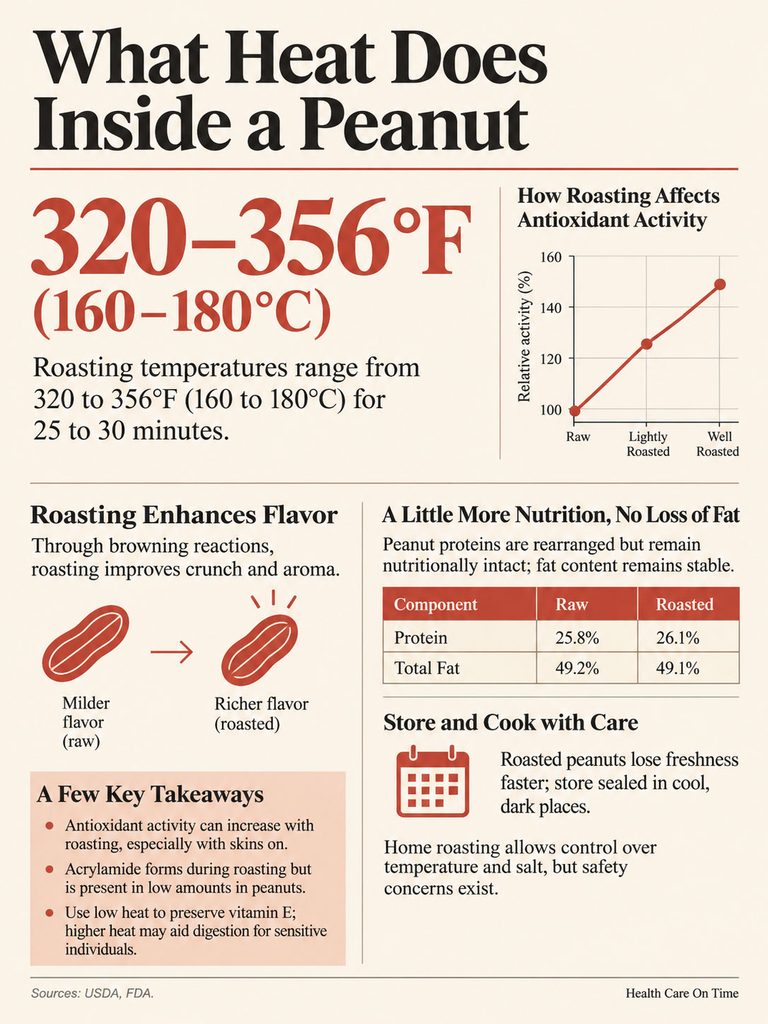
Commercial roasters typically run peanuts at 320 to 356°F (160 to 180°C) for 25 to 30 minutes. That dries the kernel, darkens it and builds the roasted flavor through browning reactions between sugars and proteins, the same chemistry that browns toast. Flavor, aroma and crunch are the main reasons nuts get roasted at all.
Does roasting damage the protein or fat?
Heat unfolds and rearranges peanut proteins, and you can taste and hear the result in the crunch, but the amino acids are still there for your body to use. Peanut fat handles roasting temperatures well; total fat and the monounsaturated share hardly change between the raw and dry-roasted records.
Once the jar is open, though, roasted peanuts go stale faster than raw ones. Keep them sealed in a cool cupboard, or in the fridge if you buy in bulk, and throw out any that smell like old paint or crayons, a sign the oils have oxidized.
Do roasted peanuts lose their antioxidants?
Some compounds drop and others climb, and the skins decide a lot of it. When researchers roasted peanut kernels at 320°F (160°C) for up to 50 minutes, antioxidant activity rose significantly. Peanuts roasted with their thin red skins on showed the largest gains in p-coumaric acid and quercetin between 30 and 50 minutes, while in skinless kernels the phenolic compounds rose at first and then fell after about 20 minutes.
Many store-bought roasted peanuts are blanched first, a quick heat step that loosens those skins so they can be blown off for looks and a milder taste. That takes the skins’ plant compounds with them. Keeping the skins on when you roast at home holds on to those compounds and adds a little fiber.
Resveratrol, the compound best known from red wine, ends up highest in boiled peanuts and lowest in roasted ones, though none of the amounts are large. An analysis of commercial peanut products measured an average of 0.055 micrograms per gram in roasted peanuts, 0.324 in peanut butter and 5.138 in boiled peanuts, with a single fresh sample at 0.070.
Should you worry about acrylamide?
Acrylamide forms when sugars react with an amino acid called asparagine during high-temperature cooking such as frying, roasting and baking; boiling and steaming don’t typically produce it. Because very high doses caused cancer in animals, the FDA tracks it in foods like fries, chips and coffee.
Roasted peanuts are a minor source. Retail roasted peanuts in one survey carried roughly 6 to 43 micrograms per kilogram, and FDA testing of peanuts and cashews found levels that were very low or undetectable. A 1-ounce serving weighs 0.028 kg, so even a peanut at the top of that range would deliver about 1.2 micrograms. That’s a trace, and nothing in the research suggests roasted peanuts are a meaningful acrylamide source in an American diet.
Roasting raw peanuts at home
Roasting your own gives you control over temperature and salt. Spread shelled raw peanuts in a single layer on a sheet pan, as you would for roasted Brussels sprouts, and stir every few minutes so the kernels at the edges don’t scorch before the middle ones color. Pull them a shade lighter than you want, because they keep cooking from their own heat on the pan, and let them cool before you judge doneness.
Lower heat, around 284 to 302°F (140 to 150°C), protects vitamin E. If raw peanuts upset your stomach, hotter and longer roasting is the better bet, since the lectin testing that found nothing left used conditions close to a commercial roast. A home oven also can’t promise the Salmonella kill an industrial roaster is validated to deliver, since ovens heat unevenly and nobody is checking kernel temperatures, so people at higher risk from food poisoning are better off with store-bought roasted peanuts.
Salt after roasting, if at all. A measured pinch, or a toss with smoked paprika, cumin or cinnamon, gives plenty of flavor for a fraction of the sodium in a can of cocktail peanuts.
Dry-Roasted vs Oil-Roasted Peanuts
Oil-roasted peanuts are cooked in hot oil, usually peanut or another vegetable oil, and absorb only a little of it. Total fat goes from 49.7 g per 100 g in dry-roasted peanuts to 52.5 g in oil-roasted, and calories go from 587 to 599, which per ounce means 14.1 g of fat versus 14.9 g and 166 calories versus 170. Saturated fat edges up too, to 2.45 g per ounce from 2.19 g. If the oil is a refined vegetable oil, nearly all of the added fat is unsaturated. Taste is the bigger difference. Oil-roasted peanuts come out a little richer and more evenly browned, while dry-roasted ones are drier and more brittle, and most people simply have a favorite.
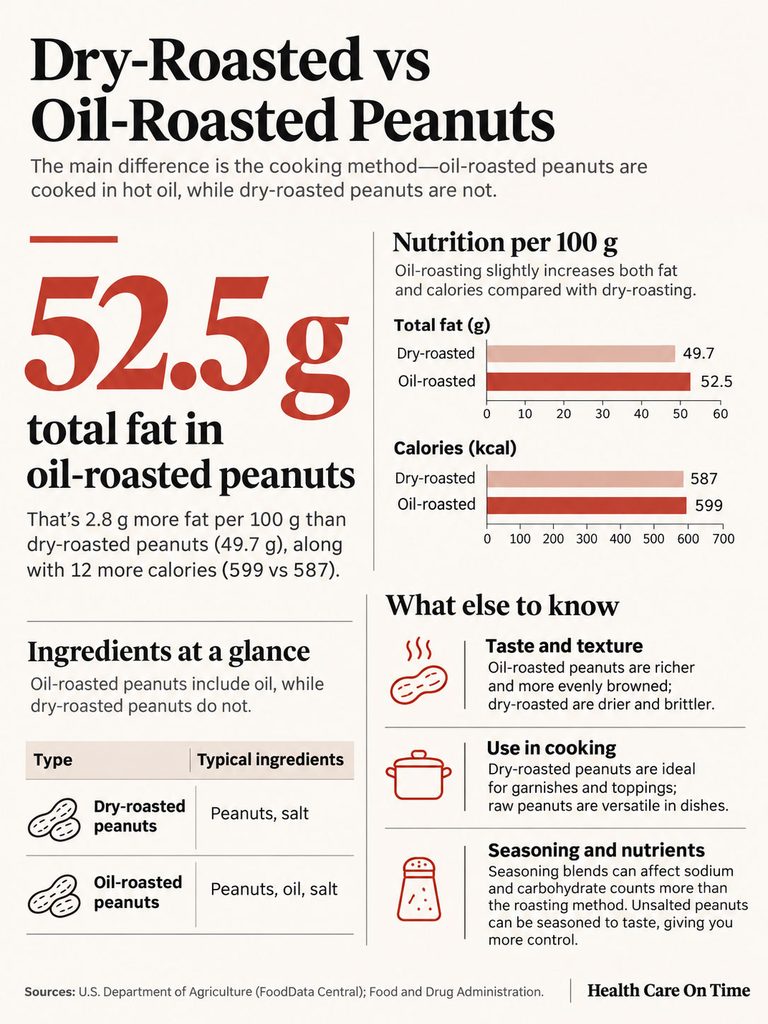
The ingredient list tells you which kind you’re holding. Dry-roasted peanuts list peanuts, and sometimes salt; oil-roasted ones list peanuts plus an oil such as peanut, cottonseed or sunflower. Some jars sold as “dry-roasted” also carry a seasoning blend with sugar, cornstarch, spices or flavor enhancers, and that blend shifts the sodium and carbohydrate numbers by more than the roasting method does.
In cooking, the choice comes down to texture and how much control you want. Raw peanuts take on the flavor of whatever they’re cooked with, so they suit slow-simmered dishes, stews and homemade peanut sauces where you’ll toast or grind them yourself, while dry-roasted peanuts are the easy pick for sprinkling over salads, noodles, stir-fries and oatmeal at the end. If a recipe calls for salted peanuts as a garnish, unsalted ones plus a little salt you add yourself give the same crunch and let you decide how much sodium the dish really needs, which is handy when the sauce already leans on soy sauce or fish sauce.
Salt Changes More Than Roasting Does
The American Heart Association advises no more than 2,300 mg of sodium a day and an ideal limit of 1,500 mg for most adults. Americans average more than 3,300 mg.
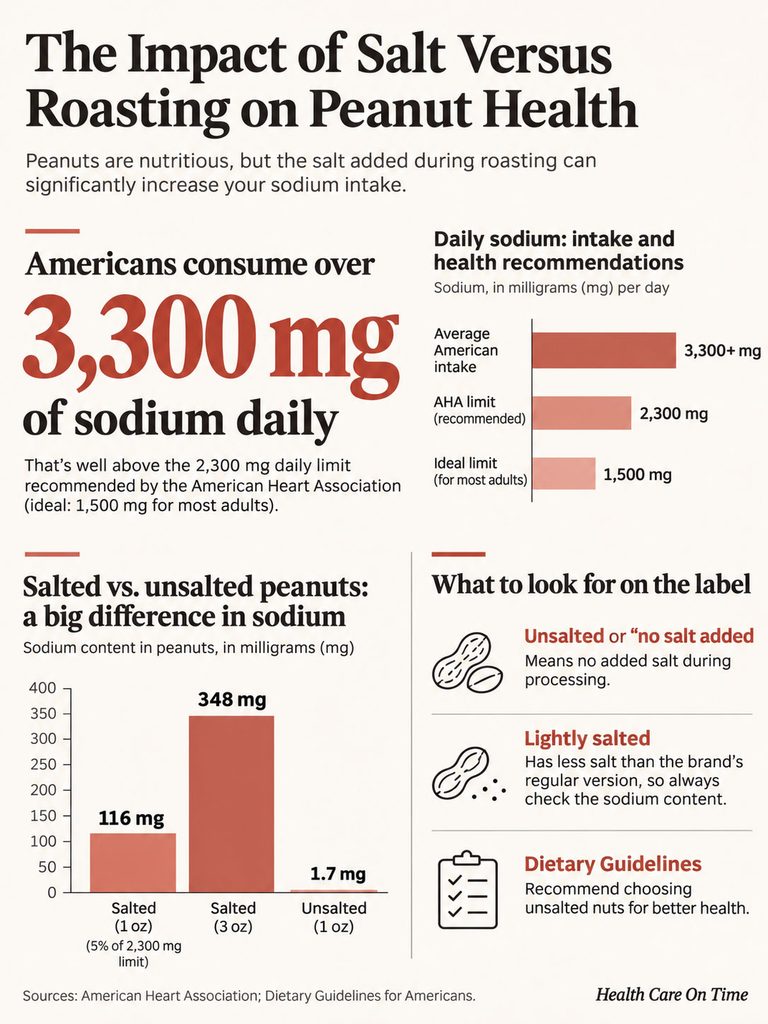
On paper, one ounce of salted dry-roasted peanuts looks harmless at 116 mg, about 5% of a 2,300 mg day. Few people stop at an ounce from an open can, though, and three ounces during a ballgame brings 348 mg, before you count any branded peanuts salted more heavily than the USDA average. Unsalted peanuts give you the same calories, protein and fat with 1.7 mg of sodium per ounce. If you have high blood pressure, kidney disease or heart failure, or your doctor has you on a sodium limit, salted versus unsalted is the choice worth making carefully; raw versus roasted barely registers next to it.
The Dietary Guidelines for Americans put peanuts in the nuts and seeds group within protein foods and call for unsalted nuts. Under the FDA’s updated “healthy” claim rule, announced in December 2024, nuts and seeds with no added ingredients except water qualify automatically, and the saturated fat that occurs naturally in nuts doesn’t count against them, so a jar of plain unsalted peanuts fits the definition while seasoned versions are judged on what was added.
On the front of the bag, “unsalted” and “no salt added” mean nothing was salted during processing, and the peanut’s own trace of sodium is all that’s left. “Lightly salted” only means less salt than that brand’s regular version, so the sodium line on the back is the number to trust. Honey-roasted and flavored peanuts usually add both sugar and salt. Salted peanuts in the shell carry the salt on the outside, where it ends up on your fingers and lips as you crack them.
Are Raw Peanuts Safe to Eat?
For most healthy adults eating normal amounts, yes, though raw peanuts carry two specific food-safety issues that roasting reduces, aflatoxin and Salmonella, along with the anti-nutrients that heat also breaks down.
| Safety numbers for US peanuts | Figure | Source |
| FDA action level for aflatoxin in peanuts for human food | 20 ppb | FDA action levels guidance |
| Average cut in aflatoxin by roasting (19 trials) | B1 46.91%, B2 30.66%, G1 40.88%, G2 26.19% | Emadi et al., Crit Rev Food Sci Nutr, 2022 |
| Raw shelled US peanut samples positive for Salmonella | 2.33% of 944 | Calhoun et al., J Food Prot |
| Raw shelled US peanut samples positive for Salmonella, seven crop years | 1.63% of 2,506 | Calhoun, Peanut Science, 2020 |
| People sickened in the 2008-2009 PCA Salmonella outbreak | 714 in 46 states | CDC |
| US children with peanut allergy | 2.2% | Gupta et al., Pediatrics, 2018 |
| US adults with peanut allergy | 1.8% | Gupta et al., JAMA Network Open, 2019 |
Aflatoxin
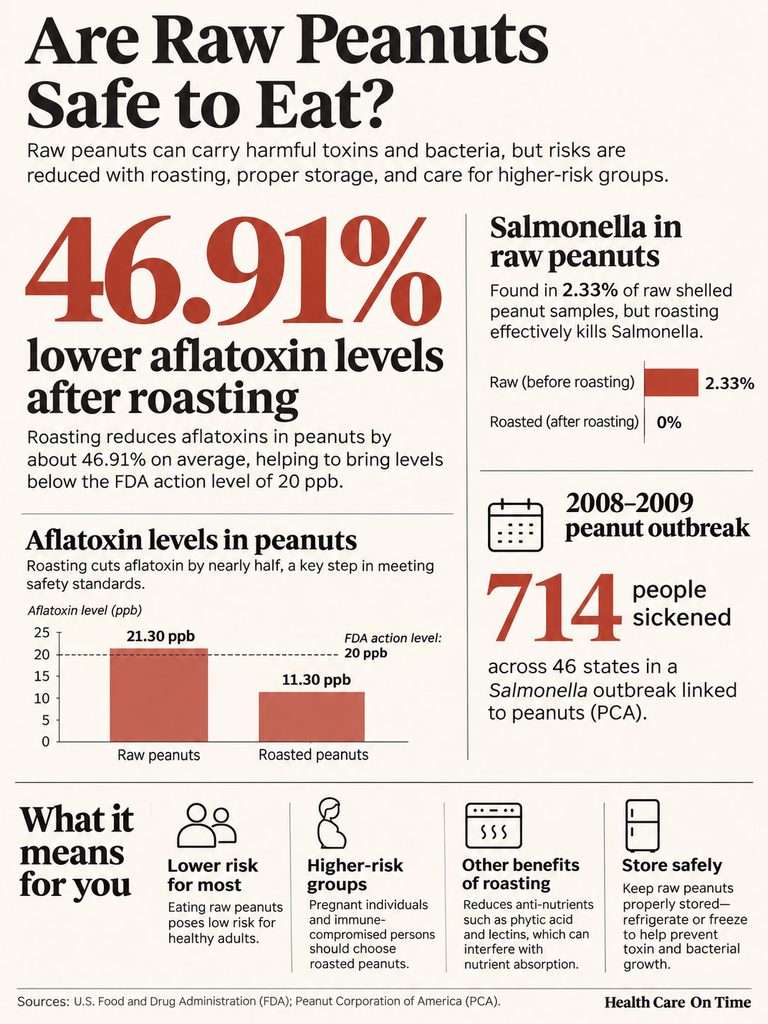
Molds that grow on peanuts in the field or in storage can produce aflatoxins, which the National Toxicology Program lists as known human carcinogens, tied mainly to liver cancer in parts of the world where contamination is common and poorly controlled. In the US, the FDA’s action level is 20 parts per billion for peanuts and peanut products meant for people, and raw peanuts testing above 25 ppb can go to processors only if moldy and damaged kernels are sorted out first.
Roasting cuts aflatoxin B1, the main type, roughly in half on average, according to a meta-analysis of 19 trials done mostly on peanuts, and it removes less of the other types. Half is a long way from zero, so the real protection comes from testing and removing bad kernels before peanuts reach the store.
In your own kitchen, throw out any peanuts, raw or roasted, that look shriveled, discolored or moldy, or that taste bitter or stale. When in doubt, toss it. Brands with steady turnover are a safer bet than bulk bins that may sit for months in a warm store.
Salmonella
Raw peanuts can pick up Salmonella in the field, and roasting is the step that kills it. Two large surveys of raw shelled US peanuts found the bacteria in 2.33% of 944 samples and in 1.63% of 2,506 samples collected over seven crop years, mostly at very low levels. Manufacturers of roasted products use a validated roasting step designed to cut Salmonella by at least 5 logs, or 100,000-fold; blanching, the skin-loosening step, does little against it. Raw peanuts sold in stores, including blanched skinless ones, usually haven’t gone through that kill step at all.
The failures that have happened in the US came through processing plants. The 2008 to 2009 outbreak tied to the Peanut Corporation of America plant in Blakely, Georgia, sickened 714 people in 46 states, put 24% of them in the hospital and may have contributed to nine deaths, and a 2012 outbreak traced to Sunland, Inc. peanut butter led to a recall widened to raw and roasted, shelled and in-shell peanuts after the FDA found the bacteria in raw peanuts at the plant.
If you do buy raw peanuts, treat them more like a fresh ingredient than a pantry snack. Keep them in a sealed container in the refrigerator, or in the freezer for longer storage, buy amounts you’ll use in a reasonable time, and look them over before eating, since a cool, dry spot slows both mold growth and the oils turning rancid.
A healthy adult eating a handful of raw peanuts faces a low risk. If you’re pregnant, over 65, getting chemotherapy or otherwise immune-compromised, choose roasted peanuts, and do the same for young children.
Anti-nutrients and lectins
Phytic acid and lectins get called “anti-nutrients” because they can bind minerals or proteins in the gut, and raw peanuts have both. Roasting, boiling and oil-roasting all significantly reduce phytic acid and other anti-nutrients in peanuts, and phytic acid also acts as an antioxidant, so for anyone eating a varied diet these compounds have very little impact.
Lectins get more attention, largely thanks to lectin-free diet books like Steven Gundry’s, which tell readers to avoid beans and legumes, peanuts included. Raw legumes are among the richest lectin sources, but cooking inactivates most lectins, and in an older lab study raw peanuts measured 144.7 units of active lectin while peanuts roasted at 350°F (177°C) for 30 minutes had none that could be detected. Boiling did even better than dry heat. Human research on how much active lectin people actually eat is thin.
If raw peanuts sit heavy in your stomach, roasted or boiled peanuts may be easier to tolerate.
Where Boiled Peanuts Fit In
Boiled peanuts, a Southern staple sold in the shell at roadside stands and in cans, are raw green or dried peanuts simmered in salted water for hours. They aren’t in the USDA comparison above, but in the cooking-method research they come out well on several counts at once. Moist heat breaks down lectins better than roasting, boiling doesn’t produce acrylamide, the commercial-product analysis found far more resveratrol in boiled peanuts than in roasted ones, and in allergy lab work boiled peanuts bound much less allergy antibody than dry-roasted peanuts did.
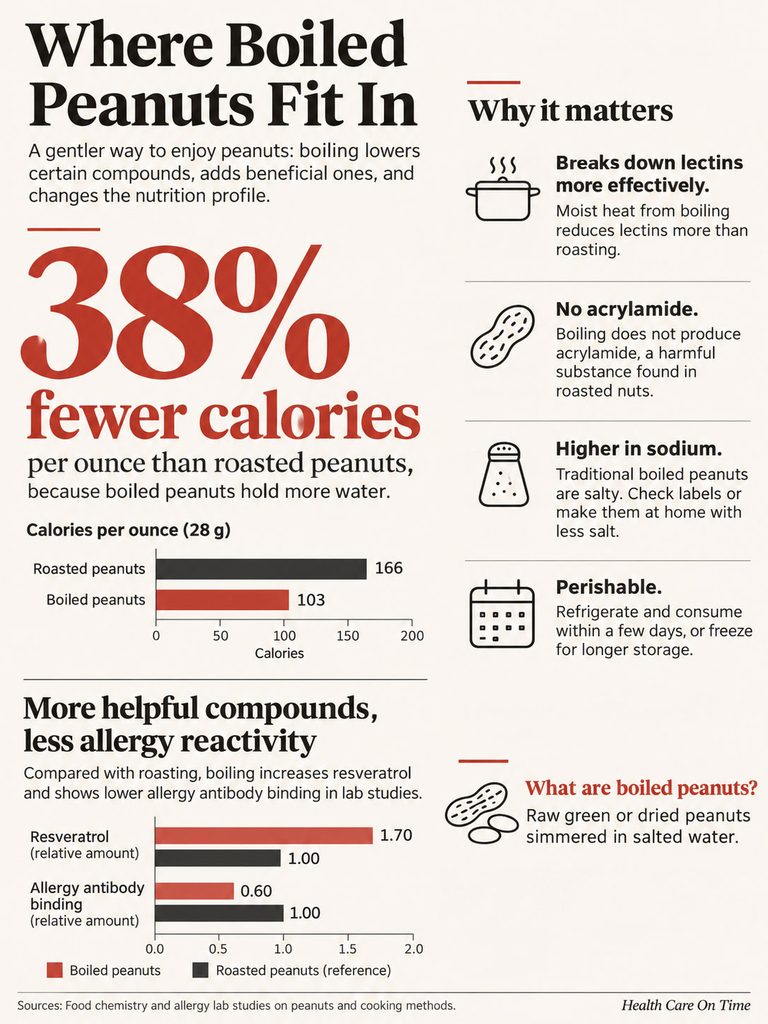
The brine is the trade-off. Traditional boiled peanuts are cooked in heavily salted water and canned versions can run high in sodium, so read the label or make your own with less salt. Because they hold so much water, boiled peanuts also have fewer calories per ounce than roasted ones, which makes it easy to eat a big bowl without noticing how much salt came with it.
Making them at home is mostly a matter of patience. Raw in-shell peanuts go into a big pot with enough water to cover them by a few inches and a modest amount of salt, then simmer, often for several hours, until the kernels are as soft as a cooked bean, with water topped up as it boils off. Taste the brine partway through and dilute it if it’s getting too salty, because the shells soak up whatever is in the pot.
Once cooked, they’re perishable. Refrigerate boiled peanuts and eat them within a few days, or freeze them.
Peanut Allergy and the Way Peanuts Are Cooked
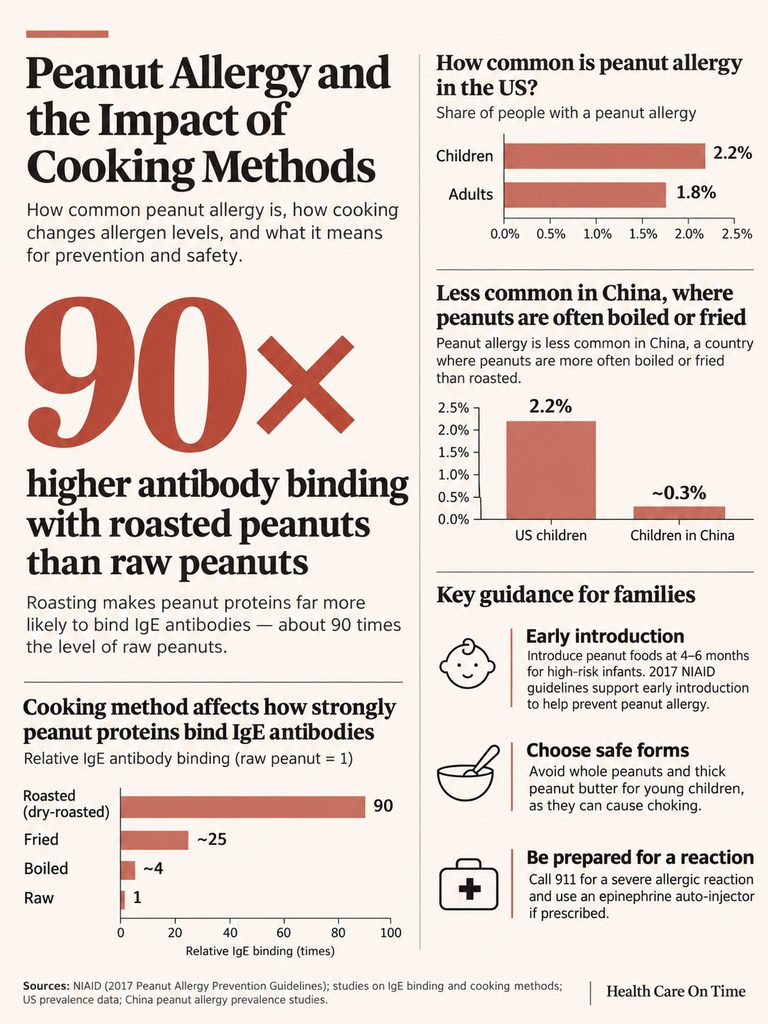
About 2.2% of US children and 1.8% of US adults have peanut allergy, and the way peanuts are cooked changes how strongly allergy antibodies react to them. In lab testing, roasted peanuts bound IgE antibodies from allergic patients at about 90 times the level of raw peanuts of the same varieties, probably because browning reactions change the proteins. Fried and boiled peanuts produced much less antibody binding than dry-roasted ones, a finding the researchers connected to China, where peanuts are mostly boiled or fried and peanut allergy is less common, and the US, where dry roasting dominates.
Lab binding isn’t the same as safety, and none of this makes raw or boiled peanuts safe for someone with a peanut allergy.
People with the allergy can react to any form, including peanut flour, peanut butter and some peanut oils.
For babies, US guidance now favors early introduction over avoidance. The 2017 NIAID guidelines say infants at high risk because of severe eczema, egg allergy or both should get age-appropriate peanut foods as early as 4 to 6 months, after a talk with the pediatrician and often after testing, based on a trial that showed an 81% relative reduction in peanut allergy with early introduction. Whole peanuts and thick spoonfuls of peanut butter are choking hazards for young children, so infants get thinned peanut butter or peanut puffs.
Call 911 if anyone has trouble breathing, throat tightness, widespread hives with vomiting, or faintness after eating peanuts, and use an epinephrine auto-injector if one has been prescribed.
How Many Peanuts a Day, and Which Kind to Buy
An ounce of dry-roasted peanuts is about 28 kernels, since each one carries roughly 5.85 calories. The FDA’s qualified health claim for nuts is built around 1.5 ounces per day as part of a diet low in saturated fat and cholesterol, and its wording is careful: evidence suggests, but doesn’t prove, a lower risk of heart disease.
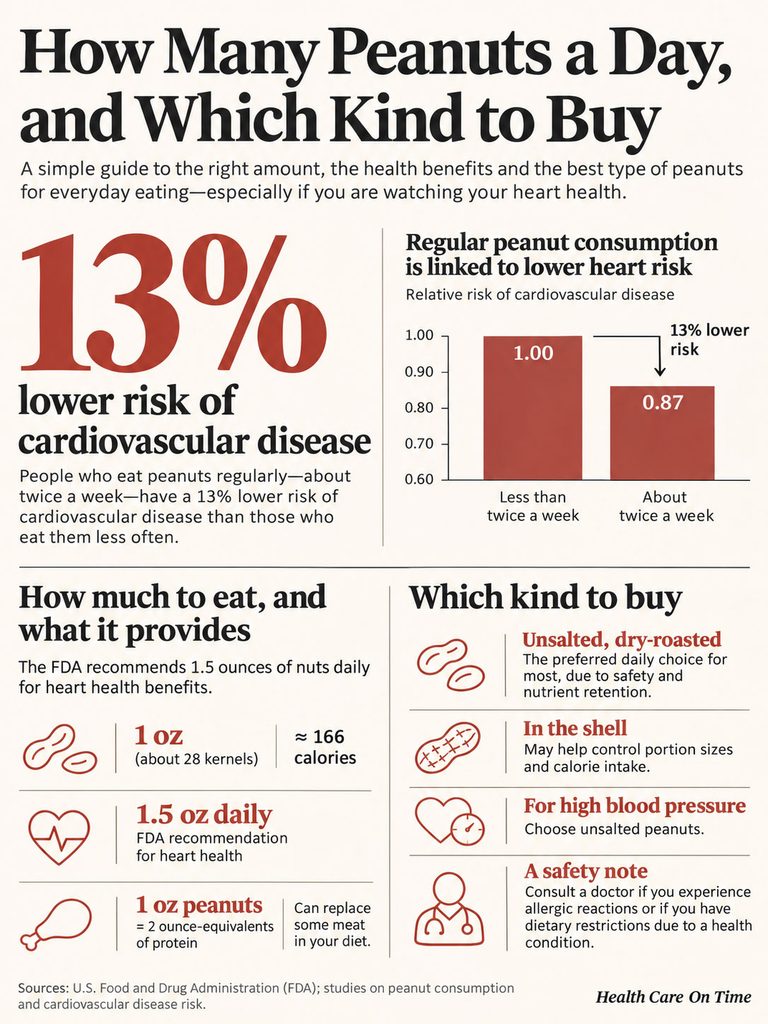
Across three cohorts of more than 210,000 nurses and health professionals followed for up to 32 years, people who ate peanuts at least twice a week had a 13% lower risk of cardiovascular disease and a 15% lower risk of coronary heart disease than people who rarely ate them, and among 71,764 mostly low-income Black and white adults in the Southern US, the highest nut and peanut intake went with lower death rates overall (a hazard ratio of 0.79), which works out to roughly a fifth lower risk of dying during follow-up. Observational studies like these can’t prove that peanuts caused the difference. None of them compared raw with roasted peanuts either, which is no surprise in a country where peanuts are rarely eaten raw.
In MyPlate terms, half an ounce of nuts counts as 1 ounce-equivalent of protein foods, the same as 1 tablespoon of peanut butter, so a 1-ounce handful of peanuts counts as 2 ounce-equivalents and can stand in for some meat a few days a week. Peanut butter isn’t a perfect swap, though. In that 210,000-person analysis, peanuts and walnuts were linked to lower stroke risk while peanut butter wasn’t, and the study couldn’t say why, so jars with peanuts as the only ingredient, or peanuts and salt, are the better buy.
At about 166 calories an ounce, the size of the handful affects your weight far more than the roasting method. Pour a measured portion into a small bowl instead of eating from the jar, or pair it with something crunchy and filling like an apple or a few raw carrots. Peanuts in the shell slow you down, and some people eat less that way.
Most grocery stores stock unsalted dry-roasted peanuts in the same aisle as the salted cans, often from the same brand, and many sell lightly salted versions for anyone who finds plain peanuts too flat at first. Mixing a salted can half and half with an unsalted one is a simple way to step down gradually over a few weeks.
| Your situation | Better pick | Why |
| High blood pressure, kidney disease or on a sodium limit | Unsalted dry-roasted | 1.7 mg sodium per oz vs 116 mg salted |
| Pregnant, over 65 or immune-compromised | Roasted, not raw | Roasting is the Salmonella kill step |
| Watching calories | Dry-roasted, measured to 1 oz | 166 kcal per oz; oil-roasted is 170 |
| Want the most vitamin E | Raw, or roasted at home at 284-302°F | Little vitamin E loss at 140-150°C |
| Stomach trouble with raw legumes | Boiled or roasted | Heat inactivates lectins; boiling works best |
| Infant at high allergy risk | Ask the pediatrician first, then thinned peanut butter | NIAID 2017: as early as 4-6 months |
| Diagnosed peanut allergy | No peanuts in any form | Raw, roasted and boiled can all trigger reactions |
See a doctor if peanuts reliably bring on stomach pain, an itchy mouth, hives or swelling, even mild, because those can be early allergy signs. An allergist can test whether the reaction is to peanuts themselves or to something else in a mix, such as tree nuts, sesame or a seasoning, and adults can develop food allergies too, so new symptoms after years of eating peanuts without trouble still deserve a check. If you’re on a strict potassium limit for kidney disease, ask your care team how peanuts fit, since one ounce carries 180 to 206 mg of potassium.
Frequently Asked Questions
Is it better to eat raw peanuts or roasted peanuts?
For most people, unsalted dry-roasted peanuts are the better everyday choice. Nutrition is nearly identical, and roasting kills Salmonella and lowers aflatoxin and lectins.
Why does Dr. Gundry say not to eat peanuts?
Steven Gundry’s low-lectin diet tells people to avoid beans and legumes, including soy and peanuts, on the theory that lectins damage the gut and drive inflammation. Human evidence for that theory is thin. Cooking inactivates most lectins, roasted peanuts tested in the lab had no detectable active lectin, and large US cohorts tie regular peanut eating to lower heart disease risk. Someone with a specific gut condition who feels better off legumes can talk that through with a doctor or dietitian, but roasted peanuts give the general public no reason for fear.
Is 20 peanuts a day too much?
Twenty dry-roasted peanuts come to roughly 117 calories, a little under an ounce, well inside the 1.5 ounces a day used in the FDA’s nut health claim.
What are the top 3 healthiest nuts to eat every day?
No official ranking exists. In the same large US cohorts, walnuts once a week went with a 19% lower risk of cardiovascular disease and peanuts twice a week with 13%, and tree nuts as a group also scored well. Rotating two or three unsalted kinds you actually like, say peanuts, walnuts and almonds, covers more nutrients than hunting for a single winner.
Do you need to soak raw peanuts before eating them?
Not for occasional snacking. Tufts nutrition experts consider soaking unnecessary for a handful of raw nuts eaten once in a while, and the phytic acid involved also works as an antioxidant.
Are peanuts nuts or legumes?
Botanically, peanuts are legumes, related to beans and peas, and they grow underground rather than on trees. Nutritionally they behave like tree nuts, with similar fat and protein, which is why US dietary guidelines group them with nuts and seeds. If you have a peanut allergy, ask an allergist before assuming tree nuts are either safe or off-limits.
Are boiled peanuts healthier than roasted?
In several ways, yes: fewer calories per ounce because of the water they hold, more resveratrol, no acrylamide, and lower allergy-antibody binding in lab tests. Many are cooked in heavy brine, so the sodium can cancel out much of that advantage.
Do roasted peanuts have more calories than raw?
By a few calories: dry-roasted peanuts have 166 per ounce against 161 raw, mostly because water cooks off, and oil-roasted have 170.
Should you eat the red skins on peanuts?
Yes, if you like the taste. The skins are slightly bitter, carry plant compounds that roasting can actually boost, and add a little fiber, so leaving them on is a small but free upgrade.
Does roasting destroy the protein in peanuts?
Very little changes. Dry-roasted peanuts still have 6.9 g of protein per ounce, compared with 7.3 g raw, and heat alters the shape of the protein rather than its value as food.
Medical disclaimer: This article is for general information only and isn’t a substitute for advice from your doctor, a registered dietitian or another qualified health professional. If you have a peanut allergy, kidney disease, high blood pressure or a weakened immune system, ask your care team how peanuts fit into your diet.
References
- USDA FoodData Central, SR Legacy (April 30, 2026 release). Peanuts, all types, raw (FDC 172430): https://getfoodfacts.com/food/peanuts-all-types-raw-172430
- USDA FoodData Central, SR Legacy. Peanuts, all types, dry-roasted, with salt (FDC 174262): https://getfoodfacts.com/food/peanuts-all-types-dry-roasted-with-salt-174262
- USDA FoodData Central, SR Legacy. Peanuts, all types, oil-roasted, with salt (FDC 174261): https://getfoodfacts.com/food/peanuts-all-types-oil-roasted-with-salt-174261
- USDA SR Legacy. Peanuts, all types, dry-roasted, without salt: https://triagemethod.com/tools/human-nutrition-explorer/food/peanuts-all-types-dry-roasted-without-salt.html
- USDA SR Legacy. Peanuts, all types, oil-roasted, without salt: https://triagemethod.com/tools/human-nutrition-explorer/food/peanuts-all-types-oil-roasted-without-salt.html
- University Hospitals Health Library. Peanuts, all types, dry-roasted, without salt, 1 peanut: https://www.uhhospitals.org/health-information/health-and-wellness-library/article/nutritionfacts-v1/peanuts-all-types-dry-roasted-without-salt-1-peanut
- Lichtenstein AH. Which is a better choice for my health, raw nuts or roasted? Tufts Health & Nutrition Letter, 2020: https://www.nutritionletter.tufts.edu/food-allergies-sensitivities/q-which-is-a-better-choice-for-my-health-raw-nuts-or-roasted/
- Rasmussen H. What are the nutritional differences between raw and roasted nuts? Tufts Health & Nutrition Letter, 2018: https://www.nutritionletter.tufts.edu/?p=1849
- Tufts Health & Nutrition Letter. Don’t Fear Anti-nutrients, 2019: https://www.nutritionletter.tufts.edu/healthy-eating/dont-fear-anti-nutrients/
- Tufts Health & Nutrition Letter. Is it a good idea to soak raw nuts before eating them? 2016 (updated 2019): https://www.nutritionletter.tufts.edu/general-nutrition/q-is-it-a-good-idea-to-soak-raw-nuts-before-eating-them/
- Tufts Health & Nutrition Letter. Acrylamide in nuts, 2015 (updated 2019): https://www.nutritionletter.tufts.edu/?p=952
- Eitenmiller RR, Choi SG, Cheon JY. Effects of dry roasting on the vitamin E content and microstructure of peanut. J Agric Life Sci. 2011;45(4):121-133: https://scholarworks.gnu.ac.kr/item/47a94bbb-a4d5-40d4-9c5d-2a80e39c363c
- Win MM, et al. Effects of roasting on phenolics composition and antioxidant activity of peanut kernel flour. Eur Food Res Technol. 2011;233(4):599-608: https://link.springer.com/doi/10.1007/s00217-011-1544-3
- trans-Resveratrol content in commercial peanuts and peanut products. J Agric Food Chem. 1999;47(4):1435-1439: https://scilit.com/publications/6c392e317db4dbad2a2cb98692944067
- De Paola EL, et al. Determination of acrylamide in dried fruits and edible seeds. Food Chemistry. 2017;217:191-195: https://iris.unimore.it/bitstream/11380/1132604/4/FOODCHEM-D-15-03161_R2.pdf
- FDA. Acrylamide Questions and Answers: https://www.fda.gov/food/chemical-contaminants-food/acrylamide-questions-and-answers
- FDA. Guidance for Industry: Action Levels for Poisonous or Deleterious Substances in Human Food and Animal Feed: https://www.fda.gov/food/guidance-documents-regulatory-information-topic/guidance-industry-action-levels-poisonous-or-deleterious-substances-human-food-and-animal-feed
- FDA. CPG Sec. 570.375 Aflatoxins in Peanuts and Peanut Products: https://www.fda.gov/regulatory-information/search-fda-guidance-documents/cpg-sec-570375-aflatoxin-peanuts-and-peanut-products
- National Toxicology Program. Report on Carcinogens profile: Aflatoxins: https://ntp.niehs.nih.gov/ntp/roc/content/profiles/aflatoxins.pdf
- Emadi A, et al. Effect of roasting on aflatoxins: a meta-analysis. Crit Rev Food Sci Nutr. 2022;62(18):5056-5066: https://agris.fao.org/search/fr/records/65df65486eef00c2cea29632
- Calhoun S, et al. Salmonella prevalence in raw shelled peanuts. J Food Prot. 2013: https://www.sciencegate.app/document/10.4315/0362-028x.jfp-12-322
- Calhoun RS. A note to review information for the risk management of Salmonella on raw peanuts. Peanut Science. 2020;47:150-155: https://peanutscience.com/article/1482/galley/2683/view
- CDC. Multistate outbreak of Salmonella Typhimurium infections linked to peanut butter, 2008-2009: https://archive.cdc.gov/www_cdc_gov/salmonella/2009/peanut-butter-2008-2009.html
- CDC. Salmonella Bredeney outbreak linked to peanut butter, 2012: https://archive.cdc.gov/www_cdc_gov/salmonella/bredeney-09-12/index.html
- Embaby HE. Effect of heat treatments on certain antinutrients and in vitro protein digestibility of peanut and sesame seeds. Food Sci Technol Res. 2011;17(1):31-38: https://www.jstage.jst.go.jp/article/fstr/17/1/17_1_31/_article
- Harvard T.H. Chan School of Public Health, The Nutrition Source. Lectins: https://nutritionsource.hsph.harvard.edu/?p=15540
- Ahmed EM. Lectin quantitation in peanut and soybean seeds. Peanut Science. 1986;13(1):4-7: https://peanutscience.com/article/id/306/
- Reinagel M. Lectins and the Plant Paradox. Nutrition Diva, 2018: https://quickanddirtytips.com/?p=52214
- Gupta RS, et al. The public health impact of parent-reported childhood food allergies in the United States. Pediatrics. 2018;142(6): https://pmc.ncbi.nlm.nih.gov/articles/PMC6317772/
- Gupta RS, et al. Prevalence and severity of food allergies among US adults. JAMA Netw Open. 2019: https://jamanetwork.com/journals/jamanetworkopen/fullarticle/2720064
- Maleki SJ, et al. The effects of roasting on the allergenic properties of peanut proteins. J Allergy Clin Immunol. 2000;106(4):763-768: https://www.em-consulte.com/article/573773/figures/the-effects-of-roasting-on-the-allergenic-properti
- Beyer K, et al. Effects of cooking methods on peanut allergenicity. J Allergy Clin Immunol. 2001;107(6):1077-1081: https://scholars.mssm.edu/en/publications/effects-of-cooking-methods-on-peanut-allergenicity-2/
- NIAID. Addendum Guidelines for the Prevention of Peanut Allergy in the United States, Clinician Summary, 2017: https://www.niaid.nih.gov/sites/default/files/peanut-allergy-prevention-guidelines-clinician-summary.pdf
- American Heart Association. How much sodium should I eat per day?: https://heart.org/en/healthy-living/healthy-eating/eat-smart/sodium/how-much-sodium-should-i-eat-per-day
- Dietary Guidelines for Americans 2020-2025. Customizing the Dietary Guidelines Framework: https://www.dietaryguidelines.gov:443/sites/default/files/2021-11/DGA_2020-2025_CustomizingTheDietaryGuidelinesFramework.pdf
- FDA (archived). Qualified health claims: nuts and heart disease: https://webarchive.library.unt.edu/eot2008/20080917094028/http:/www.cfsan.fda.gov/~dms/qhcnuts.html
- American College of Cardiology. Nut consumption associated with lower risk of CVD (Guasch-Ferré et al., JACC 2017): https://www.acc.org/Latest-in-Cardiology/Articles/2017/11/13/18/05/Nut-Consumption-Associated-With-Lower-Risk-of-CVD
- American College of Cardiology Journal Scan. Prospective evaluation of nut/peanut consumption and mortality (Luu et al., JAMA Intern Med 2015): https://www.acc.org/latest-in-cardiology/journal-scans/2015/03/03/11/52/prospective-evaluation-of-the-association-of-nut-peanut-consumption