It’s late. Dinner was heavy, and now there’s a steady ache under your breastbone and a wave of nausea that won’t pass. Heartburn? Your gallbladder? Something worse?
Table of Contents
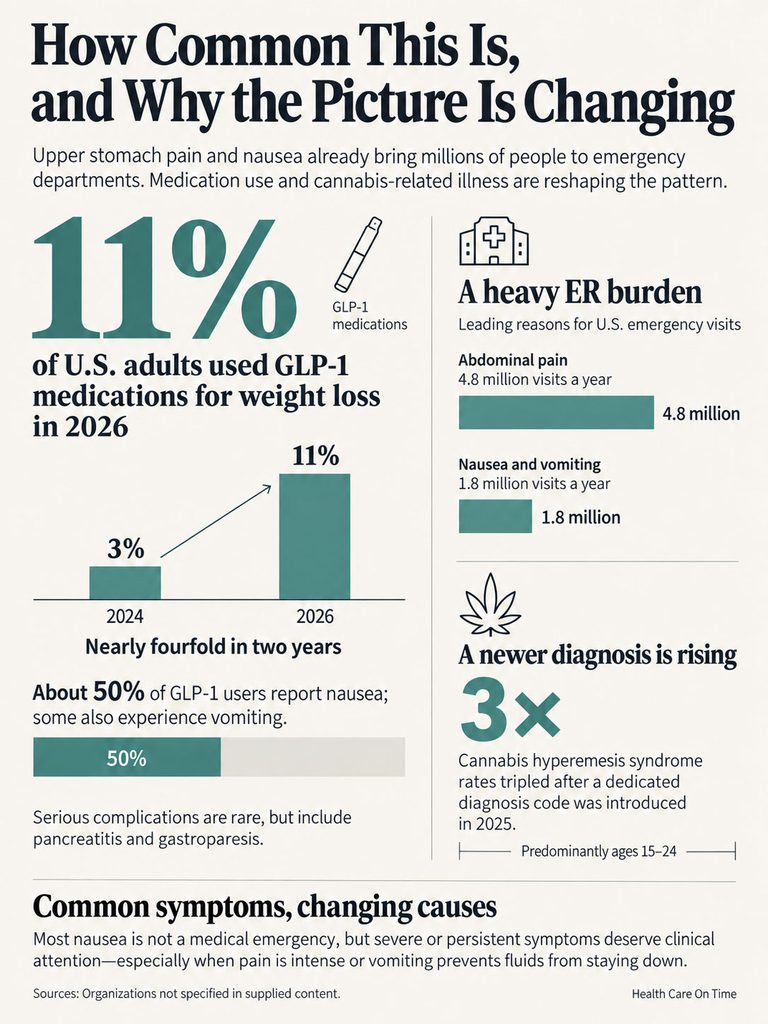
You’re far from alone. In US emergency rooms, abdominal pain is the most common GI diagnosis at about 4.8 million visits a year, and nausea with vomiting ranks second at about 1.8 million.
Quick Answer: Upper stomach pain with nausea most often comes from a stomach bug, acid reflux, gastritis, or functional dyspepsia. Ulcers, gallstones, medicines (including GLP-1 drugs), gastroparesis, and cannabis use come next. Call 911 if it comes with chest pressure, sweating, or breathlessness. Go to the ER for severe pain spreading to your back, pain lasting over 5 hours, vomiting blood, or fever with yellow skin.
Here are the 12 causes, ranked from least to most urgent:
- Stomach bug or food poisoning
- GERD (acid reflux)
- Gastritis
- Functional dyspepsia
- Peptic ulcer or H. pylori infection
- Gallstones (biliary colic)
- Medication side effects
- Gastroparesis
- Cannabis hyperemesis syndrome
- Acute pancreatitis
- Acute cholecystitis or a blocked bile duct
- Heart attack
At a Glance
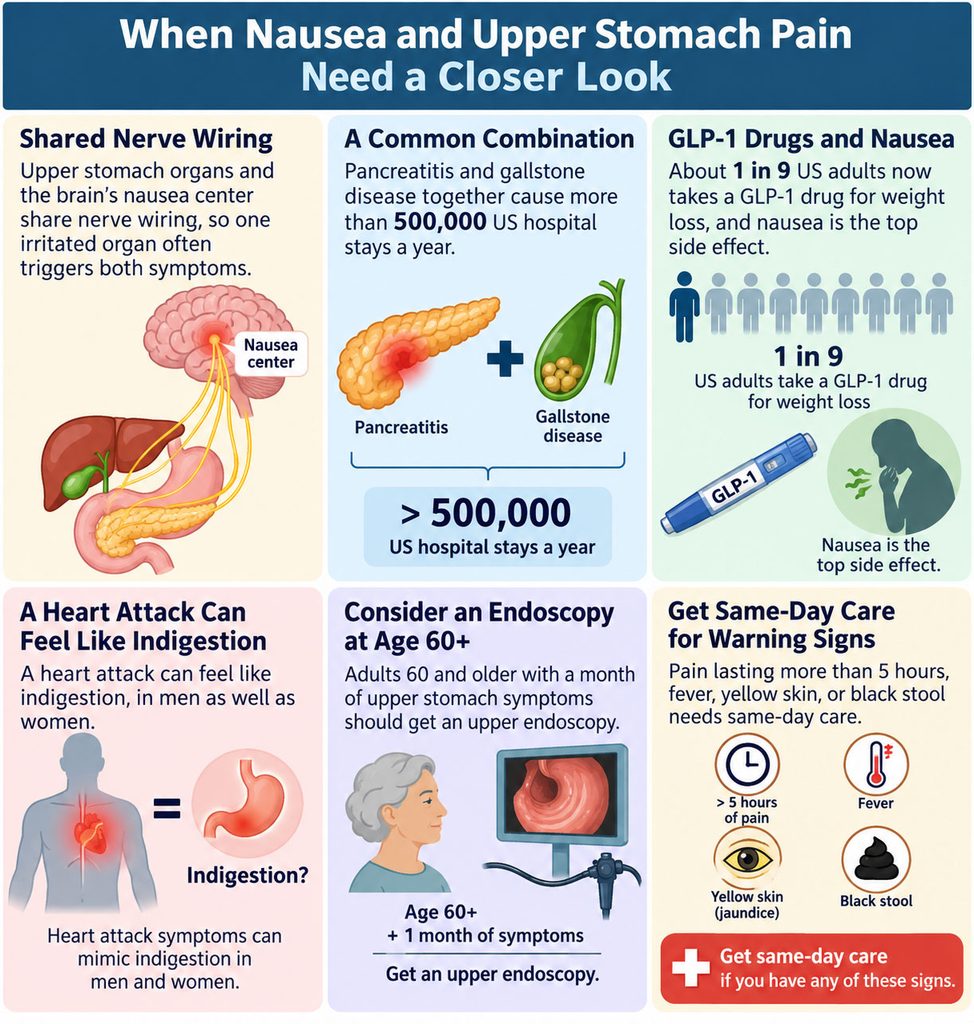
- Upper stomach organs and the brain’s nausea center share nerve wiring, so one irritated organ often triggers both symptoms.
- Pancreatitis and gallstone disease together cause more than 500,000 US hospital stays a year.
- About 1 in 9 US adults now takes a GLP-1 drug for weight loss, and nausea is the top side effect.
- A heart attack can feel like indigestion, in men as well as women.
- Adults 60 and older with a month of upper stomach symptoms should get an upper endoscopy.
- Pain lasting more than 5 hours, fever, yellow skin, or black stool needs same-day care.
What “Upper Stomach Pain With Nausea” Really Means
Where the Upper Stomach Is
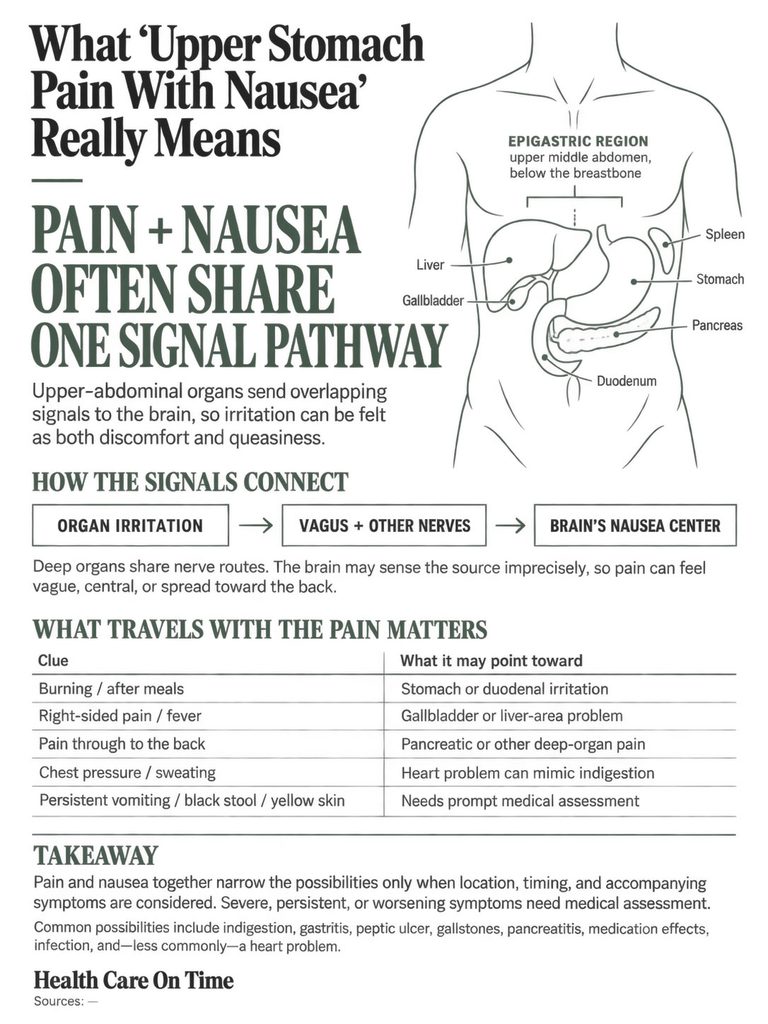
Doctors call the area between the bottom of your breastbone and your belly button the epigastric region. It covers your stomach, the first part of your small intestine (the duodenum), and part of your pancreas.
Your liver and gallbladder sit to the right, under the ribs. Your spleen and the tail of the pancreas sit to the left. Pancreas pain can surface in the back or in the middle to upper left belly.
Just above all of it, separated only by the diaphragm, is the bottom of your heart. That crowded layout is why location alone rarely gives the answer.
Patients booking lab tests with us often describe the same thing: a knot under the breastbone and a queasy stomach that won’t settle. That description fits at least a dozen conditions.
Why Pain and Nausea Show Up Together
Your gut and your brain’s nausea center are linked, mostly through the vagus nerve. When the stomach, gallbladder, or bile ducts stretch, swell, or get irritated, the signals that register as pain also set off nausea.
Pain from deep organs is hard to pinpoint, too. Your brain can’t tell exactly where it starts, so pancreas, gallbladder, and even heart pain can all land in the same spot.
The practical takeaway: what comes with the pain (fever, back pain, sweating, diarrhea, yellow skin) tells you more than where it hurts.
How Common This Is, and Why the Picture Is Changing
Upper stomach pain and nausea rank among the top reasons Americans seek care. Here’s what the latest US data shows.
| Statistic | US Number | Source |
| ER visits with abdominal pain as the GI diagnosis | 4,845,670 per year | Peery et al., Gastroenterology 2025 |
| ER visits for nausea and vomiting | 1,795,502 per year | Peery et al., 2025 |
| Hospital stays for pancreatitis | 263,265 (2021) | Peery et al., 2025 |
| Hospital stays for gallstones or gallbladder inflammation | 247,015 (2021) | Peery et al., 2025 |
| Adults with heartburn at least 2 to 3 days a week | 14.2% | Rome Foundation data via Peery et al. |
| Adults currently taking a GLP-1 for weight loss | 11% in 2026, up from 3% in 2024 | Gallup |
| GLP-1 users reporting nausea | About half | RAND, 2025 |
| Cannabis hyperemesis ER visits after a new diagnosis code | 3.7 times the prior monthly average | CDC MMWR, Aug 2026 |
| Norovirus illnesses per year | 19 to 21 million | CDC |
| US veterans tested who had H. pylori | 25.8% of 913,328 | Clin Gastroenterol Hepatol |
Two newer trends are changing who gets these symptoms, and why.
The GLP-1 Effect
Weight-loss shots like Wegovy, Zepbound, Ozempic, and Mounjaro have gone mainstream. Gallup’s 2026 survey puts the share of US adults using a GLP-1 for weight loss at 11%, nearly four times the 3% reported in 2024.
Nausea is the headline side effect. In a 2025 national survey, roughly half of GLP-1 users reported nausea, and about one in five had vomited. For most people it’s mild and fades as the body adjusts.
Serious complications are rarer, and the research hasn’t settled. A 2023 JAMA analysis tied weight-loss GLP-1 use to more pancreatitis (adjusted hazard ratio 9.1), bowel obstruction (4.2), and gastroparesis (3.7) than bupropion-naltrexone, an older weight-loss drug.
A 2024 study that accounted for starting body weight found no significant pancreatitis link (hazard ratio 1.19), though it still tied the drugs to gastroparesis and gallstones. Our medical reviewers read that as a real but small risk. It’s not a reason to panic or to quit on your own.
The Cannabis Signal Doctors Were Missing
Cannabis hyperemesis syndrome (CHS) causes cycles of severe nausea, vomiting, and belly pain in frequent cannabis users. For years it hid under vague labels like “cyclic vomiting.”
That changed on October 1, 2025, when a dedicated CHS diagnosis code launched. The share of ER visits tagged as CHS then tripled in a single month, from 3.35 to 11.26 per 10,000.
Rates ran highest in teens and young adults aged 15 to 24, at nearly 39 per 10,000 ER visits. CDC credits much of the jump to better recognition and coding rather than a sudden wave of new cases. Either way, CHS had been missed for years.
12 Causes of Upper Stomach Pain and Nausea, Ranked by Urgency
The causes fall into three tiers. Tier 1 usually improves with home care or a routine visit. Tier 2 needs a doctor within days. Tier 3 needs the ER now.
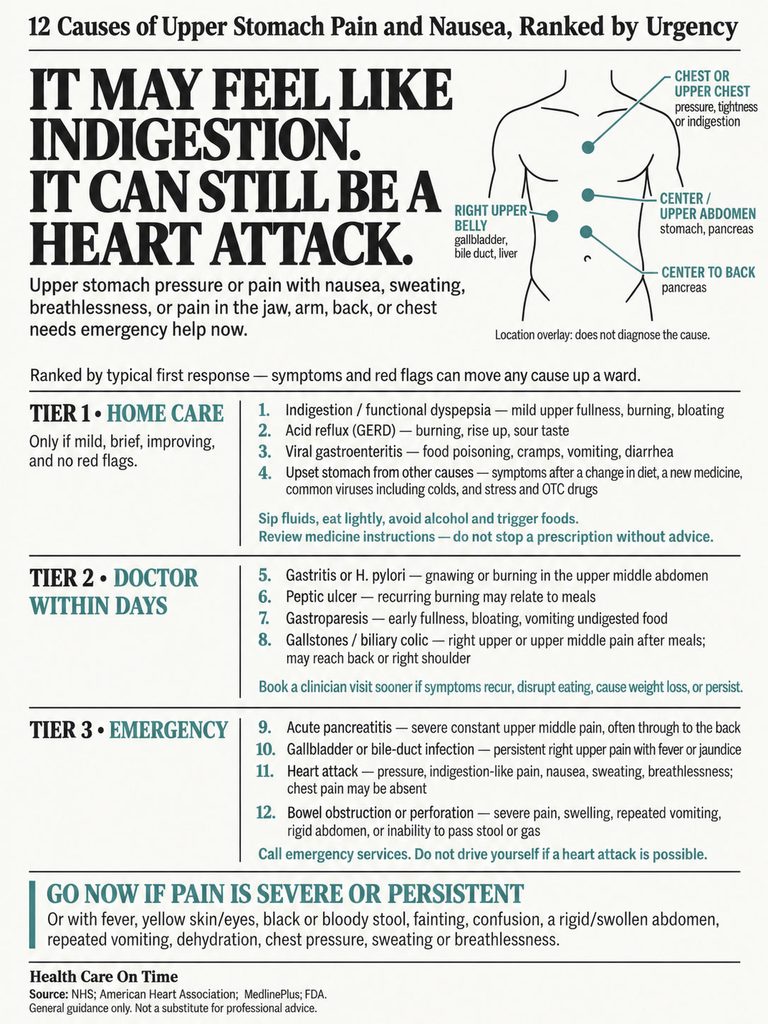
| Cause | Where It Hurts | Nausea Pattern | Telltale Clue | Urgency |
| Stomach bug or food poisoning | Center, crampy | Sudden, with vomiting and diarrhea | Others sick; lasts 1 to 3 days | Tier 1 |
| GERD / acid reflux | Center, behind breastbone | Sour taste, worse lying down | Burning after big meals | Tier 1 |
| Gastritis | Center, burning | Mild, with early fullness | NSAIDs, alcohol, H. pylori | Tier 1 |
| Functional dyspepsia | Center | On and off for months | Normal tests; full after a few bites | Tier 1 |
| Peptic ulcer | Center, gnawing | Mild to moderate | Pain on an empty stomach or at night | Tier 2 |
| Gallstones (biliary colic) | Right upper or center, to right shoulder blade | Often with vomiting | After fatty meals; lasts 1 to 5 hours | Tier 2 |
| Medication side effects | Center | Starts with a new drug or dose | GLP-1s, NSAIDs, metformin, iron | Tier 2 |
| Gastroparesis | Center | Vomiting food eaten hours earlier | Diabetes, GLP-1s, opioids | Tier 2 |
| Cannabis hyperemesis | Center, diffuse | Severe vomiting cycles | Frequent cannabis; hot showers help | Tier 2 |
| Acute pancreatitis | Center or left, boring into back | Severe, repeated vomiting | Gallstones or heavy drinking | Tier 3 |
| Acute cholecystitis / blocked bile duct | Right upper | With fever | Pain over 5 hours; yellow skin | Tier 3 |
| Heart attack | Center, pressure | With sweating | Breathlessness; starts with exertion | Tier 3 |
Tier 1: Usually Manageable at Home or With a Routine Visit
1. Stomach Bug or Food Poisoning
Norovirus drives most US stomach bug outbreaks. CDC estimates it causes 19 to 21 million illnesses a year, plus about 109,000 hospital stays and 900 deaths.
A newer strain has taken over. GII.17 grew from 7.5% of US outbreaks in the 2022 to 2023 season to 75.4% in 2024 to 2025. Alcohol sanitizer works poorly against norovirus, so scrub with soap and water for 20 seconds.
Food poisoning looks much the same but usually follows a specific meal. Both typically clear in 1 to 3 days. Dehydration, not the germ itself, is the main danger.
2. GERD and Acid Reflux
About 1 in 7 US adults (14.2%) has heartburn at least two or three days a week. Reflux brings burning behind the breastbone, a sour taste, and sometimes nausea, especially after large meals or when lying down.
Smaller meals, no food within 3 hours of bed, and raising the head of your bed 6 to 8 inches all help. OTC omeprazole-type acid reducers are labeled for 14-day courses. If you need them longer, or swallowing gets harder, book a visit.
3. Gastritis
Gastritis means the stomach lining is inflamed. H. pylori infection and regular NSAID use top the list of causes, with alcohol and other infections close behind.
Expect a burning or gnawing ache, nausea, and feeling full quickly. People often ask us why their stomach feels worse after taking ibuprofen for the pain. NSAIDs weaken the stomach’s protective lining, so they can deepen the very pain you’re treating.
4. Functional Dyspepsia
This is the most common diagnosis most people have never heard of. Up to 30% of adults in the US, Canada, and the UK have dyspepsia, and roughly 7 in 10 of them have the functional type.
“Functional” means tests come back clean, yet the symptoms are real. Under the Rome IV criteria, that’s fullness after meals, feeling full early, or upper stomach pain or burning at least one to three days a week, with no structural disease found and symptoms that started at least 6 months earlier.
Tier 2: Book a Doctor’s Visit Within Days
5. Peptic Ulcer and H. pylori
Ulcers are open sores in the stomach or duodenum. The pain usually sits high in the belly, can seem to bore into the back, and often flares at night. With some ulcers, eating actually eases it.
H. pylori remains common here. In a national VA study, about 1 in 4 of the 913,328 people tested were positive.
Treatment changed in 2024. The ACG’s new guideline favors a 14-day, four-drug bismuth regimen as the first treatment when antibiotic resistance is unknown. It also calls for a test of cure about four weeks after the last dose.
Black, tarry stool or vomit that looks like coffee grounds signals bleeding. That’s an ER trip, not an appointment.
6. Gallstones (Biliary Colic)
Gallstones often cause no trouble until one blocks the gallbladder outlet. Then pain hits the right upper belly or center and may spread to the right shoulder blade, often with vomiting.
Fatty or fried meals are the usual trigger, and most attacks fade within one to five hours. Pain beyond five hours, or pain with fever, chills, or yellowing, calls for the ER.
Patients commonly ask us whether a gallbladder attack can pass for bad heartburn. It can, but antacids won’t touch it, and it can wake you up at night. Book an ultrasound within a week, even if the pain fades.
7. Medication Side Effects
Several common medicines upset the upper stomach:
- GLP-1 drugs (semaglutide, tirzepatide): nausea and fullness, usually worst after a dose increase.
- NSAIDs (ibuprofen, naproxen, aspirin): gastritis and ulcers.
- Metformin: nausea and stomach upset, often eased by taking it with food or using an extended-release form.
- Doxycycline: can burn the esophagus if swallowed without a full glass of water or taken right before lying down.
- Iron and potassium pills: nausea and burning.
Our medical reviewers note a common GLP-1 pattern: nausea that peaks a day or two after the weekly shot, especially in the first weeks at a new dose. Smaller, lower-fat meals and stopping at the first sign of fullness often help.
Never stop a prescribed medicine on your own. Your prescriber may lower the dose, change the timing, or switch the form.
8. Gastroparesis
Gastroparesis means the stomach empties too slowly even though nothing is blocking it. Signs include nausea, fullness after a few bites, bloating, and vomiting food eaten hours earlier.
Diabetes is a classic cause. Opioids and GLP-1 drugs are others. Diagnosis usually requires a gastric emptying study, typically after an endoscopy rules out a blockage.
9. Cannabis Hyperemesis Syndrome
CHS brings repeating bouts of intense nausea, vomiting, and belly pain. Relief from hot showers or baths is a classic clue.
It isn’t only a long-term user’s problem. CDC points to newer evidence that symptoms can begin within the first year of use, sooner than experts once believed.
The only lasting fix is stopping cannabis. If you can’t keep fluids down, go to the ER. Being upfront about cannabis use can spare you repeat scans.
Tier 3: Go to the ER Now
10. Acute Pancreatitis
Pancreatitis led to 263,265 US hospital stays in 2021. The pain is severe and steady in the upper belly, often boring straight through to the back. Leaning forward may ease it a little. Nausea and repeated vomiting are common.
Gallstones and alcohol cause most cases. When neither is to blame, doctors check triglycerides, since a level above 1,000 mg/dL can trigger pancreatitis on its own. Diagnosis rests on your pain pattern plus a lipase level at least three times normal, or on imaging.
11. Acute Cholecystitis or a Blocked Bile Duct
When a gallstone stays stuck, the gallbladder becomes inflamed or infected. The key clue is time. The pain runs past the usual one-to-five-hour window, often with fever or chills.
If a stone slips into the main bile duct, you may notice yellow skin or eyes, dark urine, and pale stool. Fever, right upper pain, and yellowing together point to cholangitis, a bile duct infection that needs emergency care.
12. Heart Attack
This is the cause people least expect below the breastbone. A heart attack, especially one affecting the bottom of the heart, can feel like pressure, burning, or indigestion, with nausea and sweating.
A US registry of more than 1.1 million heart attack patients found that 42.0% of women and 30.7% of men arrived with no chest pain at all.
Most articles get the next part backward. In a Scottish emergency department study, burning, stabbing, or indigestion-like pain was reported by 41% of men versus 23% of women, while nausea alongside chest pain was more common in women (33% vs 19%). The lesson applies here too: an indigestion-type heart attack isn’t a women-only problem.
Call 911 if upper stomach discomfort comes with shortness of breath, sweating, lightheadedness, or pain in the jaw, arm, or back, or if it starts with exertion. Don’t drive yourself.
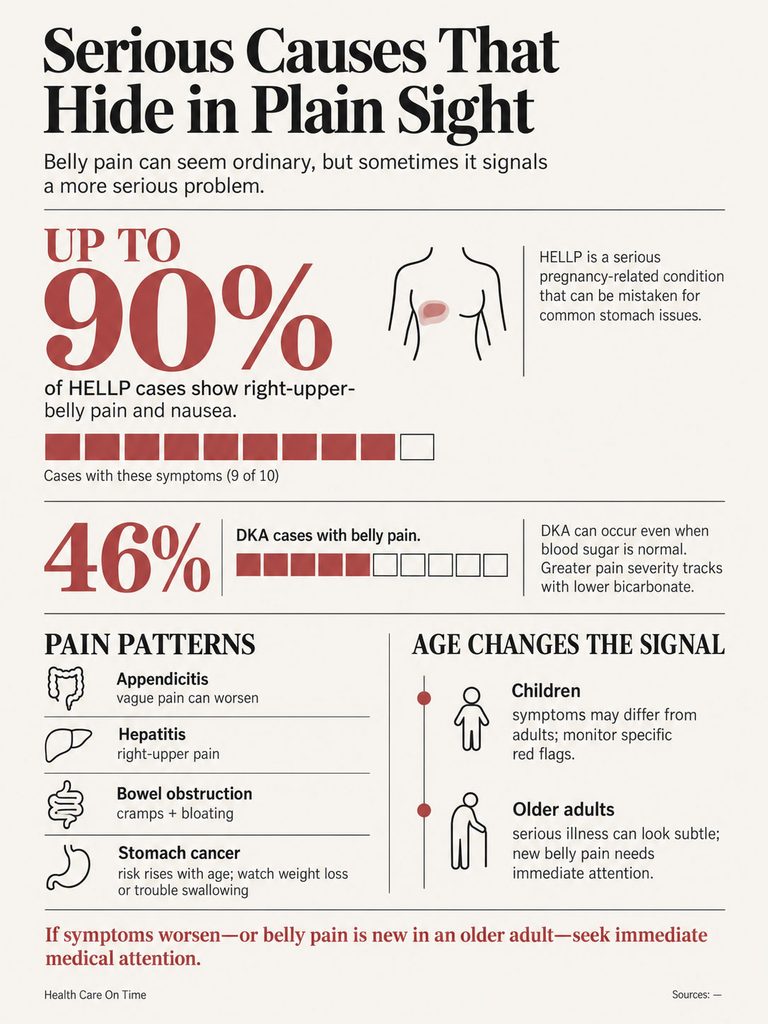
Serious Causes That Hide in Plain Sight
Diabetic Ketoacidosis, Including the “Normal Sugar” Type
DKA is a dangerous acid buildup that happens when your body can’t use sugar for fuel. In an Atlanta study of 189 DKA episodes, 46% involved belly pain.
The worse the acid buildup, the more likely the pain. It showed up in 86% of patients with a bicarbonate under 5 mmol/L, versus 13% at 15 to 18 mmol/L.
SGLT2 inhibitors like Jardiance, Farxiga, and Invokana add a twist. The FDA warned in 2015 that these drugs can cause ketoacidosis with near-normal blood sugar, often below 250 mg/dL. A normal meter reading doesn’t rule it out.
Clinical reviews advise pausing these drugs during vomiting, poor eating, dehydration, or acute illness, and getting checked even when home glucose looks fine. Our medical team recommends asking your prescriber for a written sick-day plan before you need one.
Early Appendicitis
Appendicitis often starts as a vague ache around the belly button or upper stomach, with nausea and poor appetite. Over 12 to 24 hours, the pain usually shifts to the lower right side. If pain moves and sharpens, get seen the same day.
Pregnancy: Morning Sickness vs. HELLP Syndrome
Nausea is normal in early pregnancy. Steady right upper or central belly pain later in pregnancy is not.
According to ACOG, right upper belly pain and a general unwell feeling appear in up to 90% of HELLP cases (a severe form of preeclampsia), and nausea or vomiting in about half.
Up to 30% of HELLP cases appear after delivery, and about 1 in 5 occur without high blood pressure. Any new upper stomach pain after 20 weeks, or in the weeks after birth, deserves a same-day call to your OB.
Hepatitis, Bowel Obstruction, and Stomach Cancer
Hepatitis can cause right upper pain, nausea, fatigue, dark urine, and yellow eyes. A bowel obstruction brings cramping, bloating, vomiting, and trouble passing gas.
Stomach cancer is uncommon in the US but becomes more likely with age. Warning signs include unplanned weight loss, trouble swallowing, ongoing vomiting, and iron-deficiency anemia. That’s the reason for the age-60 rule below.
Children and Older Adults
Kids get upper stomach pain and nausea for different reasons than adults. Stomach bugs and constipation lead the list. Strep throat can also cause belly pain and nausea in school-age children, sometimes with only a mild sore throat.
Watch for red flags in children: pain that moves to the lower right side, a swollen or hard belly, green vomit, or vomiting with a headache or stiff neck. Heavy thirst and frequent urination alongside nausea can signal new type 1 diabetes with DKA.
Older adults have the opposite problem, because serious illness often looks mild. Fever may be low or missing, pain may be vague, and confusion can be the main sign. Our medical team urges families to take new belly pain in a parent over 75 seriously, since a gallbladder infection or heart attack can hide behind it.
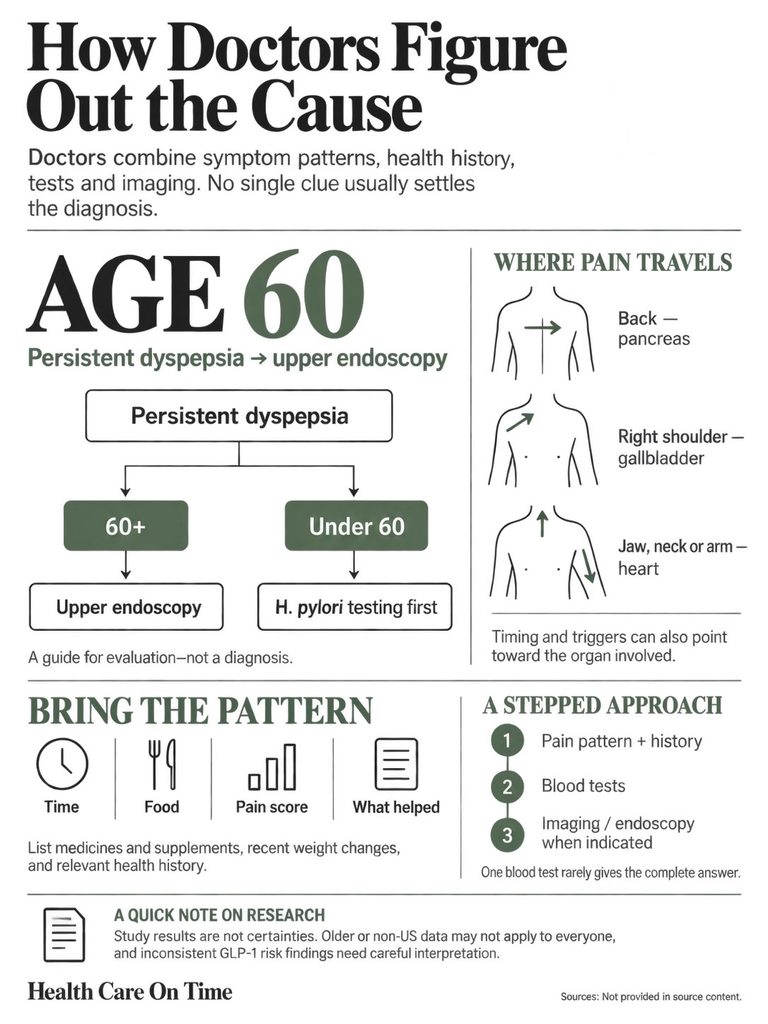
How Doctors Figure Out the Cause
Clues That Narrow It Down
Timing and triggers point to different organs:
- After a fatty meal or at night: gallbladder.
- On an empty stomach, easing with food: duodenal ulcer.
- Worse lying down or bending over: reflux.
- Starting with exertion: heart.
- A day or two after a GLP-1 dose increase: medication.
Where the pain travels helps, too. Pain straight through to the back suggests the pancreas. The right shoulder blade suggests the gallbladder. The jaw, neck, or arm suggests the heart.
A simple symptom diary is worth more than you’d think. Log the time, what you ate, a 1-to-10 pain score, and what helped.
Also bring a list of every medicine and supplement you take, including GLP-1 shots, SGLT2 pills, NSAIDs, and cannabis. Mention recent weight loss, and the date of your last period if pregnancy is possible.
The Tests You’re Likely to Get
- CBC: infection or bleeding.
- Metabolic panel and liver tests (ALT, AST, bilirubin): liver, bile ducts, and kidneys.
- Lipase: the pancreas.
- ECG and troponin: the heart.
- Pregnancy test: for anyone who could be pregnant.
- H. pylori breath or stool test: stop omeprazole-type drugs 2 weeks beforehand to avoid a false negative.
- Right upper quadrant ultrasound: gallstones.
- CT scan: pancreatitis complications, blockages, or appendicitis.
- Upper endoscopy (EGD): a direct look at the esophagus, stomach, and duodenum.
Patients booking tests with us often ask whether one blood test can settle the question. Rarely. A lipase result helps confirm pancreatitis, but doctors read it alongside your pain pattern and usually imaging.
The Age-60 Endoscopy Rule
The joint US and Canadian gastroenterology guideline calls for upper endoscopy in anyone 60 or older with a month or more of dyspepsia, and it advises against routine scopes for people under 60.
Under 60, the usual first steps are H. pylori testing and a trial of acid-reducing medicine. Bleeding, weight loss, or trouble swallowing can move anyone straight to endoscopy.
Where the Research Falls Short
A few key numbers here come from older or non-US data. The DKA pain figures come from patients admitted over 13 months beginning in October 1995. The heart attack registry covers 1994 through 2006.
The indigestion-in-men finding comes from Scotland, and GLP-1 risk studies still disagree with each other. Treat these as good guides, not exact odds.
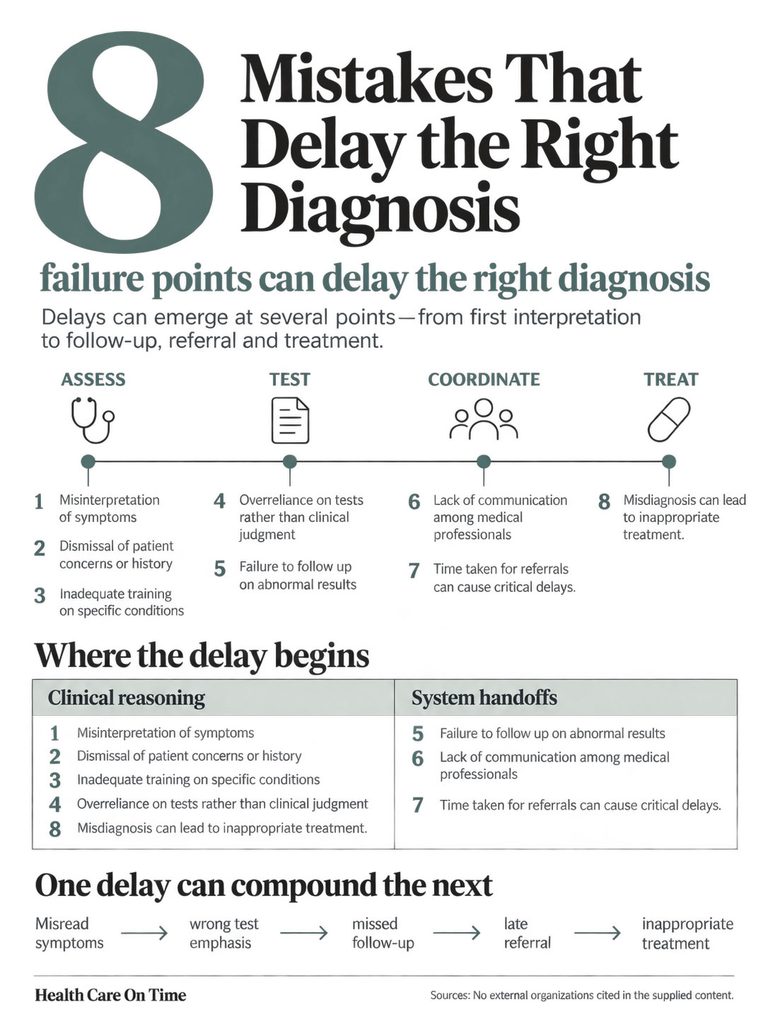
Mistakes That Delay the Right Diagnosis
- Taking ibuprofen or naproxen for stomach pain. These drugs can cause or worsen gastritis and ulcers. Acetaminophen is gentler on the stomach.
- Treating chest pressure with antacids. If an antacid “sort of” helps pressure that came on with exertion, don’t count on it. Get checked.
- Calling it a stomach bug after day three. Norovirus rarely lasts longer. Persistent pain needs a new explanation.
- Leaving cannabis out of the story. Doctors can’t diagnose CHS without knowing about your use.
- Pushing through GLP-1 side effects in silence. Your prescriber can slow the dose schedule.
- Stopping H. pylori treatment early. Unfinished courses fail and breed resistance. Finish all 14 days and get retested.
- Trusting a normal glucose reading on an SGLT2 drug. Nausea plus belly pain can still mean DKA.
Our medical team considers mistake number 2 the most dangerous, because minutes matter in a heart attack.
What to Do Right Now: A Triage Plan
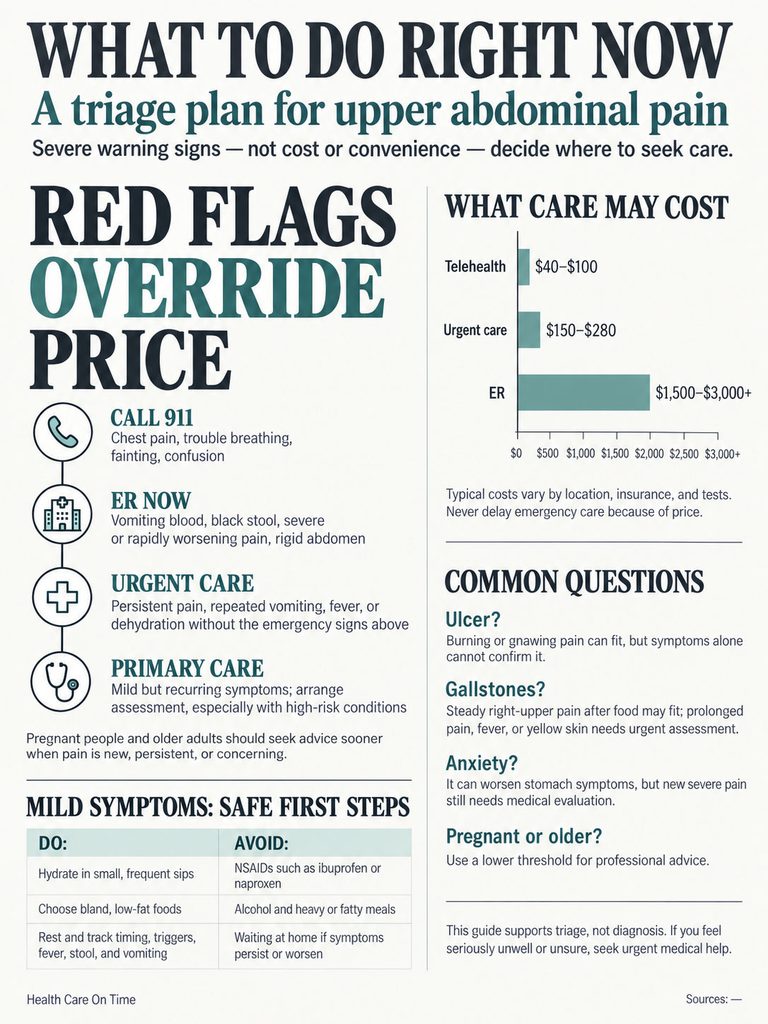
Match your situation to the right level of care.
| Scenario | What to Do | How Fast |
| Upper stomach pressure with sweating, shortness of breath, or jaw or arm pain | Call 911; don’t drive yourself | Now |
| Severe pain boring into your back, with repeated vomiting | Go to the ER | Now |
| Right upper pain lasting over 5 hours, or with fever or yellow skin | Go to the ER | Now |
| Vomiting blood or coffee-ground material, or black, tarry stool | Go to the ER or call 911 | Now |
| Pregnant after 20 weeks, or recently delivered, with new upper stomach pain | Call your OB or labor and delivery | Within hours |
| Taking an SGLT2 inhibitor, with nausea and belly pain | Urgent care or ER for a ketone check | Same day |
| Can’t keep fluids down for 24 hours | Urgent care | Same day |
| Gallbladder-type attack that has eased | Primary care visit plus ultrasound | Within 1 week |
| Nausea after a GLP-1 dose increase, no severe pain | Call your prescriber | Within 2 to 3 days |
| Burning upper pain lasting 2 or more weeks | Primary care visit plus H. pylori test | Within 2 weeks |
| Age 60 or older with a month of symptoms, or weight loss or trouble swallowing | GI referral for endoscopy | Within 2 to 4 weeks |
Where to Go and What It Costs
Cost worries keep many people home when they shouldn’t be. Here’s a realistic picture.
| Care Setting | Typical US Cost | Best For |
| Telehealth visit | About $40 to $100 cash pay | Mild nausea, reflux questions, GLP-1 side effects |
| Urgent care | About $195 median; $150 to $280 uninsured | Stomach bug with dehydration, same-day lab work |
| Emergency room | About $2,750 median; $1,500 to $3,000 or more uninsured | Any Tier 3 cause or red flag |
UnitedHealthcare’s 2025 figures put the median ER visit at about $2,750, compared with about $195 for urgent care. Cash-pay telehealth usually runs $40 to $100, urgent care $150 to $280, and an uninsured ER visit $1,500 to $3,000 or more.
Telehealth has limits. A video visit can’t press on your belly, run a lipase test, or record an ECG. If any Tier 3 sign is present, skip the screen and go in person.
Federal law (EMTALA) requires hospital ERs to screen and stabilize you whether or not you can pay. Our care team’s rule is simple: red flags go to the ER, whatever the price.
Safe Home Care for Mild Cases
For mild symptoms with no red flags, sip water or an oral rehydration solution often. Move to small, bland, low-fat meals such as toast, rice, bananas, or broth.
Skip alcohol, caffeine, spicy food, and NSAIDs. Stay upright for 3 hours after eating. An OTC antacid can ease reflux-type burning.
One caution about Pepto-Bismol and other bismuth subsalicylate products: they contain a salicylate, a chemical cousin of aspirin. Skip them in children and teens, and check with a pharmacist if you take a blood thinner. They can also turn stool black, which is harmless but easy to confuse with bleeding.
If you aren’t clearly better within 48 to 72 hours, call your doctor. Older adults, pregnant women, and people with diabetes should call sooner.
When to Call 911
Call 911 for upper stomach pain with any of these:
- Chest pressure, shortness of breath, cold sweat, or fainting
- Pain spreading to your jaw, neck, arm, or back
- Vomiting blood
- A rigid, board-hard belly
- Confusion or fast breathing, especially if you have diabetes
Frequently Asked Questions
What illnesses cause upper stomach pain and nausea together?
The most common are stomach bugs, acid reflux, gastritis, and functional dyspepsia. Next come ulcers, gallstones, medication side effects, gastroparesis, and cannabis hyperemesis. The emergencies to rule out are pancreatitis, a gallbladder infection or blocked bile duct, heart attack, and diabetic ketoacidosis.
When should upper stomach pain and nausea mean a trip to the ER?
Go now for chest pressure, sweating, or shortness of breath. Also go for severe pain spreading to your back, pain lasting over 5 hours, fever with yellow skin, vomiting blood, black stool, or a rigid belly. Pregnant after 20 weeks? Call your OB the same day.
Can upper stomach pain and nausea be a heart attack?
Yes. A heart attack can feel like indigestion, with nausea and sweating. In a US registry of more than 1.1 million heart attack patients, 42% of women and about 31% of men had no chest pain. If symptoms start with exertion or come with breathlessness, call 911.
How does gallbladder pain differ from stomach pain?
Gallbladder attacks usually strike the right upper belly or center after a fatty meal, often at night. The pain is steady, may spread to the right shoulder blade, and typically lasts 1 to 5 hours. Ulcer and gastritis pain feels more like a gnawing burn tied to an empty stomach.
Why does the upper stomach hurt with nausea after eating?
Meals stretch the stomach, release acid, and make the gallbladder squeeze. That’s why dyspepsia, gastritis, gallstones, gastroparesis, and pancreatitis often flare after eating. Fatty meals point toward the gallbladder. Feeling full after a few bites suggests dyspepsia or gastroparesis.
Can anxiety or stress cause upper stomach pain and nausea?
Yes. The gut and brain share nerve pathways, and stress can worsen dyspepsia and reflux. But anxiety should be the conclusion after red flags are checked, not the first guess. New symptoms after 60, weight loss, black stool, or repeated vomiting need a medical workup first.
Can Ozempic, Wegovy, or Mounjaro cause upper stomach pain?
Yes. About half of GLP-1 users report nausea, usually after starting or raising a dose, and it often fades within weeks. Severe pain spreading to the back, repeated vomiting, or right-side pain after meals can signal pancreatitis or gallstones. Seek care promptly.
How long can a stomach bug last before it needs a doctor?
Most norovirus illness lasts 1 to 3 days. See a doctor if symptoms pass 72 hours, you can’t keep fluids down for 24 hours, you see blood, or you feel dizzy and pass very little urine. Infants and adults over 65 need care sooner.
Is upper stomach pain with nausea a sign of pregnancy?
Nausea is a classic early pregnancy sign, but sharp or steady upper stomach pain isn’t typical early on. After 20 weeks, or in the weeks after delivery, right upper or central pain with nausea can signal preeclampsia or HELLP syndrome. It needs a same-day check.
What helps mild upper stomach pain and nausea at home?
Sip fluids often, ideally an oral rehydration solution. Eat small, bland, low-fat meals and skip alcohol, caffeine, ibuprofen, and naproxen. An OTC antacid can ease reflux-type burning. Stay upright after eating. If you aren’t better within 48 to 72 hours, call your doctor.
What tests find the cause of upper abdominal pain and nausea?
First tests usually include a CBC, a metabolic and liver panel, and lipase for the pancreas. An ECG and troponin check the heart. An ultrasound looks for gallstones, and breath or stool tests check for H. pylori. Endoscopy is used for people 60 and older or anyone with red flags.
Can H. pylori cause nausea and upper stomach pain?
Yes. H. pylori infects the stomach lining and is a leading cause of gastritis and ulcers. Many carriers feel nothing, but others get burning pain, nausea, and bloating. It’s confirmed with a breath, stool, or biopsy test and treated with a 14-day combination of medicines.
clinician. If you have chest pain, severe abdominal pain, vomiting blood, or trouble breathing, call 911. If you’re pregnant or recently gave birth, contact your OB about any new upper abdominal pain. Don’t stop or change a prescribed medicine without talking to your prescriber.
References
- Peery AF, et al. Burden and Cost of GI, Liver, and Pancreatic Diseases in the United States: Update 2024. Gastroenterology, 2025
- Gallup: In U.S., GLP-1 Usage Reaches New High, 2026
- KFF Health Tracking Poll: 1 in 8 Adults Currently Taking a GLP-1 Drug, Nov 2025
- RAND: GLP-1 Agonist Use and Side Effects in the United States, 2025
- American College of Gastroenterology: GI Adverse Events With GLP-1 Agonists for Weight Loss (Sodhi et al., JAMA 2023)
- Medscape: GI Complications With GLP-1s for Weight Loss, DDW 2024
- CDC MMWR: ED Visits Involving Cannabis Hyperemesis Syndrome, Jan 2023 to May 2026
- Swartz JA, Franceschini D. Cannabinoid Hyperemesis Syndrome, 2016 to 2022. JAMA Network Open, 2025
- CDC: Norovirus Data and Research
- Barclay L, Vinjé J. Increasing Predominance of Norovirus GII.17 over GII.4, United States. Emerging Infectious Diseases, 2025
- American Family Physician: Functional Dyspepsia, Evaluation and Management
- ACG Clinical Guideline: Treatment of Helicobacter pylori Infection, 2024 (Guideline Central summary)
- University of Minnesota College of Pharmacy: 2024 ACG H. pylori Guidelines
- H. pylori Burden in the United States: VA Nationwide Analysis. Clinical Gastroenterology and Hepatology
- Houston Methodist: When to See a Doctor About Stomach Pain, 2025
- Cleveland Clinic: Upper Abdominal Pain
- Cleveland Clinic: Gallstones
- The Hospitalist: Applying the 2024 ACG Guidelines on Acute Pancreatitis
- Critical Care Nurse: Acute Myocardial Infarction Without Chest Pain (Canto et al., JAMA 2012 NRMI data)
- British Heart Foundation: Heart Attack Symptoms in Men and Women, 2019
- American Heart Association: Heart Attack Symptoms in Women
- Umpierrez G, Freire AX. Abdominal Pain in Patients With Hyperglycemic Crises. J Crit Care, 2002
- Pharmacy Times: Understanding SGLT2 Inhibitors’ Diabetic Ketoacidosis Risk
- Euglycemic DKA With SGLT2 Inhibitors: A Practical Review for Acute Care
- ACOG Practice Bulletin No. 222: Gestational Hypertension and Preeclampsia
- Preeclampsia Foundation: HELLP Syndrome
- UnitedHealthcare: Comparing Costs of Urgent Care, ER, and Virtual Visits
- CoveredUSA: ER vs Urgent Care vs Telehealth Cost Comparison, 2026