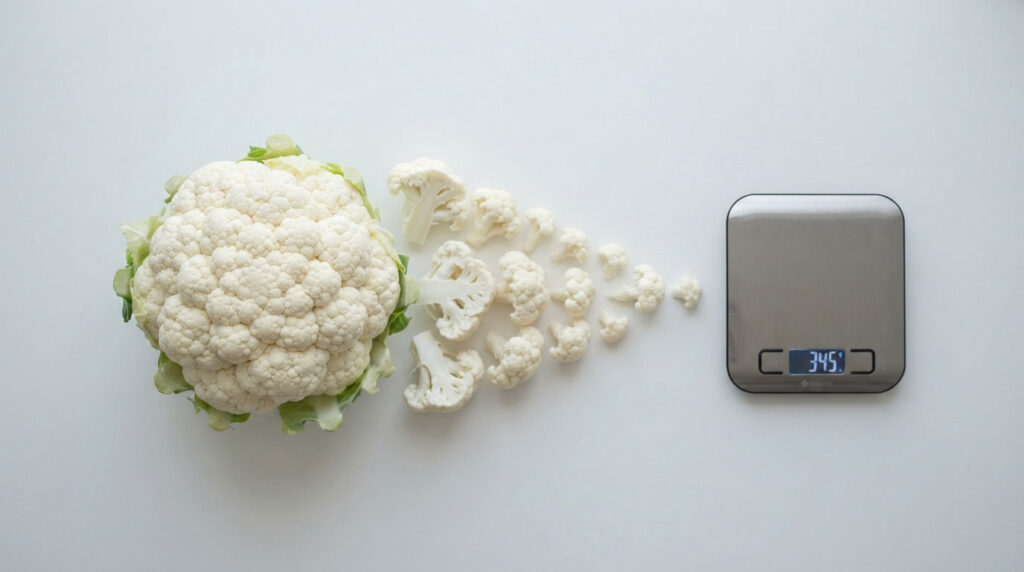
Two of America’s most trusted health sites publish different calorie counts for the exact same serving of cauliflower. One says 25 per cup. The other says 27. Neither is wrong, and neither explains the gap. The answer comes down to a single number almost nobody prints: how many grams the writer decided a “cup” weighs.
Quick Answer: One cup of raw chopped cauliflower (107 grams) contains 27 calories, according to USDA FoodData Central. Per 100 grams, raw cauliflower has 25 calories. One cup of boiled, drained cauliflower (124 grams) has 29 calories. A whole medium head, trimmed, runs about 147 calories. Cauliflower is roughly 92 percent water, which keeps every one of these numbers low.
At a Glance
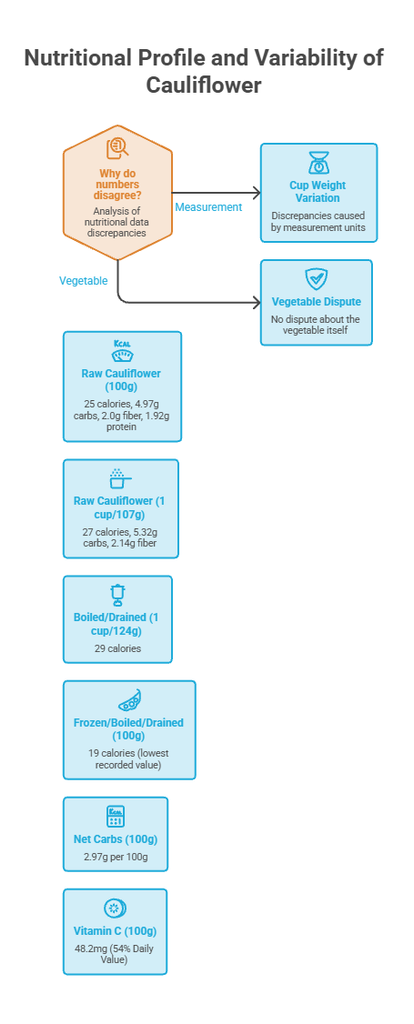
- Raw, per 100 g: 25 calories, 4.97 g carbs, 2.0 g fiber, 1.92 g protein
- Raw, per 1 cup chopped (107 g): 27 calories, 5.32 g carbs, 2.14 g fiber
- Boiled and drained, per 1 cup (124 g): 29 calories
- Frozen, boiled, drained, per 100 g: 19 calories, the lowest cauliflower value USDA records
- Net carbs: 2.97 g per 100 g, which is why cauliflower dominates keto menus
- Vitamin C: 48.2 mg per 100 g, or 54 percent of the Daily Value
- Published numbers disagree because of cup weight, not because of any dispute about the vegetable
The Short Answer, and Why Published Numbers Disagree
Cauliflower has 25 calories per 100 grams raw. That figure comes from USDA FoodData Central record 169986, the Standard Reference Legacy entry for raw cauliflower, and every reputable US database traces back to it.
The confusion starts when that number gets converted to a cup. USDA assigns one cup of chopped raw cauliflower, cut into half-inch pieces, a weight of 107 grams. Run the math: 107 grams at 0.25 calories per gram gives 26.75, which rounds to 27.
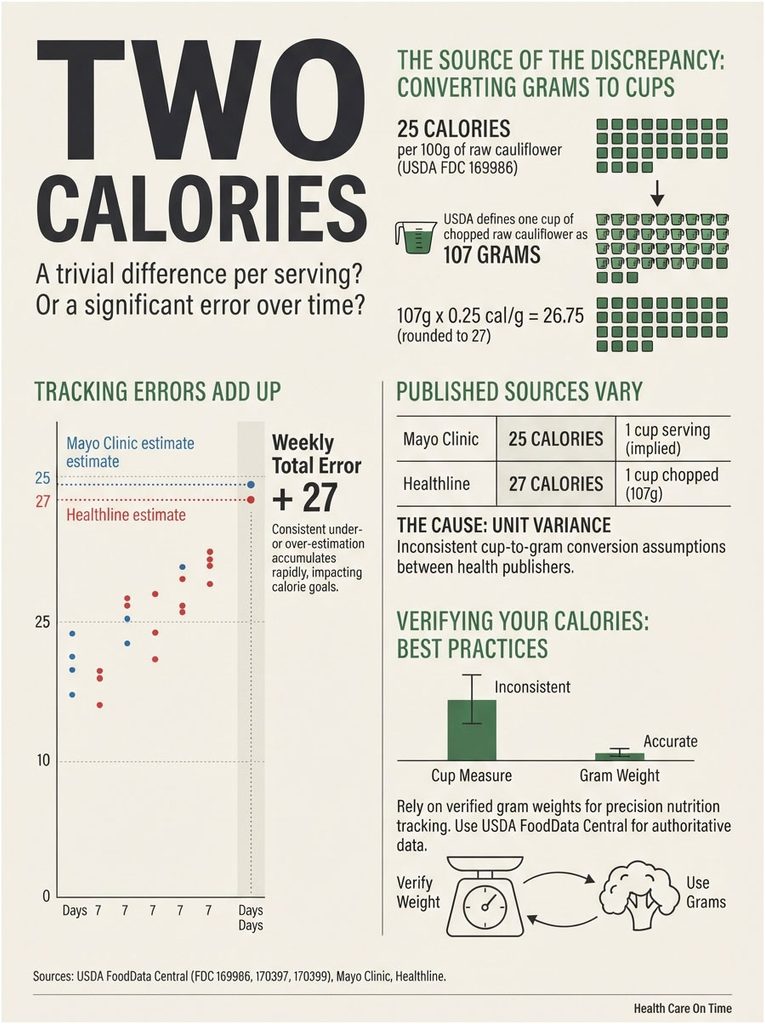
So where does 25 per cup come from? It comes from writers taking the per-100-gram value and labeling it one cup without doing the conversion.
Mayo Clinic Health System lists 25 calories per one-cup serving. Healthline lists 27 for the same 107-gram cup. The vegetable did not change. The arithmetic did.
Why a two-calorie gap is worth explaining
On a single serving, two calories is noise. It stops being noise when someone eats three cups of roasted cauliflower a day and their tracking app quietly runs 6 percent low across an entire food group for months.
It also matters because the same error repeats across every low-calorie vegetable. Learn to spot it once and you can audit any nutrition page you read.
Patients who bring food logs to our nutrition team most often ask why their app numbers do not match the label or the article they read. Nine times out of ten the answer is a gram weight nobody printed.
The rule for reading any calorie claim
Before trusting a calorie figure for a vegetable, look for the gram weight attached to it. If an article says one cup with no gram number beside it, the figure cannot be verified and should not be logged.
The same principle governs how our medical reviewers read lab results. A value without its unit and its measurement basis is not usable data, whether it appears on a blood panel or a nutrition page.
Which USDA record should you actually use
USDA maintains several cauliflower entries, and picking the wrong one produces a number that is technically sourced and practically wrong.
For fresh cauliflower eaten raw, use FDC 169986. For anything boiled, use FDC 170397. For bagged frozen florets you steam or boil at home, use FDC 170399. Green cauliflower, sometimes labeled broccoflower, carries its own record and different numbers entirely.
Cauliflower Calories by Serving Size
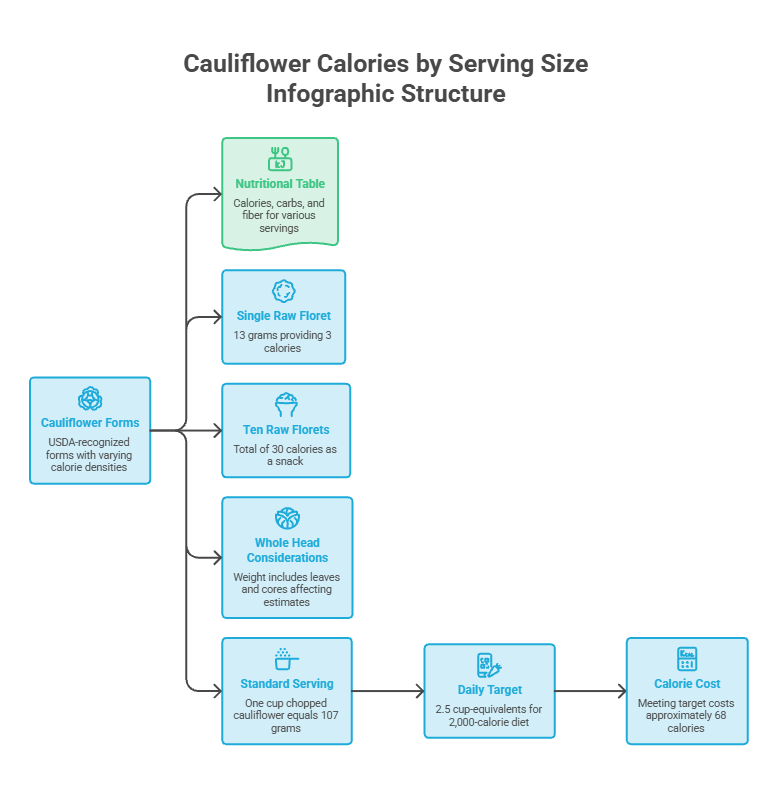
Cauliflower comes in more USDA-recognized forms than most people expect. Raw florets, boiled florets, frozen unprepared, frozen and boiled, and green cauliflower each carry separate records with different calorie densities.
The table below pulls them together with gram weights attached, so every number can be checked against its source.
| Form and USDA record | Serving | Grams | Calories | Carbs / Fiber |
| Raw, FDC 169986 | 100 grams | 100 g | 25 | 4.97 g / 2.0 g |
| Raw, FDC 169986 | 1 cup chopped, 1/2″ pieces | 107 g | 27 | 5.32 g / 2.14 g |
| Raw, FDC 169986 | 1 floret | 13 g | 3 | 0.65 g / 0.26 g |
| Raw, FDC 169986 | 1 ounce | 28 g | 7 | 1.39 g / 0.56 g |
| Raw, FDC 169986 | 1 small head (about 4″ diameter) | 265 g | 66 | 13.2 g / 5.3 g |
| Raw, FDC 169986 | 1 medium head (5 to 6″ diameter) | 588 g | 147 | 29.2 g / 11.8 g |
| Raw, FDC 169986 | 1 large head (6 to 7″ diameter) | 840 g | 210 | 41.7 g / 16.8 g |
| Boiled, drained, FDC 170397 | 1 cup | 124 g | 29 | 5.1 g / 2.9 g |
| Boiled, drained, FDC 170397 | 1/2 cup | 62 g | 14 | 2.6 g / 1.5 g |
| Frozen, boiled, drained, FDC 170399 | 100 grams | 100 g | 19 | 3.7 g / 2.4 g |
| Green cauliflower, raw | 100 grams | 100 g | 31 | 6.1 g / 3.2 g |
Per floret, and why snackers care
A single raw floret weighs about 13 grams and delivers 3 calories. Ten florets on a crudite plate comes to 30 calories.
For context, two tablespoons of ranch dressing runs well over 100 calories. The dip costs three times what the vegetable does, which is the practical reason cauliflower gets recommended as a snack base and then quietly sabotaged at the table.
Per whole head
Head weights in USDA data refer to trimmed edible florets, not the head as sold. A cauliflower bought with leaves and thick core attached can carry another 30 to 40 percent of gross weight you will never eat.
That matters if you weigh the whole head at the store and try to back into a calorie figure. Trim first, then weigh, or accept a meaningful overestimate.
What counts as one serving under US guidance
USDA SNAP-Ed uses one cup of chopped cauliflower, 107 grams, as its standard serving. Under MyPlate rules, one cup of raw or cooked cauliflower counts as a full cup-equivalent of vegetables.
Adults following a 2,000-calorie pattern are advised to reach about 2.5 cup-equivalents of vegetables daily. Meeting that entire target with cauliflower alone would cost roughly 68 calories.
How Cooking Changes the Calorie Count
Cooking cauliflower without added fat lowers its calorie density rather than raising it. This surprises people, and the mechanism is simple. Boiling drives water into the tissue and leaches soluble compounds out.
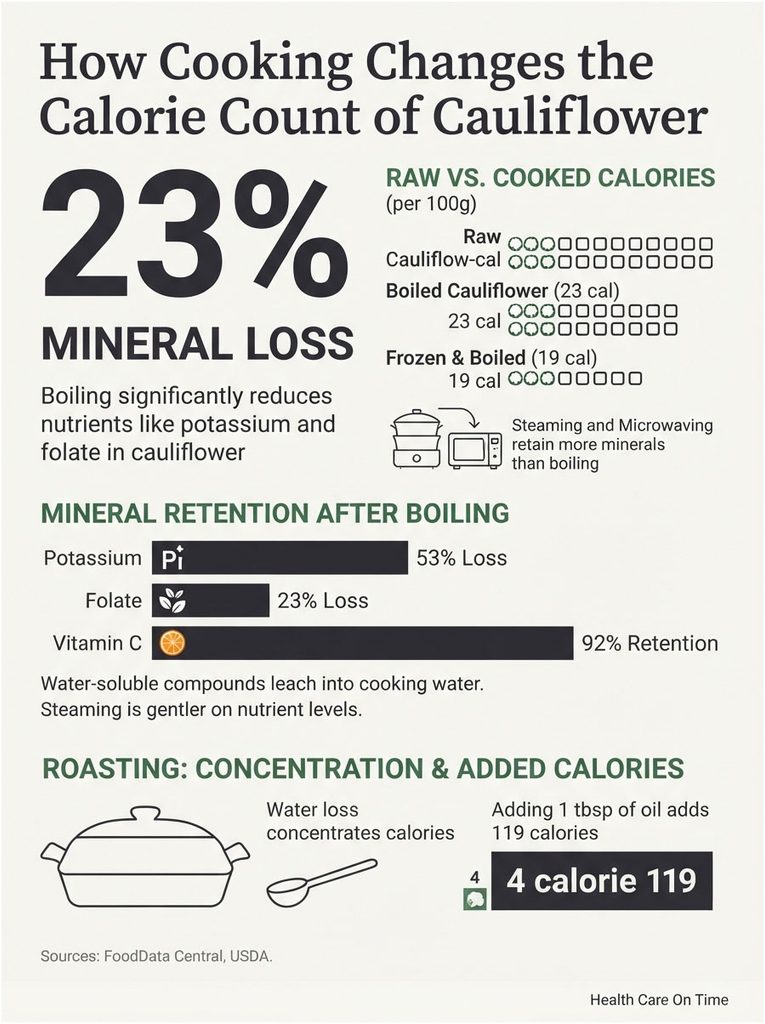
Raw cauliflower is 25 calories per 100 grams. Boiled and drained, it drops to 23. Frozen and boiled falls to 19.
Boiled and drained: what the water takes with it
The calorie change is small. The mineral change is not, and this is the part competitor pages skip entirely.
Raw cauliflower carries 299 mg of potassium per 100 grams. After boiling and draining, USDA record 170397 shows 142 mg per 100 grams. That is a 53 percent loss straight into the cooking water.
Vitamin C, the nutrient everyone assumes gets destroyed, holds up far better. Raw is 48.2 mg per 100 grams; boiled is 44.3 mg, a loss near 8 percent.
Folate lands in between, falling from 57 mcg to roughly 44 mcg per 100 grams, a loss around 23 percent.
The practical takeaway: if potassium matters to you, steam or roast instead of boiling, or fold the cooking liquid into a soup rather than pouring it down the drain.
Steamed and microwaved
Neither method adds calories, and both retain more water-soluble minerals than boiling because far less liquid touches the food.
Steamed cauliflower also carries a documented insulin index of 48 in the University of Sydney database, which is low for any carbohydrate-containing food and reflects how little digestible starch cauliflower holds.
Microwaving with a tablespoon or two of water in a covered dish is functionally steaming, and it is the fastest low-loss method available in a home kitchen.
Roasted: where the calories actually come from
Roasting drives off water, which concentrates calories per gram without changing the total. Two cups of raw florets weighing about 214 grams start at 54 calories and finish near 150 grams cooked, still 54 calories.
The oil is the whole story. One tablespoon of olive oil adds roughly 119 calories, which more than triples the dish.
Across the food logs our nutrition team reviews, roasted vegetables are the single most underestimated entry, because people log the vegetable and forget the fat it was cooked in. A light spray produces the same browning at a fraction of the cost.
Frozen cauliflower, the lowest number in the database
USDA lists frozen unprepared cauliflower at 24 calories per 100 grams and frozen, boiled, drained at 19. The blanching step commercial processors use before freezing pulls out some soluble solids before the bag is ever sealed.
Frozen also holds vitamin C well, because freezing halts the enzymatic degradation that keeps running in fresh produce sitting in a refrigerator drawer for a week.
Green and purple varieties
Green cauliflower, sold in some US markets as broccoflower, runs 31 calories per 100 grams raw and 32 cooked. It carries more carbohydrate and more fiber than white.
Purple varieties get their color from anthocyanins and sit close to white cauliflower on calories. Orange cultivars such as Cheddar carry beta-carotene that white heads lack. Across all of them, the color difference matters more for pigment content than for energy.
Full Nutrition Profile Beyond Calories
Calorie counts tell you what cauliflower costs. The nutrient profile tells you what it buys, and for 25 calories the return is unusually strong.
| Nutrient | Raw, per 100 g | % Daily Value | Boiled, per 100 g | Source |
| Calories | 25 kcal | 1% | 23 kcal | USDA FDC 169986 / 170397 |
| Protein | 1.92 g | 4% | 1.84 g | USDA FDC 169986 / 170397 |
| Total carbohydrate | 4.97 g | 2% | 4.11 g | USDA FDC 169986 / 170397 |
| Dietary fiber | 2.0 g | 7% | 2.3 g | USDA FDC 169986 / 170397 |
| Total fat | 0.28 g | 0% | 0.45 g | USDA FDC 169986 / 170397 |
| Vitamin C | 48.2 mg | 54% | 44.3 mg | USDA / FDA Daily Value 90 mg |
| Vitamin K | 15.5 mcg | 13% | 13.8 mcg | USDA / FDA Daily Value 120 mcg |
| Folate | 57 mcg | 14% | 44 mcg | USDA / FDA Daily Value 400 mcg |
| Vitamin B6 | 0.184 mg | 14% | 0.169 mg | USDA / FDA Daily Value 1.7 mg |
| Pantothenic acid (B5) | 0.667 mg | 13% | 0.508 mg | USDA / FDA Daily Value 5 mg |
| Choline | 44.3 mg | 8% | 39.1 mg | USDA / FDA Daily Value 550 mg |
| Potassium | 299 mg | 6% | 142 mg | USDA / FDA Daily Value 4,700 mg |
| Manganese | 0.155 mg | 7% | 0.129 mg | USDA / FDA Daily Value 2.3 mg |
| Magnesium | 15 mg | 4% | 9 mg | USDA / FDA Daily Value 420 mg |
| Water | 92.07 g | n/a | 93.0 g | USDA FDC 169986 / 170397 |
Daily Values follow the FDA Nutrition Facts label reference amounts.
Macronutrients and net carbs
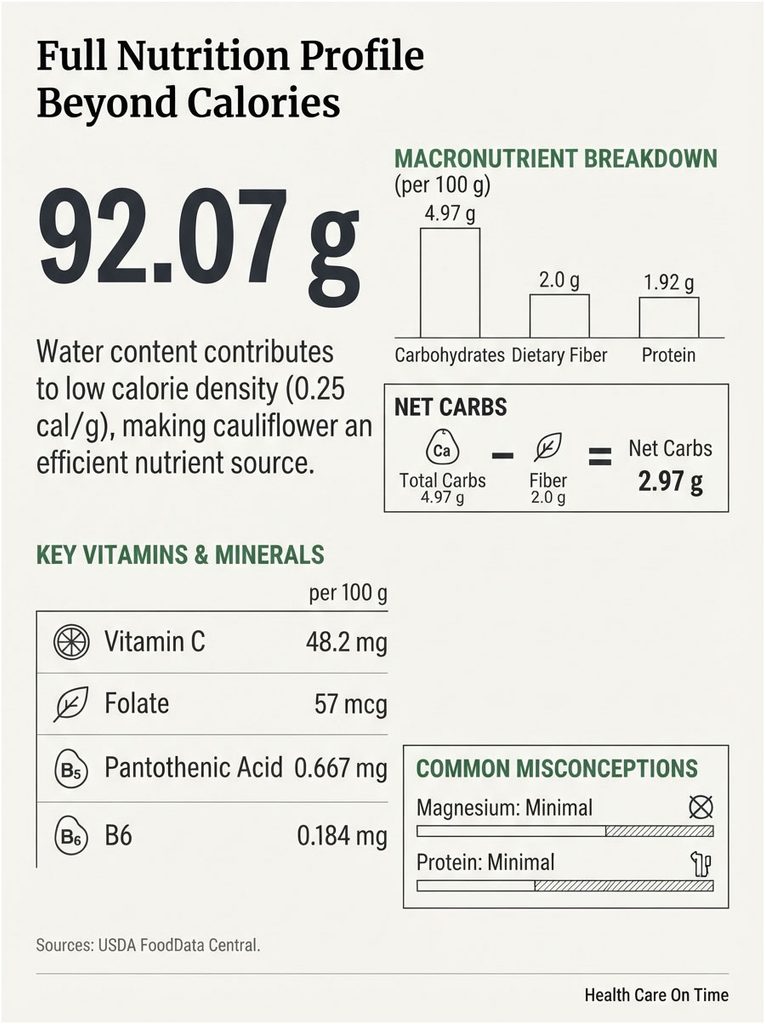
Cauliflower is 4.97 grams of carbohydrate per 100 grams, of which 2.0 grams is fiber. Subtract fiber and you get 2.97 grams of net carbs, the figure low-carb eaters actually track.
Sugars account for about 1.91 grams of that carbohydrate, split roughly evenly between glucose and fructose. Starch is effectively absent, which is the structural reason cauliflower behaves so differently from potato on a plate.
Vitamin C is the standout
At 48.2 mg per 100 grams, cauliflower sits in the top few percent of all foods for vitamin C density. One raw cup delivers about 51.6 mg, which is 57 percent of the Daily Value.
That puts a cup of cauliflower roughly on par with a medium orange at one-quarter the calories, a comparison almost nobody makes because cauliflower does not read as a vitamin C food.
The B vitamins and choline nobody mentions
Folate at 57 mcg per 100 grams, pantothenic acid at 13 percent DV, and vitamin B6 at 14 percent DV make cauliflower a quietly useful contributor for people eating a plant-heavy pattern.
Choline at 44.3 mg per 100 grams also matters, because most Americans fall short of the 550 mg adequate intake and few foods outside eggs and liver contribute meaningfully.
What cauliflower does not deliver
Some pages describe cauliflower as an excellent source of magnesium. USDA data does not support that claim. At 15 mg per 100 grams, it supplies about 4 percent of the Daily Value.
Iron sits at 0.42 mg, calcium at 22 mg, and protein under 2 grams per 100 grams. Cauliflower is a vitamin and fiber food, not a mineral or protein food.
Readers who book nutritional panels through HealthCareOnTime regularly ask whether a vegetable-heavy diet covers iron and B12. Cauliflower contributes almost nothing to either, and no amount of it will move those numbers.
Water content and calorie density
At 92.07 grams of water per 100 grams, cauliflower is denser in water than in anything else. That single fact drives its calorie density of 0.25 calories per gram.
You would need to eat 400 grams, close to a pound, to reach 100 calories from cauliflower alone.
Cauliflower in Its Most Popular American Forms
This is where calorie counts stop being about cauliflower and start being about what got added to it.
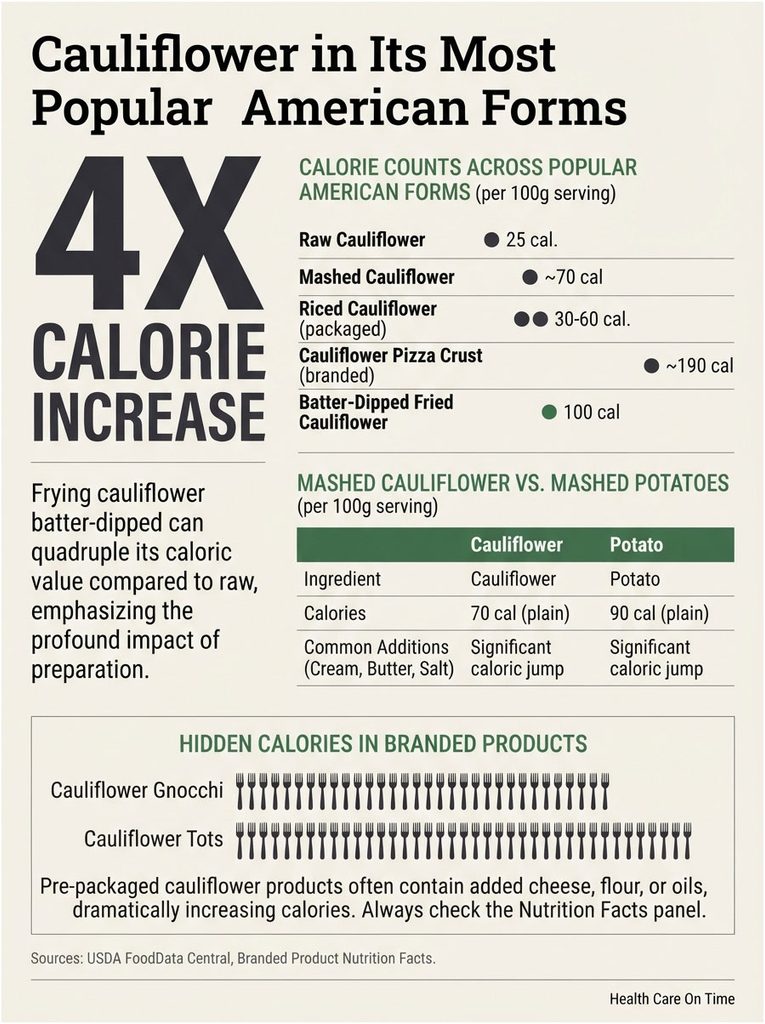
| Prepared form | Typical serving | Calories | What drives the number |
| Riced cauliflower, raw | 1 cup (107 g) | 27 | Nothing added |
| Riced cauliflower, sauteed in 1 tbsp oil | 1 cup portion | About 86 | 119 kcal of oil split across the batch |
| Cauliflower cooked with fat | 1 cup | 62 | Butter or oil added at the pan |
| Mashed cauliflower | 1 cup | 142 | Cream, butter, or cheese |
| Canned cauliflower | 1 cup | 89 | Packing medium and added oils |
| Batter-dipped fried cauliflower | 1 cup | 172 | Flour coating plus absorbed fry oil |
| Cream of cauliflower soup | 1 cup | 196 | Dairy base and roux |
| Creamed cauliflower | 1 cup | 249 | Heavy cream and cheese |
Prepared-form values reflect typical US recipe preparations catalogued in consumer food databases rather than USDA Standard Reference records.
Cauliflower rice, and why published numbers range from 25 to 47
Search for cauliflower rice calories and you will find 25, 27, 38, and 47 all presented as fact. Every one of them is defensible. None is complete.
The 25 and 27 figures are raw riced cauliflower at 100 or 107 grams. The 38 figure comes from a 150-gram sauteed cup, denser because it cooked down. The 47 figure comes from database entries that already include cooking fat.
One widely cited page states cauliflower rice is 25 calories per cup both raw and cooked. That holds only if you cook with zero added fat and re-measure to the same gram weight, which almost nobody does.
The honest version: raw riced cauliflower is 27 calories per 107-gram cup. Whatever oil, butter, or coconut milk hits the pan is the real variable.
Mashed cauliflower versus mashed potato
Mashed cauliflower at roughly 142 calories per cup is often sold as the light option, and it is, but the margin is smaller than the marketing suggests.
Mashed potato prepared with milk and butter runs around 214 calories per cup. The saving is real at about 72 calories, though the cauliflower version reaches 142 only because cream and butter went in too.
Mashed with broth and seasoning instead of dairy, the same cup lands closer to 40 calories.
Cauliflower pizza crust, gnocchi, and tots
Branded cauliflower products vary enormously and cannot be estimated from the vegetable. Many list cassava flour, potato starch, rice flour, or cheese ahead of cauliflower on the ingredient panel.
The only reliable number for these is the Nutrition Facts panel on the specific package in your hand. Treat the word cauliflower on the front of a box as a flavor claim, not a calorie claim.
Buffalo and fried cauliflower
Batter-dipped fried cauliflower at about 172 calories per cup carries roughly six times the energy of the raw vegetable, and buffalo-style versions add sauce built on butter.
A restaurant appetizer portion can easily match a serving of chicken wings on calories and fat. The vegetable underneath does not rescue the preparation.
Is Cauliflower Good for Weight Loss?
At 0.25 calories per gram, cauliflower is among the least calorie-dense foods in the American food supply. That property is what makes it useful. It is not magic, and it is not free.
Calorie density beats calorie counting
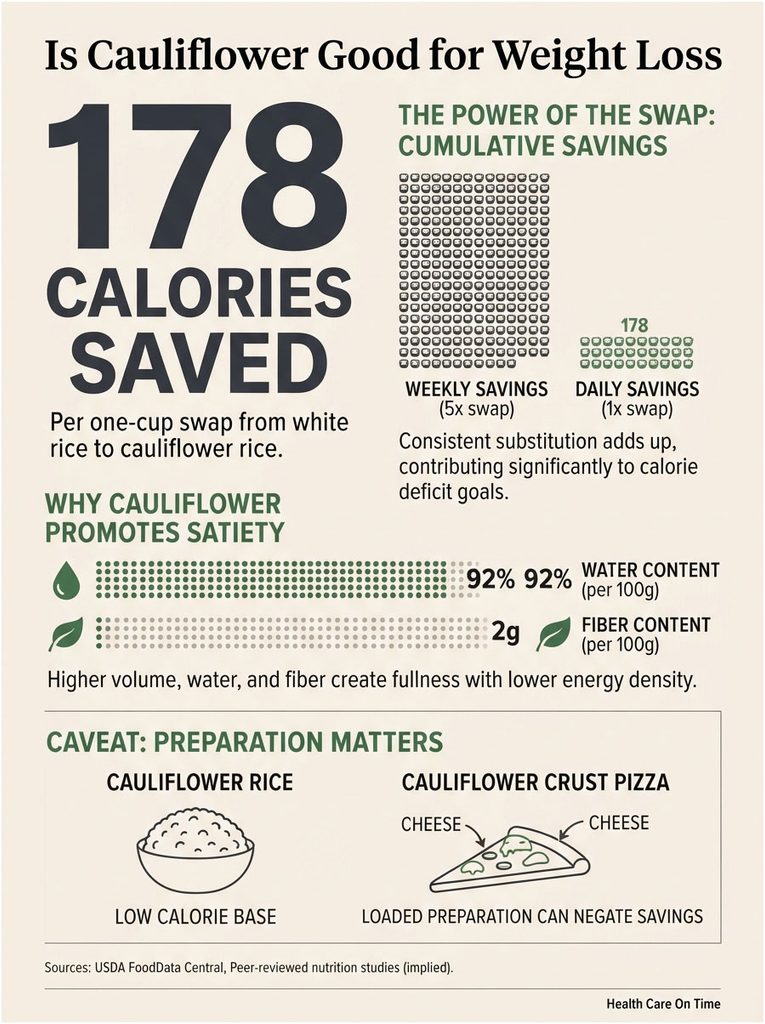
Swapping one cup of cooked white rice for one cup of cauliflower rice removes roughly 178 calories from a meal while keeping plate volume identical. Cooked white rice runs about 130 calories per 100 grams against cauliflower’s 25.
Do that at five dinners a week and the arithmetic reaches roughly 890 calories, with no change to portion size and no hunger penalty.
Applied to a mashed potato side, the same swap saves about 72 calories, or closer to 174 if you mash with broth instead of cream.
Volume, water, and satiety
Cauliflower is 92 percent water by weight and supplies 2 grams of fiber per 100 grams. Water-dense, fiber-containing foods increase the physical volume of a meal, and volume is one of the signals that ends eating.
This is why half a plate of roasted cauliflower next to a smaller portion of protein and starch tends to satisfy better than a smaller plate of the same starch alone.
What negative calorie food gets wrong
The claim is that chewing and digesting cauliflower burns more energy than the food provides. The thermic effect of food for vegetables is real but modest, generally a few percent of the energy consumed.
Twenty-five calories minus a few percent is still a positive number. Cauliflower is very low in calories, which is a different claim and a true one.
Where the strategy breaks down
Cauliflower substitution fails when the substitute arrives loaded. Cauliflower crust pizza covered in cheese, cauliflower tots deep-fried, and cauliflower gnocchi pan-fried in butter can each land above the food they replaced.
Our medical reviewers see this pattern often enough to name it plainly: the swap only saves calories if the preparation stays honest.
Cauliflower Versus Other Low-Calorie Vegetables
Cauliflower usually gets compared to broccoli, and the comparison runs closer than expected on calories and further apart than expected on nutrients.
Cauliflower versus broccoli
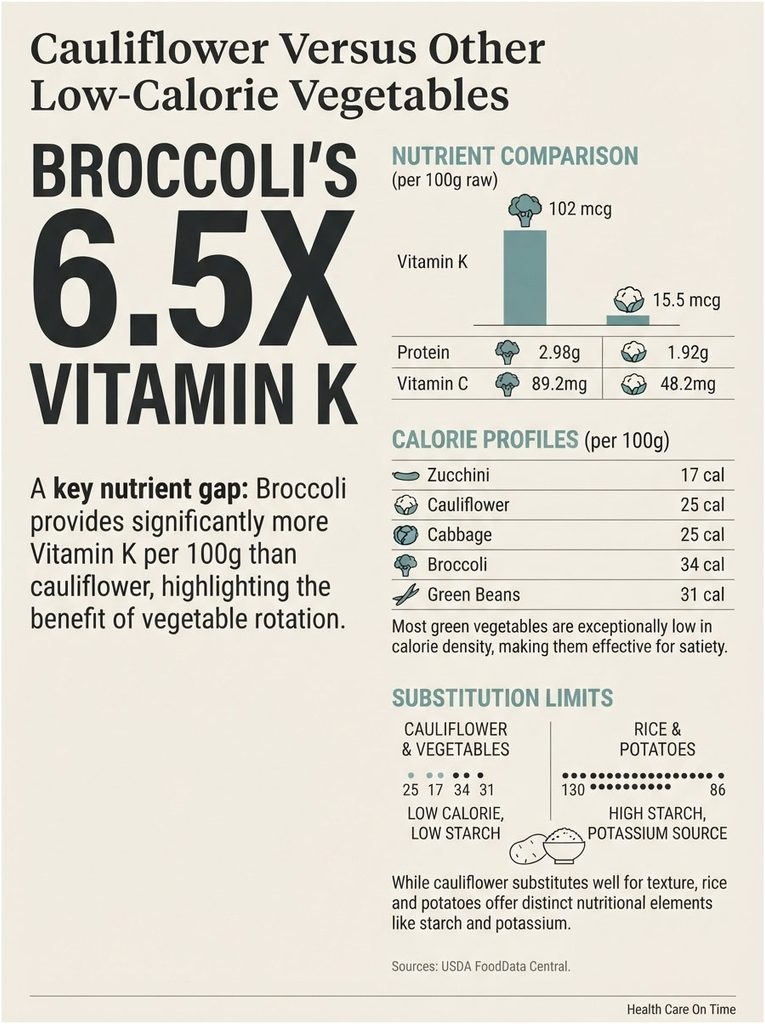
Raw broccoli runs about 34 calories per 100 grams against cauliflower’s 25. Broccoli carries roughly 50 percent more protein and close to twice the vitamin C.
The gap that matters most is vitamin K. Broccoli holds about 102 mcg per 100 grams against cauliflower’s 15.5 mcg, roughly six and a half times more. For anyone on anticoagulant therapy, that difference is the entire clinical conversation.
Flavor drives most real-world choices. Cauliflower’s mildness is precisely why it substitutes for rice, potato, and dough while broccoli cannot.
Cauliflower versus other low-calorie vegetables
Cauliflower sits mid-pack among the low-calorie group. Zucchini runs about 17 calories per 100 grams, cabbage matches cauliflower at 25, and green beans land near 31.
None of these differences will decide a diet. Rotating among them delivers a wider nutrient spread than eating any one of them daily.
Cauliflower versus rice and potato
Against starches, the gap is enormous. Boiled potato sits near 86 calories per 100 grams and cooked white rice near 130, which is three to five times cauliflower’s density.
The tradeoff is real and worth stating: rice and potato also deliver satisfying starch, potassium, and staying power that cauliflower does not replicate. Substitution works best as a sometimes tool, not a permanent replacement for every starch on the plate.
How Much Cauliflower Americans Actually Eat
Cauliflower’s US trajectory is one of the more dramatic vegetable stories in USDA records, and it maps almost exactly onto low-carb dieting trends.
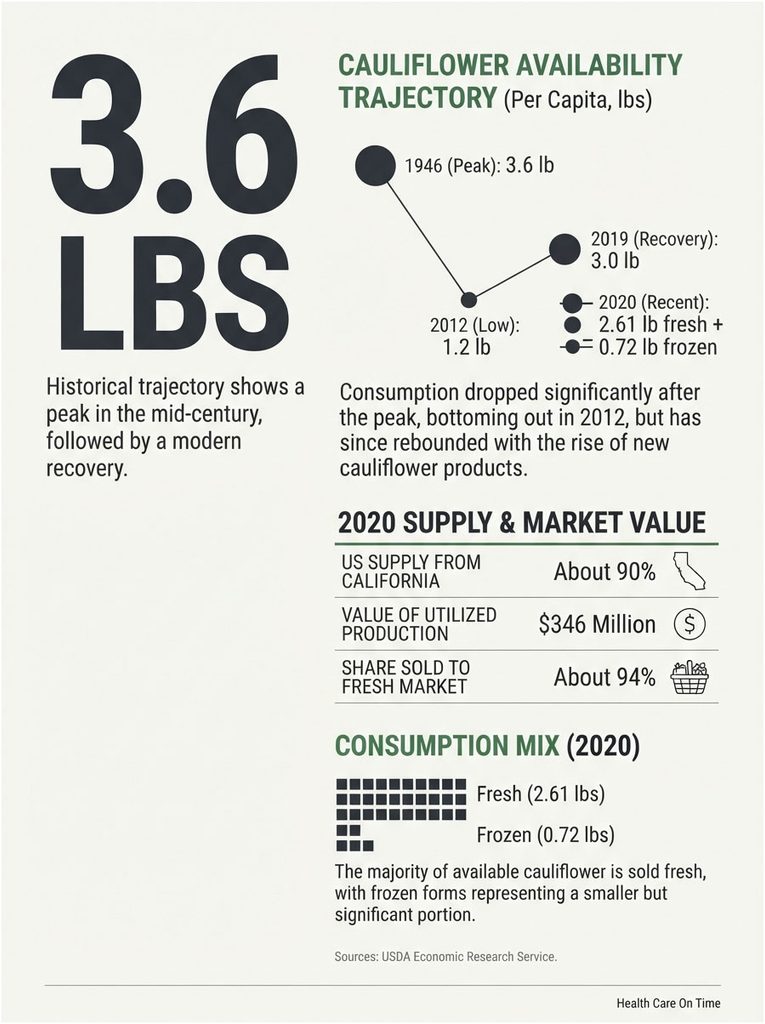
| US cauliflower statistic | Figure | Source |
| Peak fresh per capita availability | 3.6 lb per person (1946) | USDA Economic Research Service |
| Low point of modern decline | 1.2 lb per person (2012) | USDA Economic Research Service |
| Recovery level | 3.0 lb per person (2019) | USDA Economic Research Service |
| Fresh plus frozen availability | 2.61 lb fresh, 0.72 lb frozen (2020) | AgMRC citing USDA ERS |
| Share of US supply from California | About 90 percent | AgMRC citing USDA NASS |
| Value of utilized production | About $346 million (2020) | AgMRC citing USDA NASS |
| Share sold to fresh market | About 94 percent (2020) | AgMRC citing USDA NASS |
USDA Economic Research Service attributes the recovery from 1.2 pounds in 2012 to 3.0 pounds in 2019 largely to low-carb and gluten-free eating, and to manufacturers building products around the vegetable.
Even at 3 pounds a year, that works out to roughly 22 calories per person per day averaged across the population. Only about 1 in 10 US adults meets the daily vegetable recommendation according to CDC surveillance, so there is room in almost every American diet for more of it.
Who Should Watch Their Cauliflower Intake
Cauliflower is safe and useful for most people. A few groups need specifics rather than blanket encouragement.
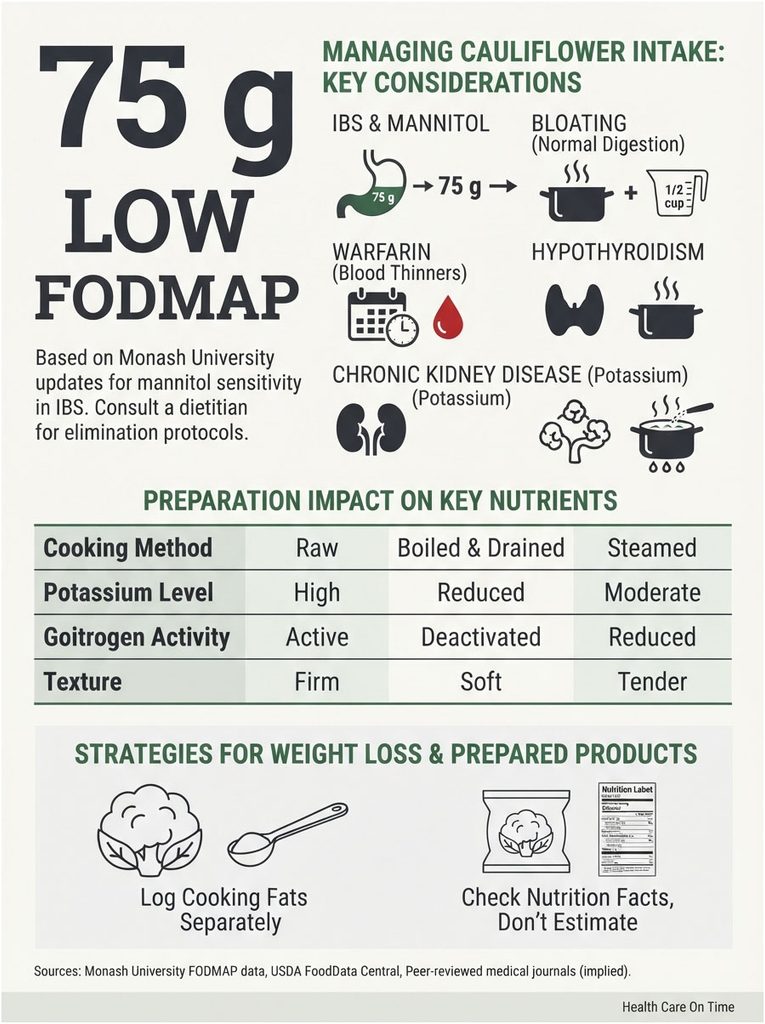
| Your situation | What it means for cauliflower | Recommended action |
| IBS with mannitol sensitivity | Monash testing now places a 75 g serving of white cauliflower in the low FODMAP range | Start at 75 g (about 3/4 cup) and watch for fructan effects at larger portions |
| Bloating with normal digestion | Sulfur compounds and fermentable fiber cause gas independent of FODMAP status | Cook thoroughly, start at 1/2 cup, increase gradually over two weeks |
| Taking warfarin | 15.5 mcg vitamin K per 100 g raw is modest, but consistency matters | Keep weekly intake steady rather than eliminating it; discuss changes with your prescriber |
| Diagnosed hypothyroidism | Goitrogens in raw cruciferous vegetables affect thyroid function mainly at very high raw intakes | Cook cauliflower, which deactivates the enzyme involved, and keep normal portions |
| Chronic kidney disease with potassium limits | Raw cauliflower supplies 299 mg potassium per 100 g | Boil and drain, which cuts potassium roughly in half, and follow your renal dietitian limit |
| Tracking calories for weight loss | The vegetable is not the variable; the cooking fat is | Log oil, butter, and sauces separately from the cauliflower |
| Buying prepared cauliflower products | Crusts, gnocchi, and tots can carry four to ten times the calories of the raw vegetable | Read the Nutrition Facts panel; do not estimate from cauliflower data |
The FODMAP update most sites missed
For years cauliflower carried a high FODMAP label because of its mannitol content, and most food lists online still say so.
That guidance changed. Monash University testing now places a three-quarter cup serving of white cauliflower in the low FODMAP range, with fructans rather than mannitol becoming the limiting FODMAP at larger portions. Purple cauliflower tested low at the same serving size.
Labs do not fully agree. FODMAP Everyday notes that FODMAP Friendly’s testing of white cauliflower produced a far smaller low-FODMAP serving. Reporting that disagreement is more useful than pretending the question is settled.
If you are working through a structured elimination protocol, the current Monash app is the reference to follow, ideally with a FODMAP-trained dietitian.
Gas that has nothing to do with FODMAPs
Cauliflower is high in sulfur-containing compounds shared across the cruciferous family. Gut bacteria ferment them and produce gas even at low FODMAP portions.
Cooking thoroughly and building portion size over a couple of weeks handles this for most people. Patients commonly ask us whether persistent bloating means intolerance; more often it means the portion jumped too fast.
How to Buy, Store, and Cook Without Adding Calories
Choosing a head at a US grocery store
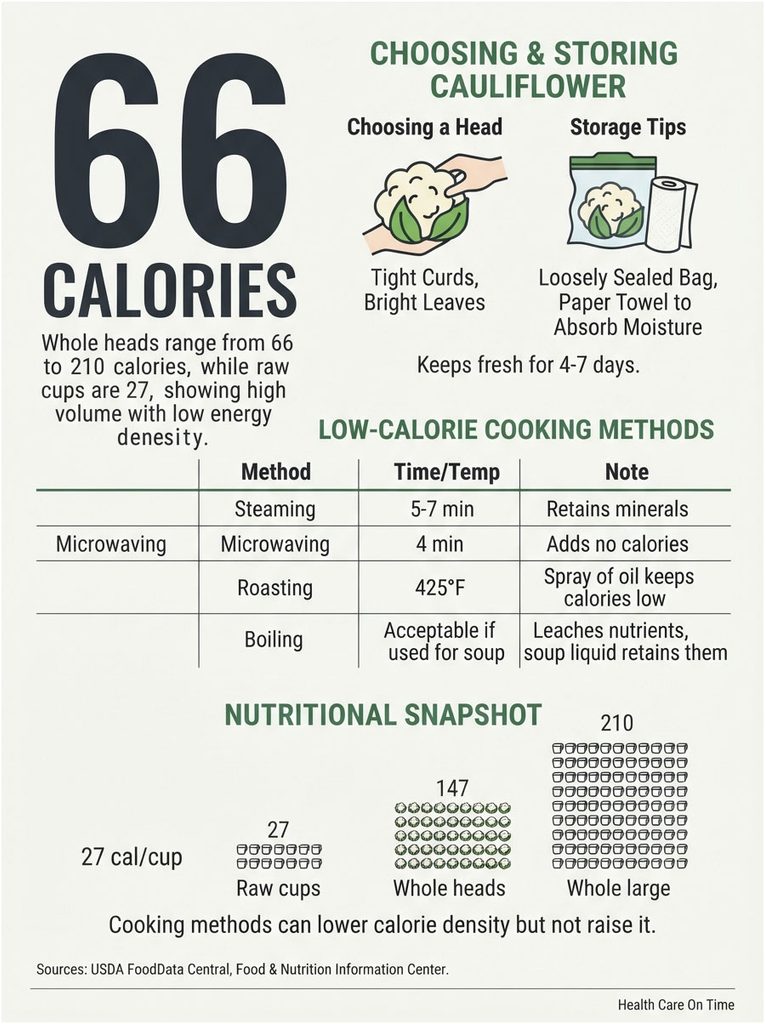
Look for tight, creamy-white curds with no browning, and bright green leaves attached firmly at the base. Loose, separating florets mean the head is past its prime.
Small brown spots can be trimmed away and are cosmetic. Widespread grey or brown discoloration means it has been in transit or on display too long.
Storage that protects the vitamin C
Skip cellophane-wrapped heads where you can. Trapped moisture accelerates spoilage.
Transfer the head to a loosely sealed bag with a paper towel to absorb condensation, and it will keep four to seven days refrigerated. Cut florets last two to three days and lose vitamin C faster because more surface is exposed.
Four low-calorie cooking methods
Steaming for five to seven minutes adds nothing and retains the most minerals. Microwaving in a covered dish with a splash of water does the same in about four minutes.
Roasting at 425 degrees Fahrenheit with a spray of oil rather than a pour delivers browning for roughly 15 calories instead of 119. Boiling is fine as long as the liquid becomes soup rather than going down the drain.
Our lab partners note that vitamin C status reflects recent intake across days rather than any single meal, so consistency beats perfect technique on any given night.
Frequently Asked Questions
How many calories are in one cup of cauliflower?
One cup of raw chopped cauliflower weighs 107 grams and contains 27 calories per USDA FoodData Central. One cup of boiled, drained cauliflower weighs 124 grams and contains 29 calories. The cooked cup is higher only because it weighs more, not because cooking added energy.
How many calories are in a whole head of cauliflower?
A trimmed small head at about 265 grams has roughly 66 calories. A medium head near 588 grams has about 147 calories. A large head around 840 grams reaches about 210 calories. These weights cover edible florets only, not the leaves and core you discard.
Does cooking cauliflower change the calorie count?
Boiling and draining lowers calorie density slightly, from 25 to 23 calories per 100 grams. Frozen and boiled drops to 19. Cooking never raises the count on its own. Oil, butter, cheese, and batter do, and they can multiply the total several times over.
How many calories are in cauliflower rice?
Raw riced cauliflower is 27 calories per 107-gram cup, identical to chopped florets since it is the same vegetable. Published figures of 38 or 47 calories reflect heavier cooked cups or added cooking fat. Sauteing in one tablespoon of oil adds roughly 119 calories to the batch.
How many carbs are in cauliflower?
Raw cauliflower has 4.97 grams of total carbohydrate per 100 grams, with 2.0 grams of fiber, leaving 2.97 grams of net carbs. A 107-gram cup works out to 5.32 grams total carbohydrate and roughly 3.2 grams net carbs. Cooked and drained values run slightly lower per 100 grams.
Is cauliflower keto friendly?
Yes. At under 3 grams of net carbs per 100 grams, cauliflower fits comfortably in ketogenic and low-carb patterns, and it is the standard substitute for rice, mashed potato, and pizza crust. Watch prepared cauliflower products, which often contain starches that raise net carbs considerably.
How much protein does cauliflower have?
Raw cauliflower supplies 1.92 grams of protein per 100 grams, or about 2.05 grams per cup. That is roughly 4 percent of the Daily Value and well below broccoli. Treat cauliflower as a fiber and vitamin food, with protein coming from other parts of the meal.
Is cauliflower a negative calorie food?
No. The thermic effect of digesting vegetables is real but small, generally a few percent of the energy they contain. Twenty-five calories minus a small digestive cost is still a positive number. Cauliflower is extremely low in calories, which is accurate, and negative-calorie, which is not.
Does cauliflower have more calories than broccoli?
Fewer. Raw cauliflower is 25 calories per 100 grams; raw broccoli is about 34. Broccoli wins on protein, vitamin C, and dramatically on vitamin K, at roughly 102 mcg per 100 grams against cauliflower’s 15.5 mcg. Both belong in a regular vegetable rotation.
Why does cauliflower make me bloated?
Two separate causes. Cauliflower contains fermentable carbohydrates, and Monash testing places a three-quarter cup serving of white cauliflower in the low FODMAP range with fructans limiting larger portions. Separately, sulfur compounds common to all cruciferous vegetables produce gas during bacterial fermentation regardless of FODMAP content.
Is cauliflower safe if I take warfarin?
Generally yes, with consistency. Raw cauliflower carries 15.5 mcg of vitamin K per 100 grams, modest compared with broccoli or leafy greens. Warfarin management depends on steady weekly vitamin K intake rather than avoidance. Discuss any substantial diet change with the clinician managing your INR.
How much cauliflower counts as one vegetable serving?
One cup of raw or cooked cauliflower, about 107 grams raw, counts as a full cup-equivalent under MyPlate guidance. Adults on a 2,000-calorie pattern are advised to reach about 2.5 cup-equivalents of vegetables daily, which cauliflower alone would supply for roughly 68 calories.
Medical Disclaimer: This article is for general informational purposes and reflects nutrient data published by USDA FoodData Central at the time of writing. It is not medical or dietary advice and does not replace consultation with a licensed physician or registered dietitian. Anyone managing kidney disease, thyroid disorders, IBS, or anticoagulant therapy should discuss dietary changes with their treating clinician before making them.
References
- USDA FoodData Central, Cauliflower, raw, FDC 169986
- USDA FoodData Central, Cauliflower, cooked, boiled, drained, FDC 170397
- USDA FoodData Central home
- USDA SNAP-Ed Seasonal Produce Guide, Cauliflower
- USDA Economic Research Service, Cauliflower popularity re-emerges
- USDA Economic Research Service, Vegetables and Pulses topic page
- USDA Economic Research Service, Vegetables and Pulses Outlook, April 2026
- Agricultural Marketing Resource Center, Cauliflower commodity profile
- FDA, Daily Value on the Nutrition and Supplement Facts Labels
- Mayo Clinic Health System, Cauliflower: a versatile veggie
- Healthline, The top 8 health benefits of cauliflower
- Monash University FODMAP reclassification of cauliflower
- FODMAP Everyday, Cauliflower lab testing comparison
- Gut symptoms during FODMAP restriction and reintroduction, 21,462 participants
- MyFoodData, Cooked cauliflower nutrient detail, USDA SR mirror