Open three calorie apps, type “cucumber,” and you’ll likely see 45, 32, and 20 calories for what looks like the same vegetable. Nobody is lying to you. USDA publishes three separate cucumber records, and each app picked a different one or a different size.
Table of Contents
Patients who book lab work with HealthCareOnTime ask us about this more than you’d think, usually while tracking food for a weight or blood sugar goal. So our medical reviewers pulled every current cucumber record from USDA FoodData Central and did the math.
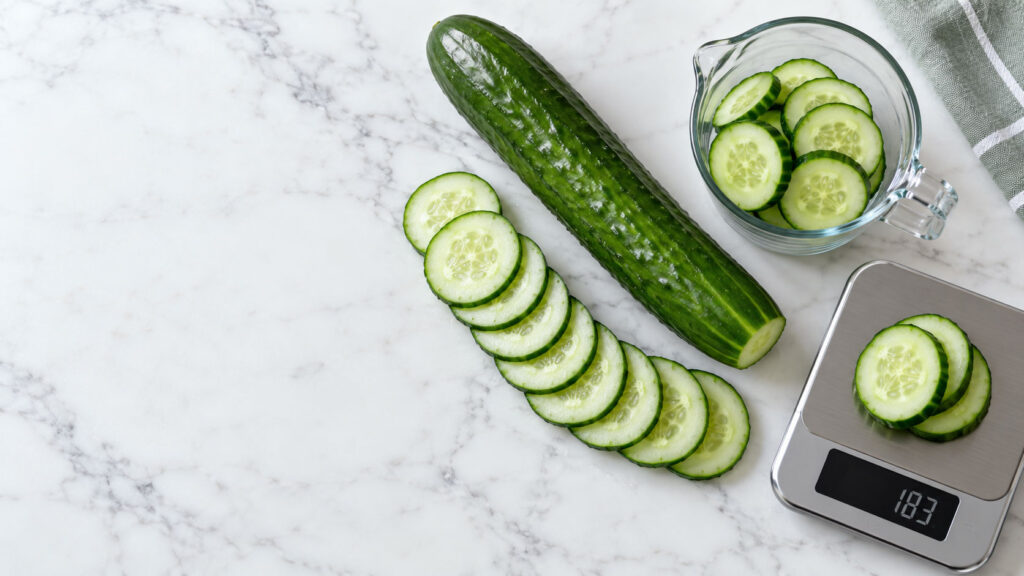
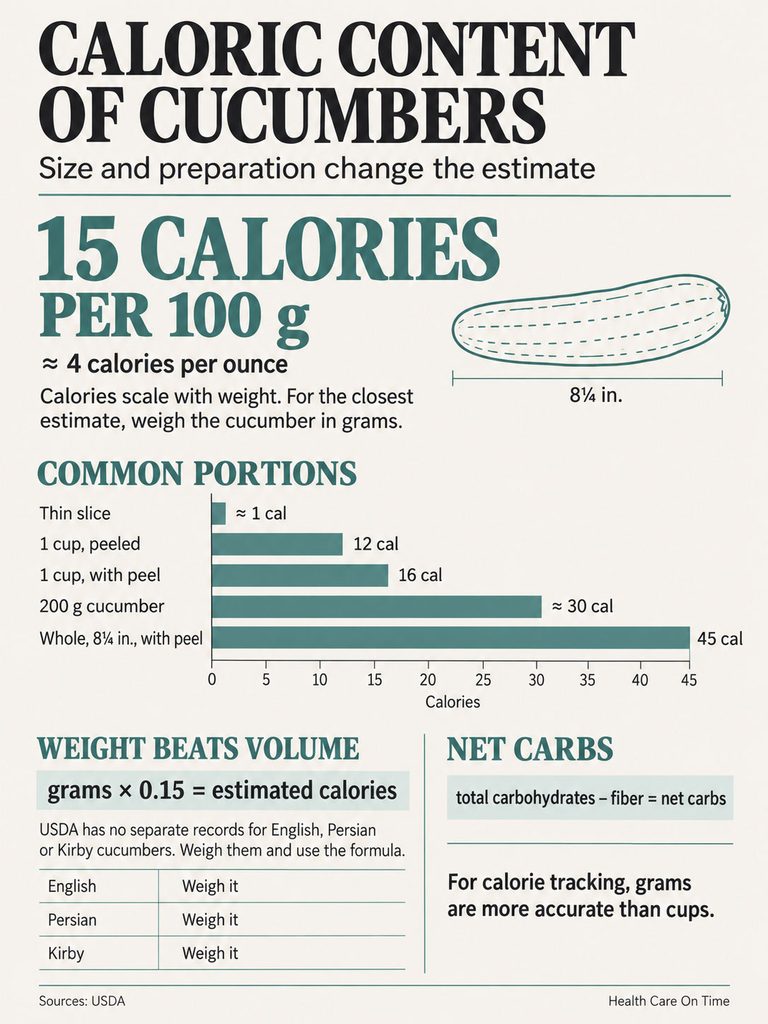
Quick Answer: A whole 8¼-inch cucumber with peel (301 grams, about 10.6 ounces) has 45 calories, according to USDA FoodData Central. One cup of sliced cucumber has 16 calories, and half a cup has 8. A medium peeled cucumber has about 20 calories. Per 100 grams, raw cucumber with peel has 15 calories. Because cucumbers are about 95% water, size matters far more than type.
Here are the most-searched servings, based on USDA data:
- 1 thin slice (7 g): 1 calorie
- ½ cup slices with peel (52 g): 8 calories
- 1 cup slices with peel (104 g): 16 calories
- 1 medium peeled cucumber (201 g): 20 calories
- 1 whole cucumber with peel (301 g): 45 calories
- 100 grams with peel (3.5 oz): 15 calories
At a Glance
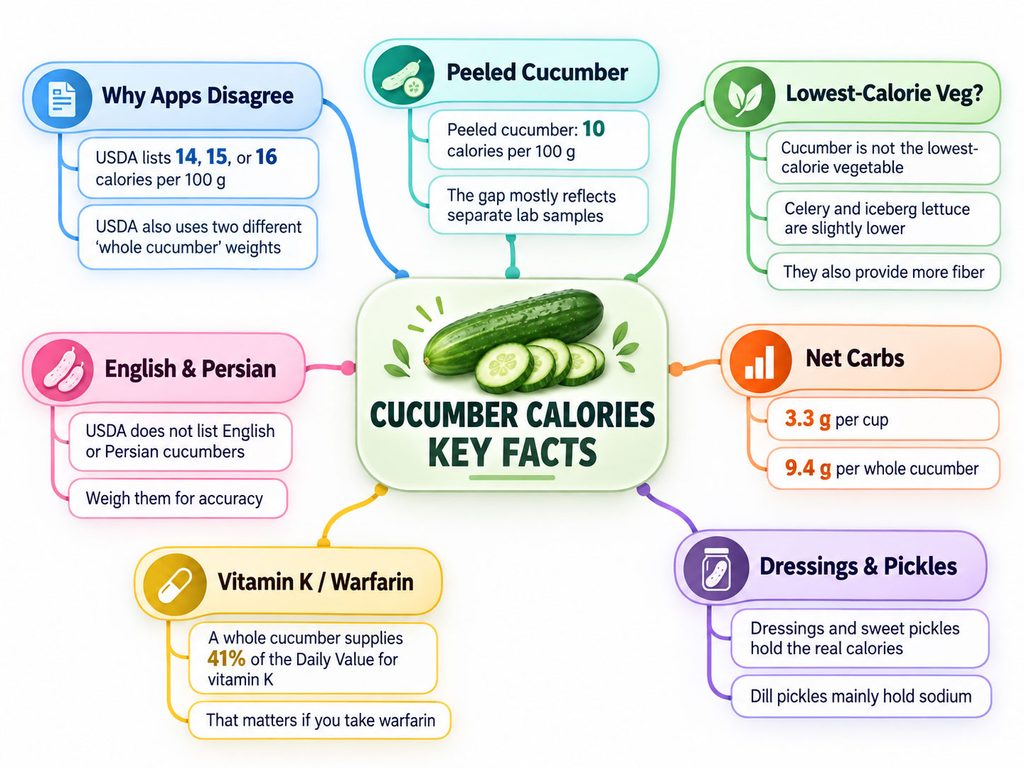
- Apps disagree because USDA lists 15, 16, or 14 calories per 100 grams and uses two different “whole cucumber” weights.
- Peeled cucumber lists 10 calories per 100 grams, but that gap mostly reflects separate lab samples.
- Cucumber isn’t the lowest-calorie vegetable. Celery and iceberg lettuce edge it out, with more fiber.
- Net carbs run 3.3 grams per cup and 9.4 grams per whole cucumber.
- Dressings and sweet pickles hold the real calories. Dill pickles hold sodium.
- A whole cucumber supplies 41% of the Daily Value for vitamin K, which matters if you take warfarin.
- USDA doesn’t list English or Persian cucumbers, so weigh them.
How Many Calories in a Cucumber, by Size and Cut
Cucumber calories scale almost perfectly with weight. At 15 calories per 100 grams, every ounce of cucumber with peel adds about 4 calories, whether you slice it, spear it, or eat it whole.
The table below draws on three USDA records:
- SR Legacy raw cucumber with peel (FDC 168409)
- SR Legacy peeled cucumber (FDC 169225)
- The FNDDS record (FDC 2709784) that federal diet surveys use
| Portion | Weight (g) | Weight (oz) | Calories | Net Carbs (g) | USDA Record |
| 1 slice, peeled | 7 | 0.25 | 1 | 0.1 | SR Legacy 169225 |
| 1 stick (4 inches), peeled | 9 | 0.3 | 1 | 0.1 | SR Legacy 169225 |
| ½ cup slices, with peel | 52 | 1.8 | 8 | 1.6 | SR Legacy 168409 |
| 1 cup slices, with peel | 104 | 3.7 | 16 | 3.3 | SR Legacy 168409 |
| 1 cup sliced, peeled | 119 | 4.2 | 12 | 1.7 | SR Legacy 169225 |
| 1 cup chopped, peeled | 133 | 4.7 | 13 | 1.9 | SR Legacy 169225 |
| 1 miniature cucumber | 65 | 2.3 | 10 | 1.6 | FNDDS 2709784 |
| 1 small (6⅜ inches), peeled | 158 | 5.6 | 16 | 2.3 | SR Legacy 169225 |
| 1 “regular” cucumber | 200 | 7.1 | 32 | 4.9 | FNDDS 2709784 |
| 1 medium, peeled | 201 | 7.1 | 20 | 2.9 | SR Legacy 169225 |
| 1 large (8¼ inches), peeled | 280 | 9.9 | 28 | 4.1 | SR Legacy 169225 |
| 1 whole (8¼ inches), with peel | 301 | 10.6 | 45 | 9.4 | SR Legacy 168409 |
| 100 grams, with peel | 100 | 3.5 | 15 | 3.1 | SR Legacy 168409 |
Net carbs equal total carbohydrate minus fiber.
A Whole Cucumber
The most common figure for calories in a whole cucumber, 45, comes from USDA’s 8¼-inch cucumber with the peel on. That’s a standard slicing cucumber, the thick-skinned kind sold loose in most US grocery stores.
If yours is shorter or thinner, it has fewer calories. A smaller slicer around 200 grams (7 ounces) lands at about 30 calories.
Slices, Cups, and Spears
A cup of sliced cucumber with peel weighs 104 grams and has 16 calories. Peeled slices pack more tightly, so a cup weighs 119 grams but still comes in at about 12 calories.
A single thin slice is about 1 calorie. That’s why most people never log a few slices on a sandwich, and they don’t really need to.
Per 100 Grams and Per Ounce
For tracking, grams beat cups every time. Raw cucumber with peel has 15 calories per 100 grams (3.5 ounces), or about 4 calories per ounce.
Peeled cucumber lists 10 calories per 100 grams. As the next section shows, that gap is smaller in real life than it looks on paper.
English, Persian, and Kirby Cucumbers
USDA has no separate record for English (hothouse), Persian (mini), or Kirby (pickling) cucumbers. The closest official entry is the FNDDS “miniature” cucumber at 65 grams and about 10 calories.
These varieties vary a lot in size by grower and season. The reliable answer is to weigh yours and multiply the grams by 0.15. Here’s how that plays out:
- A 14-ounce (397-gram) English cucumber: about 60 calories
- A 3-ounce (85-gram) Persian cucumber: about 13 calories
- A 4-ounce (113-gram) Kirby cucumber: about 17 calories
These are worked examples, not averages. A basic kitchen scale settles the question in seconds.
Why Calorie Apps Disagree on Cucumbers
In the nutrition questions our team fields, cucumber is one of the most common “my app must be broken” complaints. The app usually isn’t broken. It’s pulling from a different USDA file or assuming a different size.
Three USDA Records, Three Answers
USDA FoodData Central holds three current records for raw cucumber with peel:
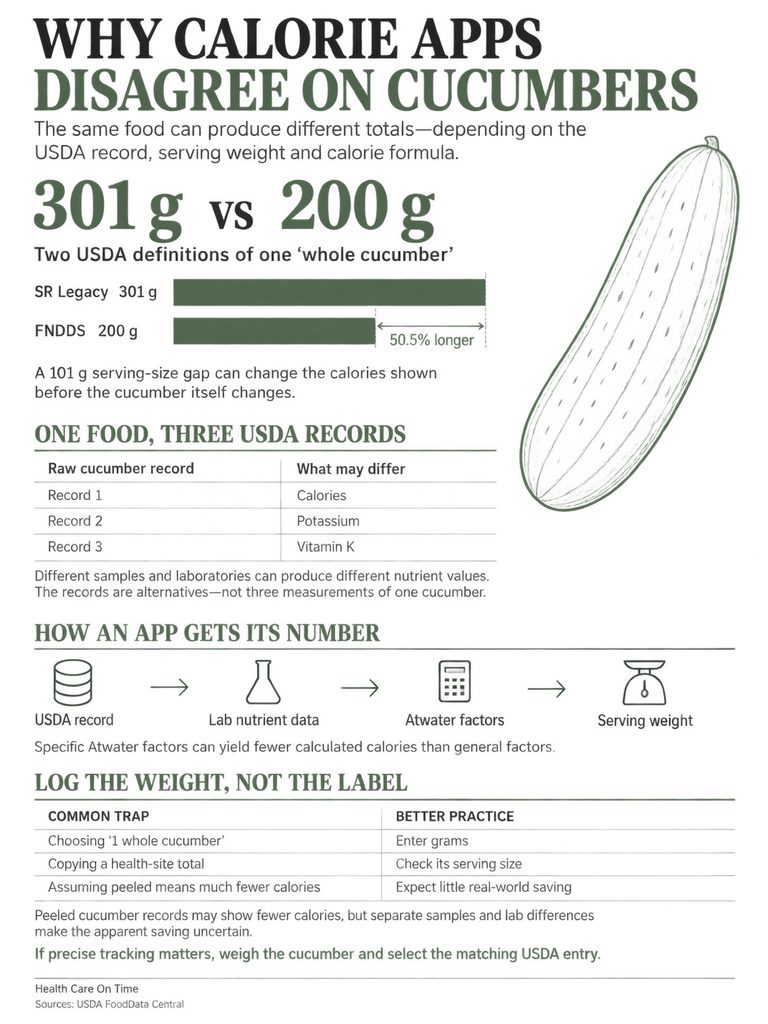
- SR Legacy (FDC 168409): 15 calories per 100 grams. This is USDA’s classic reference file, frozen since 2018, and the one most websites use.
- Foundation Foods (FDC 2346406): 16 calories using general conversion factors, or 14 using food-specific factors.
- FNDDS (FDC 2709784): 16 calories per 100 grams. This file powers federal dietary surveys such as What We Eat in America.
The differences go beyond calories. The Foundation record lists 170 mg of potassium and 24 mcg of vitamin K per 100 grams, compared with 147 mg and 16.4 mcg in SR Legacy. The records come from different samples, different years, and different labs.
Atwater General vs Specific Factors
The calories on a nutrition panel aren’t measured by burning the food. They’re calculated from protein, fat, and carbohydrate using conversion factors named after nutrition scientist Wilbur Atwater.
- General factors apply the same values to every food: 4 calories per gram of protein, 9 per gram of fat, and 4 per gram of carbohydrate.
- Specific factors adjust those values for how well your body digests a particular food.
For cucumber, switching from general to specific factors moves the answer from 16 to 14 calories per 100 grams.
The “Whole Cucumber” Weight Problem
SR Legacy defines one cucumber as 8¼ inches long and 301 grams. FNDDS defines a “regular” cucumber as 200 grams. It’s the same word with a 50% difference in weight.
That’s why some apps show 45 calories for “1 cucumber” while others show 30 to 32. Each is correct for the size it assumes. Neither may match the cucumber on your counter.
Peeled vs Unpeeled: A Lab Quirk, Not a Diet Trick
On paper, peeling cuts calories by a third, from 15 to 10 per 100 grams. Now compare USDA’s two 8¼-inch cucumbers: 45 calories with peel (301 grams) and 28 calories peeled (280 grams).
That math implies 21 grams of peel holds 17 calories. That would be nearly as much energy per gram as a boiled potato, and cucumber skin isn’t that dense.
The likely explanation is that the two records come from separate lab samples, not one cucumber measured before and after peeling. In practice, peeling saves you a few calories at most. It also costs you about half the vitamin K (16.4 vs 7.2 mcg per 100 grams).
Two Common Errors, Corrected
Even major health sites trip over cucumber math. WebMD states that a half-cup serving of cucumber is about 19 calories. USDA’s half cup of slices weighs 52 grams and has 8 calories. The number 19 happens to match a full 120-gram FNDDS cup, which suggests a serving-size mix-up.
Similarly, FatSecret’s default entry lists a cup of peeled, sliced cucumber at about 14 calories. The current USDA peeled record puts that same 119-gram cup at 12. It’s a small gap, but it adds up if you log cucumber every day.
Cucumber Nutrition Facts Beyond Calories
Here’s the full picture for raw cucumber with peel, based on USDA SR Legacy (FDC 168409). Percent Daily Values use FDA reference amounts for adults.
| Nutrient | Per 100 g | Per 1 Cup Slices (104 g) | Whole Cucumber (301 g) | % Daily Value (Whole) |
| Calories | 15 | 16 | 45 | 2% |
| Water | 95.2 g | 99 g | 287 g | n/a |
| Total carbohydrate | 3.6 g | 3.8 g | 10.9 g | 4% |
| Fiber | 0.5 g | 0.5 g | 1.5 g | 5% |
| Total sugars | 1.7 g | 1.7 g | 5.0 g | n/a |
| Protein | 0.65 g | 0.7 g | 2.0 g | 4% |
| Fat | 0.11 g | 0.1 g | 0.3 g | Under 1% |
| Vitamin K | 16.4 mcg | 17.1 mcg | 49.4 mcg | 41% |
| Potassium | 147 mg | 153 mg | 442 mg | 9% |
| Vitamin C | 2.8 mg | 2.9 mg | 8.4 mg | 9% |
| Magnesium | 13 mg | 13.5 mg | 39 mg | 9% |
| Sodium | 2 mg | 2 mg | 6 mg | Under 1% |
Carbs, Fiber, Sugar, Protein, and Fat
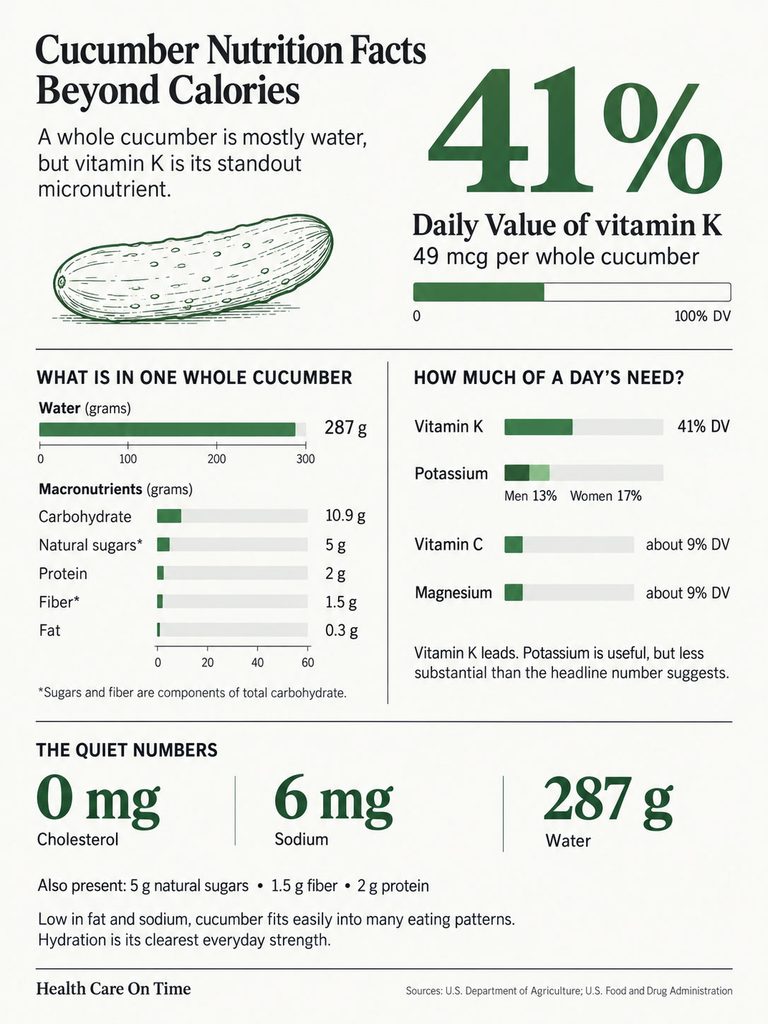
Almost all of a cucumber’s calories come from carbohydrate. A whole cucumber has about 10.9 grams of carbs, 5 grams of natural sugar, 1.5 grams of fiber, and 2 grams of protein.
Fat is close to zero at 0.3 grams per whole cucumber. With no cholesterol and only 6 mg of sodium, plain cucumber fits almost every eating plan.
The Vitamins and Minerals That Actually Count
Vitamin K is the standout. One whole cucumber delivers about 49 mcg, or 41% of the Daily Value, and much of it sits in the peel.
Potassium gets more hype than it deserves. An American Heart Association expert noted that a whole cucumber covers only about 13% of a man’s daily potassium needs and 17% of a woman’s, and that leafy greens are much stronger sources. Vitamin C and magnesium each land near 9% DV per whole cucumber.
What 95% Water Means for Hydration
A whole cucumber holds about 287 grams of water, roughly 9.7 fluid ounces. That’s a bit more than a standard 8-ounce glass, packaged with 45 calories and a satisfying crunch.
Water from food counts toward your daily fluid intake. A cucumber-heavy salad on a 90°F afternoon genuinely helps, though it doesn’t replace drinking water.
Cucumber vs Other Low-Calorie Vegetables
Cucumber gets called the lowest-calorie vegetable all the time. It’s close, but not quite. Our reviewers ran the same USDA comparison for the produce people most often swap in.
| Vegetable (Raw) | Calories per 100 g | Water (%) | Fiber (g) | Potassium (mg) | USDA Record |
| Iceberg lettuce | 14 | 95.6 | 1.2 | 141 | SR Legacy 169248 |
| Celery | 14 | 95.4 | 1.6 | 260 | SR Legacy 169988 |
| Cucumber, with peel | 15 | 95.2 | 0.5 | 147 | SR Legacy 168409 |
| Radishes | 16 | 95.3 | 1.6 | 233 | SR Legacy 169276 |
| Zucchini, with skin | 17 | 94.8 | 1.0 | 261 | SR Legacy 169291 |
| Tomato | 18 | 94.5 | 1.2 | 237 | SR Legacy 170457 |
| Green bell pepper | 20 | 93.9 | 1.7 | 175 | SR Legacy 170427 |
| Watermelon | 30 | 91.4 | 0.4 | 112 | SR Legacy 167765 |
| Carrots | 41 | 88.3 | 2.8 | 320 | SR Legacy 170393 |
Cucumber Isn’t the Lowest-Calorie Vegetable
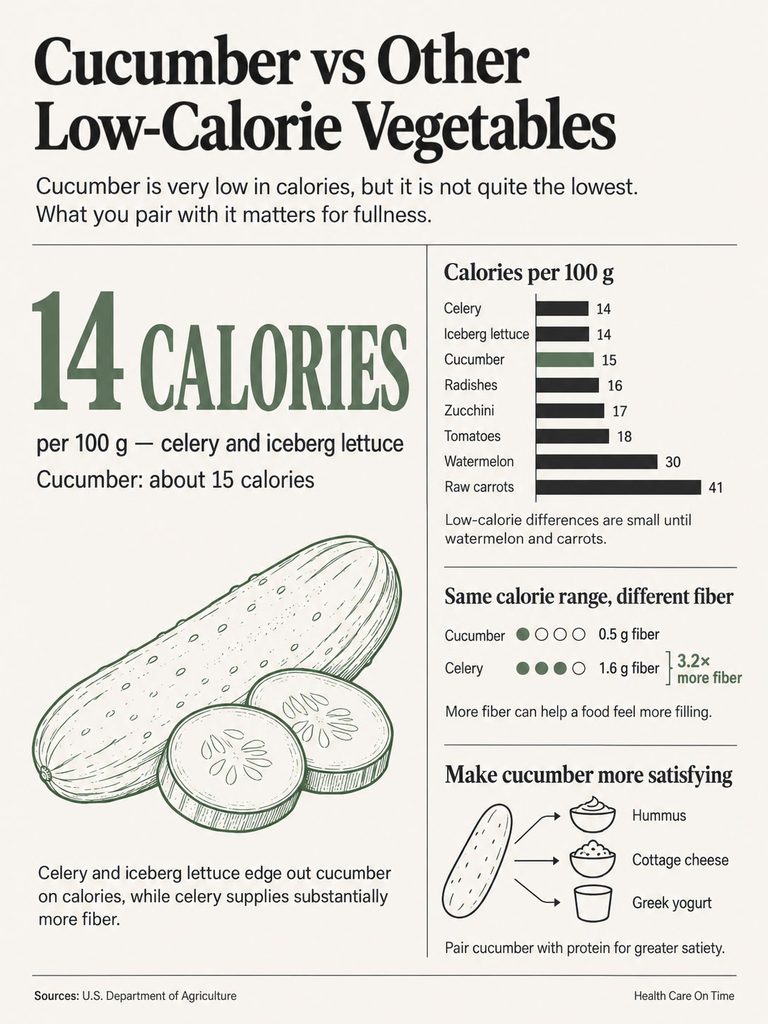
Celery and iceberg lettuce both come in at 14 calories per 100 grams, one below cucumber. Radishes, zucchini, and tomatoes sit just above it. For weight goals, the difference among these is meaningless; all of them are nearly free.
The bigger gaps show up further down the list. Watermelon has twice the calories of cucumber, and raw carrots have nearly three times as many. [Internal link: How Many Calories in a Carrot?]
Why Cucumber Is Less Filling Than Celery
Here’s the surprise: cucumber has the least fiber of any vegetable in the table, at 0.5 grams per 100 grams versus 1.6 for celery. An AHA expert made the same point, noting that cucumbers lack the bulk to keep you full for long.
So if staying full is your goal, celery sticks or radishes carry more fiber for the same calories. Cucumber still wins on crunch, mild flavor, and versatility.
Pairings That Make Cucumber More Satisfying
Pair cucumber with protein to make it a real snack. Try slices with ¼ cup of hummus, a scoop of cottage cheese, or plain Greek yogurt mixed with dill.
Protein and a little fat slow digestion. That turns a 16-calorie cup of cucumber into something that holds you until dinner.
Cucumbers and Weight Loss: What Low Calories Actually Do
Energy Density, Explained
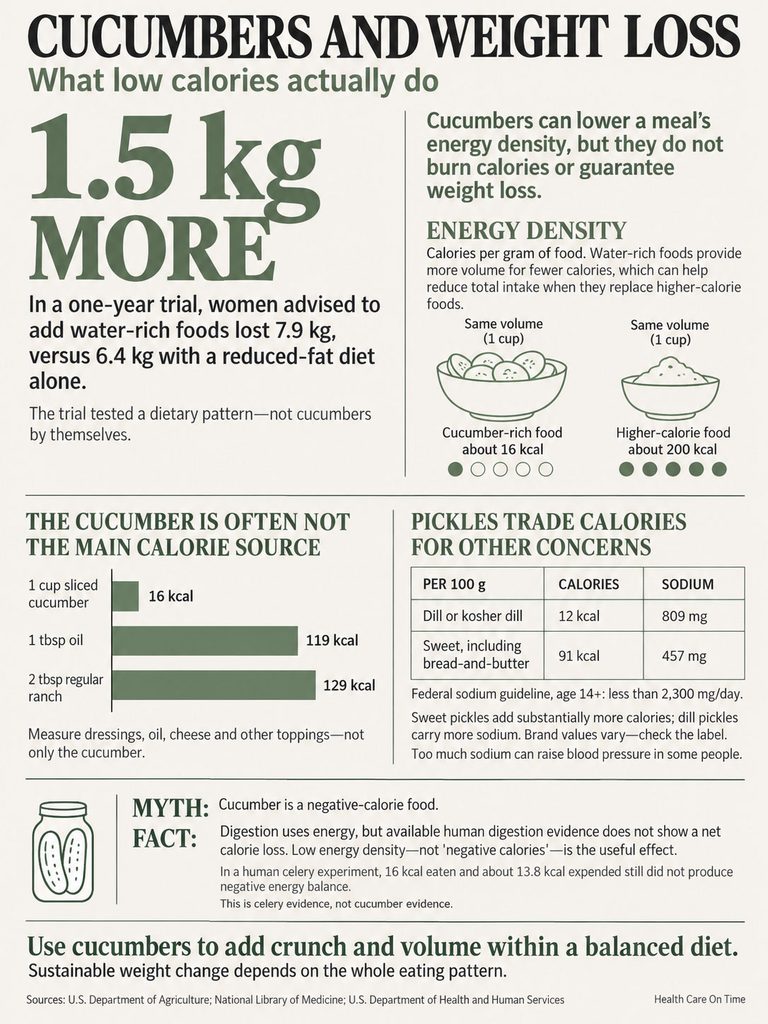
Energy density means calories per gram. Penn State nutrition researcher Barbara Rolls has shown that water adds weight to food without adding calories, while fat adds 9 calories per gram. Her work also shows that lowering a diet’s energy density leads people to eat fewer calories without deliberately restricting. At 0.15 calories per gram, cucumber sits near the bottom of that scale.
The best test of this idea came from Rolls’s lab. In a year-long trial, 97 women with obesity were randomized to one of two approaches, with no calorie goals set:
- Cut fat only
- Cut fat and eat more water-rich foods, especially fruits and vegetables
At six months, the water-rich group had lost 8.9 kg (19.6 lb) compared with 6.7 kg (14.7 lb). After one year, completers in the water-rich group had lost 7.9 kg versus 6.4 kg and reported less hunger. By the end of the trial, though, the gap between the groups was no longer statistically significant.
The honest takeaway: water-rich foods let you eat more volume for fewer calories, and that seems to ease hunger. The HealthCareOnTime team found no controlled human trial testing cucumbers alone for weight loss.
The Negative-Calorie Myth
Cucumbers appear on almost every “negative-calorie foods” list. The claim is that digesting them burns more calories than they contain. It doesn’t hold up.
University of Alabama researchers tested the idea by feeding celery to bearded dragons, which digest food much like humans. The lizards lost about 29% of the meal’s energy in feces, 14% in urate, and 33% to digestion itself, leaving a net gain of about 24%.
In people, digestion burns roughly 10% of a meal’s calories. A 16-calorie cup of cucumber costs you about 1.6 calories to process, which leaves about 14. That’s tiny, but still positive.
Where Cucumber Calories Really Come From
Across the patients we serve, the calories that surprise people rarely come from the cucumber. They come from what’s on it. USDA’s FNDDS survey records show the jump clearly, per 100 grams (3.5 ounces):
- Plain raw cucumber: 16 calories
- Cucumber and vinegar salad: 34 calories
- Cucumber salad with sour cream dressing: 66 calories
- Cucumber salad with Italian dressing: 120 calories
- Tomato and cucumber salad with oil and vinegar: 122 calories
Dressing can raise a cucumber salad’s calories seven or eight times. Measure the dressing, not the cucumber. [Internal link: How Many Calories in a Tomato?]
Pickles: Low Calories, High Sodium
Dill pickles have only 12 calories per 100 grams, about the same as fresh cucumber. The issue is salt. A large 4-inch dill pickle (135 grams, about 4.8 ounces) carries 16 calories and 1,092 mg of sodium.
Federal guidelines advise most adults to stay at or below 2,300 mg of sodium a day, and the AHA’s ideal limit is 1,500 mg. One large dill uses nearly half the federal limit. [Internal link: Blood Pressure Chart for Women by Age]
Sweet pickles are a different story. Bread-and-butter chips run 91 calories per 100 grams, so a cup (153 grams) has about 139 calories and 28 grams of sugar. Reduced-sodium dill pickles drop sodium to 18 mg per 100 grams while keeping the same calories.
Cucumber Carbs, Keto, and Blood Sugar
Net Carbs per Serving
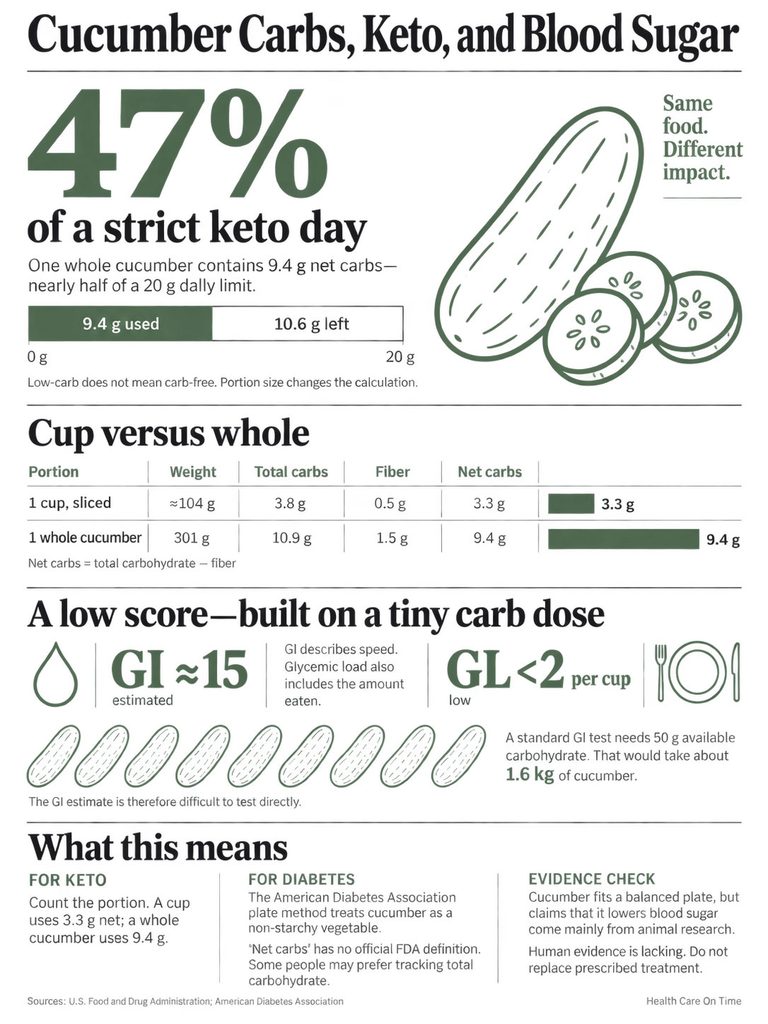
A cup of sliced cucumber with peel has 3.8 grams of total carbohydrate and 3.3 grams of net carbs. A whole 301-gram cucumber has about 10.9 grams total and 9.4 net.
Patients commonly ask us whether cucumber is “free” on keto. On a strict plan of 20 grams of net carbs a day, one whole cucumber uses almost half your budget, while a cup or two fits easily. [Internal link: Is Cauliflower Keto?]
“Net carbs” has no official FDA definition. If you count carbs for diabetes, your care team may prefer that you track total carbohydrate instead.
Why “GI 15” Is an Estimate
You’ll see “glycemic index 15” repeated across the web. Treat it as an estimate. A standard GI test has people eat a portion containing 50 grams of available carbohydrate.
For cucumber, that means about 1.6 kilograms (3.5 pounds), roughly five whole cucumbers in one sitting. That’s why glycemic load is the more useful number. Even if you assume a moderate GI of 50, a cup of cucumber has a glycemic load under 2. Anything under 10 counts as low.
Cucumbers on a Diabetes Plate
The American Diabetes Association’s plate method fills half the plate with non-starchy vegetables, and cucumber is a textbook choice. It adds crunch and volume with almost no effect on blood glucose. [Internal link: Are Potatoes Good for Diabetics?]
Claims that cucumber lowers blood sugar come largely from animal research, such as a 2020 study in which cucumber extract was given to rats with induced diabetes. Human evidence is missing, so think of cucumbers as a smart side dish, not a treatment.
Cucumbers in the US: Supply, Outbreaks, and Safe Handling
Cucumbers are a year-round staple, yet most Americans still fall short on vegetables. Only 10.0% of US adults met vegetable intake recommendations in the 2019 national survey. Here are the numbers that shape what lands in your crisper drawer.
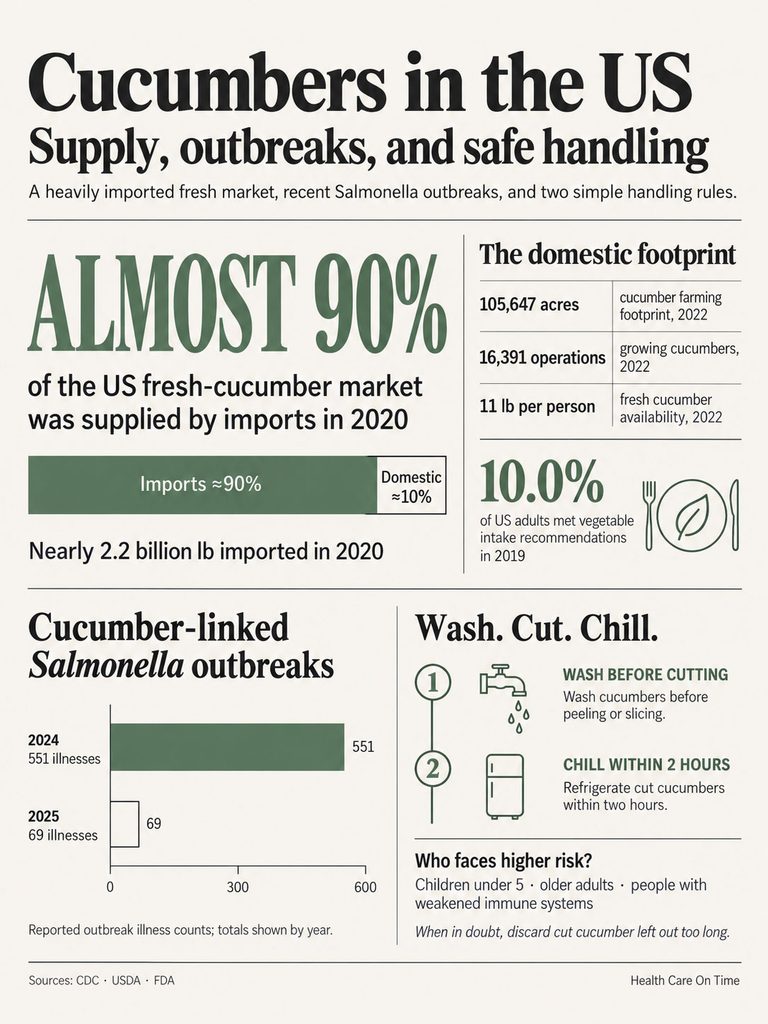
| Metric | Figure | Source |
| Adults meeting vegetable recommendations | 10.0% (2019) | CDC MMWR, January 2022 |
| Fresh cucumber availability per person | About 11 lb (2022) | USDA ERS, via Penn State Extension |
| Import share of the US fresh cucumber market | Almost 90% (2020) | USDA ERS |
| Fresh cucumber imports | Nearly 2.2 billion lb (2020) | USDA ERS |
| US cucumber farming footprint | 105,647 acres, 16,391 operations (2022) | USDA Census of Agriculture, via Penn State Extension |
| 2024 cucumber Salmonella outbreak | 551 illnesses, 34 states plus DC | FDA and CDC |
| 2025 cucumber Salmonella outbreak | 69 illnesses, 22 hospitalized, 21 states | CDC |
| FDA whole-cucumber surveillance sampling | May 4 to September 30, 2026 | FDA |
Where Your Cucumbers Come From
Imports grew from about 35% of the US fresh cucumber supply in the early 1990s to almost 90% by 2020, totaling nearly 2.2 billion pounds that year. Most came from Mexico and Canada.
Demand keeps climbing: availability reached about 11 pounds per person in 2022, helped by the popularity of mini snacking varieties. Imported or domestic, field or greenhouse, the nutrition is essentially the same.
Recent Salmonella Outbreaks
Cucumbers have been linked to several multistate outbreaks. In 2024, a Salmonella Africana and Braenderup outbreak sickened 551 people in 34 states and Washington, DC. Cucumbers from two South Florida growers were identified as likely sources.
In 2025, cucumbers grown by Bedner Growers were tied to a Salmonella Montevideo outbreak that sickened 69 people in 21 states and hospitalized 22, with no deaths reported. Given that history, FDA is sampling domestic and imported whole cucumbers for Salmonella from May 4 through September 30, 2026.
Salmonella illness usually starts 12 to 72 hours after eating and lasts four to seven days. Symptoms include diarrhea, fever, and cramps. Children under 5, older adults, and people with weakened immune systems face higher risk.
How to Wash and Store Cucumbers
FDA recommends against washing produce with soap, detergent, or commercial produce washes, because produce is porous and can absorb them. Instead:
- Rub cucumbers under plain running water.
- Scrub them with a clean vegetable brush.
- Dry them.
- Refrigerate at 40°F or below.
Wash before you peel or slice, so the knife doesn’t carry surface bacteria into the flesh. Refrigerate cut cucumber within 2 hours and eat it within a few days.
Who Should Pay Attention to Cucumber Intake
Warfarin and Vitamin K
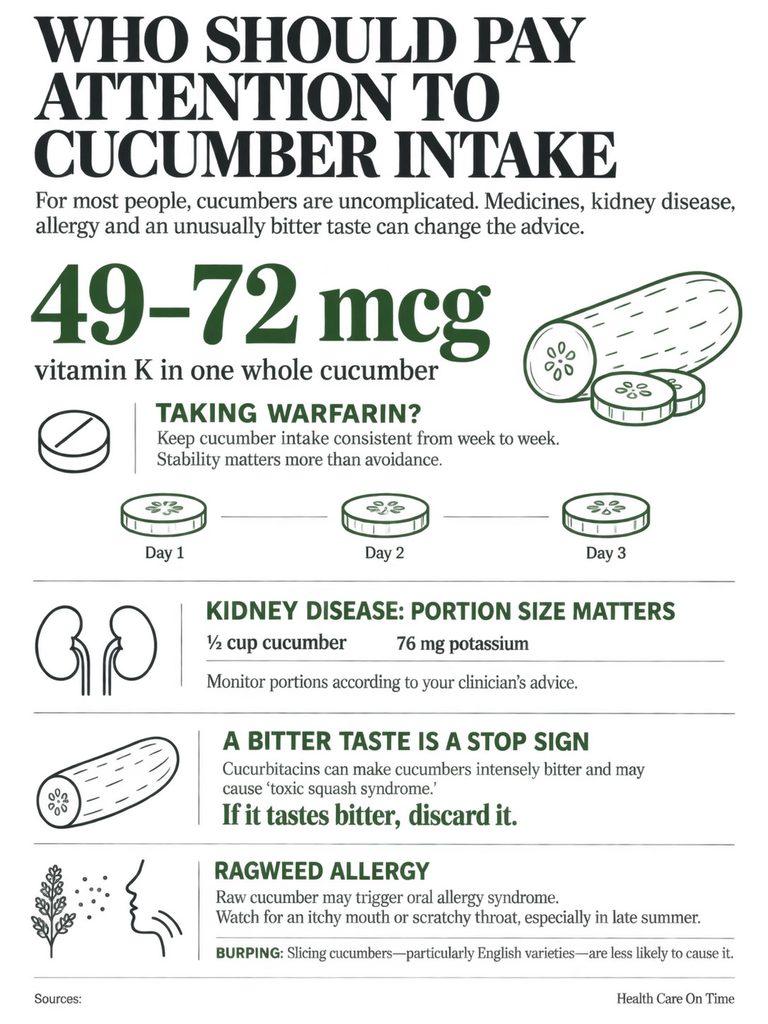
If you take warfarin, you don’t need to avoid cucumbers. You need to eat them consistently. A whole cucumber with peel supplies about 49 mcg of vitamin K, and the newer Foundation record puts it closer to 72 mcg.
INR blood tests, which labs run to monitor warfarin, respond to big shifts in vitamin K intake. Our medical reviewers suggest mentioning a new daily cucumber-salad habit to your prescriber before your next INR check. [Internal link: Warfarin Guide]
Kidney Disease and Potassium
The National Kidney Foundation lists cucumber among low-potassium vegetables, and half a cup has about 76 mg. Still, NKF cautions that eating a large amount of a low-potassium food can turn it into a high-potassium serving.
A whole cucumber has about 442 mg of potassium. If your care team limits potassium, count portions rather than treating cucumbers as unlimited.
Bitter Cucumbers and Cucurbitacin
Cucumbers belong to the gourd family, which can produce bitter compounds called cucurbitacins. Poison Control describes “toxic squash syndrome,” in which eating an intensely bitter gourd, cucumbers included, can cause vomiting, diarrhea, and abdominal pain. Cooking does not neutralize the toxin.
Commercial cucumber varieties have been bred over many years to keep cucurbitacin levels low, but an occasional bitter one still turns up. If a cucumber tastes strongly bitter, spit it out and throw the whole thing away.
Oral Allergy Syndrome and Burping
According to the American College of Allergy, Asthma and Immunology, people allergic to ragweed pollen may react to raw cucumber, melons, banana, and zucchini. The usual symptoms are an itchy mouth or a scratchy throat. Reactions often flare during late-summer ragweed season.
Some people also find that standard slicing cucumbers make them burp. Thin-skinned English types, often sold as “burpless,” tend to sit easier.
How to Count Cucumber Calories Accurately
If you’ve ever wondered how many calories in a cucumber you actually ate, four habits settle it:
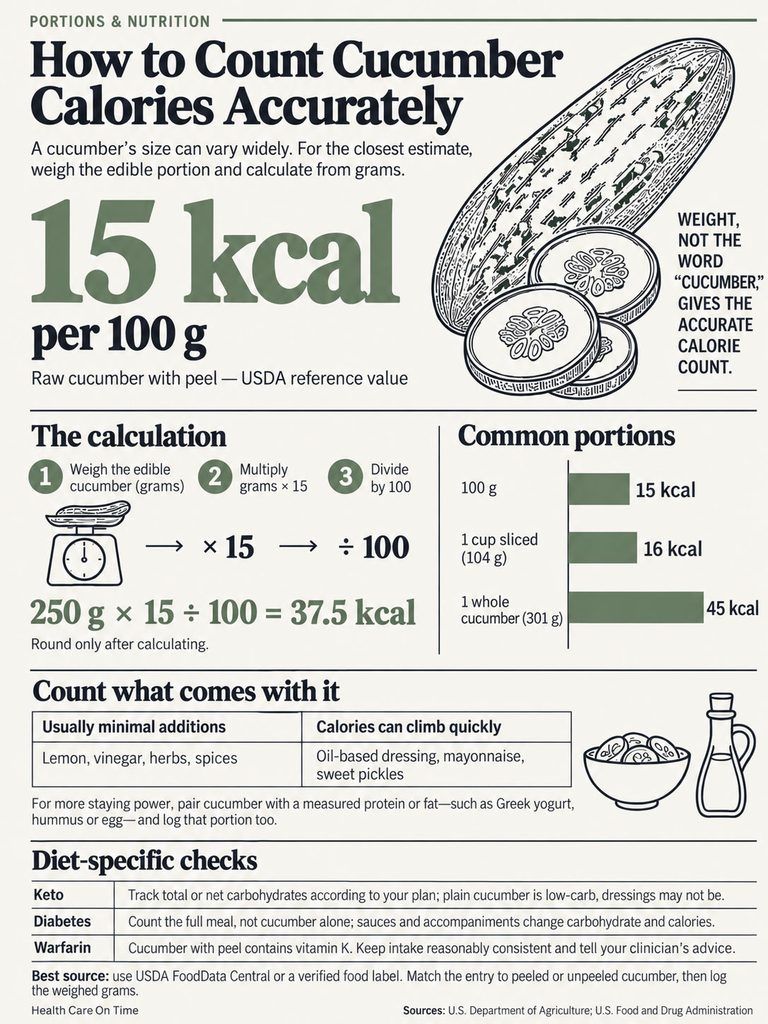
- In your app, choose “Cucumber, with peel, raw” (or “peeled” if you peel). Skip entries with no gram weight.
- Weigh your cucumber once. Multiply the grams by 0.15 for cucumber with peel.
- Log what goes on it: dressing, dip, feta, or oil.
- For pickles, track the sodium as well as the calories.
| Scenario | Recommended Action | Why It Matters |
| Your app shows 10 or more cucumber entries | Pick “Cucumber, with peel, raw” and log in grams | Gram logging removes the 200 g vs 301 g size confusion |
| You bought an English or Persian cucumber | Weigh it and multiply grams by 0.15 | USDA has no record for these varieties |
| You follow keto at 20 g net carbs a day | Budget 3.3 g net carbs per cup with peel | A whole cucumber uses about 9.4 g, nearly half a strict day |
| You want a snack that keeps you full | Pair cucumber with hummus or cottage cheese, or swap in celery | Cucumber has 0.5 g fiber per 100 g vs 1.6 g for celery |
| You take warfarin | Keep cucumber intake steady week to week | A whole cucumber has 49 to 72 mcg of vitamin K |
| You have CKD with a potassium limit | Stick to ½-cup portions and count them | ½ cup is about 76 mg, but a whole cucumber is 442 mg |
| You eat pickles often | Choose reduced-sodium dills | A large dill has 1,092 mg sodium vs about 24 mg reduced-sodium |
| You make cucumber salad with dressing | Measure the dressing, not the cucumber | Italian-dressed salad is 120 kcal per 100 g vs 16 plain |
| A cucumber tastes intensely bitter | Spit it out and discard the whole cucumber | Cucurbitacin isn’t destroyed by cooking |
| You see a cucumber recall notice | Check FDA outbreak updates and toss cucumbers of unknown origin | The 2024 and 2025 outbreaks involved whole cucumbers |
Frequently Asked Questions
How many calories are in a whole cucumber?
A whole 8¼-inch cucumber with peel weighs about 301 grams (10.6 ounces) and has 45 calories, based on USDA SR Legacy data. A smaller slicer around 200 grams has about 30 calories. English cucumbers are often heavier, so weigh yours and multiply the grams by 0.15.
How many calories are in half a cucumber?
Half of a standard 301-gram cucumber with peel has about 23 calories. Half of a medium peeled cucumber has about 10. If you mean half a cup of slices instead, that’s 52 grams and 8 calories. The weight of the piece you eat sets the number.
How many calories are in an English cucumber?
USDA doesn’t list English cucumbers separately, so use the raw-with-peel value of 15 calories per 100 grams. A 12-ounce English cucumber (340 grams) has about 51 calories, and a 16-ounce one (454 grams) has about 68. Sizes vary widely, so a kitchen scale gives the best answer.
How many calories are in a mini (Persian) cucumber?
USDA’s FNDDS lists a “miniature” cucumber at 65 grams and about 10 calories. Many minis sold in US stores run larger. At 15 calories per 100 grams, a 3-ounce mini has about 13 calories and a 4-ounce mini about 17. Weigh a few from your usual bag once, then reuse that number.
Does peeling a cucumber lower the calories?
Only slightly. USDA lists 15 calories per 100 grams with peel and 10 without, but those figures come from separate lab samples. Realistically, peeling saves a few calories per cucumber while removing about half the vitamin K and some fiber. Wash well and eat the peel unless it tastes bitter.
Are cucumbers a negative-calorie food?
No. Digestion uses roughly 10% of a food’s calories, so a 16-calorie cup of cucumber still nets about 14. A University of Alabama study of celery, a similar watery food, found animals kept about 24% of the meal’s energy after digestion and excretion. Cucumbers are low-calorie, not negative-calorie.
How many carbs are in a cucumber?
A cup of sliced cucumber with peel has 3.8 grams of total carbohydrate and 3.3 grams of net carbs. A whole 301-gram cucumber has about 10.9 grams total and 9.4 net. Cup-size portions fit most keto and low-carb plans, though a whole cucumber uses nearly half a strict 20-gram day.
Can people with diabetes eat cucumbers freely?
Cucumbers barely move blood sugar. A cup has about 3.3 grams of net carbs and a glycemic load under 2, which makes cucumber an ideal non-starchy vegetable for the diabetes plate. Watch pickles and dressings, which add sodium, sugar, or fat. Ask your care team how cucumbers fit your plan.
How many calories are in a dill pickle?
A large 4-inch dill pickle (135 grams) has about 16 calories, and a small spear (35 grams) has about 4. The bigger concern is sodium: a large dill carries about 1,092 mg. Sweet bread-and-butter pickles are higher in calories, around 91 per 100 grams, because of the added sugar.
Does cucumber water have calories?
Cucumber-infused water has close to zero calories, because very little of the cucumber’s carbohydrate dissolves into the water. Even if you eat every slice afterward, a few slices add only 3 to 5 calories. It’s an easy swap for soda or juice when plain water feels boring.
Is it OK to eat a whole cucumber every day?
For most healthy adults, yes. A whole cucumber adds about 45 calories, 1.5 grams of fiber, and roughly 9.7 ounces of water. If you take warfarin, keep the habit consistent. If you have advanced kidney disease with a potassium limit, count it, since a whole cucumber has about 442 mg.
Should you log cucumbers in a calorie app?
A few slices won’t change your totals. If you eat cucumbers daily in bigger portions, logging keeps your numbers honest, since a whole cucumber a day adds about 315 calories a week. Always log the dressing, dip, or oil, because that’s where most of the calories hide.
Disclaimer: This article is for general education and is not medical advice. Nutrient values come from USDA FoodData Central records and may differ from package labels or the cucumbers you buy. If you take warfarin, have kidney disease or diabetes, or have a food allergy, talk with your doctor or a registered dietitian before changing your diet.
References
- USDA FoodData Central: Cucumber, with peel, raw (SR Legacy, FDC 168409)
- USDA FoodData Central: Cucumber, peeled, raw (SR Legacy, FDC 169225)
- USDA FoodData Central: Cucumber, with peel, raw (Foundation, FDC 2346406)
- USDA FoodData Central: Cucumber, raw (FNDDS, FDC 2709784)
- USDA FoodData Central: Celery, raw (FDC 169988)
- USDA FoodData Central: Lettuce, iceberg, raw (FDC 169248)
- USDA FoodData Central: Pickles, cucumber, dill or kosher dill (FDC 168558)
- USDA FoodData Central: Pickles, cucumber, sweet (FDC 169378)
- Ello-Martin JA, et al. Dietary energy density in the treatment of obesity. Am J Clin Nutr. 2007;85(6):1465-1477
- Rolls BJ. Dietary energy density: Applying behavioural science to weight management. Nutrition Bulletin. 2017
- Buddemeyer KM, Alexander AE, Secor SM. Testing the validity of “negative-calorie” foods with a reptile model
- American Heart Association News: Cucumbers are trendy, but how healthy are they?
- CDC MMWR: Adults Meeting Fruit and Vegetable Intake Recommendations, United States, 2019
- USDA ERS: Fresh cucumber imports capture nearly 90 percent of U.S. market
- Penn State Extension: Cucumber Production in the United States
- FDA: Outbreak Investigation of Salmonella, Cucumbers (June 2024)
- CDC: Investigation Update, Whole Cucumbers Outbreak (May 2025)
- FDA: Outbreak Investigation of Salmonella, Cucumbers (May 2025)
- FDA: FY26 Domestic and Imported Whole Cucumber Sampling for Salmonella
- FDA: 7 Tips for Cleaning Fruits, Vegetables
- FDA: Selecting and Serving Produce Safely
- National Kidney Foundation: Potassium in Your CKD Diet
- Poison Control: Toxic Squash Syndrome
- Pacific Northwest Pest Management Handbooks: Toxic Squash
- ACAAI: Oral Allergy Syndrome