
When Dutch researchers measured anxiety across all four seasons in more than a thousand diagnosed patients, autumn came back with the lowest average score of the year. Not the highest. The lowest.
That result does not mean the tight chest you get every September is imaginary. It means the season itself may not be doing it, and that changes what will actually fix it.
Quick Answer: Autumn anxiety is the popular name for worry, restlessness, or low-grade dread that arrives as summer ends. It is not a diagnosis in the DSM-5-TR. Large studies find little seasonal swing in anxiety symptoms, so the usual drivers are schedule changes, money pressure, disrupted sleep timing, and anticipation of winter rather than shorter days on their own. Most cases respond to light timing, movement, and sleep corrections.
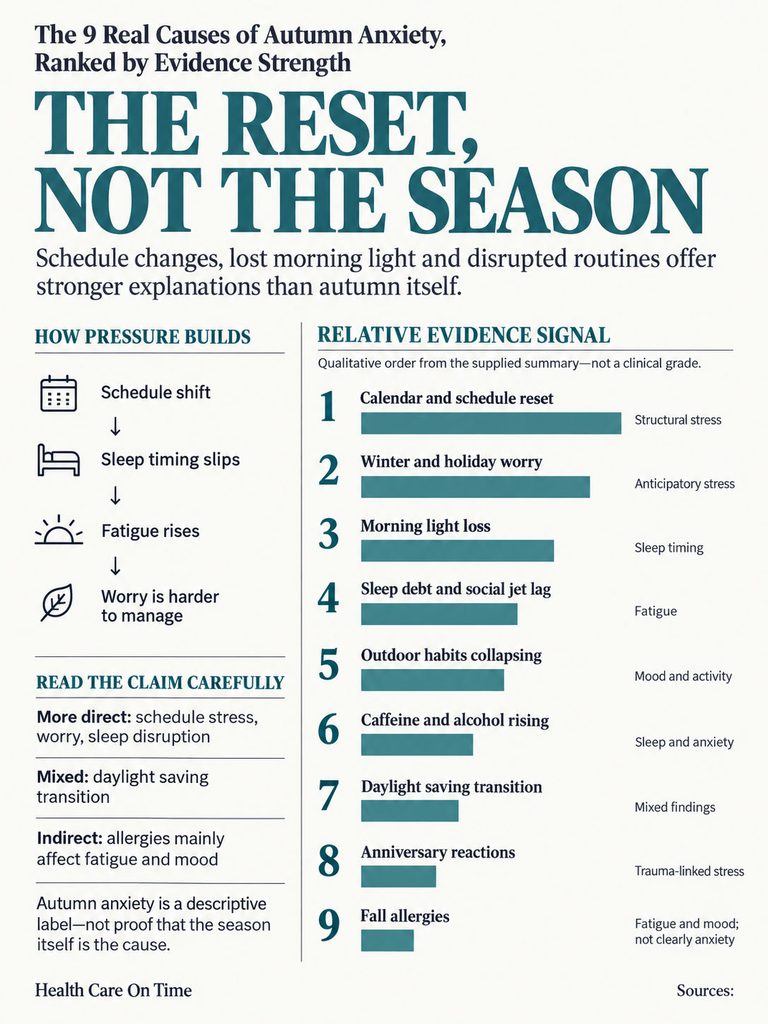
Nine causes explain most of what people call autumn anxiety:
- The calendar resetting, not the season changing
- Anticipatory worry about winter and the holidays
- Light timing shifting your internal clock
- The end of daylight saving time
- Sleep debt and social jet lag rebuilding after summer
- Outdoor habits collapsing when the weather turns
- Caffeine and alcohol creeping upward
- Fall allergy season and the fatigue it brings
- Anniversary reactions the season carries with it
At a Glance
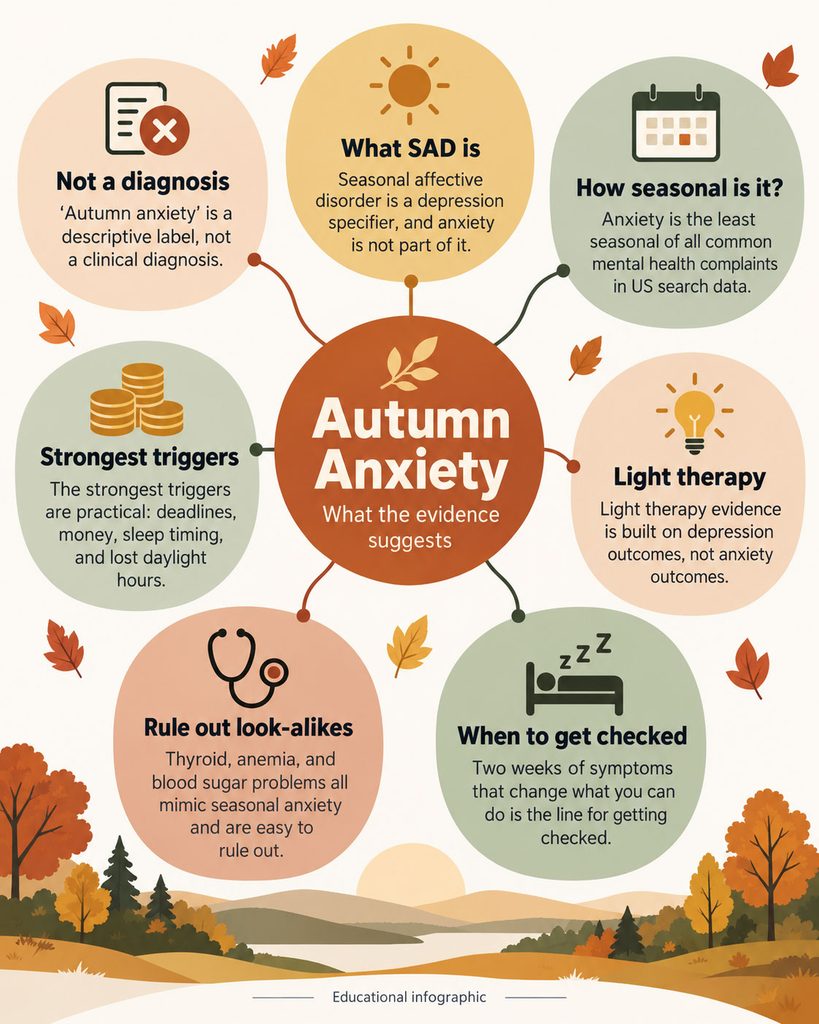
• “Autumn anxiety” is a descriptive label, not a clinical diagnosis
• Seasonal affective disorder is a depression specifier, and anxiety is not part of it
• Anxiety is the least seasonal of all common mental health complaints in US search data
• The strongest triggers are practical: deadlines, money, sleep timing, and lost daylight hours
• Light therapy evidence is built on depression outcomes, not anxiety outcomes
• Thyroid, anemia, and blood sugar problems all mimic seasonal anxiety and are easy to rule out
• Two weeks of symptoms that change what you can do is the line for getting checked
What Autumn Anxiety Actually Is (And Is Not)
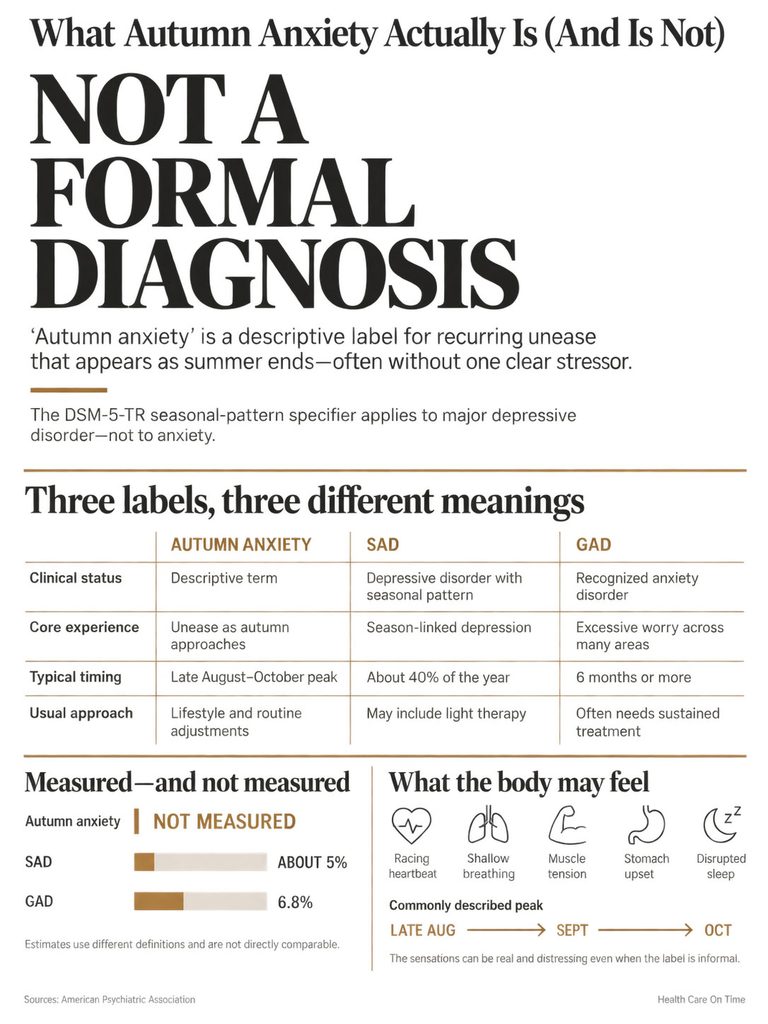
The working definition most clinicians use is straightforward. Autumn anxiety describes a recurring rise in unease, tension, or worry that tracks the transition out of summer, without an obvious new stressor to explain it.
People who report it describe restlessness more often than sadness. There is a sense of running late on something unnamed, a low hum of dread in the background, or trouble settling once the sun goes down.
What It Feels Like in the Body
Anxiety is not only a thought pattern. It produces a measurable physical state, and in the fall people frequently notice the physical side first and the emotional side second.
Common physical signs include a racing or pounding heartbeat, shallow chest breathing, muscle tension across the jaw, neck, and shoulders, stomach upset, and waking at 3 or 4 a.m. with the mind already running.
That physical overlap is exactly why the season gets blamed. Fatigue, poor sleep, and tension all rise in October for reasons that have nothing to do with mood, and the brain reaches for the nearest available explanation.
Why You Will Not Find It in the DSM-5-TR
Search the American Psychiatric Association diagnostic manual for autumn anxiety and you will come up empty. The closest entry is the “with seasonal pattern” specifier, and it does not cover anxiety at all.
What the Seasonal Pattern Specifier Actually Covers
The specifier attaches to major depressive disorder or bipolar disorder. It requires a regular seasonal timing of mood episodes, full remission at a characteristic time of year, that pattern holding across at least two consecutive years, and seasonal episodes outnumbering non-seasonal ones across a lifetime.
Nothing in that definition mentions anxiety. Seasonal affective disorder is depression with a calendar attached, and the American Psychiatric Association estimates about 5% of US adults experience it, typically for around 40% of the year.
Patients booking thyroid and vitamin D panels with us from late August onward often ask whether what they are feeling “counts” as SAD. The label matters far less than two things: how long it has lasted, and what it is stopping them from doing.
Autumn Anxiety, SAD, and Generalized Anxiety Disorder Side by Side
| Feature | Autumn Anxiety (informal) | SAD (MDD with Seasonal Pattern) | Generalized Anxiety Disorder | Ordinary Seasonal Transition |
| Recognized diagnosis | No | Yes, as a DSM-5-TR specifier | Yes, DSM-5-TR code F41.1 | No |
| Core experience | Restlessness, tension, dread | Low mood, loss of interest, oversleeping, carb craving | Persistent worry across multiple areas of life | Mild, passing adjustment |
| Typical onset | Late August to October | October to January, worst in January and February | Any time; median onset around age 30 | First two weeks of the change |
| Typical duration | Days to a few weeks | About 40% of the year, remitting in spring | Six months or more by definition | Under two weeks |
| US prevalence | Not measured, no case definition | About 5% of adults (APA) | 6.8% past-year GAD; 19.1% any anxiety disorder (NIMH) | Not applicable |
| Main treatment | Schedule and light adjustments | Light therapy, CBT, medication | CBT, medication, sustained treatment | Time |
Table 1. How autumn anxiety compares with the conditions it is most often confused with.
What the Research Says About Whether Anxiety Is Seasonal At All
This is the part every competing article skips. Researchers have looked at this question repeatedly, in large samples, and the picture is far less dramatic than the wellness internet suggests.
The Large Studies That Looked and Found Almost Nothing
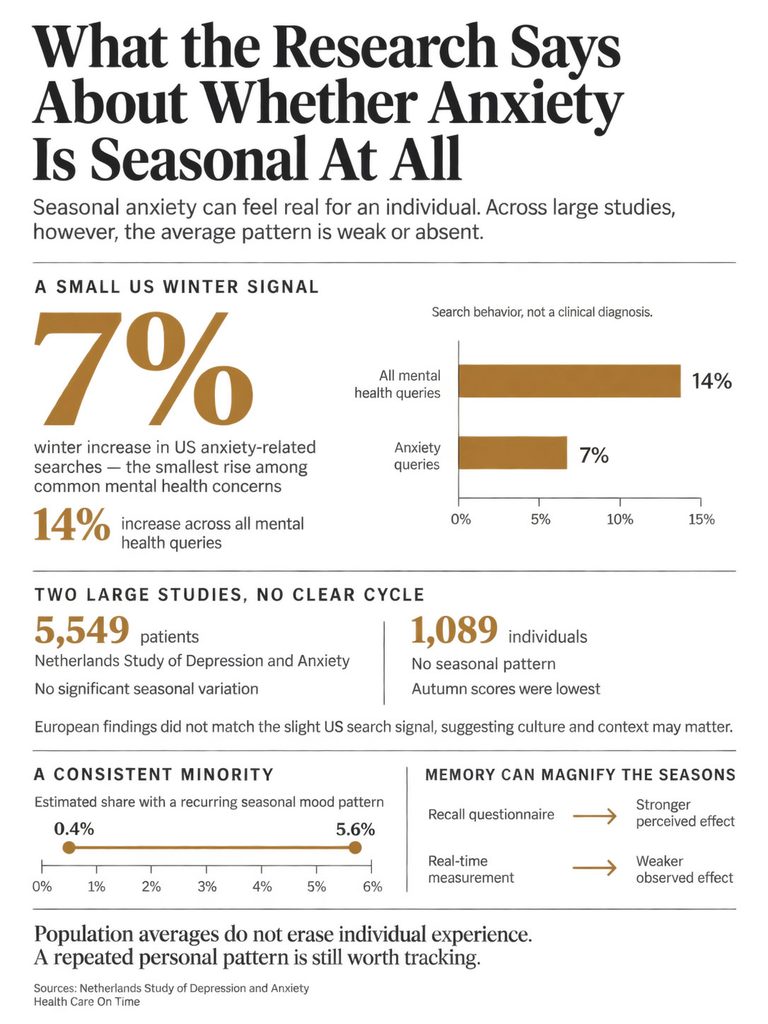
The Netherlands Study of Depression and Anxiety screened 5,549 primary care patients with the Kessler-10 questionnaire across a full calendar cycle. The mean score was 19.2, and seasonal differences were not statistically significant, with an autumn coefficient of -0.022 against a standard error of 0.019.
The same team then examined 1,089 people sorted into four diagnostic groups: healthy controls, major depression, any anxiety disorder, and both together. Beck Anxiety Inventory scores were lowest in autumn at 12.3 and highest in winter at 13.9, and the authors concluded that no seasonal pattern for anxiety symptoms could be demonstrated.
A separate Dutch general population survey of 7,076 people found no seasonal difference in the one-month prevalence of anxiety disorders. An Icelandic study that mailed the Hospital Anxiety and Depression Scale to four separate 1,000-person cohorts in January, April, July, and October found no seasonal mood change either.
Does European Data Apply to American Readers?
Reasonable question, and the answer is mostly yes with one caveat. Amsterdam sits at roughly 52 degrees north, further from the equator than Seattle, Minneapolis, or Bangor, Maine, so the Dutch sample experienced a steeper autumn light decline than most Americans do.
If anything, that makes the null result more striking. A population with a harsher seasonal light drop than almost any US city still showed no autumn rise in anxiety.
The caveat is cultural. The American academic and fiscal calendar, the American holiday spending pattern, and the American health insurance open-enrollment window are not Dutch features, which is part of why the US-specific drivers below matter so much.
The US Data That Does Show a Seasonal Signal
American researchers tracked every Google mental health query in the United States from 2006 through 2010 and found a clear pattern: 14% more queries in winter than summer.
Broken down by topic, anxiety showed the smallest seasonal swing of all eight categories at 7% (95% CI 5% to 10%), compared with 37% for eating disorders, 37% for schizophrenia, 31% for ADHD, and 19% for depression. A later Canadian replication using five years of provincial search data found the same winter peaks and summer troughs.
Read that carefully. In the dataset where seasonality is most visible, anxiety is the flattest line on the chart, and its peak is January, not October.
Why Your Experience Can Be Real Even When the Population Data Is Flat
Two things explain the gap. The share of people with a genuinely seasonal mood pattern is small, ranging from 0.4% to 5.6% across studies depending on the instrument used, which is far too few to move the average score of an entire population.
The second reason is how seasonality gets measured. Questionnaires that ask people to recall how they felt across the previous year produce noticeably larger seasonal effects than studies measuring people in real time, because memory organizes scattered experience into a tidy story.
Our medical reviewers put it this way: population averages describe crowds, not individuals. If your September pattern has repeated reliably for five years, that pattern is real data about you, whatever the group mean says. What the research changes is where you go looking for the cause.
The 9 Real Causes, Ranked by How Well the Evidence Holds Up
1. The Calendar Resetting, Not the Season Changing
American life runs on an academic and fiscal calendar that restarts in the fall. School begins, quarterly targets tighten, performance reviews land, insurance open enrollment opens, and year-end tax planning starts.
For parents, the load is concrete: new teachers, new schedules, sports registration, and a household routine rebuilt in a single week. For anyone in sales or finance, Q4 is the quarter that decides the year.
None of that is caused by daylight. It arrives in the same eight-week window every year, which is precisely why it feels seasonal when it is really structural.
2. Anticipatory Worry About Winter and the Holidays
Anticipation is an underrated anxiety engine. The brain treats a future demand as a present threat, which is why October often feels worse than the holidays themselves.
The American Psychiatric Association Healthy Minds Poll in November 2025 found that 41% of US adults expected more holiday stress than the previous year, up sharply from 28% in 2024 and 29% in 2023. Among adults aged 18 to 34 the figure reached 49%, and 75% reported being anxious about the economy.
Earlier polling by the American Psychological Association placed money at the top of the list, with 58% naming spending too much or not having enough as a holiday stressor and 89% reporting at least one stressor overall. That poll also found 43% saying holiday stress interfered with their ability to enjoy the season.
3. Light Timing Shifting Your Internal Clock
The variable that matters is not how much light you get but when you get it. Morning light advances the body clock and evening light delays it.
As sunrise slides later through September and October, many people lose their morning light signal entirely. The commute happens in the dark, the office is lit at a few hundred lux, and the evening is spent in front of bright screens.
The clock drifts later, falling asleep gets harder, and the following day arrives with less sleep and more edge. This is a timing problem, not a quantity problem, which is why “get more sunshine” is such unhelpful advice.
4. The End of Daylight Saving Time
Clocks fall back on Sunday, November 1, 2026, at 2:00 a.m. The extra hour of sleep is genuine, and so is the abrupt collapse of evening daylight that follows it.
Danish researchers analyzed 185,419 hospital contacts for unipolar depression from 1995 to 2012 and found an 11% increase in new depressive episodes after the autumn transition (95% CI 7% to 15%), fading over roughly 10 weeks. The spring transition produced no equivalent effect.
That finding deserves a caveat most articles omit. A US study of emergency department visits for mental and behavioral health conditions found no significant change associated with either daylight saving transition, so the American data does not replicate the Danish result.
The American Academy of Sleep Medicine has called for eliminating the twice-yearly switch entirely in favor of permanent standard time. Arizona and Hawaii already sit it out.
5. Sleep Debt and Social Jet Lag Rebuilding
Summer schedules drift. Late sunsets, travel, and loose bedtimes push sleep timing later, and the return to fixed school and work start times forces an abrupt correction in a single week.
The gap between your body preferred timing and your alarm clock is called social jet lag, and it behaves like mild chronic jet lag. Concentration drops, irritability rises, and emotional regulation gets harder.
A person running a 90-minute mismatch five days a week is accumulating the equivalent of a time zone shift every Monday and undoing it every Saturday. That pattern alone produces symptoms most people would describe as anxiety.
6. Outdoor Habits Collapsing
Walking, cycling, gardening, dog-walking, and evening sport were doing quiet therapeutic work all summer. When the weather turns and the light goes, most people stop without ever consciously deciding to.
Nobody notices the decision because there was no decision. The habit simply stops being convenient, and three weeks later the baseline has shifted.
Removing the thing that was managing your stress looks identical, from the inside, to a seasonal mood disorder. The distinction is that this one is fully reversible in a fortnight.
7. Caffeine and Alcohol Creeping Upward
Darker mornings push coffee later into the afternoon, and caffeine has a half-life of roughly five hours. A 3 p.m. cup still has meaningful caffeine circulating at bedtime.
Alcohol rises with the social calendar from October onward. It shortens time to sleep onset and then fragments the second half of the night, producing early waking with a racing heart that is easy to mistake for a panic response.
Both are reversible within days, which makes them the highest-yield inputs to check before anything else. Across cases seen in our diagnostic network, this is the most common single correctable factor in autumn symptom reports.
8. Fall Allergy Season and the Fatigue It Brings
Ragweed pollinates from August into November across most of the United States, and CDC data from January 2026 shows 25.2% of US adults report a seasonal allergy. The mood effect is real, but narrower than wellness sites claim.
In a controlled study following ragweed-allergic adults across multiple pollen seasons, participants reported significantly more mental and motivational fatigue and more negative mood during ragweed season than in winter. The researchers specifically noted no increase in anxiety or emotional distress.
Poor sleep from nasal congestion adds a second layer on top of that. Patients frequently tell us they assumed a September slump was psychological when it tracked their pollen exposure almost day for day.
9. Anniversary Reactions
Grief and trauma carry dates. A death, a diagnosis, a job loss, a divorce, or an accident that happened in October can produce a full physical stress response every October afterward.
The response often arrives before the conscious memory does. People describe a week of inexplicable dread and only later connect it to what the date means.
This one does not respond to light boxes or exercise programs. It responds to being named.
| Trigger | What the US data shows | Source and year | Evidence strength |
| Holiday and money anticipation | 41% expect more holiday stress than last year, up from 28% in 2024; 58% name money | APA Healthy Minds Poll, 2025; APA/Harris Poll, 2023 | Strong, repeated national polling |
| End of daylight saving time | 11% rise in depressive episodes after autumn change (95% CI 7-15%), 185,419 contacts | Hansen, Epidemiology, 2017 | Moderate; US emergency data did not replicate |
| Seasonal allergy load | 25.2% of adults report seasonal allergy; ragweed season raised fatigue and low mood, not anxiety | CDC NCHS Data Brief 545, 2026; Marshall, Psychosomatic Medicine, 2002 | Moderate for mood, negative for anxiety |
| The season itself | No seasonal pattern in anxiety scores; autumn Beck Anxiety mean 12.3 vs winter 13.9 | Winthorst, BMC Psychiatry, 2011 | Strong evidence against |
| US search behavior | Anxiety queries only 7% higher in winter, the smallest swing of 8 categories | Ayers, Am J Prev Med, 2013 | Strong, but peak is winter, not autumn |
| Baseline anxiety burden | 19.1% of adults had an anxiety disorder in the past year; 18.2% had symptoms in the past 2 weeks | NIMH; CDC NCHS Report 213, 2024 | Strong national data |
| Exercise as a countermeasure | Consistent symptom reduction across 32 randomized trials in 3,243 adults | Banyard, Int J Ment Health Nurs, 2025 | Strong |
Table 2. What US and international data actually show for each proposed autumn anxiety trigger.
Three Things the Internet Says That Do Not Hold Up
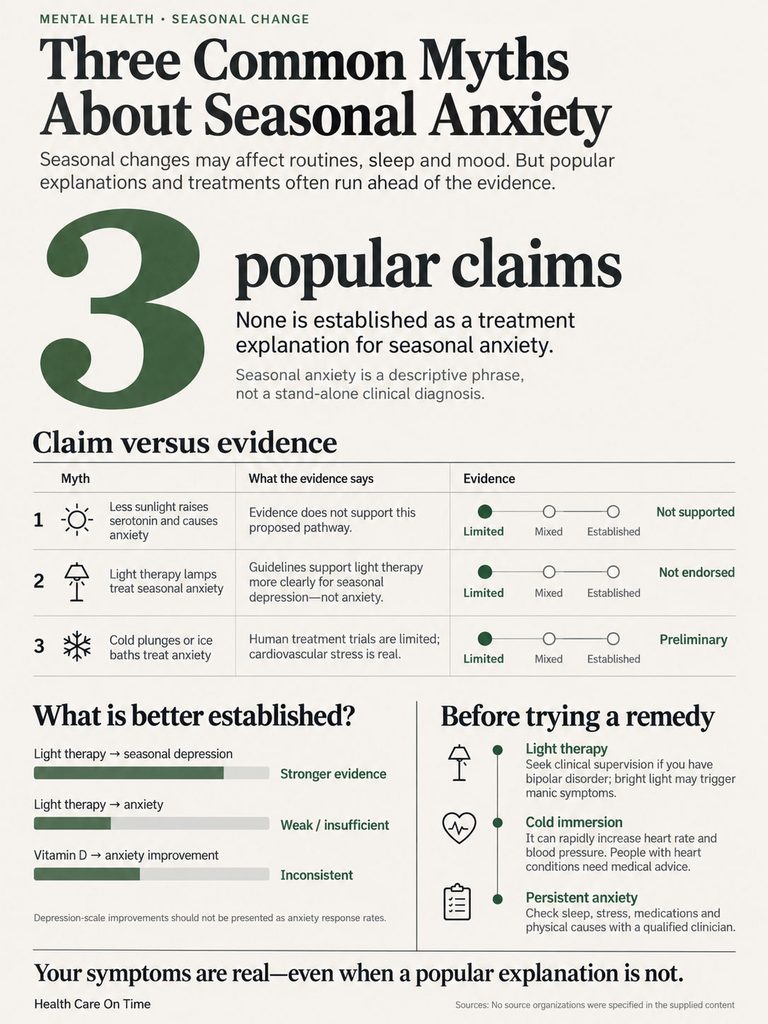
Myth 1: Low Sunlight Drops Serotonin, and That Causes the Anxiety
This sentence appears on several pages currently ranking for autumn anxiety, always without a citation. The serotonin story originates in seasonal depression research, where it remains one competing hypothesis among several rather than a settled mechanism.
Stretching it to cover anxiety goes past what the evidence supports. The studies that actually measured anxiety by season found no autumn rise that needs explaining in the first place.
Vitamin D gets bolted onto the same claim. Low vitamin D is worth correcting for bone and muscle health, but trials testing supplementation specifically to improve mood have produced inconsistent results, and the anxiety data is weaker still.
Myth 2: A Light Therapy Lamp Will Fix Seasonal Anxiety
Bright light therapy has genuinely good data behind it. A 2024 review in JAMA Psychiatry pooled 11 randomized trials covering 858 patients and found remission in 40.7% of the light therapy group against 23.5% of controls, with response rates of 60.4% against 39.0%.
Read the outcome measures, though. Every one of those numbers was recorded on a depression scale. The trial evidence for light boxes treating anxiety specifically is thin, and no major US clinical guideline recommends them for that purpose.
Light therapy is still worth trying if low mood, oversleeping, and carbohydrate craving dominate your picture, using a 10,000 lux box for 20 to 30 minutes within an hour of waking. Anyone with bipolar disorder should only start under clinical supervision, because bright light can trigger manic symptoms.
Myth 3: Cold Plunges and Ice Baths Treat Anxiety
Cold exposure is currently the most heavily marketed autumn anxiety fix on the open web, promoted by commercial breathwork programs that rank on the first page of Google for this exact query. The human trial evidence for cold immersion as an anxiety treatment is preliminary, small, and largely uncontrolled.
Cold water also carries real cardiovascular risk through the cold shock response, which raises heart rate and blood pressure sharply within seconds. For anyone with heart disease, uncontrolled hypertension, or an arrhythmia, this is not a harmless wellness experiment.
What Actually Helps, Graded by Evidence
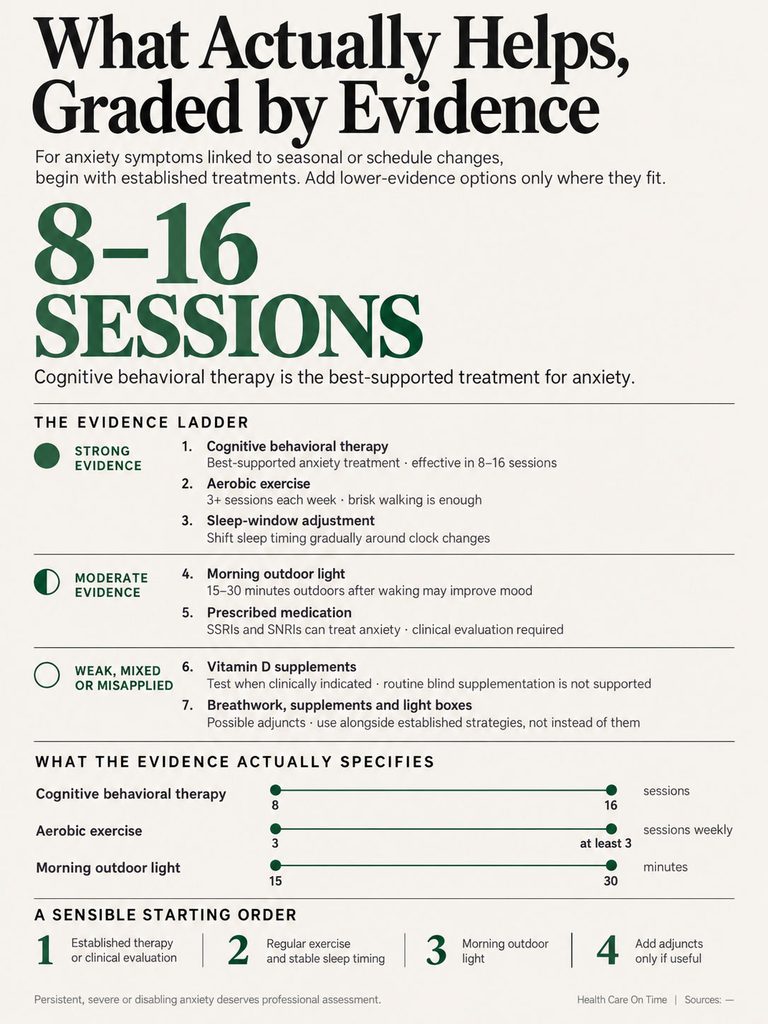
Strong Evidence
Cognitive Behavioral Therapy
CBT remains the best-supported psychological treatment for anxiety disorders, and a seasonal adaptation exists for people whose pattern repeats every year. Most people see meaningful movement within 8 to 16 sessions.
The seasonal version targets the specific thought patterns that cluster around winter, such as catastrophic predictions about the months ahead. It tends to hold up better across subsequent years than light therapy used alone, because the skills persist after treatment stops.
Aerobic Exercise, at a Real Dose
A 2025 systematic review pooled 32 randomized trials covering 3,243 adults diagnosed with depression or anxiety and found consistent symptom reduction from both aerobic and resistance training. A separate meta-analysis in older adults reported a standardized mean difference of -0.60 for anxiety symptoms.
The dose that keeps appearing across analyses is three or more sessions per week, each under 60 minutes, totaling roughly 150 to 180 minutes. That sits neatly inside the federal physical activity guideline of 150 minutes of moderate activity weekly.
Consistency beats intensity here. A brisk 25-minute walk five days a week clears the bar, and a walk taken outdoors in the morning does double duty by delivering the light signal at the same time.
Correcting the Sleep Window Before the Clock Change
Sleep researchers recommend shifting in 15-minute steps rather than absorbing the full hour at once. For the November 1 change, that means going to bed and waking 15 minutes later each day for the four days beforehand.
Hold a fixed wake time across weekends, including the weekend of the change itself. The wake time anchors the body clock far more strongly than bedtime does, and letting it drift on Saturday undoes most of the week work.
Moderate Evidence
Morning Outdoor Light, With Timing Attached
Aim for 15 to 30 minutes of outdoor light within an hour of waking, cloudy days included. Overcast daylight still delivers several thousand lux, which is roughly ten times what a well-lit indoor room provides.
This is the one change most people can make at no cost, and it targets the mechanism rather than the symptom. If your commute is dark year-round, a 10,000 lux light box positioned at eye level during breakfast is a reasonable substitute.
Prescribed Medication
SSRIs and SNRIs have strong evidence in anxiety disorders. Whether they fit your situation is a clinical decision requiring an evaluation, and they are not a seasonal supplement to be started in October and stopped in April.
Weak, Mixed, or Misapplied
Vitamin D Supplementation
Testing makes sense if you have limited sun exposure, darker skin, obesity, a malabsorption condition, or are over 65. Correcting a documented deficiency is worthwhile on its own merits.
Supplementing blind on the assumption it will resolve seasonal worry is not supported by the evidence, and high-dose self-supplementation carries its own risks.
Breathwork, Supplements, and Light Boxes for Anxiety Alone
Each is reasonable to try and unlikely to be the whole answer. In cases reviewed by our clinical team, these tend to help most when layered on top of corrected sleep timing and restored activity, rather than used instead of them.
How to Tell Ordinary Seasonal Unease From Something That Needs Care
Three questions separate the two, and none require a clinician to ask.
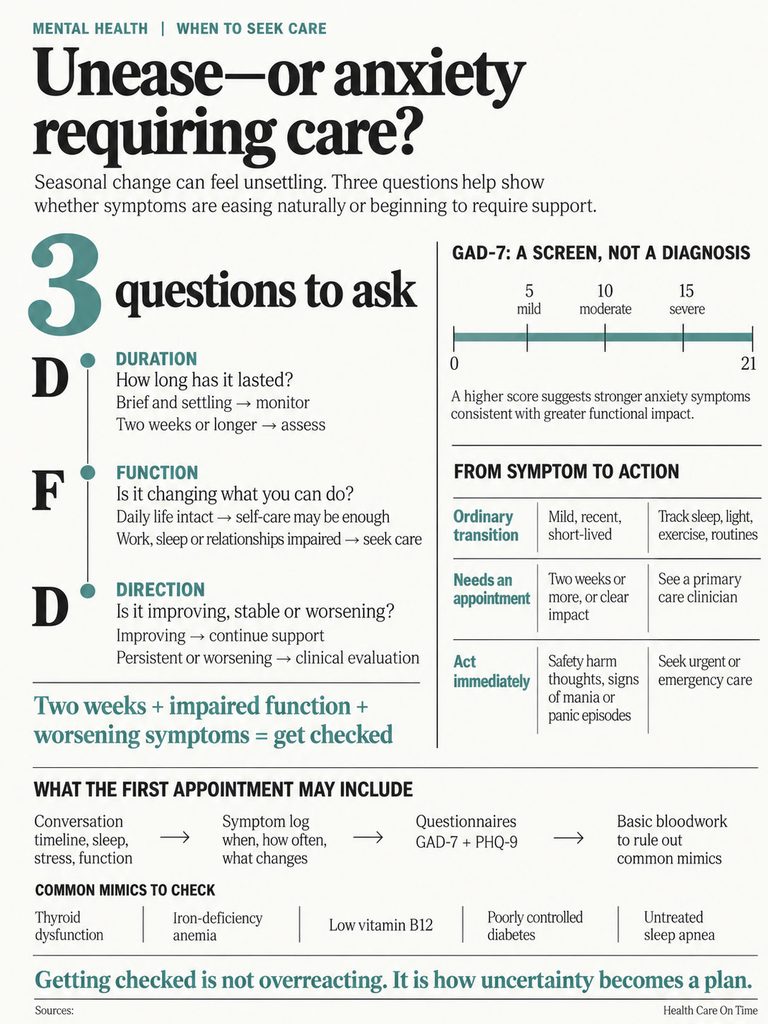
Duration. Has it lasted more than two weeks without letting up? Ordinary transition unease fades as the new routine settles into place.
Function. Is it changing what you actually do? Missed work, cancelled plans, avoided phone calls, and disrupted sleep matter more than how intense the feeling is on any given day.
Direction. Is it getting worse week over week, or holding level? A worsening curve is worth acting on sooner, regardless of how long it has been running.
What a GAD-7 Score Does and Does Not Tell You
The GAD-7 is a seven-item questionnaire used across US primary care. Scores of 5, 10, and 15 mark the thresholds for mild, moderate, and severe symptoms, and a score of 10 or above usually prompts further assessment.
It is a screening tool, not a diagnosis. A high score means a conversation is warranted, and a low score does not override the fact that something feels wrong to you.
Conditions That Mimic Seasonal Anxiety
Thyroid dysfunction, iron deficiency anemia, low vitamin B12, poorly controlled blood sugar, and untreated sleep apnea all produce restlessness, poor concentration, and fatigue that read convincingly as anxiety. An overactive thyroid in particular presents with palpitations, tremor, heat intolerance, and a sense of being wound up.
Patients booking panels with us in the fall are frequently surprised by what turns up. A basic workup of TSH, free T4, CBC, a metabolic panel, vitamin D, and vitamin B12 rules out most of the common mimics in a single draw.
What a First Appointment Actually Involves
Expect a conversation rather than a test. A primary care clinician will ask about duration, sleep, appetite, alcohol and caffeine, medications, family history, and what has changed recently.
You will likely complete a GAD-7 and possibly a PHQ-9 in the waiting room. Bringing a two-week symptom log, including sleep and wake times, makes the visit substantially more productive than trying to reconstruct it from memory.
| Your Situation | What It Most Likely Is | Recommended Action | Timeline |
| Unease for a few days as school or work restarts, still functioning | Ordinary transition | Fix wake time, add morning light, keep moving | Reassess in 2 weeks |
| The same low-grade dread every September for 3 or more years, mild | Learned seasonal pattern | Start countermeasures in August next year; consider seasonal CBT | Plan by July |
| Worry most days for over 2 weeks, plus poor sleep and physical tension | Possible anxiety disorder | Book primary care; ask for a GAD-7 and basic bloodwork | Within 2 weeks |
| Low mood, oversleeping, heavy carb craving from October, lifting in spring | Possible SAD | Clinical evaluation; discuss light therapy and CBT | Within 2 to 4 weeks |
| Anxiety plus palpitations, weight change, heat or cold intolerance, hair thinning | Possible thyroid or metabolic cause | Request TSH, free T4, CBC, metabolic panel, vitamin D, B12 | Within 2 weeks |
| Symptoms began within days of a new medication or dose change | Possible medication effect | Contact the prescriber before stopping anything | Same week |
| Panic episodes, unable to work or care for yourself, or thoughts of self-harm | Urgent | Contact a clinician today, or call or text 988 | Immediately |
Table 3. Scenario-to-action guide for deciding whether autumn symptoms need clinical attention.
Getting Care in the US: Cost, Coverage, and Wait Times
The gap between need and treatment is wide. NIMH puts past-year prevalence of any anxiety disorder at 19.1% of US adults, while recent national analysis found roughly 61% of adults with a psychiatric disorder received any treatment and only about 34% received care meeting minimum adequacy standards.
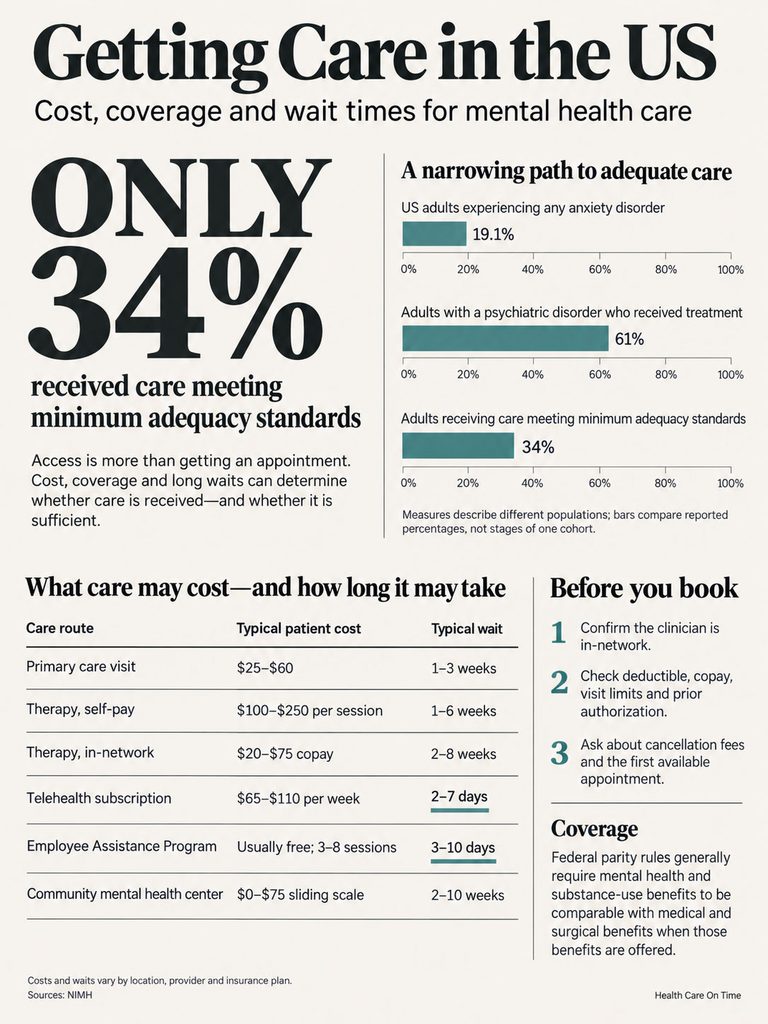
Cost is the most commonly cited barrier, followed by not knowing where to start. Knowing the actual routes and price points removes a good deal of that friction.
| Care Route | Typical US Cost | Typical Wait |
| Primary care visit, in-network copay | $25 to $60 | 1 to 3 weeks |
| Therapy session, self-pay | $100 to $250 | 1 to 6 weeks |
| Therapy session, in-network copay | $20 to $75 | 2 to 8 weeks |
| Telehealth therapy subscription | $65 to $110 per week | 2 to 7 days |
| Employee Assistance Program | Usually free, 3 to 8 sessions | 3 to 10 days |
| Community mental health center, sliding scale | $0 to $75 | 2 to 10 weeks |
Table 4. Typical US costs and wait times by care route. Figures are indicative ranges and vary by state and plan.
Check three things before booking. Whether your plan requires a referral, whether the provider is in-network for behavioral health specifically rather than medical care generally, and whether your employer runs an EAP you have never used.
Federal parity rules require most plans to cover mental health on terms comparable to physical health, including copays and visit limits. If a plan is applying stricter rules to therapy than to a specialist visit, that is worth questioning.
A Four-Week Reset for Fall
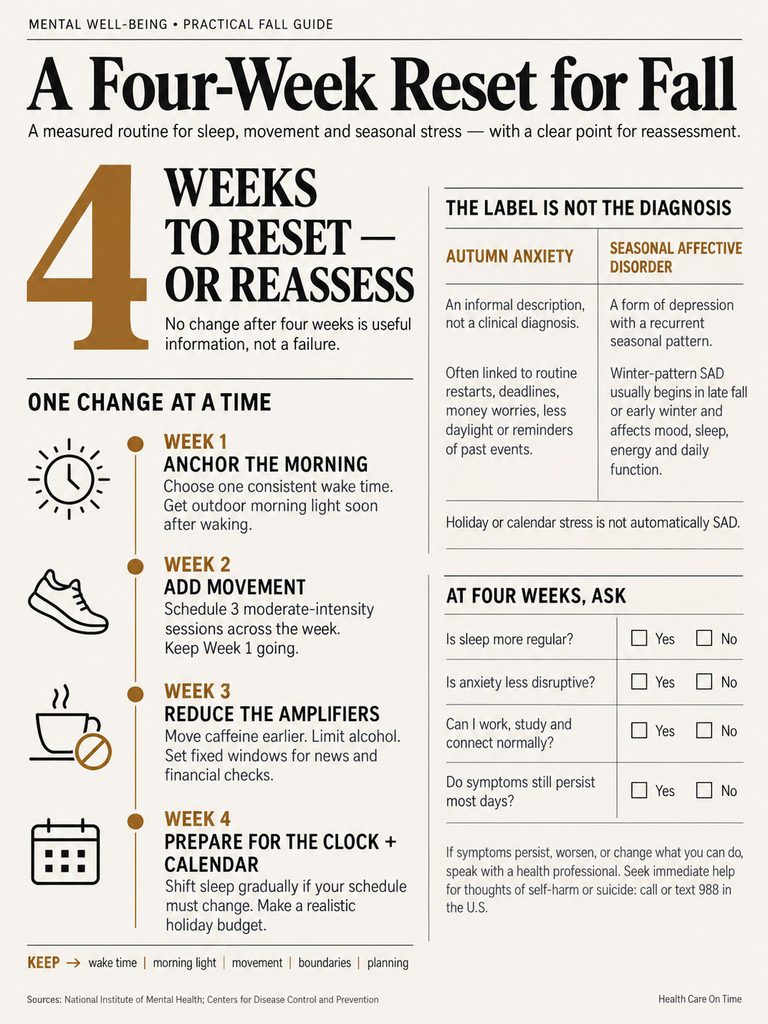
Week 1: light and wake time. Set one wake time and hold it seven days a week. Get outside within an hour of waking for 15 to 30 minutes. Dim overhead lighting after 8 p.m. and move screens out of the bedroom.
Week 2: movement floor. Add three sessions of 25 to 30 minutes at an intensity where talking is possible but singing is not. Set a floor you can hit every week rather than a program you will abandon by mid-November.
Week 3: the inputs. Move your last caffeine before 2 p.m. Cap alcohol at two nights per week. Pick two fixed times a day to check news and account balances, and leave both alone otherwise.
Week 4: the clock change and the calendar. Shift bed and wake times 15 minutes later each day for the four days before November 1. Write out the holiday budget and travel plan now, in October, while it is still hypothetical and easy to edit.
If four weeks of all of the above produces no change, that is useful information rather than a personal failure. A pattern that does not respond to corrected sleep, light, and activity points toward an evaluation, not toward trying harder.
Frequently Asked Questions
Is autumn anxiety a real medical diagnosis?
No. It is a descriptive label used in popular writing and by some clinicians, but it appears in no diagnostic manual and has no agreed case definition. The experience is real and worth addressing. The name carries no clinical weight, which is why persistent symptoms should be assessed against actual diagnostic criteria.
What is the difference between autumn anxiety and seasonal affective disorder?
SAD is major depressive disorder carrying a “with seasonal pattern” specifier, which requires repeating seasonal timing across at least two years and full remission in spring. Its hallmarks are low mood, oversleeping, and carbohydrate craving. Autumn anxiety describes worry and restlessness, which the specifier does not cover.
Why do I feel a sense of dread every September?
Usually because September is when demands restart, not because light levels changed. School years, fiscal quarters, performance cycles, insurance enrollment, and holiday planning all reload in the same weeks. Anniversary reactions to past September events are another common driver, and they frequently operate below conscious memory.
Does the end of daylight saving time make anxiety worse?
The evidence is mixed. A Danish register study of 185,419 hospital contacts found an 11% rise in depressive episodes after the autumn transition, fading over about 10 weeks. A US emergency department analysis found no equivalent signal. The sudden loss of evening daylight plausibly affects sleep timing regardless.
Can a light therapy lamp help with anxiety, or only depression?
The randomized trial evidence, including a 2024 JAMA Psychiatry review of 11 trials and 858 patients, measured depression outcomes exclusively. Light therapy has solid support for seasonal and non-seasonal depression. Its effect on anxiety alone is not established, making it a reasonable trial rather than a targeted treatment.
Does low vitamin D cause anxiety?
Low vitamin D is common and worth correcting, but trials testing supplementation for mood have produced inconsistent results and the anxiety data is weaker still. Testing makes sense with limited sun exposure, darker skin, obesity, malabsorption, or age over 65. Supplementing blind for seasonal worry is not evidence-based.
How long does seasonal anxiety usually last?
Ordinary transition unease typically settles within two weeks as routines stabilize. Anything persisting past that, worsening week over week, or changing what you can do at work or home has moved outside the normal range and warrants an evaluation rather than more waiting.
Why does back-to-school season make me anxious even though I am an adult?
The academic calendar shapes adult life more than most people notice, through children schedules, workplaces that mirror it, and decades of conditioning. The brain learned in childhood that late August means evaluation and new demands, and that association does not expire at graduation.
Can fall allergies affect my mood?
Yes, though the effect is specific. A controlled study of ragweed-allergic adults found significantly more mental and motivational fatigue and more negative mood during ragweed season, but no increase in anxiety. Congestion-related poor sleep adds to it. CDC data shows 25.2% of US adults report a seasonal allergy.
Does moving somewhere sunnier actually help?
SAD prevalence does rise with latitude, so geography is not irrelevant. Reviews attempting to demonstrate a clean latitude effect have been inconsistent, and Icelandic populations show unexpectedly low rates despite extreme winters. Adjusting light timing and daily routine where you already live is the more reliable intervention.
When should I see a doctor about seasonal anxiety?
Book a visit if symptoms last more than two weeks, change what you are able to do, worsen steadily, or arrive alongside physical signs such as palpitations, weight change, or heat intolerance. Ask for a GAD-7 and basic bloodwork. If you are in crisis, call or text 988 now.
Medical Disclaimer: This article is for educational purposes and is not a substitute for diagnosis or treatment by a licensed clinician. Anxiety and mood symptoms can have medical causes that require testing, and treatment decisions should be made with a healthcare professional who knows your history. If you are in distress or having thoughts of harming yourself, help is available 24 hours a day: call or text the 988 Suicide and Crisis Lifeline, or reach the SAMHSA National Helpline at 1-800-662-4357. If you are in immediate danger, call 911.
References
- NIMH: Any Anxiety Disorder statistics
- CDC NCHS, Symptoms of Anxiety and Depression Among Adults: United States, 2019 and 2022 (NHSR No. 213)
- American Psychiatric Association: Seasonal Affective Disorder
- APA Healthy Minds Poll: Americans More Anxious About the Holidays (November 2025)
- Winthorst et al., Seasonality in depressive and anxiety symptoms, BMC Psychiatry 2011;11:198
- Ayers et al., Seasonality in Seeking Mental Health Information on Google, Am J Prev Med 2013;44(5):520-525
- Hansen et al., Daylight Savings Time Transitions and the Incidence Rate of Unipolar Depressive Episodes, Epidemiology 2017;28(3):346-353
- Heboyan et al., Effects of seasonality and daylight savings time on emergency department visits for mental health disorders, Am J Emerg Med 2019;37(8):1476-1481
- Menegaz de Almeida et al., Bright Light Therapy for Nonseasonal Depressive Disorders, JAMA Psychiatry 2024
- Marshall et al., Effects of seasonal allergic rhinitis on fatigue levels and mood, Psychosomatic Medicine 2002
- Banyard et al., The Effects of Aerobic and Resistance Exercise on Depression and Anxiety, Int J Ment Health Nurs 2025
- StatPearls: Seasonal Affective Disorder
- CDC Mental Health: Conditions and Care Data