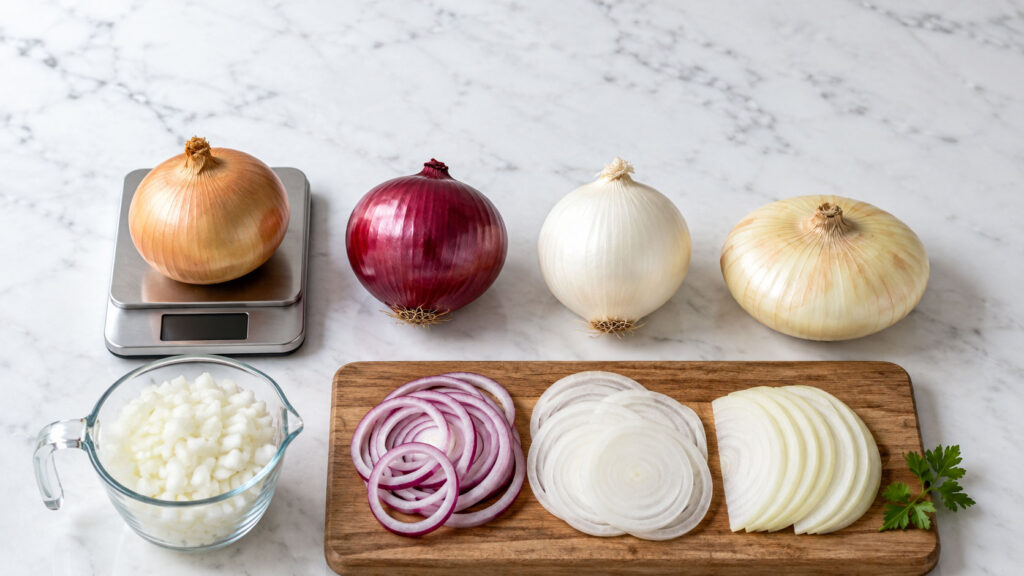
Ask five calorie apps how many calories are in a medium onion, and you may get five answers: 41, 44, 45, 46, or 60. None of them is a typo.
Table of Contents
The same “medium onion” weighs 94, 110, or 148 grams depending on who is counting. USDA also keeps several onion records that don’t match each other.
This guide traces every number back to its source, so what you log matches what’s on your cutting board. Our nutrition reviewers checked each figure against the USDA or FDA record it came from.
Quick Answer: A raw onion has 40 calories per 100 grams, according to USDA FoodData Central. A medium onion (2.5 inches across, 110 g or 3.9 oz) has 44 calories, a small (70 g) has 28, and a large (150 g) has 60. One cup chopped is 64 calories. Onions are about 89% water with almost no fat. Cooking in oil is what changes the count: sautéed onions reach 132 calories per 100 grams.
At a Glance
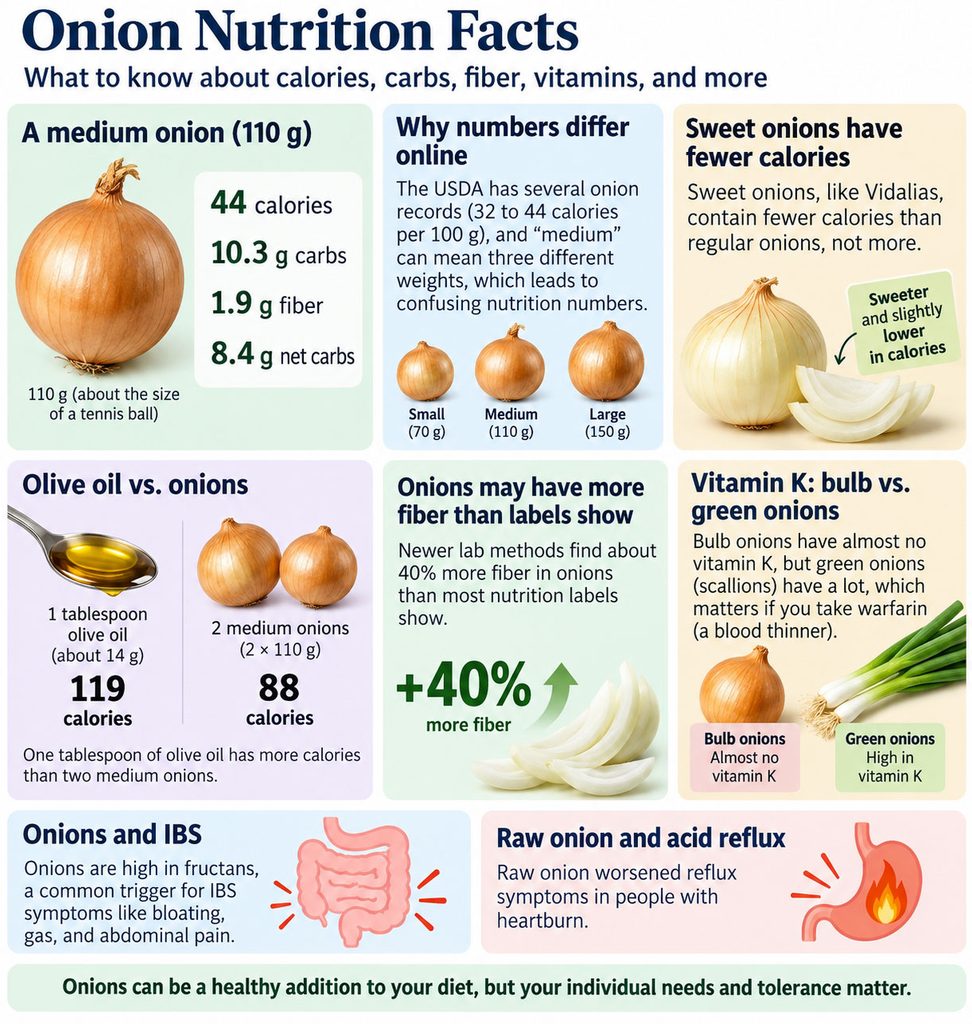
- A medium raw onion (110 g) has 44 calories, 10.3 g carbs, 1.9 g fiber, and 8.4 g net carbs.
- Numbers differ online because USDA has several onion records (32 to 44 calories per 100 g) and “medium” means three different weights.
- Sweet onions like Vidalias have fewer calories than regular onions, not more.
- One tablespoon of olive oil (about 119 calories) has more calories than two medium onions (88).
- Newer lab methods find about 40% more fiber in onions than most labels show.
- Bulb onions have almost no vitamin K, but green onions have a lot, which matters if you take warfarin.
- Onions are high in fructans, a common IBS trigger, and raw onion worsened reflux in people with heartburn.
How Many Calories Are in an Onion by Size?
The simplest way to count onion calories is by weight. USDA’s standard raw onion record lists 40 calories, 9.3 grams of carbs, and 1.7 grams of fiber per 100 grams.
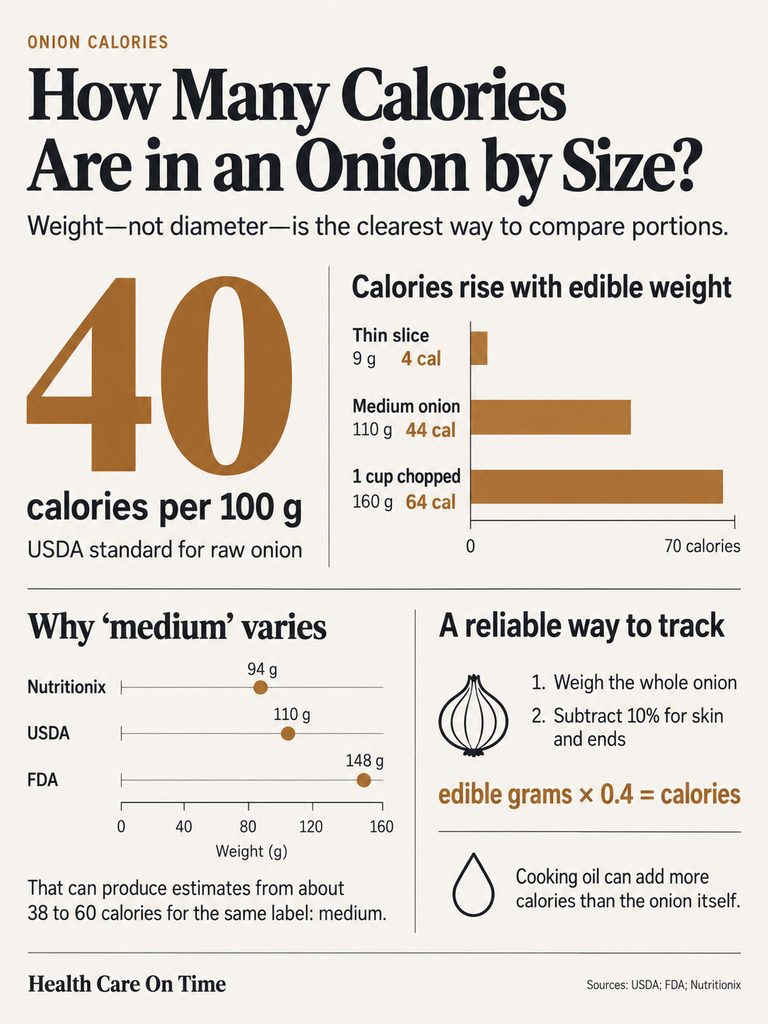
Here are the raw onion calories most people need, per USDA:
- One tablespoon chopped (10 g): 4 calories
- One small onion (70 g): 28 calories
- One medium onion (110 g): 44 calories
- One large onion (150 g): 60 calories
- One cup chopped (160 g): 64 calories
USDA publishes gram weights for common cuts, from a thin slice at 9 grams to a cup of chopped onion at 160 grams. Table 1 applies those weights to the USDA FoodData Central record. Net carbs are total carbs minus fiber.
| Portion | Weight | Calories | Total Carbs | Fiber | Net Carbs |
| 1 thin slice | 9 g (0.3 oz) | 4 | 0.8 g | 0.2 g | 0.7 g |
| 1 tbsp chopped | 10 g (0.4 oz) | 4 | 0.9 g | 0.2 g | 0.8 g |
| 1 medium slice (1/8 inch) | 14 g (0.5 oz) | 6 | 1.3 g | 0.2 g | 1.1 g |
| 1 large slice (1/4 inch) | 38 g (1.3 oz) | 15 | 3.5 g | 0.6 g | 2.9 g |
| 10 rings | 60 g (2.1 oz) | 24 | 5.6 g | 1.0 g | 4.6 g |
| 1 small onion | 70 g (2.5 oz) | 28 | 6.5 g | 1.2 g | 5.3 g |
| 1 medium onion (2.5 inches) | 110 g (3.9 oz) | 44 | 10.3 g | 1.9 g | 8.4 g |
| 1 cup sliced | 115 g (4.1 oz) | 46 | 10.7 g | 2.0 g | 8.8 g |
| FDA poster “medium,” USDA values | 148 g (5.2 oz) | 59 | 13.8 g | 2.5 g | 11.3 g |
| 1 large onion | 150 g (5.3 oz) | 60 | 14.0 g | 2.6 g | 11.5 g |
| 1 cup chopped | 160 g (5.6 oz) | 64 | 14.9 g | 2.7 g | 12.2 g |
Half a medium onion comes to about 22 calories. A whole large onion has 60 calories, roughly half of what’s in one tablespoon of olive oil.
The “Medium Onion” Problem: 94, 110, or 148 Grams
USDA defines a medium onion as 2.5 inches across and 110 grams. FDA’s grocery-store nutrition poster uses a much bigger “medium”: 148 grams, or 5.3 ounces.
Some apps show a third weight. Nutritionix lists a medium onion at 94 grams and 41 calories, which matches USDA’s weight for a medium onion after boiling.
That’s a 54-gram spread, about 22 calories, hiding behind one word. Patients who book metabolic panels with us and start tracking food often ask why their app disagrees with the bag label. Onion weight is nearly always the reason.
Here’s the reassuring part. If you log “1 medium” daily but actually use a 150-gram onion, you undercount by about 16 calories a day. Onions rarely derail a calorie budget; the oil they cook in does.
Many supermarket onions are bigger than USDA’s 2.5-inch medium. Weigh one on a kitchen scale once, and you’ll know which row of Table 1 fits the onions you usually buy.
Why Sources Say 35, 38, 40, 42, 44, 45, or 60
USDA doesn’t keep one onion record. It keeps several, analyzed in different years with different methods:
- SR Legacy “Onions, raw”: 40 calories per 100 g (the default in most apps)
- Foundation Foods yellow onion: 38 calories per 100 g
- Foundation Foods white onion: 35 calories per 100 g
- Foundation Foods red onion: 44 calories per 100 g
- A separate generic database record: 42 calories per 100 g
Some large nutrition sites quote 38 calories per 100 grams, which matches the newer Foundation Foods yellow onion record. Neither 38 nor 40 is wrong. They describe different onion samples.
Brand labels add more noise. For the same 148-gram onion, Publix yellow onions list 45 calories, while a Bland Farms Vidalia label lists 60. One user-created database entry even claims 20 calories for a 110-gram onion, which no USDA record supports.
What the FDA Grocery Poster Uses
FDA’s poster says a 148-gram onion has 45 calories and 11 grams of carbs. Its values reflect a Federal Register update from August 2006.
By USDA’s standard record, 148 grams works out to about 59 calories and 13.8 grams of carbs. The poster runs roughly 25% lower, likely because it rests on older composition data plus FDA label rounding, which rounds anything at 50 calories or below to the nearest 5.
For tracking, USDA’s SR Legacy record at 40 calories per 100 grams is a sensible default. The gap between USDA’s own onion records is under 10 calories per medium onion.
Edible Weight vs. What You Buy
Onion skin and root ends aren’t eaten. CalorieKing, working from USDA data, notes that about 10% of a whole onion’s weight is refuse, mostly stem ends and defects.
All USDA calorie numbers refer to the peeled, edible part. If you weigh a whole onion with its skin on, subtract about 10% before logging.
Full USDA Nutrition Breakdown of a Raw Onion
Onions are mostly water. One cup of chopped raw onion holds about 143 grams of water out of 160 grams total, which is why the calories stay so low.
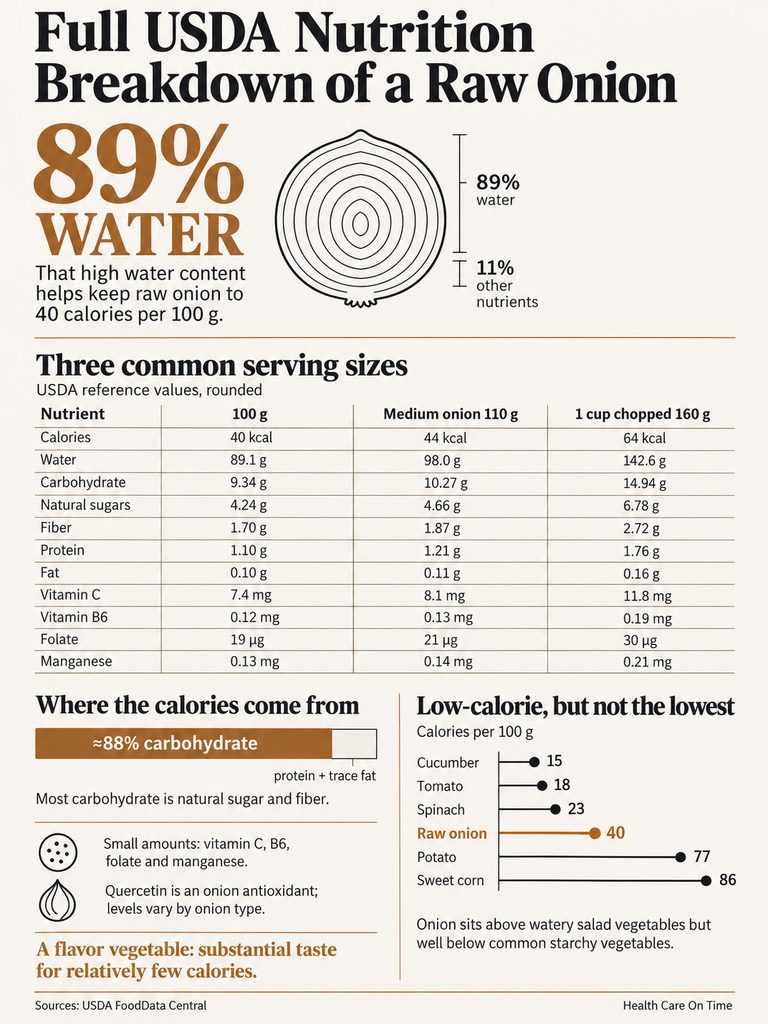
Here is the full USDA nutrient profile for raw onion at three common amounts.
| Nutrient | Per 100 g | Per Medium (110 g) | Per Cup Chopped (160 g) | % Daily Value (Medium) |
| Calories | 40 | 44 | 64 | 2% |
| Water | 89.1 g | 98.0 g | 142.6 g | n/a |
| Protein | 1.1 g | 1.2 g | 1.8 g | 2% |
| Fat | 0.1 g | 0.1 g | 0.2 g | 0% |
| Total carbs | 9.3 g | 10.3 g | 14.9 g | 4% |
| Fiber | 1.7 g | 1.9 g | 2.7 g | 7% |
| Total sugars | 4.2 g | 4.7 g | 6.8 g | n/a |
| Vitamin C | 7.4 mg | 8.1 mg | 11.8 mg | 9% |
| Vitamin B6 | 0.12 mg | 0.13 mg | 0.19 mg | 8% |
| Folate | 19 mcg | 21 mcg | 30 mcg | 5% |
| Potassium | 146 mg | 161 mg | 234 mg | 3% |
| Manganese | 0.13 mg | 0.14 mg | 0.21 mg | 6% |
| Sodium | 4 mg | 4 mg | 6 mg | 0% |
| Vitamin K | 0.4 mcg | 0.4 mcg | 0.6 mcg | 0% |
Source: USDA FoodData Central, SR Legacy FDC 170000. Daily Values use FDA reference amounts for a 2,000-calorie diet.
Where the Calories Come From
About 88% of an onion’s calories come from carbohydrates, with most of the rest from protein. Fat barely registers.
Those carbs aren’t starch. USDA lists zero starch in raw onion. The carbs are natural sugars (glucose, fructose, and sucrose) plus a type of fiber called fructans.
Cooked onions taste sweeter because heat tames the sharp sulfur compounds and breaks some fructans into simple sugars, which then brown.
Vitamins and Minerals: What 44 Calories Buys You
A medium onion gives you about 9% of the Daily Value for vitamin C, 8% for vitamin B6, 6% for manganese, and 5% for folate. It also adds small amounts of potassium.
Here’s the honest version: onions are a flavor vegetable first. FDA’s poster credits a medium bell pepper with 190% of the Daily Value for vitamin C, against 20% for a medium onion.
Where onions shine is flavor per calorie. A cup of chopped onion adds a lot of taste for 64 calories, often in place of salt, butter, or heavy sauce.
Quercetin and Other Plant Compounds
Onions are one of the richest everyday sources of quercetin, a plant pigment studied for its antioxidant effects. Red onions carry about 39 milligrams per 100 grams, based on the USDA flavonoid database.
Levels swing widely between onions. In USDA’s data, white onions averaged 13 milligrams per 100 grams, with a standard deviation of 18.2, larger than the average itself.
Our medical team treats these compounds as a bonus, not a reason to eat onions by the pound. Most human evidence comes from small or short studies, and FDA has not authorized a health claim for onions.
How Onions Compare With Other Vegetables
Per 100 grams, raw onion (40 calories) sits above cucumber (15), tomato (18), spinach (23), and cauliflower (25). It’s about even with raw carrots (41).
It runs well below starchy vegetables like a boiled potato (86) or a baked sweet potato (90). In other words, onions belong with the low-calorie vegetables you can use freely.
Onion Calories by Variety: Yellow, Red, White, Sweet, and Green
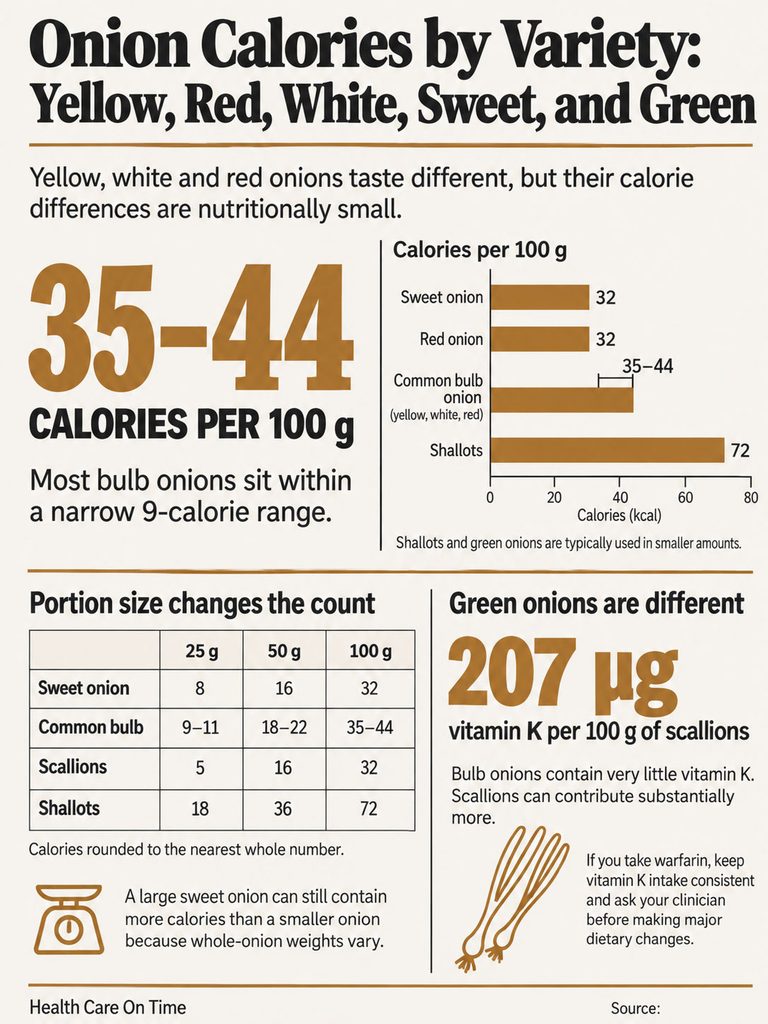
Most bulb onions land between 35 and 44 calories per 100 grams. That’s too small a gap to matter in one serving, but two varieties break the pattern.
Yellow, White, and Red: Choose by Flavor
Yellow onions are the all-purpose pick and caramelize best. White onions are sharper and crisper, which suits salsas and tacos. Red onions add color and a milder bite to salads and sandwiches.
Across a medium onion, the calorie gap between them is about 9 calories. Choose by taste and recipe, not by calories.
Why Sweet Onions Have Fewer Calories
Sweet onions such as Vidalia, Walla Walla, and Maui taste sugary, so many people assume they carry more calories. USDA says the reverse: 32 calories per 100 grams, with 5.0 grams of sugar and 0.9 grams of fiber.
Their mild taste comes from lower sulfur content and higher water content, not extra sugar. Less bite simply makes the natural sugar easier to taste.
One catch: sweet onions are often big. A single 148-gram Vidalia lands between 45 calories on one brand’s label and 60 on another’s.
Green Onions and Scallions: Low Calorie, High Vitamin K
Scallions have 32 calories per 100 grams, and one medium scallion, a little over 4 inches long, has about 5 calories.
The surprise is vitamin K. Scallions carry 207 micrograms per 100 grams, which is 172% of the Daily Value. Bulb onions have almost none, about 0.4 micrograms per 100 grams. That gap matters for anyone taking warfarin, covered below.
Shallots: Small but Denser
Shallots taste like a mix of onion and garlic and hold less water. USDA lists raw shallots at about 72 calories per 100 grams, nearly double a regular onion.
In practice, recipes call for small amounts. One tablespoon of chopped shallot adds about 7 calories.
The table below pulls the main onion types and forms into one place, using the USDA record for each.
| Type or Form | USDA Record | Calories per 100 g | Typical Serving | Calories per Serving |
| White onion, raw | Foundation Foods | 35 | Medium, 110 g | 39 |
| Yellow onion, raw | Foundation Foods | 38 | Medium, 110 g | 42 |
| Onion, raw (standard) | SR Legacy | 40 | Medium, 110 g | 44 |
| Red onion, raw | Foundation Foods | 44 | Medium, 110 g | 48 |
| Sweet onion, raw | SR Legacy | 32 | Label medium, 148 g | 47 |
| Scallions, raw | SR Legacy | 32 | 1 cup chopped, 100 g | 32 |
| Shallots, raw | SR Legacy | 72 | 1 tbsp chopped, 10 g | 7 |
| Onion, boiled and drained | SR Legacy | 44 | 1 cup, 210 g | 92 |
| Yellow onion, sautéed in oil | SR Legacy | 132 | 1 cup, 87 g | 115 |
| Onion rings, frozen, oven-heated | SR Legacy | 276 | 3 oz, 85 g | 235 |
| Onion rings, fast food | SR Legacy | 411 | 3 oz, 85 g | 349 |
| Dehydrated onion flakes | SR Legacy | 349 | 1 tbsp, 5 g | 17 |
| Onion powder | SR Legacy | 342 | 1 tsp, 2.3 g | 8 |
How Cooking Changes Onion Calories
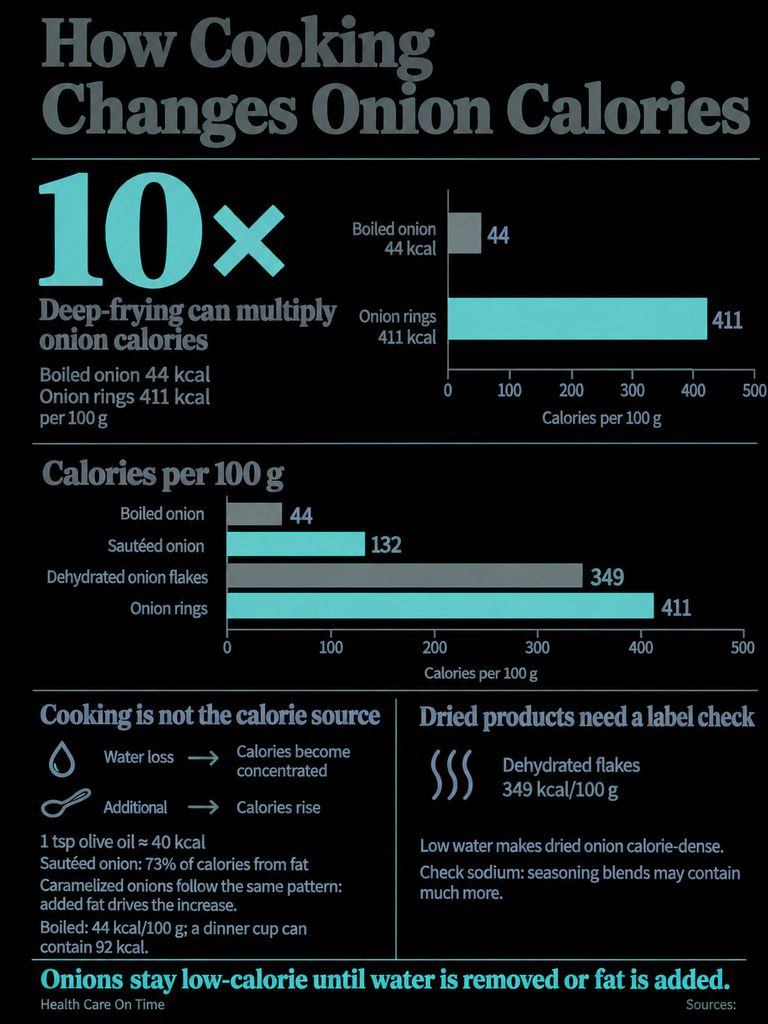
Heat doesn’t add calories to an onion. Two things do change: how much water the onion holds, and how much fat goes into the pan.
Boiled Onions: Same Onion, Denser Cup
Boiled, drained onions come in at 44 calories per 100 grams, and a cup of them has 92 calories. USDA’s medium onion weighs about 94 grams after boiling, with 41 calories.
The onion loses a little water and softens, so more of it fits in a cup. The calories per whole onion barely move.
Grilled and Roasted Onions
Grilling or roasting without oil keeps onion calories close to raw, measured by the raw weight you started with. The onion shrinks, but nothing is added.
A light brush of oil changes that. One teaspoon of olive oil adds about 40 calories, which is plenty for a whole sliced onion on the grill.
Sautéed and Caramelized Onions: The Oil Is the Story
USDA’s sautéed yellow onion record lists 132 calories and 10.8 grams of fat per 100 grams, and one cup of sautéed onions has 115 calories. About 73% of those calories come from fat.
The onion didn’t gain calories; the pan did. A cup of raw chopped onion shrinks to a little over half its weight as it cooks, soaking up fat along the way.
Caramelized onions work the same way. Long, slow cooking browns the natural sugars and drives off water, but it adds no calories beyond the butter or oil. In food diaries our medical team reviews, that cooking fat is the line people forget most.
Butter vs. Olive Oil Math per Batch
Say you caramelize two large onions (300 grams, 120 calories) in 2 tablespoons of olive oil (about 238 calories). The batch totals roughly 358 calories, and two-thirds of that is oil.
Using 2 tablespoons of butter instead adds about 204 calories. Using 2 teaspoons of oil adds about 80. To trim the batch, measure the fat, use a nonstick pan, and add a splash of water or broth when the onions start to stick.
Onion Rings and the Bloomin’ Onion
Batter and deep frying multiply onion calories roughly tenfold. USDA’s fast-food onion rings record lists 411 calories, 25.2 grams of fat, and 776 milligrams of sodium per 100 grams. Frozen rings heated in the oven come in lower, at 276 calories per 100 grams.
The Bloomin’ Onion is in another league. Outback Steakhouse’s published nutrition guide lists 1,920 calories, 152 grams of fat, and 4,870 milligrams of sodium per serving.
Several websites quote this appetizer at 800 to 1,000 calories, about half the restaurant’s own figure. Even a one-pound sweet onion has only about 145 calories raw. The rest comes from batter, frying oil, and sauce.
That sodium figure is more than double the 2,300-milligram daily limit in the Dietary Guidelines for Americans.
Onion Powder and Dried Minced Onion
Drying removes most of the water, so calories per gram jump nearly ninefold. Dehydrated onion flakes have 349 calories per 100 grams, yet a tablespoon has only 17.
Onion powder follows the same pattern: about 8 calories per teaspoon and 24 per tablespoon. With blends like onion salt and dry onion soup mix, watch the sodium, not the calories.
Carbs, Sugar, and Fiber in Onions
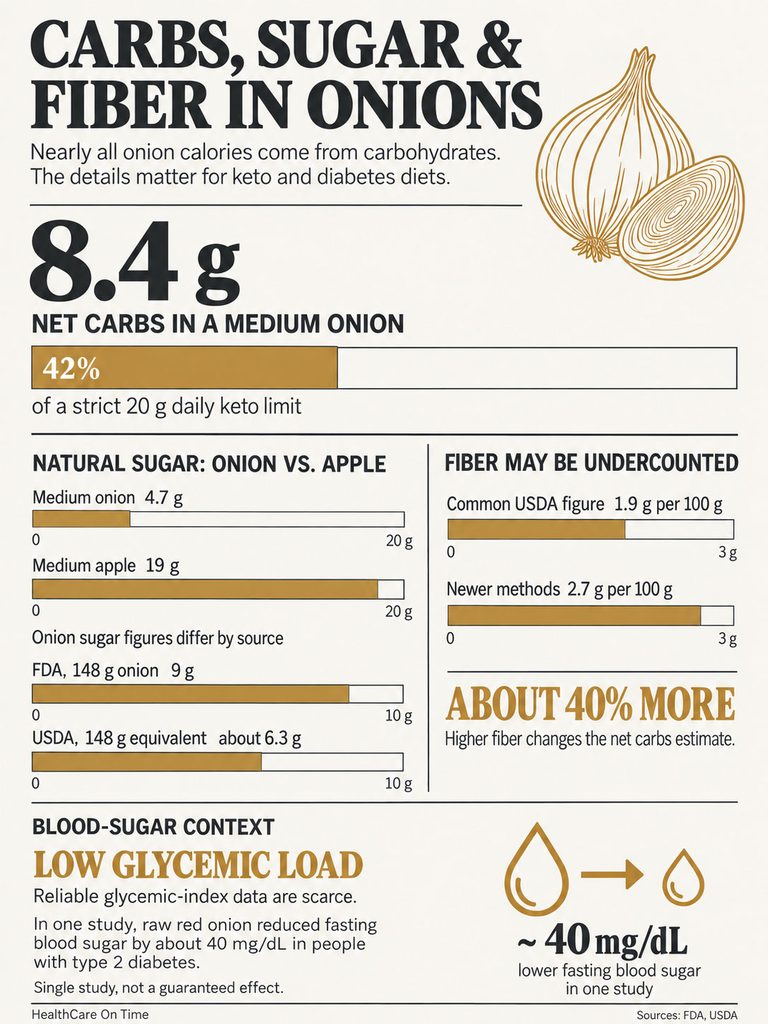
Nearly all of an onion’s calories come from carbs, so the carb details matter for keto and diabetes diets. They’re more interesting than most labels suggest.
How Much Sugar Is in an Onion?
A medium onion has about 4.7 grams of natural sugar and no added sugar. A medium apple has about 19 grams, so an onion carries roughly a quarter as much.
Labels disagree here too. FDA’s poster lists 9 grams of sugar for a 148-gram onion, while USDA’s standard record gives about 6.3 grams for the same weight. That’s another sign the poster rests on different data.
The Fiber Number Is Probably Too Low
USDA’s Foundation Foods yellow onion record shows 1.9 grams of fiber per 100 grams by the standard method, but a newer method (AOAC 2011.25) measured 2.7 grams.
The difference is fructans, the soluble fibers onions are known for. Older lab methods miss the smallest fructan molecules, so they undercount.
That means an onion may hold about 40% more fiber than most apps and labels show. It also means net carb counts for onions run slightly high.
Are Onions Keto-Friendly?
Onions fit keto as a seasoning, not as a main vegetable. A medium onion has 8.4 grams of net carbs, which is 42% of a strict 20-gram daily limit.
Smaller amounts work fine. Two tablespoons of chopped onion come to about 1.5 grams of net carbs. A cup of chopped scallions has about 4.7 grams, versus 12.2 grams for a cup of chopped onion.
Keep in mind that “net carbs” has no official FDA definition. Our guide on whether cauliflower is keto explains why the American Diabetes Association points people to total carbs instead.
Onions and Blood Sugar
Onions have a low glycemic load. Testing a food’s glycemic index takes 50 grams of digestible carbs, which would mean eating about six medium onions at once, so reliable GI numbers for onions are rare.
The best-known human study comes from researchers at Sudan’s University of Gezira. In a 2010 preliminary trial, 100 grams of raw red onion lowered fasting blood sugar by about 40 mg/dL in people with type 2 diabetes four hours later, compared with 81 mg/dL for the drug glibenclamide.
That was a single-dose, four-hour test, not a long-term trial. Onions don’t replace diabetes medicine, and if you take insulin or a sulfonylurea, talk with your care team before making big diet changes.
Patients booking HbA1c tests through HealthCareOnTime often ask whether onions “count” as carbs. They do, at about 10 grams per medium onion. They belong in your carb count, not on a do-not-eat list.
Onions in America by the Numbers
In 2017 data compiled by the Agricultural Marketing Resource Center, onions ranked as the fourth most consumed fresh vegetable in the U.S., behind potatoes, tomatoes, and sweet corn. In 2024, fresh onion availability rose 1% to 21 pounds per person, even as total fresh vegetable availability fell 3%.
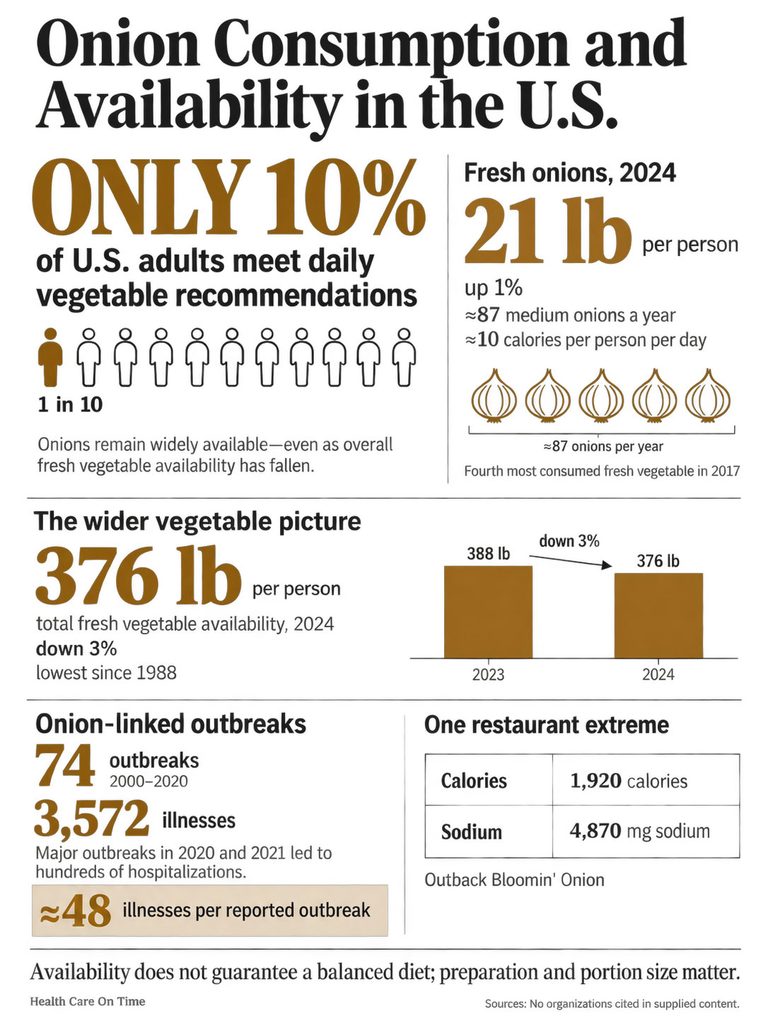
Twenty-one pounds is about 87 medium onions per person per year, or roughly 10 calories a day. Availability isn’t the same as intake, but the math shows how little onions add to the average American diet.
Table 2 pulls together the U.S. numbers that matter most for this topic, with the source for each.
| Measure | Figure | Source |
| Fresh onion availability per person, 2024 | 21 lb, up 1% from 2023 | USDA Economic Research Service |
| Total vegetable and pulse availability per person, 2024 | 376 lb, lowest since 1988 | USDA Economic Research Service |
| U.S. adults meeting daily vegetable recommendations | 10.0% | CDC, MMWR 2022 |
| Onion-linked outbreaks reported, 2000 to 2020 | 74 outbreaks, 3,572 illnesses, 302 hospitalizations | CDC NORS, via Colorado State University |
| 2020 Salmonella Newport outbreak (red onions) | 1,127 illnesses in 48 states; 167 hospitalized | CDC |
| 2021 Salmonella Oranienburg outbreak (whole onions) | 1,040 illnesses in 39 states; 260 hospitalized | CDC |
| 2024 E. coli O157:H7 outbreak (slivered onions) | 104 illnesses in 14 states; 34 hospitalized; 1 death | CDC |
| Outback Bloomin’ Onion, 1 serving | 1,920 calories; 4,870 mg sodium | Outback Steakhouse nutrition guide |
Two numbers stand out. Total U.S. vegetable and pulse availability fell to 376 pounds per person in 2024, the lowest level since 1988, per the USDA ERS Vegetables and Pulses Outlook.
And CDC data show only about 1 in 10 adults eats enough vegetables. Onions aren’t the problem. What gets fried around them often is.
Who Should Watch Their Onion Intake
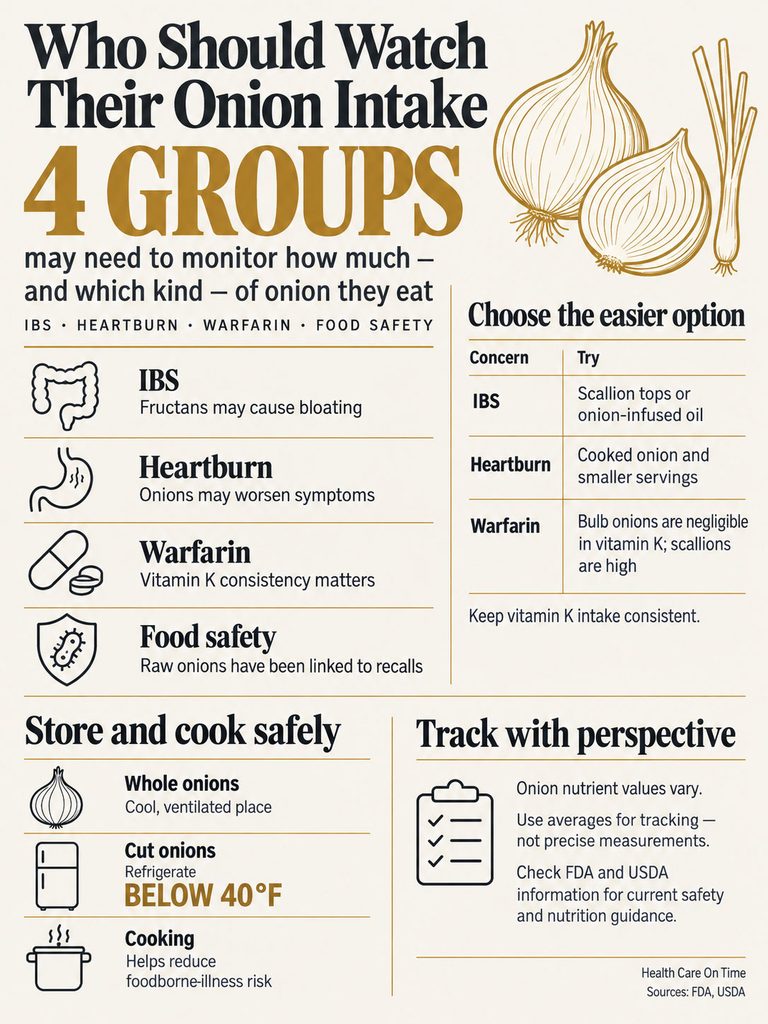
Onions are safe and useful for most people. Four groups should pay closer attention.
IBS and the Low-FODMAP Diet
Fructans ferment in the gut and can trigger bloating, gas, and pain in people with irritable bowel syndrome (IBS). Lab testing shows how little onion it takes:
- White onion: even a 12-gram serving tests moderate for fructans
- Yellow onion: low at 26 grams, but high by 30 grams
- Red onion and shallots: no low-FODMAP serving found
Green scallion tops are the usual swap. Monash University rates scallion greens low FODMAP up to 75 grams (3/4 cup). Onion-infused oil also works, because fructans dissolve in water, not oil.
A low-FODMAP diet is a short elimination and reintroduction plan, ideally guided by a registered dietitian. It isn’t meant to remove onions for life.
Heartburn and Acid Reflux
In a pH-probe study, 16 people with heartburn and 16 without ate a plain hamburger, then the same meal with a slice of raw onion on another day. The onion didn’t change reflux in the healthy group, but it raised every reflux measure in the heartburn group.
The study was small and dates to 1990, but it matches what many people notice. Cooked onions, sweet onions, and smaller portions tend to be easier to tolerate.
Warfarin: Bulb Onions vs. Green Onions
Our medical team hears this question often from patients on warfarin. The answer depends on which onion you mean.
Bulb onions have almost no vitamin K, so they don’t affect warfarin. Scallions carry 207 micrograms per 100 grams, so one cup of chopped scallions exceeds the full Daily Value of 120 micrograms.
You don’t need to avoid scallions. The goal is to keep your vitamin K intake steady from week to week, so your INR stays stable. Tell your care team before making big diet changes.
Food Safety and Onion Recalls
Raw onions have been linked to three large U.S. outbreaks since 2020:
- 2020: Salmonella Newport traced to red onions from Thomson International, with contaminated irrigation water in a Holtville, California, field as the leading theory
- 2021: Salmonella Oranienburg traced to whole onions imported from Chihuahua, Mexico
- 2024: E. coli O157:H7 traced to slivered onions on McDonald’s Quarter Pounders, with 104 confirmed patients in 14 states and one death
Cooking onions thoroughly kills these bacteria. The risk sits mostly with raw onions served on burgers, salads, and salsas.
Pre-Cut Onions and Storage
Store whole onions in a cool, dry, well-ventilated spot, away from potatoes. Once cut, refrigerate onions in a sealed container at 40°F or below.
When an onion recall makes the news, check the FDA recall list. Throw away affected products, including salsas and deli salads made with them.
What the Research Can and Can’t Tell You
USDA values are averages from sampled onions. Your onion can differ by variety, growing season, and how long it sat in storage.
FDA’s poster values date to 2006 and haven’t been updated since. The reflux study had 32 people, and the red onion diabetes study tested one dose over four hours.
Quercetin levels vary so widely that any single number is a rough guide. Use the figures in this article for everyday tracking, not as lab-grade precision.
How to Count Onion Calories Accurately
Five habits keep your onion numbers honest:
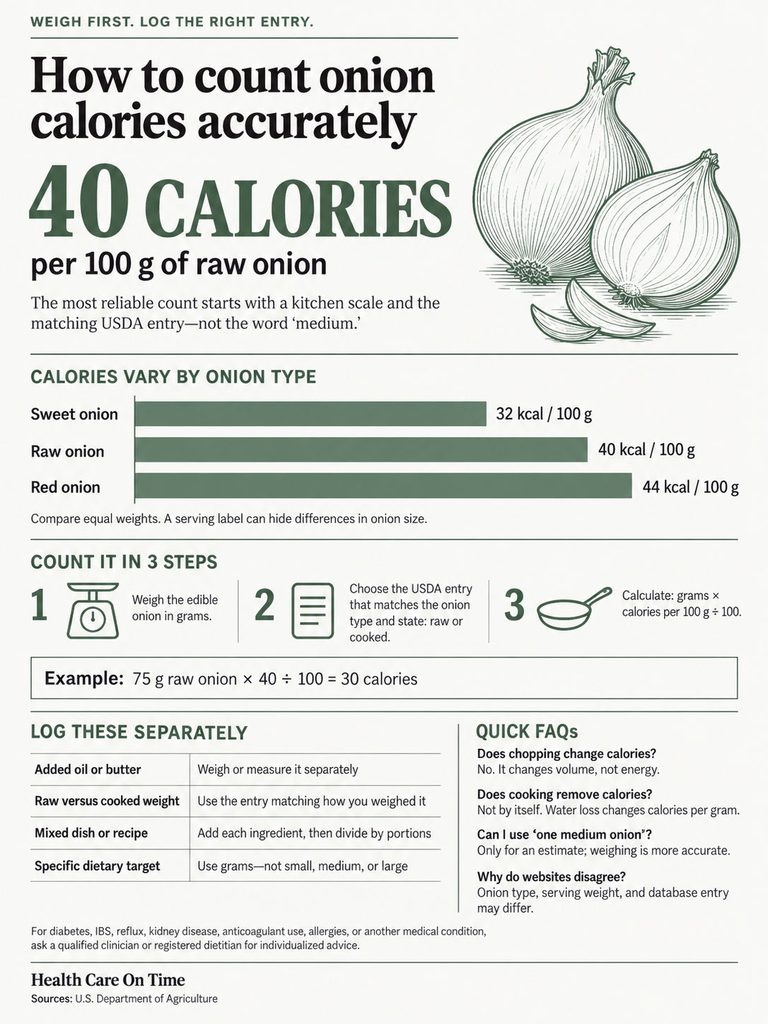
- Weigh your usual onion once, then log grams instead of “medium.”
- Pick USDA’s “Onions, raw” entry (40 calories per 100 grams) in your app, not a user-created one.
- Peel before weighing, or subtract about 10% for skin and root ends.
- Log cooking oil or butter as its own line.
- For recipes, log the raw onion weight plus all the fat, then divide by servings.
Which App Entry to Pick
In most tracking apps, search “onions, raw” and look for the USDA entry at 40 calories per 100 grams. Skip entries with oddly round numbers, like 20 calories per medium onion, and entries with no gram weight at all.
If you mostly cook with sweet or red onions, their own USDA entries (32 and 44 calories per 100 grams) are more precise. For sautéed onions, log raw onion plus measured oil rather than a generic “sautéed onions” entry, since oil amounts vary so much.
Table 3 matches common situations with a practical next step.
| Scenario | What to Do | Why It Matters |
| Logging onions in an app | Choose USDA “Onions, raw” and log grams | “Medium” entries range from 94 to 148 g |
| Cooking with oil or butter | Measure fat with a spoon and log it separately | 1 tbsp olive oil (about 119 cal) beats two medium onions (88 cal) |
| Strict keto (20 g net carbs) | Keep to 2 to 4 tbsp chopped per meal, or use scallions | A medium onion has 8.4 g net carbs |
| IBS or low-FODMAP phase | Swap in scallion greens (up to 75 g) or onion-infused oil | Bulb onions trigger symptoms at small servings |
| Taking warfarin | Keep scallion portions steady week to week | Scallions have 207 mcg vitamin K per 100 g; bulb onions have almost none |
| Frequent heartburn | Choose cooked or sweet onions in smaller portions | Raw onion raised reflux in heartburn patients |
| Diabetes carb counting | Count about 10 g carbs per medium onion | Low glycemic load, but carbs still count toward the meal |
| Onion recall in the news | Check FDA’s recall list and discard affected foods | Raw onions caused three large outbreaks since 2020 |
| Ordering fried onions | Share it, or order grilled onions instead | A Bloomin’ Onion has 1,920 calories |
Frequently Asked Questions
How many calories are in a whole onion?
A whole raw onion has 28 calories if small (70 grams), 44 if medium (110 grams), and 60 if large (150 grams), per USDA. Supermarket onions often run bigger than USDA’s medium, so weighing one gives the most accurate count. Skin and root ends aren’t included.
How many calories are in half an onion?
Half a medium onion (55 grams) has about 22 calories and 4.2 grams of net carbs. Half a large onion (75 grams) has about 30 calories. These figures are for raw onion. If you sauté that half onion in oil, log the oil’s calories separately.
How many calories are in a red onion?
USDA’s newer Foundation Foods record puts raw red onion at 44 calories per 100 grams, so a medium red onion (110 grams) has about 48 calories. That’s a few calories more than yellow or white onions. Red onions also carry more quercetin and anthocyanins, the pigments behind their color.
How many calories are in a cup of chopped onion?
One cup of chopped raw onion weighs about 160 grams and has 64 calories, 14.9 grams of carbs, and 2.7 grams of fiber. A cup of sliced onion is lighter, at 115 grams and 46 calories, because sliced pieces don’t pack as tightly into the cup.
Do cooked onions have more calories than raw onions?
Not by themselves. Boiled onions have 44 calories per 100 grams, close to raw at 40, because they lose a little water. Sautéed onions jump to 132 calories per 100 grams, but nearly all of that increase comes from the cooking oil, not the onion.
How many calories are in caramelized onions?
Caramelized onions carry the calories of the raw onions plus whatever fat you cook them in. Two large onions (120 calories) caramelized in 2 tablespoons of olive oil (238 calories) make a batch of about 358 calories. Cutting the oil to 2 teaspoons brings it to about 200.
How many carbs are in an onion?
A medium raw onion (110 grams) has 10.3 grams of total carbs, 1.9 grams of fiber, and 8.4 grams of net carbs, with no starch. Newer lab testing suggests onions hold more fiber than labels show, so the true net carb count may be slightly lower.
Are onions good for weight loss?
Onions help mainly by adding big flavor for few calories. A cup of chopped onion is 64 calories, so it can bulk up eggs, soups, and stir-fries. The traps are cooking oil, batter, and creamy dips, which can multiply the calories many times over.
How many calories are in a green onion?
One medium green onion (scallion) has about 5 calories, and a cup of chopped scallions has 32. Green onions are also high in vitamin K, with 207 micrograms per 100 grams, so people on warfarin should keep their portions consistent from week to week.
How many calories are in onion rings?
USDA lists fast-food onion rings at 411 calories per 100 grams, about 349 calories for a 3-ounce serving. Frozen rings baked in the oven have 276 calories per 100 grams. Outback’s Bloomin’ Onion is far higher, at 1,920 calories per serving, per the restaurant’s nutrition guide.
Does onion powder have calories?
Yes, but very few per use. Onion powder has about 8 calories per teaspoon and 24 per tablespoon. Drying removes the water, so it’s calorie-dense by weight (about 342 calories per 100 grams), but you use such small amounts that it barely registers. Watch the sodium in onion salt instead.
Can people with diabetes eat onions?
Yes. A medium onion has about 10 grams of carbs and a low glycemic load, so it fits most diabetes meal plans when counted with the rest of the meal. One small 2010 study found raw red onion lowered blood sugar short-term, but onions don’t replace medication.
Disclaimer: This article is for general education and isn’t medical or dietary advice. If you have IBS, frequent heartburn, or diabetes, or you take warfarin, talk with your doctor or a registered dietitian before changing your diet. Nutrient values come from USDA records and can vary by onion variety, size, and growing conditions.
References
- USDA FoodData Central: Onions, raw (SR Legacy, FDC 170000)
- USDA FoodData Central: Onions, yellow, raw (Foundation, FDC 790646)
- USDA FoodData Central: Onions, red, raw (Foundation, FDC 790577)
- USDA FoodData Central: Onions, white, raw (Foundation, FDC 1104962)
- USDA FoodData Central: Onions, sweet, raw (FDC 170008)
- USDA FoodData Central: Onions, spring or scallions, raw (FDC 170005)
- USDA FoodData Central: Onions, yellow, sautéed (FDC 170004)
- USDA FoodData Central: Onions, dehydrated flakes (FDC 170002)
- USDA FoodData Central: Fast foods, onion rings, breaded and fried (FDC 170697)
- FDA: Nutrition Information for Raw Vegetables
- FDA: Nutrition Information for Raw Fruits, Vegetables, and Fish
- USDA ARS: Database for the Flavonoid Content of Selected Foods, Release 3.3
- USDA ERS: Vegetables and Pulses Outlook, VGS-375 (April 2025)
- Agricultural Marketing Resource Center: Onions
- CDC MMWR: Adults Meeting Fruit and Vegetable Intake Recommendations (2022)
- CDC: 2020 Salmonella Outbreak Linked to Onions
- FDA: Outbreak Investigation of Salmonella Newport, Red Onions (2020)
- CDC: Salmonella Oranienburg Outbreak Linked to Onions (2021)
- Colorado State University: Onion Food Source Information
- Food Safety News: CDC Declares Taylor Farms Onion Outbreak Over (2024)
- Taj Eldin IM et al. Preliminary Study of the Clinical Hypoglycemic Effects of Allium cepa (Red Onion). Environ Health Insights. 2010
- Allen ML et al. The Effect of Raw Onions on Acid Reflux and Reflux Symptoms. Am J Gastroenterol. 1990
- Outback Steakhouse: Full Nutrition Information
- Monash University FODMAP
- FODMAP Everyday: Scallions and FODMAPs
- FDA: Recalls, Market Withdrawals, and Safety Alerts