In the FDA’s own Zoloft trials, 12% of people on placebo reported nausea, compared with 26% on the drug. That single gap changes how you should read almost every list of Zoloft side effects online.
Table of Contents
If you’re feeling worse on Zoloft instead of better, you’re in very common company. This guide separates what the drug causes from what a sugar pill causes, then maps what usually happens week by week.
Quick Answer: Feeling worse in the first one to two weeks on Zoloft (sertraline) is common and usually temporary. In FDA trials, nausea hit 26% of people on Zoloft versus 12% on placebo, and insomnia 20% versus 13%. Stomach upset often eases within a few weeks, while low mood can start lifting by week two and depression relief builds through week 12. Sexual side effects tend to persist. Call 988 or 911 for suicidal thoughts.
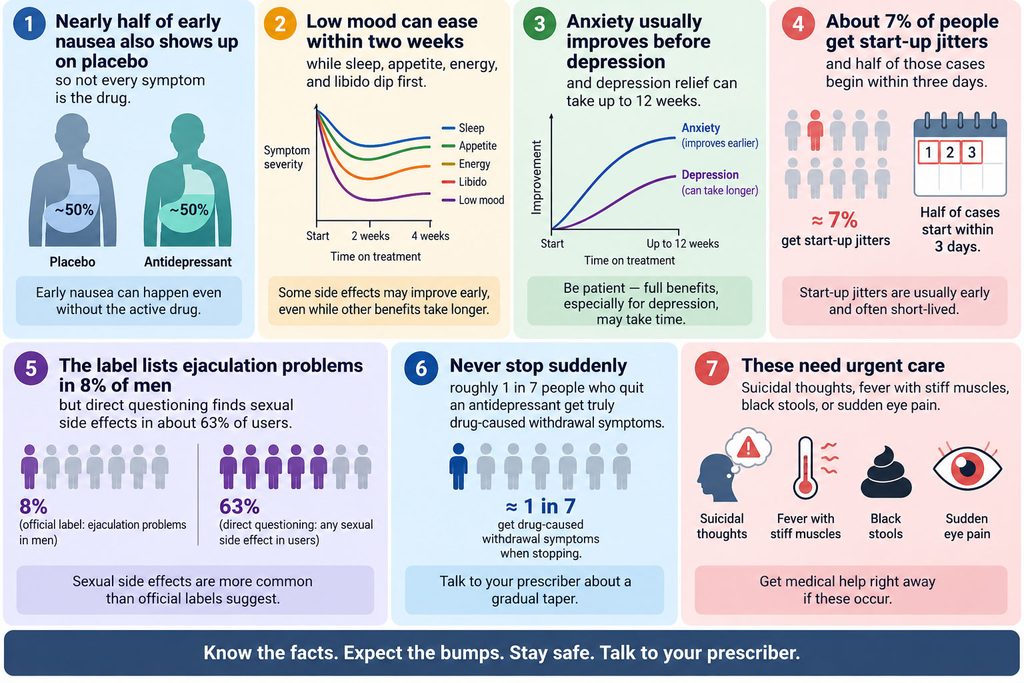
At a Glance: seven facts that matter most in the first month.
- Nearly half of early nausea also shows up on placebo, so not every symptom is the drug.
- Low mood can ease within two weeks while sleep, appetite, energy, and libido dip first.
- Anxiety usually improves before depression, and depression relief can take up to 12 weeks.
- About 7% of people get start-up jitters, and half of those cases begin within three days.
- The label lists ejaculation problems in 8% of men, but direct questioning finds sexual side effects in about 63% of users.
- Never stop suddenly; roughly 1 in 7 people who quit an antidepressant get truly drug-caused withdrawal symptoms.
- Suicidal thoughts, fever with stiff muscles, black stools, or sudden eye pain need urgent care.
What Zoloft Is and Its Most Common Side Effects
Zoloft is the brand name for sertraline, a selective serotonin reuptake inhibitor (SSRI). The FDA has approved it for adults with major depression, OCD, panic disorder, PTSD, social anxiety disorder, and premenstrual dysphoric disorder, plus OCD in kids ages 6 to 17.
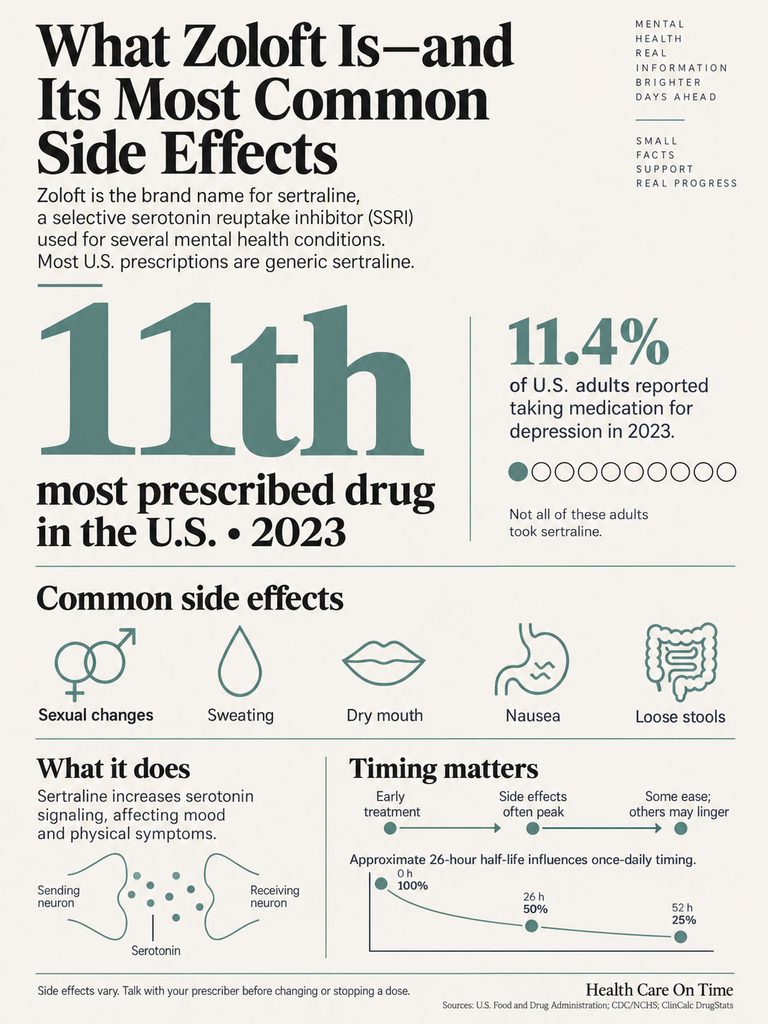
Viatris now distributes the brand, but most Americans fill generic sertraline, which has the same active ingredient.
These are the most common Zoloft side effects in pooled FDA trials, ranked by how much more often they hit people on the drug than people on placebo:
- Nausea (26% vs. 12%)
- Diarrhea or loose stools (20% vs. 10%)
- Insomnia (20% vs. 13%)
- Tremor (9% vs. 2%)
- Ejaculation failure in men (8% vs. 1%)
- Dry mouth (14% vs. 9%)
- Sleepiness (11% vs. 6%)
Most of these peak early. Sexual changes, sweating, and dry mouth are the ones most likely to linger.
How Sertraline Works
Sertraline blocks the recycling of serotonin, so more of it stays active between nerve cells. Its effects on norepinephrine and dopamine are very weak, which is why sertraline side effects look so “serotonin-shaped.”
Serotonin isn’t only a brain chemical. Most of your body’s serotonin is made in the gut, which helps explain why nausea and loose stools often show up before any mood change.
Why the Timing Is Slow
Sertraline’s half-life is about 26 hours. Blood levels roughly double before leveling off after about a week of daily doses, which is why the label recommends waiting at least a week between dose changes.
In older adults, clearance ran about 40% lower in label studies, so steady levels took two to three weeks. A side effect that appears on day 10 in a 72-year-old may simply mean levels are still climbing.
Why These Questions Matter More Now
Sertraline was the 11th most prescribed drug in the US in 2023, with about 42.6 million prescriptions filled for roughly 9.4 million patients. Federal surveys show 11.4% of adults took medication for depression in 2023, and 19.3% took medication for their mental health in 2024.
Patients who book medication-monitoring labs with HealthCareOnTime most often ask one thing in the first two weeks: is this normal? The numbers below show how many Americans share that question.
| Metric | Figure | Source |
| US sertraline prescriptions, 2023 | 42.6 million (rank #11 of all drugs) | ClinCalc DrugStats, based on federal MEPS data |
| US patients taking sertraline, 2023 | 9.39 million | ClinCalc DrugStats |
| Average out-of-pocket cost per prescription | $6.04 | ClinCalc DrugStats |
| Adults taking medication for depression, 2023 | 11.4% (women 15.3%, men 7.4%) | CDC NCHS Data Brief 528 |
| Adults taking any mental health medication, 2024 | 19.3% | CDC NCHS Data Brief 564 |
| Depression in past 2 weeks, ages 12+, 2021 to 2023 | 13.1% | CDC NCHS Data Brief 527 |
| Trial patients who quit Zoloft over side effects | 12% vs. 4% on placebo | FDA Zoloft prescribing information |
Why You Feel Worse on Zoloft Before You Feel Better
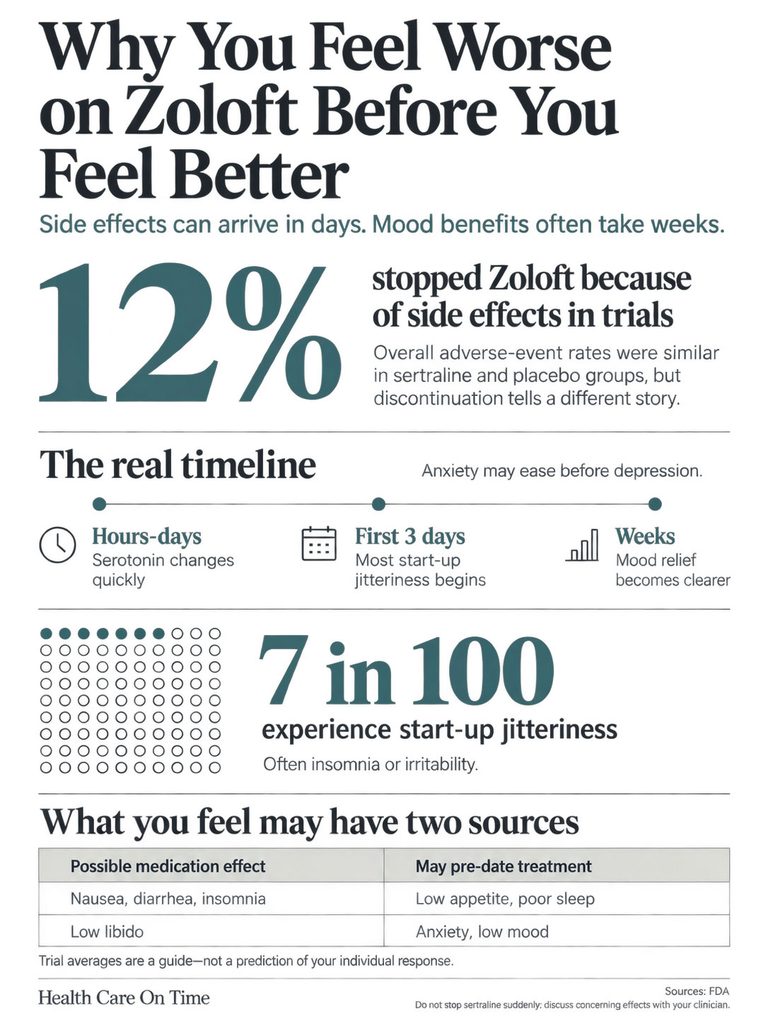
Four separate things stack up in the first weeks: early side effects, a lag in benefits, start-up jitters, and symptoms that would have shown up anyway. Pulling them apart makes the experience far less frightening.
Side Effects Arrive Before Benefits
Serotonin rises at nerve endings within days, but mood relief takes weeks. The leading explanation is receptor adaptation: the brain’s serotonin “brakes” push back at first, then gradually relax.
That theory isn’t fully proven. Still, it fits the pattern most people describe, where the body reacts first and the mind catches up later.
Emotions Improve First, the Body Lags
A 2025 Nature Mental Health reanalysis looked at individual symptoms instead of total scores. In 571 PANDA participants, sertraline improved low mood and suicidal thinking within two weeks. Over the same stretch, side effects pushed up low libido, low appetite, and tiredness.
Those physical symptoms overlap with depression itself, so you may feel worse even as the emotional core starts to shift. UCL psychiatrist Joanna Moncrieff cautioned that the symptom-level differences were small.
Anxiety Eases Before Depression Lifts
The original PANDA trial randomized 655 English primary care patients to placebo or sertraline, starting at 50 mg for a week, then 100 mg for up to 11 weeks.
At six weeks, depression scores barely differed (PHQ-9 of 7.98 vs. 8.76), but GAD-7 anxiety scores were 17% lower with sertraline. Evidence for a depression benefit at 12 weeks was weak but present.
Critics called the anxiety gain modest, about 0.77 points on a 21-point scale at 12 weeks. Participants’ symptoms ranged from mild to moderate, so results may differ in severe depression.
Start-Up Jitteriness: About 7%, Mostly in Days 1 to 3
Some people feel wired, restless, or more anxious right after starting. In a prospective study of 301 new antidepressant users, 21 (7.0%) developed jitteriness or anxiety syndrome, about half within three days and 16 within the first week.
Insomnia was the most common symptom, followed by irritability. Earlier studies reported rates from 4% to 65%, mostly because definitions differed, and this study was done in Japan.
Side Effect, Illness, or Something Else?
Not every bad day on sertraline is a side effect. Three quick questions help sort it out before your follow-up.
- Timing: Did it start within days of the first dose or a dose increase? That points toward a side effect, since most start-up effects appear in the first week.
- Placebo overlap: Is it something placebo groups also reported often, like nausea (12%), fatigue (8%), or dizziness (8%)? Then anxiety, the illness itself, or chance may be part of it.
- Direction: Are mainly physical symptoms worse, such as stomach, sleep, and energy, or emotional ones? Physical-only dips in weeks 1 to 2 fit the usual pattern, but new hopelessness or suicidal thoughts need a call today.
How Much Is Really the Drug? The Placebo Math
The label pools placebo-controlled trials covering 3,066 people on Zoloft and 2,293 on placebo, mostly at 50 to 200 mg for 8 to 12 weeks. Subtracting the placebo rate shows how much the drug itself adds.
Our medical reviewers checked every percentage in the table below against the current FDA prescribing label.
| Side effect | On Zoloft | On placebo | Extra caused by the drug | Usual course |
| Nausea | 26% | 12% | +14 points | Early; dose-related and often fades |
| Diarrhea or loose stools | 20% | 10% | +10 points | Early; often eases |
| Insomnia | 20% | 13% | +7 points | May linger; dose timing helps |
| Dry mouth | 14% | 9% | +5 points | Often mild but lasting |
| Dizziness | 12% | 8% | +4 points | Mostly early |
| Fatigue | 12% | 8% | +4 points | Mixed; overlaps with depression |
| Sleepiness | 11% | 6% | +5 points | Mixed; evening dosing may help |
| Tremor | 9% | 2% | +7 points | Dose-related |
| Ejaculation failure (men) | 8% | 1% | +7 points | Often persists |
| Agitation | 8% | 5% | +3 points | Mostly first 1 to 2 weeks |
| Heavy sweating | 7% | 3% | +4 points | Often persists |
| Decreased appetite | 7% | 2% | +5 points | Early; appetite often returns |
Nausea was dose-dependent and often short-lived in trials. In PANDA, overall adverse events were similar between the sertraline and placebo groups.
Still, 12% of Zoloft trial patients quit over side effects versus 4% on placebo. Nausea led the reasons at 3%, followed by diarrhea, agitation, and insomnia at 2% each.
What This Evidence Can’t Tell You
Label trials lasted only 8 to 12 weeks, PANDA was run in England, and the jitteriness data came from one Japanese clinic. Treat every percentage here as a starting estimate, not a prediction about you.
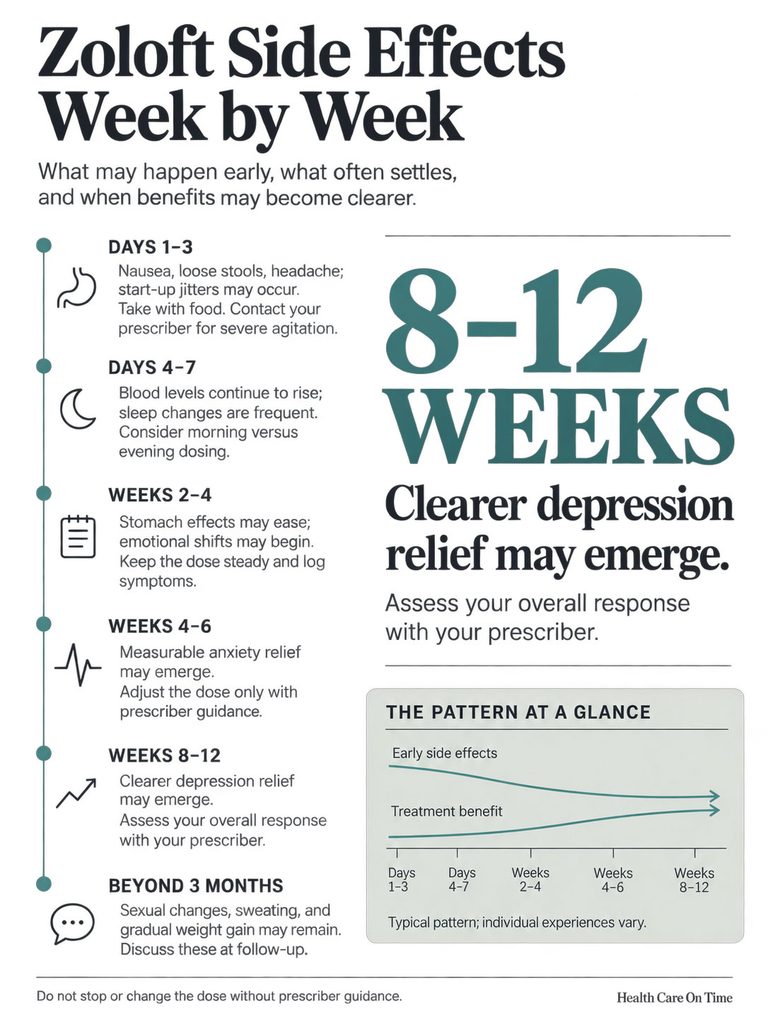
Zoloft Side Effects Week by Week
Your timeline depends on dose, age, and the condition being treated. Most people still follow a similar arc, mapped below.
| When | What’s typical | What helps |
| Days 1 to 3 | Nausea, loose stools, headache; about half of start-up jitteriness begins here | Take with food; call if agitation is severe |
| Days 4 to 7 | Blood levels still climbing; sleep changes common | Ask about morning vs. evening dosing |
| Weeks 2 to 4 | Stomach effects often easing; low mood may start to lift | Keep the dose steady; log symptoms |
| Weeks 4 to 6 | Anxiety relief becomes measurable | Dose changes only on prescriber advice, at least a week apart |
| Weeks 8 to 12 | Depression relief becomes clearer | Judge overall response with your prescriber |
| Beyond 3 months | Sexual effects, sweating, slow weight gain may remain | Raise lasting effects at follow-up |
Your First Week on Zoloft
Expect the gut to react first. Nausea, loose stools, and sleep changes are the most common early Zoloft side effects, and nausea tends to track with dose.
This is also the window for start-up jitters. Mild restlessness often settles within days, while intense restlessness or dark thoughts call for a same-day call.
Blood levels keep rising all week, so feeling a bit worse on day 5 than on day 2 doesn’t mean something is wrong. Levels usually settle around day 7.
Weeks 2 to 4: The Crossover
Many people notice small emotional shifts here, like fewer crying spells or less dread, while energy and sleep still feel off. The 2025 reanalysis suggests that mixed picture is normal, not a sign of failure.
Dose increases usually come after at least a week, and each one can briefly revive early effects. Patients who book follow-up labs with us often ask about exactly this; levels take about another week to settle after each change.
Weeks 4 to 12: Judging Whether It Works
In PANDA, anxiety relief was measurable by week six, while depression relief built more slowly toward week 12.
No change at all by week six to eight is a conversation for your prescriber, not a reason to quit alone. Options may include more time, a dose adjustment, adding therapy, or a different medication.
Beyond 3 Months: What’s Left
Most early effects have faded by now. What tends to remain are sexual changes, sweating, dry mouth, and gradual weight gain, the group covered next.
Zoloft Side Effects That Usually Don’t Fade on Their Own
Some sertraline side effects are temporary nuisances. Others tend to stick around, and they deserve a direct conversation instead of silent tolerance.
Sexual Side Effects: 8% on the Label, 63% When Asked
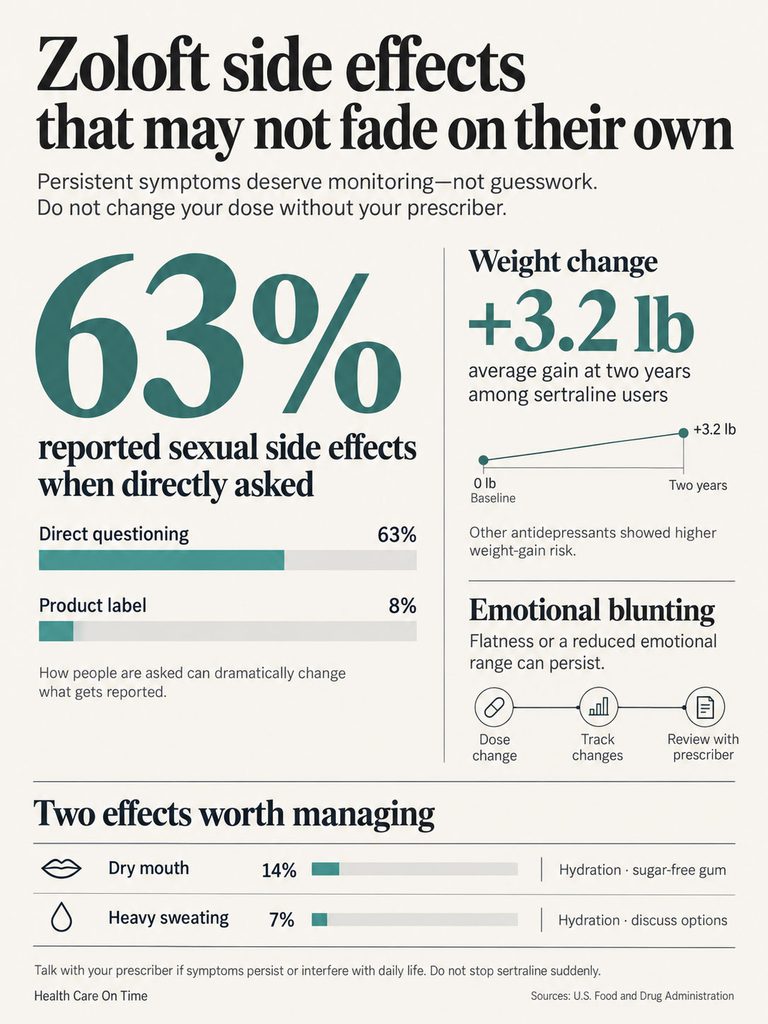
In pooled trials, 8% of men reported ejaculation failure versus 1% on placebo, and 4% of women reported lower libido versus 2%. The label itself says these figures may undercount the real rate, since people often don’t volunteer them.
A Spanish study of 1,022 outpatients asked directly with a questionnaire. It found sexual dysfunction in 62.9% of sertraline users, and about 40% of patients tolerated it poorly.
That study was open-label and dates to 2001, but the gap between 8% and 63% is striking. It’s the clearest example of how the way a question is asked changes the answer.
Patients commonly tell our care team they had no idea sexual changes counted as a side effect. Only about a quarter of affected people mention them unless a clinician asks, so bring it up yourself.
Options your prescriber may discuss include waiting a few weeks, adjusting the dose, switching medications, or adding a treatment. Don’t change your dose on your own.
Weight Change
A study of 183,118 new antidepressant users across eight US health systems used sertraline as its comparison drug. Sertraline users gained an average of nearly half a pound at six months and 3.2 pounds at two years.
Compared with sertraline, escitalopram, paroxetine, and duloxetine carried a 10% to 15% higher risk of gaining at least 5% of body weight. Bupropion carried a 15% lower risk.
A 2025 Lancet review of 30 antidepressants found about a 4 kg (roughly 9-pound) spread in short-term weight change between drugs. Weight is a fair factor when choosing, but it isn’t the only one.
Emotional Blunting
Some people describe feeling flat, with fewer highs and lows, or crying less than they expect to. It can be hard to separate from depression’s own numbness.
Note whether it started or worsened after a dose increase, and whether it bothers you more than the symptoms it replaced. Those two details help your prescriber decide between waiting, adjusting, or switching.
Heavy Sweating and Dry Mouth
Excessive sweating affected 7% on Zoloft versus 3% on placebo, and dry mouth 14% versus 9%. Neither is dangerous, but both often persist; water, sugar-free gum, and lighter bedding help.
Serious Zoloft Side Effects and Who Is at Higher Risk
Serious reactions are uncommon, but knowing the signs lets you act fast. The details below come from the FDA’s warnings section.
Suicidal Thoughts and the Boxed Warning
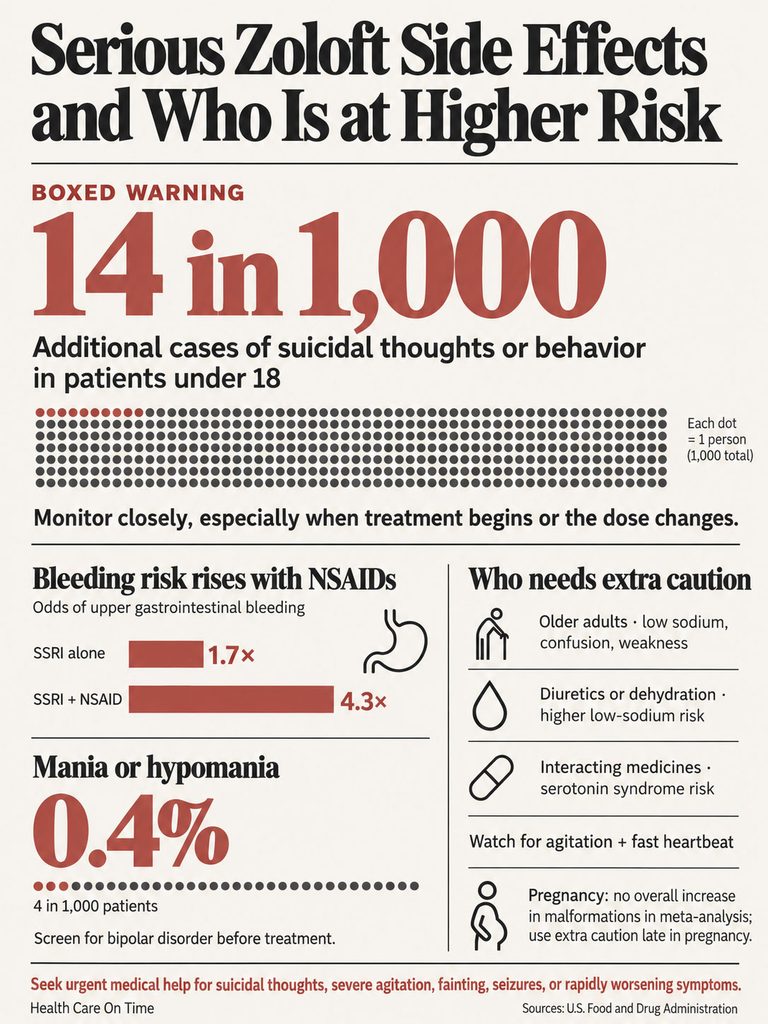
Zoloft carries the FDA’s boxed warning about suicidal thoughts in young people. In pooled trials of roughly 77,000 adults and 4,400 children, antidepressants added 14 cases per 1,000 patients under 18 and 5 per 1,000 at ages 18 to 24.
The same data showed 1 fewer case per 1,000 at ages 25 to 64 and 6 fewer at 65 and older.
Depression itself remains the most important cause of suicidal thoughts. The watch window is the first few months and any dose change. For new or worse suicidal thoughts, call or text 988, or call 911 for immediate danger.
Serotonin Syndrome
Serotonin syndrome is rare but potentially life-threatening. Signs include agitation, hallucinations, fast heartbeat, unstable blood pressure, sweating, fever, tremor, stiff or twitching muscles, vomiting, and diarrhea.
Risk rises with triptans, tramadol, fentanyl, lithium, amphetamines, buspirone, tryptophan, and St. John’s Wort. Sertraline can’t be combined with MAOIs, including linezolid and IV methylene blue, and the syndrome can occur on sertraline alone.
Bleeding Risk With Ibuprofen and Naproxen
SSRIs affect how platelets clot. A 2014 meta-analysis found SSRIs alone raised the odds of upper GI bleeding about 1.7-fold, and SSRIs plus NSAIDs raised them about 4.3-fold.
The absolute risk is still low: about one extra bleed for every 3,177 low-risk people treated, or every 881 high-risk people. Warfarin users need careful INR monitoring.
Low Sodium in Older Adults
SSRIs can cause low blood sodium, often through a hormone imbalance called SIADH. Older adults, people on diuretics, and anyone dehydrated face the highest risk.
Watch for headache, poor concentration, memory trouble, confusion, weakness, and unsteadiness that can lead to falls. When clinicians order a basic metabolic panel through our lab network for an older adult starting an SSRI, sodium is often the value they check first.
Mania, Eye Pressure, and Heart Rhythm
Mania or hypomania appeared in 0.4% of trial patients, so prescribers screen for bipolar disorder first. Eye pain, vision changes, or eye redness can signal angle-closure glaucoma in people with narrow eye angles.
At twice the maximum daily dose, sertraline lengthened the QTc heart interval by about 10 milliseconds in a formal study. That matters mainly if you take other rhythm-affecting drugs.
Pregnancy: What the Label Says Now
The label cites a meta-analysis showing no rise in overall malformations (odds ratio 1.01) or heart malformations (0.93) after first-trimester sertraline.
Use in the month before delivery is tied to a less than 2-fold rise in postpartum hemorrhage, and late-pregnancy exposure can cause newborn adaptation problems.
In July 2025, an FDA panel debated stronger SSRI pregnancy warnings. ACOG criticized the panel as one-sided. Competing citizen petitions were still under FDA review in March 2026. Don’t stop sertraline because of pregnancy without talking to your OB first.
Who Tends to Feel Side Effects More
- People under 25, who carry the boxed-warning risk.
- Adults 65 and older, who clear sertraline more slowly and face higher sodium risk.
- People with mild liver disease, who need half the usual dose; use in moderate or severe liver disease isn’t recommended.
- Anyone with a personal or family history of bipolar disorder.
- People on drugs cleared by the CYP2D6 enzyme, such as metoprolol, flecainide, propafenone, or atomoxetine, since sertraline can raise their levels.
How to Manage Zoloft Side Effects Without Quitting
Most early sertraline side effects respond to small changes. Make any dose or timing change with your prescriber, not on your own.
Nausea and Loose Stools
Cleveland Clinic advises taking sertraline with food if it upsets your stomach. Nausea was dose-related in trials, so ask whether a 25 mg start makes sense. That’s already the label’s starting dose for panic disorder, PTSD, and social anxiety.
If you’re offered an anti-nausea drug like ondansetron, ask your pharmacist to check it against sertraline first.
Sleep Problems or Daytime Sleepiness
Insomnia and sleepiness both beat placebo in trials. If you’re wired at night, ask about morning dosing; if drowsy, ask about evening dosing. Don’t drive until you know how sertraline affects you.
Jitteriness and Restlessness
Call your prescriber within a day or two if you feel wired, panicky, or unable to sit still. A lower dose or slower increase often helps, and intense restlessness with dark thoughts needs a same-day call.
Headaches and Pain Relievers
Because of the bleeding risk above, many pharmacists steer SSRI users toward acetaminophen (Tylenol) for occasional pain. Stay within the acetaminophen label’s daily limit and review your full medication list with your pharmacist.
Alcohol
The Medication Guide says not to drink alcohol on Zoloft. Yet in healthy volunteers, sertraline didn’t worsen alcohol’s short-term effects on thinking and coordination.
The bigger concern is alcohol worsening mood, anxiety, and sleep. The liquid form contains 12% alcohol and can’t be combined with disulfiram.
Keep a Two-Week Symptom Log
Our medical team suggests a simple daily log for the first two weeks: dose time, meals, hours slept, and 0 to 10 ratings for nausea, anxiety, and mood. Patterns jump out fast, and prescribers can act on specifics.
Getting Help Fast in the US
You don’t have to wait weeks for answers. Your pharmacist can check interactions and dose timing for free, often the same day, and many prescribers handle side-effect questions through a patient portal or telehealth visit.
Cost is rarely the barrier: the average out-of-pocket cost for a sertraline fill was $6.04 in 2023. To report a side effect, call FDA MedWatch at 1-800-FDA-1088. For a double dose or overdose, call Poison Help at 1-800-222-1222.
Questions to Ask Your Prescriber
- Which of these side effects are likely to fade, and which may last?
- Would a lower starting dose or slower increase help?
- Is morning or evening dosing better in this case?
- Do any current medicines or supplements raise the risk?
- By what week should improvement show?
Stopping, Skipping, or Switching Zoloft Safely
Stopping suddenly is where many people get into trouble. Recent research suggests severe withdrawal is less common than many online accounts claim.
What Withdrawal Really Looks Like
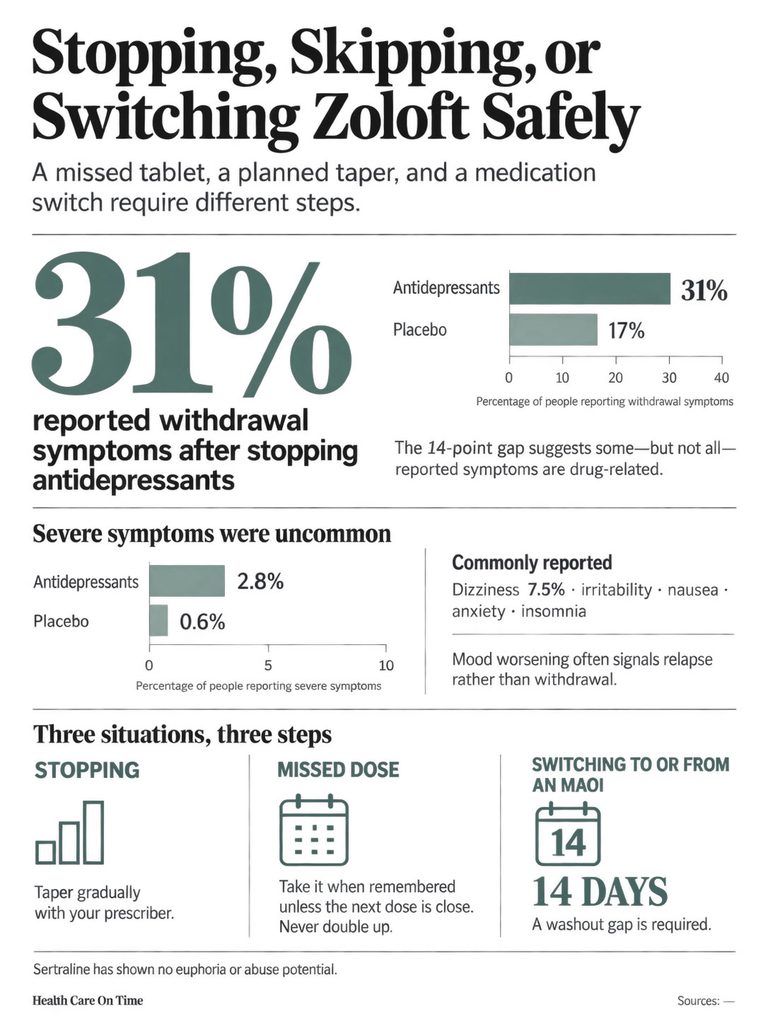
A 2024 Lancet Psychiatry meta-analysis pooled 79 studies and 21,002 patients. Withdrawal symptoms were reported by 31% of people stopping an antidepressant, but also by 17% of people stopping placebo.
Severe symptoms hit 2.8% versus 0.6%. The drugs tied to more frequent or more severe symptoms were desvenlafaxine, venlafaxine, imipramine, escitalopram, and paroxetine; sertraline wasn’t on that list.
A 2025 JAMA Psychiatry review of 50 trials and 17,828 people found dizziness the most common withdrawal symptom, at 7.5% versus 1.8%.
That review only measured the first two weeks after stopping. Mood worsening wasn’t linked to stopping itself, so depression that returns later points to relapse rather than withdrawal.
Withdrawal Isn’t Addiction
Patients commonly ask us whether withdrawal symptoms mean they’re hooked. They don’t: in a controlled comparison with alprazolam and amphetamine, sertraline produced none of the euphoria or “drug-liking” effects that signal abuse potential.
How to Stop or Skip a Dose
The label lists dizziness, electric-shock sensations, irritability, nausea, anxiety, and insomnia among withdrawal symptoms, and recommends a gradual taper. For a missed dose, take it when you remember unless the next dose is close, and never double up.
Switching to or from an MAOI antidepressant requires at least 14 days in between.
When to Call Your Doctor, 988, or 911
Use this table as a quick triage guide for Zoloft side effects. When in doubt, call.
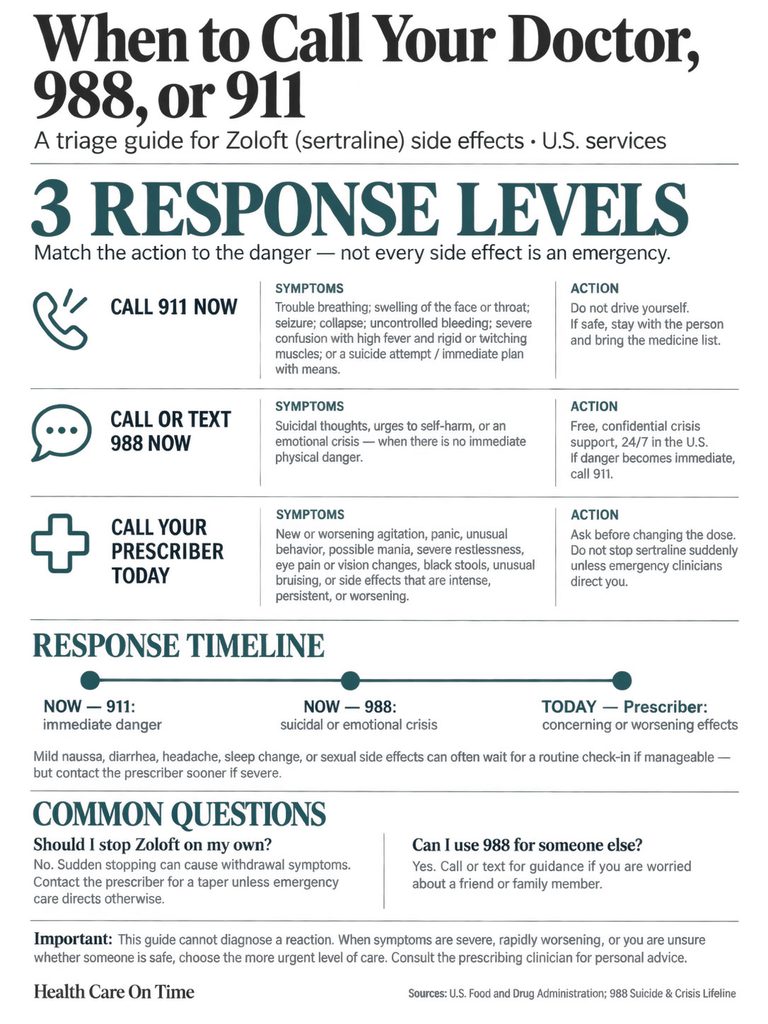
| Scenario | What it may mean | What to do | How fast |
| Nausea or loose stools in the first week | Expected early side effect | Take with food; mention at follow-up | Routine |
| Wired, panicky, or restless in days 1 to 7 | Start-up jitteriness (about 7%) | Call prescriber about dose | Within 1 to 2 days |
| Trouble sleeping | Common activating effect | Ask about morning dosing | Routine |
| New or worse suicidal thoughts | Boxed-warning risk or worsening illness | Call or text 988; 911 if in danger | Immediately |
| Fever, sweating, stiff or twitching muscles, confusion | Possible serotonin syndrome | Go to the ER | Immediately |
| Confusion, unsteadiness, headache in an older adult | Possible low sodium | Same-day visit and sodium test | Same day |
| Black or bloody stools, vomiting blood | Possible GI bleeding | Go to the ER | Immediately |
| Eye pain, blurred vision, red eye | Possible angle-closure glaucoma | Go to the ER | Immediately |
| Rash, facial swelling, trouble breathing | Allergic reaction | Call 911 | Immediately |
| Racing thoughts, little need for sleep, risky behavior | Possible mania | Call prescriber | Same day |
| Dizziness or “brain zaps” after missed doses | Discontinuation symptoms | Resume dose; don’t double | Routine |
| Sexual problems past 8 weeks | Persistent side effect | Discuss options at next visit | Routine |
Frequently Asked Questions
Why Do People Feel Worse on Zoloft at First?
Side effects like nausea, loose stools, and sleep changes start within days, while mood benefits build over weeks. A 2025 reanalysis found low mood improved within two weeks even as tiredness, appetite, and libido dipped. Nearly half of early nausea also appears on placebo, so some symptoms aren’t the drug at all.
How Long Do Zoloft Side Effects Last?
Stomach upset and start-up jitters usually peak in the first one to two weeks and often fade within a few weeks. Sertraline levels settle after about a week, or two to three weeks in older adults. Sexual changes, sweating, and slow weight gain are more likely to persist.
Can Zoloft Make Anxiety Worse Before It Gets Better?
Yes, for a minority. In one prospective study, 7% of new antidepressant users developed jitteriness or worse anxiety, half within three days. Past that window, anxiety tends to improve earlier than depression; in PANDA, anxiety scores were 17% lower by week six.
When Does Zoloft Start Working for Anxiety and Depression?
Low mood can begin shifting within two weeks, based on the 2025 reanalysis. In PANDA, anxiety relief was measurable at six weeks, while clearer depression relief took closer to 12 weeks. Talk with your prescriber if nothing has changed by week six to eight.
Is It Better to Take Zoloft in the Morning or at Night?
There’s no single right time, and it can be taken with or without food. If it keeps you awake, morning dosing often helps; if it makes you drowsy, evening dosing may work better. Keep the time consistent and confirm any change with your prescriber.
Can You Take Ibuprofen or Tylenol With Zoloft?
Ibuprofen and naproxen raise bleeding risk with SSRIs; one meta-analysis found about 4.3 times the odds of upper GI bleeding with the combination. Acetaminophen (Tylenol) doesn’t share that platelet effect and is often suggested instead. Check your full medication list with a pharmacist first.
Does Zoloft Cause Weight Gain?
Usually a little, over time. A study of 183,118 US patients linked sertraline to about half a pound of gain at six months and 3.2 pounds at two years. Escitalopram, paroxetine, and duloxetine carried a higher risk of larger gains, while bupropion carried less.
Is It Safe to Drink Alcohol on Zoloft?
The Medication Guide says to avoid it. Sertraline didn’t amplify alcohol’s short-term effects in healthy volunteers, but alcohol can worsen depression, anxiety, and sleep, which undercuts treatment. If you drink, keep it light and tell your prescriber how much.
What Happens If You Stop Zoloft Suddenly?
You may get dizziness, nausea, irritability, insomnia, or brief electric-shock sensations. About 1 in 6 or 7 people who stop an antidepressant get truly drug-caused symptoms, and severe symptoms affected 2.8% versus 0.6% after stopping placebo. A gradual taper lowers the risk.
Do Zoloft Side Effects Differ for Women and Men?
Somewhat. In trials, men reported ejaculation failure (8%) and lower libido (7%), while women reported lower libido (4%). In a direct-questioning study, men reported sexual dysfunction more often (62.4% vs. 56.9%), though women rated it more severe. Women also face pregnancy and postpartum bleeding considerations.
Can Zoloft Cause a False-Positive Drug Test?
Yes. The label reports false-positive urine screens for benzodiazepines in people taking Zoloft, lasting several days after stopping, and confirmatory testing such as GC-MS tells the two apart. Patients booking tests with us sometimes arrive worried about this, so mention your prescription to the tester.
Is 25 mg of Zoloft Less Likely to Cause Side Effects?
Often, yes. Nausea was dose-related in trials, and the label already starts panic disorder, PTSD, and social anxiety at 25 mg. Increases then come in 25 to 50 mg steps no more often than once a week, giving your body time to adjust.
Disclaimer: This article is for general education and isn’t medical advice. Don’t start, stop, or change Zoloft (sertraline) without your prescriber. If you have thoughts of suicide, call or text 988 (Suicide & Crisis Lifeline). For a suspected overdose, call Poison Help at 1-800-222-1222 or 911. Report side effects to FDA MedWatch at 1-800-FDA-1088.
References
- FDA: Zoloft (sertraline) Prescribing Information and Medication Guide, revised August 2023
- Lewis et al., PANDA trial, Lancet Psychiatry 2019
- NIHR PANDA research programme report, NCBI Bookshelf
- Piazza et al., Sertraline and networks of mood and anxiety symptoms, Nature Mental Health 2025
- Harada et al., Antidepressant-induced jitteriness/anxiety syndrome, Neuropsychiatric Disease and Treatment 2014
- Montejo et al., Sexual dysfunction with antidepressants, Journal of Clinical Psychiatry 2001
- Henssler et al., Antidepressant discontinuation symptoms, Lancet Psychiatry 2024
- Kalfas et al., Antidepressant discontinuation symptoms, JAMA Psychiatry 2025
- Harvard Health: Weight gain from antidepressants (Petimar et al., Annals of Internal Medicine 2024)
- Pillinger et al., Antidepressants and cardiometabolic parameters, Lancet 2025
- Anglin et al., SSRIs and upper GI bleeding, American Journal of Gastroenterology 2014
- ClinCalc DrugStats: Sertraline
- CDC NCHS Data Brief 527: Depression Prevalence, 2021 to 2023
- CDC NCHS Data Brief 528: Prescription Medication for Depression, 2023
- CDC NCHS Data Brief 564, June 2026
- ACOG Statement on SSRIs During Pregnancy, July 2025
- NAMI: Sertraline (Zoloft)
- Cleveland Clinic: Sertraline Tablets
- 988 Suicide & Crisis Lifeline