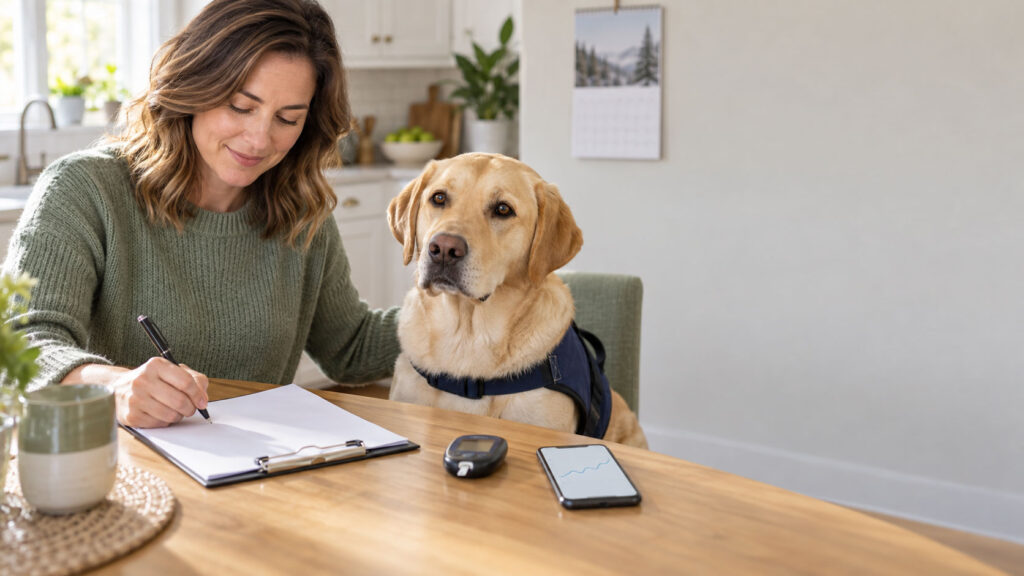
Here’s the number most application guides skip. In the 2025 Assistance Dogs International (ADI) census, diabetic service dogs made up 3% of service dogs at accredited programs, seizure service dogs 3%, and medical alert dogs just 1%. By our math from those shares, that’s roughly 1,000 teams worldwide.
Table of Contents
Now set that against the 2.1 million Americans living with diagnosed type 1 diabetes and the roughly 2.9 million U.S. adults with active epilepsy. Demand far outruns supply, so how you apply matters as much as whether you qualify.
Timing helps, too. Several major programs open applications on January 1, so the months before that date are the time to get your paperwork ready.
Quick Answer: To apply for a medical alert dog, get written confirmation of your diagnosis from your clinician, then choose a path: a donor-funded nonprofit, a program that asks you to fundraise, or training your own dog with an accredited program. Apply during the intake window (often January 1 to April 30), finish interviews and scent sampling, then complete team training. Plan on a wait of a year or more and $0 to about $21,500 out of pocket.
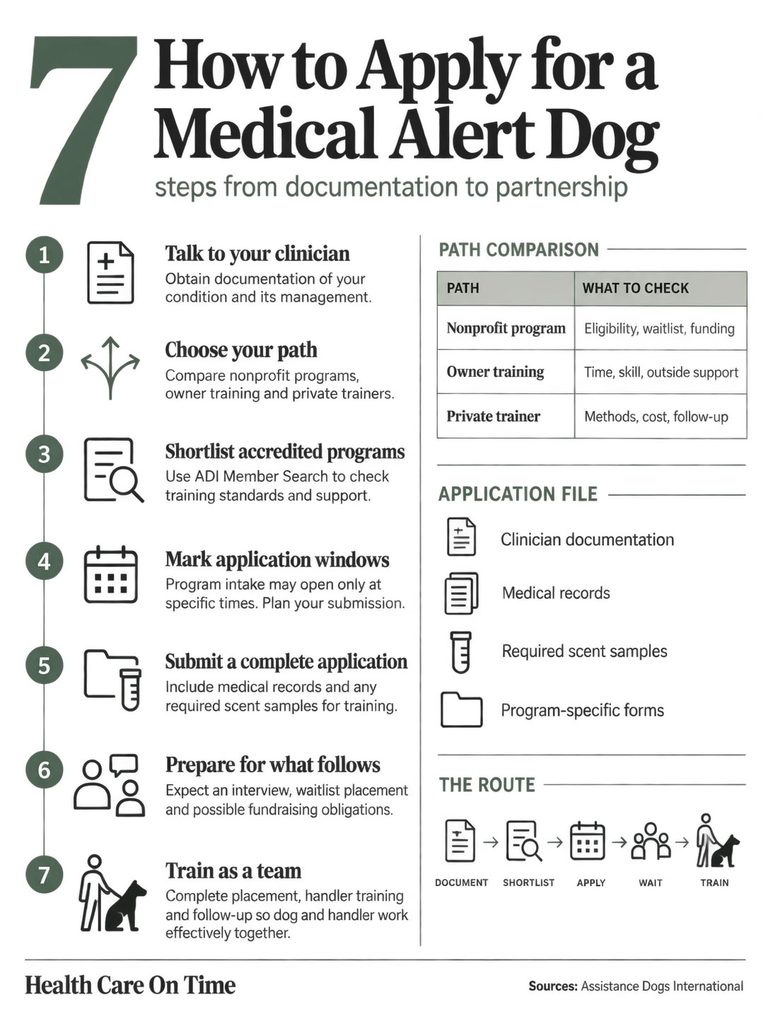
- Talk to your clinician and get a letter documenting your condition.
- Pick your path: donor-funded nonprofit, fundraising-share program, owner training, or VA referral.
- Shortlist accredited programs using ADI’s Member Search.
- Mark the application window on your calendar.
- Submit a complete application with medical forms and references.
- Interview, join the waitlist, and fundraise if required.
- Finish team training and stay in the program’s follow-up.
At a Glance
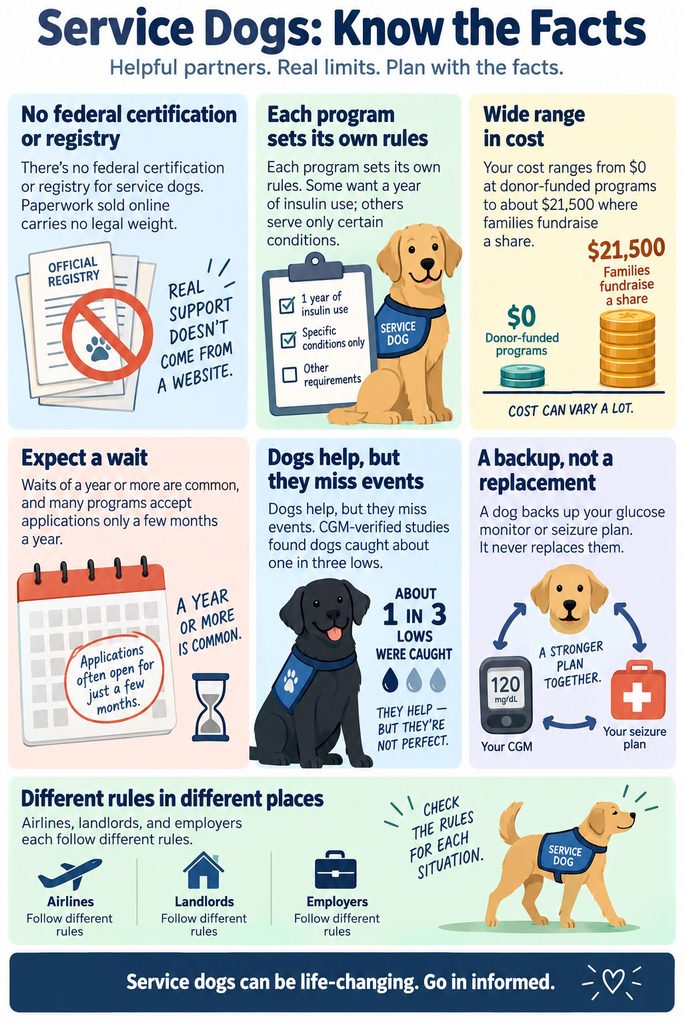
- There’s no federal certification or registry for service dogs. Paperwork sold online carries no legal weight.
- Each program sets its own rules. Some want a year of insulin use; others serve only certain conditions.
- Your cost ranges from $0 at donor-funded programs to about $21,500 where families fundraise a share.
- Waits of a year or more are common, and many programs accept applications only a few months a year.
- Dogs help, but they miss events. CGM-verified studies found dogs caught about one in three lows.
- A dog backs up your glucose monitor or seizure plan. It never replaces them.
- Airlines, landlords, and employers each follow different rules.
What Is a Medical Alert Dog (and What Isn’t One)?
A medical alert dog is a service dog trained to warn you, or someone nearby, that a health event is starting. Most work by scent.
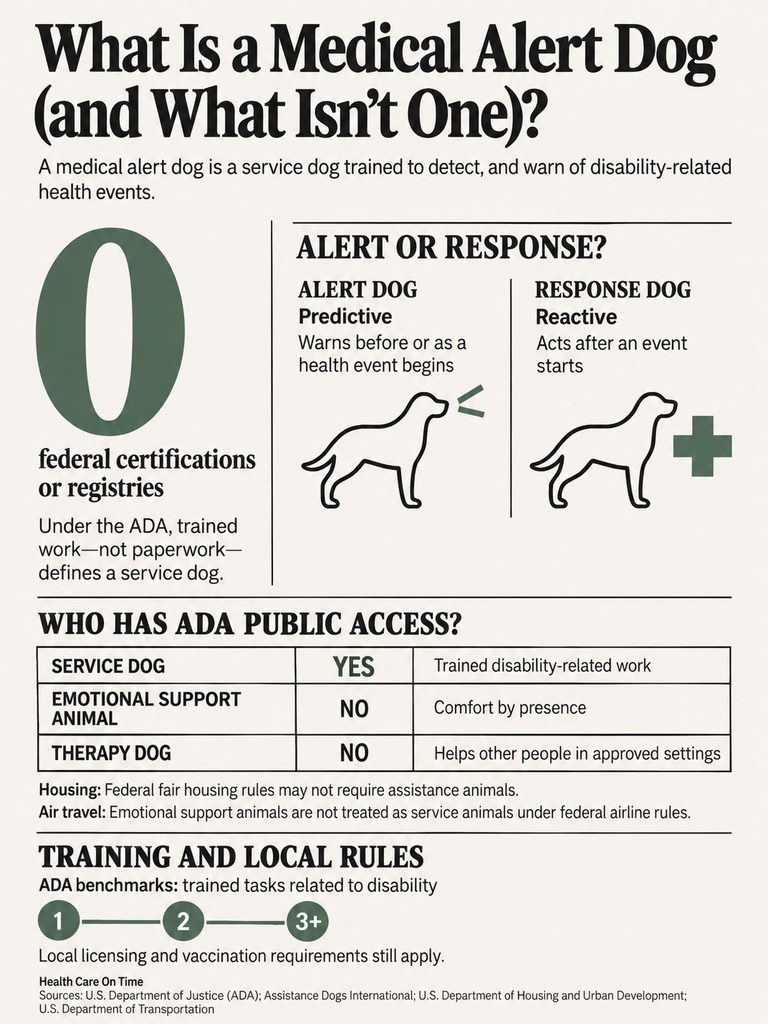
Many also respond afterward. They fetch medication, bring a phone, or go get another person.
The Legal Definition in Plain English
Under the Americans with Disabilities Act (ADA), training makes a dog a service dog, not paperwork. People with disabilities have the right to train the dog themselves, and no professional program is required.
Timing matters, though. A dog still in training isn’t covered by the ADA, although some state and local laws do protect dogs in training.
Alert Dogs vs. Response Dogs
An alert dog signals before trouble peaks: a falling blood sugar, the start of a seizure, a drop in blood pressure. A response dog acts once the event is underway. It barks for help, brings a phone, or stays beside you.
The difference shapes what you should ask a program. Response tasks can be trained and tested reliably. Predictive alerts are harder to prove, especially for seizures.
Why “Certified” and “Registered” Mean Nothing Legally
Some health sites say service dog certification rules vary by state. Under federal law, there’s no certification to get.
The Justice Department says certificates and registrations sold online give no rights under the ADA and aren’t accepted as proof that a dog is a service animal. What does apply: service dogs must meet the same local licensing and vaccination rules as any other dog.
ADI’s Stricter Standard
ADI defines an assistance dog as one specifically trained to perform three or more tasks that lessen the effects of a disability. That’s a quality bar, not a legal one. It’s still a useful yardstick when you compare programs.
Service Dog vs. Emotional Support Animal vs. Therapy Dog
An emotional support animal comforts by presence alone and has no task training. A therapy dog visits hospitals and schools with its owner. Neither gets ADA public access.
A medical alert dog does, because it’s trained for a task tied to your disability.
Emotional support animals have also lost most of their special federal status on flights and in housing in recent years, while trained service dogs kept theirs.
Who Qualifies for a Medical Alert Dog?
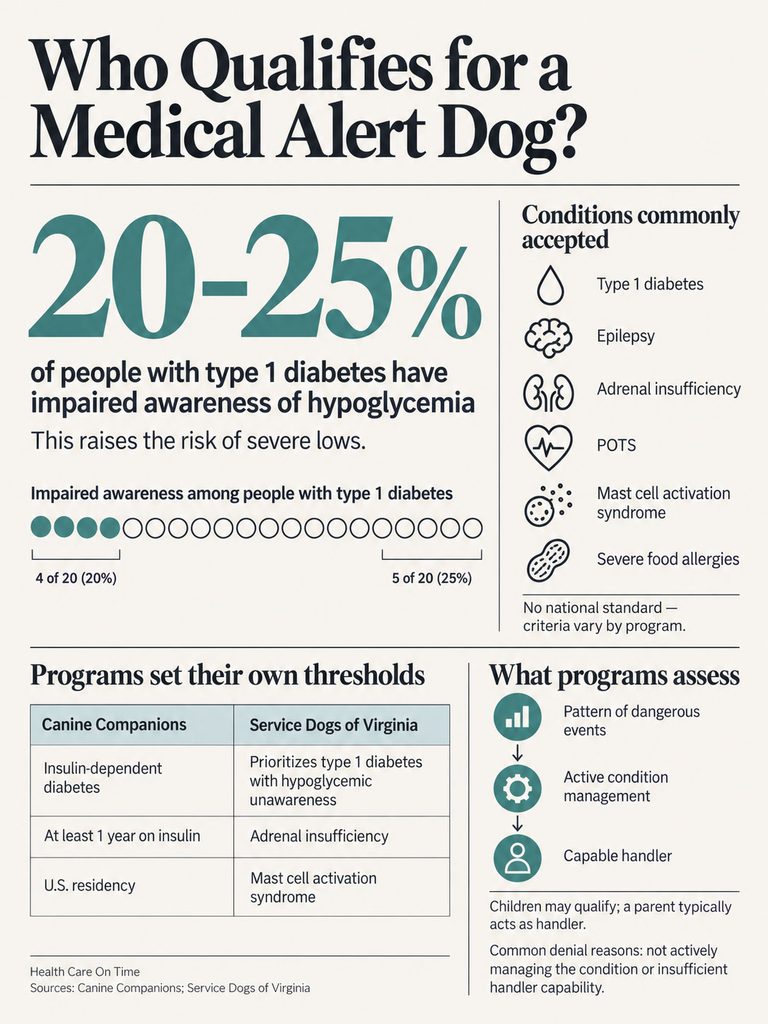
There’s no national standard. Each program writes its own criteria, so you qualify for a program, not for “a medical alert dog” in general.
Conditions Programs Commonly Accept
Type 1 diabetes and epilepsy lead the list. Some programs also serve adrenal insufficiency (Addison’s disease), postural orthostatic tachycardia syndrome (POTS), mast cell activation syndrome, and severe food allergies.
Real Eligibility Rules From U.S. Programs
Canine Companions requires insulin-dependent diabetes, at least one year on insulin therapy, and U.S. residency. It also says its dogs aren’t suited to people who aren’t actively working to control their condition.
Service Dogs of Virginia places medical alert dogs with people who have type 1 diabetes complicated by hypoglycemic unawareness, adrenal insufficiency, or mast cell activation syndrome.
Patients who book HbA1c and fasting glucose tests with HealthCareOnTime often ask whether one lab number “qualifies” them. Programs rarely work that way. They look at your pattern of dangerous events, how you manage them, and whether a dog would change your safety.
Common Reasons Applicants Get Turned Down
- Condition outside the program’s scope. Many programs train for only one or two conditions.
- Condition not actively managed. Programs want to see you following a treatment plan.
- No consistent handler. A young child needs an adult who will reinforce training every day.
- Home setup. Other pets, rental restrictions, or an unsafe yard can delay approval.
- Location. ADI-accredited programs serve defined geographic areas based on where they can support clients.
Children and Families
Kids can get medical alert dogs, but a parent usually acts as the handler. Little Angels Service Dogs says there’s no strict age requirement, and dogs can even alert to seizures in an infant when a parent reinforces the training consistently.
The Hypoglycemia Awareness Factor
Impaired awareness of hypoglycemia affects roughly 20% to 25% of people with type 1 diabetes and raises the risk of severe lows three- to sixfold. That’s the group many diabetic alert dog programs put first.
How to Apply for a Medical Alert Dog: 7 Steps
Step 1: Talk to Your Clinician and Get Documentation
Start with the doctor who manages your condition. Ask whether a dog would add real safety on top of your current tools, and ask for a letter.
Our medical review team suggests the letter cover your diagnosis, how long you’ve had it, how often dangerous events happen, whether you lose warning symptoms, and your current devices and medications. Programs use it to judge fit, not to “prescribe” a dog.
Also check for dog allergies in your household before you apply.
Step 2: Choose Your Path
Each route trades off cost, wait time, and quality control differently. Here’s how the five main paths compare.
| Path | Typical cost to you | Typical wait | Who checks quality | Best fit |
| Donor-funded nonprofit (for example, Canine Companions) | $0 for the dog; travel may apply | Annual window, then a waitlist | Program testing; verify ADI status | Applicants who meet strict criteria |
| Nonprofit with a family fundraising share | About $17,000 to $20,000 at 4 Paws for Ability; $21,500 at Little Angels | About 2 years at 4 Paws | Program testing; verify ADI status | Families able to run a fundraiser |
| Owner training with an ADI-accredited program | Program fees vary | At least 6 months of team training | ADI standards | You already own a calm, eager dog |
| Private or for-profit trainer | $18,000 to $27,000 in one state lawsuit | Varies widely | No outside accreditation required | Only with references and written performance terms |
| VA referral (eligible veterans) | Vet care covered once approved | Set by the partner program | ADI or IGDF program plus VA clinical review | Veterans with qualifying impairments |
The owner-training route is bigger than most people realize. ADI counts 49 accredited organizations that will train with an owner and their personal dog, and its standards require at least six months of training for those teams.
Step 3: Shortlist Accredited Programs
Use the ADI Member Search and filter by region, dog type, owner-dog training, and veteran service. ADI itself doesn’t train, certify, or register individual dogs; its member organizations do that work.
Apply to more than one program if their rules allow it. In ADI’s 2025 census, 55% of accredited members placed 10 or fewer dogs a year.
Step 4: Mark the Application Window
Canine Companions accepts medical alert dog applications from January 1 through April 30, reviews them in May and June, and sends decisions by the end of August. Early Alert Canines in California uses the same January-through-April window.
If a window just closed, use the months before the next one to gather forms, references, and records. A complete file on opening day keeps you from losing a whole cycle.
Step 5: Submit a Complete Medical Alert Dog Application
Expect questions about your condition, daily routine, home, and whether the dog will go to work or school with you.
Little Angels’ process is typical. You apply online first. If the team sees a possible fit, it asks for records from your medical provider and a personal reference, then a simple home video, then a phone interview.
Scent Samples: What Programs Ask You to Collect
At Service Dogs of Virginia, approved applicants send scent samples that trainers use to teach the dog their specific medical odor. For diabetes, that’s usually saliva or skin swabs taken during lows and normal readings.
For seizures, families often use clothing. One 4 Paws family described wiping their son with a plain white T-shirt after each seizure and sending it in for scent training.
Step 6: Interview, Waitlist, and Fundraising
Approval puts you on a waitlist, and it’s a long line. ADI’s 2025 census counted 7,887 potential clients waiting, while member programs placed 4,291 new teams that year. 4 Paws for Ability describes its process as taking about two years.
Some programs ask families to raise a share. At Little Angels, you return a signed contract with at least a $500 deposit before fundraising starts. The program puts its average cost at $63,000 per dog and asks recipients to cover $21,500.
Get key terms in writing: who owns the dog, what happens if the match fails, and whether money is refundable.
Step 7: Team Training, Placement, and Follow-Up
Placement isn’t the finish line. One family’s fundraiser covered a 10-day trip to Ohio for 4 Paws handler training. Expect follow-up visits and periodic retesting after that.
In Canine Companions’ program, handlers confirm each alert with a standard glucose meter and reward the dog when the meter agrees. That confirm-and-reward loop keeps the dog’s skill sharp for years.
What the First 90 Days Look Like
The first few months are a trial run for both of you. Keep a simple log of every alert, the meter or CGM reading that followed, and any events the dog missed. Share it with your program at follow-up visits.
Expect some false alarms while the dog learns your home and schedule. Reward only confirmed alerts, and don’t drop any of your usual checks or alarms. If accuracy slips, call the program early, because small problems are easier to retrain than set habits.
Medical Alert Dog Cost: What You’ll Really Pay
Upfront: What Programs Spend vs. What You Pay
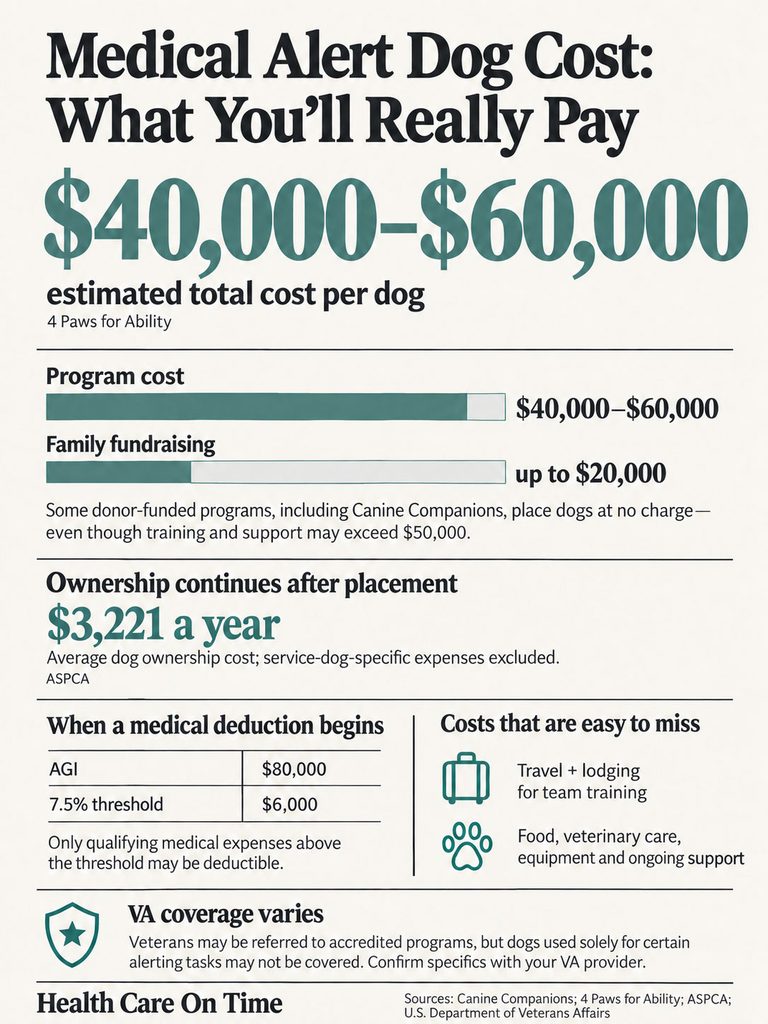
Canine Companions places dogs free, but it says training plus lifetime support runs upwards of $50,000 per dog. 4 Paws for Ability estimates $40,000 to $60,000 per dog, and one family’s fundraising goal was $20,000.
ADI says most accredited programs use donor and grant money to place dogs at very low or no cost. They can still charge application fees, training fees, or travel costs.
Families who ask us about budgeting are often surprised that travel and lodging for team training can be the biggest bill at a “free” program.
Lifetime Costs
The ASPCA has estimated the yearly cost of dog ownership at $3,221, covering essentials like food, insurance, and grooming. Service dogs add gear, refresher training, and, eventually, a successor dog.
Ways to Pay
- Program fundraising help. Many programs provide donation pages and coaching.
- Community and disease groups. Local clubs, churches, and patient groups sometimes sponsor dogs.
- Taxes. IRS Publication 502 lets you count the costs of buying, training, and maintaining a service animal, including food, grooming, and vet care, as medical expenses.
- HSA and FSA. Because Publication 502 treats these as medical costs, ask your plan administrator whether health savings or flexible spending funds can pay for them.
The 7.5% of AGI Rule
Medical deductions count only above 7.5% of your adjusted gross income, and you must itemize. With an $80,000 AGI, for example, the first $6,000 of medical costs doesn’t count.
Veterans: What VA Covers and What It Doesn’t
VA doesn’t supply dogs. It refers approved veterans to ADI or IGDF-accredited programs, and its benefit is tied to a visual, hearing, or substantial mobility impairment. VA later extended the vet-care benefit to veterans with chronic mobility limits linked to a mental health disorder.
A dog used only for glucose or seizure alerting doesn’t clearly fit those categories. The regulation also says VA won’t approve the benefit if devices or rehab would give the same independence. Ask your VA provider directly before you count on coverage.
Do Medical Alert Dogs Actually Work?
Our medical reviewers read these studies the way they’d read any diagnostic test. How many real events does it catch, and how often is an alert real?
Diabetic Alert Dogs: Owner Logs vs. CGM Checks
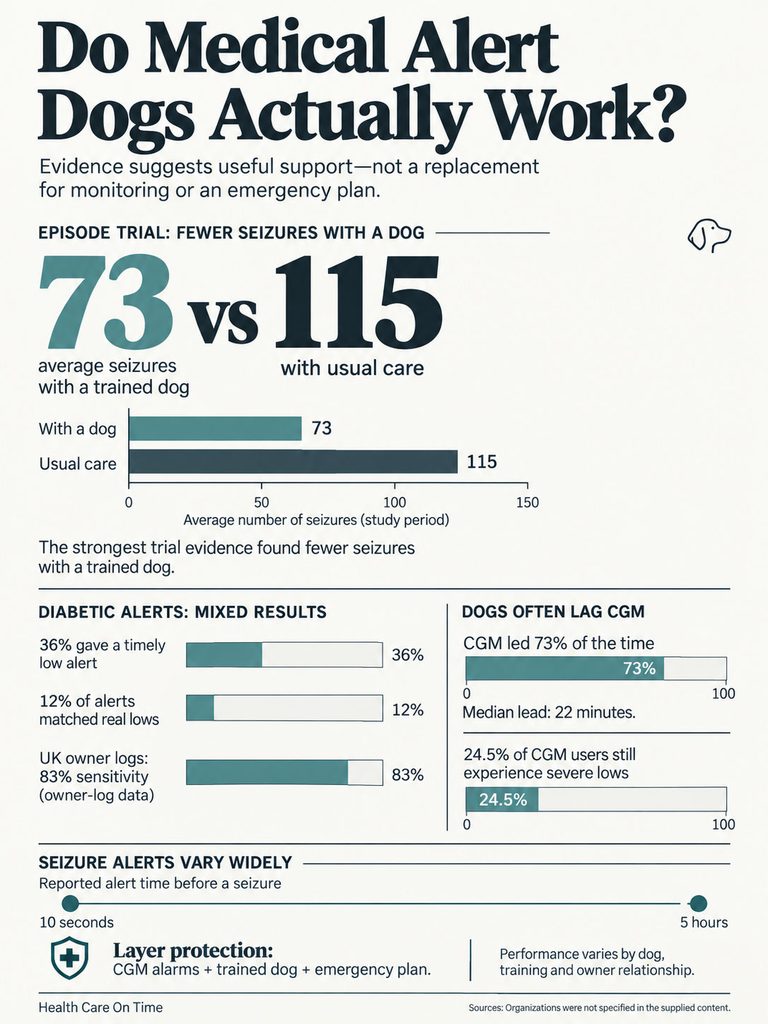
In a U.S. study that compared dogs with blinded CGM readings, dogs gave a timely alert for 36% of lows, and only 12% of alerts matched a real low.
When the dog and the CGM caught the same event, the CGM usually got there first. It led 73% of the time, by a median of 22 minutes.
A second U.S. study of 14 dog owners found dogs caught 35.9% of lows while the person was awake but only 22.2% during sleep. Only 3 of 14 dogs beat chance.
A larger UK study landed much higher. Using owner records for 27 dogs from one charity, it found a median 83% sensitivity to lows, with 81% of alerts falling during out-of-range glucose.
Why the gap? The UK data came from owner logs, while the U.S. studies checked alerts against masked CGMs. A January 2026 scoping review noted that results depend on how each study defined and confirmed events, and no standard performance threshold exists.
| Metric | Figure | Source |
| Americans with diagnosed type 1 diabetes | 2.1 million (314,000 under age 20) | CDC National Diabetes Statistics Report |
| U.S. adults with active epilepsy | About 2.9 million, plus about 456,000 children | CDC Epilepsy Facts and Stats |
| Share of ADI service dogs that are diabetic, seizure, or medical alert | 3% + 3% + 1% (about 1,000 teams, our estimate) | ADI 2025 Census |
| ADI waitlist vs. new placements | 7,887 waiting; 4,291 placed in 2025 | ADI 2025 Census |
| DAD sensitivity to lows, CGM-checked (U.S.) | 36%; 12% of alerts were real lows; CGM first in 73% | Los et al., J Diabetes Sci Technol 2017 |
| DAD sensitivity awake vs. asleep (U.S.) | 35.9% vs. 22.2%; 3 of 14 dogs beat chance | Gonder-Frederick et al., Diabetes Res Clin Pract 2017 |
| DAD sensitivity, owner records (UK) | Median 83%; 81% of alerts during out-of-range glucose | Rooney et al., PLOS ONE 2019 |
| Seizures per 28 days with a seizure dog | 115 usual care vs. 73 with a dog | EPISODE trial, Neurology 2024 |
| Impaired hypoglycemia awareness in type 1 diabetes | 20% to 25%; 3 to 6 times the severe-low risk | CMAJ clinical review |
Seizure Dogs: What the Evidence Shows
The research is thin. A scoping review found only 5 of 28 published studies qualified for inclusion. Owners reported alerts anywhere from 10 seconds to 5 hours before a seizure, with 70% to 85% accuracy by their own reports.
The strongest trial studied response dogs. In the Dutch EPISODE trial of 25 adults with hard-to-treat epilepsy, seizures averaged 115 per 28 days under usual care versus 73 with a seizure dog, and seven people cut seizures by half or more. For scale, CDC counts about 456,000 U.S. children with active epilepsy on top of the adult total.
Why the Dog Backs Up a Device
CGMs aren’t perfect either. In one U.S. study, 24.5% of people using a CGM for over six months still had at least one severe low in the prior six months, and impaired awareness still raised their risk.
For high-risk people, the safest setup layers tools: CGM alarms, a trained dog, and a written emergency plan your family knows.
What Makes One Dog Better Than Another
In the UK study, performance tracked with the dog, the partnership, and the household: whether the dog was a pet first, when it was trained, and whether its partner was an adult or a child.
Your Legal Rights Once the Dog Comes Home
Different places follow different laws. Here’s the quick map.
| Setting | Law | What they may ask | Paperwork allowed |
| Stores, restaurants, hospitals | ADA Titles II and III | Two questions only | None |
| Airlines | Air Carrier Access Act (DOT rule) | DOT form questions | DOT Air Transportation Form; relief form for 8+ hour flights |
| Rental housing | Fair Housing Act plus state law (federal guidance withdrawn in 2025) | Disability-related need, if it isn’t obvious | Varies; keep a program or clinician letter ready |
| Workplace | ADA Title I | Accommodation discussion | Employer may request supporting information |
Public Places: The Two Questions
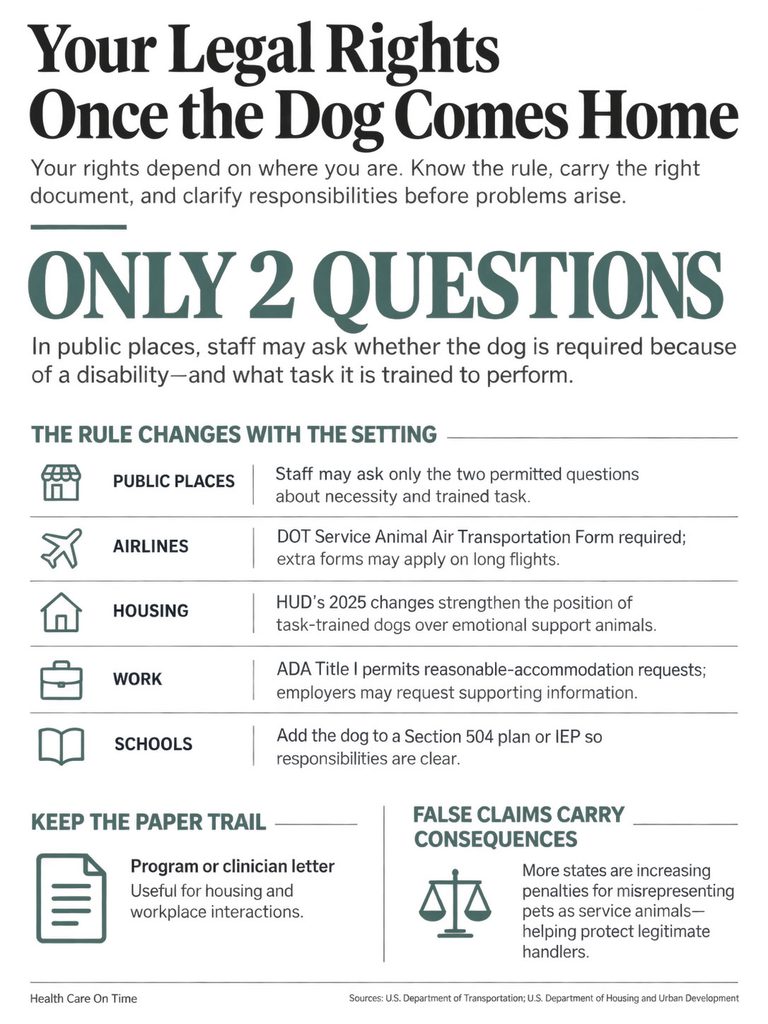
When it isn’t obvious, staff may ask only whether the dog is required because of a disability and what task it’s trained to do. They can’t request documents, ask for a demonstration, or ask about your condition.
Patients commonly ask us whether a vest is required. It isn’t. A business can still ask you to remove a dog that’s out of control or not housebroken.
Flying
Airlines may require DOT’s Service Animal Air Transportation Form, the only form they’re allowed to require. For flights of eight hours or more, they may add a relief form, and they can ask for both up to 48 hours before travel.
Airlines can also limit you to two service animals and require the dog to fit on your lap or in your foot space.
Housing After HUD’s 2025 and 2026 Changes
On September 17, 2025, HUD withdrew its two main guidance documents on service and assistance animals in housing. Then, on May 22, 2026, HUD made the rescission permanent, said it will pursue cases only for animals individually trained for the specific disability, and noted that state and local laws aren’t affected.
The practical effect: a task-trained medical alert dog is in a stronger position than an emotional support animal. Keep a letter from your program or clinician on file, and check your state’s law.
Work and School
At work, bringing your dog is a reasonable accommodation request under ADA Title I. Your employer may ask for information that supports the need, then work through the details with you. Schools and colleges follow their own disability-office procedures.
For a child, write the dog into the student’s Section 504 plan or IEP so teachers, nurses, and bus staff know the dog’s tasks and who handles it during the school day.
State Laws on Fake Service Dogs
States keep cracking down on pets passed off as service animals. South Dakota’s governor signed SB82, which penalizes misrepresenting an animal as a service animal, on March 9, 2026. These laws protect real handlers from the fallout of untrained dogs.
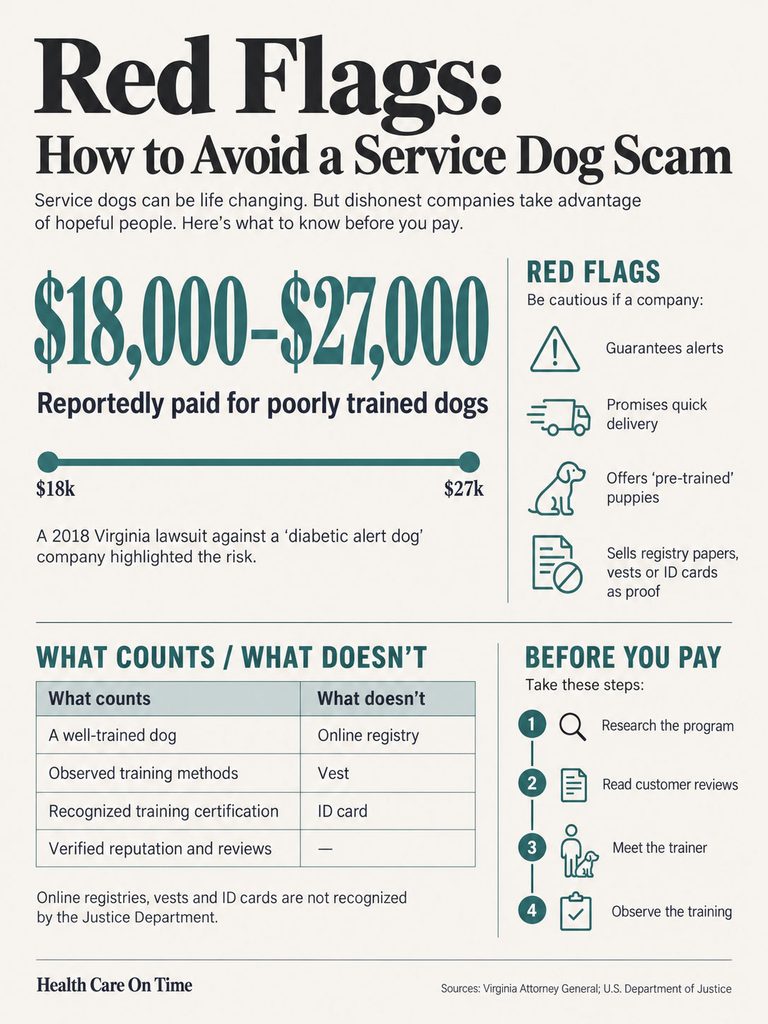
Red Flags: How to Avoid a Service Dog Scam
A Cautionary Case From Virginia
In 2018, Virginia’s attorney general sued a company selling “diabetic alert dogs,” alleging customers often received poorly trained puppies with behavior problems that couldn’t warn of dangerous blood sugar changes. The suit said customers paid $18,000 to $27,000 per dog.
Those are lawsuit allegations, but the warning signs apply everywhere.
8 Questions to Ask Any Program Before You Pay
- Are you ADI-accredited, or an ADI candidate?
- How many dogs did you place last year, and how many washed out?
- What alert accuracy do your placed dogs achieve, and how do you measure it?
- Can you share contact details for three current clients?
- Who owns the dog, and what happens if the match fails?
- What’s your refund policy, in writing?
- What follow-up and retraining do you provide?
- Are you a registered 501(c)(3)? You can confirm this with the IRS Tax Exempt Organization Search.
Walk away from any program that guarantees alerts, promises a dog within weeks, or sells “pre-trained” puppies.
Online Registries, Vests, and ID Cards
Skip them. The Justice Department doesn’t recognize online registrations, and no business can require one. A calm, well-trained dog is your best credential.
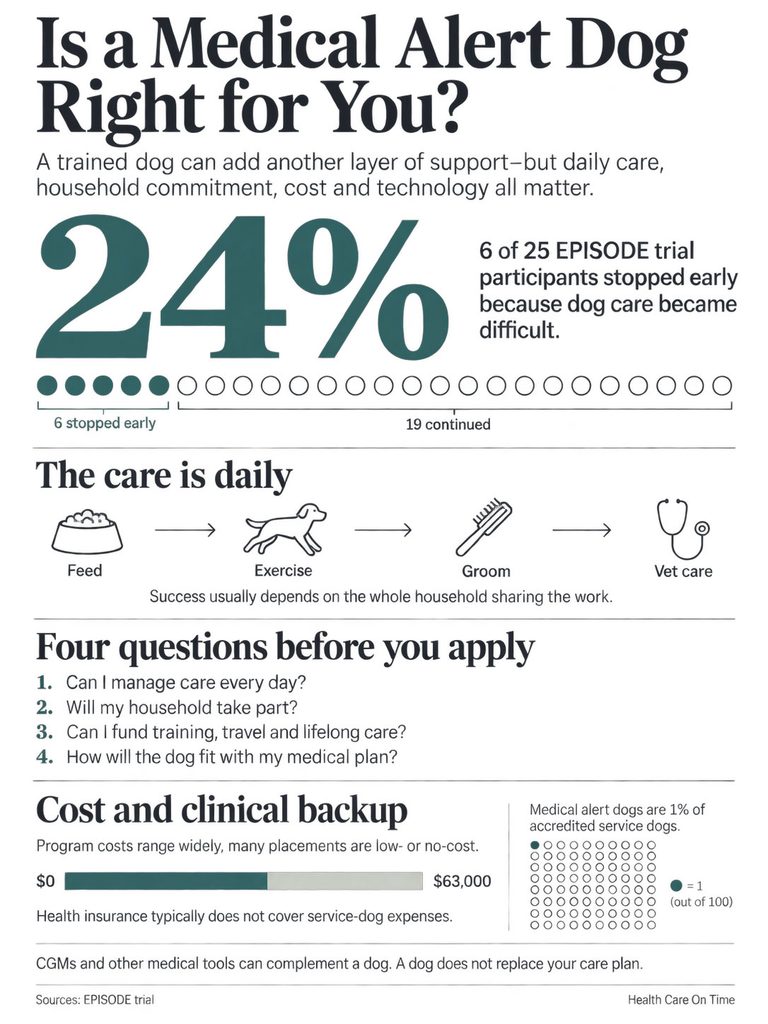
Is a Medical Alert Dog Right for You?
The Daily Workload
A service dog means daily feeding, exercise, grooming, vet visits, and training for as long as it works. In the EPISODE trial, 6 of 25 participants stopped early, and 4 of them left because of difficulty with dog care and training.
When families ask our care team what separates smooth placements from rocky ones, the answer is almost always the same: the whole household shares the work.
Four Questions to Ask Yourself First
- Time: Can someone give the dog an hour or more of care and practice every day?
- Household: Is everyone at home, including other pets, ready for a working dog?
- Travel: Can you take one to two weeks away for team training?
- Backup: Will you keep your CGM, seizure plan, and alarms running on days the dog misses?
If you answered “no” to two or more, strengthen your devices and home plan first, then revisit a dog next cycle.
Alternatives and Add-Ons
- CGM with follower alerts that notify a parent or partner.
- Wearable seizure detectors that alert caregivers during convulsive seizures.
- Medical alert pendants and bed sensors for people who live alone.
Many families end up using two or three of these alongside a dog, not instead of one.
| Your situation | Best next move | Why |
| Adult with type 1 diabetes and impaired awareness, already on a CGM | Apply to a diabetic alert dog program in the January window; keep CGM alarms on | Dogs add a layer, but a CGM flagged lows first 73% of the time |
| Parent of a child with overnight lows | Set up CGM follower alerts now; ask programs about parent-handler placements | Dogs caught only 22.2% of lows during sleep |
| Epilepsy with seizures that risk injury | Ask programs for response tasks (fetching help, activating alarms) | Seizure prediction evidence is thin; response tasks are trainable |
| POTS, adrenal insufficiency, or mast cell activation syndrome | Search for programs that list your condition | Medical alert dogs are only 1% of ADI service dogs |
| Veteran | Start with your VA provider for an evaluation | Benefit rules center on visual, hearing, or mobility impairment |
| Can’t afford a fundraising share | Apply to donor-funded programs; ask about fee waivers; track costs for Pub 502 | Most ADI programs place dogs at low or no cost |
| Already own a calm, food-motivated dog | Use ADI’s owner-dog filter | 49 accredited programs train with personal dogs |
| Flying within two weeks | Download the DOT form and submit it 48 hours ahead | It’s the only form airlines may require |
| A trainer guarantees results for $20,000+ | Ask for references, contracts, and accuracy data before paying | A 2018 Virginia lawsuit alleged poorly trained dogs at these prices |
Frequently Asked Questions
How Long Is the Wait for a Medical Alert Dog?
Plan on a year or more after approval. 4 Paws for Ability describes about two years from start to placement, and ADI’s 2025 census counted 7,887 people waiting against 4,291 new placements. Many programs also accept applications only during a set window, which can add months before review.
How Much Does a Medical Alert Dog Cost?
Programs spend $40,000 to $63,000 or more per dog. What you pay ranges from $0 at donor-funded programs like Canine Companions to about $21,500 where families fundraise a share. Private trainers in one state lawsuit charged $18,000 to $27,000. Budget for yearly food, vet care, and gear on top.
Can You Get a Medical Alert Dog for Free?
Yes, at some programs. Canine Companions places dogs at no cost to recipients, and ADI says most accredited programs place dogs at low or no cost. You may still pay application fees, travel for team training, and lifetime care costs.
Does Health Insurance Cover a Medical Alert Dog?
Usually not. Most health plans don’t pay for buying or caring for a service dog. However, IRS Publication 502 counts these costs as medical expenses, so they may count toward an itemized deduction above 7.5% of AGI. Ask your plan administrator whether HSA or FSA funds apply.
Is a Doctor’s Note Needed for a Medical Alert Dog Application?
Programs almost always ask for medical documentation with your medical alert dog application, even though federal law doesn’t require it for public access. A strong letter states your diagnosis, how often events happen, whether you lose warning symptoms, and which devices you use. Businesses can’t demand to see it.
Can You Train Your Own Medical Alert Dog?
Yes. The ADA lets people with disabilities train their own service dogs. For structure and support, 49 ADI-accredited programs will train with an owner’s personal dog, with at least six months of team training. Scent alerting is hard to teach, so expert help matters.
Does a Medical Alert Dog Need to Be Certified or Registered?
No. Federal law has no certification or registry, and the Justice Department doesn’t recognize documents sold online. Your dog does need to meet local licensing and vaccination rules. Programs may test and certify their own teams as a quality check, but it isn’t a legal requirement.
How Accurate Are Diabetic Alert Dogs?
Accuracy varies widely by dog. U.S. studies that checked alerts against masked CGMs found dogs caught about 36% of lows. A UK study based on owner records found a median of 83%. Treat a dog as an extra warning layer and always confirm with a meter.
Can a Child Get a Medical Alert Dog?
Yes. Many programs place dogs with children, and a parent usually acts as the handler. Little Angels Service Dogs has no strict age minimum when a parent reinforces training consistently. Nighttime alerts are the weakest point, so keep CGM follower alerts running.
Can Veterans Get a Medical Alert Dog Through the VA?
VA doesn’t supply dogs directly. It refers veterans to ADI or IGDF-accredited programs and covers vet care for approved dogs. The benefit centers on visual, hearing, or substantial mobility impairments, plus mobility limits tied to mental health. Ask your VA provider about glucose or seizure alerting.
Can You Fly With a Medical Alert Dog?
Yes. Airlines must recognize trained service dogs. They may require DOT’s Service Animal Air Transportation Form, plus a relief form for flights of eight hours or more. Submit forms up to 48 hours before your flight, and plan for the dog to fit in your foot space.
Can a Landlord Refuse a Medical Alert Dog?
Generally not, if the dog is trained to help with your disability. In May 2026, HUD said it will focus enforcement on individually trained animals, which covers medical alert dogs. State laws still apply, so check yours and keep a program or clinician letter on hand.
Disclaimer: This article is for general education only and isn’t medical, legal, or tax advice. A medical alert dog doesn’t replace glucose checks, prescribed devices, seizure action plans, or emergency care. Call 911 for any medical emergency. Talk with your healthcare provider, program staff, and a qualified tax or legal professional about your situation.
References
- ADA.gov: Frequently Asked Questions about Service Animals and the ADA
- ADA.gov: Service Animals
- U.S. Department of Justice: Service Animal Q&A (PDF)
- Assistance Dogs International: Looking for an Assistance Dog
- Assistance Dogs International: 2025 Member Organization Statistics
- Assistance Dogs International: Member Search
- Canine Companions: Medical Alert Dogs
- Early Alert Canines: Apply
- Service Dogs of Virginia: Medical Alert
- Little Angels Service Dogs: Apply for a Dog
- KCII Radio: 4 Paws for Ability family fundraising report
- CDC: National Diabetes Statistics Report
- CDC: Epilepsy Facts and Stats
- Los et al., Reliability of Trained Dogs to Alert to Hypoglycemia, J Diabetes Sci Technol 2017
- Gonder-Frederick et al., Diabetes Alert Dogs: An Assessment of Accuracy, Diabetes Res Clin Pract 2017
- Rooney et al., How Effective Are Trained Dogs at Alerting Their Owners, PLOS ONE 2019
- Scoping Review: Diabetic Alert Dogs in Type 1 Diabetes, MDPI 2026
- Catala et al., Dog Alerting and/or Responding to Epileptic Seizures: A Scoping Review, PLOS ONE 2018
- EPISODE Study: Effectiveness of Seizure Dogs, Neurology 2024
- Lin et al., Impaired Awareness of Hypoglycemia Despite CGM, Endocrine Practice 2019
- CMAJ: Impaired Awareness of Hypoglycemia
- IRS: Guide Dog or Other Service Animal (Publication 502)
- U.S. Department of Veterans Affairs: Service Dog Veterinary Health Benefit
- 38 CFR § 17.148: Service Dogs
- Cozen O’Connor: DOT Final Rule on Service Animals
- LeadingAge: HUD Withdraws Fair Housing Guidance (September 2025)
- Mondaq: HUD Rescinds Emotional Support Animal Guidance (May 2026)
- Virginia Office of the Attorney General: Suit Against Service Dogs by Warren Retrievers
- LegiScan: South Dakota SB82 (2026)
- Fox Business: ASPCA Estimate of Annual Dog Ownership Costs