Search this question and you’ll read that white onions have no calcium. USDA’s own lab analysis says the opposite: a raw white onion has slightly more calcium than a red one.
Table of Contents
That mistake is a clue. Most red-vs-white articles recycle rounded numbers, mix up data sources, and miss the one difference that is actually big.
Our nutrition team rebuilt the comparison from the color-specific USDA records, the USDA flavonoid database, and the human studies that exist. Here’s what holds up.
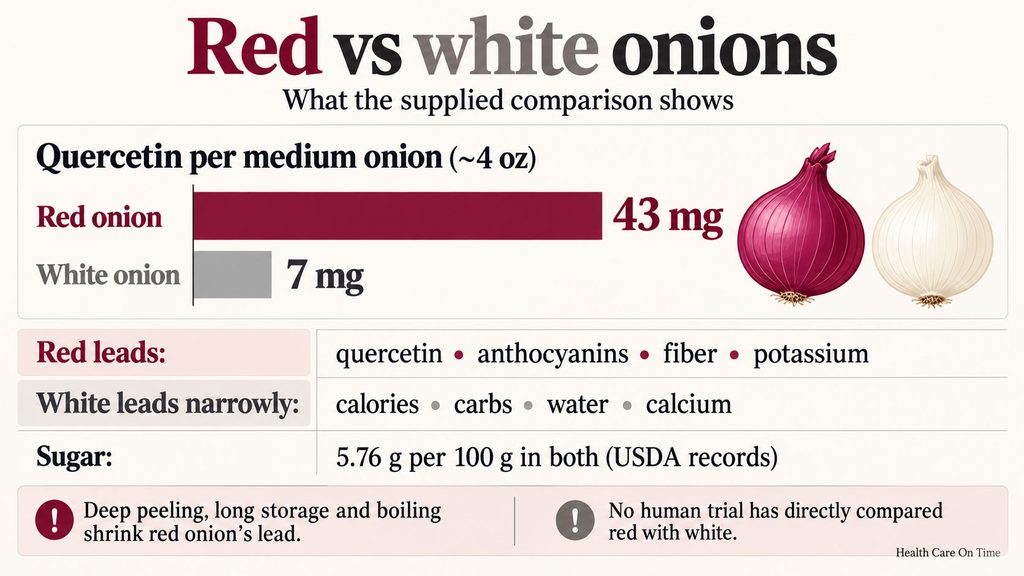
Quick Answer: Red onions are healthier if your goal is antioxidants. USDA data shows raw red onions average about 39 mg of quercetin per 100 grams (3.5 ounces) versus about 6 mg in white onions, plus anthocyanin pigments that white onions lack. Red onions also have more fiber and potassium. White onions have fewer calories and slightly more calcium. No human study has compared the two head to head, so eating onions often matters more than color.
The five differences that matter most, per 100 grams of raw onion:
- Quercetin: about 39 mg in red vs 6 mg in white (roughly 6 times more)
- Anthocyanins: about 9.6 mg in red vs none in white
- Fiber: 2.2 g in red vs 1.2 g in white
- Potassium: 197 mg in red vs 141 mg in white
- Calories: 44 in red vs 35 in white, mostly because red onions hold less water
At a Glance
- Red onions win on quercetin, anthocyanins, fiber, and potassium.
- White onions win narrowly on calories, carbs, water, and calcium.
- Sugar is identical in the USDA records: 5.76 g per 100 g in both.
- One medium onion (about 4 ounces) gives roughly 43 mg of quercetin if red and 7 mg if white.
- Deep peeling, long storage, and boiling all shrink red onion’s lead.
- No human trial has tested red against white directly.
Red Onion vs White Onion: The Side-by-Side Numbers
Our nutrition review team pulled the three color-specific raw onion records from USDA FoodData Central’s Foundation Foods data, which is based on direct lab analysis. Flavonoid values come from the USDA Flavonoid Database, Release 3.3.
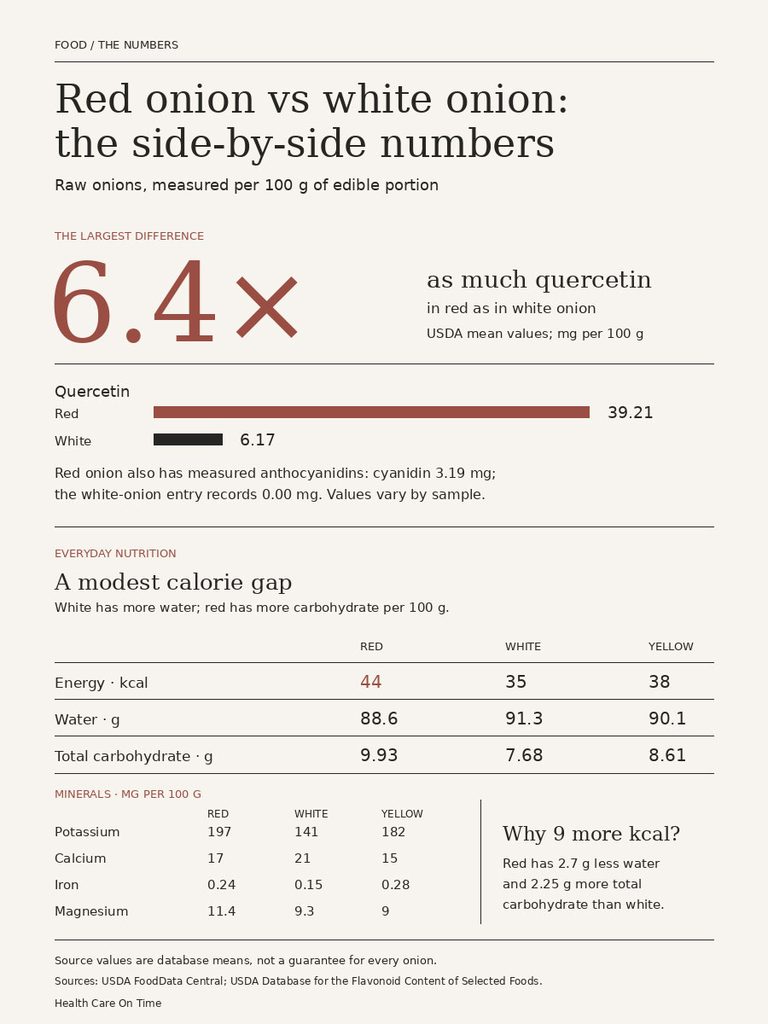
All values are per 100 grams, about 3.5 ounces or a little less than one medium onion. Yellow onion is included because it makes up most of the U.S. crop.
| Nutrient (per 100 g raw) | Red Onion | White Onion | Yellow Onion | Edge |
| Calories | 44 | 35 | 38 | White (lower) |
| Water | 88.6 g | 91.3 g | 90.1 g | White |
| Total carbohydrate | 9.93 g | 7.68 g | 8.61 g | White (lower) |
| Fiber | 2.2 g | 1.2 g | 1.9 g | Red |
| Total sugars | 5.76 g | 5.76 g | 5.82 g | Tie |
| Protein | 0.94 g | 0.89 g | 0.83 g | Tie |
| Potassium | 197 mg | 141 mg | 182 mg | Red |
| Calcium | 17 mg | 21 mg | 15 mg | White |
| Iron | 0.24 mg | 0.15 mg | 0.28 mg | Yellow, then red |
| Magnesium | 11.4 mg | 9.3 mg | 9.0 mg | Red |
| Vitamin C | 8.1 mg | Not analyzed* | 8.2 mg | Red and yellow |
| Quercetin | 39.21 mg | 6.17 mg | 20.30 mg** | Red |
| Anthocyanidins | 9.56 mg | 0 mg | Not reported | Red |
*USDA’s Foundation Foods white onion record does not include vitamin C. The generic raw onion record lists 7.4 mg.
**The flavonoid database has no separate yellow entry. This is its generic “Onions, raw” value, drawn mostly from yellow onions.
The mineral rows show real but tiny gaps. The 4 mg calcium difference equals about 0.3% of the 1,300 mg Daily Value. The potassium gap, 56 mg, is about 1% of the 4,700 mg Daily Value.
The flavonoid rows are different. That’s where red onions pull far ahead, and it’s the only gap large enough to matter.
Why Red Onions Have More Calories
Red onions hold 88.6 g of water per 100 grams, while white onions hold 91.3 g. Less water means more solids packed into the same weight.
That explains 44 vs 35 calories. Red onions don’t carry more sugar; they carry less water. Nine calories per 3.5 ounces won’t affect your weight.
For serving-size math on slices, cups, and whole onions, see our guide to how many calories are in an onion.
Why Onion Nutrition Numbers Online Don’t Match
In our review of the pages ranking for this question, red onion calories showed up as 37, 38, 42, and 44 per 100 grams. White onion ranged from 35 to 42. Those can’t all be right.
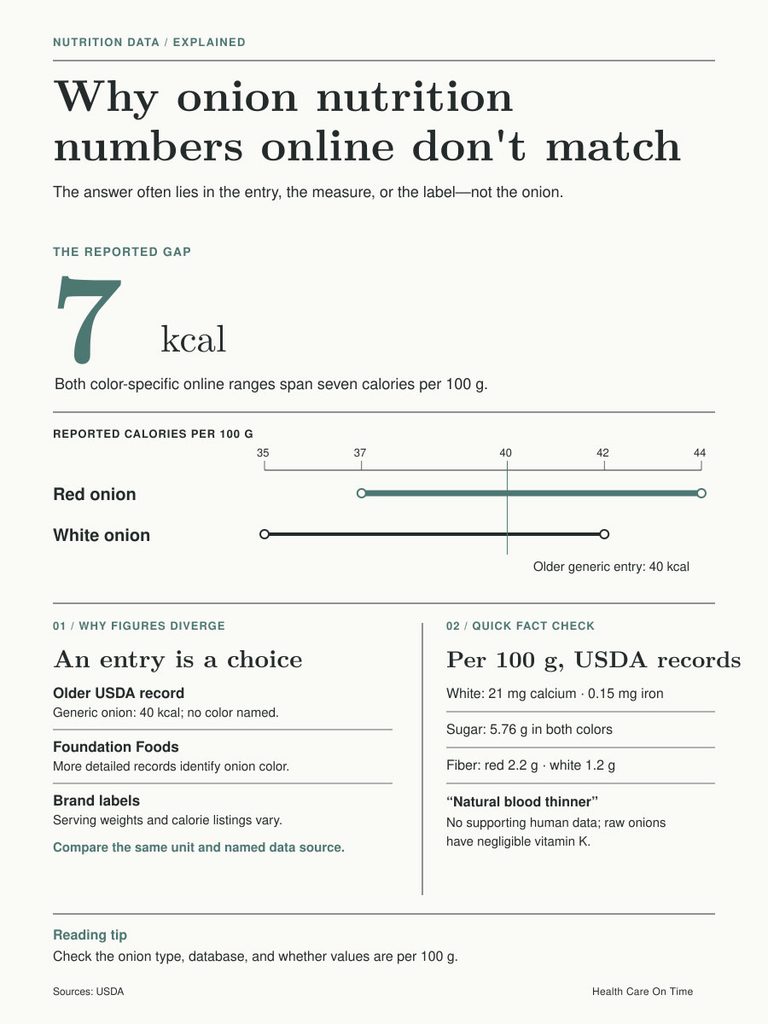
The cause is simple. Different pages pull from different databases, and most never say which one they used.
Generic vs Color-Specific USDA Records
USDA keeps an older generic entry called “Onions, raw” (SR Legacy 170000). It lists 40 calories and doesn’t specify color. Many calorie apps still default to it.
USDA’s newer Foundation Foods data has separate red, white, and yellow records. Those are the numbers in the table above, and they’re the only fair basis for comparing colors.
Brand labels add more noise. A store label may round 44 calories down to 40 or list a whole onion at a different weight.
Four Myths Page One Repeats
“White onions have no calcium or iron”
One widely shared food site says red onions win because they supply iron and calcium, while white onions have neither. USDA lab values show white onions contain 21 mg of calcium and 0.15 mg of iron per 100 grams. Neither onion is a meaningful source of either mineral.
“White onions contain more sugar”
Older blog posts claim white onions carry more sugar, which supposedly explains their sweeter taste. The USDA records list exactly 5.76 g of total sugar in both red and white onions.
“Red onions have 12 grams of fiber”
A popular health site lists 12 g of fiber per 100 grams of red onion and 10 g for white. The USDA values are 2.2 g and 1.2 g, so that claim is off by more than five times.
“Red onions are a natural blood thinner”
Some blogs say red onions’ flavonoids make them a stronger natural blood thinner than white onions. No human data supports this. Raw onions have almost no vitamin K (0.4 mcg per 100 grams), and no trial shows red onions change clotting.
The Real Gap: Quercetin and Anthocyanins
Minerals and calories are close. Flavonoids are not. Flavonoids are plant compounds that act as antioxidants in lab tests and are linked to heart and metabolic health in population studies.
Quercetin: About Six Times More in Red
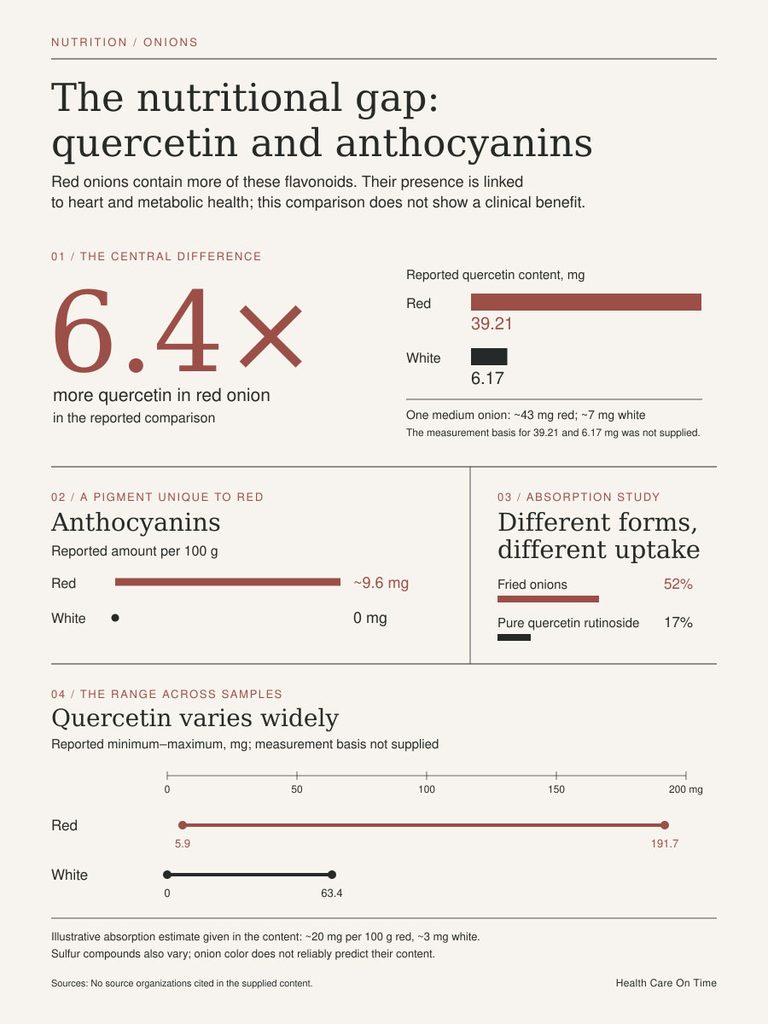
USDA’s flavonoid database lists 39.21 mg of quercetin per 100 grams of raw red onion, averaged from 147 samples. Raw white onion averages 6.17 mg, from 113 samples. That’s about 6.4 times more in red.
In everyday terms, one medium red onion gives about 43 mg of quercetin. A medium white onion gives about 7 mg.
Generic raw onion, mostly yellow, lands in between at 20.30 mg. The rough ranking is red first, yellow second, white third. Red onion also carries more of several related flavonoids that white onion has little or none of.
Anthocyanins: Red Onions Only
Anthocyanins are the purple-red pigments also found in blueberries, cherries, and red cabbage. USDA lists about 9.6 mg of these pigments per 100 grams of red onion.
White onions contain none. This is a true yes-or-no difference. If anthocyanins are your goal, only red onions deliver them.
The Overlap Nobody Mentions
Averages hide a wide spread. USDA’s red onion quercetin samples ranged from 5.90 to 191.70 mg per 100 grams. White onion samples ranged from 0 to 63.40 mg.
That means a high-quercetin white onion can beat a low-quercetin red one. Variety, soil, sunlight, and storage all shift the numbers. Color predicts the average, not every onion in your cart.
How Much Actually Reaches Your Bloodstream
Content in food is only half the story. In a Dutch study of nine healthy adults with ileostomies, about 52% of the quercetin in fried onions was absorbed, compared with 17% from pure quercetin rutinoside.
That makes onion one of the better-absorbed food sources of quercetin. At that rate, 100 grams of red onion supplies roughly 20 mg of absorbed quercetin, versus about 3 mg from white.
Anthocyanins are harder to track. In lab digestion models using red onion peel, anthocyanins showed limited recovery after digestion. Much of their effect, if any, may come from breakdown products made in the gut.
What About Sulfur Compounds?
Onions’ bite and eye-watering come from sulfur compounds. Some pages claim USDA data shows white onions have about 15% more of them than red. USDA’s food databases don’t report onion sulfur compounds by color, so that figure has no USDA source.
Pungency is usually measured through pyruvate levels. Variety, ripeness, and storage all change it. Color alone doesn’t tell you much about sulfur content.
Does the Color Difference Change Your Health?
This is where most comparisons overreach. A six-fold flavonoid gap sounds decisive. The human evidence is much thinner than the headlines suggest.
What Human Studies Actually Show
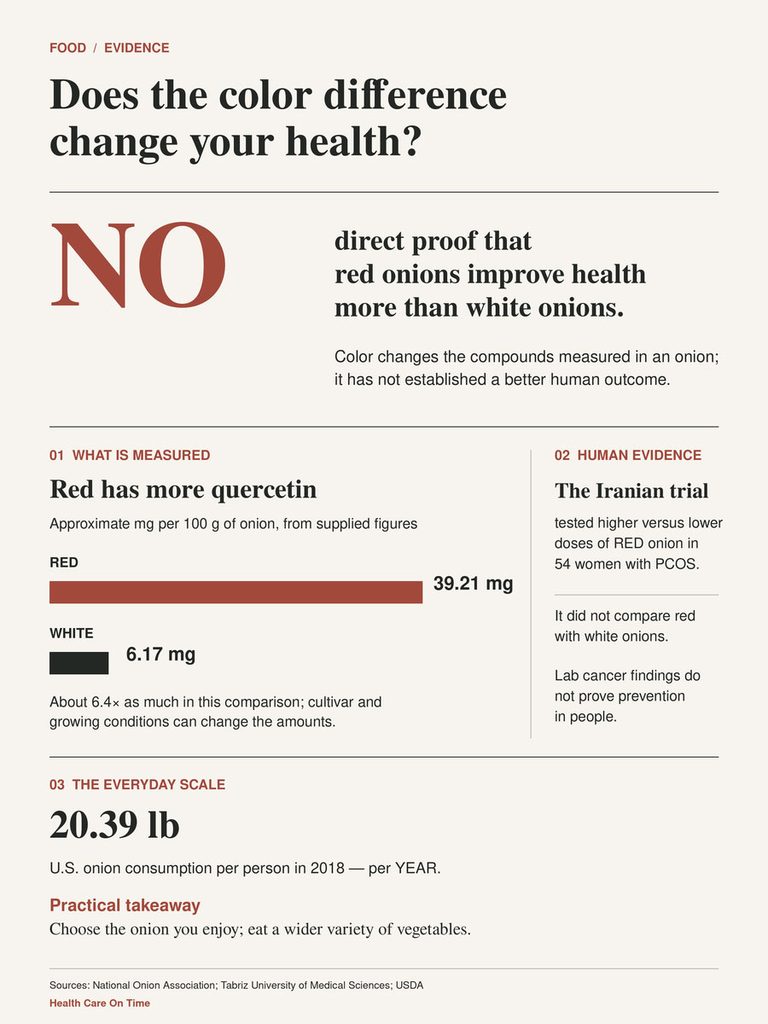
Our medical reviewers searched for trials comparing red and white onions directly in people and found none. Claims that red onions “fight cancer better” rest on lab work.
That cancer claim traces largely to a Canadian study that tested Ontario-grown onion extracts against colorectal cancer cells. Cell studies show a compound can act on cells in a dish. They don’t show that eating onions changes your cancer risk.
The best-known raw red onion trial, run in Iran, enrolled 54 overweight or obese women with polycystic ovary syndrome. The high-onion group ate two 40 to 60 g servings of raw red onion daily. The low-onion group ate two 10 to 15 g servings. The trial lasted 8 weeks.
Total cholesterol and LDL fell in both groups, while fasting blood sugar, triglycerides, and HDL did not change. Because white onion was never tested, the trial can’t tell you whether color mattered.
For US readers, that trial used about 3 to 4 ounces of raw onion a day, roughly one medium onion. That’s more than most Americans eat, but it’s doable in salads and salsas.
Patients who book lipid panels with us often ask whether switching onion colors could move their numbers. Based on current evidence, the honest answer is “probably not by itself.” For the wider evidence, see are onions good for heart health and cholesterol.
The Dose Math
A 2016 meta-analysis in the Journal of the American Heart Association found quercetin supplements lowered blood pressure mainly at 500 mg a day or more.
Reaching 500 mg from food would take about 2.8 pounds of raw red onion every day. From white onion, it would take nearly 18 pounds. Neither is realistic.
Real-world intake is far lower. At about 20 pounds a year, the average American eats roughly 25 grams of onion a day, a little under 1 ounce. That much red onion supplies about 10 mg of quercetin, compared with about 1.5 mg from white.
Swapping every white onion for red would add a few milligrams a day. That’s a small, easy win, not a cure.
That doesn’t make onions pointless. It means the benefit comes from steady, everyday intake as part of a vegetable-rich diet, not from one “super” color.
Here’s how onion color fits into the bigger US picture.
| Statistic | Value | Source |
| U.S. onion consumption per person | 20.39 lb per year (2018) | National Onion Association |
| U.S. onion crop by color | About 87% yellow, 8% red, 5% white | National Onion Association |
| U.S. onion production | About 125,000 acres; 6.75 billion lb per year | National Onion Association |
| Quercetin, raw red vs white | 39.21 vs 6.17 mg per 100 g | USDA Flavonoid Database 3.3 |
| Samples behind those averages | 147 red, 113 white | USDA Flavonoid Database 3.3 |
| Quercetin absorbed from onions | About 52% | Hollman et al., AJCN |
| 2020 red onion Salmonella outbreak | 1,127 U.S. illnesses in 48 states; 167 hospitalized | CDC; California Dept. of Public Health |
| U.S. adults meeting vegetable goals | 10.0% | CDC MMWR |
Red onions are only about 8% of the U.S. crop, against about 87% yellow and 5% white. Americans ate about 20.39 pounds of onions per person in 2018, roughly double the 1970 level.
The last row matters most. With only about 1 in 10 American adults eating enough vegetables, adding any onion beats debating which one.
What This Data Can’t Tell You
Three limits are worth knowing. First, the flavonoid averages pool published studies from different countries, varieties, and years. They’re averages, not guarantees.
Second, the Foundation Foods records reflect specific samples, and the white onion record skips vitamin C. Third, the absorption and peeling studies date to 1995 and 2002, and neither tested onions grown in the US.
The direction is clear: red leads on flavonoids. The exact size of the gap in the onion you buy is not.
Where White Onions Come Out Ahead
White onions aren’t nutritional losers. They have fewer calories (35 vs 44 per 100 grams), more water, and slightly more calcium.
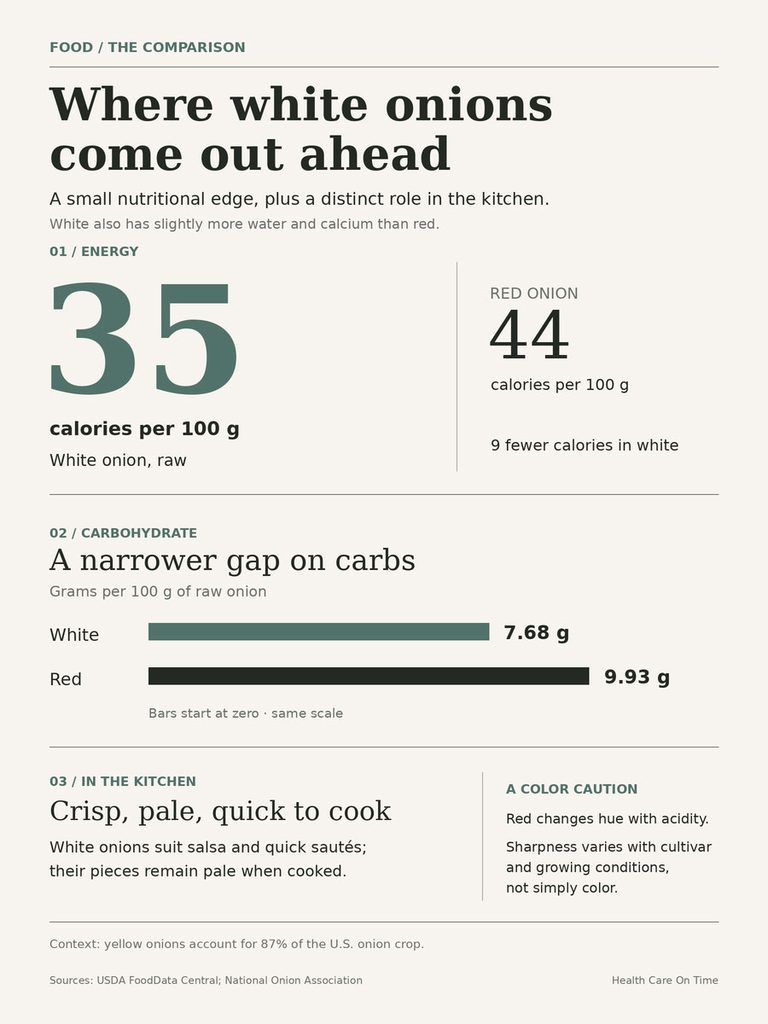
They’re also lower in carbs: 7.68 g per 100 grams versus 9.93 g in red. Subtracting fiber, that’s about 6.5 g of net carbs in white versus 7.7 g in red. It’s a small edge, but a real one for low-carb eaters.
White onions also stay white when cooked. Red onion pigments change color with acidity, looking redder in acidic foods and more violet in neutral ones. That’s why red onion can tint soups, sauces, and rice dishes an odd shade.
Many cooks like white onion’s crisp, clean texture for salsas and quick sautés. The National Onion Association describes white onions as the traditional choice for classic Mexican cooking and notes they turn golden and sweet when sautéed.
Flavor: Color Doesn’t Decide Sharpness
Online guides can’t agree on which onion is sharper. One page says white onions are sharper in its main text, then says red onions are sharper in its FAQ.
Sharpness depends mostly on variety and growing conditions, not color. Mild “sweet” onions come in yellow, white, and red. If raw red onion bites too hard, soaking the cut pieces in cool water and draining them softens the pungency.
Yellow Onions: The Middle Ground
Yellow onions deserve a mention because they fill most American grocery carts. The National Onion Association estimates about 87% of the U.S. crop is yellow.
Nutritionally, yellow sits between the other two. USDA’s generic raw onion value, drawn mostly from yellow onions, lists 20.30 mg of quercetin per 100 grams, about half of red and more than three times white.
Yellow onions also carry the most iron of the three (0.28 mg), nearly as much potassium as red (182 mg), and 1.9 g of fiber. They lack anthocyanins, but they brown well and hold their flavor through long cooking.
How Peeling, Cooking, and Storage Change the Winner
Red onion’s lead is fragile. How you prep and store it can erase much of the advantage.
Peeling
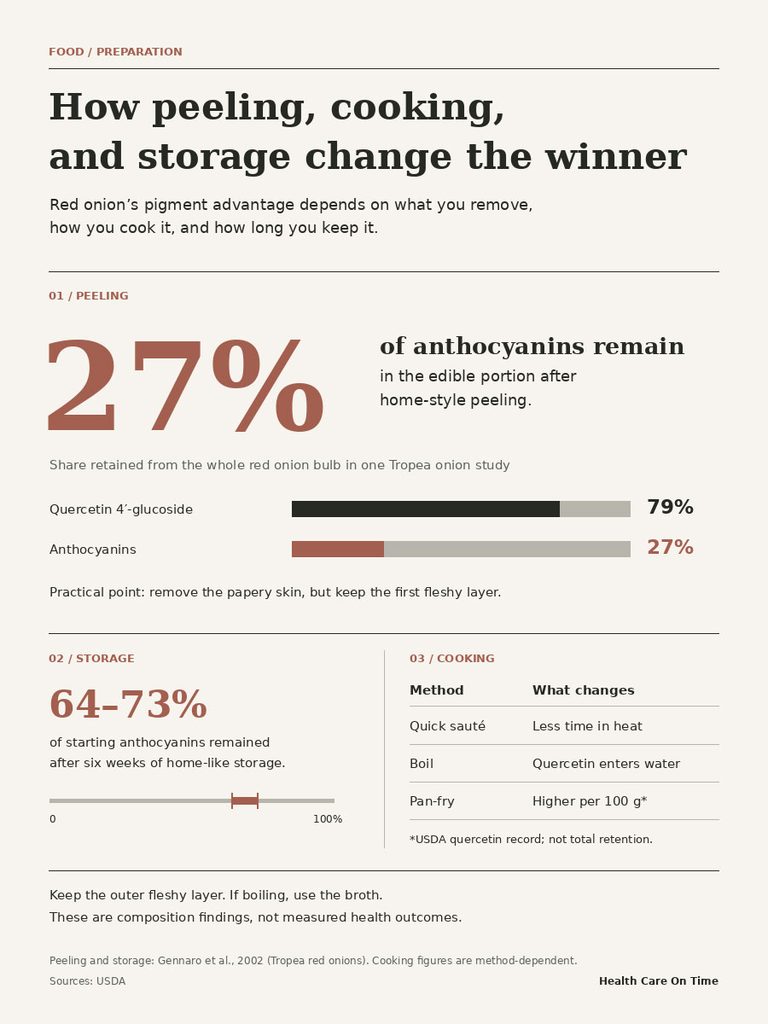
Flavonoids concentrate in the outer layers. In an Italian study of Tropea red onions, home-style peeling left the edible part with 79% of the main quercetin compound but only 27% of the anthocyanins.
The fix is easy. Remove only the dry, papery skin. Keep the first fleshy layer, even if it looks a little tough.
Cooking
Anthocyanins break down with heat, which is why red onions fade to dull purple-brown when cooked. Quercetin holds up better, but boiling moves some of it into the cooking water.
USDA’s database lists more quercetin per 100 grams in pan-fried white onion (26.90 mg) than raw (6.17 mg). Treat that cautiously. It comes from only three samples, and cooking removes water, which concentrates everything per gram.
If you boil onions, eat the broth. For red onions, raw or quickly sautéed keeps the most of what makes them different.
Storage
In the same Tropea study, six weeks of home-style storage cut anthocyanins to 64% to 73% of their starting level. A red onion used within a couple of weeks keeps more pigment than one left in the pantry for a month.
Digestion, IBS, and Heartburn: Is White Really Gentler?
The top-ranking article on this topic quotes a dietitian saying white onions are less likely than red to cause problems for people with GI conditions. Our medical reviewers could not find lab data to support that.
Fructans Are the Issue, Not Color
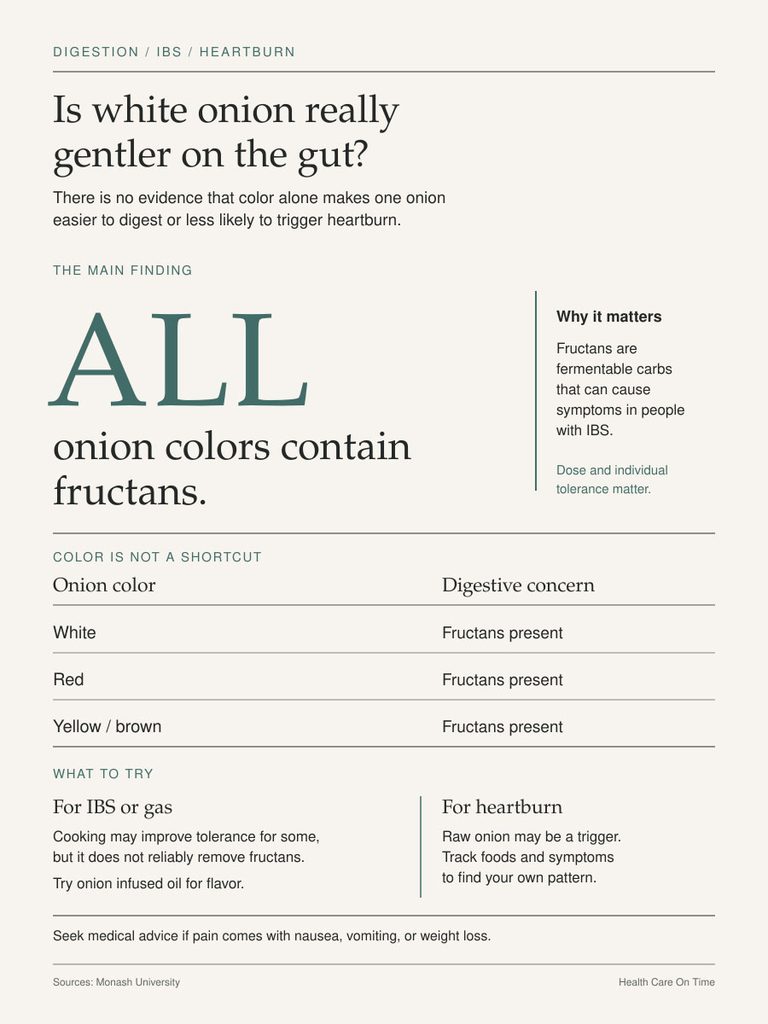
Onions cause gas and bloating in sensitive people mainly because of fructans, a type of fermentable carbohydrate. Monash University, which developed the low-FODMAP diet, lists onion among the vegetables particularly rich in fructans.
In Monash testing, fresh bulb onions of every color are high in fructans. No color gets a free pass for people with irritable bowel syndrome (IBS).
Patients managing IBS often tell our care team that a little cooked onion is fine while a raw onion salad is not. That fits the science: the amount matters more than the color.
Low-FODMAP swaps that keep onion flavor:
- Green tops of scallions (green onions)
- Chives
- Onion-infused oil, since fructans don’t dissolve in oil
- Drained pickled onions in small amounts, since fructans leach into the pickling liquid, cutting the onion’s fructan content by around 80%
Heartburn and GERD
Raw onions are a common heartburn trigger, and there’s no good evidence one color is worse. If onions bother you, smaller portions of cooked onion are usually easier to tolerate than raw.
Across the digestive questions our care team fields, raw onion often turns out to be a trigger people only spot after keeping a food diary. A simple two-week log of meals and symptoms can show whether onion is really the problem.
If upper stomach pain comes with nausea, vomiting, or weight loss, see a clinician. Our guide to upper stomach pain and nausea explains the warning signs.
Safety Notes: Outbreaks, Medications, and Pets
Outbreaks Can Involve Any Color
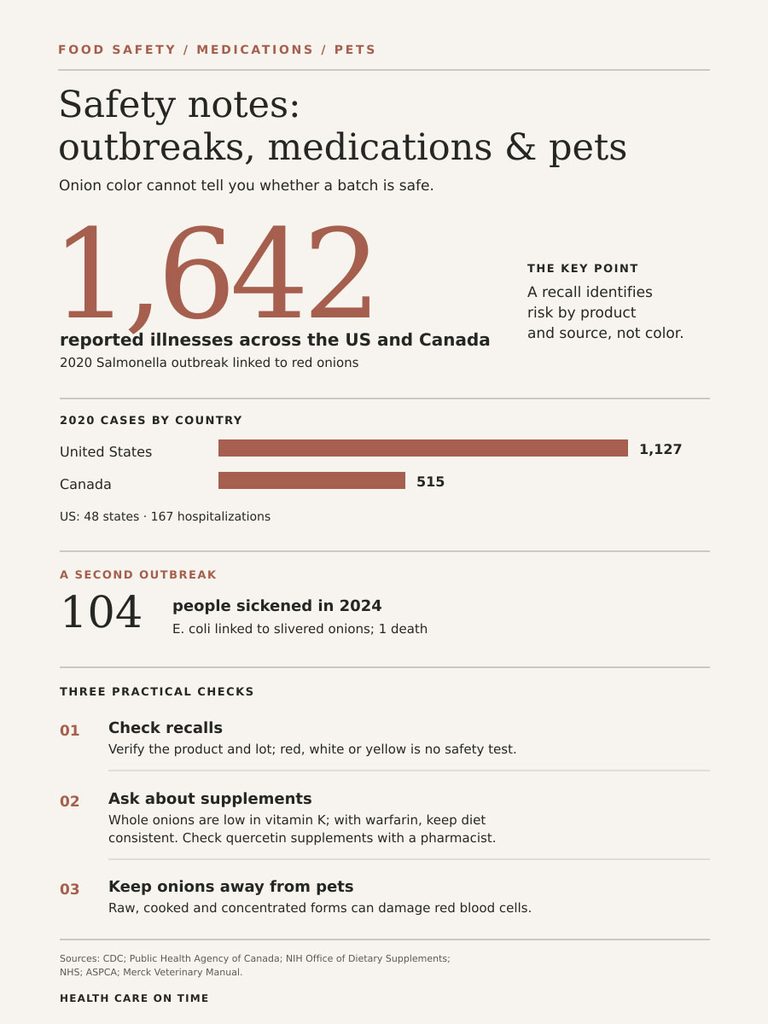
In 2020, whole red onions from a California supplier were linked to a Salmonella outbreak with more than 1,600 illnesses across the US and Canada, the largest Salmonella foodborne outbreak in over a decade.
In the US, 1,127 cases were reported from 48 states, and 167 people were hospitalized. The company also recalled its yellow, white, and sweet onions because shared processing surfaces may have cross-contaminated them.
In 2024, an E. coli outbreak traced to slivered onions on McDonald’s Quarter Pounders sickened 104 people in 14 states, and one person died. The supplier recalled yellow onions. Color doesn’t predict safety; recalls do.
Warfarin and Other Medications
Whole onions of any color aren’t a concern for warfarin users because they contain almost no vitamin K. Quercetin supplements are different. Concentrated doses may interact with some prescription drugs, so ask your pharmacist before starting one.
Pets
Onions of every color are toxic to dogs and cats. Raw, cooked, and powdered forms can all damage a pet’s red blood cells.
Which Onion Should You Buy?
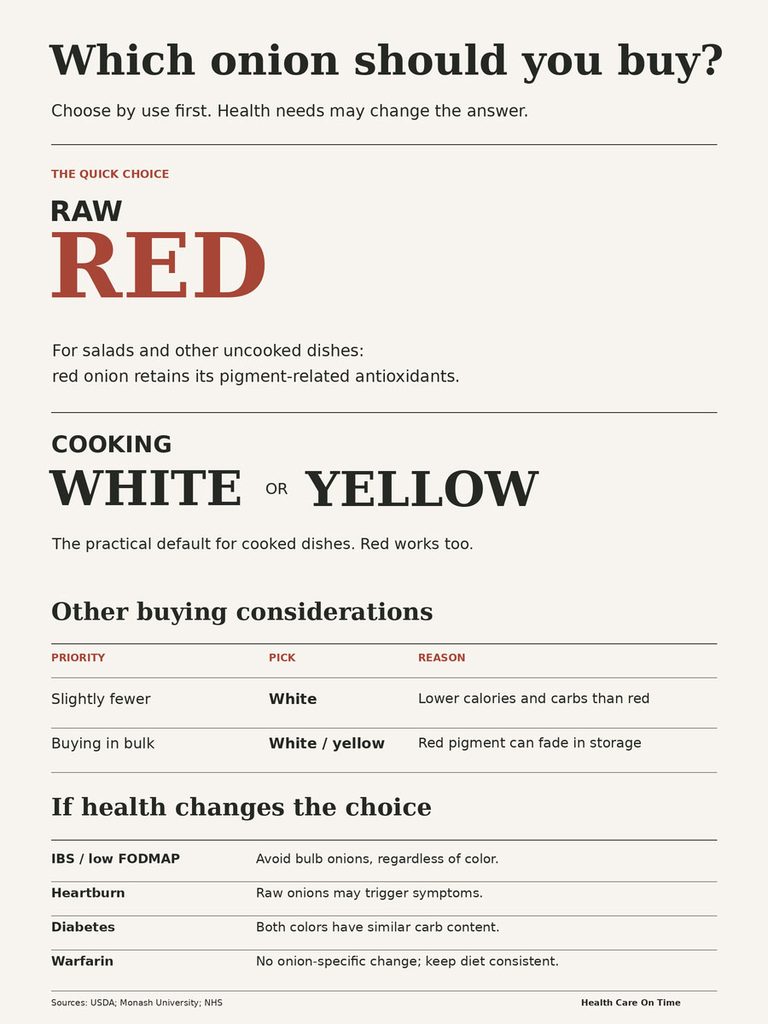
Our nutrition team built this quick guide from the USDA data and the evidence above.
| Your Situation | Better Pick | Why |
| You want the most antioxidants | Red, eaten raw | About 39 vs 6 mg quercetin per 100 g, plus anthocyanins |
| Salsa, tacos, pico de gallo | Either; white is traditional | Nutrition gap is small at 1 to 2 tablespoons |
| Soups, sauces, rice dishes | White or yellow | Red pigments fade and can tint food; keep the broth |
| Counting calories or carbs | White | 9 fewer calories and about 1.2 g fewer net carbs per 3.5 oz |
| IBS or low-FODMAP diet | Neither during elimination | All bulb onions are high in fructans; use chives or scallion greens |
| Heartburn or GERD | Cooked, either color | Raw onion is a common trigger |
| Taking warfarin | Either, no change needed | About 0.4 mcg vitamin K per 100 g |
| Managing diabetes | Either | About 8 to 10 g carbs per 100 g; no color-specific data |
| Buying in bulk | White or yellow | Red onion pigments drop over weeks of storage |
The pattern is simple. Buy red when you’ll eat it raw and soon. Use white or yellow for cooking. Rotate colors across the week.
How to Get the Most From Either Onion
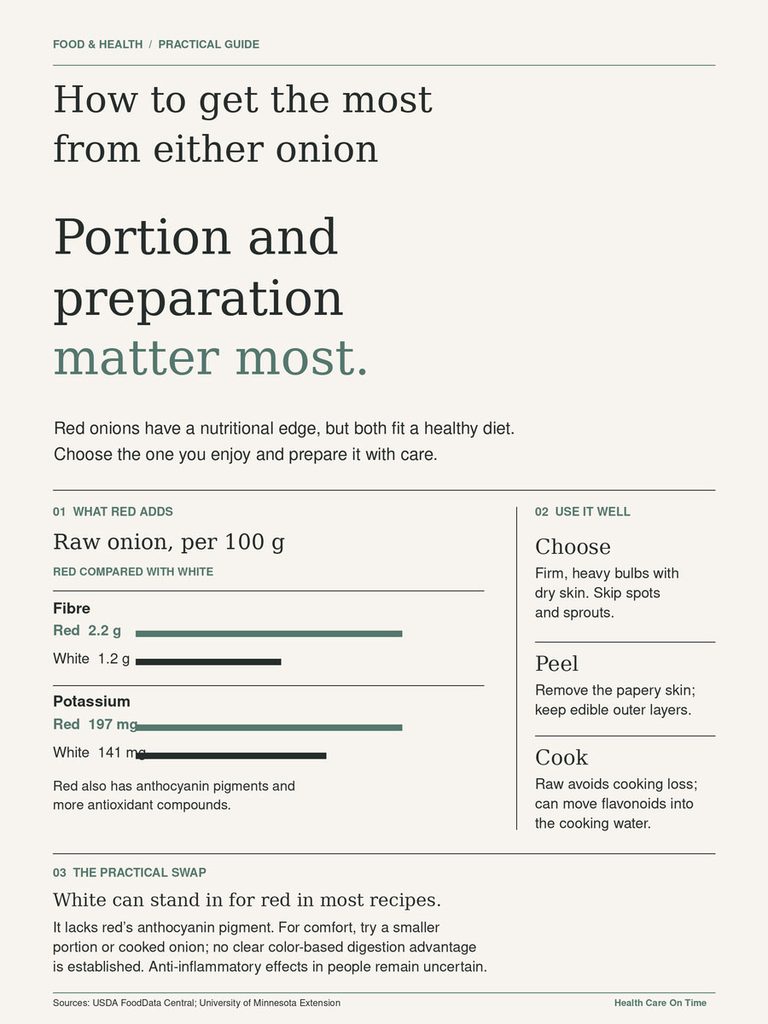
- Peel only the papery skin. Keep the first fleshy layer, where flavonoids concentrate.
- Eat red onions raw or lightly cooked, since heat fades anthocyanins.
- Sauté or roast instead of boiling. If you boil, keep the liquid.
- Buy red onions in smaller batches and use them within two to three weeks.
- Store whole onions in a cool, dry, dark place with airflow, away from potatoes. Refrigerate cut onions and use them within about a week.
- Rotate red, yellow, and white. Each brings a slightly different nutrient mix.
How to Pick a Good Onion at the Store
Choose onions that feel firm and heavy for their size, with dry, papery skin that crackles. Skip any with soft spots, dark patches, mold near the neck, or green sprouts.
A strong onion smell before you cut it can signal bruising or early spoilage. For red onions, look for deep, even color on the skin, since the pigment in the outer layers is a big part of their value.
Frequently Asked Questions
Is red onion healthier than white onion?
For antioxidants, yes. Raw red onions average about 39 mg of quercetin per 100 grams versus about 6 mg in white onions, and only red onions contain anthocyanins. Red onions also have more fiber and potassium. White onions are slightly lower in calories and carbs. No human trial has compared them directly.
Which onion has the most antioxidants?
Red onions lead, followed by yellow, then white. USDA flavonoid data puts quercetin at about 39 mg per 100 grams in red onions, about 20 mg in generic raw onions (mostly yellow), and about 6 mg in white onions. Growing conditions and storage can shift any single onion widely.
Do white onions have health benefits?
Yes. White onions provide fiber, potassium, some vitamin C, some quercetin, and the sulfur compounds found in all onions. They’re lower in calories and carbs than red onions and add flavor without fat or sodium. Their antioxidant content is lower, but regular onion intake of any color supports a healthy diet.
Is white onion easier to digest than red onion?
There’s no lab evidence for that. Onion-related gas and bloating come mainly from fructans, and Monash University testing shows fresh bulb onions of all colors are high in them. Cooking, smaller portions, or low-FODMAP swaps like chives and scallion greens help more than switching colors.
Does cooking destroy the antioxidants in red onions?
Partly. Heat breaks down anthocyanins, the pigments that make red onions red. Quercetin is more stable, but boiling pulls some into the water. To keep the most, eat red onions raw, add them near the end of cooking, or sauté briefly. If you boil onions, eat the broth.
Should red onions be eaten raw?
Raw is the best way to keep red onion’s anthocyanins, which fade with heat. Raw red onion works well in salads, sandwiches, salsas, and quick pickles. If raw onion tastes too sharp or triggers heartburn, soak the slices in cool water for about 10 minutes or cook them lightly.
Which onion is best for people with diabetes?
Any onion color fits a diabetes eating plan as a non-starchy vegetable. Onions have about 8 to 10 grams of carbohydrate per 100 grams, and no study shows one color controls blood sugar better. Red onion offers more fiber and antioxidants, but portion size and the whole meal matter far more.
Which onion is best for weight loss?
Both work well. Red onions have 44 calories per 100 grams and white onions have 35, a gap of just 9 calories per 3.5 ounces. Onions add big flavor for very few calories, which can make healthy meals more satisfying. Fried onion rings and creamy dips are where calories pile up.
Can you substitute white onion for red onion?
Yes, one for one in most recipes. In cooked dishes the difference is small. In raw dishes, white onion gives a crisper, cleaner bite while red adds color. You’ll lose red onion’s anthocyanins, so add other colorful produce like berries or red cabbage elsewhere in your day.
Which onion is healthiest: red, white, or yellow?
Based on USDA flavonoid data, red ranks first, yellow second, and white third for antioxidants. Yellow onions have slightly more iron than the other two, and white onions have the fewest calories. The healthiest onion is the one you’ll eat regularly, prepared in a way you enjoy.
Does peeling an onion remove nutrients?
Yes, if you peel too deep. Flavonoids concentrate in the outer layers. In one Italian study, home-style peeling of red onions kept 79% of the main quercetin compound but only 27% of the anthocyanins. Remove just the dry papery skin and keep the first fleshy layer.
Are red onions anti-inflammatory?
Red onions contain quercetin and anthocyanins, which lower inflammation markers in lab and animal studies. Human evidence for red onions specifically is limited. Quercetin’s clearest human effects come from supplement doses far above what food provides. Enjoy red onions as part of an anti-inflammatory eating pattern, not as a treatment.
Medical Disclaimer: This article is for general information only and is not medical advice. Nutrient values vary by onion variety, growing conditions, and storage. If you have IBS, GERD, diabetes, kidney disease, or take prescription medications, talk with your doctor or a registered dietitian before making major diet changes. HealthCareOnTime content is reviewed for accuracy but doesn’t replace care from your own clinician.
References
- USDA FoodData Central: Onions, red, raw (FDC 790577)
- USDA FoodData Central: Onions, white, raw (FDC 1104962)
- USDA FoodData Central: Onions, yellow, raw (FDC 790646)
- USDA FoodData Central: Onions, raw, SR Legacy (FDC 170000)
- USDA Database for the Flavonoid Content of Selected Foods, Release 3.3
- Gennaro L, et al. Flavonoid and carbohydrate contents in Tropea red onions: effects of homelike peeling and storage. J Agric Food Chem. 2002
- Hollman PC, et al. Absorption of dietary quercetin glycosides and quercetin in healthy ileostomy volunteers. Am J Clin Nutr. 1995
- Ebrahimi-Mamaghani M, et al. Effects of raw red onion consumption on metabolic features in women with PCOS. J Obstet Gynaecol Res. 2014
- Murayyan AI, et al. Antiproliferative activity of Ontario grown onions against colorectal adenocarcinoma cells. Food Res Int. 2017
- Serban MC, et al. Effects of quercetin on blood pressure: a systematic review and meta-analysis. J Am Heart Assoc. 2016
- Valorization of onion-processing waste: digestive fate and bioavailability of red and yellow peel polyphenols
- FDA: Outbreak Investigation of Salmonella Newport, Red Onions (July 2020)
- CDC: 2020 Salmonella Outbreak Linked to Onions
- Bi-national outbreak of Salmonella Newport infections linked to onions: the United States experience
- CDC: Onions served at McDonald’s are likely source of E. coli outbreak
- National Onion Association: Seasons, Colors, Flavors, and Sizes
- National Onion Association: Consumer Trends
- National Onion Association: U.S. Production and Availability
- Monash University: High and Low FODMAP Foods
- CDC MMWR: Adults Meeting Fruit and Vegetable Intake Recommendations
- ASPCA Animal Poison Control: Onion