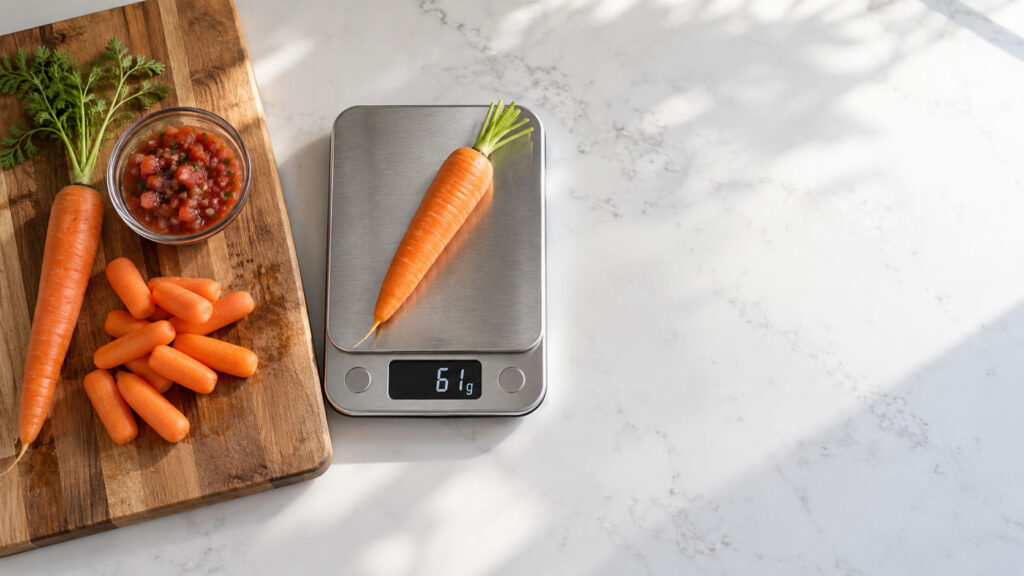
Search “carrot calories” and page one hands you four different answers: 25, 30, 41, and 44 calories. Only one of them fits the carrot in your fridge.
Table of Contents
That mix-up says a lot about carrots and weight loss. The advice online is friendly, but it’s often vague, and sometimes the numbers are simply wrong.
This guide fixes that. You’ll get real USDA figures, the one carrot-specific fullness trial most articles skip, 24 years of Harvard data, and three myths that quietly stall progress.
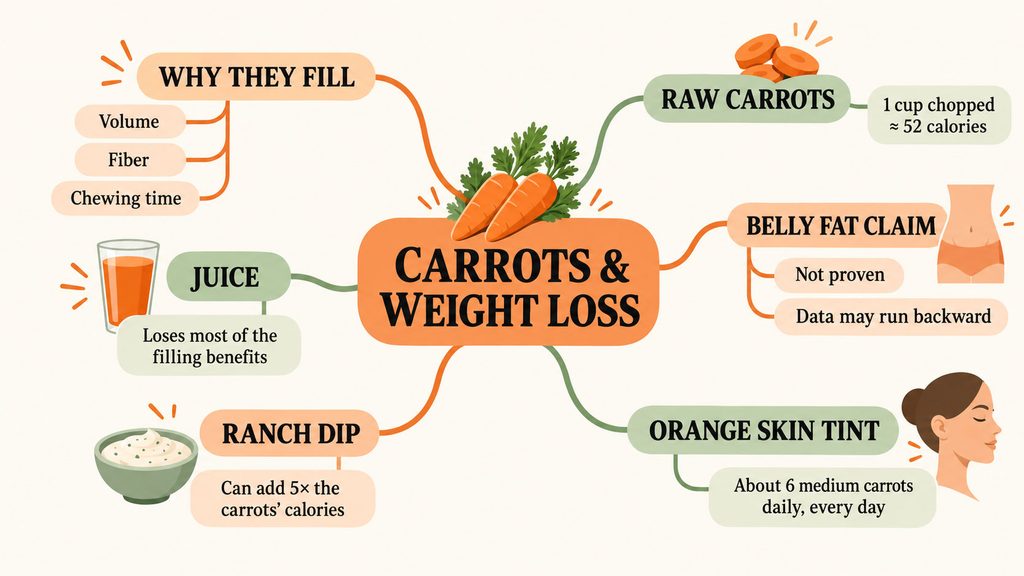
Quick Answer: Yes, carrots can help with weight loss, but they work by helping you eat less, not by burning fat. A medium carrot has about 25 calories and 1.7 grams of fiber. Whole carrots keep you fuller than blended carrots or juice. Harvard data on more than 133,000 US adults tied each extra daily serving of carrots to about 0.4 pounds less weight gain over four years.
The 7 facts in one list:
- A medium carrot (61 grams, about 2 ounces) has about 25 calories.
- Carrots are about 88% water, so they fill you up for very few calories.
- Whole carrots beat blended carrots for fullness in a controlled trial.
- Blended carrots still beat carrot nutrients with the fiber removed.
- Harvard cohorts linked more carrots to slightly less weight gain over time.
- The sugar in carrots barely moves blood sugar at normal portions.
- The dip you choose can matter more than the carrot itself.
At a Glance
- Carrots support weight loss through volume, fiber, and chewing time.
- A cup of chopped raw carrots has about 52 calories.
- Carrot juice loses most of what makes carrots filling.
- “Carrots burn belly fat” is not proven; the data may run backward.
- Ranch dip can add five times the calories of the carrots it covers.
- About six medium carrots a day, every day, can tint your skin orange.
How Carrots Can Help You Lose Weight
Carrots don’t contain a fat-burning compound. What they have is a physical makeup that makes it easier to eat fewer calories without feeling deprived.
Our medical reviewers sum it up this way: carrots help you lose weight the same way a full plate helps you stop eating. They take up room.
Low Energy Density: More Food, Fewer Calories
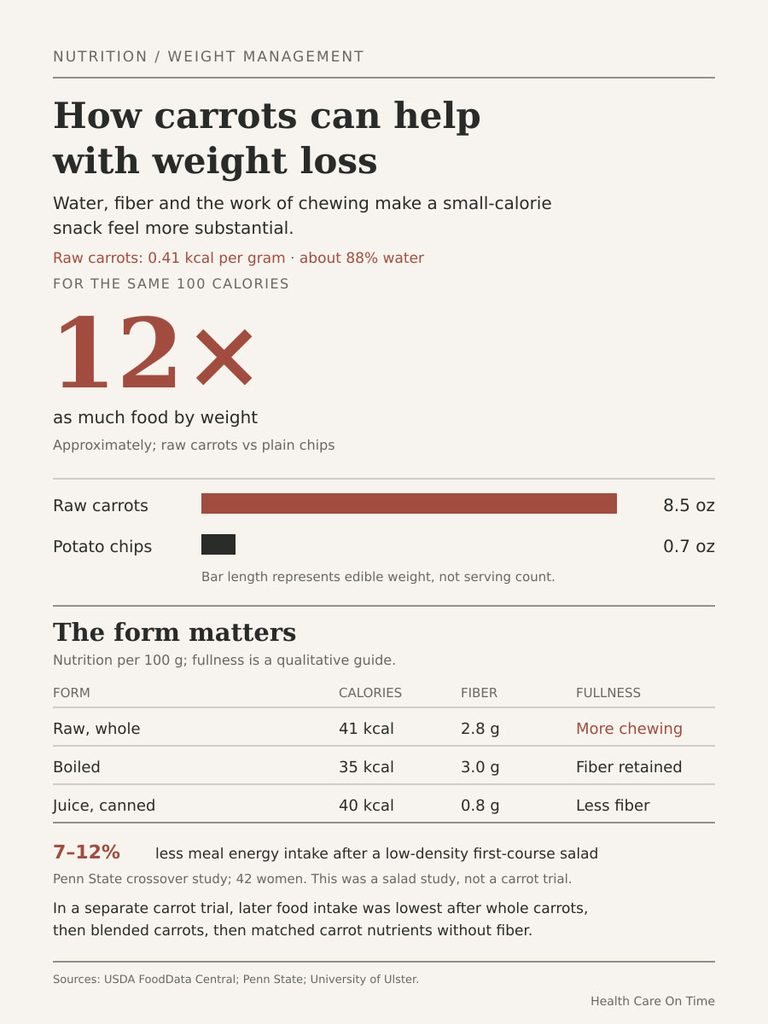
Energy density means calories per gram. Raw carrots come in at about 0.41 calories per gram, according to USDA FoodData Central. Roughly 88 of every 100 grams is water.
Potato chips run over 5 calories per gram. For the same 100 calories, you could eat about 8.5 ounces of carrots or under 0.7 ounces of chips. One is a big bowl; the other is a small handful.
Penn State research led by Barbara Rolls shows this matters in real meals. In a 7-week study of 42 women, low-energy-density salads eaten before a pasta lunch cut total meal intake by 7% to 12%. High-energy-density salads raised it.
Fiber and Structure: The Carrot Trial Most Articles Skip
The strongest carrot-specific evidence comes from a crossover trial in the British Journal of Nutrition. Young women ate the same lunch of rice, chicken, and sweet and sour sauce on three days, four weeks apart.
The only change was the carrots, all 200 grams (about 7 ounces). They came in three forms:
- Whole carrots: fiber plus the natural cell structure
- Blended carrots: fiber, but the structure broken down
- Carrot nutrients: same calories and nutrients, no fiber or structure
Both fiber-containing versions made people feel fuller after lunch. Researchers then secretly weighed what everyone ate three hours later and tracked food diaries for the rest of the day.
Food intake dropped in a clear order: carrot nutrients highest, blended in the middle, whole carrots lowest. Fiber mattered, and so did keeping the carrot intact.
The Chewing Factor
A raw carrot takes real work to eat. That chewing slows you down and gives fullness signals time to reach your brain.
Patients booking tests with us often ask why a bag of baby carrots feels more satisfying than a smoothie with the same calories. The short answer: chewing time and intact fiber, not anything magical.
Here’s how common carrot forms compare for weight loss.
| Carrot Form | Serving | Calories | Fiber | Fullness Effect | Weight Loss Verdict |
| Whole raw carrot | 1 medium (61 g / 2.2 oz) | 25 | 1.7 g | High (chewing plus structure) | Best choice |
| Baby carrots | About 10 pieces (100 g / 3.5 oz) | 35 | 2.9 g | High | Excellent snack |
| Chopped raw carrots | 1 cup (128 g / 4.5 oz) | 52 | 3.6 g | High | Excellent preload |
| Boiled carrots | 1 cup sliced (156 g / 5.5 oz) | 55 | 4.7 g | Moderate to high | Very good in meals |
| Carrot soup, broth-based | 1 cup | About 60 to 90 (estimate) | 2 to 3 g | Moderate | Good if not cream-based |
| Carrot juice | 1 cup (8 fl oz) | 94 | 1.9 g | Low | Weak for weight loss |
| Glazed carrots | 1 cup + 1 tbsp butter + 1 tbsp brown sugar | About 210 | 4.7 g | Moderate | Watch the add-ons |
| Carrot cake | 1 bakery slice | Often 400 to 600 | Under 2 g | Low | Dessert, not a vegetable |
Raw, boiled, baby carrot, and juice values from USDA FoodData Central. Soup, glazed carrots, and cake vary by recipe.
The Calorie Confusion, Solved
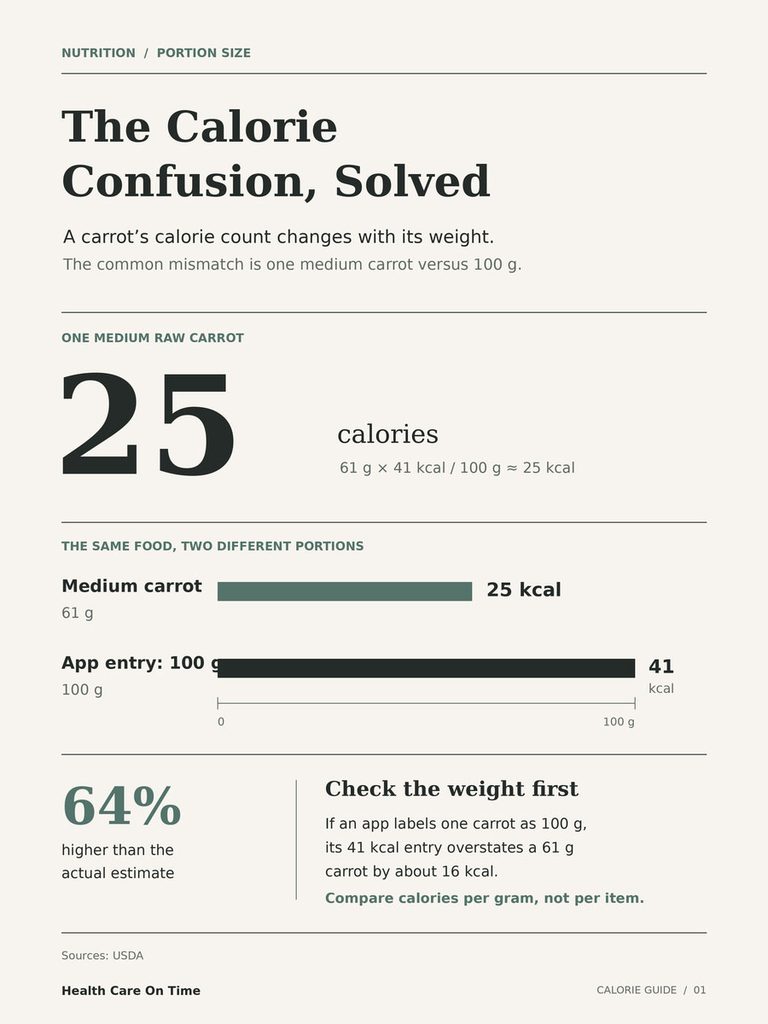
Why does one site say a carrot has 25 calories while another says 41? Because “per carrot” and “per 100 grams” get mixed up.
Why You See 25, 30, 41, and 44
The USDA lists raw carrots at 41 calories per 100 grams. A medium carrot weighs about 61 grams, not 100. That puts it at about 25 calories.
Here’s where each number comes from:
- 25 calories: a medium carrot (61 g). Correct.
- 30 calories: a large carrot (72 g). Also correct.
- 41 calories: 100 grams of raw carrot. Correct, but it’s not “one carrot.”
- 44 calories: likely a different database entry or rounding. It doesn’t match the standard USDA raw record.
One popular diet app labels a medium carrot as 100 grams and 41 calories. That overstates it by about 64%. Our editorial team checked each figure in this article against the USDA records, and the lesson is simple: check the portion weight, not just the name.
Carrot Portions in Real Life
For quick logging, these round numbers work:
- 1 small carrot (50 g): about 21 calories
- 1 medium carrot (61 g): about 25 calories
- 1 large carrot (72 g): about 30 calories
- 1 baby carrot (about 10 g): 3 to 4 calories
- 1 cup chopped (128 g): about 52 calories
For the full nutrient breakdown by portion and cooking method, see our carrot calories guide. This article stays focused on what those numbers mean for your weight.
What the Research Actually Shows
No large trial has tested carrots alone as a weight loss tool. The evidence comes from fullness trials, long-term observation, and blood studies. Together, they point in a helpful direction, with real limits.
Harvard’s 24-Year Data
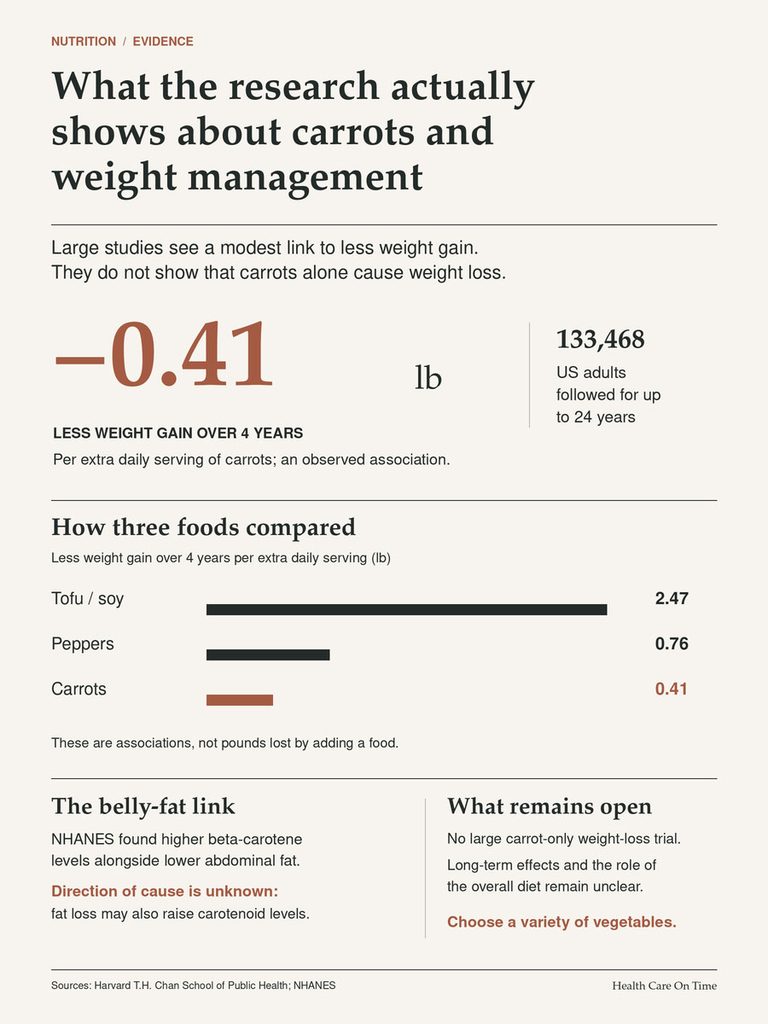
The biggest dataset comes from three Harvard cohorts: the Nurses’ Health Study, Nurses’ Health Study II, and the Health Professionals Follow-up Study. Researchers followed more than 133,000 US adults from 1986 to 2010.
They tracked how changes in specific fruits and vegetables lined up with weight change over 4-year periods. In the PLOS Medicine analysis, each extra daily serving of carrots was tied to about 0.41 pounds less weight gain per 4 years.
That’s modest. It won’t reshape your body in a month. But across years, next to other good choices, small shifts add up.
Here’s the detail most articles miss. The Harvard team grouped carrots as a “low-fiber, high-glycemic-load” vegetable. Going by their own starting idea, carrots should have looked bad. They still tracked with less weight gain.
How Carrots Compare With Other Vegetables
Carrots weren’t the top performer in the Harvard data. Tofu and soy were linked to about 2.47 pounds less weight gain per daily serving over 4 years, and peppers to about 0.76 pounds.
That’s useful context. Carrots are a good choice, not a special one. The bigger pattern in that study was that higher-fiber, lower-starch produce tended to beat starchy options like corn and potatoes.
So the goal isn’t carrots at every meal. It’s using carrots as one easy, cheap, crunchy option in a wider rotation of vegetables.
Belly Fat and Beta-Carotene: Which Came First?
A study using NHANES 2003 to 2006 data measured belly fat with DXA scans in 3,904 US adults. People with more beta-carotene in their blood tended to carry less belly fat.
That sounds like proof carrots shrink your waist. It isn’t.
A separate 6-week weight reduction program found that people who lost more than about 9 pounds (4 kg) of body fat saw blood beta-carotene rise, even though their fruit and vegetable intake stayed the same. Losing fat may raise carotenoid levels, rather than carotenoids causing fat loss.
Our medical reviewers treat the belly fat link as real but unexplained. It’s a correlation, and the direction is still open.
What We Don’t Know Yet
Three gaps are worth saying out loud:
- No carrot-only weight loss trial exists. The Moorhead trial measured fullness and next-meal intake, not weight over months.
- The fullness trial was small. About 34 young women per condition, in Northern Ireland.
- Cohort data can’t prove cause. People who eat more carrots may also do other healthy things the statistics can’t fully separate out.
Here’s a summary of the key numbers.
| Study or Source | Population | Key Finding | Source |
| Moorhead et al., 2006 | Young women, crossover, 200 g carrots per lunch | Later intake lowest after whole carrots, then blended, then carrot nutrients | British Journal of Nutrition |
| Bertoia et al., 2015 | 133,000+ US adults, 1986 to 2010 | About 0.41 lb less weight gain per 4 years per extra daily serving | PLOS Medicine (Harvard) |
| NHANES 2003 to 2006 analysis | 3,904 US adults | Higher serum beta-carotene linked to lower DXA belly fat (partial r = -0.23) | Nutrients (PMC) |
| AntioxObesity program | 75 adults completing 6 weeks | Losing more than 4 kg of fat raised blood beta-carotene | Nutrients (PMC) |
| Rolls et al., 2004 | 42 women, 7 weeks | Low-density salads cut meal intake 7% to 12% | Journal of the American Dietetic Association |
| CDC NCHS Data Brief 508 | US adults, 2021 to 2023 | Adult obesity at 40.3% | CDC |
| CDC BRFSS vegetable analysis | US adults | About 10% meet vegetable recommendations | CDC MMWR |
3 Carrot Myths That Hurt Your Diet
Some carrot advice sounds reasonable but backfires. These three come up again and again among the patients we serve.
Myth 1: Carrots Have Too Much Sugar
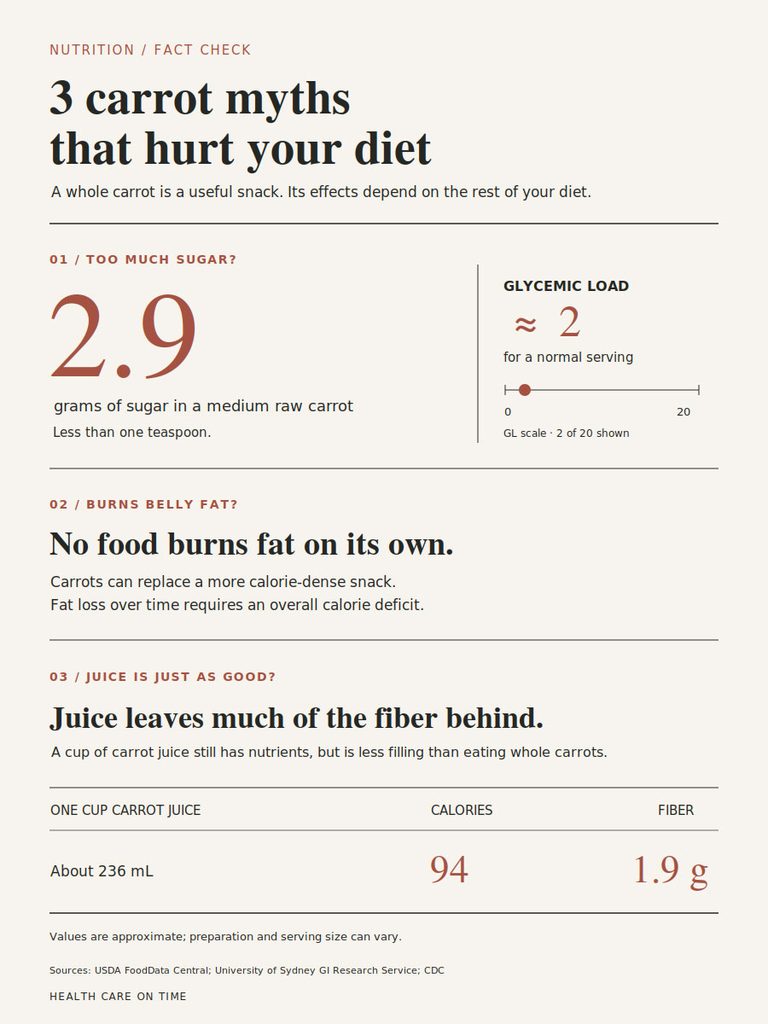
A medium carrot has about 2.9 grams of sugar. That’s under a teaspoon.
The worry comes from glycemic index. Boiled carrots land in the moderate range, roughly 32 to 49, and raw carrots test lower. But glycemic index is measured with a 50-gram carb dose. Getting 50 grams of carbs from raw carrots takes more than a pound of them.
Glycemic load, which uses real portions, is about 2 for a normal serving. Anything under 10 counts as low. The American Diabetes Association lists carrots as a non-starchy vegetable for this reason.
Myth 2: Carrots Burn Belly Fat
No food burns fat on its own. Carrots have no proven fat-burning compound, and the beta-carotene link to belly fat may run in reverse.
What carrots can do is replace higher-calorie snacks. That calorie gap is what trims fat over time, including around your waist.
Myth 3: Carrot Juice Is Just as Good
A cup of carrot juice has about 94 calories and 1.9 grams of fiber. That’s roughly the calories of four medium carrots with about a quarter of their fiber.
Juice skips the chewing and wrecks the cell structure. The Moorhead trial showed that just blending carrots reduced their effect on later eating, even with the fiber kept. Juicing goes further and strips most of the fiber too.
A small glass of carrot juice isn’t harmful. It’s just a weak weight loss tool next to whole carrots.
How to Eat Carrots for Weight Loss
Knowing carrots can help is step one. Using them well is where results happen.
Before Meals: The Preload
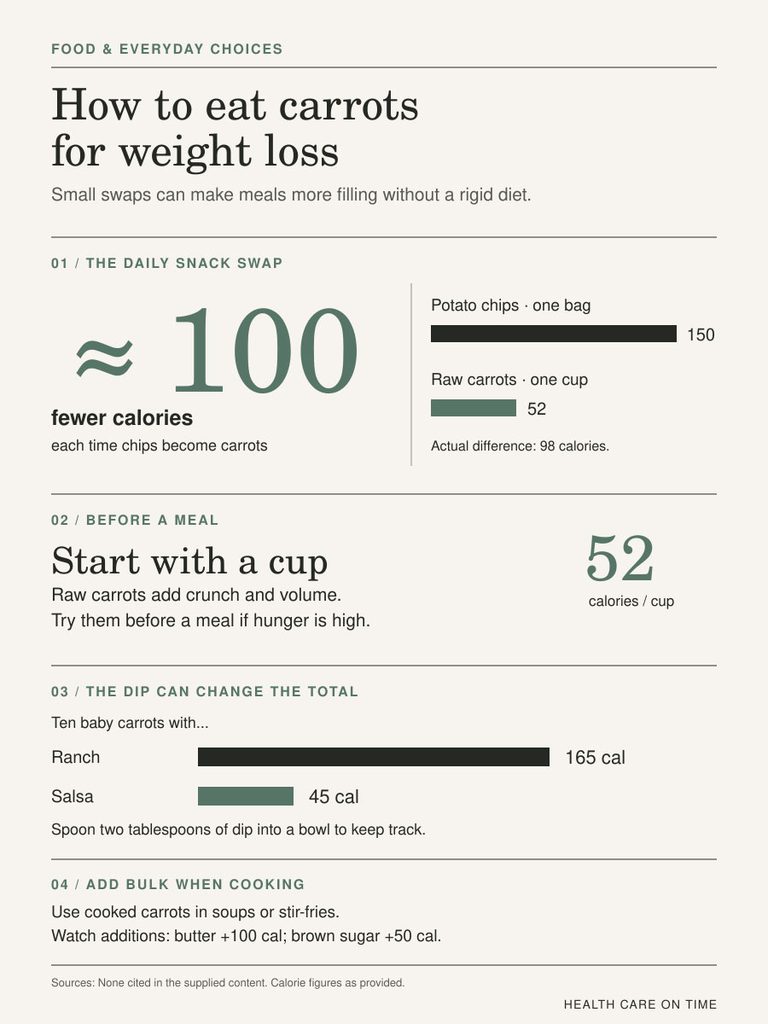
Eat about a cup of raw carrots (around 52 calories) 10 to 15 minutes before dinner. You’ll reach the main course a little less hungry.
This works best raw, since chewing time is part of the effect. Add a glass of water for extra volume.
As a Snack Swap
Swapping is where carrots earn their spot. Replacing one daily 1-ounce bag of potato chips (about 150 calories) with a cup of carrots (52 calories) saves about 100 calories a day.
The Dip Trap
This is where many carrot plans quietly fail. The carrots are light; the dip often isn’t. Approximate values for 2 tablespoons:
- Ranch dressing: about 130 calories
- Peanut butter: about 190 calories
- Hummus: about 50 to 70 calories
- Plain nonfat Greek yogurt: about 20 calories
- Salsa: about 10 calories
Ten baby carrots with 2 tablespoons of ranch lands near 165 calories. The same carrots with salsa lands near 45.
How to Measure Dip Without a Scale
Two tablespoons is about the size of a golf ball. Spoon it into a small bowl instead of dipping from the tub. That one habit often cuts dip intake in half.
Cooked Carrots in Meals
Cooked carrots still count. Add them to soups, chili, stir-fries, and sheet-pan dinners to bulk up the plate for few calories.
Watch the glaze. A tablespoon of butter adds about 100 calories, and a tablespoon of brown sugar adds about 50. Roasting at 400°F with a light spray of oil and some herbs keeps things lean.
For more on how cooking changes carrot nutrients, see our raw vs cooked carrots comparison.
Easy Carrot Swaps for Everyday Meals
Small swaps inside meals you already eat often work better than new recipes. A few that hold up:
- Mashed potatoes to half-and-half mash: boiled carrots have about 35 calories per 100 grams versus about 86 for boiled potatoes. Mixing them 50/50 cuts the side dish by roughly a third.
- Fries to roasted carrot sticks: oven-roast at 425°F with a light oil spray and paprika.
- Half the pasta: replace half a serving of spaghetti with spiralized or ribboned carrots.
- Sandwich crunch: add shredded carrots instead of extra cheese.
- Taco and chili filler: stir finely grated carrots into ground meat to stretch it.
None of these feel like dieting. That’s the point.
What a Realistic Month Looks Like
Here’s honest math. Say you swap one bag of chips a day for carrots and salsa, and keep everything else the same.
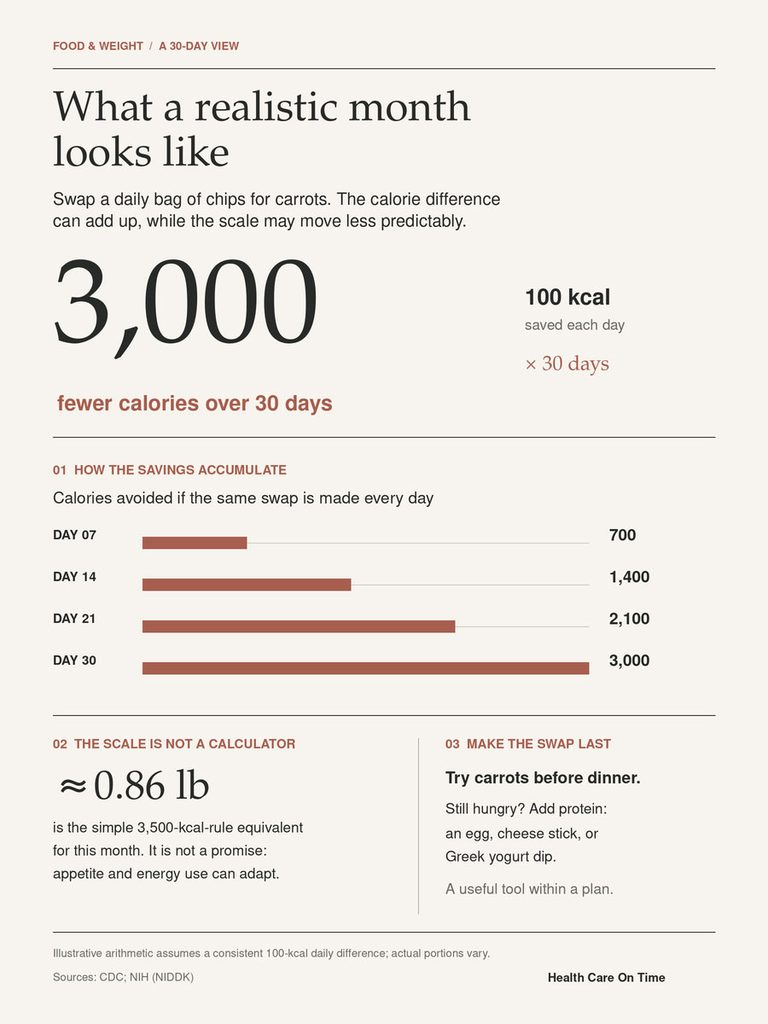
That’s about 100 calories saved daily, or roughly 3,000 calories over 30 days. By the old 3,500-calorie rule, that’s a bit under a pound.
Real bodies adapt, so long-term loss often runs lower than that rule predicts. Still, a pound a month from one easy swap is 12 pounds of avoided gain over a year.
Add a carrot preload before dinner and a lighter dip, and the effect grows. Carrots aren’t a diet. They’re a tool that makes the rest of your plan easier to stick with.
Signs Carrots Aren’t Working for You
Carrots don’t suit everyone’s appetite. Watch for these signs:
- You feel hungry again within an hour of a carrot snack.
- Your dip portion keeps creeping up.
- You feel bloated or gassy most days.
- The scale hasn’t moved in four to six weeks despite the swaps.
If carrots alone leave you hungry, pair them with protein, like a cheese stick, a hard-boiled egg, or Greek yogurt dip. Protein and fiber together tend to hold hunger off longer than either one alone.
How Many Carrots a Day Is Too Many?
Carrots are safe for nearly everyone. Still, “healthy” doesn’t mean “unlimited.”
Carotenemia: When Skin Turns Orange
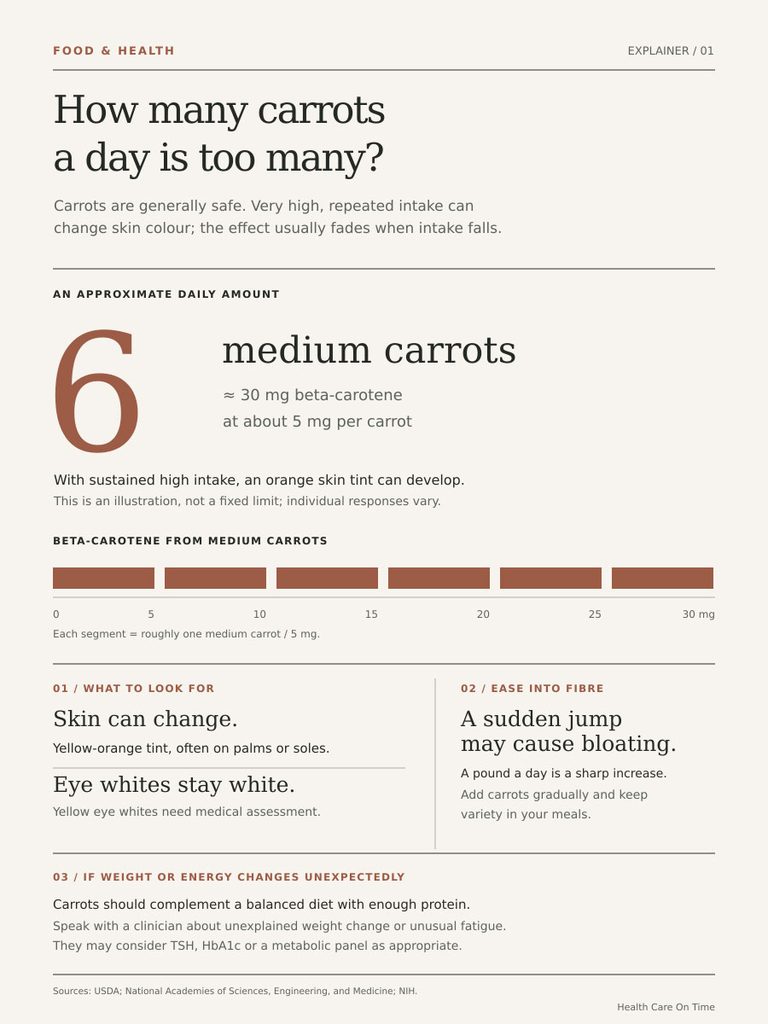
A medium carrot has about 5 milligrams of beta-carotene. Eating more than about 30 milligrams a day for several weeks can cause carotenemia, a harmless yellow-orange tint on the palms, soles, and around the nose.
That’s roughly six medium carrots a day, every day. The color fades once you cut back. Carotenemia doesn’t yellow the whites of your eyes; jaundice does. If your eyes look yellow, see a doctor.
Gas and Bloating
Going from zero to a pound of carrots a day can cause gas and bloating. Increase slowly over one to two weeks and drink enough water.
Who Should Be Careful
- People on insulin or sulfonylureas: carrots are low-risk, but big diet changes can shift blood sugar. Keep checking.
- Strict keto dieters: a medium carrot has about 4 grams of net carbs, which adds up fast on a 20-gram day.
- GLP-1 medication users: low-calorie vegetables can fill a small appetite and crowd out protein. Eat protein first.
- Young children: the CDC lists pieces of hard raw vegetables such as raw carrots as a choking hazard for young kids. Shred or cook them soft.
In cases seen across our diagnostic network, people reporting fast “healthy” weight loss sometimes aren’t eating enough protein. Carrots should add to a balanced plate, not replace it.
When to Talk With a Doctor
Diet changes aren’t the answer to every weight question. Talk with a doctor if you’re losing weight without trying, gaining weight despite real changes, or feeling unusually tired or cold.
Those patterns can point to thyroid problems, blood sugar issues, or medication effects. Across the patients we serve, simple blood tests like a TSH, HbA1c, and metabolic panel often answer questions that food tracking alone can’t.
Buying and Storing Carrots So You Actually Eat Them
The best weight loss food is the one that’s ready when you’re hungry. A few habits help.
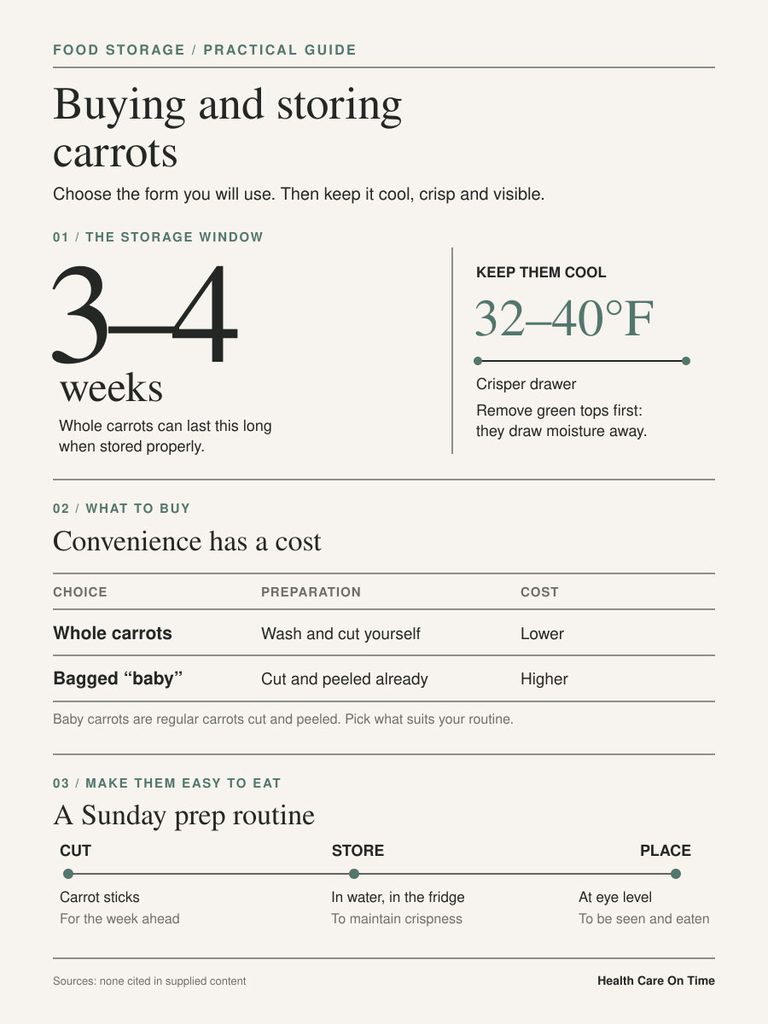
Buy whole carrots or bagged baby carrots, whichever you’ll really eat. Baby carrots are regular carrots peeled and cut to size; they cost more but win on convenience.
Remove green tops before storing, since they pull moisture from the root. Keep carrots in the crisper drawer at around 32°F to 40°F. Whole carrots often last three to four weeks this way.
Pre-cut a batch of sticks on Sunday and store them in a container of water in the fridge. They stay crisp for several days and sit at eye level when you open the door.
Your Carrot Weight Loss Game Plan
Carrots won’t do the work alone, but they fit almost any eating plan. Only about 10% of US adults eat enough vegetables, and the Dietary Guidelines for Americans 2025-2030 still push for more.
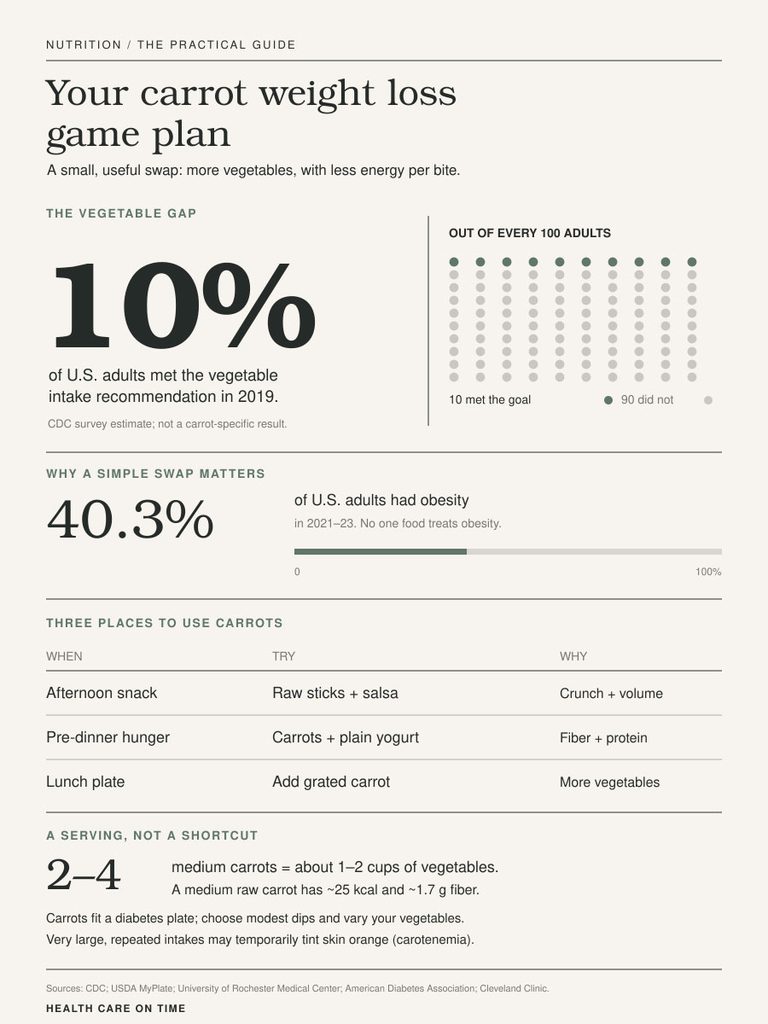
With 40.3% of US adults living with obesity, small habits you can repeat beat dramatic diets. Use this table to match carrots to your situation.
| Your Situation | Recommended Action | Why It Works |
| You snack on chips in the afternoon | Swap one daily bag for 1 cup baby carrots with salsa | Saves about 100 to 140 calories a day |
| You’re starving by dinner | Eat 1 cup raw carrots 10 to 15 minutes before the meal | Preload eases hunger for about 52 calories |
| You love ranch dip | Switch to a Greek yogurt dip or measure 2 tbsp max | Cuts dip calories by up to 85% |
| You drink carrot juice to lose weight | Swap for whole carrots; keep juice to 4 fl oz if you enjoy it | Whole carrots are more filling |
| You have type 2 diabetes | Treat carrots as a non-starchy vegetable; check glucose if eating large amounts | Glycemic load is about 2 per serving |
| You follow strict keto (20 g net carbs) | Limit to 1 to 2 medium carrots a day | About 4 g net carbs each |
| You take a GLP-1 medication | Eat protein first, then carrots | Keeps vegetables from crowding out protein |
| Your skin looks orange | Cut back to 2 to 3 carrots a day for a few weeks | Carotenemia fades as intake drops |
| Packing a toddler’s lunch | Serve shredded or soft-cooked carrots | Raw pieces are a choking hazard |
For more on daily carrot habits beyond weight, see our guide to the health benefits of eating carrots every day.
Frequently Asked Questions
How Many Carrots a Day Should You Eat to Lose Weight?
Two to four medium carrots a day works well for most people. That’s about 50 to 100 calories and 3.5 to 7 grams of fiber. There’s no magic number; the benefit comes from replacing higher-calorie foods. Staying under about six a day avoids the orange skin tint of carotenemia.
Are Carrots Too High in Sugar for Weight Loss?
No. A medium carrot has about 2.9 grams of sugar, less than a teaspoon. Its glycemic load is about 2, which is low. Harvard data even linked eating more carrots to slightly less weight gain over time. For most people, the natural sugar in carrots is not a real barrier.
Is Carrot Juice Good for Weight Loss?
Not really. A cup of carrot juice has about 94 calories and only 1.9 grams of fiber. It skips the chewing and intact fiber that make whole carrots filling. A small glass is fine as part of a balanced diet, but whole carrots are the better choice for weight loss.
Do Carrots Burn Belly Fat?
No food burns belly fat directly. People with more beta-carotene in their blood tend to have less belly fat, but research shows losing fat may raise beta-carotene levels rather than the reverse. Carrots help with belly fat indirectly, by replacing higher-calorie foods in your day.
Are Baby Carrots as Healthy as Regular Carrots?
Yes. Baby carrots are regular carrots that have been peeled and cut into small pieces. They have about 35 calories per 100 grams, similar fiber, and plenty of beta-carotene. Peeling removes a little of the outer layer’s nutrients, but the difference for weight loss is small.
Raw or Cooked Carrots: Which Is Better for Weight Loss?
Raw carrots have a slight edge, since chewing takes longer and slows eating. Cooked carrots are still low in calories and high in fiber, and your body absorbs more beta-carotene from them. Both work well. Pick the form you’ll eat often, without heavy butter or sugar glazes.
Can Eating Carrots at Night Cause Weight Gain?
No. Timing doesn’t change a carrot’s calories. A late-night snack of carrots is far lighter than chips, cookies, or ice cream. If evening snacking is your weak spot, keeping pre-cut carrots ready in the fridge is one of the easiest swaps you can make.
Are Carrots Keto Friendly?
In small amounts. A medium carrot has about 4 grams of net carbs. On a strict 20-gram keto day, one or two carrots can fit. On a looser low-carb plan of 50 grams or more, carrots fit easily. Track portions if staying in ketosis is your goal.
Can Eating Too Many Carrots Turn Your Skin Orange?
Yes. Eating more than about 30 milligrams of beta-carotene daily for weeks can cause carotenemia, which is roughly six medium carrots a day. It’s harmless and fades once you cut back. If the whites of your eyes turn yellow, see a doctor, since that points to jaundice instead.
Are Carrots Good for Weight Loss With Diabetes?
Yes, for most people. The American Diabetes Association counts carrots as a non-starchy vegetable, and their glycemic load is low at normal portions. If you use insulin or glucose-lowering pills and make big diet changes, keep checking your blood sugar and talk with your care team.
What Is the Best Dip for Carrots When Dieting?
Salsa and plain Greek yogurt dips are the lightest, at about 10 to 20 calories per 2 tablespoons. Hummus is a solid middle option at about 50 to 70 calories. Ranch and peanut butter run 130 to 190 calories per 2 tablespoons, so measure those carefully.
Do Carrots Help You Feel Full?
Yes. In a controlled trial, meals with whole carrots led to lower food intake later in the day than meals with blended carrots or carrot nutrients alone. Water, fiber, intact structure, and chewing time all work together to help you feel satisfied on fewer calories.
Disclaimer: This article is for general education and is not medical advice. It was reviewed for accuracy but does not replace care from a licensed health professional. If you have diabetes, kidney disease, an eating disorder, take weight loss medication, or are pregnant, talk with your doctor or a registered dietitian before changing your diet.
References
- USDA FoodData Central: Carrots, raw, and related records
- Moorhead SA, et al. The effects of the fibre content and physical structure of carrots on satiety and subsequent intakes. British Journal of Nutrition, 2006
- Bertoia ML, et al. Changes in Intake of Fruits and Vegetables and Weight Change in United States Men and Women. PLOS Medicine, 2015
- Serum carotenoids and visceral adipose tissue in US adults, NHANES 2003 to 2006
- Changes in plasma carotenoid concentrations during the AntioxObesity weight reduction program
- Rolls BJ, Roe LS, Meengs JS. Salad and satiety. Journal of the American Dietetic Association, 2004
- CDC NCHS Data Brief 508: Obesity and Severe Obesity Prevalence in Adults
- CDC MMWR: Adults Meeting Fruit and Vegetable Intake Recommendations
- CDC: Choking Hazards for Infants and Toddlers
- American Diabetes Association
- Dietary Guidelines for Americans 2025-2030