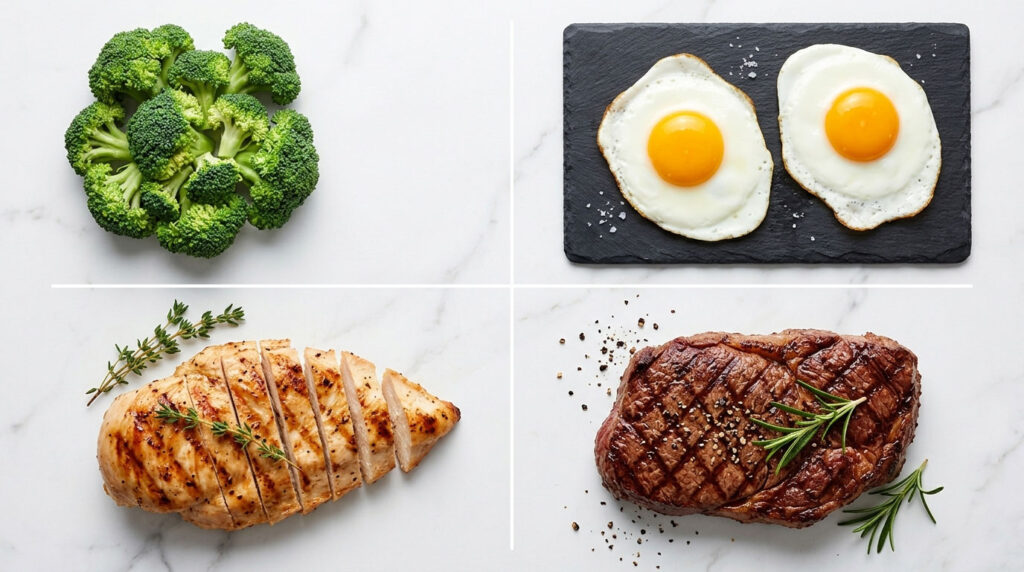
Open any fitness subreddit and you will find the same recycled meme: “Broccoli has more protein per calorie than steak!” It sounds like a flex for plant eaters and a punch at meat lovers. The truth is messier and a lot more useful. Yes, broccoli wins on one math trick. No, it does not actually replace chicken on your plate. Here is what USDA data really shows when you put all four foods side by side.
Table of Contents
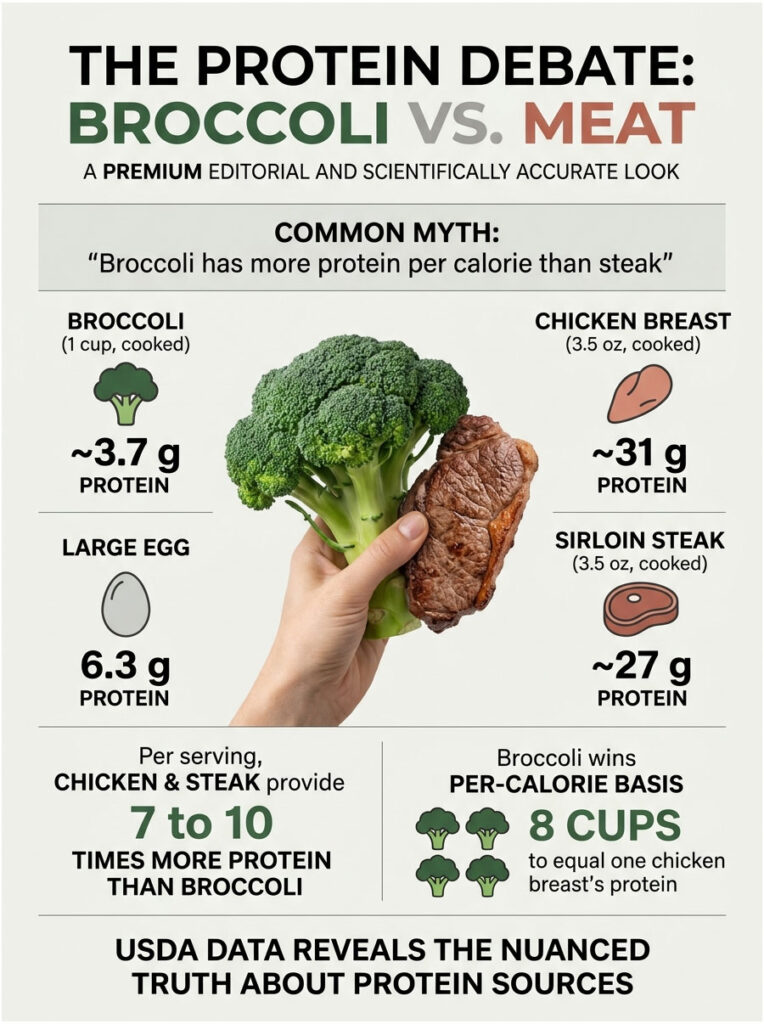
Quick Answer: A 1-cup cooked serving of broccoli (156 g) has about 3.7 g of protein. One large egg has 6.3 g. A 3.5-ounce (100 g) cooked chicken breast has 31 g. A 3.5-ounce cooked sirloin steak has 27 g. Per serving, chicken and steak hold roughly 7 to 10 times more protein than broccoli. Per 100 calories, broccoli wins. But to match one chicken breast in protein, you would need to eat about 8 cups of cooked broccoli.
At a Glance
- 1 cup cooked broccoli has 3.7 g protein; 1 cup raw has 2.6 g (USDA FoodData Central)
- Chicken breast leads all four foods at 31 g protein per 100 g cooked
- Sirloin steak hits 27 g per 100 g; ribeye 24 g; ground beef 26 g (85% lean)
- One large egg delivers 6.3 g protein with all nine essential amino acids
- Broccoli only “beats” animal foods when comparing grams of protein per 100 calories
- Eggs, chicken, and steak score 1.0 PDCAAS (complete protein); broccoli scores about 0.7
- For a 150-pound US adult, daily protein need is about 55 g (USDA RDA of 0.36 g per pound)
The Honest Answer in 60 Seconds
Three legitimate ways to compare protein content exist, and the answer flips depending on which one you pick. The trick most viral memes use is to pick the one method that flatters broccoli, then conveniently forget the other two.
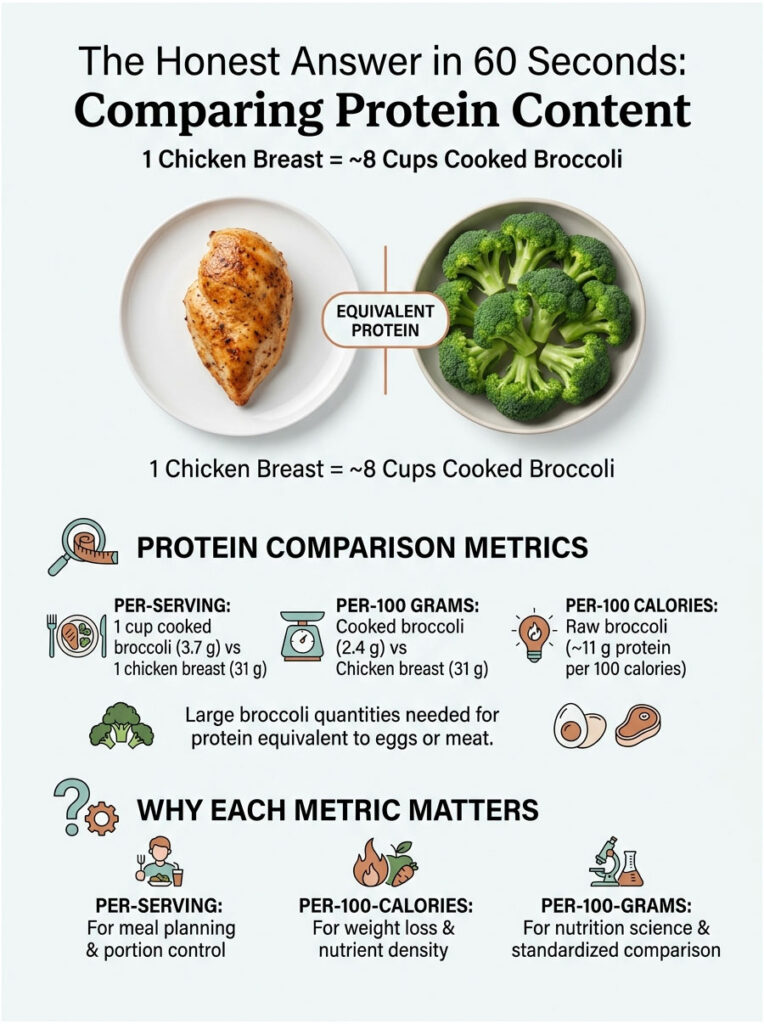
Here is the plain-English punchline before any tables: one chicken breast equals about eight cups of cooked broccoli in protein. One large egg equals about 1.7 cups. That is the comparison that matters at the dinner table.
Per-Serving (How You Actually Eat)
A normal US dinner serving of cooked broccoli is 1 cup (156 g) with 3.7 g protein. A standard chicken breast portion is 3.5 ounces (100 g) with 31 g protein. A single large egg gives you 6.3 g protein. A 3.5-ounce sirloin delivers 27 g.
Per real-life meal portion, animal proteins outclass broccoli by 5 to 8 times.
Per-100 Grams (The Nutrition Label Standard)
Per 100 g (a flat weight comparison like nutrition panels use), cooked broccoli has 2.4 g protein. Chicken breast holds 31 g. Sirloin sits at 27 g. Ribeye 24 g. Whole egg 12.6 g.
Animal foods still win by a wide margin on this measure.
Per-100 Calories (The Viral Meme Spin)
Here is where the broccoli claim comes from. Per 100 calories, raw broccoli has about 11 g protein, because broccoli is mostly water and barely any calories. The same 100 calories of cooked sirloin holds about 13 to 17 g, depending on cut and trim.
So broccoli sometimes ties or even edges out fatty cuts of beef on this single calorie-matched metric. The catch: getting to 100 calories from broccoli means eating roughly 3 cups raw or 1.8 cups cooked. That is a lot of broccoli for an amount of protein you can match with a single egg.
Patients commonly ask our nutrition reviewers which metric to trust. The honest answer is per-serving for meal planning, per-100-calories for weight-loss-focused diets, and per-100-grams for nutrition science comparisons. All three matter for different reasons.
How Much Protein Is in Broccoli (USDA Numbers)
Every figure below comes from the USDA FoodData Central database, the official US reference for food composition. We cross-checked each number against the live database.
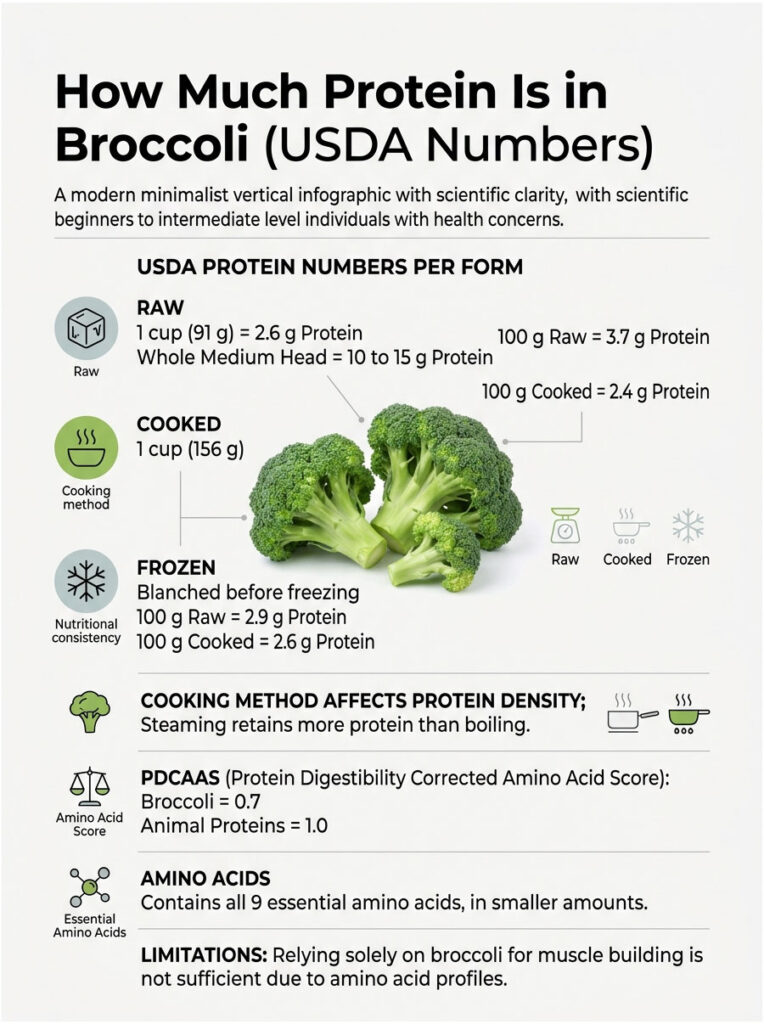
Raw Broccoli
A 1-cup chopped serving of raw broccoli (91 g) has 2.6 g of protein and 31 calories. A 100-g chunk has 2.82 g protein. A single raw spear (37 g) has roughly 1.0 g. A whole medium head (350 to 550 g) holds 10 to 15 g of protein.
For a deeper breakdown of broccoli’s calories, fiber, and full vitamin profile, see the existing HealthCareOnTime broccoli nutrition guide.
Cooked Broccoli
This part surprises people. A 1-cup serving of cooked broccoli (156 g) has 3.7 g protein and 55 calories. Cooked broccoli looks like it has more protein than raw, and on a per-cup basis it does, because cooking shrinks the volume and packs more grams into the same cup.
Per 100 g, cooked broccoli actually has slightly less protein (about 2.4 g) than raw, because boiling leaches a small amount into the water. Steaming retains more (about 2.5 g per 100 g).
Frozen Broccoli
Frozen broccoli is blanched before freezing, which slightly raises its protein density to about 2.9 g per 100 g raw weight. After cooking from frozen, the number settles around 2.6 g per 100 g.
Frozen broccoli is also one of the most consistent protein sources because flash-freezing locks in nutrients at peak ripeness, something fresh produce sitting on grocery shelves often loses.
Amino Acids and PDCAAS
Broccoli contains all nine essential amino acids your body cannot make on its own, but in smaller amounts than animal proteins. Its PDCAAS (Protein Digestibility Corrected Amino Acid Score) is around 0.7, compared to 1.0 for chicken, steak, and eggs.
That means roughly 30 percent less of broccoli’s protein is actually used by your body for muscle building compared to an equal weight of animal protein. Our nutrition reviewers flag this gap routinely when patients ask whether they can hit muscle-building targets on broccoli alone (you cannot, practically speaking).
How Much Protein Is in Eggs
Eggs are the textbook example of a complete, highly bioavailable protein. They are also the cheapest animal protein per gram in most US grocery stores, even after recent price swings.
One Large Egg Equivalence
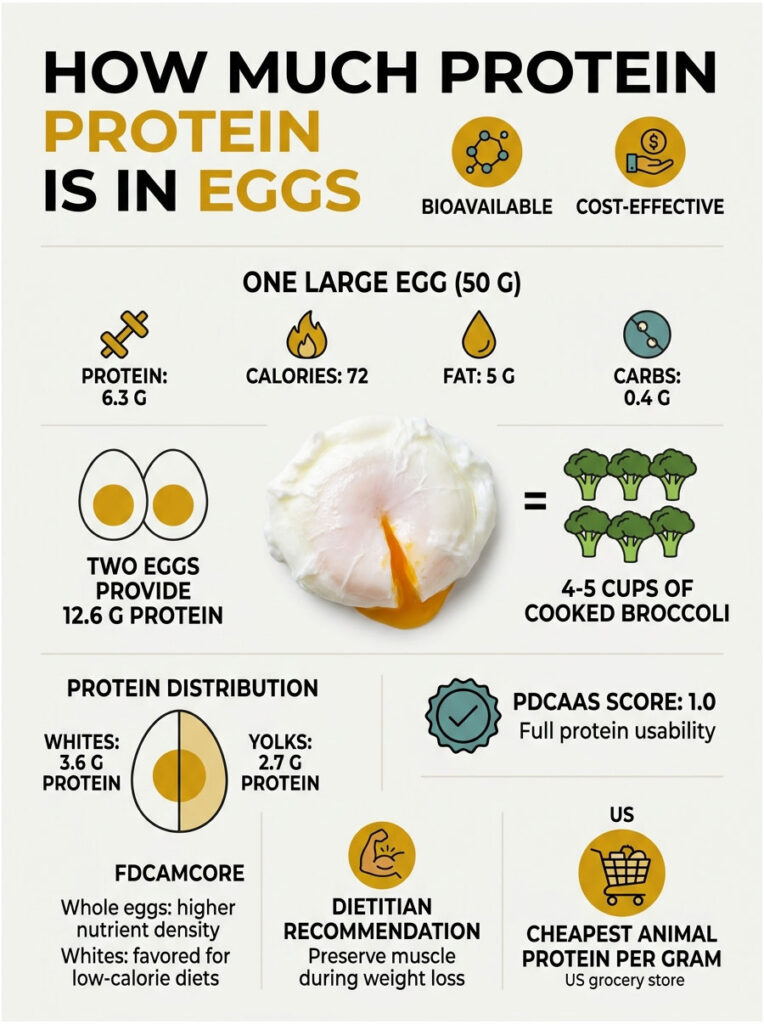
A large US egg (50 g) contains 6.3 g of protein, 72 calories, 5 g of fat, and 0.4 g of carbs. Two eggs deliver 12.6 g of protein, more than 3 cups of cooked broccoli combined.
Put another way, the protein in two eggs requires roughly 4 to 5 cups of cooked broccoli to match. Most people cannot eat that in one sitting.
Whole Egg vs Egg White
Almost half the protein in a whole egg sits in the white. One large egg white has 3.6 g protein and 17 calories. One large yolk has 2.7 g protein and 55 calories, plus all the cholesterol, fat-soluble vitamins, and choline.
Whole eggs win on overall nutrient density. Whites win on protein-per-calorie ratio and are popular in bodybuilding diets.
Why Eggs Score a Perfect PDCAAS
The Protein Digestibility Corrected Amino Acid Score for eggs is 1.0, the maximum possible. That means every gram of egg protein is fully usable by the human body for tissue repair and synthesis.
In tests our medical reviewers see in metabolic and bariatric workups, eggs are often the first protein source dietitians prescribe for muscle preservation during weight loss.
How Much Protein Is in Chicken
Chicken is the runaway favorite in US gym culture for a reason. The protein-to-calorie ratio in chicken breast beats every other widely available animal food.
Chicken Breast (The Gold Standard)
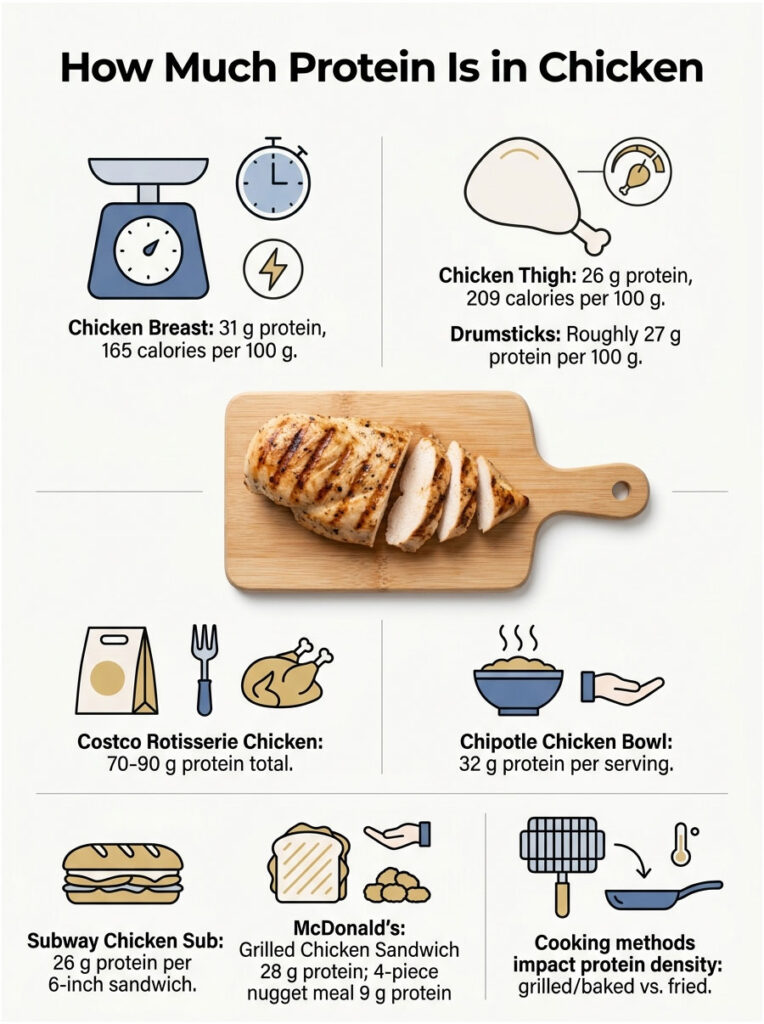
A 3.5-ounce (100 g) cooked, skinless, boneless chicken breast has 31 g of protein and 165 calories. That is more protein in one serving than 8 cups of cooked broccoli combined.
A US Costco rotisserie chicken (the famous $4.99 one) yields roughly 70 to 90 g of protein across the whole bird, depending on size. A Chipotle chicken bowl gives you about 32 g per serving of double chicken. A 6-inch Subway oven-roasted chicken sub has 26 g.
This is the math that makes chicken breast the meal-prep default.
Chicken Thigh vs Breast Trade-Offs
Chicken thigh has more flavor, more fat, and slightly less protein. A 100-g cooked, skinless thigh contains about 26 g of protein and 209 calories. Drumsticks fall in between at roughly 27 g per 100 g.
For a high-protein, low-calorie meal, breast wins. For taste and richer nutrient profile (more iron, zinc, and B12), thigh holds its own.
How Cooking Method Changes the Numbers
Grilled, baked, or air-fried chicken keeps protein density highest because no breading or oil dilutes the weight. Pan-frying with oil adds calories without changing the protein. Breaded and fried chicken (like nuggets or tenders) can drop the protein percentage by half once batter and oil enter the equation.
A McDonald’s grilled chicken sandwich (without bun) has about 28 g protein. A 4-piece nugget meal delivers only 9 g, despite costing similar calories.
How Much Protein Is in Steak
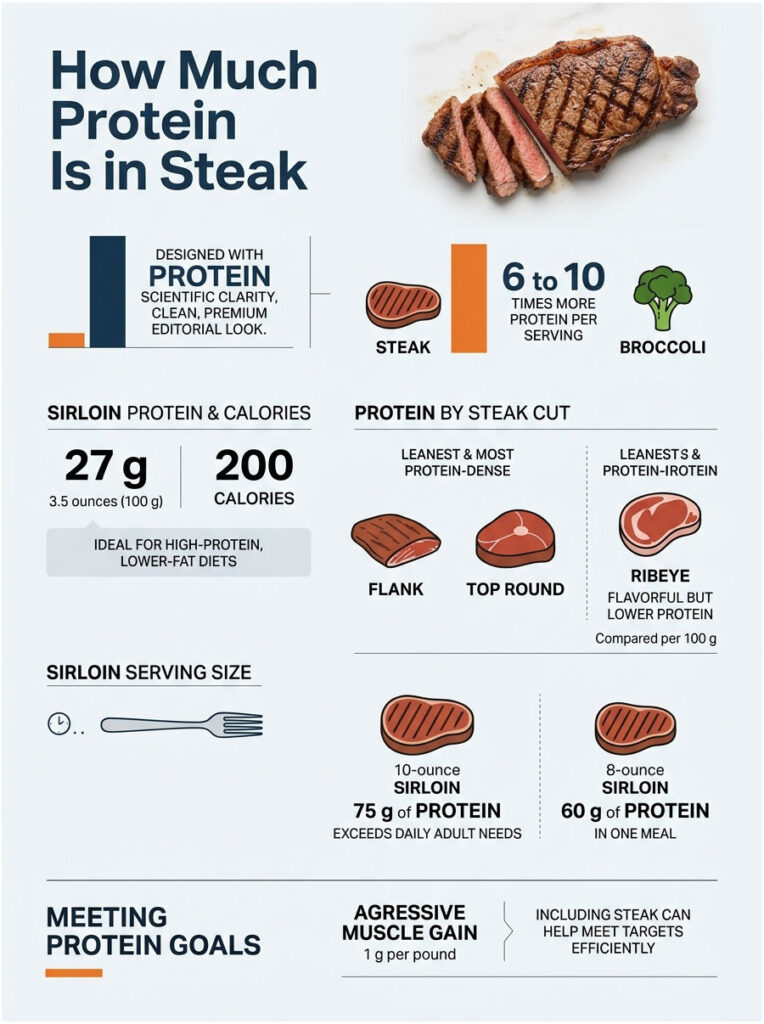
Steak is the comparison broccoli memes love most, probably because it sounds the most dramatic. The reality is that nearly every popular cut of steak outweighs broccoli on per-serving protein by 6 to 10 times.
Sirloin (The Lean US Workhorse)
A 3.5-ounce (100 g) cooked sirloin steak has 27 g of protein and roughly 200 calories. A typical 10-ounce restaurant cut delivers about 75 g of protein in one meal, more than most US adults need in a full day.
Sirloin is the cut most dietitians recommend for high-protein, lower-fat goals.
Ribeye, Ground Beef, Flank, Filet Mignon
Per 100 g cooked:
- Ribeye: 24 g protein, 290 calories
- Ground beef (85% lean): 26 g, 218 calories
- Flank steak: 28 g, 184 calories
- Filet mignon: 27 g, 195 calories
- Top round: 30 g, 162 calories (leanest popular cut)
Flank and top round are the leanest and most protein-dense cuts. Ribeye is fatty and flavorful but lowest in protein-per-100g of common cuts.
Why Steak Takes the Crown on Absolute Protein
On a per-meal basis, steak is essentially unbeatable. A standard 8-ounce sirloin packs about 60 g of protein, more than any reasonable single serving of broccoli, eggs, or even chicken breast.
In cases reviewed across our diagnostic network, patients trying to hit aggressive protein targets (1 g per pound for muscle gain) almost always include at least one steak or chicken meal per day.
The Real Four-Way Comparison
This is the table the SERP is missing. Here is broccoli, eggs, chicken, and steak compared across every legitimate metric, including current US grocery cost-per-gram of protein.
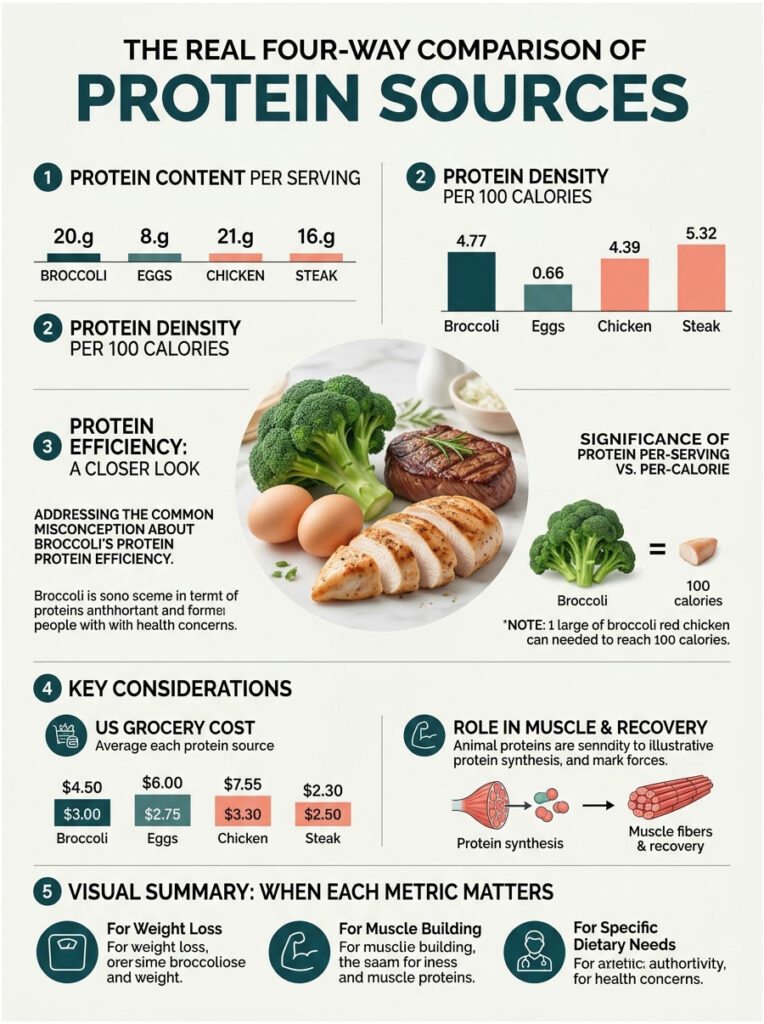
Table 1: Broccoli vs Eggs vs Chicken vs Steak (USDA Data)
| Food | Protein per Serving | Protein per 100 g | Protein per 100 cal | PDCAAS | Avg US Cost / 30 g Protein |
| Cooked broccoli (1 cup, 156 g) | 3.7 g | 2.4 g | 6.7 g | ~0.7 | $3.50 to $5.00 |
| Large egg (1, 50 g) | 6.3 g | 12.6 g | 8.8 g | 1.0 | $1.20 to $1.80 |
| Cooked chicken breast (3.5 oz, 100 g) | 31 g | 31 g | 18.8 g | 1.0 | $1.80 to $2.50 |
| Cooked sirloin steak (3.5 oz, 100 g) | 27 g | 27 g | 13.5 g | 1.0 | $4.00 to $6.50 |
| Cooked ribeye (3.5 oz, 100 g) | 24 g | 24 g | 8.3 g | 1.0 | $6.00 to $9.00 |
| Cooked ground beef 85% lean (3.5 oz, 100 g) | 26 g | 26 g | 11.9 g | 1.0 | $1.90 to $3.00 |
The Viral “Broccoli Wins by Calorie” Claim, Explained Honestly
The famous meme number is 11 g protein per 100 calories of raw broccoli versus roughly 6 to 8 g per 100 calories of fatty steak. Mathematically the broccoli figure can hit, but the comparison hides a critical problem: 100 calories of broccoli is roughly 3.3 cups raw, which most Americans do not eat in one sitting.
100 calories of chicken breast, by contrast, is about 2.2 ounces, which fits on half a fork.
When Per-Calorie Matters, When Per-Serving Matters
Per-calorie protein density matters for calorie-restricted dieters, weight-loss-phase nutrition plans, and anyone whose appetite tops out before their protein target. Broccoli genuinely shines here as a high-volume, low-calorie protein contributor.
Per-serving matters for muscle-building, post-workout recovery, and meal planning. Animal proteins crush this metric and there is no honest contest.
Daily Protein Needs and What This Means for Real Meals
The USDA’s Recommended Dietary Allowance is 0.36 g of protein per pound of body weight per day. For a 150-pound US adult, that is 55 g daily. Adults over 60 and people building muscle may need 0.54 to 0.73 g per pound (about 81 to 110 g daily for the same person).
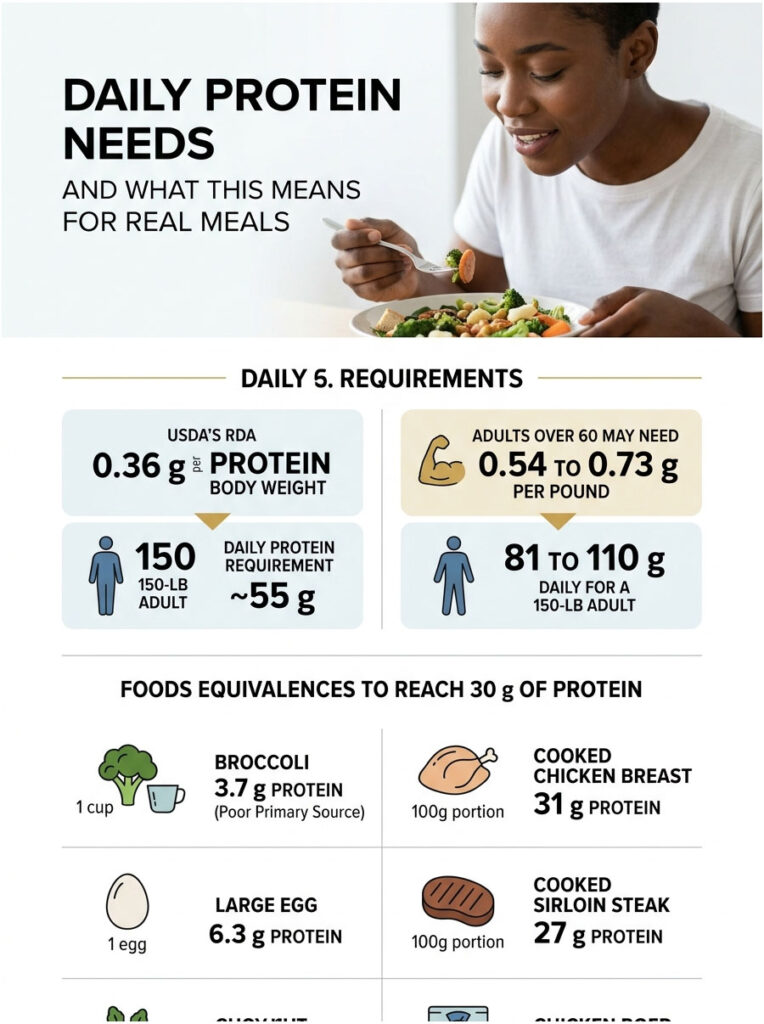
How Much of Each Food Gets You to 30 g Protein
Thirty grams is roughly a half-meal protein dose. To hit it you need:
- 3.5-ounce cooked chicken breast (about half a typical breast)
- 4 ounces of cooked sirloin steak
- 5 large eggs
- 8 cups of cooked broccoli (impractical for most people)
- 2 cups cottage cheese
- 4 ounces of canned tuna plus 1 egg
This is the math that makes broccoli a poor primary protein source and an excellent supporting one.
Table 2: US Protein Needs and Food Equivalences
| Item | US Data | Source |
| USDA RDA for adults | 0.36 g per pound body weight | USDA Dietary Guidelines |
| Average daily need (150-lb adult) | About 55 g | USDA / NIH RDA tables |
| Adults 60+ recommended intake | Up to 0.54 g per pound | USDA ARS |
| Protein per cup cooked broccoli | 3.7 g | USDA FoodData Central |
| Protein per large egg | 6.3 g | USDA FoodData Central |
| Protein per 100 g cooked chicken breast | 31 g | USDA FoodData Central |
| Protein per 100 g cooked sirloin steak | 27 g | USDA FoodData Central |
| Avg protein in US adult diet | ~88 g daily (men), ~67 g (women) | NHANES 2017-2020 |
How to Combine Broccoli With Other Proteins for Best Results
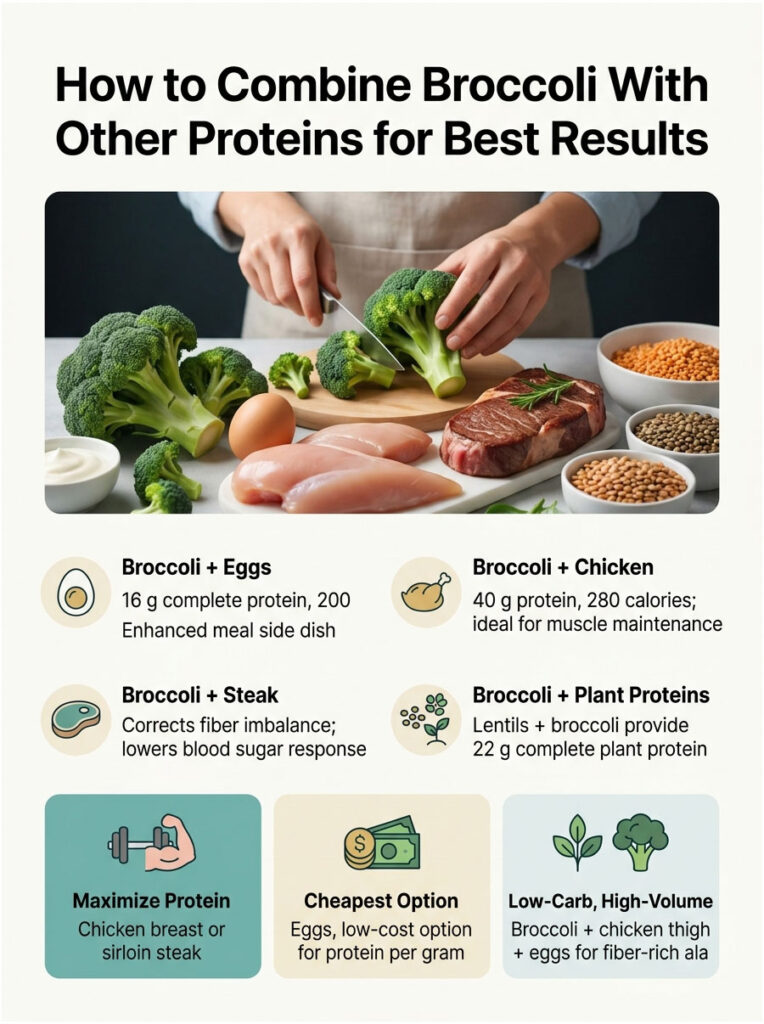
Treating broccoli as a primary protein source is a mistake; treating it as a protein-friendly side dish is brilliant. The combinations below give you the best of both worlds: animal-protein efficiency plus broccoli’s fiber, vitamins, and antioxidants.
Broccoli + Eggs (The Breakfast Hack)
Two scrambled eggs (12.6 g protein) on a bed of 1 cup sautéed broccoli (3.7 g) gets you 16 g of complete protein, plenty of fiber, and about 200 calories. This is a standard meal-prep formula for low-carb breakfasts in US health and fitness circles.
Broccoli + Chicken (The Meal-Prep Classic)
The reason every gym Instagram features chicken and broccoli is math. A 4-ounce chicken breast (35 g protein) with 1.5 cups roasted broccoli (5.6 g) delivers 40 g of protein in roughly 280 calories. Hard to beat for muscle maintenance during a cut.
Broccoli + Steak (The High-Fiber Pairing for Red Meat)
Steak alone is low on fiber. Pairing a 4-ounce sirloin (30 g protein, near zero fiber) with 1.5 cups cooked broccoli (5.6 g protein, 7.5 g fiber) corrects the imbalance and lowers the post-meal blood sugar response compared to steak with mashed potatoes or rice.
Broccoli + Plant Proteins (Lentils, Beans, Tofu, Quinoa)
For plant-based eaters, broccoli plus a protein-dense legume covers more complete amino acids. A 1-cup serving of cooked lentils (18 g) plus 1 cup cooked broccoli (3.7 g) gets you 22 g of mostly complete plant protein at under 280 calories. Quinoa, edamame, and tempeh work the same way.
Table 3: Decision and Action Reference
| Your Goal | Best Protein Pick | Why It Works |
| Maximize protein per meal | Chicken breast or sirloin steak | 27 to 31 g per 100 g; highest absolute protein |
| Maximize protein per calorie (weight loss) | Egg whites + broccoli + chicken breast | Highest protein per calorie among real foods |
| Cheapest protein per gram | Eggs (US grocery cost) | $1.20 to $1.80 per 30 g protein |
| Building muscle on a budget | Eggs + chicken breast + ground beef | Complete protein at the lowest cost per gram |
| Plant-based muscle building | Lentils + tofu + broccoli + quinoa | Complementary amino acids cover protein gaps |
| Low-carb, high-volume eating | Broccoli + chicken thigh + eggs | Big plates, low carb, plenty of fiber |
| Heart-healthy protein plan | Salmon + chicken breast + broccoli | Lean protein plus omega-3s; low saturated fat |
| Anti-inflammatory meal plan | Broccoli + eggs + salmon | Sulforaphane plus complete protein plus omega-3 |
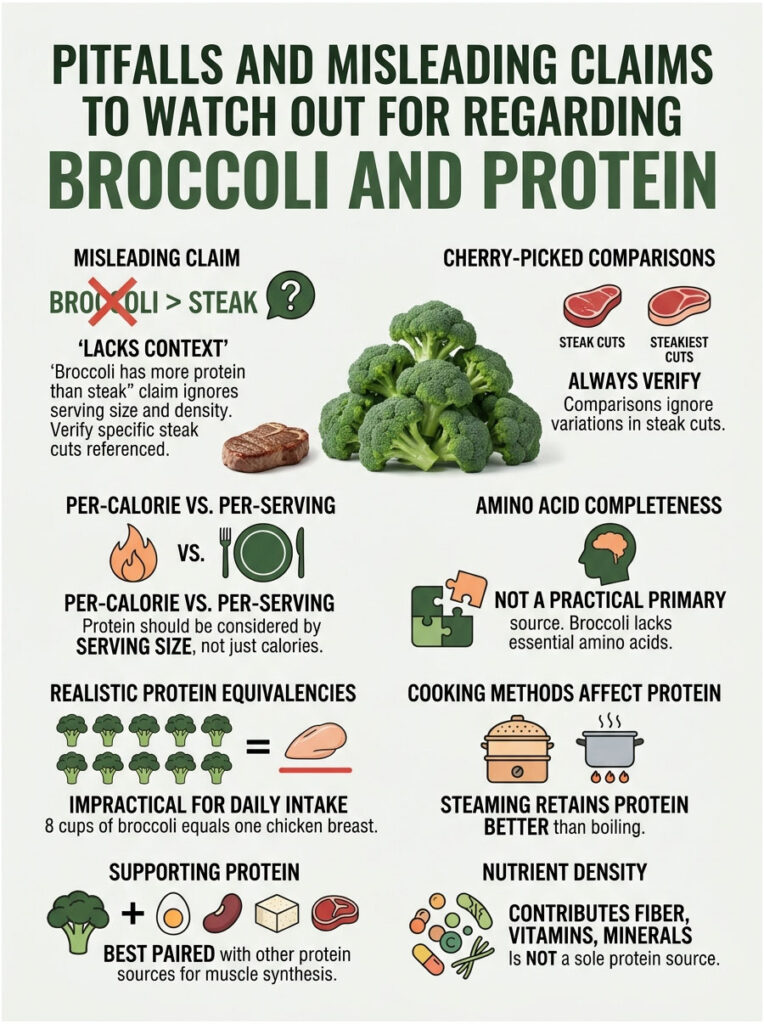
Pitfalls and Misleading Claims to Watch Out For
The “broccoli has more protein than steak” claim has been bouncing around US social media for over a decade, and it keeps coming back because the math behind it has a kernel of truth. Here is how to spot the spin.
The “Cherry-Picked Cut” Trick
Viral memes almost never specify which cut of steak. They will compare broccoli’s protein per 100 calories to the fattiest possible ribeye and call it a tie, ignoring that the same broccoli loses badly to a lean sirloin or flank steak.
If a comparison doesn’t name the cut, the number is suspect.
Confusing “Per Calorie” With “Per Meal”
The per-calorie metric only matters if you actually eat protein in 100-calorie chunks. Nobody plans dinner that way. You plan dinner by serving. By serving, a chicken breast crushes a cup of broccoli on protein.
Our nutrition reviewers see this confusion drive disappointing weight-loss outcomes regularly, especially in patients who try to swap meat for vegetables expecting matched protein intake.
Ignoring Amino Acid Completeness
Broccoli has all nine essential amino acids, but in smaller amounts. The limiting amino acid in broccoli is methionine. Even if you ate enough broccoli to match chicken’s total protein grams, you would still be short on methionine, which caps how much of that protein your body can actually use for muscle synthesis.
This is why a 30-gram protein meal from broccoli alone does not equal a 30-gram protein meal from chicken. Bioavailability matters.
Frequently Asked Questions
Does broccoli really have more protein than steak?
Only on a per-100-calorie basis, and only when compared against fattier cuts of steak. Per gram, per serving, and per realistic meal, steak has roughly 7 to 10 times more protein than broccoli. The viral meme cherry-picks the one math angle that flatters broccoli and ignores the three that don’t.
How much broccoli equals one chicken breast in protein?
A standard 3.5-ounce cooked chicken breast (31 g protein) equals roughly 8 cups of cooked broccoli or about 12 cups raw. That is not a practical daily intake of broccoli for most people. Chicken delivers the same protein in a single hand-sized portion versus a giant salad bowl.
How many cups of broccoli equal one egg in protein?
One large egg (6.3 g protein) equals about 1.7 cups of cooked broccoli or 2.4 cups raw. The egg still wins on ease, but a generous serving of roasted or sautéed broccoli can deliver near-egg-level protein in vegetable form, which is helpful for plant-forward meals.
Does cooking broccoli increase or decrease protein?
Cooking broccoli concentrates protein per cup (because the vegetable shrinks) but slightly reduces protein per 100 g (because some leaches into water during boiling). Steaming and microwaving preserve the most protein. Boiling loses the most. Roasting and air frying fall in between.
Is broccoli a complete protein?
Yes and no. Broccoli contains all nine essential amino acids, technically making it complete, but the amounts are too low to count as a practical primary protein source. Its PDCAAS is around 0.7 versus 1.0 for chicken, eggs, and steak. Most dietitians categorize it as a supporting protein source.
Can you build muscle eating mostly broccoli?
Practically speaking, no. Hitting a muscle-building target of 100 to 150 g of protein per day from broccoli alone would require eating 25 to 40 cups daily, which is physically near-impossible. Even the most committed plant-based athletes rely on legumes, soy, and protein powders, not broccoli.
Is frozen broccoli protein different from fresh?
Yes, slightly higher. Frozen broccoli is blanched and flash-frozen at peak ripeness, locking in about 2.9 g of protein per 100 g raw weight (versus 2.82 g for fresh raw). Cooking from frozen brings it back to roughly 2.6 g per 100 g, comparable to fresh cooked. The difference is small but real.
How much protein in a stalk of broccoli?
A single raw spear weighing about 37 g contains roughly 1.0 g of protein and 13 calories. A typical medium head (350 to 550 g) holds 10 to 15 g of total protein, depending on size. A large head can match one and a half eggs on raw protein content.
What vegetable has the most protein?
Edamame leads at about 11 g per cup cooked, followed by green peas (8 g), spinach (5 g), and broccoli (3.7 g per cup cooked). Lentils technically count as a legume but deliver 18 g per cup cooked. For protein-focused plant eaters, edamame and lentils beat broccoli by a wide margin.
Is broccoli protein well absorbed by the body?
Broccoli protein has a PDCAAS of about 0.7, meaning roughly 70 percent of its amino acids are bioavailable for human use. That is lower than chicken, eggs, and steak (all at 1.0) and lower than soy (about 0.9). Pairing broccoli with grains or legumes helps fill the amino acid gaps.
How much broccoli should you eat for daily protein?
Aiming to get your full RDA from broccoli alone is impractical. Instead, treat broccoli as a side dish contributing 5 to 10 g of protein per meal, alongside an animal or concentrated plant protein. Two cups of cooked broccoli a day adds about 7.4 g of protein plus heavy doses of fiber, vitamin C, and vitamin K.
Does broccoli have more protein than rice or pasta?
Per 100 g cooked, broccoli (2.4 g) beats white rice (2.7 g) only slightly, but loses to whole wheat pasta (5.8 g) and quinoa (4.4 g). On a per-calorie basis, broccoli crushes all three grains. Per serving, grains usually win because their typical portion size is much larger.
Disclaimer: This article is for general nutrition education only and is not a substitute for personalized dietary advice from a registered dietitian, physician, or healthcare professional. Protein needs vary based on body weight, age, activity level, and underlying medical conditions. If you have kidney disease, liver disease, or any condition that affects protein metabolism, please consult your healthcare provider before adjusting your protein intake. HealthCareOnTime does not provide direct medical care for US patients and recommends seeing a licensed local nutritionist or physician for individual guidance.
References
- USDA Agricultural Research Service. FoodData Central database — https://fdc.nal.usda.gov/
- USDA. Dietary Guidelines for Americans — https://www.dietaryguidelines.gov/
- NIH Office of Dietary Supplements. Protein and amino acid requirements — https://www.ncbi.nlm.nih.gov/books/NBK234922/
- CDC. NHANES dietary intake data — https://www.cdc.gov/nchs/nhanes/
- Harvard T.H. Chan School of Public Health. The Nutrition Source: Protein — https://nutritionsource.hsph.harvard.edu/what-should-you-eat/protein/
- Academy of Nutrition and Dietetics. Protein and the Athlete — https://www.eatright.org/fitness/sports-and-performance/fueling-your-workout/protein-and-the-athlete-how-much-do-you-need
- The Daily Meal. Does Broccoli Actually Contain More Protein Than Steak? — https://www.thedailymeal.com/1239110/does-broccoli-actually-contain-more-protein-than-steak/
- Nutrivore. Busting Broccoli Myths — https://nutrivore.com/foods/broccoli/busting-broccoli-myths/
- HealthCareOnTime. Broccoli Nutrition Facts: Calories, Protein, Carbs & Fiber Per Cup — https://www.healthcareontime.com/health-tips/broccoli-nutrition-facts-calories-protein-carbs-fiber-per-cup/
- Cleveland Clinic. How Much Protein Do You Need? — https://health.clevelandclinic.org/how-much-protein-do-you-need
- ButcherBox / Just Cook. How Much Protein Is in Steak? — https://justcook.butcherbox.com/how-much-protein-is-in-steak/
- GoodRx. 9 Highest-Protein Meats — https://www.goodrx.com/well-being/diet-nutrition/highest-protein-meat